Original Research Article.
Are Rheumatological Diseases Prevalent Among University Students?
A Call for Group Education: A Cross-Sectional Study
Abeer Abdulaziz Alraddadi, Aisha Mohammed Alemam, Afaf Mubarak Aljohani, Imad M. Al-Khawaja
Department of Medicine, College of Medicine, Taibah University, Madinah, KSA.
ABSTRACT
Background: To estimate the prevalence of musculoskeletal disorders among university students. Another objective was to identify any incorrect information or beliefs about rheumatological diseases among university students.
Methods: A cross-sectional study was conducted on students of Taibah University, Medina, Saudi Arabia. An online questionnaire that included general knowledge items on common rheumatological diseases was sent by email to a random sample of students. Demographic and personal information were recorded including age, sex, nationality, college of specialty, diagnosis with a Rheumatological disease and medical education.
Results: Out of 1500 distributed questionnaires, 1128 were completed and returned giving an overall response rate of 75.2%. Female responders were (69.9 %) and (30.1%) were males. A total of 71 students (6.3 %) reported some form of rheumatological conditions. At Taibah University, 2.2% of the male student population was suffering from rheumatological conditions compared to 4.1% of the female counterparts having similar conditions. Students had limited information about rheumatological conditions with a number of misconceptions about the causes and course of these diseases.
Conclusions: The prevalence of rheumatological diseases
amongst students at Taibah University was found to be high. Furthermore, rheumatological diseases were found to be more prevalent in female students. Both knowledge and perception about rheumatological diseases were evaluated by a questionnaire and have showed that although students had limited information about rheumatological diseases they had a desire for more information on rheumatological diseases. Screening and health awareness programs are recommended.
Key Words: Rheumatology, University Students, Health Education.
*Correspondence to:
Abeer Abdulaziz Alraddadi (MBBS), Medical Intern, College of Medicine, Taibah University, Madinah, KSA. Article History:
Received: 11-10-2017, Revised: 04-11-2017, Accepted: 11-12-2017 Access this article online
Website:
www.ijmrp.com
Quick Response code
DOI:
10.21276/ijmrp.2018.4.1.004
INTRODUCTION
Rheumatological or musculoskeletal diseases are defined as a group of disorders that affect the joints and/or the connective tissue. According to the World Health Organization, there are over 150 diseases, which are progressive and painful. They are usually categorized as joint diseases, physical disability, spinal disorders, and conditions resulting from trauma. Musculoskeletal conditions are leading causes of morbidity and disability, giving rise to enormous healthcare expenditures and loss of work.1
Since these conditions are usually chronic and lifelong, it is important to provide the general population and patients with good
quality information regarding Rheumatological and
Musculoskeletal diseases. With more knowledge, people will be able to change their attitude and behavior toward rheumatological diseases.2 In addition, patient education has a positive effect on the ability to cope better with diseases, increases adherence to therapy and improves psychological well-being.3,4
Early identification of some rheumatological diseases such as Rheumatoid Arthritis (RA) at its initial presentation and the treatment at the early stages will affect the disease course and will
prevent the development of joint destruction and the progression of erosive disease.5,6
In recent years, some therapeutic options have emerged for early lupus (SLE) treatment such as antimalarial agents, vitamin D, statins and vaccination with self-derived peptides. All these immune modulators seem to be particularly useful when administered in the early stages of the disease.7
We carried out a cross-sectional survey to estimate the prevalence of musculoskeletal disorders among university students. A secondary objective was to assess students' level of knowledge about musculoskeletal disorders.
METHODS
Design and Participants
A cross-sectional study was conducted on students at Taibah University, Medina, Saudi Arabia, from 1 June to 1 July, 2017. A convenience sampling method was used, in which students were invited to complete an anonymous survey. All students at Taibah University were deemed eligible to complete the questionnaire regardless of their age, sex, health status or their college specialty.
Survey: An online questionnaire was sent by email to a random sample of students at Taibah University. The Questionnaire was an Arabic version of the Dutch Questionnaire designed to evaluate knowledge regarding rheumatological diseases.13 It has been translated to Arabic Language and then validated by translation back to English. The survey was open for 4 weeks over the period from 1st of June to 1st of July 2017. The survey consisted of true
or false questions that were drafted in an understandable, simple way without using medical terms, and participants were also asked to scale 4 consequences of rheumatological disease from 0- not serious- to 3 –very serious- based on their opinions about the disease.14-16 and what was reported as consequences of rheumatological diseases.17,18 Susceptibility for arthritis was assessed by rating two statements using a scale of 5 options ranging from 1-completely disagree- to 5 –completely agree. Two statements about the idea that said rheumatological patients can influence the onset and course of their disease was measured by a scale of 5 options rating from 1-completly disagree- to 5-completely agree. Fear of rheumatological disease was measured with 3 items with a scale ranging from 1-certainly not – to 5 – certainly. The behavioral intention was assessed by asking to rate 2 items from 1- certainly not- to 5 –certainly. Using mass media for information on rheumatological diseases was measured by using a scale of 4 options from 0 –never- to 4 –very often- to assess their knowledge about rheumatological diseases.19,20 Demographic and personal information were recorded including age, sex, nationality, college of specialty, diagnosis with a Rheumatological disease and medical education.
Table 1: Socio-Demographic Profile of Surveyed Population.
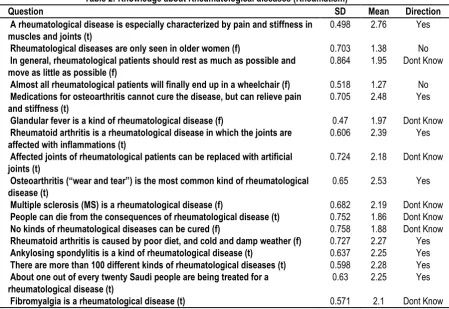
Table 2: Knowledge about Rheumatological diseases (Rheumatism)
Q Question SD Mean Direction
1 A rheumatological disease is especially characterized by pain and stiffness in muscles and joints (t)
0.498 2.76 Yes
2 Rheumatological diseases are only seen in older women (f) 0.703 1.38 No 3 In general, rheumatological patients should rest as much as possible and
move as little as possible (f)
0.864 1.95 Dont Know
4 Almost all rheumatological patients will finally end up in a wheelchair (f) 0.518 1.27 No 5 Medications for osteoarthritis cannot cure the disease, but can relieve pain
and stiffness (t)
0.705 2.48 Yes
6 Glandular fever is a kind of rheumatological disease (f) 0.47 1.97 Dont Know 7 Rheumatoid arthritis is a rheumatological disease in which the joints are
affected with inflammations (t)
0.606 2.39 Yes
8 Affected joints of rheumatological patients can be replaced with artificial joints (t)
0.724 2.18 Dont Know
9 Osteoarthritis (“wear and tear”) is the most common kind of rheumatological
disease (t)
0.65 2.53 Yes
10 Multiple sclerosis (MS) is a rheumatological disease (f) 0.682 2.19 Dont Know 11 People can die from the consequences of rheumatological disease (t) 0.752 1.86 Dont Know 12 No kinds of rheumatological diseases can be cured (f) 0.758 1.88 Dont Know 13 Rheumatoid arthritis is caused by poor diet, and cold and damp weather (f) 0.727 2.27 Yes 14 Ankylosing spondylitis is a kind of rheumatological disease (t) 0.637 2.25 Yes 15 There are more than 100 different kinds of rheumatological diseases (t) 0.598 2.28 Yes 16 About one out of every twenty Saudi people are being treated for a
rheumatological disease (t)
0.63 2.25 Yes
17 Fibromyalgia is a rheumatological disease (t) 0.571 2.1 Dont Know
Socio-demographic profile
With Rheumatological Disease (n= 71)
Without Rheumatological Disease (n= 1057)
P-Value
No. % No. %
Sex distribution
Male 25 2.2 314 27.8 0.327
Female 46 4.1 743 65.9
Specialty
Medical 13 1.2 342 30.3 0.014
RESULTS
Out of 1500 online questionnaires distributed to the students, 1128 were completed and returned giving an overall response rate of 75.2%, (69.9 %) were females and (30.1%) were males, most of the surveyed students (63.4%) were between the age of 20-24, (29.3%) were below the age 20, and about (7.4%) were above the age of 24. (Table 1) A total of 71 (6.3%) respondents reported having rheumatological conditions, and prevalence of rheumatological diseases was 6.2%.
At Taibah University, 2.2% of the male population were suffering from rheumatological conditions in comparison to 4.1% of the females having similar conditions. Generally, the proportion of the students with rheumatological conditions was 3.6. The probability of a male having rheumatological conditions was 2.2% while the probability of a female having the same condition was 4.1%. Amongst all the students with rheumatological conditions, 2.35% were males and 8.64% were females. Table 1 also demonstrates
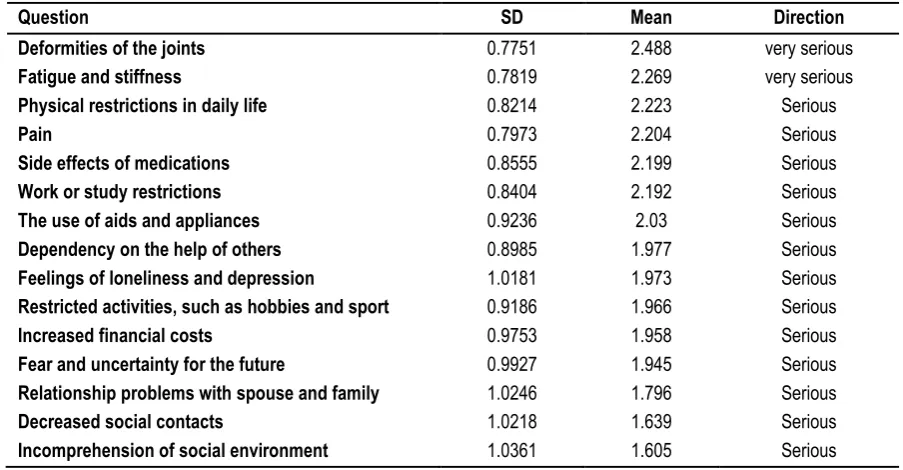
the percentages of students with and without rheumatological conditions, comparing medical students to students in non-medical fields at Taibah University. In table 2, the respondents gave the right answer to a mean of 9 statements out of 17 statements. Nine statements were correctly judged to be true or false by a majority of the respondents, while eight statements were judged correctly by less than 50% of the respondents. Placing different signs and symptoms of rheumatological diseases on the scale of seriousness is shown in (Table 3) which illustrates which sign/symptom is more/less serious (mean-value determines seriousness). Based on the Perceived Seriousness Mean ± (SD) scale, “Deformities of the joints” was judged as the most serious
consequence of rheumatological diseases while
“Incomprehension of social environment” was seen as the least serious consequence. In general, the consequences of rheumatological diseases were judged as “serious”.
Table 3: Perceived seriousness Mean (SD) scale from 0 (not serious) to 3 (very serious)
Question SD Mean Direction
Deformities of the joints 0.7751 2.488 very serious
Fatigue and stiffness 0.7819 2.269 very serious
Physical restrictions in daily life 0.8214 2.223 Serious
Pain 0.7973 2.204 Serious
Side effects of medications 0.8555 2.199 Serious
Work or study restrictions 0.8404 2.192 Serious
The use of aids and appliances 0.9236 2.03 Serious
Dependency on the help of others 0.8985 1.977 Serious
Feelings of loneliness and depression 1.0181 1.973 Serious
Restricted activities, such as hobbies and sport 0.9186 1.966 Serious
Increased financial costs 0.9753 1.958 Serious
Fear and uncertainty for the future 0.9927 1.945 Serious
Relationship problems with spouse and family 1.0246 1.796 Serious
Decreased social contacts 1.0218 1.639 Serious
Incomprehension of social environment 1.0361 1.605 Serious
Table 4: Comparison of knowledge between medical and non-medical groups.
Comparing the means of the medical and the non-medical groups, Table 4 shows that there is a statistically significant difference in the knowledge between the two groups, sig. (2 tailed) = 0.001. The mean difference value which is equal to 0.07568, indicates that the medical group got a higher knowledge than non-medical group. Comparing the means of the males and females in Table 5 which shows that there is a statistically significant difference in the knowledge between males and females at Taibah University, sig. (2 tailed) = 0.001. The mean difference value which is equal to 0.06046, indicates that the females got a higher knowledge than males. Table 6 shows the comparison between males and females mean scores. There was a statistically significant difference regarding knowledge about rheumatological diseases
as females appeared to know more about rheumatological diseases.
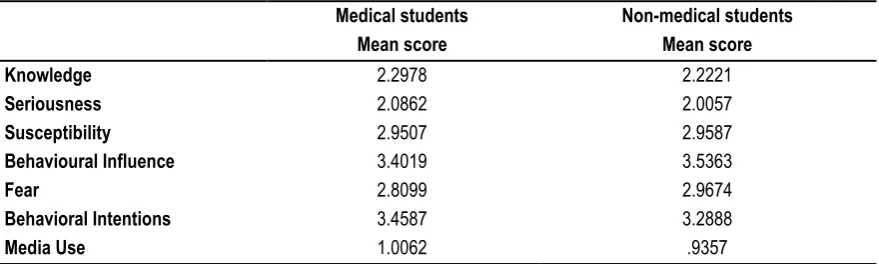
Regarding the use of the mass media for gathering information about rheumatological diseases, males used the mass media more frequently than females did. Table 7 shows the differences in knowledge, perceptions, fear, intentions and media use between medical and non-medical students. There was a statistically significant difference between medical and non-medical students in knowledge about rheumatological diseases. Medical students appeared to know more about rheumatological diseases than non-medical students. Moreover, medical students perceived rheumatological diseases to be more serious, while non-medical students showed more behavioral influence on onset Independent Samples Test
t-test for Equality of Means
t df Sig. (2-tailed) Mean Difference
and course of rheumatological diseases than medical students. On the other hand, non-medical students showed more fear of rheumatological diseases. Nevertheless, medical students
showed more behavioral intentions to gather information, visit a doctor and help a patient more than those of non-medical field students.
Table 5: Comparison of knowledge between male and female groups.
Table 6: Differences in knowledge, perceptions, fear, intentions and media use between men and women.
Table 7: Differences in knowledge, perceptions, fear, intentions and media use between medical and non-medical students.
Medical students Mean score
Non-medical students Mean score
Knowledge 2.2978 2.2221
Seriousness 2.0862 2.0057
Susceptibility 2.9507 2.9587
Behavioural Influence 3.4019 3.5363
Fear 2.8099 2.9674
Behavioral Intentions 3.4587 3.2888
Media Use 1.0062 .9357
DISCUSSSION
Bias might be expected in this study due to the high female response rate (69.9%), although the overall response rate was considered to be high (75.2%) compared to three other studies, a Dutch study -similar to our study- on knowledge and perceptions about rheumatological diseases used a questionnaire that was sent by regular mail to a random sample with 658 respondents and the response rate was (37.2%)13, and other two American studies on the public’s perceptions of arthritis were telephone surveys with 300 and with 2533respondents, and response rates of 64% and 68% respectively.21,22
In the Dutch study 38.9% represented the respondents with high education level, 41% of the respondents in both American studies had attended college while in our study all respondents were college attendants with high education level. Van Der Wardt et al13 received a female response rate of 53.8% while we have received relatively more female responses (69.9%) which is close to the response rate in the study of Price et al21who interviewed more women as well (67%). Dubbert et al22 did not provide details about the sex and age of their respondents. The prevalence of rheumatological diseases at Taibah University was found to be
6.2% out of 1128 respondents. It was more prevalent in females than in males. The male to female ratio was 1:2. The prevalence is considered to be high compared to other studies conducted in Saudi Arabia, as the prevalence of Rheumatoid Arthritis in Al Qassim was estimated to be 2.2 per thousand people.23 In the city of Taif, the prevalence of Rheumatoid Arthritis was 0.3% with female- to-male ratio 11: 1, hence more prevalent in females than in males as what was found in our study.24 In Comparison to other countries, the prevalence of Rheumatoid Arthritis is 1.0% in Canada and 0.6 % in US.25, 26 The prevalence of Systemic Lupus Erythematosus in Saudi Arabia was found to be 0.01928% which is lower than the prevalence in United States and United Kingdom which were 0.082% and 0.025%respectively.27,29 In all countries, the prevalence was found to be higher in females than in males and also the prevalence increased with age.
This study however, cannot represent the exact prevalence of each specific rheumatological disorder or the prevalence of rheumatological disorders in the general community of the studied region. The prevalence might be higher than what we found because this study was limited to Taibah University students. Further studies are warranted to determine factors associated with Independent Samples Test
t-test for Equality of Means
t Df Sig. (2-tailed) Mean Difference
Knowledge -4.146 425.032 0.001 -0.06046
Men Mean score
Women Mean score
Knowledge 2.1978 2.2583
Seriousness 1.9990 2.0311
Susceptibility 3.0593 2.9246
Behavioural Influence 3.5160 3.4917
Fear 2.9694 2.9170
Behavioral Intentions 3.3617 3.3350
the differences in prevalence of rheumatological disorders in Saudi Arabia and other countries.
The main objective of this study was to determine the prevalence of rheumatological diseases among university students. In addition, we evaluated students’ knowledge and what might be needed in terms of health education. We found that students had limited information about rheumatological diseases, as the respondents judged a mean of 9 statements correctly out of 17 true/false statements regarding factual knowledge of rheumatological diseases. This was close to the mean of 8.2 in the Dutch study. Many respondents had a wrong belief about the causes of rheumatological diseases, and the majority believed that rheumatological diseases may be caused by a poor diet and cold weather. Similar results have been found in the Dutch study and two American studies.13,21,22 Students were uninformed about the various types of Rheumatological diseases. However, they had a good idea about the prevalence of Rheumatological diseases in our country (Saudi Arabia).
Students of a health related specialty had better knowledge about rheumatological diseases than those in non-health related specialties. They had little information about the consequences of rheumatological diseases. In the Dutch study the respondents underestimated the prevalence of rheumatological diseases and were unaware of the various types, they also found that people with lower education and people who had few contacts with rheumatological patients knew less about rheumatological diseases. In this study, students judged deformities of the joints, fatigue, stiffness and physical restrictions in daily life as the most serious consequences of rheumatological diseases. Pain, deformities of the joints, dependency on the help of others and physical restrictions in daily life were seen as the most serious consequences of rheumatological diseases by the respondents in the Dutch study. In studies in which rheumatoid arthritis or osteoarthritis patients were asked what they experienced as the main disadvantages of having a rheumatological disease, pain, dependency and physical restrictions were most often named, but deformities were seldom mentioned as a serious problem.14-16;30-32 This shows that students had a fairly good idea about the most serious consequences of rheumatological diseases but overstated the importance of deformities.
The students’ intentions of visiting a doctor if experiencing rheumatological complaints and of helping a rheumatological patient were high. The same intentions of visiting a doctor for the same reasons as in our study were high in the Dutch public as well. Students of a health related specialty had better knowledge about rheumatological diseases than those in non-health related specialties. There are similarities between our study and the Dutch study, as Van Der Wardt et al13 found that medically educated respondents knew significantly more information about rheumatological diseases than non-medically educated people. Similarly, medical students in this study were found to have a better knowledge concerning rheumatological diseases, although they had little information about the consequences of rheumatological diseases.
Education level correlated positively with knowledge about rheumatological diseases in the Dutch study, as highly educated respondents knew more about rheumatological diseases than less educated respondents. Such comparison was not possible in our study due to the fact that all of our respondents were considered
highly educated (college population). However, on comparing the level of awareness of the two genders, as that in the Dutch study, we found that female students were more aware about rheumatological diseases in comparison with their male counterparts (we must point that women were more often medically educated than men in the Dutch study).13 It may be due to the fact that rheumatological diseases are more prevalent among females. However, they had less knowledge about the possibility of replacing affected joints with artificial joints. Van Der Wardt et al13 provided more details about the sex and age of their respondents regarding knowledge about rheumatological diseases, seriousness, susceptibility, behavioral influence, fear, gathering information, visiting a doctor, helping a patient and media use. Similar to the findings of the Dutch study, most respondents in our study had not used the mass media very often to get information about rheumatological diseases. However, Knowledge, susceptibility, fear and behavioral intentions were positively correlated with past consultation of the mass media for rheumatological diseases in the Dutch population, and also with the intention to take more information in the future.13 Both Saudi and Dutch population showed a moderate desire for more information on rheumatological diseases. More information about rheumatological diseases in the mass media might lead to a better perception of rheumatological diseases among students. Special attention by the mass media could have the effect of placing rheumatological diseases on the agenda of those who lack direct experience of rheumatism. We also recommend educational campaigns about rheumatological diseases to be held at campuses, in order to allow University students to be more knowledgeable about these diseases and to help Rheumatological patients to be more accepted in this society.
There were a number of limitations in our study. For example, the questionnaire assessed the prevalence of rheumatological diseases in general and did not estimate the prevalence of each rheumatological disease specifically. Further studies and surveys are needed to assess the prevalence of each rheumatological disease per se. Another limitation was the higher response rate from females compared to males, which may have altered the male: female prevalence ratio. Generally speaking, the findings in this study indicate the need for more and better education on the problems of rheumatological patients and information on the various types of rheumatological diseases.
CONCLUSIONS
The prevalence of rheumatological diseases at Taibah University was found to be high. Furthermore, rheumatological diseases were found to be more prevalent in female students. Both knowledge and perception about rheumatological diseases were evaluated by a questionnaire and have showed that although students had limited information about rheumatological diseases they had a desire for more information on rheumatological diseases. Screening and health awareness programs are recommended.
ACKNOWLEDGEMENTS
collecting the data of this research. We extend our gratitude to the students who participated, volunteered and spared the time to complete and return the questionnaire.
REFERENCES
1. WHO Technical Report Series. The Burden Of Musculoskeletal Conditions At The Start Of The New Millenium. (Internet). (Cited 2017 july25).http://www.bing.com/cr?IG=6BC98278C96945CBA26F5FA36 D70F879&CID=0BFECAD068A0698B19D1C01A69A66837&rd=1&h= iBxdxxY1UDUBF_wxwtjZX4gdRDkYy_bME3SNSqDeAo&v=1&r=http %3a%2f%2fapps.who.int%2firis%2fbitstream%2f10665%2f42721%2f 1%2fWHO_TRS_919.pdf&p=DevEx,5061.
2. Brekke M, Hjortdahl P, Kvien TK. Involvement and satisfaction: A Norwegian study of health care among 1,024 patients with rheumatoid arthritis and 1,509 patients with chronic noninflammatory musculoskeletal pain. Arthritis Rheum. 2001;45(1):8–15.
3. Taal E, Rasker JJ, Wiegman O. Group education for rheumatoid arthritis patients. Semin Arthritis Rheum. 1997;26(6):805–16. 4. Hill J, Bird H, Johnson S: Effect of patient education on adherence to drug treatment for rheumatoid arthritis: a randomised controlled trial. Ann Rheum Dis. 2001, 60(9):869-875.
5. Finckh A, Liang MH, Herckenrode CMV, Pablo PD. Long-term impact of early treatment on radiographic progression in rheumatoid arthritis: A meta-analysis. Arthritis & Rheumatism. 2006;55(6):864–72. 6. Goekoop-Ruiterman YP, de Vries-Bouwstra JK et al. Comparison of treatment strategies in early rheumatoid arthritis: a randomized trial. Ann Intern Med. 2007;146:406–15.
7. Doria A, Zen M, Canova M et al. SLE diagnosis and treatment: When early is early. Autoimmun Rev. 2010;10(1):55–60.
8. Kwiatkowska B, Raciborski F, Kłak A, Maślińska M, Gryglewicz J. Early diagnosis of rheumatological diseases: an evaluation of the present situation and proposed changes. Reumatologia/ Rheumatology. 2015; 53(1):3–8.
9. European League Against Rheumatism (EULAR). 10 things you should know about rheumatological diseases (Internet). https://www.eular.org/myUploadData/files/10%20things%20on%20RD .pdf (Cited 2017July 25).
10. Lawrence RC, Helmick CG et al. Estimates of the prevalence of arthritis and selected musculoskeletal disorders in the United States. Arthritis Rheum. 1998;41(5):778–99.
11. Carmona L. The burden of musculoskeletal diseases in the general population of Spain: results from a national survey. Ann Rheum Dis. 2001Jan;60(11):1040–5.
12. Salaffi F, De Angelis R, Grassi W, MArche Pain Prevalence, Investigation Group (MAPPING) study. Prevalence of musculoskeletal conditions in an Italian population sample: results of a regional community-based study. I. The MAPPING study. Clin Exp Rheumatol. 2005 Nov-Dec;23(6):819-28.
13. Wardt EM, Taal E, Rasker JJ. The general public's knowledge and perceptions about rheumatological diseases. Annals of the Rheumatological Diseases. 2000;59(1):32-38.
14. Cornelissen PG, Rasker JJ, Valkenburg HA. The arthritis sufferer and the community: a comparison of arthritis sufferers in rural and urban areas. Ann Rheum Dis 1988; 47:150-6
15. Taal E, Rasker J, Seydel E, Wiegman O. Health status, adherence with health recommendations, self-efficacy and social support in patients with rheumatoid arthritis. Patient Educ Couns. 1993;20(2-3):63-76.
16. Van Lankveld W, Näring G et al. Stress caused by rheumatoid arthritis: relation among subjective stressors of the disease, disease status, and well-being. J Behav Med 1993;16:309–22
17. Wardt EM van der. Reuma in Beeld (Rheumatological disease in focus). PhD thesis (in Dutch). Enschede: University of Twente, 1997. 18. van der Wardt E, Taal E, Rasker J, Wiegman O. Media coverage of chronic diseases in the Netherlands. Semin Arthritis Rheum. 1999;28(5):333-41.
19. Seydel ER. Kanker en het algemene publiek (Cancer and the general public). PhD thesis (in Dutch). Enschede: University of Twente, 1989.
20. Seyde E, Taal E, Wiegman O. Risk-appraisal, outcome and self-efficacy expectancies: Cognitive factors in preventive behaviour related to cancer. Psychol Health. 1990;4(2):99-109.
21. Price J, Hillman K, Toral M, Newell S. The public's perceptions and misperceptions of arthritis. Arthritis Rheum. 1983;26(8):1023-8. 22. Dubbert ML, Sharp GC, Kay DR, Sylvester JL, Brownson RC. Implications of a statewide survey of arthritis in Missouri. Mo Med 1990;87(3):145–8.
23. Al-Dalaan A, Al Ballaa S, Bahabri S, Biyari T, Al Sukait M, Mousa M., The prevalence of rheumatoid arthritis in the Qassim region of Saudi Arabia, Ann Saudi Med. 1998;18(5):396-7.
24. Bishri J, Attar SM, Bassuni N, Nofaiey Y, Qutbuddeen H, Al-Harthi S, et al. Clin Med Insights Arthritis Musculoskelet Disord.2013; 6: 11–18.
25. Badley E, DesMeules M. Introduction. In: Badley E, DesMeules M, eds. Arthritis in Canada. An ongoing challenge. Ottawa: Health Canada; 2003:1-6.
26. Helmick C, Felson D, Lawrence R et al. Estimates of the prevalence of arthritis and other rheumatological conditions in the United States:Part I. Arthritis Rheum. 2007; 58(1): 15-25.
27. Al-Arfaj AS, Al-Balla SR et al. Prevalence of systemic lupus erythematosus in central Saudi Arabia. Saudi Med J. 2002;23(1):87-9. 28. Naleway A, Davis M, Greenlee R, Wilson D, McCarty D. Epidemiology of systemic lupus erythematosus in rural Wisconsin. Lupus. 2005;14(10):862-866.
29. Nightingale A, Farmer R, de Vries C. Systemic lupus erythematosus prevalence in the U.K.: methodological issues when using the General Practice Research Database to estimate frequency of chronic relapsing-remitting disease. Pharmacoepidemiol Drug Saf. 2007;16(2):144-51.
30. Brown GMM, Dare CM, Smith PR, Meyers OL. Important problems identified by patients with chronic arthritis. S Afr Med J 1987;72:126–8.
31. Chamberlain MA, Buchanan JM, Hanks H. The arthritic in an urban environment. Ann Rheum Dis 1979;38(1):51–6.
32. Lorig KR, Cox T, Cuevas Y, Kraines RG, Britton MC. Converging and diverging beliefs about arthritis: Caucasian patients, Spanish speaking patients, and physicians. J Rheumatol. 1984;11(1):76–9.
[
Source of Support: Nil. Conflict of Interest: None Declared.
Copyright: © the author(s) and publisher. IJMRP is an official publication ofIbn Sina Academy of Medieval Medicine & Sciences, registered in 2001 under Indian Trusts Act, 1882. This is an open access article distributed under the terms of the Creative Commons Attribution Non-commercial License, which permits unrestricted non-commercial use, distribution, and reproduction in any medium, provided the original work is properly cited.