e-ISSN: 2278-7461, p-ISSN: 2319-6491
Volume 8, Issue 3 [March 2019] PP: 01-11
An Experimental Study on Mode-II Fracture of Concrete
Modified with Sintered Fly ash Aggregates and Iron Oxide (Nano
Material)
1
S. Ramesh Reddy,
2Dr. V. Bhaskar Desai
1Professor, Dept. of Civil Engineering, Brindavan Institute of Technology & Science, Kurnool, A.P and
Research Scholar , JNTUA College of Engineering, Anantapuram-515002, A.P.
2
Professor, Dept. of Civil Engineering, JNTUA College of Engineering, Anantapuram-515002, A.P. Corresponding Author: S. Ramesh Reddy
ABSTRACT: In the recent past one decade extensive research in the field of concrete is taking place in the field
of manufactured light weight artificial aggregates using industrial wastes. Usage of Nano materials in the concrete has gained much attention recently. The incorporation of Nano sized particles in a small amount to concrete can influence their properties significantly and it can contribute to the creation of novel and sustainable structures. Shear failure i.e punching shear is more catastrophic in the case of deep beams in corbels and flat slabs. Double centered notched specimen (DCN) geometry proposed by Sri Prakash Desai and Sri Bhaskar Desai has been used to study mode-II (Punching shear) properties of modified concrete. A mix design is done for M20 grade concrete by IS code method. In this experimental investigation ACC 53 grade
cement is used and natural aggregate is fully replaced with Sintered fly ash aggregates along with partial replacement of cement (11%) with three number of pozzolanic materials like silica fume, slag and fly ash in equal proportions along with varying percentages of Nano iron oxide at 0, 0.5, 1, 1.5 and 2% on 11% of pozzolanic materials. After 28 days, tests have been carried out to find Mode-II fracture properties along with corresponding compressive strength of modified concrete.
Key words: Sintered fly ash aggregates, Pozzolanic materials, Nano Fe2O3, Mode-II shear.
--- --- Date of Submission: 28-08-2019 Date of acceptance:13-09-2019 --- ---
I.
INTRODUCTION
Manufactured artificial Light weight aggregate has been the subject of extensive research particularly from point of utilization of industrial wastes which would otherwise create problem for disposal. The management of coal fly ash produced by thermal power stations is a major problem in many parts of the world. However its generation tends to increase every year. India produces about 120 million tones of fly ash annually. Although some fly ash is used in wide range of applications particularly as a substitute for cement in concrete, large amount of fly ash i.e., about 75% of production remain unused and thus required disposal. Due to continuous usage of naturally available aggregates, within short length of time these natural resources get depleted and it will be left nothing for future generations. The use fly ash for production of sintered fly ash light weight aggregate is an appropriate step to minimize the consumption of precious natural resources on one hand and showing an alternate mode of disposal for ever increasing production of fly ash year by year. The fly ash is mixed with limited amount of water and pellets are formed through the technique of agglomeration and pelletizing and then sintered at a temperature of 10000C to 12000C. The fly ash may contain some unburnt coal which may vary from 2 to 15 percent depending upon the efficiency of burning. The aim is always to make use of the fuel present in the fly ash and to avoid the use of extra fuel materials. The burning of carbon in the pellets and loss of moisture creates a cellular structure bonded together by the fusion of fine ash particles.
Cement industry is one of primary industrial producer of carbon-di -Oxide (CO2) creating up to 7% man made emissions of this gas as production of every tonne of cement emits 0.87 tonnes of CO2. One of the practical solutions to economise cement is to replace cement with industrial wastes like silica fume, fly ash and slag etc which are proven pozzolanic materials.
Fig1: Flow chart of manufacturing process of Sintered Fly ash aggregate
Fig 2 : Sintered Fly ash Aggregate
Shear strength is of great value for multiple areas of civil engineering substances and structures. Shear and punching shear failures are fatal. Especially in concrete flat slabs and deep beams in corbels are more sensitive to this than other types of failures. For such reason this area has received greater attention in recent years. Various attempts earlier are undertaken to test specimen geometries to study Mode-II (sliding shear) type failures in concrete substance. Mode-II or edge sliding mode is associated with crack surface displacements in the crack plane and normal to the crack face. Mode II fracture is supposed to be the common type of fracture in a wide variety of civil engineering structures. It is thought to be one of the catastrophic fractures.
With the inter disciplinary research and development in material science and engineering have lead to the development of several important composite construction materials such as concrete made with partial replacement of conventional aggregate by light weight aggregate.
Recent investigations of Prakash Desai [2] shows double central notched specimen geometry which fails in predominant Mode-II failure, they also made finite element analysis to arrive at stress intensity factor.
II.
REVIEW OF LITERATURE
Robert W.Styron (1) (1984), studied on "Light Weight Aggregate". The test results were compared
with those of normal weight concrete as obtained from the ACI code equations. In general, for the same grade of concrete the modulus of elasticity was about 30 percent lower and tensile strength was about 11 percent higher than normal weight concrete. Empirical equations predicting modulus of elasticity and tensile strength of brick aggregate concrete had been derived. As the properties of brick aggregate concrete lie between those of normal weight and lightweight concrete, it may be classified as medium weight concrete.
Thorenfeldt, E (2), (1995), reported that Light weight aggregate concrete has a faster hardening factor
in the initial setting phase than conventional concrete, normally reaching 80 % of the 28 day strength within 7 days. The strength growth from 28 to 90 days was generally low and decreases with increasing concrete strength level. This was assumed to be a consequence of the strength limiting effect of the light weight aggregate.
Prakash Desai and Bhaskar Desai V (3), (1999), arrived at double central notched specimen
geometry which fails in predominant Mode-II failure; they also made finite element analysis to arrive at stress intensity factor. Using this DCN geometry lot of experimental investigation using cement paste, mortar, plain concrete have been studied.
Details of this geometry are presented in Plate 2.1.
As Per N. K. Amudhavalli, et.al., (4) (2012), Silica fume was having greater fineness and surface area than cement. The normal consistency increases about 40% with increase of silica fume percentage from 0% to 20%. The optimum 7 and 28-day compressive strength and flexural strength have been obtained in the range of 10-15 % silica fume replacement. Increase in split tensile strength beyond 10% silica fume replacement was almost insignificant whereas gain in flexural tensile strength have occurred even up to 15 % replacements. Silica fume seems to have a more pronounced effect on the flexural strength than the split tensile strength.
Hongjian Du et al., (5) (2014),this paper investigates the durability properties of concrete containing
Nano silica at the dosages of 0.3% and 0.9% respectively. Nano silica possesses pozzolanic action. Because of this Nano filler effect and pozzolanic action, the micro structure becomes less porous at the interfacial transition zone. Because of this the permeability gets reduced. The harmful agents do not enter into concrete as the pores are partially filled and blocked. Large capillary pores are also refined with Nano silica, due to pozzolanic action and Nano filler effect.
V.Bhaskar Desai et.al., (6) 2014, studied about Mode-II fracture studies using DCN specimen
geometry along with corresponding compressive strength on modified concrete by replacing natural aggregate by cold bonded artificial Silica Fume aggregate at various percentages of 0,25,50,75 and 100% from 28 days to 90 days of curing. They found that compressive strength of modified concrete with 100% silica fume concrete was increased from 14.13 N/mm2 to 26.93 N/mm2. The in plane shear stress of modified concrete with a/w ratio of 0.30 was 2.74 N/mm2 and 2.80 N/mm2 and with a/w ratio of 0.60 was 3.19 N/mm2 and 3.57 N/mm2 for 28 and 90 days of curing.
According to Arvind Kumar, Dilip Kumar(7) (2014) to increase the speed of construction, enhance
green construction environment we can use lightweight concrete. The possibility exists for the partial replacement of coarse aggregate with Sintered fly ash aggregate manufactured by utilizing fly ash generated in thermal power plants as waste material. Sintered fly ash was compatible with the cement. Use of Sintered fly ash as coarse aggregate can reduce the cost of construction and it was useful in environmental point of view. From the brief literature summary conducted here it appears that much less attention has been paid earlier on the study in plane shear properties under mode-II fracture on modified concrete with 100% Sintered fly ash aggregate along with blended cement using pozzolanic and Nano material such as Nano Fe2O3. Hence the present investigation has been under taken.
III.
OBJECTIVE
Determining of solution for disposal of industrial wastes hazardous to environment as a useful material in the construction industry.
By replacing of coarse aggregate in concrete to produce light weight concrete.
IV.
MATERIALS USED
The following materials are used for preparing the concrete mix. 1. ACC cement of 53 grade
2. Fine aggregate i.e sand
3. Coarse aggregate i.e Sintered fly ash aggregate 4. Fly ash
5. Slag 6. Silica fume 7. Nano Fe2O3 8. Water
4.1 Cement: ACC 53 grade cement with specific gravity 3.26 is used as binder.
S.No Name of the material Properties of materials
1 Cement Specific gravity 3.26
Initial setting time 50 minutes
Final setting time 460 minutes
Normal consistency 30%
Fineness of Cement 5%
2 Fine aggregate Specific gravity 2.4
Fineness modulus 2.63
3 Coarse aggregate Specific gravity 2.6
Sintered fly ash aggregates: Sintered fly ash aggregate procured from Litagg Company, Ahmedabad is used in this investigation.
Typical physical characteristics of Sintered fly ash aggregates are as follows. Aggregate Size mm : 8-12
Bulk Density : 800 kg/m3 Bulk Porosity : 40%
Aggregate Strength : 4.0 MPa Water Absorption : 16 %
Shape : Round pellets Specific gravity : 1.78
4.3 Fly ash:
The fly ash admixture is procured from Rayalaseema Thermal plant, Muddanur. The test results are shown below.
Physical Properties of Fly ash Test results
Specific gravity 2.7
Fineness (Retained on 90 micron sieve) 0%
Bulk density in the loosest state 800 kg/m3
Bulk density in the densest state 960 kg/m3
4.4 Silica Fume:
The silica fume admixture is procured from Ferro silica unit at Ahmadabad. The test results are shown below.
Properties of Silica fume
Property Test results
Specific gravity 2.1
Fineness (Retained on 90 micron sieve) 0%
Bulk density in the loosest state 420 kg/m3
Bulk density in the compacted state 700 kg/m3
4.5 Slag:
The source of slag is from Jindhal steel industries, Bellary. The test results are shown below.
Properties of Slag
Property Test results
Specific gravity 2.86
Bulk density in the loosest state 600 kg/m2
Bulk density in the compacted state 980 kg/m3
Fineness (Retained on 90 micron sieve) 0%
4.6 Nano iron oxide (Fe2O3):
Nano iron oxide is procured from AVANSA technologies, KHANPUR. The results are shown below. Purity: 98+% Colour: Red Brown
APS: 30-60 nm Bulk Density: 1.20 g/cm3
SSA: 40-60 m2/g True Density: 5.24 g/cm3
Morphology: Spherical Ph- Value: 5-7
Certificate of Analysis (Given by the supplier)
Ca Cr P SiO2 S Al Na Mn
0.024 0.037 0.016 0.134 0.12 0.0002 0.0005 0.095
4.7: FINE AGGREGATE
TABLE 3.3 VARIOUS TEST RESULTS ON SAND
Sl. No Name of the test conducted Result
1 Specific gravity 2.60
2 Bulking of sand 6 %
3 Sieve analysis Confirms to Zone-I
4 Density in the loosest state 1500 kg/m3
5 Density in the compacted state 1766 kg/m3
6 Fineness modulus 2.65
4.8: WATER
Locally available potable water which is free from the concentration of acids and organic substances has been used in this work.
4.3 Casting of specimens:
Mixing, casting and curing: M20 mix design has been carried out with the mix proportions of 1: 1.49: 2.88. It
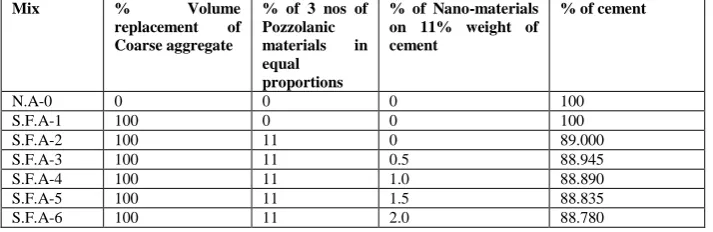
means that 1 part of cement with and without replacement of cement using pozzolanic materials and Nano-materials, 1.49 parts of fine aggregate and 2.88 parts of coarse aggregate with 100% replacement of natural Granite aggregate by artificial light weight aggregates i.e., Sintered fly ash aggregates mixed with water cement ratio of 0.5. Keeping the volume of the concrete constant with saturated and surface dry aggregates are added to concrete with four different mixes by replacing cement with 11% its weight by three numbers of pozzolanic materials with varying percentage of Nano materials which are designated as follows:
Mix % Volume
replacement of
Coarse aggregate
% of 3 nos of Pozzolanic
materials in
equal proportions
% of Nano-materials on 11% weight of cement
% of cement
N.A-0 0 0 0 100
S.F.A-1 100 0 0 100
S.F.A-2 100 11 0 89.000
S.F.A-3 100 11 0.5 88.945
S.F.A-4 100 11 1.0 88.890
S.F.A-5 100 11 1.5 88.835
S.F.A-6 100 11 2.0 88.780
S.F.A: Sintered fly ash aggregate.
To proceed with the experimental program initially steel moulds of size 150x150x150 mm are cleaned brushed with machine oil on all inner faces to facilitate easy removal of specimens afterwards. First fine aggregate and cement along with admixtures silica fume, slag, fly ash and Nano iron oxide in required percentages are mixed thoroughly and then Sintered fly ash aggregates are added with them. All of these are mixed thoroughly by hand mixing. Each time 15 nos of 150X150X150mm cube specimens out of which 12 no of DCN specimens with replacement of cement by 11% of its weight by pozzolanic materials (silica fume, fly ash and Slag) and Nano iron oxide with varying percentages (0%, 0.5%, 1%, 1.5% and 2%) on 11% weight of cement for 5no‟s of different mixes are casted. The concrete is poured into the moulds in three layers with each layer being compacted thoroughly with tamping rod 25 times each time to avoid honey combing. Finally all specimens are kept on the table vibrator after filling up the moulds up to the brim. The vibration was effected for 7 seconds and it was maintained constant for all specimens and all other castings. The steel plates forming notches are removed after 3 hours of casting carefully and neatly finished. After 28 days of curing the specimens are taken out of water and are allowed to dry under shade for few hours.
4.4Testing of specimens
4.4.1 Compressive strength of cubes: Compressive strength of cubes shall be calculated by dividing load taken
by the specimen by the cross sectional area. Values of compressive strength at different percentages of iron oxide are given in table 1 below.
4.4.2 Mode II fracture test
The in-plane shear strength was calculated by using the formula = 𝐏
𝟐𝐛(𝐰−𝐚) in N/mm
2
Where P = Ultimate Load in KN 2b (w-a) = Effective area of un-notched portion
b = width of the DCN specimen in „mm‟ w = depth of DCN specimen in „mm‟ a = notch depth in „mm‟
The basic premise in using fracture toughness, or fracture mechanics in design was to assume that materials have defects or cracks in them. The material property that resists the propagation of these cracks was the “fracture toughness”.
The critical stress intensity factor designates the minimum stress intensity required to get an existing crack in a material to propagate. The critical stress intensity factor for mode I is designated as KIC, that for mode II is KIIC. It is a material property.
The stress intensity factors for cement concrete mixes has been determined by using Finite element analysis approach, that was making use of the formulae proposed by Prakash Desayi et.al.
(A) In this approach, the expression for KIC in terms of
a
w using the least square curve fitting
method done by Prakash Desayi (16) et.al. was considered as K1
(P√(πa/2)) = 0.817-1.153( a
w) +2.577( a
w) ²-2.083( a w)³
And for KIIc in terms of a/w using the least square curve fitting method done by Prakash Desayi et.al (8) was considered as
KIIc/(P√(πa)/2) = 6.881-11.355(a/w)+15.599(a/w)²-6.33(a/w)³
Where P = TOTAL LOAD
LOADED AREA
Loaded Area A = 150 x 50 mm = 7500 mm2 a = depth of notch in mm
w = Depth of DCN specimen = 150 mm
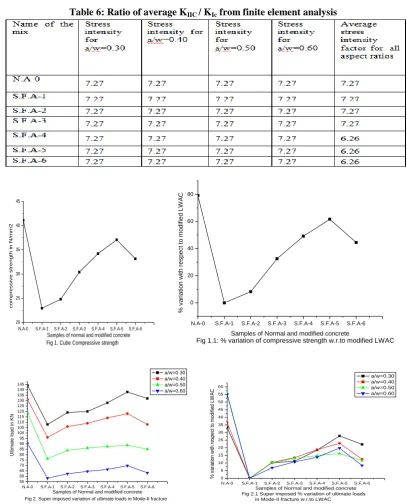
In this investigation by observing the ratios of KIIC/KIC for conventional aggregate concrete and light weight aggregate concrete, it is found that all the values are around 7.0. This clearly indicates that mode-II fracture was predominant by seven times. Physically this feature is observed with the more or less straight fracture.
Table1: Compressive strength of cubes
Name of the mix
% Volume replacemen
t of
Sintered fly ash aggregate
% of cement replaced by 3
nos of
pozzolanic materials
% of Nano Fe2O3 on 11% weight of cement
% of Cement compressive strength in N/mm2
% variation with
respect to
modified LWAC
N.A-0 0 0 0 100 41.08 79.15
S.F.A-1 100 0 0 100 22.93 0.00
S.F.A-2 100 11 0 89.00 24.80 8.16
S.F.A-3 100 11 0.5 88.945 30.38 32.49
S.F.A-4 100 11 1.0 88.890 34.20 49.15
S.F.A-5 100 11 1.5 88.835 37.06 61.62
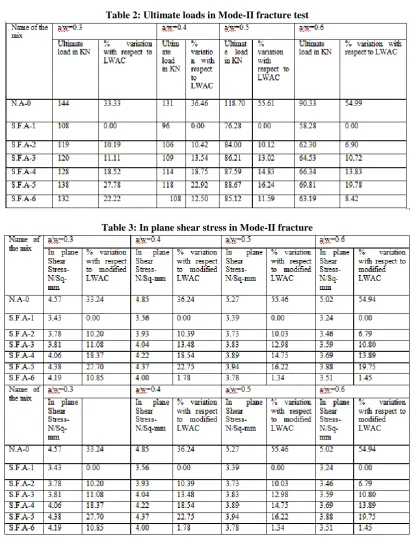
Table 2: Ultimate loads in Mode-II fracture test
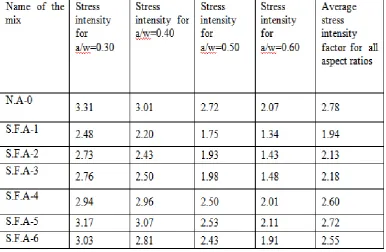
Table 4: Stress intensity factor KIIc from finite element analysis
Table 6: Ratio of average KIIC / KIc from finite element analysis
N.A-0 S.F.A-1 S.F.A-2 S.F.A-3 S.F.A-4 S.F.A-5 S.F.A-6 20 25 30 35 40 45
Fig 1. Cube Compressive strength
com p re ssi v e st re n g th i n N /m m 2
Samples of normal and modified concrete
N.A-0 S.F.A-1 S.F.A-2 S.F.A-3 S.F.A-4 S.F.A-5 S.F.A-6 0
20 40 60 80
Fig 1.1: % variation of compressive strength w.r.to modified LWAC
% v a ria tio n w ith r e sp e ct t o m o d if ie d L W A C
Samples of Normal and modified concrete
N.A-0 S.F.A-1 S.F.A-2 S.F.A-3 S.F.A-4 S.F.A-5 S.F.A-6 55 60 65 70 75 80 85 90 95 100 105 110 115 120 125 130 135 140 145
Fig 2. Super imposed variation of ultimate loads in Mode-II fracture
U lt im a te l o a d i n KN
Samples of Normal and modified concrete
a/w=0.30 a/w=0.40 a/w=0.50 a/w=0.60
N.A-0 S.F.A-1 S.F.A-2 S.F.A-3 S.F.A-4 S.F.A-5 S.F.A-6 0 5 10 15 20 25 30 35 40 45 50 55 60
Fig 2.1 Super imposed % variation of ultimate loads in Mode-II fracture w.r.to LWAC
% v ari at io n w ith re sp ect to m od ifi ed L W AC
Samples of Normal and modified concrete
a/w=0.30 a/w=0.40 a/w=0.50 a/w=0.60
N.A-0 S.F.A-1 S.F.A-2 S.F.A-3 S.F.A-4 S.F.A-5 S.F.A-6 3.0 3.2 3.4 3.6 3.8 4.0 4.2 4.4 4.6 4.8 5.0 5.2 5.4
Fig 3 Super imposed variation of Shear stress in Mode-II fracture
In p la n e She a r St re ss- N /Sq-m m
Samples of Normal and modified concrete
a/w=0.30 a/w=0.40 a/w=0.50 a/w=0.60
N.A-0 S.F.A-1 S.F.A-2 S.F.A-3 S.F.A-4 S.F.A-5 S.F.A-6 0 5 10 15 20 25 30 35 40 45 50 55 60
Fig 3.1 Super imposed % variation of Shear stress in Mode-II fracture w.r.to LWAC
% v ari at io n w ith re sp ect to m od ifi ed L W AC
Samples of Normal and modified concrete
V.
DISCUSSION OF TEST RESULTS
5.1 Influence of Nano Fe2O3 on cube compressive strength
In the present study natural aggregate is replaced with 100% sintered fly ash aggregate. The variation of compressive strength of samples of N.A-0 and S.F-1 to S.F-6 is shown vide table 1 and fig 1. It is observed that the cube compressive strength of modified concrete with 100% sintered fly ash is 22.93 N/mm2 compared to 41.08 N/mm2 i.e.,a variationof 79.15%. With partial replacement of cement by 11% of its weight by 3 nos of pozzolanic materials it is increased to 24.80 N/mm2 i.e., a variation of 8.16%. With further addition of Nano Fe2O3 in the spells of 0.5, 1, 1.5 and 2% on 11% of weight of cement the strength is continuously increased and the optimum percentage of Nano Fe2O3 is 1.5% with strength of 37.06 N/mm2 i.e., a variation of 61.62% and with more addition of Nano Fe2O3 the strength is decreased.
5.2 Influence of Nano Fe2O3 on ultimate loads in mode-II fracture.
All the DCN specimens with different a/w ratios i.e., 0.3, 0.4, 0.5 and 0.6 and with different percentages of Fe2O3 are tested with load in Mode-II (in plane shear). The variations of ultimate loads along with percentage variation with respect to modified concrete with 100% sintered fly ash aggregate for the a/w ratios are presented vide Table no: 2 and fig 2 & 2.1 after 28 days of curing and the same trend of compressive strength is observed. The ultimate loads are continuously decreasing with increase in a/w ratios.
5.3 Influence of Nano Fe2O3 on in-plane shear stress in mode-II fracture.
All the DCN specimens with different a/w ratios i.e., 0.3, 0.4, 0.5 and 0.6 and with different percentages of Fe2O3 are tested with load in Mode-II (in plane shear). The variations of in plane shear stress along with percentage variation with respect to modified concrete with 100% sintered fly ash aggregate for the a/w ratios are presented vide Table no: 3 and fig 3 & 3.1 after 28 days of curing. It is observed that with an increase in a/w ratio the in-plane shear stress increased up to 0.50 and thereafter it is decreased for M20 grade concrete. In case of samples of modified concrete increase is observed up to a/w ratio of 0.40 and decrease thereafter with increase in a/w ratios.
5.4 Influence of Nano Fe2O3 on Stress intensity factor in mode-II fracture.
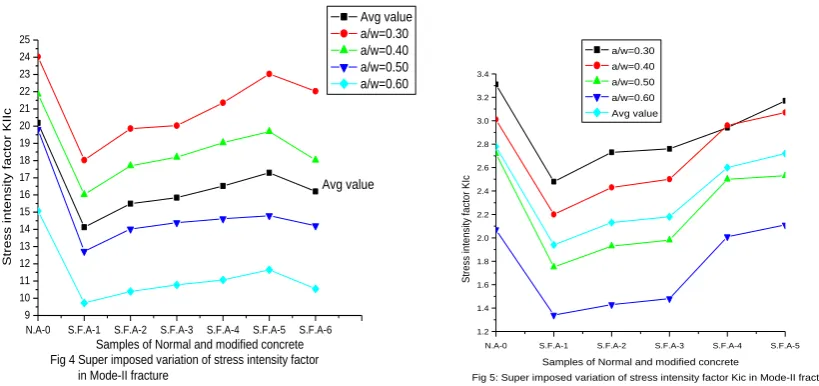
All the DCN specimens with different a/w ratios i.e., 0.3, 0.4, 0.5 and 0.6 and with different percentages of Fe2O3 are tested with load in Mode-II (in plane shear). The variations of stress intensity factors of samples of N.A-0 and S.F-1 to S.F-6 for all the a/w ratios are presented vide Table no: 4 and fig 4 after 28 days of curing and the same trend as that of compressive strength is observed.
5.5 Discussion of crack patterns in cubes and DCN specimens:
In case of cubes, the initial cracks are developed at top and propagated to the bottom with the increase in load and they are widened along the edges of cubes. The failure of the DCN specimen was such that the crack patterns obtained for DCN specimen geometry are mostly along the notch depths. During testing, for most of the specimen initial hair line cracks started at the top of one or both the notches, and as the load is increased further, the cracks widened and propagated at an inclination and sometimes to the middle of the top loaded zone. In a few cases, initial cracks started at the bottom of the one or both notches. As the load is increased propagation of
N.A-0 S.F.A-1 S.F.A-2 S.F.A-3 S.F.A-4 S.F.A-5 S.F.A-6 9 10 11 12 13 14 15 16 17 18 19 20 21 22 23 24 25 Avg value
Fig 4 Super imposed variation of stress intensity factor in Mode-II fracture
St re ss in te n si ty f a ct o r KI Ic
Samples of Normal and modified concrete
Avg value a/w=0.30 a/w=0.40 a/w=0.50 a/w=0.60
N.A-0 S.F.A-1 S.F.A-2 S.F.A-3 S.F.A-4 S.F.A-5 1.2 1.4 1.6 1.8 2.0 2.2 2.4 2.6 2.8 3.0 3.2 3.4
Fig 5: Super imposed variation of stress intensity factor Kic in Mode-II fracture
St re ss in te n si ty f a ct o r KI c
Samples of Normal and modified concrete a/w=0.30
these cracks at an inclination is observed along with the formation of cracks at top of the notches. These cracks finally propagated toward the middle of the top loaded zone leading to failure of the specimen. In some cases cracks formed either side at two edges of the supporting load bearing plate at the bottom or at the loaded length at top side. For most of the specimens with a/w = 0.3, 0.4, 0.5, 0.6, as the load is applied formation of initial hair line cracks at the top of one or both the notches was observed. With the increase of load propagation of these cracks in more or less vertical direction along with the formation of new cracks at the bottom of one or both the notches is observed.
VI.
CONCLUSIONS
The target mean strength of M20 concrete is 26.60 N/mm2. From the experimental study it is observed that the 28 days cube compressive strength of modified concrete with 100% Sintered fly ash aggregate is 22.93 N/mm2 and with replacement by 11% of cement with three numbers of pozzolanic materials i.e., silica fume, Slag and Fly ash in equal proportions and 1.5% of Nano Fe2O3 on 11% weight of cement, the cube compressive strength of modified concrete rises to 37.06 N/mm2 and with further increase of Nano materials the strength is decreased.
The in Plane shear stress of modified concrete with penta blended cement having 1.5% Nano Fe2O3 is maximum.
The average stress intensity factor (KIIc) of M20 grade concrete is 20.19, for modified concrete with 100% sintered fly ash aggregate it is 14.13 with a variation of 30.01% and it is increased to 17.29 with penta blended cement with a variation of 14.36%.
From the study it is observed that KII values (Punching shear) are almost seven times the KI values (Open mode i.e., tension failure) and hence it can be concluded that Mode-II fracture is predominant.
The light weight concrete prepared by 100% Sintered fly ash aggregate as coarse aggregate is no way inferior to the natural aggregate with a benefit of effective usage of fly ash otherwise disposed as waste and also consumption of cement can be reduced by about 11% which may lessen the depletion of scarce natural materials.
REFERENCES
[1]. Robert w. Styron, Marietta, Ga.(1984), Process for forming light weight aggregate.
https://patentimages.storage.googleapwas.com/0b/be/ce/2670af61dfc8c3/US2946112.pdf
[2]. Thorenfeldt, E., Design Criteria of Light weight Aggregate Concrete. CEB/FIP International Symposium on Structural Light weight Aggregate Concrete, Sandefjord, Norway, pp. 720- 732, 1995.
[3]. Prakash desayi, B.K.Raghu Prasad and V.Bhaskar Desai, “Mode – II fracture of cementitious materials- part – I: Studies on specimens of some new geometries”, Journal of Structural Engineering, Vol.26, No.1, April 1999, pp.11-18.
[4]. N. K. Amudhavalli , Jeena Mathew (2012),-“ Effect of Silica Fume on Strength and Durability properties of Concrete” Volume 3, Wassue 1, pp: 28-35,August-2012.
[5]. Hongjian Du et al. (2014), Durability performances of concrete with Nano-silica Construction and Building Materials 73 (2014) 705–712
[6]. V.Bhaskar Desai, A. Satyam and S.Ramesh Reddy., (2014), “Some studies on mode-II fracture of artificial light weight Silica Fume pelletized aggregate concrete”, International Journal of Civil Engineering and Technology (IJCIET), Vol.05, Issue No.2, Feb 2014, pp: 33-51.
[7]. Arvind Kumar , Dilip Kumar “ Use of Sintered Fly Ash Aggregates as Coarse Aggregate in concrete”, SSRG International Journal of Civil Engineering (SSRG-IJCE)– volume1wassue4 September2014
[8]. I.S.Code 456-2000 “Code of practice for plain and reinforced concrete” Bureau of Indian Standards, New Delhi.