AUTOMATED MESS MANAGEMENT FACILITY USING SMS
AUTHORIZATION
Adepu Rajesh1, Abhishek2, Pooja Verma3, Neha Jhade4, Neha Fakirde5, Shivani Sinha6
1. INTRODUCTION
Automated mess management system is really helpful for top level management as well as boarders in making decisions at different levels. Some of the academic institution which has mess facility are running their mess with manual process. To eliminate manual mistakes and time consumption the mess management application serves a better way. The accountability in all aspects is achieved through automated application which is not so accurate in manual system. Mess management application is engaged in providing up to date information about the details of mess boarders and stock availability. The boarding authentication is provided through SMS service. It includes option such as adding, deleting information about the students and stock items. The delete option is applicable to a single record or multiple. It also has a facility to print the status of boarding during a certain period. The other feature of this project is to provide hard copy of the total stock consumed during a given period. This project usage has scope at academic institutions, health care organizations, Industries etc.
2. LITERATURE SURVEY
Ankita Chawla, Priyanka Joshi, Sanjana Panjwani, Surbhi Sontakke, discussed about the importance of automation of mess management system. The authors illustrated the procedure through use case diagram and flow chart. The paper has expressed the advantages like time consuming, man power reduction and also manual mistakes. Thus they explained the automated mess management in broad sense which helps in giving an idea for writing this paper. This paper has used the proposed steps and identified other steps in the process [1].
B Muniraja, J Rajanikanth, discussed about the canteen facility provided in various campus. The paper has quoted drawback in the payment process. In it, usually cash or credit card transactions are carried which has serious drawback. Some times the canteen owner records the order details on paper and bill calculation will be at the end of the month. The authors explained the process of payment with recharge card through postpaid or prepaid facility [2].
B Muniraja, J Rajanikanth, demonstrated the procedure of payment process in the canteens through RIFD cards. This eliminates the cash carry. The paper explained the drawbacks f existing system and proposed features and RTC (Real Time Clock) architecture components. It has the information about the PIR (Passive Infrared) sensor working [3].
Salman Beg, discussed the factors which have influenced the transformation in technology advancement, professionalism as important resources. A computer based environment is suitable to calculate the statement of bills. Separate database is very much important to maintain the files with authorized validation [4].
1 Assistant Professor, Dept. of IT, Kavikulguru Institute of Technology & Science, Ramtek, Nagpur, India
2
Student, IT, Kavikulguru Institute of Technology & Science, Ramtek, Nagpur, India
3
Student, IT, Kavikulguru Institute of Technology & Science, Ramtek, Nagpur, India
4 Student, IT, Kavikulguru Institute of Technology & Science, Ramtek, Nagpur, India
5
Student, IT, Kavikulguru Institute of Technology & Science, Ramtek, Nagpur, India
6
Student, IT, Kavikulguru Institute of Technology & Science, Ramtek, Nagpur, India
Abstract: Mess management gives an idea about boarding details as well as stock utilization maintenance. Sometimes there is in need about current status of mess groceries and another ingredients record. In the academic institution, the students dine in the same mess throughout the month. In such case an account of students is maintained manually. Mess manager records the details of the students who dine in the mess on daily basis and at the end of the month total expenses is calculated. This method of maintaining paper-based records is not feasible. The idea of the paper is providing an automated way for recording student attendance at boarding and expense calculation process is thought to be feasible and accurate solution which saves time too. Whenever student login with roll no as an identity for boarding then immediately an acknowledgement is sent in the form of an SMS to the mobile registered which makes the boarding process for authentication. The details are respective student after login is reported to mess manager for authorization. On the manager level the application provides the details about stock consumption, balance ETC. which helps in making stock management decisions in dynamic. This also provides effective maintenance of mess. The administrator provides separate unique identity and privileges for mess manager, stock manager as well as for student.
Keywords: Mess management, Mess manager, mobile, Administrator
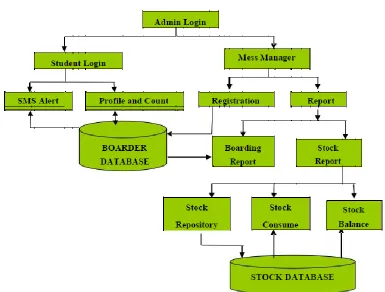
3. PROPOSED APPROACH Admin
Fig. 3.1 Flow chart describing system process
4. APPLICATIONS
Mess management is used in wide variety of applications such as 1.In academic institutions
2.In secondary schools 3.In production industries
4.In Health care organizations ETC
5. RESULTS AND DISCUSSION
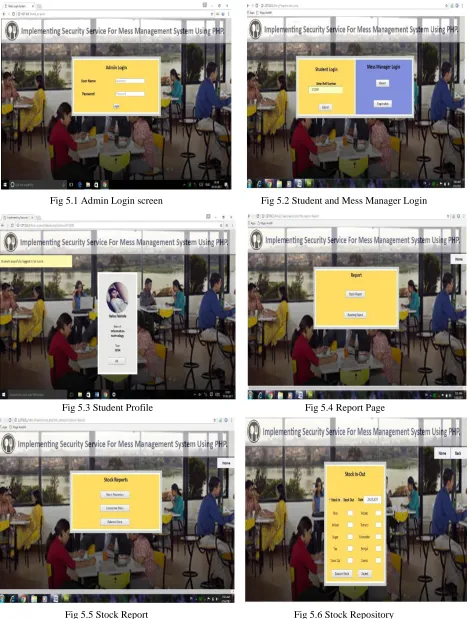
Fig 5.1 Admin Login screen Fig 5.2 Student and Mess Manager Login
Fig 5.3 Student Profile Fig 5.4 Report Page
Fig 5.5 Stock Report Fig 5.6 Stock Repository
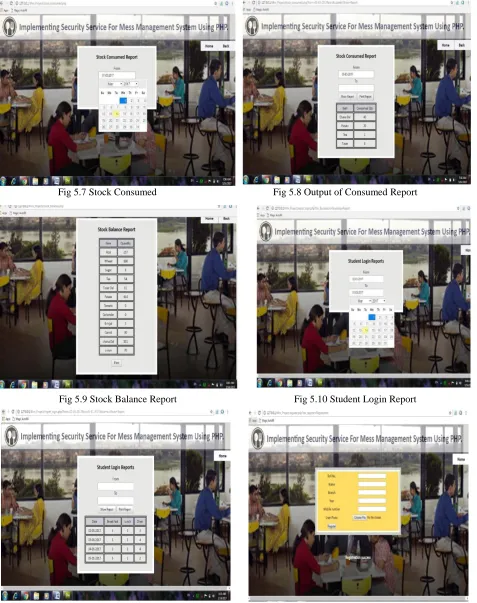
Fig 5.7 Stock Consumed Fig 5.8 Output of Consumed Report
Fig 5.9 Stock Balance Report Fig 5.10 Student Login Report
6. CONCLUSION
The paper guarantees a secured environment for attendance record of student availing mess service. In this the student, enters the roll no after submitting the roll no a new screen pops out with student details along with photograph. After successful authentication a text message will be sent to the submitted student‟s contact number for validation. It very useful for top level management to take dynamic decision. This can be enhanced by deploying on the web where different mess facilities are integrated to work and also by using Bluetooth this application may be on the hands of boarders. The billing process may be effectively managed by considering the constraints of availing mess facility.
7. REFERENCE
[1] Ankita Chawla, Priyanka Joshi, Sanjana Panjwani, Surbhi Sontakke, ”Mess Management System”, International journal of science and engineering
march-2015,vol:1 issue:2. Pg.: 82-85, e- ISSN: 2394-8299 p- ISSN: 2394-8280.
[2] B Muniraja, J Rajanikanth, ”In-Time Billing Process for Canteen Management System” International Journal of Emerging Trends in Engineering
Research (IJETER), Vol. 3 No.6, Pages : 200- 203 (2015), ISSN: 2347 – 3983.
[3] B Muniraja, J Rajanikanth, ”In-Time Billing Process for Canteen Management System” International Journal of Pure and Applied Research in
Engineering and Technology (IJETER), Vol: 3 (12), Pages: 223- 231 (2015), ISSN: 2319 – 507X.
[4] Salman Beg, “Hotel Management System”.
[5] Swapna, M. Firdouse Ali Khan, “Design and Implementation of Ordering System for Restaurants”, in International Journal of Engineering Research &
Technology (IJERT), Vol. 1, Issue 10, December- 2012
[6] S. B. Patil, Srikantha Rao, P. S. Patil 2001 „Canteen Management Design Principles‟ Proceedings of the International Conference & WorkShop on
Trades in Technology, pp. 765-766, viewed 7 October 2001
[7] Tan-Hsu Tan, Ching-Su Chang, Yung-Fu Chen, Yung-Fa Huang, Tsung-Yu Liu, “Developing an Intelligent e-Restaurant with a Menu Recommender