First
level
I
library and/or information science education and training at
South African
universities and
technikons: developments in specialisation
J.
Raju2
Department of Library and Information Studies, Durban Institute of Technology, M.L. Sultan Campus, P.O. Box 1334, Durban, 4000, Republic of South Africa
[email protected]
The literature of the early 1990s observed a general lack of differentiation and specialisation at the basic qualification level in library and/or information science education and training in South Africa. This paper draws from an empirical study on first level LIS qualifications at South African universities and technikons to examine developments in specialisation in LIS education and training. This is particularly relevant in the context of the government's current drive toward rationalisation of the higher education sector. There seems tohave been significant developments in South Africa since the early I 990s regarding specialisation in LIS education and training among the various universities and technikons offering LIS qualifications. It is recommended that LIS departments further develop this trend and also consider possible collaboration with other LIS departments especially on a regional basis. with a viewto accommodating regionally based imperatives.
Keywords: LIS education and training; LIS education and training - South Africa
Introduction
The general lack of differentiation and specialisation at the basic qualification level in library and/or information science (LIS) education and training in South Africa has been lamented and LIS departments3 have been encouraged to specialise (National Education Policy Investigation 1992; Van Brakel 1992; Nassimbeni, Stilwell and Walker 1993; International Federation of Library Associations and Institutions 1994). At the same time the government has been driving a process of rationalisation of the higher education sector in South Africa in order to overcome the fragmentation, inequality and inefficiency of the past (Department of Education 1997: 17; Council on Higher Education, Size and Shape of Higher Education Task Team 2000: I, 3; Ministry of Education 200 I). The purpose of this paper is to examine developments in specialisation in LIS education and training amongst the various universities and technikons in South Africa that offer LIS qualifications, particularly in the context of the government's current drive toward rationalisation of the higher education sector.
Empirical study
This paper draws from an empirical study (Raju 2002) on first level LIS qualifications at South African universities and technikons. As part of the study, LIS educators were surveyed on various issues relating to LIS education and training, including what possibilities exist for specialisation in LIS education and training amongst the various universities and technikons in South Africa that offer LIS qualifications. At the time the study was conducted (2002) there were thirteen LIS education and training departments based in universities and technikons in South Africa. Information gleaned from academic departments' web sites as well as direct contact with the departments themselves revealed that at the time of conducting the survey (April/May 2002) there was a total of 68 full-time educators in these various departments.
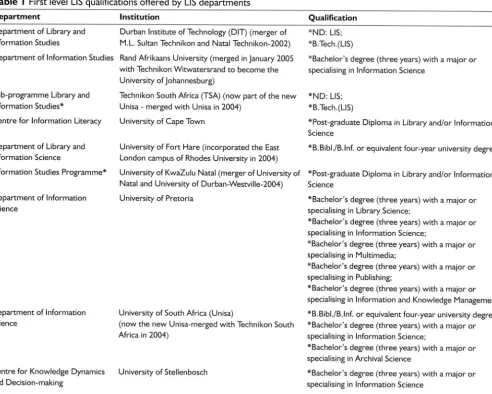
The author believed that this population was sufficiently manageable to be surveyed and that there was no need to draw a sample. A total of 65 questionnaires (three of the 68 educators had been on long leave) were sent to educators in thirteen LIS education and training departments based in universities and technikons in South Africa. Thirty-four completed questionnaires were eventually returned amounting to 52% of the total number of questionnaires sent out. There were responses from all 13 departments. The survey revealed the following (Table I) first level LIS qualifications offered by the thirteen LIS education and training departments. As the study being drawn on was conducted in 2002 the researcher visited the websites of the thirteen LIS departments and/or personally contacted departments in December 2004/January 2005 to ascertain if there had been any changes in the qualifications offered. Apart from changes in names of
I. A first level library and/or information science (LIS) qualification is, in this paper, viewed as abeginningLIS qualification that affords an individual entry into the library and/or information services work environment where the work can be at the professional or at the paraprofessional level.
2. Jayarani Raju, PhD, is an Associate Professor, Department of Library and Information Studies, at Durban Institute of Technology, South Africa
3. LIS education and training in South Africa is not always offered within academic departments but in some cases is offered as pro-grammes within a school (e.g. the University of KwaZulu Natal) or as a sub-programme within a larger academic programme (e.g. the erstwhile Technikon South Africa). However, for the sake of brevity and consistency this paper simply refers to LIS departments.
some institutions (refer to Table I) resulting largely from mergers of higher education institutions, there were no significant changesin the qualifications offered. Furthermore, the merging of institutions, for example Unisa and TSA, at the time of writing, does not seem to have affected qualifications offered. This, however, might change in the future asthe mergers become more consolidated resulting in perhaps rationalisation of academic programmes offered by merged institutions.
Table I captures first level LIS qualifications commonly offered by higher education institutions in South Africa: • ND: LIS(National Diploma: Library and Information Studies,a three-year national programme offered by technikons); • B.Tech.(L1S)(Bachelor of Technology: Library and Information Studies,a national programme offered by technikons
at the fourth level of study after completion of the three-year ND: LIS);
• Post-graduate Diploma in Library and/or Information Science(a programme offered at universities at the fourth level of study after completion of a bachelor's degree in any field); and
• B.Bibl. or equivalent four-year university LISdegree.
The table also reveals the new trend (elaborated on later in this paper) in some universities of offering three-year bachelors' degrees with majors or specialising in particular information related areas as an attempt to capture the emerging information markets by preparing graduates for the wider information market and not just libraries. Qualifications in school librarianship and other specialist areas were not the focus of the study conducted and are therefore not reflected inTable I.
The study being drawn on in this paper also surveyed LIS services employers on various issues relating to LIS education and training, among these being how they received the new three-year degree qualifications (elaborated on later). This survey of employers included headsand, where applicable, deputies and senior managersof provincial library services, major public library services, academic libraries (including both university and technikon libraries), the National Library of South Africa, major special libraries or information services, major museum libraries, and national and provincial archives. A total of 455 questionnaires were distributed. There was a return rate of 17% of the total number of questionnaires sent out. This percentage included input from significant quarters of this population and hence analysisand reporting of results here were considered essential.
Table I First level LISqualificationsoffered by LISdepartments Department
Department of Library and
Information Studies
Department of Information Studies
Sub-programme Library and Information Studies'"
Centre for Information Literacy
Department of Library and Information Science
Information Studies Programme'"
Department of Information Science
Department of Information Science
Centre for Knowledge Dynamics
and Decision-making
SAJnl Libs &Info Sci 2005, 71 (2)
Institution
Durban Institute of Technology (DIT) (merger of
M.L. Sultan Technikon and Natal Technikon-2002)
Rand Afrikaans University (merged in January 2005
with Technikon Witwatersrand to become the University of Johannesburg)
Technikon South Africa (TSA) (now part of the new Unisa - merged with Unisa in 2004)
University of Cape Town
University of Fort Hare (incorporated the East London campus of Rhodes University in 2004)
University of KwaZulu Natal (merger of University of Natal and University of Durban-Westville-2004)
University of Pretoria
University of South Africa (Unisa)
(now the new Unisa-merged with Technikon South Africa in 2004)
University of Stellenbosch
Qualification
'"ND: LIS;
'"B.Tech.(L1S)
'"Bachelor's degree (three years) with a major or specialising in Information Science
'"ND: LIS;
'"B.Tech.(L1S)
'"Post-graduate Diploma in Library and/or Information Science
'"B.Bibl./B.lnf. or equivalent four-year university degree
'"Post-graduate Diploma in Library and/or Information Science
'"Bachelor's degree (three years) with a major or specialising in Library Science;
'"Bachelor's degree (three years) with a major or specialising in Information Science;
'"Bachelor's degree (three years) with a major or specialising in Multimedia;
'"Bachelor's degree (three years) with a major or
specialising in Publishing;
'"Bachelor's degree (three years) with a major or specialising in Information and Knowledge Management
'"B.Bibl./B.lnf. or equivalent four-year university degree; '"Bachelor's degree (three years) with a major or specialising in Information Science;
'"Bachelor's degree (three years) with a major or specialising in Archival Science
Department of Information Studies University of the North (merged in January 2005
with the Medical University of South Africa (Medunsa) to become the University of Limpopo)
University of Transkei (merged in January 2005 with
Border Technikon and Eastern Cape Technikon to
become the Walter Sisulu University)
University of Zululand
University of the Western Cape
*Post-graduate Diploma in Library and/or Information
Science;
*B.Bibl./B.lnf. or equivalent four-year university degree
*B.Bibl./B.lnf. or equivalent four-year university degree;
*B.Bibl.(Alternative) (a two-year post-graduate
qualification for those who have completed a bachelor's
degree)
*Post-graduate Diploma in Library and/or Information
Science;
*B.Bibl./B.lnf. or equivalent four-year university degree
*Post-graduate Diploma in Library and/or Information
Science;
*B.Bibl./B.lnf. or equivalent four-year university degree;
*Bachelor's degree (three years) with a major or specialising in Information Science
*LIS qualifications here are not offered within LIS departments but as part of LIS programmes within larger academic units, for example, schools or programme groups.
Department of Library and
Information Science
Department of Library and
Information Science
Department of Library and
Information Science
Specialisation versus generalisation in LIS education and training
A long-standing debate in LIS education and training has been whether the basic professional programme should be generalised so that graduate professionals may be employed in a variety of environments or specialised to support professionals employed in specific roles or institutions. This 'divergence versus convergence' or 'specialisation versus generalisation' is an unresolved issueand continues to be debated in the literature.
Proponents of the generalisation argument believe that students must first master the field's central or core knowledge that includes a whole spectrum of types of library and information services, collections and clienteles. Proponents of specialisationtend to see specialisationas equipping individualsto work in special placessuch as academic or public libraries. According to Cox and Rasmussen(1997: 255-256) proponents of this latter view see the role of specialisation as educating information professionals to work in a more focussed fashion so as to carry out particular functions such as information retrieval or the preservation of certain types of information. They believe that the value of specialisation is that it offers the best way to orient students to the basic principles, theories and issuesof library and information science. Furthermore technology issues,research, fieldwork and the relationship of practice to theory all can be better managed by accommodating specialisationswithin the first degree. They also believe that the core principles emerge better developed and with specific or practical application through specialisations.
A further motivation to introduce specialisation into the basic professional qualification has been for graduates to fill niches in the diverse information environment (Rochester 1997: 172). Cronin (1985: 13)makes a similar point when he says that beyond the traditional LIS market there is a demand for systems analysts, database designers, information resource managers,marketing information specialistsand many other information-related specialists.The question to be asked, according to Cronin, is whether it will continue to be practical or desirable for a single institution to provide education and training for all types of information work or ",,:,hetherthe increasing specialisation of the job market will make more specialisedforms of education and training necessary.Robbins(1990: 41) points out, in regard to this, that emphasis on specialisation in the profession by type of institution (for example, academic libraries or public libraries) is declining and that specialisation will increasingly focus on the client served by, for example, the indexer/abstractor, collection developer or information manager. Cronin (1985: 14) sees two probable trends. Either departments will attempt to retain their grip on the 'information whole' and thus have foundation courses to cover the fundamentals of information work on top of which specialisationtracks will be set. Alternatively, departments may decide to concentrate on a limited number of career tracks and offer tailor-made courses to provide students with the necessaryskills to find employment in a particular operational environment. It is the author's opinion that while integrated or generalist programmes may be considered to be the ideal, the critical question is whether departments are capable (in terms of capacity and time) of teaching all that has to be taught especially in an increasingly diverse information environment. Stilwell(2004: 22) too contends that "no single department is likely to have the capacity to span the full spectrum of programmes required" and that there is a need to "prioritise and balancecurriculum content".
This issueof specialisationand differentiation with regard to specific specialitiesamong LISdepartments is relevant to the South African LIS context especially in light of the government's current drive towards rationalisation in higher education (Department of Education 1997: 17;Council on Higher Education, Size and Shape of Higher Education Task Team2000: I, 3;Ministry of Education200 I). In the context of these trends the LISeducation and training sector needs to examine what possibilities exist for specialisationin LIS education and training in South Africa. The local literature, as
indicated by Raju (2005: 70-71) in a previous issue of this journal, has pointed out that there has not been enough differentiation and specialisation at the basic qualification level in LIS education and training in South Africa, and LIS departments and programmes have been encouraged to specialise. The report of the National Education Policy Investigation (NEPI) Library and Information Services Research Group highlighted the lack of differentiation and specialisation among LIS teaching departments (National Education Policy Investigation 1992: 38). Nassimbeni, Stilwell and Walker (1993: 31) commented that apart from a tendency among many universities to move towards an emphasison 'information science', there are few options for specialisations in other areas. The IFLA Mission to South Africa (International Federation of Library Associations and Institutions 1994: 61) reported that first level LIS education and training in South Africa tends to be deliberately broad-based in order to enable professionals to find employment in a variety of LIS services organisations. Van Brakel's 1992 survey of LIS teaching departments also revealed very little specialisation at the basic professional qualification level and recommended that university LIS departments "ought to specialise according to their unique environments, for example, commercial/business environment, museums, information technology, public libraries, community information services, and so forth" (Van Brakel 1992: 190). The SAlLIS
Proposed guidelines for undergraduate
career training
also encouraged specialisationat the level of basic professional qualifications (South African Institute for Librarianship and Information Science 1996: 3). Underwood and Nassimbeni (1996: 219-220) observed that the range of specialisationoffered by the LISeducation and training sector in South Africa was small with school Iibrarianship being the main area of specialisation.They believed that this was a reflection of the general debate (referred to above) over whether the function of LIS education is best served by supplying generalist programmes or a range of sharply differentiated programmes leading to different career paths. It seems that the general lack of specialisation at the basic qualification level in LIS in South Africa (possibly also because departments had been focussing on consolidating basic professional LIS programmes) has been lamented and there has been much encouragement for such specialisation to occur. More recent surveys of the LIS employment market in South Africa (Snyman2000; Ocholla 200 I), while not specificallycommenting on the issueof specialisationin LIScurricula, point to the need for education and training programmes to addressthe requirements of the job market:Apart from traditional positions (in libraries or information services) a large number of opportunities exist for ... (the] information systems specialist, information and/or knowledge manager, information analyst and research worker, advisor or consultant, records manager,archivist ... (Snyman2000: 15-16)
As pointed earlier by the proponents of the specialisation argument, specialisation is one way in which the basic professional LISprogramme can respond to this fast diversifying information environment.
Some examples of specialisationsat the basicqualification level include the example of teacher librarianship or school library/media centre specialisation.In many cases,however, this specialisationis offered by the LISeducation and training department in conjunction with the department of education with the emphasis being on the teaching function. Other specialisationsinclude courses for archivists and records managers.The largest single modification to basic professional programmes seems to have been the addition of new courses in technology and information science such as telecommunications, database management, artificial intelligence for information retrieval, marketing of information and many other courses that may be collectively viewed as an information science specialisation.Cronin (1985: 15) points out that an interesting development in many library and information schools, especially in the United States of America, has been the growth of the concept of information management as a specialisation in the field. Some of the schools have developed specialist programmes in this area. According to Cronin, graduates of this programme tend to be "more dynamic" and "have a greater interest in the new information handling and communication technologies" than the graduates with the general master's degree in library and information science. Horrocks (1986: 294) points out that various specialisationson offer may take the form of joint degrees possiblywith other departments, specialisationswithin the basic professional qualification such as the masters in library and information science in the case of the North American countries, or as separate programmes in their own right.
However, while the concept of specialisationat the basicprofessional qualification level may appear very appealingand relevant to present times, it has inherent difficulties. Firstly, when a department attempts to prepare its students to function in specific positions, according to Stieg(1992: I 12-113), it is emphasisingtraining as opposed to education, which is not necessarilya bad thing as there is the reality that some graduates must be able to function as systems analystsor children's librarians without further preparation. However, according to Stieg, the problem is that it runs contrary to established thinking and philosophy of what basic professional library and information science education is all about. That is, the meaning of 'professional' is supposed to encompass a wider vision beyond the immediate job, and too narrow a focus impairs that. There is also the issue of quality. It has been asked how truly specialiseda graduate can be after, for example, one year of LIS education and training (in the case of the master's degree in library and information science in the United States of America or even the post-graduate diploma in the case of South Africa). The length of the
programme makes it difficult to develop any depth in a specialisation. Bruce and Middleton (1996: 36), writing in the Australian context, support this when they say,"the exigencies of a one year graduate diploma course allow little avenue for specialisation". A further important factor that interferes with the logic of specialisation is the preference of students fOI"'general' preparation. They generally want programmes that will qualify them for a variety of positions. In support of this Clayden (1995: 231) points out that generalists with a wide range of knowledge and skills have a better chance of finding employment, especially in a restricted market. Employers too, according to Clayden. tend to prefer general to specialised preparation as it permits greater flexibility in the organisation. There are also administrative problems associated with specialisation. In order for specialisations to be viable, faculty expertise must be available as well as enrolments sufficient for economic feasibility (Hayes 1988: 314). A general global trend is that LIS education and training departments tend to have small student and staff populations (Hayes 1988: 315; Clayden 1995: 231; Rochester 1997:
172). It is not always possible to offer a specialisationthat only a few students wish to take. Furthermore. there should be enough permanent faculty members in a department to ensure that they can adequately cover core courses and still have sufficient faculty with the necessaryexpertise to cover the specialisationson offer. This is not always possible in the light of the general tendency for departments in this field to be small. In fact Kaniki (1995), in a study that assessesthe viability of LIS education and training departments in South Africa in offering specialisedcourses in information provision to rural communities, concludes that while departments recognise the need to offer such a specialisation it is unfortunately not viable largely becauseof departments having few staff members already burdened with other academic programmes.
The literature discussedreflects the on-going specialisationversus generalisation debate that affects LISeducation and training the world over including South Africa. There are merits and problems on both sides of the debate. Individual LIS departments will need to base decisions on whether to 'specialise' or 'generalise' on departmental and institutional circumstances as well as on other local and national considerations, including market imperatives.
Specialisation in LIS education and training: the South African context
The study undertaken by Raju(2002) also sought to investigate if since the I 990s there have been any changesregarding the general lack of specialisation at the basic qualification level among LIS departments. Educators surveyed had been asked if the programmes leading to first level qualifications offered by their departments have particular foci, which they view as niche areas for their particular departments. Sevenor 20.6% of the 34 respondents indicated that their first level LIS programmes did not have niche areas. Two of the 34 respondents did not respond to this item. Twenty-five (25) or 73.5% of the 34 respondents indicated that their first level LIS programmes did have particular foci, which they viewed as niche areas for their particular departments.
Table
2. which presents these niche areas by departments, reveals an interesting array of specialisations,a contrast to the situation in the early I990s. What had happened to effect this change? Dramatic changes in the information environment created by rapid developments in information and communication technologies (ICT) seem to have been instrumental here. Ocholla (2000: 37) points out that "because of the 'catastrophe' emerging from competition in the market place and new technology•... L1Sdepartments have been forced to ... re-orient and diversify ... [resulting] in the revision of most LIS curricula in South Africa". Furthermore, the government's programme for rationalisation of higher education to overcome past inefficiency and to make higher education more responsive to societal (including market) trends, brings with it the threat of closure of academic departments found wanting. This as well as competition from other information related disciplines for similar job markets (alluded to by Ocholla above) seem to have spurred many LISdepartments to embrace specialisation at the basic qualification level. As Ocholla (2000: 56) remarks: "These issues and trends constitute a challenge for viability that involves [among other things]. .. reorganising the curriculum by introducing new content ... , introducing and exploiting new technology ... ". This re-organisation of curricula for relevance and viability has in some cases also impacted on the names of academic departments with the new name often reflecting the area of specialisation. For example. the Department of Information and Library Studies at the University of Cape Town, is now known as the Centre for Information Literacy while the Department of Information Science at the University of Stellenbosch is called the Centre for Knowledge Dynamics and Decision-making (refer toTable 2).
At the same time one needs to bear in mind that "some departments have moved faster than others to manage change through review of curriculum and programmes ... and taking up the challenges of the new technology and the market place" (Ocholla 2000: 46). A case in point is the department (refer to
Table
2) that does not reflect a niche area for its first level qualification. This department has recently indicated to the researcher that it recognises the need to move away from a generalist first level programme and hopes to develop an area of specialisation in the near future (Khayundi 2005). In the case of some institutions, particularly the historically disadvantaged. adequate staffing. ICT infrastructural resources and other logistical support are not always available to support curriculum change and development.It would seem that generally much has changed since the I 990s regarding differentiation and specialisation at the basic qualification level among LIS education and training departments in South Africa. This augurs well for LIS education and training, especially in the light of calls for a review of duplication of LIS programmes in certain regions, for example Kwa-Zulu Natal (Ministry of Education 2002), which is part of the government's wider programme of rationalisation in higher education (Department of Education 1997: 17; Council on Higher Education, Size and Shape of Higher Education Task Team 2000: I, 3; Ministry of Education 200 I).
Table
2 Niche area/saof library and/or information science departments"Digital Iibrarianship/information work
"Information literacy; "Information society
No niche area at the moment
"Records and documents management; "Information needs assessment Niche area(s)
"Digital information technologies;
"Community librarianship/information work
"Management of information as an economic resource
"Schoollibrarianship;
"Children's and youth Iibrarianship
"Rural librarianship
"Information for development;"Multimedia;
"Publishing;"lnformation sc.;*Library sc.;
*Information and knowledge management
"General librarianship;
"Archival practice;
"Information and knowledge management
"Digital information work in the corporate
information environment (Corporate information management)
"Public librarianship;
"Rurallibrarianship Institution
Durban Institute of Technology (DIT) (merger of M.L.
Sultan Technikon and Natal Technikon-2002)
Rand Afrikaans University (merged in january 2005 with
Technikon Witwatersrand to become the University of johannesburg)
Technikon South Africa (TSA) (now part of the new
Unisa - merged with Unisa in 2004)
University of Cape Town
University of Fort Hare (incorporated the East London
campus of Rhodes University in 2004)
University of KwaZulu Natal (merger of University of
Natal and University of Durban-Westville-2004)
University of Pretoria
University of South Africa (Unisa)
(now the new Unisa-merged with Technikon South Africa in 2004)
University of Stellenbosch
University of the North (merged in january 2005 with the Medical University of South Africa (Medunsa) to
become the University of Limpopo)
University of the Western Cape
University of Transkei (merged in january 2005 with Border Technikon and Eastern Cape Technikon to
become the Walter Sisulu University)
University of Zululand "Information needs, seeking, services and
users analysis
"Knowledge management; indigenous
knowledge systems (IKS) " Application of ICT in LIS
a. These are niche areas as provided by participants in the 2002 survey of LIS educators (Raju 2002). Department of Information Studies
Department
Department of Library and Information Studies
Sub-programme Library and Information
Studies
Department of Information Science
Department of Information Science Centre for Information Literacy
Department of Library and Information Science
Information Studies Programme
Centre for Knowledge Dynamics and
Decision-making
Department of Information Studies
Department of Library and Information Science
Department of Library and Information Science
Department of Library and Information Science
A new trend: three-year bachelors' degrees
A recent trend at some South African universities has been to offer a three-year bachelor's degree with a major or specialising in, for example, Information Science. This major is broken up into a number of Information Science modules4 that are spread over the three years. The balance of the modules are usually certain compulsory academic foundation modules such as computer literacy, language proficiency and academic skills as well as modules selected from general social and human science modules in terms of specific degree rules. According to these institutions these bachelor's degree programmes are aimed at positions in the wider information field. At some of these institutions the major subject or specialisation could be Library Science or Archival Science or Multimedia or Publishing or Information and Knowledge Management.
4. Some examples of these modules include: Electronic information seeking; Information management; Digital information retrieval; WWW management; Intranet evaluation; Strategic information management; and Knowledge management.
This is a relatively new development in LIS education and training in South Africa that attempts to capture the
emerging information markets and in some cases still target the traditional LIS services markets, a situation that LIS
departments the world over have been faced with (Hayes 1988; Lor 1990; Van House and Sutton 1996). The study (Raju
2002) being drawn on in this paper attempted to find out how LIS services employers were receiving these new
three-year degree qualifications after many years of employing four-year LIS graduates as professionals in LIS services. Thus
employer respondents had been asked if they think that these programmes5, particularly those with Information Science
or Library Science majors or specialisation, incorporate the fundamental elements leading to a first level professional LIS
qualification. Fifty-seven point nine percent (57.9%) of the 76 employer respondents who participated in the survey
believed that these new three-year degree programmes
do incorporate
the fundamental elements leading to a first level professional LIS qualification. Fifteen point eight percent (15.8%) of the 76 respondents believed that these programmesdo not incorporate
the fundamental elements leading to a first level professional LIS quali"iication and collectively provided the following explanations for this response:• one wonders about the depth of coverage in the modules if the programme is done in three years (it sounos like a
national diploma being offered at a university);
• these programmes are not as comprehensive on librarianship as the B.Bibl. or B. Tech.(L1S);
• majors and ancillaries are too restrictive and there might be a problem placing graduates in a general library;
• graduates would not be fully prepared to work alone and would probably need a mentor;
• only selective training is received while the core of LIS is neglected; and
• these programmes are too specialised for a provincial library service environment.
The majority of the 76 LIS employers surveyed (57.9%) seem to have no problem with accepting these new three-year
degree qualifications as first level professional LIS qualifications. However, the relatively low majority figure (57.9%) and
the fact that approximately 20 respondents (26.3%) did not commit themselves to a response to this item are possibly
indications of some uncertainty among some LIS services employers regarding these new three-year degree
qualifications. On the whole, however, employers' participation in the survey was disappointing both in terms of the
overall return rate as well as non-response to certain issues. This makes generalisation of opinions expressed, difficult.
Educators from LIS departments that offer such three-year bachelors' degrees had been asked what job market these
programmes are aimed at. There were responses to items relating to these three-year bachelors' degrees from
educators from all five LIS departments that have indicated (refer to Table I) that they offer such three-year bachelors'
degrees. Explanations from these educators as to what job market these programmes are aimed at included:
• the general job market;
• broad-based library and information services but not necessarily library services;
• information work environments in general (more than libraries but including libraries, for example, preparing
knowledge managers, archivists, database and web-page designers and information professionals in publishing and in tourism);
• information and knowledge management of digital information in public and private sector organisations;
• the corporate environment (preparing information managers, knowledge managers and competitive intelligence professionals); and
• the market for people (such as information managers, information system developers, infopreneurs, information trainers, information consultants) who manage (increasingly digital) information in the corporate environment and
whose skills include electronic publishing (web-sites, multi-media products), information organisation and retrieval
(for search engines, portal and corporate intranets), building and using databases for decision support and competitive
intelligence, specifying user requirements and developing user-system interfaces using object-oriented programming, and training end-users.
These responses suggest that the institutions offering these new three-year bachelors' degrees view the wider
information market, including libraries, as the market at which these programmes are aimed. This reflects an attempt to
capture the emerging information markets by preparing graduates for the wider information market and not just libraries.
There are, however, one or two of these institutions that seem to be targeting more specifically the corporate
information environment.
Educators from the five LIS departments that offer three-year bachelors' degrees had also been asked, based primarily
on the content of the programmes and secondarily on the time taken for completion (three years instead of the
traditional four years), at which level (professional, paraprofessional or any other level) of library and/or information
service entry point they would locate the three-year bachelor's degree graduates. Respondents had been provided with
examples of these three-year programmes. There were a total of eight responses to this item, out of a possible ten, from
5. Survey respondents were provided with examples of these three-year degree programmes.
respondents from LIS departments that offer the new three-year bachelors' degrees. Five of the eight respondents indicated that they would locate the three-year bachelor's degree graduates at the professional level and their explanations for their responses included:
• these are the new information professionals, the people in demand in the knowledge society;
• students who enrol for these programmes are aiming at professional positions and once they graduate they should be placed in professional entry-level posts;
• the content and outcomes of the:se programmes are at the same intellectual level as the traditional four-year LIS programmes (while some traditional library oriented content such as cataloguing, classification and collection development are not covered or covered very superficially, other areas such as knowledge management, information organisation and information technology are done in detail); and
• our curriculum is not relevant to library and information services and focuses on management aspects of information in the corporate environment (this response comes from a respondent from one of the LIS departments that has broken with the library paradigm and now focuses on preparing three-year graduates specifically for the corporate information environment).
One of the eight respondents indicated that the three-year bachelor's degree graduates would be located at the paraprofessional level and provided the following explanation br this response:
• if graduates of tr.is three-year programme have aspirations towards a career in library and information services, then the professional component (fourth year) should be added on (this response comes from a respondent from one of the LIS departments offering the new three-year qualifications alongside the traditional four-year LIS qualifications). Two of the eight respondents selected the 'other' option when asked at which level (professional, paraprofessional or any other level) of library and/or information service entry point they would locate the three-year bachelor's degree graduates. One of the two respondents specified this 'other' level as being a junior position within an LIS service and explained that with exposure and experience these graduates should be able to work their way up to paraprofessional and professional positions in the LIS service. The second respondent specified the 'other' level as being a corporate level and explained that "the corporate world in which our graduates work usually do not distinguish between professional and paraprofessional job titles". This latter response comes from a respondent from one of the LIS departments that has broken with the library paradigm and now focuses on preparing three-year graduates specifically for the corporate information environment.
These varied explanations forwarded by respondents, even among those from the same department offering the new three-year programme, suggest some uncertainty regarding at which level of LIS service entry point they would locate the three-year bachelor's degree graduates.
Educators from LIS departments that offer three-year bachelor's degrees had also been asked if the three-year bachelor's degree graduates can be admitted to senior LIS programmes such as honours and masters' programmes to which usually persons with the Post-graduate Diploma in Library and/or Information Science and B.Bibl. or equivalent four-year university degree qualifications are admitted. There were a total of eight responses to this item, out of a possible ten, from respondents from LIS departments that offer the new three-year bachelors' degrees. One of the eight respondents indicated that these three-year bachelor's degree graduates cannot be admitted to senior LIS programmes such as honours and masters' programmes for the following reason:
• it would be unfair on the four-year graduate professionals and belittles the profession; a separate path to senior LIS programmes should be possible for these three-year bachelor's degree graduates.
Seven of the eight respondents indicated that these three-year bachelor's degree graduates can be admitted to senior LIS programmes such as honours and masters' programmes and collectively provided the following explanations for this response:
• the three-year bachelor's degree qualifications are good enough for graduates to be admitted to senior LIS programmes; RPL (recognition of prior learning) can be used in assessment of candidates and candidates can be asked to do some extra modules;
• the student with the three-year bachelor's degree meets the credit points criteria to be admitted into a senior programme;
• in all other three-year degree programmes subjects taken as majors give access to honours and masters' programmes; it must be remembered that the fourth year of four-year degree programmes is not at the post-graduate level but at the same level as the third year and that the original idea of a four-year LIS degree was to make provision for approximately the same content and mix of subjects provided by a three-year bachelor's degree plus a one-year post-graduate diploma;
• provided that the three-year bachelor's degree has delivered thorough LIS education and training; • if the student has obtained high enough marks in the Information Science major; and
• it depends on the kind of post-graduate programme that the student wishes to pursue and its market orientation.
It is interesting to observe that although seven out of the eight respondents have indicated that the three-year bachelor's
degree graduates can be admitted to senior LIS programmes such as honours and masters' programmes, many of the
explanations forwarded seem to indicate that some sort of assessment is required or even the possibility of doing extra
modules in order for a three-year bachelor's degree graduate to articulate vertically into a senior LIS programme.
Interestingly, this is very much in line with the view of the respondent who indicated that these three-year bachelor's
degree graduates cannot be admitted to senior LIS programmes such as honours and masters' programmes and
suggested that a separate path to senior LIS programmes should be followed by the three-year bachelor's degree
graduates.
Although the majority of educator respondents from the LIS departments that offer the new three-year bachelors'
degrees indicated that they would locate these degree graduates at the professional level entry point in LIS services, the
varied explanations forwarded by them suggest some degree of uncertainty regarding at which level of LIS service entry
point they would locate the graduates. One supposes this is expected of any programme that is new on the market and
still needs to establish itself more firmly. Employers surveyed also showed some uncertainty about the new three-year
degree qualifications. More time and considerably more research and in-depth critical analysis into this new area in the
future are necessary before any definitive conclusions may be arrived at.
To this end the author would like to point out that in terms of the higher education qualifications structure proposed
by the New Academic Policy (Council on Higher Education 200 I: 30-32) and the more recent academic policy document
(Ministry of Education 2004), these new three-year degree qualifications would be pegged at NQF level 7 which is one
level lower than the traditional four-year LIS qualifications which would be pegged at NQF level 8. Horton (1990: 10), in
a structure that he proposed for the LIS profession in South Africa, also placed graduates with a "three-year degree with
a strong major in information studies" at a level lower that those graduates with the four-year LIS qualifications. It would
seem that because the new three-year qualification is a general degree aiming at the wider information market, it is likely
to be largely lacking in specific professional LIS components which an individual may have to complete in a fourth year
before being accepted at a professional level entry point in LIS services. Further research in the future would need to
assess how employment market trends and curriculum planning within these three-year programmes impact on their
level of entry point in LIS services. This is not likely to be an issue for graduates entering the corporate world because, as
pointed out by one of the educator respondents (mentioned above), the corporate world does not distinguish between
professional and paraprofessional job titles. However, the traditional LIS services sector does, as revealed in responses by
both educators and employers (Raju 2002; Raju 2004) on the issue of whether there should be clearly defined
professional and paraprofessional job titles in LIS services.
Discussions
The 1997
Education White Paper
3: aprogramme for the transformation
of
higher education
stressed, that central to the transformation process is that higher education must be planned, governed and funded as a single national co-ordinatedsystem in order to overcome the fragmentation, inequality and inefficiency which are the legacy of the past (Department
of Education 1997: 17). Towards this end the Council on Higher Education (CHE) that was charged with the responsibility
of spearheading the restructuring of the higher education sector in South Africa reviewed the institutional landscape of
the higher education sector and provided the Minister of Education with advice on the reconfiguration of this landscape
to ensure long-term affordability and sustainability of the higher education system (Council on Higher Education, Size and
Shape of Higher Education Task Team 2000: 1,3). Among the many proposals put forward by the CHE Task Team to the
Minister and which largely forms the basis of the Education Ministry's
National plan for higher education
(200 I), was the proposal relating to the need for differentiation and diversification of the higher education system. The report of the CHETask Team argues that one of the reasons why differentiation and diversity are essential in higher education is that it
serves no purpose if all institutions have exactly the same mandates and missions.
Thus it is evident that differentiation and diversity are important in the government's restructuring and rationalisation
of the higher education sector to bring about a more efficient and equitable higher education system. It is therefore
important that this differentiation and diversity reflect itself in LIS education and training programmes offered at various
universities and technikons in South Africa, as well.
The literature (discussed above) reflects that a long-standing debate in LIS education and training has been whether
the basic professional programme should be generalised so that graduate professionals may be employed in a variety of
environments or specialised to support professionals employed in specific roles or institutions. Despite this ongoing
'specialisation versus generalisation' debate, LIS education and training departments in South Africa had been encouraged
to specialise according to their individual unique environments. NEPI (1992), Van Brakel (1992), Nassimbeni, Stilwell and
Walker (1993) and the IFLA Mission to South Africa (1994) had all pointed out that by the early I 990s there was very little
differentiation and specialisation at the basic qualification level among LIS education and training departments in South Africa. More recently LIS employment market surveys by Snyman (2000) and Ocholla (200 I) have emphasised the need for curricula to reflect current trends and technologies of a rapidly diversifying information environment. Approximately ten years later, findings (refer to Table 2) in a study by Raju (2002) reveal an interesting array of niche areas or specialisationsamong LISdepartments in South Africa.
The two technikons (recently designated as universities of technology), very much in keeping with the purpose of technikon education and training (vocationally oriented technological education), seem to focus on digital information technologies. TSA has now merged with Unisa to form a comprehensive higher education institution (the new Unisa) that offers both university and technikon-type programmes. The University of the Transkei (now called the Walter Sisulu University), located in a province (Eastern Cape) that is essentially rural, focuses on rural librarianship. The emerging information markets are being targeted by LISdepartments at the Universities of Pretoria, Zululand, Stellenbosch, South Africa and at the RandAfrikaans University. It is not surprising that these are the five LISdepartments, which according to Table I are offering the new three-year bachelors' degrees with majors or specialising in particular information related areas in an attempt to capture the emerging information markets by preparing graduates for the wider information market and not just libraries. The University of the Western Cape sees librarianship for young people (children and the youth) as its niche area. The University of KwaZulu-Natal and the University of South Africa appear to be taking care of the area of records and documents management particularly in the archives environment. Librarianship in general and the important area of public Iibrarianship, seem to be the specialities of the University of South Africa and the University of the North (recently renamed the University of Limpopo), respectively while the University of Cape Town has information literacy and the information society as its focus.
Responsesfrom educators from LIS departments offering the new three-year bachelors' degrees indicate that they see the wider information market, including libraries, as the market at which these programmes are aimed. There are, however, one or two of these departments that are targeting more specifically the corporate information environment. The heads of the Information Science departments at both the Rand Afrikaans University and the University of Stellenbosch have been quite specific about this as is evident from their responses (provided earlier) to the item that enquired what job market their three-year degree programmes are aimed at and also from Table 2 which shows the niche areas of the various LISdepartments. It is precisely these two departments that have broken with the library paradigm in their education and training and have gone completely the route of preparing three-year graduates for the wider information market. Other LIS departments offering the new three-year bachelors' degrees, for example the University of Zululand and the University of South Africa, are offering these new qualifications alongside the traditional LIS qualifications (refer to Table I) thus targeting the traditional library and information services market as well as the emerging information markets. The University of Pretoria seems to be doing the same as the RandAfrikaans University and the University of Stellenbosch, except that it still offers a major in Library Science in one of its three-year bachelors' degrees.
Conclusions and recommendations
Since the early I 990s much differentiation and specialisation has developed among LIS departments in South Africa. This augurs well for the LIS sector especially in view of the government's initiatives toward differentiation and diversity in higher education. There seem to be distinct possibilities developing in South Africa for specialisation in LIS education and training among the various universities and technikons offering LISqualifications. A study by Kagan(2002: 8) revealed calls by both LIS practitioners and educators for more specialisation "by library type and kind of work" and the argument that "specialisation at various institutions develops excellence". The information related niche areas (reflected in Table 2) in both the traditional LIS qualifications as well as the new three-year bachelors' degrees with specialisations in various information aspects particularly those in the non-traditional information sector, indicate that most South African LIS programmes in the new millennium are being responsive to a dynamic and diverse information environment. It is recommended that this trend be further developed "in order to capitalise on the opportunities presented [especially] by the emerging market" (Snyman 2000: 18). Perhaps a further aspect that would be useful to consider in programme reviews and subsequent curriculum planning and development would be possible collaboration among LIS departments especially on a regional basis,with a view to accommodating regionally based imperatives. Finally,in view of rapid changes in the employment market largely generated by ICT developments, ongoing research needs to be undertaken of both LIS programmes and the market for LISgraduates in order to identify new market trends and the extent to which existing LIS programmes are responding to change and, importantly, competition in the employment market.
References
Bruce, e. and Middleton, M. 1996. Teaching and learning information organisation: the Queensland University of Technology experience. Cataloguing Australia, 22(!/2): 34-47.
Clayden, J. 1995. Theory versus practice in cataloguing education: some Austrc;lian experiences. journal of education for library and information science, 36(3): 230-238.
Council on Higher Education. 200 I. New academic policy for programmes end qualifications in higher education: discussion document. [Pretoria]: Department of Education.
Council on Higher Education, Size and Shape of Higher Education Task Team. 2000. Towards anew higher education landscape: meeting the equity. quality and social development imperatives of South Africa in the 215tcentury. Visited on 19/07/2000 at:http:!
/www.polity.org.za/govdocs/reports/education/chereport.html
Cox, R.J.and Rasmussen, E. 1997. Reinventing the information professions and the argument for specialisation in LIS education: case studies in archives and information technology. journal of education for library and information science, 38(4): 255-267. Cronin, B. 1985. On the outside looking in ... : issues in education for librarianship and information science. In Armstrong, e. and
Keenan, S. eds. Information technology in the library/information school curriculum: an international conference. pp. 9-24. Aldershot, England: Gower.
Department of Education. 1997.Education White Paper 3: aprogramme for the transformation of higher education. Pretoria: Government Printer.
Hayes, R.M. 1988. Education of the information professional: a library school perspective. journal of the American Society for Information Science, 39(5): 312-317.
Horrocks, N. 1986. North American trends in library and information science.Canadian library journal, 43(5): 293-296. Horton, W.J. 1990.The structure of the information profession in South Africa: the development of arational pattern: inaugural
lecture. Pietermaritzburg: University of Natal Press.
International Federation of Library Associations and Institutions (IFLA). 1994. Education, training and employment of library and information professionals in South Africa.journal of education for library and information science, 35( I): 61-63.
Kagan, A. 2002. The transformation of South African librarianship: survey results and analysis of current opinions. Innovation, 25: 1-19.
Kaniki, A.M. 1995. Library and information science education and training for information provision to rural communities in South Africa. Quarterly bulletin of the International Association of Agricultural Librarians and Documentalists, 40( I): 21-29. Khayundi, F.A. 2005. Personal communication with F.A. Khayundi, University of Fort Hare. 20 Jan.
Lor, P. 1990. The future of education for library and information science in South Africa. In Nassimbeni, M. and de Jager, K. eds. The future of library and information science: social. technological and educational challenges: proceedings of the 50th Anniversary Symposium of the School of Librarianship, University of Cape Town, 20-21 November 1989. pp.67-82. Cape Town: University of Cape Town.
Ministry of Education. 200 I. National plan for higher education. Visited on 07/03/200 I at: http://education.pwv.gov.za/doe-sites/
h .. ./national/plan/final/draft.html
Ministry of Education. 2002.Approved academic programmes for universities and technikons: 2003-2006. Pretoria: Department of Education.
Ministry of Education. 2004. The higher education qualifications framework: draft for discussion. Visited on 10/08/2004 at:http://
www.saqa.org.za/show.asp?main=docs/misc/hediscussion/index.html
Nassimbeni, M., Stilwell, e. and Walker, e. 1993. Education and training for library and information work: an analysis of the current South African situation with a view to the way forward. Innovation, 6: 30-44.
National Education Policy Investigation (NEPI). 1992.Library and information services: report of the NEPI Library and Information Services Research Group: aproject of the National Education Co-ordinating Committee. Cape Town: Oxford Un:versity Press. Ocholla, D. 2000. Training for library and information studies: a comparative overview of LIS education in Africa. Education for
information, 18: 33-52.
Ocholla, D. 200 I. Curriculum response to a changing national and international information environment: theoretical and methodological paradigms on review and revision. Education for information, 19: 143-167.
Raju, J. 2002. First level library and/or information science qualifications at South African universities and technikons: a comparative study of curricula. PhD thesis, University of Natal, Pietermantzburg.
Raju, J. 2004. First level library and/or information science qualifications at South African uni"ersltles and technikons: a comparative study of curricula. South African journal of libraries and information science, 70( I): 9-19.
Raju, J. 2005. LIS education and training in South Africa: a historical review. South African journal of libraries and information science, 71(I): 69-79.
Robbins, J.B. 1990. Yes Virginia, you can require an accredited master's degree for that job! Library journal, I 15(2): 40-44. Rochester, M.K. 1997.Education for librarianship in Australia. London: Mansel.
Snyman, R. 2000. Employment market for information professionals in South Africa. A paper presented at the L1ASA Conference, Durban, 26-29 September 2000.
South African Institute for Librarianship and Information Science (SAlLIS). 1996. Proposed guidelines for undergraduate career training. s.I.: SAlLIS.
Stieg, M.F. 1992.Change and challenge in library and information science education. Chicago; London: ALA.
Stilwell, e. 2004. Alumni perceptions of a post graduate information and library science education programme at the University of Natal, South Africa. South African journal of libraries and information science, 70( I): 20-29.
Underwood, P.G. and Nassimbeni, M.e. 1996. First steps: reconstructing library and information science education in South Africa. Education for information, 14: 215-223.
Van Brakel, P.A. 1992. Aspects regarding the educational structure of LIS training at South African universities. South African journal of library and information science, 60(3): 188-193.
Van House, N. and Sutton, S.A. 1996. The panda syndrome: an ecology of LIS education. journal of education for library and information science, 37(2): 131-147.