Original Research Article.
Knowledge Regarding Risk Factors of Otitis Media Among Mothers of
Under 5 Years of Age Children Attending in the Primary Health Care
Centers in Abha: A Cross Sectional Study
Alaa Khalid Alatabani
1, Latifah Khalid Mohammad Alrashed
2, ShamsuNahar Khalil
3*1General Practitioner, King Khalid University, Abha, Saudi Arabia. 2Medical Student, Hail University, Hail, Saudi Arabia.
3*Professor, Department of Family and Community Medicine, King Khalid University, Abha, Saudi Arabia. ABSTRACT
Background: Many of the risk factors for otitis media in children could be modified by adopting proper lifestyle changes which helps in control of otitis media and its associated sequel. Objectives: To determine the knowledge of caregivers about risk factors (RFs) associated with OM for possible controlling of some of these factors and reducing the burden of the disease. Subjects and Methods: This quantitative cross sectional study was carried out in Abha capital of Assir province in Saudi Arabia on mothers attending PHCCs throughout the study period (November. 2017), provided that they had children less than 5 years of age. Data were collected using a modified Ear Infection Survey questionnaire.
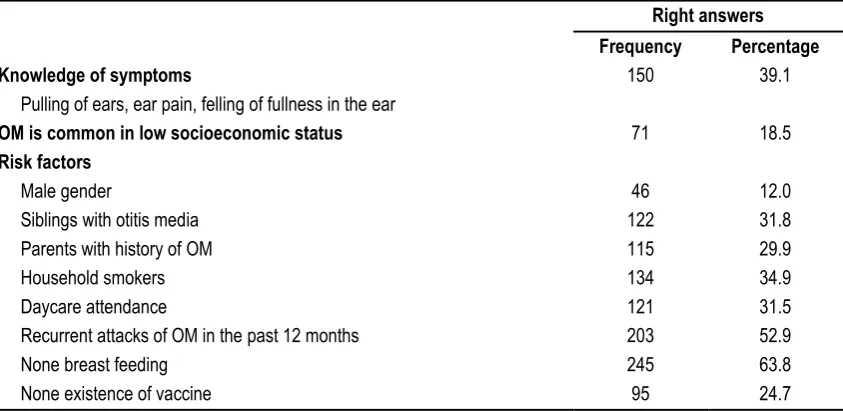
Results: The study included 384 mothers. Their age ranged between 17 and 56 years with a mean of 33.6 and standard deviation of 9.1 years. Most of the participants (70.6%) heard about otitis media. Only 39.1% of mothers knew the main symptoms of otitis media. Also only 18.5% of them could recognize that otitis media is a disease of low socio-economic status people. Regarding risk factors, the most frequent known one was absence of breast feeding (63.8%0 followed by recurrent attacks of OM in the past 12 months 52.9%) whereas the lowest frequent known risk factor was male gender (12%). Overall, poor knowledge regarding otitis media was reported by
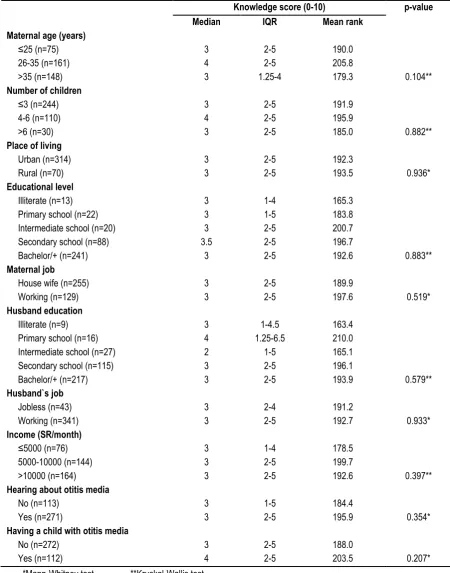
70.6% of the participated mother. None of the studied factors were significantly associated with mothers` knowledge regarding childhood otitis media. Attitude and behavior of mothers towards protection against otitis media was good. Conclusion: Knowledge of risk factors of OM that can be modified among mothers is poor. Therefore, healthcare educational programs should be implemented to increase their awareness. Fortunately, their behavior attitude towards protection against otitis media was very promising.
Keywords: Otitis Media, Risk Factors, Mothers, Knowledge.
*Correspondence to:
ShamsuNahar Khalil,Professor,
Department of Family & Community Medicine, King Khalid University, Abha, Saudi Arabia. Article History:
Received: 24-11-2017, Revised: 20-12-2017, Accepted: 26-01-2018
Access this article online
Website:
www.ijmrp.com
Quick Response code
DOI:
10.21276/ijmrp.2018.4.1.072
INTRODUCTION
In both developed and developing counties, Otitis media (OM) is a very common health problem and considered the main preventable reason (90%) for hearing loss among.1
The prevalence of chronic OM differs in varies countries, but the highest prevalence rates were reported in South East Asia, Africa and Western Pacific regions.1
Epidemiological studies for middle ear inflammatory conditions in the Kingdom of Saudi Arabia are scarce as only few regional studies were conducted through local universities to investigate prevalence of Otitis media in different provinces of KSA.In Riyadh prevalence of OM was 13.8 %2 and in Abha it was 2.3%.3 In
Qassim region, it was 7.5%.4
Classical Risk factors (RFs) of OM include recurrent upper respiratory tract infections,5,6 season,7 household tobacco smoke,8
short duration of breast feeding,9 parents working status,10 artificial
bottle feeding,11 day care attendance,12 family history,13 male
gender and low socio-economic status (SES).12,14 Many of these
risk factors could be modified by adopting proper lifestyle changes which helps in control of OM and its associated sequel.15
This study aimed to determine the knowledge of caregivers about risk factors (RFs) associated with OM for possible controlling of some of these factors and reducing the burden of the disease.
SUBJECTS AND METHODS
This quantitative cross sectional study was carried out in Abha capital of Assir province in Saudi Arabia on mothers attending PHCCs throughout the study period (November. 2017), provided that they had children less than 5 years of age.
Data were collected using a modified Ear Infection Survey questionnaire,16 which includes questions regarding the possible
risk factors for otitis media (low socio-economic status, recurrent of chronic rhinitis, exposure to household smokers, past history of Otitis media in the last 12 months, otitis media of siblings, malnutrition, male gender, parents with history of otitis media, day care attendance, bottle feeding, and non-existence of vaccines. The researchers visited the involved PHCCs and interviewed the mothers with the questionnaire manually. Care was taken to not disturb the system.
Mothers who responded correctly to knowledge questions were given a score of “1” whereas those responded incorrectly were given “0” score. Total score was computed and those scored below 50% were considered as having “poor knowledge” and those got 50% or more were considered as having “good
knowledge”. Consent to participate in the study was obtained from
each mother as well as approval from Ethics Committee, KKU, Abha was obtained.
The data were coded before computerized data entry. The
abnormally distributed as evidenced by significant Shapiro Wilk test. Mann-Whitney test was used for comparison of two groups whereas Kruskal-Wallis test was applied to compare more than two groups. P-values <0.05 was considered as statistically significant.
RESULTS
The study included 384 mothers. Their age ranged between 17 and 56 years with a mean of 33.6 and standard deviation of 9.1 years. About two-thirds of them (63.5%) had 3 children or less. Most of them (81.8) live in urban places. About two-thirds of them (62.8%) had Bachelor degree or above and working as house wives (66.4%). More than half of their husbands (56.5%) had bachelor degree or above and majority of them (88.8%) had jobs. The average income per month exceeded 10000 Saudi Riyals in 42.7% of the respondents. (Table 1)
Most of the participants (70.6%) heard about otitis media as illustrated in figure 1. Less than one third of the mothers (29.2%) reported history of having a child with otitis media. (Figure 2)
Table 1: Demographic characteristics of the participants
Frequency Percentage
Maternal age (years) ≤25
26-35 >35
75 161 148
19.5 42.0 38.5
Number of children ≤3
4-6 >6
244 110 30
63.5 28.7 7.8
Place of living Urban
Rural
314 70
81.8 18.2
Educational level Illiterate
Primary school Intermediate school Secondary school Bachelor/+
13 22 20 88 241
3.4 5.7 5.2 22.9 62.8
Maternal job House wife
Working
255 129
66.4 33.6
Husband education Illiterate
Primary school Intermediate school Secondary school Bachelor/+
9 16 27 115 217
2.3 4.2 7.0 29.9 56.5
Husband`s job Jobless
Working
43 341
11.2 88.8
Income (SR/month) ≤5000
5000-10000 >10000
76 144 164
271, 70.6%
113, 29.4%
Yes
No
Figure 1: Hearing of the participants about otitis media.
112, 29.2%
272, 70.8%
Yes
No
Figure 2: History of having a child with Otitis media among the participants
Table 2: Responses of the participated mothers to otitis media knowledge questions Right answers
Frequency Percentage
Knowledge of symptoms
Pulling of ears, ear pain, felling of fullness in the ear
150 39.1
OM is common in low socioeconomic status 71 18.5
Risk factors Male gender
Siblings with otitis media Parents with history of OM Household smokers Daycare attendance
Recurrent attacks of OM in the past 12 months None breast feeding
None existence of vaccine
46 122 115 134 121 203 245 95
the past 12 months 52.9%) whereas the lowest frequent known risk factor was male gender (12%). Overall, poor knowledge regarding otitis media was reported by 70.6% of the participated
change smoking habit to reduce risk of surgery for ear tubes (77.1%) and willing to change child day care arrangement to reduce risk of otitis media (68.5%). (Table 4)
Table 3: Factors associated with knowledge of mothers regarding otitis media
Knowledge score (0-10) p-value
Median IQR Mean rank
Maternal age (years) ≤25 (n=75)
26-35 (n=161) >35 (n=148)
3 4 3
2-5 2-5 1.25-4
190.0 205.8
179.3 0.104**
Number of children ≤3 (n=244)
4-6 (n=110) >6 (n=30)
3 4 3
2-5 2-5 2-5
191.9 195.9
185.0 0.882**
Place of living Urban (n=314) Rural (n=70)
3 3
2-5 2-5
192.3
193.5 0.936*
Educational level Illiterate (n=13) Primary school (n=22) Intermediate school (n=20) Secondary school (n=88) Bachelor/+ (n=241)
3 3 3 3.5
3
1-4 1-5 2-5 2-5 2-5
165.3 183.8 200.7 196.7
192.6 0.883**
Maternal job
House wife (n=255) Working (n=129)
3 3
2-5 2-5
189.9
197.6 0.519*
Husband education Illiterate (n=9) Primary school (n=16) Intermediate school (n=27) Secondary school (n=115) Bachelor/+ (n=217)
3 4 2 3 3
1-4.5 1.25-6.5
1-5 2-5 2-5
163.4 210.0 165.1 196.1
193.9 0.579**
Husband`s job Jobless (n=43) Working (n=341)
3 3
2-4 2-5
191.2
192.7 0.933*
Income (SR/month) ≤5000 (n=76)
5000-10000 (n=144) >10000 (n=164)
3 3 3
1-4 2-5 2-5
178.5 199.7
192.6 0.397**
Hearing about otitis media No (n=113)
Yes (n=271)
3 3
1-5 2-5
184.4
195.9 0.354*
Having a child with otitis media No (n=272)
Yes (n=112)
3 4
2-5 2-5
188.0
203.5 0.207*
271, 70.6%
113, 29.4%
Poor
Good
Figure 3: Overall knowledge level of mothers regarding otitis media
Table 4: Attitudeof the mothers towards prevention of otitis media among their children
Behavior modification Yes
N (%)
No N (%)
I don’t know
N (%)
Willing to change smoking habit to reduce OM risk in children 295 (76.8) 18 (4.7) 71 (18.5)
Willing to change smoking habit to reduce risk of surgery for ear tubes 296 (77.1) 21 (5.5) 67 (17.4)
Willing to change child day care arrangement to reduce risk of OM 263 (68.5) 40 (10.4) 81 (21.1)
DISCUSSION
Awareness of caregivers, especially mothers with the common risk factors associated with otitis media will help in controlling the disease and reducing its bad prognosis. Therefore this study was conducted to evaluate the awareness of mothers of children less than 5 years regarding the common risk factors of OM among their children.
Several studies identified risk factors for otitis media among children which include recurrent upper respiratory tract infections, exposure to household passive smoking, bottle feeding, immune-suppression, malnutrition, infection, low socioeconomic status with overcrowding in homes, schools and day care centers.17
Several studies reported male predominance of the disease.9,18,19
On the other hand, some studies did not observe a gender difference regarding prevalence of OM among children.20-22 In the
present study, only 12% of mothers could recognize the male predominance of the disease.
Some authors reported that the low socio-economic status (SES) was a single largest risk factor of OM.14,23,24 In Nigeria, Lasisi et al.,
(2007) also reported a strong association between low socioeconomic status and OM.12 Low SES itself is a risk factor,
and at the same time it is closely related to others risk factors such as malnutrition and overcrowding. Also, low socioeconomic status may explain the recurrence of otitis media seen among parents and siblings of cases. Other risk factors may be responsible for greater incidence of OM in the low socio-ecomonic status including lack of access to proper healthcare and medication and exposure to household passive smokers.25,26
Unfortunately, in the current study, low SES itself was recognized by only 18.5% of mothers as a risk factor for OM. However, other related risk factors were recognized by higher percentages such as OM in parents (29.9%), siblings (31.8%), recurrent OM in the
past 12 months (52.9%) and exposure to household smoking (34.9%).
Overcrowding in poor ventilated day care centres is another important risk factor for Otitis media among children due to predisposition to upper respiratory tract viral infection which can lead to congestion of the Nasopharynx, Eustachian tube dysfunction and subsequent otitis media.19 In the current survey,
31.5% of mothers could recognize that daycare center is a risk factor for children otitis media.
Breast feeding has been shown to protect against otitis media by enforcing the children immunity, but this protection decreases as they grow; hence susceptibility to infection increases from the age of one year because breast milk could no longer meet their nutritional need.18 In the current study, fortunately absence of
breast feeding as a risk factor for children OM was recognized by 63.8% of mothers.
Overall in the present study, poor knowledge of risk factors of OM observed among 70.6% of mothers who scored below 50% which suggests that a public health education campaign directed to mothers of young children is of great importance in our community. This study has some important limitations that should be mentioned. First of all, we included mothers from one institution which could affect the generalizability of results. However, mothers from all socio-economic statuses attending this health institution. Second, the cross-sectional design of the study which permits only association and not causality between dependent and independent variables.
tympanogram in Riyadh. Int JPediatrOtorhinolaryngol. 1995; 31:53-61.
3. Abolfotouh MA, Ghieth MM, Badawi IA. Hearing loss and other ear problems among schoolboys in Abha, Saudi Arabia. Ann Saudi Med. 1995; 15:323-6.
4. Humaid AI, Ashraf AS, Masood KA, Nuha AS, Saleh AA, Awadh AM. Prevalence and risk factors of Otitis Media with effusion in school children in Qassim Region of Saudi Arabia International Journal of Health Sciences, Qassim University 2014 Oct-Dec; 8(4):325-334.
5. Aniansson G, Alm B, Andersson B, Håkansson A, Larsson P, Nylén O, et al. A prospective cohort study on breast-feeding and otitis media in Swedish infants.Pediatr Infect Dis J 1994;13:183-8. 6. Daly KA, Brown JE, Lindgren BR, Meland MH, Le CT, Giebink GS. Epidemiology of otitis media onset by six months of age. Pediatrics 1999; 103:1158-66.
7. Adair-Bischoff CE, Sauve RS. Environmental tobacco smoke in middle ear disease in preschool age children. Arch PediatrAdolesc Med 1998;152:127-33.
8. Wintermeyer SM, Nahata M. Chronic suppurative otitis media. Ann Pharmacother 1994;28:1089-99.
9. Teele DW, Klein JO, Rosner B. Epidemiology of otitis media during the fi rst seven years of life in children in greater Boston: A prospective cohort study. J Infect Dis 1989;160:83-94.
10. Jahn AF. Chronic otitis media: Diagnosis and treatment. Med Clin North Am 1991;75:1277-91.
11. Fliss DM, Shoham I, Leiberman A, Dagan R. Chronic suppurative otitis media without cholesteatoma in children in Southern Israel: Incidence and risk factors. Pediatr Infect Dis J 1991;10:895-9.
12. Lasisi AO, Olaniyan FA, Muibi SA, Azeez IA, Abdulwasiu KG, Lasisi TJ, et al. Clinical and demographic risk factors associated with chronic suppurative otitis media. Int J PediatrOtorhinolaryngol 2007;71:1549-54.
13. Kerschner JE, Lindstrom DR, Pomeranz A, Rohloff R. Comparison of caregiver otitis media risk factor knowledge in suburban and urban primary care environments. Int J Pediatr Otorhinolaryngol 2005;69:49-56.
14. Adeyemo AA. Knowledge of caregivers on the risk factors of otitis media. Indian Journal of Otology 2012 Oct; 18 (4):184-188. 15. Lasisi AO, Olayemi O, Irabor AE. Early onset otitis media: risk factors and effects on the outcome of chronic suppurative otitis media. Eur Arch Otorhinolaryngol. 2008 Jul;265(7):765-8. 16. Kerschner JE, Lindstrom DR, Pomeranz A, Rohloff R. Comparison of caregiver otitis media risk factor knowledge in suburban and urban primary care environments. Int J Pediatr Otorhinolaryngol 2005;69:49-56.
19. Amutta SB, Abdullahi M, Aliyu D, Iseh KR, Inoh MI. Risk factors for chronic suppurative Otitis Media among children under the age of fifteen years in Sokoto Metropolis, North-Western Nigeria. IJIRD 2016;5(10):400-404.
20. Al-Humaid IH, Abou-halawa SA, Khan AM, Al-Hamamah SN, Al Duways AS, Alanazi MA. Prevalence and risk factors of Otitis Media with effusion in school children in Qassim Region of Saudi Arabia. International Journal of Health Sciences, Qassim University 2014; 8(4):325-334.
21. Kiris M, Muderris T, Kara T, Bercin S, Cankaya H, Sevil E. Prevalence and risk factors of otitis media with effusion in school children in Eastern Anatolia. Int J Pediatr Otorhinolaryngol. 2012; 76:1030-5.
22. Engel J, Anteunis L, Volovics A, Hendriks J, Marres E. Risk factors of otitis media with effusion during infancy. Int J PediatrOtorhinolaryngol. 1999; 48:239-49.
23. Paradise JL, Rockette HL, Colborn DK, Bernard BS, Smith CG, Kurs-Lasky M, et al. Otitis media in 2253 Pittsburgh-area infants: Prevalence and risk factors during the first two years of life. Pediatrics 1997;99:318-33.
24. Ah-Tye C, Paradise JL, Colborn DK. Otorrhea in young children after tympanostomy-tube placement for persistent middle-ear effusion: Prevalence, incidence and duration. Pediatrics 2001;107:1251-8.
25. Chandra RK. Nutrition and the immune system from birth to old age. Eur J Clin Nutr 2002;56:S73-6.
26. Casselbrant ML, Mandel EM. Genetic susceptibility to otitis media. Curr Opin Allergy Clin Immunol 2005;5:1-4.
[
Source of Support: Nil.
Conflict of Interest: None Declared.
Copyright: © the author(s) and publisher. IJMRP is an official publication of Ibn Sina Academy of Medieval Medicine & Sciences, registered in 2001 under Indian Trusts Act, 1882. This is an open access article distributed under the terms of the Creative Commons Attribution Non-commercial License, which permits unrestricted non-commercial use, distribution, and reproduction in any medium, provided the original work is properly cited.