T. Jeyalakshmi et al / Int. J. Pharm. Phytopharmacol. Res. 2014; 4 (2): 89-94
ISSN (Online) 2249-6084 (Print) 2250-1029
International Journal of Pharmaceutical and
Phytopharmacological Research (eIJPPR)
[Impact Factor – 0.852]
Journal Homepage: www.eijppr.com
Research Article
Development and Validation of RP-HPLC Method for Simultaneous Estimation of
Vitamins B
1,B
3,B
5and B
6in Multi Vitamin Injection
T. Jeyalakshmi
1, A. Chenthilnathan
1*and A.Vairamani
21Department of Pharmaceutical Chemistry, Manonmaniam Sundaranar University, Tirunelveli – 627 012, Tamil Nadu, India. 2Caplin Point Laboratories Ltd., Gummidipoondi Taluk, Chennai – 601 201, Tamil Nadu, India.
Article info
Article History: Received 2 May 2014 Accepted 31 October 2014
Keywords:
Vitamins B1, B3, B5, B6,
Multivitamin injections, RP- HPLC, Validation.
Abstract
A simple, efficient and reproducible RP-HPLC method for simultaneous determination of vitamins B1 (Thiamine
hydrochloride), B3 (Nicotinamide), B5 (Dexpanthenol) and B6 (Pyridoxine hydrochloride) in a combined
multivitamin injection dosage form has been developed and validated. The Chromatographic Separation was carried out on Water C18 (250 × 4.6mm; 5µm) column using the mobile phase consists of buffer (pH 3.5) and methanol in the ratio 95:5. The mobile phase was flowed at the rate of 1.5 ml/min and effluent was detected at 210 nm. The retention times of Thiamine hydrochloride, Nicotinamide, Dexpanthenol and Pyridoxine hydrochloride were 2.492 min, 6.748 min, 20.084 min and 4.077 min respectively. The method was validated according to ICH guidelines and the acceptance criteria for system suitability, specificity, linearity, accuracy, precision and ruggedness were met in all cases. The method was linear in the range of 10-200 µg/ml for Thiamine hydrochloride (r2 = 0.9992), 40-800 µg/ml for Nicotinamide (r2 = 0.9994) 10-200 µg/ml for
Dexpanthenol (r2 = 0.9993) and 8-160 µg/ml for Pyridoxine hydrochloride (r2 = 0.9991). The percentage relative standard deviation for precision was found to be less than 2.0%. Hence, the method could be successfully applied for routine analysis of B1 (Thiamine hydrochloride), B3 (Nicotinamide), B5 (Dexpanthenol) and B6
(Pyridoxine hydrochloride) from multivitamin injections.
1. INTRODUCTION
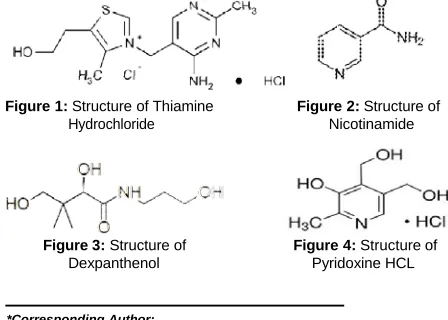
Thiamine hydrochloride (Fig. 1) chemically, 2-[3-[(4-amino-2- methylpyrimidin-5-yl) methyl]-4-methyl-1, 3-thiazol-3-ium-5-yl] ethanol hydrochloride, used to treat ulcerative colitis and persistent diarrhea 1-7
. Nicotinamide (Fig.2) chemically, pyridine-3- carboxamide, used to treat skin disorders, anxiety, Alzheimer’s disease 2,8-12
. Dexpanthenol (Fig.3) chemically, 2,4-Dihydroxy-N-(3- hydroxypropyl)-3,3-dimethylbutanamide, used to minimize paralytic ileus; treatment of postoperative distention; topical to relieve itching and to aid healing of minor dermatoses3,13-17 . Pyridoxine hydrochloride (Fig. 4) Chemicaly, 4, 5-Bis (hydroxymethyl)-2-methylpyridin-3-ol hydrochloride, used to treat nausea and vomiting in early pregnancy 4,18-22
.
Figure 1: Structure of Thiamine Figure 2: Structure of
Hydrochloride Nicotinamide
Figure 3: Structure of Figure 4: Structure of
Dexpanthenol Pyridoxine HCL
*Corresponding Author:
A. Chenthilnathan
Assistant Professor & Head i/c
Department of Pharmaceutical Chemistry, Manonmaniam Sundaranar University, Tirunelveli – 627 012, Tamil Nadu
Email: [email protected]
A literature survey revealed that a few analytical methods have been reported for the estimation of these vitamins individually or in combination with other vitamins by UV Spectrophotometry 5,23-26
, High- Performance Liquid Chromatography 6,27
, Electrospray ionization- mass spectrometry 7,28
, reversed-phase ion-pair high performance liquid chromatography 8,29
. In this present work, an attempt was made to develop a simple, feasible and simultaneous determination of vitamins B1, B3, B5 and B6 in combined
multivitamin injection by RP-HPLC. The proposed method was validated in accordance with International Conference on Harmonization (ICH) guidelines9.
2. MATERIALS AND METHODS
2.1 Experimental
2.1.1 Chemicals and reagents
Methanol of HPLC grade, Potassium di hydrogen phosphate and Phosphoric acid were purchased from E.Merck (India) Ltd., Mumbai. Vitamins B1, B3 B5 and B6 were a gift sample by Caplin
Point Laboratories Ltd., Gummidipoondi Taluk, Chennai – 601 201, Tamil Nadu, India. The commercially available multivitamin injection containing B1 (Thiamine hydrochloride), B3 (Nicotinamide), B5 (Dexpanthenol) and B6 (Pyridoxine hydrochloride) were procured from the local market.
2.1.2 Instrumentation and chromatographic conditions
2.1.3 Preparation of Standard and Sample Preparations
a) Standard Preparation
Weighed accurately about 50 mg of Thiamine hydrochloride, 200 mg of Nicotinamide WS 50mg of Dexpanthenol and 40 mg of Pyridoxine hydrochloride transferred into a 50 ml volumetric flask. Added 20 ml of mobile phase used as diluent and Sonication was done for 5 minutes. Dissolved and diluted up to the volume with mobile phase. Transferred 5 ml of the above solution through a pipette into a 50 ml volumetric flask and diluted up to the volume with mobile phase. Filtered the solution through 0.22 µm Nylon filter and collected the solution in a HPLC vial after discarding the first 2 ml of filtrate.
b) Sample Preparation
Transferred 2 ml of the sample (which is equivalent to 10 mg of Thiamine Hydrochloride, 40 mg of Nicotinamide, 10 mg of Dexpanthenol and 8 mg of Pyridoxine Hydrochloride) through a pipette into a 100 ml volumetric flask. Added 20 ml of Diluent and Sonication was done for 5 minutes. Dissolved and diluted up to the volume with diluent. Filtered the solution through 0.22 µm Nylon
filter and collected the solution into a HPLC vial after discarding the first 2 ml of filtrate.
All of the analytical validation parameters for the proposed method were determined according to International Conference on Harmonization (ICH) guidelines.
3. RESULTS AND DISCUSSION
3.1 System Suitability
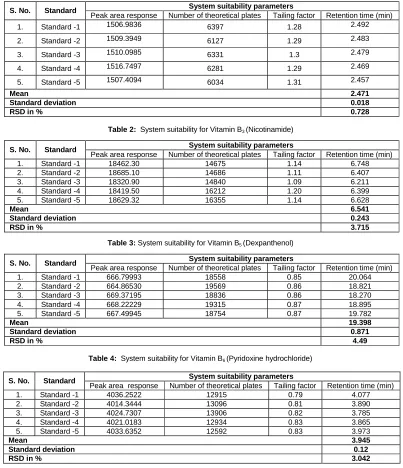
It is essential for the assurance of the quality performance of chromatographic system. Five injections of standard drug solutions, Vitamins B1 (Thiamine hydrochloride), B3 (Nicotinamide), B5
(Dexpanthenol) and B6 (Pyridoxine hydrochloride) were given
separately to the system. The system suitability parameters such as retention time, peak area response, Tailing factor and number of theoretical plates and their Mean, Standard deviation & %RSD were also be calculated for the standard drug solutions and mentioned in Table 1 - 4. It was observed that all the values are with in the limits.
Table 1: System suitability for Vitamin B1 (Thiamine hydrochloride)
S. No. Standard System suitability parameters
Peak area response Number of theoretical plates Tailing factor Retention time (min)
1. Standard -1 1506.9836 6397 1.28 2.492
2. Standard -2 1509.3949 6127 1.29 2.483
3. Standard -3 1510.0985 6331 1.3 2.479
4. Standard -4 1516.7497 6281 1.29 2.469
5. Standard -5 1507.4094 6034 1.31 2.457
Mean 2.471
Standard deviation 0.018
RSD in % 0.728
Table 2: System suitability for Vitamin B3 (Nicotinamide)
S. No. Standard System suitability parameters
Peak area response Number of theoretical plates Tailing factor Retention time (min)
1. Standard -1 18462.30 14675 1.14 6.748
2. Standard -2 18685.10 14686 1.11 6.407
3. Standard -3 18320.90 14840 1.09 6.211
4. Standard -4 18419.50 16212 1.20 6.399
5. Standard -5 18629.32 16355 1.14 6.628
Mean 6.541
Standard deviation 0.243
RSD in % 3.715
Table 3: System suitability for Vitamin B5 (Dexpanthenol)
S. No. Standard System suitability parameters
Peak area response Number of theoretical plates Tailing factor Retention time (min)
1. Standard -1 666.79993 18558 0.85 20.064
2. Standard -2 664.86530 19569 0.86 18.821
3. Standard -3 669.37195 18836 0.86 18.270
4. Standard -4 668.22229 19315 0.87 18.895
5. Standard -5 667.49945 18754 0.87 19.782
Mean 19.398
Standard deviation 0.871
RSD in % 4.49
Table 4: System suitability for Vitamin B6 (Pyridoxine hydrochloride)
S. No. Standard System suitability parameters
Peak area response Number of theoretical plates Tailing factor Retention time (min)
1. Standard -1 4036.2522 12915 0.79 4.077
2. Standard -2 4014.3444 13096 0.81 3.890
3. Standard -3 4024.7307 13906 0.82 3.785
4. Standard -4 4021.0183 12934 0.83 3.865
5. Standard -5 4033.6352 12592 0.83 3.973
Mean 3.945
Standard deviation 0.12
T. Jeyalakshmi et al / Int. J. Pharm. Phytopharmacol. Res. 2014; 4 (2): 89-94
3.2 Specificity
The specificity of the HPLC method is illustrated in Fig. 5, where a complete separation of Vitamins B1, B3, B5, and B6 were noticed in
presence of other inactive excipients used in injections. In addition, there was no any interference at the retention time of in the chromatogram of placebo solution. In peak purity analysis with PDA, purity angle was always less than purity threshold for the analyte. This shows that the peaks of analyte were pure and excipients in the formulation does not interfere the analyte. The data were presented in the Table 5 -8.
Table 5: Specificity for Vitamin B1 (Thiamine hydrochloride)
S. No. Name No. of Injections Area
1. Blank 1 Nil
2. Placebo 1 Nil
3. Standard 1 1496.62610
4. Sample 1 1453.84509
Table 6: Specificity for Vitamin B3 (Nicotinamide)
S. No. Name No. of Injections Area
1. Blank 1 Nil
2. Placebo 1 Nil
3. Standard 1 618.68878
4. Sample 1 689.46204
Table 7: Specificity for Vitamin B5 (Dexpanthenol)
Table 8: Specificity for Vitamin B6 (Pyridoxine hydrochloride)
S. No. Name No. of Injections Area
1. Blank 1 Nil
2. Placebo 1 Nil
3. Standard 1 3758.68530
4. Sample 1 3687.21362
Figure 5: Typical HPLC Chromatogram of Sample Injection
(Vitamins B1, B3, B5, and B6)
3.3 Linearity and Range
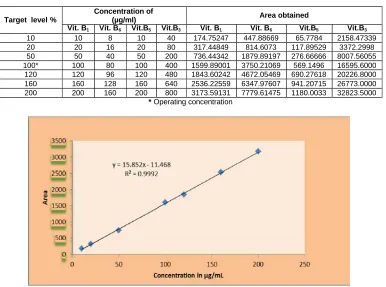
The Linearity of this method was determined at five levels from 10%– 200% of operating concentrations for Vitamins B1, B3, B5, & B6
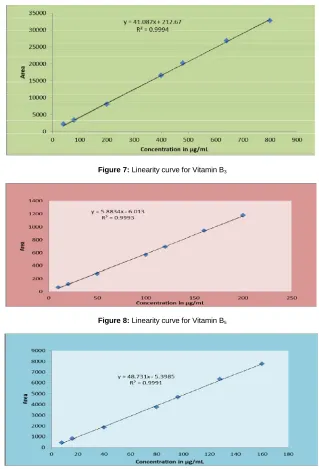
and it was shown in Table 9. The plots of peak area of each sample against respective concentrations of Vitamins B1, B3, B5, and B6 were
found to be linear (Fig.6 – 9) in the range of 10%– 200% of operating concentrations. Beer’s law was found to be obeyed over this concentration range. The linearity was evaluated by linear regression analysis using least square method. The linear regression equations and correlation coefficient were found. It observed that correlation coefficient and regression analysis were with in the limits.
Table 9: Linearity of response for Vitamins B1, B3, B5 and B6
Target level %
Concentration of
(µg/ml) Area obtained
Vit. B1 Vit. B6 Vit.B5 Vit.B3 Vit. B1 Vit. B6 Vit.B5 Vit.B3
10 10 8 10 40 174.75247 447.88669 65.7784 2158.47339
20 20 16 20 80 317.44849 814.6073 117.89529 3372.2998
50 50 40 50 200 736.44342 1879.89197 276.66666 8007.56055
100* 100 80 100 400 1599.89001 3750.21069 569.1496 16595.6000
120 120 96 120 480 1843.60242 4672.05469 690.27618 20226.8000
160 160 128 160 640 2536.22559 6347.97607 941.20715 26773.0000
200 200 160 200 800 3173.59131 7779.61475 1180.0033 32823.5000
* Operating concentration
Figure 6: Linearity curve for Vitamin B1
S. No. Name No. of Injections Area
1. Blank 1 Nil
2. Placebo 1 Nil
3. Standard 1 18.8249
Figure 7: Linearity curve for Vitamin B3
Figure 8: Linearity curve for Vitamin B5
Figure 9: Linearity curve for Vitamin B6
3.4 Accuracy
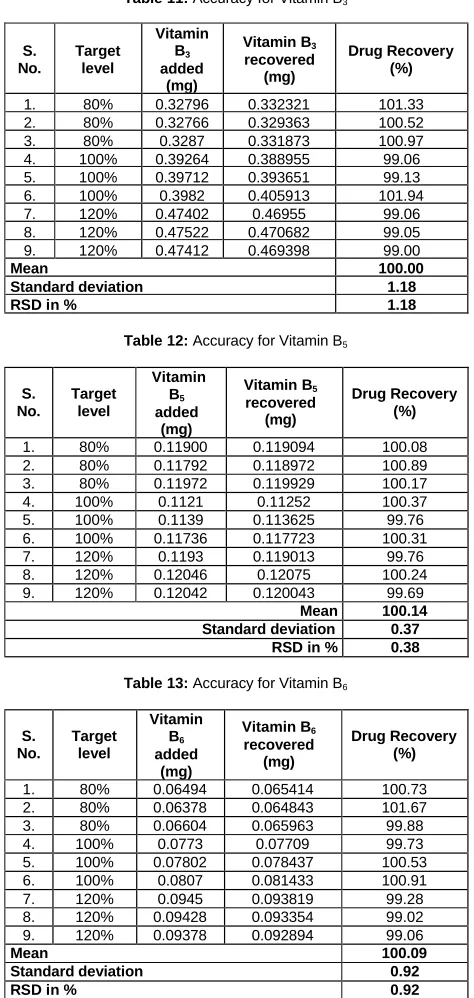
Accuracy of the method was found out by recovery study by standard addition method. The known amounts of standards, Vitamins B1, B3, B5, & B6 were added to pre-analysed samples at a
level from 80% up to 120% and then subjected to the proposed HPLC method individually. The results of recovery studies were shown in Table 10 -13. It was observed that the mean percentage recoveries were found to be for Vitamins B1, B3, B5, & B6 which
demonstrated that the method was highly accurate.
Table 10: Accuracy for Vitamin B1
S. No. Target level
Vitamin B1
added (mg)
Vitamin B1
recovered (mg) Drug Recovery (%)
1. 80% 0.08072 0.081959 101.53
2. 80% 0.08256 0.081978 99.29
3. 80% 0.08372 0.082925 99.05
4. 100% 0.0973 0.097017 99.71
5. 100% 0.09936 0.098721 99.36
6. 100% 0.1033 0.102717 99.44
7. 120% 0.1204 0.119976 99.65
8. 120% 0.1193 0.11935 100.04
9. 120% 0.1191 0.11957 100.39
Mean 99.82
Standard deviation 0.75
T. Jeyalakshmi et al / Int. J. Pharm. Phytopharmacol. Res. 2014; 4 (2): 89-94
Table 11: Accuracy for Vitamin B3 Table 14: Precision – Repeatability for Vitamin B1
Table 12: Accuracy for Vitamin B5
Table 15: Precision – Repeatability for Vitamin B3
Table 16: Precision – Repeatability for Vitamin B5
Table 13: Accuracy for Vitamin B6
Table 17: Precision – Repeatability for Vitamin B6
3.5 Precision
The precision of an analytical procedure expresses the closeness of agreement between a series of measurements obtained from multiple sampling of the homogenous sample under the prescribed conditions.
3.6 Repeatability
Repeatability is the precision of a method under the same operating conditions over a short period of time. One aspect of this is instrumental precision. A second aspect is sometimes termed intra- assay precision and involves multiple measurements of the same sample by the same analyst under the same conditions. Repeatability data for Vitamins B1, B3, B5, & B6 were shown in Table
14 -17. This indicated that method was highly precise.
3.7 Ruggedness
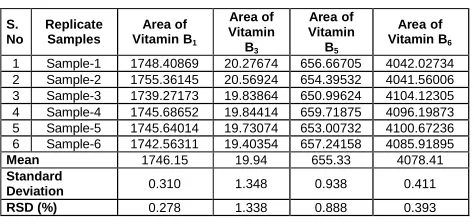
Six sample preparations were analyzed as per the methodology by a different analyst on a different instrument on a different day. The robustness data for Vitamins B1, B3, B5, & B6 were shown in Table
18. It was observed that there were no marked changes in the chromatograms, which demonstrated that the proposed method was ruggedness.
S. No.
Sample
Name Area
Amount of drug present
(mg)
Drug Recovery
(%)
1. Sample -1 1835.636 5.57 111.40
2. Sample -2 1874.873 5.68 113.60
3. Sample -3 1968.618 5.57 111.40
4. Sample -4 2002.918 5.67 113.40
5. Sample -5 2047.996 5.68 113.60
6. Sample -6 2026.000 5.59 111.80
Mean 112.53
Standard deviation 1.10
RSD in % 0.98
S. No. Target level Vitamin B3 added (mg)
Vitamin B3
recovered (mg)
Drug Recovery (%)
1. 80% 0.32796 0.332321 101.33
2. 80% 0.32766 0.329363 100.52
3. 80% 0.3287 0.331873 100.97
4. 100% 0.39264 0.388955 99.06
5. 100% 0.39712 0.393651 99.13
6. 100% 0.3982 0.405913 101.94
7. 120% 0.47402 0.46955 99.06
8. 120% 0.47522 0.470682 99.05
9. 120% 0.47412 0.469398 99.00
Mean 100.00
Standard deviation 1.18
RSD in % 1.18
S. No.
Sample
Name Area
Amount of drug present
(mg)
Drug Recovery
(%)
1. Sample -1 21801.40 21.35 106.75
2. Sample -2 21013.05 20.55 102.75
3. Sample -3 22437.25 20.50 102.50
4. Sample -4 22522.50 20.57 102.85
5. Sample -5 23131.00 20.69 103.45
6. Sample -6 23301.10 20.74 103.70
Mean 103.66
Standard deviation 1.57
RSD in % 1.52
S. No. Target level Vitamin B5 added (mg)
Vitamin B5
recovered (mg)
Drug Recovery (%)
1. 80% 0.11900 0.119094 100.08
2. 80% 0.11792 0.118972 100.89
3. 80% 0.11972 0.119929 100.17
4. 100% 0.1121 0.11252 100.37
5. 100% 0.1139 0.113625 99.76
6. 100% 0.11736 0.117723 100.31
7. 120% 0.1193 0.119013 99.76
8. 120% 0.12046 0.12075 100.24
9. 120% 0.12042 0.120043 99.69
Mean 100.14
Standard deviation 0.37
RSD in % 0.38 No.S. Sample Name Area
Amount of drug present
(mg)
Drug Recovery
(%)
1. Sample -1 676.740 5.35 107.00
2. Sample -2 665.323 5.25 105.00
3. Sample -3 727.344 5.37 107.40
4. Sample -4 736.088 5.43 108.60
5. Sample -5 725.891 5.24 104.80
6. Sample -6 734.753 5.28 105.60
Mean 106.4
Standard deviation 1.50
RSD in % 1.42
S. No. Target level Vitamin B6 added (mg)
Vitamin B6
recovered (mg)
Drug Recovery (%)
1. 80% 0.06494 0.065414 100.73
2. 80% 0.06378 0.064843 101.67
3. 80% 0.06604 0.065963 99.88
4. 100% 0.0773 0.07709 99.73
5. 100% 0.07802 0.078437 100.53
6. 100% 0.0807 0.081433 100.91
7. 120% 0.0945 0.093819 99.28
8. 120% 0.09428 0.093354 99.02
9. 120% 0.09378 0.092894 99.06
Mean 100.09
Standard deviation 0.92
RSD in % 0.92
S. No.
Sample
Name Area
Amount of drug present
(mg)
Drug Recovery
(%)
1. Sample -1 4514.453 4.27 106.75
2. Sample -2 4581.609 4.33 108.25
3. Sample -3 4761.943 4.20 105.00
4. Sample -4 4845.079 4.27 106.75
5. Sample -5 5010.323 4.33 108.25
6. Sample -6 5064.331 4.35 108.75
Mean 107.29
Standard deviation 1.40
Table 18: Ruggedness data for Vitamins B1, B3, B5, & B6 S. No Replicate Samples Area of
Vitamin B1
Area of Vitamin B3 Area of Vitamin B5 Area of
Vitamin B6
1 Sample-1 1748.40869 20.27674 656.66705 4042.02734 2 Sample-2 1755.36145 20.56924 654.39532 4041.56006 3 Sample-3 1739.27173 19.83864 650.99624 4104.12305 4 Sample-4 1745.68652 19.84414 659.71875 4096.19873 5 Sample-5 1745.64014 19.73074 653.00732 4100.67236 6 Sample-6 1742.56311 19.40354 657.24158 4085.91895
Mean 1746.15 19.94 655.33 4078.41
Standard
Deviation 0.310 1.348 0.938 0.411
RSD (%) 0.278 1.338 0.888 0.393
4. CONCLUSION
The Proposed study describes a simple, feasible and sensitive reverse-phase high-performance liquid chromatographic method for the quantitative determination of vitamins B1, B3, B5 and B6 in a
combined multivitamin injection dosage form. The method was validated as per ICH guidelines and found to be simple, specific, linear and precise. Therefore the proposed method can be successfully used for the routine analysis of vitamins B1, B3, B5 and
B6 in pharmaceutical dosage form without interference.
5. ACKNOWLEDGEMENTS
The authors are thankful to the management of Caplin Point Laboratories Limited, Chennai – 601 201, Tamil Nadu, India for providing the necessary facilities to carry out for the research work. REFERENCES
1. http://www.nlm.nih.gov/medlineplus/druginfo/natural/965.h t ml
2. https://doctorvolpe.com/add-adhd/vitamin-b3 3. http://www.drugs.com/pro/dexpanthenol.html 4. http://www.diclegis.com/
5. Smita C. Nayak1, Preeti V. Kulkarni1, Vaidhun Bhaskar, Vinit Chavhan, “Development and Validation Of UV Spectrophotometric Method For Simultaneous Estimation Of Doxylamine Succinate and Pyridoxine Hydrochloride In Bulk And Tablet Dosage Form”,
International Journal of Pharmacy and Pharmaceutical Sciences, 2013;5(3),:390- 393.
6. N. Kitprapiumpo, P. Kulkanjanatorn and S. Wongyai, “Determination of Cyanocobalamin in Multivitamin Tablets by Multimode High-Performance Liquid Chromatography”, Mahidol University Journal of Pharmaceutical Science, 2011; 381-2, 8-12: 9-12. 7. Zhi Chen, Bo Chen, Shouzhuo Yao, “High-performance
liquid chromatography/electrospray
ionization- massspectrometry for simultaneous determination of taurine and 10 water-soluble vitamins in multivitamin tablets”, Analytical Chemical Acta, 2006; 569 :169–175.
8. K. Li., Simultaneous determination of nicotinamide, pyridoxine hydrochloride, thiamine mononitrate and riboflavin in multivitamin with minerals tablets by reversed- phase ion-pair high performance liquid chromatography, Biomedical Chromatography, 2002; 16(8): 504–507.
9. ICH guidelines, analytical method validation (Q3). Geneva, July 2000.
10. Pourmeidani H, Habibi M. Hierarchical defect tolerance technique for NRAM repairing with range matching CAM. 2013 21st Iranian Conference on Electrical Engineering, ICEE 2013.
11. Habibi M, Pourmeidani H. A hierarchical defect repair approach for hybrid nano/CMOS memory reliability enhancement. 2014. Microelectronics Reliability. 54(2), pp. 475-484.
12. Niafar M, Bahrami A, Aliasgharzadeh A,
Aghamohammadzadeh N, Najafipour F, Mobasseri M. Vitamin D status in healthy postmenopausal Iranian women. 2009. Journal of Research in Medical Sciences. 14(3), pp. 171-177
13. Abolghasemi J, Eshraghian MR, Toosi MN, Mahmoodi M,
14. Adib S, Tiraihi T, Darvishi ., Taheri T, Kazemi H. Cholinergic differentiation of neural stem cells generated from cell aggregates-derived from Human Bone marrow stromal cells. Tissue Engineering and Regenerative Medicine, 2014. 12(1), pp. 43-52
15. Amiridavan M, Nemati S, Hashemi SM, Jamshidi M, Saberi A, Asadi M. Otoacoustic emissions and auditory brainstem responses in patiens with sudden sensorineural hearing loss. Do otoacoustic emissions have prognostic value?. 2006. Journal of Research in Medical Sciences
16. Mousavimughaddam SR. Healthy man and its role in the spiritual health and mental health from the viewpoints of rene descartes and allamah tabatabaei based on the interpretative attitude of almizan. 2014, Journal of Zanjan University of Medical Sciences and Health Services. 22(90), pp. 33-44
17. Pakiman K, Ashoori T, Najafi M, Tabesh A, Abediniangerabi B. Micro tunneling in Tehran metropolis. International No-Dig Madrid 2014. International No-No-Dig Madrid 2014. IFEMA Convention CentreMadrid; Spain; 13 October 2014 through 15 October 2014; Code 110896.
18. Rezaee O, Sharifi G, Samadian M, Haddadian K, Ali-Asgari A, Yazdani M. Endoscopic third ventriculostomy for treatment of obstructive hydrocephalus. 2007. Archives of Iranian Medicine. 10(4), pp. 498-503
19. Shushizadeh MR, Kiany M. Solvent-free alkylation of dimethyl malonate using benzyl alcohols catalyzed by FeCl3/SiO2. 2009. Chinese Chemical Letters. 20(9), pp. 1068-1072.
20. Rastegarian ., Abedi HA, Sepidkar A, Kheyrkhah N, Jahrom HK, Farzam M. The use of laryngeal mask airway in pilonidal cyst excision after muscle relaxant (Atracurium) injection in prone position. 2014. Biosciences Biotechnology Research Asia. 11(2), pp. 875-878.
21. Rastegarian A, Abedi HA, Sepidkar A, Kheyrkhah N, Jahrom HK, Farzam M. The use of laryngeal mask airway in pilonidal cyst excision after muscle relaxant (Atracurium) injection in prone position. Biosciences Biotechnology Research Asia. 2014, 11(2), pp. 875-878
22. Khayati G, Anvari M, Kazemi S. Peanut pod-an inexpensive
substrate for β-galactosidase production by Bacillus sp. in
solid-state fermentation: Process evaluation and optimization by Taguchi design of experimental (DOE) methodology. Minerva Biotecnologica.2014. 26(4), pp. 301-307
23. Mobasseri M, Bahrami A, Zargami N, Aliasgarzadeh A, RhmatiB M, Delazar, A, Agamohmmadzadeh N. Effect of total extract of Urtica dioica on insulin and C-peptide secretion from rat (RIN5F) pancreatic β cells and glucose utilization by human muscle cells. 2010. Iranian Journal of Endocrinology and Metabolism. 11(6), pp. 721-727+743.
24. Ansarin K, Niroomand B, Najafipour F.,
Aghamohammadzadeh N, Niafar M, Sharifi A, Shoja MM. End-tidal CO2 levels lower in subclinical and overt hypothyroidism than healthy controls; no relationship to thyroid function tests. 2011. International Journal of General Medicine. 4, pp. 29-33.
25. arassoli A, Shushizadeh MR. Synthesis and
characterization of tris[2,3-di(o-oxyphenylene)quinoxalin]
cyclotriphosphazene - A novel
spiroheterocyclophosphazene. 2003. Phosphorus, Sulfur and Silicon and the Related Elements. 178(4), pp. 803-809. 26. Sharifi V, Bakhshaie J, Hatmi, Z, Faghih-Nasiri L,
Sadeghianmehr Z, Mirkia S, Mirsharifa SM. Self-reported psychotic symptoms in the general population: Correlates in an Iranian Urban area. 2012. Psychopathology. 45(6), pp. 374-380.
27. Ashrafi MR, Salehi S, Malamiri RA, Heidari M, Hosseini SA, Samiei M, Tavasoli AR, Togha M. Efficacy and safety of cinnarizine in the prophylaxis of migraine in children: A double-blind placebo-controlled randomized trial. 2014. Pediatric Neurology. 51(4), pp. 503-508
28. Shushizadeh MR, Dalband N. SiO 2/H 2SO 4: An efficient catalytic system for solvent-free 1, 5-benzodiazepines synthesis. 2012. Jundishapur Journal of Natural Pharmaceutical Products. 7(2), pp. 61-64.