Abstract
The present paper attempts to explain the impact of demonetization on NIFTY returns using historical volatility. Demonetization is one of the historic events not only within the economy but also even beyond borders of the nation. The recent economic surgical strike on November 8, 2016 stunned the markets, which instrumented by Government of India (GOI) to limit black money circulation in the market. To study the impact of demonetization as one of the effects on Indian Incorporation, in this research, differences between returns of historical volatility of the country best managed portfolio NIFTY.
Keywords: Close to Close estimator, Parkinson, Garman-Klass, Rogers-Satchell, Yang and Zhang
1.
Introduction
Demonetization was one of the boldest steps taken by Government of India to curb the huge net of black money in the country in order to bring more number of people within the tax bracket. The massive strike enabled the sub continent to wipe out 86% of total money circulation from the economy.This specific move of government impacted India till its bottom and every single citizen and companies present in India felt the waves passing through them.
Indian stock market was highly impacted by such strict action of government. Investors run out of money and huge chaos apparently evident in the market place. Immediately a day after the announcement was made on 8th November 2016, a steep fall was observed in both the indices viz BSE and NSE. BSEs' Sensex and NSEs' Nifty fell by over 338 and 111 points respectively on 9th November 2016, which was the immediate effect of demonetization.
The Figure -1 elucidates the one-year forward price-earnings (P-E) multiple of the MSCI India Index with that of MSCI Asia ex-Japan. It is obviously understood from the figure that the difference between MSCI India P-E multiple and the MSCI Asia ex-Japan P-E multiple has come down from 4.9 on 8 November to 4.6 now. That could be the impact of demonetization, but it's not much
Historical volatility of NIFTY Returns and Demonetisation
-An Overview
– Param Raj* – M.P.Pandikumar**
(Source: Livemint- 3rd January 2017)
Figure 1:PE Multiple of MSCI India and MSCI Asia Ex-Japan
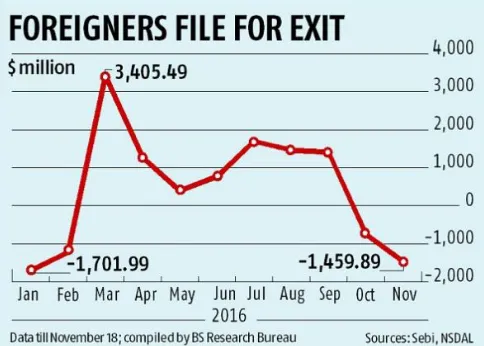
The sharp fall reckoned shaken confidence of Foreign Institutional Investors (FIIs) in Indian markets. FIIs withdrawn an amount of around $1billion just within 6 trading days after the demonetization move by government of India.
(Source: Business Standard, 21st November 2016)
Among all the sectors in India Incorporation, Automobiles and Realty were identified much impacted sectors , those two largely dependent upon huge amount of money. Bank, IT and Pharma sector were also to be the hitters of demonetization. The move was predicted as a cause for steep fall in the GDP numbers. Many Economists and corporate leaders predicted that the GDP figure will fall as low as 5% in the third fiscal (October-December)'16. But against all the predictions ,GDP figures came out to be a healthy number of 7% which was just a minor correction of 0.4%. Many are still not agreeing with the number released by Central Statistical Organization (CSO). and claiming that it was just a false figure to win accolades for the demonetization move. But the figures can be right. It may be possible that the impact may be seen in the coming quarters or no impact at all.
Demonetization move might be a short term hurdle, but in the long run it will be beneficial to both Indian Investors and Indian economy . This move driven Indian populace to keep a large amount of their money in banks which not only enhanced the savings rate of India and also channelized a huge sum in Indian stock market. This massive economic action evolved a pathway for consolidation of Indian banking and financial industry, but also mooted a paradigm shift in financial and digital literacy among Indian population In a nutshell, this move benefits all the stakeholders of the subcontinent viz Government of India (GOI), people, companies or banks.
2.
Review of Existing Literature
Ederington, Louis H; Guan,et.al. (2006) concluded that the adjusted mean absolute deviation is proposed as a simple-to-calculate alternative to the historical standard deviation as a measure of historical volatility and an input to option pricing models. They showed that this measure forecasts future volatility consistently better than the historical standard deviation across a wide variety of markets. Moreover, it forecasts as well as or better than the GARCH (1,1) model and can be used in future models to improve the efficiency and giving a better estimation of efficiency and accuracy.
Fiszeder Piotr and GrzegorzPerczak (2013)conducted a study to evaluate the properties of most of the historical volatility measures based on open, high, low and close prices and suggested some new methods of measuring the historical volatility. They then applied the newly constructed estimators on the Polish Index WIG20. They concluded that estimators based on open, high, low and close are much more efficient than GARCH models and GARCH models must be based on all these four prices to give a much more comprehensive and accurate picture of volatility.
HanzaeiHaiderzadehAlireza (2016) conducted a study on Tehran Stock Exchange. In his study, he analyzed the Intra-day volatility of Tehran stock exchange from 21st September 2011 to 21st September 2013 to test the efficiency of various estimators through which historical volatility can be computed. The data was collected within a time frame of 9AM to 12AM at every interval of 30 minutes and therefore, there were 6 observations recorded for the day. He founded Parkinson estimator as the best estimator in giving the detailed picture about historical volatility. He concluded that a good volatility should not only contain the information about the closing prices but also about the price range as well.
Kumar Dilip and S. Maheshwaran (2014) developed a new framework for measuring the volatility based on Conditional Autoregressive Range (CARR). This new framework was known as Conditional Autoregressive Rogers and Satchell (CARRS) which is a modified version of original Rogers-Satchell model. They conducted regression test on CARRS and fond that that the estimation provided by CARRS is much superior to any other alternative tool of measuring volatility present.
Shu Jinghong and Jin E. Zhnag (2006) conducted a study to test the efficiency and biasedness level in various estimators of historical volatility. They found that all estimators performed well when the price follows a continuous geometric Brownian motion. However, with the introduction of jumps and drift the efficiency of each estimators keep on reducing. They found in their empirical research on S&P 500 that the usage of traditional measure of volatility and range based volatility gave the same result. However, the information required in range based estimator is quite less as compared to traditional estimator. Hence, they concluded that range based estimators can be used to calculate historical volatility.
Yildirin Sinan and Kalpana Pai (2012) conducted a study analyzing the impact of TARP (Troubled Asset Relief program) legislation on the volatility of the stocks by using historical volatility estimators as well as GARCH technique. The basic objective was to analyze how TARP impacted the short-term volatility of stocks. The study concluded that Intra-day volatility as measured by various indicators was found decreasing in many of the institutions and Inter day volatility as measured by GARCH (1,1,) also supports the same conclusion. Hence, government intervention indeed reduced the volatility.
3.
Objectives of the Study
The present study is with reference to analyze Demonetization impact on NIFTY returns through following mentioned objectives:
1. To analyze the impact of demonetization on the NIFTY returns by using various historical volatility estimators.
2. To study significant difference in historical volatility in NIFTY before and after the declaration of demonetization i-e November 8,2016.
4.
Methodology of the Study
The methodology used in achieving the desired objectives considers the following points:
a. Time period of study: The time horizon of this study is 90 days before and 90 days after demonetization. Demonetization happened on 8th November 2016, hence the study period is from 8th August 2016 to 8th February 2017. The selection of that specific horizon was with reference to an impact of demonetization in the Indian economy and Indian stock market till the end of January 2017. At the end of January, the cash circulation problem was solved in the economy and status quo was achieved.
b. Data Computation: The volatility has been computed on intra-day basis for each day. It is further assumed that the intra-day volatility of one day is independent of another day that is there is random walk in the intra-day volatility and on none of the days intra-day volatility was co-integrated.
c. Data Source: Secondary data of Open, high, low and close prices of NIFTY for each day are used in computation in accordance with the volatility tool used.
d. . Softwares used : Historical volatility estimators and T-test statistic are calculated by instrumenting MS-Excel'2013 and SPSS'18
5.
Tools used in the Study
The following tools were used in computation of historical volatility. Each of these tools has its own advantages and disadvantages.
5.1
Close to close Estimator
Close to Close estimator is the easiest method available in calculating the historical volatility. In calculating the volatility, only the closing prices of a day is considered. The key advantage of using this estimator is its simplicity of usage and freedom from any bias on account of market activity. But the main disadvantage of this estimator is limited to the closing prices and rest of them viz Opening, high and low are ignored. These prices are also important while calculating the historical volatility and will be discussed in the further estimators. Because of this disadvantage, the efficiency level is impacted. Historical volatility is computed by using the below mentioned formula.
Formula 1
5.2
Parkinson Estimator (High-Low Volatility Estimator):
Parkinson estimator was developed by Parkinson in 1980. This was the first advance volatility measure developed with both high and low prices but not closing unlike the previous estimator . This approach of calculating volatility is known as extreme value approach and it helps in reflecting a greater detail throughout a given period. This estimator is 5 times more efficient than close to close estimator. But on the other hand, this estimator assumes continuous trading without any halt. In reality, the stock market is closed on some days due to which potential movement of prices are ignored and volatility is underestimated. This measure is considered as the best for calculating volatility. This estimator is given by the formula:
Formula 2
Where: li = low price
hi = high price
5.3
Garman Klass Estimator (Ohlc Estimator)
Based on the study done by Parkinson, Garman Klass went a step further and incorporated a model in early 1980's which not only considers the high and low prices but the opening and closing as well. Due to these characteristics, this estimator is much more efficient as compared to Parkinson. This estimator is 8 times more efficient than close to close estimator and able to reflect higher amount of information available. This indicator is calculated by using the following formula:
Formula 3
Where li = low price hi = high price ci = closing price
ci-1 = Yesterday closing price
5.4 Rogers Satchell Estimator (Ohlc Estimator)
Formula 4
Where li = low price
hi = high price
ci = closing price
oi = opening price
5.5
Yang-Zhang Estimator (Ohlc Estimator)
This estimator is the latest and most powerful tool available for calculating the volatility. This estimator was developed in the year 2000 by Yang-Zhang. Unlike, other estimators, this estimator can handle both the drift as well as jump. This estimator is calculated by taking the weighted average of Rogers-Satchell, open to close and close to open volatility. The efficiency is best achieved and Yang Zhang is 14 times more efficient than close to close estimator. But like Parkinson, Yang-Zhang also assumes continuous trading due to which it can underestimates volatility. Also, too much of jumps, can make Yang Zhang as equivalent to close to close estimator. Yang Zhang is given by the following formula:
Formula 5
and, k = 0.34 / (1 + (n+1)/ (n-1))
5.6
Independent Sample Student Distribution T-Test
T-test is intstrumented in order to study the significant difference between two serial of observations viz Returns of historical volatility of NSE indices before and after Demonetisation ,. The test assumes that both samples are independently collected and null hypothesis is tested in order to study the significant difference between two independent observations. In accordance with the assumption of equal variance or its violation, the formula for computing t statistic value differs.
Formula 6
In case if the variances are not equal, then the t value is computed by the following formula:
Formula 7
Where,
x¯1 = Mean of first sample
x¯2 = Mean of second sample
n1 = Sample size (i.e., number of observations) of first sample
n2 = Sample size (i.e., number of observations) of second sample
S1 = Standard deviation of first sample
S2 = Standard deviation of second sample
Sp = Pooled standard deviation
The calculated t-value is compared against the critical value from t distribution table at a degree of freedom and accordingly the significance level is assessed.
6.
Analytical Framework
In performing the analytical framework, the first step chosen is to form the null and alternate hypothesis. In the present study, null and alternate hypothesis are chosen as follow:
Null Hypothesis (Ho): There is no significant difference in the historical volatility of NIFTY returns before and after demonetization.
Alternate Hypothesis(H1): There is a significant difference in the historical volatility of NIFTY returns before and after demonetization.
The testing of null and alternate hypotheses remain same for all historical volatility estimators.
The next vital step in the analytical framework is to test the significance of calculated intraday volatility of each estimator using Independent T-test. The test was performed with the help of SPSS'18 and it is obviously understood from the Table -1
Table 1: Independent sample T-test significance levels (At 95% level)
Estimator used Sig. Level
Close to close Estimator Parkinson Estimator German-Klass Estimator Rogers-Satchell Estimator Yang-Zhang Estimator Leven’s Test for
Equality of Variance
0.168 0.201 0.155 0.104 0.352
Equal Variances Assumed
0.495 0.246 0.237 0.221 0.255
Equal Variances Not Assumed
0.467 0.168 0.153 0.143 0.172
In all the estimators used, the significance level is greater than 0.05 which ultimately leads to the rejection of alternate hypothesis. This means that there was no significant change in historical volatility of NIFTY returns before and after demonetization in each estimator.
To find out the reasons for the result , an analysis of sectoral composition of NIFTY has been done and the impact of demonetization has been studied with respect to certain specific sectors. The composition of various sectors in NIFTY are as follows:
Table 2: Sectoral composition of NIFTY
Sector Percentage Allocation
Fin. Services 32.29%
IT 13.54%
Energy 12.74%
Automobiles 11.28%
Consumer Goods 10.10%
Pharma 5.91%
Construction 3.69%
Cement &Cement Products 3.06%
Metals 2.99%
Telecom 2.36%
Media& Entertainment 0.85%
Services 0.74%
Industrial Manufacturing 0.45%
Figure 3: Sectoral Composition of NIFTY
Demonetization had its own impact on each of the sector mentioned in Table1. In accordance with the impact, the major sectors can be broadly classified into two categories:
Postively Impacted Sectors
Financial Services
Financial services were one of the main beneficiaries of demonetization move of Indian government. With such a move, a huge sum of money flowed into the saving account which helped the banks to their deposit base and cut down on their lending rates. Around Rs.5 lakh crores of money were deposited in lakhs of accounts. Therefore, demonetization helped in creating a positive impact on the Banking and financial services sector.
Information Technology
After demonetization move of government, many business will be required to switch to digital payments. To enable digital platform, the services of IT companies will be required,which would help IT companies in enhancing their client base and increasing their revenue. IT companies themselves could enter digital space to facilitate ease of transaction .
Energy
In Power sector, Government allowed people to exchange their old notes to pay the electricity bills. Therefore, the companies started collecting many of the unsettled electricity bills across sub continent during this mega campaign , really benefited them to downsize their book debts .
Negatively Impacted Sectors
Automobiles
Within automobile sector, there are various categories of players and the impact of demonetization differs from player to player. Within automobile sector, massive impact on two-wheeler segment because generally people prefer to buy two-wheeler against cash .
Within four-wheeler, it is a common trend to go for financing options. A clear majority of car-buyers opt for financing options when they go out to buy a new car. Similarly, majority of trucks and tractors sold in this space is on financing basis. Therefore, the overall impact of demonetization was negative.
Consumer Goods
Consumer goods sector was worst impacted by demonetization. Consumer goods represents discretionary demand on part of consumer which can be curtailed in case of any unfortunate event.
JM Financial Report
JM financial stated that sales with consumer goods sector will be done by almost 20-25 percent in the month of November and 10-12 percent in the month of December. Therefore, demonetization created a negative impact on consumer goods sector.
Source: New Indian Express, January 11, 2017
Pharma
As of now, majority of the business done in pharma sector was without any invoice raised, but with demonetization, the pharma sector will be much more regulated and this would make it compulsory for retailers to raise the bill for each sale. With the proper billing of medicine, government will also find it easy any harmful or illegal drug in the market and can ban the drug. New regulations will be in place which will stop bribing of hospitals and doctors by some of the big players in pharma industries. The overall impact of demonetization will be negative on some of the big pharma companies but such impact is good and is required to maintain the good practices in the sector.
Construction and Cement
sector. As a spillover effect, along with realty, construction and cement industry was also negatively impacted to a very large extent.
Findings
In analyzing the given objectives, these were the three broad findings:
1. There are no significant differences in the intra-day historical volatility of NIFTY returns before and after demonetization in any of the historical volatility estimator.
2. Financial services, Information Technology and Energy sectors were positively impacted by Demonetization move while sectors like Automobiles, Consumer goods, Pharma and Construction & Cement were negatively impacted.
3. NIFTY is a well hedged portfolio comprising of stocks from various sectors due to which the historical volatility was not significantly different before and after demonetization.
Suggestions
NIFTY is one of the best hedged portfolio in India. This index comprises of stocks of many sectors and thus is a true benchmark of measuring economic performance of the country. Demonetization did not have any impact on historical volatility of NIFTY returns, therefore, it is suggested to investors that they can go for any position in NIFTY be it short or long without worrying about any other demonetization move by the government in the future years.
Conclusion
The study concludes that there are no significant differences in the intra-day historical volatility before and after demonetization. Sectoral composition of NIFY was attributed as one of the main reasons for achieving such kind of outcome. It is understood from the sectoral composition viz Financial Services, Information technology and Energy account 57-60% of total NIFTY share were found to be positively impacted. Contrary to the early, some of the sectors such as Automobiles, Consumer Goods, Pharma, Construction and Cement account for 33-25% of total NIFTY share were found to be negatively impacted.
Scope for Further Research
The present study can be better done by incorporating the following points in further research:
1. The analysis is done only on NSE NIFTY. The study could have been made more comprehensive by inculcating sectoral indices. In the present study, the analysis was done by breaking down NIFTY into its sectoral composition and then the reason behind the conclusion was found out. Instead if sectoral indices were used, then a big picture can be obtained with less efforts.
2. The study could have been performed much better if different time frames were considered for studying the significance level. In present study, a time period of 90 days before and 90 days after demonetization is considered. But if separate time frame of say 25 days, 50 days and 90 days would have been considered then short term, medium term and long term significance of Intra-day volatilities could have been checked.
3. Along with Intra-day volatility, Inter-day volatility can also be studied for working out a broad framework showcasing the impact of demonetization on historical volatility of NIFTY.
References
1. Dennis Yang and Qiang Zhang, "Drift?Independent Volatility Estimation Based on High, Low, Open, and Close Prices", The Journal of Business, Vol. 73, No. 3 (July 2000), pp. 477-492
2. Ederington, Louis H. and Guan, Wei, "Measuring Historical Volatility". Journal of Applied Finance, Vol. 16, No. 1, Spring/Summer 2006
3. Fiszeder Piotr and Grzegorz Perczak, "A new look at variance estimation based on low, high and closing prices taking into account the drift", Statistica Neerlandica, Nov2013, Vol. 67 Issue 4, p456-481.
4. Garman Mark B., Klass Michael J. "On the Estimation of Security Price Volatilities from Historical Data", Journal of Business. Jan80, Vol. 53 Issue 1, p67-78.
5. Garvey John and Liam Gallagher, "The economics of data: Using simple model-free volatility in a high-frequency world" North American Journal of Economics & Finance, Dec2013, Vol. 26, p370-379.
6. Hanzaei, Alireza Heidrzadeh, "Properties of Range-Based Volatility Estimators using Intra-Day Data: Evidence from Tehran Securities Exchange (TSE)" Annual International Conference on Accounting & Finance. 2016, p108-116.
8. L. C. G. Rogers and S. E. Satchell, "Estimating Variance From High, Low and Closing Prices" The Annals of Applied Probability, Vol. 1, No. 4 (Nov., 1991), pp. 504-512
9. Jinghong Shu; Zhang, Jin E, "Testing Range Estimators of Historical Volatility", Journal of Futures Markets. Mar2006, Vol. 26 Issue 3, p297-313
10. Yildirim, Sinan; Pai, Kalpana, "Stock Market Volatility of the Financial Industry After TARP", Journal of Applied Financial Research. 2012, Vol. 2, p61-68
Websites used
1. www.nseindia.com
2. www.sensasecurities.com
3. www.wikipedia.com
4. www.ebscohost.com
Appendix
Intra-day Volatilities
Date Close to
close Parkinson
Garman -Klass
Rogers Satchell
Yang and Zhang
8-Aug-16 ---- 0.0018 0.0021 0.0021 ----
9-Aug-16 0.0038 0.0062 0.0064 0.0069 0.0030
10-Aug-16 0.0119 0.0087 0.0064 0.0048 0.0103
11-Aug-16 0.0020 0.0043 0.0048 0.0052 0.0064
12-Aug-16 0.0093 0.0055 0.0044 0.0037 0.0069
16-Aug-16 0.0034 0.0057 0.0064 0.0068 0.0025
17-Aug-16 0.0021 0.0044 0.0051 0.0051 0.0031
18-Aug-16 0.0057 0.0032 0.0033 0.0033 0.0037
19-Aug-16 0.0007 0.0034 0.0035 0.0037 0.0027
22-Aug-16 0.0044 0.0049 0.0051 0.0049 0.0044
23-Aug-16 0.0004 0.0043 0.0051 0.0060 0.0023
24-Aug-16 0.0020 0.0028 0.0033 0.0036 0.0024
25-Aug-16 0.0067 0.0069 0.0060 0.0052 0.0044
26-Aug-16 0.0023 0.0053 0.0054 0.0053 0.0070
29-Aug-16 0.0041 0.0055 0.0062 0.0065 0.0014
30-Aug-16 0.0158 0.0075 0.0054 0.0038 0.0117
Date Close to
close Parkinson
Garman -Klass
Rogers Satchell
Yang and Zhang
1-Sep-16 0.0013 0.0036 0.0041 0.0040 0.0016
2-Sep-16 0.0040 0.0038 0.0044 0.0045 0.0027
6-Sep-16 0.0150 0.0069 0.0051 0.0038 0.0108
7-Sep-16 0.0028 0.0037 0.0026 0.0018 0.0052
8-Sep-16 0.0039 0.0043 0.0044 0.0043 0.0011
9-Sep-16 0.0096 0.0054 0.0043 0.0035 0.0038
12-Sep-16 0.0172 0.0033 0.0037 0.0036 0.0210
14-Sep-16 0.0013 0.0035 0.0040 0.0040 0.0007
15-Sep-16 0.0018 0.0033 0.0039 0.0046 0.0029
16-Sep-16 0.0043 0.0066 0.0078 0.0084 0.0050
19-Sep-16 0.0032 0.0034 0.0038 0.0037 0.0021
20-Sep-16 0.0037 0.0039 0.0036 0.0035 0.0012
21-Sep-16 0.0001 0.0048 0.0055 0.0057 0.0031
22-Sep-16 0.0102 0.0038 0.0044 0.0045 0.0120
23-Sep-16 0.0041 0.0044 0.0039 0.0034 0.0031
26-Sep-16 0.0124 0.0065 0.0047 0.0034 0.0108
27-Sep-16 0.0019 0.0054 0.0055 0.0053 0.0074
28-Sep-16 0.0044 0.0044 0.0046 0.0045 0.0006
29-Sep-16 0.0178 0.0168 0.0135 0.0112 0.0097
30-Sep-16 0.0023 0.0057 0.0064 0.0063 0.0122
3-Oct-16 0.0146 0.0076 0.0073 0.0071 0.0123
4-Oct-16 0.0035 0.0033 0.0038 0.0041 0.0078
5-Oct-16 0.0029 0.0052 0.0042 0.0036 0.0046
6-Oct-16 0.0039 0.0066 0.0066 0.0063 0.0070
7-Oct-16 0.0014 0.0041 0.0046 0.0052 0.0049
10-Oct-16 0.0013 0.0029 0.0028 0.0027 0.0044
13-Oct-16 0.0157 0.0098 0.0091 0.0084 0.0117
14-Oct-16 0.0012 0.0038 0.0044 0.0048 0.0064
17-Oct-16 0.0074 0.0077 0.0060 0.0049 0.0061
18-Oct-16 0.0183 0.0090 0.0059 0.0036 0.0061
19-Oct-16 0.0022 0.0043 0.0042 0.0043 0.0073
Date Close to
close Parkinson
Garman -Klass
Rogers Satchell
Yang and Zhang
21-Oct-16 0.0007 0.0039 0.0045 0.0056 0.0011
24-Oct-16 0.0018 0.0036 0.0043 0.0043 0.0019
25-Oct-16 0.0020 0.0041 0.0043 0.0047 0.0019
26-Oct-16 0.0088 0.0042 0.0039 0.0039 0.0082
27-Oct-16 0.0000 0.0052 0.0061 0.0072 0.0030
28-Oct-16 0.0026 0.0050 0.0058 0.0062 0.0024
30-Oct-16 0.0014 0.0043 0.0038 0.0034 0.0040
1-Nov-16 0.0001 0.0038 0.0041 0.0040 0.0044
2-Nov-16 0.0131 0.0031 0.0031 0.0028 0.0136
3-Nov-16 0.0034 0.0043 0.0050 0.0055 0.0043
4-Nov-16 0.0061 0.0074 0.0070 0.0070 0.0051
7-Nov-16 0.0075 0.0038 0.0035 0.0034 0.0120
8-Nov-16 0.0055 0.0056 0.0066 0.0075 0.0051
9-Nov-16 0.0131 0.0346 0.0300 0.0261 0.0578
10-Nov-16 0.0111 0.0062 0.0069 0.0072 0.0353
11-Nov-16 0.0273 0.0126 0.0089 0.0061 0.0197
15-Nov-16 0.0229 0.0143 0.0103 0.0073 0.0246
16-Nov-16 0.0004 0.0089 0.0076 0.0068 0.0171
17-Nov-16 0.0039 0.0067 0.0077 0.0080 0.0090
18-Nov-16 0.0007 0.0060 0.0068 0.0068 0.0031
21-Nov-16 0.0181 0.0140 0.0095 0.0062 0.0127
22-Nov-16 0.0092 0.0061 0.0071 0.0077 0.0104
23-Nov-16 0.0039 0.0062 0.0071 0.0086 0.0069
24-Nov-16 0.0085 0.0054 0.0053 0.0049 0.0068
25-Nov-16 0.0185 0.0109 0.0098 0.0090 0.0091
28-Nov-16 0.0016 0.0059 0.0060 0.0057 0.0095
29-Nov-16 0.0019 0.0051 0.0059 0.0074 0.0045
30-Nov-16 0.0101 0.0070 0.0072 0.0071 0.0076
1-Dec-16 0.0038 0.0048 0.0041 0.0036 0.0028
2-Dec-16 0.0130 0.0066 0.0059 0.0053 0.0122
5-Dec-16 0.0052 0.0063 0.0068 0.0068 0.0018
Date Close to
close Parkinson
Garman -Klass
Rogers Satchell
Yang and Zhang
7-Dec-16 0.0051 0.0083 0.0084 0.0080 0.0048
8-Dec-16 0.0177 0.0076 0.0054 0.0039 0.0083
9-Dec-16 0.0018 0.0024 0.0027 0.0030 0.0084
12-Dec-16 0.0111 0.0056 0.0048 0.0043 0.0081
13-Dec-16 0.0062 0.0054 0.0060 0.0066 0.0032
14-Dec-16 0.0048 0.0047 0.0043 0.0041 0.0013
15-Dec-16 0.0035 0.0076 0.0088 0.0104 0.0085
16-Dec-16 0.0017 0.0038 0.0033 0.0031 0.0031
19-Dec-16 0.0043 0.0028 0.0028 0.0027 0.0055
20-Dec-16 0.0027 0.0046 0.0049 0.0048 0.0032
21-Dec-16 0.0026 0.0044 0.0039 0.0034 0.0046
22-Dec-16 0.0102 0.0061 0.0052 0.0045 0.0094
23-Dec-16 0.0008 0.0061 0.0071 0.0071 0.0043
26-Dec-16 0.0098 0.0058 0.0051 0.0046 0.0054
27-Dec-16 0.0156 0.0106 0.0085 0.0069 0.0050
28-Dec-16 0.0002 0.0054 0.0062 0.0074 0.0089
29-Dec-16 0.0085 0.0067 0.0056 0.0047 0.0041
30-Dec-16 0.0101 0.0061 0.0050 0.0043 0.0113
2-Jan-17 0.0008 0.0057 0.0064 0.0073 0.0052
3-Jan-17 0.0016 0.0052 0.0061 0.0063 0.0024
4-Jan-17 0.0002 0.0028 0.0031 0.0031 0.0013
5-Jan-17 0.0101 0.0043 0.0036 0.0031 0.0067
6-Jan-17 0.0036 0.0053 0.0056 0.0055 0.0016
9-Jan-17 0.0009 0.0026 0.0025 0.0023 0.0037
10-Jan-17 0.0064 0.0024 0.0020 0.0017 0.0038
11-Jan-17 0.0110 0.0048 0.0041 0.0035 0.0095
12-Jan-17 0.0032 0.0025 0.0027 0.0026 0.0057
13-Jan-17 0.0008 0.0063 0.0061 0.0060 0.0060
16-Jan-17 0.0015 0.0037 0.0041 0.0040 0.0033
17-Jan-17 0.0018 0.0045 0.0051 0.0051 0.0006
18-Jan-17 0.0023 0.0045 0.0052 0.0060 0.0007
Date Close to
close Parkinson
Garman -Klass
Rogers Satchell
Yang and Zhang
20-Jan-17 0.0102 0.0059 0.0057 0.0053 0.0060
23-Jan-17 0.0050 0.0055 0.0046 0.0040 0.0025
24-Jan-17 0.0100 0.0059 0.0047 0.0039 0.0103
25-Jan-17 0.0149 0.0083 0.0063 0.0048 0.0137
27-Jan-17 0.0045 0.0046 0.0049 0.0053 0.0097
30-Jan-17 0.0010 0.0031 0.0037 0.0038 0.0016
31-Jan-17 0.0083 0.0055 0.0043 0.0034 0.0050
1-Feb-17 0.0180 0.0129 0.0109 0.0096 0.0059
2-Feb-17 0.0020 0.0049 0.0058 0.0059 0.0111
3-Feb-17 0.0008 0.0028 0.0033 0.0036 0.0011
6-Feb-17 0.0069 0.0030 0.0034 0.0033 0.0067
7-Feb-17 0.0037 0.0047 0.0048 0.0050 0.0013