e-ISSN: 2278-067X, p-ISSN: 2278-800X, www.ijerd.com
Volume 12, Issue 7 (July 2016), PP.77-86
Common Language Vis-À-Vis English as A Learning Tool in
Solving Algebraic Problems
Joan Jamin Sinagpulo
a*, Noel P. Tancinco
bAbstract:
The main purpose of this study was to determine the relationship of English and Cebuano as a learning tool in solving algebraic problems. Employing the descriptive-survey design, 90 students of BEEd third year students SY 2010-2011 of Naval State University were involved as respondents based on the following objectives: describe the process of employing the English and Cebuano as a learning tool in solving algebraic expressions; the scores of the respondents in the tests using the two languages (English and Cebuano); their incremental scores in the two sets of tests conducted; significant relationship of their scores in both English and Cebuano as well as the significant difference of their scores in relation to the incremental scores; and finally, the highlights of their experiences and exposure during the implementation of the study. The learning tools involved in this study were English and Cebuano in which the scores of the students in English were lower than in Cebuano. Most of the respondents got higher scores in Cebuano compared to its English counterpart. Most of the respondents correctly answered using Cebuano compared to its English counterpart. Most of the incremental points from English to Cebuano were in negative integers, from Cebuano to English, the incremental points were in positive integers. The mean incremental score of the respondents was statistically low at 1.39.The students strongly agreed that the teachers use Cebuano as a learning tool in teaching Mathematics because of the positive results derived from it.Key-Terms
: Algebraic Problems; Common Language; Learning Tool.
I.
INTRODUCTION
Mathematics is truly the language of science. It deals with the way of describing relationships between numbers and other measurable quantities and can express simple equations as well as interactions among the smallest particles and the farthest objects in the known universe and allows scientists to communicate ideas using universally accepted terminology.
Encarta (2009) revealed the benefits of mathematical research every day. The fiber-optic network carrying our telephone conversations was designed with the help of mathematics. Our computers are the result of millions of hours of mathematical analysis. Weather prediction, the design of fuel-efficient automobiles and airplanes, traffic control, and medical imaging all depend upon mathematical analysis. However, for the most part, mathematics remains behind the scenes. We use the end results without really thinking about the complexity underlying the technology in our lives. But the phenomenal advances in technology over the last 100 years parallel the rise of mathematics as an independent scientific discipline.
Sophian (2007) exposed that majority of the students nowadays are not interested to learn mathematics because of its seemingly complex process. The analysis and comprehension of the mathematical problems create in them a dislike for the subject. Thus, the teaching of mathematics in the Philippines has been observed to be weak as shown by the results of the survey tests given to the students recently. Since most people around the world learn English as a second language, it is taught more and more and has become the world‟s language in science, mathematics, business, and technology. Today it influences other languages because it is the medium by which students learn the concept in any field of education.
Yap (2008) emphasized that English is a language of the world, a language of Asia, a language of the Philippines. English is a language of the government, commerce, industry and trade, science and technology, tourism, cinema, and other fields. It is a prestige language, a language of progress and opportunities for a better life. However, the Encyclopedia on Early Childhood Development as cited by Sophian (2009) revealed that most students have problems understanding or expressing ideas using the English language. These problems can slow down or even stop the learning of a wide range of skills, including reading, spelling, writing and solving mathematical problems. They include difficulty with the understanding and construction of sentences, and confusion that occurs with lengthy or complex language such as solving algebraic problems in mathematics.
associated into a problem solving in all mathematics subjects because of the limited English vocabulary of the students.
All these languages and dialects contribute to the development and enrichment of our evolving national language: Global Filipino. The growth, development and spread of Global Filipino is unstoppable. It has been gaining acceptance and popularity, especially among language organizations, linguistic circles, and in the academes here and abroad. But this Global Filipino is still “in limbo” in the present educational system of our country. It is for this matter that in 2009, the Department of Education promulgated an order institutionalizing a system of mother-tongue based multilingual education (MLE), wherein instruction is conducted primarily in a student‟s mother tongue with additional languages such as Filipino and English being introduced as separate subjects. In secondary school, Filipino and English become the primary languages of instruction, with the learner‟s first language taking on a secondary role.
Yap (2008) emphasized that the mother tongues in the regions play an important role in the Philippine Educational System. She added that we Filipinos have strong ethnic loyalty and pride in using our own native tongues in all occasions. We have the human rights and language rights to use, develop and preserve our mother tongues, especially the dialects in the brink of extinction.
It is along this premise that the researcher conducted this study to find out if the use of Cebuano as a learning tool in solving algebraic problems improves the mathematics‟ performance of the students.
In general, the findings of this study could be of significance to the teachers by comparing students‟ performance using English vis-à-vis Cebuano (common language) as a learning tool in solving algebraic problems.
Objectives of the Study
This study simply aimed to compare English and Cebuano languages as learning tool in solving algebraic problems. Specifically, this study sought to achieve the following objectives:
1. Describe the process of employing the English language vis-à-vis Cebuano as a learning tool in solving algebraic problems;
2. Find out the scores of the respondents in solving algebraic problems using the two languages (Cebuano and English);
3. Determine the incremental scores of the respondents between the two sets of tests conducted using the English and Cebuano languages;
4. Determine the significant relationship of the respondents‟ scores using the English language vis-à-vis Cebuano as a learning tool in solving algebraic problems;
5. Determine the significant difference of the respondents‟ scores in relation to their incremental scores; and 6. Elicit students‟ feedback on their experiences and exposure with regards to the use of English vis-à-vis
Cebuano in solving algebraic problems.
Framework Of The Study
The researcher believes that when the amount of attention a student gives to a lesson at hand is not complete, there is no understanding of the subject matter. There can be no learning when the student is not interested to learn at all due to inability to comprehend. The teacher on the other hand, is a secondary and merely instrumental cause of learning, though he is also, in many situations, an indispensable one.
Moreover, Dewey‟s reflective thinking considered the classic model for problem-solving. He asserted that everyone learns from experience, either positive or negative. In Mathematics, experience alone is not sufficient for lasting learning; rather it is the analysis that leads to new meaning. Through reflection, students acquire meaning and truth is an idea that has worked in practical experience.
As a philosopher, Dewey emphasized the practical, striving to show how philosophical ideas can work in everyday life. His sense of logic and philosophy was ever-changing, adaptive to need and circumstance. The process of thinking, in his philosophy, is a means of planning action, of removing the obstacles between what is given and what is wanted.
From these insights, the researcher all the more believed problem-solving approach can be useful in resolving genuine problems or difficulties that a person encounters and also encourages him to find or create problems, thereby; laying the groundwork for the acquisition of new knowledge.
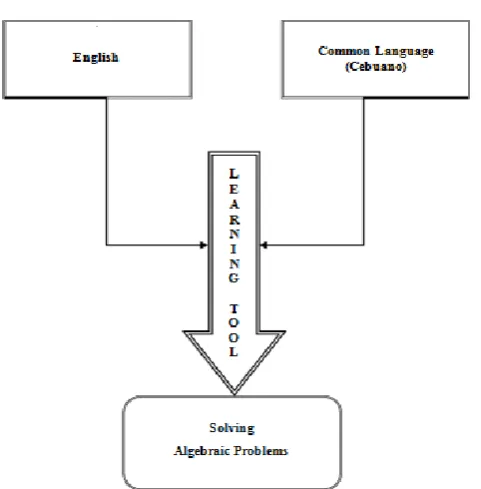
Conceptual. This study was conducted to compare the result of using the English vis-à-vis Cebuano as a learning tool in solving algebraic problems. The respondents were given the English problems to be solved first followed by Cebuano (common language) translation. Furthermore, their scores in both presentations were taken into consideration and the incremental scores were computed in order to know whether the use of the English in solving algebraic problems has significant relationship with their scores in the subsequently conducted similar problems using Cebuano as a learning tool.
Figure 2. The conceptual framework of the study
Scope and Delimitation of the Study
This study focused on determining the relationship of using English and Cebuano as a learning tool in solving algebraic problems. Respondents of this study were limited to ninety (90) students presently taking mathematics handled by the researcher herself. They were randomly selected from the four (4) sections among the one hundred sixty (160) BEED third year students of this University.
II.
METHODOLOGY
The design of the study followed the descriptive-survey method. The main purpose in conducting this study was to compare and relate the respondents‟ score after taking the test using the English language and its Cebuano translation. This design was suitable because it determined the relationship of the English and Cebuano as a learning tool in solving algebraic problems. A total of ninety (90) randomly selected students from the four sections of the third year BEEd students of Naval State University were chosen as respondents for the study. The researcher selected thirty (30) students from Section A, another thirty (30) from section B, twenty (20) from section C and the remaining ten (10) from Section D as the respondents, constituting about 60% of the total BEEd population. The venue of this study was the College of Education of Naval State University-Main Campus located at P.I. Garcia, Naval, Biliran. This study originally utilized a 15-item teacher-made algebraic problem tests using English language classified into easy, average, and difficult with five (5) questions each. In order to test the instrument‟s validity, the researcher conducted a dry-run to the third year BS Marine Engineering students of the university in which the original 15-item test was reduced to 10-item, after analyzing each item based on the level of difficulty of the students. After the conduct of the dry-run, the researcher submitted the remaining algebraic problems to some mathematics‟ teachers for their Cebuano translation of the problems. Having prepared the instrument, the researcher identified the respondents and administered the two sets of algebraic problems to assess if there is significant difference in their scores using the two languages (English and Cebuano). Aside from the teacher-made tests, the researcher also distributed survey questionnaire to the respondents in order to elicit feedback on their experiences and exposure throughout the duration of the study.
Tests comparisons were obtained by determining means and standard deviations. The differences between their scores in the two sets of tests were analyzed with the following: To determine the level of performance of the respondents through problem solving, the frequency distribution with underlying percentage were applied using the following formula: Weighted Mean, Descriptive Statistics categorized as mean percentage and frequency counts were used to describe the respondents‟ scores in the tests. The t-test was used to find out significant differences in their scores in both English and Cebuano presentations.
III.
RESULTS AND DISCUSSION
two languages; their incremental scores in the two sets of tests conducted; significant difference of their scores in English and Cebuano as well as the significant difference of their scores in relation to the incremental scores; and finally, the highlights of their experiences and exposure during the implementation of the study.
Common Language Vis-à-vis English as a learning tool in solving algebraic problems
In this study, the respondents were given algebraic problems in which the usual English mathematical problems were translated into Cebuano and were consecutively administered to the respondents. Throughout the conduct of the experiment, the students gained knowledge on the common language translation of some mathematical expressions; thus, they were able to understand it better and get accurate answers compared to presenting it in English language only. Most of them had pleasant experiences as evidenced by the results presented in table 6. Furthermore, this process allows students to think and analyze the problems in both English and Cebuano, thereby enhancing their creative thinking skill.
Students’ Score in Algebraic Problems
In this study, the students‟ scores using the English and Cebuano languages in solving algebraic problems were determined. In included 10-item using the frequency, summation of frequency and the means of the scores in English and Cebuano. Table 1 presents the scores of the respondents.
Table1. Scores of the Respondents
Scores
English Cebuano
f fx f fx
10 0 0 0 0
9 0 0 3 27
8 0 0 21 168
7 2 14 13 91
6 17 102 5 30
5 19 95 5 25
4 7 28 9 36
3 21 63 17 51
2 15 30 9 18
1 5 5 6 6
0 4 0 2 0
∑ x = 90 ∑fx = 337 ∑ x = 90 ∑ fx = 452
∑ fx __
--- = x2 = 3.74
∑ x
∑ fx __
--- = x1 = 5.02
∑ x
As shown in the table, the scores of the respondents in algebraic problems ranged from 0 to 10 both in English and Cebuano. It further shows that out of 90 respondents, only 21 got the score of 8 (highest frequency) using the Cebuano language while nobody (0) obtained the same score using the English language. Meanwhile, 21 out of 90 got the score of 3 (highest frequency) in the English translation while only 17 in Cebuano. The lowest score obtained by the respondents was 0 with a frequency of 2 for Cebuano and 4 for English. Furthermore, the table shows that there is a difference in the scores of the respondents using English and Cebuano languages as evidenced by their mean score of 3.74 in English and 5.02 in Cebuano. With the scores presented, majority of the respondents who answered the Cebuano test got scores above 5 with a total frequency of 47 while only 43 in English. Moreover, majority of the respondents got scores below 5 in the English translation with a total frequency of 71 and only 19 in the Cebuano.
Figure 3. Mean and Percentage Distribution of the Respondents‟ Scores
As reflected on the figure above, the English algebraic problems obtained a slightly higher percentage (%) score that falls under the „low‟ category and slightly lower under the „average‟ category compared to its Cebuano translation. Moreover, only 3 percent belongs to „high‟ category in Cebuano while zero (0) in English. The mean scores of the two groups were; (x1 =3.74; x2=5.02), English and Cebuano respectively.
Frequency and Percentage Distribution of the Respondents’ Scores. The frequency and percentage distribution of the respondents‟ scores in English and Cebuano algebraic tests are presented in table 2. The succeeding table and figure above clearly shows that out of the ten questions, only one got higher frequency using the English language with 64 or 71.11 percent compared to Cebuano with 52 or 57.77 percent. It further shows that eight or 80 percent of the common language translation were answered correctly by most of the respondents than in its English counterpart. Among the algebraic problems, item 10 is the most difficult and it can be seen that nobody (0) answered correctly using the English language, while six or 6.66 percent were able to get the answer in the Cebuano translation. Furthermore, the result shows that item 7 got the same results with 8 or 8.88 percent in both English and Cebuano. It further shows that majority of the respondents got correct answers using Cebuano compared to its English counterpart.
Table 2. Frequency and Percentage Distribution of the Respondents‟ Scores
English F %
Cebuano
(Common Language) f %
1. One number is 19 less than the other,
their sum is 65. Find the numbers. 57 63.33
1. Ang usa ka numero mubo ug 19 kaysa lain nga numero, unya 65 ang ilang total. Unsa man ning mga numeroha?
73 81.11
2. The sum of two consecutive even integers is 62. What are the numbers?
79 87.77
2. Kung 62 ang total sa duha ka magkasunod nga
pares nga numero, unsa man ni nga mga numero?
85 94.44
3. Separate 98 into two parts so that, when the greater is divided by the smaller, the quotient is 3 and the remainder is 6.
52 57.77
3. Bahina ang 98 sa duha ka parte nga kung ang daku nga parte bahinon sa gamay nga parte, ang resulta 3 unya may sobra nga 6.
63 70.00
4. James can paint a certain house in 10 days and Allan can paint the same house in 12 days. How long will it take to paint the house if both men work?
41 45.55
4. Mapintorahan ni James ang usa ka balay sulod sa 10 ka adlaw samtang si Allan makahuman ug pintora niini sulod sa 12 ka adlaw. Kung magtinabangay silang duha pagpintora sa maong balay, unsa kadugay mahuman nila ang pagpintora niini?
46 51.11
Frank‟s age is 11. Six years from now, the sum of their ages will be 40. How old is each now?
30 33.33
ikatulo ka parte sa edad ni Frank, ang resulta 11. Unom ka tuig gikan karon, ang total sa ilang edad mahimong 40. Pila man ang edad ni Frank ug ni Henry karon?
44 48.89
6. The denominator of a certain fraction is four less than thrice its numerator. If seven is added to both its numerator and denominator, the fraction becomes 2/3. What is the original fraction?
4 4.44
6. Ang denominator sa usa ka fraction menos ug upat sa katulog pilo sa iyang numerator. Kung dugangan ug matag 7 ang numerator ug denominator, ang fraction mahimo nga 2/3. Unsa man ang orihinal nga fraction?
34 37.77
7. A certain number of two digits is four times the sum of its digits, and if 36 be added to it, the digits will be reversed. Find the number.
8 8.88
7. Ang usa ka numero nga duha ka digits, upat ka pilo sa total sa mao nga mga digits; pero kung dugangan ang resulta ng 36, mabaliktad ang digits. Unsa man ni nga numero?
8 8.88
8. The sum of the squares of the two digits of a positive integer number is 13. If the number itself is 2 more than 6 times the sum of its digits, find the number.
2 2.22
8. Trese ang total sa squares sa duha ka digits nga positibo nga numero. Kung ang mao nga numero sobra ug duha sa kaunom nga pilo sa total sa iyang digits, unsa man ni numero?
36 40.00
9. The length of a rectangular building lot is twice its width. If the perimeter is 240 meters, what are the dimensions of this building lot?
64 71.11
9. Ang katas-on sa usa sa eskinado (rectangular) nga lote sa building, kadoblehon sa iyang gilapdon. Kung 240 metros ang iyang sukod palibot, unsa man ang katas-on ug kalapdon niini nga lote?
52 57.77
10. A parking lot is in the form of a square. The lot is enlarged by adding strips of 16 meters wide on one side and 12 meters wide on the adjacent side. If the rectangular area formed contains 1,440 square meters, find the original area of the lo
0 0
10. Eskinado (square) ang porma sa usa ka parking-nganan. Gipadako lamang kini pinaagi sa pagdugang ug mga strips (floor covering) nga 16 metros ang gilapdon sa usa ka parte ug 12 metros ang gilapdon sa lain nga parte. Kung ang naporma nga eskinado (rectangular) adunay area nga 1,440 metros kwadrados, unsa man ang orihinal nga area sa mao nga lote?
6 6.66
Incremental Scores Of The Respondents
After the administration of the test both in English and Cebuano, the difference of the respondents‟ scores were computed and as referred as the incremental scores. Table 3 shows the incremental scores of the respondents. As reflected in the succeeding table, the incremental scores of the respondents ranged from -2 to 5; where most of them got 2 increment points or 23 percent and the least was 5-point increment or 2 percent. Zero increment means that the respondents obtained the same score in both English and Cebuano in solving algebraic problems and there is no difference at all in their scores; while the negative increment points show that their score in English is comparatively higher than the common language translation.
Graph presentation of the frequency and percentage distribution of the respondents‟ scores in both English and Cebuano. The graph presentation on the frequency and percentage distribution of both English and Cebuano in the respondents‟ scores in items 1-10 are presented in figure 4.
Table 3. Incremental Scores of the Respondents
Incremental Point
Frequency Percentage Frequency x
incremental point
F % fx
5 2 2.0 10
4 8 9.0 32
3 11 12.0 33
2 21 23.0 42
1 18 20.0 18
0 15 17.0 10
-1 10 11.0 -10
-2 5 6.0 -10
∑ x = 90 100.0 ∑ fx = 125
Mean and Percentage Distribution of the Respondents’ Incremental Scores. The mean and percentage distribution of the respondents‟ incremental scores are presented in Figure 5.
Figure 5. Mean and Percentage Distribution of the Respondents‟ Incremental Scores
The figure shows that out of 90 respondents, 30 or 33.33 percent falls under „low‟ level (-2-0 increment points); 50 or 55.56 percent under „average‟ level (1-3 increment points); and 10 or 11.11 percent under „high‟ level (4-5 increment points). Furthermore, the mean incremental score of the respondents is statistically low which is only 1.39.
Significant Difference of the Respondents’ Scores in English and Cebuano
To determine the relationship between English and Cebuano based on the scores of the respondents in the test conducted, the t-test was used to ascertain if there was a significant difference in the main gain of the respondents‟ scores. The results are presented in table 4.
Table 4. Significant Difference of the Respondents‟ Scores
Test Scores Decision
_
x SD tc tv
Ho1Rejected Significant
English 3.74 1.79
3.92 1.98
Cebuano
5.02 2.58
Alpha level of significance (a) = 0.05 degree of freedom (df) =89
Level of significance = two-tailed or non-directional
significant relationship between the respondents‟ scores using English and Cebuano as a learning tool in solving algebraic problems is rejected. Both English and Cebuano have higher computed absolute t-value, 3.92 compared to the tabular value of 1.98 at .05 level of significance. The result explains that there is a significant relationship between the respondents‟ scores using the two languages (English and Cebuano) as a learning tool in solving algebraic problems. Meanwhile, the mean score of the English language was 3.74, significantly lower than the Cebuano mean sore of 5.02; showing an increase of the respondents‟ scores from English to Cebuano.
Significant Difference of the Respondents’ Scores and Incremental Points
To determine the relationship between English and Cebuano based on their scores in the test conducted as well as their incremental scores, the t-test was used to ascertain if there was a significant difference in the mean gain of the respondents‟ scores. The results are presented in table 5.
Table 5. Significant Difference of the Variables
Variable Groups t SD
Sig. (2-tailed)
Decision
tc tv
Test Scores
English 3.74
2.31 3.92 1.98
Ho2 Rejected Significant
Cebuano 5.02
Incremental Score English (-) Cebuano 1.39 1.71 32.58 1.96 Ho3
Rejected Significant
Alpha level of significance (a) = 0.05
The incremental scores were found to be of significant difference as compared to the test results. As gleaned from the results, there is a significant difference in the incremental scores and the test scores of the two languages as further evidenced by the computed t-value of 32. 58 lower than the tabled value of 1.96. Cebuano got a higher mean gain of 5.02; while English‟ mean was only 3.74. The computed t- value is 3.92, higher than its tabled value of 1.98, thus, the hypothesis that there is no significant difference in the variables is rejected. Moreover, statistical analysis revealed that there is a significant difference favoring the students who were exposed to Cebuano (common language translation) which further means that it contributed in the increase of the respondents‟ incremental scores. In general, the hypothesis that “there is no significant relationship between the respondents‟ scores and their incremental scores” is rejected and that there is indeed a significant difference in the two variables.
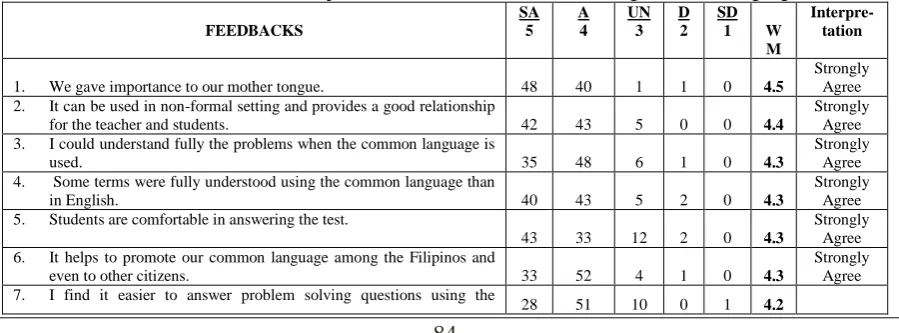
Highlights of the respondents‟ experiences in English vis-à-vis Cebuano (common language) in solving algebraic problems. To give highlights of the employed teaching strategy, different views or feedbacks from the respondents on the benefits gained in translating the English questions into the Cebuano were taken and presented in table 6. Special considerations of this study are the reactions of the respondents exposed to Cebuano as a new method in teaching Mathematics. Arranged from highest to lowest in terms of weight (score), their opinions are expressed and interpreted according to the degree of agreement relative to the use of English and Cebuano as shown in table 6.
Respondents‟ feedback on the benefits gained using Cebuano as a Learning Tool in Solving Algebraic Problems. The respondents‟ feedback on the benefits gained using Cebuano as a learning tool in solving algebraic problems is presented in table 6.
Table 6. Feedback of the Respondents on the Benefits Gained Using Cebuano Language
FEEDBACKS SA 5 A 4 UN 3 D 2 SD
1 W
M
Interpre- tation
1. We gave importance to our mother tongue. 48 40 1 1 0 4.5
Strongly Agree 2. It can be used in non-formal setting and provides a good relationship
for the teacher and students. 42 43 5 0 0 4.4
Strongly Agree 3. I could understand fully the problems when the common language is
used. 35 48 6 1 0 4.3
Strongly Agree 4. Some terms were fully understood using the common language than
in English. 40 43 5 2 0 4.3
Strongly Agree 5. Students are comfortable in answering the test.
43 33 12 2 0 4.3
Strongly Agree 6. It helps to promote our common language among the Filipinos and
even to other citizens. 33 52 4 1 0 4.3
Strongly Agree 7. I find it easier to answer problem solving questions using the
common language than the English language. Agree
8. It is easy to read because it is written in our dialect.
35 45 7 3 0 4.2 Agree
9. Some students can understand but it only depends on the level of
comprehension and the structure of the sentence. 28 50 10 2 0 4.2
Agree
10. My understanding of the problems has improved because my native
language was used. 31 48 9 2 0 4.2 Agree
11. It promotes understanding between the teacher and students. 26 55 6 3 0 4.2 Agree 12. Cebuano people who have wide vocabulary in Mathematics will have
the great capacity in understanding Cebuano translation. 33 46 8 3 0 4.2
Agree
13. Students can easily understand the simple terms in the problem. 32 47 10 1 0 4.2 Agree 14. It is one way of- preserving the Cebuano language which is getting
obsolete nowadays. 33 46 9 2 0 4.2 Agree
15. Utilizing the common language gives us the privilege to convey our
message to other people. 32 47 10 1 0 4.2 Agree
16. We could better understand the problems and analyze it word for
word. 27 45 15 3 0 4.1
Agree
17. It is easier to interpret and analyze the problems using the common
language. 25 49 12 4 0 4.1 Agree
18. Using the common language in Mathematics would result a good
result because it is our mother tongue. 26 45 15 4 0 4.0 Agree
19. It is easy for the teachers to formulate questions and for the students
to understand its meaning. 23 46 13 6 2 3.9 Agree
20. The common language is easier to understand but it depends largely
on the given problem. 18 48 17 7 0 3.9 Agree
Total Weighted Mean 4.2 Agre
e
The preceding table explains that the respondents strongly agree on the benefits gained of employing the common language (Cebuano) in solving algebraic problems. It is evident in the following statements: “We gave importance to our mother tongue;” “It can be used in non-formal setting and provides a good relationship for the teacher and students;” “I could understand fully the problems when the common language is used; Some terms were fully understood using the common language than in English;” and “Students are comfortable in answering the test.” With the mean score of 4.2, the students “strongly agree” that the teachers use Cebuano as a learning tool in teaching Mathematics because of the positive results derived from it.
IV.
CONCLUSIONS
After thorough analysis of the results based on the findings gathered from the study, the following conclusions were drawn: The learning tools involved in this study are English and Cebuano in which the scores of the students in English is lower than in Cebuano. Majority of the respondents got scores above 5 with 43 using English, while 47 using Cebuano. Majority of the respondents got scores below 5 in English 71 and only 19 in Cebuano. The English algebraic problems obtained a slightly higher mean (x) score than its common language counterpart. Majority of the respondents correctly answered using Cebuano compared to its English counterpart. Most of the incremental points from English to Cebuano are in negative integers, from Cebuano to English, the incremental points are in positive integers. The mean incremental score of the respondents is statistically low (1.39.) There is a significant difference in the respondents‟ scores in solving algebraic problems using English and Cebuano as a learning tool. The students strongly agree that the teachers will use Cebuano as a learning tool in teaching Mathematics because of the positive results derived from it.
V.
RECOMMENDATIONS
successful learners. Capability building activities that would enhance teachers‟ skills and ability in order to provide their students with the best knowledge must be conducted. Since the study was only limited to the third year NSU-COEd students and the duration of the experiment was relatively short, it is highly recommended that a follow-up study employing a larger scope of topics and duration of the experiment be conducted.
REFERENCES
[1]. Abadzi, Helen. Efficient Learning for the Poor: Insights from the Frontiers of Neuroscience. 2010 [2]. Catherine Sophian, Ph.D.; Numerical Knowledge in Early Childhood; University of Hawaii, USA; June
11, 2009
[3]. DepED Order #74 s. 2009. Education policy, language policy, medium of instruction, mother tongue as language of instruction, pedagogy, Teaching profession | Tags: bilingual education, medium of instruction (MOI), mother tongue as MOI, Posted in bilingualism. Spanish profs train Pinoy teachers on language teaching. MLE Strategic Plan Approved by National Learning Strategies.
[4]. Duncan GJ, Dowsett CJ, Claessens A, Magnuson K, Huston AC, Klebanov P, Pagani LS, Feinstein L, Engel M, Brooks-Gunn J, Sexton H, Duckworth K, Japel C. School readiness and later achievement. Developmental Psychology. 2007.
[5]. Microsoft ® Encarta ® 2009. © 1993-2008 Microsoft Corporation. All rights reserved.
[6]. National Mathematics Advisory Panel. Foundations for success: The final report of the National Mathematics Advisory Panel. Washington, DC.: U. S. Department of Education; 2008.
[7]. Piaget J. The Child's Conception of Number. Gattegno C, Hodgson FM, trans. New York, NY: Norton; 1952. and "Microsoft® Student 2009 [DVD]. Redmond, WA: Microsoft Corporation, 2008.
[8]. Sophian C. The Origins of Mathematical Knowledge in Childhood. New York, NY: Lawrence Erlbaum Associates; 2007.
[9]. Sophian C, Garyantes D, Chang C. When three is less than two: Early developments in children's understanding of fractional quantities. Developmental Psychology1997.
[10]. Wikipedia, the free encyclopedia, August 2008
[11]. www.GlobalVillageSchool.org. Online School Curriculum. Online private school curriculum program for
K-12 students. Adds by Goggle