Application of Hill Climbing Algorithm as Data
Mining Technique for Surveillance of Real Time
Video Streams
1 Avinash P. Ingle; 2 Sushma D. Ghode
1Assistant Prof., Department of Information Technology, PIET,
RTMNU Nagpur, India
2Assistant Prof., Department of Computer Science, MIT(E),
DBAMU Aurangabad, India
Abstract: Data mining is the application of statistical techniques and programmatic algorithms to discover previously unnoticed relationships within the data. Video surveillance has long been in use to monitor security sensitive areas such as banks, department stores, highways, crowded public places and borders. The advance in computing power, availability of large-capacity storage devices and high speed network infrastructure paved the way for cheaper, multi sensor video surveillance systems. The ultimate goal of the present generation surveillance systems is to allow video data to be used for on-line alarm generation to assist human operators and for offline inspection effectively. Moving object detection is the basic step for further analysis of video.
Keyword: Data Mining; Video surveillance; Object detection.
1.
Introduction
n traditional system, Video surveillance has gained importance in security, law enforcement and military applications and so is an important computer vision problem. As more and more surveillance cameras are deployed in a facility or area, the demand for automatic methods for video processing is increasing [5]. The operator constantly watching the video footages could miss a potential abnormal event (e.g. bag being abandoned by a person), as the amount of information/data that has to be handled is high [6]. Analyzing human activity is one of the key tasks to understand and search surveillance videos. Human activity analysis is to under-stand activities which people are performing in videos. The goal of human activity analysis is to identify interested human activities [20]. Initially it includes the tracking of the objects in videos, which can be simply defined as the creation of temporal correspondence among detected objects from frame to frame [9]. This procedure provides temporal identification of the segmented regions and generates cohesive information about the objects in the monitored area such as trajectory, speed and direction. The output produced by tracking step is generally used to support and enhance motion segmentation, object classification and higher level activity analysis [8]. Video surveillance systems have been in our daily life in malls, corporate sectors, public and private places, colleges and so on. Need people to operate them. But human being has limitations. So need Automatic system for monitoring. It
is very difficult for human being to monitor the video footage 24×7. Therefore it needs some real time action against abnormal events or activity. So to fulfill the requirement there is need of intelligence system that automatically process the video footage and track whether it has unusual events or not. The abnormal events can be happened due the abnormal motion of the objects in the footage or any unusual activity that’s leads to anomalous behavior of the object such as person, car etc. The Proposed system automatically monitors the video footage and processes the videos in term of segment frame by frame and then preprocesses the each frame in order to find the unusual activity. Ones any abnormal activity found it give the alarm or signal for indication purpose.
2. Literature Survey
K-means Algorithm- The algorithm uses both Background Subtraction and Symmetrical Differencing methods to obtain the moving object or targets [7]. As per the amount of motion occurs in video frames it divides the video into different segments [1]. Then the Video segments are group by using the improved K-Means algorithm.
Probabilistic Latent Semantic Analysis (PLSA)-The Technique includes Low-level HDP (Hierarchical Dirichlet Process), Higher-level temporal motif, Measure for Abnormality Rating Model Behavior on Synthetic Activities, Abnormality Rating in a Metro
Station [2]. This method is not supervised and it uses the long term data to learn the activities. The method is efficient and scalable as well. It can be used to handle the information provided by un-calibrated multiple cameras, jointly learning activities shared by them if in case it happens.
Dynamic Oriented Graph (DOG) - The system obtains the color images from video cameras which is situated at stationary places and applies state of the art algorithms to classify, segment, locate or track moving target or objects [3]. The DOG method observed actions and characterizes the actions by means of a structure of nodes which are unidirectional connected. Each connected node defining a region in the hyperspace of attributes measured from the moving objects which has been observe from stationary video camera and assigned a probability in order to generate an unusual behavior. A new approach to automatically detect and predict abnormal behaviors was presented. It is possible to assign distinct behaviors to different kind of objects performing a similar Path [14].Markov model.-Initially it will read the next image of the video sequence. Then it will take the difference between this image and image used for the reference. Threshold the difference image and find connected components.
Bipartite graph co-clustering- An unsupervised technique for detecting unusual activity in a large video set using many simple features. Divide the video into equal length segments and classify the extracted features into prototypes, from which a prototype–segment co-occurrence matrix is computed [16]. Seek a correspondence relationship between prototypes and video segments which satisfies the transitive closure constraint. An important sub-family of correspondence functions can be reduced to co-embedding prototypes and segments to N-D Euclidean space.
.
Multilevel hierarchical clustering approach.-In the multi-level hierarchical clustering approach initially it segments the incoming videos then it extract the location feature and motion feature and finally apply the clustering algorithm for classification. In Video Segmentation a background frame is extracted from a given sequence as preprocessing, and its color histogram is computed. In other words, this frame is represented as a bin with a certain number (bin size) of quantized colors from the original [12]. Compute the difference between the background and each frame.
3. Implementation and Methodology
The Video Surveillance has been a number of surveys about object detection, classification, tracking and activity analysis in the literature. The input to the Video Surveillance system is real time video footage at public place, malls etc. The system follows the target area
detection and then video segmentation in order to perform clustering on the frames and to find out the abnormal events [19]. The system include three important module first one is Target area detection second one is video segmentation and third one is clustering algorithm which is used to cluster the similar segment [1]. The detail explanation is given below.
3.1 Target Area Detection
It is very important to obtain the exact target area for clustering surveillance video segments. Background Subtraction can obtain two binary image s of the video frame and use different gray levels to divide the target and background area of the video frame. Symmetrical differencing can detect the profile of a moving target occurring in the middle of the frame and reduce the background caused by movement.
3.2 Video Segments
Surveillance video is always stable and consecutive , and the camera works 24- hour per day. Average motion of a video segment will change when objects move faster/slower or the amounts of objects increase/reduce [15].
3.2.1 Object Detection
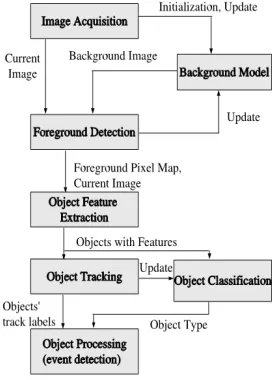
The overview of video object detection, tracking and classification is shown in fig 1. The presented system is able to distinguish transitory and stopped fore-ground objects from static background objects in dynamic scenes; detect and distinguish left objects; track objects and generate object information; classify detected objects (into bag and non-bag) in video imagery [9]. The intent of designing these modules is to produce a video-based surveillance system which works in real time environment.
The computational complexity and even the constant factors of the algorithms it use are important for real-time performance[17]. The object tracking algorithm utilizes extracted object features together with a correspondence matching scheme to track objects from frame to frame. The color histogram of an object produced in previous step is used to match the correspondence of objects after an occlusion event. The output of the tracking step is analyzed further for detecting abnormal events [19].
3.2.2 Foreground Detection
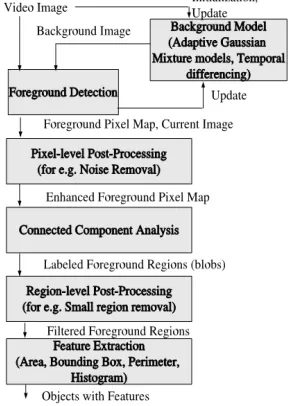
Distinguishing foreground objects from the stationary background is both a significant and difficult research problem. It implemented adaptive Gaussian mixture model mainly, but also looked at the results of temporal differencing from performance study point-of-view. The background scene related parts of the system is isolated and its coupling with other modules is kept minimum to let the whole detection system to work flexibly with any one of the background models [13]. Next step in the detection method is detecting the foreground Pixels by using the background model and the current image from video a shown in fig.2.
Figure 2 Foreground detection
This pixel-level detection process is dependent on the background model in use and it is used to update the background model to adapt to dynamic scene changes. Also, due to camera noise or environmental effects the detected foreground pixel map contains noise [14]. Pixel-level post-processing operations are performed to remove noise in the foreground pixels. Once it get the filtered foreground pixels, in the next step, connected regions are found by using a connected component labeling algorithm and objects’ bounding rectangles are calculated. The labeled regions may contain near but disjoint regions due to defects in foreground segmentation process. Hence, some relatively small regions caused by environmental noise are eliminated in the region-level post-processing step. In the final step of the detection process, a number of object features (like area, bounding box, perimeter and color histogram of the regions corresponding to objects) are extracted from current image by using the foreground pixel map.
4. Results and Discussions
For the experimental purpose here it has taken the two videos one contains the normal activity and another video contains abnormal activity. The length of the normal video segment is 32.96 sec. The numbers of the frames are 825. After applying the key frame extraction technique the number of key frame founds are 19. Similarly the length of the abnormal video segment is 17.2 sec. The numbers of the frames are 430. After applying the key frame extraction technique the number of key frame founds are 109.
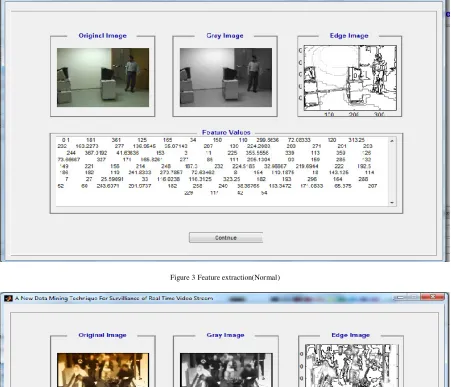
The system processes the videos frame by frame. Initially it divides the video based on the motion and location of the objects in the segment. Then it finds the number of key frames and preprocesses the each key frame by converting the original image to grayscale image as shown in the fig 3. Then it obtains the edge image since the edge is an important factor in order to extract the features. Feature values are extracted on the basis of edge, color and texture. The extracted feature values for both frame which contain the normal and
Figure 3 Feature extraction(Normal)
Figure 4. Feature extraction(abnormal)
Ones the feature are extxracted for the fram it will generate the feature vector for that perticular frame and then taking the sum of feature of all the
frame it will generate the feature vector for whole
perticular segement in order
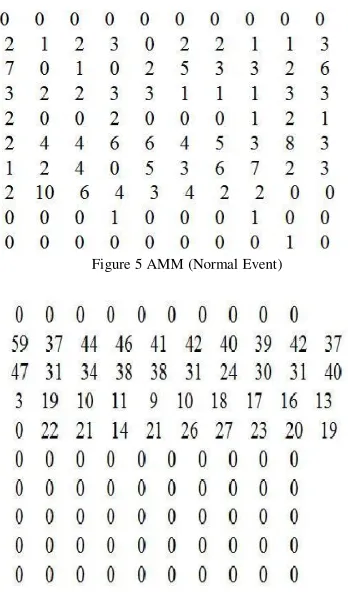
to aaply the clustering algorithm for the classification purpose. The avarege motion matrix( AMM) for the normal and abnormal segment as given
below.
Figure 5 AMM (Normal Event)
Figure 6 AMM (Abnormal Event)
On applying the hill climbing algorithm on the above average motion matrix of both normal and abnormal video segment, it will form the cluster in order to detect the normal and abnormal events. The hill climbing algorithm for the cluster by examining the counts of the 8-neighbors of a particular cell, a link is established between that cell and the closest cell having the largest count in the neighborhood. At the end of the link assignment, each cell is linked to one parent cell, but can be parent of more than one cell.In this way it will for the cluster in order to classify normal and abnormal events.
Finally it will generate the signal massage to indicate the whether the events, activities and behaviors in the segments is normal or abnormal. The signal massage is show on the following figure.
5. Conclusion
The hill climbing algorithm will effectively find out the abnormal activities. It includes target area detection, video segmentation and clustering. Hill climbing can often produce a better result than other algorithms such
as k-means algorithm, when the amount of time available to perform a search is limited, such as with real-time systems. It can return a valid solution even if it's interrupted at any time before it ends. Hill climbing is noise tolerant so far as the real time environment is concern.
References
[1] Jinghua Wang and Guoyan Zhang, “Video Data Mining based on K-means Algorithm for Surveillance Video”, 2011 IEEE International Conference on data mining. [2] Jagannadan Varadarajan, Jean-Marc Odobez, R´emi
Emonet “Multicamera Open Space Human Activity Discovery for Anomaly Detection”, 8th IEEE International Conference on Advanced Video and Signal-Based Surveillance, 2011.
[3] Jun Wu; Zhitao Xiao,”Video surveillance object recognition based on shape and color features”, 3rd International conference on Image and Signal Processing (CISP), Publication Year: 2010, Page(s): 451 – 454. [4] Yanmin Luo; Minghong Liao; Zhipeng Zhan “A
similarity analysis and clustering algorithm for video based on moving trajectory time series wavelet transform of moving object in Video” ,International Conference on Image Analysis and Signal Processing (IASP), Publication Year: 2010 , Page(s): 625 – 629 [5] Chakraborty, Ishita; Paul, Tanoy Kr.,“A Hybrid
Clustering Algorithm for Fire Detection in Video and Analysis with Color Based Thresholding Method”, Publication Year: 2010 , Page(s): 277 – 280.
[6] Ouivirach, K.; Dailey, M.N. “Clustering human behaviors with dynamic time warping and hidden Markov models for a video surveillance system”, International Conference on Electrical Engineering/Electronics Computer Telecommunications and Information Technology (ECTI-CON),Publication Year: 2010 , Page(s): 884 – 888.
[7] Zhen Lei; Chao Wang; Qinghai Wang; Yanyan Huang “Real-Time Face Detection and Recognition for Video Surveillance Applications”, WRI World Congress on Computer Science and Information Engineering, , Publication Year: 2009 , Page(s): 168 – 172.
[8] Singh, S.; Haiying Tu; Donat, W.; Pattipati, K.; Willett, P.,“Anomaly Detection via Feature-Aided Tracking and Hidden Markov Models”, IEEE Transactions on Systems, Man and Cybernetics, Part A: Systems and Humans,Publication Year: 2009 , Page(s): 144 – 159. [9] Chun-Man Mak; Wai-Kuen Cham,” Fast video object
segmentation using Markov random field”, IEEE 10th Workshop on Multimedia Signal Processing, Publication Year: 2008, Page(s): 343 – 348.
[10] Jungong Han; Minwei Feng; de With, P.H.N.,” A real-time video surveillance system with human occlusion handling using nonlinear regression”, Multimedia and Expo, 2008 IEEE International Conference on, Publication Year: 2008, Page(s): 305 – 308.
[12] Fan Jiang; Ying Wu; Katsaggelos, A.K.,” Abnormal Event Detection from Surveillance Video by Dynamic Hierarchical Clustering”,IEEE International Conference on Image Processing, Publication Year: 2007 , Page(s): V - 145 - V – 148.
[13] Jae Young Lee, William Hoff,” Activity Identification Utilizing Data Mining Techniques”, IEEE Workshop on Motion and Video Computing (WMVC'07).
[14] Duarte Duque, Henrique Santos and Paulo Cortez,” Prediction of Abnormal Behaviors for Intelligent Video Surveillance Systems” ,IEEE Symposium on Computational Intelligence and Data Mining (CIDM 2007).
[15] Kexue Dai; Guohui Li; Defeng Wu, “Motion clustering for similar video segments mining”,12th International Conference on Multi-Media Modeling Conference Proceedings, Publication Year: 2006. [16] Hua Zhong, Jianbo Shi, Mirk´o Visontai, “Detecting
Unusual Activity in Video”, Proceedings of the 2004 IEEE Computer Society Conference on Computer Vision and Pattern Recognition (CVPR’04).
[17] JungHwan Oh, Praveen Sankuratri, “Automatic distinction of camera and object motions In video sequences”, IEEE International Conference on Image Processing, Publication Year :2002.
[18] Ismail Haritaoglu, David Harwood, Larry S. Davis,, “Real-Time Surveillance of People and Their Activities”, IEEE transactions on pattern analysis and machine intelligence, vol. 22, no. 8, August 2000.
[19] AP Ingle, S Dongre “Surveillance of Real Time Video Streams by using Hill Climbing Algorithm”, International Journal of Computer Applications 65 (22), 2013.
[20] S D Ghode, AP ingle, “A Survey On Nature Inspired Routing Algorithms For Ad Hoc Network” International Journal of Engineering Science and Research Technology, vol.2 issue 3, pp 404-409, March 2013.
Authors -
Avinash P. Ingle has completed his BE in IT from Government
college of engineering Amaravti. He has completed his M.Tech in CSE from GHRCE Nagpur. He is a Assistant Professor at Department of Information Technology in Priydarshini Institute of Engineering and Technology, Nagpur. His research interests are Data Mining, Data Structure, Image Processing artificial intelligence.
Sushma D. Ghode has completed her B.E. in Information