Online database vendors:
will they transform to pull technology?
P.A. van Brakel
Department of Information Studies, Rand Afrikaans University, P.O. Box 524, Auckland Park, 2006 Republic of South Africa
Received September 1997; accepted September 1997
World-Wide Web-based search systems (or pull technology) stimulated large commercial database vendors to transfer to Web interfaces as well. Various reasons exist why Web-interfacing could be an asset to traditional online search systems, for example, using familiar Web browsers, implementing user-friendly Web sites, or lower search fees because of the unique features of client/server architecture. The differences between the content and retrieval procedures of search engines and database vendors emphasize the fact that vendors have to be extremely cautious when transferring to a Web interface. It seems possible that Web interfacing techniques and database vendors can soon become full partners in the pull technology environment. The purpose of the research was therefore to investigate and report on the trends currently noticeable among those online systems or databases embarking on full Web interfacing. Experienced online searchers, especially those who use front-end software to support their online search activities, seem dubious about the fact that Web interfaces can provide the same search sophistication level as obtained via traditional dial-up searching. The basic features of front-end software were used to address the pros and cons of Web-based online searching.
World-Wide Web-gebaseerde herwinningstelsels (sogenaamde pull technology) het die wereld se groot kommersiele databasismakelaars gestimuleer om ook Web-koppelvlakke te begin gebruik. Verskeie redes kan aangevoer word waarom die Web-koppelvlak 'n bydrae tot die verbetering van intydse stelsels kan lewer, byvoorbeeld die gebruik van bekende Web-browsers, .Implementering van gebruikervriendelike Web-omgewings, of die veri aging van soekkoste weens die unieke eienskappe van klientlbediener-argitektuur. Die prominente verskille tussen die inhoud en herwinningswyses van soekenjins en databasismakeiaars beklemtoon die feit dat makelaars uiters versigtig sal moet wees wanneer oorbeweeg word na die benutting van die Web-koppelvlak. Dit lyk egter moontlik dat Web-koppelvlaktegnieke en databasismakelaars binnekort ten volle en as deel vanpull technology sal kan integreer. Die doel van hierdie navorsing was om vas te stel in watter mate databasismakelaars reeds van Web-koppelvlakke gebruik maak. Ervare gebruikers van intydse stelsels, veral diegene wat tussengangerprogrammatuur be nut, twyfel tans of die vermelde Web-koppelvlakke dieselfde vlak van herwin-ning sal kan bereik as via die tradisionale direkte lynkoppeling. Die basiese eienskappe van tussengangerprogrammatuur is in die artikel gebruik om die voor- en nadele van Web-gebaseerde intydse herwinning te oorweeg.
New terminology appeared concurrently with the advent of new technology. The appearance of the Internet, and especial-ly World-Wide Web (WWW or Web), is one such example. It was with some amusement that experienced information pro-fessionals observed the search facilities and search functions (or lack thereof!) of search engines when they first appeared on the online scene during late 1994 and early 1995. Single-term searching was the order of day. Barring limited trunc-ation, phrases, Boolean logic and word proximity were not catered for. Gradually more and more functions were added, resulting in a variety of options which the end-user can activate when searching for different types and/or formats of information. Any experienced search engine user will con-firm that, despite their current level of search sophistication, the relevancy and precision ratios of the search results are still not on par with that of the well-known commercial online hosts such as KRs DIALOG and DataStar. One of the main reasons for the search engines' shortcomings is that the scope of each search is as extensive as the number of Web sites it covers, in which any kind of mainly full-text and multimedia information is being scanned for the specified search terms. It must also be kept in mind that the engines are only available for the last two years and that the ratio of development
indicates that further and substantial improvements can be expected in the near future.
Search engine technology is therefore here to stay. Re-cently, within this environment, a new term was born: pull technology. Pull technology indicates a Web-based search, via a typical search engine (such as AltaVista, Lycos or Excite), using a previously structured search strategy and manipu-lating the various Web sites covered by the specific engine's robots. It has been argued elsewhere that Web searching demonstrates the same features as commercial vendor or rather online searching (Van Brakel 1996:58-59). On the basis of this argument, the reverse also holds true: that traditional online searching could be classified as one of the many pull technologies currently available.
S.AfrJ .Ubr.lnf.Sci., 1997,65(4)
World-Wide Web is rapidly becoming the plat-form of choice for inplat-formation delivery, as demon-strated by the numerous databases and information services that have announced Web access in the past few months. With the convergence of enabling tech-nologies, delivering an acceptable multimedia ex-perience to the end-user over the Internet is now possible' .
End-users and information professionals, used to reliability and quality as far as online services are concerned, are watching these developments with interest: Will online vendors redesign their search software and command-driven approaches after the style of the now familiar Web search engines? Could it really be true that the retrieval quality of those sophisticated command-driven systems can be ex-changed by HTML-based forms and/or Common Gateway Interface (CGI) scripts? 'Or is it merely a depressing case of trying to keep up with the technological Joneses?' (Eaton 1997:13).
There are important reasons why a migration towards Web technology will be advantageous to online searching (Eaton
1997:13):
- Despite its limitations, HTML offers more rapid develop-ment opportunities than the complexities of creating large custom-built Windows programs.
- For end-users, HTML is a richer medium than plain ASCII text, and documents can now be delivered directly to PCs in their original as-published format, namely as Acrobat PDF files.
- For most (all!) information professionals, the Web brow-ser has become the friendly environment for manipulating information, regardless of the platform being used.
Any information professional who keeps a keen eye on developments in this environment (especially via articles appearing in the newpapers Information world and Informa-tion today) will soon realize that the database vendor's Inter-net access has reached the stage where it seems that comprehensive Web interfacing could in due course become the standard. With client/server architecture and HTMLs support for forms, the online searcher can now take all the time to fill out the form before submitting it. The Web browser/client connects to the server and disconnects again as soon as the results are being displayed to the searcher.
However, Web-based online interfacing still needs ex-tensive developing and testing when compared to the relevance and precision ratios of a commercial online search. Eaton' (1997: 13) warns against the following pitfalls - this author's opinion is added in brackets to put Eaton's fears into perspective:
- HTML code and Web servers alone cannot entirely re-place traditional session-orientated online access, for example, some of the sophisticated search functions. (This remains to be seen, because the full potential of Web technology has not been realized yet. For a more com-mand-friendly approach, a drop-down list of all the
235
commands plus their meanings could be made available to the novice searcher.)
- For those searchers that do not have high-speed Internet access, the bandwidth bottlenecks mean that pages of search results tend to trickle rather than flow across the networks. Frames with a graphic image increase the problem. (Bandwidth is currently a major shortcoming but, with full-scale electronic commerce just around the corner and increased business via the Web, commercial demands for faster lines will soon be addressed.)
It is believed that Java, the much-hyped Web programming language (developed and licensed by Sun), will be able to create a more mature and reliable environment. Although Java is still under development, it will enable the creation of small specialized programs that allow an Internet browser (e.g. Internet Explorer) to perform complex tasks without being influenced by heavy network traffic.
With the above-mentioned advantages of Web-interfacing and database vendors soon to become full partners in the pull technology environment, the purpose of this research was therefore to investigate and report on the trends currently noticeable among those online systems or databases em-barking on full Web interfacing. Secondly, the approach by Knight-Ridder's DIALOG Web was evaluated to establish to what extent its new Web interface can address the various phases of the typical online search. The typical features of front-end software, established during previous research work by this author (Van Brakel 1987) were used in the evaluation process. The first part of this article is devoted to brief de-scriptions on how database vendors are already applying Web interfaces. This is followed by a few examples to illustrate how even database producers are already embracing Web technology to bypass the commercial online vendor (e.g. DataStar). The balance of the article concentrates on evalu-ating DIALOG Web's features - DIALOG being well known to all experienced online searchers and without doubt the standard in the online industry.
Vendors moving towards Web interfacing
The following examples are being included to indicate the state-of-the-art. It is not always easy to distinguish if a specific product originated from a vendor or producer. Fur-thermore, not much information (such as comparisons be-tween or evaluations of Web interfaces) has been published yet.
Medline
Infotrieve interface can also be used to access internal as well as external databases from different platforms.
The service can be accessed at www.infotrieve.com. Like all the other vendors, the Medline databases are not for free; access is via a login code and password and for subscription holders only (see the above URL).
UMl's ProQuest Direct
In October 1996 UMI announced the availability of its Pro-Quest Direct online system on the Web (Database race ... I996a:43 ). This is an information system that combines the search facilities for its electronic sources and information delivery in a single, easy-to-use desktop package. End-users interested in full-text information can order documents directly from ProQues~ Direct and have them sent or faxed by overnight service. The interface provides access to all UMIs databases, including indexes to 17.000 periodicals, 7.000 newspapers and 1.4 million dissertations (Database race ... 1996a:43).
CAB International
CAB International (CABI), the US Centre for Agriculture and BioSciences and SilverPlatter Information Inc. have signed an agreement to create Internet access to all 13 CAB! data-bases from over 11.000 journals covering subjects such as agriculture, health and disease. End-users and information professionals will use SilverPlatter's SPIRS interface, which is the same one being used to search the firm's CDROM databases. SilverPlatter's Internet interface is based on its Electronic Reference Library (ERL) technology, which is a client/server approach that enables multiple options for both searching and operating platforms (Database race ... 1996a: 43).
LEXIS-NEXIS
This database vendor has begun releasing a series of products which will allow its customers to use any WWW browser to find information in its various databases. The first product, LEXIS-NEXIS Advantage for the Web, allows a legal profes-sional with a subscription to search for state legal material, such as case law and statutes. The company anticipates that the majority of its legal clients will have Web access by the end of 1997(Internet and inteiface ... 1996:I). The Web inter-face service is complementary to the firm's traditional online service. The company will also offer Web searching of the service via credit card transactions for more casual users.
Ovid Online
According to Jacso (1996:25), Ovid Technologies, Inc.
(www.ovid.com) was the first online vendor that developed a fully functional Web interface that can manage search sets, display thesauri and search large databases such as Medline and EMBASE with ease. The main features are discussed here to indicate possible trends to be expected in this en-vironment. A basic and advanced search mode have been
provided for the Ovid Web Gateway. Typical Web search engine features have been included, such as check boxes for field searching, with navigational buttons to help the user to move around. Browsing has been made easy too: the index terms could be selected by mouse, with posting information (number of references) shown next to the word. Selected terms are automatically combined in an OR relationship. A search is then activated by a mouse click. A more experienced end-user may bypass the indexes and search directly by term (lacso 1996:26-27). Field restrictions are still limited, for example to the title field. Commands must still be used to apply other tield limits. To increase search efficiency, a Java client has also been introduced in an effort to reduce traffic on the Internet or an Intranet by optimizing communication between server and client (Ovid ... 1997:7).
Database producers opting for Web interfaces
The above examples illustrate the directions current Web interfacing by online vendors are taking. It is clear that Web interfaces support searching by end-users who are already acquainted with Web-based search engines such as Excite, Yahoo! or AltaVista. The cumbersome menu-driven systems and consequently end-user-orientated marketing approaches of the mid to late eighties did not succeed in selling online searching to end-users. It is possible that Web-based access may become the watershed between past and future database search techniques. Before a discussion of DIALOG Web, the trends regardi,ng database producers are highlighted.
Web technology allows database producers to purchase or develop a search engine and, instead of leasing or selling their database products to online vendors as in the past, make these database services available to information professionals and end-users. It is still too early to speculate about the medium-and long-term future of the online vendor but, in the light of possible direct Web access to database publishers, there is a strong possibility that the influence of this important role player in the online industry might eventually diminish.
It is already clear that the end-user will be an important target group, as the current friendly search engine technology is already a familiar application for the serious as well as the casual end-user. An investigation regarding trends in this area indicates that the producers of well-known bibliographic databases have yet to begin exploring Web interface pos-sibilities. In contrast with the traditional bibliographic data-bases, it is the full-text, business news and financial database producers who were quick to explore and invest in the Web in an effort to break new ground. Under the next two headings these developments are described.
Bibliographic databases (journal indexes or abstracting journals)
S.AfrJ .Libr.lnf.Sci., 1997,65(4)
The ERIC Clearinghouse on Information and Technology sponsors the AskERIC Web site at ericir.syr.edulEricl. A Web interface (fill-in forms) has been developed and the searchers input can include Boolean operators and field limitations. As with the typical WWW search engine, results can be ranked according to relevancy. However, the database coverage is still very limited as it only goes back to 1991. Further limit-ations are that no nested search statements are permitted, no online thesaurus is available and as search results cannot be saved as sets, no further combinations can be made to narrow down results (Notess, 1996b:93).
The GPO Web site can be found at www.access.gpo and DOE reports at www.doe.gov. The advantage of visiting the GPO site is that bibliographic records are updated daily. An important limitation is, again, that the retrospective files are
small as they are available only from 1994 onwards. The same search limitations, when compared to online services, prevail.
The above examples were provided to indicate the possible beginning of a trend where an individual database producer makes its database available to end-users via a Web interface. The current emphasis is on business and financial data and information such as news, forecasts or financial transactions. It is difficult to categorize these products, because they vary in content (from indexes to full text) and in purpose (con-centrating on adding value, or updating links to applicable Web sites only). The following examples indicate the im-portance of being aware of the existence of Web sources in the business arena:
DunsLink on the Web was announced in late 1996 by Dun
& Bradstreet Information Services (Database race ... 1996b:
39). This site (www.dbis.na.com) provides customers with access to its information services dealing with US companies and allows them to retrieve the company's most popular reports on US businesses, such as the Business information report, Payment analysis report, Supplier evaluation report, Comprehensive report and selected Credit score products.
The Dow Jones & Company's Investor Network (DJIN) has been available since January 1997 to customers via the Internet (Database race ... 1996a:44). It offers exclusive inter-views with corporate officials, stock outlooks by top analysts, important financial news events and corporate presentations. A unique coming feature to this site is that the content will be available in audio format, with video (both still-frame and full-motion) to follow soon. DJIN clients will have the ability to listen to events as they occur and to retrieve events that are stored in its recorded database, which contain more than a year's past broadcasts.
A similar but very specialized example comes from the Investext Group, a unit of Thomson Financial Services, which offers a series of industry-specific research databases via the Web(Database race ...I996a:44). The service provides business professionals with access to a large collection of company, industry and competitive intelligence research. The information is available according to specific economic sectors such as BioMed Strategies (biomed.securities.com),
237
which covers the biotechnology, pharmaceutical, medical and health care industries; Telecom Strategies (telecom.securities. com) for telecommunications, broadcasting and cable indus-tries; and Computer and Electronics Strategies (electronics. securities.com). The latter offers research on the software, computer, electronics and semi-conductor industries. Each database offers executive industry-specific information need-ed to make decisions regarding strategic planning, com-petitive intelligence, marketing, product development and business forecasts.
Although the financial and business sectors are traditionally a specialized area, Web access to electronic financial and business sources has widened the possibilities of information professionals becoming involved in this sector.
Specialized newspaper databases
This category could also be grouped under the previous heading, but because of the prominence of newspaper data-bases, limited mostly to the business environment, it is dis-cussed here as a separate trend. Online news and specifically business news were relative easy to obtain during the pre-Internet era. Vendors such as DIALOG, FT Profile and Mead Data (NEXIS) were prominent providers of full-text news from important newspapers such as the Financial times (Scott 1996:43). Today many of these vendors are still prominent in providing financial and business news, either in the form of specific newspaper titles, for example Financial times, or specific news delivery services, such as those described in the previous paragraph. The Internet, and more specifically the Web, provides the ideal infrastructure for developing multiple and even multimedia news services.
Irrespective of all the available specialized alerting and real-time services, the Webcbased full-text newspaper is also gaining ground. Their strength surpasses that of their online counterparts because their Web-based interfaces and protocol allow for multimedia such as graphics and colour. The update policy of the information provided has been improved (events can even be updated interactively) and hypertext linking can provide a versatile and imaginative value-added service. All the examples cited below provide continually updated full-text news stories (for a comprehensive overview of the different categories of news resources, see Notess [1996a: 12-20]). The following international business newspapers are already available via the Web (Scott 1996:47):
- Wall Street journal interactive edition (www.wsj.com)
(O'Leary 1997a:22-23)
- The Guardian (g02.guardian.co.uk)
- The Financial times (www.ft.com)
- The Times orSunday times'(www.sunday-times.co.uk).
In the last section of this article, an investigation into the specialized database vendor features being made available by Web technology is decribed. As indicated earlier, the basic features of the typical front-end are used to structure the discussion and at the same time establish how the Web interface of one of the main role players in the online environment, KnightRidder, compares with its own front-end, namely DialogLink.
Online front-end versus DIALOG Web searching
The nature and requirements of front-ends for databases were extensively researched and consequently described in an article which was published exactly a decade ago (Van Brakel 1987:111-122). In the following ten years many front-end products were introduced to the market, for example Search (developed under the supervision of the author, then at the Department of Information Science, University of Pretoria),
InSearch, which was later improved and changed to Pro-Search, or Tome Searcher. All the software had basically the same features:
- Communication facilities: vendor, modem and network setup; storing multiple network addresses; automatic logon to external database vendors; vendor directory; automatic routing to alternative networks if no lines are available; TCP/IP and LAN modem compatibility
- Offline facilities: creating and storing new search strategies; editing downloaded (mainly bibliographic) search results; offline printing; accounting functions (automatic invoicing)
- Online facilities: uploading stored search strategies; type-ahead facility; saving search results; online status in-dication; online cost counter; command assistence; recall last line functions; advanced screen scrolling.
The following discussion of the main features of DIALOG Web indicates if the newly designed Web interface provides the same or even better facilities than the front-end, which experienced information professionals have been using since the mid-eighties, for example DialogLinks Windows and LAN version. Apart from citing a few overview articles published recently, the author's personal experience is used as input.
Overview
DIALOG Web is a good example of a planned and well-designed Web site. Its main purpose is very clear: to limit download time to the minimum and allow for links between different search modes, that is, between search forms and various other links to assist a searcher during a search, such as using Dialindex and consulting specific Blue sheets. Various HTML facilities are effectively applied, for example, using
frames and forms to support even the most experienced online searcher. The first page of the site provides access to
the various database, command searching and guided searching (see Figure 1).
Communication facilities
Since the introduction of Internet protocol (TCP/IP; Telnet),
the need to install front-end software to store various packet-switching networks does not exist any more. Searching the Web via single or LAN modems implies that the modem would store all the necessary network protocols and ad-dresses. Contrary to the situation in the past, all the network communication problems are now being addressed by an organization's IT or network section and, in the case of small or private users, by the applicable Internet provider.
SOURCEONE-FEEDBACK HELP
Databases - free browsing to find the best databases
Conunand Search - enter DIALOG commands
Guided Search- usefoms to create your search
'-;.", :XiJ"'~lf,\b;;.\1JI_Wh01j';; N1t'N_OIALOc; •
S.Afr.J .Libr.Inf.Sci., 1997,65(4)
Thus no front-end power is necessary any more as far as setting up communication with an external vendor is con-cerned.
Offline facilities
In Internet terms, the term 'offline' has a completely different meaning: client/server protocol implies that any downloaded file (a Web page, or document) actually stays in RAM until deleted or RAM storage is exhausted. Search results can be saved via any Web browser, for example as HTML files, and can be printed during or after a session. If saved as a text file, all HTML tags are removed and the content (bibliographic references or full-text) can be edited with the workstation's word processor.
However, DIALOG Web possesses none of the above-mentioned offline facilities which made the front-end such a valuable concept. Therefore, the online searchers who have used front-ends extensively will find no support here in terms of accounting capabilities or multiple search strategy building functions. These are major limitations as only one search strategy can be designed and uploaded at a time. The ad-vantages of preparing and storing strategies in advance are familiar to experienced searchers.
Online facilities
Contrary to the typical Web search engine, DIALOG Web still requires use of its command language; KnightRidder as opted not to transform to full search engine or pull techno-logy, although the recently announced Version 1.1 does make provision for novice or form searching (Announcing DIALOG Web...1997:4). To make up for the fact that thorough com-mand knowledge is still essential, KnightRidder has followed a conservative design philosophy and the main purpose of its applications is to enhance DIALOG's own documentation
239
and online help features (O'Leary I 997b: I 8). The graphical nature of the Web enables links to a complete online help system and the addition of features that assist the searcher with command syntax. As mentioned earlier, Version I. I, which was announced in September 1997, includes a forms facility to guide the novice searcher in finding relevant in-formation (Announcing DIALOG Web...1997:5).
Despite the limitations of searching without a reliable front-end, DIALOG Web's first and most important advantage is its renewed cost structure. Where online time was previously calculated from the moment of logon, search time charges are now suspended when a specific command stops processing. For example, when the retrieved hits have been downloaded to the workstation, a 'Search Hold' is automatically exce-cuted. The validity of this 'compromise' has been tested by this author: search fees (communication excluded) are much cheaper via the Web interface. For those interested in online costs, Klapper (1997:28) provides more detail about the suspended connect time concept. Offline search strategy de-sign capabilities are therefore substituted by a no-cost function once a user is connected to the system in client/ server mode but no processing is taking place by DIALOG's server.
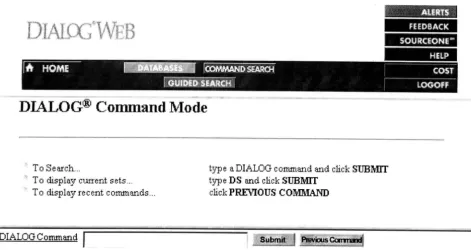
Furthermore, no type-ahead function is available, but in Version I. I provision has been made to stack commands: from the command line, a searcher can now enter a series of commands using a semi-colon between them (Figure 2). No processing message is available to indicate that the connection with the DIALOG server is still valid (although browsers' Favorites or Bookmarks can easily be used to rectify a disconnected link). With a few exceptions, all the commands are available via the Web interface. These are fortunately quite minor instructions such as SET ALIAS, SET POSTINGS and KEEP CANCEL (Klingener 1997:19).
01
B
FEEDBACKSOURCEONE"
w',.""",=-~,,,,:<,'X',,,-.,,:,,,,,,~,~,,«.:,:,,,.:.~;,~ .."".">•.,,.. 'W'." w'",,,,,,
DIALOG@ Command Mode
, To Search ...
To display current sets ... ~ To display recent conun::l.nds...
DIALOG Conunand
I
type a DIALOG conunand and click SUBl\ill type DS and click SUBl\ill
click PREVIOUS
CO:MMAND
Very few online facilities of the database front-end could be incorporated into DIALOG Web. In fact, the concept of Web searching introduces a completely new online search model, basically because of the client/server and hypertext concept. Experienced front-end online searchers will probably find that too many basic front-end functions were not yet (or could not be) incorporated in such a model.
The following documentation and online help features might influence the decision of the casual front-end searcher to use the Web or not:
- Demo/tutorial: A comprehensive tutorial that illustrates the power and features of DIALOG Web is available. It uses Macromedias Shockwave plug-in that highlights database selection, searching, displaying results, and other features (see www.krinfo.com/dialog/ train/quick/dweb. html).
- Database directory: The 450+ DIALOG databases are organized by general subject category (Figure 3). A searcher can browse through the categories, click on a specific category and get a list of databases covering the category. Searching can commence by clicking the rele-vant database.
- Dialindex: Access to the free Dialindex can be obtained either via the database directory, or directly from the first page. Once a search is typed in, the results appear in file number order, with a checkbox next to each file. This is a most versatile function, because only the desired files are selected in the search that follows.
- Blue sheets: Context-sensitive hyperlinks take the search-er to any Blue sheet for up-to-the-minute overviews of database contents, price structure and capabilities. This solves the previous problem of first filing, then finding and consulting the correct paperbased Blue sheet during
an online search. Access to any Web-based Blue sheet is free of charge.
- SDI: DIALOG Web's cautious contribution to push tech-nology is reflected in the new graphical approach to its SDI facility. A DIALOG Alert profile is created by following the convential dial-up (direct) search phases, but the rich graphical Web interface make Alerts much easier to create and modify than ever before.
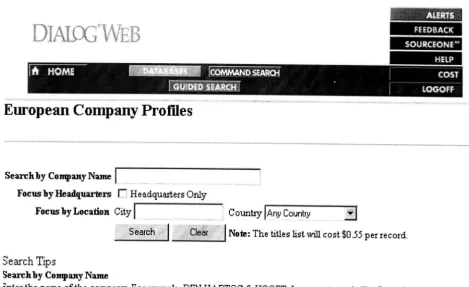
- Guided search (see Figure 4): Specifically aimed at the end-user, guided searching features access to 250 data-bases 12 application areas. It remains to be seen if this facility for the novice searcher will be more successful than DIALOG's previous efforts to create an end-user product that will 'sell', namely the unsuccessful non-graphical menu-based Business Connection and Medical Connection.
- Help files: The versatility of any Web interface is best illustrated when context-sensitive assistance is being sought. Clicking on the HELP button displays various help catagories on how to navigate the site and ex-planations with multiple examples on how to use the various DIALOG commands.
To summarize: The above overview of DIALOG Web's performance when compared to the basic features of a typical front-end indicates that the product is not yet ready to be utilized by the experienced online searcher. The latter will, inter alia, miss the ability to stack commands or make use of the type-ahead buffer. And don't try to use the interface when downloading large numbers of records! For beginner or inter-mediate DIALOG searchers the Web interface may have more to offer, for example, the integration of a database with its documentation, online assistance or clickable search aids. The discussion has also shown that the experienced searcher
I)
SOURCEONE-FEEDBACK~ •••••••• ~ l -- -COST
~
~ --
-iOGOF'-All Categories
Click a categOIY below to browse available databases by subject Display a list of all databases by name or number.
New'Sand Media Business and Finance .~ Intellectual Properly
Govenun.ent and Re~ulations Technolo~y
Ene~y and Environment
ID 1991 Knigll1-Rid.der~1rIc.
Medicine Pkann.aceuticals Chemicals
Food and ~riculture Social Sciences Rererence
S.Afr.J.Libr.lnf.Sci., 1997,65(4) 241
D1
~VVEB
European Company Profiles
Search by Company Name
I ..~
Focus by Headquarters
JJ
Headquarters OnlyFocus by Location City 1m
FEEDBACK
SOURCEONE"
HELP
Countty IAnyCountry
Note:The titles list will cost $0.55 per record.
Search Tips
Search by Company Name
~ter the name of the company. For example, DEN HARTOG & HOOFT. Leave out words like Cotp., Inc., Ltd., etc. focus by Location
Jse this option if you want to focus the search by the company's location. You can enter a city and countty __or just
Figure 4 Guided search form for the end-user or novice searcher
might prefer to use the interface to consult aBlue sheet or the ability to work with enhanced content (Klingener 1997:24).
Services such as Wall Street Journal Interactive are adding not only charts and graphs, but also links to related stories, photographs and other related information. Although DIALOG Web does not provide any enhanced content yet, its browser-based searching facilities have the potential of ad-ding it to the service in future.
This review of DIALOG Web is based on the first and second (Version 1.1) release. Further enhancements are ex-pected during 1998.
Conclusion
The versatility of the World-Wide Web to access various categories of information systems has stimulated database vendors to investigate the advantages and disadvantages of-fered by such a user-friendly environment. Various levels or phases of using Web technology were found when studying the Web sites of the large commercial vendors. Some hosts, such as Ovid, have redesigned their entire interface to utilize all the advantages of current Web technology. Other vendors, such as KnightRidder, have opted to use Web interface tech-nology to receive the searcher, provide access to the systems documentation, pricing policy, database manuals, subject categories, document ordering facilities, and SDI functions. Searching can be done via the Web interface, but the mand language still has to be used for searching. When com-pared with the essential features of database front-end
software, such as those of DialogLink, it becomes obvious that current Web interfacing can accommodate only some of these front-end features. The main problem area can be found during the online phase when essential actions such as strategy saving, type-ahead buffers, online editing and down-loading large sections of retrieved information are deemed important. Therefore, it can be concluded that the ex-perienced online searcher will not find many reasons to change his/her search habits by moving over to Web-based online searching. However, casual visits to favourite vendor sites might be valuable, even to the experienced searcher. Different nodes can be visited for information, for example to link to database manuals, or to update oneself on new developments regarding the specific system and/or additions to the vendor's Web site.
References
Announcing DIALOG Web Version 1.1. 1997.Chronolog, Septem-ber:45.
Database race to the Web.1996a.Information today, 13(9):43,50,59. Database race to the Web.1996b.Information today, 13(10):39.
Internet and interface: new from LEXIS-NEXIS. 1996.Information retrieval and library automation, 32(3):1-3.
lacsa, P. 1996. Ovid Web gateway: nobody does it better.Online, 20(6):24-31.
Eaton,l.1997.The future of Web services: changes in the use of the Web have been a mixed blessing.Information world review, 125:13.
Klopper, S.M. 1997. Testing, pushing and pulling the DIALOG Web. Online, 21 (5):27-32.
Medline over the Web. 1996. Information retrieval and library auto-mation, 3(8):3.
Notess, G.R. 1996a. News resources on the WorldWide Web. Database, I 9( I): 12-20.
Notess, G.R. I996b. The Internet as an online service: bibliographic databases on the Net. Database, 19(4):92-95.
O'Leary, M. 1997a. Database review: the Wall Street Journal meets the Web.Information today, 14(3):22-23.
O'Leary, M. 1997b. DIALOG debuts Web version. Information today, 14(5): 18,28.
Ovid: Javafirst, pay-as-you-go Web, journals online. 1997.
Information retrieval and library automation, 32(8):7-8.
Scott, J. 1996. Online access to international newspapers and wires: a status report. Database, 19(4):42-49.
Van Brakel, P.A. 1987. Criteria for the evaluation of database access software, inProceedings of the I I th International Online Information Meeting, London, 8-10 December 1987. Oxford: Learned Information: I I I- 122.