S.Afr.J.Libr.Inf.Sci., 1997,65(4)
Information needs of the teachers of Orange Farm
Berendien L. Oosthuizen
Department of Information Studies, Rand Afrikaans University, P.O. Box 524, Auckland Park, 2006 Republic of South Africa [email protected]
Received September 1997; accepted September 1997
The purpose of this research project was to determine what the information needs are of teachers in a black metropolitan informal settlement. A group survey was conducted on a sample of 206 teachers from 42 primary and secondary schools in the Orange Farm area. The results were processed by computer and cross tabulation was performed on the data to identify any possible influences of variables like sex, age and type of school. The findings are discussed and in view of the picture that emerges of a complete lack of library services or any other available resources, recommendations are made. The most important recommendation is that a mobile library service for the teachers should be started with the co-operation of the educational authorities, local government and the Provincial Library Services.
Die doeI van hierdie navorsingsprojek was om die inligtingbehoeftes van onderwysers in 'n informele swart metropoli-taanse gebied vas te stel. 'n Groepopname is uitgevoer op 'n steekproef van 206 onderwyser uit 42 laer en hoer skole in die Orange Farm-gebied. Die resultate is rekenaarmatig geprosesseer en kruistabulering is gedoen om moontlike invloede van veranderlikes soos geslag, ouderdom en soort skool te bepaal. Die bevindinge word bespreek en in die lig van die beeld van algehele gebrek aan biblioteekdienste of enige ander hulpbronne, word aanbevelings gemaak. Die belangrikste aanbeveling is dat 'n mobiele biblioteekdiens vir die onderwysers ingestel moet word met die samewerking van onderwys-owerhede, plaaslike owerhede en die'Provinsiale Biblioteekdienste.
227
This article reports the results of an empirical study that was undertaken to determine the actual information needs of the teachers in Orange Farm. A profile of their needs was
con-sidered pertinent to the development of any library and
in-formation service.
In the informal settlement of Orange Farm and surrounding
areas to the South of Johannesburg, Gaute~g, there are more
than 40 schools with none of them having library facilities. Where school libraries are available in South Africa, they are on the whole 'totally under-utilized' (Le Roux 1992:44). This can be blamed on a number of factors, but one of them surely is the teachers' lack of familiarity with library services. In the opinion of this researcher information literacy should start with the teachers. Physical accessibility of information alone is not enough. Intellectual accessibility together with societal
and psychological accessibility are imperative for
informa-tion use. Provision of informainforma-tion to the teachers of Orange Farm was therefore identified as a high priority issue and the
logical starting point for the introduction of some kind of
library and information service. The culture of information use will hopefully be diffused through the school community.
Fairer-Wessels and Machet (1993:109) also identify the
pro-vision of reference works to teachers as one of the services that are urgently needed in the black communities.
History of the Orange Farm Settlement
The Group Areas Act (1950) made provision for separate
settlement of racial groups in metropolitan areas. After influx control laws were repealed in 1986 migration from rural areas
increased dramatically. Poverty was augmented by over
population in the urbanization process.
In the former political dispensation, cities represented the
First World while the Homelands represented the Third
World. The growth rate of the black population was a doub-ling of numbers every 27 years. The inbalance between
popu-lation growth and economic growth resulted in a lack of
housing (Ferreira 1993:13-16). A conglomeration of fastly
erected shelters and shacks started to appear on the fringes of
cities. Many of these developments started on property not
owned by the squatters. Any type of building material was and is still used: cardboard, corrugated iron, paraffin tins, canvas, pieces of wood, plastic, and so on. To remedy the
situation the government started with so-called organized
squatting. A piece of land would be earmarked for this,
divided into small plots and serviced with water and
sewer-age. In 1991 the number of informal settlements was
cal-culated at approximate 3 million (Ferreira 1994: 18).
These alternative housing schemes are legal and work on a self-help basis (Vali, Rispel & Motale 1994:28). Housing is
considered to be the responsibility of the individual with
assistance from the public and private sectors. The authorities
lay down policy concerning ownership, standards and
finance. The resident initiates the building of a home (Ferreira 1993:20).
Orange Farm as an informal town was established in 1987.
It is situated 25 kilometres South of Johannesburg next to the
NI-Highway near Grasmere and Evaton. It is on the
Ver-eeniging-Langlaagte railway line with the station two
kilo-metres from the centre of town. Stands of 250 square kilo-metres have been marked out, each with a pit lavatory and one tap for
every eight stands. Gravel roads, water trenches, informal
shops and an open terrain for sports complete the
infra-structure (Ferreira 1993:21). The inhabitants mostly use
plastic, hardboard and corrugated iron as building material, but brick houses are also being erected. They can own the
228
(Mtshelweni 1989:23). According to Ferreira (1993:22) the
community appreciates the physical space, privacy and access to economic activities.
It started off as a formal town but housing could not be
made available at the required rate and an informal town
developed. On average seven people live in each house.
Initially 500 plots (3500 people) were proclaimed, but houses
started to appear on every open piece of land (Ferreira
1993:51).
Van Niekerk (1990:72) is of the opinion that Orange Farm
presents a solution, especially for people who are serious
about home ownership. In this way urbanization is being
turned into a virtue instead of a problem.
To illustrate the rate of expansion in the area the following
statistics can be quoted (South Africa. Central Statistical
Service 1991).
1985 Population 00519 (1985 Census)
1990 Population 48036
Formal houses 20283
Informal houses 27750
None the less, Eskom has made good progress in providing the area with electricity. This will have a direct effect on the kind of information service that can be started in the area.
Survey
Sampling
In order to build up a profile of the information needs of
teachers in black schools, it was decided to use an
ideo-graphic research strategy and conduct a sample survey on the
target population of teachers in primary and secondary
schools in black townships (Mouton 1996: 133).
As a sampling frame 280 teachers from 42 schools from
Orange Farm and environments were used. These 280
teach-ers were enrolled at the Rand Afrikaans Univteach-ersity for
con-tinuing education courses. Of this group 206 respondents
were used because they attended the class on the day of the 'survey.
S.Afr.Tydskr.Bibl.lnligtingk., 1997,65(4)
The questionnaires were handed out in class with the
re-searcher present to answer all questions. This is a
combina-tion of a postal survey and a structured interview. The
advantages are obvious: it is more personal than a postal or telephone survey; the fact that the operation is done in class time with the formal consent of the lecturer gives additional status to the survey; the questionnaire is completed within a given period of time and this method usually renders a higher response rate than a postal survey. In this particular instance the response rate was 90%.
A disadvantage was the fact that one person could not
control the completeness of each questionnaire at hand-in
time. If this could be done a response rate of near 100% could be attained.
Analysis of data Personal information
Gender
The sample had 30.1 % male and 69.9% female respondents. Gender proved to be the most important variable influencing personal preferences for recreational reading.
Language ability
Reading, speaking and writing abilities in different languages were measured on a five-point scale registering from none to very well. An interesting observation was made, namely that
mother tongue does not correlate with reading and writing
ability.
Educational qualifications
The picture that came forward here is distressing. The large
proportion of teachers with standard 10 (grade 12) as their
Questionnaire
A questionnaire was used as a data collection instrument. The questionnaire was developed to comply with the requirements for computerized statistical processing for quantitative ana-lysis. Attitude was not tested, so structured closed and open questions were used. The responses to open questions were coded before processing took place. A pilot study resulted in
the rephrasing of some of the questions to rule out any
possibility of misunderstanding.
The questionnaire was divided into the undermentioned
four sections that will also be used as headings for the dis-cussion of the results:
Section A: Personal information
Section B: Information needs concerning teaching career
Section C: Personal information needs
Section D: Use of information resources
20 40 60 80
Figure 1 Language ability
100 120 140 160 180 200
Clslzulu
.'sixhosa .Tshivenda .Setswans .Xltsonga .Siswati
• Sesotho 5 • Sesotho N Ndebele
S.AfrJ.Libr.Inf.Sci., 1997,65(4) 229
5t10+3-4 15%
5t 10+1-2 47%
5t10+5+ 1%
Welfare
9%
Recreation
28%
Figure 3 Community activities Figure 2 Educational qualifications of the teachers
highest qualification is unaccountable for, in the light of many
qualified teachers presently having to leave the profession
due to the rationalization process. The only positive aspect for . this particular sample, is that they are all enrolled for
edu-cation courses at the Rand Afrikaans University.
Community activities
The lowest score was attained by political activities, while church activities and sports and recreation were ranked first
and second respectively. Overall the involvement in
com-munity activities is high. This is a positive scenario for the
assumption that the teachers have an influence in the
community.
Age groups
Almost 90% of the sample are under the age of 35. So most of the respondents still have a long career ahead of them. In the cross tabulation of the data, age as a variable did not have any significant influence as indicated by the Pearson Chi-square value.
Information needs concerning teaching career
Primary or secondary schooL
Primary school teachers formed 60% of the sample. This vari-able was responsible for statistical significant (p
=
0.0059) differences on the 1% level of meaning for the two groups intheir responses to the question dealing with the need for
subject knowledge. Primary school teachers rated the
import-ance of subject knowledge much lower than did secondary
school teachers. The difference between the answers of the two groups to the question on the need for information for preparing lessons, was statistically significant (p
=
0.0455) ona 5% level of meaning. Primary school teachers did not give a high rating to this need.
Currently available information sources
To this question 77.7% of respondents replied that they had
no access to information sources.
Information categories
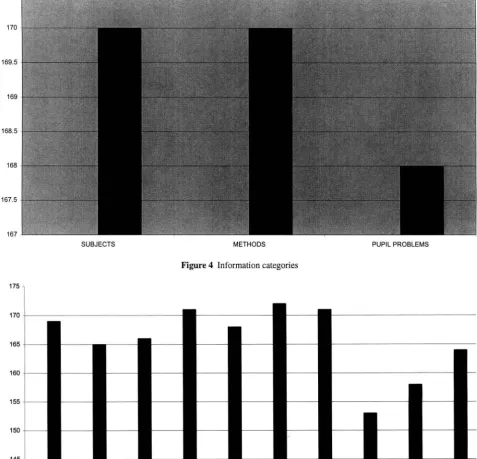
Knowledge of teaching methods was rated highest in import-ance, followed by subject knowledge and then pupil problems lower down the scale.
Kinds of information sources
The response to this question still reflects the dependence on
the textbook. Handbooks were rated most important, with
teaching manuals and subject literature in second place. Bib-liographic tools like indices and bibliographies received the lowest ratings. This can be an indication of a lack of knowl-edge of information retrieval tools.
Types of information services
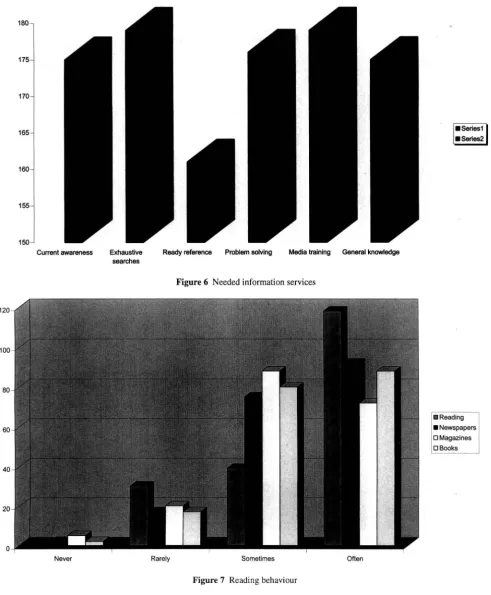
There is clearly a need for all kinds of information services. More than 94% of the sample put media training, exhaustive
searches, and information for problem solving as the most
needed services.
Personal information needs and behaviour
Frequency of reading
Regular readers made up 62.9% while the rest of the group indicated 'sometimes' as the appropriate description of their
reading behaviour. As far as their preferences for
biblio-graphic forms are concerned, it is good to notice the strong
position of the book in comparison to newspapers and
230
170.5
170
169.5
169
168.5
168
167.5
167
S.Afr.Tydskr.Bibl.Inligtingk., 1997,65(4)
SUBJECTS METHODS
Figure 4 Information categories
PUPIL PROBLEMS
Figure 5 Information sources
Types of literature preferred for recreational reading
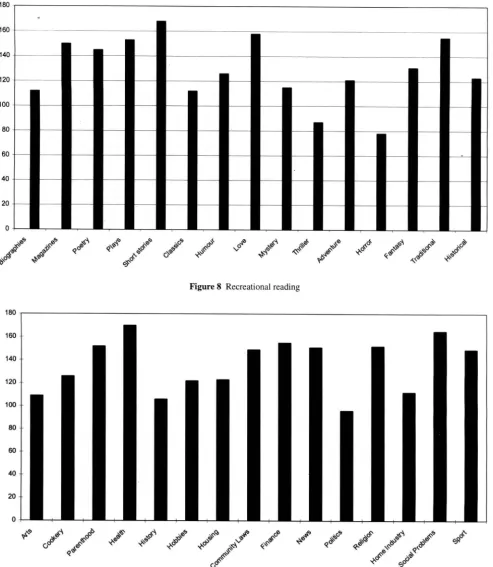
The priority list starts with short stories, love stories and traditional stories, and ends with horror stories.
Subject interest
The variable with the strongest influence on reading interest was gender. The results showing statistically significant dif-ferences between the sexes were predictable. Arts and crafts, cookery and housing are obviously more appealing to women and common law, politics, history and sport are more likely to interest men.
Use of information resources
Library use
Nearly 70% do make use of some kind of library not with-standing the fact that 27.4% indicated that the nearest library to their school is more than 20 km away and 25.8 % indicated that the nearest library to their home is more than 20 km away. The public library was used mostly (60.2%).
Current use of information resources
Apart from the library the respondents use the
S.Afr.J .Libr.Inf.Sci.,1997 ,65(4) 231
180
175
170
165
160
155
150
Current awareness Exhaustive
searches
Ready reference Problem solving Media training General knowledge
Figure 6 Needed information services
• Reading
• Newspapers
oMagazines
oBooks
Never Rarely Sometimes
Figure 7 Reading behaviour
Often
Own collection
- Borrowed
- Television
Radio
Importance of access to information for teachers
The respondents (93%) indicated that accesss to information
was very important.
Information for formal studies
Of the respondents 140 had difficulty in finding relevant
in-formation for their studies.
Need for library services
The opinion of the respondents came out very strongly on this
matter. A large proportion (95.7%) supports library service
for the teaching staff; 97.8% want library services for pupils and 94.5% for the whole Orange Farm community.
Opening times of such a service
232 S.Afr.Tydskr.Bibl.lnligtingk.,1997,65(4)
180
160
140
120
100
80
60
40
20 0
~0" 0" ~-\
q'~-\" '0" .r!}> ,}- ".0 r/;--\
.sl
~0 0' ~,,-\ W.JJ
r/;;p,'" q00 0<::' 4~
~,,~
,,0 ?;l A$'<::' f::o<>l ~o~ .0'" ,-&'~~<:/ ?;l (}~
~~
«.~'"
is'll;~l($
~~~
~~ol:- .p'::''lJ ",'Ii~"
Figure 8 Recreational reading
180
140
120
100
80
60
40
20
o
Figure 9 Subject interest
Facilities available at their schools
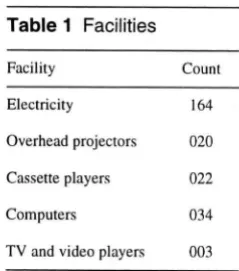
Electricity is nearly generally available, which is very Im-portant for the use of information technology in services.
Findings and recommendations
The study has proved that a dire need exists for information services in schools in the Orange Farm Settlement. Although the research was restricted to a certain geographical area it can be accepted that similar conditions will be found in other black townships.
The new Curriculum 2005, based on the principle of
Outcomes Based Learning, will only strenghthen this need
(Faasen &Metcalfe 1997:8). Information will and should be the cornerstone for both teachers and pupils for independence from lectures and a change to a style of lifelong learning.
It has been discussed often in the literature that public
libraries and school libraries (where they exist) should work closer together. In the present financial circumstances and in the light of the burden that the Department of Education must
S.AfrJ .Libr.lnf.Sci.,1997 ,65(4)
Table 1 Facilities
Facility Count
Electricity 164
Overhead projectors 020 Cassette players 022
Computers 034
TV and video players 003
idealistic. The researcher agrees with Le Roux (1992:46) that, in view of the present circumstances, alternative models for school media centres have to be considered.
Public libraries have always catered for staff and pupils after school hours. There is also a shift in many public libra-ries towards a stronger focus on the educational function (Harris 1992: 10-13). They have the infrastructure as well as the sources. The respondents in this study also indicated that they mostly use the public library. The rigid lines drawn between the functions of different kinds of libraries should be reconsidered. Scarce resources should be used to the ultimate if the information profession takes up the challenge of re-maining relevant in a fast changing South Africa.
Therefore, in the case of Orange Farm, it is suggested that the Provincial Library Service together with the local govern-ment and the educational authorities get involved in rendering a servtce.
There are a number of reasons for an alternative to the idea of a permanent collection at every school. The most important reasons are the following:
- the cost involved in supplying each school with its own collection
- the lack of suitable permanent structures in the area - the security situation
- the very real danger of stormy weather and fire hazards - the lack of professional knowledge in schools to manage
the service.
On account of the above it is suggested that mobile libraries should be used.
The following advantages come to mind:
- Can serve a number of schools with the same collection Professional librarians can be appointed to manage the library
An initial reference collection for the teachers can be extended to fulfill in the pupils needs.
Can be used as a model library service with the newest technology and user-oriented service. In this way a positive image of a library service can be established in the new market.
- Information user education can be given the high priority profile that it should have.
233
Why start with the teachers?
One of the most likely reasons for the under-utilization of school libraries is the lack of information literacy on the part of the teachers. Kistan's (1992:205) study on the use of media centres in South Africa shows that the use of the library by staff members was rated by respondents between Q-4 on a ten-point scale. According to Zinn (1997:46) the reason for the negative attitude of teachers to libraries is because they themselves had a lack of access to libraries. If the teachers know how, why, where and when to find information and use it, these skills will not only enhance their teaching and pre-pare them for the new curriculum, but will filter through to the pupils and the community. By the time services can be extended to the pupils themselves, the teachers will be able to guide them.
The availability of relevant information on the teacher's level, the implementation of a continuous users training program, and the services of dedicated professional personnel as facilitators can be the driving force towards learner-centered, quality education.
References
Dixon, B.J. 1989. Opnamemetodes. InOpnamemetodes en praktyk.
J. Schnetler (Red.). Pretoria. RGN: 12-39.
Faasen, N.&Metcalfe, L. 1997. Curriculum 2005; a new challenge to resource managers. Cape librarian, 41(4):7-9.
Fairer- Wessels, F.&Machet, M.P. 1993. The development of alternative library services for the black community in South Africa. Mousaion, Series II (1): 100- I I !.
Ferreira, H. 1993. Orange Farm as informele nedersettingsterrein: 'n geografiese evaluering. MA dissertation. Johannesburg: Rand Afrikaans University.
Harris, D. 1992. Meeting the demands for educational materia!.
Cape librarian, 36(8):10-13.
Kistan, G. 1992. Perceptions and utilization of media centres in South Africa. Journal of librarianship and information science,
24(4):203-210.
Le Roux, S. 1992. School media centres in a new South Africa.
Mousaion, Series III, 10(2):37-5!.
Mouton, J.1996. Understanding social research. Pretoria: J.L.van Schaik.
Mtshelwane, Z .. 1989. Making the best of a home-made home. Work in progress, no. 62, Nov.:22-24.
South Africa. Central Statistical Service. 1991. Boipatong, Bophe-long, Evaton, Orange Farm, Sebokeng &Sharpeville: Bevol-kingseienskappe =Population characteristics, November 1990.
Pretoria: Central Statistical Service. (Statistiese nuusberig; P030!.3
=
Statistical news release; P030!.3).Vali, A., Rispel, L.&Motale,P. 1994. Informal settlements; health priorities and policy implications. Critical health, no.46, July:28-32.
Van Niekerk, P. 1990. Precious little. Leadership SA,9(5):67-73.
Zinn, S. 1997. Teachers and libraries, a low priority relationship.