Abstract—Software defect predictive model can efficiently
help improve software quality and lessen testing effort. A large number of predictive models are proposed in a software engineering literature, but this paper presents the proposed method in software defect prediction with the comparative results based on two classifiers, i.e., backpropagation neural network and radial basis functions with Gaussian kernels as classifiers. Comparative results on NASA dataset are demonstrated and analyzed on the basis of mean square error and percent of accuracy. Experimental results show that the neural network performs better prediction than the RBF in almost subsets of data from 5.76% to 6.75%.
Index Terms—Software quality, software defect prediction,
Software classifiers, fault-prone software modules
I. INTRODUCTION
Development and testing of a large software system consumed resources and time. Software development managers often experience problems of allocating sufficient time and resources for software testing and quality assurance activities. Recently, much work has been researched in a software engineering literature about fault-prone classifiers for software quality assessment. Many well-known classification techniques in machine learning, data mining, statistics such as neural network, Bayesian network, radial basis function (RBF), clustering, probabilistic relational model, decision trees, and naive bayes are used to evaluate software modules. Studies are reported in the literature [2, 3]. In addition, parsimonious classifier of software quality assessment using Gaussian kernel radial basis functions is studied in [4]. A model reported in [5] has been developed by using Bayesian network to assess and predict software quality. Unsupervised learning technique such as clustering is used in prediction of faults in software systems [6, 7]. Moreover, other data mining techniques such as feature subset selection, classifying feature description and associate rule are respectively applied to classify software engineering dataset in [8, 9, 10].
The common point of such studies is that their works focus on the insight and the analysis of their own techniques. They pay very little attention to the comparative results and no recommendation of the software defect classifiers is suggested. Moreover, the heavy metrics of the software engineering dataset is used without performance testing on attribute reduction. Therefore, our work aims to present comparative results of the backpropagation neural network
Manuscript received June 3, 2012; revised July 3, 2012.
The authors are with the Department of Computer Science, Faculty of Science, Prince of Songkla University Hatyai, Songkhla, Thailand 90112 (e-mail:[email protected],[email protected],[email protected],ladd [email protected] )
and the RBF. An experimental comparison of the proposed methods is provided in this paper. Different experiments in this research are conducted by using smaller subsets of NASA software engineering dataset [1]. The quality of our models is evaluated based on classification accuracy and mean square error (MSE). Models obtained from each presented technique are analyzed and then selected. The comparative results within the same size of networks and the difference of average percent of accuracy between them are also presented. Then, the recommendation is suggested to software developers.
The rest of paper is organized as follows. Section II discusses about the classification techniques. In Section III, the proposed method is described. The dataset, model implementation, the software predictive results and comparison are discussed in Section IV. Finally, conclusions are reported in Section V.
II. MODEL DESCRIPTION
A. Backpropagation Neural Network
To obtain predictive models, the algorithm of the backpropagation neural network with multihidden layer [12] is applied to software engineering dataset. In the neural network architecture with a perceptron, inputs are activated with the sum of the product of the inputs and the weights . Its output becomes the input of each hidden units. In each hidden unit, the inputs are computed to obtain a predictive output (O) by a sigmoid function, a non linear function defined by the equation (1).
(1)
In the training process, using given inputs training data with corresponding output value , an error can be computed by the equation (2).
← - (2)
Then, the neural network weight can be updated in the equation (3).
) (3)
A derivative of is = and is a learning rate. In multilayer case, errors are approximated by backpropagating the final output error. The algorithm of the backpropagation neural network [12] is described in the following procedure in Fig. 1.
Comparative Classifiers for Software Quality Assessment
Input: Given input training data Output: Output from each output unit
1. Initialize the weight to small numbers until satisfied do
2. For each training example, do
2.1 Input the training example to the networks and compute actual outputs. (forward pass)
2.2 Compute weight change (backward pass)
For each output unit k
) Where is a target output and is an output of each
output unit k.
For each hidden unit h
Where is an output of each hidden unit h.
2.3 Update each network weight
Where =
3. The algorithm is stopped when the value of the Mean Square Error (MSE) is acceptable.
Fig. 1. The backpropagation neural network algorithm [12].
B. Radial Basis Function (RBF)
The SG RBF algorithm, which is a recent RBF algorithm proposed by the author, Shin and Goel [4, 11] is applied to the datasets. RBF architecture is similar to the neural network, but using the Gaussian function as the nonlinearity for the hidden layer. The RBF network consists of three layers, (i.e., input, hidden and output.)
n d input vector is nonlinearly transformed by the basis function to the hidden layer.
where n is an input data size,
and d is a dimensional input data vector.
In practice, the Gaussian function gives a good approximation and is easy to control parameter , which is a width of the basis function. The RBF model for the Gaussian case can be described as equation (4)
where n is an input data
size, and d is a dimensional input data vector.
In practice, the Gaussian function gives a good approximation and is easy to control parameter , which is a width of the basis function. The RBF model for the Gaussian case can be described as equation (4).
(4)
where is the input vector and is the basis function center. Then, the transformed output is linearly weighted to produce the final output. A mapping of
is in equation (5).
(x)=
(5)
From equation (5), m is the number of basis function. s are weight and is the Euclidean distance. A parameter set for the RBF model is defined by . In the SG RBF algorithm, a global parameter that users control the value is given. The algorithm selects the number of basis function for a given . The center of the basis function ’s are determined for a pair of selected m and Next, the
III. PROPOSED METHOD
Three core steps of our proposed method are illustrated in Fig 2. They are 1) Data gathering and preprocess, 2) Model building and evaluation, and 3) Model comparison.
In data gathering and preprocess step, dataset is gathered by selecting from the collection of public software engineering data repository. Then, the data are preprocessed by removing redundant data. Outliers are also removed from the dataset by observing from thplot of the attribute values, and data are normalized within the range between 0 and 1. The labels of output are classified as 1 (fault-prone) and 0 (non fault-prone). Null or zero value attributes are eliminated from the dataset. In model building and evaluation step, the backpropagation neural network and RBF are applied to build the models. Two new subsets of data are created under the assumption that subset of attributes contain only important feature will give better result. Only class relevant attributes or only method relevant attributes are selected for class-level dataset or method-level dataset respectively. The experimental results are compared in the last step.
Problem Definition
Remove Redundancy data Step 1
Data Gathering and Preprocess
Remove outlier data Remove null or zero
attribute Normalize data with the range between 0 and 1 Select attribute and Create subsets of dataset
Step 2
Model Building and Evaluation
Train Model Create Model Test Model Evaluate and Interpret model Select the best model
Train Model Create Model Test Model Evaluate and Interpret model Select the best
model Backpropagation Neural
Network
RBF Compare the results
Step 3 Model Comparison
Fig. 2. The proposed method.
IV. IMPLEMENTATION AND ANALYSIS
A. Dataset
numbers of instances are 145 records. The first 31 attributes are input, and the last attribute is output classified into a discrete value as 0 and 1. If the class or the method of the program module contains one or more defects, the output is 1 and 0 otherwise. There are 60 records in class 1 and 85 record in class 0. In modeling process, the dataset is partitioned to three data subsets: class-level, method-level and all attributes.
B. RBF Model
The dataset used is randomly selected 50% for training, 25% for validation and 25% for testing. The RBF model is selected based on low value of MSE on testing data, but it should have moderate number of basis function to avoid overfitting
problem. From the experiments, 95% and 99% of the confidential level are assigned for testing and comparing the results. The models with a small number of the Gaussian function that have high value of and large training error are considered to be underfitting models because they do not learn enough. However, the complex models with the large number of the Gaussian function with small value of and large testing error are overfitting models because it is unable to provide good generalization on unseen data. The results of the RBF classifiers on three data subset: class-level, method-level and all attributes are presented in Table IIa)-IIc) and their MSE plots are shown in Fig. 3a)-3c), respectively.
TABLEI:ATTRIBUTES OF THE INPUT DATASET
Features at Class Level
1. PERCENT_PUB_DATA: The percentage of data that is public and protected data in a class.
2. ACCESS_TO_PUB_DATA: The amount of times that a class's public and protected data is accessed.
3.COUPLING_BETWEEN_OBJECTS: The number of distinct non- inheritance-related classes on which a class depends.
4. DEPTH: The level for a class.
5. LACK_OF_COHESION_OF_METHODS: This metric indicates low or high percentage of cohesion.
6. NUM_OF_CHILDREN: The number of classes derived from a specified class.
7. DEP_ON_CHILD: Whether a class is dependent on a descendant. 8. FAN_IN: This is a count of calls by higher modules.
9.RESPONSE_FOR_CLASS: A count of methods implemented within a class plus the number of methods accessible toan object class due to inheritance.
10. WEIGHTED_METHODS_PER_CLASS: A count of methods implemented within a class
Features Transformed to Class Level (Originally at Method Level) 11. sumLOC_BLANK: Lines with only white space or no text content. 12. sumBRANCH_COUNT: This metric is the number of branches for each module.
13. sumLOC_CODE_AND_COMMENT: Lines that contain both code and comment.
14. sumLOC_COMMENTS:The number of lines in a module including all blank lines, comment lines, and source lines.
15. sumCYCLOMATIC_COMPLEXITY: It is a measure of the complexity of a modules decision structure. It is the number of linearly independent paths.
16. sumDESIGN_COMPLEXITY: Design complexity is a measure of a module's decision structure as it relates to calls to other modules. 17. sumESSENTIAL_COMPLEXITY: Essential complexity is a measure of the degree to which a module contains unstructured constructs.
18. sumLOC_EXECUTABLE: Source lines of code that contain only code and white space.
19. sumHALSTEAD_CONTENT: Complexity of a given algorithm independent of the language used to express the algorithm.
20. sumHALSTEAD_DIFFICULTY: Level of difficulty in the program.
21.sumHALSTEAD_EFFORT: Estimated mental effort required to develop the program.
22. sumHALSTEAD_ERROR_EST: Estimated number of errors in the program.
23. sumHALSTEAD_LENGTH: This is a Halstead metric that includes the total number of operator occurrences and total number of operand occurrences.
24. sumHALSTEAD_LEVEL: Level at which the program can be understood.
25. sumHALSTEAD_PROG_TIME: Estimated amount of time to implement the algorithm.
26. sumHALSTEAD_VOLUME: This is a Halstead metric that contains the minimum number of bits required for coding the program. 27. sumNUM_OPERANDS: Variables and identifiers Constants Function names when used during calls.
28. sumNUM_OPERATORS: Number of operators.
29. sumNUM_UNIQUE_OPERANDS: Variables and identifiers Constants (numeric literal/string) Function names when used during calls
30. sumNUM_UNIQUE_OPERATORS: Number of unique operators. 31. sumLOC_TOTAL: Total Lines of Code.
TABLEII:RESULTS OF THE RBFCLASSIFIERS
After analyzing the choice of models (A to J) with different parameters (sigma and basis function) along with their MSE plots shown in Fig. 3, the best model is chosen based on low validation and testing error. The best model should be the best compromise point between the training error and the
a) Class-level b) Method-level c) All attributes
Fig. 3. Mean square error (MSE)
A comparison among three data subsets shows that the selected model using the method-level dataset gives better result than others because this model has the lowest testing error, which is 0.1675, and it is less complex than models from other subsets of data.
C. Backpropagation Neural Network Model
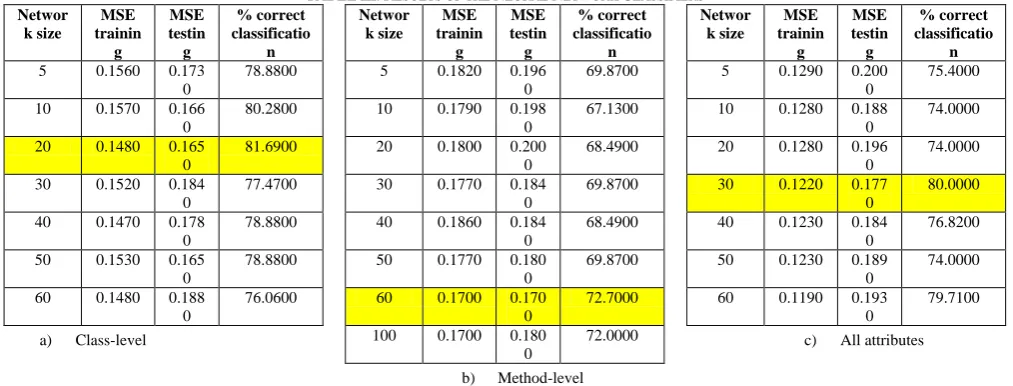
The backpropagation neural network is applied, and the datasets are randomly partitioned in to 50% for training and another 50% for testing. Learning rate = 0.1 is assigned, and the starting point for the momentum is at 0.9. The feedforward backpropagation algorithm is repeated up to 2000 epochs to update weight and the obtained results are in
Table III.
From Table IIIa)-IIIc), the class-level dataset with the network size 20 has the best result with the lowest MSE on testing data and the highest percent of correct classification, which are 0.165 and 81.69% respectively. For the method-level dataset, the network size 60 gives the best result with the MSE testing 0.17 and 72.7% correct classification. For dataset using all attributes, the network size 30 gives the best result with the MSE testing 0.177 and 80% correct classification. Among three datasets, the class-level has the best modeling result.
TABLEIII:RESULTS OF THE NEURAL NETWORK CLASSIFIERS
Networ k size MSE trainin g MSE testin g % correct classificatio n
5 0.1560 0.173
0
78.8800
10 0.1570 0.166
0
80.2800
20 0.1480 0.165
0
81.6900
30 0.1520 0.184
0
77.4700
40 0.1470 0.178
0
78.8800
50 0.1530 0.165
0
78.8800
60 0.1480 0.188
0 76.0600 a) Class-level Networ k size MSE trainin g MSE testin g % correct classificatio n
5 0.1820 0.196
0
69.8700
10 0.1790 0.198
0
67.1300
20 0.1800 0.200
0
68.4900
30 0.1770 0.184
0
69.8700
40 0.1860 0.184
0
68.4900
50 0.1770 0.180
0
69.8700
60 0.1700 0.170
0
72.7000
100 0.1700 0.180
0 72.0000 b) Method-level Networ k size MSE trainin g MSE testin g % correct classificatio n
5 0.1290 0.200
0
75.4000
10 0.1280 0.188
0
74.0000
20 0.1280 0.196
0
74.0000
30 0.1220 0.177
0
80.0000
40 0.1230 0.184
0
76.8200
50 0.1230 0.189
0
74.0000
60 0.1190 0.193
0
79.7100
c) All attributes
D. Comparative Results of Models
When considering the values of MSE testing and percentage of correct classification, the models from the neural network size 20 is the best (MSE = 0.165 and accuracy = 81.69%). Beside, the models from the neural network have better results than the RBF in all datasets except the method-level. The neural network on the class-level dataset gives the lowest MSE testing and the highest percentage of correct classification. However, our observation is that to obtain almost the same MSE value, the models from the neural network approach are more complicate than the RBF because the models from the neural network approach have more number of hidden units than the RBF, leading to consume more processing time.
models from the neural network have better results than the RBF in all datasets except the method-level. The neural network has lower MSE testing and higher percentage of correct classification. Considering m = 10 in Table IIa) and the network size 10 shown in Table IIIa), the MSE testing of the model from the neural network is only 0.166 while one from the RBF is 0.214.
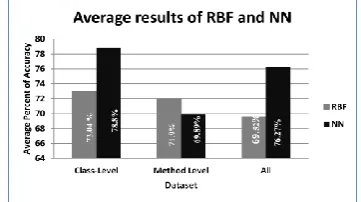
Overall, the neural network performs better than the RBF. To confirm the fact that the neural network has better percent of accuracy in most subsets of data, average percent of accuracy of three datasets are computed and the comparative results between two approaches are presented in the graph in Fig. 4. 0 20 40 60 80 0 0.2 0.4 0.6 0.8 1 0 0.05 0.1 0.15 0.2 0.25 0.3 0.35 0.4 0.45 0.5 m Mean Square Error of Software Engineering Dataset (Class Level, 8 inputs)
sigma M S E Training Data Validation Data Testing Data 0 5 10 15 20 0 0.2 0.4 0.6 0.8 1 0.1 0.15 0.2 0.25 0.3 0.35 0.4 0.45 m Mean Square Error of Software Engineering Dataset (Method Level, 21 inputs)
sigma M S E Training Data Validation Data Test Data Training Data Validation Data Test Data 0 10 20 30 40 50 60 0 0.2 0.4 0.6 0.8 1 0 0.05 0.1 0.15 0.2 0.25 0.3 0.35 0.4 m Mean Square Error of Software Engineering Dataset (29 inputs)
Fig. 4. Average percent of accuracy results of the RBF and the neural network (NN).
From Fig. 4, the neural network achieves 5.76% of accuracy higher than the RBF in the class-level. However, in the method-level, the RBF is slightly better than the neural network, which is 2.01% more accurate. In all attributes dataset, the neural network performs better than the RBF 6.75%.
V. CONCLUDING REMARKS
The software defect predictive models using the neural network and the RBF techniques are developed in our proposed method. Overall, the selected models from both approaches offer impressive result. The comparative results show that the performances are better by using subset of data with some features. Based on our results compared with the same size of network, the backpropagation neural network performs better classification than the RBF with lower MSE and higher percent of accuracy in most subsets of data. In the future work, the research will be focus on feature subset selection on software engineering dataset to seek for the best and simplest model as possible. It is therefore; conclude that the backpropagation neural network is the best classifier in our experiment. This approach is recommended to help to
identify software fault-prone classes or modules that are required immediate attention from the software developers.
REFERENCES
[1] KC1/Software defect prediction (2012, June 3). Retrieved from
promise.site.uottawa.ca/SERepository/datasets.
[2] Z. Jianhong, S. P Sandhu, and S. Rani, “A Neural Network Based
Approach for Modeling of Severity of Defects in Function Based
Software Systems,” International Conference on Electronics and
Information Engineering (ICEIE 2010), vol. 2, pp. 568-575.
[3] E. R. M. Bezerra, L. I. A. Oliverira, and R. L S. Meira, “A Constructive
RBF Neural Network for Estimating the Probability of Defects in
Software Modules,” Proceedings of International Joint Conference on
Neural Networks 2007.
[4] A. Goel, M. Shin, S. Ratanothayanon, and A. P. Raymond,
“Parsimonious Classifiers For Software Quality Assessment,” High
Assurance Systems Engineering Symposium, HASE '07. 10th
IEEE.2007, pp. 411-412.
[5] S. A Wagner, “Bayesian network approach to assess and predict
software quality using activity-based quality models,” ACM 2009.
[6] S. P. Sandhu, R. Goel, S. A. Brar, J. Kaur, and S. Anand, “A model for
early prediction of faults in software systems,” IEEE 2010, vol4, pp. 281-285.
[7] X. Tan, X. Peng, S. Pan, and W. Zhao, “Aessing Software Quality by
Program Clustering and Defect Prediction,” IEEE 2011, pp. 244-248.
[8] S. S. Kamaruddin, Yahaya, Jamaiah. A. Deraman, and R. Ahmad,
“Feature Subset Selection Method for Dynamic Software Quality
Assessment,” IEEE 2011, pp. 304-306.
[9] L. Zhang and Z. Shang, “Classifying feature description for software
defect prediction,” IEEE 2011, pp.138-143.
[10] Q. Song, M. Shepperd, M. Cartwright, and M. Carolyn, “Software
defect association mining and defect correction effort prediction,”
IEEE transactions on Software Engineering, 2006, vol. 32, no. 2, pp.
69-82.
[11] A. Goel and M. Shin, “Radial basis functions: An algebraic approach
(with data mining applications),” Tutorial at the 15th European
Conference on Machine Learning, (ECML 2004), Pisa, Italy, 2004.
[12] T. Mitchell, Machine Learning: Neural Network (2012, May 10).
Retrieved from [Online]. Available: http://www.cs.cmu.edu
![Fig. 1. The backpropagation neural network algorithm [12].](https://thumb-us.123doks.com/thumbv2/123dok_us/1365512.1646064/2.595.131.463.48.231/fig-backpropagation-neural-network-algorithm.webp)