DYNAMIC MODELING OF DFIG BASED WIND ENERGY
CONVERSION SYSTEMS
M.Ramesh1, T.R.Jyothsna2
1. INTRODUCTION
Because of environmental pollution and power shortage people are planning to implement energy resource programs in various governments in different countries. So many countries are recognized the importance of renewable energy resources. In that wind is one of the best sustainable sources of energy. In the past few years, the importance of Wind power has been penetrated into power grids. Many classifications are made to develop the wind turbine techniques. Now, doubly fed induction generator based wind turbine is becoming so familiar [1]; DFIG WT has the advantages of economic in construction, flexible control and high transfer energy efficiency, and three phase winding of the stator is directly connected to the grid , and three phase windings of the rotor is connected to the converters through slip rings. Because of supplying o f exciting current from converters to the DFIG, the rating of converters in DFIG is considerably low and which is 20-25% of rating of DFIG. Flexibility of control in DFIG can be achieved by using IGBT based converters and these controllers can impact on stability of the system [2],[3].
This paper will be organized as follows. First, Section II describes the dynamic modeling of the DFIG and rotor side converter. Then, the control schemes for the RSC, using feedback linearization technique and its detailed analysis of input output linearization is presented and Implementation of internal dynamics of the rotor side converter through voltage control is given in section III. Simulation results are showcased in Section IV. Finally, section V summarizes the conclusions.
2. DOUBLY FED INDUCTION GENETAROES
2.1 Doubly Fed Induction Generator model
A schematic diagram of a Doubly Fed Induction Generator based wind turbine is shown in Fig.1. It consists of wind turbine, back to back converters with DC link. The back to back converters are connected to the DFIG rotor and other end is connected to the grid. Power transition among rotor and grid side converters can be controlled by adjusting the control signals of IGBT legs in converters [4], [5], [6]. This scheme acts as a adjustable voltage source to the rotor [7], [8]. The dynamic model of DFIG is fairly contained with three sub models, including the wind turbine model, the transmission mechanism model and the generator model [9] .
Fig.1 Scheme of a DFIG equipped wind turbine.
1
Department of Electrical Engineering, Andhra University College of Engineering (A), Visakhapatnam, A.P, India
2
Department of Electrical Engineering, Andhra University College of Engineering (A), Visakhapatnam, A.P, India
Abstract- From the past few years, people are realizing that renewable energy resource are sustainable energy resources because of environmental pollution and power shortage problems. With deep penetration in wind energy into the various networks, vigorous studies are carried out on DFIG based variable speed wind turbine to find out the integration between wind energy farms and power systems. These systems require accurate models of doubly fed induction generator wind turbines and their associated modeling. In this paper a dynamic model of DFIG has been derived, which can be used to simulate the DFIG wind turbine representation of the generator stator and rotor circuits.
Keywords –DFIG, variable speed, Dynamic model
2.2 Wind turbine modelling
For converting wind energy to mechanical energy wind turbine is used. Wind turbine output power is stated as followed based on the principle of aerodynamics:
(1)
(2)
2.3 Transmission Mechanism model
A reduced design of drive train is achieved by neglecting the damping and stiffness of the shaft. In this model, only one single inertia is measured as summation of inertia of turbine and inertia of rotor and equivalent torque based equation is stated as follows:
(3)
Based on assumptions the one-mass model of the shaft in wind system is stiff and other constructed moving parts are lumped together.
2.4 Generator model
The dynamic analysis of a Doubly Fed Induction Generator is done by using -β and the d – q model[14],[15]. Variables of stator and rotor are related with relevant reference frames in this model which can deal the characteristics in more realistic way. The generator model of DFIG can be expressed by voltage equations, power and electromagnetic torque equations under the -β coordinate system [14],[16].
Voltage Equations:
(4)
(5)
(6)
(7)
Power Equations:
(8)
(9)
(10)
Electromagnetic Torque Equation:
(12)
3. D_Q MODELING
In doubly fed induction generator, flux linkage is chosen as basic variable for representing [17],[18] the d-q axis used for simulation. This representation is based on two axis full-order known as the Park model [10]. There is an equivalent two-axis representation of three axis. In that stator direct axis is represented as ds and quadrature axis is represented as qs, and Rotor direct axis is represented as dr and rotor quadrature axis is represented as qr. Here a synchronously rotating reference frame chosen as d-q reference frame which is rotating at synchronous speed. There by interaction among electromagnetic torque and current in rotor is observed. In this model three-phase quantities are changed to the two-phase quantities [11],[12].The generator model of DFIG can be expressed by voltage equations, power and electromagnetic torque equations under the d-q coordinate system.
3.1 Voltage Equations:
- (13)
+ j (14)
+ j (15)
- j (16)
3.2 Flux linkage Equations:
(17)
(18)
(19)
(20)
3.3 Electromagnetic Torque Equation:
(21)
3.4 Power Equations:
(22)
(23)
(24)
(25)
4. SIMULATION RESULTS
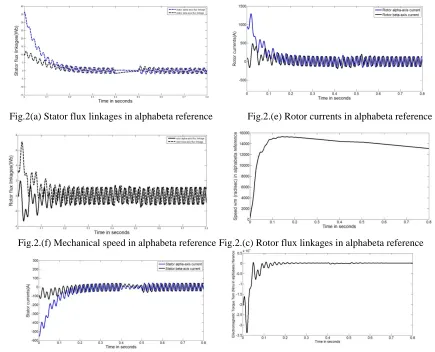
Fig.2(a) Stator flux linkages in alphabeta reference Fig.2.(e) Rotor currents in alphabeta reference
Fig.2.(f) Mechanical speed in alphabeta reference Fig.2.(c) Rotor flux linkages in alphabeta reference
Fig.2.(d) Stator currents in alphabeta reference Fig.2.(g) Electromagnetic Torque in alphabeta reference
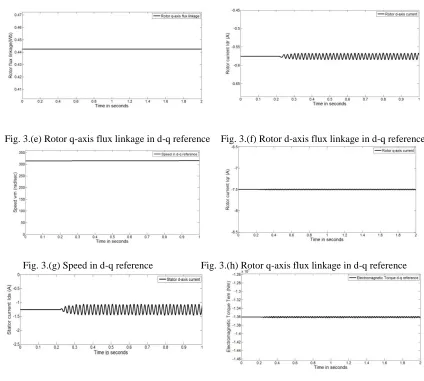
Based on d-q modeling, stator flux linkages, rotor flux linkages, stator currents, rotor currents, speed of the rotor and Electromagnetic torque parameters are shown in Fig.3.(a) to Fig.3.(j).
Fig. 3.(a) Stator d-axis flux linkage in d-q reference Fig. 3.(b). Stator q-axis flux linkage in d-q reference
Fig. 3.(e) Rotor q-axis flux linkage in d-q reference Fig. 3.(f) Rotor d-axis flux linkage in d-q reference
Fig. 3.(g) Speed in d-q reference Fig. 3.(h) Rotor q-axis flux linkage in d-q reference
Fig. 3.(i) Stator d-axis current in d-q reference Fig.3.(j) Electromagnetic Torque in alphabeta reference
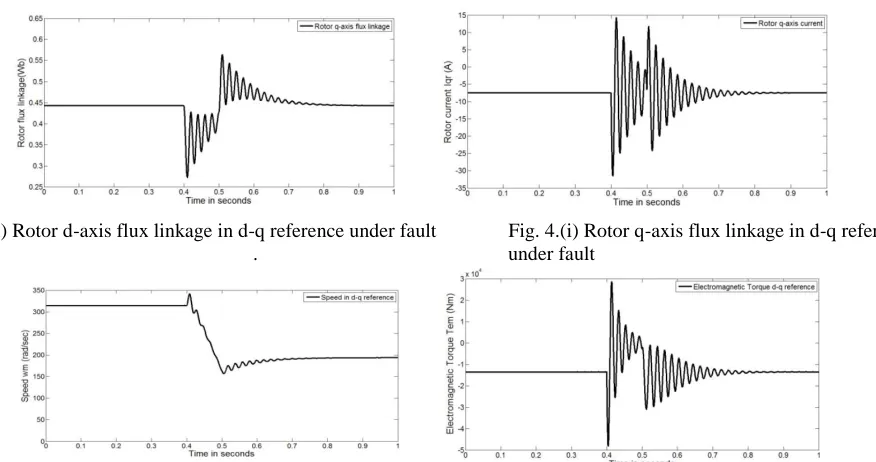
A disturbance is created with a duration of two seconds which is between 0.4 sec to 0.6 sec in d-q modeling of DFIG equipped with wind turbine is shown in Fig.4.(a) to Fig.4.(j).
Fig. 4.(b) Stator d-axis flux linkage in d-q reference under fault Fig. 4.(g) Stator q-axis current in d-q reference under fault
Fig. 4.(c) Rotor d-axis flux linkage in d-q reference under fault Fig. 4.(h) Rotor d-axis current in d-q reference under fault
Fig. 4.(d) Rotor d-axis flux linkage in d-q reference under fault Fig. 4.(i) Rotor q-axis flux linkage in d-q reference . under fault
Fig. 4.(e) Mechanical speed in d-q reference under fault Fig. 4.(j) Stator d-axis flux linkage in d-q reference under fault
Table 1 DFIG Wind system Parameters
Parameter Value Units
Prated 2 MW
Rs 2.6 m
Rr 2.9 m
Ls 2.587 mH
Lr 2.587 mH
Lm 2.5 mH
5. CONCLUSION
Because of problems encountered in power sector needful and accurate modeling has to be done to give a remedy for power shortage. In order to get that simulation of DFIG based wind turbine has been done under fault condition and hence a dynamic model with full-order representation for the DFIG and its associated circuits has been analysed and developed.
6. REFERENCES
[1]. Eriksen, P.B., Ackermann, T., Abildgaard, H., Smith, P., Winter, W., and Rodriguez Garcia, J.M.: „System operation with high wind penetration‟,
IEEE Power Energy Mag., 2005, 3, (6), pp. 65–74.
[2]. Lei, Y., Mullane, A., Lightbody, G., and Yacamini, R.: „Modeling of the wind turbine with a doubly fed induction generator for grid integration
studies‟, IEEE Trans. Energy Convers., 2006, 21, (1), pp. 257–264.
[3]. Mei, F., and Pal, B.C.: „Modelling and small-signal analysis of a grid connected doubly-fed induction generator‟. Proc. of IEEE PES, General
Meeting, 2005, San Francisco, USA.
[4]. S. Doradla, S. Chakrovorty, and K. Hole, “A new slip power recovery scheme with improved supply power factor,” IEEE Trans. Power Electron.,vol.
PE-3, no. 2, pp. 200–207, Apr. 1988.
[5]. R. Pena, J. Clare, and G. Asher, “Doubly fed induction generator using back-to-back pwm converters and its application to variable-speed wind energy
generation,” Proc. Inst. Elect. Eng., Electric Power Applications,vol. 143, no. 3, pp. 231–241, May 1996.
[6]. Y. Tang and L. Xu, “A flexible active and reactive power control strategy for a variable speed constant frequency generating system,” IEEE Trans.
Power Electron., vol. 10, no. 4, pp. 472–478, Jul. 1995.
[7]. A. Feijo, J. Cidrs, and C. Carrillo, “Third order model for the doubly-fed induction machine,” Elect. Power Syst. Res., vol. 56, pp. 121–127, Mar.2000.
[8]. P. Kundur, Power System Stability and Control. New York: McGraw-Hill, 1994.
[9]. Y. Xu and N. Wang, “Study on dynamic equivalence of wind farms with DFIG based on clustering analysis,” J. North China Elect. Power Univ., vol.
40, no. 3, pp. 1–5, 2013.
[10].G.R.Slemon, “Modelling Induction Machines for Electric Drives”, IEEE Transaction on Industry Application Vol.25, No.6 pp 1126-1131, Nov 1989.
[11].A. Petersson, “Analysis, Modeling and Control of Doubly-Fed Induction Generators for Wind Turbines”, Licentiate Thesis, Dept. Electric Power
Engineering, Chalmers University of Technology, Sweden 2003.
[12].S.Muller,M.Deicke and Rik W.De.Doncker,“Doubly-fed Induction Generator systems for Wind Turbines,” IEEE Industry Applications Magazine,
May-June, 2002.
[13].S.A. Papatbanassiou, M.P. Papadopoulos, “Dynamic behavior of variable speed wind turbines under stochastic wind”, tEEE Transactions on Energy
Conversion, vol. 14, no.4, December 1999, pp.1617-l 623.
[14].Ekanayake, J.B., Holdsworth, L., Wu, X.G., and Jenkins, N.: „Dynamic modeling of doubly fed induction generator wind turbine‟, IEEE Trans. Power
Syst., 2003, 18, (2), pp. 803–809.
[15].M.Y. Uctug & I. Eskandarzeh, H. Ince, “Modelling and output power optimisation of a wind turbine driven double output induction generator”, IEE
Proceedings-Electric power applications, vol. 141, no,2, March 1994,pp.33-38.
[16].J. G. Slootweg, H. Polinder, and W. L. Kling, “Dynamic modeling of a wind turbine with doubly fed induction generator,” in Proc. IEEE Power Eng.
Soc. Summer Meeting, Vancouver, BC, Canada, July 15-19, 2001.
[17].F. Mei and B. Pal, “Modal analysis of grid-connected doubly fed induction generators,” IEEE Trans. Energy Convers., vol. 22, no. 3, pp.728–736,
Aug. 2007.
[18]. P. Krause, Analysis of Electric Machinery. New York: McGraw-Hill,1986.