(General article)
Ethical Issues in Advertising
Rahul Singala* & Geeta Kamraa
a CSE Deptt. OITM
Accepted 7 July 2012, Available online 1Sept 2012
Abstract
Advertising is a form of communication used to persuade an audience (viewers, readers or listeners) to take some action with respect to products, ideas, or services. Advertisement acts as a communicating bridge between producer and consumer. With industrialization and expansion of market access, importance of advertising is steadily on the increase in modern society. Advertising, using media as its vehicle, is a pervasive, powerful force shaping attitudes and behavior in today's world. At times it goes beyond the traditional role of ‘fair and truthful’ information and portraits obscene, undesirable and unethical scenes giving a detrimental result especially on the young population of the society. The article have talked about various types of unethical advertisements like advertisements with obscenity and sexual overtone, endorsed by children, surrogate advertising, subliminal advertisements, false and misleading advertisements etc. The ethical aspect of Indian advertisement is extremely important for restoration of our Indian culture, norms, ethics and heritage. This article also talks about statutory prohibition and regulations of such unethical advertisements and establishment of self-regulatory body like ASCI to tackle the problem. But the most important problem lies in improper implementation of the laws.
Keywords: Advertisement, Ethics in Advertising, ASCI, regulatory laws, Advertising regulations
1. Introduction
1Advertising is a form of communication used to persuade
an audience (viewers, readers or listeners) to take some action with respect to products, ideas, or services. Advertising messages are usually paid by sponsors and viewed via various traditional media, including mass media such as newspaper, magazines, television commercial, radio advertisement, outdoor advertising or direct mail, or new media such as websites and text messages. In our day to day lives, we always face situations were we have to take decisions, and decide what is right and wrong. We are always faced with the debate of what is moral or immoral, ethical or unethical and according to the perception of each individual, the right decision from their point of view is made. The proper definition of “Morals”; are the beliefs that people hold against what is considered right or wrong. Morals direct people as they make decisions in their personal and professional lives. Another term that always accompanies Morals is Ethics; these are the principles that serve as guidelines for both individuals and organizations, they help create boundaries regarding what is acceptable and
*Corresponding author's email: [email protected],
what is not, since these behaviors are related to moral feelings about right and wrong.( Clow&Baack,2007) Over the years advertising and marketing communication messages have created a lot of debatable ethical issues, due to the public belief , that advertisements nowadays deeply affect the way people perceive themselves and the world surrounding them, including crucial actions and behaviors.(Foley1999). For these reasons, Moral issues in marketing are important, given the fact that marketing is expected to identify, predict and satisfy customer requirements profitably (Carrigan et al, 2005). Due to the difficult equation between both ends of the marketer’s responsibility, some actions (like certain Ads), have led to the creation of new laws and regulations regarding the world of advertising. (Clow&Baack,2007). In order to have a better understanding of the situation, we need to further explore the world of advertisements, the appeals used, the targeted decision making components and the effects of Ads on the targeted consumer as a whole. The are two main components advertisers aim to effect; the affective component, where affective message strategies are applied by invoking feelings and trying to match them with the product or service offered in an effort to increase the likeability of the product, and also the cognitive components, where the Ad focuses on the attributes and International Journal of Engineering, Science and Metallurgy
benefits of the product, encouraging the consumer to buy it (Clow&Baack,2007). Such components are affected by the leverage points in an Ad; these are the features in the Ad that helps the consumer transfer the advertised message into personal value (Clow&Baack,2007). In order to achieve that, over the years, advertisers have attempted a wide variety of advertising approaches, there are seven main ones; fear, humor, sex, music, rationality, emotions and scarcity. Advertisers use one or combine several of these appeals to ensure that their targeted audiences receive their message (Clow&Baack,2007). However, nowadays, two main appeals are being used extensively sometimes combined with others, but most of the time they are strong enough to be used solely. These are; sex appeal, which is the use of sexual content in advertisements and emotional appeal; which is the process of trying to affect the viewer’s feelings with the Ad presented, in an attempt to link the positive feelings generated to the product advertised. (Clow&Baack,2007). Although these two appeals are very popular, yet popularity does not come cheap. Marketing and advertising both reflect and shape cultural values and norms, they are one of the strongest forces
that shape our world today, and for these reasons the popularity of these 2 appeals are quit concerning (Fam&Grohs2007). Throughout the literature of this paper, I will be discussing the debatable effect of these appeals on adolescents.
Definitions
Advertisement “Sell hopes and dreams, not only products and services” Professor Alfonso Mendiz Noguero "A good advertisement is one which sells the product without drawing attention to itself" David Ogilvy
Indian advertising industry
Due to the economic slowdown, the advertising industry was flat showing almost no growth in 2009. This came close on the heels of 2008, a year when the performance of this industry slowed down as compared to the previous years. In 2009, the advertising industry remained at an estimated size of Rs. 216.5 billion as compared to Rs. 216 billion in 2008. In the last four years (2005- 2009), the industry recorded a cumulative growth of 13.5%1on an overall basis. The most impressive growth was from the smallest segment of the industry by size – internet advertising. Though, this segment grew by 20.0% in 2009, it was well below the growth of 85% in 2008. American companies are discovering the appeal of marketing their products in India. With a population of approximately one billion, and a middle class that's larger than the total population of the United States, there's definitely money to be made. Local retailers in apparel, food, watches and jewellery have all increased
their average ad spending by almost 50% in the past two years. Coupled with many other local players big retailing brands are spending to the tune of Rs 12,000 crores annually on advertising and promotional activities.
Table1 Growth of Indian Advertising Industry in 2005-09
Rs.Billion 200
5 2006 2007 2008 2009 CAGR
TV Advertisin
g
54.5 66.2 21.5 84.2 89 13
% change 21.50 %
17.80
% 7.90% 5.70%
Print Advertisin
g
62.7 78 94 103.5 100 12.40
%
% Change 24.40 %
20.50 %
10.10 %
-3.40%
Radio Advertisin
g
3.2 5 6.9 8.3 9 29.50
%
% Change 56.30 %
38.00 %
20.30
% 8.40%
Internet Advertisin
g
1 1.6 2.7 5 6 56.50
%
% Change 60.00 %
68.80 %
85.20 %
20.00
%
Source: PwC Analysis and Industry Estimates
outdoor advertising and even models. The advertising and promotional spending by local brands is substantial during the festival season and almost 70% of the spending is done between September to January. The advertising industry in India is growing at an average rate of 10-12% per annum. Over 80% of the business is from Mumbai and Delhi followed by Bangalore and Chennai.
Online advertising spending in india
Online advertising spending is holding its own and will continue to grow steadily over the next several years. Marketers are responding to the economic challenges with new techniques and strategies, along with research data to prove their effectiveness. According to statistics, online ad spending has reached $23 billion. Nonetheless, nearly three-quarters of web advertising space goes unsold and more than 99.7 per cent of banner ads are not clicked on.
Scope of advertising industry in india
The advertising industry in India has several competitive advantages:
• India has a rich pool of strategic planning, creative and media services personnel: Indeed, Indian advertising industry has been exporting senior-level talent to many countries, particularly to the Gulf, South-East Asia, China, the UK and the US. Indian talent is recognized and respected in global agency networks.
• No other country has access to so many trained management graduates who can provide strategic inputs for brand and media planning.
• Indians are multicultural: we learn at least two languages and that gives us a head start in understanding cultural diversity.
• Most of the top 20 agencies in India have a global partner or owner, which should provide an immediate link to global markets.
• Our production standards in TV and print have improved: With a vibrant animation software industry, we have access to this area of TV production.
Top advertising companies
Internationally, the largest ("big four") advertising conglomerates are Interpublic, Omnicom, Publicis, and WPP.Deceptive Advertising Overview
In India Ogilvy and Mather, J Walter Thompson India, Mudra Communication Pvt. Ltd, FCB-Ulka Advertising Ltd, Rediffusion-DY&R, McCann-Erickson India Ltd, RK Swamy/BBDO Advertising Ltd, Grey Worldwide (I) Pvt. Ltd, Leo Burnett India Pvt. Ltd, Contract Advertising India Ltd:
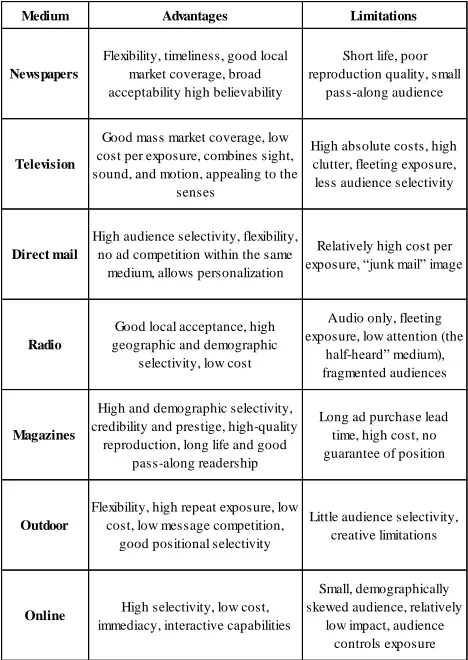
Table 2Profiles of major media types
Advertising regulation – global perspective
Advertising regulation refers to the laws and rules defining the ways in which products can be advertised in a particular region. Rules can define a wide number of different aspects, such as placement, timing, and content. In the United States, false advertising and health-related ads are regulated the most. Many communities have their own rules, particularly for outdoor advertising. Sweden and Norway prohibit domestic advertising that targets children.
Some European countries don’t allow sponsorship of children’s programs, no advertisement can be aimed at children under the age of twelve, and there can be no advertisements five minutes before or after a children’s program is aired.
In the United Kingdom advertising of tobacco on television, billboards or at sporting events is banned. Similarly alcohol advertisers in the United Kingdom are not allowed to discuss in a campaign the relative benefits of drinking, in most instances therefore choosing to focus around the brand image and associative benefits instead of those aligned with consumption. There are many regulations throughout the rest of Europe as well. In
Medium Advantages Limitations
Newspapers
Flexibility, timeliness, good local market coverage, broad acceptability high believability
Short life, poor reproduction quality, small
pass-along audience
Television
Good mass market coverage, low cost per exposure, combines sight, sound, and motion, appealing to the
senses
High absolute costs, high clutter, fleeting exposure, less audience selectivity
Direct mail
High audience selectivity, flexibility, no ad competition within the same
medium, allows personalization
Relatively high cost per exposure, “junk mail” image
Radio
Good local acceptance, high geographic and demographic
selectivity, low cost
Audio only, fleeting exposure, low attention (the
half-heard” medium), fragmented audiences
Magazines
High and demographic selectivity, credibility and prestige, high-quality
reproduction, long life and good pass-along readership
Long ad purchase lead time, high cost, no guarantee of position
Outdoor
Flexibility, high repeat exposure, low cost, low message competition,
good positional selectivity
Little audience selectivity, creative limitations
Online High selectivity, low cost,
immediacy, interactive capabilities
Small, demographically skewed audience, relatively
many non-Western countries, a wide-variety of linguistic and non-linguistic strategies are used to mock and undermine regulations.
It is a fact that advertising agencies tend to go overboard, when it comes to selling a product. Double meaning words, sexuality, violence, misleading, false and offensive advertising videos are now a part of our life.
Unethical and ethical advertising
Unethical advertising methods use falsehoods to deceive the public, ethical advertising uses truthful facts to deceive the public. (Vilhjalmur Stefansson, 1964.) In advertisements clear demarcation of true and false is not possible. If advertisements changes personal trait of consumers and affects their desired buying behaviour by misguiding, misinforming, then advertisements are unethical. But some manipulations, slightly exaggerated claims and a pinch of puffery in advertisements are permissible. It is not considered as unethical. So products advertised as Best, Most Often Used, Mostly Recommended by Doctors, Long Lasting etc., are accepted and are ethical. So small manipulations, slightly exaggerated claims, pinch of puffery etc are all lies but are accepted by the society because the demarcation is based on relativity of ethics than ethical absolutism.
Ethical Issues in Advertising
Advertising is a highly visible business activity and any lapse in ethical standards can often be risky for the company. Some of the common examples of ethical issues in advertising are given below:
Vulgarity / Obscenity used to gain consumers’ attention Misleading information and deception
Puffery Stereotypes Racial issues
Controversial products (e.g. alcohol, gambling, tobacco etc)
Ethics in Advertising
Should not mislead the consumer
What it promises must be there in the performance of products
Ad should not be indecent and obscene
As advertising is also a social process, it must honor the norms of social behavior, and should not offend our moral sense
It has the set guidelines ASCI (Advertising Standards Council of India) regulates the advertising in India Some more ethics and standards to be followed in advertisements
1. Permission will not be granted where objects are completely or largely religious or political in nature.
Advertisements cannot be directed towards any religious or political end, or to gain mileage of any form.
2. Any goods or services that are advertised should not have any defect or deficiencies of any
form declared in the Consumer Protection Act 1986. 3. Products should not be portrayed in a way that misleads the public to infer that the item has
some special, miraculous or a super natural quality, which is anyways difficult to prove.
4. Picture and the audible matter of the advertisement video should not be excessively 'loud'.
5. Advertisement should not endanger the safety of children or produce any sort of perversion or
interest that prompts them to adopt or imitate unhealthy practices.
6. Any type of offensive, indecent, suggestive, vulgar, repulsive themes and/or treatment must be
avoided under all circumstances.
7. Good creative advertisement will always attract people’s attention, but they should have
meaningful visual content. One shouldn’t have an attitude to play with people’s sentiments
and emotions.
Regulatory Authorities in the world
In South Africa, advertising content is self-regulated and is governed according to standards contained in a Code of Advertising Practice established by the Advertising Standards Authority (ASA) of South Africa, whose members are advertisers, advertising agencies, and media sources that carry advertising. The ASA of South Africa's Code of Advertising Practice is based on the International Code of Advertising Practice prepared by the International Chamber of Commerce.
In the United Kingdom, advertising content regulation is governed by the Advertising Standards Authority whereas in the UK most forms of outdoor advertising such as the display of billboards is regulated by the UK Town and County Planning system. Currently the display of an advertisement without consent from the Planning Authority is a criminal offence liable to a fine of £2500 per offence. All of the major outdoor billboard companies in the UK have convictions of this nature.
In the United States, the Federal Trade Commission is the highest authority on the subject. States and more local political divisions can have their own laws on the subject. Regulation of Advertisements in India
Regulatory Authorities in India
Absence of a single comprehensive legislation had created a lot of confusion in the advertising industry. In 1985, a self regulatory mechanism of ensuring ethical advertising practices was established in the form of the Advertising Standards Council of India (ASCI), a non statutory tribunal. It is an independent body under the aegis of Advertising Agencies Association of India (AAAI) ASCI entertained and disposed off complaints based on its Code of Advertising Practice (ASCI Code). Gradually, the ASCI Code received huge recognition from the advertising industry.
In August 2006, the ASCI Code was made compulsory for TV advertisements by amending the Cable Television Networks (Amendment) Rules, 2006: “No advertisement which violates the Code for Self-Regulation in Advertising, as adopted by the ASCI, Mumbai for public exhibition in India, from time to time, shall be carried in the cable service.” This move has provided a binding effect on the ASCI Code. Rule 7 postulates that any advertisement which derides any race, caste and tends to incite people to crime, cause disorder or are indecent or vulgar. Further, section 6 of the Cable Television Networks (Regulation) Act, 1955 prohibits the transmission or retransmission of any advertisement through a cable service unless they are in conformity with the ASCI Code.
ASCI GUIDELINES (Advertising Standards Council of India)
To ensure the truthfulness and honesty of representations and claims made by advertisements and to safeguard against misleading advertising.
To ensure that advertisements are not offensive to generally accepted standards of public decency.
To safeguard against indiscriminate use of advertising for promotion of products which are regarded as hazardous to society or to individuals to a degree or of a type which is unacceptable to society in large.
To ensure that advertisements observe fairness in competition so that consumers need to be informed on choices in the market place and the canons of generally accepted competitive behavior in business are both served.
Under the ASCI Code, complaints against the advertisements can be made by any person who considers them to be false, misleading, offensive, or unfair. The complaints are evaluated by an independent Consumer Complaints Council (CCC). CCC decides on complaints from the general public including government officials, consumer groups, etc., complaints from one advertiser against another and even suo moto complaints from the member of the ASCI Board, CCC, or the Secretariat. The CCC usually decides upon the complaints within a period
of 4 to 6 weeks once the party concerned is afforded an opportunity of presenting its case.
Moral principles of advertising
a) Respect Truthfulness (deception objection) 1. Never directly intend to deceive
2. Never use simply untrue advertising
3. Do not distort the truth by implying things that are not so or withholding relevant facts
4. "Puffery" is acceptable where it is consonant with recognized and accepted rhetorical and symbolic practice b) Respect the Dignity of each human person (attacks autonomy objection)
1. Do not exploit our "lower inclinations" to compromise our capacity to reflect or decide either
through its content or through its impact: using appeals to lust, vanity, envy and greed, and
other human weakness.
2. Give special care to the weak and vulnerable: children, young people, the elderly, the poor,
and the culturally disadvantaged c) Respect Social Responsibilities (promotes consumption,
empties communication, objections) Regulatory Laws in India
The Following are the statutory provisions which regulate advertisements in India
1.Sec. 292(2) (d) of Indian Penal Code, 1860, makes it a punishable offence to publish,
distribute, sell, hire or circulate any obscene advertisement.
2.Sec. 294-A of Indian Penal Code, 1860 says publication of any advertisement related to any lottery other than a state lottery is a punishable offence.
3.The Young Persons (Harmful Publications) Act 1956 makes it a punishable offence to
advertise a harmful publication.
4.The Emblems and Names (Prevention of Improper Use) Act, 1950 prohibits the use of certain emblems and names of national or international significance for commercial purposes.
5.The Drugs and Magic Remedies (Objectionable Advertisements) Act, 1954 prohibits
advertisements of drugs for certain purposes and of treatment of certain diseases. The Act also prohibits misleading advertisements related to drugs and of magical remedies for treatment of certain diseases.
6.The Indecent Representation of Women (Prohibition) Act 1986 prohibits the publication of advertisements containing an indecent representation of women.
7.The Prenatal Diagnostic Techniques (Regulation and Prevention of Misuse) Act 1994
prohibits advertisements related to prenatal determination of sex.
advertisements inviting persons to supply human organs for payment.
9.The Drugs and Cosmetics Act 1940, makes it an offence to use any report of a test or
analysis made by central drugs laboratory for the purpose of advertising any drug or cosmetics.
10.The Prize Competition Act 1955 prohibits the publication or distribution of advertisements of prize competition where the prize offered exceeds Rs1000/- in any month.
11.The Motor Vehicles Act 1998 entitles the State Government to empower police to remove advertisements which can obscure a traffic sign or misleading advertisements which appears to be a traffic sign or which distract the concentration or attention of a driver.
12.The Prize Chits and Money Circulation Schemes (Banning) Act 1978 prohibits the printing or publication of advertisements of prize chits and money circulation schemes.
13.The Cigarettes and other Tobacco Products (Prohibition of Advertisement and Regulation of Trade and Commerce, Production, Supply and Distribution) Act 2003 prohibits the advertisements of cigarettes and other tobacco products.
14.The Representation of People Act, 1951, prohibits political advertising 48 hours prior to polling time. 15.The Cable Television Networks (Regulation) Act, 1995, prohibits the transmission of
advertisements on the cable network which are not in conformity with the Advertisement Code.
Legal actions can be taken against advertisements that encourages the following practices
1. Ridicule caste, race, nationality, colour and creed. 2. Goes against any provision of the Indian Constitution. 3. Incite people towards criminal activity, provocative, cause disorder and/or violence in the country.
4. Breach laws and/or glorify obscenity or violence in any form.
5. Glorify terrorism, communal massacres, and criminality and so on.
6. Ridicule the father of the nation, the national emblem, part of Constitution or the image of national leader or a state dignitary.
7. Depict women in a deprecating manner. Females should not be portrayed in a manner that is obscene, exploitative or vulgar.
8. Display distasteful visual content that goes beyond the established norms of good taste and decency.
9. Exploit and encourage social evils like child marriage, bride burning and dowry system.
Conclusion
The ethical aspect of Indian advertisement is extremely important for restoration of our Indian culture and heritage. Indian culture is getting diluted by the western
culture which influences our country to a great extent. Telecasting and publication of obscene, indecent advertisements clearly shows the percolation of western culture in India so, to save our culture, norms and ethics regulations of such unethical advertisements are extremely essential. The researcher has shown a large number of statutory provisions which regulates advertisements. Moreover a self regulatory body- ASCI has been established by an association of advertisers to regulate and control unethical advertisements. But today the numbers of unethical and obscene advertisements are escalating in numbers instead of decreasing. This clearly shows that implementation of the laws controlling advertisement is not properly done. The lacks of implementation of the laws are pouring in more and more unethical and obscene advertisements. So proper implementation of the laws is highly required in our country.
References
1. Bruce G. Vanden Bergh, Dean M. Krugman, and Michael B. Salwen (1983). The Temptation to Puff:Puffery in Automotive Advertising, 1930 to 1980. Journalism Quarterly, 60 (4): 700-4, 769.
2. Gary J. Gaeth and Timothy B. Heath (1987). The Cognitive Processing of Misleading Advertising in Young and Old Adults: Assessment and Training. Journal of Consumer Research, 14 (June): 43-54.
3. Gary Kurzbard and Lawrence C. Soley (1984). Puffery and Industrial Advertising Readership and Evaluation. Proceedings of the 1984 Convention of the American Academy of Advertising, (ed.), Donald R. Glover: 104-7.
4. Gerald A. Schorin, Bruce G. Vanden Bergh, and Keith Adler (1984). Is Puffery in Automotive Advertising on the Road Back? Proceedings of the 1984 Convention of the American Academy of Advertising, (ed.), Donald R. Glover: 112-114.
5. Ivan L. Preston (1987). A Review of the Literature on Advertising Regulation, 1983-87. Current Issues and Research in Advertising, 10 (2): 123-152.
6. James D. Gill and Sanford Grossbart (1985). Influence of Deceptive Claim Strategy and Product Class Involvement on Beliefs Induced by Deceptive and Corrective Commercials. Current Issues and Research in Advertising, 8 (1): 129-160. 7. Jef I. Richards and Ivan L. Preston (1992). Proving and
Disproving Materiality of Deceptive sAdvertising Claims. Journal of Public Policy and Marketing, 11(2): 45-56.
8. John Liefeld and Louise A. Heslop (1985). Reference Prices and Deception in Newspaper Advertising. Journal of Consumer Research, 11 (March): 868-76.
9. Michael A. Kamins and Lawrence J. Marks (1987). Advertising Puffery: The Impact of Using Two-Sided Claims on Product Attitude and Purchase Intention. Journal of Advertising, 16 (4): 6-15.
10. O’Sullivan,T(2005). What do the kids think?.advertising and chidren,8,371-384
11. Waller.S(1999). Attitudes towards offensive advertising.journal of consumer marketing.16,288-294
12. Nantel,J&weeks, W (1996).Marketing ethics: Is there more to it than utilitarian approach? European journal of marketing. 30, 9-19. 13. O’Sullivan,T(2005). What do the kids think?.advertising and
chidren,8,371-384