Fresh Characteristic and Mechanical Compressive
Strength Development of Self-Compacting Concrete
Integrating Coal Bottom Ash as Partial Fine
Aggregates Replacement
Ahmad Farhan Hamzah
1,a,d, Mohd Haziman Wan Ibrahim
2,a, Norwati Jamaluddin
3,a, Ramadhansyah Putra Jaya
4,b,
Mohd Fadzil Arshad
5,c, and Norul Ernida Zainal Abidin
6,aaFaculty of Civil and Environmental Engineering, Universiti Tun Hussein Onn Malaysia, 86400 Parit Raja, Batu Pahat, Johor
Darul Takzim, MALAYSIA.
bFaculty of Civil Engineering, Universiti Teknologi Malaysia, 81310 Skudai, Johor Darul Takzim, MALAYSIA. c
Faculty of Civil Engineering, Universiti Teknologi MARA, 40450 Shah Alam, Selangor Darul Ehsan, MALAYSIA.
d
National Hydraulic Research Institute of Malaysia, Ministry of Natural Resources and Environment, Lot 5377, Jalan Putra Permai, 43300 Seri Kembangan, Selangor Darul Ehsan, MALAYSIA.
1[email protected] 2[email protected]
3
4[email protected] 5[email protected]
Abstract— This paper presents the experimental works to study the effect of use of coal bottom ash as a partial replacement of fine aggregates in self-compacing concrete (SCC). The compressive strength properties studied instead of fresh characteristic of mixtures. The SCC mixtures were produced by three different water cement ratios (0.35, 0.40 and 0.45) and coal bottom ash as a replacement of fine aggregates in varying percentages of 0%, 10%, 15%, 20%, 25% and 30%. The fresh properties were investigated by slump flow, T500 spread time,
sieve segregation and L-box test in order to evaluate its self-compatibility. It can be concluding that the filling and passing ability of SCC mixture decreased when the amount of coal bottom ash content increased. The compressive strength development for various percentages replacement of fine aggregates with coal bottom ash was conducted at 28, 90 and 180 days. It is clearly noticeable the progress of compressive strength on intensification of water cement ratio at different curing ages. The increase of water cement ratio decreased the compressive strength for all percentages of coal bottom ash at all ages
Index Term— Self-compacting concrete, coal bottom ash,
compressive strength
I. INTRODUCTION
Presently, self-compacting concrete also known as SCC is a type of concrete that had gained significance highlight by practitioner in concrete construction. SCC is an inventive high performance concrete without compaction and vibration for placing. This high fluidity concrete is capable to strengthen only under influence of gravitation and will be very suitable to apply in complex formwork, where fully reinforced or mechanical vibration would be difficult, and handled without
bleeding and segregation [1]. The advantages of SCC is significantly minimize problems that associate with conventional concrete such as there is a need for extra workers and noise hazard because of vibrator as this concrete is able to consolidate under its own weight and completely fill the formwork, even in the presence of dense reinforcement with excludes the need for vibration. It is understood that SCC improved concrete durability and requires the influence of different mixture variables to certify satisfactory fresh properties and excellent mechanical properties especially compressive strength [2]. The key challenge in SCC is to achieve high compressive strength with economical cost, as compared with conventional concrete, which is used high quantity of Portland cement and chemical admixtures [2–4]. An approach to reduce the cost with mineral admixtures, the use of supplementary cementitious materials is appropriate in SCC due to durability developments potential in the concrete composite and overall economy. In addition, the inclusion of mineral admixtures is able to sustain workability and long-term properties [5,6].
available on the use of bottom ash as a fine aggregate replacement material in SCC [12].
Experimental works reported by Syahrul et al [13] were carried out by substituting the fine aggregates by an equal weight of wash bottom ash in special concrete. It was found that wash bottom ash with 10% replacement is not suitable due to the lower compressive strength at an early age. Conversely, Aggarwal et al [14] claimed that the compressive strength concrete mixed with bottom ash was lower compared to the control concrete mixture and 50% of coal bottom ash replacement to fine replacement is satisfactory for the most structural application due to compressive strength result at 28 days more than 20 MPa. In opposition, Purushothaman & Senthamara [15] have studied different level coal bottom ash replacement to fine aggregates from 0% to 60% and suggested that the optimum level of replacement is about 40%. Kasemchaisiri et al [16] has done the properties of SCC comprising coal bottom ash as a supplementary material of fine aggregate and appealed that percentage replacement of coal bottom ash as 10% as a good performance in terms of strength and durability compared to the control specimens. While Siddique et al [17] recommended the percentage replacement was 20% of coal bottom ash in SCC. The diversity of results incorporating coal bottom ash in SCC, there is significant development in the compressive strength to be improved by combining coal bottom ash in concrete. This article presents the compressive strength development of SCC with coal bottom ash as a fractional auxiliary of fine aggregates. The authors showed the results in the form of mechanical compressive strength test with various water cement ratio and different replacement level of coal bottom ash at the age of 28, 90 and 180 days.
II. EXPERIMENTAL PLAN
A. Materials
In present study, silica-rich coal fly ash and Portland Fly Ash cement conforming to all the requirements by the MS EN 197-1:2007 used in SCC production as a main binder. The fine aggregates were natural coal bottom ash and river sand. The coal bottom ash was collected from one of coal-fired power plant in Malaysia and has a fine classified size distribution
within the range of 0.075 mm to 20 mm. All aggregates were in good condition without the humidity that can be affected the concrete mixture result. The aggregates have dried at 105℃ (± 5℃) in the oven before preceded for grading size. The coarse aggregates were grading size passing pass through 16 mm and retained at 10 mm, meanwhile for fine aggregates were sieved pass through 5 mm. Polymer-based superplasticizer has a precise gravity of 1.09 with pH 5.29 which is used to intensification the workability of fresh concrete.
TABLEI
CHEMICAL COMPOSITION OF CEMENT AND COAL BOTTOM ASH
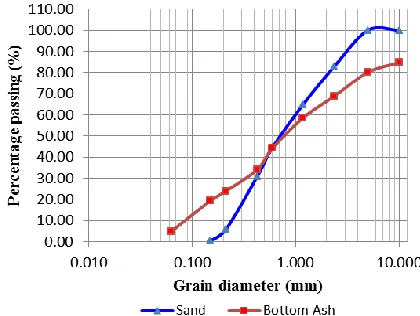
Table I shows the physical and chemical properties of binders. The analysis of the coal bottom ash was examined by X-ray fluorescence (XRF). The calcium content is identically low with the addition of SiO2 +Al2O3 +Fe2O3 reaches 94.07%. This shows the ash belongs to ASTM Type F ash with a loss-on-ignition of 2.68%. As the moisture content of coal bottom ash is 40%, the ash particle was desiccated for 24 hours before grading. The Figure 1 shows the coal bottom ash particle size spreading and natural sand.
Fig. 1. Particle size analysis
B. Mixtures proportion and test procedure
Mix proportion was referred to Jawahar et al [18]. The key proportions of the constituent are given in Table 2. The water/binder ratios of 0.35, 0.40 and 0.45 concrete mixtures were considered in six batches: BA0, BA10, BA15, BA20, BA25, and BA30. Based on the experimental work, coal bottom ash was partly substituted at 10%, 15%, 20%, 25% and 30% volumetrically. The coarse aggregate and fine aggregate was well-maintained at 28% by volume of concrete and 45% by volume of mortar respectively. The air content is assumed to be 2% in all mixtures. Polymer-based superplasticizer was used to achieve excellent condition of viscosity and leading the rheological properties. The dosage of Sp in all mixes adapted to attain an outstanding flowability without segregation. The cube specimen was
Content (%)
Cement Coal bottom
ash Chemical composition
SiO2 22.00 68.9
Al2O3 8.35 18.67
Fe2O3 3.92 6.5
CaO 58.93 1.61
K2O 1.01 1.52
TiO2 0.72 1.33
MgO 0.52 0.53
Na2O 0.26 0.24
CO2 0.10 0.1
MnO 0.15 -
Loss on ignition 1.72 2.68
Physical tests
Specific gravity 3.0 1.9
prepared for experimental works with dimension of 100 mm × 100 mm × 100 mm. All preparation, casting and curing process were according to BS EN 12390-1:2012 and BS EN 12350-1:2009. The fresh properties of mixtures such as slump flow, slump spread time (T500), L-box ratio and segregation resistance were performed before moulding. These tests are important in order to classify the mixtures
are good as SCC fresh state. All specimens were unmould after 24 hours and placed in water tank for curing process. The density of concrete are recorded and compressive strength was tested at age 28, 90 and 180 days. The practice of the test conducted by technique describe in agreement to British Standard [19-21].
TABLEII MIX PROPORTIONS IN KG/M3
Mix w/c
ratio Cement
Coarse Aggregates
Fine Aggregates
Coal Bottom
Ash
Water SP
(%)
BA0
0.35 557 715.5 874.50 0 194.95 0.17
0.40 518 715.5 874.50 0 207.20 0.16
0.45 485 715.5 874.50 0 218.25 0.16
BA10
0.35 557 715.5 787.05 87.45 194.95 0.23
0.40 518 715.5 787.05 87.45 207.20 0.20
0.45 485 715.5 787.05 87.45 218.25 0.19
BA15
0.35 557 715.5 743.33 131.175 194.95 0.28
0.40 518 715.5 743.33 131.175 207.20 0.26
0.45 485 715.5 743.33 131.175 218.25 0.21
BA20
0.35 557 715.5 699.60 174.90 194.95 0.36
0.40 518 715.5 699.60 174.90 207.20 0.32
0.45 485 715.5 699.60 174.90 218.25 0.30
BA25
0.35 557 715.5 655.88 218.625 194.95 0.17
0.40 518 715.5 655.88 218.625 207.20 0.16
0.45 485 715.5 655.88 218.625 218.25 0.16
BA30
0.35 557 715.5 612.15 262.35 194.95 0.23
0.40 518 715.5 612.15 262.35 207.20 0.20
0.45 485 715.5 612.15 262.35 218.25 0.19
III. RESULTS AND DISCUSSION
A. Fresh characteristic of mixtures
The results of fresh characteristic of mixtures such as slump flow, slump spread time (T500), L-box ratio and
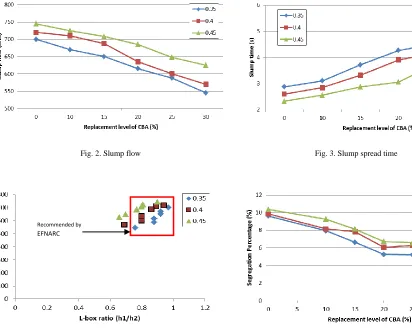
segregation resistance are presented in graphs. As shown in Figure 2 and Figure 3, the slump flow values for all water cement ratios were identified within the ranged of 550–750 mm while T500 spread times were in ranged between 2.5 and 5 seconds. The values of slump flows for mix design BA0, BA10 and BA15 are categorized under class 2 (SF2), whereas for BA20, BA25 and BA30 as slump flow class 1 (SF1). The
flowability of mixtures was reduced significantly with an increase of coal bottom ash. The decrease in slump flow value shows the significant effect of coal bottom ash to the fresh properties of the concrete mixture. The decreased of slump flow values are due to the porosity of coal bottom ash in concrete, thus absorbed more fluid with higher content of coal bottom ash. As the percentage of coal bottom ash was increased from 0% to 30%, the T500 spread times increased from 2.59 to 4.57 seconds. The result infers of the irregular shape of coal bottom ash that decreasing aggregates inter-particle friction and indicates by combining coal bottom ash reduces the viscosity of SCC mixtures [22].
Fig. 2. Slump flow Fig. 3. Slump spread time
Fig. 4. L-box ratio vs. slump flow
Fig. 5. Segregation resistance
For passing ability and filling of mixtures were measured by L-box ratio. The h2/h1 ratio decreased when the percentage of coal bottom ash increased from 0% to 30%, shown in Figure 4. In context of water/cement ratio, all mixtures achieved blocking ratio within range 0.66 to 0.97. From the results, all mixtures presented acceptable passing ability values except for BA20, BA25 and BA30, which are out of the EFNARC [23] recommendations (Figure 4). However, it should be distinguished that Kasemchaisiri and Tangtermsirikul [16] determined blocking ratio as lower 0.6 and above has been accepted for SCC to achieve good filling ability. In present study, the good result of passing ability was acknowledged for the mixture of 0%, 10% and 15% coal bottom ash. The results of L-box test also reflected due to the aggregate congested in front of openings, which cause from difficulty particle to flow without obstruct. The blocking of bridged coarse aggregates has to be avoided. Thus, it also should be stated that L-box bar spacing is more critical than many of real in-situ condition. Meanwhile, sieve segregation involves in bucketing a fresh concrete onto a 5 mm sieve, which passes through the sieve is measured. It can also be seen that the segregation ratio of different replacement of coal bottom ash ranged from 5% to 10% as the ratio decreased with increase coal bottom ash content (Figure 5). The test results
are indication of aggregates settlement was decreased with higher percentage replacement of coal bottom ash. This is recognized to the increased plastic viscosity decreases the settlement rate of coarse aggregate, and thus improves the segregation resistance of fresh concrete [12].
B. Density of concrete
The results of 28 days unit weight for different SCC mixtures are recorded as shows in Figure 6. The unit weight of the concretes varied in the range of 2276–2426 kg/m3 for three different water/cement ratios. The average density of concrete containing coal bottom ash as aggregate at 28 days is 2330 kg/m3 signifying the reduction of the self-weight of 3.1% compared to the average density of normal concrete which is 2404 kg/m3. The results specify control mixture achieves the highest density while BA30 shows the lowest density. This form is recognized to all water/cement ratios. Obviously, water/cement ratio and incorporation of coal bottom ash in the mixture influences the workability result by the water absorption from the interior of bottom ash, later its workability reduces as the content of coal bottom ash increases [7,12]. It can be concluded that the increases of replacement level of coal bottom ash is corresponding with the Recommended by
decrement density of concrete specimen. Meanwhile, the lower water cement ratio shows higher density of concrete. It is understood that the variation of water cement ratio would affected the concrete density. The decrease of 0.35 w/c ratio concrete density indicates as much 2.86% reduction of the density. The comparison are significantly demonstrates to concrete mixtures with w/c ratio 0.40 and 0.45 which the density reduction are 3.01% and 3.2% respectively. The pores
refinements reduce permeability into concrete by pozzolanic reaction of bottom ash attributed to the major reduction of concrete density. Concrete with greater w/c ratio would prompt pore spaces of water that not contribute in water-binder reaction hence constructing insignificant diameter of capillaries channel. The voids are formed within the specimen throughout the water evaporation and thus contribute to the decrement of concrete density [14,17,24].
Fig. 6. Density of concrete
C. Compressive strength development
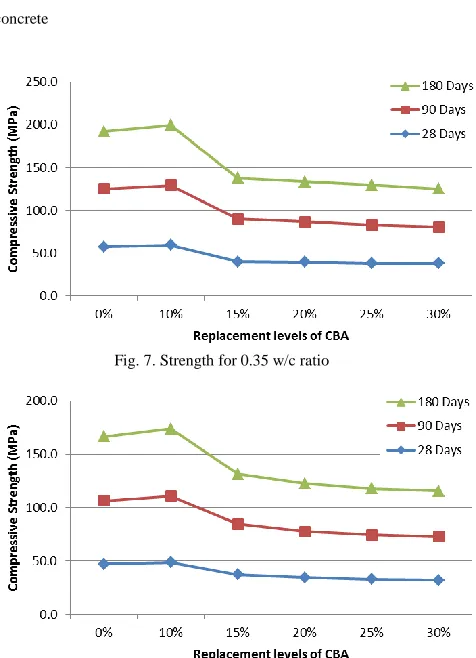
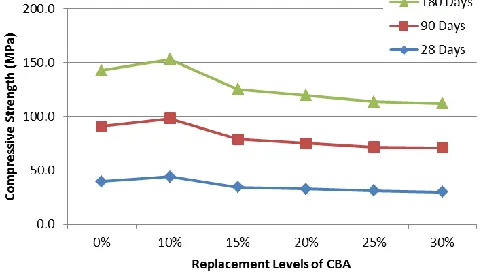
Figure 7–9 show the compressive strength of SCC mixes versus the replacement of fine aggregates proportions with different bottom ash contents at ages of 28, 90 and 180 days. The decrement in compressive strength of concrete with high inclusion of bottom ash as replacement to normal sand has been observed. The concrete with designation as BA10 has shown an achievement atleast 40 MPa at the age of 28 days. This significant result shows that the BA10 mixture achieves higher compressive strength compared to BA0 mixture. The strength increased from 28 days was positively for most mixtures up to 180 days. At 28 days, the hardened concrete of 0.35, 0.40 and 0.45 water cement ratios gained its strength about 3.37%, 3.08% and 9.77% higher than control specimen for replacement level of 10% coal bottom ash respectively. Later at the ages of 90 days, the compressive strength of the three water cement ratios (0.35, 0.40 and 0.45) achieved about 2.58%, 4.83 and 5.71 higher than control specimen for BA10 mixture. The increase in strength is due to the pore refinery effect by pozzolanic reaction of bottom ash. Regardless of the increase in porosity due to the present of coal bottom ash, the silica content in bottom ash particles enhance the formation of C-S-H, a gel responsible for strength development [12,25,26]. Meanwhile, in terms of water cement ratios, a low water cement ratio gives higher compressive strength. As the water cement ratio are lower, the mixtures were demonstrates good value of compressive strength compared to the higher water cement ratios. The compressive strength of the bottom ash concrete starts to decrease when the replacement level increased to 15%. The excessive amount of bottom ash has produced porous concrete hence contributing in reducing its compressive strength.
Fig. 7. Strength for 0.35 w/c ratio
Fig. 9. Strength for 0.45 w/c ratio
The relation between 28 days, 90 days and 365 days compressive strength and water cement ratio for mixes without bottom ash and with various percentages are shown in Figure 10, Figure 11 and Figure 12 respectively. The development of compressive strength on intensification of water cement ratio at different ages is obviously noticeable and also that increase of water cement ratio decreased the compressive strength for all percentages of CBA at all ages. It is observed that the results obtained from the present study, demonstrate a best fit for most of the cases (R2 value above 0.8). Although factors as content of fine and coarse aggregate are identical influence the results; the mix design, ingredients constituent, and curing age could affect the compressive strength. Furthermore, the water cement ratio is the utmost prominent factor of compressive strength.
Fig. 10. Relationship strength and w/c ratios at 28 days
Fig. 11. Relationship strength and w/c ratios at 90 days
IV. CONCLUSION
The results of the present study comfirmed that the CBA have a good prospect as a supplementary cementitious material for Self-compacting concrete (SCC) with best fresh characteristic concrete and compressive strength. The decrease in slump flow value, L-box ratio and sieve segregation ratio shows the significant effect of CBA to the fresh properties of the concrete mixture. The results are in context with the increased of CBA content; thus reduces the viscosity of the fresh concrete mixture. Meanwhile, the water cement content is influence significantly with higher binder content. The effect of CBA by decreases the amount of free water in mixtures due to the inter-particle friction between aggregates in the cement paste which reducing the workability of the concrete as the percentage of replacement increased. In addition, the development of compressive strength on intensification of water cement ratio at different ages is apparently noticeable and shown positive results incorporation of CBA as supplementary cementitious materials.
Acknowledgement
This study was supported by Faculty of Civil and Environmental Engineering, Universiti Tun Hussein Onn Malaysia and Ministry of Education Malaysia through Fundamental Research Grant Scheme (FRGS) Vot No: 1454.
REFERENCES
[1] O. Boukendakdji, E.-H. Kadri, and S. Kenai, ―Effects of granulated blast furnace slag and superplasticizer type on the fresh properties and compressive strength of self-compacting concrete,‖ Cem. Concr. Compos., vol. 34, no. 4, pp. 583–590, Apr. 2012.
[2] R. Siddique, P. Aggarwal, and Y. Aggarwal, ―Prediction of compressive strength of self-compacting concrete containing bottom ash using artificial neural networks,‖ Adv. Eng. Softw., vol. 42, no. 10, pp. 780– 786, Oct. 2011.
[3] N. Pathak and R. Siddique, ―Properties of self-compacting-concrete containing fly ash subjected to elevated temperatures,‖ Constr. Build. Mater., vol. 30, pp. 274–280, May 2012.
[4] H. Awang, ―The Mechanical Properties of Self-compacting Concrete Incorporating Raw Rice Husk Ash,‖ vol. 60, no. 1, pp. 166–176, 2011.
[5] N. E. World, ―EPG 2005 Conference,‖ 2005.
[6] K. H. Khayat, ―Workability , Testing , and Performance of Self-Consolidating Concrete,‖ no. 96, pp. 346–354, 2000.
[7] K. Turk, M. Karatas, and T. Gonen, ―Effect of Fly Ash and Silica Fume on compressive strength, sorptivity and carbonation of SCC,‖ KSCE J. Civ. Eng., vol. 17, no. 1, pp. 202–209, Oct. 2012.
[8] R. Siddique, P. Aggarwal, and Y. Aggarwal, ―Influence of water/powder ratio on strength properties of self-compacting concrete containing coal fly ash and bottom ash,‖ Constr. Build. Mater., vol. 29, pp. 73–81, Apr. 2012.
[9] P. Ramanathan, I. Baskar, P. Muthupriya, and R. Venkatasubramani, ―Performance of self-compacting concrete containing different mineral admixtures,‖ KSCE J. Civ. Eng., vol. 17, no. 2, pp. 465–472, Mar. 2013.
[10]Sandhya B. & Reshma E.K., (2013). A Study on Mechanical Properties of Cement Concrete by Partial Replacement of Fine Aggregates with
[11]Bottom Ash. International Journal of Students Research in Technology & Management Vol 1 (04), pp. 416-430.
[12]N. E. Zainal Abidin, M. H. Wan Ibrahim, N. Jamaluddin, K. Kamaruddin, A. F. Hamzah, "The Effect of Bottom Ash on Fresh Characteristic, Compressive Strength and Water Absorption of
Self-Compacting Concrete", Applied Mechanics and Materials, Vol 660, pp. 145-151, Oct. 2014.
[13]Mohd Syahrul Hisyam bin Mohd Sani, Fadhluhartini bt Muftah, Zulkifli Muda, (2010), ―The Properties of Special Concrete Using Bottom Ash (WBA) as Partial Sand Replacement‖, International Journal of Sustainable Construction Engineering & Technology, Vol.2, pp.65-76.
[14]Aggarwal P. , Aggarwal Y, Gupt S.M.,(2007), ―Effect of bottom ash as replacement of fine aggregates in concrete‖, Asian journal of civil engineering (building and housing), Vol. 8, no. 1 Pages 49-62
[15]M. Purushothaman, Rm. Senthamarai, "High performance concrete using bottom as fine aggregate", Journal of Structural Engineering, Volume 39, Number 1, Apr 2012, pp.56-60.
[16]R. Kasemchaisiri and S. Tangtermsirikul, ―Properties of Self-Compacting Concrete in Corporating Bottom Ash as a Partial Replacement of Fine Aggregate,‖ Sci. Asia, vol. 34, pp. 87–95, 2008.
[17]R. Siddique, P. Aggarwal, and Y. Aggarwal, ―Influence of water/powder ratio on strength properties of self-compacting concrete containing coal fly ash and bottom ash,‖ Constr. Build. Mater., vol. 29, pp. 73–81, Apr. 2012.
[18]J. G. Jawahar, C. Sashidhar, I. V. R. Reddy, and J. A. Peter, ―A S IMPLE T OOL FOR S ELF C OMPACTING C ONCRETE M IX,‖ vol. 3, no. 2, pp. 550–558, 2012.
[19]―BSI Standards Publication Testing fresh concrete,‖ 2010.
[20]―BSI Standards Publication Testing fresh concrete Part 10 : Self-compacting concrete — L box test,‖ 2010.
[21]―BSI Standards Publication Testing fresh concrete Part 11 : Self-compacting concrete — Sieve segregation test,‖ 2010.
[22]A. F. Hamzah, M. H. Wan Ibrahim, N. Jamaluddin, R. P. Jaya, N. E. Zainal Abidin, ―Fresh Properties of Self-Compacting Concrete Integrating Coal Bottom Ash as a Replacement of Fine Aggregates‖, Advanced Materials Research Vol. 1125, pp 370-376, 2015.
[23]T. E. Guidelines and S. Concrete, ―ERMCO The European Guidelines for Self-Compacting Concrete,‖ no. May, 2005.
[24]Chai Jaturapitakkul and Raungrut Cheerarot, (2003), ―Development of Bottom Ash as Pozzolanic material‖, Journal of materials in civil engineering, Vol.15, pp.48-53.
[25]L. B Andrade, J. C Rocha, M. Cheriaf, Evaluation of Concrete Incorporating Bottom Ash as a Natural Aggregate Replacement, Waste Management, 27(2007) 1190-1199.