Centers
Hamzeh Khazaei1, Jelena Miˇsi´c2, and Vojislav B. Miˇsi´c2 1
University of Manitoba, Winnipeg, Manitoba, Canada,
WWW home page:http://www.cs.umanitoba.ca/~hamzehk 2
Ryerson University, Toronto, Ontario, Canada
Abstract. Cloud computing is a computing paradigm in which differ-ent computing resources, including infrastructure, hardware platforms, and software applications, are made accessible to remote users as ser-vices. Successful provision of infrastructure-as-a-service (IaaS) and, con-sequently, widespread adoption of cloud computing necessitates accurate performance evaluation that allows service providers to dimension their resources in order to fulfil the service level agreements with their cus-tomers. In this paper, we describe an analytical model for performance evaluation of cloud server farms, and demonstrate the manner in which important performance indicators such as request waiting time and server utilization may be assessed with sufficient accuracy.
Key words: cloud computing, performance analysis, M/G/m queuing system, response time
1 Introduction
Significant innovations in virtualization and distributed computing, as well as improved access to high-speed Internet, have accelerated interest in cloud com-puting [15]. Cloud comcom-puting is a general term for system architectures that involves delivering hosted services over the Internet. These services are broadly divided into three categories: Infrastructure-as-a-Service (IaaS), which includes equipment such as hardware, storage, servers, and networking components are made accessible over the Internet); Platform-as-a-Service (PaaS), which includes computing platforms—hardware with operating systems, virtualized servers, and the like; and Software-as-a-Service (SaaS), which includes sofware applications and other hosted services [11]. A cloud service differs from traditional hosting in three principal aspects. First, it is provided on demand, typically by the minute or the hour; second, it is elastic since the user can have as much or as little of a service as they want at any given time; and third, the service is fully managed by the provider – user needs little more than computer and Internet access. Cloud customers pay only for the services they use by means of a customized service level agreement (SLA), which is a contract negotiated and agreed between a cus-tomer and a service provider: the service provider is required to execute service
requests from a customer within negotiated quality of service(QoS) requirements for a given price.
Due to dynamic nature of cloud environments, diversity of user’s requests and time dependency of load, providing expected quality of service while avoiding over-provisioning is not a simple task [17]. To ensure that the QoS perceived by end clients is acceptable, the providers must exploit techniques and mechanisms that guarantee a minimum level of QoS. Although QoS has multiple aspects such as response time, throughput, availability, reliability, and security, the primary aspect of QoS considered in this work is related to response time [16].
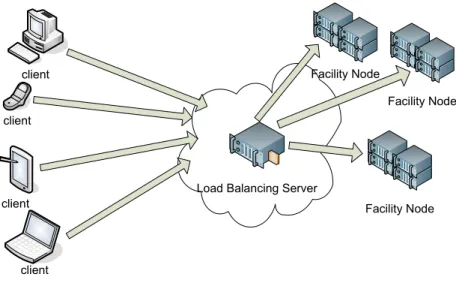
Cloud computing has been the focus of much research in both academia and industry, however, implementation-related issues have received much more at-tention than performance-related ones; in this paper we describe an analytical model for evaluating the performance of cloud server farms and verify its accu-racy with numerical calculations and simulations. we assume that any request goes through a facility node and then leaves the center. A facility node may contain different computing resources such as web servers, database servers, and others, as shown in Fig. 1. We consider the time a request spends in one of those facility node as the response time; response time does not follow any specific distribution. Our model is flexible in terms of cloud center size and service time of customer requests; We model the cloud environment as an M/G/m queu-ing system which indicates that inter-arrival time of requests is exponentially distributed, the service time is generally distributed and the number of facility nodes ism. Also, due to the the nature of cloud environment (i.e., it is a service provider with potentially many customers), we pose no restrictions on the num-ber of facility nodes. These two characteristics, general service time and large number of nodes, have not been adequately addressed in previous research.
Facility Node
Facility Node
Facility Node Load Balancing Server
client
client client
` client
The remainder of the paper is organized as follows: Section 2 gives a brief overview of related work on cloud performance evaluation and on performance characterization of M/G/m queueing systems. We introduce our analytical model in Section 3, and present performance results obtained with it in Section 4, using discrete event simulation to validate them. Discussion of our approach and outlook to future research activities complete the paper.
2 Related Work
As mentioned above, most of the research related to cloud computing has dealt with implementation issues, while performance-related issues have received much less attention. For example, [20] studied the response time in terms of various metrics, such as the overhead of acquiring and realizing the virtual computing resources, and other virtualization and network communication overhead. To address these issues, they have designed and implemented C-Meter, a portable, extensible, and easy-to-use framework for generating and submitting test work-loads to computing clouds.
In [18], the cloud center was modeled as an M/M/m/N queuing system, which was been used to compute the distribution of response time. Inter-arrival and service times were both assumed to be exponentially distributed, and the system had a finite buffer of size N. The response time was broken down into waiting, service, and execution periods, assuming that all three periods are in-dependent which is unrealistic, based on their own argument.
In [17], the authors consider a cloud center which is modelled as the classic open network; they obtained the distribution of response time based on assump-tion that inter-arrival time and service time are both exponential. Using the distribution of response time, they found the relationship among the maximal number of tasks, the minimal service resources and the highest level of services. Theoretical analyses have mostly relied on extensive research in performance evaluation of M/G/m queuing systems, as outlined in [2, 5, 7, 8, 9, 19]. As solutions for mean response time and queue length inM/G/msystems can’t be obtained in closed form, suitable approximations were sought. However, most of these provide reasonably accurate estimates of mean service time only when number of servers is comparatively small, (say, less than twenty or so), but fail for large number of servers [1, 3, 13, 14]. Approximation errors are particularly pronounced when the offered load ρ is small, and/or when both the number of servers m and the coefficient of variation of the arrival process for service requests, CV, are large. As a result, these results are not directly applicable to performance analysis of cloud computing server farms where the number of servers is huge and service request arrival distribution is not generally known.
3 The Analytical Model
We model a cloud server farm as a M/G/m queuing system which indicates that the inter-arrival time of requests is exponentially distributed, the service times of customers’ requests are independent and identically distributed random variables with a general distribution whose service rate is µ; both µ and CV, the coefficient of variation defined as standard deviation divided by the mean, are finite.
A M/G/m queuing system may be considered as a Markov process which can be analysed by applying the embedded Markov chain technique. Embedded Markov Chain techique requires selection of Markov points in which the state of the system is observed. Therefore we monitor the number of the tasks in the system (both in service and queued) at the moments immediately before the task request arrival. If we consider the system at Markov points and number these instances 0, 1, 2, . . . , then we get a Markov chain [4]. Here, the system under consideration containsm servers, which render service in order of task request arrivals.
Task requests arrival process is Poisson. Task request interarrival timeA is exponentially distributed with rate to λ1. We will denote its Cumulative Distribu-tion FuncDistribu-tion (CDF) asA(x) =P rob[A < x] and its probability density function (pdf) asa(x) =λe−λx. Laplace Stieltjes Transform (LST) of interarrival time is
A∗(s) =R∞ 0 e
−sxa(x)dx= λ λ+s.
Task service times are identically and independently distributed according to a general distributionB, with a mean service time equal tob=µ1. The CDF of the service time isB(x) =P rob[B < x], and its pdf isb(x). The LST of service time isB∗(s) =R0∞e−sxb(x)dx.
Residual task service time is time from the random point in task execution till the task completion. We will denote it asB+. This time is necessary for our model since it represents time distribtion between task arrivalz and departure of the task which was in service when task arrival z occured. It can be shown as well that probability distrubtion of elapsed service time (between start of the task execution and next arrival of task request B− has the same probability
distribtion [12].
The LST of residual and elapsed task service times can be calculated in [12] as
B∗+(s) =B−∗(s) = 1−B
∗(s)
sb (1)
The offered load may be defined as ρ, λ
mµ (2)
For practical reasons, we assume that the system never enters saturation, which means that any request submitted to the center will get access to the required facility node after a finite queuing time. Furthermore, we also assume each task is serviced by a single server (i.e., there are no batch arrivals), and we do not
distinguish between installation (setup), actual task execution, and finalization components of the service time; these assumptions will be relaxed in our future work.
3.1 The Markov chain
We are looking at the system at the moments of task request arrivals – these points are selected as Markov points. A given Markov chain has a steady-state solution if it is ergodic. Based on conditions for ergodicity [4] and the above-mentioned assumptions, it is easy to prove that our Markov Chain is ergodic. Then, using the steady-state solution, we can extract the distribution of number of tasks in the system as well as the response time.
Fig. 2. Embedded Markov points.
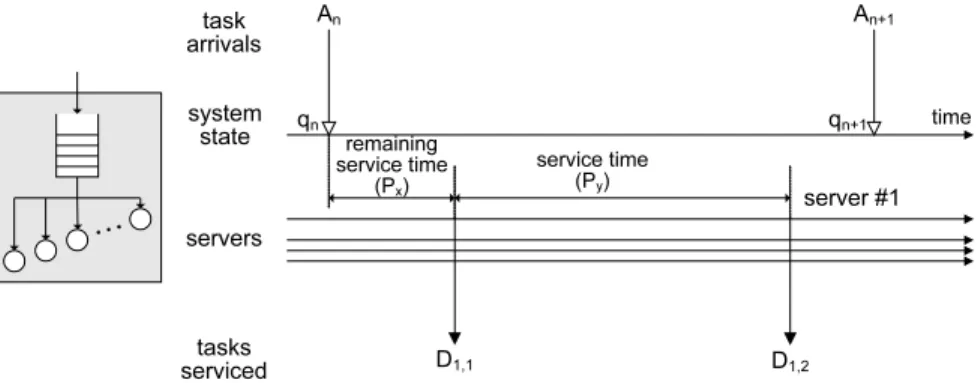
LetAn and An+1 indicate the moment ofnth and (n+ 1)th arrivals to the system, respectively, whileqnandqn+1indicate the number of tasks found in the system immediately before these arrivals; this is schematically shown in Fig. 2. If vn+1 indicates the number of tasks which are serviced and depart from the system betweenAn andAn+1, the following holds:
qn+1=qn−vn+1+ 1 (3)
We need to calculate the transition probabilities associated with this Markov chain, defined as
pij ,P rob[qn+1=j|qn =i] (4)
i.e., the probability thati+1−jcustomers are served during the interval between two successive task request arrivals. Obviously forj > i+ 1
pij = 0 (5)
since there are at mosti+ 1 tasks present between the arrival ofAn andAn+1.
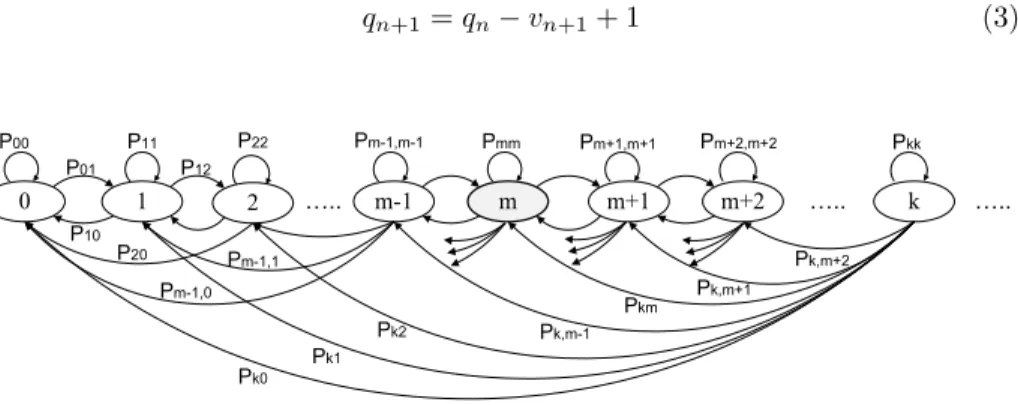
The Markov state-transition-probability diagram as in Fig. 3, where states are numbered according to the number of tasks currently in the system (i.e those in service and those awaiting service). For clarity, some transitions are not fully drown, esp. those originating from states abovem. We have also highlighted the state m because the transition probabilities are different for states on the left and right hand side of this state (i.e., below and abovem).
3.2 Departure Probabilities
Due to ergodicity of the Markov chain, an equilibrium probability distribution will exist for the number of tasks present at the arrival instants; so we define
πk= lim
n→+∞P rob[qn=k] (6)
From [12], the direct method of solution for this equilibrium distribution requires that we solve the following system of linear equations:
π=πP (7)
where π = [π0, π1, π2, . . .], and P is the matrix whose elements are one-step transition probabilitiespij.
To find the elements of the transition probability matrix, we need to count the number of tasks departing from the system in between two successive arrivals. Consider the behaviour of the system, as shown in Fig. 4. Each server has zero or more departures during the time between two successive task request arrivals (the inter-arrival time). Let us focus on an arbitrary server, which (without loss of generality) could be the server number 1. For a task to finish and depart from the system during the inter-arrival time, its remaining duration (residual service time defined in (1)) must be shorter than the task inter-arrival time. This probability will be denoted asPx, and it can be calculated as
Px=P rob[A > B+] = Z ∞ x=0 P{A > B+|B+ =x}P{B+=x} = Z ∞ 0 e−λxdB+(x) =B∗+(λ) (8)
Physically this result presents probability of no task arrivals during residual task service time.
In the case when arriving task can be accommodated immediately by an idle server ( and therefore queue length is zero) we have to evaluate the probability that such task will depart before next task arrival. We will denote this probability asPy and calculate it as:
Py =P rob[A > B] = Z ∞ x=0 P{A > B|B =x}P{B+=x} = Z ∞ 0 e−λxdB(x) =B∗(λ) (9)
However, if queue is non-empty upon task arrival following situation may happen. If between two successive new task arrivals a completed task departs from a server, that server will take a new task from the non-empty queue. That task may be completed as well before the next task arrival and if the queue is still non-empty new task may be executed, and so on until either queue gets empty or new task arrives. Therefore probability ofk >0 job departures from a single server, given that there are enough jobs in the queue can be derived from expressions (8) and (9) as:
Pz,k=B∗+(λ)(B
∗(λ))k−1 (10) note thatPz,1=Px.
Using these values we are able to compute the transition probabilities matrix.
3.3 Transition Matrix
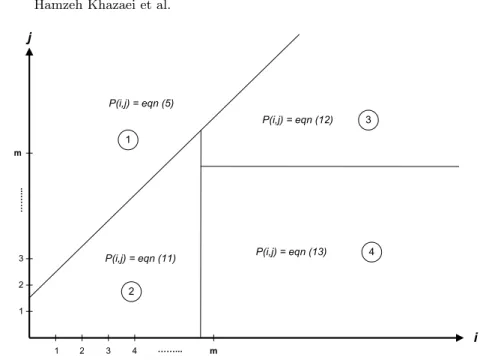
Based on our Markov chain, we may identify four different regions of operation for which different conditions hold; these regions are schematically shown in Fig. 5, where the numbers on horizontal and vertical axes correspond to the number of tasks in the system immediately before a task request arrival (i) and immediately upon the next task request arrival (j), respectively.
Fig. 5. Range of validity forpijequations.
Regarding the region labelled 1, we already know from Eq. 5 thatpij= 0 for
i+ 1< j.
In region 2, no tasks are waiting in the queue, hence i < m and j ≤ m. In between the two successive request arrivals, i+ 1−j tasks will complete their service. For all transitions located on the left side of statemin Fig. 3, the probability of havingi+ 1−j departures is
pij= i i−j Pxi−j(1−Px)jPy+ i i+ 1−j Pxi+1−j(1−Px)j−1(1−Py) fori < m, j≤m (11) Region 3 corresponds to the case where all servers are busy throughout the inter-arrival time, i.e., i, j ≥m. In this case all transitions remain to the right of statemin Fig. 3, and state transition probabilities can be calculated as
pij = σ X s=φ m s Pxs(1−Px)m−sPz,i+12 −j−s(1−Pz,2)s fori, j≥m (12)
In the last expression, the summation bounds are σ = min[i+ 1−j, m] and φ=min[i+ 1−j,1].
Finally, region 4, in whichi≥mand j ≤m, describes the situation where the first arrival (An) finds all servers busy and a total of i−m tasks waiting
are exactly j tasks in the system, all of which are in service. The transition probabilities for this region are
pij = σ X s=1 m s Pxs(1−Px)m−s η α Pz,ψ2(1−Pz,2)ζβ fori≥m, j < m (13)
where we used the following notation:
σ=min[m, i+ 1−j] η=min[s, i+ 1−m] α=min[s, i+ 1−j−s] ψ=max[0, i+ 1−j−s] ζ=max[0, j−m+s] β= 1 ifψ≤i+ 1−m 0 otherwise (14)
4 Numerical Validation
The steady-state balance equations outlined above can’t be solved in closed form, hence we must resort to a numerical solution. To obtain the steady-state probabilities π = [π0, π1, π2, ...], as well as the mean number of tasks in the system (in service and in the queue) and the mean response time, we have used the probability generating functions (PGFs) for the number of tasks in the system: P(z) = ∞ X k=0 πzzk (15)
and solved the resulting system of equations using Maple 13 from Maplesoft, Inc. [6]. Since the PGF is an infinite series, it must be truncated for numerical solution; we have set the number of equations to twice the number of servers, which allows us to achieve satisfactory accuracy (as will be explained below), plus the necessary balance equation
i=2m
X
i=0
πi= 1. (16)
the mean number of tasks in the system is, then, obtained as
E[QS] =P0(1) (17)
while the mean response time is obtained using Little’s law as
E[RT] =E[QS]/λ (18)
We have assumed that the task request arrivals follow the gamma distribu-tion with different values for shape and scale parameters; however, our model
may accommodate other distributions without any changes. Then, we have per-formed two experiments with variable task request arrival rate and coefficient of variationCV (which can be adjusted in the gamma distribution independently of the arrival rate).
To validate the analytical solutions we have also built a discrete even simu-lator of the cloud server farm using object-oriented Petri net-based simulation engine Artifex by RSoftDesign, Inc. [10].
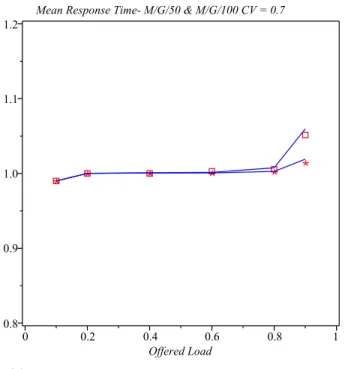
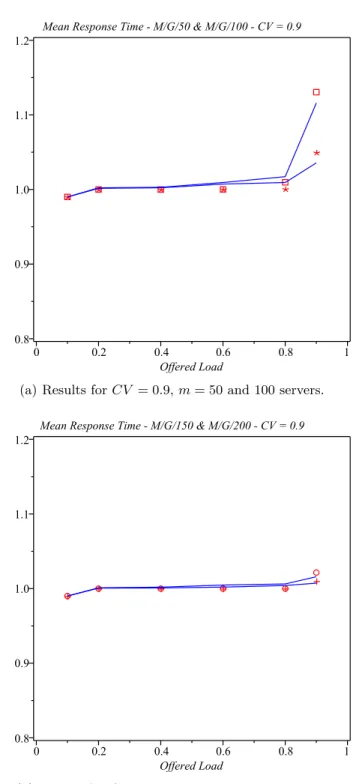
The diagrams in Fig. 6 show analytical and simulation results (shown as lines and symbols, respectively) for mean number of tasks in the system as functions of the offered load ρ, under different number of servers. Two different values of the coefficient of variation,CV = 0.7 and 0.9, were used; the corresponding results are shown in Figs. 6(a) and 6(b). As can be seen, the results obtained by solving the analytical model agree very well with those obtained by simulation. The diagrams in Fig. 8 show the mean response time, again for the same range of input variables and for the same values of the coefficient of variation. As above, solid lines correspond to analytical solutions, while different symbols correspond to different number of servers. As could be expected, the response time is fairly steady up to the offered load of around ρ= 0.8, when it begins to increase rapidly. However, the agreement between the analytical solutions and simulation results is still very good, which confirms the validity of our modelling approach.
5 Conclusions
Performance evaluation of server farms is an important aspect of cloud comput-ing which is of crucial interest for both cloud providers and cloud customers. In this paper we have proposed an analytical model for performance evaluation of a cloud computing center. Due to the nature of the cloud environment, we assumed general service time for requests as well as large number of servers; in the other words, our model is flexible in terms of scalability and diversity of ser-vice time. We have further conducted numerical experiments and simulation to validate our model. Numerical and simulation results showed that the proposed method provided a quite accurate computation of the mean number of tasks in the system and mean response time.
In future work we plan to extend our model for burst arrivals of requests or a kind of task including several subtasks; we are also going to examine other types of distributions as service time which are more realistic in cloud computing area, e.g. Log-Normal distribution. Looking in to the facility node and breaking down the response time into several components such as setup, execution, return and clean up time will be another dimension of extension. We will address all these issues in our future work.
References
1. O. J. Boxma, J. W. Cohen, and N. Huffel. Approximations of the mean waiting time in anM/G/squeueing system. Operations Research, 27:1115–1127, 1979. 2. P. Hokstad. Approximations for theM/G/mqueues. Operations Research, 26:510–
523, 1978.
3. T. Kimura. Diffusion approximation for anM/G/mqueue. Operations Research, 31:304–321, 1983.
4. L. Kleinrock. Queueing Systems, volume 1, Theory. Wiley-Interscience, 1975. 5. B. N. W. Ma and J. W. Mark. Approximation of the mean queue length of an
M/G/cqueueing system. Operations Research, 43:158–165, 1998. 6. Maplesoft, Inc. Maple 13. Waterloo, ON, Canada, 2009.
7. M. Miyazawa. Approximation of the queue-length distribution of anM/GI/squeue by the basic equations. J. Applied Probability, 23:443–458, 1986.
8. S. A. Nozaki and S. M. Ross. Approximations in finite-capacity multi-server queues with poisson arrivals. J. Applied Probability, 15:826–834, 1978.
9. E. Page. Tables of waiting times for M/M/n,M/D/n andD/M/nand their use to give approximate waiting times in more general queues. J. Operational Research
Society, 33:453–473, 1982.
10. RSoft Design. Artifex v.4.4.2. RSoft Design Group, Inc., San Jose, CA, 2003. 11. searchcloudcomputing.techtarget.com. Cloud computing definition. Website,
2010. http://searchcloudcomputing.techtarget.com/sDefinition/0,,sid201_ gci1287881,00.html.
12. H. Takagi. Queuing Analysis, volume 1, Vacation and Priority Systems, Part 1. Elsevier Science Publisher B.V., 1991.
13. Y. Takahashi. An approximation formula for the mean waiting time of anM/G/c
queue. J. Operational Research Society, 20:150–163, 1977.
14. H. C. Tijms, M. H. V. Hoorn, and A. Federgru. Approximations for the steady-state probabilities in theM/G/cqueue. Advances in Applied Probability, 13:186– 206, 1981.
15. L. Vaquero, L. Rodero-Merino, J. Caceres, and M. Lindner. A break in the clouds: towards a cloud definition. ACM SIGCOMM Computer Communication Review, 39(1), 2009.
16. L. Wang, G. V. Laszewski, A. Younge, X. He, M. Kunze, J. Tao, and C. Fu. Cloud computing: a perspective study. New Generation Computing, 28:137–146, 2010. 17. K. Xiong and H. Perros. Service performance and analysis in cloud computing.
volume 0, pages 693–700, Los Alamitos, CA, USA, 2009.
18. B. Yang, F. Tan, Y. Dai, and S. Guo. Performance evaluation of cloud service considering fault recovery. InCloud Computing, volume 5931 ofLecture Notes in
Computer Science, pages 571–576. Springer Berlin Heidelberg, 2009.
19. D. D. Yao. Refining the diffusion approximation for theM/G/mqueue.Operations
Research, 33:1266–1277, 1985.
20. N. Yigitbasi, A. Iosup, D. Epema, and S. Ostermann. C-meter: A framework for performance analysis of computing clouds. InCCGRID ’09: Proceedings of the
2009 9th IEEE/ACM International Symposium on Cluster Computing and the Grid,
(a)CV = 0.7.
(b) V = 0.9.
Fig. 6. Mean number of tasks in the system: m = 50 (denoted with squares), 100 (circles), 150 (asterisks), and 200 (crosses).
(a) Results forCV = 0.7,m= 50 and 100 servers.
(b) Results forCV = 0.7,m= 150 and 200 servers.
Fig. 7.Mean response timeCV = 0.7,m= 50 (denoted with squares), 100 (asterisks), 150 (circles), and 200 (crosses).
(a) Results forCV = 0.9,m= 50 and 100 servers.
(b) Results forCV = 0.9,m= 150 and 200 servers.
Fig. 8. Mean response time for CV = 0.9, m = 50 (denoted with squares), 100 (asterisks), 150 (circles), and 200 (crosses).