BASEL II - AN ENDOGENOUS ASSET DROP MODEL WITHOUT ADDITIONAL CORRELATION
SEBASTIAN EBERT AND EVA L ¨UTKEBOHMERT
Abstract. In 2005 the Internal Ratings Based (IRB) approach of ‘Basel II’ was enhanced by a ‘treatment of double default effects’ to account for credit risk mitigation techniques such as ordinary guarantees or credit derivatives. This paper reveals several severe problems of this approach and presents a new method to account for double default effects. This newasset drop tech-nique can be applied within any structural model of portfolio credit risk. When formulated within the IRB approach of Basel II, it is very well suited for prac-tical application as it does not pose extensive data requirements and economic capital can still be computed analytically.
Key words: Basel II, double default, IRB approach, regulatory capital, structural credit portfolio models
JELCodes: G31, G28
1. Introduction
In 2005 the Basel Committee of Banking Supervision (BCBS) made an amend-ment (BCBS, 2005) to the original New Basel Accord of 2003 (BCBS, 2003) that deals with the treatment of hedged exposures in credit portfolios.1 In the original
New Basel Accord of 2003, banks are allowed to adopt a so-calledsubstitution ap-proach to hedged exposures. Roughly speaking, under this approach a bank can compute the risk-weighted assets for a hedged position as if the credit exposure was a direct exposure to the obligor’s guarantor. Therefore, the bank may have only a
Date: April 26, 2010.
The authors are grateful to John O’Keefe who discussed the paper at the 22nd Australasian Banking and Finance Conference (Sydney) and to Laurent Clerc for his discussion at the 3rd Financial Risk International Forum (Paris). The authors also thank Ernst Eberlein, Thomas Gehrig and seminar participants in Bonn and Freiburg for helpful comments and suggestions. Both authors acknowledge the financial support from the Bonn Graduate School of Economics and from the German Research Foundation through the project “Pricing of Risk in Incomplete Markets”.
1Meanwhile the amendment also has been incorporated in a revised version of the 2003 New Basel Accord, BCBS (2006). If not noted otherwise, this is the version we refer to with “Basel II”.
small or even no benefit in terms of capital requirements from obtaining the pro-tection. Since the 2005 amendment, for each hedged exposure the bank can choose between the substitution approach and the so-calleddouble default treatment. The latter, inspired by Heitfield and Barger (2003), takes into account that the default of a hedged exposure only occurs if both the obligor and the guarantor default (“double default”) and thus seems to be more sophisticated and realistic than the substitution approach.
The recent global financial crisis drastically demonstrated the importance of how to treat hedged exposures in credit portfolios. However, the literature on the treat-ment of double default effects within the computation of economic capital is scarce. This is particularly true for the literature on the computation of regulatory capital under Basel II. Given that the former model sets a benchmark for the quantifica-tion of minimal capital requirements for hedged exposures of banks in the European Union, this seems to be unjustified.
There is no doubt that hedging exposures is rather a natural act than a rare excep-tion. For example, granting loans and transferring the risk afterwards is a typical business for a bank. This can be done by use of numerous instruments (referred to as credit risk mitigation (CRM) techniques in Basel II) such as ordinary guar-antees, collateral securitization and credit derivatives (in particular credit default swaps and bundled credit packages such as credit loan obligations), to name a few.2
This is also why CRM techniques were discussed extensively in Basel II in the first place and why the Basel Committee chose to improve on the earlier version by introducing the treatment of double default effects in 2005. After all, through the regulatory treatment of double default effects, the BCBS sets incentives for banks to obtain credit protection. In the aftermath of the global financial crisis, the BCBS again is largely concerned with making improvements to the treatment of counter-party risk in Basel II in general (see BCBS, 2009). In this paper we propose a new methodology to treat double default effects in structural credit risk models. In particular, we are concerned with the computation of regulatory capital in the IRB approach of Basel II.
2The market for credit derivatives has grown rapidly in the years preceding the crisis. According to a survey of the International Swaps and Derivatives Association published on April 22, 2009, the notional of outstanding CDSs was US$39 trillion as of December 2008.
There are different opinions on the impact of credit risk transfers on financial sta-bility.3 It should be noted that application of a treatment of double default effects
can actually imply anincrease in overall regulatory capital in the economy. While the capital requirements for a bank that obtains credit protection decreases (but does not vanish), the protection seller could be required to increase its capital re-quirements.
To motivate our new method, we first review the Internal Ratings Based (IRB) treatment of double default effects and reveal several severe problems of the ap-proach. Most importantly, we argue that imposing additional correlation between obligors and guarantors is unsuitable to capture their essentially asymmetric rela-tionship appropriately. We also show that this approach, in general, violates some of the assumptions of the Asymptotic Single Risk Factor (ASRF) model (see Gordy, 2003) which represents the mathematical basis of the IRB approach. Furthermore, it is implicitly assumed within the IRB treatment of double defaults that guarantors are external. That is, it is assumed that there is no direct exposure to guarantors. It is also assumed that every loan in the portfolio is hedged by a different guarantor. This leads to an underestimation of the associated concentration risk.
The major contribution of this paper is a new method to account for double default effects in the computation of economic capital. It can be used within all structural models of credit risk and, in particular, in the IRB approach of Basel II. The model does not exhibit any of the deficiencies we point out for the IRB treatment of double defaults. Instead of modeling the relationship between an obligor and its guaran-tor through a dependency on an additional stochastic risk facguaran-tor, we adjust the guarantor’s default probability appropriately if the hedged obligor defaults. The model is endogenous as it actually quantifies the increase of the guarantor’s default probability instead of exogenously imposing a numerical value as it is done in the IRB treatment of double default effects for the additional correlation parameters. The idea behind the model is to quantify the size of the downward jump of the guarantor’s firm value process in case of the obligor’s default which triggers the
3For example, Wagner and Marsh (2006) find that credit risk transfer decreases systematic risk for reasons of diversification. Allen and Carletti (2006) and Neyer and Heyde (2010) on the other hand find the opposite because credit risk transfer can create channels of contagion and bring along liquidity issues.
guarantee payment. We therefore call this approach anasset dropmodel. Practi-cal application of the model is straightforward since it does not require extensive data. Moreover, due to its simple analytic representation, economic capital can be computed almost instantaneously.
Structural models with (downward) jumps have been considered previously in the literature, e.g. in case of the jump diffusion model of Zhou (2001b). Bivariate versions of the latter were introduced in Zhou (2001a) and Hull and White (2001). These approaches have also been used to model default dependencies in the coun-terparty risk literature, in particular for evaluating the credit value adjustment (CVA) for credit default swaps (CDSs). See, for example, Lipton and Sepp (2009) and Brigo and Chourdakis (forthcoming), and references therein. In these mod-els jumps occur randomly rather than being triggered by a specific event as in our model. That is, we provide an explanation for the jump time as well as for the jump size. Moreover, in contrast to our approach the above mentioned literature models dependencies symmetrically by correlating the asset processes. Most importantly, none of the papers deals with the computation of regulatory capital.
Parts of the CVA literature (e.g. Pykhtin and Zhu, 2007, Gregory, 2009 and Pykhtin, 2010) explicitly focus on the estimation of exposure at default (EAD), i.e. on estimating the loss in market value when the contract terminates. Similarly, Taplin et al. (2007) and Valvonis (2008) investigate the credit conversion factor used to account for possible (retail) overdrafts. This literature can be understood as being complementary to our work, also in order to consider the price, value and market risk of a guarantee. Similarly, one could calculate the refinancing costs that occur if a guarantor defaults and the guarantee should be reestablished. If a collat-eral serves as a guarantee, the jump size could be taken as its exposure at default. While the mentioned literature focuses on the proper pricing of guarantees like CDSs by evaluating the CVA, our paper deals with the impact of guarantees on regulatory capital. That is, once the guarantee has been obtained (no matter what its price, CVA or current market value is), by how much should credit risk sensi-tive regulatory capital be reduced? Although the IRB treatment of double default effects is largely applied in practice, this question has not been answered so far. To
the best of our knowledge the only other paper that is directly addressing the IRB model of double default is Grundke (2008). The latter, however, is not concerned with the IRB model itself and its assumptions, but rather with the appropriate parameter choices within the model of Heitfield and Barger (2003).
The remainder of the paper is structured as follows. In Section 2 we provide a review of the Internal Ratings Based (IRB) treatment of double default effects and we reveal several severe problems of the approach. Section 3 contains our new asset drop model to account for double default effects which can be used in all structural models of credit risk and, in particular, in the IRB approach of Basel II. We also implement our method within some examples and compare the results to the current IRB treatment of double default effects. The discussion and conclusions of the paper are given in Section 4.
2. Review and Discussion of the IRB Treatment of Double Defaults Within the IRB approach of Pillar 1 in Basel II banks may choose between the simplesubstitution approach outlined in the Introduction and a double default approach where risk-weighted assets for exposures subject to double default are cal-culated as follows.4 Assume the exposure to obligorn is hedged by guarantor gn.
Within the double default treatment in the IRB approach one first computes the unexpected loss (UL) capital requirementKn for the hedged obligornin the same way as the one for an unhedged exposure5with LGDn replaced by the loss given
default LGDgn of the guarantor. In the computation of the maturity adjustment the default probability is chosen as the minimum of the obligor’s default prob-ability PDn and the guarantor’s default probability PDgn. Then the UL capital requirement KDD
n for the hedged exposure is calculated by multiplying Kn by an
adjustment factor depending on the PD of the guarantor, namely
(1) KnDD=Kn·(0.15 + 160·PDgn).
Finally, the risk-weighted asset amount for the hedged exposure is computed in the same way as for unhedged exposures. Note that the multiplier (0.15 + 160·PDgn)
4Compare BCBS (2006), paragraph 284.
is derived as a linear approximation to the UL capital requirement for hedged ex-posures. For the computation of the latter, i.e. to derive the exact conditional expected loss function for a hedged exposure, the ASRF framework, which also presents the basis for the computation of the risk weighted assets in the IRB ap-proach, is used in an extended version. Specifically, it is assumed that the asset returnsrn (resp. rgn) of an obligor and its guarantor are no longer conditionally independent given the systematic risk factor X but also depend on an additional risk factorZn,gn which only affects the obligor and its guarantor. More precisely,
(2) rn =√ρnX+p1−ρnpψn,gnZn,gn+p1−ψn,gnn,
where ρn is the asset correlation of obligorn, ψn,gn is a factor specifying the sen-sitivity of obligor n to the factor Zn,gn and n is the idiosyncratic risk factor of obligorn.By implicitly assuming that all hedges are perfect full hedges, guarantors are themselves not obligors in the portfolio and different obligors are hedged by different guarantors, the joint default probability of the obligor and its guarantor can be computed explicitly as6
(3)
P({default of obligor n} ∩ {default of guarantorgn})
= Φ2 Φ−1(PDn),Φ−1(PDgn);ρn,gn
,
whereρn,gn is the correlation between obligornand its guarantorgn and Φ2(·,·;ρ)
denotes the cumulative distribution function of the bivariate standard normal dis-tribution with correlationρ.Therefore, the conditional expected loss function for a hedged exposure is given by
(4) E1l{rn≤cn}1l{rgn≤cgn}LGDnLGDgn|X = LGDnLGDgn· ·Φ2 Φ−1(PD n)− √ ρnX √ 1−ρn ,Φ −1(PD gn)− √ ρgnX p 1−ρgn ; ρn,gn− √ ρnρgn p (1−ρn)(1−ρgn) !
for default thresholds cn and cgn for obligor n and its guarantorgn, respectively. One obtains the IRB risk weight function for a hedged exposure with effective maturity of one year by inserting Φ−1(0.001) forX,subtracting the expected loss
(5) Φ2(Φ−1(PDn),Φ−1(PDgn);ρn,gn)·LGDnLGDgn
and multiplying with 12.5 and 1.06. Since the expected loss should in general be rather small, in BCBS (2005) this term is set equal to zero. Moreover, it is assumed that there are no double recovery effects and thus LGDn= 1.Within the IRB
treat-ment of double default effects, however, the linear approximation (1) of the exact conditional expected loss function (4) is used which holds for the parameter values specified before.7
Let us now discuss the assumptions underlying this approach in more detail. First let us investigate how well correlation in general suits to model the depen-dency between a guarantor and an obligor. Positive correlation implies that the default of the obligor makes the default of the guarantor more likely. This seems very reasonable as the guarantor suffers from the guarantee payment, and if it is large it might even drag him into default. Vice versa, however, it seems neither theoretically nor empirically justified that the default of the guarantor implies a similar pain to the hedged obligor.8 Note that the obligor in general will not even know whether the bank that granted the loan obtained credit protection at all. And if so, the obligor will not know the name of the guarantor. Essentially, for the hedged obligor the pain from the default of the guarantor should be not larger than the pain from the default of any other firm in the economy. It will influence the default probability of the obligor only through shifts in the state of the systematic risk factor. As correlation necessarily introduces a symmetric dependency between two random variables, it can never capture appropriately the asymmetric relation-ship that holds between a guarantor and an obligor.
Before we continue, let us first consider a case where modeling the dependency between a guarantor and an obligor symmetrically could be justified. Suppose, first, there is no direct exposure to guarantors and, second, every guarantor hedges exactly one position in the portfolio. In this case one is interested in the double
7Grundke (2008) explains this approximation in more detail and illustrates its accuracy. For a
comprehensive and more detailed overview of the double default treatment we refer to his paper and the original paper by Heitfield and Barger (2003).
8For a discussion of wrong-way risk and the market risk of guarantees see Remark 2 at the end of
default but otherwise not in the default of the guarantor. The unconditional de-pendence of the guarantor with the rest of the portfolio is ignored, but this can be compensated perfectly by choosing the additional correlation sufficiently high. Es-sentially, in this case the obligor and its guarantor (that interacts with the obligor and nobody else) constitute a conditionally independent unit in the portfolio. Then correlation can be used reasonably to model the default dependency between the obligor and its guarantor and the default event of obligor 1 can be simply replaced with the less likely double default event.
In reality, the bank might have direct exposure to the guarantor (i.e. the guarantor is “internal” in the sense that it is itself an obligor in the portfolio) which implies a direct dependency between the bank and the guarantor. Likewise, if one guaran-tor is contracted for many different loans of different obligors, the double default events are actually dependent. However, the implicit approach undertaken in the IRB model for any hedging constellation is to treat it as an independent unit as just explained.
Thus under the IRB treatment of double defaults, possible interactions of guaran-tors with the rest of the portfolio are ignored. To be more precise, if the guarantor itself is in the portfolio, it would be treated as any other obligor in the portfolio, in particular conditionally independent from the obligor it guarantees for. Its ex-pected loss is computed as if it was not involved in a hedging relationship, i.e. with an unchanged default probability and a correlation parameter as used for obligors rather than guarantors. If a guarantor hedges several positions this problem be-comes even more severe. Moreover, this implies that overly excessive contracting of the same guarantor is not reflected in the computation of economic capital. Further note that the IRB treatment of double default effects is generally unsuited to deal with the above situations because of the additional correlation assumption. If the guarantor is itself in the portfolio, its default will significantly increase the default probability of the obligor, what, as mentioned before, is an unappreciated consequence. If on the other hand the guarantor hedges more than one obligor, say 3 hedges 1 and 2, then the default of 1 increases the guarantor’s default probability which itself increases the default probability of 2. That is, 1 and 2 are no more conditionally independent because they share the same ‘contagious’ guarantor. In
general, this seems to be very unreasonable as there need not be any business re-lationship between 1 and 2 or there even might be a negative rere-lationship between them such that the default of 1 should actually decrease the default probability of obligor 2.9 Thus we conclude that the IRB treatment of double default effects can only be used reasonably if every obligor in the portfolio has a different guarantor and if there is no direct exposure to any of those guarantors.
Remark 1. (Consistency with the ASRF model.) From a theoretical or mathemat-ical point of view introducing additional correlation within the IRB approach leads to some problems as a main assumption underlying this framework is violated. Suppose that a guarantor hedges several obligors or that a guarantor is internal in the sense that there is also direct exposure to the guarantor. In this case the additional correlation violates the conditional independence assumption, on which the ASRF model is based. Conditional independence between the obligor loss vari-ables, however, is required as the ASRF model relies on a law of large numbers. Let us mention here, however, that the violation of the conditional independence assumption underlying the ASRF model will essentially occur in any approach that correctly accounts for the interactions resulting from double default effects. The as-ymptotic result used in the approximation of the value-at-riskαq(L) of the portfolio loss by the expected portfolio loss E[L|αq(X)] conditional on the quantile αq(X)
of the systematic risk factor in this situation only holds when the hedged exposure shares and the direct exposure shares to guarantors are sufficiently small.
Finally, let us also mention another deficiency of the IRB treatment of dou-ble default effects which is highly relevant for practical applications. It concerns the parameter choice of the conditional correlation parameters. While not ques-tioning the assumption of imposing additional correlation between an obligor and its guarantor in general, in a recent and long overdue empirical study, Grundke (2008) investigates the numerical values of the correlation parameters ρgn = 0.7 andρn,gn = 0.5 set by the BCBS. To this purpose, he reviews empirical studies on default correlation and further initiates new simulation studies, which yield rather different results. While the empirical studies he considers imply that the param-eters are chosen overly conservative, the simulation experiments “show that the assumed values are not unrealistic for capturing the intended effects”.10 He also
notes that the appropriateness of the parameter choice actually depends, for ex-ample, on the size of the guarantor and the amount guaranteed. Within the IRB treatment of double default effects the correlation parameters are independent of
9Similarly to the argument before, also note that 1 and 2 will not know wether there is a guarantor.
And if so, they will not know who it is.
these quantities. Implicitly this means, for instance, that a small bank and a large insurance company would suffer equally from any guarantee payment.
Remark 2. (Wrong-way risk.) It might be argued that not the obligor, but thebank
whose regulatory capital we aim to compute will be affected by the guarantor’s default. This phenomenon, sometimes referred to as ‘wrong-way risk’, might be due to a loss in market value of the defaulted hedging product. For example, if the bank decides to obtain a new guarantee, this loss in market value had to be realized immediately as replacement costs. It should be clear, however, that this effect will not justify a symmetric dependency structure.11 Moreover, we propose not to dilute this effect with the Pillar 1 capital requirements. Also in the current treatment of double default effects within the IRB approach the price or market value of guarantees is not reflected, and this seems well justified. Given the existence of the guarantee, the bank should benefit from smaller capital requirements (depending on the quality of the guarantee). If there is no guarantee (or of it has defaulted), it should not. Price, market value or possible replacement costs of the guarantee should be reflected on the market risk side. The CVA literature mentioned in the introduction offers appropriate tools for its risk assessment.
3. The Asset Drop Technique as an Alternative Approach
In this section we will present an alternative method to account for double de-fault effects in credit portfolios that does not rely on additional correlation between obligor and guarantor. It does capture their asymmetric relationship, i.e. that the guarantor should suffer much more from the obligor’s default (triggering the guar-antee payment) than vice versa. Further, our method distinguishes the case where there is direct exposure to the guarantor from the case where it is external to the portfolio. Furthermore, we properly treat the situation where a guarantor hedges several obligors. This will imply higher capital requirements compared to when several distinct guarantors are contracted.
Instead of modeling the relationship between guarantor and obligor through a de-pendency on an additional stochastic risk factor, we adjust the guarantor’s default probability appropriately if the obligor defaults. Our model is endogenous as it actually quantifies the increase of the guarantor’s default probability, thereby ex-ploiting extra market information. This is in contrast to exogenously imposing numerical values as it is done in case of the additional correlation parametersρn,gn in the IRB treatment of double default effects. The increase in the guarantor’s
11Within the model we will propose it is straightforward to incorporate such a reverse feedback
effect while still having some asymmetry. This can be achieved e.g. by introducing an additional drop in the asset value of the obligor by the market value of the hedging product.
default probability in our new approach depends on the size of the guarantee pay-ment as well as on the size of the guarantor measured in terms of its asset value. The method is very well suited for practical applications as it does not pose any extensive data requirements. Moreover, due to its simple analytic representation of economic capital when incorporated in the IRB model, it can be computed almost instantaneously.
3.1. Methodology. Within a structural model of default, the guarantee payment that occurs to the guarantor corresponds to a downward jump in its firm value process or, equivalently, in the firm’s asset return. This causes the unconditional default probability to increase by a growth factor (1 +λn,gn). This qualitative ob-servation can be found in Grundke (2008), p. 53.12 To illustrate the idea of the approach, let us first consider the simple case where obligor 1 is hedged by a guar-antor, g1, which is external to the portfolio. That is, the guarantor is itself not an obligor in the portfolio. We want to quantify the impact of obligor 1’s default on the guarantor’s unconditional default probability. In the current situation the default of the guarantor is only of interest if obligor 1 defaults as well. If solely the guarantor defaults there is no loss as there is no direct exposure to the guarantor. Thus, our objective is to compute the guarantor’s (increased) default probability when the hedged obligor already has defaulted such that the guarantee payment has been triggered. The loss due to the guarantee payment may cause the guarantor’s default or may make it more likely. For simplicity and for consistency with the IRB approach we illustrate the method within an extension of the model of Mer-ton (1974). However, in principle our new approach can also be applied in more sophisticated structural credit risk models which are e.g. driven by L´evy processes.
In the IRB approach we consider a two-period model with a 1-year horizon where time t is today and T refers to one year in the future. Our input parameters are the initial firm valueVg1(t) of the guarantorg1, i.e. the firm’s value at timettaken
12In order to assess the conservativeness of the parameter choices for the additional correlation
in the treatment of double default effects in the IRB approach, Grundke (2008) shows that the additional correlation approximately translates into an increase of 100% in the guarantor’s uncon-ditional PD.In principle, one could use Grundke’s calculation to (numerically) obtain individual additional correlation parameters from our estimate ofλn,gn.
e.g. from the balance sheet or inferred from the current stock price, as well as an estimate of its volatility σg1. We further need the (non-portfolio specific) default probability PDg1, that could be obtained from a rating agency, and the risk-free
interest rate r. In Merton’s model it is assumed that the asset value process of guarantorg1follows a geometric Brownian motion of the form
(6) Vg1(T) =Vg1(t)·e(µg1− 1 2σ
2
g1)(T−t)+σg1WT−t
whereWT−tis a standard Brownian motion andBg1 is the guarantor’s debt value.
Under the risk-neutral measure, one then obtains the unconditional default proba-bility of guarantorg1as (7) PDg1=P(Vg1(T)< Bg1) = 1−Φ ln (Vg1(t)/Bg1) + (r−1 2σ 2 g1)(T−t) σg1 √ T−t ! .
From this one can compute the default threshold Bg1 of guarantor g1 implied by Merton’s model as (8) Bg1 =Vg1(t)·exp −Φ−1(1−PDg1)·σg1 p Tt+ r−1 2σ 2 g1 (t−t) .
Figure 1 illustrates the mechanism of the Merton model.
Our asset drop model represents an extension of Merton’s model. If obligor 1 defaults, this corresponds to a drop in the asset valueVg1 of the guarantor by the nominal ˆE1,g1 that g1 guarantees for obligor 1.13 Hence we model the asset value process of the guarantorg1as
(9) Vg1(T) =Vg1(t)·e(µg1− 1 2σ 2 g1)(T−t)+σg1WT−t−E1,gˆ 1·1l{V1(T)≤B1}.
Thus our model represents a jump-diffusion model in the sense that the jump time is determined by the stopping time 1l{V1(T)≤B1} i.e. by the default time of obligor 1
triggering the guarantee payment. Moreover, the jump size is deterministic and given by the nominal ˆE1,g1 thatg1guarantees for obligor 1. We refer to this type of
model as a Bernoulli mixture model.14 The guarantor defaults with the increased 13Note that at this point it can be seen that the model is, in principle, capable to capture also
other dependencies such as business-to-business relationships. For example, if it is known that the guarantor also has a direct claim ofE1,g1 to obligor 1, it might be reasonable to continue the computation with the higher asset drop ˆE1,g1+E1,g1.To appropriately treat risky collaterals
ˆ
E1,g1could be taken as expected exposure at default.
14Note that a classical jump diffusion model as e.g. in Zhou (2001b) is not suitable to model
double default effects for the following reason. In the jump-diffusion model of Zhou (2001b) the jumps are driven by a Poisson process with intensityλand the jump amplitude is stochastic as
Figure 1. Probability of default in the Merton model E [ln VT] ln Vt ln [B] Default Probability ln Vt t T time
The asset value process Vtfollows a geometric Brownian motion such that the log asset-returns are normally distributed with meanE[lnVT] at maturityT.If the asset value at maturity falls below the value of the firm’s liabilities B,the firm will default.
probability PD0g
1 when the guarantee payment has been triggered, i.e. under the
risk-neutral measure the increased default probability ofg1 is given by
(10) PD0g1 = P(Vg1(T)≤Bg1|V1(T)≤B1) = PVg1(t)·e(r− 1 2σ 2 g1)(T−t)+σg1WT−t−Eˆ1,g1 = 1−Φ ln Vg1(t) Bg1+ ˆE1,g1 + r−1 2σ 2 g1 (T−t) σg1√T −t .
well. The main idea of our double default model is that we model explicitly the time when the asset value drops (resp. jumps) by considering the default time of the obligor that is hedged. This then leads to a Bernoulli-mixture model as stated above. Moreover in our setting the jump amplitude is deterministic as the amount that is guaranteed should be known in advance.
Similarly the guarantor defaults with the probability PDg1 if obligor 1 survives, i.e. (11) PDg1 = P(Vg1(T)≤Bg1|V1(T)≥B1) = PVg1(t)·e (r−1 2σ 2 g1)(T−t)+σg1WT−t = 1−Φ ln (Vg1(t)/Bg1) + r− 1 2σ 2 g1 (T−t) σg1 √ T −t ! .
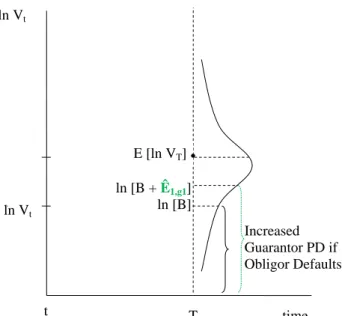
Figure 2 illustrates the functioning of our new asset drop approach. In particular, it shows how the guarantor PD increases when the guarantee payment has been triggered.
Figure 2. Probability of default in the asset drop model
E [ln VT] ln Vt Increased Guarantor PD if Obligor Defaults ln [B + Ê1,g1] ln [B] ln Vt t T time
The asset value process Vt follows a Bernoulli mixture model of the form (9) such that the asset value of the guarantor drops by the guarantee’s nominal ˆE1,g1in case the hedged obligor
defaults. Otherwise the asset value of the guarantor is log-normally distributed with mean E[lnVT] at maturityT . If the hedged obligor has defaulted and if the asset value of the guarantor at maturity falls below the value of the firm’s liabilities B plus the guarantee’s nominal ˆE1,g1,the guarantor will default as well. Hence the default of the hedged obligor leads to an increase in the guarantor’s default probability.
Note thatBg1is the default threshold of guarantorg1in case the hedged obligor 1
has not defaulted. ThusBg1 can be computed from the guarantor’s observed rating
according to the classical Merton model by equation (8). Thus, we can compute the increased PD0g
(8) and (10). This then provides an analytic formula for the unconditional default growth rate λ1,g1, i.e. the relative increase of the guarantor’s default probability due to the hedged obligor’s default. It is defined as
(12) λ1,g1= PD0g1−PDg1 PDg1 such that (13) PD0g 1 = PDg1·(1 +λ1,g1).
We now illustrate how this approach can be incorporated in the IRB model for the computation of economic capital. The probability distribution of the loss vari-ableL1of obligor 1 is in our setting given by
(14) P(L1=l) = PD0g1PD1 forl=s1LGDg1 (1−PD0g1) PD1+(1−PD1) forl= 0.
Note that to respect double recovery effects LGDg1 could be multiplied by LGD1.
However, for several reasons double recovery is not reflected in the current Basel II framework. Thus in the above and in the following we always set LGD1= 1 such
that only recovery of the guarantor is accounted for. Then the expected loss for obligor 1 is E[L1] = s1LGDg1PD1PD0g1 and the expected loss conditional on a
realizationxq of the systematic risk factorX is
E[L1|xq] =s1LGDg1PD1(xq) PD
0
g1(xq)
where the conditional PDs are computed as in the IRB approach by PD1(X) = Φ Φ−1(PD 1)− √ ρ1X √ 1−ρ1
and respectively for PD0g1. Hence the unexpected loss capital requirement K1 for
the hedged exposures1is15
K1= LGDg1(PD1(xq) PD
0
g1(xq)−PD1PD0g1).
15The Basel II economic capital for the hedged exposure 1 is obtained by multiplyingK1 with
the scaling factor 1.06 and the maturity adjustmentM A1, where we insert PD1PD0g1 instead of
Hence, to compute the IRB capital charges for the hedged exposure to obligor 1, one simply inserts the double default probability PD0g1PD1 instead of PD1 in the
formula for the IRB risk weight functions.
Remark 3. (Convexity of effective guarantor PD) By taking derivatives in equa-tions (8) and (10) it can be shown that PD0g is convex in the guarantee nominal. This convexity sets an incentive for banks to use several distinct guarantors for various loans. If, for example, there are two identical loans and two guarantors with exactly the same characteristics, the overall increase in default probability is smaller if each guarantor is contracted for one of the loans compared to when one guarantor is chosen to guarantee both loans. Thus also the bank’s economic capital will be smaller if it diversifies its guarantor risk. In particular, as will be shown explicitly in Example 1, overly excessive contracting of the same guarantor will sig-nificantly increase economic capital. This definitely is an appreciated consequence from a regulatory point of view. However, the effect is not reflected in the current treatment of double default effects within the IRB approach. Under this approach economic capital does not depend on whether a hundred loans are hedged by one single guarantor or whether every loan is hedged by one out of a hundred different guarantors.
Example 1(Computation of effective PD with the asset drop technique). Consider two medium-sized banks, g1 and g2, which according to their balance sheets have total asset values of Vg1(t) = 50 andVg2(t) = 10 billion Euros, respectively. Both firm value volatilities are estimated to be σ2
g1 = σg22 = 30%. Assume both to
have the same rating which translates into an unconditional default probability of PDg1 = PDg2 = 0.5%. The market’s risk free interest rate isr= 0.02%.Assume
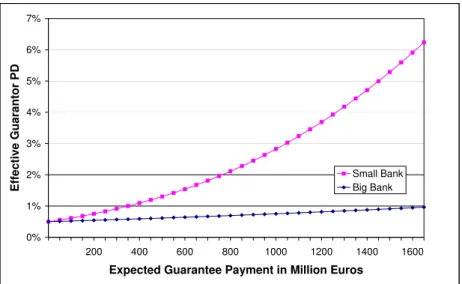
a 1-year time horizon. Using formula (8) we can compute the implicit default threshold for the larger bank in the Merton model and obtain Bg1 = 22.517.068 billion Euros. Likewise, for the smaller bank we obtain Bg2 = 4.502.414 billion Euros. Figure 3 shows the effective default probabilities PD0g1 and PD
0
g2 of the two
banks as a function of the expected guarantee payment ˆE1,g1 ≡ E1,gˆ 2. This has been computed with the asset drop technique according to equation (10). When the expected guarantee payment is e.g. 400 million Euros, the effective default probability of the smaller bank would be PD0g2 = 1.09%, which corresponds to an increase by a factor (1 +λ1,g2) = 2.19, i.e. λ1,g2 = 1.19. This means, that a
financial institution which has no direct exposure tog2and which buys protection
from the latter for its 400 million exposure to obligor 1, will use this increased default probability when computing its economic capital due to obligor 1.This is intuitive asg2’s default is only of interest when obligor 1 already has defaulted. For the larger bank the guarantee payment corresponds to a less significant loss. Its effective PD would only increase by a factor (1 +λ1,g1) = 1.18 to PD0g1 = 0.59%.
Note also that the relationship is convex as already mentioned in Remark 3. Also note from equations (8) and (10) that the increase in PD is scale invariant with respect to the firm size and the loan nominal. Thus, for example, a true global player with 100 times the firm size of the large bank considered here could guarantee 100 times as much as the large bank while suffering from the same increase in PD.
Figure 3. Effective PD computed with the asset drop technique 0% 1% 2% 3% 4% 5% 6% 7% 200 400 600 800 1000 1200 1400 1600
Expected Guarantee Payment in Million Euros
E ff e c ti v e G u a ra n to r P D Small Bank Big Bank
Figure 3 shows the effective guarantor default probability PD0gn= PDgn(1 +λn,gn) for two
banks as a function of the expected guarantee payment ˆEn,gn.For a large bank (diamond
line) the graph is moderately increasing and a guarantee payment of 1600 million Euros would roughly double its initial default probability. For a smaller bank (square line) the initial default probability already doubles when it has to make a payment of 275 million Euros. From this graph we also see the convexity of the relationship. This implies higher capital requirements if the same guarantor is used for several transactions.
3.2. Generalizations. Let us now consider the more complicated case where there is direct exposure to the guarantor. Denote the exposure share of obligor 1 bys1
and assume that it is fully hedged by guarantor g1. Denote the direct exposure
share to the guarantor by sg1. In this case we also have to focus on the default
of the guarantor itself, i.e. a loss also occurs if the guarantor defaults and the hedged obligor survives. In this situation, in a sense, there are two appropriate default probabilities of the guarantor. If obligor 1 already has defaulted, the default probability of the guarantor is given by PD0g
1. Otherwise it is given by PDg1.
To compute the contribution to economic capital of the hedged obligor and its guarantor within in the IRB approach we have to compute the conditional expected loss of both. As we do not want to reflect double recovery effects (similarly to the treatment in Basel II) we set LGD1 = 1 for a hedged exposure. The probability
distribution of the joint loss variableL1,g1 of obligor 1 and its guarantorg1,is then (15) P(L1,g1 =l) = PD0g1PD1 forl=s1LGDg1 +sg1LGDg1 PDg1(1−PD1) forl=sg1LGDg1 (1−PD0g 1) PD1+(1−PDg1)(1−PD1) forl= 0.
Note that the increased unconditional default probability PD0g1 occurs together with PD1 (i.e. with the probability that obligor 1 defaults), as in these situations
the guarantee payment is triggered. The first case corresponds to the situation where both the obligor and the guarantor default (i.e. to the double default case). In the second case only the guarantor defaults such that only the direct exposure to
g1 is lost. The third case comprises the hedging case, i.e. the obligor defaults and the guarantor succeeds in delivering the guarantee payment (although its default probability has increased) and the case where both the guarantor and the obligor survive. Thus in this case no loss occurs. The expected loss can be computed as
E[L1,g1] = PD0g1PD1(sg1LGDg1+s1LGDg1) + PDg1(1−PD1)sg1LGDg1 = sg1LGDg1 PDg1+ PD1·(PD0g1−PDg1) +s1LGDg1PD 0 g1PD1
This can be reformulated as
(16) E[L1,g1] =sg1LGDg1PDg1(1 +λ1,g1PD1) +s1LGDg1PD0g1PD1.
Note that probability that the exposuresg1 in the first term is lost, is the expected default probability of the guarantor whereas the probability that the hedged ex-posure s1 in the second term is lost, is the default probability of the guarantor conditional on obligor 1’s default. The second term in equation (16) is the ex-pected loss due to obligor 1 that only occurs in the situation of double default. This term is the same as in the case where the guarantor is external. The first term in equation (16) is the expected loss due to obligor 2 whose default probability increases if it has to exercise its guarantee payment. That is, the expected loss due
to an obligor increases if it is involved in a hedging activity because its expected PD increases. This fact is ignored in the treatment of double default effects in the IRB approach since guarantors are implicitly treated as external.16
The derivation of economic capital for the hedged exposure and its guarantor is obtained as follows. The conditional expected loss can be obtained as in the model underlying the IRB treatment of double default effects when there is no additional correlation. Denote by rn resp. rgn the log asset return of obligorn resp. of its guarantor gn. Let the conditional default probabilities be defined as in the IRB model by (17) PDn(X) = Φ Φ−1(PD n)− √ ρnX √ 1−ρn
forn= 1 org1and analogously for PD0g1(X). Then in our setting we have (18) E[L1,g1|X] = s1LGDg1E[1l{r1<c1}1l{rg1<c0g1}|X] +sg1LGDg1E[1l{rg1<cg1}1l{r1≥c1}+ 1l{rg1<cg01}1l{r1<c1}|X] = s1LGDg1PD1(X) PD 0 g1(X) +sg1LGDg1 PDg1(X)(1−PD1(X)) + PD 0 g1(X) PD1(X)
where we again neglected double recovery effects. Note that the loss variables fors1
andsg1 in the above equation are stochastically dependent conditional onX.Thus,
approximating the value-at-riskαq(L) by the conditional expected portfolio loss as
it is done in the IRB approach only makes sense within a double default treatment when the hedged exposure shares and the direct exposure shares to guarantors are sufficiently small (compare Remark 1 for more details).
Partial hedging and the case where a guarantor hedges multiple obligors in a port-folio can be approached with the same technique just presented and the results are straightforward. See also Ebert and L¨utkebohmert (2009) for a detailed treatment of these situations under Pillar 2 of Basel II.
16Note, again, that under the IRB approach it would not be reasonable to take into account direct
exposure to a guarantor as the additional correlation would induce an unrealistic dependency between obligor and guarantor.
Example 2. (Comparison of EC computed with the IRB double default treatment and with the asset drop technique.) Consider a portfolio with N = 110 obligors. The firstn= 1, . . . ,10 loans in the portfolio are hedged by guarantors 101, . . . ,110,
who also act as obligors in the portfolio. Assume the exposures to equal EADn = 1
for alln= 1, . . . ,110.The PDs are assumed to be 1% forn= 1, . . . ,100 and 0.1% for the guarantors n = 101, . . . ,110. As in the IRB approach, let LGDs be 45% for all unhedged obligors n= 11, . . . ,110.Hedged exposures are assigned an LGD of 100% to neglect double recovery effects, i.e. LGDn = 100% for n = 1, . . . ,10.
We assume an effective maturity of M = 1 year for all obligors and guarantors in the portfolio. Value-at-risk is computed at the 99.9% percentile level. The IRB treatment of double default effects yields an economic capital of 5.40% of total exposure.17 This is lower than the value obtained when neglecting double default effects entirely which equals 5.79%. Denoting by xq the qth percentile of
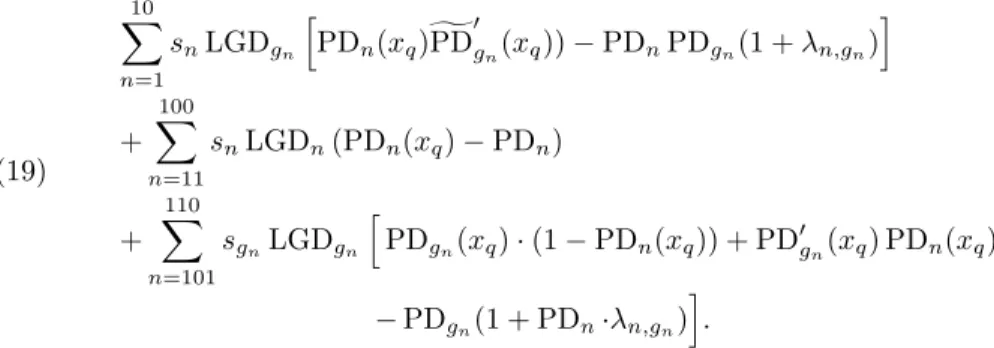
the systematic risk factor X, we calculated the IRB capital with the asset drop technique as (19) 10 X n=1 snLGDgn h PDn(xq)gPD 0 gn(xq))−PDnPDgn(1 +λn,gn) i + 100 X n=11 snLGDn(PDn(xq)−PDn) + 110 X n=101 sgnLGDgn h PDgn(xq)·(1−PDn(xq)) + PD 0 gn(xq) PDn(xq) −PDgn(1 + PDn·λn,gn) i .
In the above equationgPD 0
gn(xq) denotes the conditional increased default probabil-ity for the guarantor computed via equation (17) with PD equal to PDgn(1 +λn,gn) and asset correlation parameterρset to 0.7.The latter value is the increased cor-relation parameter chosen in the IRB treatment for exposures subject to double default. Although the choice of this parameter might be questionable we use it here for reasons of better comparability of our model with the IRB treatment of double defaults.
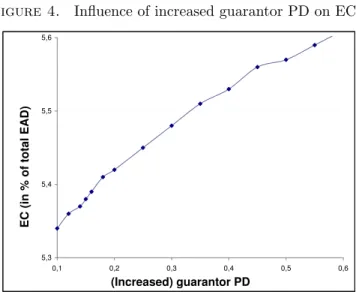
Figure 4 shows the influence of the parameter λ through the increased default probability PD0g
n = PDgn(1 +λ) of the guarantor on the IRB capital computed within the asset drop approach. Here we chose a constant level ofλfor all hedged obligors in the portfolio. With increasing λ the IRB capital also increases. This is very intuitive as higher values ofλmean that the expected default probabilities of the guarantors increase. This obviously results in higher capital requirements. For λ= 0.7 (PD0gn = 0.17%) our new asset drop method leads to the same eco-nomic capital as the one computed within the IRB treatment of double defaults, i.e. EC= 5.40% of total portfolio exposure.
17This computation is based on the approximation in equation (1) as this is the one applied in
Figure 4. Influence of increased guarantor PD on EC 5,3 5,4 5,5 5,6 0,1 0,2 0,3 0,4 0,5 0,6 (Increased) guarantor PD E C ( in % o f to ta l E A D )
Figure 4 shows the influence of the parameter λ through the increased guarantor default probability PD0gn= PDgn(1 +λn,gn) on regulatory capital computed within the asset drop
model. λincreases from 0.0 to 5.0 leading to an increase in EC from 5.34% to 5.61% of total portfolio exposure. For λ = 0.7 (PD0gn = 0.17%) the asset drop model leads to the same
EC= 5.40% as the IRB treatment of double defaults.
4. Conclusion
In this paper we pointed out several severe problems of the treatment of double default effects applied under Pillar 1 in the IRB approach of Basel II. Our main crit-icism is that it relies on the assumption of additional correlation between obligors and guarantors. Thus, it fails to model their asymmetric dependence structure ap-propriately, that is, that the guarantor should suffer much more from the obligor’s default triggering the guarantee payment than vice versa. The particular choice for the additional correlation parameter is the same for all obligors and guarantors and it remains entirely unclear how specific guarantor and obligor characteristics could be reflected in this parameter. Further, all guarantors are treated as distinct for different obligors and are assumed to be external to the portfolio. Thus, if there is direct exposure to guarantors or if several obligors have the same guarantor, then the additional dependencies and concentrations in the credit portfolio are ignored. Hence, also overly excessive contracting of the same guarantor is not reflected in the computation of economic capital.
To overcome these deficiencies, we proposed a new approach to account for double default effects that can be applied in any model of portfolio credit risk and, in particular, under the IRB approach of Basel II. It is easily applicable in terms of data requirements and computational time. Specifically, compared to the model of Heitfield and Barger (2003) underlying the IRB treatment of double defaults we need in addition the total values of the firms’ assets. These, however, can be directly inferred from the balance sheets and hence it should not be too much of a burden for any bank. Moreover, it should be obvious that theses quantities should be reflected in any good model for double default effects.
Despite of its simplicity our new approach does not show any of the above mentioned shortcomings and thus better reflects the risk associated with double defaults. The model endogenously quantifies the impact of the guarantee payment on the guaran-tor’s unconditional default probability. Within a structural model of portfolio credit risk the guarantor’s loss due to the guarantee payment corresponds to a downward jump in its firm value process. The jump size is determined endogenously through the underlying credit risk model assumed. This new asset drop technique could also be applied to model other dependencies within a conditional independence framework, as for example default contagion effects through business-to-business dependencies.
References
Allen, F., Carletti, E., 2006. Credit risk transfer and contagion. Journal of Monetary Economics 53, 80–111.
Basel Committee on Banking Supervision, 2003. Basel II: International convergence of capital measurement and capital standards: a revised framework. Bank for International Settlements.
Basel Committee on Banking Supervision, 2005. The application of Basel II to trad-ing activities and the treatment of double default effects. Bank for International Settlements.
Basel Committee on Banking Supervision, 2006. Basel II: international convergence of capital measurement and capital standards: a revised framework. Publication No. 128. Bank for International Settlements.
Basel Committee on Banking Supervision, 2009. Strengthening the resilience of the banking sector. Consultative Document. Bank for International Settlements. Brigo, D., Chourdakis, K., forthcoming. Counterparty risk for credit default swaps.
International Journal of Theoretical and Applied Finance.
Ebert, S., L¨utkebohmert, E., 2009. Treatment of double default effects within the granularity adjustment in Basel II, Bonn Econ Discussion Papers No. 10/2009, available from http://www.bgse.uni-bonn.de/bonn-econ-papers-1/archive/2009. Gordy, M., 2003. A risk-factor model foundation for ratings-based bank capital
rules. Journal of Financial Intermediation 12 (3), 199–232.
Gregory, J., 2009. Being two-faced over counterparty credit risk. Risk Magazine 22 (2), 86–90.
Grundke, P., 2008. Regulatory treatment of the double default effect under the New Basel Accord: how conservative is it? Review of Managerial Science 2, 37–59. Heitfield, E., Barger, N., 2003. Treatment of double-default and double-recovery
effects for hedged exposures under Pillar I of the proposed New Basel Accord, White Paper by the Staff of the Board of Governors of the Federal Reserve System.
Hull, J., White, A., 2001. Valuing credit default swaps II: modeling default corre-lations. Journal of Derivatives 8 (3), 12–22.
Lipton, A., Sepp, A., 2009. Credit value adjustment for credit default swaps via the structural default model. The Journal of Credit Risk 5 (2), 127–150. Merton, R., 1974. On the pricing of corporate debt: the risk structure of interest
rates. Journal of Finance 29, 449–470.
Neyer, U., Heyde, F., 2010. Credit default swaps and the stability of the banking sector. International Review of Finance 10 (1), 27–61.
Pykhtin, M., 2010. Modeling credit exposure for collateralized counterparties. The Journal of Credit Risk 5 (4), 3–27.
Pykhtin, M., Zhu, S., 2007. A guide to modelling counterparty credit risk. GARP Risk Review July/ August, 16–22.
Taplin, R., To, H., Hee, J., 2007. Modeling exposure at default, credit conversion factors and the Basel II accord. Journal of Credit Risk 3 (2), 75–84.
Valvonis, V., 2008. Estimating EAD for retail exposures for Basel II purposes. Journal of Credit Risk 4 (1), 79–101.
Wagner, W., Marsh, I., 2006. Credit risk transfer and financial sector stability. Journal of Financial Stability 2, 173–193.
Zhou, C., 2001a. An analysis of default correlations and multiple defaults. Review of Financial Studies 14 (2), 555–576.
Zhou, C., 2001b. The term structure of credit spreads with jump risk. Journal of Banking and Finance 25, 2015–2040.
University of Bonn, BWL 3 - Banking and Finance, Adenauerallee 24-42, D-53113 Bonn
University of Freiburg, Institute for Research in Economic Evolution, D-79085 Freiburg
![Figure 1. Probability of default in the Merton model E [ln V T ] ln V t ln [B] Default Probability ln Vt t T time](https://thumb-us.123doks.com/thumbv2/123dok_us/9995172.2491947/13.918.289.603.255.567/figure-probability-default-merton-model-default-probability-time.webp)