SPACE RESEARCH CENTRE, POLISH ACADEMY OF
SCIENCES
SOLAR PHYSICS DIVISION
WROCŁAW
REPORT FOR 2014
Janusz Sylwester February 2014Based on individual Team members contribution
Our Team consisted of 23 people:
9 scientists, 5 PhD, 7 engineers and 2 support
Data reduction and interpretation
RESIK
RESIK was a unique Bragg crystal spectrometer operating on the Russian
CORONAS-‐F satellite launched 31 July 2001. The instrument operated for two
years (2002-‐2003) during a period close to the maximum of Solar Cycle 23. The
instrument recorded many high quality spectra in the spectral range 3.3-‐6.1 Å,
which has never before been studied before systematically. In the spectra,
several prominent X-‐ray emission lines are seen formed in active regions and
flares in particular.
Fig. 1. Example of RESIK spectra for flare SOL2002-11-14T22:26 . On the flare- averaged
spectrum (top left panel), identifications of stronger spectral lines are given. Panels e, g and n
correspond to the rise, maximum and decay phases of the event. The pre-flare spectrum is
shown at the bottom of panel n.
The analysis of emission lines and the continuum allows the study of the
physical conditions in the multi-‐million kelvin plasmas and determination of
plasma chemical composition in particular. In 2014, further analysis of flaring
plasma spectra have been performed in close collaboration with Prof. Ken
Phillips (Natural History Museum, London).
The dependence of abundance determinations on iso-‐ or multi-‐temperature
plasma source models has been investigated. The results obtained indicate that
a simplified isothermal approach provides overestimated values for
abundances of elements whose ions are formed at relatively low-‐temperature.
Thus, for RESIK X-‐ray spectra, it is clear from these studies that an isothermal
approach is not valid for abundance determinations of silicon and sulfur, and
instead, a multi-‐temperature approach is necessary. A dedicated multi-‐
temperature abundance optimization method AbuOpt has been further
developed and described in the paper published in ApJ (10.1088/0004-‐
637Х/787/1/1). This has been applied for a single flare in 2002 (SOL2002-‐11-‐
14T22:26), with the result that abundance estimates of Si and S are decreased
compared with those from isothermal analyses but Ar and K (ions formed at
higher temperatures) are approximately the same. With mean optimized
abundances (A
Si, A
S, A
Arand A
K)for this flare, the time evolution of the
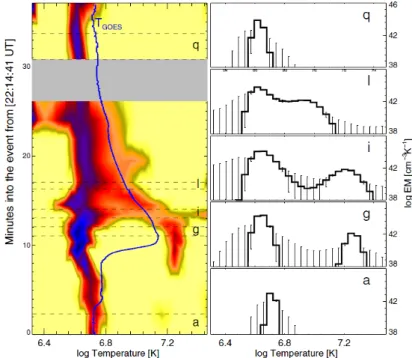
differential emission measure was determined. Fig. 2 illustrates this.
Fig. 2. Left: contour plot of the differential emission measure during the SOL2002-‐11-‐
14T22:26 flare, darker colors indicating greater emission measure. The horizontal scale is the
logarithm of temperature in K, with time increasing upwards, measured from 22:14:41 UT.
The horizontal dotted lines define the time intervals a, g, i, l, and q (right panel) and the
smooth curve running from top to bottom is the temperature derived from the ratio of the
two GOES channels on an isothermal assumption. Right: emission measure distributions for
the intervals indicated in the left plot, derived from the Withbroe–Sylwester routine. Vertical
error bars indicate uncertainties. A cooler (temperature
∼
4–5 MK) component is present over
all the time intervals shown, with the hotter component (
∼
18 MK) at the peak of the GOES
light curve.
Subsequently, our AbuOpt approach has been used in the analysis of 33 flares
observed by RESIK in the period December 2002 – March 2003, after the
instrument settings had been optimized. Very precise determinations of
abundances (A
Si, A
S, A
Arand A
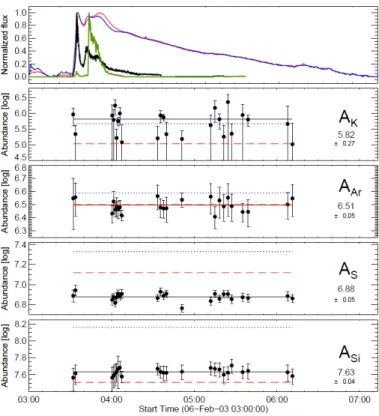
K) were made throughout each event to search
for any time dependence but no such variability was detected outside the
measurement uncertainties (Fig. 3 shows one of the 33 flares).
Fig. 3. Time variations of absolute abundance estimates of K, Ar, S, and Si. The abundances
were determined using the abundance–optimization (AbuOpt) approach described in the
text. The error bars on abundance determination are based on the results in Figure 4 and
correspond to the range of values for min(χ
2) + 1.0. The thin black horizontal lines represent
time-‐averaged values of elemental abundances together with their rms error bands (dotted
horizontal lines). X-‐ray light curves from GOES (blue and red) and the RHESSI hard X-‐ray
spacecraft are shown in the top panel. In the lower 4 panels, the horizontal blue dotted lines
correspond to “coronal” abundances (Feldman 1992), the dashed red lines to “photospheric”
Also, very little if any difference is present from flare to flare. The paper
describing these results has been submitted to ApJ and is at present under
review.
Fig. 4. Mean abundance estimates for each of the 33 flares of K, Ar, S, and Si. The red dashed
horizontal lines indicate photospheric abundance estimates from Asplund et al. (2009) (Si, S,
K) or solar proxies from Lodders (2008) (Ar). The blue dotted lines are coronal abundance
estimates from Feldman et al. (1992), those specified in the CHIANTI database “coronal”
abundance set.
DIOGENESS
DIOGENESS was a spectrometer on the CORONAS-‐F spacecraft consisting of the
four flat scanning crystals. The instrument operated a couple of months after
the launch in 2001. Two of the crystals were mounted in a so-‐called
M and X classes. Spectra from the four bands have been reduced and show
several lines not seen before. Some forty emission lines at least feature in the
spectra and nearly all have been identified.
Left: Forward (increasing wavelength) scans for DIOGENESS channel 4 (Ca XIX lines) during
the 25 August 2001 flare stacked with increasing times from top to bottom (time range 16:29
– 18:00 UT). Right: Corresponding backward (decreasing wavelength) scans.
Details of the Diogeness construction, operation data reduction and initial
analysis are given in the paper published in Solar Physics (DOI 10.1007/s11207-‐
014-‐0644-‐1).
SphinX
The SphinX soft X-‐ray spectrophotometer on board the Russian CORONAS-‐
Photon satellite operated successfully between February and December 2009.
The instrument collected ~2 million spectra from a period of record low solar
activity, the lowest for approximately 100 years. SphinX was developed entirely
in Wroclaw Solar Physics Division of SRC PAS under the financial support from
the Ministry of Science grants 4 T12E 045 29 and N N203 381736. Over the past
year, a detailed analysis of X-‐ray light curves observed in the energy range
above ~1 keV has been performed with the aim of counting weak flares and X-‐
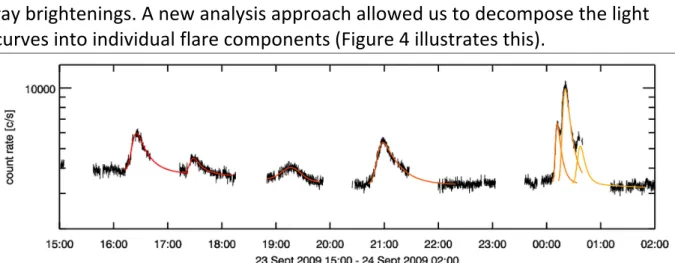
ray brightenings. A new analysis approach allowed us to decompose the light
curves into individual flare components (Figure 4 illustrates this).
Fig. 4. Example of the fit to the observed lightcurve over a several-hour period of solar X-ray
emission (E > 1 keV) with individual elementary flare profiles.
By fitting the elementary flare profiles, it is possible to precisely determine
basic flare characteristics: start, maximum and end times and study flare
evolution on a so-‐called diagnostic diagram.
Fig. 5 Example of the elementary flare time profile fit to the SphinX light curve of a small
(A9.0) event SOL2009-‐07-‐18T0204 (left) and the corresponding diagnostic diagram (right)
showing the evolution of plasma emission measure and the temperature. Changing colours
reflect progressing times. It is seen that initial decay phase runs along the steady state
branch (red dashed). At later times the “heating-‐OFF” takes place and the inclination
steepens, being close to the OFF-‐case (yellow dot branch). Such a detailed study has been
performed for the first time and the results are to be presented in a dedicated paper.
X-‐ray light curves from SphinX have been compared with measurements of
solar X-‐ray emission from the XRS-‐SAX instrument on board the
MESSENGER
spacecraft on its way to the planet Mercury. For two intervals during 2009, the
The straight lines:
Quasi steady state
location of Messenger was along the Sun-‐Earth line, so during those times a
comparison of SAX and SphinX X-‐ray emission profiles is possible, as shown in
Fig. 6.
Fig. 6 Upper panel: The comparison of X-‐ray lightcurves of the Sun as seen from MESSENGER
(black) and SphinX (blue). The sensitivity of SphinX was many times higher than XRS. For the
period in late September 2009 (lower panel), MESSENGER observed the same part of the
solar disk, so a direct comparison is possible.
Analysis of SphinX and XRS-‐SAX data is in progress, with early results indicating
a problem with absolute calibration of one of the instruments, most likely the
XRS.
Fig. 7. Comparison of XRS (MESSENGER) and SphinX absolute fluxes of solar X-‐ray emission
above 1 keV (left). SphinX values are about twice those of the XRS, though the derived
plasma temperatures (from an isothermal assumption) are in a good agreement. Different
SphinX individual detector “events” from D1 (the detector having the largest
aperture) were carefully examined “one by one” with the aim of discriminating
those due to solar X-‐ray photons from those due to magnetospheric energetic
particles penetrating the instrument.
Fig. 7. Two examples of D1 SphinX records from very low activity period. Green lines
represent signal before “cleaning” and black after rejection of solar “events”. The dynamic
range of the signal due to energetic particles is increased by about a factor of 100.
In Fig. 7, an example of this analysis is shown. Elimination of solar detector
events allows for studies of particle events with an accuracy that is ~100 times
better than before. The analysis of SphinX records due to particles is
progressing in close collaboration with the Kharkiv group (Dr. Dudnik).
Theoretical Modeling
A new approach has been conceived using the CERN Geant4 particle package
to model the detailed interaction of electron beams precipitating from the
coronal acceleration region to denser chromospheric layers. Geant4 has an
advantage of solving the problem in a Monte-‐Carlo approach, without using
simplified assumptions as has been done before.
Fig. 8. Left: visualization of the relativistic electron track (red) impeding the solar denser
chromosphere. Secondary electron paths are clearly visible leading to emission of
bremsstrahlung continuum. Right: Spectrum of X-‐ray emission, calculated using Geant4 for
electron power low beam above 10 keV (histogram). Straight line represents the analytical
solution.
New instruments & ideas
STIX
STIX is the imaging Fourier hard X-‐ray spectrophotometer for the ESA Solar
Orbiter. The instrument is in the final phase of construction C/D for the launch
expected in 2018. Poland is contributing to the hardware and software
development as a significant partner in the instrument consortium led by
Switzerland. The main task of the SPD SRC Wrocław group is development of
the instrument EGSE, development of the hardware/software detector
simulator (~300 independent detector channels) and software flare simulator.
All the activities evolved nominally over 2014. Numerous documents have been
drawn up and delivered to the consortium and/or ESA. Software and hardware
progress were substantial, example of which is the construction of so called 3D
detector simulator (cf. Fig. 9). This DSS allows the simulation of “real”
responses of the instrument detector pixels (>300 units in 32 detectors) and
electronics down to the compressed telemetry stream. The front part of the
simulator consists of elaborated block of IDL routines simulating the hard X-‐ray
source with a high time (20 ns) and spatial resolution (1 arcsec) in a Monte-‐
Carlo approach.
Fig. 9. A view of the detector simulator system (DSS-‐left) and one of the printed boards to be
placed inside.
The back-‐end of the instrument IDPU, under construction in Warsaw, interfaces
with the SIIS Solar orbiter’s simulator system delivered to SPD from ESA. The
corresponding software (scripts) has been written in Wrocław to allow
development of the IDPU software and test procedures.
Fig. 10. Block scheme of the STIX test configuration to be used for EM and FM of the
instrument.
In Fig. 10, a block-‐scheme of the test configuration, including SIIS and IDP.
In order that the simulator adequately represents the real instrument with all
its detectors, a Geant4 simulation of detector response to illumination by X-‐
rays has been undertaken. These calculations were found to be in a good
agreement with the test measurements of the detector response performed in
the SACLAY, France -‐ the detector construction laboratory.
Fig. 11. Comparison of the measured STIX detector response (in red) with the Geant4
calculated response (in blue). Satisfactory agreement is observed. All 32 STIX detectors (flight
units) will be measured and fitted in order to properly convert the stream of telemetry data
into images of X-‐ray flares in selected energy ranges.
ChemiX
ChemiX is the Bragg bent crystal spectrometer under development for the two
Russian Interhelioprobe interplanetary missions to be launched in 2020 and
2022. Orbits of Interhelioprobe will be similar to Solar Orbiter, reaching
distances to the Sun as close as ~0.3 a.u. ChemiX is equipped with pin-‐hole soft
X-‐ray imager and 10 bent crystals illuminating CCD detectors taking the soft X-‐
ray spectra in the entire range from 1.5 Å to ~9 Å. Three pairs of identical
crystals are placed in a so-‐called dopplerometer configuration allowing for
precise determinations of line shifts and physical line profiles. Over 2014, a
complete reconfiguration of the instrument construction took place reducing
the weight of the detection section.
Fig. 12. General view of the ChemiX Bragg spectrometer (left). The upper two panels are the
filter boards to be mounted on the mission thermal screen. They have to withstand harsh
thermal conditions (~400 C). The crystals and detectors are mounted within the block placed
~1m behind the filters. The red-‐capped tube is the particle detector system, under
development by the Ukrainian Kharkiv group led by Dr. Dudnik. Right: a view of ChemiX from
the direction of the Sun.
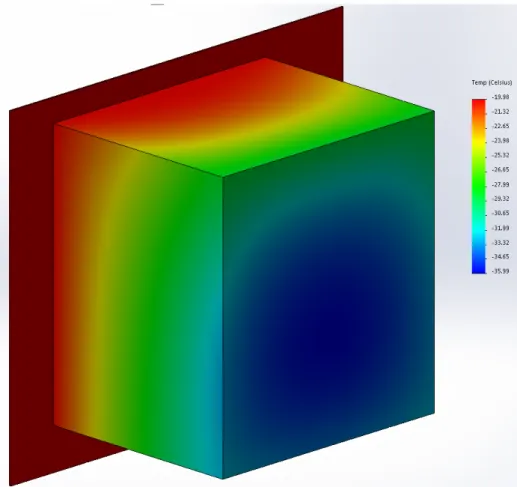
Reliable thermal modelling is especially important for ChemiX since the mission
approaches the Sun so closely and the solar thermal flux is many times larger
than in the Earth’s neighborhood. An example of the thermal modelling is
shown in Fig. 13.
Fig. 13. Distribution of ChemiX instrument temperatures, calculated for the case of the
instrument support temperature being at -‐20 C. This corresponds to the lowest temperature
envisaged for the payload support plate.
SolpeX
SolpeX is the soft X-‐ray polarimeter-‐spectrometer for the International Space
Station. The instrument consists of three functional blocks to be placed inside
Russian-‐build KORTES assembly. Delivery of KORTES to the ISS is planned for
2017/2018. The three SolpeX units are: the rotating bent-‐crystal polarimeter
(B-‐POL), a fast rotating drum spectrometer RDS, and the pin-‐hole imager. B-‐
POL will hopefully detect (for the first time) the polarization of the soft X-‐ray
lines and continuum around a photon energy of ~3 keV, which is expected to
be present during impulsive phase of flares. RDS will take spectral
measurements covering the entire soft X-‐ray range 1.5 Å – 23 Å up to 10 times
per sec and the pin-‐hole will image the solar disk in a softer X-‐ray range
Fig. 14. A view of the three SolpeX units within KORTES shadow. The B-‐POL rotating
polarimeter axis is actively directed towards the flare (being in progress) as seen in the pin-‐
hole image. The RDS consists of 8 flat crystals mounted on the rotating drum revolving 10
times/sec. Bragg-‐reflected X-‐rays are collected by four SDD detectors. Appropriate crystal
selection assures a full spectral coverage over the soft X-‐ray spectral range.
Proba-‐3
Proba-‐3 is the ESA project aimed to observe details of solar corona in the
optical range. Project is in phase C/D.
http://www.esa.int/Our_Activities/Space_Engineering_Technology/Proba_Miss
ions/About_Proba-‐3
Members of the SPD SRC (Siarkowski, Stęślicki & Sylwester), were engaged in
process of selection of the spectral bands where the observations are to be
undertaken by this formation flying solar coronograph. We suggested that the
mission be equipped with the X-‐ray spectrometer SphinX-‐NGP to widen the
science output.
Fig. 15. The construction of SphinX-‐NGP soft X-‐ray spectrophotometer intended to be placed
on the front satellite (occulter) of the Proba-‐3 formation flying duo.
Grant applications & grant progress
Eleven grant applications were submitted to various Polish grant agencies. Out
of them only one was granted funds (SolpeX), while one other is still under
consideration by the peer review commission.
The team of SPD-‐SRC continued receiving the support through 7FP as a
member of the eHEROES consortium of 15 European institutes. eHEROES aims
to study problems of “Environment for Human Exploration and RObotic
Experimentation” within the scope of THEME [SPA.2011.2.1-‐01] Exploitation of
space science and exploration data. Activities at SPD SRC were led in 2012 by
Szymon Gburek. Three quarterly reports of activities have been compiled.
In 2014 the NCN supported works at SRC PAS through the following running
grants:
•
Prof. Barbara Sylwester, Investigation of physical conditions based on
analysis of their X-ray spectra, Badanie warunków fizycznych w strukturach
korony słonecznej na podstawie analizy ich promieniowania rentgenowskiego,
2011/01/B/ST9/05861- year three out of three,
•
Prof. Marek Siarkowski, Design of a new concept Polish Bragg
spectrometer ChemiX. ChemiX: opracowanie za
ł
o
ż
e
ń
naukowych i
konstrukcji (faza B) nowego spektrografu Bragga na misj
ę
mi
ę
dzyplanetarn
ą
Interhelioprobe (IHPM)”) - year three out of four,
•
Prof. J. Sylwester (we spólpracy z Tomaszem Mrozkiem, Piotrem.
Orleanskim i Markiem St
ęś
lickim- przyj
ę
tym w 2012 na etat adiunkta w
the ESA Solar Orbiter mission to the Sun Rentgenowski spektrometr
obrazuj
ą
cy STIX: zdefiniowanie szczegó
ł
owych celów naukowych i sposobu
prowadzenia obserwacji na podstawie modelowania matematycznego
przyrz
ą
du, oraz jego systemu testuj
ą
cego". - year three out of four,
•
SPD-SRC participated (J. Sylwester, M. Kowali
ń
ski, P. Podgórski) in
PECS/PRODEX supporting STIX technical activities (led by SRC
Headquarters team).
A new international agreements had been signed between the National
Radioastronomical Institute of Ukraine represented by Dr. O. Dudnik and SRC
PAS (J. Sylwester). The agreement will support common interpretation of data
collected by STEP-‐F and SphinX instruments on the CORONAS-‐Photon and the
ChemiX construction.
The teams from Radioastronomical Institute of Ukraine (Dr. O. Dudnik, and E.
Kurbatov) and SPD SRC PAS (Prof. J. Sylwester, Dr. S. Gburek, Dr. M. Kowalinski,
P. Podgórski) were awarded prestigious inter-‐Academy Award between Polish
and Ukrainian Academies of Sciences. For details see
http://www.cbk.waw.pl/en/index.php?option=com_content&view=article&id=
370:the-‐solar-‐physics-‐division-‐of-‐the-‐space-‐research-‐centre-‐won-‐pas-‐nasu-‐
competition&catid=2:aktualnoci&Itemid=91
Visiting scientists
Irina Myaghkova, Skobeltsyn Institute, MGU, Moscow, Russia, 13-‐21 May
Ken Phillips, National History Museum, London 16-‐27 August
Oleksiy Dudnik, Kharkiv University and Radioastronomical Institute of Ukraine,
5-‐25. 10.2012
Kanti Aggarwal, Astrophysics Research Centre, School of Mathematics and
Physics, Queen’s University Belfast, 1-‐2. October
Publications from the “Philadelphia” list
tytuł autor czasopismo
Solar Flare Composition and Thermodynamics from RESIK X-‐Ray Spectra
Sylwester, B.; Sylwester, J.; Phillips,
K. J. H.; Kępa, A.; Mrozek, T. The Astrophysical Journal, Volume 787, Issue 2, article id. 122, 10 pp
A CCD Search for Variable Stars of Spectral Type B in the Northern Hemisphere Open Clusters. IX. NGC 457
Mozdzierski, D.; Pigulski, A.; Kopacki, G.; Kolaczkowski, Z.; Steslicki, M.
Acta Astronomica, vol 64, no 2, p. 89-‐114
X-‐ray Flare Spectra from the DIOGENESS
Spectrometer and its concept applied to ChemiX on the Interhelioprobe spacecraft Sylwester, J.; Kordylewski, Z.; Płocieniak, S.; Siarkowski, M.; Kowaliński, M.; Nowak, S.; Trzebiński, W.; Stęślicki, M.; Sylwester, B.; Stańczyk, E.; Zawerbny, R.; Szaforz, Z.; Phillips, K. J. H.; Farnik, F; Stepanov, A.
Solar Physics, accepted for publication
Izerski Park Ciemnego Nieba i inne inicjatywy
Tomasz Mrozek, Sylwester
Kołomański Prace i Studia Geograficzne Tom: 53, Strony: 171-‐185 Spectroscopic survey of
Kepler stars: high-‐
resolution observations of A-‐ and F-‐type stars
Niemczura, E.; Smalley, B.; Murphy, S.; Catanzaro, G.; Uytterhoeven, K.; Drobek, D.; Briquet, M.; De Cat, P.; Marcos-‐Arenal, P.; Pápics, P. I.; Gameiro, J. F. S., Stęślicki M.
MNRAS, Precision
Asteroseismology, Proceedings of the International Astronomical Union, IAU Symposium, Volume 301, pp. 467-‐468
Testing the Model of
Oscillating Magetic Traps Szaforz Z; Tomczak M.; Solar Physics, Volume 290, Issue 1, pp.115-‐127 RESIK solar X-‐ray flare
element abundances on non-‐isothermal
assumption
B. Sylwester, K.J.H. Phillips, J.
Sylwester, A. Kępa 2014, ApJ, submitted
Multiperiodicity in quasi-‐ periodic pulsations of flare hard X-‐rays: a case study
Szaforz Ż., Tomczak M., Central European Astrophysical Bulletin 2014, accepted
Other publications (12)
Lp tytuł autor czasopismo
1 Development of small-‐ sized SIDRA device for monitoring of charged particle fluxes in space
Dudnik, O.V.; Kurbatov, E.V.; Sylwester J; Siarkowski,M.; Kowaliński, M; Tarasov, V.O.; Andryushenko, L.A.; Zajtsevsky, I.L.; Valtonen, E.
Space Research in Ukraine, 2012-‐ 2014. The Report to the COSPAR”. -‐ ISBN 978-‐966-‐360-‐255-‐4, ed. by O.P. Fedorov. – Kyiv: Publ. House “Akademperiodika”. – 2014. – p. 62-‐67. 2 Разработка малогабаритного спутникового прибора SIDRA для мониторинга потоков заряженных частиц в космическом пространстве
Dudnik, O.V.; Kurbatov, E.V.; Sylwester J; Siarkowski,M.; Kowaliński, M; Tarasov, V.O.; Andryushenko, L.A.; Zajtsevsky, I.L.; Valtonen, E. Космічні дослідження в Україні, 2012−2014. Звіт до COSPAR». − ISBN 978-‐966-‐360-‐254-‐7, під ред. О.П. Федорова. – Київ: Видавничий дім «Академперіодика». – 2014. − С. 65-‐70. 3 Properties of magnetospheric high energy particles based on analysis of data from STEP-‐ F and SphinX instruments aboard the “CORONAS-‐ PHOTON” satellite
Dudnik, O.V.; Sylwester, J.;
Podgórski, P. Space Research in Ukraine, 2012-‐2014. The Report to the COSPAR, ISBN 978-‐966-‐360-‐255-‐4, ed. by O.P. Fedorov. – Kyiv: Publ. House “Akademperiodika”. – 2014. – P. 53-‐61 4 Исследования частиц высоких энергий на низкоорбительном спутнике «КОРОНАС-‐ ФОТОН» по данным приборов СТЭП-‐Ф и SphinX
Dudnik, O.V.; Sylwester, J.;
Podgórski, P. Космічні дослідження в Україні, 2012−2014. Звіт до COSPAR, ISBN 978-‐966-‐360-‐254-‐7, під ред. О.П. Федорова.– Київ: Видавничий дім "Академперіодика". – 2014. − С. 56-‐64.
5 Investigations of Physical Processes in Solar Flare Plasma on the Basis of RESIK Spectrometer Observations
Kordylewski, Z.; Sylwester, J.; Sylwester, B.; Kepa, A.; Kowalinski, M.; Trzebinski, W.
The Coronas-‐F Space Mission, Astrophysics and Space Science Library, Volume 400. ISBN 978-‐3-‐ 642-‐39267-‐2. Springer-‐Verlag Berlin Heidelberg, 2014, p. 157
6 Observations of Doppler Shifts of X-‐Ray Lines in Solar Flare Spectra Based on DIOGENESS
Spectrometer Data
Kordylewski, Z.; Sylwester, J.; Sylwester, B.; Siarkowski, M.; Plocieniak, S.; Kepa, A.; Kowalinski, M.; Trzebinski, W.; Farnik, F.
The Coronas-‐F Space Mission, Astrophysics and Space Science Library, Volume 400. ISBN 978-‐3-‐ 642-‐39267-‐2. Springer-‐Verlag Berlin Heidelberg, 2014, p. 149
7 Properties of 42 Solar-‐type Kepler Targets from the Asteroseismic Modeling Portal
Metcalfe, T. S.; Creevey, O. L.; Dogan, G.; Mathur, S.; Xu, H.; Bedding, T. R.; Chaplin, W. J.; Christensen-‐Dalsgaard, J.; Karoff, C.; Trampedach, R.; Benomar, O.; Brown, B. P.; Buzasi, D. L.; Campante, T. L.; Celik, Z.; Cunha, M. S.; Davies, G. R.; Deheuvels, S.; Derekas, A.; Di Mauro, M. P.; Garcia, R. A.; Guzik, J. A.; Howe, R.; MacGregor, K. B.; Mazumdar, A.; Montalban, J.;
Monteiro, M. J. P. F. G.;
Salabert, D.; Serenelli, A.; Stello, D.; Steslicki, M.; Suran, M. D.;
Yildiz, M.; Aksoy, C.; Elsworth, Y.; Gruberbauer, M.; Guenther, D. B.; Lebreton, Y.; Molaverdikhani, K.; Pricopi, D.; Simoniello, R.; White, T. R.
eprint arXiv:1402.3614
9 Geant4 simulations of detector response matrix for Caliste-‐SO
Barylak, J.; Podgórski, P.; Mrozek, T.; Barylak, A.; Stęślicki, M.; Sylwester, J.; Ścisłowski, D.
Proc. SPIE 9290, Photonics Applications in Astronomy, Communications, Industry, and High-‐Energy Physics Experiments 2014, 929037 (November 25, 2014); DOI:10.1117/12.2075654
10 Solar Orbiter spacecraft instrument interface simulator and its applications for the STIX telescope tests
Ścisłowski, D.; Kowaliński, M.; Podgórski, P.; Sylwester, J.; Orleański, P.; Mrozek, T.; Stęślicki, M.; Barylak, J.; Barylak, A.; Skup, K. R.; Cichocki, A.; Ber, K.;
Juchnikowski, G.
Proc. SPIE 9290, Photonics Applications in Astronomy, Communications, Industry, and High-‐Energy Physics Experiments 2014, 929038 (November 25, 2014); DOI:10.1117/12.2075708
11 Soft X-‐ray Solar
polarimeter-‐spectrometer Stęślicki, M.; Sylwester, J.; Siarkowski, M.; Kowaliński, M.; Płocieniak, S.; Bąkała, J.; Szaforz, Ż.; Kuzin S.
Proc. SPIE 9441, 19th Polish-Slovak-Czech Optical Conference on Wave and Quantum Aspects of
Contemporary Optics, 94410T (December 5, 2014);
doi:10.1117/12.2176043
12 Solar activity during the
deep minimum of 2009 Sylwester, Janusz; Siarkowski, Marek; Gburek, Szymon; Gryciuk, Magdalena; Kepa, Anna;
Kowalinski, Miroslaw; Mrozek, Tomek; Phillips, Kenneth J. H.; Podgórski, Piotr; Sylwester, Barbara
XXXVI Polish Astronomical Society Meeting, Proceedings of the conference held 11-‐14
September, 2013. Edited by A. Rózanska and M. Bejger. Polish Astronomical Society, Bartycka 18, 00-‐716 Warszawa, 2014, pp.82-‐88
Submitted publications
tytuł autor czasopismo
1
Solar Flare Composition and Thermodynamics from RESIK X-‐Ray Spectra
B. Sylwester, K.J.H. Phillips, J.
Sylwester, A. Kępa 2014, ApJ, submitted
Presentations
tytuł autor miejsce wygłoszenia
Spacecraft Instrument Interface
Simulator SO -‐ SIIS Ścisłowski D., Kowaliński M., Podgórski P., AJB, TM, SM, JS STIX Consortium Meeting, 25 -‐ 27 March 2014, Prague
Spacecraft Instrument Interface Simulator and its applications for the STIX telescope tests
Ścisłowski D., Kowaliński M., AJB
XXXIV IEEE-‐SPIE Wilga 2014, http://wilga.ise.pw.edu.pl/
Spektrofotometr rentgenowski SphinX-‐NG na wspólnym polsko-‐ amerykańskim nanosatelicie
Kowaliński M, Janusz
Sylwester, Bąkała J., Podgórski P., Gastonis N., Rudawy P.,
Polska w kosmosie wczoraj, dziś, jutro, 13–14 November 2014, Warszawa,
http://www.polskawkosmosie .org/index.php/oficjalny-‐ program
STIX — teleskop rentgenowski na
pokładzie sondy Solar Orbiter Podgórski P., Seminarium Heliofizyczne, IA Wrocław, IA Wrocław
KORTES experiment – EUV & SXR imaging&spectroscopy of the solar corona aboard International Space Station
S. Shestov, S. Kuzin, A. Pertsov, A. Reva, E.
Vishnyakov, Marek Stęślicki, Janusz Sylwester, Marek Siarkowski, Piotr Podgórski, Mirosław Kowaliński, Jarosław Bąkała
COSPAR 2014,
http://cospar2014moscow.co m
How to form and feed a flare coronal
source? (oral) pdf Kołomański S., Mrozek T. 13th RHESSI Workshop, 1 -‐ 4 April 2014, Windisch (Switzerland),
http://sprg.ssl.berkeley.edu/~ solarsdy/rhessi13/,
HXR footpoint sources and
chromospheric dynamics from RHESSI data
Mrozek T., Kołomański S., Sylwester B., Kępa A., Sylwester J., Gburek S., Siarkowski M., Gryciuk M., Stęślicki M. 13th RHESSI Workshop, 1 -‐ 4 April 2014, Windisch (Switzerland), http://sprg.ssl.berkeley.edu/~ solarsdy/rhessi13/,
Soft X-‐ray polarimeter-‐spectrometer
SOLPEX Stęślicki M., Sylwester J., Siarkowski M., Kowaliński M., Szaforz Ż, Shestov S. 13th RHESSI Workshop, 1 -‐ 4 April 2014, Windisch (Switzerland), http://sprg.ssl.berkeley.edu/~ solarsdy/rhessi13/
Evolutionary pattern of DEM
variations in flare(s) Sylwester B., Sylwester J., Kępa A., Mrozek T., Phillips K.J.H., Kuznetsov V.D 13th RHESSI Workshop, 1 -‐ 4 April 2014, Windisch (Switzerland), http://sprg.ssl.berkeley.edu/~ solarsdy/rhessi13/
ChemiX – the soft X-‐ray Bragg
spectrometer under development for the Interhelioprobe Mission
Sylwester J., Siarkowski M., Szaforz Ż. , Bąkała J., Dudnik O., Kuznetsov V.D., Zimovets I.V., Kuzin S 13th RHESSI Workshop, 1 -‐ 4 April 2014, Windisch (Switzerland), http://sprg.ssl.berkeley.edu/~ solarsdy/rhessi13/
CubeSat imaging X-‐Ray Solar
Spectrometr-‐ CubIXSS STĘŚLICKI M., Mrozek T., Gburek S., Kowaliński M., Trzebiński W., A.Caspi, A.Shih
XIX Polish-‐Slovak-‐Czech Optical Conference on Wave and Quantum Aspects of Contemporary Optics, 8-‐12 September 2014, Wojanów, Poland, https://indico.ncbj.gov.pl/indi co/internalPage.py?pageId=12 &confId=1
Transient flows of the solar wind associated with small-‐scale solar activity in solar minimum
V. Slemzin, S. Kuzin, S. Gburek, Yu. Shugay, I. Veselovsky, F. Goryaev, A. Kirichenko, A. Ulyanov
COSPAR 2014,
http://cospar2014moscow.co m
SphinX catalogue of small flares and
brightenings Magdalena Gryciuk, Janusz Sylwester, Szymon Gburek, Marek Siarkowski, Tomasz Mrozek, Anna Kepa
COSPAR 2014,
http://cospar2014moscow.co m,
Soft X-‐ray spectra of strong flares seen by Bragg flat crystal spectrometer aboard Coronas-‐F
Barbara Sylwester, Janusz Sylwester, Frantisek Farnik, Marek Siarkowski, Zbigniew Kordylewski, Stefan Plocieniak, Kenneth Phillips, Marek Steslicki
COSPAR 2014,
http://cospar2014moscow.co m,
Anomalous intensities of lines observed in RESIK soft X-‐ray flare spectra
Barbara Sylwester, Janusz Sylwester, Tomasz Mrozek, Anna Kepa, Kenneth Phillips
COSPAR 2014,
http://cospar2014moscow.co m,
Analysis of selected microflares observed by SphinX over the last minimum of solar activity
Marek Siarkowski, Janusz Sylwester, Barbara Sylwester, Magdalena Gryciuk
COSPAR 2014,
http://cospar2014moscow.co m,
Chromospheric dynamics from RHESSI
and RESIK data. Tomasz Mrozek, Janusz Sylwester, Barbara Sylwester, Szymon Gburek, Marek Siarkowski, Sylwester Kolomanski, Magdalena Gryciuk, Anna Kepa, Zaneta Szaforz, Marek Steslicki
COSPAR 2014,
http://cospar2014moscow.co m
ChemiX: a new generation bent crystal spectrometer for
Interhelioprobe mission to the Sun
Sylwester, Janusz; Zimovets, Ivan; Kowalinski, Miroslaw; Bakala, Jaroslaw; Siarkowski, Marek; COSPAR 2014, http://cospar2014moscow.co m,
Trzebinski, Witold; Kuznetsov, Vladimir; Szaforz, Zaneta
Diogeness observations of the X-‐ray spectra of the impulsive phase of Solar flares
Stęślicki, M., Sylwester, J., Sylwester, B., Siarkowski, M., Szaforz, Ż., Gburek, S., Mrozek, T., Kordylewski, Z., Płocieniak, S.
COSPAR 2014,
http://cospar2014moscow.co m,
Common observations of solar X-‐rays from SPHINX/CORONAS-‐PHOTON and XRS/MESSENGER
Kępa A., Gryciuk M., Siarkowski M., Sylwester B., Sylwester J., Mrozek T., Gronkiewicz D., Phillips K.J.H. COSPAR 2014, http://cospar2014moscow.co m
Tiny flares properties based on Sphinx
observations Gryciuk M., Siarkowski M., Sylwester B., Mrozek T., Kępa A., Sylwester J.
Physics of the Solar Atmosphere -‐ XIIIth Hvar Astrophysical Colloquium, 22 -‐ 26 September 2014, Hvar, Croatia,
http://oh.geof.unizg.hr/index. php/en/xiii-‐hac
Catalogue of Solar Flares observed by SphinX
Gryciuk M., Siarkowski M., Sylwester J.
XXVI Winter School of Astrophysics– Bayesian Astrophysics, La Laguna, 3 – 14 November 2014,
http://www.iac.es/winterscho ol/2014/
LEM in Space Gryciuk M. Journal Club, IA,
http://www.astro.uni.wroc.pl/ index.php?option=com_conte nt&view=article&id=51&Itemi d=59&limitstart=1
Superflares can it happen on the Sun? Gryciuk M. Journal Club,
IA,http://www.astro.uni.wroc. pl/index.php?option=com_co ntent&view=article&id=51&It emid=59&limitstart=1
Superflares New Study Gryciuk M. Journal Club,
IA,http://www.astro.uni.wroc. pl/index.php?option=com_co ntent&view=article&id=51&It emid=59&limitstart=1
SphinX observations of tiny flares
during extremly low solar activity Gryciuk M., Siarkowski M., Kępa A., Sylwester J Solar and Stellar Flares Observations, Simulations and Synergies, 23 -‐ 27 June 2014, Prague (Czech Republic), http://solarflares2014.cz/regis tration-‐fees-‐and-‐
deadlines.php
Determination of elemental
abundances from X-‐ray spectra in the multitemperature approach;
B. Sylwester, J. Sylwester, A. Kępa, K.J.H. Phillips, V.D. Kuznetsov;
eHeroes General Meeting , Davos, Szwajcaria,
http://projects.pmodwrc.ch/e HEROES/
Wspólne obserwacje XRS/Messenger i
SphinX Kępa A. Seminarium Heliofizyczne, IA Wrocław
Izerski Park Ciemnego Nieba 04.11.2009-‐03.1.2014 czyli 200% normy
Mrozek T., IPCN,
http://www.astro.uni.wroc.pl/ astroizery/park/park.html
IPCN -‐ jak połączyć astronomię z
przyrodą? Mrozek T., IPCN, http://www.astro.uni.wroc.pl/
astroizery/park/park.html
Dig in the RHESSI catalogue. Mrozek T., Dominik Gronkiewicz
Pomiary jasności tła nocnego nieba z
wykorzystaniem aparatu cyfrowego. Mrozek T., IPCN, http://www.astro.uni.wroc.pl/ astroizery/park/park.html
Lekcje w Uniwersytecie Izerskim Mrozek T., Kołomański S., Szklarska Poręba
Światło i ciemnośc Mrozek T., IPCN,
http://www.astro.uni.wroc.pl/ astroizery/park/park.html
Góry Izerskie -‐ Wszechświat w pigułce Mrozek T., IPCN,
http://www.astro.uni.wroc.pl/ astroizery/park/park.html
Dynamika chromosfery z obserwacji
położeń źródeł HXR Mrozek T., Seminarium Heliofizyczne, IA Wrocław
Kiedy polecimy do gwiazd? Mrozek T., IA, Wrocław
Rozkłady temperatury i gęstości w koronie w okresie minimum aktywności
Siarkowski M Seminarium Heliofizyczne, IA Wrocław
RESIK measurements of particle background radiation & non-‐solar emission
Sylwester J., Trzebiński W., Kowalinski M., Bąkała J., Kordylewski Z., Barylak J., Gburek S.
eHeroes Second Annual Meeting, 10 -‐ 12 March 2014, Davos (Switzerland),
http://projects.pmodwrc.ch/e HEROES/
Are there abundance differences between flares?; Solar and Stellar Flares: Observations, Simulation and Synergies, Praga, Czechy
B. Sylwester, K.J.H. Phillips, J.
Sylwester, A. Kepa, T. Mrozek Solar and Stellar Flares Observations, Simulations and Synergies, 23 -‐ 27 June 2014, Prague (Czech Republic), http://solarflares2014.cz/regis tration-‐fees-‐and-‐
deadlines.php
Unusual patterns of line intensities
seen on Resik soft X-‐Ray Flare Spectra B. Sylwester, J. Sylwester, A. Kepa, K.J.H. Phillips, E.Dzifcakova,
Non-‐Equilibrium Processes in the Solar Corona and their Connection to the Solar Wind, 13-‐16 October, 2014, Bern (Szwajcaria).
http://www.issibern.ch/teams /scsolwind/?page_id=7
Interpretation of soft X-‐ray spectra obtained using common Czech-‐Polish spectrometer Diogeness
J. Sylwester
, F. Farnik, M.
Stęślicki, Z. Szaforz, M.
Siarkowski , B. Sylwester ;
Solar and Stellar Flares
Solar and Stellar Flares
Observations, Simulations and Synergies, 23 -‐ 27 June 2014, Prague (Czech Republic), http://solarflares2014.cz/regis tration-‐fees-‐and-‐
Plazma wielotemperaturowa interpretowana w przybliżeniu izotermicznym: wpływ na
wyznaczanie obfitości pierwiastków; oral, J. Sylwester,
J. Sylwester Seminarium Heliofizyczne, IA Wrocław
SMM BCS revitalized: High resolution spectra evolution for a number of impulsive flares
Sylwester J., Sylwester B.,
Kepa A., Szaforz Ż Non-‐Equilibrium Processes in the Solar Corona and their Connection to the Solar Wind, 13-‐16 October, 2014, Bern (Szwajcaria).
http://www.issibern.ch/teams /scsolwind/?page_id=7
Symulacje rozbłysków słonecznych w
GEANT4 Barylak J.,Barylak A., Mrozek T., Seminarium Heliofizyczne, IA Wrocław
Geant4 simulations of detector
response matrix for Caliste-‐SO Barylak, J.; Barylak, A; Podgórski, P.; Mrozek, T.; XXXIV IEEE-‐SPIE Wilga 2014
STIX & Geant4 Barylak, J.; Barylak, A; STIX Consortium Meeting, 25 -‐ 27 March 2014, Prague
Quasi periodyczne pulsacje rozbłysków zabrzegowych
Szaforz Ż., Seminarium Heliofizyczne, IA Wrocław
Quasi periodic pulsations in partially
occulted flares Szaforz Ż., Tomczak M., XIIIth Hvar Astrophysical Colloquium, http://oh.geof.unizg.hr/index. php/en/xiii-‐hac
Soft X-‐ray Solar polarimeter-‐
spectrometer SOLPEX Stęślicki M., Sylwester J., Siarkowski M., Kowaliński M., Szaforz Z., Shestov S, J. Bąkała, Z. Szaforz
XIX Polish-‐Slovak-‐Czech Optical Conference on Wave and Quantum Aspects of Contemporary Optics, 8-‐12 September 2014, Wojanów, Poland, https://indico.ncbj.gov.pl/indi co/internalPage.py?pageId=12 &confId=1
SolpeX: the soft X-‐ray flare
polarimeter for ISS J. Sylwester, S. Płocieniak, J. Bąkała, Z. Szaforz, S. Kuzin, M. Stęślicki, M. Kowaliński, S. Shestov
Polarimetry: From the Sun to to the Stars and Stellar Environments, Costa Rica, December 2014,
https://www2.hao.ucar.edu/e vents/IAUS305,