DIPLOMARBEIT
Titel der Diplomarbeit
„Regulated Microfinance Institutions:
Between Profit and Social Mission”
Verfasserin
Nathalie Dreihann-Holenia
angestrebter akademischer Grad
Magistra der Sozial- und Wirtschaftswissenschaften
(Mag. rer. soc. oec.)
Wien, im August 2009
Studienkennzahl lt. Studienblatt: A 157
Studienrichtung lt. Studienblatt: Internationale Betriebswirtschaft Betreuer: Univ.-Prof. Dr. Jörg Finsinger
Eidesstattliche Erklärung
Ich erkläre hiermit an Eides Statt, dass ich die vorliegende Arbeit selbstständig
und ohne Benutzung anderer als der angegebenen Hilfsmittel angefertigt habe.
Die aus fremden Quellen direkt oder indirekt übernommenen Gedanken sind als
solche kenntlich gemacht.
Die Arbeit wurde bisher in gleicher oder ähnlicher Form keiner anderen
Prüfungsbehörde vorgelegt und auch noch nicht veröffentlicht.
Danksagung
In erster Linie möchte ich mich ganz herzlich bei Univ.-Prof. Dr. Jörg Finsinger
für seine Unterstützung und Inspiration bedanken. Weiters danke ich von
ganzem Herzen meiner Familie, besonders meinen lieben Eltern, für ihr
Vertrauen, ihre Geduld und ihre emotionale und finanzielle Unterstützung
während meiner gesamten Studienzeit. Meinen zwei Schwestern, Sophie und
Caroline, danke zusätzlich ich für ihre Hilfe, ihr Feedback und ihre nützlichen
Tipps. Ein besonderes Dankeschön geht an Niklas Reissinger, der es geschafft
hat, mich immer wieder zu motivieren und zu ermutigen, und der mein Studium
durch seine Begleitung und Hilfe zu einer besonderen Zeit gemacht hat.
Abstract
“There will be no poor people, no beggars, no homeless people.”1 That is Muhammad Yunus’ wish list for 2050. Having this target in mind, Muhammad Yunus began 30 years ago to develop one of the most important innovations in the world of finances: the concept of microcredits.
Dr. Yunus began 1976 by distributing around U.S.$27 worth of loans from his pocket among 40 extremely poor Bangladeshis and serves nowadays more than six million poor families with loans, savings, insurance and other services. The aim is to understand what the concept consists of, how it must be used, what added value it brings and above all if it can be considered an efficient way to overcome poverty and to provide better options to start new businesses to people that are normally excluded from conventional financial services such as credits.2 Because of its importance in the fight against poverty, the United Nations dedicated an entire year, the International Year of Microcredit 2005, to this concept. Dr. Yunus was even awarded with the Nobel Peace Prize in 2006.
The microfinance industry is characterized by organizations without a view to profit. Latter are mostly donation-funded non-governmental organizations (NGOs). They often face resource limitations when it comes to satisfy the enormous, increasing demand, which hamper growth and further development. To overcome these obstacles, a new trend could be observed in the recent years: microfinance institutions (MFIs) decided to transform their NGOs into regulated microfinance institutions (RFIs). This form of MFI implicates an orientation towards financial targets.
This paper is devoted to the question, if a transformation to a profit-oriented organization systematically brings a mission drift, meaning a shifting of priorities along, from its initial social mission to the satisfaction of the investors.
1 See Yunus (2008) 2 See Orsi (2009)
Zusammenfassung
„Es wird keine armen Menschen, keine Bettler und keine obdachlosen Menschen mehr geben.“3 Dies stand auf der Wunschliste von Muhammad Yunus für das Jahr 2050. Mit diesem Ziel vor Augen begann er vor 30 Jahren einer der größten Innovationen im Finanzsektor zu entwickeln: das Konzept der Mikrokredite.
Dr.Yunus begann 1976 25U.S.$ unter 40 extrem armen Bangladeschis aufzuteilen. Heutzutage kann er sechs Millionen arme Familien zu seinen Kunden zählen denen er mit seiner gegründeten Grameen Bank mit Krediten, Einlagen, Versicherungen und anderen Dienstleistungen zur Verfügung stellt. Die Herausforderung besteht darin, das Konzept zu verstehen und herauszufinden wie man es effizient zur Armutsbekämpfung anwendet, nämlich extrem arme Menschen zu adressieren, die normalerweise vom konventionellen Finanzsektor und deren Dienstleitungen ausgeschlossen sind.4
Durch die Wichtigkeit der Mikrokredite in der Armutsbekämpfung widmete die Vereinten Nationen ihnen das ganze Jahr 2005. Muhammad Yunus bekam sogar den Friedensnobelpreis in 2006.
Im Mikrofinanzsektor überwiegen non-profit Organisationen. Diese sind meistens spendenabhängige non-governmental Organisationen, so genannte NGOs. Diese stoßen oft und bald an Grenzen bezüglich ihrer Ressourcen wenn es dazu kommt die stark wachsende Nachfrage zu befriedigen. Dies wiederum blockiert das Wachstum und weitere Entwicklungen der Organisation. Um diese Hindernisse zu überwinden kann man heutzutage einen Trend verfolgen: die Transformation von NGO Mikrofinanzinstitute in regulierte Mikrofinanzinstitute.
Diese Diplomarbeit beschäftigt sich mit der Frage, ob eine solche Transformation systematisch zu einem Abdriften der sozialen Mission führt, da ein reguliertes Mikrofinanzinstitut finanzielle Ziele, aufgrund der Forderungen der Investoren, nicht außer Acht lasse kann.
3 Vgl. Yunus (2008) 4 Vgl. Orsi (2009)
Table of Content
1 Introduction ...1 2 Introduction in Microfinance...3 2.1 Microfinance...3 2.2 Clients of Microfinance...4 2.3 Microcredit...52.3.1 Strategy of Granting Microcredits...5
2.3.2 Individual Credit...5 2.3.3 Group Credit...6 2.4 Microsaving...7 2.5 Remittance...8 2.6 Microinsurance...9 3 Impact of Microfinance ...9
3.1 Fighting Against Poverty...9
3.2 Empowerment of Women...10
3.3 Wages...11
3.4 Nutrition...11
3.5 Education...12
4 Microfinance Institutions...12
4.1 Definition of Microfinance Institutions...12
4.2 Minimalist and Integrated Approaches to Microfinance...15
4.3 Establishing MFIs...17
4.4 Résumé...20
5 Transformation ...21
5.1 Transformation...21
5.2 Is There a Need to Regulate MFIs?...22
6 Regulation...23 6.1 Internal Regulation...23 6.2 External Regulation...24 6.3 Requirements of a Regulation...25 6.3.1 External Requirements...25 6.3.2 Internal Requirements...27
7 Chances and Challenges of the Transformation of MFIs...28
7.1 Chances and Targets of Transformation...28
7.1.1 Provision of Savings Services and Other Products...29
7.1.2 Access to Capital...29
7.1.3 Increased Outreach...31
7.2 Challenges of Regulation...32
7.2.1 Inappropriate Donor Subsidies...32
7.2.2 Poor Regulation and Supervision...32
7.2.3 Few MFIs Mobilize Savings...33
7.2.5 Institutional Inefficiencies...34
7.2.6 Need for More Rural, Agricultural Microfinance Methodologies...34
7.3 What Activities and Types of MFIs should be Regulated?...35
7.4 Framework of Regulation by Van Greuning...35
8 Results to Date...38
8.1 Evaluation of the Success of Transformation...38
8.1.1 Provision of Savings Services...38
8.1.2 Access to Capital...39
8.1.3 Increased Outreach...41
8.2 Experience of MFIs with Regulation and Supervision...42
8.2.1 Lack of Understanding...44
8.2.2 Observations from the Licensing Process...44
8.2.3 Regulation and Supervision of Microloan Portfolios...45
8.3 Areas where Microfinance May Need Special Norms...46
8.4 Rating for Microfinance...49
9 Critics ...50
9.1 Case Study BancoSol...53
9.1.1 History...53
9.1.2 Analysis of Mission Drift...53
List of Tables
Table 1: Special Characteristics of Microfinance Institutions, Staschen (1999)...14
Table 2: MFIs with the Highest Number of Clients...19
Table 3: Loan Portfolio of MFIs...19
Table 4: Average Loan Balance per Borrower...19
Table 5: Evolution of Funding Sources for Maturing MFIs...31
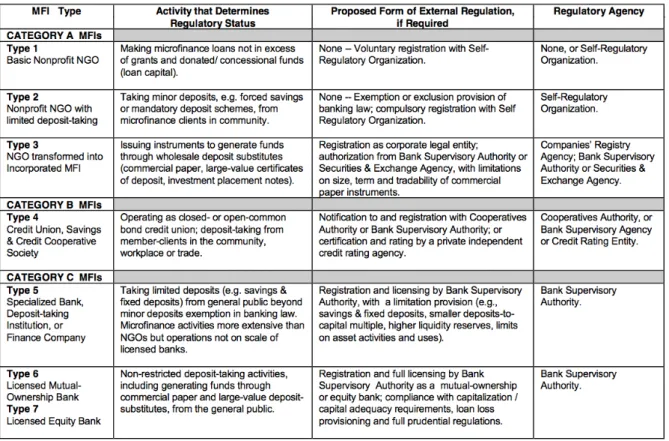
Table 6: Regulatory Thresholds of Activities by Type of Microfinance Institution...36
Table 7: Deposit-Taking Members of the Microfinance Network, dec. 2004...39
Table 8: Funding Structures of Regulated Deposit-Taking Institutions (in percent), 12/2004 ...40
Table 9: Transformation Results: Outreach...41
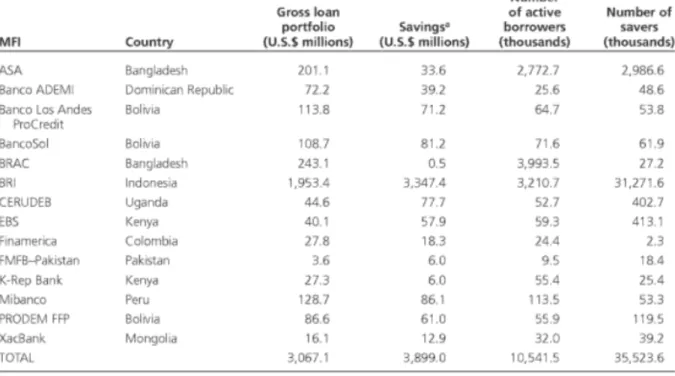
Table 10: Institutions Involved in the Survey...43
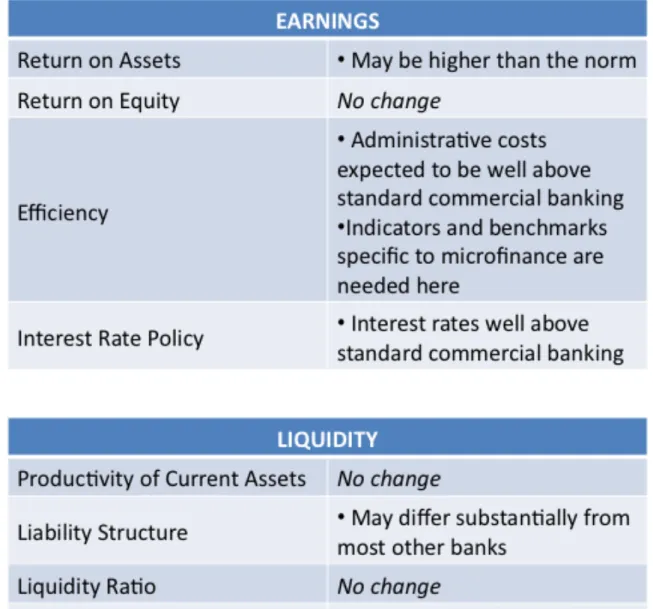
Table 11: ACCION CAMEL Key Indicator...48
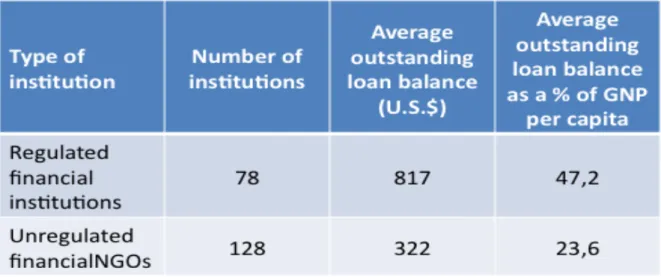
Table 12: Average outstanding loan balances for regulated and unregulated MFIS in Latin America, 1999...50
List of Figures
Figure 1: Minimalist and Integrated Approaches to Microfinance...16
1
Introduction
“There will be no poor people, no beggars, no homeless people.”5 That is Muhammad Yunus’ wish list for 2050. Having this target in mind, Muhammad Yunus began 30 years ago to develop one of the most important innovations in the world of finances: the concept of microcredits.
Dr. Yunus began 1976 by distributing around U.S.$27 worth of loans from his pocket among 40 extremely poor Bangladeshis and serves nowadays more than six million poor families with loans, savings, insurance and other services. The aim is to understand what the concept consists of, how it must be used, what added value it brings and above all if it can be considered an efficient way to overcome poverty and to provide better options to start new businesses to people that are normally excluded from conventional financial services such as credits.6 Because of its importance in the fight against poverty, the United Nations dedicated an entire year, the International Year of Microcredit 2005, to this concept. Dr. Yunus was even awarded with the Nobel Peace Prize in 2006.
The microfinance industry is characterized by organizations without a view to profit. Latter are mostly donation-funded non-governmental organizations (NGOs). They often face resource limitations when it comes to satisfy the enormous, increasing demand, which hamper growth and further development. To overcome these obstacles, a new trend could be observed in the recent years: microfinance institutions (MFIs) decided to transform their NGOs into regulated microfinance institutions (RFIs). This form of MFI implicates an orientation towards financial targets.
This paper is devoted to the question, if a transformation to a profit-oriented organization systematically brings a shifting of priorities along, from its initial social mission to the satisfaction of the investors. This would be called a mission drift.
5 See Yunus (2008) 6 See Orsi (2009)
In this paper, I will start by explaining the concept of microfinance, describing the target clients and will elaborate on the different services included in the term. After giving this introduction, I will define the great macroeconomic impacts coming along with the success or failure of microfinance.
In Chapter 2 follows a focus on the financial institutions providing microfinance, the microfinance institutions, and how they are established.
The next two Chapters elaborate on the process of the transformation from an NGO to a regulated microfinance institution, followed by the chapter where chances and challenges involved before, during and after the decision and procedure of transformation are elucidated. Chapter 8 examines if MFIs could achieve what they were targeting with the regulation, based on the data collected in the last years from institutions that went through this process. The key question is answered by evaluating the most known case of transformation, the NGO PRODEM becoming the Banco Solidario, short BancoSol, in 1992.
2
Introduction in Microfinance
2.1
Microfinance
“Poverty is not created by the poor. It is created by the structure of society and the policies pursued by society. Change the structure as we are doing in Bangladesh, and you will see that the poor change their own lives. Grameen’s experience demonstrates that, given the support of financial capital, however small, the poor are fully capable of improving their lives.” Muhammad Yunus, Grameen Bank, Founder.7
Microfinance is a short term of micro financial service and describes small-scale financial services such as savings, loans, remittances, insurance or pensions.8
The targeted clientele is characterised by the heterogeneity of their financial needs. To fulfil them, the microfinance institution has to customize services as much as possible and respond quickly to changes with a minimum of bureaucratic procedures.
The remarkable achievement of microfinance is that they found systems and methods to lend to these households and enterprises without formal employment. According to Rhyne, those techniques are developed around the following key principles, also known as core best practices in microfinance:
• Motivating the clients to repay with the promise of continued access to credit, peer pressure,
loss or personal assets, and other collateral substitutes
• Following a conservative approach to loan approval and loan size determination based on
analysis of existing repayment capacity, or stepped lending
• Having strong management systems, including immediate, personal follow-up, staff
incentives, and management, and management information systems.9
7 See About Microfinance, 2009, http://www.kiva.org/about/microfinance
8 See Microfinance Information Exchange (2009)
2.2
Clients of Microfinance
People can be classified into two categories, bankable and unbanked. They are called unbanked when they have no chance with their actual economical and social situation to access any financial services, such as savings, loans, remittances, insurance or pensions through any type of financial sector organization such as banks, non-bank financial institutions, financial cooperatives and credit unions, finance companies and NGOs. Banked people have access to financial services through their economical activeness, which can lead to income generation, repayment of loans, savings and the building of assets.10
“The great challenge before us is to address the constraints that exclude people from full participation in the financial sector… Together, we can and must build inclusive financial sectors that help people improve their lives.” Kofi Annan, UN secretary General.
The main characteristics of the targeted clientele are that they are very poor, often not even able to provide a loan security and mostly living in remote areas. The conventional banks therefore consider this segment as unbankable due to the lack of collateral, tangible security. Neither can they borrow against their future income due to the tendency no to have steady jobs or income streams that can be tracked. Microfinance clients often speak a local dialect, which complicates the communication and leads to asymmetric information between clients and institutions. They are also often living far away or in the urban slums so that it would take too long to visit their businesses. The result is that the payout for the financial institution would be inefficient due to the small amounts and the relative high transaction costs.
Microfinance makes unbanked people bankable. Its systems, tools and services to enable it are discussed subsequently.
Women make up a majority of microfinance clients, in some instances even 100%. Considering the total of the microfinance clientele, 33% are men. The clients operate small businesses, such as fishing, small shops or transportation, often owned by them, enabled by microcredits.11
10 See International Year of Microcredit 2005 (2009), 11 See Consultative Group to Assist the Poor, (2009)
2.3
Microcredit
A microcredit is a small amount of money loaned by a bank or other institution, generally for a productive purpose. Further characteristics are the short-term lending periods and the in-depth client relation.
2.3.1 Strategy of Granting Microcredits
The question we have to ask us is, why the repayment rate of microcredits is higher than the one of the conventional credits. Microfinance clients are excellent credit risks. Even without security deposit, the repayment rate is between 95 and 98 percent, higher than the one of student loans or credit card debts in the United States.12
Because of the lack of security provided by the clients, microfinance lenders had to develop other incentives for the amortisation of debts. Two methods are applied predominantly: group and individual microcredit. The difference is that the credit is lent to a single person or to a group of mostly five people as a unit.
2.3.2 Individual Credit
The characteristics of individual lending include the guarantee of loans by some form of collateral or a co-signer, a person who agrees to be legally responsible for the repayment of the loan.13 Lenders of individual credits need to be innovative to find incentives that could guarantee repayments. The standardized contracts of credits differ in every institution, but following are some effective incentives:
• Contracts terms and conditions can be gradually improved with each new loan as
borrowers show their willingness to repay and their capacity
• The promise of future access to other services, encouraging the development of a long
term relationship between the lender and borrower
• The use of direct or delegated strict monitoring of repayment behaviour
12 See Grameen Foundation (2009)
• Seizing of assets if existent14
2.3.3 Group Credit
The group credit is characterised by joint liability, meaning that each member is liable for the repayment of the loan and has to repay the total of the outstanding amount in case another member does not repay. Thus, borrowers have a limited liability constraint, meaning that the total dues to the bank cannot exceed the total revenues gained from the project they invested in with the microloan. In case the project fails, group members don’t owe the institution anything.15
Showcases for this group-lending model would be the Grameen Bank in Bangladesh and ACCION International’s solidarity group lending. They form relatively small group of 5 to 10 people and give individual credits to the members. The Foundation for International Community Assistance (FINCA) use the village banking model, where they form larger groups between 30 and 100 people. The microcredit is given to the group itself, rather than to individuals. A clear advantage of this model is that certain institutional transaction costs can be reduced by shifting the screening and monitoring to the group. Self-selection of new group members is very important as people of the same community have normally good knowledge about how reliable other members are. Groups are very careful about whom they let in, given the joint liability. Thus, the MFI is able to reach a larger number of clients, as transaction costs and effort are proportionally smaller considering the number of individuals.16
In the case of group lending, the created social pressure within the group substitutes the collateral and the joint liability is an incentive for the repayment of the partial loan.
Two problems can occur within a group, the mismatching and domino effect. The matching problem happens when a members who originally agreed to the same terms and conditions, evolve financially and have different financial needs as time passes during a loan cycle. Different economical targets require diverse preferences concerning conditions of repayment or credit volume. Members needing only a smaller amount of loan could refuse to accept the joint liability for higher amounts.17
14See Rodríguez‐ Meza, (2000), S.11
15 See Andersen and Nina, 1998
16 See Ledgerwood, (2002), pp. 69‐70
A second negative facet within the group could be the domino effect caused by members deciding not to repay they part of the loan if others default, even if sufficient income exists. Thus blocking the ability to endanger the entire group’s future access to credits. The loan default rate rises because “good” borrowers make the decision not to repay because of the financial failure of others.18
Examples of Categories of Microloans:
• Philippines: maximum amount of microcredits is approximately U.S.$2,700
• Colombia: microcredits are given to microenterprises with fewer than ten employees and
total assets below 501 times monthly minimum wages (approximately U.S.$115.60 in 2003). The amount of the credit to such microenterprise shall not exceed 25 times monthly minimum wages (U.S.$2,890 in 2003)
• Peru: microcredits are loans given to microenterprises with a volume of assets (excluding
fixed assets) below U.S.$20,000 and accumulated debts below U.S.$20,000.19
2.4
Microsaving
Micro saving is the division of microfinance that enables people and families with very low-income levels to save money in accounts for eventual unforeseen expenses, future investments and education. It has always been a controversial issue, but statistics have proven by now that low-income clients can and do save. Statistical analysis of surveyed institutions state though that the mobilization of deposits depends very much on the macroeconomic and legal environment and has as an example the following connections:
• A positive correlation with the average growth in per capita GNP of the country • A negative correlation with high levels of inflation
• A positive correlation with high levels of population density
This service does not require a minimum balance and is therefore designed for small amounts of money. Account users are not charged for this service. The provision of this service offers a stable source of funds for the MFI. It can be voluntary or compulsory to clients.
18 See Paxton (1996), p.48
Compulsory savings are more part of a loan product rather than an actual financial product. Borrowers as a condition of receiving a loan must contribute them a percentage of the loan or a nominal amount. Compulsory savings can be a disincentive to clients, as a withdrawal is usually forbidden while a loan is outstanding. For the MFI this kind of saving acts as a form of collateral and enables them to help clients to build up their asset base in a debatable manner.
Voluntary savings are independent to any loan product and not mandatory to access credit services. Interest rates offered range between very low percentages and slightly higher than the rates given by conventional institutions.20 For a MFI to consider mobilizing voluntary savings successfully, several conditions have to be fulfilled.
First of all, the macroeconomic and financial sector environments need certain stability. It is difficult convincing the poor to save money during turbulent times in politics and high annual inflation rates. People tend to hedge with nonfinancial assets against instability. Secondly, on the next level, the MFI needs an adequate and effective capability for supervision to provide security of the deposits and to protect clients. Government-owned banks have a clear advantage over private-owned institutions, as it is more likely to be rescued in difficult times. This implicit guarantee provides clients’ confidence in the deposit facilities of these institutions. MFIs offering a saving service require an appropriate management of liquidity in case of unexpected rising of withdrawal.21
To make the act of saving as simple as possible, clients need to have bureaucratically easy access to their deposits and a geographically easy access to the MFI.
2.5
Remittance
Remittances in microfinance are small amounts of money, sent around the world with the help of technology. The clients drawing in this service are mostly immigrants sending earnings to families in their countries of origin. A second significant clientele are the domestic remittances, between urban and rural areas. A positive correlation has been observed with increased savings rates. Remittances help to channel the funds towards productive uses like education and health of children and therefore leverage their economic impact. They play a very important economic role in countries like India and China. 22 The
20 See Ledgerwood (2002)
21 See CGAP (1998)
most outstanding example is probably ACLEDA (Association of Cambodian Local Economic Development Agencies), which transferred about $7 million in 2001, $28 million in 2002 and increased to $68 million in 2003.23
2.6
Microinsurance
The concept of the microinsurance is the same as for conventional insurances, with the difference that it is again designed for the needs of very poor clients. It is a nascent industry. Microinsurance includes for example life, health, accidental death or disability, so that losses due to natural disasters, fire or death of a family member cannot endanger the economical existence at one stroke. To fulfil the needs of the poor, the terms and conditions are kept simple and clear, the premium payments are kept to a minimum, and exclusions and requirements such as medical examinations are avoided to the maximum extend possible. 24 Clients of the Grameen Bank, for example, need to contribute 1% of the credit to an insurance fund. In case of death of the client, this fund is firstly used to cover the outstanding loan of the deceased client and secondly to provide his family with the means to cover burial costs.25
3
Impact of Microfinance
3.1
Fighting Against Poverty
“Eradicate extreme poverty and hunger” is the first out of eight goals of the Millennium Development Goals (MDGs), drawn from the actions and targets contained in the Millennium Declaration that was adopted by 189 nations and signed by 147 heads of state and governments during the UN Millennium Summit in 2000. The MDGs are to be achieved by 2015 and respond to the main development challenges in the world.26
23 See Fernando (2004), S.7 24 See Microinsurance Products, (2007) 25 See Ledgerwood (2002) 26 See United Nations Development Program (2009)
The World Bank defines poverty as a lack of resources or ability needed to cover the basic needs on an individual or household level.27 According to Latifee, more than 1.2 billion people are living at the margins of human being, under one dollar a day.28 Microfinance, especially microcredit, is a very powerful tool to fight this problem.
Johnson and Rogaly consider powerlessness as a further dimension of poverty. It is not only the low levels of annual income per person, but also the economic inequalities. This can occur on different levels: between and within households, as a result of differences in age and gender or between communities or social groups, as a result of caste, ethnicity and wealth. Defining poverty in terms of social power, gives the MFI the challenge to not only offer financial services to the poor in general, but especially to the poor, who are normally excluded from such, due to social inequalities.29
3.2
Empowerment of Women
The World Bank defines empowerment as “process of increasing the capacity of individuals or groups to make choices and to transform those choices into desired actions and outcomes.”30
Since the Fourth World Conference on Women in Beijing in 1995, where women’s access to credit has been put on the international agenda, the number of women having access to microfinance has increased steadily. According to the United Nations, the number of women receiving microcredits had more than doubled to 10.3 million poor, and increased rapidly to 69 million by 2005. This last number would represent 84% of the total number of poor having access to microfinance.31
According to Bayes, microfinance, especially loans, can help women in three different ways. Firstly, a microcredit enables women to manage an independent source of income outside home, which reduces economic dependency on husbands and help foster their autonomy. Secondly, with their own source of income, comes the exposure to new sets of ideas, values and social support, which makes them more assertive of their social, political and legal rights.
27 See The World Bank (2009) 28 See Latifee (2003) 29 See Johnson et al.(1997) 30 See The World Bank, (2009) 31 See General Assembly of the United Nations (2007)
And finally, by having the control over material resources, women’s prestige and status in the eyes of husbands and society should raise and gain on importance.32
Grameen Bank has a special focus on enabling access to microcredits to women. Muhammad Yunus, founder of Grameen Bank, said at a US Congressional Forum “women have plans for themselves, for their children, about their home, the meals. They have a vision. A Man wants to enjoy himself” to justify the fact that 94% of his loans go to women. Statistics show that women proved not only to be reliable borrowers but also astute entrepreneurs.
3.3
Wages
In Theory, microfinance can pull a significant number of people out of the rural labour market by creating self-employment. Families borrowing microcredit could theoretically get a double improvement with the women’s profit from the entrepreneurship and the wages of the men increase at the same time. There are only a few empirical evidences for this effect though. Khandker, economist in the World Bank Institute for Poverty Reduction, could only prove that the Grameen Bank raised rural wages. This effect is feasible and testable, but more effort has to be made to control differences in characteristics between villages.33
3.4
Nutrition
Loans given to women had a significant impact on the health situation of their children, as the study “Credit Programs for the Poor and the Health Status of Children in Rural Bangladesh” by Pitt, Khandker, Chowdhury and Millimet. According to the study, women’s borrowing had very positive effect on children’s height and arm circumference, while the effect of credits to men on children’s heath were insignificant or even negative.34
32 See Bayes (2009)
33 See Goldberg (2005), p.39 34 See Goldberg (2005), p.40
3.5
Education
Nowadays, it is well known that children’s education, especially for girls, is one of the crucial ingredients for a country’s economic growth and its social development. The UN Millennium Development Goals (MDGs) stipulate that all children, independent of their gender, should be able to complete a full course of primary schooling by the year 2015. Microfinance plays an important role in achieving this goal. Households with access to microfinance came off much better concerning children’s education than other compared groups. Khandker came to the result that an increase about 1% of the women’s credit at the Grameen Bank, raises the probability about 1.9% that girls are sent to school and even about 2.4% for boys. Is the credit given to men, the probability that boys are sent to school raises about 2.8%, while there is no effect on girl’s education.35
4
Microfinance Institutions
4.1
Definition of Microfinance Institutions
A microfinance institution (MFI) is an organization providing financial services, especially tailored to fulfil the needs of the poor. Clients are in general too poor to be able to access services from conventional institutions.36 Thus, MFIs also have in addition to the financial objective a developmental or social objective (the macroeconomic impact has already been discussed above). If you would ask managers of MFIs which of the two is the key objective, they would say the social one.
Among the first organizations lending money to poor without getting guarantees in return was Opportunity International, an NGO with Christian origin, which began to lend in 1973 in Columbia. The non-profit organization ACCION International in Brazil followed in the year 1973 and began to deal with microcredits. The Grameen Bank began in 1976 and soon became famous for the credit-lending model, primarily targeted at poor women in small groups.
35 See Khandker (2003), p.49
Since everybody assumed that poor people couldn’t save money, organizations initially focused on providing loans. Only after the transformation of the Bank Rakyat Indonesia (BRI) from a state-controlled bank in a bank for poor, a bank offered for the first time, additionally to the credits, state-guaranteed saving accounts without minimum deposit.37 Details about the exact number of currently established MFIs vary strongly. Forbes is saying there are upward of 12.000 issuing loans worldwide38, while the MIXMarket (Microfinance Information Platform) has only 1.400 institutions listed.39
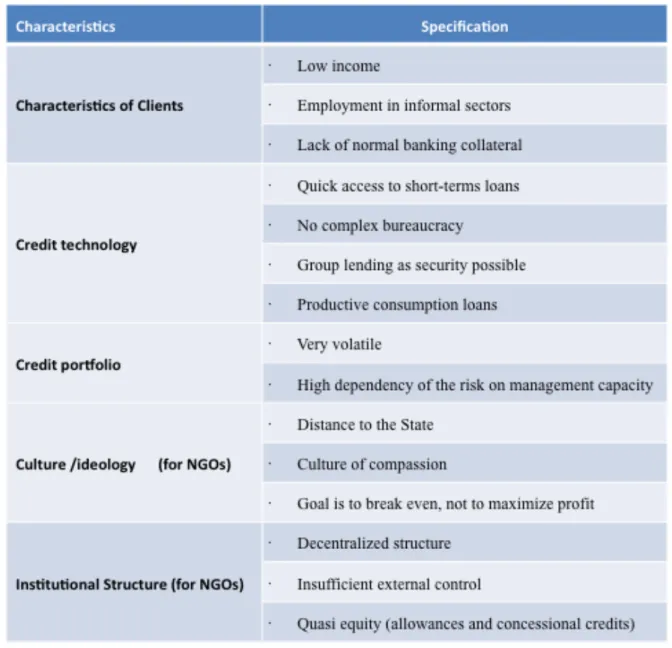
Because of the large range of different types of institutions, it is difficult to make a general statement about the special characteristics of MFIs. Based on the following five indicators of Staschen, it can be demonstrated that they still differ from traditional financial institutions: characteristics of their clients, credit technology, characteristics of the loans, culture and ideology, and institutional structure.40
37 See The Economist (2005), p.2 38 See Swibel (2007)
39 See The MIXMarket (2009)
Table 1: Special Characteristics of Microfinance Institutions, Staschen (1999) Source: Staschen (1999)
According to Greuning et al., there are three rough categories of MFIs that can be categorized by the structure of the liability side of their balance.
Category A includes those using “other people’s money” for funding their credit business. These are mostly allowances and concessional loans from donors. These MFIs are also called credit-only institutions. Category A include three types of non-profit NGOs:
• Using grants and donations to provide microcredits
• Augmenting grants and donations with members’ savings and limited borrowings from
• Changing their organizational format into incorporate entities and exercising some
leverage by mobilizing some “wholesale” funds through wholesale deposits, commercial paper or bank credit lines.41
In category B, the member’s money is exclusively used to lend money to members. This category consists of membership-based credit unions and savings and credit cooperative associations. Examples for this kind of MFI are RoSCAs and Credit Unions.42
Category C consists of all MFIs using the public’s money to fund their credit business, fully developed financial intermediaries.43 This category also consists of three different types:
• Corporate entities authorized to operate as specialized banks or finance companies • Licensed banks with mutual ownership of capital by members
• Licensed regular banks with equity capital owned by individual investors.44
Another type of MFI is a formal bank with a microfinance section. Concerning the microfinance portfolio, the banking legislation for regulations is automatically applied, which does not meet the requirements of microfinance. This is still an unsolved problem.45
4.2
Minimalist and Integrated Approaches to Microfinance
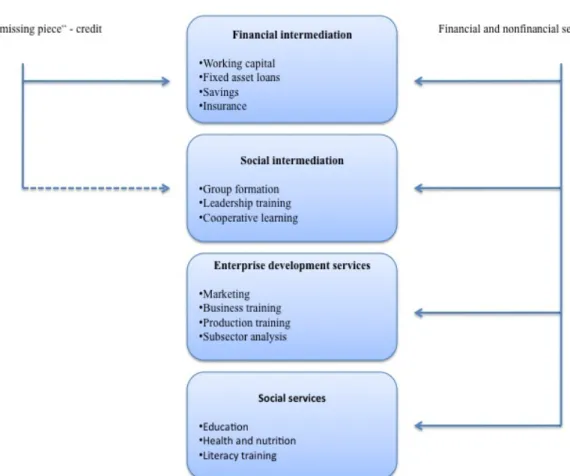
Joanna Ledgerwood describes two types of Microfinance Institutions, the minimalist and integrated, both illustrated in the following figure.
41 See Van Greuning (1998), p.4 42 See Van Greuning (1998), p.6 43 See Van Greuning (1998), p.6 44 See Van Greuning (1998), p.6 45 See Staschen (1999)
Figure 1: Minimalist and Integrated Approaches to Microfinance Source: Ledgerwood (1999)
MFIs using the minimalist approach just offer financial intermediations, occasionally limited social intermediation services too. These institutions base their offers on the assumption that there is only a single “missing piece”. This piece is considered to be the lack of accessible and affordable short-term loans.
MFIs using the integrated approach go further than just the financial need of the client and offer social intermediation, enterprise development and social services, even though providing financial services stays the primary role of MFIs. In this paper, only financial services will be discussed. 46
4.3
Establishing MFIs
Due to the history the development of microfinance, non-profit organizations (NPO) are the most common form of MFIs. Many MFIs have their origin in aid programs, generally initiated and supported by non-governmental organizations (NGO).
In the debate over the statute of the MFIs, GTZ distinguishes between four different strategies of formation47:
• Downscaling: a formal financial institution offers products and services to poorer
population by changing processes in its organization, e.g. by creating or transforming special departments for microfinance.
• Upgrading: NGOs can gain important market share through institutional growth and by
upgrading them to commercial microfinance service providers.
• Linkage: this strategy is linking formal banks with self-help groups. Is has contributed to a
significant deepening of the financial sector and enhanced territorial coverage.
• Greenfield banking: establishing microfinance institutions from scratch.
The strategies of upgrading, downscaling and linkage make it difficult to separate the formal financial sector from the unregulated microfinance sector.48
All MFIs created by upgrading method are subject to the state regulation and therefore need a concession from the competent supervisory authority to transact business.49 They can operate as good as formal financial institutions and even outperform them in both the range and quality of their products and services and geographical coverage. As an obstacle to the growth and to assure the survival of these institutions, their charitable nature has been proved. They have a lack of real owners, making sure inserted capital is used efficiently, that means cost recovery and making profit, to secure sustainability.
47 See Schliwa (2004) 48 See Staschen (1999)
Downscaling enhances the geographical coverage of microfinance business. The challenge of this strategy is to convince Stakeholder of formal banks of the microfinance sector. 50 These projects shown to be successful in transition countries of Eastern Europe and Central Asia, like the Ukraine and Kazakhstan, where financial markets are developing rapidly and many new small businesses are looking for funding.51
Financial intermediaries established by the Greenfield banking method usually have the legal form of a corporation and own a banking license from the beginning.52
In 2007, Forbes created a list of the World’s top 50 microfinance institutions, chosen from a field of 641 microcredit providers. Every institution must have made available their audited financials and must have passed review by a Forbes panel of advisor. The detailed list is located in the appendix. This list gives the rank based on:
• Size of their gross loan portfolio
• Efficiency, which considers operating expense and the cost per borrower as a percent of
the gross national income per capita of their country of operation
• Risk, which looks at the quality of their loan portfolios, measured as the percent of the
portfolio at risk greater than 30 days
• Return, which is measured as a combination of return on equity and return on assets.
Each category is equally weighted for an institution's overall ranking.53
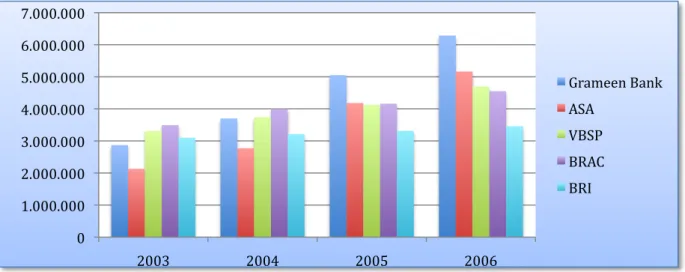
The comparison of the following two rankings is of interest. Based on the highest numbers of clients being compared with their gross loan portfolio, it shows that the placement varies completely. This change is due to the different average loan balance per borrower, shown is the table 4 below.
The MFI with the highest number of active clients was the Grameen Bank with 6.707.000 borrowers, while the MFI with the highest gross loan portfolio was the BRI, with 3.035.685.400 US$ in 2006. Meanwhile, the average loan balance per borrower was 555 US$ at BRI and only 77 US$ at the Grameen Bank in the year 2006.
50 See Schliwa (2004), p.5 51 See Terberger (2002) 52 See Terberger, (2002) 53 See Swibel, (2007)
Table 2: MFIs with the Highest Number of Clients Source: on the basis of The MIXMarket (2009)
Table 3: Loan Portfolio of MFIs Source: on the basis of The MIXMarket (2009)
Table 4: Average Loan Balance per Borrower Source: on the basis of The MIXMarket (2009) 0 1.000.000 2.000.000 3.000.000 4.000.000 5.000.000 6.000.000 7.000.000 2003 2004 2005 2006 Grameen Bank ASA VBSP BRAC BRI 0 500.000.000 1.000.000.000 1.500.000.000 2.000.000.000 2.500.000.000 3.000.000.000 3.500.000.000 2003 2004 2005 2006 Grameen Bank ASA VBSP BRAC BRI 0 100 200 300 400 500 600 700 800 900 1000 2003 2004 2005 2006 Grameen Bank ASA VBSP BRAC BRI
Despite high interest rates most MFIs cannot manage their internal financing. A few institutions actually achieve profit. The majority could not survive without ongoing donations or are dependent on subsidies in the form of more favourable refinancing through donated equity or low interest rates. Instead of striving for profits, MFIs often go for sustainability. In this context, sustainability is an important concept and can be defined as follows: developments that meet present needs without compromising the ability of future generations to meet their needs.54 This means for financial institutions that they survive by generating income and not using their substance.
However, capital is mostly provided by donations. The Consultative Group to Assist Poor (CGAP), a Wold Bank related consortium of multilateral, bilateral and private donors has indicated that they pour between half and one billion US$ a year in MFIs, in the form of grants and soft loans.55 Significant amounts also come from private donors, which provide the institutions large numbers of capital at low costs. But given the growing importance of the sector and the exploding demand for microfinance, the requirements of capital often exceed the resources of capital provided by donors.
Thus, more and more microfinance institutions come to the conclusion that profit-orientation is the best way to reach the mass-market of poor people. An economical self-supporting organization that is able to generate profit has access to sufficient capital at reasonable costs to be able to transform microfinance from an interesting niche product into a financial service with the desired scope and importance.
4.4
Résumé
In the previous chapter we had an introduction to the topic microfinance and its institutions. We saw that microcredits are not the only important financial service offered by the microfinance institutions, but also insurances, remittances and the savings. They don’t just differ strongly from services offered by formal institutions to bankable people but also among each other, in terms of the providing organization, conditions or the use of the services. The common characteristic of the microfinance services is that they are tailored to
54 See WECD (1987)
fulfil the needs of the very poor people, precisely negotiating with very small, undefined amounts of money.
We also discussed what macroeconomic impact microfinance has on the clients in the developing world. Their general goal is to fight against poverty. Alongside, but whose importance is not to be undervalued, microfinance is empowering women, enhancing education and simplifying the access to nutrition and health. The most well-known microcredit model is the Grameen Bank in Bangladesh, founded by Muhammad Yunus, having a special focus on women, providing them access to financial services.
5
Transformation
5.1
Transformation
Most informal and semiformal organizations offering financial services are not subject of the governmental regulations that are applied to other financial institutions such as banks. Some non-banks such as NGOs operate on the fringe of existing regulations, especially with regard to deposit mobilization, which is in sometimes tolerated by the government due to political reasons or simply because they do not have enough capacity or time to deal with it. Another method to dodge governmental restriction concerning deposit mobilization is simply to call it something else.56
While in the past most MFIs worked as NGOs or government-sponsored programs, a trend towards the transformation into regulated financial institutions (RFI) can be observed. NGOs are normally private, non-profit organizations, pursuing objectives such as poverty reduction, development or protection of the oppressed. They are characterized by their financial, organizational and legal independence of Governments and authorities. RFI are, on the other side, state-licensed financial intermediaries, which are subject to the supervision of the Central Bank of the supreme regulator of the country. An individual or group of NGOs, transferring their loan portfolio entirely or partially to the RFI, defines the transformation.57
56 See Ledgerwood (1999), p. 20
More precisely, transformation in the microfinance industry generally refers to “the institutional process whereby an NGO microfinance provider or a microfinance project creates or converts into a share-capital company and becomes licensed as a regulated financial institution”58. This may involves becoming a license for taking deposits or just to be a credit institution.
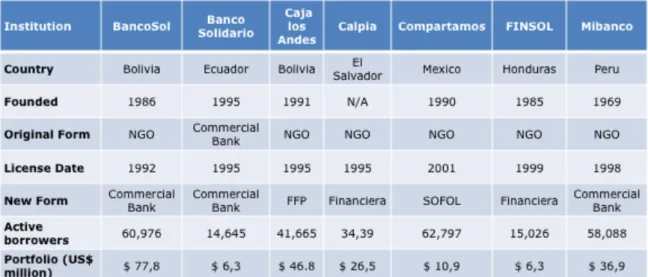
According to Fernando, this idea started with the transformation of the Bolivian PRODEM (Fundación para la Promoción y el Desarrollo de la Microempresa) into BancoSol in 1992 and he further refers to at least 39 other microfinance NGOs converted to RFIs in the years 1992 to 2003, most of them located in Latin America and Asia. The transformation to BancoSol was decided based on the assumption that PRODEMs NGO status could inhibit the continued sustainable growth due to the restricted access to funds on the financial market.59
5.2
Is There a Need to Regulate MFIs?
When looking at banking laws, banking business usually “consists of receiving funds from the public by accepting deposits or borrowing from the general public and using such funds for loans and investments at the risk of the institution conducting the business.”60 In most countries, taking deposits from the public is only allowed to formally specially licensed financial institutions. The expression “public” is used in banking law when speaking of persons beyond a specific number who are not related to each other by law or association. Furthermore, the name “bank” is reserved to entities that are legally organized or licensed as such and lending to public is subject to prior registration with a supervisory authority. As mandatory saving schemes for clients are tied to borrowers credit contracts, non-bank MFIs do not provide bank-type savings services. They are therefore not allowed to leverage its capital by accepting retail deposits from the public.61
58 See Fernando (2004), p.1 59 See Fernando (2004), p.1 60 See Van Greuning (1998), p.10 61 See Van Greuning (1998), p.10
6
Regulation
This chapter looks at internal and external requirements of transformation. Another focus is the analysis of additional requirements and contents as a result of transformation. The most difficult challenge is the economic aspects as former NGOs struggle with the realisation. RFIs come across these struggles because of the regulation and supervision of controlling institutions, requirements of investors, and the implementation of internal management, controlling and supervisory systems and the installation of a risk management.
The success of MFI transformations is dependent on an appropriate and enabling regulatory and supervisory environment. The Consultative Group to Assist the Poor (CGAP) defines regulation as the “binding rules governing the conduct of legal entities and individuals, whether they are adopted by a legislative body (law) or an executive body (regulations)” and supervision as the “external oversight aimed at determining and enforcing compliance with regulation”62 (CGAP 2003, p.6)
Before the authorities in charge are able to regulate a MFI, the internal structure requires a certain level of self-regulation too. Another approach is therefore the internal regulation through governance.
6.1
Internal Regulation
Tasks of the governance are to ensure that no party within an MFI hinders the attainment of corporate objectives by diverting its resources or makes decisions for private gain. It is a system holding together shareholders, members or donors and the board of directors or trustees, executive management, the staff, the clients and the general public. To avoid conflicts of interests, the loyalties of management and the board should not only consist of shareholders or donors, but also of depositors or other sources of funds that provide the leverage to institutional capital.
When a MIF decides to regulate and therefore to grow, they must adapt their management and internal control systems to the different risk profiles and management’s changing needs for information to supervise these risks.
6.2
External Regulation
The regulating authorities such as bank supervisors, deposit insurance companies and securities regulators become involved in the external risk management process for regulated MFIs because of the compelling interest of the government in the soundness and stability of the banking and financial system for the sake of the rest of the economy. Though, external supervisor cannot prevent institutions from failing. Furthermore, as facilitators of the risk management process supervisors and regulators must evaluate and enhance the statutory framework under which risk management is carried out by regulated and supervised MFIs. One of the tools to regulate MFIs is the threat and use of penalties. Guidelines, requirements and regulations are easier to implement with a rather painful consequence for nonconformity or non-compliance. Logically, it is impossible for the regulating governance to stay up-to-date about the existence of an entity, especially if reports are not being submitted.
The two main principles of disobedience are fining consequences appropriate to the degree of non-compliance, and the standardization of basic penalties and sanctions for institutions. Degrees of penalties for financial institutions imposed by the supervising bank could be changed and adjusted to the seriousness and recurrence of the interference of the regulating authority. Cooperative societies have to follow strict guidelines and rules implemented by a board or commissioner.
Incorporated NGO MFIs should have the same regulations to follow, than registered organizations, and should transmit financial statements and reports of operation to a registration agency, preferably audited externally to ensure a equal standard of supervision. Unfortunately, regulating agencies have scare resources of staff and time to execute, control and process these submissions, already with registered institutions, that it is a bigger challenge to the same with incorporated NGO MFIs. Even the smallest requirements, standard or individual, have to be controlled and in the event of non-conformity, be penalized.
Difficulties in operating at acceptable standards carries the risk of not being able to comply with them and some institutions make the choice of terminating its operations instead of adjusting the guidelines to the standards required. Reworking, cancelling or suspending a MFI’s basis needs the consideration of the format and nature of the guidelines. A granted license for microfinance activities is the core of such standards.
The appropriate procedure to execute a mandatory suspension of operations and the definition of operating standards and performance should be addressed prior to the existence or termination of an MFI.63
6.3
Requirements of a Regulation
6.3.1 External Requirements
The course and success of the transformation of a microfinance institution is strongly dependent of the external conditions in its environment. The levels with the highest influence on the process would be the political, economic, and legal and the position of the financial and banking sector discussed further on.
6.1.3.1 Information and Incentive Problems in Financial Markets
To begin with, the normative theory of regulation should be considered, based on the ideal of perfect and complete markets, to be able to highlight the specifics of the financial markets. Any regulation comes along with high costs. On the one hand, internal costs emerge while the microfinance institution is trying to meet the regulatory requirements. On the other hand, the costs on a macroeconomic level due to the restriction of competition and efficiency losses coming along with the regulation. In perfect and complete markets, regulatory interventions could not be justified. The question is what makes the financial markets not perfect, especially in developing countries. One main reason would be the asymmetric distribution of information between capital seeker and investors.
6.1.3.2 Political and Economic Environment
The macroeconomic and political environment can make the microfinance business very difficult if it is not stable and secure. If the risk of unexpected changes concerning the bank regulation is high, investors loose confidence in the system, which complicates the access to commercial capital. Macroeconomic factors such as unemployment rate, currency stability and inflation affect regulated MFIs much more than NGO, as investors expect certain justification concerning the bottom line.64
63 See Van Greuning (1998), p. 17‐18
6.1.3.3 Legal Environment
If a MFI decides to become a regulated institution, the legal environment needs to provide the existence of an adequate legal form. Furthermore, to win investors confidence, norms must assure the legal enforceability of contracts. The greatest challenges would be though, to find the balance between minimum interference guaranteeing efficiency and competitiveness of the institution and needed supervision to control risks and corruption.65
6.1.3.4 Financial and Banking Sector
The financial and banking sector should consider the following aspects if they want to provide an attractive and interesting market to microfinance institutions.
• Role of governmental banks: governmental banks can play important roles in case of
market failure when they for example provide financial services to the poor population.66 However, providing subsidized loans can lead to market distortion and can therefore hinder the entry of commercial financial institutions usually unwilling to compete with them.67
• Limits of interest rates:Upper limits concerning interest rates are often assigned to protect
poor people from to high rates.68 But especially in microfinance business they need to be higher than conventional credits, as they must be able to cover the above-average costs of transaction and administration. If this is not considered, MFI will have to pull themselves out of this market.
• Minimum reserve and capital requirements: The more minimum reserve institutions have
to deposit at the central bank, the less they have at disposal to accommodate loans. Minimum capital requirements can be expressed as a percentage or as an absolute value. Former, called capital adequacy ratios, indicate the required equity in relation to their risk weighted assets and should not be inferior to 8 percent according to Basel II. Latter could adversely affect and be an obstacle to smaller regulated institutions, as they have an inferior capacity than larger MFIs. 69
65 See Campion and White (1999), p.19 66 See Lapenu (2000), p.33 67 See Loubière et al. (2004), p.6 68 See Loubière et al. (2004), p.7 69 McGuire et al. (1998)
6.3.2 Internal Requirements
Alongside the significant external factors influencing the transformation to a regulated institution, internal requirements such as economical sustainability, operating efficiency and the ability to charge high interest rate to cover the costs need to be fulfilled as well.
6.2.3.5 Economical Sustainability
If a MFI is economical sustainable, Kabeer, means that it generates enough sources of capital to be able to cover all costs. This is independent of the level of interest rates, financial charges, administrative costs, loan defaults, the composition of the portfolio and the inflation.70
6.2.3.6 Operating Efficiency
The share of operating and administrative expenses in the total lending portfolio is significant for self-preservation of the MFI. This share reflects the operating efficiency of this institution and is influenced by the following three factors:
• Average salary of employees • Average loan per borrower and • Number of clients per employee
One factor can compensate or abolish another, as for instance by recompensing higher transaction costs with lower salaries.71
6.2.3.7 Use of Adequate Interest Rates
Interest rates are the main source of income for MFIs. They can be up to 36% per annum or above. Considering the high number of borrowers, each with a very low amount of credit, the level of the interest rate is justified.72
Depending on the extent to which the external and internal requirements have been fulfilled, the transformation from an NGO to a regulated microfinance institution can take place. As
70 See Kabeer (2006), p.1 71 See Christen (2000), p.42 72 See Latifee (2005), p.27
shown in this chapter, external factors are as important as internal, organisational factors during this process. This is on the other hand the qualification to attract commercial capital. The higher the degree of regulation of the MFI, the more opportunities it has to have access to capital on the market.
7
Chances and Challenges of the Transformation of MFIs
In order to analyse chances and challenges of the transformation of MFI, we first need to look at different aspect of transformation. This chapter focuses on target setting and background information why MFIs change. These targets lay out the developments of such a transformation.
Over the past years, the financial system approach became more popular within the microfinance sector. This approach describes the application of market guidelines in the sense of economic principles of providing financial services to the poor to formal financial institutions. On one side there is the focus of profitability for each level of the individual MFI. And on the other side there is the liberalisation or relaxation of restrictions in financial markets.
7.1
Chances and Targets of Transformation
From a microfinance institutions point of view, three main reasons why to transform can be defined:
• To offer more products and services to their clients • To gain access to capital (debt and equity)
7.1.1 Provision of Savings Services and Other Products
Some people share the opinion that enabling access to saving services to build assets is the better way to reduce poverty than giving them access to credits and consequently accumulate debt. Taking deposits also brings chances such as having the capacity to increase the number of clients, improving customer satisfaction and retention, improving loan repayment, stabilizing sources of funds and, last but not least, improving governance of the institution. Though in most of the country, taking deposits is only permitted to regulated institutions. In fact, other appreciated services such as specialized housing loans, money transfer or microinsurance may also be prohibited to provide before becoming a licensed MFI.73
To fund loans by mobilizing savings from the public is not easy. The question is if it is worth all the trouble. Ledgerwood state that commercial microfinance does make a big difference and that it virtually benefits everyone involved:
• MFIs clients benefit in different ways, as they are helped expending their enterprise,
reducing their risks, to store their excess liquidity safely and obtain returns on their savings. Their options and self-confidence can be increased.
• MFIs providing commercial microfinance services are able to increase efficiency and
profitability and become viable for the long term.
• Governments no longer do not need to offer subsidized loans or to cover the losses of
subsidized credit programs.
• Economies benefit from the augmented production, the positive macroeconomic impact of
microfinance and the new resources made available for investments.
• Societies benefit from the establishment of an inclusive financial sector, which creates an
enabling environment for the growth of social and political participation.74
7.1.2 Access to Capital
MFI being NGOs are strongly dependent on donors funding. Given the actual tendency of unwillingness of donors to permanently fund the growing needs of capital loans and the institution’s limitation in debt they can access, MFIs face continual challenges concerning the desired long-term sustainability. The ability of funding is elementary for a MFI to grow as
73 See Ledgerwood(2006), p. xxx
they meet continual demands for credits by new and existing clients and can therefore be the number one constraint to growth.
According to CGAP, the worldwide portfolio of microfinance institutions in 2006 was U.S.$15 billion. When considering the speculation that the business of microfinance is growing between 15 and 30 percent, translating into a demand of between U.S.$2.4 and U.S.$5 billion for portfolio capital and requiring between U.S.$300 and U.S.$400 million in additional equity each year and considering that non-commercial investors (including donors, bilateral and multilateral financial institutions) pay out approximately U.S.$400 million annually to the sector, it is obvious that they can not reach the level of capital required to fully meet the demand, since part of the capital is needed for regulatory changes, information services, sector associations and other sector development initiatives.
Taking deposits is not only an additional services for the clients, but also a possibility to fund larger volumes of credits and access a stable and potentially cheaper local source of funds. Thus accessing clients deposits also means accessing capital, alongside to commercial and concessional debt and equity sources.75
It reduces the risk of capital shortage, which is considered to be the main adversary of growth. In the start-up phase, money provided by donors is usually sufficient, while quick and comprehensive access to capital is required during the phase of constant and sustainable growth. Due to the special characteristics of MFIs, a temporary shortage of funding can lead to a ruin of the MFI. Even a rumour of a capital shortage can cause a lot of damage, as clients will stop paying the loan repayment rate to hedge against eventual future illiquidity. Regulated Microfinance Institutions have easier access to cash, through other financial institutions or through the discount window of the Central Bank and can therefore reduce the risk of an institutional crisis caused by a shortage of liquid funds.
The transformation of an NGO into a regulated deposit-taking MFI permit the institution to increase and diversify their capital funding source. Capital includes deposits, borrowing, subordinated debt, bonds, private equity and retained earnings. The creation of a shareholding company, which is usually implied while transformation, opens two more important sources of capital: private and public equity. The equity base is converted from one founded by donation to one composed of share capital, retained earnings, and sometimes
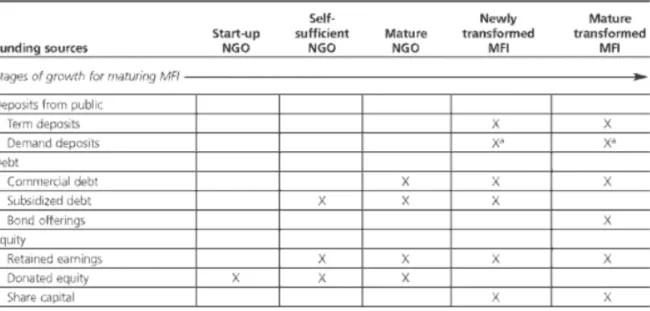
subordinated debt. The following table shows the evolution of funding sources while the MFI is maturing beginning as a start-up NGO and ending as matured transformed MFI.
Table 5: Evolution of Funding Sources for Maturing MFIs76
According to the MicroBanking Bulletin the average leverage ratios among NGOs is 2,2:1 compared to 10:1 among banks. When leverage increases, it correlates positively with the portfolio size that can again permit an MFI to progress its return on equity, thus providing the capability to attract additional equity capital.77
7.1.3 Increased Outreach
Considering the initial and primary mission of MFIs to reduce poverty, as much poor people as possible need to be reached. By offering new products and services and having access to enough capital, institutions can growth as in the volume of credits lent and geographical extension. Market share and outreach can also increase due to the better competition compared to unregulated MFIs, as they are not forced to operate efficiently in order to satisfy stakeholder such as investors, shareholders and regulators.78
76 See Ledgerwood (2006), p.165
77 See Ledgerwood (2006), p.165
7.2
Challenges of Regulation
In the last two decades, microfinance has been improving constantly. To reach its goal of satisfying the massive worldwide demand and eliminate poverty, several challenges have to be overcome and will be discussed further on:
1. Inappropriate donor subsidies
2. Poor regulation and supervision of deposit-taking MFIs 3. Few MFIs that mobilize savings
4. Limited management capacity in MFIs 5. Institutional inefficiencies
6. Need for more dissemination and adoption of rural, agricultural microfinance methodologies79
7.2.1 Inappropriate Donor Subsidies
A great obstacle of regulation is the continued subsidization of the microfinance industry by donors. It is not clear anymore in what extend donors are discouraging natural market mechanisms. Microfinance are not motivated to pursue more commercial sources of capital such as mobilizing savings and commercial debt and equity funding and stay dependent on donors. The Grameen Bank for example reports U.S.$16.4 million in direct grants and U.S.$126.5 million of implicit subsidies in 1998. Campion declare that this focus on donor support has kept the Bank from implementing loan technologies that would lower operational costs and make savings rates more attractive to clients.
7.2.2 Poor Regulation and Supervision
To provide an effective regulation of microfinance institutions, it is not only dependent of the MFI itself, but also very much of the capacity of the regulatory authorities. Especially in poor countries, where microfinance is needed the most, authorities are not able to provide the capacity required to regulate and supe