HOUSING WEALTH AND AGGREGATE SAVING
Jonathan Skinner
Working Paper No. 2842
NATIONAL BUREAU OF ECONOMIC RESEARCH 1050 Massachusetts Avenue
Cambridge, MA 02138 February 1989
This paper was prepared for the NBER Conference on Housing and Capital Accumulation, Newport, RI, October 1988. I am grateful to conference participants, Maxim Engers, Don Fullerton, Patric Hendershott, Daniel McFadden, Robert Schwab, Kevin Terhaar, and the Public Economics seminars at Duke University, the University of Virginia, and the University of Michigan
for helpful comments and suggestions, and to Kevin Terhaar for excellent research assistance. This paper is part of NBER's research program in Taxation. Any opinions expressed are those of the author not those of the National Bureau of Economic Research.
HOUSING WEALTH AND AGGREGATE SAVING ABSTRACT
The recent appreciation in housing value can have large effects on aggregate saving. This paper uses a simulation model to show that aggregate saving will decline substantially if life cycle homeowners spend down their housing windfalls. Homeowners with a bequest motive, however, may save
na
to
assist their children in buying the now more expensive housing. To test whether families spend their housing capital gains, I use housing, income, and consumption data from the Panel Study of Income Dynamics. Whilea
cross-section time—series regression implies that housing wealth does affect saving, a fixed—effects model finds no effect.Jonathan Skinner Department of Economics University of Virginia Charlottesville, VA 22901
The price of
a
new single-family dwelling rose in real terms by 23 percent during the 19705.1 Much of this increase was concentrated in the western United States, where real house prices grew by 57 percent during a period of 8 years (Hendershott, 1987).The standard life-cycle model predicts that homeowners will increase their consumption by some fraction of their capital gains in housing. Case and Shiller (1987) suggest that the total value of
single-family housing in 1985 was about 5.5 trillion dollars, based on the mean price of $90,800 for an existing house. If homeowners
consumed, say, 5 percent of their additional wealth (i.e., the increase in their "permanent income'), then the 23 percent increase in housing value would have caused aggregate consumption to rise by 51 billion dollars.2 Holding income constant, this would have caused a 36 percent decline in personal saving. Hence the windfall in housing prices could have been a primary cause in the saving slowdown of the late 1970s and early l980s.
One objection to this explanation is that a shift in the relative price of housing may not affect aggregate consumption. Any relative price increase implies that some gain (those selling the good), while
others lose (those buying the good); usually, these effects wash out
across
the economy as a whole. That is, the positive wealth gain of homeowners could be exactly offset by the wealth loss of younger consumers saving for their dream home.the homeowner. If there is a permanent increase in demand for the
long-lived asset, the current owner can capture some of the future rent on the asset when it is sold to future generations. The question of whether the appreciation in housing prices should affect homeowners' consumption and saving therefore hinges on whether the expected life of their house and land exceeds their own planning horizon. In life cycle models, the answer is generally yes; current owners ultimately sell
their house to younger generations. As with government debt in a life cycle model, current homeowners enjoy wealth and additional consumption
at the expense of future generations (Feldstein, 1977; Chamley and Wright, 1987).
As with government debt, the expansionary effect of an increase in housing prices disappears in models with Barro-style utility functions;
current homeowners internalize those higher future house prices by
bequeathing more to future generations (Calvo, Kotlikoff, and Rodriguez, 1979). There is a strong similarity between the question of whether government bonds are net wealth and whether homeowners will spend their newly realized housing wealth.
This paper first describes the interaction between housing wealth and nonresidential wealth in an dynamic
overlapping
generations model of housing and consumption choice. The model numerically simulates the 60 year transition path of housing prices, saving, and consumption inresponse to an initial shift in housing demand. I allow for two
exogenous changes as causal factors in the housing price increase of the 1970s; the interaction of taxes and inflation leading to a low user cost
of housing (Hend.rshott, 1980; Poterba, 1984),
nd
the increased pressure of population on inelastically supplied housing (Henderson, 1985; Mankiw and Wail, 1989). When bequests are ruled Out, any housing price increase causes a substantial short-run decline in aggregate saving rates as homeowners spend down their windfall gains.When the bequest motive is sufficiently strong, housing
appreciation has little or no impact on aggregate saving. Homeowners bequeath the housing capital gain to help their children afford the more
expensive housing. That is, whether housing price increases affect consumption and saving depends on the strength of the bequest function.
The second part of this paper uses the Panel Study of Income Dynamics to test whether shifts in housing value have any affect on the consumption (and saving) of homeowners. The empirical evidence is mixed; in standard consumption functions, house prices are estimated to have a small but significant impact on consumption. When corrected for individual heterogeneity, however, the link between housing prices and consumption disappears. Whether this finding supports a Barro-style model of intergenerational transfers, or whether it is indicative of constraints against borrowing by the elderly, is not clear.
Section II develops a computable model of housing demand, life cycle consumption, and bequests. Housing prices and supply are determined endogenously in a perfect foresight model with 55
generations. Calculations of the transition path in savings, housing value, and other factors are presented for tax and demographic changes. Section III describes the data from the Panel Study of Income Dynamics,
and empirical estimates, while Section IV concludes.
II.
A
Model of Hpusin. Consumtion. and SavingThere is
a
growing literature describing the effects of government policies on saving and welfare in the presence of fixed assets.Feldstein (1977) used an overlapping generations model to show that a newly imposed tax on land will reduce its market price by the full
capitalized value of the land tax. This tax harms current owners of
land, but benefits future owners (who can buy the land for less).3 Related results have been found in a general equilibrium model of fiscal
policy (Chamley and Wright, 1987), in international trade (Eaton;
1987,1988), and in development (Drazen and Epstein, 1988). However,
Calvo, Kotlikoff, and Rodriguez (1979) have pointed out that the
assumption of life cycle consumers is essential for these models;
results often disappear in the presence of Barro-style bequest functions.
The model presented below solves for housing prices and saving in a dynamic
partial
equilibrium
framework.
Individuals live for
a
fixed
lifespan
of T years and retire after year R. They buy a house at age b,and live there until death; there are no borrowing (or downpayment) constraints. While the interest rate and wage rate are assumed fixed, the asset price of housing capital (and the spot price of housing services) are determined endogenously.
The timing of the model is as follows. Individuals begin the year with assets A. which earn the constant net after-tax rate of interest r.
At
the end of the period, earnings and interest income are received, rental housing services are purchased, and consumption choices are made. What remains is passed to the next period either as assets, or as bequests to the most recently born generation. Dropping the timesubscripts for the moment, the utility function is
U
— (1÷b)il[haaJ
+
(l+o)Tfloln(BfllQT+b)
(1)where 8
is
the rate of time preference,h
andC
are the flow of housing services and consumption at age i, anda
is the expenditure share on housing at any age. The bequest function depends on the level of the bequest, 8, as well as the price per unit of housing asset,faced
by descendants who are born at the beginning of year T÷l and who must buy their house at the end of year T+b. The bequest function encompasses a life cycle model —0),
a traditional bequest function—
0,
00),
and an approximation to a dynastic bequest model > 0) in which the current generation is concerned about the future price of housing.To approximate the fixed costs involved in switching houses, it is assumed that individuals buy their house at age b, and live there until
death
(h
—h.D,
i
>
b).
The downpayment
is a proportion of the market value of the house, Qbhb. Individuals rent property at an ageless than b, and adjust the size of their rental property costlessly from year to year.4 The budget constraint is written
+
+
QT+l(1)\
--
(l)Qb\r(l+r)1
-(l*)Qb(l+r)T
(2)where is the (spot) price of rental housing, m is the maintenance costs incured by the property owner (assumed proportional to the spot price),
I, Y,
and Gi are inheritances, earnings, and government rebates at age i, r is the net return paid on the mortgage as well as the interest rate used to discount all future income and expenditures,and C
is
the net tax (or subsidy) on housing services. I abstract from the issue of whether rental or owner-occupied housing has enjoyed 'more favorable tax treatment, and assume that they are perfect substitutes inproduction and that each enjoys the same (preferential) tax advantage 0
(Gordon, Hines, and Summers, 1987).
The left side of equation (2) measures full expenditures on housing and consumption, while the right side of (2) reflects lifetime income; the present value of inheritances, earnings, government rebates, the returns on housing (the net service flow plus the sale price) minus the costs of housing (the downpayment, mortgage payments, and the repayment of the principal). By the arbitrage condition, we know that in a model of perfect foresight,
-
(10m)(l÷r)t
(3)
[Cj
+
Ph](1+r)1
+B(l+r)T
—1
+(Yj+Gj)(1+r)1]
(2')It is straightforward to derive the first order conditions; (4)
h
—{i±.]
(C/P)
i<
b.
_!__(1÷5)2.b
(1÷5)1T hii.cCi
T .-
[T
+
lT+l
The derivations above have described consumption, housing, and bequests for the steady state. Once a change occurs in the economic system, generations along the transition path will differ from one another, depending on their age at the time of the change. The
generalized
solution to consumption in year t at time i is expressed as T+l-i—
D8(l-a)[Ait(l+r)
+ EG÷j+-
hbP+](l+r)]
-(l+r)
ll÷T+t-i
(5) whereD — (1+5)
-[(1÷5)iT
+
5(l+5)T/30I/(l(c)
and
— 1
for homeowners (in which case the consumption choice is constrained give the chosen quantity of housing) and — 0 for renters(i <
b).
It is straightforward to derive the equivalent expressions for housing and bequests as functions of consumption.T
rental housing, is expressed as
A
— Ajt(l+n)i, where n is the rate i—iof population growth. The non-residential capital stock is Vt —
A
-
Q(H
+
Se), and andSt are the aggregate quantity of owner-occupied and rental housing. The distribution mf ownership of rental property is assumed to
be in proportion to total assets (less owner-occupied housing) held by the population, so individuals at year t and age i own
[A
-Qth.]x
of rental property.5 It is necessary to assignownership because changes in rental property asset values will also have
wealth effects for current individuals. Suoply of Housing
To allow for an upward-sloping supply of housing, land is
introduced as a fixed factor in the production of housing units. Land is assumed to grow at an exogenous rate U; in the initial steady state, land growth 1' is equal to population growth n. When land growth is
slower than population growth, the price of housing will rise gradually over time. The housing production function is given by
(6)
where
1
is the technological parameter,K
physical capital invested in housing at tiiue t (with assumed zero deprecation rate),7
the share parameter, and Lt—
L0(l.,u)t
is the exogenously given supply of land. One unit of housingX
produces one unit of housing serviceh.
The marginal condition that the cost of a unit of housing is given by the—
H+S
(7)The elasticity of the housing stock with respect to the price (holding land constant) is 7/(l-7). Note that a "reasonable" factor share of land, such as 1-7
— .25,
implies a large housing stockelasticity of 3.0. Converting the housing stock elasticity to a housing investment elasticity (where investment is assumed to be 10 percent of the stock) yields a measure of 30, which is clearly much larger than empirically observed investment elasticities. This may be a consequence of assuming that the elasticity of substitution is one; empirical
evidence suggests an elasticity between .3 and .7 (Kau and Sirmans, 1981). To compensate, I assume a lower value of
7
than that implied by factor share payments.Government and Becuests
The government sector collects revenue from individual i at time t equal to
Gj
—
OPhi
+r*T(AjtQthjt) (8)
and r* is the gross rate of return and T the tax on interest income. The government collects revenue and returns the entire amount
C
to each individual, in each year. This age- and year-specific lump-sum rebate therefore avoids any cross-generation transfer of tax revenue, or accumulation of government capital or debt.Bequests and inheritances are normalized so that the bequests given by individuals at death at the end of year t are equal to (l+n)1T times
the
inheritances received by people born at the beginning of year t+l. Converaence MethodIt is not difficult for iteration methods that
solve
dynamic rational—expectations models to veer off far from the equilibrium path(see Lipton, et al, 1982). The method used below uses the condition
that is equal to the marginal supply cost of new housing capital. The initial balanced steady state is first calculated for
n
—I',
and all relative prices are constant over time. A permanent change is made, either in the relative population/land growth rate or the tax regime.An initial guess of the new vector of yearly prices is made, as well as the corresponding vector where each element of —
XP(1-8-m).
The actual calculations take place only from year 0 toyear
60;
beyond that point steady-state properties of the future prices are used to allow calculation ofGiven the guess of
(Q)
and(Pr), individuals make consumption and housing choices, which in turn imply a vector of aggregate housing
(X}
in each year.A
new vector, is then calculated which is the supply price of housing necessary to generate the quantity of housingdemanded. If
{Q}
—
then
the system has converged; the quantity of housing demanded given and is equal tothe quantity
supplied.
If not, then each priceP
is adjusted from its previous level depending on the value of - The convergence measure workedwell for all the cases considered, although it was quite slow when a bequest function was allowed, because shifts in estimated affected bequests b years before, which in turn would affect prior consumption
and housing choices. Emoirical Parameters
In the numerical calculations that follow, I assume that the net after tax rate of return is 4 percent, the time preference rate is 2 percent, the population growth rate 2 percent, and the cost of
maintenance 20 percent of
P.
King and Fullerton (1984) calculate an effective tax rate Tequal
to 37 percent. While the subsidy to homeownership varies with ma'rginal (or average) income tax brackets, Iwill assume that
9—
0 in the initial equilibrium; the return to homeownership is simply untaxed.Individuals are assumed to live for 55 years, and retire after 45 years. The earnings path for a white high-school graduate is taken from Lillard (1983), and all figures are expressed in thousands of dollars. Houses are purchased in year 30, and the housing preference parameter
a
is set at .29; this is the ratio of housing expenses to totalexpenditures from the Consumer Expenditure Survey in 1980 (Statistical Abstract, 1987, p. 430). The production parameter 7
is
assumed to be.1, which yields an elasticity of supply for the stock of housing equal
to .11; if, for example, investment is 5 percent of the total stock, the investment elasticity is 2.2, a measure consistent with the long-run housing elasticity (Topel and Rosen, 1988). The production parameter
was calculated by normalizing P
—
1 in the initial steady state. The parameter is predetermined to approximatett+b'
where is the generation tindirect
utility function. From the direct utility function, and denoting h as the steady state value of housing,—
(l+r)l(l+n)T,
which turns out to be roughly 8.0 for the base case simulations. For reasons of stability, the model does not allowfor
a
full Barro-style utility function;—
0.5
< 1.0.
There are a number of explanations for the jump in housing prices during the past two decades. The first explanation is based on the interaction of high inflation rates and the taxation of nominal interest income which led to negative real after tax interest rates during the late 1970s (Feldstein, 1980; Summers, 1981). Poterba (1984) developed a dynamic model of housing with variable supply, and explained much of the increase in housing value during the late 1970s as a consequence of the high effective tax rate on nonresidential investment. The most obvious
way to replicate the experience of the l970s is to increase r while
holding B constant. The problem with this experiment is that it confounds the effect on consumption of an interest rate shift with the effect of housing price shifts. Both will lead to a sharp decline in saving rates. To hold the interest rate effect constant (so the
interest
rate is fixed), the housing tax differential is increased by 20 percent by shifting from B — 0 to B —-
.20.
The taxation explanation alone cannot successfully explain the pattern of housing prices in the l980s (1-iendershott, 1988). Despite the substantial fall in inflation rates and marginal tax rates, housing prices have fallen only slightly, and in some areas have continued to
rise (Case and Shiller, 1987).
A
second explanation focuses ondemographic changes which increased the number of potential renters and
homeowners during the 1970s and early l980s. Between 1975 and 1985, the population expanded by 11 percent, while the number of household
scarce
land/housing cotweniently close to employment centers will be bid up as households or
population grows (Henderson, 1985). Mankiw and Weil (1989) argue that it was the increased housing demand
by baby boomers that led to the
sharp rise in housing prices during the late 1970s. To capture general demographic effects in this model, I assume that the growth rate of land V
falls
permanently behind the growth rate of population n.6 That is, the per capita
supply of land (and, over time, housing) declines, and housing prices rise, as population growth exceeds land growth. The reason why
land growth is reduced rather than population growth increased is to hold constant the age composition of the population.
Increasing population growth will increase the relative number
of
young
people,
which
by
itself
will
increase
aggregate saving
rates
in life cycle models.1 SimulationResults
The
simulation model was calculated for boththe life cycle case (with
no
bequest
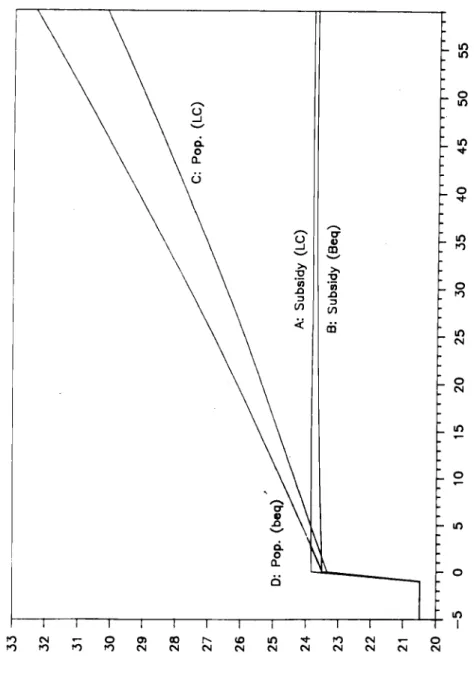
motive) and for the bequest case. Figure 1 displays the
impact on house
prices of
reducing
Ufrom
0.0
to
-0.2.
Paths
(A)
and
(8)
show
the housing price shift for thelife
cycle
(LC)and
bequest
(Beq)
casesrespectively. The effect of taxation on housing prices depends only marginally on whether homeowners have a bequest motive; housing prices jump by roughly 16 percent and settle close to their new steady state values.
The
aggregate saving rate in the simulation model is patterned after the national income accounts measure of
saving. Income is earnings plus the return on
housing (PX)
andgovernment rebates, while saving is
income less consumption less housing
expenditures. Initially, the aggregate saving
rate in the economy
with
a
bequest motive (20.5 percent) is higher than the savingrate in a
life cycle economy (15.3 percent).
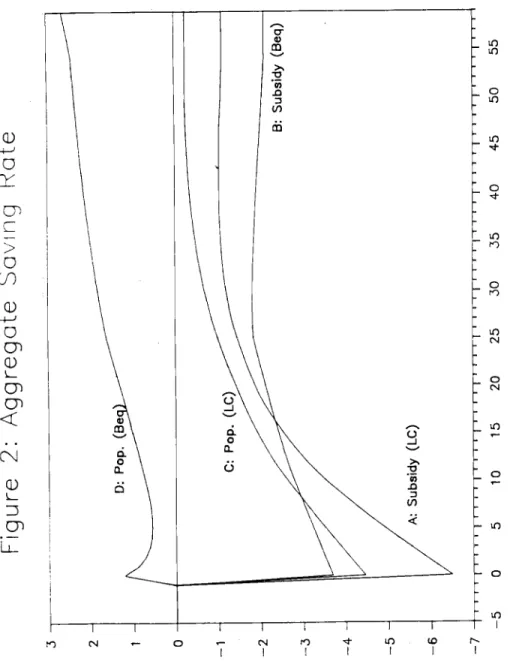
Figure 2 shows the change in the aggregate saving
rate as a
consequence of the housing subsidy.
In the life cycle case (A),
aggregate saving declines by 6.1 percentage points
as current
generations spend down their windfall;
over time the saving rate
declines permanently by 2 percentage points.
While the saving rate for
the economy with a bequest motive still declines
(s),
the
magnitude ofthe change is only one-third that for the life cycle economy.
In the
long-rim, the saving rate is
1. percent below the initial steady state
value. The bequest function dampens and can potentially offset
the life
cycle response to the housing price appreciation.
The converse of the policy presented above is to increase the
implicit tax
on housing services.
One possibility, for example, is toassess a tax on estimated housing service flows. Separate
simulations
(not reported) indicate that short-run saving rates
would rise
(substantially in the life cycle case,
less so with a bequestmotive) in
response to the equalization of capital taxes
on housing and nonhousing
capital (i.e., r —
0).
The impact of an increasing pressure of population
on land (i.e., a
reduction in the growth rate of land by 0.5 percent) is to
raise housing
prices by 15 percent for both the life cycle (C) and bequest
(D) model
(Figure 1). Given that the per capita
time, the perfectly foreseeable housing price will grow at a constant rate
ineach
year. Aggregate saving rates shifts in response to the housing price changes are shown in Figure 2 for the life cycle model (C) and the bequest model (D). Once again, a housing price appreciation causes current life cycle homeowners to spend down their wealth, thereby reducing aggregate saving. However, a housing price appreciation causes homeowners with a bequest motive to permanently increase their saving to provide for their childrens' more expensive housing.The long run
impact
of housing prices on capital accumulation depends on the behavior of the consumers who enjoy the windfall housing profits; do they spend down their capital gains or save them? To measure the behavior of this group, I turnnext
to an empirical test of the impact of house value on consumption and saving.III. Ernirical Estimates of Housing Value and Savina
A
number of time-series studies have estimated that housing wealth has a positive effect on consumption. In particular, the coefficients from Bhatia (1987) and Hendershott and Peek (1987) suggest that the marginal propensity to consume out of housing wealth is between 4 and 5 cents. Krummand
Miller (1986) used the Panel Study of Income Dynamics(PSID) to compare the changes in asset income of homeowners with renters. While nonhousing saving fell temporarily following a house purchase, homeowners on average saved more in nonhousirig assets than renters, holding income constant. Their evidence is consistent with
to
buy houses.The empirical analysis below also uses the PSID to test the effect of housing windfalls on consumption. The primary sample was selected in
the following way. Observations were excluded if (1) there were changes in the composition of family heads during the years 1973-83; (ii)
families rented or had moved during the period 1976-81; (iii) there were missing values for selected variables; (iv) the reported house value was less than $4000, and (v) if income during any year 1973-81 was equal to zero or exceeded $99,999. One-thousand and fifty-six families remained in the primary sample.
In the past, researchers have used food consumption in the PSID as a proxy for total consumption. It is straightforward, however, to take advantage of alternative consumption indicators reported in the PSID to
construct a better measure of consumption (Skinner, 1987). In particular, the survey reports utility payments, restaurant spending,
food at home, and the number of automobiles.8 These expenditures correspond to categories in the Consumer Expenditure Surveys (CEX) of
1972-73 and 1982. The strategy used here is to regress total
consumption in the CEX on these independent variables; the regression
coefficients are then used to weight the corresponding PSID variables to generate predicted total consumption. Using the full set of consumption indicators increases the explanatory power from as little as 26 percent of total variance (using food consumption alone) to almost 60 percent with the full set of variables.9
dependent variable, consumption, was constructed to be total consumption expenditures less automobile and furniture purchases and mortgage
payments, plus an imputed 6 percent return on the house value.'0 The regression to predict consumption from the 1972-73 Consumer Expenditure Survey, which used annual data, is
C — 1935
+ l.29*Food
+ 3.32*Away+
680*Auto+
2.97*Utility
(36) (59) (82) (21) (37)
R2
— .59;
N
— 14499where t-statistics are in parentheses, Food measures food expenditures at home, Away measures food away from home, Auto is the number of
automobiles up to a maximum of 2, and utility measures utility payments. Using similar notation, predicted consumption from the 1982 Consumer
Expenditure Survey (on a quarterly basis but adjusted to annual terms)
C — 2173 +
l.63*Food
+ 3.62*Away +l9l4*Auto
+
2.60*Utility
(9) (25) (38) (12) (21)
R2 —
.59;
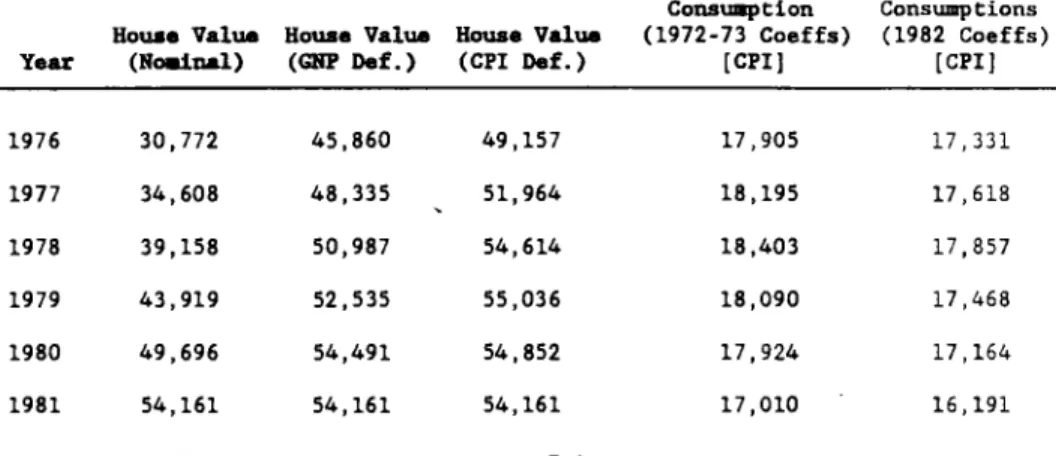
N — 3431Predicted consumption was constructed using both the 1972-73 and the 1982 survey results, with appropriate adjustments using the CPI. Average consumption for the sample is presented in the 5th and 6th columns of Table 1. All consumption and income variables used in the PSID regressions are in terms of constant 1981 dollars.
The
survey
asked for the respondent's subjective value of their house in each year (presumably consumption decisions are based on the subjective value of the house). The average house value is presented inTable 1. In nominal terms, housing valuation increased by 76 percent; when deflated by the CPI, housing prices increased by only 10 percent. However, the CPI is likely to overstate the true cost of living increase for homeowners, since it accounts for higher house prices facing
prospective homeowners. An alternative measure is the GNP deflator; using this adjustment, house prices rose by 18 percent during 1976-81;
during the period 1976-80, housing prices increased at an average annual
rate of 4.3 percent in real terms.
As a first exploratory step in measuring the impact of housing prices on consumption, it is useful simply to regress the individual log difference in consumption between 1976 and 1981 on the log difference in income and the log difference in house value. Because the sample is restricted to those who did not move, the change in house value should correspond to asset revaluation of an existing structure, although the individual may have added home improvements (or allowed the house to depreciate). The regression yielded the following coefficients (with
t-statistics in parentheses);
a — - .059
+
.l33
-.0l0
R2 — .079(7.6) (8.1) (0.6) (9)
That is, the simplest model implies that individuals' consumption patterns are sensitive to income changes ('i) but not to changes in housing valuation (1i). One potential objection to this regression is
that consumption should respond only to the unpredictible cornponent of housing price changes. To separate the unpredictable from the
predictable components of housing price changes, I assume
that
homeowners forecast future price changes with an AR(2) model. Using 1976-78 data yields a predictive equation equal to ln(h) — .654 +.52lln(h1)
+.423ln(h2)
with t-statistics of 3.8, 17.8, and 14.4, 2respectively;
R
—.77.
The predicted change in the housing price between 1976 and 1981 (calculated using the AR(2) model) is denoted by h, the unexpected change by h. It is interesting to note that theaverage value of was less than zero, suggesting that the house prices in 1981 may not have been unanticipated. A regression similar to Equation (9) was run with
h
and entered separately;O —
-.054
+.l33
- .032h -.0O3
— .060(5.5) (8.1) (1.0) (0.1) (10)
It seems clear that changes in housing prices, whether expected or unexpected, do not have a large impact on consumption in these simple regressions. One hypothesis would be that the bequest motive just offsets the life cycle wealth effect, so that saving is left unchanged.
A
test of this "weak bequest" hypothesis is to include a variable (1ix
family
size); if the bequest motive were tronger for families with more children, one might expect this coefficient to be negative. However, the variable is insignificant.The next step is to take advantage of the full data set by forming a combined cross-section time-series data set. From the theoretical model, it can be shown that the main determination of consumption is
measure of permanent income by including (logged) current income,
current earnings,'1 three years of lagged income, and next year's income. An accurate measure of lifetime wealth is particularly important in this
equation,
since housing purchases are likely to be highly correlated with lifetime wealth (some consumption studies in the past have even used housing value as a proxy for permanent income!). While the life cycle model implies that the marginal propensity to consume out oflifetime wealth is a function of age, interactive terms of income with age were insignificant, and were therefore excluded. To adjust for
demographic effects, age, age2, the sex of the household head, and
family size were included in the regression. Finally, the dependent
variable, log(consumption), is constructed using the 1982 weights, although the regression results were similar when the 1972 weights were used.
A
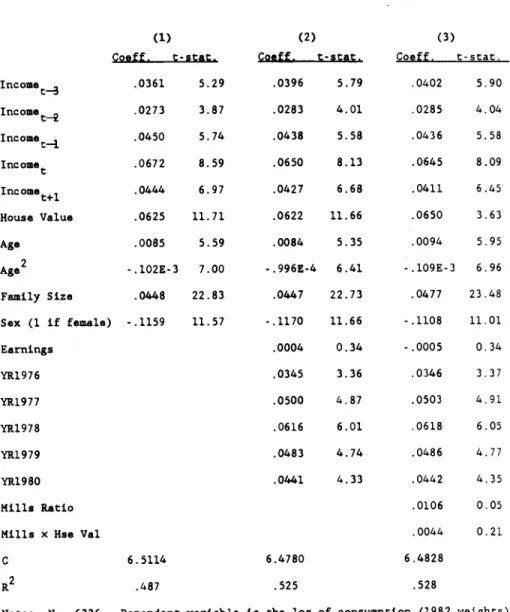
parsimonious regression is presented in the column labeled (1) in Table 2. The impact of a temporary change in (log) income on current (log) consumption is 0.06, which is roughly consistent with the predictions of a life cycle model for a younger individual. Thepredicted change in consumption as a result of a permanent (5 year) change in income, .22, is less than that predicted by the life cycle model. The coefficient on the house value is significant; it
implies
that
a 23 percent increase in the market value of housing would increase consumption by 1.4 percent.One disadvantage with the model in Column (1) is that it potentially confounds two effects. If interest rates affect both
housing prices and consumption directly (through the Euler equation), the coefficient on housing could confound these two effect.
Furthermore, business cycles could both depress housing prices and increase consumption (conditional on income), leading to further bias. To measure the direct impact of interest rate changes, dummy variables for each year are also included in the column labeled (2). Conditional on lagged, current, and future income, consumption rates were higher during the late l970s, a period of low real after-tax interest rates.
The pooled cross-section time-series regression coefficients from column (2) suggest that a rise in real housing prices of 23 percent is predicted to reduce consumption by 1.4 percent. Since these figures apply only to homeowners, the estimate must be adjusted before applying
it to aggegate assumption. Noting that 64 percent of all housing units were owner-occupied in 1983, and that homeowners enjoyed a median family
income double those who rented in 1983 (Statistical Abstract 1987, p. 712). Then the adjusted drop in aggregate consumption is predicted to
be
$26 billion in 1985 (or 18 percent of personal saving), assuming that (a) consumption is proportional to income and (b) renters' consumption is unaffected by housing prices. The meaured effects are somewhat less than those implied by the pure life cycle model.Correctinz for Heteroseneity among Homeowners
Heterogeneity may affect these estimates for two reasons. First, there may be some selectivity bias from choosing only those who did not move for the entire period. If, for example, those individuals with
"cash
out" their house (by moving toa
less expensive house in another region, for example), then restricting the sample to "stayers" will biasthe results. The standard Heckman method is used to adjust for this bias; the inverse Mills ratio for "stayers" is calculated from a probit which explains whether individuals move or not.'-2 This ratio is then
interacted with the housing wealth variable and entered independently in the regression on consumption; results are presented in Table 2, Column
(3). The interactive term is positive implying that the larger the unobservable component that predicts the family will move, the higher
the inverse Mills ratio, and hence the smaller the response of
consumption to housing value. This interactive term alone is not
significant, although the joint test that both the Mills ratio and the
interactive term are zero is rejected at the 0.01 level (F(2,63l7)
—
16.57).
A
second source of heterogeneity is that some individuals in the sample may be "spendthrifts" who both consume more relative to income, and live in larger houses. Hence including house value on the RHS could lead to a spurious correlation, since both consumption and housing will reflect the unobservable heterogeneity. To correct for this correlation between the unobservable effect and the independent variables, a fixedeffect model of consumption is estimated. Individual effects are
removed from the least squares regression by subtracting each variable's household-specific (arithmetic or logrithmetic) average. This is
equivalent to including a dummy variable for each family in the
family
over time,such
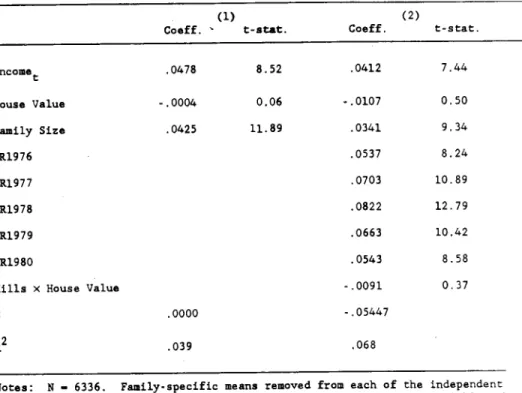
as sex or the Mills ratio, are excluded from the regression. Column(1)
in Table 3 reports regression results for asimple
model explaining log consumption as a function of a limited numberof
variables. While income and family size remain signficant, house value does not have a signficant effect on consumption. Thesecond regression reports results for the model including year dummies; once again there is no evidence that house value has an effect on consumption.
What can one conclude from these sets of regressions? One interpretation would be that house value has no impact on consumption, and that regressions from Table 2 (which imply
that
house values affect consumption) reflect spurious correlation between the twovariables.
However, the fixed effect regressions may not be as statistically powerful as the non-fixed effect regressions, since the former are based only on within-family variation, and ignore potentially useful variation between families.IV. Conclusion
This paper has suggested that the rise in housing prices during the past decades can
have
an important impact on long run capitalaccumulation. In particular, if consumers follow life cycle patterns of consumption, the increased house values is predicted to reduce saving rates in theoretical models with rational expectations and perfect foresight. The saving effects are moderated in the presence of a bequest motive; individuals concerned about their children facing higher
housing
prices leave larger bequests rather than spending their windfall gains.The Panel Study of Income Dynamics was used to assess the impact of housing values on consumption. While one set of regressions suggested a
small but significant effect, another set which corrected for individual differences across families suggested that shifts in house value had no effect on consumption during the later 1970s.
What light do these results shed on the theoretical models of saving behavior? The latter regressions support Ricardian equivalence;
homeowners do not consume their housing wealth. But consumers may be unable to spend down their housing wealth. While second mortgages are an increasingly popular method for unlocking housing equity (Manchester and Poterba, 1987), retirees may face difficulties in meeting mortgage payments. There are few reverse annuities that allow elderly homeowners
to spend part of their housing equity (Manchester, 1987). Another possibility is that consumers do not view their capital gains as
permanent. Current homeowners may not wish to risk an over-leveraged house if prices do ultimately fall. Finally, homeowners may have grown
accustomed
to an accelerating pattern of housing price increases, so that the house price changes anticipated for the late 1970s were already reflected in 1976 (and later) consumption choices.Bibliography
Bhatia, Kul B., 1987, Real estate assets and consumer spending, Quarterly Journal of Economics 102, 437-444.
Blinder,
Alan, 1974, Toward an economic theory of income distribution, (The MIT Press, Cambridge).Calvo, Guillermo A., Kotlikoff, Laurence J., and Carlos A. Rodriguez, 1979, The incidence of a tax on pure rent: a new (7) reason for an old answer, Journal of Political Economy 87, 869-874.
Cass, Karl E., 1986, The market for single-family homes in the Boston area, New England Economic Review (May/June) 38-48.
Cass, Karl E. and Robert J. Shiller, 1987, Prices of single-family homes since 1970: new indexes for four cities, New England Economic Review (September/October), 45-56.
Chamley, Christophe and Brian D. Wright, 1987, Fiscal incidence in an overlapping generations model with a fixed asset, Journal of Public Economics 32, 3-24.
Drazen, Allen and Zvi Eckatain, 1988, On the organization of rural markets and the process of economic development, American Economic Review 78, 431-443.
Eaton, Jonathan, 1987,
A
dynamic specific-factor model of international trade, Review of Economic Studies 54, 325-38.Eaton, Jonathan, 1988, Foreign-owned land, American Economic Review 78, 76-88.
Feldstein, Martin, 1977, The suprising incidence of
a
tax on pure rent: a new answer to an old question, Journal of Political Economy 85, 349-360.Feldstain, Martin, 1978, The welfare cost of capital income taxation, Journal of Political Economy 86, S29-S52.
Feldstein, Martin, 1980, Inflation, tax rules, and the price of land and gold, Journal of Public Economics 14, 309-17.
Goulder, Lawrence, 1989, Tax policy, housing prices, and housing investment, Regional Science and Urban Economics 19.
Gordon, Roger H., Hines, James R., Jr., and Lawrence H. Summers, 1987, Notes on the tax treatment of structures, in: M. Feldstein, ed., The
Chicago)
223-254.Henderson, J. Vernon, 1985, Economic Theory and the Cities (Academic Press, New York).
Henderson, J. Vernon and Yannis M. loannides, 1987, Dynamic aspects of consumer decisions in housing markets, Journal of Urban Economics,
forthcoming.
Hendershott, Patric H., 1987, Household formation and home ownership: the impacts of demographics'and taxes, Housing Finance Review
(Summer).
Hendershott, Patric H., 1988,
Home
ownership and real house prices: sources of change, 1965-85, Housing Finance Review (Spring).Hendershott, Patric H. and Joel Slemrod, (1983), Taxes and the user cost of capital for owner-occupied housing, AREUEA Journal
10,
375-393.
loannides, Yannis, 1987, Residential mobility and housing tenure choice, Regional Science and Urban Economics 17, 265-287.
Kau, James 3. and C.F. Sirmans, 1981, The demand for urban residential land, Journal
of
Regional Science 21, 519-528.King, Mervyn
and
Don Fullerton, 1984, The taxation of income from capital, (University of Chicago Press, Chicago).Krumm,
Ronald
and Nancy Miller, 1986, Household savings,homeownership, and tenure duration, Office of Real Estate Research Paper No. 38, University of Illinois.
Lillard, Lee
A.,
1983,
A
model of wage expectations in labour supply, in: F.A. Cowell, ed., Panel dataon
incomes (London School ofEconomics, London).
Lipton,
David, Poterba, James, Sachs, Jeffrey, and Lawrence Summers,1982, Multiple shooting in rational expectations models, Econometrica, 50, 1329-33.
Manchester, Joyce, 1987, Reverse mortgages and their effects on consumption, savings, and welfare, mimeo.
Manchester, Joyce, and James Poterba, 1989, Second mortgages, Home equity borrowing, and household saving, Regional Science and Urban Economics 19.
Mankiw, N. Gregory, and David N. Veil, 1989, The baby boom, the baby bust, and the housing market, Regional Science and Urban Economics 19.
Poterba,
James 14. • 1984, Taxsubsidies
to owner-occupied housing: anasset-market approach, Quarterly Journal of Economics 99, 729-752. Rosen, Harvey, 1985, Housing subsidies: effects on housing decisions, efficiency, and
equity,
in: A. J. Auerbach and 14. S. Feldstein, eds.,Handbook of Public Economics (North Holland, Amsterdam).
Skinner, Jonathan, 1987,
A
superior measure of consumption from the panel study of income dynamics, Economic Letters 23, 213-216. Stover, Mark E., 1986, The price elasticity of the supply ofsingle-family detached urban housing, Journal of Urban Economics 20, 331-340.
Summers, Lawrence, 1981, Inflation, the stock market, and owner-occupied housing, American Economic Review 71, 429-434. Topel, Robert and Sherwin Rosen, 1988, Housing investment in the United States, Journal of Political Economy 96, 718-740.
Venti, Stephen F. and David A. Wise, 1987, Aging, moving, and housing wealth, NBER Working Paper No. 2324.
Table 1: House Value and
Real
Consui.otion 1976-81: Non-ovinHo.eovners
ConsuIption
Consump tions House Value House Value House Value(1972-73
Coeffs) (1982 Coeffs) Year (No.ina.1) (GNP Del.) (CPI Del.) [CPI] [CPu1976 30,772 45,860 49,157
17,905
17,331
1977 34,608 48,335 51,964 18,19517,618
1978 39,158 50,987 54,614 18,40317,857
1979 43,919 52,535 55,03618,090
17,468
1980 49,69654,491
54,852
17,924
17,164 1981 54,161 54,161 54,161 17,010 16,191Table 2:
Constion Rearessions
1976-81(1) (2) (3)
Coaff. t-stat. Coaff. t-stat. Coeff. t-stat.
Income
.0361 5.29 .0396 5.79 .0402 5.90Income.
0273 3.87 .0283 4.01 .0285 4.04Income
.0450 5.74 .0438 5.58 .0436 5.58 Income .0672 8.59 .0650 8.13 .0645 8.09 Income+i .0444 6.97 .0427 6.68 .0411 6.45 House Value .0625 11.71 .0622 11.66 .0650 3.63 Age .0085 5.59 .0084 5.35 .0094 5.95Age2 - .102E-3 7.00 - .996E-4 6.41 - .109E-3 6.96 Family Size .0448 22.83 .0447 22.73 .0477 23.48 Sex (1 if female) - .1159 11.57 -.1170 11.66 - .1108 11.01 Earnings .0004 0.34 - .0005 0.34 YR1976 .0345 3.36 .0346 3.37 YR1977 .0500 4.87 .0503 4.91 YR1978 .0616 6.01 .0618 6.05 YR1979 .0483 4.74 .0486 4.77 YR1980 .0441
4.33
.0442 4.35 MillsRatio
.01060.05
Mills
x Hse Val .0044 0.21C
6.5114
6.4780
6.4828
a2
.487 .525 .528Table 3: Conaition ReEreasiona
With
Fixed Effects. 1976-81 (1) Coeff. t-stat. (2) Coeff. t-stat. Income .0478 8.52 .0412 7.44 House Value - .0004 0.06 - .0107 0.50 Family Size .0425 11.89 .0341 9.34 YR1976 .0537 8.24 YR1977 .0703 10.89 YR1978 .0822 12.79 YR1979 .0663 10.42 Ya1980 .0543 8.58Mills x House Value - .0091
037
C .0000 - .05447
a2 .039 .068
Notes: N — 6336. Family-specific means removed from each of the independent variables (except the year dummies) as well as from the dependent variable,
he
log of consumption (calculated using 1982 weights).1 The
price of housing is assumed to be the price index for new single dwelling structures, adjusted by the GNP deflator.
2 Time-series estimates of the effect of
housing inclusive wealth on consumption are 4.6 cents (Bhatia, 1987) and 4.0 cents (Hendershott and Peek, 1987) per dollar.
Since the land tax is rebated, the tax
inclusive
price of land for a particular generation falls. Alternatively, the owners of the land make no profit on the land but they enjoy the proceeds of the lump sumrebate.
4The PSID reports that in the total sample, roughly 20 percent of renters move to a new location each year. For the sample of
homeowners in 1976/77, only 27 percent moved at any time during the four year period 1978-81. See loannides (1987) and Henderson and loannides (1987) for a more general model of housing tenure choice.
If rental property exceeds non-owner-occupied capital, the limit is set to one.
6 The model
captures a permanent perfectly anticipated change in housing prices. In Mankiw and Weil (1989), the demographic change is temporary, but because individuals appear to be myopic, they treat the change as if it were permanent.
There are other explanations for the housing price increases. Case (1987) suggests that a speculative bubble is the only factor that can explain the sharp jump in Boston housing prices. Hendershott (1988) favors an explanation in which a slowdown in housing
construction productivity leads to a secular rise in housing prices. One disadvantage with using utility payments is that the real price of gas and electricity grew by 33 percent during the 1970s.
Similar regressions are reported in Skinner (1987). In those
which
is clearly not appropriate for this exercise.'°
It
iight appear that the imputed housing flow will contaminate this measure
of
total consumption. However, the instruments used to predict consumption are independent of changes in housing values, so the consumption measure will not bias the results."The log of earnings was set to zero when earnings were zero. 12The
probit
equation for whether individuals moved or not isM —
-2.47
-.045Y
+.034LEarn + .27lLFmsz + .005(H/Y)
(3.1) (0.6) (2.0) (7.0) (0.2)
+
.162Y+
.O28Earn - .OO2Fmsz(2.0) (1.8) (0.1)
N
— 1465where
M
is the probit index as to whether the family moves during 1976-81,Y
is log of income, Earn is earnings, Fmsz is family size, H/Yis
the ratio of 1976 housing value to 1976 current income, andL
denotes
changes over the 5 year period. This sample is expanded to include those who owned a house during 1976 and 1977, but who may have moved or sold their house between 1978 and 1981. There were 393movers and 1072 who stayed. See Venti and Wise (1987), loannides (1987), and Henderson and loannides (1987).
33
32
3130
29
28
27
I,26
0I
25
24
23
22
2120
Figure
1:
House
Prices
D: Pop.(beq)
Pop. (LC) A: Subsidy(Lc)
B: Subsidy(Beq)
—50
5
10 15 2025
30
3540
4550
Yenr
V 4-I a C > a (I)
r
I) 0' C0
r
0
V0'
04-, C V 0 L V ElFigure 2: Aggregate Saving Hate
3 2 0 —1 —2 —3 —4 —5 —6 —7