86
Establishing Basic Standards of Nursing care protocol at Neonatal Intensive care unit.
Sabah Mohamed El sayed1, Yomn Y. Sabry2, Hamed M. sharkawy3, Ebtisam M. elsayed1 and Thanaa Ali1 Faculty of Nursing,1 Tanta and2 Alexandria University,3Faculty of Medicine, Tanta University
Abstract: The advancements in intensive care in recent decades have enabled better survival of full spectrum of newborns. The management of neonates at NICU is based on various modalities of support and application of fundamental principles of neonatal care. The aim of this study was to establish basic standards of care for nurses working at Neonatal Intensive Care Unit. The subjects of the present study consisted of 70 nurses working in Neonatal Intensive Care Unit and responsible for providing direct care for newborn. Two tools were used to collect data:. Knowledge assessment sheet and observation checklist to assess nurses' knowledge and actual performance of nurses providing direct care for neonates in Neonatal Intensive Care Unit before, immediately, and after three months from the standard application. The results. showed that, before the standard application the total scores of knowledge for nurses were good (3o %) and poor with percentages of 63%. It was improved immediate, and after three months later of the standard application. There was significant difference in nurses' performance before, immediate, and after three months of the standard application. Conclusion: it can be concluded that all the nursing activities presented in the initial standard as basic nursing responsibilities was enhanced. Recommendations: The developed standards should be translated into Arabic and disseminated to the managers of health organizations. [Sabah Mohamed El sayed, Yomn Y. Sabry, Hamed M. sharkawy, Ebtisam M. elsayed and Thanaa Ali.
Establishing Basic Standards of Nursing care protocol at Neonatal Intensive care unit.. Nature and Science 2013; 11(4): 86-92]. (ISSN: 1545-0740). http://www.sciencepub.net. 14
Keywords: Basic Standards of Nursing care Neonatal- Intensive care unit.
1. Introduction
The neonatal period is defined as the first four weeks subsequent to birth (1). Some newborns require observation and care that is beyond the scope of a normal newborn nursery, these are called high risk neonates (2). High risk neonate can be defined as a newborn, regardless of gestational age or birth weight, which has a greater-than-average chance of morbidity or mortality, requiring early intervention that should be delivered at neonatal intensive care unit(3). It provides care to full spectrum of newborns ranging from extremely premature infants, to high-risk and critically ill babies, to less critically ill babies who are recovering and maturing with increased emphasis is being placed on the need for standards of care, as well as mechanisms which address the barriers to provision and use of quality care(4).The first step in improving quality of nursing care is an articulation of standards of care that provide a mean for determining quality of care as well as accountability of the nurses(5). A standard is defined as a professionally agreed level of performance, it provides the required knowledge and skills that can be used to orient new staff and to guide nurses in clinical practice (6). Nurses are the key elements in critical care. They are required to keep pace with the rapid changes in health care, and provide quality of patient's care in a cost-effective manner (7).
Aim of the study: was to assess actual performance of nurses working in Neonatal Intensive Care Unit at Tanta University Hospital.1
2.Subjects and Method:- Research design: -
A quasi-experimental research design was used to accomplishthis study.
Setting:
This study was carried out at the Neonatal Intensive Care Unit of Tanta University Hospital.
Sample:
Consisted of all bedside nurses working in NICU responsible for providing direct care for neonates with any health problems in the previously mentioned setting. Their number was 70.
Tools:-
1-A Structured questionnaire sheet for Neonatal Nursing management competences: This tool was developed to assess nurses' knowledge and skills related to the basic competences needed for neonatal care.
2- Nurses practice observational checklist to assess their actual performance in providing direct care for those neonates.
87
Method:
- All nurses were observed during different nursing procedure at different shifts (morning, afternoon and night shifts).
- The questionnaire was answered on an individual basis in the presence of the researcher. The time needed to answer the questionnaire ranged from thirty minutes to one hour. Data collection of this tool lasted approximately ten months.
- Preparation of suitable media for teaching the nurses including; lectures, data show, poster, video, doll for redemonstration, and book notes.
- Determining the framework of the standards; The Donnabedian model (8) (structure, process and outcome) was used.
Implementation of the standard care strategies. - Nurses were divided into ten groups, seven nurses
in each group.
-The standard of care was discussed for all nurses included in the study; it includes 13 sessions; daily care , high risk, infection control, CPR, suction, ventilator, phototherapy, kangaroo care, relactation, tactile stimulation , palliative care , communication and discharge plan.)
Evaluation was done immediately and three months later.
Part (A):-Knowledge of the nurses regarding care of neonates at NICU was evaluated and classified as:
Every item was evaluated as follow:
Correct and complete answer was scored (2)
Correct and incomplete answer had been scored (1)
incorrect and incomplete answer had been scored (0)
Total score of knowledge items was calculated in percentage and a score of 70% or more is considered good, 60-69% fair & less than 60% was considered poor.
Part (B):-Practice of the nurses regarding care of neonates at NICU was evaluated and classified as:
Every item evaluated as follow:
Competent (Correct and complete done) had been scored (2)
incompetent (Correct and incomplete done) had been scored (0)
incorrect or not done had been scored (0) The scoring system of the practice including zero point for either incorrectly or not done, because this result will affect the survival of the neonates. The total score of every item had been calculated in percentage and classified as follow:
85 and more had been considered good
70-84 % had been considered fair.
Less than 70% had been considered poor.
3.Results:
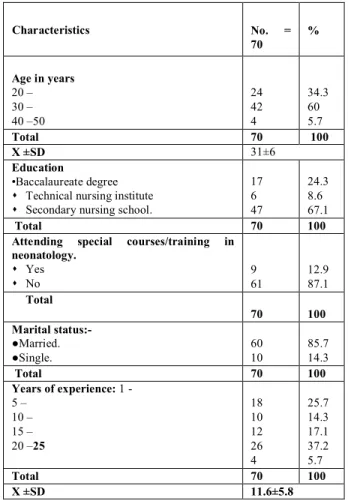
Table (1) illustrates the general characteristics of nurses included in the study. It was observed that, nearly two third (60%) of the nurses were 30 to less than 40 years old, with mean age were 31 ± 6. Regarding their education, 67.1% of nurses are secondary nursing school graduates while 24.3 % of them have completed their university nursing education and only 8.6 % of them have a technical nursing institute certification.
Unfortunately, the same table indicates that only 12.9 % of nurses have attended specific course/ training in neonatology, and the majority of them (87.1%) did not attain any course or training. It was observed that most of them (85.7) were married and 14.3% were single. In relation to their years of experience in NICU, the result reveals that the mean years of experience in NICU were 11.6±5.8 years.
Table (1): Distribution of the Nurses According to Their General Characteristics.
Characteristics No. = 70 % Age in years 20 – 30 – 40 –50 24 42 4 34.3 60 5.7 Total 70 100 X ±SD 31±6 Education •Baccalaureate degree
Technical nursing institute
Secondary nursing school.
17 6 47 24.3 8.6 67.1 Total 70 100
Attending special courses/training in neonatology. Yes No 9 61 12.9 87.1 Total 70 100 Marital status:- ●Married. ●Single. 60 10 85.7 14.3 Total 70 100 Years of experience: 1 - 5 – 10 – 15 – 20 –25 18 10 12 26 4 25.7 14.3 17.1 37.2 5.7 Total 70 100 X ±SD 11.6±5.8
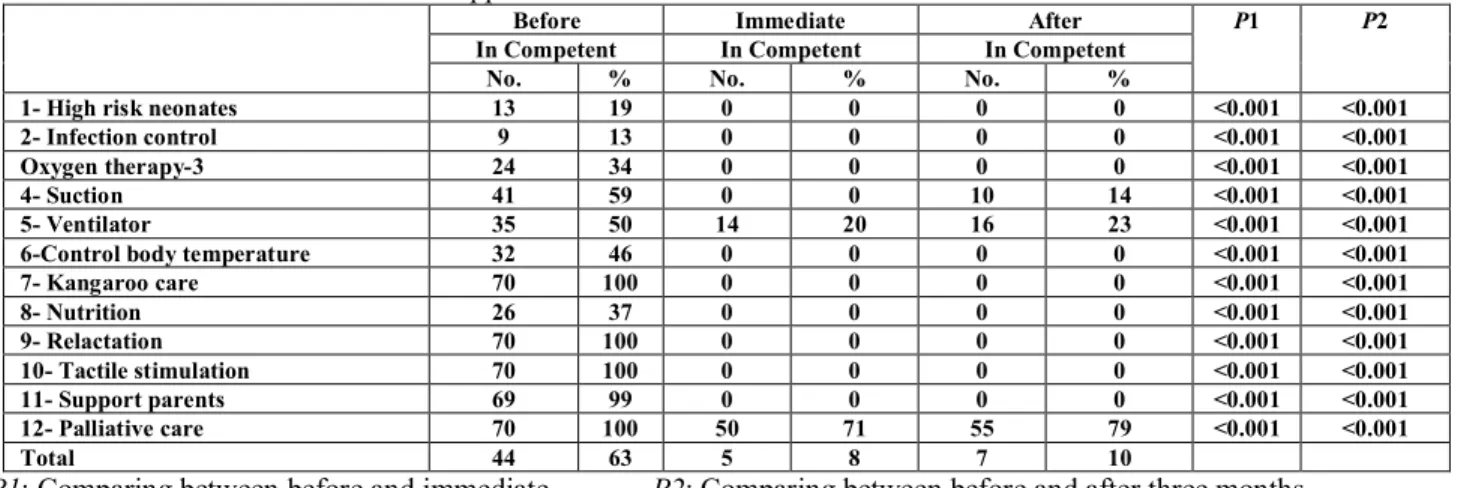
Table (2): shows the correlation between nurses' knowledge before and immediately after application of the standard, and between before and three months after application of the standards of care. It was observed that, the nurses' levels of knowledge
88 regarding high risk neonates, infection control, oxygen therapy, control of body temperature, kangaroo care, nutrition, re-lactation, tactile stimulation, and support of parents (19%, 13%, 34%, 46%, 100%, 37%, 100%100%, and 99%,) respectively were incompetent before application of the standard, while after application of the standards either immediately or three months later , the nurses ' knowledge regarding the previously mentioned items completely improved, With statistical significant differences p<0.001.
Table (3): shows the correlation between nurses' performance before, immediately after application of the standards, and between before and three months later from application of the standards. It was reveals that, the percentage of nurses' performance regarding control of infection were 96% incompetent before standard compared to 61% and 69% immediately and after application of the standard respectively. The percentage of others items also was decreased after application of the standard as: (daily care, measurements, suction, resucetation,ventilation and communication) . statistical significant difference was detected (p<0.001).
Table (4) and figs. (1, 2): represents the total score for the nurses' knowledge and practice
according to their level of performance. It was observed that 63% of the nurses' knowledge was incompetent before standard application, compared to 8% and10% immediately and three months later respectively. As regards nurses' practices the total scores were 80% incompetent before standard and decreased to 30% and 36% respectively immediately and three months later from application of the standards. There were statistically significant differences (p<0.001).
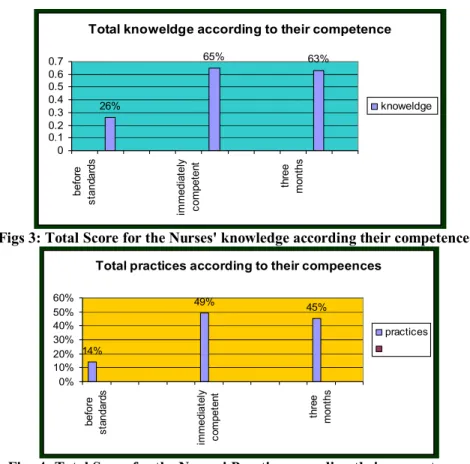
Table (5) and Figs (3, 4): Illustrated the total score of nurses' performance according to their competences. It was observed that, the total scores of nurses' knowledge were poor with percentage 63%, whereas, immediately and after three months of the standard application, the total score of knowledge improved as the majority of them (89%) and (81%) obtained good scores respectively. As regards the total score of practice, 80% of nurses' performances were poor before the standard, while after application of the standard either immediately or after three months, the nurses' performance improved and 45%,43%obtained good scores respectively with statistical significant difference . (p<0.001).
Table (2): The correlation between nurses' knowledge before and immediately after application of the standard, and between before and three months after application of the standard
P2 P1 After Immediate Before In Competent In Competent In Competent % No. % No. % No. 0.001 < 0.001 < 0 0 0 0 19 13
1- High risk neonates
0.001 < 0.001 < 0 0 0 0 13 9 2- Infection control 0.001 < 0.001 < 0 0 0 0 34 24 Oxygen therapy-3 0.001 < 0.001 < 14 10 0 0 59 41 4- Suction 0.001 < 0.001 < 23 16 20 14 50 35 5- Ventilator 0.001 < 0.001 < 0 0 0 0 46 32
6-Control body temperature
0.001 < 0.001 < 0 0 0 0 100 70 7- Kangaroo care 0.001 < 0.001 < 0 0 0 0 37 26 8- Nutrition 0.001 < 0.001 < 0 0 0 0 100 70 9- Relactation 0.001 < 0.001 < 0 0 0 0 100 70 10- Tactile stimulation 0.001 < 0.001 < 0 0 0 0 99 69 11- Support parents 0.001 < 0.001 < 79 55 71 50 100 70 12- Palliative care 10 7 8 5 63 44 Total
P1: Comparing between before and immediate. P2: Comparing between before and after three months.
Table (3): Correlation between nurses' performance before and immediately after, and between before and three months after application of the standards of care.
P2 P1 After Immediate Before Items In Competent In Competent In Competent 0.001 < 0.001 < % No. % No. % No. 0.001 < 0.001 < 69 48 61 43 96 67 1- Infection control 0.001 < 0.001 < 23 16 5.5 4 57 45 2- Daily care. 0.001 < 0.001 < 78.5 55 78.5 55 100 70 3- Measurement. 0.001 < 0.001 < 38 27 35 25 73 51 4- Phototherapy 0.001 < 0.001 < 63 44 63 44 76 53 5- Intravenous therapy 0.001 < 0.001 < 29 20 21 15 96 67 6- Gavage feeding. 0.001 < 0.001 < 11 8 7 5 23 16 7- Oxygen therapy. 0.001 < 0.001 < 14 10 14 10 83 58 8- Pulse oximetery
89 0.001 < 0.001 < 0 0 0 0 100 70 9- Suction 0.001 < 0.001 < 29 20 14 10 100 70 10- Resuscitation 0.001 < 0.001 < 43 30 31 22 100 70 11-Ventilator 0.001 < 0.001 < 30 21 28 19 61 43 12-Communication 0.001 < 0.001 < 36 25 30 21 80 56 Total
P1: Comparison between before and immediate after application of the standard P2:-Comparison between before and after three months application of the standard
Table (4): The Total Score of Nurses’ Knowledge and Practice according to Their Level of performance.
Before Immediately Three months later P value
Comp. In comp. Comp. In comp. Comp. In comp.
No % No % No % No % No % No % <0.001
Knowledge 26 37 44 63 65 92 5 8 63 90 7 10
practice 14 20 56 80 49 70 21 30 45 64 25 36 <0.001
Figs. 1: Total Score for the Nurses' Knowledge according their level of performance.
Figs 2: Total Score for the Nurses' Practice according their level of performance Table (5): The Total Score for the Nurses' Knowledge and Practice according to their competence
Before standard Immediately after the standard Three months after the
standard
Fisher exact test
P value no % No % No % p<0.001 knowledge Good 21 30 62 89 57 81 Fair 5 7 3 4 6 9 Poor 44 63 8 7 7 10 Total 70 100 70 100 70 100 Practice Good 10 14 32 45 30 43 p <0.001 Fair 4 6 9 14 8 12 Poor 56 80 29 41 32 45 Total 70 100 70 100 70 100 be fore Imme diate ly aft er t he sta nd ard Thr ee mon ths a fte r th e stan da rd Good Fair poor 63 7% 10% 7 4% 9% 30 89 81% 0 10 20 30 40 50 60 70 80 90
Total score of nurses knoweldge
Good Fair poor
Total practices of nurses
12% 45% 43% 41% 14% 45% 14% 6% 80% 0 10 20 30 40 50 60 70 80 90 Bef ore stan dard Goo d Fair Poor Imm edia tely afte r the sta ndar d Goo d Fair Poor Thr ee m onth s a fter t he s tand ard Goo d Fair Poor
90
Figs 3: Total Score for the Nurses' knowledge according their competences.
Figs 4: Total Score for the Nurses' Practice according their competences 4.Discussion:
Maintaining and improving neonatal care requires active involvement of everyone in health care system, in order to meet the needs for evaluating health care in its totality as well as to identify whether effective and appropriate care has been provided. Education and training are potential means for implementing effective nursing care at Neonatal Intensive Care Unit (NICU), as they alter perception, increase knowledge, and in turn change work practice.(9) "The current study is figuring out that, most of nurses didn't attend any previous in-service training program related to neonatal care at NICU .This finding may be owing to the shortage of nurses' number, absence of continuing education department in the hospital and lack of motivation for training, as well as increased workload in Neonatal Intensive Care Unit. The findings of the current study are in line with ". The British Association of Perinatal medicine (BAPM) (10) which stated that "a lack of trained staff may lead to care that is unsafe.'' and Jeffery et al. (11), Vidal et al. (12), stated that the implementation of effective training programs for health care providers in hospital settings followed by moderate improvement in Essential Newborn Care (ENC) is a must .While the finding was incongruent with another study (13), who revealed that the nurses' factors
related to in-service training had no effect on both nurses' knowledge and performance.
The current study revealed that about two third of nurses' knowledge was incompetent about neonates in intensive care unit before standards application, while immediately and after three months application of the standards, nurses' knowledge highly improved . On the other hand, it was found that, most of them demonstrated incompetent level of performance before standards, which improved also immediately and three months later. This moderate level of competencies could be related to the improper working environment and unclear cut-responsibilities among nurses, as well as the in- adequate attendance of continuous pre-service and in-service training programs. This finding is supported by Salem (14) who showed that, half of the studied nurses gave correct responses when assessing their level of knowledge, while none of them attained the competent level in their performance. Another study carried out by El-Sayed (15) who reported that, a score of more than half of studied nurses was unsatisfactory regarding care provided for neonates. Fair performance was observed among more than half of nurses as mentioned by El-Mommani (16).
In addition WHO (2006), (17), which stated that, there was inadequate nurses' knowledge and performance and attributed this deficiency to one or
Total knoweldge according to their competence
26% 65% 63% 0 0.1 0.2 0.3 0.4 0.5 0.6 0.7 befo re s tand ar ds im me dia tely c omp et en t th ree mo nt hs knoweldge
Total practices according to their compeences
14% 49% 45% 0% 10% 20% 30% 40% 50% 60% b efore s ta nd a rd s immedi at e ly c o mp et e n t th re e mo n ths practices
91 more of the following reasons as mentioned; lack of orientation program prior to work as well lack of nursing care conference during work, invariability of procedure, and books especially in the studied area, lack of supervision, and nurses' evaluation against identified standards of patient care. On the contrary, this finding disagreed with Al-Sharkawy (18). Who reported that, almost three-quarters of nurses had good scores of performance.
The present study showed that few of nurses have competent level of performance about infection control, before standards, which increased immediately and after three months application of the standards. This low level of performance may be due to shortage of staff, absence of continuous observation from health professionals and lack of work motivation either verbal or financial .This result is congruent with Abd-alla (19). who found inadequate nurses knowledge and practice related to nosocomial infection, principle of disinfectant, sterilization, and standard infection control precautions and he interpreted that by the lack of nurses' awareness with importance of infection control and safe health practice. Attia (20) and El-Shenawy (21) revealed that control of infection in ICU was considered a total responsibility of the nurse as stated by the entire expert group included in their studies.
A large number of premature infants require prolonged ventilatory support. In order to provide this support an artificial airway must be inserted. This airway can be established in one of two ways, either with an end tracheal tube or by the means of a tracheotomy tube. Regardless of which method is used, the neonate’s upper airway is by passed, thus reducing the neonate’s ability to clear secretions spontaneously. Additionally, the presence of the tube may lead to an increase in sputum production. For these reasons neonates with an artificial airway in place will require airway suctioning (22). Endotracheal intubation may be necessary for the ventilation process. The nurse must constantly ensure tube placement, stability and patency. End tracheal intubation and subsequent oxygen therapy decrease ciliary activity and accelerate mucus production. Appropriate suctioning of the end tracheal tube is required to aid in the outflow of pulmonary secretions and assure patent airway. (23, 24-5)
The present study revealed that half of nurses were competent in performing suctioning before standard application and it increased to include all of them immediately and after three months application of standards. . Increased awareness that suctioning is one of nurses' own responsibilities could be the reason behind this competent level of performance, in addition to the understanding of the danger of accumulation of these secretions in the neonates'
airway. The Finding of the present study was in-accordance with El-Mommani (16) who reported that ,more than half of nurses demonstrated poor level of performance in suction procedure, and another(13) who reported that ,suction was satisfactory in only few numbers of nurses. The result of the current study is in the line with Salman (7) who revealed that, three quarter of nurses gave competent answers about assisting pediatricians during end tracheal tube insertion. Moreover, most of nurses scored competent in performing suctioning.
Anthropometric measurements help in assessing neonates' growth and development. When combined with other measurements, they are used to form an index that becomes useful (WHO 2009) (26). Anthropometric indices such as height for age, weight for age and weight for height can be compared to recognized standards of growth to decide if the individual or populations under investigation are within the normal for size, proportion or composition. (27) As regards this aspect, the present study revealed that, the majority of the studied nurses demonstrated incompetent level of performance in taking the neonates' general measurements. This could be attributed to the fact that pediatricians usually do the measurements on admission as a part of their physical examination. Weight is an important measurement which should be performed by the nurses and couldn't be measured, in spite of the fact that weighing the neonate is considered as a part of their routine nursing care which should be performed every night shift, this could be attributed to unawareness of the nurses that weighing should be done regularly to protect rapid decrease in body weight which may result from dehydration or insufficient caloric intake.
The findings of the current study are in harmony with a study carried out by El-Sayed (15) who reported that none of the studied nurses had taken the general measurements for the neonates. Furthermore, El-Mommani (16) stated that the lowest scores were assigned to taking general measurements, and Mahmoud (28) reported that approximately two-thirds of nurses were unsatisfactory in this aspect. In addition Al-Sharkawy (18) found that only few numbers of the studied nurses were good in taking general measurements for neonates. Mohamed (13) found that the majority of nurses did not take the length, the head and chest circumferences, while weighing the neonates was done by more than one-quarter of nurses.
Conclusion: Recommendations:-
Conclusion: it can be concluded that there was an enhancement in nurses' knowledge and moderate improvement in performance after application of the standard. Recommendations: The developed
92 standards should be translated into Arabic and disseminated to the managers of health organizations.
References
1-Australian Resuscitation Council. Guideline 13.1 introduction to Resuscitation of the newborn infants. New Zealand Resuscitation Council.2010.
2-Brookside A. Obstetric and Newborn Care II:-Medical Education Diversion. 200 ; 20
3- Hill K. Choi Y. Neonatal mortality in the developing world. Journal Demographic Research: 2006; 18 (14):429
4- Duderstadt k. Health of U.S. Children from the global view. Journal of Pediatric Health Care.2007; 21(6), 403-406
5- Royal collage of Nursing. Setting standards of care. Nursing standard, 1994; 3-8
6- Vetter N. The hospital from center to community support London: chapman and flall Co., 1995; 183-87
7- Salman M. Establishing basic standards for nursing management of neonates with respiratory distress syndrome at El shatby children's hospital .Doctorial thesis in Critical Care department, Faculty of Nursing, Alexandria University , 2008
8- World Health Organization .Bulletin of the World Health Organization, 2000; 1475
9 - Needleman J., Ellen T. Kenneth W, Brandes K. Performance Measurement of Nursing Care: State of the Science and the Current Consensus. Braneis University 2008. http://mcr.sagepub.com
10- The British Association of Perinatal Medicine. Standards for Hospitals providing neonatal intensive and high dependency care.2nd ed. 2001
11- Jeffery H, Kocova M., .The impact of Evidence Based Education on Perinatal Capacity- Building Initiative in Macedonia, Medical Education 2004; 38,435-447 12- Vidal S, Ronfani l, Mello M, Comparison of Two
Training Strategies for Essential Newborn Care in Brazil. Bulletin of the World Health Organization 2001; 79(2): 1024- 1031
13- Mohamed E. Assessment of Nurses' Knowledge and Performance Regarding Nursing Care given to Chronic Renal Failure Patient Under-goining Maintenance Hemodialysis. Thesis Submitted for the Partial Fulfillment of Master Degree in Medical Surgical Department Faculty of Nursing .Tanta University. 2008; 55-62
14- Salem A. Development of Nursing Practice Standards for Emergency Trauma Patients. Unpublished Doctoral Thesis in Critical Care Nursing. Faculty of Nursing, Alexandria University 2006; 120
15- El-Sayed E. Designing and evaluation an educational program to nurses at premature unit, Tanta University.
Unpublished Doctrol thesis i Pediatric Nursing. Faculty of Nursing. Alexandria University 1996; 61-71
16- El-Mommani M Quality of nursing care provided in the neonatal intensive care unit of Princes Badia Teaching
Hospital. Jordan. Unpublished Doctoral Thesis
submitted to the High Institute of Public Health, University of Alexandria 2002.
17- WHO. Improving health worker performance. Evidence and Information for Policy, Department of Human Resources for Health Geneva, September 2006
18- Al-Sharkawy S. Improving an in-service training program for the pediatric nurses about care of preterm and low birth weight infants. Unpublished Doctoral Thesis in Pediatric Nursing. Faculty of Nursing, Ain Shams University 1991; 68-70
19-- Abd-alla. A. Impact of Health Education on Infection Control Measures in Operating Theater. Thesis Submitted for the Partial Fulfillment of Doctorial Degree in the Medical- Surgical Nursing Science. Tanta University 2008; 90
20- Attia A. Development of An Instrument to Measure Basic Standards for Critical Care Nursing. Unpublished Doctoral Thesis in Medical- Surgical Nursing. Faculty of Nursing, Alexandria University 1992; 87- 90
21- El- Shenawy S. Establishing Standards for Prevention and Control of Nosocomial Infection in the Intensive Care Unit at the Alexandria main University hospital Unpublished Doctoral Thesis in Critical Care Nursing. Faculty of Nursing, Alexandria University 2002; 235 22- Buglass, E. Tracheotomy care: Tracheal Suctioning and
Humidification. British Journal of Nursing. 1999. 8(8): 500-504
23- Pillitteri A. Maternal and child health nursing: Care of the childbearing and childbearing family. 4th ed. Philadelphia: Lippincott Williams and Wilkins Co., 2003; 739 – 43, 1081 85, 1371- 3.
24- Niel-Weise B, Snoeren R, Van De Broek P. Policies for
Endotracheal Suctioning of Patients Receiving
Mechanical Ventilation: a Systematic Review of Randomized Control Trials. Infection Control and Hospital Epidemiology Journal 2007; 28(5): 531- 6 25-Andrews D, Deboer S, and Adams K. Securing Pediatric
Endotracheal Tubes: Tape it like you mean it. Australian Emergency Nursing Journal 2007; 10(2): 30- 3.
26- World Heath Organization. Newborns: reducing mortality; 2009; 333.
27- Morton P, Fontaine D, Hudak C, Gallo B. Critical Care Nursing: A holistic Approach. 8th ed. Philadelphia: Lippincott Williams and Wilkins Co., 2005; 36- 84 28- Mahmoud-M, Assessment of Nursing Care Provided for
Neonates with Hyperbilirubinemia Exposed to
Phototherapy. Unpublished M.Sc. Thesis in Pediatric Nursing. Faculty of Nursing, Alexandria University 2004.