Trigeminal Neuralgia
RUDOLPH M. KRAFFT, MD,Northeastern Ohio Universities College of Medicine, Rootstown, Ohio
T
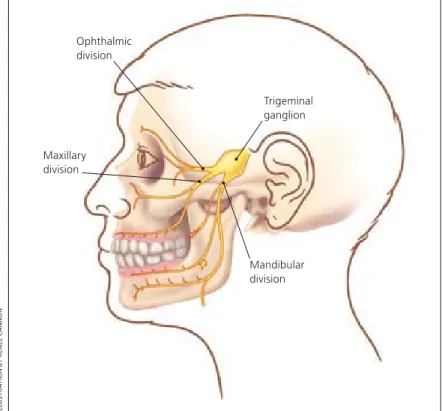
rigeminal neuralgia was first described at the end of the first century and was later given the name “tic douloureux” because of the distinctive facial spasms that often accompany the attacks. The International Headache Society has published criteria for the diagnosis of classical and symptomatic trigeminal neuralgia (Table 1).1 Inclassi-cal trigeminal neuralgia, no cause of the symptoms can be identified other than vas-cular compression. Symptomatic trigeminal neuralgia has the same clinical criteria, but another underlying cause is responsible for the symptoms. Trigeminal neuralgia may involve one or more branches of the tri-geminal nerve(Figure 1), with the maxillary branch involved the most often and the oph-thalmic branch the least.2,3The right side of
the face is affected more commonly than the left (ratio of 1.5:1), which may be because of the narrower foramen rotundum and fora-men ovale on the right side.2-4
The annual incidence of trigeminal neural-gia has been reported as 4.3 per 100,000 pop-ulation, with a slight female predominance (age-adjusted ratio of 1.74:1).2 Primary care
physicians might expect to encounter this condition two to four times over the course of a 35-year career. The peak incidence is at 60 to 70 years of age, and classical trigeminal neuralgia is unusual before age 40 years.2,3
The incidence of trigeminal neuralgia in patients with multiple sclerosis is between
1 and 2 percent, making it the most common associated disease.2 Patients with
hyperten-sion have a slightly higher incidence of tri-geminal neuralgia than does the general population.2There is no racial predilection.2
Trigeminal neuralgia is generally sporadic, although there have been reports of the dis-ease occurring in several members of the same family. Spontaneous remission is pos-sible, but most patients have episodic attacks over many years.
Pathophysiology
It has been proposed that the symptoms of trigeminal neuralgia are caused by demy-elination of the nerve leading to ephaptic transmission of impulses. Surgical speci-mens have demonstrated this demyelination and close apposition of demyelinated axons in the trigeminal root of patients with tri-geminal neuralgia.5 Results from
experi-mental studies suggest that demyelinated axons are prone to ectopic impulses, which may transfer from light touch to pain fibers in close proximity (ephaptic conduction).5
Current theories regarding the cause of this demyelination center on vascular compression of the nerve root by aberrant or tortuous vessels. Pathologic and radio-logic studies have demonstrated proximity of the nerve root to such vessels, usually the superior cerebellar artery.5 Relief of
symptoms by surgical techniques that sepa-rate the offending vessels from the nerve
Trigeminal neuralgia is an uncommon disorder characterized by recurrent attacks of lancinat-ing pain in the trigeminal nerve distribution. Typically, brief attacks are triggered by talklancinat-ing, chewing, teeth brushing, shaving, a light touch, or even a cool breeze. The pain is nearly always unilateral, and it may occur repeatedly throughout the day. The diagnosis is typically deter-mined clinically, although imaging studies or referral for specialized testing may be necessary to rule out other diseases. Accurate and prompt diagnosis is important because the pain of tri-geminal neuralgia can be severe. Carbamazepine is the drug of choice for the initial treatment of trigeminal neuralgia; however, baclofen, gabapentin, and other drugs may provide relief in refractory cases. Neurosurgical treatments may help patients in whom medical therapy is unsuccessful or poorly tolerated. (Am Fam Physician. 2008;77(9):1291-1296. Copyright © 2008 American Academy of Family Physicians.)
further strengthens this hypothesis. Demyelination has also been demonstrated in cases of trigeminal neuralgia associated with multiple sclerosis or tumors affecting the nerve root.
Multiple other causes of trigeminal neuralgia have been described, including amyloid infiltration, arterio-venous malformations, bony compression, and small infarcts in the pons and medulla. In most of these situ-ations, demyelination may also be an underlying cause. Most investigators now accept the theory that classical trigeminal neuralgia results from vascular compression of the nerve root. This leads to demyelination of the
nerve and the generation of ectopic impulses that are spread ephaptically to precipitate the typical attack. Diagnosis
The diagnosis of trigeminal neuralgia should be consid-ered in all patients with unilateral facial pain. Accurate and prompt diagnosis is important because the pain of trigeminal neuralgia can be severe. Other diagnoses must also be considered, particularly in patients with atypical features of the disease or “red flags” in the history or phys-ical examination(Table 2). In addition, it is important to distinguish classical from symptomatic trigeminal neu-ralgia for the purpose of treatment. Symptomatic trigemi-nal neuralgia is always secondary to another disorder, and treatment should focus on the underlying condition. HISTORY
Because trigeminal neuralgia is a clinical diagnosis, the patient’s history is critical in the evaluation. Patients with trigeminal neuralgia present with a primary description of recurrent episodes of unilateral facial pain. Attacks last only seconds and may recur infrequently or as often as hundreds of times each day; they rarely occur during sleep. The pain is generally severe, and is described as a stabbing, sharp, shock-like, or superficial pain in the dis-tribution of one or more of the trigeminal nerve divisions. Patients generally are asymptomatic between episodes, although some patients with long-standing trigeminal neuralgia have a persistent dull ache in the same area.
Talking, smiling, chewing, teeth brushing, and shaving have all been implicated as triggers for the pain. Even a breeze touching the face may cause a paroxysm of pain in some patients. In trigger zones—small areas near the nose or mouth in patients with trigeminal neuralgia— minimal stimulation initiates a painful attack. Patients with trigeminal neuralgia can pinpoint these areas and will assiduously avoid any stimulation of them. Not all patients with trigeminal neuralgia have trigger zones, but trigger zones are nearly pathognomonic for this disorder. The patient’s history is also important for ruling out other causes of facial pain. Because of the association Clinical recommendation
Evidence
rating References Physicians should obtain magnetic resonance imaging in all patients with suspected trigeminal neuralgia. C 3, 11-13 Carbamazepine (Tegretol) should be the initial treatment for patients with classical trigeminal neuralgia
because it has been found to be successful in most cases and no other medication has been shown to be superior in large studies.
A 15, 16, 41
Surgical options should be considered for patients who have persistent pain after trials with several medications or who have a relapse after initial success with medical treatment.
C 12-14
A = consistent, good-quality patient-oriented evidence; B = inconsistent or limited quality patient-oriented evidence; C = consensus, disease-oriented evidence, usual practice, expert opinion, or case series. For information about the SORT evidence rating system, see page 1205 or http:// www.aafp.org/afpsort.xml.
Table 1. IHS Diagnostic Criteria for Trigeminal Neuralgia
Classical
A. Paroxysmal attacks of pain lasting from a fraction of a second to two minutes, affecting one or more divisions of the trigeminal nerve, and fulfilling criteria B and C B. Pain has at least one of the following characteristics:
1. Intense, sharp, superficial, or stabbing
2. Precipitated from trigger zones or by trigger factors C. Attacks are stereotyped in the individual patient D. There is no clinically evident neurologic deficit E. Not attributed to another disorder
Symptomatic
A. Paroxysmal attacks of pain lasting from a fraction of a second to two minutes, with or without persistence of aching between paroxysms, affecting one or more divisions of the trigeminal nerve, and fulfilling criteria B and C
B. Pain has at least one of the following characteristics: 1. Intense, sharp, superficial, or stabbing
2. Precipitated from trigger zones or by trigger factors C. Attacks are stereotyped in the individual patient
D. A causative lesion, other than vascular compression, has been demonstrated by special investigations and/or posterior fossa exploration
IHS = International Headache Society. Information from reference 1.
between trigeminal neuralgia and multiple sclerosis, patients should be asked about other neurologic symp-toms, particularly those common in multiple sclerosis (e.g., ataxia, dizziness, focal weakness, unilateral vision changes). An evaluation for other diagnoses is indicated in younger patients, because classical trigeminal neural-gia is unusual in persons younger than 40 years.3
Trigeminal neuralgia pain is nearly always unilateral. In rare cases of bilateral trigeminal neuralgia, individ-ual attacks are usindivid-ually unilateral, with distinct episodes involving each side of the face at separate times. Symp-toms are always confined to the trigeminal nerve distri-bution, with most cases involving the second or third division, or both. The asymptomatic period between attacks is important to distinguish classical trigeminal neuralgia from other causes of facial pain, as well as from symptomatic trigeminal neuralgia. Patients with
trigeminal neuralgia have stereotyped attacks; a change in the location, severity, or quality of the pain should alert the physician to the possibility of an alternative diagnosis. PHYSICAL EXAMINATION
The physical examination in patients with trigeminal neuralgia is generally normal. Therefore, physical examination in patients with facial pain is most useful for identifying abnormalities that point to other diagno-ses. The physician should perform a careful examination of the head and neck, with an emphasis on the neurologic examination. The ears, mouth, teeth, and temporoman-dibular joint (TMJ) should be examined for problems that might cause facial pain.
The finding of typical trigger zones verifies the diagnosis of trigeminal neuralgia. Patients with classical trigeminal neuralgia have a normal neurologic examination. Sensory abnormalities in the trigeminal area, loss of corneal reflex, or evidence of any weakness in the facial muscles should prompt the physician to consider symptomatic trigeminal neuralgia or another cause of the patient’s symptoms.
ANCILLARY TESTING
Laboratory studies generally are not helpful in patients with typical symptoms of trigeminal neuralgia. Occasion-ally, TMJ or dental radiographs may be useful when TMJ syndrome or dental pain is in the differential diagnosis.
Magnetic resonance imaging (MRI) of the brain is use-ful to look for multiple sclerosis, tumors, or other causes of symptomatic trigeminal neuralgia, and it should be performed in the initial evaluation of all patients pre-senting with trigeminal neuralgia symptoms. One study found that specific clinical variables may be helpful in determining the likely utility of MRI, which may be use-ful in prioritizing MRI studies when there is limited MRI capacity.6Some studies have indicated that MRI may
pre-dict surgery outcomes based on findings of neurovascular contact or the volume of the affected trigeminal nerve.7-9
One recent study demonstrated that trigeminal reflex testing could distinguish classical from symptomatic trigeminal neuralgia with a sensitivity of 96 percent and a specificity of 93 percent.10Trigeminal reflex
test-ing involves electrical stimulation of the divisions of the trigeminal nerve and measurement of the response with standard electromyography apparatus. This testing is not readily available to most physicians, and its indica-tions and clinical utility are still unclear.
Figure 1.Trigeminal nerve.
Trigeminal ganglion Mandibular division Maxillary division Ophthalmic division
Table 2. Atypical Features Suggesting Symptomatic Trigeminal Neuralgia or an Alternative Diagnosis
Abnormal neurologic examination Abnormal oral, dental,
or ear examination Age younger than 40 years Bilateral symptoms Dizziness or vertigo
Hearing loss or abnormality Numbness
Pain episodes persisting longer than two minutes Pain outside of trigeminal
nerve distribution Visual changes ILL U S T R A TION B Y R E NE E C A NNON
DIFFERENTIAL DIAGNOSIS
Some disorders that might be included in the differential diagnosis of trigeminal neuralgia are listed inTable 3.11A
careful examination may disclose local findings indica-tive of otitis, sinusitis, dental disorders, or TMJ dysfunc-tion. A history of persistent pain or pain that occurs episodically in attacks lasting longer than two minutes eliminates classical trigeminal neuralgia and should lead to a search for other diagnoses. The pain of glossopha-ryngeal neuralgia, which may be triggered by talking or swallowing, is located in the tongue and pharynx.
Symptomatic trigeminal neuralgia is usually caused by multiple sclerosis or by tumors arising near the trigeminal nerve root. A history of previous neurologic symptoms and typical findings on MRI assist with the diagnosis of multiple sclerosis. Tumors involving the trigeminal nerve usually cause additional symptoms or examination find-ings that suggest the diagnosis, and these tumors are gener-ally visible on MRI. An algorithm for the diagnosis and
treatment of trigeminal neuralgia is pro-vided inFigure 2.12
Treatment
The initial treatment of choice for trigemi-nal neuralgia is medical therapy, and most patients have at least temporary relief with the use of selected agents. Patients who have no response to or who relapse with medical therapy should be considered for surgical treatment.12-14 Surgery may also be
consid-ered for patients who are intolerant of medi-cal treatment.
MEDICAL TREATMENT
Carbamazepine (Tegretol) has been studied extensively in trigeminal neuralgia, with one meta-analysis finding good evidence for its effectiveness.15A Cochrane review confirmed
that carbamazepine is effective for the treat-ment of trigeminal neuralgia.16The number
needed to treat has been calculated at 2.5 for trigeminal neuralgia. The number needed to harm for minor adverse events is 3.7, which was calculated using data for all conditions.16
Some authors have suggested that car-bamazepine is useful as a diagnostic trial for classical trigeminal neuralgia. Lack of response would suggest symptomatic trigeminal neu-ralgia or another diagnosis, both of which are less likely to respond to the drug. Dosages used have ranged from 100 to 2,400 mg per day, with most patients responding to 200 to 800 mg per day in two or three divided doses.
Carbamazepine should be the initial treatment for patients with classical trigeminal neuralgia. Other medi-cations may be tried if carbamazepine is unsuccessful or provides only partial relief. These may be substituted or added to carbamazepine as necessary. Baclofen (Liore-sal) in dosages of 10 to 80 mg daily has been shown to be useful.17Additional medications with reported success in
smaller studies or case reports include phenytoin (Dilan-tin), lamotrigine (Lamictal), gabapentin (Neuron(Dilan-tin), topiramate (Topamax), clonazepam (Klonopin), pimo-zide (Orap), and valproic acid (Depakene).13,18-23 Most
patients will respond, at least temporarily, to single or combination therapy with these agents.
A variety of other medications and modalities have been tried for treatment of trigeminal neuralgia. There are small studies reporting success with botulinum toxin type A (Botox) in some patients,24and one case report
of relief being experienced after an accidentally high Table 3. Differential Diagnosis of Trigeminal Neuralgia
Diagnosis
Features that differentiate from trigeminal neuralgia
Cluster headache Longer-lasting pain; orbital or supraorbital; may cause patient to wake from sleep; autonomic symptoms
Dental pain (e.g., caries, cracked tooth, pulpitis)
Localized; related to biting or hot or cold foods; visible abnormalities on oral examination Giant cell arteritis Persistent pain; temporal; often bilateral; jaw
claudication Glossopharyngeal
neuralgia
Pain in tongue, mouth, or throat; brought on by swallowing, talking, or chewing
Intracranial tumors May have other neurologic symptoms or signs Migraine Longer-lasting pain; associated with photophobia
and phonophobia; family history Multiple sclerosis Eye symptoms; other neurologic symptoms Otitis media Pain localized to ear; abnormalities on
examination and tympanogram
Paroxysmal hemicrania Pain in forehead or eye; autonomic symptoms; responds to treatment with indomethacin (Indocin)
Postherpetic neuralgia Continuous pain; tingling; history of zoster; often first division
Sinusitis Persistent pain; associated nasal symptoms SUNCT Ocular or periocular; autonomic symptoms Temporomandibular
joint syndrome
Persistent pain; localized tenderness; jaw abnormalities
Trigeminal neuropathy Persistent pain; associated sensory loss
SUNCT = shorter lasting, unilateral neuralgiform, conjunctival injection, and tearing. Information from reference 11.
The initial choice of treat-ment for trigeminal neural-gia is medical therapy.
discharge from a transcutaneous electrical nerve stim-ulation unit.25 Topical capsaicin (Zostrix) was helpful
for trigeminal neuralgia pain in one open-label trial,26
and intramuscular sumatriptan (Imitrex) was benefi-cial in one small, single-dose study.27One recent study
found that intranasal lidocaine (Xylocaine) significantly decreased second-division trigeminal neuralgia pain for more than four hours.28 Acupuncture, high-dose
dextromethorphan (Delsym), and topical ophthalmic anesthetic have been tried unsuccessfully in small tri-als.29-31A recent Cochrane review concluded that there
was insufficient evidence from randomized controlled trials to show significant benefit from non-antiepileptic drugs in patients with trigeminal neuralgia.32
SURGICAL TREATMENT
Surgical procedures may be percutaneous or open. The choice of procedure should be made after patient preference and the experience of the surgeon have been considered and the potential risks and benefits of each procedure have been evaluated. Most procedures provide effective short-term relief, but studies suggest that recurrence is likely
within several years for many patients.33-40
Percutaneous techniques include glycerol injection, balloon compression, radiofre-quency rhizotomy, and gamma knife stereo-tactic radiosurgery. These techniques offer the advantage of being relatively noninvasive, being outpatient procedures or requiring only a short hospital stay, and lacking life-threatening adverse effects. However, they may provide less long-lasting relief than the more invasive techniques and have a higher incidence of sensory loss, which may cause the patient significant discomfort and can be extremely difficult to treat.
Open techniques include partial trigemi-nal rhizotomy and microvascular decom-pression. These procedures involve posterior fossa exploration with its attendant risks, including stroke, meningitis, and death, although the reported incidence of these complications with microvascular decom-pression is less than 2 percent. Microvascular decompression appears to provide the longest lasting relief, with persistent relief at 10 years in more than 70 percent of patients.36,41,42It
has low risks of symptom recurrence and sensory loss, and is therefore a good choice for young, healthy patients, who have lower risks of adverse outcomes with the invasive surgery involved.
The author thanks Brian Selius, DO, and Azfar Ahmed, MD, for their assistance in the preparation and review of the manuscript.
The Author
RUDOLPH M. KRAFFT, MD, is an associate professor of family medicine at Northeastern Ohio Universities Col-lege of Medicine in Rootstown and director of the Fam-ily Medicine Residency at St. Elizabeth Health Center in Youngstown, Ohio. He received his medical degree from Jefferson Medical College of Thomas Jefferson University,
Diagnosis and Treatment of Trigeminal Neuralgia
Patient with unilateral, episodic facial pain History and physical examination consistent with trigeminal neuralgia?
No Yes
MRI; especially if atypical symptoms, abnormal examination, or age < 40 years
Evaluate for other causes
Abnormal?
No Yes
Treat underlying disorder Medical therapy with carbamazepine (Tegretol)
Resolution of pain? No Yes
Continue treatment Add second agent Resolution of pain?
No Yes
Continue treatment Surgical therapy Trial without medication after
several symptom-free months
Figure 2. Algorithm for the diagnosis and treatment of trigeminal
neuralgia. (MRI = magnetic resonance imaging.) Information from reference 12.
Philadelphia, Pa., and completed a residency in family medicine at St. Vin-cent Health Center in Erie, Pa.
Address correspondence to Rudolph M. Krafft, MD, FAAFP, 1053 Bel-mont Ave., Youngstown, OH 44504 (e-mail: rudolph_krafft@hmis. org). Reprints are not available from the author.
Author disclosure: Nothing to disclose. REFERENCES
1. Headache Classification Subcommittee of the International Headache Society. The international classification of headache disorders: 2nd ed.
Cephalalgia. 2004;24(Suppl 1):9-160.
2. Katusic S, Beard CM, Bergstralh E, Kurland LT. Incidence and clinical fea-tures of trigeminal neuralgia, Rochester, Minnesota, 1945-1984. Ann Neurol. 1990;27(1):89-95.
3. Cruccu G, Biasiotta A, Galeotti F, et al. Diagnosis of trigeminal neu-ralgia: a new appraisal based on clinical and neurophysiological find-ings. In: Cruccu G, Hallett M, eds. Brainstem Function and Dysfunction.
Amsterdam, the Netherlands: Elsevier; 2006:171-186.
4. Neto HS, Camilli JA, Marques MJ. Trigeminal neuralgia is caused by maxillary and mandibular nerve entrapment: greater incidence of right-sided facial symptoms is due to the foramen rotundum and foramen ovale being narrower on the right side of the cranium. Med Hypotheses. 2005;65(6):1179-1182.
5. Love S, Coakham HB. Trigeminal neuralgia: pathology and pathogen-esis [published correction appears in Brain. 2002;125(pt 3):687]. Brain. 2001;124(pt 12):2347-2360.
6. Majoie CB, Hulsmans FJ, Castelijns JA, et al. Symptoms and signs related to the trigeminal nerve: diagnostic yield of MR imaging. Radiology. 1998;209(2):557-562.
7. Erbay SH, Bhadelia RA, Riesenburger R, et al. Association between neu-rovascular contact on MRI and response to gamma knife radiosurgery in trigeminal neuralgia. Neuroradiology. 2006;48(1):26-30.
8. Kress B, Schindler M, Rasche D, et al. MRI volumetry for the preoperative diagnosis of trigeminal neuralgia. Eur Radiol. 2005;15(7):1344-1348. 9. Kuncz A, Vörös E, Barzó P, et al. Comparison of clinical symptoms and
magnetic resonance angiographic (MRA) results in patients with tri-geminal neuralgia and persistent idiopathic facial pain. Medium-term outcome after microvascular decompression of cases with positive MRA findings. Cephalalgia. 2006;26(3):266-276.
10. Cruccu G, Biasotta A, Galeotti F, Ianetti GD, Truini A, Gronseth G. Diag-nostic accuracy of trigeminal reflex testing in trigeminal neuralgia. Neu-rology. 2006;66(1):139-141.
11. Zakrzewska JM. Diagnosis and differential diagnosis of trigeminal neu-ralgia. Clin J Pain. 2002;18(1):14-21.
12. Delzell JE, Grelle AR. Trigeminal neuralgia. New treatment options for a well-known cause of facial pain. Arch Fam Med. 1999;8(3):264-268. 13. Scrivani SJ, Mathews ES, Maciewicz RJ. Trigeminal neuralgia. Oral Surg
Oral Med Oral Pathol Oral Radiol Endod. 2005;100(5):527-538. 14. Haanpää M, Truini A. Neuropathic facial pain. Suppl Clin Neurophysiol.
2006;58:153-170.
15. McQuay H, Carroll D, Jadad AR, Wiffen P, Moore A. Anticonvulsant drugs for management of pain: a systematic review. BMJ. 1995;311(7012): 1047-1052.
16. Wiffen PJ, McQuay HJ, Moore RA. Carbamazepine for acute and chronic pain. Cochrane Database Syst Rev. 2005;(3):CD005451.
17. Fromm GH, Terrence CF, Chattha AS. Baclofen in the treatment of tri-geminal neuralgia: double-blind study and long-term follow-up. Ann Neurol. 1984;15(3):240-244.
18. McCleane GJ. Intravenous infusion of phenytoin relieves neuropathic pain: a randomized, double-blinded, placebo-controlled, crossover study. Anesth Analg. 1999;89(4):985-988.
19. Zakrzewska JM, Chaudhry Z, Nurmikko TJ, Patton DW, Mullens EL.
Lamo-trigine (lamictal) in refractory trigeminal neuralgia: results from a dou-ble-blind placebo controlled crossover trial. Pain. 1997;73(2):223-230. 20. Cheshire WP. Defining the role for gabapentin in the treatment of
tri-geminal neuralgia: a retrospective study. J Pain. 2002;3(2):137-142. 21. Gilron I, Booher SL, Rowan JS, Max MB. Topiramate in trigeminal
neu-ralgia: a randomized, placebo-controlled multiple crossover pilot study.
Clin Neuropharmacol. 2001;24(2):109-112.
22. Lechin F, van der Dijs B, Lechin ME, et al. Pimozide therapy for trigeminal neuralgia. Arch Neurol. 1989;46(9):960-963.
23. Peiris JB, Perera GLS, Devendra SV, Lionel ND. Sodium valproate in tri-geminal neuralgia. Med J Aust. 1980;2(5):278.
24. Piovesan EJ, Teive HG, Kowacs PA, Della Coletta MV, Werneck LC, Sil-berstein SD. An open study of botulinum-A toxin treatment of trigemi-nal neuralgia. Neurology. 2005;65(8):1306-1308.
25. Thorsen SW, Lumsden SG. Trigeminal neuralgia: sudden and long-term remission with transcutaneous electrical nerve stimulation. J Manipula-tive Physiol Ther. 1997;20(6):415-419.
26. Epstein JB, Marcoe JH. Topical application of capsaicin for treatment of oral neuropathic pain and trigeminal neuralgia. Oral Surg Oral Med Oral Pathol. 1994;77(2):135-140.
27. Kanai A, Saito M, Hoka S. Subcutaneous sumatriptan for refractory tri-geminal neuralgia. Headache. 2006;46(4):577-582.
28. Kanai A, Suzuki A, Kobayashi M, Hoka S. Intranasal lidocaine 8% spray for second-division trigeminal neuralgia. Br J Anaesth. 2006;97(4):559-563. Epub 2006 Aug 1.
29. Millán-Guerrero RO, Isáis-Millán S. Acupuncture in trigeminal neuralgia management. Headache. 2006;46(3):532.
30. Gilron I, Booher SL, Rowan JS, Smoller MS, Max MB. A randomized, controlled trial of high-dose dextromethorphan in facial neuralgias.
Neurology. 2000;55(7):964-971.
31. Kondziolka D, Lemley T, Kestle JR, Lunsford LD, Fromm GH, Janetta PJ. The effect of single-application topical ophthalmic anesthesia in patients with trigeminal neuralgia. A randomized double-blind pla-cebo-controlled trial. J Neurosurg. 1994;80(6):993-997.
32. He L, Wu B, Zhou M. Non-antiepileptic drugs for trigeminal neuralgia.
Cochrane Database Syst Rev. 2006;(3):CD004029.
33. Zakrzewska JM. Trigeminal neuralgia and facial pain. Semin Pain Med. 2004;2(2):76-84.
34. Kannan V, Deopujari CE, Misra BK, Shetty PG, Shroff MM, Pendse AM. Gamma-knife radiosurgery for trigeminal neuralgia. Australas Radiol. 1999;43(3):339-341.
35. Oturai AB, Jensen K, Eriksen J, Madsen F. Neurosurgery for trigemi-nal neuralgia: comparison of alcohol block, neurectomy, and radiofre-quency coagulation. Clin J Pain. 1996;12(4):311-315.
36. Barker FG, Janetta PJ, Bissonette DJ, Larkins MV, Jho HD. The long-term outcome of microvascular decompression for trigeminal neuralgia.
N Engl J Med. 1996;334(17):1077-1083.
37. Kondziolka D, Lunsford LD, Flickenger JC, et al. Stereotactic radio-surgery for trigeminal neuralgia: a multiinstitutional study using the gamma unit. J Neurosurg. 1996;84(6):940-945.
38. Mendoza N, Illingworth RD. Trigeminal neuralgia treated by micro-vascular decompression: a long-term follow-up study. Br J Neurosurg. 1995;9(1):13-19.
39. Hai J, Li ST, Pan QG. Treatment of atypical trigeminal neuralgia with microvascular decompression. Neurol India. 2006;54(1):53-56. 40. Taha JM, Tew JM. Comparison of surgical treatments for trigeminal
neuralgia: reevaluation of radiofrequency rhizotomy. Neurosurgery. 1996;38(5):865-871.
41. Tronnier VM, Rasche D, Hamer J, Kienle A, Kunze S. Treatment of idio-pathic trigeminal neuralgia: comparison of long-term outcome after radiofrequency rhizotomy and microvascular decompression. Neurosur-gery. 2001;48(6):1261-1268.
42. Lichtor T, Mullan JF. A 10-year follow-up review of percutaneous micro-compression of the trigeminal ganglion. J Neurosurg. 1990;72(1):49-54.