Wellesley College
Wellesley College Digital Scholarship and Archive
Honors Thesis Collection
2017
Banking Crises at the Micro-Level: the Panic of
1837
Katharine Liang
[email protected]Follow this and additional works at:
https://repository.wellesley.edu/thesiscollection
This Dissertation/Thesis is brought to you for free and open access by Wellesley College Digital Scholarship and Archive. It has been accepted for inclusion in Honors Thesis Collection by an authorized administrator of Wellesley College Digital Scholarship and Archive. For more information, please [email protected].
Recommended Citation
Liang, Katharine, "Banking Crises at the Micro-Level: the Panic of 1837" (2017).Honors Thesis Collection. 457. https://repository.wellesley.edu/thesiscollection/457
Banking Crises at the Micro-Level: The Panic of 1837
Katharine Liang
Submitted in Partial Fulfillment
of the
Prerequisite for Honors
in Economics
under the advisement of Eric Hilt
April 2017
Acknowledgements
I would like to thank many people for their support and encouragement over the course of this year. I would like to thank my advisor, Professor Hilt, for sharing his passion for economic history and for his outstanding mentorship. Without his guidance, I could not have completed this thesis.
I would also like to thank Professor Pattanayak for teaching me the analytical methods that made this thesis possible. Working at the QAI has been an invaluable experience and I am extremely thankful for that opportunity.
I am also indebted to the Economics community at Wellesley, and would like to offer my gratitude to my professors over the years who have cultivated my fascination with Economics and pushed my curiosity and abilities. I am especially thankful to Professor Butcher and Professor Fetter for helping me develop my skills in Econometrics and to Professor Sichel for being an amazing, insightful, and understanding advisor.
Finally, I would like to thank my family for the constant support and encouragement. Especially Rob; thank you for your daily support throughout this whole process.
Table of Contents
Table of Contents
2
I. Introduction
4
II. Background
6
II.a. Politics and Banking
6
II.b. The Panic of 1837
13
III. Literature Review : What caused the Panic of 1837?
15
III.a. The Underlying Causes of the Panic
15
III.b. Proximate Causes of the Panic
17
IV. Hypotheses, Data and the Empirical Strategy
21
IV.a. Hypothesis for each Theory
21
IV.b. Data
26
IV.c. Empirical Strategy
28
V. New York Bank Balance Sheets
28
VI. All U.S. Bank Balance Sheets
31
VII. The Interbank Payments Network
33
VIII. Banknote Discounts
37
VIIII. Bank Failures
39
Abstract
In the substantial body of literature that has been written about the Panic of 1837, two schools of thought have become dominant. One focuses on domestic factors such as Andrew Jackson’s Specie Circular and legislation to distribute the federal surplus, while the other focuses on an international shock stemming from changes in the Bank of England’s lending policies. Although there is compelling evidence supporting each of the theories, the Panic remains imperfectly understood. This paper uses new bank-level data to econometrically test each of the existing theories and to explore an additional trigger. I find that the effects of the distribution to be overemphasized and that while some evidence supports the theory focused on international factors, the data strongly suggests that the Panic was in fact due to the collapse of confidence in Andrew Jackson’s pet banking system.
I. Introduction
The decade building up to financial panic that punctuated Andrew Jackson’s controversial career fascinates scholars for several reasons. The United States economy was booming as land sales, investment in state
infrastructure, and trade with Britain reached historic heights. As consumer confidence swelled, so did speculation, and the mild inflation that began at the start of the decade intensified. Politics proved to be equally sensational, starting with Jackson’s veto of the rechartering of the Second Bank of the United States. The ensuing ‘Bank War’ only intensified the longstanding disagreements over federal regulation of the banking system and served to crystallize the formation of the opposition Whig Party; political polarization only increased with Jackson's
experimentation with the pet banking system. The Panic, which came at the height of the boom, served as a dramatic end to the turbulent decade. It is not surprising that ever since, it has been the focus of considerable scholarship.
In the aftermath of the Panic, understanding the crisis became a polarizing political issue. Democratic Republicans blamed speculators for fueling the land boom, banks for the unscrupulous monitoring of their own balance sheets, and the “panic makers” in the opposition party for conspiring to bring about political change.1 On the other hand, Whigs blamed the veto of the re-chartering of the Second Bank of the United States, the subsequent removal of its deposits into state depositories, and Jackson’s Specie Circular for fueling inflation and the Panic. Their explanation, which would eventually become the ‘traditional’ interpretation of the Panic, held that the veto of the re-chartering of the Second Bank of the United States led to an overexpansion of the banking system that fueled reckless growth in public land sales. Jackson’s Specie Circular and the Deposit Act were the straw that finally broke the camel's back. It was not until Peter Temin’s groundbreaking use of cliometrics in his 1967 book, The
Jacksonian Economy, that the narrative experienced a shift. He not only found the sources of the Panic to be outside of the United States itself, but additionally exonerated Jackson and his policies from any significant responsibility. Temin observed that the reserve ratio of the banking system had not fallen below its 1833 levels, as it should have state banks were overextended credit after being freed from the SBUS. Instead, he traces attributes the inflation to an increase in the supply of specie from abroad. Although his work remains the standard interpretation of the Panic, significant emendations have been made by Engerman (1970) and Hugh Rockoff (1971), and in recent decades scholars such as Peter Rousseau (2002) and Jane Knodell (2006) have even provided new evidence in support of the traditionalists argument.
1
“Panic makers” are referred to in Lepler(2013: 184). Evidence on the Democrats blaming the Panic on bankers are found in Lepler(2013: 200), and Schreiber (1963:213) who quotes letter by Jackson “Every day that the directors of these Banks [the state banks] met with their boards they knew their liabilities and their assets… They were repeatedly and earnestly cautioned by the Treasury Department not to over issue… Still, in open violation of all obligation, they suspended specie payment in a time of profound peace, robbed the Treasury of millions of dollars.” original source, “Maryland Historical Magazine, VIII, Treasury Circular of July 3, 1837, Letters to Banks Treasury Correspondence. Amos Kendall to John Thompson, July 1 1837.
Lepler documents multiple cases where the democrats believed that the suspension was a Whig conspiracy. Andrew Jackson “all the Whig papers from New York to Louisiana recommending the suspension at the same time, and then suddenly as a waterspout, suspension of specie payments from one end of this content to another’ Lepler (2013, 210) Jackson to martin van buren June 6 1837, reel 23 , MVBLOC. Lepler also documents Bennetts’s article in the Courier and Enquirer who printed an article a day before the suspensions, with the belief that the banks were conspiring with each other to suspend specie to bring about political change. Lepler( 2013:199)
Today there exists a general consensus that the inflationary boom of the 1830s was in large part due to the rapid expansion in the monetary base from the inflow of specie from abroad.2 However, it remains unclear what exactly triggered the Panic. This uncertainty exists despite the wealth of literature for a multitude of reasons. For one, the literature has limited the scope of the analysis to focusing largely on the Second Bank of the United States and the inflation. But more importantly, in the 130 years since the Panic, there have been significant changes in the availability of data and the methodology with which to analyze it. Temin (1969) was the first to utilize quantitative evidence in the form of regional balance sheets. Building off of his argument, Rousseau (2001) and Knodell (2006) have also incorporated a greater amount of quantitative evidence. However, like Temin they only analyze the data at the regional level. Although extremely insightful in exploring the wider macroeconomic effects, there are limitations in the conclusions that could be drawn, because regional aggregates obscure the variation within the experiences of individual banks. Additionally, there have been significant changes in the way we understand banking crises. As Calomiris and Gorton (1991) suggest, they are no longer understood as inherent parts of the business cycle or a suboptimal feature of banking debt contracts, but rather stem from weaknesses that arise from a lack of important institutional structures. Exogenous shocks are no longer sufficient explanations for financial panics.
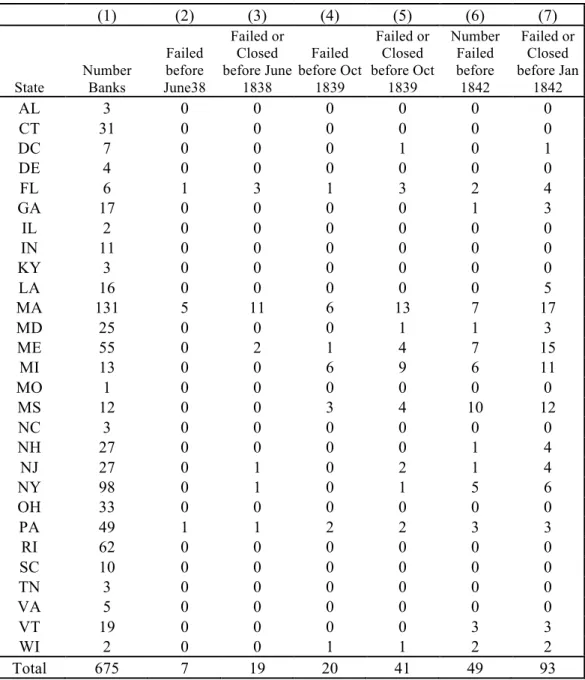
Utilizing firm-level data in the form of individual bank balance sheets and monthly banknote discounts, as well as new theories of financial panics, this thesis seeks to take a fresh look at the events surrounding the Panic of 1837. More specifically, I test the assertions of previous scholars and explore the possibility that the Panic was due to the loss of confidence in the Democratic Pet banking system. To do this at the firm level, I analyze the differences in the impact of the Panic on the assets, liabilities, and quoted banknote discounts for different banks. The results suggest that the transfers in 1836 and 1837 had a much smaller effect than what is described in the literature and in some cases was correlated with better outcomes. Theories pertaining to Temin’s (1969) argument are somewhat less conclusive. Although the states with the highest increases in banknote discount after the Panic include many major cotton producers, they also had significant public land sales and may have suffered from the bursting of a land bubble. The findings at all levels of analysis most convincingly suggest that the Panic was related to a loss of confidence in Jackson’s pet banks. In terms of deposits and banknote discounts, I find that deposit banks were more adversely affected after the Panic. Additionally, the more politically connected deposit banks in the Mid-Atlantic saw statically significant decreases for all balance sheet items, and a larger increase in their bank note discount. The paper is organized as follows. Section two presents historical background on Jacksonian banking and the Panic of 1837. Section three is a review of the literature, focusing specifically on the proximate causes of the Panic. Section four gives a very brief overview of all the collected data and the general empirical strategy. I also discuss what we would expect to see in the results given each of the theories presented in the past literature. The remainder of the discussion of the data and results is broken down into five separate sections corresponding to four levels of analysis: section five focuses on the balance sheets of New York banks, section six expands the analysis of balance sheets to include all banks in the United States, section seven explores the interbank payments network, section eight looks at the banknote discounts of all U.S banks and section nine looks at bank failures. Section ten concludes the paper by tying together the results and discussions in the preceding sections.
II. Background
II.a. Politics and Banking
In the early nineteenth century, banking was a highly politicized issue at both the state and national level. State governments were actively involved in the chartering and regulation of banks. Because the number of charters was significantly restricted, obtaining one was particularly difficult and often required political bargaining or bribery. The privileged few that were able to obtain a charter would receive monopoly rents and could provide party supporters with disproportionate credit and ownership.3 New York was a particularly acute example of this. In the 1830s, The Democratic party machine known as the “Albany Regency” strictly controlled the banking system and only granted charters to their political allies, who in turn would provide them the financial support to maintain political clout. Between 1830 to 1837, only 53 out of the 535 applications for bank charters were granted.4
At the national level, the Second Bank the United States (SBUS), which was the only federally chartered Bank, proved to be equally politicized. The Second Bank of the United States was opened in 1816 on the basis of a 20-year charter to act as the government's sole fiscal agent. To carry out its duties, it was granted the unique
privilege of opening multiple branches across the nation to better facilitate dispersal of revenue and financial capital, as well as receiving payments due to the U.S. government from custom duties, land sales and taxes. The nationwide branching also addressed the currency losses on interstate transfers and resulted in its notes being circulated widely as a national currency. Besides facilitating a majority of the country’s exchange business, the Bank also provided monetary stability by informally regulating state banks. As the federal depository, the Bank accumulated large amounts of state bank notes when individuals paid their taxes. The Bank could then rapidly redeem those notes at the state banks, which would prevent them from over issuing notes. By changing the rate at which they redeem the notes, the Bank was able to enforce an informal reserve ratio.5
The SBUS got off to a rocky start under its first president, William Jones, who both poorly managed the distant branches of the Bank and was accused of diverting the Bank's funds to speculate in the stock market.6 Although his replacement, Langdon Cheeves, was able to turn the Bank around under his more conservative management, the Bank’s true rise to prominence began after the appointment of its third president, Nicholas Biddle. Under his leadership, the Bank undertook an aggressive policy of expansion; by the time Jackson was up for reelection in 1832, the Bank had grown into a colossal financial network with twenty six branches7. At its peak, the Bank supplied 27 percent of the dollar value of all commercial loans, making it the largest supplier of credit in the
3Bodenhorn (2006: 231)
4 Hilt (2017,66)
5 (Catterall 1960 : 451) , Hammond(1957: 301), Timberlake (1961 : 314-41)This function of the Bank was popularized by Hammond (1957), however there is disagreement over how effectively the bank was at achieving this policy (Temin,1969 : 49). Importantly, it assumes that state banks were constantly trying to expand beyond their means, which coincides with Hammond’s interpretation of the ‘Bank War’ as struggle between the established capitalists dn the new upcoming entrepreneurs. However Redlich (1951:66) characterizes the 1820s and 1830s to be a period where banking “amonted to a continuous process of inflation”
6
(Rockoff, 2000 :648), Redlich (1951:129) 7 Knodell, (2017,:chapter 3)
country.8 Its power would generate resentment in hard money Jacksonian Democrats and in state banks, who were eager to expand but were hampered by the deflationary policies of the SBUS.9
Disagreement over the existence of a national bank and the federal government’s role in the regulation of state banks was not new. The SBUS faced the same rhetorical attacks as its predecessor with critics claiming that it infringed on states rights, that it was unconstitutional, and that it concentrated power in the hands of the mercantile elite and the foreign powers who had invested in a large portion of the Bank's capital stock. The animosity towards the Bank came to a head as its charter was about expire.
The Bank War
In anticipation of the expiration of the SBUS’s charter in 1836, Nicholas Biddle, with the help of the U.S. senators Daniel Webster and Henry Clay, applied to recharter the Bank in early 1832. After a fair amount of lobbying, their bill passed in Congress by a wide margin, but was ultimately vetoed by President Jackson. Jackson had a longstanding disdain for all banks, however it did not become clear that he was intent on destroying the SBUS until Henry Clay, his opponent in the 1832 Presidential election, aligned himself with the Bank (Hammond, 1957: 370).
In Jackson’s veto message, he attacked the Bank from multiple angles, claiming that it was a corrupt monopoly that only served the interests of foreign governments and privileged aristocrats. Although the message mostly resonated with hard money anti-bank agrarians and supporters of state control over banking, the destruction of the National Bank also found support from impatient state bankers eager to be free of the SBUS’s restraints as well as New York bankers who were eager to seize Philadelphia's status as the nation’s financial capital.
Rechartering the National Bank became a key issue in the presidential race between Jackson and Henry Clay. Although Jackson won in a landslide, the disagreements over federal regulation of the banking system continued to deepen political fault lines. Supporters of the National Bank, who also shared animosity towards Jackson, would eventually form the opposition Whig party. The following political struggle, which is now known as the “Bank War”, was only the beginning in a series of political regulatory interventions in the banking system.
Removal of the Deposits in 1833 and Creation of the Pet Banking System
Despite defeating the Bank’s attempts to acquire a new charter, Jackson feared that Biddle might make a second attempt to either override the veto or obtain a new charter by bribing Congressmen with the Bank’s funds. To further divorce the federal government from the SBUS, and to remove the power it wielded through holding federal deposits, Jackson issued an executive order in September 1833 to remove federal deposits from the Bank. This would return the nation to a system similar to the one it had prior to the opening of the SBUS, where the federal government relied on a set of state chartered banks to hold federal funds (Hammond, 1957: 227-230). Although this was not a new idea, the last time this strategy was deployed there were far fewer banks and the Treasury had
8
(Knodell 2006: 551) At its peak the Bank discounted 44 million in bills on personal security and 14.8 million in bills of exchange. U.S. Congress. Senate. 23 Cong., 2d sess. S. Doc. 373
9
There are many interpretations of the Bank War, Sherlinger interparty clash between working class Jacksonian Democrats and wealthy Whigs, Hammond, struggle between the established capitalist and a “newer, more numerous set” Hammond (1957:329)
Congressional consent (Gattell, 1964: 35). Since it was necessary to apportion the federal deposits on some basis, the possibilities for patronage were considerable, and to critics the pet banks represented the extension of the Jacksonian “spoils system” into banking.
The decision was highly controversial even within Jackson’s own cabinet: he had to replace the Secretary of the Treasury twice before finding someone willing to carry out the removal. He finally settled on close friends Amos Kendall and Roger Taney, who selected seven large banks all located in cities in the major Eastern seaboard under the guidance of Taney’s close personal friend Thomas Ellicott, president of the Union Bank of Maryland.10 Political favoritism and personal connections were an important part of the selection process, which was evident in the choice of the Union Bank of Maryland. The other banks included The Manhattan Company and The Mechanics Bank, which were the two largest Democratic banks in New York City; the Commonwealth Bank of Boston, whose president at the time was John K. Simpson, a close friend of Amos Kendall and a Democratic state politician; and the Girard Bank, which was one of the few banks to side against the SBUS in the Bank War. The one exception was the Bank of America, which had been recommended to Martin Van Buren by Cornelius Lawrence, the mayor of New York.11 Although the Bank of America had been a well known Federalist bank, its president, George Newbold, had a reputation for being a conservative banker; Taney hoped that he would take the lead in making sure the other deposit banks were being similarly cautious. Despite the selection of the Bank of America, the deposits were ultimately “in the hands of the politically friendly,” as Taney wrote to a Democratic colleague. Eventually, the deposit banks would become pejoratively known by its critics as Jackson's “pet banks”. 12
In the early stages of the pet banking system, the state banks were portrayed as a temporary solution while Taney and Jackson focused on destroying the National Bank. In the event that Biddle decided to retaliate against the pet banks, Taney secretly supplied each pet bank with a $500,000 draft with which to defend themselves.13 If Biddle decided to draw down their reserves by suddenly redeeming large quantities of their notes, the pet banks could retaliate by presenting the SBUS with bank drafts made payable to each respective pet bank. Although Taney encouraged the banks to increase lending on the basis of the newly received deposits, he made clear that the drafts were only to be used in an emergency. But to the chagrin of Taney, the pet banks had extended their loans on the basis of both the deposits and bank drafts, and soon found themselves deeply in debt to the National Bank. A month later they wrote to Taney asking for additional drafts. Although he initially refused, the collapse of the pet banking system only months after its inception would have been an embasrassment.14 Revelations of the secret drafts and Taney’s mismanagement of the pet banks proved to be quite the embarrassment and colored the public's perception
10 As Secretary of the Treasury, Taney would have been the one officially assigned to the role. Some sources say that Roger B. Taney was responsible for the selections. Schreiber (1963 : 197) and Hammond (1957: 412) suggest both Taney and Kendall were important but Kendall played larger role in reaching out to bankers. McFaul, page 60, Kendal and Taney. Gatell (1964 :36), Schreiber(1963: 196)
11
Gatell (1964 : 51) characterizes the Girard Bank as an opponent, but Hammond characterizes Bank of America as the only opposition bank. Other authors as well as contemporary evidence, follow Hammond’s characterization
12 Exchange between Taney and Niles on October 1833. Gatell (1964: 36)
13 The one exception was the Union Bank of Maryland who only received a $300,000 draft (Hammond, 1951: 421) (Catterall : 302). These drafts were massive compared to the total amount of federal funds in the state banks at the end of 1833. In the last quarter of 1833, the State Banks had around 34 thousand of the Federal Deposits while the SBUS had 9 million. Sen. Doc. 16, Statement A (23rd Cong., 1st Sess.) 14 Redlich (1951 : ch II. 177) and Hammond(1951 : 420) have slightly different interpretation for why They eventually gave the banks more drafts despite their disobedience. Like Redlich, Hammond notes that the recklessness of the pet banks actions would have been an embarrassment to Taney, but in Hammond’s description, Taney later decided that it they might as well ‘destroy’ the bank by drawing down the SBUS funds with new drafts.
of the pet banks.15 However, after suddenly receiving drafts for amounts of up to $500,000 at a time, Biddle angrily reacted by severely contracting lending, resulting in a recession known as “Biddle’s Contraction”.16 The financial pressure on the business community galvanized support for the pet banks in Congress. These same members eventually endorsed removal of the deposits and sanctioned the use of state depositories. As hopes of obtaining a new charter for a national bank grew slim, the pet banking experiment became a more permanent part of the Jacksonian administration and attributing economic prosperity to the success of the pet banking system became an important part of Jacksonian Democratic rhetoric.17
Selecting additional pet banks: 1833 to June 1836
From January 1834 to June 1836 the deposit banking system gradually grew from seven banks to thirty five.18 The importance of politics in the selection of the additional deposit banks after the original seven has been the subject of significant debate.19 However, it is readily apparent that both Taney and his predecessor chose the next pet banks based on political and personal connections, in addition to the financial stability of the banks. They both realized the importance of developing a system that was stable in the face of financial uncertainties and political opposition. Thus the chosen banks had to be able to provide financial stability in addition to political spoils. Taney’s selection of the initial seven pet banks, especially the Bank of America, demonstrated this. All seven of these banks had some of the largest amounts of capital in their respective states and were generally very reputable banks, which helped solidify the foundation for the system. The selections by Taney’s successor, Levi Woodbury, similarly reflected a focus on creating a system that balanced stability and serving the interests of the administration. However, as the selections expanded, political favoritism and personal connections began to play a larger role (Gatell, 1964: 36).
Many of the bank selections in the North confirmed critics’ perceptions that the selections prioritized political favoritism over financial security. Gatell (1964: 58) cites the Moyamensing Bank of Philadelphia, the Clinton Bank of Columbus, the Farmers and Mechanics Bank of Detroit and Mechanics and Farmers Bank of Albany as examples of banks that had strong Democratic ties but were weak in terms of capital. In particular, the Mechanics and Farmers Bank of Albany, which was known as the “Regency Bank”, served the interest of the New York Democratic party machine. Although its capital was only a fourth of the size of the average Wall Street pet bank, it received deposits through incessant lobbying. The selections in New England, were an even greater product of “pure politics, nepotism, or personal connections”: Secretary Woodbury’s father-in-law ran the Maine Bank of Portland; the Commercial Bank of New Hampshire had a Jacksonian President; the Bank of Burlington was close to
15 , "The Secretary of the Treasury - The Kitchen Cabinet - And the Bank." New York Spectator , November 18, 1833. "The Bank of The United States--The Kitchen Cabinet." Philadelphia Inquirer, November 18, 1833.
16Meerman (1963:379), Catterall (1903:314-331). The secret drafts were an immediate action that set Biddle off but there were many other reasons for Biddle’s decision to contract lending. It is suggested that he was attempting to force congress to pass a new charter by causing economic distress.
17
(McFaul, 1972: 70) 18
U.S. Treasury Reports in 1833 to 1837, corroborated by (Schreiber 1963 : 197), 19 Hammond (1957), Scheiber (1963), Gatell (1964), Taus (1943), Redlich (1951)
the administration; and John P. Van Ness, Democratic president of Bank of Metropolis, was a personal friend of Jackson’s (Gatall, 1964: 60).
There were anomalies, as Schreiber (1963) and Gattal (1964) have pointed out. The Treasury offered deposits to banks in South Carolina and Mississippi that had officers who were outspokenly anti-Jackson. The State Bank of North Carolina, the Bank of Louisville and the Bank of Michigan at Detroit all had boards that were controlled by Whigs.20 It is not particularly surprising that these banks were chosen despite their political persuasions. The Southern and Western states in particular relied more on the branches of the SBUS for banking, having established far fewer banks by the time of the selection.21 Michigan, Mississippi, Kentucky, Alabama, North Carolina, South Carolina and Virginia all had less than ten banks across the state in January 1836, whereas the New England and Mid Atlantic states had between twenty to one hundred banks per state.22 Selecting a depository in a state like Kentucky, where there were only three banks, meant choosing banks in the hands of the political opposition. In some cases, many of the banks in the South even declined to receive public deposits, but as Taney writes in an executive summary detailing the selections, several of them eventually “surrendered.”23
Regulation of pet banks: 1833 to June 1836
Around the time of the removal, Kendall advocated for a more centralized system that would replace some of the important roles of the SBUS. By concentrating specie and making all paper redeemable in pet banks located in the financial centers of the Mid Atlantic region, he hoped to create a system that would replace the SBUS’s role in facilitating a more uniform national currency. Furthermore, these Banks would also would replace the SBUS in intermediating international payments, which required large amounts of specie for export. However, as the Secretary of the Treasury, Taney envisioned a more decentralized system for monetary stability that depended on strong interbank relationships and mutual redemptions between the pet banks.24 Levi Woodbury seemed to have settled on a design that incorporated elements from both.
As Secretary of the Treasury, Woodbury kept the federal deposits heavily concentrated in the Wall Street pet banks (see Figure 1). As the financial capital of the country, New York City accumulated massive amounts of deposits through customs duties collected at its ports. These large deposit banks would in turn provide funds to a vast network of state banks which included other smaller pet banks. In his 1835 Treasury Report, Woodbury expressed that his confidence in the pet banking system was based on their strong creditor relationship to other banks. However, Woodbury's confidence was misplaced, since credits held at correspondent banks proved to be relatively weak assets in the face of Panic when confidence in banking structure was lost (McFaul 1972: 160).
20 Schreiber (1936:197) .Gatell(1964: 55) also identifies the Franklin Bank of Baltimore and the Bank of the State of North Carolina as opposition banks.
21Knodell (2006:550) measures the differences in banking services by region and finds that the Northwest and Southeast were more severely under banked, and were more adversely affected from the closing of the SBUS branches.
22
Using Weber Bank Census Dataset, The number of operating banks on the 1 January 1836 23
25th Congress 3rd session, Senate Document 302 , 1833 to 1834, Banks that Declined, Bank of South Carolina, Agricultural Bank Mississippi, Cape Fear Wilmington NC, State Bank, Planters and Mechanics Bank Charleston, Union Bank of South Carolina,
It is traditionally believed that Woodbury was unable to regulate the pet banks without Congressional oversight. However, Schreiber (1963) and McFaul (1972) have shown, through exchanges between the Treasury and the pet banks, that Woodbury did attempt to enforce a conservative reserve ratio especially on the pet banks, which held large amounts of federal funds. 25 However, as autonomous state banks they made the decisions on how to manage the massive quantity of federal funds in their possession. Given the limited resources at Woodbury’s disposal, he could not feasible regulate all of them with the same effectiveness (McFaul 1972: 176).
Despite the financial rationale behind Woodbury’s policies, the concentration of funds and the restrictions on lending at the New York banks renewed accusations that the administration was the servant of Wall Street interests. Furthermore, the restrictions to expand lending at the deposit banks brought criticisms from inflationists who argued that the federal deposits were being locked up in the Wall Street pet banks. Growing resentment contributed to the political support for the Deposit Act of 1836. 26
The Deposit Act of 1836
In 1835, the rapid growth of the American economy combined with Jackson's opposition to many forms of federal spending enabled him to pay off the federal debt.27 Increasing land sales and customs duties from trade with Britain only increased the federal surplus that was accumulating in the vaults of the few pet banks where Woodbury concentrated federal deposits. Either resentment against “locking up” funds in the strictly held deposit banks or fear of overexpansion on the basis of the growing deposits led to enough support in Congress to pass the Deposit Act of 1836 on June 23.28 The Act sought to “regulate the deposits of public money” and required the distribution of the federal surplus to the states in proportion with their population. In total, thirty seven million dollars was planned to be distributed in four equal installments as an interest-free loan starting in January 1837.29 The second part of the Act dealt with regulation of the deposit banks.
The Deposit Act of 1836 was the first time Congress took an active role in regulating the deposit banks. The legislation required that the Treasury select at least one depository in each state “located at, adjacent to, or convenient to the points or places at which the revenue may be collected or disbursed.” It restricted the pet banks from issuing notes less than five dollars in denomination and ruled that any bank that suspended specie payments would be discontinued as a depository.30 Most importantly, the Act stipulated that federal funds at deposit banks could not exceed three fourths of its paid-in capital. To keep in accordance with this rule, the number of pet banks grew from 36 to 81 over the course of six months.
25 Timberlake (1960: 113) argued that despite Woodbury’s claims, the banks were practically unregulated in the lack of Congressional oversight, and were perhaps even in violation of state reserve requirements Schlesinger, 1946: 218)
26 There are various Interpretations of the political origins of the Deposit Act, this analysis mostly draws from McFaul(1972: 165)
27 Hammond (1957: 451) Expenditures remained fairly constant over 1833 to 1836, A majority of the federal government's income came from customs, but from 1834 to 1835 land sales can also increased from 4,900 to 14,800
28
McFaul(1972: 113) , Trufant (1918), McGrane(1924), and Russell(1875) suggest that the deposit banks were overextending 29
U.S. Congress, Senate Doc No. 29, 24th Congress, 2d Session, p. 3,(1836), also Temin (1969:128), Schreiber (1963:202), Hammond (1957:453)
The Supplemental Transfers of 1836 and the Distribution of the Surplus in 1837
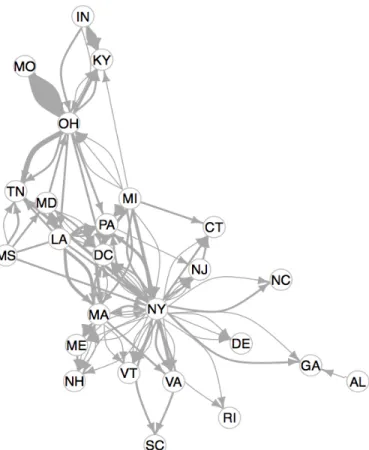
Because most of the surplus was concentrated in the deposit banks located in financial centers, Woodbury asked Congress if he could prepare for distribution by reallocating funds in a more equitable manner. Congress responded by amending the Act to give the Secretary of the Treasury the power to transfer funds in order to “produce a due equality, and just proportion, according to the provisions of said act.”31 Over the course of the six months between the enactment of the Deposit Act of 1836 and the first installment of the official distribution in 1837, Woodbury ordered around thirty eight million dollars in “supplemental transfers.” Twenty-six million of these transfers were completed by the end of 1836, and the rest in the early months of 1837. These transfers were thirty-five percent larger than those planned in the official distribution. Seventy percent of the transfers were ordered between banks in different states. Figure 2a summarizes the interstate transfers ordered from June 1836 to January 1837. The funds were generally directed from West to East and North to South. Clearly, banks in New York and the Western states were drawn on for the greatest amounts of funds in interstate transfers, whereas banks in the
Southeast, Mid-Atlantic, and New England states were net recipients. The chaotic pattern of transfers reflected the continued growth in the federal surplus that made Woodbury’s job increasingly difficult.
In 1836, speculation in land had spiraled out of control. In response, Jackson issued an executive order known as the Specie Circular, which was intended to prevent the excessive land sales that he attributed to banks who were overextending credit through the issuance of paper money. Hard money Jacksonians who feared the excessive growth of paper money enthusiastically supported the measure. The circular went into effect on the 1st of August 1836 and required federal land agencies to only accept specie in payment for public lands under 320 acres; by the 1st of December, it applied to all land.32 Although the effectiveness of Jackson's policy at stopping the speculation is under debate, receipts from public land sales remained enormous and the accumulation of specie in the western deposit banks further complicated Woodbury’s efforts to equitably distribute the deposits.33
Just as twenty-six million dollars in supplemental transfers was completed at the end of 1836, nine million dollars of the first installment of the official distribution of the surplus was ordered in January 1837. Despite mounting pressures in the money market, Woodbury continued with the second installment on the April 1st. Compared to the transfers in 1836, only 32 percent of eighteen million dollars were in interstate transfers.34 As seen from Figure 2b there were far fewer interstate transfers and most were drawn out of New York. In May, before the third installment could take place, the Panic occurred and banks suspended payments; all but five of the ninety one deposit banks were stripped of their status under the regulations of the Deposit Act.35 The suspension essentially marked the end of the pet banking system. In August, Woodbury still carried out the third installment by placing drafts on the former deposit banks; however, these payments were in depreciated currency. The fourth installment
31
U.S. Congress, Senate Doc No. 29, 24th Congress, 2d Session, Rousseau (2002, 464), Hammond (1957) 32
Hammond (1957,445), McGrane (1924, 79), Rousseau (2002, 459) 33
Smith, Walter Buckingham, and Arthur Harrison Cole. Fluctuations in American business 1790-1860. (1969). Table 2 Receipts from Sales of Public Lands, Quarterly 1816-1860,
34
House Executive Document No. 30, 25th Congress 1st session, pp 72-81, Sept 1837
was eventually abandoned in the face of mounting federal debt; ultimately only 28 million dollars of the original 37 million planned in the official distribution of the surplus was realized (Schreiber, 1963: 210).
II.b. The Panic of 1837
The Onset of the PanicThe early stages of the Panic began on May 2nd, following the publication of a New York Herald investigation on a scandal at the Mechanics Bank, a major Wall Street pet bank. The bank’s president, John Fleming, had entered into a check kiting scheme with the Dry Dock Company Bank and the Wall Street brokerage firm Bullock, Lyman & Co.36 After pledging his Dry Dock Bank shares as collateral, Fleming agreed to let the brokerage firm draw checks against him and place them between the Dry Dock Bank and the Mechanics bank. Through their operation, Bullock, Lyman & Co. was able to procure a loan of $254,000. In April, when the price of the Dry Dock Bank stock lost half of its value, Fleming stopped extending credit to the firm. Following their failure in early April, the brokerage firm owed the Dry Dock Bank up to $141,000. After the revelation of the scandal, Fleming, the cashier John Leonard and the vice president resigned under pressure from the board of directors.37 Although the Mechanics Bank emphasized that the change of officers was not due to financial difficulties and ensured that Mr. Fleming would remain on the board of directors, his untimely death set off panic amongst note holders and depositors, and a run began that very day. Following the run on the Mechanics bank, attention shifted to the Dry Dock Company. Rumors spread that New York City banks were refusing to accept Dry Dock notes and that they would not be able to sustain itself under financial pressure. Predictably, this set off a run at the bank. Despite bank officers’ assurances that all Dry Dock bills would be redeemable at any bank, it did little to stop the drain of its specie.38 Unable to sustain the withdrawals, the bank requested an injunction to temporarily shut down. The Panic quickly spread to note holders of other banks, triggering a “general run” on all of the banks in New York City. The Commercial Advertiser estimates that six hundred thousand dollars of specie were withdrawn on the 8th and seven hundred thousand on the 9th. After a private meeting on the 10th of May, New York banks collectively decided to suspend specie payments.39 The next day, banks in Mobile, Philadelphia, Hartford, Baltimore, Providence and upstate New York suspended. As the news traveled, the suspensions continued: Boston, Maine, and Washington D.C. on the 12th, New Orleans on the 13th, Cincinnati on the 17th, and Charleston, North Carolina, and Indiana on the 18th. Within a little over a week, most of the banks in the country had suspended payments.
Resolution of the Panic
Since banking was regulated by the states, the official response to the suspension fell to state legislatures. On the 16th of May, mere days after the Panic, the New York state legislature met and passed the Suspension Law,
36
Check kiting is a type of fraud that involves taking advantage of the duplicate money in the banking system during delays in processing a check. The scheme often requires the use of accounts at several different banks so money can be moved between them.
37
New York Herald May 2 1837 New York 38
Commercial Advertiser May 8 1837 New York 39The Commercial Advertiser May 10 1837 New York.
authorizing the banks to suspend payments for the next year without risking charter revocation. Banks in turn were required to receive the notes of any other bank in payments due to itself. In addition, the law also limited bank circulation to a percentage of each bank’s capital; to ensure this, they were required to regularly report their condition to the bank commissioner. Other states passed similar laws legalizing the suspension for the next year or until the New York banks resumed operations.40 Given the disreputable nature of suspending specie payments, many states did not pass laws legalizing the suspension, and wrote back to the Treasury in June with the excuse that their state legislature had not been in session.41 For the next year, state legislatures commissioned the investigation of all banks in each state, with reports sent to the Treasury to be discussed at the House of Representatives in June 1838. The banks that were found to be insolvent were eventually forced into closure.
Although New York's Suspension Law mandated resumption to occur in a year, New York bankers were eager to negotiate an earlier date. On the 19th of of August 1837, the New York banks sent an invitation to the banks of Philadelphia, beginning a long negotiation to coordinate a date of resumption. After months of stalling by banks in Philadelphia and a collective inability to reach a consensus, the frustrated New York bankers met on the 21st of April 1838, and announced that they would resume all specie payments on the 9th of May, much to the surprise of Philadelphia bankers.42 With the arrival of a
£
1,000,000 shipment of specie from the Bank of England in the spring of 1838 (which ignited the jealousy of Biddle, who had been attempting to receive loans from the Bank of England), the early resumption by New York banks went quite smoothly (Hammond, 1957: 480). Banks in New England quickly followed suit, while the Philadelphia and Southern banks resumed in the Fall.Aftermath of the Panic
Although data on the overall economic impact remains thin, the Panic of 1837 has been labeled by many as one of the worst panics in U.S. history.43 One author even dubbed it “America’s First Great Depression” (Alasdair, 2012). Rousseau (2002: 457) presents statistics by George Evans which showed that non-financial business incorporations fell by 80 percent and that growth per capita investment fell from 6.6 percent per year between 1831-1836 to 1 percent over the next five years. Contemporary sources paint a picture of widespread unemployment and failure. “In the Fall of 1837, nine tenths of factories in eastern states were said to be closed” and “one fourth of all firms connected with mercantile and manufacturing interest are out of business with dreary prospects for the coming winter.” (Reznik 1935: 665). Despite the surmised downturn, the economy quickly recovered from the Panic as
40
Other states include, New Hampshire, Connecticut, Rhode Island, Virginia, Alabama, Illinois. , 25th Congress, 3rd Session S.Doc. 30 41
Maine, New Jersey, Delaware, North Carolina, South Carolina, Kentucky, Tennessee, Ohio, Michigan, Missouri reported to the treasury that they had passed no law. Suspension laws are found in 25th Congress, 2nd Session H.Doc. 13 Suspension of specie payment. Summary of the investigation is found in Senate Document no. 471. 25th Congress 2nd session June 7 1838
42 After attempting to negotiate a resumption date several times, on the 26th of January the New Yorkers went to meet the Philadelphians who proposed to hold a convention on the 11th of April 1838 saying that the resumption date should incorporate the thoughts of everyone in the union. During the convention, a unanimous decision was not reached despite the New York bankers pressures for an early resumption. The
Philadelphian bankers said that it was too premature to make a decision, prompting the New York Bankers to resume on their own. Further details of the story are found in the New York Gazette and the Portsmouth Journal on Saturday May the 5th 1838
43
“The Panic of 1837 was one of the most disastrous crises this nation has ever experienced” - McGrane (1924: 1) ; “The financial panic that gripped the U.S. economy in the spring of 1837 was among the most severe in its’ history” - Rousseau (2002: 457) ; “One of the most severe, if perhaps, not the worst, was the panic of 1837.” - CF. Warren, G.F Pearson, ( 1935: 239) ; “The Panic of 1837, represents the greats economic downturn of the 19th century.“ - Alasdair (2012:37) ; “The Panic of 1837 was by far the most severe [panic] before the Civil War. “- Rockoff (2000: 666) ; “One of the worst of these panics in the United States was the Panic of 1837” - Weber et al.(2000:1) ; “ Between 1837 and 1843 American society was passing through the deep hollow of a greater economic cycle “Rezner (1935: 662)
exemplified by what Wallis refers as the “double headed peak” in Smith and Cole's wholesale price index. 44 Although the Panic of 1837 has been associated with causing the depression in the 1840s, the downturn came after the Panic of 1839, which Wallis(2001) has identified as a separate crisis due to collapse of internal improvement projects in the South and West following the massive increase in state borrowing after 1836.
The Panic’s effect on politics was equally profound. It added fuel to the debate about the role of government in the regulation of banking, solidifying the differences between the Democrats and the newly formalized Whig party. Anti-bank hard money radicalism increased Democratic hostility towards banks, alienating Democratic bankers who supported Treasury regulation through the pet banking system.45 After divorcing
themselves from banking, the Democrats devised an “Independent Treasury” that would serve as a federal depository but without any of the functions of a bank. The government's money would then remain safe in an institution that did not have the power to extend credit by issuing loans.
At the state level, the Panic ushered in an era of free banking, where state governments transitioned from “a fairly ‘iron handed’ regime to a more invisible one”.46 State banks also began to impose restrictions on banking. Louisiana passed the Banking Law of 1838 that required banks to hold specie at a 1:3 ratio with notes and limited note issuance to a maximum of a fifth of the bank’s paid-in capital (Trufant, 1918: 11). In 1838, Massachusetts created a Board of Bank Commissioners to annually examine the condition of all the banks in the state. Ohio passed a similar law in 1839, requiring the regular reporting of balance sheets, and well as restrictions on note issuance relative to specie reserves (Ghandhi, 2003: 18-24).
III. Literature Review: What caused the Panic of 1837?
III.a. The Underlying Causes of the Panic
“Inflation, crisis, deflation: This was the story of the Jacksonian Era” - Temin (1969: 176)
The rapid rise in prices, land sales and capital flows in the years preceding the Panic has been the focus of much of the existing literature. The earliest works echoed Whig contemporaries and attributed the overexpansion of the money supply to the destruction of the Second Bank of the United States.47 After the deposits were removed and put into state banks, the growing federal surplus allowed the state banks to overextend their lending which resulted
44 Wallis (2001:4) borrows the term “double headed peak” from R.C.O Matthews.in the The Trade Cycle (1960). Smith and Cole (1935:158) Statistics on the inflation also presented in Rockoff(2000: 654) Figure 14.1:the price and ratio of money to real gross domestic product 45
Scheiber(1963: 214), McFaul(1972: 210) 46
Although Bodenhorn (2001: 233) attributes the move to free banking as being part of a long chain of events starting in the late 1810s, he does acknowledge that the Panic was important in that it galvanized the support of those where were displeased with the corruption of the Democratic Party Machine.
in a “restless spirit of adventure and daring enterprise” that swept the nation (McGrane 1924: 91).48 The resulting speculative frenzy would eventually lead to the inflation and then Panic.
In 1957, Bray Hammond further popularized the inflationary effects of the Bank War. Depicting the Bank War as a struggle between well established capitalists and new entrepreneurs, Hammond saw the destruction of the Second Bank of the United States as removing the only restraint preventing overexpansion of credit at the state chartered banks. As a federal depository, the SBUS accumulated large amounts of state bank notes that it could rapidly redeem in large quantities at the issuing bank. This in turn required state banks to keep adequate reserves in case of a rash of sudden large withdrawals. By moderating the speed with which they redeemed state banks notes, the Bank could apply an informal reserve ratio requirement. Under the assumption that state banks were eager to expand beyond their means, the destruction of the only monitor over the state banks enabled the period of speculative growth.
This was the conventional wisdom until Peter Temin challenged Hammond’s analysis. Using the Friedman-Schwartz framework to decompose the estimates of the money stock into its basic components, Temin first pointed out the simple fact that the reserve ratio of the banking system did not fall below its level in the 1830s, like it should have if the destruction of the Second Bank unleashed reckless banking. Rather than lowering their reserve ratios, banks were able to expand because the overall level of specie reserves was increasing. Through the analysis of each link in a causal chain, Temin identifies Mexico as the main source of the specie and finds that it was retained due to changes in the ability of the U.S. to use bills of exchange drawn on English merchants when trading with China after the Opium War. Temin then realizes that all else equal the inflation should have corrected itself as individuals chose cheaper foreign goods over more expensive American ones, which would lead to an outflow of specie. However, it did not because capital flows from British investments in American assets underwrote a trade deficit which resulted in the continued retention of the specie in the U.S. Building off of Temin’s work, Williams (2016: 3) identifies another source of the accumulation of specie in the nation’s banks. Starting with expansion of British joint stock banking acts of 1826, Williams traces the explosive growth in the flow of short term lending into the US by focusing on the major trade artery linking cotton production in the South to the Lancaster region of the UK. Together the “capital flow bonanza”, and the retention of silver from Mexico, would increase the money supply and cause the inflation.49
There is general consensus behind Temin's identification of the source of the inflation. However, some remain skeptical of his exoneration of Jackson's Bank War. Engerman (1970: 726) finds that the removal of the SBUS resulted in a loss of confidence in state banks, which increased the currency-deposit ratio leading to a decline in the money supply. Accounting for the “investment club” nature of commercial banking at the time, Knodell (2006: 557) identifies 45 to 52 percent of observed growth in bank credit in the Southwest and 26 to 46 percent in Northwest as stemming from excessive credit growth that accompanied the removal of the Second Bank.
Furthermore, she notes that the replacement of the relatively conservative Second Bank branches with new plantation and property banks, which financed long term debt in land and state infrastructure, also increased the
48
Trufant: the surplus revenue, . Trufant argument slightly different, but mechanism is the same. Role of SUBUS different Removal of the deposits into the pet banks, and the surplus that was distributed. who lent money to speculators
overall level of risk in the banking system. Regardless of the Bank War’s true effects, the rapid price inflation was readily apparent, and it resulted in the monetary pressure leading up the Panic.
III.b. Proximate Causes of the Panic
There are two general schools of thought regarding the triggers of the Panic. The first, held by most of the early historians and revived by Rousseau (2002), focuses on some combination of domestic factors such the Specie Circular, the supplemental transfers in 1836, and the distribution of the surplus in 1837. The second, which is held by Temin (1969), focuses on international factors such as increases in the Bank of England’s discount rate and the tightening of its lending policies. The earliest work actually emphasized both international and domestic forces, but as the use of quantitative techniques increased, arguments became sharper and ideas evolved to become increasingly divergent.
The ‘Traditionalists’ (1837 - 1957)50 - Limited by the availability of data and computing power, the earliest
literature on the Panic provided more of a detailed narrative of events, with evidence in the form of written exchanges amongst important figures and contemporary news reports. While they differ in some nuanced ways, a majority of the earliest theories have emphasized the distribution of the surplus and the Specie Circular as having triggered the Panic. Without giving much detail on the direction or amount transferred in 1836 and 1837, the Traditionalist authors have argued that the distribution of the surplus caused the movement of specie “in opposition to the normal course of trade”, and that it locked up funds in transit.51 The Specie Circular, which had taken effect around the same time, exacerbated the problem further by draining specie from the East to be used to pay for land purchases in the West.52 The inadequate movement of specie to support the growing land sales burst the land bubble, causing the price of land to drop significantly.53 While early scholars have stressed Jacksonian policy, many also acknowledged the specie calls from English creditors as playing an important role in contributing to the tipping point in New York.54 Hammond even thought, “Although the Specie Circular and the Distribution were important domestic disturbances, they were minor besides other evils produced by the speculation and hasty expansion in the transatlantic economy comprising Britain and America” (1957: 457).
Timberlake (1960) - Responding to the work of the Traditionalists, Timberlake finds that that the Specie Circular had a negligible effect on the economy due to the relatively small size in the reduction of land sales relative to GNP. Instead, he points to the official distribution of the surplus in 1837, but distinguishes his argument by specifying that the reason the transfers were so harmful was not because funds were “locked up” in transit. Instead, it was because substantial amounts of specie were drained from the New York City banks in the interstate portion of the transfers. Timberlake begins by deducing that the government could not have required that all transfers be in
50 Bourne (1885), Russell (1896), Trufant (1918), Benton (1854-56), Hammond (1957), McGrane (1924), Woofter (1940), Conway (1939), Catterall (1903)
51 The specific traditionalists are Bourne (1885) , Sumner (1899: 280), Hammond (1957: 456).
The quote “in the opposition to the normal course of trade” comes from Timberlake(1960:111) who is quoting Bourne (1885) 52
Bourne (1885: 35), McGrane (1924: 92). Rousseau (2002: 460) mentions this in his background. Temin (1969: 121) also discusses the traditionalists theories on the Specie Circular.
53
Rousseau (2002: 465) references Traditionalists argument that the flow of specie to the west was inadequate to support pace causing a break in land prices ushering the panic. Also mentioned in Bourne (1885) and Bancroft (1914)
specie given the fact that the whole banking system had only 40.2 million total in specie and the deposit banks only had 15.52 million (Timberlake, 1960:113). He then posits that only the interstate transfers must have been in specie because state depositories and deposit banks within the same state cooperate to ease the facilitation of payments. To bolsters his argument, Timberlake shows that the total amount of specie at deposit banks fell by 4.94 million from November 1, 1836 to August 15, 1837, which coinciding with the 5.58 million needed for the interstate portion of all four of the installments of the distribution. Since only the first two installments could take place before the Panic, Timberlake then highlights the 2.9 million of the 18 million in interstate transfers that were actually distributions in the first two installments, noting that the 1.431 million that was drawn on New York City deposit banks was disportionately heavy. Despite the relatively small amount of specie being drawn, Timberlake concludes that the distribution resulted in a “seven fold contraction of bank credit” because of the fractional reserve basis on which the banks operated (Timberlake, 1960 :115).
Schreiber (1963) - Although he devotes much of his analysis to the pet banking system, Schreiber (1963) also responds directly to Timberlake's arguments. He first calls for the further investigation of the claim that the Specie Circular had a negligible effect, arguing that although it did not reduce aggregate demand, it did cause a net increase in demand for specie in the West. This would naturally have had a significant effect on state banks, who would be called on to provide the specie. He provides evidence of correspondence between banks and the Treasury, documenting the movement of large amounts of specie from New York banks to Western banks.55 Schreiber also questions Timberlake's assumption that only the interstate transfers were in specie, finding evidence that transfers to both “neighboring and distant institutions alike often had to be paid in specie rather than in bank credits or paper.”56 Additionally, he points out that Timberlake failed to discuss the supplemental transfers of 1836, which were significantly larger than the ones in 1837 and involved a higher number of interregional transfers. Schreiber concludes that the total amount of transfers carried out “dealt a severe blow” to banks who were also experiencing an asset freeze as bills of exchange became uncollectable due to the decline in prices (Scheiber 1963: 209).
Temin (1969) - Although Temin acknowledges that the Specie Circular and the distribution of the surplus may have contributed to the crisis, he is unconvinced by the previous literature. Temin first disputes the claim that the Specie Circular caused the movement of specie from East to West on the grounds that: 1) there is a lack of banking statistics to support this fact and 2) the reserve ratio of banks in the West should have risen relative to the ones in the East, but only the reserve ratios of the banks in the Northwest rose by any significant amount.57
Furthermore, he observes that even if specie had accumulated from land sales, the Western banks could have gotten the specie without taking it from the Eastern banks since the total amount of specie in the country was rising. To counter the distribution of the surplus, Temin adopts Timberlake's assumption that the interstate transfers were in specie and concludes that the 2.9 million in interstate transfers was too small to have caused the Panic. He further diminishes the effects of the official distribution by suggesting that the interstate transfers were likely to not have
55 Scheiber (1963: 206) “Letters from Banks” Treasury Correspondence. Bank of Michigan reported that they brought $500,000 in coin from New York. The Commercial Bank of Cincinnati imported more than $300,000 in specie from June to October, and then another $150,000 in mid October.
56
Schreiber (1963: 207) Footnote 46, Correspondence from James Hall to Woodbury on October 15 in the “letters from banks Treasury correspondence” and T.P Handy to J.Woodbridge on September 1 1836 in the Commercial Bank of Lake Erie Papers.
been in specie. Noticing that transfers were through large commercial cities to outlying districts, Temin suggests the transfers were probably paid in drafts on those large commercial cities since “drafts on the cities were more
desireable than specie (before May 10).” 58
In response to the supplemental transfers in 1836, Temin uses Woodbury's summary address to Congress to first note that these transfers were not actually to geographically relocate funds in preparation, but were actually due to the provision in the Deposit Act of 1836 that required banks to only hold deposits amounting to three fourths of their paid-in capital. Despite acknowledging that these supplemental transfers were fairly large and placed strain on the banking system, Temin points out the fact that large government transfers were quite common. From June 1835 to April 1836 the Treasury also transferred around 18 million in government deposits. Although these were only half the size as those in 1836, when measured relative to the total amount of federal deposits at the time, they appear similar in size (Temin 1969: 135). After rejecting the Specie Circular and the distribution of the surplus as triggers of the Panic, Temin finds an explanation elsewhere.
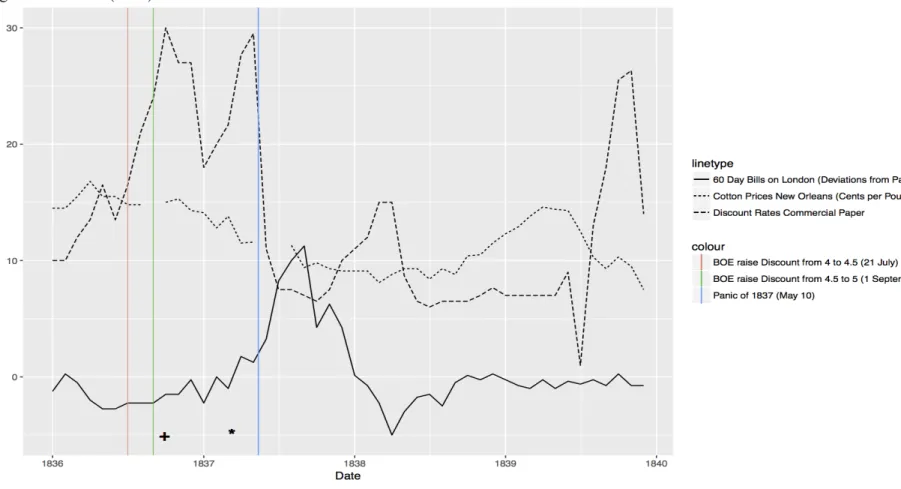
According to Temin, the Panic came in two stages. First, in the summer of 1836, the Bank of England raised its discount rate and imposed restrictions on the availability of credit by instructing its Liverpool branch to reject bills drawn on houses involved in American trade. The scarcity of credit was reflected in the rise in the discount rate on commercial paper and the price of foreign exchange in late 1836. The rate was maintained until the second stage, when the resulting financial pressure and changes in the foreign demand for cotton caused a drop in its price in early 1837. As a result, debts secured on cotton became uncollectable and banks found their assets to be either worthless or highly illiquid, thus forcing them to suspend payments (Temin, 1969: 141).
The primary evidence Temin uses to construct the timeline of events is summarized in Figure 3. After the Bank of England raised its discount rate in late 1836, credit became scarce and the discount rate on commercial paper increased at rate of around 2 percent per month, reaching a peak of 30 percent in October 1836. Since the market for foreign exchange was the major channel through which changes in Britain could influence the United States, Temin (1969:145) also notes that the price of foreign exchange also began to rise, reaching a peak in the second quarter of 1837. To explain why the discount rate would rise in late 1836 and be “maintained for about six months” until the crisis, Temin notes that in the second quarter of 1837 the price of cotton dropped severely which resulted in the second spike in the discount rate as well more firm failures (Temin 1969: 146).
Temin documents the widespread firm failures, beginning with the New Orleans cotton factor Herman Briggs & Co59 A week after hearing news of the Herman failure, one of their major creditors, J.L & S Joseph & Co. of New York, also had to close its doors in early March 1837. The Josephs were a particularly reputable bill brokerage firm in New York, and their failure is cited by Temin as the beginning of the Panic.60 As the pressure continued the number of firm failures increased. On April 8 the Journal of Commerce reported 93 failures in New York. A week later and the New York Courier and Enquirer reported that ten to twelve first rate houses, and forty to
58 Temin (1969: 132) also quotes Biddle who wrote in a letter to John Q. Adams saying “there Is no individual and no state in the union that would not prefer payments in New York or the North Atlantic cities, to payments elsewhere; and for the obvious reason that money is worth more than else where”, Original source: Biddle letter to John Q. Adams on November 11, 1836.
59
Lepler (2013, 109) also attributes the pressure to change from the Bank of England, and attributes the Herman failure as the start of the Panic. An in depth exploration of the Hermann failure is presented in pages 109 -111
fifty second rate houses in New Orleans had failed. To further bolster his argument that the Panic was the result of international forces, Temin highlights that the types of firms that failed were more exposed to “changes in international affairs” and were located in the principal markets for cotton. Furthermore, he claims that the suspension in New Orleans was independent of the suspension in New York given the time it took for news to travel. Since the In doing this, he establishes that the Panic also began in the two principal markets for cotton. Given the financial pressure, firm failures, and suspensions in both New Orleans and New York, Temin concludes that the crisis must have originated in international affairs and was transmitted through the price of cotton (Temin 1969: 144).
Rousseau (2002) - Although Rousseau acknowledges the disturbances that stemmed from the actions of the Bank of England, he argues that these events only played a secondary role in the Panic. He challenges Temin, noting: 1) there was an eight month gap between the Bank of England's actions and the Panic; 2) the fall in the price of cotton came after the annual export cycle; and 3) the Bank of England’s rejection of U.S bills was quickly reversed.61 Having also rejected Timberlake’s theory on the grounds that the interstate transfers were too small to have had a significant effect, Rousseau found the cause of the Panic elsewhere.
Revisiting the domestic disturbances touched upon by Schreiber (1964),Rousseau makes the argument that the interstate portion of the supplemental transfers in 1836 in conjunction with the Specie Circular drained the reserves of the New York City deposit banks, precipitating the Panic. From the 1st of September 1836 to the 1st of May 1837, the specie reserve of New York deposit banks fell from from 7.2 million to 1.5 million, leaving them vulnerable to sudden demands for specie by the British. Noting that the unit banking system was particularly fragile, the drain of specie could have easily caused widespread runs.
To make the argument that the interstate transfers were actually in specie and that they did cause a drain from the New York banks, Rousseau (2002) analyzes the monthly balance sheet items for deposit banks and Congressional documentation of individual transfers aggregated by region. He shows that the interstate transfers in 1836 followed a particular geographic pattern that followed existing transportation networks, claiming that such a pattern would not have been observed if Woodbury intended the transfers to only involve bookkeeping or paper transactions (Rousseau 2002: 472). As further evidence that the transfers involved specie, he also showed that the New York pet banks lost 4.4 million of specie around the same time that they lost 5.3 million of their deposits between August to March 1837 (Rousseau 2002: 468). If all of the interstate transfers were in specie, then large amounts of interstate transfers drawn from the New York banks would explain the reduction in their reserves.
The second part of Rousseau’s argument emphasizes the Specie Circular. In the past, the main problem in implicating the Specie Circular has been that there has been poor evidence of the alleged drain of specie from the East to West. To address that, Rousseau uses Woodbury’s records of deposits made in pet banks made by federal receivers.
61 Rousseau (2002: 486) does acknowledges that the rejection of commercial bills from the American Houses could have caused uncertainty in the U.S money market when the news was accidentally leaked to one of the American Houses (Wiggins & Co.) three weeks before the rejections were to begin. However, the Bank of England's actions were severely criticized by the British financial community, which led to a quick reversal of the policy. There was only a two week window between news of the rejection and the reversal.
Since Woodbury’s summary displayed the composition of the deposits, Rousseau was able to determine how much was paid in gold and estimates that around 8.4 million dollars of the of land sales between July 1836 to May 1837 were in specie. Although the summary only showed land sales after the Circular began, Rousseau makes the assumption that specie was seldom used before to emphasize that the amount of land paid for in gold increased significantly after the Circular. To further highlight the specie drain, he elaborates on the strange pattern in the monthly data for Michigan, which saw its deposits by land office receivers fall from 0.75 million in August to 0.09 million and then rise back to 0.29 million in October. Because Michigan was fairly isolated, importing specie was more difficult, resulting in a delay in the flow of specie that severely inhibited land sales. But once they received specie, land sales would rapidly continue, which explains the jump from 0.09 to 0.29 million. To show that the specie was being drained specifically out of the New York banks, he explains that gold was used in the majority of the transactions in Michigan as a less costly alternative to silver. Gold was also commonly used for international transactions, and accumulation in New York which was the financial capital at the time. Therefore, he concludes that the gold being sent to supply Michigan was most likely from New York.
Today there is a general consensus that both international and domestic factors played a role in
precipitating the Panic. Sylla (2001), Wallis (2001) and Williams (2016) find both Temin and Rousseau’s evidence to be compelling but remain impartial as to which had a greater effect.62 Despite all the insightful contributions towards identifying economic disturbances leading up to the Panic, there is still room for better understanding what was most impactful in triggering it. Most of the evidence documents regional patterns, which has made it difficult to rule out any of the theories. Additionally, the evidence relating to transfers focuses more on determining the substance, size, and movement of funds rather than quantifying the direct impact on banks. Although
Rousseau(2001) and Timberlake(1960) present balance sheets, they are regionally aggregated and only include deposit banks.
IV. Hypotheses, Data and the Empirical Strategy
To test the various theories, I utilize individual bank balance sheets and banknote discounts to examine which variables are correlated with more adverse effects on a bank’s assets, liabilities, and quoted banknote discount after the Panic. Variables of interest inc