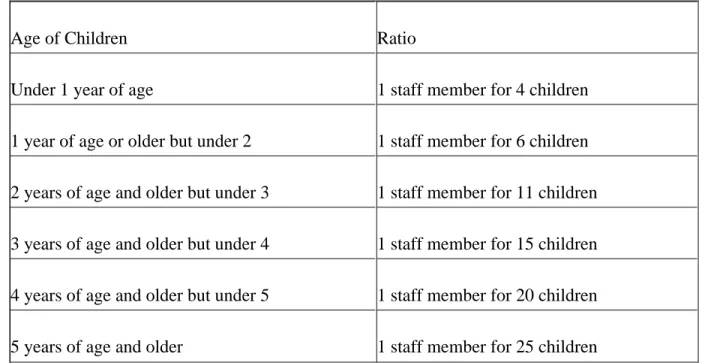
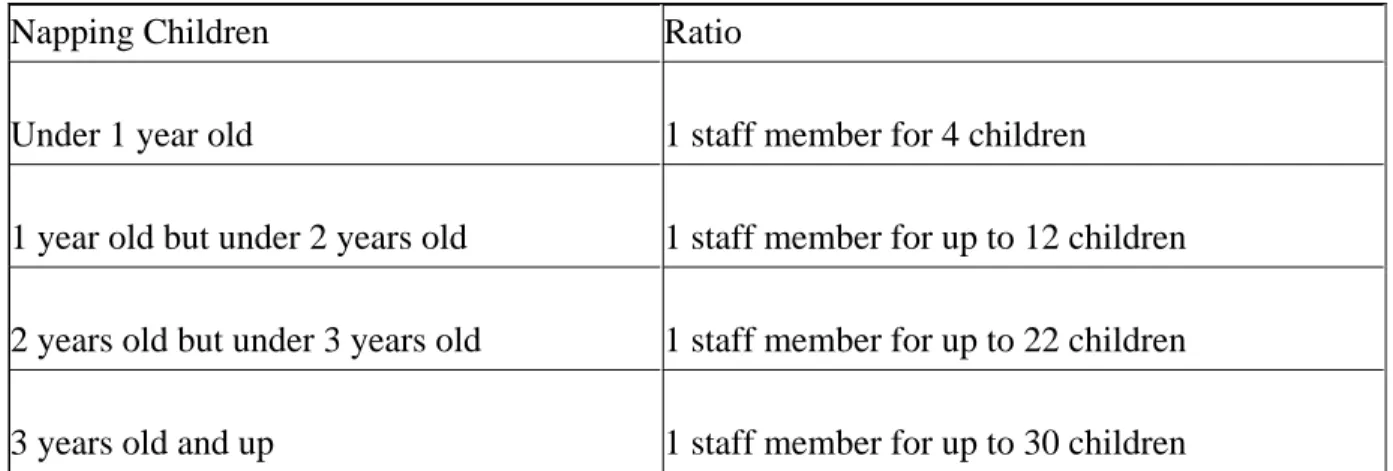
Chapter 7 CHILD CARE* __________
*Editor's note: Ord. No. 2004-02, § 1, adopted Feb. 10, 2004, amended former Ch. 7, Arts. I, II, in its entirety to read as herein set out. Former Ch. 7 pertained to similar subject matter and derived from Ord. No. 94-2, § 1, adopted Jan. 11, 1994. Material in brackets has been added by the editor for purposes of clarification.
Cross references: Licenses, ch. 20; licensing of family day care homes, § 20-291 et seq.
State law references: Child care facilities, § 402.301, F.S. et seq. __________
Article I. Licensure of Child Care Facilities Sec. 7-1. General provisions.
Sec. 7-2. Declaration of intent. Sec. 7-3. Definitions.
Sec. 7-4. Minimum standards for child care personnel. Sec. 7-4.01. Personnel education requirements.
Sec. 7-4.02. Personnel training.
Sec. 7-4.03. Child care licensing seminar. Sec. 7-4.04. Minimum age requirements. Sec. 7-4.05. Health requirements.
Sec. 7-4.06. Ratios of staff-to-children and direct supervision. Sec. 7-4.07. Child discipline.
Sec. 7-5. Physical facilities. Sec. 7-5.01. General requirements. Sec. 7-5.02. Usable indoor space. Sec. 7-5.03. Outdoor play space. Sec. 7-5.04. Napping space.
Sec. 7-5.05. Toilet and bath facilities. Sec. 7-5.06. Nighttime child care. Sec. 7-5.07. Isolation area.
Sec. 7-5.08. Fire safety.
Sec. 7-6. First aid treatment, emergency procedures and communicable diseases. Sec. 7-6.01. First aid treatment and emergency procedures.
Sec. 7-6.02. Communicable diseases--Mildly-ill children. Sec. 7-7. Nutrition, food preparation and food service. Sec. 7-7.01. Dietary standards.
Sec. 7-7.02. Alternate nutrition plan. Sec. 7-7.03. Snacks.
Sec. 7-7.04. Special diets.
Sec. 7-7.05. Other nutritional concerns. Sec. 7-7.06. Menus.
Sec. 7-7.07. Feeding procedures. Sec. 7-7.08. Seating.
Sec. 7-7.10. Catering service.
Sec. 7-7.11. Equipment and utensils. Sec. 7-8. Admission and record keeping. Sec. 7-8.01. Enrollment information.
Sec. 7-8.02. Health examinations and health maintenance. Sec. 7-8.03. Personnel screening and health records. Sec. 7-8.04. Signed statements.
Sec. 7-8.05. Medication records.
Sec. 7-8.06. Records of unusual incidents and accidents. Sec. 7-8.07. Record of fire drills.
Sec. 7-8.08. List of substitutes. Sec. 7-8.09. Field trips.
Sec. 7-8.10. Release of child from child care facility. Sec. 7-8.11. Referenced forms, brochures, etc. Sec. 7-9. Transportation.
Sec. 7-10. Insurance. Sec. 7-11. License. Sec. 7-11.01. License.
Sec. 7-11.02. Exemption from licensure. Sec. 7-11.03. License fee.
Sec. 7-11.04. Fee schedule.
Sec. 7-11.05. Licensing procedure. Sec. 7-11.06. Transfer of ownership. Sec. 7-11.07. Advertisement.
Sec. 7-11.08. Provisional license. Sec. 7-11.09. Denial of license. Sec. 7-11.10. Inspections.
Sec. 7-11.11. Violations/penalties. Sec. 7-11.12. Administrative fines. Sec. 7-11.13. Disciplinary action.
Sec. 7-11.14. Creation and powers of the hearing officer. Sec. 7-11.15. Notice of hearing
Sec. 7-11.16. Hearing procedures.
Sec. 7-11.17. Findings and recommendations of the hearing officer. Sec. 7-12. Temporary suspension of a facility's license.
Sec. 7-12.01. [Temporary suspension.] Sec. 7-13. Drop-in child care.
Sec. 7-13.01. Exempted provisions.
Sec. 7-14. Before-and after-school programs. Sec. 7-14.01. Additional requirements. Sec. 7-14.02. Exempted provisions. Sec. 7-15. Indoor recreational facility. Sec. 7-15.01. Additional requirements. Sec. 7-15.02. Exempted provisions. Sec. 7-16. Urban child care facility. Sec. 7-16.01. Requirements.
Sec. 7-16.02. Exempted provisions. Sec. 7-17. Weekend child care. Sec. 7-17.01. Requirements.
Article II. Standards for Substantial Compliance Sec. 7-18. General intent.
Sec. 7-18.01. Applicability. Sec. 7-19. Definitions.
Sec. 7-20. Background screening.
Sec. 7-21. Minimum standards for health, safety, and sanitation. Sec. 7-21.01. Personnel training.
Sec. 7-21.02. Minimum age requirements. Sec. 7-21.03. Health requirements.
Sec. 7-21.04. Ratios of staff-to-children. Sec. 7-21.05. Child discipline.
Sec. 7-22. Physical facilities. Sec. 7-22.01. General requirements. Sec. 7-22.02. Usable indoor space. Sec. 7-22.03. Outdoor play space. Sec. 7-22.04. Napping space.
Sec. 7-22.05. Toilet and bath facilities. Sec. 7-22.06. Nighttime child care. Sec. 7-22.07. Isolation area.
Sec. 7-22.08. Fire safety. Sec. 7-23. Weekend child care. Sec. 7-23.01. Exempted provisions.
Sec. 7-24. First aid treatment, emergency procedures and communicable diseases. Sec. 7-25. Nutrition, food preparation and food service.
Sec. 7-25.01. Food protection and service. Sec. 7-26. Admission and record keeping. Sec. 7-27. Transportation.
Sec. 7-28. Insurance.
Sec. 7-29. Registration procedures. Sec. 7-30. Transfer of ownership. Sec. 7-31. Advertisement.
Sec. 7-32. Inspections.
Sec. 7-33. Enforcement of requirements for substantial compliance.
Article III. Specialized Child Care Facilities for the Care of Mildly-Ill Children Sec. 7-34. General intent.
Sec. 7-34.01 Applicability. Sec. 7-35. Definitions.
Sec. 7-36. Background screening.
Sec. 7-37. Minimum standards for health, safety, and sanitation. Sec. 7-37.01. Personnel training.
Sec. 7-37.02. Additional requirements for personnel training. Sec. 7-37.03. Minimum age requirements.
Sec. 7-37.05. Ratios of staff-to-children. Sec. 7-37.06. Child discipline.
Sec. 7-38. Physical facilities. Sec. 7-38.01. General requirements. Sec. 7-38.02. Additional requirements. Sec. 7-38.03. Usable indoor space.
Sec. 7-38.04. Additional requirements for usable indoor space. Sec. 7-38.05. Outdoor play space.
Sec. 7-38.06. Napping space.
Sec. 7-38.07. Additional requirements. Sec. 7-38.08. Toilet and bath facilities. Sec. 7-38.09. Additional requirements. Sec. 7-38.10. Nighttime child care.
Sec. 7-38.11. Additional requirements for nighttime child care. Sec. 7-38.12. Isolation area.
Sec. 7-38.13. Fire safety.
Sec. 7-39. First aid treatment, emergency procedures and communicable diseases. Sec. 7-39.01. First aid treatment and emergency procedures.
Sec. 7-39.02. Additional requirements for first aid treatment and emergency procedures. Sec. 7-39.03. Communicable diseases/mildly-ill children.
Sec. 7-40. Nutrition, food preparation and food service. Sec. 7-40.01. Food protection and service.
Sec. 7-40.02. Additional requirements for food protection and service. Sec. 7-41. Admission, assessment and record keeping.
Sec. 7-41.01. Additional requirements. Sec. 7-42. Transportation.
Sec. 7-43. Insurance. Sec. 7-44. License.
Sec. 7-44.0l. Additional requirements for license. Sec. 7-45. Weekend child care.
Sec. 7-45.01. Exempted provisions.
ARTICLE I. LICENSURE OF CHILD CARE FACILITIES Sec. 7-1. General provisions.
Short Title: Article I of this Ordinance sets forth the minimum standards for licensing of child care facilities. Article II sets forth requirements for "substantial compliance" for those child care facilities and arrangements not subject to licensure under this Ordinance. Article III sets forth requirements for specialized child care facilities for the care of mildly-ill children. This Ordinance shall be known and cited as the Broward County Child Care Ordinance.
(Ord. No. 2004-02, § 1, 2-10-04) Sec. 7-2. Declaration of intent.
The Board of County Commissioners finds and declares that the reasonable control and regulation of activities related to the health, welfare, and safety of children in child care is necessary. It is the intent of the Board of County Commissioners to adopt such minimum standards as are necessary to protect persons in or attending child care facilities or other types of child care arrangements in Broward County.
(Ord. No. 2004-02, § 1, 2-10-04) Sec. 7-3. Definitions.
For the purposes of this Ordinance, the following terms shall have the meaning indicated in this section. No attempt is made to define ordinary words that are used in accordance with their established dictionary meaning except when necessary to avoid
misunderstanding.
(1) Adult shall mean a person eighteen (18) years of age or older.
(2) Before- and/or after-school child care shall mean child care programs provided for children enrolled in five-year-old kindergarten and grades one (1) or above, which are time limited to before and/or after a routine school day, or which extends to full days during school holidays. Before- and/or after-school child care programs shall meet all the requirements for a child care facility except those requirements that are specifically exempted.
(3) At-risk shall mean a child who has deafness, hearing impairment, blindness, visual impairment, physical (orthopedic) disability, speech impairment, health or development impairment, mental retardation, serious emotional disturbance, specific learning
disabilities, or special needs who, by reason thereof, requires special services. (4) Child shall mean a person under eighteen (18) years of age.
(5) Children with disabilities shall mean children who have disabilities related to deafness, hearing impairment, blindness, visual impairment, physical (orthopedic)
handicap, speech impairment, health or development impairment, including AIDS-related viruses, mental retardation, serious emotional disturbance, or specific learning disabilities who by reason thereof require special services.
(6) Child care shall mean the care, protection, and supervision of a child for a period of less than twenty-four (24) hours a day on a regular basis, which supplements parental care, enrichment, and health supervision for the child, in accordance with the child's individual needs, and for which a payment, fee, grant, or other type of financial arrangement is made for care.
(7) Child care facility shall mean a place or child care arrangement other than an occupied residence that provides care for more than five (5) children unrelated to the operator and that receives a payment, fee, grant, or some other form of compensation for any of the children in child care whether or not operated for profit. The definition of a child care facility includes public school programs referenced in Section 402.3025(1)(b), Florida Statutes. The following arrangements are not included in the definition of a child care facility and are exempt from licensure under Article I of this Ordinance:
a. Religious-affiliated child care facilities described in Section 402.316, Florida Statutes; however, exempt facilities must comply with the requirements for substantial compliance under Article II of this Ordinance;
b. Public school programs referenced in Section 402.3025(1)(a), Florida Statutes; c. Non-public schools and their integral programs, except as provided in Section 402.3025, Florida Statutes; however, exempt non-public schools must comply with the requirements for substantial compliance under Article II of this Ordinance;
d. Summer camps having children in full-time residence;
e. Bible or other religious schools normally conducted during vacation periods and that are sponsored and supervised by a recognized religious group or institution;
f. Summer day camps for school age children; and
g. Operators of transient establishments, as defined in Chapter 509, Florida Statutes, that provide child care services solely for the guests of their establishment or resort; provided, however, that all persons providing child care at the establishment or resort are
background screened according to the requirements set forth in this Ordinance. h. All programs that provide child care exclusively for children grades six (6) and above, regardless of location.
(8) Child care for mildly-ill children shall mean the care of children with short term illness or symptoms of illness or disability, provided either as an exclusive service in a center specialized for this purpose, or as a component of other child care services offered in a distinct part of a regularly licensed child care facility, for a period of less than twenty-four (24) hours per day.
(9) Child care personnel shall mean all owners, directors, employees, volunteers, part-time workers, and substitutes working in a child care facility. The term does not include persons who work in a child care facility after hours when children are not present. The term "child care personnel" shall also include any reference herein to "staff," "staff member," or "employee." For purposes of background screening, the term "child care personnel" includes: (a) any member of a child care facility director's family who is over the age of twelve (12) years, or (b) any person over the age of twelve (12) years residing with a child care facility director, if the child care facility is located in or adjacent to the home of the director, or if the family member of, or person residing with, the child care facility director has any direct contact with the children in the facility during its hours of operation.
Members of the director's family, or persons residing with the director who are between the ages of twelve (12) years and eighteen (18) years shall not be required to be
fingerprinted, but shall be screened for delinquency records.
For purposes of background screening, the term shall also include persons who work in child care programs that provide care for children fifteen (15) hours or more each week in public or non-public schools, summer day camps, family child care homes, and
religious-affiliated child care facilities otherwise exempt under Section 402.316, Florida Statutes. The term does not include persons who work in public and non-public school programs during regular school hours, or after hours for activities related to a school's program for grades kindergarten through 12 pursuant to Section 1006.25, Florida Statutes.
A volunteer who assists on an intermittent basis for less than forty (40) hours per month is not included in the term "child care personnel" for the purposes of background
screening and training, provided that the volunteer is under the direct and constant supervision of the director or a designee of the director who meets the requirements set forth in Sec. 7-4 of this Ordinance. Students who observe and participate in a child care facility as part of their required course work shall not be considered child care personnel, if such observation and participation are on an intermittent basis and the students are under the direct and constant supervision of child care personnel.
(10) Contagious disease shall mean a type of infectious disease caused by receiving living germs directly from a person afflicted with the disease, or by contact with a secretion of an afflicted person, or by some object handled or used by an afflicted person.
(11) Department shall mean the State of Florida, Department of Children and Families, abbreviated and referred to in this Ordinance as "DCF."
(12) Direct supervision shall mean watching and directing the children's activities within close proximity within the same room inside or within a designated outdoor play area and responding to each child's needs. Child care personnel and volunteers at a facility must be assigned to provide care to a specific group of children and be present with that group of children at all times during the day including during meals, napping, snack time, and transportation of children.
(13) Director shall mean any on-site individual who is ultimately responsible for the daily operation, and supervision of a child care facility. The director must leave a staff person in charge in his/her absence who has a Child Development Associate ("CDA") or Child Development Associate Equivalent ("CDAE") as a minimum qualification
whenever the director is absent more than one (1) hour and there are thirty-nine (39) or more children present.
(14) Division shall mean the Children's Services Administration Division, Human Services Department, Broward County, Florida.
(15) Drop-in child care shall mean child care provided occasionally in a child care facility in a shopping mall or business establishment whose sole purpose is to provide babysitting for no more than a four (4) hour period and where the parent remains on the premises of the shopping mall or business establishment at all times. Drop-in child care arrangements shall be licensed and must meet all the requirements for this type of child care arrangement set forth in Sec. 7-13 of this Ordinance. Drop-in child care shall not refer to child care arrangements in health clubs/spas/gyms, bowling alleys, hotels/resorts, athletic training/ instructional facilities, or similar-type establishments, or to short-term care in a licensed child care facility. A determination as to whether an arrangement is considered to be a drop-in child care facility will be made by the local licensing agency on a case-by-case basis.
(16) Elementary school-age child shall mean a child attending public and non-public elementary school who has attained the age of five (5) years by the preceding September 1.
(17) First aid training shall mean the successful completion of a course of instruction designed to provide fundamental principles, knowledge of, and skills in first aid and accident prevention directly related to the care of children.
(18) Health provider consultant shall mean a Florida licensed pediatric physician; a Florida licensed family practitioner; a physician's assistant; an advanced registered nurse practitioner (ARNP) with appropriate pediatric experience; or a registered nurse with experience in pediatric nursing, who supervises or provides direction to the licensed health caregiver and is available for consultation.
(19) Hearing officer shall mean a person designated by the County Administrator to preside over hearings as specified in this Ordinance.
(20) Indoor recreational facility shall mean an indoor commercial facility established primarily for the purpose of entertaining children in a planned fitness environment through equipment, games, and activities in conjunction with the provision of food service, which includes providing snacks, and which provides child care for a particular child no more than four (4) hours in any one (1) day. An indoor recreational facility must be licensed as a child care facility; however, the facility is exempt from the minimum outdoor square footage per child requirement specified in Sec. 7-5.03 of this Ordinance, if the indoor recreational facility has, at a minimum, three thousand (3,000) square feet of usable indoor floor space.
(21) Infant shall mean a child less than twelve (12) months of age.
(22) Isolation area shall mean a room or a series of rooms within the child care facility for mildly-ill children, which provides for separate airflow and physical separation from the rest of the facility. The isolation area must include a separate toilet, handwashing facility and diaper changing area. These areas shall be utilized when caring for children with contagious diseases.
(23) Legal age shall mean a person eighteen (18) years of age or older.
(24) Licensed health caregiver shall mean, at a minimum, a licensed practical nurse who has knowledge and experience in the routine medical needs of mildly-ill children, is trained to perform the written physical assessment, and is under the direction of a health provider consultant.
(25) Local licensing agency shall mean the Child Care Licensing and Enforcement Section, Children's Services Administration Division, Human Services Department, Broward County, Florida.
(26) Medication shall mean any substance or preparation which is used for the purposes of prevention or treatment of an injury, illness, or disease.
(27) Mildly-ill children shall mean children exhibiting illnesses or symptoms of illnesses, as defined in Article III of this Ordinance, which have caused or would cause them to be excluded from regular child care settings, as outlined in Sec. 7-6.02(a)(2)(a-j) and who need special attention and supervision, and meet the admission criteria for mildly-ill child care programs as described in Sec. 7-41 and the applicable subsections of this Ordinance.
(28) Nighttime child care shall mean child care during that time after 6:00 p.m. and prior to 6:00 a.m. Eastern Standard or Daylight Savings Time. Child care for twenty-four (24) hours or more is defined as residential care and is governed by the state pursuant to Chapter 409, Florida Statutes. Such care is not governed under the terms of this
(29) Owner shall mean any individual or proprietary entity holding the child care facility's license and vested with the ultimate authority and responsibility for the administration and operation of the facility.
(30) Parent shall mean a child's natural parent, adopted parent, guardian, or legal custodian appointed by a court of competent jurisdiction.
(31) Preschooler shall mean a child over thirty-six (36) months of age.
(32) Public and non-public school programs shall mean those programs referenced in Section 402.3025, Florida Statutes, and shall not include religious-affiliated child care facilities that provide child care programs pursuant to Section 402.316, Florida Statutes. Certain public and non-public school programs will require licensure under Article I of this Ordinance, and others not subject to licensure may be required to meet the
requirements for substantial compliance under Article II of this Ordinance. (33) Religious-affiliated child care facilities shall mean those child care facilities operating pursuant to Section 402.316, Florida Statutes, that are exempt from licensure under Article I of this Ordinance but must meet the standards and requirements for substantial compliance under Article II of this Ordinance.
(34) Sanitize shall mean, with respect to cleaning linens, adding one-quarter ( 1/4) cup of bleach per gallon of water to the final rinse cycle of the wash in an effort to eliminate children's exposure to disease micro-organisms.
(35) Screening shall mean the act of assessing the background of child care personnel, which includes, but is not limited to, review of local criminal records checks through local law enforcement agencies, fingerprinting for all purposes and records checks required in this Ordinance, statewide criminal records checks through the Florida Department of Law Enforcement, federal criminal records checks through the Federal Bureau of Investigation, and employment history checks.
Screening for volunteers included under the definition of "child care personnel" includes only local criminal records checks through local law enforcement agencies for current residence and residence immediately prior to employment as a volunteer, if prior residence is different than the current one. If prior residence was outside of Broward County, statewide criminal records correspondence checks through the Department of Law Enforcement must be submitted to the local licensing agency.
(36) Single-service articles shall mean any cups, containers, closures, plates, straws, place mats, napkins, doilies, spoons, stirrers, paddles, knives, forks, wrapping materials and all similar materials which are constructed wholly, or in part, from paper,
paperboard, molded pulp, foil, wood, plastic, synthetic or any other readily destructible material, and are intended by the manufacturer to be for a one (1) time, one (1) person use, and then discarded.
(37) Substantial compliance shall mean compliance with the minimum standards set forth in Article II of this Ordinance for background screening of child care personnel, and health, safety, and sanitation requirements. Public and non-public schools and their integral programs, except as provided in Section 402.3025, Florida Statutes, and religious-affiliated child care facilities operating pursuant to Section 402.316, Florida Statutes, are exempt from licensure pursuant to Article I of this Ordinance but shall be required to meet the standards and requirements for substantial compliance set forth in Article II of this Ordinance prior to operating.
(38) Substitute: A substitute shall refer to an individual who is considered an employee of a child care facility and who provides services to, for, or at the facility in the absence of regular staff members and who has successfully obtained the background screening clearance based on the requirements set forth in Sec. 7-4 of this Ordinance prior to employment.
(39) Summer day camp shall mean recreational, educational, and/or other enrichment programs operated during summer vacations for children who are five (5) years of age on or before September 1 of the current school year and older. Section 409.175, Florida Statutes, requires that owners, operators, employees, and volunteers working in day or residential summer camps be screened as outlined in Chapter 435, Florida Statutes. (40) Toddler shall mean a child twelve (12) to thirty-six (36) months of age. (41) Training coordinating agencies shall mean authorized contract providers,
designated by DCF and responsible for the coordination of child care personnel training. (42) Urban child care facilities shall mean child care facilities located in urban areas as determined by the local licensing agency and meeting the minimum standards set forth in Sec. 7-16 of this Ordinance.
(43) Usable indoor space shall mean that space available for indoor play, classrooms, children's work areas or nap space, excluding means of egress and permanent fixtures. (44) Volunteer shall mean a person who provides services to, for, or at a child care facility in the presence or absence of regular staff members for no compensation. A volunteer must be at least eighteen (18) years of age to be counted in the staff-to-children ratio.
(45) Weekend child care shall mean child care provided between the hours of 6:00 p.m. on Friday and 6:00 a.m. on Monday.
(Ord. No. 2004-02, § 1, 2-10-04)
Sec. 7-4. Minimum standards for child care personnel.
(a) All child care personnel must be of good moral character in order to work in a child care facility as determined through screening and background checks. Screening and background checks shall include, but are not limited to, contacting previous employers, local, state and federal law enforcement agencies, and any other resource deemed appropriate by the local licensing agency for a determination of moral character, including a delinquency screening check, if applicable. All child care personnel must obtain a successful background screening clearance based on the requirements in this section prior to employment in a child care facility.
(1) The screening and background checks shall include a one-time employment history check for the last two (2) years or last three (3) jobs, if applicable, a local criminal
records check every five (5) years, a state criminal records check every five (5) years and a federal criminal records check.
(2) For all child care personnel, the owner or the designee of the owner shall be
responsible for obtaining the screening and background checks required in paragraph (1) above.
(3) The owner or director of the child care facility shall inform all child care personnel of the requirement to inform the owner or director immediately if the employee has been found guilty of, regardless of adjudication, or if the employee has entered a plea of nolo
contendere (no contest) or guilty to, any of the disqualifying offenses listed below in Sec. 7-4(b) of this Ordinance while employed at the child care facility.
(4) In addition to the screening and background checks conducted by the local licensing agency pursuant to paragraph (b) below, the local licensing agency, at its discretion, may conduct supplemental screening and background checks when relevant information is subsequently brought to the attention of the local licensing agency.
(5) The screening and background checks for child care personnel that require
employment history must be completed, documented, and maintained in the individual's personnel record.
(6) Information in the central abuse hotline may not be used for employment screening except as provided in Sections 39.202(2)(a) and (h), Florida Statutes. Information in the central abuse hotline and DCF's automated abuse information system may be used by the local licensing agency as part of the licensure or registration process pursuant to this Ordinance.
(7) Each owner and director of a child care facility shall be subject to an annual records check for child abuse or neglect as part of the local licensing agency's consideration in determining licensure or registration approval or renewal.
(8) The owner or director of the child care facility shall require that the application for a child care personnel position contain a question that specifically asks the applicant if he or she has ever worked in a child care facility that has, during the term of his or her employment, (i) had its license denied, revoked, or suspended in any state or jurisdiction, or (ii) been the subject of disciplinary action, or (iii) received a fine(s), while the person was employed in the child care facility. The applicant shall attest to the accuracy of the information requested under penalty of perjury. If the applicant admits any such action has occurred, the employer shall review the nature of the denial, suspension, revocation, disciplinary action, or fine before the applicant is hired.
(b) Screening and background checks for child care personnel shall, at a minimum, comply with Level 2 screening standards set forth in Section 435.04, Florida Statutes, as may be amended from time to time. Factors to be considered by the local licensing agency in determining good moral character shall include, but not be limited to, the following:
No person shall be an owner or director of, nor be employed in, nor be a substitute or volunteer in a child care facility or other child care program who has been found guilty of, regardless of adjudication, or entered a plea of nolo contendere (no contest) or guilty to, any offense prohibited under any of the following provisions of the Florida Statutes or under similar statutes of other jurisdictions:
(1) Section 415.111, Florida Statutes, relating to adult abuse, neglect, or exploitation of aged persons or disabled adults.
(2) Section 741.28, Florida Statutes, relating to acts of domestic violence. (3) Section 782.04, Florida Statutes, relating to murder.
(4) Section 782.07, Florida Statutes, relating to manslaughter, aggravated manslaughter of an elderly person or disabled adult, or aggravated manslaughter of a child.
(5) Section 782.071, Florida Statutes, relating to vehicular homicide.
(6) Section 782.09, Florida Statutes, relating to killing of an unborn child by injury to the mother.
(7) Section 784.11, Florida Statutes, relating to assault, if the victim of the offense was a minor.
(8) Section 784.021, Florida Statutes, relating to aggravated assault.
(9) Section 784.03, Florida Statutes, relating to battery, if the victim of offense was a minor.
(10) Section 784.045, Florida Statutes, relating to aggravated battery.
(11) Section 784.075, Florida Statutes, relating to battery on a detention or commitment facility staff.
(12) Section 787.01, Florida Statutes, relating to kidnaping.
(13) Section 787.02, Florida Statutes, relating to false imprisonment.
(14) Section 787.04.04(2), Florida Statutes, relating to taking, enticing, or removing a child beyond state limits with criminal intent pending custody proceedings.
(15) Section 787.04.04(3), Florida Statutes, relating to carrying a child beyond state limits with criminal intent to avoid producing a child at a custody hearing or delivering the child to the designated person.
(16) Section 790.115(1), Florida Statutes, relating to exhibiting firearms or weapons within one thousand (1,000) feet of a school.
(17) Section 790.115(2)(b), Florida Statutes, relating to possessing an electric weapon or device, destructive device, or other weapon on school property.
(18) Section 794.011, Florida Statutes, relating to sexual battery.
(19) Former Section 794.041, Florida Statutes, relating to prohibited acts of persons in familial or custodial authority.
(20) Chapter 796, Florida Statutes, relating to prostitution.
(21) Section 798.02, Florida Statutes, relating to lewd and lascivious behavior. (22) Chapter 800, Florida Statutes, relating to lewdness and indecent exposure. (23) Section 806.01, Florida Statutes, relating to arson.
(24) Chapter 812, Florida Statutes, relating to theft, robbery, and related crimes, if the offense is a felony.
(25) Section 817.563, Florida Statutes, fraudulent sale of controlled substances, only if the offense is a felony.
(26) Section 825.102, Florida Statutes, relating to abuse, aggravated abuse, or neglect of an elderly person or disabled adult.
(27) Section 825.1025, Florida Statutes, lewd or lascivious offenses committed upon or in the presence of an elderly person or disabled adult.
(28) Section 825.103, Florida Statutes, relating to exploitation of an elderly person or disabled adult, if the offense was a felony.
(29) Section 826.04, Florida Statutes, relating to incest.
(30) Section 827.03, Florida Statutes, relating to child abuse, aggravated child abuse, or neglect of a child.
(31) Section 827.04, Florida Statutes, relating to contributing to the delinquency or dependency of a child.
(32) Section 827.05, Florida Statutes, relating to negligent treatment of children. (33) Section 827.071, Florida Statutes, relating to sexual performance by a child. (34) Section 843.01, Florida Statutes, relating to resisting arrest with violence. (35) Section 843.025, Florida Statutes, relating to depriving a law enforcement, correctional, or correctional probation officer means of protection or communication.
(36) Section 843.12, Florida Statutes, relating to aiding in an escape.
(37) Section 843.13, Florida Statutes, relating to aiding in the escape of juvenile inmates in correctional institutions.
(38) Chapter 847, Florida Statutes, relating to obscene literature.
(39) Section 874.05(1), Florida Statutes, relating to encouraging or recruiting another to join a criminal gang.
(40) Chapter 893, Florida Statutes, relating to drug abuse prevention and control, only if the offense was a felony or if any other person involved in the offense was a minor. (41) Section 944.35(3), Florida Statutes, relating to inflicting cruel or inhuman treatment on an inmate resulting in great bodily harm.
(42) Section 944.46, Florida Statutes, relating to harboring, concealing, or aiding an escaped prisoner.
(43) Section 944.47, Florida Statutes, relating to introduction of contraband into a correctional facility.
(44) Section 985.4045, Florida Statutes, relating to sexual misconduct in juvenile justice programs.
(45) Section 985.4046, Florida Statutes, relating to contraband introduction into detention facilities.
(c) For purposes of this section, a finding of delinquency or a plea of nolo contendere (no contest) or other plea amounting to an admission of guilt to a petition alleging delinquency pursuant to Part II, Chapter 39, Florida Statutes, or similar statutes of other jurisdictions, for any of the foregoing acts, has the same effect as a finding of guilt, regardless of adjudication or disposition.
(d) The local licensing agency may grant a person an exemption from disqualification from employment in a child care facility for the following, if the local licensing agency has clear and convincing evidence to support a reasonable belief that the person is of good moral character as to justify an exemption:
(1) Commission of felonies, prohibited under any of the foregoing Florida Statutes cited in this Sec. 7-4 or under similar statutes of other jurisdictions, committed more than three (3) years prior to the date of disqualification;
(2) Commission of misdemeanors prohibited under any of the Florida Statutes cited in this Sec. 7-4 or under similar statutes of other jurisdictions;
(3) Commission of offenses that were felonies when committed but are now deemed misdemeanors;
(4) Findings of delinquency;
(e) In those instances where the local licensing agency may consider granting an exemption from disqualification from employment in a child care facility, the person seeking employment shall bear the burden of setting forth sufficient evidence of
rehabilitation, including, but not limited to, the circumstances surrounding the incident, the time period that has elapsed since the incident, the nature of the harm occasioned to the victim, if applicable, and the history of the person since the incident, or such other circumstances that shall by the aforementioned standards indicate that the person will not present a danger to the safety or well-being of children. The decision of the local
licensing agency regarding an exemption may be contested through the hearing procedures set forth in Section 435.07(3), Florida Statutes.
(f) The disqualification from employment provided in paragraph (d) above shall not be removed from, nor may an exemption be granted to, any person found guilty of,
regardless of adjudication, or having entered a plea of nolo contendere (no contest) or guilty to, any felony covered in paragraph (d) above solely by reason of any pardon, executive clemency, or restoration of civil rights.
(g) In addition, no person shall be a director, owner of, nor be employed in a child care facility who:
(1) Is a habitual and excessive user of alcohol;
(2) Illegally uses narcotics or other impairing drugs; or (3) Has falsified applicant information.
(h) Time frame for Completion of Background Screening Requirements: Child care personnel shall be background screened by the local licensing agency, including
fingerprinting, and have obtained a successful background screening clearance from the local licensing agency prior to employment. Child care personnel shall have proof of identification and proper payment at the time of background screening.
(i) The local licensing agency has established a Criminal Background Screening Unit for the purpose of providing applicants for employment in the child care profession and their household members, when applicable, with technical assistance in completing the
required background screening documents. Services provided include fingerprint taking, notarizing the affidavit of good moral character, processing the local criminal records check, and personal and telephone inquiry assistance.
(j) New child care personnel must attest, through a notarized affidavit on DCF Form 1649, Affidavit of Good Moral Character, that they are of good moral character. New personnel shall be considered on a probationary status pending a final determination of compliance with the minimum standards for good moral character set forth in this Ordinance.
(k) In the event that a person is currently working in a child care facility and certain crime-related information comes to the attention of the local licensing agency which may, in fact, disqualify the person from working in child care, the local licensing agency shall notify the person in writing of a hearing to be scheduled before a County-appointed hearing officer to determine the potential disqualification of the individual from employment in child care. The notice shall set forth the nature of the information obtained by the local licensing agency that could potentially disqualify the person from employment. The hearing shall be conducted in accordance with Sec. 7-11.14 through Sec. 7-11.17 of this Ordinance.
(l) Child care personnel who have been unemployed in child care for more than ninety (90) days must be re-screened as set forth in Sec. 7-4 of this Ordinance. Child care personnel are allowed up to one hundred eighty (180) days on a leave-of-absence employment status without the requirement for rescreening if the local licensing agency is notified in writing by the employee. Written verification of the leave-of-absence status with the specific dates must be completed by the owner or director of the child care facility and included in the personnel record of the employee.
(m) The following persons are not required to be fingerprinted or screened pursuant to this Ordinance in order to be employed in a child care facility:
(1) Individuals who have been fingerprinted or screened pursuant to any of the following Florida Statutes: Chapters 393, 394, 397, 402, 409; or
(2) Teachers and non-instructional personnel who have been fingerprinted pursuant to Section 1012, Florida Statutes;
if they have not been unemployed for more than ninety (90) days and who, under penalty of perjury, attest to the completion of such fingerprinting or screening and to compliance with the provisions for good moral character contained in the respective sections of the following Florida Statutes: Sections 110.1127(3), 393.0655(1), 394.4572, 397.451, 402.305 and 409.175. However, persons covered by paragraph (m)(2) above will be required to complete a teachers/non-instructional affidavit prepared by the Children's Services Administration Division and a local criminal records check.
(n) Within three (3) days of employment at a child care facility, all child care personnel, shall have a statement on file at the child care facility that they have read DCF's pamphlet entitled, "Child Abuse and Neglect in Florida, A Guide for Professionals," DCF 175-17, guidelines on reporting and identifying child abuse and neglect, or have participated in the equivalent child abuse training course approved by DCF. The pamphlet, "Child Abuse and Neglect in Florida, A Guide for Professionals" shall be provided by the local licensing agency for this purpose.
(o) The owner or director shall be responsible for assuring that the applicant for employment complies with the background screening requirements prior to that person beginning work. A notarized affidavit shall be submitted annually to the local licensing agency by the owner or director of the facility to verify that all child care personnel have been screened and are eligible to work in child care.
(p) The information obtained by the local licensing agency or an employer relating to a criminal records check conducted in accordance with Sec. 7-4 of this Ordinance is exempt from public disclosure pursuant to Section 435.09, Florida Statutes. The information shall not be made available to anyone other than the person who is the subject of the criminal records check, his or her legal representative, the local licensing agency and DCF.
(Ord. No. 2004-02, § 1, 2-10-04)
Sec. 7-4.01. Personnel education requirements.
(a) Director Requirements: Pursuant to Section 402.305(2)(f), Florida Statutes, every director of a child care facility must have a director credential by January 1, 2004, which consists of the foundational level or the advanced level. Directors employed in a child care facility prior to January 1, 2004, who do not possess the director certification requirements pursuant to this Ordinance as of that date shall be granted a grace period until June 30, 2004, to come into full compliance with the requirements. If a child care facility does not have a qualified director employed within the required time frame, including any grace period granted, the local licensing agency shall seek action to revoke the facility's license. However, directors employed after January 1, 2004, shall be
required to meet the requirements of this section upon hire.
(b) As of January 1, 2004, every applicant for a license to operate a child care facility or a license for a change of ownership of a child care facility must document that the facility director has a director credential prior to issuance of the license to operate the facility. As it relates to the director credential, the following exceptions shall apply:
(1) A credentialed director is not required for a facility which provides only nighttime child care as defined in Sec. 7-3(28) of this Ordinance.
(2) Pursuant to Section 402.305(1)(c), Florida Statutes, a credentialed director holding a foundational or advanced level Florida director credential may supervise multiple before-and after-school sites.
(c) The foundational level applicants must meet the following educational and experiential requirements:
(1) High school diploma or GED; and
(2) DCF's thirty (30) hour introductory child care training course (Part I); and
(3) DCF's module "Special Needs Appropriate Practices" or at least eight (8) hours of training in serving children with disabilities that meets the statutory requirement for licensing; and
(4) One (1) of the following staff credentials: a Child Development Associate (CDA) Credential; a state approved Florida CDA Equivalency; the approved Florida School-Age Certification; a formal education exemption qualification (including a waiver); or a documented employment history recognition exemption; and
(5) One (1) course in the curriculum content area "Overview of Child Care Center Management," which must be met by one (1) DCF approved three (3) hour college level course, offered for credit or 4.5 Continuing Education Units (CEUs) through continuing education or one (1) DCF approved Post Secondary Adult Vocational course offered through a vocational-technical institution in Florida; and Directors who have attained another state's approved Director Credential may receive credit towards the "Overview of Child Care Management" educational component of the credential; and
(6) One (1) year experience on-site as a child care director. For those candidates who have met the educational requirements of this level but have not completed the one (1) year experiential requirement, a temporary credential, not to exceed one (1) year, will be granted by the Florida Children's Forum.
(d) The advanced level applicants must meet the following educational and experiential requirements:
(1) High school diploma or GED; and
(2) DCF's thirty (30) hour introductory child care training course (Part I); and
(3) The DCF's module "Special Needs/Appropriate Practices" or at least eight (8) hours of in-service training in serving children with disabilities that meets the statutory
requirement for licensing; and
(4) One (1) of the following staff credentials: a Child Development Associate (CDA) Credential; a state approved Florida CDA Equivalency; the approved Florida School-Age Certification; a formal education exemption qualification (including a waiver); or a documented employment history recognition exemption; and
(5) Three (3) DCF approved courses in child care education program administration. The course work requirement must be taken for college credit and must be from the following curriculum areas; Overview of Child Care Center Management, Child Care and Education Organizational Leadership and Management, Child Care and Education
Financial and Legal Issues, Child Care and Education Programming; and
(6) Two (2) years of experience on-site as a child care director. For those candidates who have met all the educational requirements of this level but have not completed the two (2) year experiential requirement, a temporary credential, not to exceed one (1) year, will be granted by the Florida Children's Forum.
(e) All applications and documentation will be verified and credentials issued through the Florida Children's Forum. Applications may be obtained from: Administrator Credential Coordinator, Florida Children's Forum, 2807 Remington Green Circle, Tallahassee, Florida 32308.
(f) Exceptions: For the foundational level, directors who have attained another state's approved Director Credential shall receive credit towards the "Overview of Child Care Management" educational component of the credential. For the advanced level credential only, an educational exception will be granted to individuals who meet the requirement of Sec. 7-4.01(c)(1)--(4) and (6) of this Ordinance, and any of the following:
(1) An A.S. degree in child care center management; or
(2) An A.S., B.A., B.S., or advanced degree in early childhood education/child development, family and consumer sciences (formerly home economics/child
development), school-age child care or elementary education with at least three (3) credit hours in child care administration, business administration or educational administration; or
(3) B.A., B.S., or advanced degree other than those degree areas in subpargraph (2) above, with three (3) credit hours in early childhood/child development or school-age child care and three (3) credit hours in child care administration, business administration or educational administration; or
(4) Persons with five (5) or more years of experience as an administrator or director in a licensed child care facility, or a facility that is legally exempt pursuant to Sections
402.3025 and 402.316, Florida Statutes, and with three (3) college credit hours in early childhood/child development or school-age child care and three (3) college credit hours in child care administration, business administration or educational administration. All course work for this exception must have been completed within the last ten (10) years. (g) Testing: For the advanced level credential only, individuals who meet the
requirements for the educational exception but do not have course work in early
childhood education or administration may opt to take a competency-based test to meet the three (3) credit hour course requirement in early childhood educational/child
development and/or the three (3) credit hour course requirement in administration. This process will require the candidate to complete a written test developed and approved by the DCF at a local community college with a minimum score of seventy percent (70%). (h) Renewal: To maintain a valid temporary Director Credential or Director's
Credential at either level, every five (5) years, the individual must complete and
document 4.5 Continuing Education Units (CEUs) or one (1) three (3) hour college credit course in any one (1) of the curriculum areas listed in Sec. 7-4.01(c)(5), of this
Ordinance. Course work completed to renew a State of Florida Teaching Certificate also satisfies this course work requirement for renewal of a Director Credential. An individual must also demonstrate professional contributions in the field through any one (1) of the following: Serve in a professional organization related to the field of early childhood or school age programs; make a presentation or provide training in the field of early childhood or school age programs; serve as a validator or advisor for a
Florida-recognized accreditation program or as a CDA advisor or as a school-age certification representative for the Florida School-Age Certification Training Program; advocate for an issue in the field of early childhood or school age programs; publish an item related to the field of early childhood or school age program; document program improvements by
completing a Florida-recognized accreditation program; serve as a consultant or mentor to another early childhood or school age program; participate in an educational research or innovation project related to early childhood or school age programs; or participate in a creative production that relates to the field of early childhood or school age programs. (i) Course work recognition and approval.
(1) The Florida Children's Forum is responsible for reviewing existing course work and developing new course work offered through vocational-technical schools, community colleges and universities, to determine if the course work meets the requirements for Florida's credentials.
(2) The Florida Children's Forum is responsible for reviewing out-of-state adopted director credentials to determine if they meet the requirements for the Director Credential set forth in Sec. 7-4.01(a--k) of this Ordinance.
(3) A list of approved courses and approved out-of-state credentials must be maintained and will be available through the Florida Children's Forum.
(j) A director credential issued prior to January 1, 2004, will have an initial renewal date of January 1, 2009, and every five (5) years thereafter. A director credential issued after January 1, 2004, will have an initial renewal date after five (5) years from the issue date and every (5) years thereafter.
(k) Before-and after-school sites.
(1) A director holding a foundational or advanced level Florida Director Credential may supervise multiple before-and after-school sites as follows:
a. Three (3) sites regardless of the number of children enrolled; or
b. More than three (3) sites if the combined total number of children enrolled at the site does not exceed three hundred fifty (350) children. In calculating the total number of children enrolled, the number of children in the before- and after-school program shall be calculated and viewed as separate programs.
c. The school district may participate in the multi-site supervision option because four (4) year old children are included in public before-and after-school programs.
(2) When a credentialed director is supervising multiple sites, the individual left in charge of the site during the director's absence must meet the following requirement: a. Be at least twenty-one (21) years of age;
b. Have completed DCF's approved forty (40) clock-hour Introductory Child Care Training (Parts I and II);
c. Have completed DCF's basic training in serving children with special needs, whether as part of the Introductory Child Care Training, Part II, specialized training module, Special Needs Appropriate Practices for Children with Special Needs, or through completion of a minimum of eight (8) hours of in-service training in serving children with disabilities; or
d. Have completed DCF's School-Age Appropriate Practices specialized training module separately.
In the event that a director of a child care facility also acts in the capacity of a teacher, the director will be subject to the teacher certification requirements set forth in subparagraph (3) of this section.
(3) Teacher Requirements: Every licensed child care facility, if the facility operates eight (8) hours or more per week, shall have one (1) staff member for every twenty (20) children who possesses one (1) of the following qualifications:
a. National Child Development Associate (CDA) Credential recognized throughout the United States and worldwide issued by the Council for Early Childhood Professional Recognition in Washington, DC, (1-800-424-4310); or
b. One (1) of the following formal educational qualifications:
1. B.A., B.S. or advanced degree in early childhood education/child development, family and consumer sciences, child development (formerly home economics/child development), or elementary education, from a regionally accredited college or university with certification to teach any age, birth through 6th grade.
2. A.S. or A.A. degree in child development from a regionally accredited college or university. Procedures for individuals with an associate level (2 year) degree or higher seeking the credentialing requirement are outlined in DCF Form 5211, Apr. 97, Child Care Personnel Education/Employment History Verification Form, which is incorporated herein by reference.
3. Associate degree, or higher, from a regionally accredited college or university with six (6) college credit hours in early childhood/child development, plus four hundred eighty (480) hours experience in a child care setting serving children, from birth through eight (8) years of age.
4. A Credential Exemption (Waiver) Certificate from a participating Community/Junior College for individuals with formal educational qualifications other than those listed above. The local training coordinating agencies can provide information on participating programs; or
c. Certification regarding completion of an approved Florida CDAE Training Program. A copy of the most current list of approved CDAE Training Programs can be obtained from local training coordinating agencies, the local licensing agency, or DCF; or d. Employment History Recognition Exemption. Individuals seeking to be qualified under this paragraph shall:
1. Have been employed in child care on July 1, 1995; and
2. Have a high school diploma or GED prior to July 1, 1995; and
3. Have ten (10) or more years of documented experience (consecutive or
non-consecutive) working with children in child care from July 1, 1980, to July 1, 1995, or ten (10) years teaching experience in early childhood education through grade three (3) in a public or private school including teachers and teachers aides from July 1, 1980, to July 1, 1995.
a) Employment history experience shall include a minimum of fifteen (15) hours per week per year or five hundred forty (540) hours per year working with children in a licensed, registered, or exempt child care program, as defined in Section 402.301, Florida Statutes, or teaching experience in a public or private school.
b) Documentation of employment history recognition shall include notarized letters indicating previous employment, or any other form of documentation, such as W-2 forms, licensing records, or income tax return forms for each place of employment. (4) Transition Periods:
a. Transition Periods shall refer to the periods of time in which children are arriving and departing from the child care facility, nap time, lunch, and free time. Notwithstanding local fire codes, during transition periods, the credentialing requirements for child care personnel set forth in Sec. 7-4.01(k)(3) of this Ordinance are suspended for a period of time not to exceed thirty (30) minutes. The child care facility may utilize other personnel
including teacher's aides during transition periods in order to comply with the applicable staff-to-children ratio requirements.
b. Child care personnel meeting the credentialing requirements in subparagraphs 3(b)(1)--(4) above, shall work at the facility during normal periods of time excluding opening, closing, nap time, lunch, and free time.
c. A staff member meeting the credentialing requirements in subparagraphs 3(b)(1)--(4) above, shall be on-site at the child care facility a minimum of twenty (20) hours per week. A credentialed staff person must be on-site on a full time basis for those facilities that operate twenty (20) hours or less per week.
d. Children who are five (5) years old and above when they are enrolled in and attending a kindergarten program or grades one (1) and above are excluded from the calculation used to determine the number of personnel necessary to meet the staff-to-children ratio requirements during transition periods.
(5) Verification of Education and Employment History:
a. Child care personnel seeking satisfaction of the staff credentialing requirements, in subparagraphs 3(b)(1)--(4) above, shall submit all documentation to the owner or director of the facility where they are presently employed. Owners or directors are responsible for completing, signing, verifying, and having notarized, DCF Form 5211, April 03, Child Care Personnel Education and Employment History Verification Form, which is incorporated herein by reference. Owners or directors seeking satisfaction of the
credentialing requirement for their personnel shall submit all documentation to their local training coordinating agencies for processing.
b. Child care personnel meeting the qualifications shall obtain DCF's Form 5206, Oct. 01, Child Care Personnel Professional Development Confirmation Form, which is
incorporated herein by reference, evidencing that the individual has met the credentialing requirements.
c. A copy of the Child Care Personnel Professional Development Confirmation Form (5206) shall be maintained on-site at the facility in the employee's personnel file for review by the local licensing agency. The original form is the property of the child care employee.
(6) Calculation of Number of Credentialed Personnel Required:
a. Child care facilities with nineteen (19) or less children or that operate less than (8) hours per week are not subject to the credentialed teacher requirements set forth in this Ordinance.
b. For every twenty (20) children, a child care facility shall have one (1) staff member who meets the teacher requirements. For example, based on this formula, child care facilities with twenty (20) to thirty-nine (39) children shall have one (1) staff member with teacher credentials, facilities with forty (40) to fifty-nine (59) children shall have two (2) staff members with teacher credentials, and facilities with sixty (60) to seventy-nine (79) children shall have three (3) staff members with teacher credentials.
c. Volunteers who meet the teacher requirements shall be included in calculating the staff-to-children ratio.
d. The local licensing agency will calculate the number of credentialed personnel required based on the daily attendance at the facility.
e. A child care facility that operates less than twenty (20) hours per week shall document that personnel meeting the teacher requirements work at the facility for a
minimum number of hours equal to one-half ( 1/2) the number of hours the facility operates per week.
f. A child care facility that operates more than twenty (20) hours per week shall document that personnel meeting the credentialed teacher requirements work at the facility for a minimum of twenty (20) hours per week.
g. Children who are five (5) years old and above when they are enrolled in and attending a kindergarten program or grades one (1) and above, are excluded from the calculation for purposes of determining the number of credentialed personnel necessary to meet the staff-to-children ratio requirement.
h. In addition to DCF Form 5206, Oct. 01, Child Care Personnel Professional
Development Confirmation Form, child care facilities shall have available on-site written documentation of credentialed staff members' work schedules. Examples of written documentation include employee time sheets, personnel work schedules, and employment records.
(7) Aide Requirements: An aide shall have on file at the child care facility one (1) of the following credentials:
a. High school diploma. b. GED.
c. Four (4) years of training or experience in a child care program, unless still attending high school.
(8) All child care personnel shall be:
a. A high school graduate or equivalent except as defined in Sec. 7-4.04(b) of this Ordinance.
b. Neat and clean in personal appearance; and
c. Cheerful, friendly, and well disposed toward children.
(9) Persons permanently assigned to caring for infants shall have a minimum of ten (10) hours of approved training from Part II of the introductory child care training course referenced in Sec. 7-4.02(b)(2)(iii) below.
(10) In the event a director meeting the requirements under this section terminates employment with a child care facility, such facility shall notify the local licensing agency within three (3) business days and such facility shall have thirty (30) days to employ a qualified replacement. Prior to the first day of being employed, the new director shall meet the screening requirements set forth in this Ordinance. In the event a teacher meeting the requirements under this section terminates employment with a child care facility, such facility shall have thirty (30) days to employ a qualified replacement. Prior to the first day of being employed, the new teacher shall meet the screening requirements set forth in this Ordinance.
(11) At all times the child care facility is open for operation, there shall be at least one (1) child care personnel on site who is able to communicate in English.
(Ord. No. 2004-02, § 1, 2-10-04) Sec. 7-4.02. Personnel training:
(a) All child care personnel, excluding those listed in paragraphs (e) and (f) of this section, must take a DCF approved forty (40) hour Introductory Child Care Training course provided by qualified trainers and approved by the training coordinating agencies. (b) The forty (40) hour introductory training requirement is divided into two (2) parts.
(1) Part I is outlined in Section 402.305(2)(d), Florida Statutes--Part I of the introductory child care training is comprised of thirty (30) hours of training and is composed of the following five (5) training modules.
(i) State and local rules and regulations which govern child care; (ii) Health, safety and nutrition;
(iii) Identifying and reporting child abuse and neglect;
(iv) Child growth and development, including typical and atypical language, cognitive, motor, social and self-help skills development; and
(v) Behavioral Observation and Screening.
(2) Part II--Ten (10) Hour Specialized Training Requirement: Part II consists of five (5) specialized training modules identified below. Child care personnel (all permanently assigned infant care givers that must take module (iii) below) must successfully complete the forty (40) hour training requirement as evidenced by passage of competency
examinations (competency examination required as of October 1, 2003) covering the following:
(i) Pre-school Appropriate Practices; (ii) School-age Appropriate Practices;
(iii) Infant and Toddler Appropriate Practices; (iv) Special Needs Appropriate Practices; or (v) Owner or Directors of Child Care Programs.
(c) Documentation. Training certificates are available online at
myflorida.com/childcare/training after successfully passing the competency examinations:
(d) Individuals who are not required to complete DCF's approved forty (40) hour introductory child care training course include the following:
(1) Volunteers and substitutes who work less than forty (40) hours a month; (2) Swimming instructors;
(3) Music teachers;
(4) Dance and gymnastics instructors; and (5) Other occasional or part-time support staff.
(e) All child care personnel hired prior to October 1, 1992, substantiated by documentation must complete Part I requirements, and the Module "Behavioral
Observation and Screening," ten (10) hour course and are not required to complete Part II requirements. All child care personnel hired on or after October 1, 1992, must
successfully complete Part I, and Part II, of DCF's forty (40) hour Introductory Child Care Training courses requirements. Successful completion of the forty (40) hour training requirement is evidenced by passage of competency examinations with a score of seventy percent (70%) or better. Child care personnel who also have completed the mandatory forty (40) hour Introductory Child Care Training prior to the availability of the
competency examinations will not be required to complete the competency based testing. The successful completion of Part I and Part II modules will be documented on CF-FSP Form 5267, May 2003, and the DCF's child care training transcript.
(f) All child care personnel have ninety (90) days from the date of employment to begin training to meet the required forty (40) hour training course. The DCF's approved forty (40) hour introductory training course must be successfully completed within one (1) year of the date on which training began as evidenced by passage of competency
examinations. To begin training means to commence course work or complete a
competency examination for one of the statutorily required child care training modules. The begin date for training is the initial date an individual commences training in the child care field. Documentation of child care personnel training initiation dates must be completed on the employee application and included in the employee's personnel record. The hiring date of the child care personnel and place of previous employment must be included in the personnel file of each employee and maintained in a location easily accessible for review. All training records are available online to view or print from myflorida.com/childcare /training. If a certificate is lost, a new certificate may be purchased from the local training coordinating agency upon receipt of a letter verifying the loss.
(g) Local training coordinating agencies will provide child care personnel with applicable exemptions through education credentials listed in DCF Form 75-58, July 1997, Training Requirements Form CF-PL175-58797, which is incorporated herein by reference, or child care personnel may be exempt from the requirement to complete Part I of the introductory training modules by successfully completing module exemption tests with a seventy percent (70%) or better score. Prior to attending the training, child care personnel have one (1) opportunity, if they choose, to be exempt from any of the forty (40) hour Introductory Child Care Training modules by successfully completing competency examinations with a score of seventy percent (70%) or better. (h) Annual In-Service Training.
(1) All child care personnel, except those listed in Sec. 7-4.02(d)(1)--(5) above, must complete at least eight (8) hours of annual in-service training after completion of the Introductory Child Care Training. The eight (8) hour in-service training must be completed annually during the state's fiscal year beginning July 1 and ending June 30. Staff members permanently assigned to care for infants must take four (4) hours of this training specifically geared to infant care.
(2) Individuals who are not required to complete the eight (8) hour in-service training include those listed in Sec. 7-4.02 (d)(1)--(5) above.
(3) The annual eight (8) clock hours in-service training may be completed in any of the following areas: health and safety, including universal precautions; CPR; nutrition; child development--typical and atypical; child transportation and safety; behavior management; working with families; design and use of child-oriented space; program curriculum and activities for children; community health, and social service resources; child abuse; child care for multilingual children; working in child care with children with disabilities; owner or directors training program, playground safety, literacy; or other appropriate course areas relating to child care or child care management.
(4) Proof of the annual in-service training must be included in the child care personnel record for each employee and recorded on DCF's Form 5130, Apr. 97, Child Care In-Service Training Record Form. The training record shall be signed by the child care facility director after each training. Supporting documents regarding training, such as certificates, transcripts, diplomas, and agendas shall be attached to the form. The local licensing agency staff will review records to ensure training is being taken in appropriate training subject areas.
(i) Required Training for Directors in Caring for Children with Disabilities. The director of a facility shall be required to take basic training in serving children with