:^---^a^^^^^im^sm^^^^m^^^^-j%
Lopisfics iViari3
Wa
ciTicnt Institute
The Depot Repair Cycle Process
Opportunities for Business
Practice Improvement
LG406MR1
drc
QVAZtty
XXfSPl2t C^,Kelvin K. Kiebler
George B. Dibble
Larry S. Klapper
Ray P. Linville
James H. Perry
Joseph M. Zurlo
£.___'_ _ » ;;* .jjMay 1996
The Depot Repair Cycle Process
Opportunities for Business
Practice Improvement
LG406MR1
Kelvin K. Kiebler
George B. Dibble
Larry S. Klapper
Ray P. Linville
James H. Perry
Joseph M. Zurlo
Prepared pursuant to Department of Defense Contract MDA903-90-C-0006. The views expressed here are those of the Logistics Management Institute at the time of issue but not necessarily those of the Department of Defense. Permission to quote or reproduce any part except for government purposes must be obtained from the Logistics Management Institute.
LG406MR1/May 1996
LOGISTICS MANAGEMENT INSTITUTE
The Depot Repair Cycle Process:
Opportunities for Business Practice Improvement
Executive Summary
The depot repair cycle (DRC) begins with a determination that an unservice- able secondary depot-level reparable (DLR) item is beyond the repair capability of an organizational-level or intermediate-level maintenance activity. It ends when the item is restored to serviceable condition and is recorded on the inven- tory control point (ICP) records. Unserviceable items may remain in storage for extended times before being needed and transferred to depot maintenance. The depot repair cycle time (DRCT) excludes the time in storage.
The overall length of the depot repair cycle is of vital importance to DoD for two basic reasons. First, timely depot repair of failed DLRs is essential to opera- tional readiness and sustainability, and repair is typically the most responsive and least-costly option for supporting customer requirements. Second, because of the high unit cost of DLRs, significant inventory investment results from the length of the depot repair cycle time. Accordingly, the Deputy Under Secretary of Defense (Logistics) asked LMI to study the depot repair cycle process and rec- ommend areas for its improvement.
Our key findings in this study are as follows:
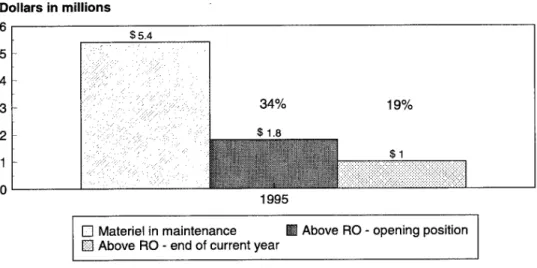
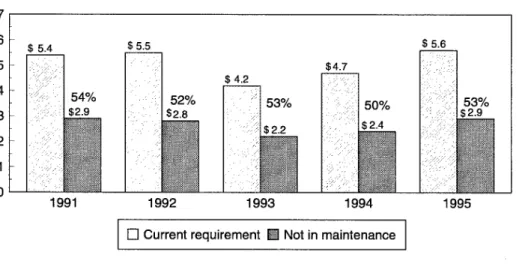
Based on the September 1995 Budget Estimate Submissions, the dollar- weighted organic/contractor DRCT is 86.8 days, with a resultant repair cy- cle level investment requirement of $4.4 billion. That requirement would be decreased an average of $51 million for each day the DRCT is reduced. Stratification reports indicate that of the $5.4 billion of assets in maintenance (organic and contractor), $1.8 billion, or 34 percent, was not needed to meet current requirements, i.e., the amount above the requirement objective. Stratification reports also indicate that of the $5.6 billion of on-hand unserv- iceable assets that should be in maintenance to meet current basic require- ments, $2.9 billion, or 53 percent, was not yet inducted. That underinduction includes backorders of $0.8 billion and safety-level deficits of $0.9 billion. This is an induction timing issue not a funding issue.
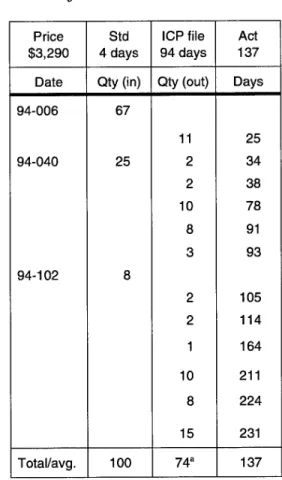
The average actual DRCT for a sample of items provided by the Services was 60 days, the ICPs used 57 days to compute the repair cycle level, and the established standard for the sample items was 36 days, or 37 percent less than that used by the inventory control point.
♦
♦
♦ Reductions of repair cycle levels, do not result in an immediate proportional decrease in inventory and inventory investment. One-time acquisition and repair savings will be realized over a number of years and will vary by in- ventory control point, the size of the reduction, the asset position in relation to the requirements, and the mix of serviceable and unserviceable assets. Annual recurring inventory carrying cost reductions associated with the lower inventory will also be realized.
♦ The total effect of awaiting parts on the DRC process is not known because its measurement is incomplete and inconsistent. However, considerable partial data indicate that it is a pervasive and serious problem — in one case as much as 12 percent of an annual negotiated program was not completed because parts were not available.
The depot repair cycle is a multifunctional and multiorganizational process. It involves the organizational-level and intermediate-level maintenance and sup- ply activities, transportation, distribution depots, inventory control points man- aging DLRs and those managing repair parts, depot maintenance activities, and supply activities supporting depot maintenance. Improvements to the repair process, therefore, must address the roles and interfaces among all functions and activities.
We recommend that the Deputy Under Secretary of Defense (Logistics) take the following actions to improve the DRC process business practices:
♦ Current business practices, especially production planning and induction processing, are major contributors to the multibillion dollar maintenance imbalance, the excessive elapsed actual maintenance shop time, and large in-process inventory. To redress both the imbalance of inductions and re- quirements and the disparity between actual and standard DRC times,
Make the objective of production planning the determination o/how the total depot maintenance requirement can be accomplished (capability), and
Revise the induction process and the use of repair workorders authorizing depot- level maintenance by increasing frequency, limiting funding and quantities to bi- weekly cycles, and using current asset data to determine those quantities. Details of these recommendations are contained in Appendix A.
♦ The present DoD policy of using actual DRCTs for requirement computa- tions results in excessive inventory investment and DRCTs. To reduce in- vestment and improve responsiveness,
Revise current policies to require establishment of standards for each DRC segment as proposed in Appendix A and require their use in requirement computations, budget submissions, the repair process, and performance evaluation, and
♦ Awaiting parts time adversely affects the maintenance process by necessi- tating the rescheduling of production and increasing the labor hours and costs. Those actions cause production inefficiencies and delay customer support. To minimize that impact,
Improve the process of recording piece-part consumption and forecasting parts re- quirements, including the use of bill-of-material concepts. Consider revising the methodology for computing depot maintenance requirements starting with a zero base and computation based on production plans and bills of material.
♦ Many of the "best practices" receiving major emphasis from Industry Week's 25 finalists for America's 10 Best Plants are germane to improving the depot repair cycle business practices and are consistent with the recommendations of this report. To exploit the benefits of those private-sector practices,
Adopt the appropriate private-sector best practices as principles for improving the DRC business processes.
♦ The current DRC segments and definitions do not provide a complete framework for improving the repair process and for establishing standards. To reduce the repair cycle level and related $4.4 billion inventory invest- ment, to establish a ceiling on assets undergoing repair, to provide for eco- nomic induction quantities, and to ensure an effective process framework,
Consider revising DoD Regulation 4140.1-R, DoD Materiel Management Regu-
lation, to incorporate DRC definitions as proposed in Appendix A. For those ac-
cepted, require their use in requirement computations, budget submissions, the repair process, and performance evaluation.
♦ Other recommendations include the following:
► Require that items in a critical asset position be automatically returned, expedi- tiously processed, and express transportation used when appropriate.
► Provide inventory control points with improved materiel management systems
to generate repair workorders on a more frequent cycle using current assets. Provide depot maintenance with finite capacity scheduling and Material Re- sources Planning II systems enabling them to respond quickly to changing cus- tomer needs and to "de-induct" quantities in excess of current requirements.
► Evaluate depot maintenance performance (organic and contractor) based on
time standards and on-time delivery. Evaluate inventory control point per- formance based on parts and carcass shortages and validity of repair production
requirement forecasts.
♦ The findings and recommendations of this report affect many activities and functions encompassed by the DRC process and interfaces among them. At the same time, those processes are undergoing major changes as the Military Services and DLA implement business process re-engineering along with
the development of new information management systems. To ensure that the near-term efforts are fully coordinated for effective, progressive, and timely implementation of the improved business practices,
Establish a DoD Depot Repair Cycle Integrated Process Team including represen- tatives from the Army, Navy, Air Force, Marine Corps, and the Defense Logistics Agency, to develop a prioritized schedule of improvements and to monitor and re- port on their status.
We believe that collectively the recommended changes will substantially re- duce the actual DRCT, will cut the RCL inventory investment requirement, will minimize the over-induction and under-induction, and will materially increase the flexibility and responsiveness of today's DLR depot repair process.
Contents
Chapter 1. Major Findings, Conclusions, and Recommendations 1-1 Introduction 1-1 Background 1-1 Study Objectives 1-2 Study Approach 1-2 Current Initiatives 1-3 Production Planning and the Induction Process 1-3 Findings 1-3 Conclusions 1-5 Recommendations 1-6 Depot Repair Cycle Segments and Time Standards 1-7 Findings 1-7 Conclusions 1-8 Recommendations 1-9 Unanticipated Delays 1-9 Findings 1-9 Conclusions 1-10 Recommendations 1-11 Performance Reporting 1-11 Findings 1-11 Conclusions 1-12 Recommendations 1-12 Implementation 1-13 Introduction 1-13 Progressive Improvement 1-14 Chapter 2. Depot Repair Cycle Segments, Times, and Performance
Measurement 2-1 Introduction 2-1 Depot Repair Cycle Segments 2-1 Current Policies and Practices 2-1 Evaluation 2-2 Process Improvement 2-2
Contents (Continued)
Depot Repair Cycle Time Allowances 2-3 DoD Policy 2-3 Current Practices 2-3 Evaluation 2-4 Process Improvement 2-7 Repair Cycle Performance Measurement 2-8 Current Practices 2-8 Evaluation 2-10 Process Improvements 2-10 Unanticipated Delays During the Repair Process 2-11 Types of Unanticipated Delays 2-11 Evaluation 2-12 Process Improvements 2-12 Chapter 3. Repair Programming, Production Planning, and Induction
Processing 3-1 Introduction 3-1 Repair Programming 3-1 Production Planning 3-2 Induction Processing 3-3 Current Policies and Practices 3-4 Repair Programming 3-4 Production Planning 3-4 Induction Processing 3-5 Evaluation 3-6 Introduction 3-6 Sample Items 3-6 Summary Stratification Data 3-13 Conclusions 3-15 Process Improvements 3-18 Introduction 3-18 Repair Programming 3-18
Contents (Continued)
Production Planning 3-19 Induction Processing 3-19 Chapter 4. Materiel Support and Awaiting Parts Delays 4-1 Introduction 4-1 Current Policies and Procedures 4-1 Policies 4-1 Measurement of Awaiting Parts Time 4-4 Evaluation 4-5 Parts Shortages and Awaiting Parts 4-5 Inclusion or Exclusion of Awaiting Parts Time
from DRCT 4-8 Automated Systems Support 4-9 Conclusions 4-10 Recommendations for Process Improvements 4-11 Awaiting Parts Time 4-11 Parts Requirement Forecast 4-12 Materiel Support 4-12 Revised Forecast Methodology 4-12 Chapter 5. Management Information Systems 5-1 Introduction 5-1 Repair Prograrnming and Production Planning 5-2 Evaluation 5-2 Recommended Process Improvements 5-2 Induction Processing 5-3 Evaluation 5-3 Recommended Process Improvements 5-3 Maintenance Shop Engineered Time Standards 5-4 Evaluation 5-4 Recommended Process Improvements 5-5
Contents (Continued)
Materiel Management Support Systems 5-5
Evaluation 5-5
Recommended Process Improvements 5-5 DRC Monitoring and Performance Measurement 5-6 Evaluation 5-6 Recommended Process Improvements 5-7 Appendix A. Detailed Depot Repair Cycle Business Practice
Improvements Appendix B. Glossary
Tables
1-1. Dimensions of DoD Depot Repair Cycle — FY95 1-2 2-1. Depot Repair Cycle Segment Use by Service 2-2 2-2. Comparison of Standard, Actual, and ICP File RTATs 2-4 2-3. Realizing Savings from RCL Reduction — Two Sample ICPs 2-5 2-4. DRCT Measurement by Segment 2-9 3-1. Turbine Nozzle 3-9 3-2. Recorder 3-10 3-3. Radar Dome Assembly 3-10 3-4. Servo Cylinder 3-10 3-5. Radar Dome Assembly Early Induction/Overinduction Summary 3-11 3-6. Servo Cylinder Early Induction/Overinduction Summary 3-12 4-1. Sample List of Items Causing AWP Conditions at the Hydraulics
Figures
1-1. Early/Late Inductions 1-4 1-2. Sample DoD DRCT Standards, Actuals, and ICP Files 1-8 3-1. Underinduction 3-7 3-2. Late Induction 3-7 3-3. Early Induction 3-8 3-4. Overinduction 3-9 3-5. Assets in Repair Above Current Requirements — Opening Position — 3-14 3-6. Assets in Repair Above Current Requirements —
End of Current Year 3-14 3-7. Basic Requirement Deficiencies — On Hand, Not in Maintenance 3-15 4-1. Portion of Program Not Completed Due to Awaiting Parts 4-5 4-2. NSNs Causing Work Stoppage or Workaround 4-6
CHAPTER 1
Major Findings, Conclusions,
and Recommendations
INTRODUCTION
Background
Department of Defense (DoD) Regulation 4140.1-R, DoD Materiel Manage-
ment Regulation, defines the depot repair cycle (DRC) for secondary depot-level
reparables (DLRs) as beginning with determination that an unserviceable item is beyond the repair capability of an organizational- or intermediate-level mainte- nance activity. It ends when the failed item is restored to serviceable condition and recorded as such on supply records. Excluded from this DRC definition are any awaiting parts delays and any intentional extended transit, storage, or repair process delays. The depot repair cycle time (DRCT) is normally measured in elapsed calendar days.
The overall length, or duration, of DRC is of vital importance to DoD for two basic reasons. First, timely depot repair of failed reparable components is essential to operational readiness and sustainability. For these key reparables, depot repair (by organic or commercial sources) is typically the most responsive and least costly option available to support the operating customers' require- ments. Second, because of the high unit cost of reparable components, signifi- cant inventory investment results from the length of the DRCT. The quantity of wholesale reparable items required to sustain operations during this period is re- ferred to as the repair cycle level (RCL). That level represents the demand (con- strained by unserviceable returns) for the item that can be expected during the DRC. The shorter the DRCT, the smaller the investment in the RCL.
The DRC is a multifunctional and multiorganizational process. It involves the organizational- and intermediate-level maintenance and supply activities, transportation, distribution depots, inventory control points (ICPs) managing DLRs, ICPs managing repair parts, depot maintenance activities (organic and contractor), and installation supply activities supporting depot maintenance. Improvements to the depot repair cycle process, therefore, need to address the roles and interfaces among all those functions and activities.
The DoD wholesale inventory investment in DLR assets was $38.1 billion as of September 1994 (Supply System Inventory Report — reduced prices).
Table 1-1 displays the overall magnitude of the DRC in terms of days and dollars and is based on the September 1995 Budget Estimate Submission (BES).
Table 1-1.
Dimensions ofDoD Depot Repair Cycle — FY95 ($ millions — at standard price)
Reparables items managed 352,022 Repair cycle times (calendar days)
Repair cycle level requirement
86.8 $4,424.6 Average value of a repair cycle day $51.0
Study Objectives
In this study, the Logistics Management Institute (LMI) analyzes the depot repair cycle process to determine whether DoD can provide more responsive customer support at a lower cost. Organic and contractor repair processes are included; however, the unique aspects of contractor repair will be the subject of a separate LMI study. The analyses in this report are focused on four major areas:
♦ The definitions of the DRC segments — the segments that are major con- tributors to the total DRCT and have the greatest potential for improvement — the establishment of "should-take" time standards, the po- tential for reducing inventory investment, and the potential for establishing performance measures.
♦ The effectiveness of repair programming, production planning, and induc- tion processing in providing to the supply system serviceable assets of the right item, in the required amount, and at just the right time.
♦ The effect of unanticipated delays (awaiting parts [AWP], awaiting car- casses [AWC], and awaiting maintenance [AWM] capacity) that are not sup- posed to be a part of the DRC but adversely affect responsiveness and costs.
♦ The system and procedural deficiencies and the changes to them that are es- sential to the implementation of the recommended improvements necessary to make the process more responsive and less costly.
Study Approach
Our review of the DoD DRC process includes analyses of available empirical data (reflected in secondary item stratification budget summaries, ICP inventory management files, depot maintenance files, and sample items selected by the ICPs we visited); review of existing policy, procedural, and system documenta- tion; and site visits/interviews at selected headquarters and at two ICPs and two
Our major findings, conclusions, and recommendations relate to
the process of developing production plans and the process of authorizing and funding the repair of materiel and its induction into maintenance; the segments of the DRC, their definitions, and the establishment and use of time standards;
the effects of unanticipated delays, especially those AWP, and their accom- modation in requirement computations; and
the accumulation of actual elapsed time by DRC segment, the comparison of actual times with standard times, and the generation of performance reports for management.
More detailed discussions of these and additional issues and more specific recommendations are presented in Chapters 2 through 5 and Appendix A, "De-
tailed Depot Repair Cycle Business Practice Improvements." Many of our recommen-
dations parallel those cited as the private-sector "best practices" in a 1994
Industry Week issue that presented the 25 finalists and nominations of "America's
10 best plants." In Appendix A, we also describe those private-sector best prac- tices that are germane to the DRC process.
♦
♦
♦
♦
Current Initiatives
The research for this task was conducted at a specific point in time. Prior to and subsequent to that time, each of the Military Services and DLA developed materiel management initiatives that included improvements to the DRC processes.
The Army, under its velocity management program, has developed initiatives covering several of the areas addressed in this report. Similarly, the Air Force under its lean logistics program, has implemented some highly innovative process improvements. The Navy made changes that reduce the DRCT and provide re- ports that permit better evaluation of the DRC processes and identify potential problem areas. While it does not manage DLRs, the Defense Logistics Agency (DLA) is the major supplier of piece parts and has, in coordination with the Serv- ices, implemented changes to improve parts support and stock positioning.
PRODUCTION PLANNING AND THE INDUCTION PROCESS
Findings
♦ Under current DoD policies, procedures, processes, and management infor- mation systems used to control and monitor the depot repair process, main- tenance inducts assets not currently required for some items and does not
induct assets that are required for other items. As shown in Figure l-l1
34 percent of the total assets in maintenance ($5.4 billion) is not required to meet current known stratification requirements. The reports also indicate that of the approximately $5.6 billion in unserviceable assets currently on hand that should be in maintenance to meet current basic requirements, 53 percent ($2.9 billion) was not yet inducted. This underinduction includes backorders of $0.8 billion and safety-level deficits of $0.9 billion.
Total unserviceable assets in maintenance - $5.4 billion
Forecasted basic requirement to be in maintenance - $5.6 billion Within requirement $3.6 billion (66%) In maintenance- $2.7 billion (47%)
Above current forecasted requirement - $1.8 billion (34%)
Available but not in maintenance - $2.9 billion (53%)
Figure 1-1.
Early/Late Inductions
Generally production planning, funding, and the authorization of repair come from the same processes. They cover from one to four quarters based on asset position data that may be from six to nine months old at the time of induction and with requirements frequently based on annual quantities lev- eled by quarter. The production planning process includes negotiations — usually downward and smoothed over time — between the maintenance ac- tivities and the ICPs.
Although actual repair requirements change daily, the negotiated schedule is then accepted for the next quarter, two quarters, or year. Once assets are physically inducted for repair, they are seldom, if ever, withdrawn. Some changes occur for high-priority requisitions but very little based on supply position (i.e., changes in requirements or assets).
1 The values are at standard price and taken from Budget Opening Position of Table I
♦ Generally the induction quantity, timing, and frequency are controlled by
maintenance within the quarterly or longer funded authorizations.
♦ The sample items included many examples of inductions that exceeded the
asset deficit, exceeded the total recurring and nonrecurring demand, and/or exceeded the maintenance production rate. Those inductions resulted in larger than necessary in-process inventory and actual DRCTs longer than the standards.
Conclusions
PRODUCTION PLANNING
♦ The objective of production planning should be to determine how depot
maintenance activities can ensure having adequate capability (overtime, ex- tra shifts, temporary employees, cross-training or subcontracting) to com- plete on time the entire forecasted DLR workload (repair for stock, concurrent repair for overhaul, inter-Service support, and foreign military support) and an agreed-upon upward variance rather than negotiating the workload down to the normal capacity.
♦ Production planning based on annual averages will not provide the capabil-
ity required for timely completion of a workload that ranges from items with backorders and safety-level deficiencies requiring very high initial "catch-up" production to items in long supply of serviceable assets that may not require initial small inductions until the 3rd or 4th quarter.
INDUCTION PROCESSING
♦ The frequency that imbalances between materiel that is in maintenance and
that which should be in maintenance occurred in the sample items, and their
magnitudes reflected in the summary data are too great to result solely from changes in requirements and assets, i.e., churn. They indicate systemic problems and a need for business practice improvements.
♦ Many of the scheduling deficiencies observed (early/overinduction and
late/underinduction) were directly or indirectly a result of practices that es- sentially used mid-term production planning projections based on relatively old requirement and asset data as the basis for funding and authorizing maintenance to induct one or more quarters of requirements.
♦ To minimize in-process inventory and actual elapsed DRCT and to provide
flexibility in meeting the fluctuating and changing requirements reflected in more frequent workorders for smaller quantities
► ICPs need automated ordering systems utilizing current information, and
depot maintenance activities need automated scheduling and control systems such as finite capacity scheduling and Manufacturing Re- sources Planning (MRP) II.
Recommendations
The major process change is the uncoupling of workorders, funding, and in- duction authorization from the production planning process (more detailed process improvements are presented in Chapter 3 and Appendix A). We believe that collectively the changes recommended in production planning and induc- tion processing, including funding, will substantially reduce actual DRCT, will decrease RCL inventory/investment requirements, will minimize the imbalance of overinduction and underinduction, and will materially increase the flexibility and responsiveness of today's depot repair process for DLRs in meeting cus- tomer needs.
We recommend that the Deputy Under Secretary of Defense (Logistics) take the following actions.
PRODUCTION PLANNING
♦ Reorient production planning with the objective of determining how the forecasted workload can be completed (overtime, extra shifts, temporary employees, or cross-training subcontracting). That fundamental change from the current practice of adjusting repair requirements to match normal maintenance capacity represents a challenge.
♦ Predicate production planning on the premise of providing flexibility to complete the repair of fluctuating item requirements with a goal of on-time (elapsed time based on standards) processing of repair workorders varying by an agreed-upon percentage above the forecasted item workload without further negotiation.
♦ Develop as a rninirnurn an annual plan with variable monthly requirements and three quarterly updates for the 2nd, 3rd, and 4th quarters, using the most current asset data for all items. The plans should provide variable monthly estimates and be coordinated and distributed 45 days before the beginning of the period. Plans should include piece part requirement forecasts.
INDUCTION PROCESSING
Standard lead-time for the item in advance of the required date for the serv- iceable assets using requirement and asset data as of the cutoff.
♦ Have ICPs transmit workorders electronically directly to the depot mainte- nance activity with automatic acceptance of orders that do not exceed the forecasted requirements by more than the agreed-upon percentage for an item. Have maintenance activities limit induction to economic quantities within the biweekly authorizations and deliver serviceable assets incrementally.
♦ Provide depot maintenance activities with automated systems, such as finite capacity scheduling and MRP II, to provide the capability and flexibility re- quired to react to smaller and more frequently funded repair orders reflect- ing variable requirements and priorities and shorter required dates.
DEPOT REPAIR CYCLE SEGMENTS AND TIME STANDARDS
To establish uniform elements for managing and measuring DRC, DoD de- fines five discreet segments. The current policy in DoD Regulation 4140.1-R states that the Services will use actual repair cycle times in computing the RCL.
Findings
♦ DRCT is inconsistently defined and measured across the Services. The in- corporation of DoD-prescribed elements varies widely by Service, as does the mix of actual time, constrained actual time, estimated times, and stan- dard times in the ICP files.
♦ In the aggregate, the current BES-based DRCT for DoD averages about 87 days with an associated RCL inventory investment of about $4.4 billion as shown in Table 1-1. That total DoD RCL inventory requirement would be decreased an average of $51 million for each day the DRCT is reduced.
♦ Figure 1-2 compares the actual DRCTs and the ICP file DRCTs with the standards for the sample items combined from the three Services. Actual DRCTs exceed those used by the ICPs to compute RCLs and are signifi- cantly longer than reasonable "should take" standard DRCTs.
Days /u 37% less than ICP files 36 days 60 days ti() 50 'in 30 H£'|p!l: ■■*■':: ?0 10 0
Standards Actuals ICP files
Figure 1-2.
Sample DoD DRCT Standards, Actuals, and ICP Files
♦ Use of the standards to compute the RCLs for the sample items would result in a 37 percent reduction in the RCL value. Applying that difference re- flected in the sample to the total RCL value of $4.4 billion shown in Table 1-1 would produce a $1.6 billion reduction.
♦ Computing the RCL on the basis of standards does not produce an immedi- ate proportional reduction in inventory investment. The rate of investment reduction is dependent upon the relationship of assets to requirements and upon the mix of serviceable and unserviceable assets.
Conclusions
♦ Inventory managers (IMs) do not have enough data to establish DRC times and the current DoD policy of using actual times is causing increased inven- tory investment and impeding the timely repair of DLRs.
♦ Use of standards as valid benchmarks in requirements computation, budg- eting, and repair execution would focus the attention of both supply and maintenance management on DRCT. Thus, the cost and ultimate support effectiveness of the depot repair processes would be directly driven by the validity of, and the use and adherence to, these standards.
♦ The actual elapsed repair turnaround time (RTAT), ihefile time used to com- pute the RCL, and the RTAT standard must have a high degree of consis- tency to minimize inventory investment, provide optimum assets to sustain issues during the repair process, and provide a reliable basis for generating repair workorders and required dates.
♦
requirements. However, reductions do not result in an immediate propor- tional decrease in inventory investment.
► Savings will be realized over a number of years varying by ICP and de- pending on the size of the reduction, the asset position in relation to the requirements, and the mix of serviceable and unserviceable assets.
► Based on total data for two ICPs, only approximately one-eighth of the potential acquisition savings and one-third of the potential repair sav- ings would be realized at the end of six years.
The current DRC segments and definitions should be revised as proposed in Appendix A to provide the necessary framework for improving the repair process and for establishing time standards.
Recommendations
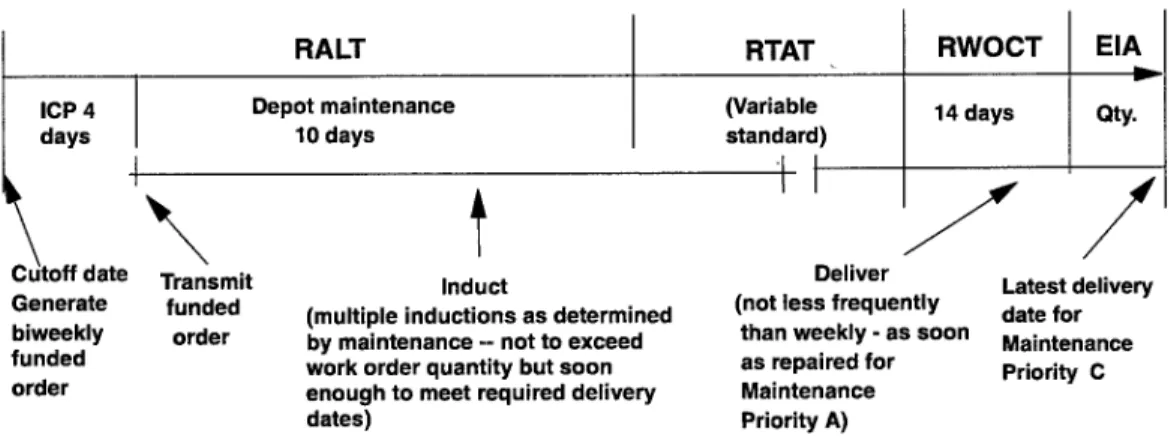
To reduce the repair cycle level and the related $4.4 billion inventory invest- ment and to provide the framework for improving the depot repair process by establishing a ceiling on assets undergoing repair, providing for economic induc- tion quantities, establishing a biweekly repair order cycle, and recognizing the need for repair administrative lead-time to generate and process workorders, we recommend that the Deputy Under Secretary of Defense (Logistics) take the fol- lowing actions:
♦ After coordination with the DoD Components, publish changes to DoD Regulation 4140.1-R to incorporate the revised DRC definitions and seg- ments and to establish standards for each as proposed in Table A-l of Ap- pendix A. Require their use in requirement computations, budget submissions, the repair process, and performance evaluations.
♦ Develop a schedule for implementing the changes and a transition plan
with goals for reducing the current RCLs to the prescribed standards and for subsequently reducing inventory investment.
UNANTICIPATED DELAYS
Findings
In concert with the move toward use of DRCT standards, maintenance man- agement information systems and the requirements determination processes in place at Service ICPs must address the major unanticipated delays that are likely to occur during the repair process and that are neither authorized to be a part of the current DRCT nor included in the proposed standards.
♦ The three types of major unanticipated delays that must be considered are
► awaiting parts (AWP), which occurs when the nonavailability of parts results in delayed production;
► awaiting carcasses (AWC), which occurs when the lack of availability of unserviceable assets results in delayed production; and
► awaiting maintenance (AWM), which occurs when capacity constraints results in delayed production.
♦ Data from one maintenance depot indicate that delays for parts, carcasses, and maintenance capacity jointly accounted for over 6 percent "underpro- duction" (the actual repair volume was less than the planned repair volume) in FY94. That does not take into account production delays during the year.
♦ Of a sample of 365 national stock number (NSN) items causing AWP delays at one depot, approximately 75 percent experienced work stoppage or re- quired workarounds of between 30 days and 574 days as of the report cut- off. The shortage quantities ranged from 1 to 5,324 units.
♦ The lack of low-cost piece parts delay the repair of high-value components. For example, a bearing caused a work stoppage on a cylinder assembly for over 440 days as of the report cut off, and that delay was expected to in- crease. The value of the 279 bearings in the assembly was $5,178 and the value of the 70 DLRs involved was $3,272,640, or 632 times the value of the parts causing the work stoppage.
Conclusions
♦ Current systems at the wholesale supply or depot maintenance level do not provide a comprehensive view of the frequency, duration, magnitude, or adverse impacts of unanticipated delays.
♦ AWP clearly has a major adverse effect on the repair process.
♦ When they occur, each of the three unanticipated delay factors affect the length of the time required to produce a serviceable asset. By properly ac- counting for unanticipated delays separately, performance evaluation and analysis of major contributors to differences between DRCT standards and the actual DRCTs can be accomplished. Failure to properly recognize and adjust for these unanticipated delays will undermine the use of DRCT stan- dards and has the potential to degrade responsive support.
Recommendations
To minimize the adverse effects of unanticipated delays, including resched- uling production and increasing labor hours and costs, production inefficiencies, and delays in customer support, we recommend that the Deputy Under Secre- tary of Defense (Logistics) take the following actions:
♦ Improve management information systems to measure the frequency and duration of each type of unanticipated delay to identify problem areas re- quiring management attention and collect enough information to compute the variance in those delays. Continue to exclude unanticipated delays from the DRCT.
♦ Use the computed variances in repair processing caused by unanticipated delay factors to compute the wholesale repair safety-level requirement.
♦ Because the investment in parts is small compared with the cost of the DLR items and lost productivity, implement the specific process improvements recommended in Chapter 4 to reduce AWP. Those improvements include improving parts consumption data, revising wholesale parts forecasting methodology, and reviewing stockage policies for activities that provide supply support to maintenance.
♦ Minimize carcass shortages by directing automatic and expedited return of items in a critical supply position.
PERFORMANCE REPORTING
Findings
A noteworthy and desirable contrast is apparent between intermediate-level maintenance and depot-level maintenance in the availability of repair process data and in the respective management uses of those data.
♦ Each of the Services' intermediate-level maintenance systems can record, by individual workorder, the beginning and ending of delays. Each begins re- cording AWP immediately upon notification of the nonavailability of parts (no minimum forecasted delay). Those records also display requisitions for parts and their status. Management reports show the work in process by time periods and all delays.
♦ At the wholesale level, the Services do not have systems for routinely meas- uring and comparing line-item standard, actual, and ICP file DRCTs, which vary significantly, or for generating management reports to permit evaluat- ing and improving the repair process.
Conclusions
♦ The Services do not evaluate the storage depot or depot maintenance per- formance on the basis of actual elapsed times compared with standards or required dates, nor do they evaluate ICP performance on the basis of parts or carcass shortages.
♦ With the adoption of DRCT standards for wholesale requirements determi- nation, induction scheduling, and DLR repair execution, supply and mainte- nance managers need to measure the actual elapsed DRCT and be able to take corrective action for significant delays or differences between it and the standards.
Recommendations
To provide the means to evaluate the performance of the repair process in producing the right item, in the right quantity, and at the right time, we recom- mend that the Deputy Under Secretary of Defense (Logistics) take the following actions:
♦ Establish performance measurement and reporting systems to collect and compare actual and standard DRCT, to measure the total elapsed repair process time by item, and account separately for the actual time for each prescribed segment and for each of the unanticipated delays; furthermore, the performance systems should
► generate reports that compare, by segment, the approved standard and the required delivery date with the actual times and that accumulate the actual time for each of the unanticipated delays; and
► use the unanticipated delay data to compute safety levels and to deter- mine the need for process improvements.
♦ In addition to the current evaluation based on efficiency, evaluate the per- formance of depot maintenance activities (organic and contractor) on the ba- sis of a comparison of actual and standard maintenance shop times and the on-time completion of the total maintenance workload.
♦ Evaluate the performance of the ICPs on the basis of DLR repair delays caused by parts shortages, carcass shortages, and the validity of the repair production requirement forecasts.
IMPLEMENTATION
Introduction
MID-TERM ACTIONS
Complete implementation of some of the major recommendations to im- prove the depot repair cycle business practices require substantial information system changes at the ICPs and at the maintenance depots. Development and installation of those changes require time.
To begin the processes for making those changes, we recommend that the Deputy Under Secretary of Defense (Logistics) take the following actions:
♦
♦
Evaluate the recommendations contained in Chapters 2 through 5 and Ap- pendix A of this report
Determine what policy changes are needed
Publish those changes with an implementation schedule as mid-term plan- ning guidance for the DoD Components.
NEAR-TERM ACTIONS
In the near term, DoD should take a series of actions to implement improve- ments incrementally. Those actions should be aimed at decreasing the imbal- ance between the DLRs that are in maintenance beyond current requirements ($1.8 billion) and those that should be in maintenance but have not yet been in- ducted ($2.9 billion), reducing the 87-day DRCT that drives the RCL inventory investment of $4.4 billion and enhancing customer response ($0.8 billion in backorders).
The specific actions that can be taken and the time frames for their imple- mentation will vary by DoD Component and will be based on existing systems, changes already in process, the acquisition of new capabilities such as finite ca- pacity scheduling and MRP II, and interfaces among functional areas.
We further recommend that the Deputy Under Secretary of Defense (Logis- tics) request each DoD Component to provide an action plan and schedule for implementing progressive near-term improvements leading to the end objective.
INTEGRATED PROCESS TEAM
The findings and recommendations in this report affect varied activities and functions encompassed by the DRC processes and interfaces among them. At the same time, these processes are undergoing changes as the result of DoD
Component improvement programs along with the development of materiel management systems.
To ensure that the total near-term and mid-term effort is fully coordinated for effective and timely implementation of the improved business practices, we recommend that the Deputy Under Secretary of Defense (Logistics) should es- tablish a DoD Depot Repair Cycle Integrated Process Team composed of repre- sentatives from the Army, Navy, Air Force, Marine Corps, DLA, and the Joint Logistics Systems Command. That team should be responsible for the following activities:
♦ Reviewing the recommendations of this report
♦ Proposing a schedule of near-term actions (those actions will vary by DoD Component)
♦ Recommending priorities for and a schedule of mid-term changes
♦ Monitoring and reporting results.
Progressive Improvement
In this subsection, we describe some of the incremental improvements that should be implemented in the near term in order to meet the overall objectives.
INDUCTION PROCESSING
The single most important change that addresses both the imbalance of in- ductions and requirements and the disparity between the actual and standard DRCTs is the revision of repair workorders authorizing depot-level maintenance to perform repair (increasing frequency, limiting funding and quantities to bi- weekly cycles, and using current asset data to determine those quantities). That change should mandate that supply and maintenance do the following:
♦ Move from the current 3- to 6-month induction funding and authorization period toward a biweekly period. That action may require phasing.
► As a minimum, determine the feasibility of running existing quarterly programs monthly with current asset data to generate monthly funded workorders.
► Preferably review current weekly and biweekly tools for possible modi- fications, including the application of those tools to all items requiring repair and the use of the current asset position.
USE DRCT STANDARDS FOR COMPUTING REPAIR CYCLE LEVELS
The use of RTAT standards (engineered and allowances) in lieu of actual or IM-determined times offers the potential for reducing the RCLs. The conversion to standard times requires that the average actual production be completed within those standard time frames and that actions by the ICPs and the depot maintenance activities be closely coordinated.
♦ Those Services that have maintenance shop standards expressed in calendar days and are not using them for RCL computations should provide those data to the ICPs:
► ICPs should develop RTATs using the maintenance shop standards and the proposed standard allowances for storage-to-maintenance and maintenance-to-storage time segments.
► Until smaller repair workorders based on current asset data have re- duced backlogs in maintenance, the difference between the existing ICP file DRCTs and those based on standards may have to be reduced incrementally.
♦ Those Services that do not have maintenance shop standards but do have labor-hour standards or historical actual hands-on hours for pricing pur- poses could develop interim proxy standards by developing ranges of labor hours and applying additives to cover non-labor-hour processes (e.g., dry- ing), queue time before and after each process, and moving time from work- station to workstation (normally those additives decrease with the increase in the number of labor hours). They could then
► convert the productive labor hours to calendar days, and
► provide the proxy standards to the ICPs for development of RTATs by adding standard allowances for transfer to and from maintenance.
♦ Those Services that do not have engineered maintenance shop standards should initiate a program to develop them.
DEVELOP DRCT PERFORMANCE MEASUREMENT AND EVALUATION
One requisite of a successful DLR repair process is the achievement of mini- mal variance between the RTAT portion of the DRCT used by the ICPs to com- pute the RCL and the actual time taken by storage and maintenance for that segment and its time standards. Neither the maintenance activities nor the ICPs
have routine management reports providing those comparisons to permit meas- urement and evaluation of this critical management performance indicator. We recommend the following actions:
♦ Those Services that have both the standard and actual RTATs should de- velop interim reports comparing those times and highlight the ones with high variances.
♦ All Service stock accounting systems should capture the transactions chang- ing items from Condition Codes F to M and M to A.
► As a interim measurement of the total RTAT, those transactions should be used to develop the actual RTATs and be provided to the ICP and to the maintenance depot. ICPs should supplement the actual data with their file times for comparison.
► Both maintenance and the ICPs should establish thresholds for actual RTATs and jointly examine those items that exceed the thresholds to determine what actions should be taken to reduce the actual time to an acceptable level.
CHAPTER
2
Depot Repair Cycle Segments, Times,
and Performance Measurement
INTRODUCTION
The amount of elapsed time during which an asset is in the depot-level re- pair cycle — the depot repair cycle time — is significant because additional as- sets must be procured to support operations while unserviceable assets are in the cycle undergoing repair. The longer the DRCT, the more assets needed in the supply system to ensure that operations are not interrupted while waiting for unserviceable DLRs to be fixed.
DEPOT REPAIR CYCLE SEGMENTS
Current Policies and Practices
DoD POLICIES
To establish uniform elements for managing and measuring the DRC, DoD policy identifies and defines five discrete segments: retrograde (includes base processing and in transit), accumulation, transfer to maintenance, depot mainte- nance turnaround, and transfer from maintenance. These terms are defined in DoD Regulation 4140.1-R. We use the term repair turnaround time (RTAT) as a collective term for transfer-to-maintenance time, depot maintenance turnaround time, and transfer-from-maintenance time. We also use the term maintenance
shop time in lieu of depot maintenance turnaround time.
CURRENT PRACTICES
As shown in Table 2-1, the DRC segments are not consistently applied across the Services. None of the Services uses all five of the prescribed DoD seg- ments; all exclude accumulation time. The Air Force alone uses the retrograde segment and divides it into base-processing time and in-transit time. While the Air Force recognizes the transfer-to-maintenance segment, it allows zero days in its standard. The Services' definitions of the segments they use follow the DoD definitions, but only the Air Force separately identifies each segment in its re- quirement studies. The Army and Navy display only the total RTAT segment.
Table 2-1.
Depot Repair Cycle Segment Use by Service
Segment Army Navy Air Force Retrograde — Base processing
— in transit No No No No Yes Yes Accumulation No No No Transfer-to-maintenance Noa Noa Yesb
Depot maintenance turnaround Noa Noa Yes
Transfer-from-maintenance Noa No" Yes
The Army and the Navy record transfer to maintenance, depot maintenance turnaround, and transfer from maintenance as a single entitity.
bThe Air Force recognizes the segment but by policy allows no time in the standard.
Evaluation
Based on our evaluation of the current DoD segments and definitions, we draw the following conclusions:
♦ The current RCL is defective in that it only establishes the rninimum num- ber of assets that should be on hand, either serviceable or in maintenance, and does not establish any ceiling or maximum. It implies the need for daily inductions equal to the daily issues. That implication fails to give maintenance any lead-time for planning its daily production or for evening out the daily fluctuations in returns or ordering parts and unserviceable as- sets.
♦ The current accumulation segment is neither needed nor used by any of the Services.
♦ Since the base-processing and in-transit segments are under completely separate functional control, they should be separate segments.
♦ The current DRC segments and definitions do not provide the necessary framework for improving the repair process and for time standards.
Process Improvement
To ensure an effective framework for improving the depot repair process, we recommend that the Deputy Under Secretary of Defense (Logistics) revise
similar to those proposed in Appendix A. It includes the following key process improvements:
♦ Establishment of a biweekly repair workorder cycle (similar to the procure- ment cycle).
♦ Recognition of the need for repair administrative lead-time to generate and process workorders and schedule production.
♦ Establishment of the maximum quantity that should be in maintenance.
DEPOT REPAIR CYCLE TIME ALLOWANCES
DoD Policy
DoD 4140.1-R states that actual repair cycle times will be used by the Serv- ices in computing RCL requirements. It requires that all the time between the beginning and end of the repair cycle be included in computing RCL require- ments, except avoidable time, such as that expended while AWPs or because of depot maintenance inefficiency. Accumulation time is constrained by policy to a maximum of seven days. The policy reiterates the time spent awaiting parts will
not be included in repair cycle computations.
Current Practices
In this report, we use the generic term standards to include three types of en- gineered standards and standard allowances established by policy.
Computation and application of DRCTs in requirements computations dif- fer across the Services. They range from actual or historical, engineered stan- dard times, standard allowances, and judgment. The Army formerly used historical averages (the data are not currently available) and the Navy uses expo- nentially smoothed times. Both are subject to modification by the IM. The Air Force uses standards and standard allowances (including constrained actuals for in-transit time) in requirements determination, budgeting, and execution. It is the only Service that provides line-item data for each segment of DRCT in the re- quirements determination system.
The most extensive use of standards is in the development of maintenance depot labor costs and repair prices charged to customers. Often they are not used to establish maintenance shop total elapsed time standards.
The Air Force maintains shop flow time standards and expresses them in elapsed calendar days; those standards include additional factors such as non- productive time and moving, queuing, and setup times. About 45 percent of the Air Force DLRs do not have individual repair cycle standards but use a
surrogate standard based on the average of all items with standards. Included in the items with standards are most contractor-repaired items for which the con- tract delivery period has been used (usually 30, 60, 90 days, etc.) as the time stan- dard. These times, which are not engineered standards, increase the average surrogate standard used for 45 percent of the items without standards. A recent Air Force study concluded that eliminating the contractor-repaired items from the computation would reduce the average from around 29 days to 15 days.1
The establishment of valid maintenance shop and RTAT standards is a pre- requisite to the successful operation of finite capacity scheduling MRP II, and similar systems for scheduling repair production and ordering materiel.
Evaluation
COMPARISON OF STANDARD, ACTUAL, AND ICP FILE RTATs
The comparison of standard, actual, and ICP file RTATs is difficult because the Services do not have systems for capturing and comparing the times. There- fore, we compared data for sample items provided by the ICPs using a combina- tion of ICP data and manual depot records. We evaluated three different measures of RTAT: standard or "should take" time, actual time based upon his- torical transactions, and the times resident in the ICP files used to compute the RCL requirement. Because the Air Force alone uses RTAT standards for budget and execution, we derived comparable standards for the Army and Navy.
As Table 2-2 illustrates, the standard ("should take") times differ from the actual time and the ICP file time used to calculate requirements.
Table 2-2.
Comparison of Standard, Actual, and ICP File RTATs (in dollar-weighted days)
Service
Standard RTAT (Days)
Actual RTAT ICP file RTAT Days
Percentage
above standard Days
Percentage above standard Army Navy Air Force 81 32 20 180 38 42 122 19 110 147 45 20 81 41 0
The Army data indicate that the sample actual times are more than twice the standard times. While the ICP file times are lower than the actuals, they exceed
the standards by 81 percent. Consequently, the Army's inventory investment for the sample items is 81 percent greater than it would be if standards were used.
The Navy data indicate that sample actual times are only 19 percent greater than the standard times. However, the ICP file times are greater than either the standard or actual times resulting in a 41 percent increase in inventory invest- ment for the sample compared to the use of standards.
The Air Force data indicate that the sample actual times are more than twice the standard times. The Air Force uses the standards in the computation of the RCL and therefore the longer actual times do not increase the inventory invest- ment for the sample items but do affect the availability of serviceable assets.
Two types of one-time savings can occur as a result of reducing the RCL. First, a one-time postponement of repair will occur when serviceable assets fall below the prior RCL. Second, a one-time postponement of procurement will oc- cur when the combined serviceable and unserviceable assets fall below the prior reorder point. Based on the asset position of all DLR items for two sample ICPs, Table 2-3 displays by year the percentage of the RCL reduction that would pro- duce inventory investment savings assuming that the change occurred on the first day of year 1. The actual savings will vary by ICP based upon the magni- tude of the RCL reduction as well as the asset mix and position. For the sample, only approximately one-eighth of the potential acquisition savings and one-third of the potential repair savings would be realized at the end of six years.
Table 2-3.
Realizing Savings from RCL Reduction — Two Sample ICPs
Year
Acquisition (percentage) Depot repair (percentage) Annual Cumulative Annual Cumulative 1 2 3 4 5 6 3.40 0.13 1.98 6.45 0.75 0.07 3.40 3.53 5.51 11.96 12.71 12.78 3.61 2.52 1.47 10.6 8.59 4.57 3.61 6.13 7.60 18.2 26.79 31.36
Because of the lack of the required information, neither the ICP nor the de- pot maintenance activity is in a position to ensure that the actual elapsed mainte- nance shop time and the ICP file times approximate the standards established for the maintenance activity. And yet, the control of the actual time is a critical element in containing inventory investment costs, and at the same time, having serviceable assets available to provide responsive supply support.
Our analyses of the DoD policies and current Service practices for establish- ing time factors for the DRC segments leads us to the following conclusions:
♦ For a minimal inventory investment, realistic induction scheduling, and re- sponsive supply support, the standard, actual, and ICP file RTATs must be approximately the same.
♦ The current DoD policy of using actual times is resulting in increased inven- tory investment and lack of timely repair of DLRs.
♦ The use of standards by the Army and the Navy for ICP file times would provide the opportunity for reducing RCLs.
♦ The exclusion of contract repair times (which are not engineered standards) from the determination of the average maintenance shop time for items with standards that are used as surrogate standards for other items would reduce Air Force RCLs.
♦ The reduction in RCLs provides the opportunity for inventory investment reductions and for one-time reductions in procurement and repair require- ments.
♦ Standards should comprise the three types of engineered standards and standard allowances; their use would automatically prevent unanticipated delays from influencing the RCL.
THE RETROGRADE BASE SEGMENT AND CARCASS SHORTAGES
In many instances, retrograde processing is the longest DRC segment. De- lays may contribute to the lack of unserviceable assets at the depot. One of the conditions that precludes timely scheduling and repair of unserviceable DLRs is the lack of unserviceable carcasses in the depot. The status of carcass availability based on the March 1995 Central Secondary Item Stratification (CSIS) report re- flects a $617 million shortage of the RCL (other war reserve- protectable and nu- meric stockage objective requirements are not included).
Normally, assets equal to the RCL should be on hand. To the extent that as- sets are in the supply system either at the retail level or in the retrograde pipe- line, expediting their return would reduce the shortage that precludes scheduling and repair of assets to fill backorders and other urgent requirements.
At one retail activity we visited, unserviceable DLRs were physically moved four times (different buildings), from the time they were determined to be be- yond the capability of maintenance until they were turned over to transporta- tion. Returns were further delayed an average of 5 to 7 days while obtaining disposition instructions from the ICP (customer excess report/reply to customer
processing are in place for those items that are in a critical or potentially critical asset position, e.g., items with on-hand assets below the RCL. The Air Force pro- vides the identity of critical items to retail activities with the authority to return serviceable and unserviceable assets automatically using express transportation.
The Army and the Navy do not include retrograde requirements in their RCLs; therefore, requirements do not provide for making serviceable assets available for during the interval between receipt of a requisition at the wholesale level and the receipt of the unserviceable asset.
Our analyses of the current Service practices regarding the retrograde proc- essing and its impact on the availability of serviceable assets leads us to the fol- lowing conclusions:
♦ For items with wholesale on-hand carcass shortages, streamlining base processing by minimizing the number of physical movements and the time between determining that a critical unserviceable asset is beyond the capa- bility of unit or intermediate maintenance and turning it over to transporta- tion for expedited shipment to a depot could reduce the shortage.
The inclusion by the Army and the Navy of the retrograde segment with the applicable assets in the RCL and improvements in the retrograde process could reduce the carcass shortage.
♦
Process Improvement
DRCT STANDARDS
To provide serviceable assets during for the critical path time needed to re- pair unserviceable assets, the Services must invest in inventory. Because the amount of that investment is a direct function of DRCT, DoD should establish reasonable "should take" time standards as processing time goals for each seg- ment of the DRCT for two key reasons.
First, a reduced RCL requirement, based on valid standard DRC, will reduce budget requirements and, over time, will require a smaller investment in inven- tory. Based on our line-item sample, the use of DRCT standards would signifi- cantly reduce RCL investment requirements.
Second, use of standards for each DRC segment permits optimal use of re- sources by providing managers with a tool to measure the performance of the depot repair process (by segment) and to take remedial management action re- quired to improve performance.
We recommend that the Deputy Under Secretary of Defense (Logistics) take the following actions:
♦ Adopt the proposed DRCT standards shown in Table A-l of Appendix A. Use of those standards as valid benchmarks in requirements computation, budgeting, and repair execution would focus both supply and maintenance management's attention on DRCT. Thus, the cost and ultimate support ef- fectiveness of the depot repair process will be directly driven by the validity and use of and adherence to those standards.
♦ Adopt a mix of engineered time standards, work sample standards, and technical standards for this segment coupled with allowances for nonlabor, queuing, and movement times.
THE RETROGRADE PROCESS
Because of the adverse impact of carcass shortages, we recommend the fol- lowing improvements in the base-processing and in-transit segments of the ret- rograde process:
♦ Require ICPs to identify the NSNs that are in a critical asset position, e.g., those with on-hand assets less than the sum of the requirements through the RCL.
♦ Require ICPs to provide information to retail activities' automated systems to (1) identify items authorized for automatic return without referral to the ICP, (2) indicate the need for expedited handling, (3) indicate the ship to destination, (4) authorize use of express transportation, and (5) permit the automatic generation of shipping documentation (similar to the Air Force's Reparable Item Movement Control System [RIMCS]).
Require retail activities to improve base processing of returns by expediting the document flow and by minimizing the number of physical movements of an unserviceable asset from the point at which it is determined to be be- yond the capability of maintenance until it is packed and turned over to transportation for shipment.
REPAIR CYCLE PERFORMANCE MEASUREMENT
Current Practices
Beyond differences in how it and its related segments are defined, DRCT is also measured differently across the Services as shown in Table 2-4.
M to A. The Army maintains document continuity between transfer in and out, thus facilitating the computation of the actual elapsed time. The times in the seg- ments within the RTAT are only available from manual maintenance records. While the accounting system records the total RTAT by transaction (it includes AWP time), no measurement reports are generated. Maintenance shop stan- dards are recorded in a different system. Standard, actual, and ICP file times are not routinely compared, and the ICP file time is determined by the IM.
Table 2-4.
DRCT Measurement by Segment
Segment Army Navy Air Force Retrograde Base processing In-Transit N/A N/A N/A N/A
Measured with con- straints
Measured with con- straints Repair turnaround Transfer-to-maintenance Maintenance shop Transfer-from-maintenance Recorded, not measured; includes all AWP time Not recorded sepa- rately
Not recorded sepa- rately
Not recorded sepa- rately
Measured F to M start; M to A end; in- cludes some AWP time
Not recorded sepa- rately
Not recorded sepa- rately
Not recorded sepa- rately Recorded, not measured Recorded, not measured Recorded, not measured; includes some AWP time Recorded, not measured
The Navy measures the total RTAT (including some AWP time) and com- putes an exponentially smoothed average for consideration in establishing the ICP file time. Times in segments within the RTAT are only available from main- tenance records. The Naval Aviation Depots (NADEPs) use unit-specific bar coding to identify materiel throughout the maintenance process and its transfer back to storage, thus providing the means for measuring the actual time for each segment of RTAT. A standard RTAT is not available for comparison with the ac- tual or ICP file time, and no routine comparisons of standard, actual, and ICP file times are made.
The Air Force uses standards as the basis for DRCT budgeting and execu- tion. While the RTAT segments are recorded (they include some AWP time), neither the segments nor total actual RTAT is systematically measured. The abil- ity to determine actual elapsed RTAT is further complicated by the use of differ- ent document numbers for induction and completion. Actual and standard RTATs are not routinely compared.
Evaluation
Our evaluation of the current Service policies and practices in measuring and evaluating repair cycle performance leads us to the following conclusions:
♦ The Services do not have systems for routinely measuring and comparing standard, actual, and ICP file DRCTs, which vary significantly, or for gener- ating management reports to permit them to evaluate and improve the re- pair process.
♦ The Service do not evaluate the storage depot or depot maintenance per- formance on the basis of actual elapsed times compared to standard or re- quired times.
♦ With the adoption of DRCT standards for wholesale requirements determi- nation, induction scheduling, and DLR repair execution, supply and mainte- nance managers need to measure the actual elapsed DRCT being experienced and be able to take corrective action for significant delays or differences between actual and standard DRCTs.
♦ The NADEPs are able to measure the actual time for each segment of RTAT by using bar-coded-unique document numbers.
♦ Contrary to DoD policy, some or all of the AWP time (varies by Service) is included in the actual recorded time but not identified.
♦ Only the Air Force measures the actual base-processing and in-transit times and only its accounting system records each RTAT segment.
Process Improvements
Based on our evaluation of the current depot repair cycle performance meas- urement and management reporting, we recommend that the Deputy Under Sec- retary of Defense (Logistics) take the following actions:
♦ Establish standard procedures for recording the actual DRCT for each seg- ment using unique document numbers to track units through depot mainte- nance and back to storage.
♦ Establish performance measurement and reporting requirements to collect and compare actual and standard DRCTs for each segment and in total. Where actual processing times differ materially from standard times, pro- vide analyses and indicate the proposed management actions.
♦ Evaluate the performance of the ICP based on the delays in repair of DLRs due to (1) shortages of parts, (2) shortages of carcasses, and (3) validity of re- pair production forecasts.
♦ Establish a reasonable baseline (founded in segment standards) for use with emerging finite capacity scheduling and MRP II systems that will require detailed process flow metrics for all repair processes in the depot to function correctly.
UNANTICIPATED DELAYS DURING THE REPAIR PROCESS
Types of Unanticipated Delays
In concert with the move toward use of DRCT standards, management in- formation systems and the requirements determination processes in place at Service ICPs must address the major unanticipated delays that are likely to occur during the repair process and that are neither a part of the DRCT nor included in the standards.
Three types of unanticipated delays need to be addressed because they are not accounted for as separate segments of the DRC nor included in the proposed standards (see Appendix A), but they increase the total time required to provide a serviceable asset. The delays include the following three major categories:
♦ Awaiting parts. AWP occurs when the depot does not have enough parts to
repair the line item in question. Because of AWP, induction is delayed, in- duction quantities are constrained, and production is delayed.
♦ Awaiting maintenance. AWM occurs when the depot does not have the ca-
pacity to repair the line item in question. Because of AWM, induction is de- layed, induction quantities are constrained, or production is delayed.
♦ Awaiting carcasses. AWC occurs when the depot does not have enough Con-
dition Code F assets for the line item in question. Because of AWC, induc- tion is delayed or induction quantities are constrained and production is delayed.
For example, data from one Service maintenance depot indicate that delays for carcasses and delays for maintenance capacity jointly accounted for more than 5 percent of underproduction (the actual repair volume was less than the planned repair volume) in FY94. While other service management information systems did not provide similar quantitative benchmark data, our interviews with depot maintenance managers clearly indicated that unanticipated delays for carcasses were common for selected items and often delayed a planned in- duction.