IMPLEMENTING PPC IN KOREA’S
CONSTRUCTION INDUSTRY
Chul-woo Lim1, Jung-ho Yu 2, and Chang-duk Kim 3
ABSTRACT
Developed by the Lean Construction Institute, the Last Planner® System (LPS) consists of four steps: Master Schedule, Phase Schedule, Lookahead Planning, and Weekly Work Plan. This paper focuses on the process of measuring the Percentage of Plan Completed (PPC) at the Weekly Work Plan stage. PPC refers to the percentage of weekly assignments completed.
The results of research on the use of PPC in many other countries confirm the benefits of using PPC. In Korea’s construction industry, however, the concept of PPC is still relatively new.
This paper analyzes the cases of PPC application in other countries and compares it with the production control system in Korea’s construction industry. The results of this research are expected to serve as the basis for the institutionalization of the PPC implementation process in Korea.
KEYWORDS
Last Planner System, Lookahead Plan, Weekly Work Plan, PPC, Time Management
1
Graduate student, Department of Architecture Engineering, Kwangwoon University, 447-1 Wolgye-Dong, Nowon-Ku, Seoul, Korea FAX +82-2-942-7101 ([email protected])
2
Professor, Department of Architecture Engineering, Kwangwoon University, 447-1 Wolgye-Dong, Nowon-Ku, Seoul, Korea FAX +82-2-942-7101 ([email protected])
INTRODUCTION
The Last Planner is a production planning and control tool used to improve the reliability of the workflow (Ballard, 1997). Many countries have studied the effect of implementing the Last Planner System (LPS); based on data they gathered from actual work sites, several cases of the successful implementation of LPS were discovered. According to studies, a typical LPS application can decrease the incidence of work failure, minimize variability, and realize continuous PPC increase and expense decrease (Alarcon, 2002; Alexandre, 1998).
Practically serving as a driver of site operations, the PPC Indicator enables cost reduction by shortening the construction period (Thomassen, 2000). Nonetheless, an alternative that can overcome the abovementioned barriers was presented, e.g., correction and supplementation of LPS based on native cultural differences, organic difference, project size, and differences in characteristics (Rodrigo, 2002; Alarcon, 2002; Thomassen, 2000).
In Korea, the implementation of LPS is currently being considered following its application to the latest subway construction (Kim, 2005). As one of the problems that emerged, however, LPS was applied without recognizing the structural difference between LPS management and production control system in Korea first. Moreover, no specific plan for LPS implementation in Korea’s construction industry detailing the general items to be considered prior to such implementation was proposed.
The performance management process for LPS includes measuring PPC. As a new technique for lean construction performed at the Weekly Work Plan step among the four LPS steps, PPC stands for the percentage of weekly assignments completed. It is also a technique for continuous process improvement, enabling the prevention of the recurrence of errors in succeeding work by analyzing the Reason for Non-Completion (RNC) (Ballard, 1997).
In his study on the value of PPC measurement, Ballard (1997) claimed that an increase in PPC resulted in enhanced productivity and cost reduction. Although LPS is widely applied in many countries, many Korean construction experts remained unreceptive about LPS, questioning the feasibility of applying LPS in Korea’s construction industry.
Therefore, this study seeks to make Korean construction companies recognize PPC as an efficient project management tool and to help implement PPC successfully in Korea by comparing the PPC implementation process in LPS with the Korean production control system, identifying the areas for improvement, and proposing an improvement plan. REVIEW OF RELATED LITERATURE
LAST PLANNER SYSTEM
One limitation of the old Critical Path Method technique in production control is the difficulty in sufficiently reflecting the site conditions, which practically change every day. In contrast, the LPS technique addresses such limitation by managing the daily work assignments (Howell and Ballard, 1994).
Studies on the Last Planner to date have been conducted mainly by the Lean Construction Institute (LCI). LCI updates the basis of the application result continuously for several years now. At present, several countries are pursuing studies on LPS.
Koskela and Ballard can be considered the leading proponents of the Last Planner, having laid down the foundation for research on Last Planner. In particular, Koskela proposed the theoretical concept and foundation of the Last Planner, with Ballard researching on its practical use (Koskela, 1994; Ballard, 1994, 1997). They are also interested in formulating strategies for the successful implementation of LPS in South America and Northern Europe.
LCI refers to the status that tries to verify the efficiency of LPS in developing an efficient process for the workflow and planning.
MAJOR LPSMANAGEMENT TOOLS
Although it consists of 4 steps, i.e., Master Schedule, Phase Schedule, Lookahead Plan, and Weekly Work Plan, LPS focuses mainly on the Lookahead Plan step and Weekly Work Plan step. For the Lookahead Plan step, constraints analysis and list of workable backlog are the most common tools.
Constraints analysis involves confirming what should be prepared to realize each assignment. At least 4~6 weeks before they are actually started, all assignments come into Lookahead. They can only go on to the Weekly Work Plan after checking all the essential preparation items related to them. On the other hand, a list of workable backlog itemizes the preparatory work related to possible assignments. All preparations are finished after the constraints analysis is completed. Therefore, the Lookahead Plan step is a crucial stage determining the success or failure throughout the Last Planner System.
For the Weekly Work Plan step, common management tools include Failure Reason Analysis and PPC measurement. Failure reason analysis and PPC measurement are conducted simultaneously during the weekly lean meeting. In particular, failure reason analysis involves analyzing the causes of failure in daily assignments. The failure reasons can then be separated based on the criteria for failure causes. Simple failure reasons that occur frequently can be examined during the daily lean meeting; complex or difficult failure reasons are identified during the Team Workshop. In contrast, PPC measurement involves measuring PPC as a valuation method of lean construction to confirm the feasibility of completing the planned work every week. The PPC indicator is measured by dividing the number of completed work by the number of actual work planned.
IMPLEMENTATION PROCEDURE OF LPS
To compare the Korean production control system with Last Planner System, the LPS procedure was analyzed based on existing literature, particularly Ballard’s IGLC papers discussing the practical use of LPS. Ballard (1994) divided LPS into 4 steps: Master Schedule, Phase Schedule, Lookahead Plan, and Weekly Work Plan. He first presented the constraints analysis and list of workable backlog at the Lookahead Plan step and Failure Reason Analysis and PPC measurement at the Weekly Work Plan step.
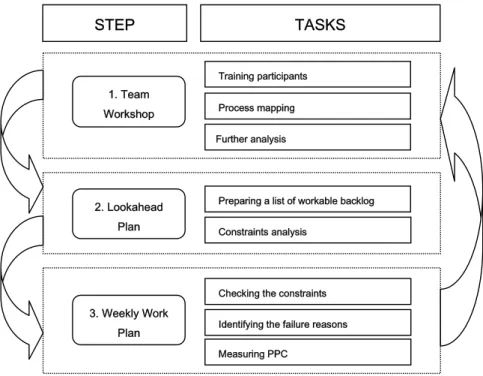
After testing LPS for the entire project period from design to actual construction, he introduced the Team Workshop for the improvement of previous LPS procedures. Figure 1 illustrates the implementation procedure for LPS as proposed by Ballard.
Figure 1. Ballard’s LPS implementation procedure PURPOSE OF THE TEAM WORKSHOP AND IMPLEMENTATION PROCEDURE
Training sessions use a methodology based on learning in action, thereby enabling the step-by-step implementation of the concepts and tools. Below is the implementation procedure:
• Establish the team.
• Identify and understand what are the challenges that can be expected in this project and how to overcome them as a team.
• Agree on the work program.
• Begin the process of identifying the work that should be done. • Plan the work for the first week on-site.
• Agree on the program for the initial phase. • Come up with an Initial Make Ready analysis. • Formulate the Initial Weekly Work Plan. • Agree on a dispute resolution procedure.
• Agree on the dates and times for Make Ready and WWP meetings. Purpose of the Lookahead Plan and Implementation Procedure
The Lookahead Plan seeks to match the workload with the capacity of the crew; thus managing the workflow effectively. Below is the implementation procedure:
• Develop detailed work completion methods. • Maintain a list of workable backlog.
• Exclude any assignment that does not meet the quality control standards. • Examine the remaining week in the lookahead plan to identify and remove any
assignment that cannot be completed on schedule.
Process mapping
Preparing a list of workable backlog Constraints analysis 1. Team Workshop 2. Lookahead Plan 3. Weekly Work
Plan Identifying the failure reasons
Measuring PPC Training participants
Checking the constraints Further analysis
• Consider the availability of materials and components as well as pending
adjustments, making sure that the tools are ready when they are needed and verifying the status of the designs.
• Clearly indicate any assignment that cannot be completed as such in the lookahead plan.
• Organize the lookahead plan by assignment.
• Group together the highly dependentassignments that still need to be planned. • Identify other work to be completed simultaneously.
• Calculate the number of man-hours needed or amount of work in the lookahead program and compare it with the project for the assignment of requirements. Purpose of the Weekly Work Plan and Implementation Procedure
Based on the Lookahead, Last planners prepare promised for completing work on a day-by-day basis for the coming week. The role of the process owner is to approve a look-ahead plan that is without constraints. This approved plan is used by the last planners as the basis for planning. The best planning is done in workstreams among the last planners for each trade specialty in the workstream.
The last planners for each of the specialties prepare their promises with each other. This contrasts with the more traditional approach of having specialists prepare promises for their specialty in isolation of the others.
• List the work to be performed for the following week. • Indicate the dates of execution and the team in charge. • Check the quality criteria.
- Is the assignmentin the right sequence? - Does the assignment have the right scope? - Is the assignment practical?
SELECTION OF COMPARATIVE ANALYSIS TARGET
Ballard proposed partial correction and repletion based on several application examples in the basic framework. In this study, the basic LPS framework proposed by Ballard was reviewed to compare LPS and Korean production control system, and the comparative target between the two systems was selected. First, from among the 4 LPS steps, the comparison was limited at the Lookahead Plan step and Weekly Work Plan step for PPC implementation in Korea’s construction industry. Tools clearly proving the application effect were also chosen from among the LPS tools.
Based on the PPC effect published by Lean achievement level, Alarcon (2005) reported that projects using common LPS tools posted higher PPC compared to other projects. Common LPS tools that were considered include Constraints Analysis and List of Workable Backlog for the Lookahead Plan step and Failure Reason Analysis for Weekly Work Plan step. In case of partial application of the tools, the PPC measurement result decreased remarkably. In particular, Constraints Analysis, List of Workable Backlog, Failure Reason Analysis, and PPC Measurement can be considered essential tools for realizing PPC successfully. Likewise, continuous process improvement through the Team Workshop was proven to be an important management tool vis-à-vis PPC (Runicon, 2004).
This study compared the Korean production control system with 5 common LPS tools to establish the procedure for achieving PPC befitting the actual Korean construction conditions from the viewpoint of users, performance cycle, and implementation procedure. COMPARATIVE ANALYSIS BETWEEN LPS AND KOREAN PRODUCTION CONTROL SYSTEM
In this study, practices of the Korean production control system were collected from 10 apartment construction projects of 5 construction firms through fieldwork; ditto for LPS implementation practices from previous research papers (Johansen, 2004; Mario, 2004; Thomassen, 2004; Alarcon, 2004; Ballard 1997).
The results of the comparative analysis between the domestic production control system and LPS based on the resulting data are presented below:
TEAM WORKSHOP
Like LPS, the Korean production control system also has a Team Workshop. Note, however, that the difference between LPS and Korean production control system lies in the existence/nonexistence of process mapping in the Team Workshop. In particular, the Korean production control system does not apply process mapping.
Table 1.a. Comparative analysis between the Korean production control system and LPS at the Team Workshop step
Comparison Result Step Task Comparison
Target LPS
Korea a. Whether it is
performed or not Yes No
b. Performer Process manager or Project manager -
Team Workshop Process mapping
c. Attendees
Project manager, ,site engineer,
Subcontractor representative Designer, Supervisor
-
In LPS, Team Workshop is performed before the start of the project and every two months during the project term. The training program of LPS targets all project participants.
On the other hand, the Team Workshop in the Korean production control system is held irregularly during the project term and not before the start of the project. Moreover, the Team Workshop is open only to the members of the main construction company and a few subcontractor representatives.
LOOKAHEAD PLAN
The Korean production control system neither has a procedure for listing a workable backlog nor the Constraints Analysis, save for a few construction companies. In the Korean production control system, either a list of workable backlog is prepared or Constraints Analysis is conducted 2~4 weeks later compared to LPS. On the other hand,
in LPS, Constraints Analysis is always performed for all assignments, unlike in the Korean production control system wherein Constraints Analysis is conducted to a limited extent.
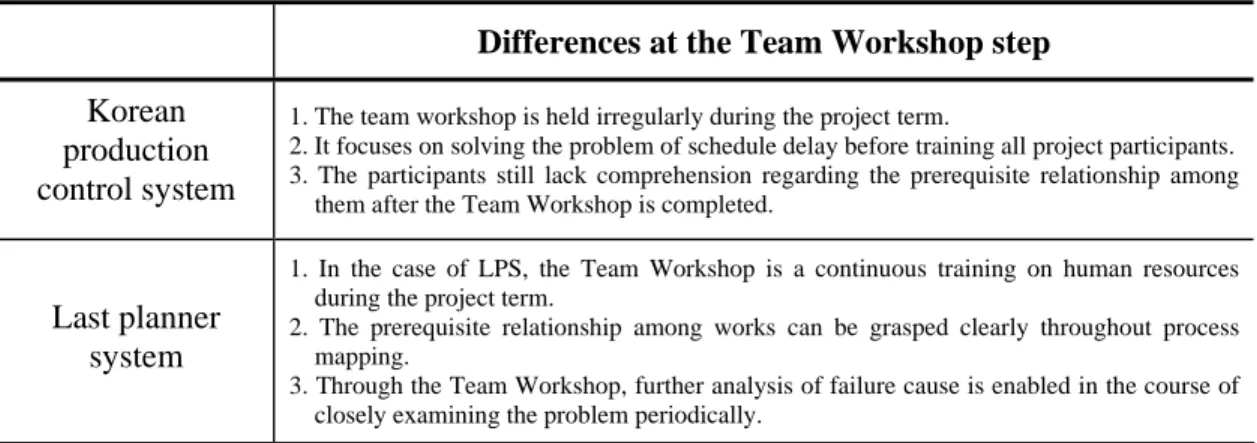
Table 1.b. Difference between the Korean production control system and LPS at the Team Workshop step
Differences at the Team Workshop step Korean
production control system
1. The team workshop is held irregularly during the project term.
2. It focuses on solving the problem of schedule delay before training all project participants. 3. The participants still lack comprehension regarding the prerequisite relationship among
them after the Team Workshop is completed.
Last planner system
1. In the case of LPS, the Team Workshop is a continuous training on human resources during the project term.
2. The prerequisite relationship among works can be grasped clearly throughout process mapping.
3. Through the Team Workshop, further analysis of failure cause is enabled in the course of closely examining the problem periodically.
Table 2.a. Comparative analysis between the Korean production control system and LPS at the Lookahead Plan step
Comparison Result Step Task Comparison Target
LPS Korea
a. Whether the list is
prepared or not Yes Yes
b. Performer Subcontractor
representative
Subcontractor representative c. Time prepared 2~5 weeks beforehand 1 week beforehand
Listing of a workable backlog
d. Whether there is a
procedure for it Yes No
a. Whether CA is
performed or not Yes Yes
b. Performer Process manager Site manager
c. Time conducted Before 2~5 weeks Irregular
Lookahead Plan
Constraints Analysis (CA)
d. Whether there is a
procedure for it Yes No
WEEKLY WORK PLAN
In the Korean production control system, Failure Reason Analysis at the Weekly Work Plan step is performed mainly by a site manager. Nonetheless, there are no method of and procedure for analyzing the failure reasons. As a result, the examination of failure reasons usually cannot come up with definite answers.
Table 2.b. Difference between the Korean production control system and LPS in terms of the list of workable backlog and constraints analysis at the Lookahead Plan step
Differences in terms of the list of workable backlog and constraints analysis
Korean production control system
1. The Monthly Work Plan is prepared mainly based on the Master Plan, although it does not analyze all assignments that come at the Lookahead Plan 2~5 weeks beforehand.
2. When listing the workable backlog, the plan of the project manager takes precedence over that of subcontractor representatives. In other words, the subcontractor cannot say “no.” 3. There is no standardized checklist for the required constraints analysis.
Last planner system
1.The required constraints analysis is performed for all assignments 2~5 weeks before they start. If constraints analysis is not completed, the assignment cannot proceed to the next step.
2. Constraints Analysis is classified into 5 criteria, i.e., contract, engineering, material, labor and equipment, and prerequisite work relationship, and performed for relevant assignments.
3. There is a standardized checklist for the required constraints analysis.
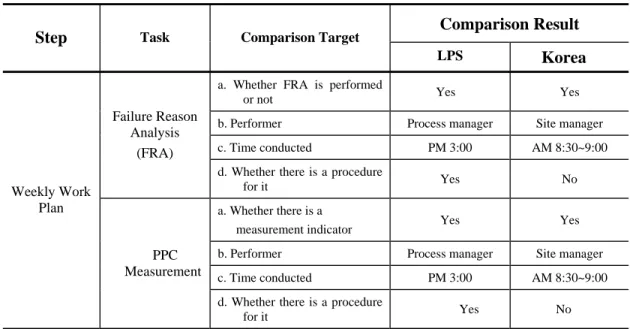
Table 3.a. Comparative analysis between the Korean production control system and LPS at the Weekly Work Plan step
Comparison Result Step Task Comparison Target
LPS Korea
a. Whether FRA is performed
or not Yes Yes
b. Performer Process manager Site manager
c. Time conducted PM 3:00 AM 8:30~9:00
Failure Reason Analysis
(FRA)
d. Whether there is a procedure
for it Yes No
a. Whether there is a
measurement indicator Yes Yes
b. Performer Process manager Site manager
c. Time conducted PM 3:00 AM 8:30~9:00
Weekly Work Plan
PPC Measurement
d. Whether there is a procedure
for it Yes No
In LPS, the failure reasons in all assignments that are not completed are checked every day. The 5Whys technique is also used to determine the fundamental cause of the failed assignments. Of course, the Failure Reason Analysis in LPS cannot always determine the fundamental, root cause of the failed assignment. Note, however, that the important difference between the two systems is the existence of a systematic procedure.
Table 3.b. Difference between the Korean production control system and LPS in terms of Failure Reason Analysis and PPC measurement at the Weekly Work Plan step
Differences in terms of Failure Reason Analysis and PPC measurement
Korean production control system
1. There is no standardized checklist for the Failure Reason Analysis and PPC measurement. 2. The solution for the failure reason is the adoption of a temporary expedient, which does not
determine the fundamental cause.
3. Project performance is not measured periodically.
4. One of its limitations is the use of data as construction records only rather than for the purpose of process improvement.
Last planner system
1. It uses the 5Whys technique to determine the fundamental cause of failed assignments. 2. It presents a classification system related to the failure cause and manages the failure cause
for all assignments.
3. PPC measurement is performed every week. The measurement cycle is periodic.
4. In using the PPC indicator, the problem area or work can be detected during the project term.
HOW TO IMPLEMENT PPC IN KOREA’S CONSTRUCTION INDUSTRY ITEMS TO BE CONSIDERED PRIOR TO PPC INPLEMENTATION
Many Korean construction experts are skeptical about the adoption of Lean Construction techniques, since they are still relatively new to them. Still, the biggest reason is the difference in the organization of Korean construction firms with that of construction companies abroad. In fact, most of the new Lean Construction techniques for construction projects in Korea do not reflect the peculiarity of country’s construction circumstances owing to the difference in the cultural mindset(Kim, 2002).
Therefore, what are the differences between an LPS organization and the Korean construction organization, which should be considered for PPC implementation? If examined based on the abovementioned comparison contents, the duty of the process manager is an important factor for a successful LPS performance. Still, most of the Korean construction companies want to operate the project economically with minimal human resources, a key factor at the site. On the other hand, in foreign countries, many construction companies are reinforcing human resources training to enable the successful accomplishment of duties through suitable training even without assigning a separate process manager for the solution to these problems. Such education is pursued through the Team Workshop. Today, Korean construction companies recognize the importance of human resources training, such as employees’ training course. Still, the scope of training is limited to the members of the main construction company; thus excluding the members of the subcontractor company.
Successful PPC performance in Korean construction projects requires providing continuing education for all participants during the project term.
In addition, there should be sufficient understanding of the LPS principle based on mutual honesty and trust. One of the differences between LPS and existing Korean production control system is the concept of “CAN” and “SHOULD.” Most Korean construction companies must overcome the mentality of saying “YES” to the boss all the time.
IMPROVEMENT PLAN OF THE KOREAN PRODUCTION CONTROL SYSTEM FOR PPC IMPLEMENTATION
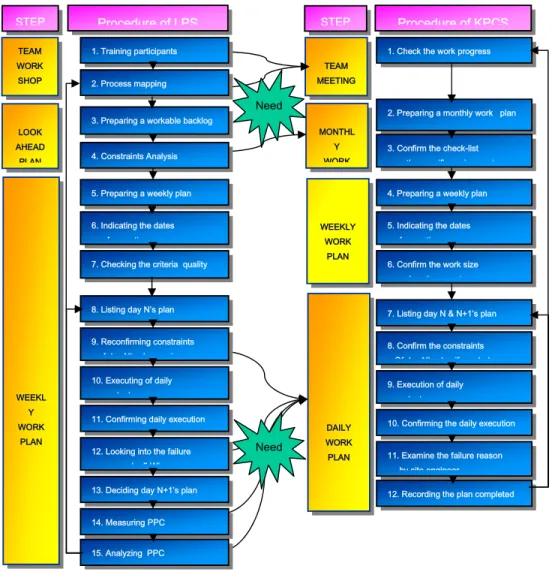
Figure 2 describes the procedures required for implementing PPC in Korea by comparing the procedures of LPS and Korean production control system. The result of the analysis revealed the need for the Korean production control system to add procedures such as process mapping, Constraints Analysis, confirmation of the daily constraints analysis, examination of the failure reasons, and PPC measurement and analysis.
Figure 2: The comparison on the procedure of LPS and Korean Production Control System (KPCS)
Below are the considerations in improving the procedures of the Korean production control system at each step:
TEAM MEETING
• Make a standardized detail activity library to perform process mapping.
• Continuously apply the process mapping method before and during the project to enable understanding of the prerequisite relationship among participants.
2. Preparing a monthly work plan 3. Confirm the check-list
th ifi i t
6. Confirm the work size
d k t W WEEEEKKLLYY W WOORRKK P PLLAANN
4. Preparing a weekly plan 5. Indicating the dates
f ti D DAAIILLYY W WOORRKK P PLLAANN
7. Listing day N & N+1’s plan 8. Confirm the constraints
Of d N’ l if d d 9. Execution of daily
k l
10. Confirming the daily execution 11. Examine the failure reason
by site engineer
12. Recording the plan completed
M MOONNTTHHLL Y Y W WOORRKK T TEEAAMM M MEEEETTIINNGG
1. Check the work progress
STEP Need Need 4. Constraints Analysis T TEEAAMM W WOORRKK S SHHOOPP
3. Preparing a workable backlog 2. Process mapping 1. Training participants
6. Indicating the dates f ti
7. Checking the criteria quality
8. Listing day N’s plan 9. Reconfirming constraints
f d N’ l i 10. Executing of daily
k l
11. Confirming daily execution 12. Looking into the failure
b 5 Wh 13. Deciding day N+1’s plan 14. Measuring PPC L LOOOOKK A AHHEEAADD P PLLAANN W WEEEEKKLL Y Y W WOORRKK P PLLAANN 15. Analyzing PPC Procedure of LPS
5. Preparing a weekly plan
• Open the Team Workshop to supervisors, designers, project managers, site engineers, and subcontractor representatives.
• Conduct a further analysis of assignments whose fundamental cause cannot be determined at the Team Workshop step.
• Train all participants who join the project for two months through the Team Workshop to ensure successful PPC performance.
MONTHLY WORK PLAN
• Prepare a list of workable backlog at least two weeks before the release of all assignments into the Weekly Work Plan.
• Classify the assignments in the list of workable backlog into a class requiring Constraints Analysis and one that does not need Constraints Analysis.
• When performing Constraints Analysis, focus mainly on items such as the prerequisite relationship among all participants in the assignments, labor, materials, and equipment.
• Disseminate the work schedule before releasing the assignments into the Weekly Work Plan.
WEEKLY WORK PLAN AND DAILY WORK PLAN
• From the list of workable backlog, select the assignment that can be started anytime and submit the list of daily work to the site engineer one day before the start of the work.
• Investigate the reason for the uncompleted assignments and classify it as failure reason during the time management meeting.
• Perform further analysis for assignments that are always not completed using the 5 Whys method or VSM technique.
• Utilize the PPC indicator as a project performance index together with other indices in the project.
• Report the result of measuring PPC to all participants in the project every Monday and use the PPC indicator to identify the assignment that requires continuous improvement.
CONCLUSION
This study analyzed the differences between the procedure for LPS and Korean production control system and proposed the areas for improvement for successful PPC implementation in Korea. Korea’s construction industry has unique characteristics that make it different from other counties; hence, we need to pay attention to identifying such differences and propose alternatives to overcome the barriers to implementing PPC in Korea. Finally, continuous support from the owner and systematic procedure for performing PPC are the most important factors for successful PPC implementation.
The study on a PPC application procedure that is suitable for Korea’s construction industry is currently being pursued. On the other hand, research on the procedure at the pilot construction site will be conducted.
ACKNOWLEDGMENT
The authors would like to thank Korea’s Ministry of Construction and Transportation for supporting this research (Research Project 05 CIT D05-01).
REFERENCES
Alarcon L.F. and Diethelmand and Rojo O. (2002). “Collabarative Implementation of Lean Planning Systems in Chilean Construction Company”, Proceedings of the 10th Annual Conference of the International Group for Lean Construction, Gramado, Brazil
Ballard, G. (1994). “The Last Planner”, Northern California Construction Institute, Monterey, California.
Ballard, G. (1994). “Beyond Can-Do”, in Lean Construction (ed. Alarcon), 2nd annual conference of the International Group for Lean Construction, Santiago, Chile Ballard, G. (1999). “Improving Work Flow Reliability”, Proceedings of the 7th Annual
Conference of the International Group for lean Construction, Tommelein, I.D. (editor),275-286
Ballard, G. and Howell, G. (1994a). “Implementing Lean Construction: improving performance”, Proceedings of the 2nd International Seminar on Lean Construction, Pontificia Uni. Catolia de Chile, Santiago, http://www.vtt.fi/rte/lean/santiago.htm Ballard, G. (2000) “ The Last Planner System of Production Control”, Unpublished PhD
Thesis, School of Civil Engineering, The University of Birmingham Fiallo, C. and Revelo, V. (2002) “Applying the Last Planner Control System to a
Construction Project : A Case Study in Quito, Equador”, Proceedings of the 10th Annual Conference of the International Group for Lean Construction, Gramado, Brazil
Johansen, Porter. (2004). “An Experience of Introduction Last Planner into a UK Construction project”, Proceedings of the 12th Annual Conference of the International Group for lean Construction, Virginia, USA
Kim, C. (2000) “Lean Construction” Korean Journal of Construction Engineering and Management, pp.48-57, 1(3), September 2000.
Kim and Jang. (2004). “Case Study: An Application of Last Planner to Heavy Civil Construction in Korea”, Proceedings of the 13th Annual Conference of the International Group for lean Construction, Denmark
Kim. Y.(2002). “The Implications of a New Production Paradigm for Project Cost Control”, Ph.D. Dissertation, Civil & Envir.Eng.,Univ.of California, Berkely, CA. Koskela, Lauri. (1992). “Application of the New Production Philosophy to Construction.
Technical Report #72. Center for Intergrated Facility Engineering. Department of Civil Engineering,. Standford University.
Thomassen et al. (2003). “Experience and Results from Implementing Lean Construction in a Large Danish Contracting Firm”, Proceedings of the 11th Annual Conference of the International Group for Lean Construction, Virginia, USA