University of Huddersfield Repository
Abu Mansour, Hussein Y
Rule pruning and prediction methods for associative classification approach in data mining Original Citation
Abu Mansour, Hussein Y (2012) Rule pruning and prediction methods for associative classification approach in data mining. Doctoral thesis, University of Huddersfield.
This version is available at http://eprints.hud.ac.uk/17476/
The University Repository is a digital collection of the research output of the University, available on Open Access. Copyright and Moral Rights for the items on this site are retained by the individual author and/or other copyright owners. Users may access full items free of charge; copies of full text items generally can be reproduced, displayed or performed and given to third parties in any format or medium for personal research or study, educational or not-for-profit purposes without prior permission or charge, provided:
• The authors, title and full bibliographic details is credited in any copy;
• A hyperlink and/or URL is included for the original metadata page; and
• The content is not changed in any way.
For more information, including our policy and submission procedure, please contact the Repository Team at: [email protected].
R
ULE
PRUNING
AND
PREDICTION
METHODS
FOR
A
SSOCIATIVE CLASSIFICATION APPROACH IN DATA MINING
H
USSEIN
Y.
A
BU
M
ANSOUR
A
THESIS
SUBMITTED
TO
THE
U
NIVERSITY
OF
H
UDDERSFIELD
IN
PARTIAL
FULFILMENT
OF
THE
REQUIREMENTS FOR THE DEGREE OF
D
OCTOR OF
P
HILOSOPHY
II
DEDICATION
Finally this moment come as a result of couple of hard years. This thesis is
devoted with innermost love and everlasting respect.
To my Father's soul, my mother, brothers and sisters. To my supervisors Dr.
McCluskey and Dr. Thabtah, beloved fiends and to everyone who help me.
Without their support and
Encouragement I could not have reached this phase
III
T
ABLE OF CONTENT
Topic Page
List of figures VI
List of Tables VII
List of abbreviations VIII
Abstract X
Chapter1: Introduction
1.1 Motivation 1
1.2 Data Mining 3
1.3 Associative Classification (AC) 6
1.4 Research Aims, Scope and Objectives 8
1.5 Thesis Contributions 10
1.6 General Structural Design 13
1.7 Thesis outline 15
Chapter 2: Literature review on Rule pruning and prediction
methods in associative classification:
2.1 Introduction 16
2.2 Pruning techniques 18
2.2.1 Database Coverage like Methods 18
2.2.2 Long Rules Pruning 21
2.2.3 Mathematical based Pruning 21
2.2.4 Laplace Accuracy 24
2.2.5 Redundant Rule Pruning 24
2.2.6 Conflicting Rules 25
2.2.7 Compact Rule Set 25
2.2.8 I-prune 25
2.2.9 PCBA based pruning 26
2.2.10 Discussions 27
2.3 Prediction techniques 29
2.3.1 Single Rule Class Assignment Method(s) 29 2.3.2 Class assignment based on group of rules methods 30
2.3.3 Predictive Confidence 32
2.3.4 Discussion 33
IV
2.4.1 Classification based on association rule (CBA) 34 2.4.2 Classification based on Multiple Association Rules
(CMAR) 34
2.4.3 Classification based on Predictive Association Rules
(CPAR) 25
2.4.4 Multi-class, Multi-label Associative Classification
(MMAC) 26
2.4.5 Multi-class Classification based on Association rule
(MCAR) 36
2.4.6 Class based Associative Classification (CACA) 38 2.4.7 ACCF Associative Classification based on Closed
Frequent item 38
2.4.8 Lazy based associative classification 39 Rules
2.4.9 Hierarchical Multi-Label AC using Negative rules
(HMAC) 40
2.4.10 Probabilistic CBA 40
2.5 Summary 42
Chapter3: The Proposed Rule Pruning and Class Assignment
Approaches
3.1 Introduction 44
3.2 The Proposed Pruning Methods 46
3.2.1 Single Criteria Pruning(3 Methods) 49 3.2.2 Two Criteria Pruning (2 Methods) 53 3.3 Impact of rule pruning on classification accuracy 56
3.4 The proposed prediction method (DC) 57
3.5 Evaluation and Experimental Results 59
3.6 Summary 63
Chapter 4: MCAR2: An Enhanced Multi-class Classification based
on Association Rules
4.1 Introduction 65
4.2 The MCAR2 algorithm 66
4.2.1 Training Dataset Representation 68 4.2.2 Frequent Ruleitems Discovery and Rule Production 69 4.2.3 Rule Sorting and Building the Classifier 72
4.2.4 Class assignment Procedure 73
4.3 The proposed Algorithm Features 76
4.4 Experimentations 77
4.5 Summery 85
V
Chapter 5: The Application of the Proposed AC Model to Text
Categorisation: A Case Study
5.1. Introduction 87
5.2 Text Categorisation Phases 89
5.2.1 Document Indexing and Dimensionality Reduction 89 5.3 Learning and constructing the classifier 94 5.4 Evaluation Measures for the Text Classification Process 97 5.5 Text Based Associative Classification 100 5.6 Empirical study and experimentations 103
5.7 summery 106
Chapter 6: Conclusions and Future work
6.1 Conclusions 107
6.1.1 Adopting Fast intersection approach for rule discovery 107
6.1.2 New Rule Pruning methods 108
6.1.3 New prediction approach 108
6.1.4 New AC model 108
6.1.5 Adapting AC to TC problem 109
6.1.6 Extensive literature review on AC 109
6.2 Future research works 109
6.2.1 Improve AC effectiveness in terms of Class balancing 110
6.2.2 Multi-label problem in AC 110
VI
L
IST OF FIGURESFigure
Number Title Page
1.1 AC model design 13
1.2 ATC model design 14
2.1 Database coverage Pruning methods 19
2.2 Single rule class assignment method 29
2.3 PCBA Algorithm 41 3.1 PC pruning method 50 3.2 PC3 pruning method 51 3.3 FC pruning method 52 3.4 FPC Pruning Method 54 3.5 FPCC Pruning Method 55
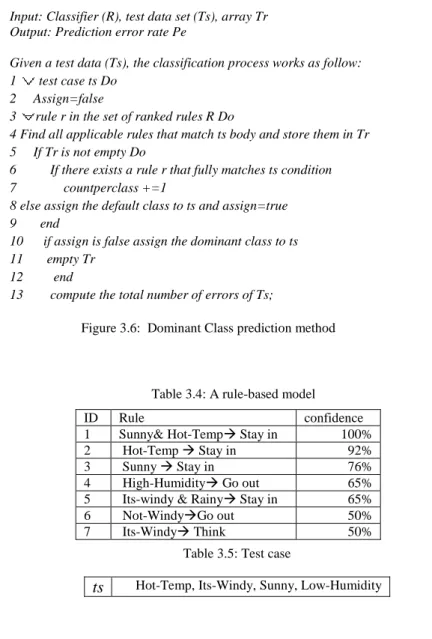
3.6 Dominant Class prediction method 62
3.7 Accuracy rate for the three scholars against the proposed
pruning methods 62
4.1 MCAR2 algorithm 67
4.2 MCAR2 Rule discovery algorithm 70
4.3 MCAR2 Rule sorting procedure 72
4.4 The pruning Procedure in MCAR 73
4.5 Dominant Class prediction method 74
4.6 The enhanced accuracy rate after using the 4 ranking
conditions against 12 datasets 80
4.7a Difference of accuracy between C4.5 and MCAR2 82 4.7b Difference of accuracy between RIPPER and MCAR2 82 4.7c Difference of accuracy between MCAR and MCAR2 82 4.8 The Number of rules derived by MCAR and MCAR2 83 4. 9 The average number of rules generated by MCAR and
MCAR2 on 18 datasets 83
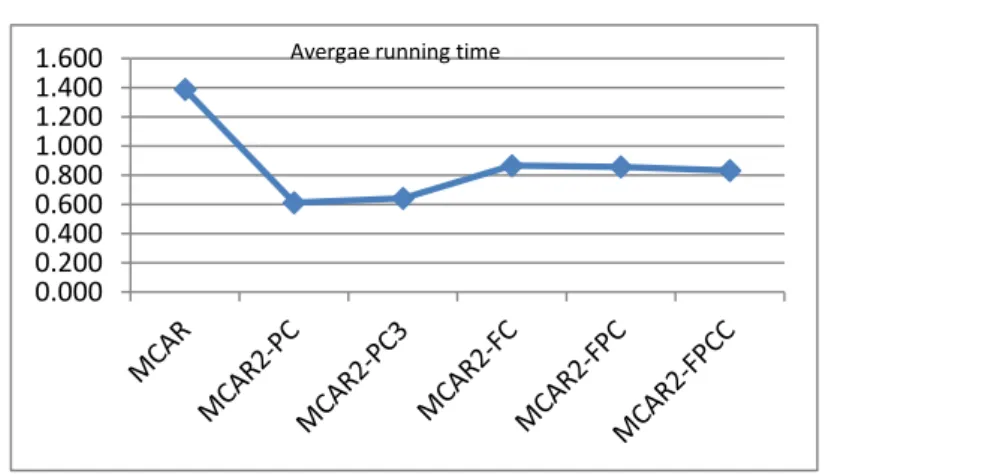
4. 10 Time taken in building the Model 84
5.1 TC problem 88
5.2 Associative text classifier model. 100
VII
L
IST OFT
ABLESTable
Number Title Page
1.1 Example of a training data 7
2.1 Summary of AC algorithms 43
3.1
Example of a rule-based model (potential rules)
from weather dataset 43
3.2 Example data from weather dataset 43
3.3
Selected rules when applying the proposed
pruning on the data in Table 3.2 55
3.4 A rule-based model 58
3.5 Testing case 58
3.6 Applicable Rules for Ts 58
3.7
Number of rules produced by the proposed
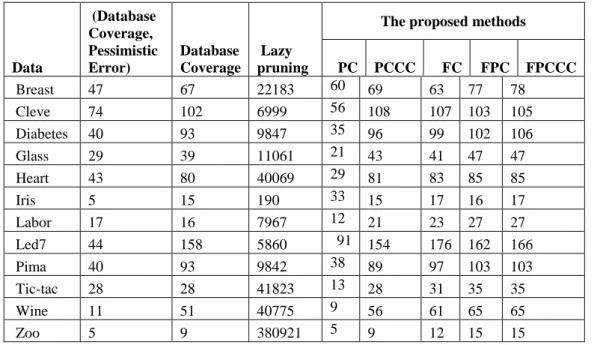
pruning methods and other pruning methods 60
3.8
Classification accuracy after applying the proposed pruning methods and other pruning
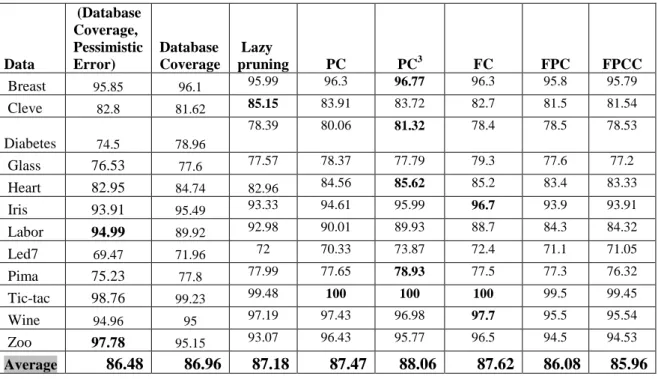
methods 61
4.1 example of a training data 68
4.2 Datasets Details 78
4.3 Accuracy of C4.5RIPPER, MCAR and MCAR2 79 4.4 won-tied-loss records of the proposed algorithm 80 5.1 Importance of term when using multiple N values 91
5.2 Contingency table in TC for ci 97
5.3
Number of documents in training and testing sets
per category 103
5.4
Precision/Recall-BEP for MCAR and other scholars on seven most populated Reuter’s
datasets 104
5.5
Won-tied-lose records of the proposed algorithm
against the other algorithms 104
VIII
L
IST OF ABBREVIATIONSAC
Associative Classification
ACCF
Associative Classification Based on Closed Frequent Itemsets
ACCR
Association Classification Based on Compactness of Rules
ACN
Associative Classifier With Negative Rules
ARM
Associative Rule Mining
ARC-BC
Association Rule-Based Categorizer By Category
BCAR
Boosting Association Rules
CAR
Class Association Rule
CACA
Class Based Associative Classification Approach
CBA
Classification based on Association Rule
CMAR
Classification based on Multiple Class-Association Rules
CPAR
Classification based on Predictive Association Rules
DF
Document Frequency
DC Dominant Class
FP
Frequent Pattern
FC Full Coverage
FPC Full & Partial Coverage
FPCC Full & Partial Coverage Correctly
IDF
Inverse Document Frequency
IG
Information Gain
IR
Information Retrieval
IREP
Incremental Reduced Error Pruning
KNN
K-Nearest Neighbor
L
3Live and Let Live
MCAR
Multi-class Classification based on Association Rule
MMAC
Multi-class, Multi-label Associative Classification
IX
NB
Naïve Bayesian
NN
Neural Network
PC Partial Coverage
PC
3Partial Coverage Correctly Classify
RIPPER
Repeated Incremental Pruning to Produce Error Reduction
SVM
Support Vector Machine
TC
Text Categorisation
TF
Term Frequency
X
A
BSTRACTRecent studies in data mining revealed that Associative Classification (AC) data mining approach builds competitive classification classifiers with reference to accuracy when compared to classic classification approaches including decision tree and rule based. Nevertheless, AC algorithms suffer from a number of known defects as the generation of large number of rules which makes it hard for end-user to maintain and understand its outcome and the possible over-fitting issue caused by the confidence-based rule evaluation used by AC.
This thesis attempts to deal with above problems by presenting five new pruning methods, prediction method and employs them in an AC algorithm that significantly reduces the number of generated rules without having large impact on the prediction rate of the classifiers. Particularly, the new pruning methods that discard redundant and insignificant rules during building the classifier are employed. These pruning procedures remove any rule that either has no training case coverage or covers a training case without the requirement of class similarity between the rule class and that of the training case. This enables large coverage for each rule and reduces overfitting as well as construct accurate and moderated size classifiers. Beside, a novel class assignment method based on multiple rules is proposed which employs group of rule to make the prediction decision. The integration of both the pruning and prediction procedures has been used to enhanced a known AC algorithm called Multiple-class Classification based on Association Rules (MCAR) and resulted in competent model in regard to accuracy and classifier size called " Multiple-class Classification based on Association Rules 2 (MCAR2)". Experimental results against different datasets from the UCI data repository showed that the predictive power of the resulting classifiers in MCAR2 slightly increase and the resulting classifier size gets reduced comparing with other AC algorithms such as Multiple-class Classification based on Association Rules (MCAR).
1
CHAPTER ONE
INTRODUCTION
1.1
Motivation
The rapid evolution of technology in the computer industry have enabled people, companies and organizations to store a huge amount of data inside computers which in some cases ranged into terabytes in size which need a new approaches to deal with these data as well as process it. Data mining is an example on these data processing approaches.
Data mining approaches are advantageous in dense databases (Yin et al., 2003). Consider for instance a large retail business with a massive amount of purchasing transactions and customer's details, finding associations between customer’s different features can help the management people in making business related decisions. For example, if a marketing department in a retail store would like to lunch new sale on some goods that best reach their target customers, figuring out the correlations among the customers’ purchases behaviour as well as the customer’s attributes may help the managers to make such decision. In data mining context, these correlations are known as association rules, for example: 68% of the customers who purchase soft drinks are likely to purchase a chocolate as well. In the transactional database, suppose that those transactions that have both items (the soft drinks and chocolate) form 19% of the whole transactions size in the store database. The customers who purchase soft drinks represent the association rule’s antecedent and those who buy chocolates are known as an association rule’s consequent. The 68% of the association rule mentioned above denotes the strength of the rule and is known as rule’s confidence, while the 19% is a statistical significance measure, known as the rule’s support.
2
Classification on the other hand is the process of forming a classification model cl that maps a group of attributes to a class. This model is then used to forecast the classes of a new data based on the value of attributes.
Given a data set of historical transactions and customer’s attributes, the problem is to discover the Class Association Rules (CARs) with significant supports and high confidences (attribute values that have frequencies above user specified minimum support and minimum confidence thresholds). A subset of the generated CARs is chosen to build a model (classifier) that could be used to predict the class labels of unseen data cases. This approach, which uses association rule to build classifiers, is called “associative classification” (AC). Unlike the classic classification approaches such as rule induction(Cohen, 1995) and decision trees(Quinlan, 1993) which usually construct small size classifiers, AC explores all associations between attribute values and their classes in the training data set aiming to construct larger size classifiers. This is because AC methods aim to produce additional useful knowledge missed by traditional methods which therefore should improve the classification accuracy within applications.
There is a wide range of profitable applications from data mining techniques beside the retail businesses and market basket such as credit card scoring, email classification, text categorization, digital library journals indexing and medical diagnosis.
The problems that can be evaluated by classification have an outcome that is affected by a set of indicator attributes. The basic objective is to estimate the effect of each indicator variable and its influence on the outcome. For example, a bank would have a historical data on borrower attributes such as job stability, credit history and income. Data mining could estimate the effect of each indicator variable on the ultimate outcome. These weights could be applied to future customer data to determine whether to grant a loan or reject the request. Further, in a digital library journal, there are large numbers of journals which belong to several categories; the process of assigning a journal to one or more applicable categories by a human requires effort, care and experience. An automated categorisation system that assigns journals based on their content to the correct category or set of categories could significantly reduce time, effort and error rate.
3
The problem of discovering the complete set of CARs requires substantial CPU time because of the requirement for multiple database passes. Hence, it is very essential to use an efficient method for rule discovery. Besides, cutting down the number of rules and keep the significant one may reduce the computations cost and increased the model efficiency.
According to several experimental studies (Liu et al., 1998) (Yin et al., 2003) (Thabtah et al., 2005), one of the main drawbacks of AC mining is that it often generates large number of rules since AC extract all the correlations among the items and the class are discovered as rules. The use of large number of rules necessitates high computation cost and often degrades the accuracy rates. Recent studies including Liu et al., 1998) (Yin et al., 2003) (Thabtah et al., 2010) believed that removing redundant and misleading rules that often lead to wrong classification might enhance model efficiency as well as effectiveness.
It has been also reported in some AC algorithms such as (Li et al., 2001) (Yin et al., 2003) that predictions procedure that based on one rule might degrade the classification accuracy and lead to favouring one rule in predicting the class label for the majority of test cases while some other classifications rules might be used, this is called prediction bias in classification. Yet, utilising group of rules in making prediction decision may slightly enhance the classification accuracy and prevent favouring one rule from predicting many test cases. Further discussions are presented in section 2.3.4.
1.2
Data mining
Data mining is one of the main phases in the knowledge discovery from database (KDD) which uses different data analysis tools to extracts useful patterns and knowledge from data (Agrawal et al., 1993). In this section, a brief overview on data mining, its main tasks and it’s domain of applications is given.
KDD process compromise many phases such as data selection, data cleansing, data reduction, pattern evaluation and visualisation of the discovered information where data mining is one of the main phases (Elmasri and Navathe, 1999). There are many tasks can be accomplished when utilising data mining approaches , including classification, clustering, association rule discovery and outlier analysis (Witten and Frank, 2000).
4
These tasks can be carried out using a range of data mining techniques that are adopted from different scientific areas such as statistics (Snedecor and Cochran, 1989), databases(Liu, et al., 1998) (Baralis, et al., 2004), probabilities (Quinlan, 1993) and artificial intelligence (Wiener et al., 1995). There is no single data mining technique applicable to all tasks and when it comes to choose a technique for a certain problem, the decision is very critical since one technique could work well for one problem and poor elsewhere. There are many criteria that can be considered before taking such a decision such as the size and nature of the data, attribute types (multimedia, text, real, etc), number of attributes, output format and more importantly the goal of application (Kuonen, 2004). The following sections describe the different data mining tasks:
1.2.1
Classification
Classification is the process of forming a model (classifier) from a historical data to guess the class label of an unseen data object. This model is derived by learning process by analysing a set of training set (cases whose class label is known). Common applications for classification including medical diagnoses (Soni et al., 2011), credit card scoring (Huang et al., 2007), websites type detection (Aburrous et al., 2010) and fraud detection (PHUA et al., 2010). There are wide range of classification approaches in the context of data mining, some of which are decision trees (Quinlan, 1993) such as C5.0, others are statistical based approaches such as naive Bayesian (Holte, 1993), k-nearest Neighbour (Yang, 1999) and support vector machines (Vapnik, 1995), Rule indication approach such as IRIP (Furnkranz and Widmer, 1994) and RIPPER (Cohen, 1995).
1.2.2
Associations Rule Mining
Association rule mining is the process of discovering the patterns that occur frequently in a data such as the frequent items in a customer shopping cart. Frequent items refer to the set of items that occurs together frequently in a transactional database (Agrawal R. and Srikant, 1994). These frequent items are employed to generate the set of association rules. In other words, the association rules simply describe a shopping behaviour of customers in retail stores. Items are considered frequent if they occurs in the database for a certain times greater than or equal a predefined thresholds called Minimum Support.
5
1.2.3
Clustering
Clustering approaches analyse data objects without knowing their class labels. A set of objects are grouped according to a certain criterion such as the similarity among objects. Each object in a cluster is correlated with other objects in the same cluster (homogeneous objects). Each cluster can be viewed as a class of objects and then the rules can be derived from each cluster. Market segmentation for identifying common characteristic for groups of people is a good example of application where clustering can be employed (Rui Xu. 2005).
1.2.4
Regression
Regression is a statistical analysis often used to model and analyse several variables and it often used for numerical data prediction (Fayyad et al., 1996). Regression is a special case of classification. Regression can be presented in many formats, some of them are: 1) Liner regression, this can be used when the relationship between the predictors and the target can be estimated with a straight line. 2) Nonlinear Regression, in some cases the relations between two parameters can't be estimated as a striate line. In this case the nonlinear regression is used by pre-processing the data to have a linear relationship. 3)Multivariate Linear Regression, this refer to two or more indicators, here the regression lines cannot be visualized in two dimensional rather, each line can be com0iuted by extending the equation of a single predictor i.e. Liner to include the parameters for each other predictors.
Regression models are often tested by computing different statistics that determine the difference between the predicted values and the expected ones. Regression approach can be employed in many applications in business planning, marketing, time series prediction, financial forecasting, biomedical and drug response modelling, and environmental modelling. (Docs.Oracle.com)
6
1.3
Associative Classification (AC)
AC is a branch of study of data mining (Liu, et al., 2001). AC approach has been proposed and successfully employed to form classifiers (Liu et al., 1998). This study has attracted extensive research works from the knowledge discovery and machine learning communities including (Li et al., 2001) (Yin & Han, 2003) (Thabtah et al., 2005) (Li X. et al., 2008) (Chen et al., 2012). AC is a promising approach that uses association rule mining in forming its classifier that would be used to predict the class label for the unseen data. It compromise advantages from fields, association rule mining and classification. Further details about AC will be presented in Chapter 2. This section defines the AC problem, and discusses the potential solution scheme.
1.3.1 AC Problem Statement
Definition 1: A row or a training case in D can be described as a combination of attributes Ai and values aij, and a class denoted by cj.
Definition 2: An attribute value can be described as a term name Ai and a value ai, denoted <(Ai, ai)>.
Definition 3: An AttributeValueSet can be described as a set of disjoint attribute values contained in a training case, denoted < (Ai1, ai1), …, (Aij, aij)>.
Definition 4: A ruleitem r is of the form < AttributeValueSet, c>, where cC is the class.
Definition 5: A ruleitem r passes the minsupp threshold if (AVSFreq(r)/|D|) ≥ minsupp, Definition 6: A ruleitem r passes the minconf threshold if (RIFreq(r)/ AVSFreq (r)) ≥
minconf.
Definition 7: Any ruleitem r that passes the minsupp threshold is said to be a frequent ruleitem.
Consider a training dataset D which contains I as a set of items (attribute values), and C
as a set of classes. d is a data case in D where d∈D that is presented by a set of attribute values. A ruleitem is the form of < (Attributevalueset), c> where Attributevalueset ⊆ I, and representing a set of attribute values, i.e. (Ai1,ai1),...,(Aij,aij), and c is a class.
Attributevalueset (AVS) frequency (AVSFreq) is the number of tuples in D that matches
the AVS. The ruleitems frequency (RIFreq)is the number of tuples in D that matches the
7
threshold that judges whether a ruleitem is good enough (frequent) or not. The first step in any AC algorithm is to discover the complete set of frequent ruleitems (thosewhich has a frequency larger than or equal to the minsupp threshold).
A rule R in the classifier has the form (Ai1,ai1)...(Aij,aij)c where the antecedent
is conjunction of disjoint Attributevalueset, and c is a class. The set of rules is produced from the frequent ruleitems and represent the ruleitemset that pass the minconf
threshold. In other words, a frequent ruleitem becomes a rule if its frequency (RIFreq) divided by the AVSFreq is larger than the minconf. The ultimate aim of AC algorithms is to extract the complete set of rules that satisfy the minsupp and minconf thresholds in order to build the classifier which is utilised to forecast test cases.
1.3.2 Solution Scheme
AC intends to achieve two goals, firstly to generate a set of rules that survive the
minsupp and minconf threshold starting by scanning the dataset to find the set of the
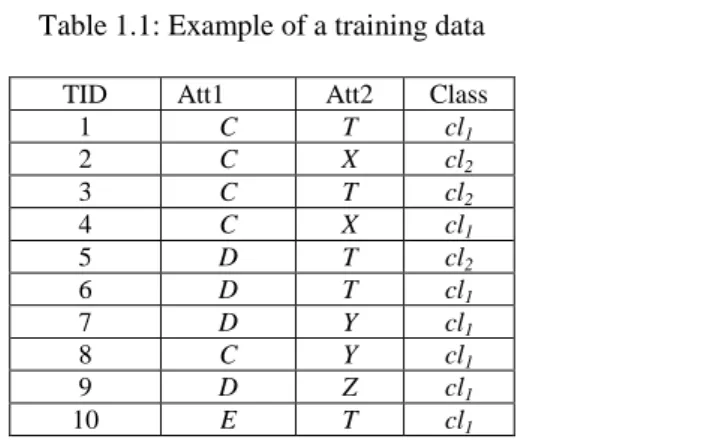
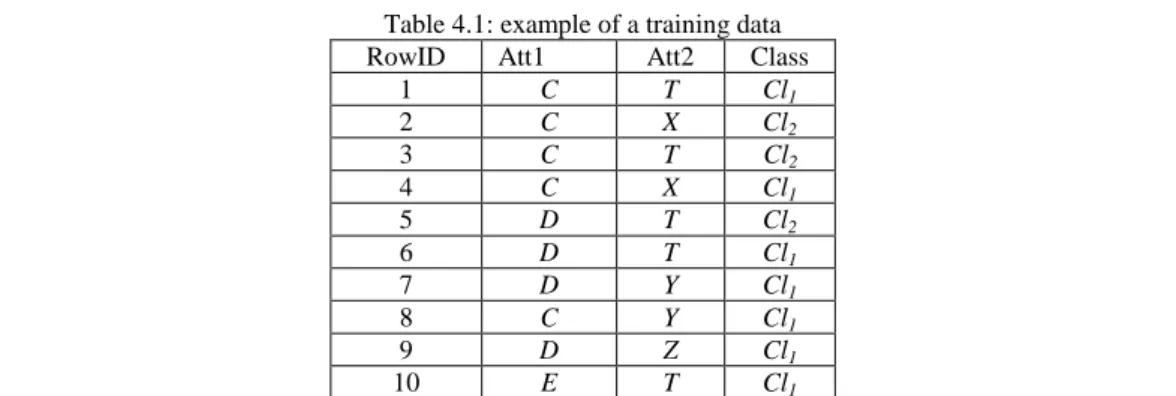
frequent ruleitems. The set of rules are then generated from these frequent ruleitems, and then a punning procedure will be invoked to evaluate the set of generated rules. Secondly it selects a significant subset of rules generated in step one to construct the classifier Cl for predicting the class labels of previously unseen cases. Consider for example the training dataset given in Table 1.1
The first step in AC approach is to discover the frequent ruleitems starting by the single
ruleitems (frequent 1- ruleitems) i.e. those that consists of only a single attribute value.
Frequent one ruleitems are used for the discovery of potential frequent two ruleitems, and frequent two ruleitems are the input for the discovery of potential frequent three
ruleitems and so forth. According to Table 1.1, and with minsupp 30%, the frequent one
Table 1.1: Example of a training data
TID Att1 Att2 Class
1 C T cl1 2 C X cl2 3 C T cl2 4 C X cl1 5 D T cl2 6 D T cl1 7 D Y cl1 8 C Y cl1 9 D Z cl1 10 E T cl1
8
ruleitems set is: < (Att1, C), cl1>, < (Att1, D), cl1>, < (Att2, T), cl1>. The disjoint between them results in the frequent two ruleitems which is in this example.
1.4
Research Aims, Scope and Objectives
This thesis aims to accomplish a number of aims, as a first aim, the thesis has the tendency to produce an extensive literature review on common AC approaches with more attention paid on two important phases, rule pruning and class assignment phases. Approaches used in both phases have been discussed in details so the reader can extract some future trends in AC. These two phases have been discussed due to their importance in solving the two main deficiencies in AC approach; the large number of produced Class Association Rule (CARs) and the overfitting problems. The thesis also aims to investigate the impact of cutting down the number of rules on the model efficiency and effectiveness Minimising the classifier size will done through a number of pruning procedures that evaluate the rule based on its coverage power with or without class correctness.
Most of the current AC algorithms are employing single high confidence rule approach for class assignment task, the thesis aims to discuss this approach, analyse it and examine the impact of employing multiple rules to predict classes for test cases on the classification accuracy. Besides, the thesis aims to develop an AC model by employing novel pruning and class assignment procedures. Furthermore, Text Categorisation (TC) problem will be exploited and its main phases will be discussed. The developed AC model at the previous stage will be adapted to TC problem and compared with other TC classifiers form AC and classical classification methods.
Lastly, after achieving the above mentioned aims, the thesis will answer a number of research questions:
1. If a rule is considered significant when its body is fully match a training case body (left right side) regardless to the class correctness (Matching between the rule's class and the training case class) during the classifier learning step, does the accuracy rate affected?
2. If a rule is considered significant when its body is partially match a training case during the classifier construction, does the accuracy affected?
9
3. When employing more than one rule (multiple rules) to make prediction decisions, does the accuracy positively affected?
4. Although AC often produces large number of rules, does the effectiveness and efficiency positively affected when adapting AC to TC?
10
1.5
Thesis Contributions
There are several achievements in this research work including the development of five pruning, and one prediction methods. Another important contribution in this thesis is the dissemination of an AC algorithm applicable to TC problem and deals with both structured and unstructured data. These issues and others are addressed in the following subsections.
1.5.3
New five rule pruning methods
AC adopts association rule mining to discover frequent ruleitems and generate a set of candidate rules. Association rules considers all correlation between items in a database since the objects in a dataset are often highly correlated, the expected number of Class association rules is often enormous; ranged into thousands, or even hundreds of thousands when dealing with dense data like text data. Many of the produced rules are redundant, misleading or conflicting with other rules. Not all of the rules derived during the learning phase can be used to form the classifier. Hence, triggering pruning procedures including Pre-pruning (Pruning before generating the set of rules) and post-pruning (during the rules generation) become essential to enhance the generated rules and filter out such uninteresting rules. Database coverage pruning (Liu, et al ., 1998) for instance discard all rules that doesn't correctly cover at least one training case whereas Lazy pruning (Baralis et al., 2004) urging that pruning must be limited to those rules that will wrongly classify a trading case and keep all others. The former may discards some useful knowledge due to the sever pruning procedure while the latter often generates large size classifiers that need high computational load (Abu-mansour et al., 2010). In this thesis, we introduce five new rule pruning (PC, PC3, FC, FPC and FPCC) in AC that construct accurate and moderated size classifiers. The proposed pruning methods are discussed in details in chapter 3.
1.5.4
New multiple rule prediction method
The ultimate goal of any classification system is to build a model (Classifier) from labelled training data, in order to classify unlabeled data objects known as testing data. Predicting the class labels of test cases by AC can be one of two types, either by predicting the class labels by the highest precedence single rule applicable to the test
11
case (Single Accurate Rule Prediction) or prediction class labels by multiple rules (Group of Rules Prediction).However, the former suffers sometime from bias classification since using single rule prediction might favour one rule to predict most of the cases that satisfies its condition (discussed in further details in chapter 3). In this thesis, we introduce a new prediction method called dominant Class (DC) which based on group of rules. The proposed class assignment method is discussed in details in chapter 3.
1.5.5
New AC algorithm (MCAR2)
Recent experimental studies (Liu et al., 1998) (Thabtah et al., 2005) (Yoon et al., 2008) in data mining revealed that AC builds more accurate classification models with reference to accuracy than traditional classification approaches. The generation of large number of rules in AC make it hard for end-user to maintain and understand the classification models. We present a new Multi-Class classification based on association rule mining that significantly reduces the number of generated rules. The proposed algorithms employ new evaluation procedures that consider a rule as significant rule if its body partially covers the training case body.
Further, MCAR2 utilise group of rule in predicting a test case in order to avoid bias in classification. For multi-Class classification rules, we introduce An Enhanced Multi-class Classification based on Association Rules (MCAR2)".Chapter 4 discusses the proposed, model in details and shows the experimental results against a number of datasets from the UCI data repository. Experimental results show that MCAR2 outperforms popular AC and traditional classification techniques such as C5.0 and RIPPER RIPPER, C5.0\, CMAR, CPAR, MCAR and CBA.
1.5.6
Application of associative classification
In recent years, TC problem has attracted many researchers due to the availability of documents online, digital libraries and digital journals. TC involves assigning text documents to one or more pre-defined categories based on the content (Antonie M. and Zaïane O. 2003). Manual handling for TC is time and effort consuming. Despite the
12
exponential growth of text documents, there are few AC research works on TC problem such as (Antonie M. and Zaïane O. 2004) (Chen et al., 2005) (Li et al., 2007).
Most of the research works on TC problem are using traditional machine learning approaches such as SVM (Vapnik, 1995), decision tree (Quinlan, 1993), and KNN (Yang, 1999) where a few attempts to tackle the problem of TC using AC including (El-halees, 2006) (Antonie and Zaïane, 2004) (Qian et al., 2005) (Chen et al., 2005). In this thesis, the developed AC model has been applied to TC problem by adding a pre-processing step to transform the data into a suitable form for learning. Extensive experimental results against common English text benchmarks (Reuter's mod-split) using the developed AC algorithm (Discussed in chapter 4) revealed a competitive results when contrasting with other algorithms from A.
1.5.7
Experimental study in testing and comparing the developed
pruning and prediction methods and the developed AC model with
other approaches.
In this thesis, we have performed a large number of experiments comparing a number of classification approaches including, decision trees, rule induction and AC against different benchmarks including binary, multi-class and text benchmark problems along with discussions in order to highlight the strength points in the proposed methods. Particularly, we test the proposed pruning methods, perdition method and the developed AC model against wide range of UCI datasets and Reuter’s mod-split benchmark (Lewis .D, 1998). The criteria used in the comparisons are time taking in building the model, number of rules produced, classification accuracy, precision and recall and breakeven point BEP (Joachims, 1998) BEP is the point where precision equals recall.
13
Figure1.1: AC model design
1.6
General Structural Design
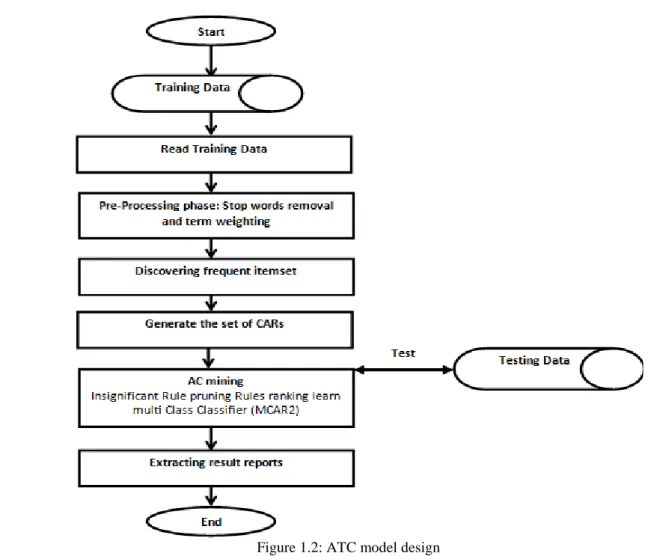
Two models were designed and used in this thesis, AC model and Associative Text Categorisation (ATS) model; both are shown in Figures 1.1 and 1.2.
1.6.1 AC model design
The AC model is working as follow: The user selects the training dataset (text file format) and then defines the required thresholds (minimum support and minimum
confidence). The AC system starts processing the training data by producing the
complete frequent ruleitems set and then produce the set of Class Association Rules. A subset of these rules is selected (interesting ones) through evaluation procedure. The selected rules are then used to form the classifier. Lastly, the classifier is applied on the testing dataset. In this thesis we developed MCAR2 algorithm which mines single label cases (each case is assigned to one class label only).
14
Figure 1.2: ATC model design
Figure 1.2: ATC Model design
1.6.2 Associative Text Classification model design
The proposed AC model is adapted to work on the TC problem. the model is working as follow; the user selects the training dataset (text file format), the dataset go through pre-processing phase that includes stop word elimination, terms extraction and weighting. The user defines the required thresholds (minimum support and minimum confidence), the AC system starts processing the training data by producing the complete frequent
ruleitems set (terms), and then a set of Class Association Rules. A subset of those rule is
selected (significant ones) to form the classifier. Lastly, the formed classifier is applied on the testing dataset (testing Documents which are pre-processed as well). In this thesis we adapt the developed MCAR2 algorithm which mines single label classifiers to deal with text data (Spars data).
15
1.7 Thesis outline
This thesis consists of 6 chapters as follows:
Chapter One introduces the motivation, the research aims and objectives. The data mining and AC are briefly introduced; thesis contributions and the used structural models' design are demonstrated.
Chapter Two is literature review; the contents of the literature review focused on the association classification approach by discussing the common approaches in AC along with methods used at each step. Particularly, the common rule pruning and prediction approaches in AC have been discussed.
Chapter Three demonstrates the proposed pruning and prediction methods and highlights the Impact of rule pruning on the accuracy of the resulting classifier. Beside, experimental study in testing and comparing the developed pruning and prediction methods with other methods with respect to the classifier size, classification accuracy and model efficacy have been conducted.
Chapter four presents and discusses the proposed AC approach “Enhanced Multi-class Classification based on Association Rules” (MCAR2). Experimental study in testing and comparing MCAR2 efficiency and effectiveness with other Algorithms has been conducted.
Chapter Five introduces text classification domain including, TC problem, TC phases and the common approaches used in each phase. Further, based on approaches and schemes proposed in previous chapters, Chapter 5 adapts MCAR2 to text classification problem. To the best of the author's knowledge there are very few attempts in adapting AC approaches to TC. Experimental study in testing and comparing the developed AC algorithm with other classification approaches from AC and Traditional classification approaches on TC has been conducted.
Lastly, Chapter Six summarises this thesis and contribution to knowledge. A discussion for the future work and directions is also described.
16
CHAPTER TWO
R
ULE
P
RUNING AND
P
REDICTION
TECHNIQUES
IN
A
SSOCIATIVE
C
LASSIFICATION
2.1 Introduction
It has been reported in many research works including (Liu, et al., 1998)(Thabtah et al., 2005)(Baralis, et al., 2008)( Hao et al., 2009)( Chen et al., 2012) that AC which builds rule based models lead to notable improvements on accuracy rate and effectiveness when contrasted with traditional classification data mining algorithms. Though, this approach suffers from two main problems
1) The large number of the generated rules which may be in tens of thousands or even hundreds of thousands when dealing with dense datasets. This often degrades the system efficiency and expands training time.
2) The biased classification and over-fitting during the classification phase (Prediction) which usually occurs due to relying on a single rule in predicting test data.
Normally, an AC algorithm operates in two phases, the rule generation and the classifier building. In the first phase, the set of frequent ruleitems are discovered and all rules satisfying the confidence threshold are then created. In the second phase, rules produced in the first phase are sorted according to certain parameters (Confidence, Support, etc) and then evaluated by pruning procedure(s) to discard redundant and misleading rules. Only the survived rules of phase one are used in the second phase to form the classification model. The scope of this chapter is to review common rule pruning and class assignment techniques in AC mining and to show their impact on the classification accuracy. In other words, we
17
intend to examine the impact of rule pruning and prediction steps on the classification accuracy and efficiency within AC.
There are different ways used by AC algorithms to evaluate the set of generated rules during the classifier construction step. For instance, the CBA algorithm (Liu, et al., 1998) utilize the database coverage pruning where rules correctly covering a number of training cases are marked as accurate rules and inserted into the classifier. However, the L3 algorithm (Baralis, et al., 2004) claims that rules pruning like database coverage normally discards useful knowledge, therefore keeping all generated rules may give more power to the produced classifiers. In fact, their believe was supported by an evaluation result reported in (Baralis, et al., 2004) which employs a lazy heuristic that stores two kinds of rules: primary and spare in the classifier. The primary rules are those that cover certain training cases and the spare rules are those which do not cover any training case where a rule is added to the spar rules if a higher ranked rule covers correctly the selected rule training case(s). Spar rules stored in a compact-set aiming to use them during the prediction step especially when no primary rules cover a test case
There are other pruning techniques based on mathematics such as Chi-square(X2) (Snedecor and Cochran, 1989) and pessimistic error (Quinlan, 1993). These techniques usually evaluate the rules statistically by measuring the correlation between rule body and the class it belongs to. Chi square X2 tends to discard all rules that have negative correlation (according to a scoring function) between the rule body and the class label they contain. Pessimistic error is used in decision tree pruning such as C5.0 to evaluate the nodes in the decision tree by calculating its estimated error in order to decide whether to replace the node and its successors with a single leaf or leave it.
In the last step of an AC algorithm, assigning the right class for a test case becomes the key to success of the algorithm. There are many class assignment techniques that have been considered in the context of AC data mining, some of which relying on one rule to assign the class for the test case such as CBA(Liu, et al., 1998), and MCAR (Thabtah et al., 2005). In this approach, the first rule in the classifier applicable to the test case classifies it. On the other hand, some AC algorithms reply on group of rules such as CMAR (Li et al., 2001) and CPAR
18
(Yin X. and Han J. 2003) where all rules applicable to the test case predict the class label for a test case based on a certain scoring procedure.
In this chapter, we review in details common pruning and prediction techniques in AC and discuss the major issues related to AC. Finally, common AC algorithms such as CBA, MCAR, CMAR, etc are surveyed.
2.2 Pruning Techniques
A number of pruning techniques have been used in the context of data mining some of which is adopted from decision trees, others from statistics such as Pessimistic Error Estimation (Quinlan, 1993), Chi-Square testing (Snedecor and Cochran, 1989). These pruning techniques are employed either during rules discovery phase (Pre-Pruning) such as Pearson’s correlation coefficient testing (Karl Pearson, 2003) or during the classifier construction phase (Post-pruning) such as Database coverage (Liu, et al., 1998) and Lazy (Baralis, et al., 2004). An early pruning step take place before generating the rules by eliminating those ruleitems didn’t passed the minsupp threshold which may occur in the process of finding frequent ruleitems. This section discusses the current pruning techniques employed by the associative classification algorithms.
2.2.1 Database Coverage based Techniques
Rule Pruning Techniques that consider the rule as significant rule according to its coverage capacity are called database coverage techniques, following section list them and discusses their working mechanisms.
2.2.1.1 Database Coverage
The database coverage is the first heuristic that has been applied in CBA (Liu, et al., 1998) to select a rules subset to form the classifier. Database coverage method is a simple and effective pruning method; it evaluates the complete set of generated rules against the training dataset. Figure 2.1 shows the database coverage heuristic method in which starting with the highest
19
Input: The set of sorted rules R and the training dataset D
Output: The classifier Cl
For each rule ri in R do
Mark all applicable cases in D that fully match ri’s body
If ri correctly classifies an case in D
{ Insert ri into Cl
Discard all cases in D covered by ri
} If ri cover no cases in D { Discard ri } } If D is not empty
{ Generate a default rule for the largest frequency class in D
Mark the least error rule in R as a cutoff rule. }
Figure 2.1 Database coverage Pruning technique
ranked rule, all training cases that fully covered by the rule and the class is matched are marked for deletion from the training dataset and the rule gets inputted into the classifier. For a rule covering no training case (the rule body does not fully match any training case) then the rule is discarded. The database coverage method ends when either the training dataset gets is totally covered or there are no more rules to be added. In the case of no more rules are left for evaluation, the remaining uncovered training cases are used to generate the default class rule which represents the largest frequency class (majority class) in the remaining unclassified cases.
It should be noted that the default class rule is used during the prediction step in cases when there is no classifier rule applicable to the test case. Lastly, before the database coverage terminates, the first rule which has the least number of errors is identified as the cutoff rule. All the rules after this rule are not included in the final classifier since they often produce errors (Liu et al., 1998). Database coverage method has been criticized by (Baralis, et al., 2004) since in some cases it discard some useful knowledge. Alternatively, they urge that rich classifiers often provide useful and rich knowledge during the classification step.
20
2.2.1.2 Lazy Pruning
Lazy associative algorithms (Baralis, et al., 2002) (Baralis, et al., 2004) (Baralis et al. 2008) believed that pruning should be limited to the rules that incorrectly cover the training cases. Only these rules that lead to incorrect classification on the testing cases are discarded. Database coverage technique discards any rule that unable to fully cover a training case and class correctness. Alternatively, Lazy based method store all rules discarded by database like i The lazy rule pruning invoked when the complete set of rules are discovered and ranked in descending order in which longer rules (rules with more items in its antecedent) are favored over general rules. For each rule starting from the highest ranked rule, if its cover correctly a training case, it will be inputted into the primary rule set, and all of its corresponding cases will be deleted from the training dataset. Whereas, if a higher ranked rule covers correctly training case(s) then it will be inserted into the secondary rule set (Spare rule-set). Lastly, if the selected rule is wrongly covers any training case, it will be removed. The process is repeated until all discovered rules are tested or the training dataset becomes empty. At that time, the output of this lazy pruning will be two rules sets, a primary set which holds all rules that cover correctly a training case, and a secondary set which contains rules that never been used during the pruning since some higher ranked rules have covered their training cases. The distinguishing difference between the database coverage and lazy pruning is that the secondary rules set extracted by the lazy method are completely removed by the database coverage. In other words, the classifier resulting from database coverage pruning does not contain the secondary rules set of the lazy pruning, and thus it is often smaller in size than that of lazy based algorithms. This is indeed an advantage especially in applications that the end user can control and maintain the rules.
Empirical studies in (Baralis, et al., 2004), against a number of UCI datasets revealed that using lazy algorithms such as L3 and L3G sometimes achieved better accuracy rate than CBA like algorithms i.e. CBA2 and MCAR.. Lastly, we conclude that Lazy based algorithm are often scores high in term of effectiveness but low in the efficiency due to the large classifier size which takes more time in generating rules and learning the classifier.
21
2.2.2 Long Rules Pruning
A rule evaluation method that discards long rules (specific rules) that have confidence values larger than their subset (general rules) was introduced in (Li, et al., 2001). General rule with highest confidence value is used to prune the specific ones. In other words, it discards rules redundancy since many of the discovered rules have common shared attribute values in their antecedents that often results in redundant rules particularly when the classifier size becomes large.
The first algorithm used the long rules pruning was CMAR (Li et al., 2001). The set of rules firstly ranked according to the confidence, support and rule length, the rules are then stored in a CR- tree structure. A retrieval query over the tree is activated to check whether a rule can be removed. Chi square testing is applied on each rule R: ri c, to determine whether ri is positively correlated with c or not. The algorithm selects only rules that are positively correlated to form the classifier. There are a number of AC algorithms that employ this type of pruning including ARC-BC (Antonie and Zaïane, 2003), and Negative Rules (Antonie and Zaïane, 2004). Experimentation results reported in (Li et al., 2001) shows that using this pruning technique will positively affect the effectiveness when contrasted with other techniques.
2.2.3 Mathematical based Pruning
Some mathematical based pruning techniques have been proposed. Most of them tend to measure the correlation between different objects to decide whether they are correlated or not
2.2.3.1 Chi-Square Testing
The chi-square test (χ2) proposed by (Snedecor and Cochran, 1989) is applied to decide whether there is a significant difference between the observed frequencies and the expected frequencies in one or more categories. It is defined as a known hypothesis that examines the relationship between two objects (Witten and Frank, 2000). The evaluation using χ2
for a group of objects to test their independence or correlation is given as:
22 χ2 =
k i i i i e e o 1 2 ) ( Where:ei is the expected frequencies and oi is the observed frequencies. When the expected
frequencies and the observed frequencies are notably different; the hypothesis that they are correlated is rejected.
This method has been used in AC to prune negatively correlated rules. For example, a test can be done on every discovered rule, such as r: x c , to find out whether the condition x is positively correlated with the class c. If the result of the test is larger than a particular constant, there is a strong indication that x and c of r are positively correlated, and therefore r will be stored as a candidate rule in the classifier. If the test result indicates negative correlation, r will not take any part in the later prediction and is discarded. The CMAR algorithm (Li, et al., 2001) adopts the chi-square testing in its rules discovery step. When a rule is found, CMAR tests whether its body is positively correlated with the class. If a positive correlation is found, CMAR keeps the rule, otherwise the rule is discarded
2.2.3.2 Pessimistic Error Estimation
Pessimistic error estimation was used in data mining within decision trees (Quinlan, 1993) which decides whether to replace a sub-tree with a leaf node or to keep the sub-tree . The method of replacing a sub-tree with a leaf is called “sub-tree replacement”. The probability of an error at a node v is giving by the following relation that defines the pessimistic error:
v c v v N N N v q( ) , 0.5 Where v
N Denotes the number of training cases that node v covers, Nv,cis the number of training cases belonging to the largest frequency class at node v.
The error rate at sub-tree ST,
) ( ) ( , 0.5 ) ( T leafs l l T leafs l c l l N N N T q .23
Pessimistic error estimation technique has been exploited successfully in decision tree algorithms including C4.5 and C5.0 (Quinlan, 1998). In AC mining, the first algorithm which has employed pessimistic error pruning is CBA. For a rule R, CBA removes one of the attribute value in its antecedent to make a new rule R’, then it compares the estimated error of
R’ with that of R. If the expected error of R’ is smaller than that of R, then the original rule R
gets replaced with the new rule R’.
It should be mentioned here that CBA employs two pruning techniques, pessimistic error and database coverage. Some studies reported that employing sever pruning procedures may affect the accuracy rate (Baralis, et al., 2004) (Abumansour et al., 2010) (Thabtah et al., 2011).
2.2.3.3 Pearson’s Correlation Coefficient Testing:
Pearson’s correlation coefficient testing (Karl Pearson, 2003) is another statistical approach to measure the correlation between two objects. HMAC (Sangsuriyun, at.el.2010) is one of the associative classification approaches that uses this measure. After generating the set of CARs, HMAC uses two pruning procedures (1) Pearson’s correlation coefficient procedure and (2) redundant rule, after the set of rules are being ranked according to the ranking procedure (Sangsuriyun, at.el.2010), HMAC starts with Pearson’s Correlation Coefficient and apply it for every positive class rule RPC to measure the correlation strength between the rules antecedent i.e. the items and the consequent i.e. the class label. All rules with correlation measure π is below a predefined threshold will not be considered in the classifier. Three states could be found for a rule ri, (1) the rule is said to be independent if the correlation measure
between the antecedent and consequent π =0, (2) is said to be positively correlated if 0< π <1 and (3) negatively correlated if π <0. Only the rules that are positively correlated are considered. The negative redundant rule pruning procedure is applied since some rules could share the same items in their antecedent.
Although it is revealed in their experimental results that algorithms using Pearson’s test can result in gaining good accuracy results, it is difficult to validate this as insufficient
24
experimental results are available and much of the information relating to their generation is absent.
2.2.4 Laplace Accuracy
Laplace accuracy (Clark and Boswell, 1991) is a post-pruning method, which is get invoked during the construction of a rule. It used to estimate the expected error ratio of a rule r:
p1p2...pn→c, the expected accuracy for a given rule r is calculated by the following formula:
Laplace(r) = ) ) ( ( ) 1 ) ( ( m r p r p tot c Where c
p (r) Indicates the number of training cases covered by r with class c, ptot(r) is the number of training cases matching r’s condition and m is the number of class labels in the domain. Laplace was adopted in associative classification by CPAR (Yin and Han; 2003). The method invoked after the rules being generated and sorted, the expected error is calculated for every rule in the set of potential ruleset, if the result above a predefined value the rule is then discarded which ensure that only those rules with best expected accuracy will be used in classification. One disadvantage of the algorithm is that (the rules are often with less quality than those generated by other AC algorithm, the reason is that CPAR is using greedy algorithm (FOIL) and rule r is generated for the remaining cases in training dataset instead of the whole dataset.
Experimental results reported in (Yin and Han; 2003) on the basis UCI repository showed that CPAR which uses Laplace accuracy algorithm showed promising results when compared with than CBA and CMAR.
2.2.5 Redundant Rule Pruning
In associative classification approaches, all of the attribute combinations are considered as a rule’s body, thus rules used in building the classifier may share some training items and as a result, some specific rules might contain many general rules. The presence of the redundant rules in the classifier could be misleading as the number of the generated rules usually huge.
25
The method was proposed in (Li, et al., 2001) which discards specific rules that have a confidence value less than general rule. The method is working as follows: once the set of rules being generated and sorted, redundant rule evaluation is invoked to discard all rules where there are some general rules with higher rank and I ⊆I’. This method notably reduces the size of the classifier.
Redundant rule pruning method have been used in several associative classification algorithms including CMAR (Li, et al., 2001), ARC-BC (Antonie and Zaïane, 2003), CACA (Tang and Liao, 2007) and contributed in enhancing their classification rate.
2.2.6 Conflicting Rules
In some datasets in which they considered dense datasets or multi-label i.e. multiple class labels associated with a training case, there is a possibility to have two rules with same antecedent associated with two different class labels, such as the following two rules: x →ca and x→ cb
,
conflicting rules pruning method (Antonie and Zaine, 2003) discards them and prevent them to take any role in the classifier. However, it has been reported in the experimental results by MMAC algorithm (Thabtah, et al., 2004) that such rules could represent useful knowledge.To benefit from such rules, a recursive learning procedure have been developed by MMAC to combines what so called conflicting rules into one multi-label rule. For the above two rules, MMAC combines the two rules into the following multi-label rule: x →ca ∨ cb.
2.2.7 I-prune
Item prune is a recent proposed method in (Baralise and Garza, 2012). I-Prune is a pre-pruning method tends to mark uninteresting items based on interestingness measure (correlation measures e.g “Chi Square”, “Lift”, “Odd ration”) and remove them and use only interesting items to build a high quality rules which will be used in building the classification model. Consequently, such early pruning step will reduce the number of generated rule as well the time taken for learning the classifier.
26
Several AC algorithms such as CBA, CPAR, CMAR, and MCAR consider an item interesting according to the support count. Alternatively, I-prune selects only those are frequent and correlated to a class, Given an item i that is correlated to class c, an interestingness measure is given as follows: if interestegness-measuer (i,c)>
predefined-threshold then i is selected else the item is discarded as soon as detected. Assume I is a subset
of frequent and correlated items with respect to class c, only the rules that contains interesting items are generated. On the other hand, I-prune may inadvertently discard some item that might produce useful classification rules in later stages. Experimental results shows that Chi Square is the best correlation measure with respect to effectiveness (See (Baralise and Garza, 2012) for more details).
Lastly, I-Prune can be easily and effectively integrated with a number of Ac algorithms especially those are Apriority based algorithms such as CBA, CBA2 and MCAR.
2.2.9 PCBA based Pruning
Class imbalancing problem has not received big attention in the context of information retrieval and data mining. Classifiers with Imbalance class examples may increase the misclassification ratio (Liu et al., 2003) (Chen et al,. 2012).
To deal with class imbalancing in (Chen et al,. 2012), PCBA pruning method was proposed .Conventional AC algorithms used one fixed minsupp and minconf which might be working properly when dealing with balanced data but not for imbalanced one. Alternatively, the algorithm uses different minsupp and minconf values based on the rule distribution across classes.
PCBA adjusts CBA algorithm by proposing a new pruning method that filters the set of deemed CARs to be suitable to SBA algorithm which will lead to better accuracy in cases where classes are imbalanced. PCBA have improved two aspects in the original CBA (1) adopting sampling method which usually used to adjust the confidence of the minority classes that lead to enhancement on the ranking effectiveness and (2) decrease the level of class imbalancing that consequently makes minority classes more common. There are two sampling approaches, “under-sampling” and “over-samples”, due to the fact that over-sampling might
27
cause over-fitting problems; PCBA adopts under-sampling approach in adjusting the confidence of the rare CARs. When under sampling used during the ranking procedure it controls the amount of positive rules by decreasing the amount of negative rules.
Second issue addressed in this work is setting multiple minsupps and minconfs thresholds. Setting single value is not appropriate when dealing with imbalanced data since two problems might occur; when setting the support to high value, it becomes impossible to locate those rule from the minority classes on the other hand, setting the support to a low value in order to locate the rule from minority class will lead to a huge number of rules which need high computational cost and might degrade. Hence, PCBA employed different minsupps and
minconfs values, the method adopted from (Liu et al., 2003) where the system users are
required to define one minsupp called t-minsupp which changed according to the class distribution.
2.2.10 Discussions
AC approach which builds classification models by employing association rule mining often produce very large numbers of rules where some of them are significant and others are not. Hence, putting constraints on selecting the classification rules which is essential for a number of reasons: 1) the generated rules often have many of noisy, redundant and misleading rules that should be used in the classification step. 2) the time taking in building the model for classification would take much time and lead to increase the computational cost, 3) having some insignificant rules in the classifier may degrade the classification rate.
In the previous section, the most common rule pruning techniques used in the context of information retrieval and data mining have been reviewed, strengths and weaknesses were highlighted. Some of which is adopted from decision trees such as Pessimistic Error Estimation, others from statistics such as, Chi-Square testing and Pearson’s correlation and AC such as database coverage and lazy pruning. These pruning techniques can be categorised based on the invoking period, Pre-Pruning (before learning the classifier) such as Pearson’s correlation coefficient, I-prune, and Post-pruning (during the classifier construction phase) such as Database coverage, Lazy and others. Some of these algorithms favor the general rules (long rules) over specific believing that general rule implicitly contains the specific one and