econ
stor
www.econstor.eu
Der Open-Access-Publikationsserver der ZBW – Leibniz-Informationszentrum Wirtschaft The Open Access Publication Server of the ZBW – Leibniz Information Centre for EconomicsNutzungsbedingungen:
Die ZBW räumt Ihnen als Nutzerin/Nutzer das unentgeltliche, räumlich unbeschränkte und zeitlich auf die Dauer des Schutzrechts beschränkte einfache Recht ein, das ausgewählte Werk im Rahmen der unter
→ http://www.econstor.eu/dspace/Nutzungsbedingungen nachzulesenden vollständigen Nutzungsbedingungen zu vervielfältigen, mit denen die Nutzerin/der Nutzer sich durch die erste Nutzung einverstanden erklärt.
Terms of use:
The ZBW grants you, the user, the non-exclusive right to use the selected work free of charge, territorially unrestricted and within the time limit of the term of the property rights according to the terms specified at
→ http://www.econstor.eu/dspace/Nutzungsbedingungen By the first use of the selected work the user agrees and declares to comply with these terms of use.
Celasun, Oya; Harms, Philipp
Conference Paper
Boon or Burden? The Effect of Private Sector Debt
on the Risk of Sovereign Default in Developing
Countries
Proceedings of the German Development Economics Conference, Zürich 2008, No. 16
Provided in cooperation with:
Verein für Socialpolitik
Suggested citation: Celasun, Oya; Harms, Philipp (2008) : Boon or Burden? The Effect of Private Sector Debt on the Risk of Sovereign Default in Developing Countries, Proceedings of the German Development Economics Conference, Zürich 2008, No. 16, http://
Boon or Burden? The Effect of Private Sector
Debt on the Risk of Sovereign Default in
Developing Countries
Oya Celasun
∗International Monetary Fund
Philipp Harms
†RWTH Aachen University
and Study Center Gerzensee
April 11, 2008
Abstract
We explore how the share of the private sector in total external debt affects perceived creditworthiness and the likelihood of sovereign default in devel-oping countries. While there are theoretical arguments both in favor and against a stabilizing role of private-sector borrowing, the evidence clearly supports the notion that a greater share of the private sector in total ex-ternal debt is associated with a reduced likelihood of sovereign default. JEL Classification: F34, O16.
Keywords: International Investment, Sovereign Risk.
∗Address: International Monetary Fund (IMF) - Research Department 700 19th Street NW
Washington , DC 20431 USA. Email: [email protected]. The views expressed in this paper are those of the authors and do not necessarily represent those of the International Monetary Fund, its Board of Executive Directors, or the governments the latter represent.
†Address: Templergraben 64/III, 52062 Aachen, Germany. Email: [email protected].
1
Introduction
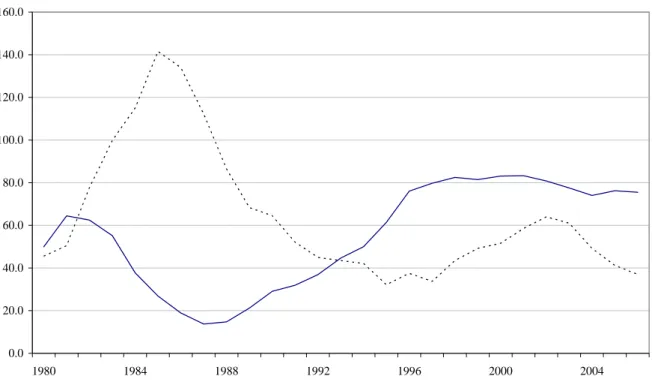
The past two decades have witnessed a sustained and accelerating increase of private foreign borrowing in emerging markets and developing countries. While in 1990 the private sector accounted for a mere 16 percent of all external loans disbursed to countries covered by the World Bank’sGlobal Development Finance, this share has increased to 77 percent in 2006 (see Figure 1a). This trend is also reflected by the evolution of debtstocks: in 2006, the share of liabilities that were held by private agents (and that were not publicly guaranteed) accounted for 44 percent of developing countries’ total external debt – up from a mere 5 percent in 1990 (see Figure 1b).1
Of course, these aggregate figures mask a substantial degree of cross-country heterogeneity: Figure 2 illustrates how total external debt (as a portion of GNI) and the private sector’s share in external debt evolved in four countries. In all cases, external debt hovered between 30 and 80 percent of GNI for most of the nineties. However, in Chile, the share of the private sector has typically been high relative to most emerging markets and increased further in the 1990s, while in Turkey the share grew considerably since the mid 1990s from relatively low levels. The private sector’s role has remained more muted in Indonesia, and in Pakistan private sector debt represented and still represents only a negligible share of total external debt.
In this paper, we investigate whether the increasing importance of private sector borrowing matters for sovereign creditworthiness in developing countries. On theoretical grounds, there are arguments both in favor and against a stabiliz-ing role of the private sector. A critical view of private-sector exposure is based 1Figure 1 and the following figures refer to Long-term debt, which comprises instruments that have an original or extended maturity of more than one year (World Bank (2007b)). Comprehensive data on private versus public external debt and borrowing is available only for long-term debt instruments.
on the notion that large-scale private borrowing creates vulnerabilities that may eventually lead to a sovereign default. A “sudden stop”may force the public sec-tor to assume at least part of the private debt and the associated real exchange rate depreciation may cause debt-service difficulties for the government. Follow-ing this logic, both public and private external debt pose a threat to external fiscal sustainability. The opposite argument that private sector borrowing does not harm government creditworthiness can be made by invoking the idea that the private sector is exposed to greater competitive pressure, which raises the incen-tives to use the borrowed funds productively. Moreover, a potentially stabilizing role of private sector borrowing can be linked to the distributional consequences of sovereign defaults: agents who are reliant on foreign credit are particularly vulnerable to the disruptions that come along with sovereign default. A larger share of the private sector in total external debt–a proxy of the relative size and stake of agents that would be hurt by sovereign default–would thus raise the political costs of default and reduce its attractiveness to the government.
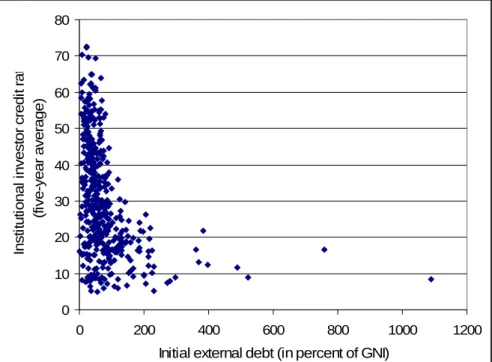
Given the competing theoretical arguments, the role of the private sector for sovereign creditworthiness is ultimately an empirical question. A first impression of how these magnitudes may be related is provided by Figure 3, which plots the Institutional Investor’s measure of country creditworthiness (IICCR) against the level of external debt relative to GNI (Figure 3a) and the share of private long-term external debt in countries’ total long-term external debt (Figure 3b).2 Not surprisingly, the correlation between debt and creditworthiness is negative (-0.37). By contrast, the correlation between private-sector share and the IICCR is positive (0.54).3 While this picture obviously doesn’t prove a causal relationship,
2For the IICCR, the data points refer to five-year averages between 1980 and 2005, while the debt-variables are measured at the beginning of these five-year periods.
3In both cases, extreme observations seem to play a prominent role. If we remove the top five percent of the debt variable observations – limiting our attention to countries with debt-to-GNI-ratios below 200 percent and a share of the private sector below 40 percent, respectively –
it suggests that relative private-sector exposure and perceived creditworthiness are positively related.
Further evidence that private and public debt are likely to have very different effects on the risk of sovereign default is provided by Table 1. The entries in this table are cross-country averages of various debt-related variables just before the onset of five-year periods in which a sovereign default did or did not take place.4 The first column of Table 1 shows that initial debt relative to GNI is, on average, much higher before a default period than before a non-default period. Conversely, column 2 indicates that the average share of the private sector in total external debt is much higher before non-default periods than before default periods.
Ini. Ext. Debt/GNI Ini. Private Ext. Debt/ Ext. Debt
Default in t 108.51 5.02
No default in t 55.33 10.59
Table 1: Debt variables before defaults
Sources: World Bank (2007b) and Standard and Poor’s (2007).
A first look at the data thus seems to point into the direction that a higher share of private debt in total external debt is associated with higher perceived creditworthiness – as reflected by the Institutional Investor’s country credit rat-ings – and with a lower likelihood of sovereign default. The aim of this paper is to subject this hypothesis to closer scrutiny: does the composition of external the correlation in Figure 3a becomes -0.43, while the correlation in Figure 3b decreases to 0.46. 4Here and in what follows we adopt the definition of the rating agencyStandard and Poor’s which identifies a sovereign default as the “...failure to meet a principal or interest payment on the due date (or within the specified grace period) contained in the original terms of the debt issue”(Standard and Poor’s (2006)).
debt still matter if we account for other determinants of sovereign risk and the potential endogeneity of international borrowing and lending? Is this relationship driven by a particular group of countries or limited to a specific time interval? Our findings suggest that there is indeed a case to be made that a high share of the private sector in countries’ external debt is more of a boon than a burden: an exogenous increase of this share reduces sovereign risk.
The rest of the paper is structured as follows: the next section offers a review of the relevant literature and highlights our own contribution. Section 3 introduces our empirical specification, the data we use, and comments on the results. Section 4 summarizes and concludes. Detailed information on data definitions and sources are given in the data appendix.
2
Review of the Literature
There is a rich literature on the causes and consequences of sovereign risk. Much of the theory departs from the notion that, in the absence of a supra-national enforcement institution, the incentive to repay crucially hinges on the sanctions a government faces in case of default. These sanctions can be subdivided into two main types: starting with Eaton and Gersovitz (1981), it has been argued that governments avoid default in order to preserve access to future loans. However, this idea was criticized by Bulow and Rogoff (1989) who demonstrate that a sovereign debtor can achieve a higher welfare level by denying repayment and by investing the outstanding amount in a third country. Hence, unless it is possible to exclude countries from financial markets both as debtorsand as creditors, only the threat of direct sanctions – including negative “reputation spillovers” (Cole and Kehoe (1997)) – is effective to enforce repayment.5
While the notion that defaulting governments are shut off from interna-5An authoritative survey of this discussion is provided by Eaton and Fernandez (1995).
tional capital markets gets mixed empirical support (see Eichengreen and Lindert (1989), Gelos et al. (2003)), there is ample evidence that a debt crisis imposes large costs on the economy: Rose (2005) demonstrates that the volume of trade is reduced by as much as eight percent for a considerable time span after a sov-ereign default. De Paoli et al. (2006) as well as Borensztein and Panizza (2006) document that defaults are associated with sharp declines in aggregate output.
It is quite obvious, however, that the costs of default do not affect all citizens of a country in a symmetric fashion. In fact, there is strong evidence that “political factors” – e.g. the proximity of elections or the characteristics of the institutional environment – have a significant effect on countries’ perceived creditworthiness and the likelihood of default.6 Nevertheless, there are few studies that explicitly consider the distributional effects of debt crises and agents’ conflicting interests with respect to sovereign default. Notable exceptions are Tomz (2002), Tomz (2004), Arteta and Hale (2008) as well as IMF (2002). Tomz (2002) analyzes the shift in popular attitude that preceded the Argentine default of 2001. In par-ticular, he documents how the sentiment of workers increasingly turned against compliance with international repayment obligations. Tomz (2004) presents the results of a survey which relates agents’ attitude towards debt repayment to their professional and educational background. Not surprisingly, agents for whom ac-cess to international capital markets is important advocate debt repayment while public employees and individuals who are dependent on public welfare payments appreciate the relaxed budget constraint that comes along with sovereign de-fault. The empirical findings of Arteta and Hale (2008) point into the same direction: sovereign default substantially worsens firms’ access to international credit markets and thus hurts those who are most reliant on foreign credit. IMF (2002) analyzes the distributional consequences of four recent default episodes. 6See, e.g., Manasse et al. (2003), Van Rijckeghem and Weder (2004), Block and Vaaler (2004).
In some of these cases, default was associated with a sharp depreciation of the domestic currency. This depreciation “...eroded the balance sheets of banks, par-ticularly those with significant open foreign exchange positions” (IMF 2002:15). By contrast, “... others, particularly low-leveraged firms, reaped benefits from the depreciation” (IMF 2002:16). These observations single out private agents with a large exposure to international capital markets as a group whose wealth and income is particularly affected by the government’s default decision and sug-gests a distributional conflict between those individuals on the one hand and workers, non-leveraged firms, and public-sector employees on the other hand. In Celasun and Harms (2007), we present a simple model that formalizes this notion by juxtaposing “workers” and “entrepreneurs”: while workers are predominantly interested in low taxes and therefore support default, entrepreneurs who borrow abroad to finance their investments suffer a capital loss in case of default and thus advocate repayment. In this model, a larger “entrepreneurial class” – i.e. a greater volume of private external borrowing – increases the political costs of default and therefore raises sovereign creditworthiness.
The alternative view that private-sector borrowing is harmful for a country’s creditworthiness focuses on private agents’ incentives to deny debt repayment and the consequences for the aggregate economy. Jeske (2006) presents a model in which private agents who default on their external debt are still allowed to borrow on domestic capital markets. This raises the attractiveness of private default and constrains a country’s ability to borrow abroad. While default never takes place in equilibrium, the important point of Jeske’s paper is that – in terms of creditworthiness – public borrowing is superior to private borrowing. The view that large private sector external debt is a source of financial risk for the public sector is also supported by anecdotal evidence on private debt nationalizations
after currency and financial crises.7 For instance Reinhart (2002) states that ”...even if the government itself has little outstanding debt, history has shown that, time after time, governments assume private sector debt during currency crises.” Hence, it is possible that private borrowing is more of a burden than a boon to sovereign creditworthiness since private agents frequently succumb to over-borrowing, and since a high level of private-sector debt may threaten government solvency even in cases of healthy public finances.8
To determine which of the theoretical effects sketched above is dominant we estimate how the share of the private sector in total external debt affects coun-tries’ perceived creditworthiness and the likelihood of sovereign default. Both the empirical studies on the determinants of sovereign defaults (Detragiache and Spilimbergo (2001), Manasse et al. (2003), Manasse and Roubini (2005)) and the literature on sovereign ratings (Cantor and Packer (1996), Haque et al. (1996), Harms and Rauber (2006), Mellios and Paget-Blanc (2006), Borio and Packer (1996) Afonso et al. (2007)) support the notion that high external debt is an important cause of debt crises. However, to the best of our knowledge, none of them considers the potentially different impact of private and public debt.9
7See, e.g., Larrain and Velasco (1990) for an account of private debt nationalizations and the Chilean external debt restructuring during the 1982 crisis.
8Corsetti et al. (1999) identify excessive foreign borrowing by the private sector as one of the key causes of the Asian currency crises of 1997-1998. Indonesia, one of the countries hit hardest by the crisis, restructured its foreign currency bank debt in 1998-99 and was thus classified by Standards and Poor’s as being in sovereign default status at that time.
9A notable exception is Frankel and Rose (1996) who explore inter alia how the share of the public sector in total external debt affects the occurrence of currency crises. Interestingly, a higher share of the government raises the likelihood of a currency crash in the subsequent year. By contrast, the effect of the public sector-share on currency crises in the same period is not significant.
3
Empirical analysis
3.1
Creditworthiness and defaults
The goal of this paper is to investigate whether an increasing share of the private sector in external debt affects developing countries’ creditworthiness and the like-lihood of sovereign default. We proceed in two steps: in a first set of regressions, we estimate the impact of private sector exposure on a widely-used indicator of creditworthiness, namely the Institutional Investor’s country credit rating. In a later section, we then estimate whether the share of private debt has an effect on the occurrence of actual defaults.
Our data set covers 65 developing countries and emerging markets for the years 1980 – 2005. The unit of time measurement we adopt is five years, and the variables used in our regressions will either be five-year averages (1981-85, 1986-1990, ..., 2001-2005), or initial values preceding the respective five-year periods (1980, 1985, ..., 2000). We will be interested in the following question: how does a change of the private-sector share in total external debt affect average creditworthiness and the likelihood of sovereign default in the subsequent five years? Our choice of five-year averages is based on the notion that many of the theoretical mechanisms sketched above are likely to have a discernible effect on creditworthiness only at a low frequency. In addition, our dynamic structure has the virtues of simplicity and transparency: using annual data would require a more sophisticated dynamic specification and would possibly lead to coefficients that are difficult to interpret. Moreover, it would be much harder to address issues like unobserved heterogeneity and endogeneity.10
While focusing on actual defaults seems straightforward at first glance, it comes with a number of serious difficulties: first, there is no generally accepted 10Note, however, that we are able to replicate most of the qualitative results reported below with annual data.
definition of sovereign default. In our analysis, we rely on the definition of the rat-ing agencyStandard and Poor’s, which characterizes sovereign defaults as “...the failure to meet a principal or interest payment on the due date (or within the specified grace period) contained in the original terms of the debt issue” (Stan-dard and Poor’s (2006)). While this approach has the advantage of applying a straightforward and transparent criterion, it does not consider the size of ar-rears, nor does it capture thoselatent debt crises whose occurrence was prevented by foreign rescue operations and concessions.11 A further problem with exclu-sively focusing on actual default episodes is that governments’ creditworthiness frequently recovers while they are still negotiating the terms on which to repay existing arrears. During these periods, they are technically “in default”, but the likelihood to deny repayment in the future may be much lower than suggested by their default status.
Therefore, as a first step, we use Institutional Investor’s measure of coun-try creditworthiness (IICCR) which is likely to represent a more delicate and informative seismograph of investors’ assessment whether current loans will be repaid in the future. The IICCR ranks countries on a scale from 0 to 100, with a lower rating reflecting a higher likelihood that borrowers in this country will default on their debt. The ratings are “...based on information provided by senior economists and sovereign risk analysts at leading global banks and money man-agement and securities firms” (Institutional Investor, 2002:170) and have been published twice per year since 1979.12 Although it does not exclusively refer to
11Given these considerations, Manasse et al. (2003) augment the Standard-and-Poors data with information on concessional IMF loans, while Beim and Calomiris (2001) differentiate be-tween outright repudiation and minor, pre-announced defaults. Rose (2005) identifies sovereign defaults with the onset of Paris-Club negotiations, Arteta and Hale (2008) combine information about renegotiations with those ofStandard and Poor’s and theEconomist Intelligence Unit.
12As reported by Haque et al. (1996), the individual criteria used by banks to assess default risk are not specified.
the likelihood ofgovernment default, we conjecture that sovereign risk makes up for a large share of “country creditworthiness”. Our conjecture is confirmed by comparing theInstitutional Investor’s indicator to ratings which more explicitly focus on government creditworthiness, but cover a smaller number of countries and years.13
The performance of rating agencies in predicting financial crises has frequently been criticized in the recent past. However, Reinhart (2002) documents that credit ratings do a fairly good job in predicting sovereign defaults. This notion is confirmed by the numbers in Table 2, which gives the results of regressing the variable SOV DEF AULT on the Institutional Investor’s measure of creditwor-thiness. SOV DEF AULT is a binary variable which is one ifStandard and Poors rated a government to be in default at least once during a five-year period (1981-85, 1986-90 etc.) and zero otherwise. IICCRini is the value of IICCR in the year preceding that period (1980, 1985 etc.). The regression is based on a probit model and includes both regional dummies and time dummies. TheInstitutional Investor credit rating has a significant relationship with the likelihood of default. Evaluated at the mean, raising IICCRini by one percentage point reduces the likelihood of default by about one percentage point. In terms of goodness of fit, the regression performs reasonably well: 81 percent of default episodes and 72 percent of the episodes without default are correctly predicted. Column (2.2) of Table 2 demonstrates that IICCRini is still significant if we include the lagged value of SOV DEF AU LT: hence, it is a good predictor of future defaults even if we control for the possibility that past defaults both raise the probability of future defaults and reduce current creditworthiness.14
13The IICCR has been widely used in empirical work on sovereign creditworthiness, given its coverage of a large number of countries and years. The rank correlation between theIICCR
and the sovereign ratings published byMoody’s in the 1990s is 0.92. The rank-correlation with the sovereign ratings ofFitchRatingsis 0.85.
3.2
Private debt and creditworthiness: data and model
specification
To investigate how a larger share of the private sector in total external debt affects perceived creditworthiness, we estimate variants of the following equation:
IICCRavit =β1P RIV SHAREitini+β2DEBTitini+ K
X
k=1
γk xk,it+ξt+εit (1) where IICCRav
it is the Institutional Investor’s average measure of country creditworthiness for country i in period t, and P RIV SHAREini
it is the initial percentage share of countryi’s long-term private external debt in its total long-term external debt at the start of periodt. Both the numerator and the denomi-nator of this ratio are taken from the World Bank’sGlobal Development Finance, which defines private non-guaranteed long-term debt outstanding and disbursed as “...an external obligation of a private debtor that is not guaranteed for re-payment by a public entity”. To compute the denominator ofP RIV SHAREini, we take the sum of private and public long-term debt. Public long-term debt comprises “...long-term external obligations of public debtors [...] and external obligations of private debtors that are guaranteed for repayment by a public entity ”(World Bank (2007b)).15 The variable DEBTini is the initial level of external debt – short-term and long-term – relative to GNI.16 Note that by using the val-ues ofP RIV SHARE and DEBT observed at the end of the previous five-year values. This variable correctly “predicts” almost 100 percent of all defaults – which is not surprising, given that risk ratings usually drop substantially once a government declares default. 15The variable P RIV SHAREini is based on long-term debt since the public versus private
sector decomposition is not available for short-term debt. As we will show later, the focus on long-term debt does not appear to be consequential for our empirical results.
16For the time being, we do not distinguish between differentsources of loans. That is, public borrowing comprises both loans from official sources and loans from private investors. As we will show later, this aggregation is not crucial for our results.
period we are reducing the potential for reverse causality, i.e. of creditworthiness affecting private and public borrowing behavior.
Our choice of control variablesxk,it largely follows the studies of Haque et al. (1996) as well as Harms and Rauber (2006). First, we use the lagged five-year average of the IICCR as a regressor (IICCRav(−1)). A dynamic specification is suggested by Haque et al. (1996:718) who find that “there is considerable persis-tence in the ratings, so that a country tends to retain its rating over time unless significant adverse or positive developments occur”. Moreover, by controlling for lagged IICCRav, we further reduce the potential endogeneity of the debt vari-ables: if a positive correlation betweenP RIV SHAREiniandIICCRav were only driven by the high persistence of credit ratings and the fact thatP RIV SHAREini reacts to ratings of the past, the correlation should disappear once lagged cred-itworthiness is explicitly taken into account.
A correlation between initial private sector debt and average creditworthi-ness could, of course, also reflect the expectation of more favorable economic and political conditions in the future: it is quite plausible that private sector bor-rowing expands more than proportionately in anticipation of a boom, and that such an upswing is also reflected by a rising measure of creditworthiness. To account for this possibility, we introduce two proxies for “economic prospects”: the average growth rate of real per-capita GDP in the preceding five-year pe-riod (GROW T Hav(−1)) and the average growth rate of the main trading part-ners’ GDP (T P GROW T Hav) in the current period. The advantage of using trading partners’ growth is that this variable – while being significantly cor-related with domestic growth – is unlikely to be endogenous with respect to IICCRav.17 We also include the five-year average of an index of government sta-bility (GOV ST ABILIT Yav), compiled by theInternational Country Risk Guide, 17Including the growth rate of domestic output did not alter the qualitative results we report in subsequent sections.
which captures the extent of political risk during a given time period, and which is likely to affect both creditworthiness and private borrowing.18
To account for the possibility that the share of the private sector in total external debt merely reflects the level of economic development, we include the logarithm of real per-capita income (in international dollars) at the end of the previous five year period. (INCOMEP Cini). Moreover we use measures of financial and macroeconomic stability which are likely to affect both private bor-rowing and creditworthiness: the initial volume of reserves as a share of imports (RESERV ESini) and the log of the average inflation rate in the preceding five-year period (INF LAav(−1)). We also include the initial degree of trade openness (OP ENini), measured as the ratio of exports and imports to GNI. Since more open economies are more vulnerable to the declines in foreign trade identified by Rose (2005), their willingness to default should be lower. At the same time, countries that are more open are likely to be more vulnerable to external shocks and may thus face a higher risk of default.
Finally, we use dummies for East Asia, Eastern Europe and Central Asia, South Asia, Latin America and Subsaharan Africa to account for regional dif-ferences as well as time dummiesξt to capture time-variant factors – changes in world interest rates or investor sentiment – that influence all countries’ credit-worthiness.
18GOV ST ABILIT Yav is the sum of three subcomponents, namely government unity,
3.3
Private debt and creditworthiness: results
3.3.1 Private debt and creditworthiness: benchmark regressions
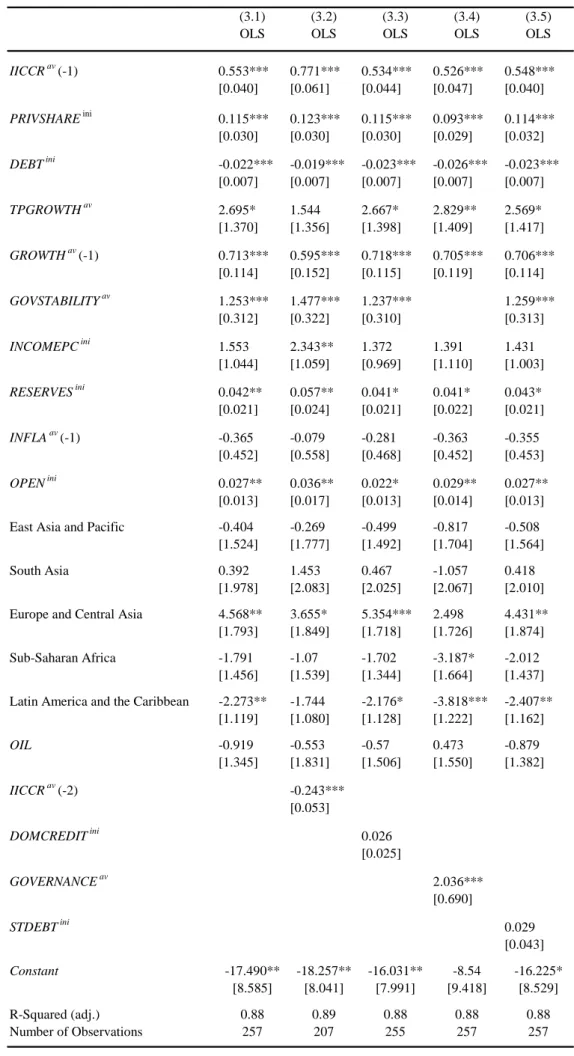
Column (3.1) of Table 3 shows the results of estimating equation (1) by OLS.19 All control variables have the expected sign. The coefficient on DEBTini is highly significant, confirming the notion that a large level of external debt reduces creditworthiness.20 Most importantly for our analysis, the share of private sector debt – as reflected by P RIV SHAREini has a significantly positive coefficient, implying that ceteris paribus, countries with a higher share of private debt in total external debt would be expected to have higher creditworthiness.21
Column (3.2) of Table 3 includes the second lag ofIICCRav as an additional regressor: if the serial correlation of creditworthiness goes beyond one period and if private debt is slow to react to changes in credit rankings, omission of this variable could lead to biased estimates. However, this does not seem to be the case: while the second lag of IICCRav has a significantly negative coefficient, the estimated coefficient of P RIV SHAREini is almost unaffected.
The results so far suggest that a higher share of the private sector in total external debt is significantly associated with a higher level of creditworthiness. However, the significantly positive coefficients could just indicate that countries with a more developed financial sector have a larger share of private external debt and run a lower risk of sovereign default. To account for this possibility we 19The standard errors presented in squared brackets are based on a covariance matrix that is robust with respect to heteroskedasticity and serial correlation of cluster-specific disturbances. 20This result is due to dropping the observation for Nicaragua in 1990, which is character-ized by an excessively high level of external debt (1087 percent of GNI). Including this data point substantially increases the standard error ofDEBTini without, however, changing the
qualitative results with respect to the other regressors.
21This result does not hinge on our indiscriminate treatment of private and officialcreditors. If we constrain our attention to debt owed toprivate agents and institutions – thus netting out official loans – we get a somewhat smaller, but significantly positive coefficient.
include the initial value of domestic credit to the private sector relative to GDP (DOMCREDITini) as a measure of financial depth. Column (3.3) demonstrates that, while this variable has a positive sign, it is not significant and its inclusion has almost no effect on the coefficient of P RIV SHAREini.
Column (3.4) of Table 3 reports the results of replacingGOV ST ABILIT Yav with another measure of the investment climate. The variableGOV ERNANCEav is also based on the International Country Risk Guide’s assessments, but refers to different criteria – namely the control of corruption, the quality of the bu-reaucracy, and the rule of law. While this modification slightly lowers the size of the coefficient ofP RIV SHAREini, the effect is not substantial, and the variable remains significant.
We also considered another disaggregation of external debt which possibly affects country creditworthiness and which might be correlated with private-sector exposure: column (3.5) in Table 3 reports the result of including the variable ST DEBTini, which reflects the share of short-term debt in total ex-ternal debt. It turns out that this variable has no significant independent effect on perceived creditworthiness, and that its inclusion does not influence the coef-ficient of P RIV SHAREini.22
3.3.2 Private debt and creditworthiness: accounting for unobserved heterogeneity and endogeneity
There is, of course, a high probability that the regressors we have included do not capture all sources of cross-country heterogeneity. The positive coefficient of P RIV SHAREini may thus merely reflect the influence of other country-specific factors which affect both private borrowing and creditworthiness. Moreover, we 22To further explore whether the maturity structure of external debt was important for our results we ran our benchmark regression under the two alternative assumptions that all short-term external debt was either private or public. It turned out that the modified values of
have not yet come to terms with the possible endogeneity of P RIV SHAREini: while we have argued above that regressing the five-year average of IICCRav on the initial share of private debt in total external liabilities should reduce the potential for reverse causality – especially, when the lagged measure of creditwor-thiness is included – there are more sophisticated ways to deal with this issue.
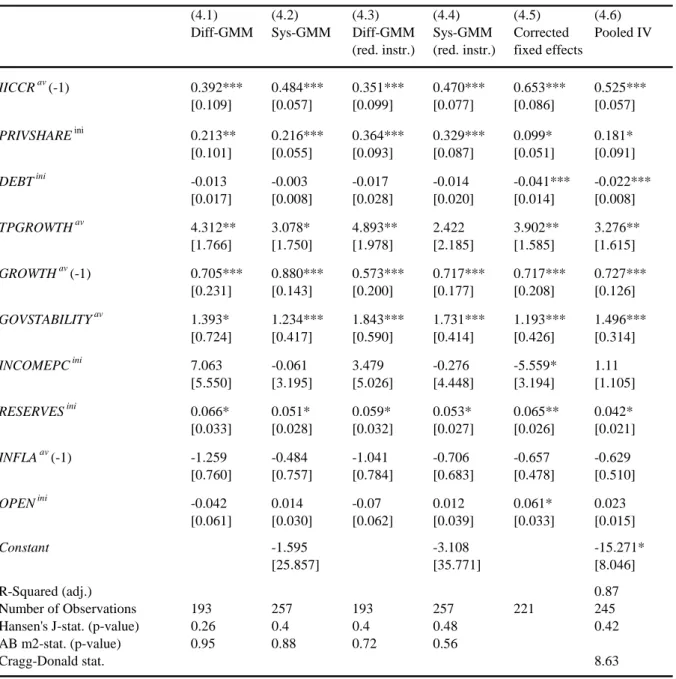
In this subsection, we first follow the approach of Arellano and Bond (1991) and estimate the parameters of interest by differencing equation (1) and by using lagged levels of the regressors as instruments.23 The results in column (4.1) of Table 4 are based on a specification that uses up to four lags of the regressors as instruments. To avoid the overfitting that comes along with an excessive number of moment conditions and that results in biases and uninformative diagnostic statistics, we impose the condition that the coefficients are uniform across the time periods in the first stage.24 Moreover, we adopt a two-step approach that uses an optimal weighting matrix to aggregate the individual moment conditions. Standard errors are computed using the finite sample correction suggested by Windmeijer (2005). The p-values referring to Hansen’s J-test of overidentifying restrictions (Hansen (1982)) and to the (m2-)test of no second-order autocorre-lation in the differenced residuals (Arellano and Bond (1991)) are given at the bottom of the table. As the results in column (4.1) show, most coefficients change when we move from pooled OLS to the “Difference-GMM estimator” of Arellano and Bond (1991), suggesting that unobserved heterogeneity and endogeneity may indeed have influenced the results presented in Table 3. Nevertheless, our find-ing that the share of the private sector in total external debt raises countries’ creditworthiness is strengthened rather than weakened.
Column (4.2) shows the results of applying the estimator developed by Arel-lano and Bover (1995) and Blundell and Bond (1998) to equation (1). This 23Bond (2002) and Wooldridge (2002a) offer excellent surveys on dynamic panel estimation. We used thextabond2 module by Roodman (2006) to implement the difference-GMM estimator.
approach simultaneously estimates the first-differenced version of the regression equation – using lagged levels of the right-hand-side variables – and the original equation in levels using lagged differences as instruments. The first advantage of this “Systems-GMM” estimator is that it exploits the information contained in the first period – a property that is of particular merit in our case where the number of periods is small. Moreover, it mitigates the weak-instruments problem that arises if the time series involved are very persistent. Column (4.2) in Table 4 demonstrates that, with this specification, the coefficient of P RIV SHAREini is significantly positive.
So far, we have followed the standard approach of using lags of all regres-sors as instruments. While the J-test gives no warning signs, our results may be biased if the right-hand side variables are endogenous. We are particularly con-cerned about P RIV SHAREini and DEBTini and therefore remove these vari-ables from the list of instruments. Column (4.3) in Table 4 presents the results of following this approach when the “Difference-GMM” estimator is used, column (4.4) refers to the “Systems-GMM” estimator. In both cases, the coefficient of P RIV SHAREini remains significant.
The last columns of Table 4 present the results of treating the problems of unobserved heterogeneity and potential endogeneity of P RIV SHAREini sep-arately: first, we estimated our model with fixed effects. To account for the bias inherent in dynamic-panel estimation (Nickell (1981)) we applied the bias-correction suggested by Kiviet (1995) and Bruno (2005).25 As indicated by col-umn (4.5), using this “corrected LSDV (LSDVC)” estimator barely changes the coefficient ofP RIV SHAREinias compared to the pooled OLS results reported in Table 3. Finally, we accounted for the potential endogeneity ofP RIV SHAREini by instrumenting this variable with potential determinants of private-sector bor-25To compute these results, we used the xtlsdvc routine developed for Stata by Giovanni Bruno.
rowing: the (lagged) quality of financial sector regulation (CREDREGav(−1)) which is based on an index compiled by the Fraser Institute (Fraser Institute (2006)), the distance from the equator (LAT IT U DEav) and the lagged average of the Freedom House index of civil liberties (REP RESSav(−1)) as proxies for the quality of governance (Freedom House (2006)), and the initial number of tele-phone main lines per 1000 people (T ELEP HONESini) as a proxy for the quality of a country’s infrastructure. The Cragg-Donald statistic of instrument relevance (see Cragg and Donald (1993) and Stock and Yogo (2005)) and Hansen’s J-test of overidentifying restrictions indicate that these instruments perform reason-ably well in terms of relevance and exogeneity, and, importantly, instrumenting for (P RIV SHAREini) does not strongly affect its estimated coefficient. The notion that the coefficient of initial private sector debt is not driven by reverse causality is also supported by an explicit test for endogeneity which prevents us from rejecting the hypothesis that (P RIV SHAREini) is actually exogenous.26
We conclude from the results presented in this subsection that accounting for unobserved heterogeneity and potential endogeneity changes the size of the estimated parameters – without, however, affecting our key finding that a higher share of the private sector in total external debt raises a country’s creditworthi-ness.
3.3.3 Private debt and creditworthiness: varying samples
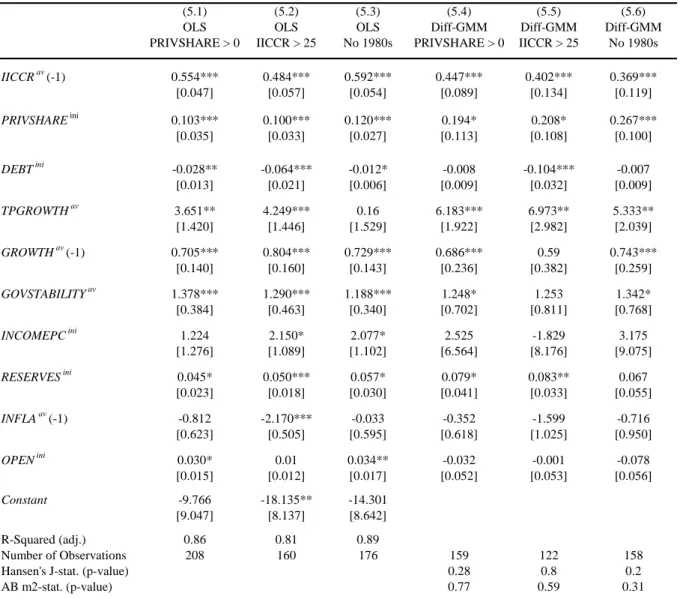
This section reports the results of estimating equation (1) using various subsets of the original sample. It is apparent from Figure 3b) that in a large number of countries, all external borrowing is done by the government. We explored whether dropping the observations for whichP RIV SHAREini was zero changes the coefficient of this regressor. Column (5.1) of Table 5 demonstrates that it does 26To test for endogeneity, we used both the Wu-Durbin-Hausman-test and the Difference-in-Sargan test implemented in Stata by Baum et al. (2003) and Baum et al. (2006).
not. We then restricted our attention to countries for whomIICCRexceeded the value of 25. Reinhart et al. (2003) identify this value as a threshold below which countries do not really have access to international capital markets. Column (5.2) demonstrates that the size of the coefficient ofP RIV SHAREini is slightly reduced in this case, but the significantly positive estimated effect is not affected. Finally, we checked whether our result depended on the simultaneous decline of creditworthiness and private foreign borrowing that could be observed during the 1980s. As column (5.3) of Table 5 reports, excluding the observations from the “lost decade” reduces the sample by almost one third, but barely affects the coefficient of P RIV SHAREini.
Columns (5.4) to (5.6) report the results of estimating equation (1) for the subsamples described above, using the Difference-GMM estimator of Arellano and Bond (1991). Again, dropping those observations for whichP RIV SHAREiniwas zero (column 5.4) or those in which creditworthiness did not exceed a minimum threshold (column 5.5) did not alter our key result – nor did restricting attention to the years after 1990 (column 5.6).
3.4
Private debt and sovereign default: results
3.4.1 Benchmark results
So far, we have used the Institutional Investor’s measure of creditworthiness as a dependent variable. While we found strong evidence that the perceived likelihood of sovereign default is reduced by a larger share of the private sector in total external debt, this does not necessarily prove that governments’ decisions on default vs. repayment are actually affected by private sector exposure. To explore whether this is indeed the case we now use the dummySOV DEF AULT as the dependent variable. As described in section 3.1, this variable is one if Standard and Poor’s rated a government as being in default – i.e. failing to meet its repayment obligations – for at least one year in a five-year interval and zero
otherwise. Except for the lagged indicator of creditworthiness, we are using the same set of covariates as in the previous subsections.
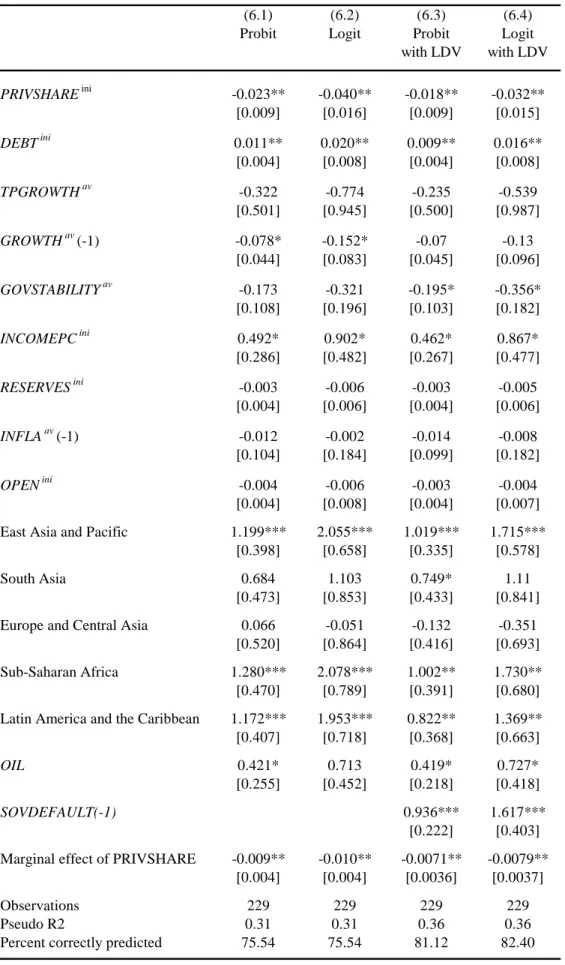
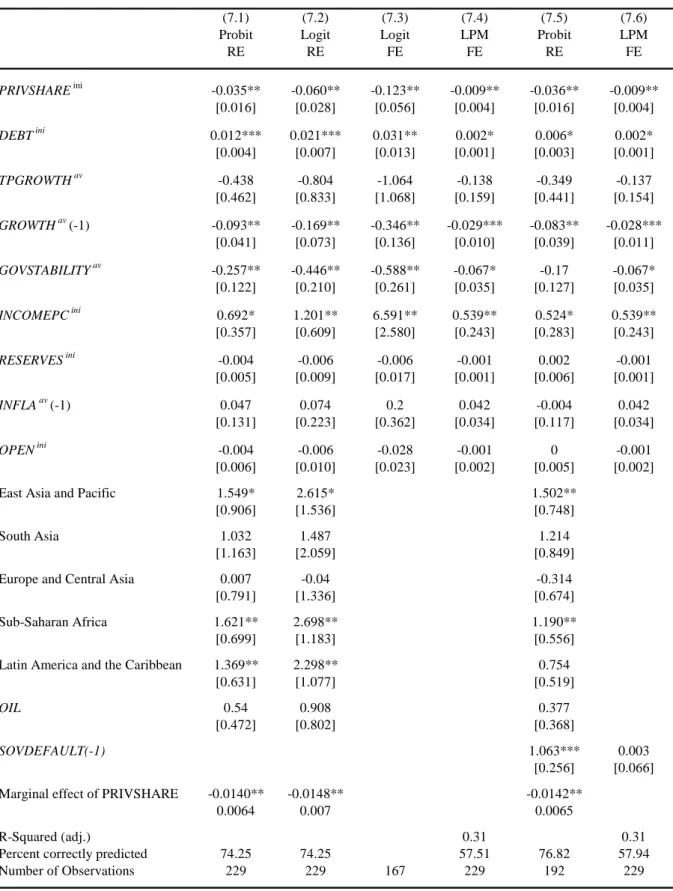
Our first regression uses the probit estimator to identify the determinants of sovereign defaults. The results are reported in column (6.1) of Table 6. With the exception of INCOMEP Cini, the coefficients of the control variables have the expected sign – although only lagged growth and the initial debt to GNI ratio are statistically significant. P RIV SHAREiniclearly has a negative relationship with the likelihood of default. At the bottom of Table 6, we report the partial effect of this variable: evaluated at the sample mean, an increase of P RIV SHAREini by roughly one percentage pointceteris paribus reduces the likelihood of default by one percentage point. As column (6.2) in Table 6 shows, using the logit estimator instead of probit yields a marginal effect of almost identical size. In terms of goodness of fit, both approaches do reasonably well: Thepseudo−R2 of McFadden (1974) is approximately 0.31 in both cases, and the percent correctly predicted is 75 percent.27
There might, however, be a problem with taking these results at face value: as the previous sections have indicated, sovereign creditworthiness is quite persis-tent – even if we focus on five-year averages. This is likely to applya fortiori to actual defaults: after the initial denial of full repayment, it usually takes several years until an agreement with creditors is reached. During this period the coun-try is rated as a defaulter. This, in turn, is likely to affect private borrowing (see Arteta and Hale (2008)). Hence, the negative coefficient of P RIV SHAREini may just capture the persistence of defaults, combined with the negative effect of past defaults on private external borrowing. Columns (6.3) and (6.4) in Ta-ble 6 indicate that this conjecture is at least partly correct: the coefficient of the first lag of SOV DEF AU LT is significantly positive, and the influence of 27Probit (Logit) correctly predicts 77.9 (78.7) percent of all defaults and 72.1 (72.1) percent of all non-defaults.
P RIV SHAREini decreases once we include the first lag of the dependent vari-able. However, as the partial effects at the bottom of Table 6 reveal, this change is quite limited: once we include the lagged dependent variable, it takes an in-crease ofP RIV SHAREini by approximately 1.3 percentage point to reduce the likelihood of default by 1 percentage point. The entries in the bottom rows in-dicate that including the lagged dependent variable improves the fit, but not by very much: the pseudo−R2 moves from 0.31 to 0.36 while the percent correctly predicted increases from 75 to 81 and 82, respectively.
3.4.2 Accounting for unobserved heterogeneity
As in the previous subsections, we need to be concerned about unobserved hetero-geneity: the likelihood of default may depend on country-specific characteristics which we have not explicitly accounted for in our regression equation. While in-troducing country-specific effects is the straightforward solution to this problem in a linear regression model, things are a bit more complicated when it comes to discrete-choice models. The probit estimator, in particular, suffers from the incidental parameters problem – i.e. it is not possible to consistently estimate the coefficients of the covariates using maximum likelihood without estimating the country-specific effects. This, in turn, fails if the number of time periods is finite.28 There are several remedies to this problem: under the assumption that the individual effects are not correlated with the covariates, the random effects probit estimator yields consistent estimates (Wooldridge (2002a)). Column (7.1) in Table 7 shows the results of adopting this approach. Column (7.2) reports the coefficients we get when estimating the random effects model using logit: in-terestingly, the partial effects for P RIV SHAREini (-0.014 and -0.015) do not 28Chapter 15 in Wooldridge (2002a) offers an excellent treatment of this issue. Further discussions of this issue can be found in Lancaster (2000) and Greene (2001).
stray too far from the values we received from the pooled regression in Table 6.29 Column (7.3) reports the results from applying thefixed effects logit estimator. If the distribution of the underlying error term is assumed to be logistic, consistent estimation of the relevant parameters is possible even if unobserved heterogeneity is treated by means of fixed effects. However, this advantage comes at a cost: since the fixed effects cannot be estimated, it is impossible to compute partial effects. Hence, the magnitude of the negative coefficient of P RIV SHAREini in column (7.3) cannot be readily compared with our previous results. To better understand the role of unobserved heterogeneity we finally specified the model as a simple linear equation including fixed effects.30 Interestingly, the coefficient of P RIV SHAREini in column (7.4) is very close to the partial effects we reported in Table 6.
The last two columns in Table 7 return to the issue of whether the significantly negative effect of P RIV SHAREini merely reflects the persistence of sovereign defaults. To explore this issue, we include the lagged value of SOV DEF AULT as an additional regressor, adopting two alternative approaches: we first follow Wooldridge (2002b) who suggests to estimate a random-effects (logit or probit) model conditioning on initial observations. The results of this strategy are pre-sented in column (7.5) of Table 7: while the lagged dependent variable is signif-icant, the coefficient of P RIV SHAREini is still significantly negative, and the estimated marginal effect barely differs from the one displayed at the bottom of column (7.1). However, this estimator is biased unless the other regressors are strictly exogenous. Hence, as a robustness check, we also estimated the linear probability (LPM) model with a lagged dependent variable and fixed effects. As 29These partial effects are evaluated under the assumption that the unobserved effect equals zero.
30While the linear probability model (LPM) has the drawback that the predicted values do not necessarily fall into the zero-one interval, the estimated marginal effects are often close to those delivered by probit and logit models.
column (7.6) demonstrates, the lagged dependent variable has no impact on the other coefficients in this case. Of course, given the caveats with respect to this estimator, we do not want to overrate this result. The main finding we take away from these estimations is that the significantly negative effect ofP RIV SHAREini on sovereign defaults does not seem to be an artifact of neglecting unobserved heterogeneity and the persistence of defaults.
4
Summary and conclusions
While external debt figures among the usual suspects when it comes to explaining sovereign risk, little attention has been devoted to the potentially different effects of private and public external debt. The main contribution of our paper is to emphasize that this difference is substantial: a higher share of the private sector in total external debt raises country creditworthiness and reduces the likelihood of default. Our results thus offer one potential explanation for the observation of Reinhart et al. (2003) that countries with similar levels of external debt may exhibit vast differences in their creditworthiness and their propensity to default: “debt intolerance” may more heavily afflict countries where the government ac-counts for most of the external borrowing.
We have gone at great lengths to show that our results are not driven by unobserved heterogeneity – i.e. creditworthiness and private sector exposure being driven by country-specific unobserved parameters – and that they do not just reflect the reverse impact of creditworthiness on private borrowing. Our findings suggest that, for a given country, an exogenous increase of private debt as a share of total external debt raises creditworthiness and reduces the likelihood of default. An explanation as to why countries exhibit such large differences in the composition of their external debt goes beyond the scope of this paper, but offers a very promising subject for future research.
5
Data appendix
5.1
Definitions and sources
CREDREGav: Five-year average of theFraser Institute’s index of credit market reg-ulation, ranging from 0 (minimal regulation) to 10 (maximal regulation). Criteria: (i) Ownership of banks: percentage of deposits held in privately owned banks; (ii) Com-petition: domestic banks face competition from foreign banks; (iii) Extension of credit: percentage of credit extended to private sector; (iv) Avoidance of interest rate controls and regulations that lead to negative real interest rates; (v) Interest rate controls: in-terest rate controls on bank deposits and/or loans are freely determined by the market. Source: Fraser Institute (2006).
DEBTini: Total external debt relative to GNI. “Total external debt is debt owed to nonresidents repayable in foreign currency, goods, or services. Total external debt is the sum of public, publicly guaranteed, and private nonguaranteed long-term debt, use of IMF credit, and short-term debt. Short-term debt includes all debt having an original maturity of one year or less and interest in arrears on long-term debt. Data are in current U.S. dollars.” Sources: World Bank (2007a) and World Bank (2007b). DOM CREDITini: Domestic credit to private sector relative to GDP. “Domestic credit to private sector refers to financial resources provided to the private sector, such as through loans, purchases of nonequity securities, and trade credits and other accounts receivable, that establish a claim for repayment. For some countries these claims in-clude credit to public enterprises.” Source: World Bank (2007a).
GOV ERN AN CEav: Simple average of indices measuring bureaucratic quality, corrup-tion, and the rule of law, from theInternational Country Risk Guide. Source: Political Risk Services (2006).
GOV ST ABILIT Yav: Index of government stability from the International Country Risk Guide. Source: Political Risk Services (2006).
five-year period. Source: Penn World Table 6.2 (Heston et al. (2006)).
IICCRav: Five-year average of the country credit ratings published in the Institu-tional Investor magazine every March and September since 1980. Source: InstituInstitu-tional Investor magazine.
IN COM EP Cini: Log of initial value of real per capita income in constant PPP-adjusted dollars. Source: World Bank (2007a).
IN F LAav(−1): Log of the average growth rate of the consumer price index in the preceding five-year period. Source: World Bank (2007a).
OP ENini: Initial value of the ratio (Exports + imports)/GNI. Source: World Bank (2007a).
LAT IT U DE: Squared latitude. Source: World Bank (2001).
P RIV SHAREini: Initial share of private nonguaranteed long-term external debt in total long-term external debt. “Private nonguaranteed debt outstanding and disbursed (LDOD) is an external obligation of a private debtor that is not guaranteed for repay-ment by a public entity. Long-term debt outstanding and disbursed (LDOD) is the total outstanding long-term debt at year end. Long-term external debt is defined as debt that has an original or extended maturity of more than one year and that is owed to nonresidents and repayable in foreign currency, goods, or services.” Source: World Bank (2007b).
REP RESSav: Five-year average of theFreedom Houseindex of civil liberties, ranging from 1 (maximal rights) to 7 (minimal rights). Source: Freedom House (2006). RESERV ESini: Initial value of the ratio (International reserves)/(Imports of goods and services). Source: World Bank (2007a).
SOV DEF AU LT: Dummy variable. One if Standard and Poors rates a government to be in default at least once during a five-year period and zero otherwise. A default is characterized by “...the failure to meet a principal or interest payment on the due date (or within the specified grace period) contained in the original terms of the debt issue” (Standard and Poor’s (2006)). Source: Standard and Poor’s (2007).
de-fined as debt that has an original maturity of one year or less. Available data permit no distinction between public and private nonguaranteed short-term debt.” Source: World Bank (2007b).
T ELEP HON ESini: Number of telephone main lines per 1000 people. Source: World Bank (2007a).
T P GROW T Hav: Five-year average of the growth rate of a weighted average of trading partners’ GDP. Sources: World Bank (2007a) and IMF (2006).
5.2
CountriesAlgeria , Argentina, Bangladesh, Benin, Bolivia, Botswana, Brazil, Bulgaria, Cameroon, Chile, China, Colombia, Congo Rep., Costa Rica, Cote d’Ivoire, Democratic Republic of Congo, Dominican Republic, Ecuador, Egypt Arab Rep., El Salvador, Estonia, Gabon, Ghana, Haiti, Honduras, Hungary, India, Indonesia, Jamaica, Jordan, Kenya, Latvia, Lithuania, Malawi, Malaysia, Mali, Mauritius, Mexico, Morocco, Nicaragua, Nigeria, Oman, Pakistan, Panama, Papua New Guinea, Paraguay, Peru, Philippines, Poland, Romania, Russian Federation, Senegal, Sierra Leone, South Africa, Sri Lanka, Syr-ian Arab Republic, Tanzania, Thailand, Togo, Trinidad and Tobago, Tunisia, Turkey, Uganda, Ukraine, Uruguay, Venezuela RB, Zambia, Zimbabwe.
References
[1]Afonso, A., P. Gomes and P. Rother: “What “hides” behind sovereign debt ratings?” ECB Working Paper No. 711, (2007).
Arellano M. and S. Bond: “Some Tests of Specification for Panel Data: Monte Carlo Evidence and an Application to Employment Equations.” Review of Economic Studies, vol. 58, 277-297, (1991).
Arellano M. and O. Bover: “Another Look at the Instrumental-Variable Estimation of Error-Components Models.”Journal of Econometrics, vol. 68, 29-52, (1995).
Arteta C. and G. Hale: “Are Private Borrowers Hurt by Sovereign Debt Reschedul-ing?”Federal Reserve Bank of San Francisco and the Board of Governors of the Federal Reserve System, mimeo, (2005).
Arteta C. and G. Hale: “Sovereign Debt Crises and Credit to the Private Sector.” Journal of International Economics, vol. 74, 53-69, (2008).
Baum, C.F., M.E. Schaffer, M.E., and S. Stillman: “Instrumental Variables and GMM: Estimation and Testing.”The Stata Journal, vol. 3, 1-31, (2003).
Baum, C.F., M.E. Schaffer, M.E., and S. Stillman: “Enhanced routines for instrumental variables/GMM estimation and testing.”Unpublished working paper, forthcoming, (2006).
Beim, D.O. and C. Calomiris: Emerging Financial Markets.McGraw Hill, (2001).
Block S.A. and P.M. Vaaler: “The Price of Democracy: Sovereign Risk Ratings, Bond Spreads and Political Business Cycles in Developing Countries.”Journal of International Money and Finance, vol. 23, 917-946, (2004).
Blundell R. and S.R. Bond: “Initial conditions and moment restrictions in dynamic panel data models.”Journal of Econometrics, vol. 87, 115-143, (1998).
Bond S.: “Dynamic Panel Data Models: A Guide to Micro Data Methods and Prac-tice.”CEMMAP Working Paper No. CWP09/02, (2002).
Borensztein, E. and U. Panizza: “The Costs of Default.” Inter-American Devel-opment Bank, (2006).
Borio, C. and F. Packer: “Assessing new perspectives on country risk.”BIS Quar-terly Review, (December 2004).
Bruno, G.S.F.: “Approximating the bias of the LSDV estimator for dynamic unbal-anced panel data models.”Economics Letters, vol. 87, 361-66, (2005).
Bulow J. and K. Rogoff: “A Constant Recontracting Model of Sovereign Debt.” Journal of Political Economy, vol. 97, 155-178, (1989).
Cantor R. and F. Packer: “Determinants and Impact of Sovereign Credit Ratings.” FRBNY Economic Policy Review, (October 1996).
Celasun, O. and P. Harms: “Who does private foreign borrowing affect the risk of sovereign default in developing countries?” Study Center Gerzensee Working Paper 07.04, (2007).
Cole H. and P. Kehoe: “Reviving Reputation Models of International Debt.”Federal Reserve Bank of Minneapolis Quarterly Review, vol. 21, (1997).
Corsetti, G., P. Pesenti, and N. Roubini: “Paper Tigers: A Model of the Asian Crisis.”NBER Working Papers No. 6783, (1998).
Cragg J.G. and S.G. Donald: “Testing Identifiability and in Specification in In-strumental Variable Models.”Econometric Theory, vol. 2, 222-240, (1993).
De Paoli, B., G. Hoggarth and V. Saporta: “Costs of sovereign default.” Bank of England, Financial Stability Paper no. 1, (2006).
Detragiache, E. and A. Spilimbergo: “Crises and Liquidity: Evidence and Inter-pretation.”IMF Working Paper 01/2, (2006).
Durbin, E. and D. Ng: “The sovereign ceiling and emerging market corporate bond spreads.”Journal of International Money and Finance 24, 631-649, (2005).
Eaton, J. and R. Fernandez: “Sovereign Debt.”In G. Grossman and K. Rogoff (eds.)Handbook of International Economics, vol. III, (1995).
Eaton J. and M. Gersovitz: “Debt with potential repudiation: theory and estima-tion.”Review of Economic Studies ,vol. 48, 289-309., (1981).
Eichengreen B. and P.H. Lindert: The international debt crisis in historical per-spective.The MIT Press (Cambridge, MA) (1989).
Eichengreen B. and A. Mody: “What explains changing Spreads on Emerging Market Debt: Fundamentals or Market Sentiment? ” NBER Working Paper No. 6408, (1998).
Frankel, J. and A. Rose: “Currency Crashes in Emerging Markets: An Empirical Treatment.”Journal of International Economics ,vol. 3/4, 351-366., (1986).
Fraser Institute: “Economic Freedom in the World.”(2006).
Freedom House: Freedom in the World, (2006).
Gelos, R.G., R. Sahay, and G. Sandleris: “Sovereign Borrowing by Developing Countries: What Determines Market Access?”IMF Working Paper No. 04/221, (2004).
Greene, W.: “Estimating Econometric Models with Fixed Effects. ” New York Uni-versity, unpublished, (2001).
Hansen, L.P.: “Large Sample Properties of Generalized Method of Moments Estima-tors.”Econometrica, vol. 50, 1029-1054, (1982 ).
Haque U. N., M. Kumar, N. Mark, and D. Mathieson: “The Economic Content of Indicators of Developing Country Creditworthiness.”IMF-Staff Papers, vol. 43, 688-724, (1996).
Harms, P. and M. Rauber: “Foreign aid and developing countries’ creditworthi-ness.”Study Center Gerzensee Working Paper No. 04.05, (2006).
Heston, A., R. Summers and B. Aten: “Penn World Table Version 6.2, Center for International Comparisons of Production, Income and Prices at the University of Pennsylvania.”, (2006).
International Monetary Fund: “Sovereign Debt Restructurings and the Domes-tic Economy Experience in Four Recent Cases” Washington DC, International Monetary Fund, (2002).
International Monetary Fund: “Direction of Trade Statistics Database” Washing-ton DC, International Monetary Fund, (2006).
Jeske, K.: “Private international debt with risk of repudiation.” Journal of Political Economy, vol. 114, 576-593.(2006 ).
Judson R. and A. Owen: “Estimating Dynamic Panel Data Models: A Guide for Macroeconomists.”Economics Letters, vol. 65, 9-15, (1999).
Kiviet, J.F.: “On bias, inconsistency, and efficiency of various estimators in dynamic panel data models.”Journal of Econometrics, vol. 68, 53-78, (1995).
Lancaster, T.: “The incidental parameter problem since 1948.” Journal of Econo-metrics, vol. 95, 391-413.(2000).
Larrain, F., and A. Velasco: “Can Swaps Solve the Debt Crisis? Lessons from the Chilean Experience.”Princeton Studies in International Finance, No. 69.(1990).
Manasse P.and N. Roubini: “ “Rules of Thumb for Sovereign Debt Crises”” IMF Working Paper No. 05/42, (2005).
Manasse P., N. Roubini and A. Schimmelpfennig: “ Predicting Sovereign Debt Crises.”IMF Working Paper No. 03/221, (2003).
McFadden, D.: “Conditional logit analysis of qualitative choice behavior, in P. Zarembka (ed.):” Frontiers of Econometrics, “Academic Press” (1974).
Mellios, C. and E. Paget-Blanc: “Which factors determine sovereign credit rat-ings?” The European Journal of Finance, vol. 12, 361-377. (2006 ).
Nickell, S.: “Biases in Dynamic Models with Fixed Effects.” Econometrica, vol. 49, 1417-26, (1981).
Political Risk Services: International Country Risk Guide.New York: Political Risk Services, (2007).
Reinhart, C.M.: “Credit Ratings, Default, and Financial Crises: Evidence from Emerging Markets.”World Bank Economic Review 16, 151-170, (2002).
Reinhart, C.M., M. Savastano and K. Rogoff: “Debt Intolerance.” Brookings Papers on Economic Activity, (2003).
Roodman, D.: “How to Do xtabond2: An Introduction to “Difference” and “System” GMM in Stata.”Working Paper 103. Center for Global Development, Washington, (2006).
Rose, A.: “One Reason Countries Pay Their Debts: Renegotiation and International Trade.”Journal of Development Economics, (2005).
Standard and Poor’s: Sovereign Credit Ratings: A Primer.McGraw Hill, (2006).
Standard and Poor’s: Sovereign Ratings History since 1975.McGraw Hill, (2007).
Stock, J.H. and M. Yogo: “Testing for Weak Instruments in Linear IV Regression.”, in D.W.K. Andrews and J.H. Stock, eds. Identification and Inference for Econo-metric Models: Essays in Honor of Thomas Rothenberg.Cambridge (Cambridge University Press), 80-108, (2005).
Tomz M.: “Democratic Default: Domestic Audiences and Compliance with Interna-tional Agreements.”unpublished Working Paper, (2002).
Tomz M.: “Voter Sophistication and Domestic Preferences Regarding Debt Default.” unpublished Working Paper, (2004).
van Rijckeghem C. and B. Weder.: “ The Politics of Debt Crises.”unpublished Working Paper, (2004).
Windmeijer, F.: “A Finite-sample Correction for the Variance of Linear Efficient Two-step GMM Estimators.”Journal of Econometrics, vol. 126, 25-51, (2005).
Wooldridge, J.M.: Econometric Analysis of Cross Section and Panel Data, MIT Press. (2002a).
Woodridge, J.M.: “Simple Solutions to the Initial Conditions Problem in Dynamic, Nonlinear Panel Data Models with Unobserved Heterogeneity.”CEMMAP Work-ing Paper No. CWP18/02, (2002b).
World Bank: “Global Development Network Growth Database.” Washington DC, The World Bank, (2001).
World Bank: “World Development Indicators 2007 on CD-ROM.”Washington DC, The World Bank, (2007a).
World Bank: “Global Development Finance 2007 on CD-ROM.” Washington DC, The World Bank, (2007b).
6. Tables
Table 2: Institutional Investor's Country Credit Rating (IICCR) and the likelihood of sovereign default
(2.1) (2.2)
Probit Probit
IICCRini -0.032*** -0.017**
[0.007] [0.008]
East Asia and Pacific 0.623 0.483
[0.439] [0.454]
South Asia -0.325 0.048
[0.678] [0.675]
Europe and Central Asia 0.368 0.265
[0.388] [0.405]
Sub-Saharan Africa 0.917*** 0.874**
[0.328] [0.344] Latin America and the Caribbean 0.899*** 0.766**
[0.314] [0.330] OIL 0.437 0.352 [0.270] [0.281] 1986-90 -0.086 -0.243 [0.302] [0.319] 1991-95 -0.546* -0.903*** [0.301] [0.324] 1996-00 -1.039*** -1.363*** [0.286] [0.306] 2001-05 -1.463*** -1.684*** [0.290] [0.306] SOVDEFAULT(-1) 1.032*** [0.221] Constant 0.953** 0.245 [0.459] [0.506] Marginal effect of IICCR -0.013*** -0.007**
[0.003] [0.003]
Observations 281 281
Pseudo R2 0.23 0.29
Percent correctly predicted 0.77 0.76
Notes on Table 2: Standard errors in parantheses. ***, **, * denote significance levels of 1, 5, and 10 percent. The data sample is an unbalanced panel, comprising five year averages or initial values between 1980-2005. The dependent variable is SOVDEFAULT, which is a binary variable indicating if Standard and Poor’s rated a government as being in default at least once during a five year period.
Table 3: The effect of PRIVSHARE on IICCR - Pooled OLS
(3.1) (3.2) (3.3) (3.4) (3.5)
OLS OLS OLS OLS OLS
IICCRav(-1) 0.553*** 0.771*** 0.534*** 0.526*** 0.548*** [0.040] [0.061] [0.044] [0.047] [0.040] PRIVSHAREini 0.115*** 0.123*** 0.115*** 0.093*** 0.114*** [0.030] [0.030] [0.030] [0.029] [0.032] DEBTini -0.022*** -0.019*** -0.023*** -0.026*** -0.023*** [0.007] [0.007] [0.007] [0.007] [0.007] TPGROWTHav 2.695* 1.544 2.667* 2.829** 2.569* [1.370] [1.356] [1.398] [1.409] [1.417] GROWTHav(-1) 0.713*** 0.595*** 0.718*** 0.705*** 0.706*** [0.114] [0.152] [0.115] [0.119] [0.114] GOVSTABILITYav 1.253*** 1.477*** 1.237*** 1.259*** [0.312] [0.322] [0.310] [0.313] INCOMEPCini 1.553 2.343** 1.372 1.391 1.431 [1.044] [1.059] [0.969] [1.110] [1.003] RESERVESini 0.042** 0.057** 0.041* 0.041* 0.043* [0.021] [0.024] [0.021] [0.022] [0.021] INFLAav(-1) -0.365 -0.079 -0.281 -0.363 -0.355 [0.452] [0.558] [0.468] [0.452] [0.453] OPENini 0.027** 0.036** 0.022* 0.029** 0.027** [0.013] [0.017] [0.013] [0.014] [0.013]
East Asia and Pacific -0.404 -0.269 -0.499 -0.817 -0.508 [1.524] [1.777] [1.492] [1.704] [1.564]
South Asia 0.392 1.453 0.467 -1.057 0.418 [1.978] [2.083] [2.025] [2.067] [2.010] Europe and Central Asia 4.568** 3.655* 5.354*** 2.498 4.431**
[1.793] [1.849] [1.718] [1.726] [1.874]
Sub-Saharan Africa -1.791 -1.07 -1.702 -3.187* -2.012 [1.456] [1.539] [1.344] [1.664] [1.437]
Latin America and the Caribbean -2.273** -1.744 -2.176* -3.818*** -2.407** [1.119] [1.080] [1.128] [1.222] [1.162] OIL -0.919 -0.553 -0.57 0.473 -0.879 [1.345] [1.831] [1.506] [1.550] [1.382] IICCRav(-2) -0.243*** [0.053] DOMCREDITini 0.026 [0.025] GOVERNANCEav 2.036*** [0.690] STDEBTini 0.029 [0.043] Constant -17.490** -18.257** -16.031** -8.54 -16.225* [8.585] [8.041] [7.991] [9.418] [8.529] R-Squared (adj.) 0.88 0.89 0.88 0.88 0.88