Procedia Computer Science 48 ( 2015 ) 497 – 502
1877-0509 © 2015 The Authors. Published by Elsevier B.V. This is an open access article under the CC BY-NC-ND license (http://creativecommons.org/licenses/by-nc-nd/4.0/).
Peer-review under responsibility of scientific committee of International Conference on Computer, Communication and Convergence (ICCC 2015) doi: 10.1016/j.procs.2015.04.125
ScienceDirect
International Conference on Intelligent Computing, Communication & Convergence
(ICCC-2014)
Conference Organized by Interscience Institute of Management and Technology,
Bhubaneswar, Odisha, India
Dynamic Cluster Head Selection Using Fuzzy Logic on Cloud in
Wireless Sensor Networks
Akshay Kumar, Payal Pahwa, Deepali Virmani, Sahil, Vikas Rathi, Sunil Swami
Department of Computer Science and Engineering/Information TechnologyBhagwan Parshuram Institute of Technology, Sector 17, Rohini, New Delhi – 110089, India
Abstract
One of the most vital activities to reduce energy consumption in wireless sensor networks is clustering. In clustering, one node from a group of nodes is selected to be a cluster head, which handles majority of the computation and processing for the nodes in the cluster. This paper proposes an algorithm for fuzzy based dynamic cluster head selection on cloud in wireless sensor networks. The proposed algorithm calculates a Potential value for each node and selects cluster heads with high potential. The proposed algorithm minimizes cluster overlapping by spatial distribution of cluster heads and discards malicious nodes i.e. never allows malicious nodes to be cluster heads.
Keywords:Wireless Sensor Networks, Cloud, Fuzzy Logic, Clustering
1.Introduction
Owing to the rampant development of communication, computation and hardware technology in the past decade, Wireless Sensor Networks (WSNs) have emerged in the fields of agriculture, homeland security, navy, weather forecasting etc. [1]. WSNs consist of spatially distributed sensor nodes which communicate wirelessly, have limited energy and computation power. A huge amount of research on WSNs is directed towards increasing the network lifetime of WSNs by making them energy efficient. One of the key activities to increase network lifetime in WSNs is clustering.
© 2015 The Authors. Published by Elsevier B.V. This is an open access article under the CC BY-NC-ND license (http://creativecommons.org/licenses/by-nc-nd/4.0/).
Peer-review under responsibility of scientific committee of International Conference on Computer, Communication and Convergence (ICCC 2015)
Clustering in WSNs is the process of dividing the WSN into smaller groups, aimed to increase network lifetime. Each group/cluster consists of a cluster head/ sink node. The cluster head is responsible for majority of the processing and computation of the cluster. Clustering helps in increasing the energy efficiency of WSNs by minimizing the number of communications in the network [2]. In most clustering techniques a cluster head is selected solely on the basis of its energy level. However, there are a few additional essential factors which make a node an ideal candidate to be a cluster head, such as:
x Reachability to nearby nodes
x Quality of connection to base station
x Node reliability [3]
Clustering techniques such as CHUFL[4] and CHEF[5] make use of 2 of these additional factors in selecting a cluster head using fuzzy logic within the WSN. These techniques, through their soft computations, add substantial processing overhead on the WSN. The integration of cloud and WSNs [6] offers the computational power needed. The fuzzy based computation in the proposed algorithm runs on the cloud, thereby eliminating the added processing overhead. The proposed algorithm also caters to all 3 additional factors.
2.Related Work
In [1] paper, detailed introduction to wireless sensor networks and their properties has been presented. In [2] paper, distance based Cluster head selection algorithm has been proposed for improving the sensor network life time. In [3] paper, effects of Blackhole attack are measured on the network parameters are presented along with the technique for the detection and prevention of Blackhole attack in WSN. In [4] paper, Cluster Head selection protocol using Fuzzy Logic (CHUFL) has been presented. Cluster Head Election mechanism using Fuzzy Logic protocol (CHEF) is discussed in [5]. In [6] paper, exponential trust based mechanism has been presented to detect malicious nodes. In [12] paper, ACE algorithm evaluates every node’s potential one by one for cluster head selection.
3.Proposed Algorithm: Dynamic Cluster Head Selection Using Fuzzy Logic on Cloud in Wireless Sensor Networks (DCHFC)
DCHFC operates in 4 phases
x Malicious Node detection [7] and removal in WSN
x Application of fuzzy logic to calculate Potential [12] for each node in Cloud
x Cluster head selection with spatial distribution in Cloud
x Clustering in WSN
3.1.Malicious Node Detection and Removal
A trust factor based malicious node detection algorithm [3] is used For each ith node:
1. Compute Trust Factor of ith node.
2. ܶܨi = 100(x^݊) where ݊ is the no of consecutive data packets dropped.
3. If ܶܨ <= TTF (threshold trust factor) value then broadcast ݅ node as malicious
.
3.2.Application of Fuzzy Logic to Calculate Potential for each Node
Cloud calculates the Potential value for all nodes, except detected malicious nodes, in the wireless sensor network. Potential is calculated by the following input variables [4]:
x Residual_Energy
x Reachability
x Reception_Power
Where, Residual_Energy is the remaining energy in the node. Reachability is the measure of how accessible the node is to its neighboring nodes, which is defined as [4]
ݎሺ݅ሻ ൌଵ
ே൫σ ݀ ୀேିଵ
ୀଵ ൯ (1)
Reception_Power is defined in [4] as Link Quality Indicator/Distance (LQI/Distance) of node from cloud. Distance is the distance between the node and cloud, and LQI has been defined in [8] can be determined by radio chips [9]. Nodes with higher Reception_Power are more likely to become cluster heads [10]. Fuzzy linguistic variables (Low, Medium High) are assigned to each of these input variables as per their membership functions in [4]. Potential is determined by the Fuzzy rule base table for cluster head selection [4].
3.3.Cluster Head Selection with Spatial Distribution
Initially 8-10% of the nodes (Pinitial) with highest Potential are chosen to be cluster heads. Then onwards each
remaining node with the highest Potential is taken and its distance D to each of the cluster heads is calculated. If the minimum calculated distance Dmin > Dthreshhold the node is selected to be a cluster head, where Dthreshold is the
minimum distance needed to be kept between two cluster heads. If Dmin < Dthreshhold the node is rejected i.e. is not
made a cluster head, to avoid cluster overlapping.
3.4.Clustering in wireless sensor network
Clustering is done in sensor network as per CHUFL rule [4], in which the selected cluster heads broadcast a message in their transmission range. Non-cluster head nodes receive the broadcasted message and select the source of the highest signal strength as its cluster head. On ties, the cluster head with least node ID is chosen. In figure (Fig. 1.) the simulation is carried out assuming that the signal strength is directly proportional to the distance D between nodes.
Fig. 1. (a) Cluster formation in CHUFL; (b) Cluster formation in DCHFC
Fig. 2. (a) Cluster overlapping in CHUFL; (b) Cluster overlapping in DCHFC
Fig. 1. (a)shows the cluster formation in WSN using CHUFL[4] by taking 14% nodes as cluster heads and Fig. 1. (b) shows the cluster formation in DCHFC. Table 1. and Table 2. correspond to the simulation of DCHFC and CHUFL respectively. Cluster overlapping is significantly reduced in DCHFC as shown in Fig. 2.
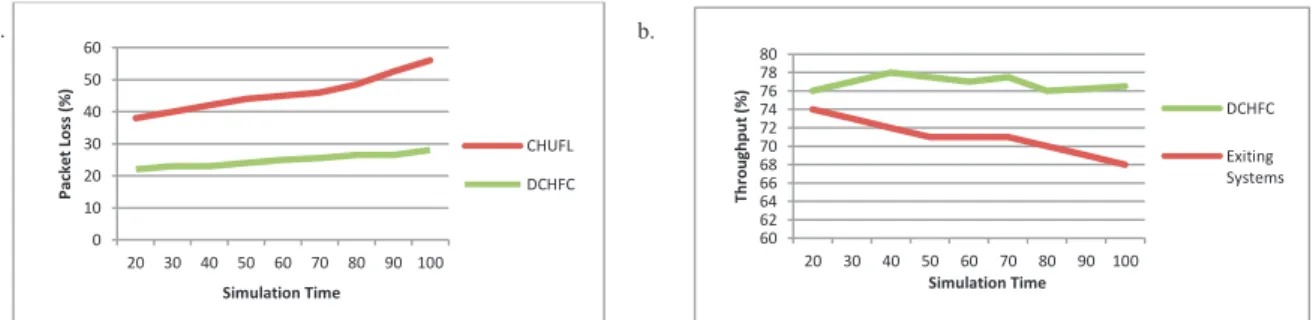
Fig. 3. (a) Packet Loss vs Simulation Time; (b) Throughput vs Simulation Time Table 1. Simulation of DCHFC
Simulator Pintitial Total no. of nodes No. of cluster heads (red) No. of malicious nodes (black) No of clusters Dthreshhold
NetBeans[11] 8% 122 16 13 14 200m
Table 2. Simulation of CHUFL
Simulator Percentage of cluster heads Total no. of nodes No. of cluster heads (red) No. of malicious nodes (black) No of clusters Dthreshhold
NetBeans 14% 122 17 13 12 200m 0 10 20 30 40 50 60 20 30 40 50 60 70 80 90 100 Pac ke t L o ss (% ) Simulation Time CHUFL DCHFC a. b. b. a. a. b. 60 62 64 66 68 70 72 74 76 78 80 20 30 40 50 60 70 80 90 100 Throughput ( % ) Simulation Time DCHFC Exiting Systems
The simulation shows that DCHFC offers spatially distributed cluster heads and creates more clusters to cater to nodes at all distances. Spatially distributed clusters regulate the energy consumption of nodes in the WSN. DCHFC also rejects malicious nodes, resulting in a lower packet loss and higher throughput (Fig. 3.). Simulations show that total residual energy of nodes in DCHFC is higher compared to CHFUL(Fig. 4. a). DCHFC offers a prolonged network lifetime with its nodes surviving longer than CHUFL (Fig. 4. b.).
Fig. 4. (a) Total residual energy of network; (b) Time for First Node Dies (FND), Half of the Nodes Alive (HNA) and Last Node Dies (LND)
5.CONCLUSION
Protocols for Wireless Sensor Networks need to be energy efficient to prolong network lifetime. To achieve enhancement in network lifetime and reliable and efficient communication in WSNs, deploying a good clustering technique is essential. The proposed algorithm (DCHFC) for clustering offers spatially distributed cluster heads selection, which reduces cluster overlapping. DCHFC detects malicious nodes and never allows them to be the cluster head; thereby DCHFC increases the reliability and makes sensor networks fault tolerant. Cluster head selection by DCHFC is based on potential value calculated using fuzzy. The spatial distribution of clusters prevents overlapping. Having all these features DCHFC proves to be the better choice for energy consumption and enhancement of network lifetime.
6.REFERENCE
1. Raghavendra V. Kulkarni, Anna Forster, and Ganesh Kumar Venayagamoorthy, “Computational Intelligence
in Wireless Sensor Networks: A Survey,” IEEE Communications Surveys and Tutorials, vol. 13, no. 1, pp.68-96, 2011.
2. Bhawnesh Kumar, Vinit Kumar Sharma, Distance based Cluster Head Selection Algorithm for Wireless Sensor Network. International Journal of Computer Applications (0975 – 8887) Volume 57– No.9, November 2012.
3. Mohammad Wazid, Avita Katal, Roshan Singh, Sachan, R H Goudar, D P Singh, Detection and Prevention Mechanism for Blackhole Attack in Wireless Sensor Network. International conference on Communication and Signal Processing, April 3-5, 2013.
4. Sachin Gajjar, Mohanchur Sarkar, Kankar Dasgupta, Cluster Head Selection Protocol using Fuzzy Logic for Wireless Sensor Networks. International Journal of Computer Applications (0975 – 8887) Volume 97– No.7, July 2014.
5. J. M. Kim, S. H. Park, Y. J. Han, and T. M. Chung, “CHEF: cluster head election mechanism using fuzzy
logic in wireless sensor networks”, Proc. of International Conference on Advanced Communication Technology, pp. 654–659, 2008. 0 50 100 150 200 250 300 350 400 450 500 550 20 40 60 80 100 120 140 160 Sum of re si dua l e n er gy of node s (J ) Rounds DCHFC CHUFL 0 50 100 150 200 250 300 350 400 450 500 FND HNA LND R o unds
Lifetime of the network
CHUFL DCHFC
6. Yuanpeng Xie, Jinsong Zhang, Ge Fu, Hong Wen, Qiyi Han, Xiping Zhu, Yixin Jiang, Xiaobin Guo, The Security Issue of WSNs Based on Cloud Computing. IEEE Conference on Communications and Network Security 2013 - Poster Session.
7. Dr. Deepali Virmani, Manas Hemrajani, Shringarica Chandel, Exponential Trust Based Mechanism to Detect Black Hole attack in Wireless Sensor Network.
8. IEEE Standard 802.15.4,”Wireless LAN Medium Access Control (MAC) and Physical Layer (PHY)
specifications for low-rate wireless personal area networks (WPANS)”, [Online] Available: http://standards.ieee.org/develop/ project/ 802.11.15.4. html
9. Texas Instruments, CC2500 datasheet [Online] Available: http: //focus.ti.com/lit/ds/symlink/cc2500
10. T. S. Rappaport,”Wireless Communications: Principles and Practice”, 2nd Edition, Prentice Hall
Publications, Englewood Cliffs, NJ, 2001 11. https://netbeans.org/
12. Chan H. and Perrig A. “ACE: An Emergent Algorithm for Highly Uniform Cluster Formation”, Proc. of 1st