Policy
Pathway
Energy Management
Programmes for Industry
Energy Management
Programmes for Industry
The IEA Policy Pathway publications provide
details on how to implement specific
recommendations drawn from the
IEA 25
Energy Efficiency Policy Recommendations
.
This Policy Pathway develops the critical
steps for policy makers implementing energy
management programmes for industry.
Optimising energy use in industry is essential
to improve industrial competitiveness and
achieve wider societal goals such as energy
security, economic recovery and development,
climate change mitigation and environmental
protection. While there is significant potential
to decrease energy consumption in this sector,
opportunities to improve energy efficiency
are still under-exploited. Energy management
programmes have shown to be instrumental
in addressing many of the barriers that inhibit
wide-scale uptake of energy management
in industry. The Policy Pathway builds on
lessons learned from country experiences and
provides actionable guidance on how to plan
and design, implement, evaluate and monitor
energy management programmes for industry.
This Policy Pathways has been developed by
the International Energy Agency in partnership
with the Institute of Industrial Productivity.
www.iea.org
The IEA Policy Pathway series
Policy Pathway publications provide details on how to implement specific recommendations drawn from the IEA 25 Energy Efficiency Policy Recommendations. Based on direct experience, published research, expert workshops and best-practice country case studies, the series aims to provide guidance to all countries on the essential steps and milestones in implementing specific energy efficiency policies. Policy Pathways have been published on:
z Joint Public-Private Approaches for Energy Efficiency Finance
Policies to Scale-up Private Sector Investment
z Monitoring, Verification and Enforcement
Improving Compliance within Equipment Energy Efficiency Programmes
z Energy Performance Certification of Buildings
A Policy Tool to Improve Energy Efficiency
The Policy Pathways series is designed for policy makers at all levels of government and other relevant stakeholders who seek practical ways to develop, support, monitor or modify energy efficiency policies. The Pathways can also provide insight into the specific policy context(s) of different countries, so that each country derives the maximum benefit from energy efficiency improvements.
POLICY
PATHWAY
EV
AL
UA
TE
PLA
N
IMPL
EM
EN
T
M
O
N
IT
OR
Energy Management
Programmes for Industry
IEA member countries: Australia Austria Belgium Canada Czech Republic Denmark Finland France Germany Greece Hungary Ireland Italy Japan Korea (Republic of) Luxembourg Netherlands New Zealand Norway Poland Portugal Slovak Republic Spain Sweden Switzerland Turkey United Kingdom United States The European Commission
also participates in the work of the IEA.
www.iea.org
The International Energy Agency (IEA), an autonomous agency, was established in
November 1974. Its mandate is two-fold: to promote energy security amongst its member countries through collective response to physical disruptions in oil supply and to advise member countries on sound energy policy.
The IEA carries out a comprehensive programme of energy co-operation among 28 advanced economies, each of which is obliged to hold oil stocks equivalent to 90 days of its net imports. The Agency aims to:
n Secure member countries’ access to reliable and ample supplies of all forms of energy; in particular, through maintaining effective emergency response capabilities in case of oil supply disruptions.
n Promote sustainable energy policies that spur economic growth and environmental protection in a global context – particularly in terms of reducing greenhouse-gas emissions that contribute
to climate change.
n Improve transparency of international markets through collection and analysis of energy data.
n Support global collaboration on energy technology to secure future energy supplies and mitigate their environmental impact, including through improved energy
efficiency and development and deployment of low-carbon technologies.
n Find solutions to global energy challenges through engagement and dialogue with non-member countries, industry,
international organisations and other stakeholders.
© 2012 OECD/IEA, 9 rue de la Fédération, 75739 Paris Cedex 15, France
and The Institute for Industrial Productivity, 2200 Pennsylvenia Avenue, N.W. 4th Floor, East Tower,
Washington, DC 20037-1701, USA
www.iipnetwork.org
The Institute for Industrial Productivity (IIP) provides companies and
governments with the best energy efficiency practices to reduce energy costs and prepare for a low carbon future. Our global team and independent experts offer an integrated service package comprising technology, policy and financing components.
We are the partner of choice for companies and governments – whether the need is best practice information or a tailored approach to implementing an initiative.
The Institute for Industrial Productivity works across the globe with a near-term focus on China, India, and the USA to ensure industrial stakeholders have access to the most effective energy efficiency technology, policy and financing approaches. We do this by:
n sharing best practices and providing access to a network of international experts;
n developing original research, analysis and databases; and
n bridging the gap between government policy and industry implementation.
Companies, industry associations and governments can leverage our expertise to achieve their goals.
Many companies, industry associations, and governments are aware that increasing energy efficiency cuts costs and helps achieve sustainable economic growth, and they establish goals to boost energy productivity. The Institute for Industrial Productivity helps these organizations understand which technologies, policies and financing options will help them achieve their vision. Our integrated technology, policy and financing model and our broad network of experts makes us the partner of choice for governments, and companies that share our goal of competitive industries through a low carbon future. The Institute for Industrial Productivity is a nonprofit organization independently funded by the ClimateWorks Foundation,
Table of contents
Acknowledgements . . . 4
Executive summary . . . 5
Introduction . . . 8
What are industrial energy management programmes? . . . 10
Drivers and support mechanisms 14 Why are energy management programmes important? . . . 15
Overcoming barriers to energy efficiency in industry 15 Benefits of EnMSs 17 Encouraging uptake of EnMSs 20 How to deliver energy management programmes? . . . 21
Plan 22 Implement 31 Monitor 37 Evaluate 41 Conclusions . . . 44
Key lessons learned from existing energy management programmes 44 Promoting international dialogue and knowledge sharing 45 The policy pathway for energy management programmes 46 Annex 1 . Case studies . . . 48
Towards energy management through voluntary agreements: the cases of Ireland, Sweden and Denmark 48 The Australian Energy Efficiency Opportunities (EEO) Programme: demonstrating the importance of industry consultation, collaboration and continuous learning 58 The European Bank for Reconstruction and Development (EBRD) promotes energy management systems in industry 63 Annex 2 . Tools for tracking energy use and identifying savings opportunities . . . .67
Glossary . . . 70
References . . . 72
www.iipnetwork.org
The Institute for Industrial Productivity (IIP) provides companies and
governments with the best energy efficiency practices to reduce energy costs and prepare for a low carbon future. Our global team and independent experts offer an integrated service package comprising technology, policy and financing components.
We are the partner of choice for companies and governments – whether the need is best practice information or a tailored approach to implementing an initiative.
The Institute for Industrial Productivity works across the globe with a near-term focus on China, India, and the USA to ensure industrial stakeholders have access to the most effective energy efficiency technology, policy and financing approaches. We do this by:
n sharing best practices and providing access to a network of international experts;
n developing original research, analysis and databases; and
n bridging the gap between government policy and industry implementation.
Companies, industry associations and governments can leverage our expertise to achieve their goals.
Many companies, industry associations, and governments are aware that increasing energy efficiency cuts costs and helps achieve sustainable economic growth, and they establish goals to boost energy productivity. The Institute for Industrial Productivity helps these organizations understand which technologies, policies and financing options will help them achieve their vision. Our integrated technology, policy and financing model and our broad network of experts makes us the partner of choice for governments, and companies that share our goal of competitive industries through a low carbon future. The Institute for Industrial Productivity is a nonprofit organization independently funded by the ClimateWorks Foundation,
Acknowledgements
The main authors of the report are Julia Reinaud (Institute for Industrial Productivity), Amélie Goldberg (Institute for Industrial Productivity) and Vida Rozite (Energy Efficiency Unit, International Energy Agency). The Policy Pathways series is project managed by Lisa Ryan, in the IEA’s Energy Efficiency Unit, who provided strategic guidance on developing this publication. This publication also benefitted from the support of Jungwook Park in the same unit. The team would like to thank Bo Diczfalusy, Director of the IEA Directorate for Sustainable Energy Technology Policy, Jigar V. Shah, Executive Director of the Institute for Industrial Productivity,
Philippe Benoit, Head of the IEA Energy Efficiency and Environment Division, and Robert Tromop, Head of the IEA Energy Efficiency Unit, for their leadership and guidance.
We are grateful to the European Bank for Reconstruction and Development (EBRD)
Shareholders Special Fund, in particular Fani Kallianou, and the Australian Government Department of Resources, Energy and Tourism, especially Louise Vickery, for their support for this work. A workshop (www.iea.org/work/workshopdetail. asp?WS_ID=532) and an extensive consultation and review process were held as part of the process of developing this publication.
The team expresses special thanks to the following individuals who contributed ideas, case studies and comments on the publication: Martin Adelaar, Thomas Björkman, Patrick Crittenden, Albert Desi, Thomas Dreessen, Claus Krog Ekman, Erik Gudbjerg, Mirjam Harmelink, Hille Hyytiä, Pierre Langlois, Eva Lembke, Helen Louis, Gianpiero Nacci, Aimee McKane, Johanna Moberg, Lars J. Nilsson, John O’Sullivan, Stuart Richardson, Clemens Rohde, Gabriele Satori, Christian Stenqvist, Ulla Suomi, Nathalie Trudeau, Henri Van Rensburg,
Ronald Vermeeren, Louise Vickery, Yukari Yamashita and Soo-hyeon Yun (Scarlette Yoon).
This publication was edited by Jonas Weisel and has benefitted from the inputs of Marilyn Smith, Muriel Custodio, Cheryl Haines, Astrid Dumond, and Rebecca Gaghen in the IEA Communications and Information Office. The graphics and layout were designed by Corinne Hayworth and Bertrand Sadin.
Executive summary
Industrial energy use accounts for roughly one-third of global energy demand. While there is significant potential to decrease energy consumption in this sector, opportunities to improve energy efficiency are still under-exploited. Although energy efficiency measures
have frequently been demonstrated to contribute to the competitiveness of companies and to raise their productivity, energy efficiency actions and improvements are still not typically or widely viewed as a strategic investment in future profitability. A number of barriers to industrial energy efficiency exist including limited access to technical know-how and to capital, risk aversion and transaction costs.
Improving energy efficiency in industrial companies provides benefits for the companies themselves as well as for the economy as a whole. Company level benefits include improved
productivity, optimised processes and new business opportunities. In addition, energy efficiency in industry contributes to improved energy security and emission reductions.
Systematic energy management is one of the most effective approaches to improve energy efficiency in industries, because it equips companies with practices and procedures to continuously make improvements and capture new opportunities. An energy management
system (EnMS) is a collection of procedures and practices to ensure the systematic tracking, analysis and planning of energy use in industry.
Government energy management programmes (EnMPs) and associated supporting measures and drivers have been shown to effectively address many of the barriers to energy efficiency and stimulate energy management in industry.
Energy management programmes are policies and initiatives that encourage companies to adopt energy management systems. Energy management programmes play an important role in showing that improving energy efficiency is not only compatible with – but can also drive – profitable business development.
This report provides guidance to policy makers on how to implement energy management programmes. Energy management programmes
have existed in some countries for more than 20 years. The lessons learned during implementation and modification of programmes provide a valuable source of information and guidance for policy makers and programme managers in the process of developing or improving measures. It builds on the diversity of approaches utilised in different countries since what constitutes an effective programme depends on the existing policy framework, objectives, industrial composition and other country-specific factors.
The IEA and IIP propose a policy pathway that supports the development and implementation of programmes comprising ten critical steps in the following four phases.
z Plan: policy makers begin the process by
defining the purpose of the programme and its role in the policy framework, which then serves as the starting point for designing the programme. The design of the programme determines the tasks that should be included in the action plan and the necessary resources.
z Implement: the success of the programme rests
on providing appropriate institutional assistance and support including training. Securing active participation requires promotion, as well as recognising and communicating achievements.
z Monitor: the first monitoring step is to establish
what to measure and how, this includes establishing indicators and data collection methodology. Monitoring also involves assessing compliance and results, and communicating results and outcomes to stakeholders.
z Evaluate: evaluation involves determining what
to evaluate and how and to utilise evaluation results to develop, revise and adapt the programme.
When designing energy management programmes, investing sufficient time and resources in the planning stage can help to avoid future challenges and problems. Careful advance
planning ensures that all the important elements can be incorporated at the outset, avoiding delays, duplication of efforts or confusion. Transparent planning, which involves consulting stakeholders from the beginning, will ensure critical aspects of the programme have been considered, and will help to increase target group buy-in and foreshadow any future implementation issues or difficulties.
Energy management programmes are most effective when planned and implemented as part of broader energy efficiency agreements with the government. During the planning
stage, the purpose of the programme should be articulated, including inter-linkages with other policies. Important design steps include establishing what support systems need to be created to boost implementation, how progress will be monitored, and setting up plans for evaluating the results of the programme. A piloting phase can be a good way to ensure that the most appropriate programme design and supporting measures are selected. To maintain effectiveness, the set-up of programmes may need to be periodically revised, and experiences gained can be used to expand the scope to include new sectors or types of enterprises.
The success of the energy management programme is clearly correlated with the provision of
appropriate resources and supporting mechanisms, including assistance, capacity building and training, and provision of tools and guidance during the implementation stage. Initially, drivers including
incentives play an important role in stimulating industry to engage in energy management. In particular, small- and medium-sized enterprises may require additional support and resources. As the programme matures, programme managers can explore options to phase out support or transfer the responsibility for the programme to the private sector. Depending on the design of the programme, the implementation phase may also require training of auditors and ensuring an effective verification and certification of energy management systems.
To encourage widespread uptake and achieve the maximum programme impact, governments need to promote the energy management programme. Promotion can occur through a variety
of means such as direct information campaigns, networking workshops, dissemination of case studies and recognition of companies that have demonstrated best practice.
Robust systems for monitoring and evaluation can provide essential insights into how programmes can be developed and improved.
Monitoring enables compliance assessments and identifies gaps in implementation. Both monitoring and evaluation require the identification of an appropriate set of qualitative and quantitative indicators and systematic data collection. Data collection and review provide a quantitative means for governments to measure compliance and verify progress towards meeting energy efficiency targets. Programme evaluations should determine whether the programme met its goals and identify opportunities for improvement. Important evaluation issues include the time-frame for evaluation, communicating how the evaluation will be used and when the outcomes will be reported, establishing a budget and selecting the appropriate organisation to undertake the evaluation.
A key challenge is determining the net results and benefits of energy management programmes.
This requires identification of what results stem from the programmes and what results are caused by e.g. other policies, market development, or other factors. Furthermore, to gauge the full impacts of energy management programmes further efforts are needed in the area of quantifying benefits beyond energy savings and emission reduction.
DONE
PLAN
Define the programme role in the policy framework
Design the programme
Develop the action plan and secure resources
IMPLEMENT
Provide institutional assistance
Promote the programme and recognise achievements
MONITOR
Establish what to measure and how
Assess compliance
Communicate results and outcomes
EVALUATE Determine what to evaluate and how
Revise and adapt the programme
Source: compiled by authors.
Table ES1 Policy Pathway action checklist for implementation of energy management programme While some progress has been made in this area,
further efforts could be instrumental in accelerating the uptake of energy management systems.
These key messages are reinforced by country examples and three case studies. The Australian
case study clearly shows the value of an extensive stakeholder process and continuous dialogue with industry. The Irish, Swedish and Danish experiences demonstrate the importance of creating supporting measures to provide incentives and promote the implementation energy efficiency opportunities. The European Bank for Reconstruction and Development (EBRD) case study illustrates how financial institutions can effectively contribute to stimulating the uptake of energy management systems in industry. This case study also shows the benefits of integrated approaches that link technical assistance, capacity building and access
to financing.
Designing and implementing effective energy management programmes will help governments to meet energy efficiency and climate change mitigation targets and policy objectives while promoting increased industrial productivity and creating opportunities
for growth. A further benefit is that energy
management programmes are flexible instruments that can be adapted to changing policy needs and changes in industry thereby ensuring continued effectiveness and relevance.
The Policy Pathway checklist for policy makers developing energy management programmes for industry includes 10 steps in four phases.
1 2 3 4 5 6 7 8 9 10
Introduction
Industry accounts for about one third of the world’s final energy consumption, and that share is growing steadily. Although industrial energy efficiency has improved and CO2 intensity has declined in many
industrial sectors over recent decades, this progress has been more than offset by growing industrial production worldwide (IEA, 2010a). Substantial potential for energy efficiency improvement exists within this sector, in the order of 31 exajoules (EJ) per year, equivalent to 26% of final industrial energy demand (IEA, 2009a; UNIDO, 2011).
Actions to improve energy efficiency in the industry sector remain one of the most cost-effective options to achieve economy-wide greenhouse-gas emission reductions, and improve energy security and productivity.1 Another advantage of pursuing
efficiency in industry relative to other sectors of the economy is that relatively fewer actors are involved. The energy efficiency potential can be captured through improving the practices of thousands of entities, as opposed to millions or billions of entities worldwide (Price and McKane, 2009).
A number of barriers, however, prevent this potential from being realised. When implemented effectively by industrial companies, energy management can overcome these barriers.2
Energy management involves the systematic tracking, analysis and planning of energy use, and enables companies to maximise energy savings and improve energy performance continuously through organisational and technology changes.
1 Although industry may be assumed to be more conscious than other sectors of the cost benefits associated with energy efficiency, there remains potential for further improvement that can be exploited cost-effectively through energy management programmes, for example, for each EUR of taxpayer money spent in the Large Industry Energy Network programme in Ireland, average energy savings benefits of EUR 12 have been attained in the productive business sector.
2 In this publication the term energy management is applied to industrial enterprises. Energy management can also apply more widely, for example, to buildings and transport.
Government support measures for energy management programmes, including legislation, incentives and guidance, can counteract, reduce or remove barriers. Energy management programmes also help countries achieve wider policy goals and target-setting policies in the areas of energy efficiency, energy security and climate change mitigation. Companies also benefit by reducing energy costs, improving productivity and realising other co-benefits.
This Policy Pathway guides policy makers and relevant stakeholders in the delivery of effective energy management programmes. The report identifies success stories and analyses proven practices from around the world, including what works and what does not - and what hinders and what enables.
This Policy Pathway has been developed in response to one of the 25 IEA recommendations, namely recommendation 21: Energy management in industry (IEA, 2011).
This recommendation calls for
governments to require large, energy-intensive industry, and encourage other industrial energy users, to conform to ISO 50001 or an equivalent energy management protocol. Actions to deliver cost-effective energy savings should be implemented, and industry should periodically report on their efforts.
Energy management measures should include:
z Identifying and assessing energy saving opportunities by benchmarking, measuring and documenting energy consumption.
z Implementing actions to capture identified energy-saving opportunities.
z Publicly reporting the energy-saving opportunities identified and the actions taken to capture them.
The publication outlines the phases, steps and actions (i.e. the pathway) necessary to successfully implement energy management programmes within the context of national policy frameworks. The report expands on this pathway by sharing experiences and offering insights on how governments have encouraged enterprises to adopt energy management practices, and how governments have linked their programmes to other industrial energy efficiency policies, measures, guidelines and tools.
The pathway includes:
z A brief overview of what energy management means for companies, and what types of government programmes have been designed to encourage energy management systems and practices.
z An explanation of why government programmes are important in encouraging enterprises to adopt energy management practices.
z A detailed set of critical steps to successfully plan, implement, monitor and evaluate energy management programmes.
Energy management programmes (EnMPs) are policies and initiatives that encourage companies to adopt energy management. Energy management involves the systematic tracking, analysis and planning of energy use. Energy management systems (EnMSs) include energy management activities, practices and processes. In this paper, EnMSs mean not only standards such as ISO 50001 or EN16001 but also other frameworks for
systematic energy management defined according to particular specifications. A number of other terms are useful in understanding this publication (Box 1). This publication focuses principally on government programmes that promote and support the adoption of EnMSs. The report, however, also covers government programmes that promote only certain aspects of energy management practices, i.e.
components of energy management. Governments and organisations promoting the rational use of energy have recognised the important role of EnMSs and are developing and implementing programmes to promote the use of EnMSs in industry. A number of government programmes have been established around the world to encourage, facilitate or mandate industrial companies to undertake energy assessments, and to establish management systems or energy management components. Experience has already shown that the market uptake of EnMSs is correlated with government-led programmes that stimulate and encourage enterprises to apply the EnMS (Goldberg et al., 2011). Many governments are now turning their attention to incorporating ISO 50001 into their programme.
What are industrial energy management programmes?
Box 1 Key definitions of energy management usedin this Pathway
Energy management programmes (EnMPs)are government-led initiatives to promote effective energy management systems.
EnMP elements are the
government-led initiatives, drivers and support systems that, combined, make up the EnMP and encourage enterprises to adopt effective energy management systems.
Energy management systems (EnMSs)
are a means by which organisations establish the systems and processes necessary to achieve operational control and continual improvement of energy performance.
Energy management components are
the energy management activities that make up the EnMS and other management activities. Some governments have chosen to encourage or mandate only selected elements of energy management rather than a full EnMS. The level of detail in requirements for each component also varies.
Energy management system
standards or energy management system specifications can be used to define EnMSs. Standards are developed by international or national standardisation bodies for use across a diverse range of circumstances. Specifications are usually formulated by a governmental policy agency as part of the development of a particular policy. In the case of EnMS standards, third-party certification of the proper use of the EnMS standard usually accompanies the standard. In the case of specifications, verification of compliance (third-party or governmental) ensures participants are following the requirements of the specifications.
EnMPs define how energy management should be carried out, either through standardised methods such as the ISO 50001 standard for Energy Management Systems and the European EN 16001 standard, or through non-standardised specifications such as the Netherlands’ energy management reference document under long-term agreements (LTAs) or Australia’s energy efficiency opportunity assessment under the Energy Efficiency Opportunities (EEO) programme (Reinaud and Goldberg, 2011b). Many national energy management standards are now being replaced by ISO 50001, as is the European standard EN 16001. EnMPs are generally embedded within target-setting policies, voluntary schemes or negotiated agreements to reduce energy demand or
greenhouse-gas emissions. Promotional aid, as well as financial and regulatory incentives, is often included to support EnMS adoption (McKane et al., 2008). Governmental support for EnMSs includes financial incentives (such as tax relief), reward programmes, ease of access to information (best practice, exchange and co-operation schemes, networking, implementation guidelines, etc.), and technical tools (support to carry out energy audits, development of technical energy profiles, benchmarking tools etc.) (Mey, 2011).
The extent of the integration into a political and fiscal framework differs considerably from country to country (Box 2).
Box 2 Three different approaches to promoting energy management in industry
The following brief descriptions of EnMPs in Australia, Denmark and the Netherlands illustrate the range of approaches taken.
Australia’s Energy Efficiency Opportunities (EEO) programme is mandatory for large energy-using businesses. These companies are required to undertake energy assessments according to a detailed Assessment Framework (similar to an EnMS) and to report publicly on opportunities identified and implemented on an annual basis. The government, with the support of technical experts, verifies compliance with the Assessment Framework and the accuracy of the public reports. Companies are not required to use certified auditors, but must demonstrate that they have utilised personnel with appropriate expertise and experience. These people may be sourced from within and/or outside the firm. The programme does not mandate any implementation of measures and does not require companies to set energy efficiency targets in advance.
Denmark’s Agreement on Industrial Energy Efficiency (DAIEE) is voluntary. Participants are mandated to implement an EnMS according to the European standard 16001 and have it certified by an external accredited certification body. If companies opt into and comply with the voluntary agreement, they receive a carbon tax reduction.
The Netherlands’ Long-Term Agreements (LTAs) are voluntary. Participants are required to achieve negotiated energy efficiency targets and adopt an EnMS according to EnMS specifications provided under the agreements. These EnMS specifications are not standards, and companies are not mandated to seek certification. Companies are also required to implement a broader and more strategic Energy Efficiency Plan. If companies opt into and comply with the LTAs, they receive partial exemptions from the energy/carbon tax and are awarded automatic compliance with the energy-saving requirements under the Environmental Management Act.
Some features of EnMPs play an important role in delivering effective energy management. For example, linkages with wider policies, such as an energy-saving agreement, can help to define and drive energy-saving efforts (or, put another way, achievement of targets within energy-saving agreements can be assisted by EnMPs). Standards and accompanying certification, or verification of compliance with legislation, can give confidence to governments that companies are performing according to common formats, metrics and processes. Drivers, including incentives and regulation can further encourage EnMS uptake (as described in the next subsection). Energy review and
benchmarking tools assist companies in identifying energy efficiency opportunities, defining targets and establishing key performance indicators (KPIs) within their EnMSs.
Training, networking events, case studies and guidance materials ensure that energy managers, energy auditors, company personnel, certification bodies and policy makers can learn from best practice approaches. Reward programmes and external recognition for EnMS adoption can enable companies to showcase their performance to customers, peers and other stakeholders, and can serve as an important motivation to initiate EnMSs. Requirements to develop a longer-term energy strategy, in addition to an EnMS, can help give operational staff greater mandate to support energy improvements.
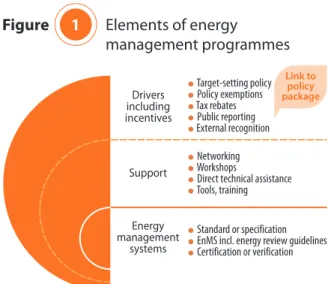
Although an EnMS is the core activity of an EnMP, a number of supporting elements and linkages with other policies are necessary to stimulate adoption of an EnMP (Figure 1). The sum of all the elements makes up the government-led EnMP.
Most government programmes encourage or require companies to adopt an EnMS in its totality, and to report and verify/certify compliance. Some government programmes, however, may be centred only on energy management components, including: appointment of an energy manager; energy assessments or energy reviews including audits (see Annex 2 for further information); establishment of energy efficiency targets; key performance indicators or benchmarks to monitor performance; and/or public reporting.
Individual energy management components on their own will not lead to sustained energy management and on-going improvements. Rather the sum of the actions, processes and systems – i.e.
energy management systems – will improve energy performance. Drivers including incentives Support Energy management systems Target-setting policy Policy exemptions Tax rebates Public reporting External recognition Networking Workshops
Direct technical assistance Tools, training
Standard or specification EnMS incl. energy review guidelines Certification or verification
Link to policy package Figure 1 Elements of energy
management programmes
Box 3 Energy management systems
A first step in promoting energy efficiency in industry is to understand energy management
systems and how embedded mechanisms help companies to systematically work toward reducing unnecessary energy use.
A thorough set of energy management activities consists of metering and monitoring energy consumption, analysing trends in energy use, identifying and implementing energy-saving measures, and verifying energy-savings with proper measurements (ACEEE, 2011). Energy management helps managers and staff to identify options for increasing energy efficiency, carry out energy efficiency projects, monitor energy use and results, and learn from technical actions. Energy management is often incorporated into business management systems, allowing it to be supported from multiple levels in a company or facility, from operators to CEOs. It is widely accepted that only systematic energy review and management process can tap the full potential of energy efficiency in industry (Mey, 2011).
The core features of an energy management system are (DOE, 2011b):
z Energy policy, top management’s official statement of the organisation’s commitment to managing energy.
z Cross-divisional management team led
by a representative who reports directly to management and is responsible for overseeing the implementation of the energy management system.
z Energy review to analyse and assess current and planned energy use and energy sources, relative to production and service delivery. The review then identifies opportunities for improvement. However, in many EnMS
standards, including ISO 50001, no guidance exists for how to conduct an energy review.3
Government programmes may provide additional guidelines (see Annex 2).
z Baseline of the organisation’s energy use.
z Energy performance indicators (EnPIs) that are unique to the company and are tracked to measure progress.
z Energy objectives and targets for energy performance improvement at relevant
functions, levels, processes or facilities within an organisation.
z Action plans to meet those targets and objectives.
z Operating controls and procedures for significant energy uses.
z Measurement, management, and
documentation for continuous improvement
for energy efficiency.
z Internal audit of progress of the EnMS based on these measurements.
z Revision by third-party auditor to receive certification/verification and recognition by external stakeholders.
3 A proposal to develop implementation guidelines for the ISO EnMS standard 50001 has recently been approved by ISO members. These guidelines will detail the establishment, implementation, maintenance and improvement of an energy management system and its co-ordination with other management systems. The guidelines are applicable to any organisation, regardless of its size, type,
location or level of maturity but are not intended to provide interpretations of the requirements of ISO 50001 (ISO, 2011).
Drivers including incentives and support
mechanisms are key components of EnMPs, because they help to motivate companies to implement EnMSs and provide clear guidance for how to do this. Drivers include regulation and mandatory requirements as well as incentives such as subsidies or rebates, while support mechanisms comprise information, guidance and training. Countries generally have a combination of drivers, incentives and support mechanisms (Table 1).
Drivers Support mechanisms
Overarching or target-setting policies such as voluntary schemes or negotiated agreements between industry and governments.
Exemptions from policies in exchange for EnMP participation, such as from an energy or carbon tax. Rebates or other tax incentives for energy-saving equipment (may not be tied to the EnMP). Subsidies for energy audits.
Reward programme and other forms of recognition. Mandatory implementation of EnMS.
Public reporting of company performance to encourage best-in-class behaviour.
Energy review, benchmarking and technical tools. Direct programme and/or technical assistance. Case studies showing peer experience.
Guidance materials.
Workshops, networks and other fora for best practice exchange.
Table 1 Drivers and support mechanisms within EnMPs
Energy management programmes (EnMPs) are important, because they encourage energy reduction, greenhouse-gas reduction and productivity benefits in firms. For governments, they act as a framework to encourage industry to achieve these outcomes by effectively adopting energy management systems (EnMSs) and supporting activities outlined in the EnMP. The main benefit of EnMPs is that they help companies overcome barriers to the implementation of EnMSs, and provide guidance and support for the implementation process.
Because energy-saving measures and actions in the industrial sector are one of the most cost-effective options to reduce energy use and greenhouse-gas emissions, EnMPs are an efficient way for society to achieve wider policy goals in the area of energy efficiency, energy security and climate change mitigation. EnMPs can be linked to and support policy objectives in key areas:
z Sustainable economic development, in terms of the improving the competitiveness and productivity of industry, cutting costs, reducing exposure to volatility of energy prices, managing risks, and fostering innovation and technology development/adoption.
z Energy security and demand-side management objectives.
z Energy efficiency and/or greenhouse-gas reduction targets, through energy-saving agreements and emissions trading schemes.
z Environmental objectives, such as greenhouse gas emission reductions and reducing local pollutants.
Experience in European countries has shown that EnMPs can usefully contribute to enhance energy-savings performance beyond isolated energy management activities, facilitate company achievement of target-setting policies and other policy objectives, and ease the burden of compliance checks on the government (Goldberg et al., 2011). This section first discusses the role of EnMPs in helping companies overcome barriers to taking energy efficiency actions. The section then describes the benefits that EnMSs can provide.
Why are energy management programmes important?
Overcoming barriers to energy efficiency in industry
Despite the fact that energy efficiency measures have been demonstrated to contribute to business competitiveness and raise productivity, energy efficiency actions and improvements are still not typically or widely viewed as a strategic investment in future profitability (McKane et al., 2009). Because energy efficiency potentials are highly fragmented and spread across a multitude of locations and devices, this dispersion ensures that energy efficiency is the highest priority for virtually no one (McKinsey and Company, 2009).
In addition, a number of financial, behavioural, technical and organisational barriers to energy efficiency prevent companies from undertaking investments and actions (Reinaud and Goldberg,
2011b). Barriers refer to all obstacles that prevent financially and technically feasible energy efficiency measures from being implemented (IPCC, 2001) (Box 4).
EnMPs are a means of encouraging the use of EnMS to overcome a range of barriers (see Box 4). For example, initiatives for measurement of baseline energy use and emissions, energy auditing, and guidance for identifying opportunities can help reduce barriers related to lack of information and technical expertise.
Box 4
Important financial barriers include: z Investments in energy efficiency projects do not
meet financial criteria within companies.4 z Companies lack access to capital.
z Investments impose too high a risk due to lack of familiarity with energy-savings projects relative to core business projects and difficulty in predicting future energy prices.
z Businesses like to use capital and resources to grow and expand their business. When they want to reduce costs, they want to do so without spending too much capital. Companies will often only fund projects with an 18-month to two-year payback or less, unless it has a productivity or growth outcome as well (Vickery, 2011).5 This is particularly true of
shareholder businesses looking to reduce costs and maximise profit in short time frames.
z Energy efficiency is seen as an operating expense for which budgets are limited.
Important market, information, behavioural and organisational barriers include:
z Energy prices and taxes are subsidised in some countries in the industrial sector; therefore, companies may not pay the full cost of their energy use and have less incentive to reduce consumption.
z Transaction costs and effort are required to find out about the costs, benefits and energy-saving options; these costs can act as a deterrent to making changes and investments within a company’s operations.
4 As noted by UNIDO (2010a), in some sectors, high capital cost of investment in new and efficient facilities or equipment is a major limitation on the rate of energy efficiency improvement in industry. This limitation is particularly the case in countries where the economy is unstable, and where interest rates are high. 5 Based on conversations with businesses over 10 years, survey results are presented in the Report of the Prime Minister’s Task Group on Energy Efficiency (2010), the Department of Climate Change and Energy Efficiency.
z Companies have limited knowledge and access to information about new and existing energy-saving technologies.
z Companies may perceive technical and operational risks of implementing energy efficiency projects due to unfamiliarity with energy-reducing technologies and practices relative to core business projects.
z Energy efficiency improvement is not a major driver for most companies; instead companies focus on their core activity such as production expansion or improvement.
z Professional and functional boundaries within the organisation limit the collaboration required to identify and support energy efficiency (Paton, 2001). For example, staff who pay the energy bills are different from staff who procure energy-using equipment, who again are different from those who maintain equipment.
External barriers include:
z Uncertainty caused by future technologies and potential unknown regulations and other policy developments (creating uncertainty for the optimal timing of adoption of new technologies).
z Lack of expertise and skill of external energy auditors and other energy service providers which can also prevent companies from maximising energy efficiency.
Source: adapted from Reinaud and Goldberg, 2011a, and based on a survey of existing literature (Rohdina et al., 2007; Groot et al., 2001; Masselink, 2008; Beer et al., 2000; Anderson and Newell, 2004; Harmelink et al., 2010; Tanaka, 2009 (unpublished); Eichhammer, 2004; Jaffe and Stavins, 1994; Paton, 2001; McKinsey and Company, 2009).
Having a representative from top management and staff from all of the different functions of the company participate in the EnMS administration and implementation can overcome organisational, behavioural and institutional barriers by creating transparency and facilitating communication on the management of energy resources. Johansson
et al. (2011) document that “soft” or managerial aspects related to EnMS, in particular culture, will, acceptance, recognition and leadership are important factors in organisational change. Reporting results of assessments to the board can adjust senior management perceptions that no cost-effective savings will result and lead to decisions-making in favour of energy efficiency project implementation. Similarly, having top management articulate the company’s energy policy and goals will lead to staff becoming more proactive and involved in raising energy issues and offering suggestions for improvement.
Improving a company’s capabilities in energy data collection and analysis can reduce the perception that energy efficiency benefits are relatively
insignificant relative to other core business concerns (assessments and audits done poorly can reinforce that position).
Life-cycle costing of products and equipment can encourage the purchase of more energy efficient technologies, help overcome information and financial barriers, and prioritise new investments.
Benefits of EnMSs
Competitiveness and productivity gains
EnMSs bring a range of corporate benefits to industrial enterprises. Introducing EnMSs allows companies to systemically analyse, manage and reduce energy use, enabling them to lower energy costs, and enhance productivity and competitiveness. Energy management becomes a dynamic process, through which new ideas and knowledge are generated, in turn producing additional energy efficiency gains (Kannan and Boie, 2003).
EnMSs are becoming ever more relevant in light of increasing and more volatile energy prices: indeed, in the most energy-intensive companies, energy costs have more than tripled since 2000, according to a survey conducted by Prindle (2010). Industries that adopt energy management practices may save between 10% and 30% of their total energy use (McKane, 2011).
Companies including Dow Chemical, United
Technologies Corporation and Toyota have achieved major energy-intensity6 improvement using EnMSs
(Scheihing, 2009).7
The use of standardised or specified EnMSs facilitates the identification of energy-saving opportunities and improvements in operational control, which would not have been possible with self-designed systems.
6 In an industrial context, energy intensity is typically measured as the ratio of energy consumption per unit of production or per unit of value added. Increased energy efficiency entails delivery of more services for the same energy input or the same level of services for less energy input.
7 Dow Chemical achieved a 22% improvement between 1994 and 2005 (USD 4 billion savings) and is seeking an additional 25% between 2005 and 2015. United Technologies Corporation reduced global greenhouse-gas emissions by 46% per dollar of revenue from 2001 to 2006. Toyota’s North American Energy Management Organisation has reduced energy use per unit by 23% since 2002; companywide energy savings efforts have saved USD 9.2 million since 1999 (Scheihing, 2009).
For example, companies using standardised EnMSs in Ireland have reported an increased pace in energy performance improvement despite not being new to energy management, and having already achieved significant savings over a previous 10-year period without the use of an EnMS standard.
Achievement of and compliance
with related policies
For enterprises, proper adoption of EnMSs and the use of one systematic, continually operating approach may make it easier to achieve and comply with government regulations. Proper adoption of EnMSs can also help companies comply with target-setting or energy-saving agreements, and ensure that energy conservation plans, projects and targets are firmly grounded in the specific realities of a company’s enterprise and suitably customised to on-site circumstances.
Facilitating access to finance
Quantifying and demonstrating the benefits of energy efficiency projects has the potential to encourage the private sector to invest in the identified opportunities. Documenting and quantifying energy use, energy savings and cost savings in accordance with a standardised methodology provided by EnMS, helps banks to better assess the risks and returns of these projects. For example, the EBRD Programme for Energy Efficiency Management Systems was launched in 2009 to address the lack of information and limited access to finance by providing support to implement integrated EnMS in a number of Central and Eastern European and Commonwealth of Independent States (CIS).
Benefits for the supply chain
If buyers (wholesalers or retailers) can help cut the energy costs of their suppliers, costs across the supply chain are reduced, which benefits the retailer as well as the supplier (Box 5).
The term “supply chain” denotes those activities “upstream” from the company, conducted by the entities that supply products, materials or services to the company that is assembling either an intermediate or final product (Prindle, 2010). In the Netherlands, for example, under the LTAs, participants can choose to extend their energy-saving efforts beyond their company boundary by engaging their suppliers.
Co-benefits of EnMS
A common experience of companies that use EnMSs effectively is that many other significant benefits, referred to as co-benefits or non-energy benefits (NEBs), are also uncovered (Box 6). These benefits include productivity gains, improved product quality, lower non-energy operating costs, longer equipment life, reduced maintenance costs, less waste generation, better resource efficiency, improvement of workplace conditions and pollution reduction (Hall and Roth, 2003; Pye and McKane, 2000). Including co-benefits reduces payback times for new investments.
Reducing energy costs of suppliers
Several companies have reported saving costs by introducing energy management components within their suppliers’ practices (Prindle, 2010). Such activities may also enable suppliers to win contracts with other retailers. This is the case for IKEA:
“IKEA has identified energy efficiency as a high priority topic. Through energy efficiency we will be able to reduce our (suppliers) carbon footprint and our production costs. Moreover, energy efficiency improvements often result in a better process control and a series of non-energy benefits such as increased productivity and better product quality. The result is lower product prices for our customers.”
Maja Dahlgren, IKEA.
In fact, co-benefits often exceed the value of energy savings, so energy savings should be viewed more correctly as part of a broader set of parameters that affect company productivity and profitability (Pye and McKane, 2000). A 2003 study of commercial and industrial energy efficiency programmes in Wisconsin valued these benefits at approximately 2.5 times the projected energy savings of the installed technologies (Hall and Roth, 2003; Willoughby et al., 2011). Another study for Alcoa showed that the company’s initial cost of USD 5 000 in consulting fees for purchasing a three-fan, variable-inlet-valve (VIV)-controlled system created a potential incremental annual revenue of USD 375 000 by enabling the redirection of energy savings towards increased product output (Pye and McKane, 2000).8
Robust energy management not only saves energy, but can also open doors to innovation across a company. By engaging people across an organisation and tapping their creativity to meet energy-savings goals, companies are discovering other useful innovations (Prindle, 2010).
Communicating the co-benefits of EnMSs is thus a critical step for addressing other priorities within a company and encouraging uptake. In Ireland, EnMSs are seen as and marketed to companies as business improvement tools because of the significant gains that companies have achieved through EnMS implementation.
Wider benefits of EnMPs
EnMPs can support and build the energy efficiency market by training energy managers and developing the energy service market, and support longer-term efforts for improved energy technologies (ISO, 2011).
8 According to the authors’ assumptions, 3 346 320 kWh in saved energy was redirected to produce an additional 500 000 lbs. of aluminum, which is sold at USD 0.75 per lb market price.
Governments and policy makers view the
co-benefits to enterprises as important additional motivating forces for EnMPs, and these co-benefits are often national priorities, especially in emerging and developing countries. Reductions in energy use, in addition to greenhouse-gas mitigation, also lead to lowering the burden of local air pollution, improving water use and efficiency, reducing waste management, and protecting the health and safety of workers. By focusing on environmental and societal benefits as well, EnMPs can contribute to meeting national priorities of energy independence, reduced price volatility, international co-operation (e.g. under frameworks such as the Rio Declaration on Environment and Development) and technology transfer (IIP, 2011).
Quantifying co-benefits of carbon reduction initiative for a glassware company
IKEA, a leading global retailer of home furnishings, and the World Wildlife Fund (WWF) are engaged in a partnership to reduce greenhouse-gas emissions and energy consumption, and increase competitiveness of IKEA’s suppliers. One of IKEA’s suppliers, the Hongwei Glassware Company in Yuncheng, China, has been involved in the initiative. The company upgraded its furnaces and switched its fuel source from coal to natural gas. As a result, in addition to reducing its greenhouse-gas emissions by 35% between 2009 and 2010, the company realised numerous non-energy benefits, reducing the costs of products by 17% (increasing the output rate and qualified rate of non-rejects due to temperature stability). The company also made improvements in product quality and health and safety conditions for workers. It then adopted the same upgrades in its two other facilities.
Source: Willoughby et al., 2011. Box 6
Despite the clear benefits of EnMSs, EnMPs are needed to encourage enterprises in the proper and widespread adoption of EnMSs.
Standards and specifications
Even though companies may actively practice several of the components of EnMSs, government programmes can use standards and specifications to facilitate and support the establishment of clear definitions for how effective EnMSs can be carried out. EnMPs provide governments and enterprises with a common understanding of EnMSs, including their content, scope, processes and methodology, and a common reporting format (Goldberg et al.,
2011). EnMS standards and specifications also create a transparent system to validate energy performance improvements and management practices, and can lead to a means for devolved implementation and compliance assurance. Indeed, companies that have implemented standardised EnMSs as part of a wider EnMP have often achieved savings beyond the expectation of the wider energy-savings agreements, or what they would have achieved through self-designed systems. These companies typically achieve savings of 10% to 20% within the first five years (NRC, 2011; Goldberg et al., 2011).
Motivation, incentives and support
Standards or specifications for EnMS on their own are not sufficient to drive widespread adoption of effective EnMS, certification often incurs significant costs. For example, in the case of EnMS standards, the costs of having an EnMS certified can be prohibitive, especially for small and medium enterprises (SMEs) (Hrustic et al., 2011).9 To
encourage EnMS adoption, incentive and support mechanisms are necessary.
In Denmark, Sweden and Ireland, an EnMS standard is underpinned by a voluntary energy-savings agreement between enterprises and the government, and linked to incentives and support. Uptake within each country is relatively high: 60%, 50% and 25%, respectively, as of 2009 (see McKane
et al., 2009). In comparison, the uptake of the United States standard (ANSI/MSE 2000:2008 available since 2000) was less than 5% despite this standard being in place the longest - since 2000 compared to compared to 2001 in Denmark, 2003 in Sweden and 2005 in Ireland. The difference in uptake was most likely due to the absence of a supporting programme in the US (Goldberg et al., 2011). This has now been addressed through the launch of the US Superior Energy Performance programme. EnMPs can also create motivation by disseminating case studies and best practice examples of excellent corporate management. Making the business case for energy efficiency reduces its perceived risk to management, which may, in turn, reduce the hurdle rate (or payback period) that a company requires of an energy efficiency investment (Pye and McKane, 2000). Sharing the experiences of companies with EnMSs through public reporting, networking and dissemination of case studies etc. can reduce learning costs for other companies.
9 In Sweden, the cost of receiving certification of the energy management system is approximately EUR 8 000.
The figure below illustrates the four phases of effective energy management programme delivery: plan, implement, monitor and evaluate phases. These phases are then broken down into ten critical programme steps, and sets of actions. The steps and actions are supported by experience drawn from practitioners and are further demonstrated in two case study examples.
The Planning phase helps countries to ask the right questions and to carefully plan, in consultation with key stakeholders, the programme design and implementation.
The Implementation phase outlines the main steps necessary for ensuring a successful outcome.
The Monitoring phase helps identify indicators and methods for measuring organisational change, energy savings and other results.
The Evaluation phase focuses on how to capture lessons learned, assess effectiveness and make improvements.
During the four phases, different types and levels of stakeholder consultation and engagement are important to help define the needed interventions, design compliance and verification requirements, comment on proposals and share experience on specific barriers.
How to deliver energy management programmes?
Assess compliance Establish what to measure and how Communicate results and outcomes
Determine what to evaluate and how
Revise and adapt the programme
Define the programme role in the policy framework Design the programme
Develop the action plan and secure resources
Provide institutional assistance Promote the programme and recognise achievements 1 2 3 4 5 6 7 8 9 10
E
V
A
LU
AT
E
PL
A
N
I MP
LE
M
EN
T
M
O
N
IT
O
R
POLICY PATHWAY
Energy Management
Programmes for Industry
Prior to planning an EnMP, governments need to conduct an assessment of existing industrial energy use and energy management practices, as well as a survey of overarching national targets in the areas of energy efficiency, climate change mitigation and industrial development. This step is necessary to determine the need for energy efficiency policy measures for industry.
Careful advanced planning of an EnMP ensures that all the important elements can be incorporated at the outset, avoiding delays, duplication of efforts or confusion. Transparent planning, which involves stakeholders from the beginning, will ensure critical aspects of the programme have been considered, and will help to increase target group buy-in and identify future implementation issues or difficulties. The purpose of the EnMP should be articulated, including inter-linkages with other policies. Once a clear purpose has been defined, the programme needs to be designed including identifying the programme’s components. The programme may involve a number of activities; however, the order in which the activities are undertaken may differ, and some may be conducted concurrently. Furthermore, some activities may be optional rather than
necessary to a successful programme.
1
Define the programme role
in the policy framework
The relevance and success of a programme is clearly linked with ensuring that it is aligned with and contributes to wider policy perspectives. It is important that the programme corresponds to the needs of industry and reinforces existing policies.
Analyse the policy framework and industrial context
The first step is to define the programme’s purpose and role in the national policy framework and industrial context. Understanding the context in which industries operate is a precondition for designing effective programmes. Policy makers need to establish how the programme will contribute to national objectives and targets in the areas of energy efficiency, environment, climate change mitigation and industrial development. A comprehensive review must be conducted of existing policies and impacts on industry, as well as analysis of other factors such as industrial composition and development trends in the markets in which the industries operate. The results of this review will constitute the basis for an assessment of how these policies stimulate or hinder energy management efforts, and an identification of drivers, barriers, gaps and possible synergies. The assessment must also consider possible overlap with other instruments (such as emissions trading schemes) so as to avoid duplication of efforts or support. Assessments may require the participation of, or inputs from, representatives from several line ministries and other stakeholders. The consultation process described below can be utilised for this purpose.
Consult with stakeholders
Consultation is a continuous process and may occur throughout the four phases of the policy pathway. Early consultation with industrial enterprises and energy experts can help provide input into the programme’s design, uncover specific industry circumstances and needs, and identify the barriers that industries face to effective energy management. The aim of this early consultation should focus on discovering the salient issues to develop clear and relevant objectives, give policy makers guidance on what the EnMS requirements should be for adoption by participants, and to determine how these
requirements can be communicated to companies in language that is relevant for them.