RISK MANAGEMENT FRAMEWORK FOR HIGHWAY CONSTRUCTION PROJECTS IN NIGERIA
By
Sani Reuben Akoh
Doctoral Thesis
Submitted for the Degree of Doctor of Philosophy in Construction Project Management
Heriot-Watt University
School of Energy, Geoscience, Infrastructures and Society
Edinburgh-United Kingdom
May-2018
The copyright in this thesis is owned by the author. Any quotation from the thesis or use of any of the information contained in it must acknowledge this thesis as the source of the quotation or information.
i
Poor performance of highway construction projects in developing countries can be attributed to the lack of understanding and application of risk management. However, risk and uncertainty of highway projects in the developing countries, particularly in Sub-Saharan Africa, (e.g. Nigeria) has been under-researched compared to countries elsewhere in the world.
Thus, this research aims to develop a new risk management framework to improve the management of highway infrastructure construction projects in Nigeria.
Thirty-five risk factors and risk management processes and techniques were identified through a comprehensive literature review. A questionnaire survey and case study interviews were adopted to seek for the opinions of Nigerian highway experts on the possibility and consequence of occurrence of those risk factors, as well as the risk management processes and techniques currently used. One hundred and twenty-eight questionnaire surveys were completed, and thirteen interviews were conducted on four cases of on-going highway infrastructure construction projects in Nigeria. The criticality of each risk was calculated to determine the top nine most critical risk factors affecting the performance of highway infrastructure construction projects in Nigeria. External risks were found to be more critical and have significant consequence on the performance of highway infrastructure construction projects in Nigeria compared to internal risks.
Based on the findings from the literature reviews, the questionnaire survey and case studies, a new highway project risk management framework has been developed. For each of the top nine most critical risks identified, practical mitigation measures have been developed and evaluated. A semi-structured interview was conducted with 16 Nigerian highways experts involved in four distinct on-going highway infrastructure construction projects in Nigeria to validate the framework. The validation feedback shows that the developed framework is user-friendly, cost effective and suitable for developing countries, as it does not involve complicated processes.
Keywords: Developing countries, highway construction projects, Nigeria, risk identification, risk management
ii With Uncontrollable Tears in My Eyes:
To the Blessed Memory of My Mother, Late Mrs Ojo-Onyi Akoh (Nee Okwori) and My Father Pa Akoh Ogala
To the Blessed Memory of my Brother, Late Mr. Joseph Akoh
To the Blessed Memory of My Brother’s Wife, Late Mrs Comfort Ojene Akoh To the Blessed Memory of My Father-in-law, Late Mr. Daniel Owoicho Inedu
You have all Sincerely, Laboured, Prayed and wish me well wholeheartedly but have inevitability gone to Rest
How I Wish my Wishes Were True and You are here! But to my Dismay, you are not here! God has been My Comfort and Strength! Adieu
We stand motionless, consumed in grief. Sorrow has arrived, Life without you, is so hard to conceive. Our hearts are damaged, and scarred severely.
Ever since you (Daniel) went away You did so much for me,
as I didn’t do much for you. I hope you will forgive me, for all the things I didn’t do You are my brother and my best friend. I will always love you. Life has never been the same We shall miss you,
much more than dearly. For having you in our lives, we’ve all been blessed. But now the time has arrived, for you to rest.
It’s sad that Daniel left without saying goodbye,
But just remember we all love you.
To My Only
Dear Younger
Brother,
Daniel Akoh
iii
First and foremost, I give thanks and praises to the Most High God for the courage and grace to undertake this research during the most difficult, most challenging and uncertain experiences of my life. No account can explain how I have coped with these terrible experiences in my life to undertake this research, if not for the Mercies of the Most High God. I would like to express my sincere appreciation to my primary supervisor, Professor Ming Sun for his professionalism, proficiency and efficiency throughout my studies. His guidance, unstinting support and constructive criticism throughout my studies are highly valued. My sincere gratitude also goes to my second supervisor, Professor Stephen O Ogunlana for his valuable advice, encouragement, prayers and support throughout my studies.
I would like to express my profound gratitude to the Deputy Principal (Innovation and Research), Professor Pender Gary, for the support given to me with personal consideration, understanding and cheerfulness when he was the head of school.
I would like to express my appreciation to all the respondents to the questionnaires, interviews and case studies for their valuable input, effort and time that made this research possible. To my colleagues at EGIS who openly shared their knowledge and experiences with me, thank you. To the administrative and research teams who helped in many ways, thank you. I would to specially thank my mum and dad for their hard work, prayers and unique love for me. I am sincerely indebted to my late brother, Joseph Akoh, who sincerely prayed and encouraged me to undertake this study. He constantly assured me that God will help me. My elder brother, Dr S O Akoh, all my brothers and sisters, nieces and nephews, my mother-in-law, brother-in-law and sister-in-law have been wonderfully supportive in different ways, I appreciate them all.
I would like to wholeheartedly thank my wife, Ada for her emotional support, love, comfort and courage in the face of unimaginable tragedy in our family. She is ‘an epitome of love’. To my loving and cheerful children: Daniel and David; Victor and Victoria; Albert and Cornelius, thank you very much for your understanding.
iv
ACADEMIC REGISTRY
Research Thesis Submission
Name: Sani Reuben Akoh
School: EGIS
Version: (i.e. First, Resubmission, Final)
Degree Sought: PhD Construction Project
Management
Declaration
In accordance with the appropriate regulations I hereby submit my thesis and I declare that:
1) the thesis embodies the results of my own work and has been composed by myself
2) where appropriate, I have made acknowledgement of the work of others and have made
reference to work carried out in collaboration with other persons
3) the thesis is the correct version of the thesis for submission and is the same version as any
electronic versions submitted*.
4) my thesis for the award referred to, deposited in the Heriot-Watt University Library, should be
made available for loan or photocopying and be available via the Institutional Repository, subject to such conditions as the Librarian may require
5) I understand that as a student of the University I am required to abide by the Regulations of the
University and to conform to its discipline.
6) I confirm that the thesis has been verified against plagiarism via an approved plagiarism
detection application e.g. Turnitin.
* Please note that it is the responsibility of the candidate to ensure that the correct version of the thesis is submitted.
Signature of
Candidate:
Date:
Submission
Submitted By (name in capitals):
Signature of Individual Submitting: Date Submitted:
For Completion in the Student Service Centre (SSC)
Received in the SSC by (name in
capitals):
Method of Submission (Handed in to SSC; posted through internal/external mail):
E-thesis Submitted (mandatory for final theses)
v ABSTRACT ... i DEDICATION ... ii ACKNOWLEDGEMENT ... iii DECLARATION OF STATEMENT ... iv TABLE OF CONTENTS ... v
List of figures ... xii
List of tables ... xiii
List of publications ... xv
Chapter 1: Introduction ... 1
1.1 Introduction ... 1
1.2 Background to the research ... 1
1.3 Statement of problem ... 3
1.4 Research aim and objectives ... 4
1.5 Research methods ... 6
1.6 Structure of the thesis ... 9
Chapter 2: Risk Management Philosophy ... 11
2.1 Introduction ... 11
2.2 Project risks ... 11
2.2.1 Risk and uncertainty... 13
2.2.2 Risk and issue ... 13
2.2.3 Sources of project risks ... 14
2.3 Project risk management ... 15
2.4 Risk management and the project lifecycle ... 15
2.5 Risk management of major infrastructure projects ... 17
2.5.1 Risk management in highway construction projects ... 24
2.5.2 Highway project risk management in developing countries ... 28
2.6 Chapter Summary and literature gap ... 29
Chapter 3: Risk Management Methodology ... 32
3.1 Introduction ... 32
3.2 Risk management process phases ... 32
3.3 Risk management planning Phase ... 37
3.3.1 The risk management plan... 38
3.3.2 Risk management planning: Tools and Techniques ... 39
vi
3.4.1 Risk identification Process framework ... 40
3.4.2 Risk identification tools/techniques ... 41
3.4.3 Usage of risk identification techniques ... 43
3.4.4 Importance of construction risk identification ... 44
3.4.5 Identification and classification of highway infrastructure project risk ... 45
3.4.6 Risk checklists for highway infrastructure projects ... 47
3.4.7 Project risk register ... 48
3.5 Risk analysis phase ... 49
3.5.1 Qualitative risk analysis ... 50
3.5.2 Qualitative risk analysis tools and techniques ... 51
3.5.2.1 Risk possibility and consequence analysis ... 51
3.5.2.2 Risk Possibility & Consequence Matrix ... 52
3.5.2.3 Expert Judgement ... 53
3.5.3 Quantitative risk analysis ... 53
3.5.4 Differences between Qualitative and Quantitative risk analysis methods ... 54
3.5.5 Risk analysis Process framework... 55
3.5.6 Application of risk analysis tools/techniques... 56
3.5.7 Importance of construction project risk analysis ... 57
3.6 Risk response Phase ... 58
3.6.1 Risk avoidance ... 59
3.6.2 Risk transfer ... 59
3.6.3 Risk mitigation ... 60
3.6.4 Risk acceptance/retention ... 60
3.7 Risk monitoring and review ... 60
3.7.1 Risk reviews and updating ... 61
3.7.2 Risk monitoring and review: Tools and techniques ... 61
3.8 Reflection on the above reviews... 62
3.9 Chapter summary and literature gap ... 63
Chapter 4: Research Methodology ... 64
4.1 Introduction ... 64
4.2 Research methodology ... 64
4.3 Research philosophy and paradigms ... 65
4.3.1 Research philosophy ... 65
vii
4.4.1 Deductive approach ... 70
4.4.2 Inductive approach ... 71
4.4.3 Abduction approach ... 72
4.4.4 Choices of research approaches ... 73
4.4.5 Importance of choice of research approaches ... 74
4.5 Research strategy ... 74
4.5.1 Quantitative research strategy ... 75
4.5.2 Qualitative research strategy ... 75
4.5.3 Mixed methods research strategy ... 77
4.6 Data collection and analysis ... 79
4.6.1 Questionnaire ... 79
4.6.2 Interviews ... 80
4.6.3 Case study ... 81
4.7 Research design (methodology) for this study ... 81
4.7.1 Selected research strategy ... 84
4.7.2 Selected research methods ... 85
4.7.3 Sampling ... 86
4.8 Quantitative data collection method ... 87
4.8.1 Questionnaire survey ... 87
4.8.2 Questionnaire design ... 88
4.8.3 Questionnaire sampling techniques ... 89
4.8.4 Approaches to Questionnaire administration ... 90
4.8.5 Validity and reliability test ... 91
4.9 Questionnaire data analysis methods ... 93
4.9.1 Statistical significance tests ... 93
4.9.2 Normality test ... 93
4.9.3 Reliability coefficient ... 94
4.9.4 Mean Ranking ... 94
4.9.5 Kruskal-Wallis Test ... 94
4.9.6 Factor analysis ... 94
4.10 Qualitative data collection methods ... 95
4.10.1 Case study methods ... 95
4.10.2 Criteria for the selection of case studies ... 95
viii
4.10.5 Approaches to the conduct of case study interviews ... 97
4.11 Data analysis of case studies interview question ... 98
4.12 Framework development and evaluation ... 99
4.13 Chapter summary... 100
Chapter 5: Quantitative Data Analysis-Questionnaire Survey ... 101
5.1 Introduction ... 101
5.2 General Background information (Section 1) ... 101
5.3 Respondents’ profiles ... 101
5.3.1 Management of highway construction projects in Nigeria ... 103
5.3.2 Assessment of the procurement methods used in the delivery of highway construction projects in Nigeria ... 103
5.3.3 Assessment of Nigerian highway professionals’ knowledge of project risk management 104 5.3.4 Performance of highway construction projects in Nigeria ... 105
5.3.5 Project risk management in Nigeria ... 106
5.4 Identification & analysis of risk factors affecting the performance of highway infrastructure construction projects in Nigeria (Section 2) ... 109
5.5 Identification of major risk factors affecting the performance of highway infrastructure construction projects in Nigeria ... 110
5.5.1 Investigation of the consequences (impacts) of occurrences of risk factors on the performance of highway infrastructure construction projects in Nigeria ... 115
5.5.2 Criticality of the identified Nigerian highway project risk ... 121
5.6 Risk management processes and techniques currently used in Nigerian highway construction projects and their effectiveness (Section 3) ... 128
5.6.1 Risk identification techniques ... 128
5.6.1.1 Effectiveness of risk identification techniques ... 129
5.6.2 Risk analysis technique ... 129
5.6.2.1 Effectiveness of risk identification techniques ... 132
5.6.3 Risk response techniques ... 132
5.6.3.1 Effectiveness of risk response techniques ... 134
5.7 Chapter summary... 137
Chapter 6: Factor analysis of Nigerian highway construction project risks ... 138
6.1 Introduction ... 138
6.2 Factors analysis of the Nigerian highway construction infrastructure project risks .... 138
6.2.1 Investigation of the reliability of measurement for factor analysis ... 139
ix
6.3 Discussion of factor analysis results ... 148
6.3.1 Factor 1: Resource risks ... 148
6.3.2 Factor 2: Construction risk ... 148
6.3.3 Factor 3: Social risks ... 149
6.3.4 Factor 4: Corruption risk ... 149
6.3.5 Factor 5: Land & Equipment risk ... 149
6.3.6 Factor 6: Third party risk ... 150
6.3.7 Factor 7: Political risk ... 150
6.3.8 Factor 8: Economic/Financial ... 150
6.3.9 Factor 9: Operational risk... 151
6.3.10 Factor 10: Force Majeure ... 151
6.4 Chapter summary... 152
Chapter 7: Qualitative Data Analysis - Case Study Interviews ... 153
7.1 Introduction ... 153
7.2 Procedure for the analysis of the interviews ... 153
7.3 General background information ... 153
7.4 Background information regarding the selected highway construction projects in Nigeria 154 Case 1: Dualization of Abuja-Lokoja Road Section III: Abaji to Kotonkarfi towns, Nigeria ... 154
Case 2: Rehabilitation Enugu Port Harcourt Expressway... 155
Case 3: Rehabilitation of Lagos-Badagry Expressway ... 156
Case 4: Rehabilitation of Lagos/Ibadan Express Road ... 156
7.5 Identification of major risk factors affecting the performance of highway construction infrastructure projects in Nigeria ... 157
7.6 Interview results and discussion of risk identification ... 158
7.6.1 Change of government and political interference ... 159
7.6.2 Corruption ... 160
7.6.3 Cost of construction materials and labour ... 160
7.6.4 Exchange rate fluctuations... 161
7.6.5 Project funding challenge ... 161
7.6.6 Construction time delay ... 161
7.7 Interview results regarding the consequences of the identified risk ... 162
7.8 Interview results regarding risk management processes and techniques currently used in Nigerian highway construction projects and their effectiveness ... 163 7.8.1 Interview results regarding current risk identification processes used in Nigerian highway projects 163
x
7.8.3 Interview results for risk response strategies used in the Nigerian highway projects169
7.9 Chapter summary... 174
Chapter 8: Framework Development ... 175
8.1 Introduction ... 175
8.2 Rationale for the development of the risk management framework for highway construction projects in Nigeria ... 175
8.4 Development of the risk management framework for the Nigerian highway construction projects ... 176
8.5 Guidelines for the Application of the Framework ... 178
8.5.1 Highway project risk management planning ... 178
8.5.2 Identification of highway project risks ... 179
8.5.2.1 Checklist ... 180
8.5.2.2 Brainstorming ... 180
8.5.2.3 Consulting expert ... 181
8.5.3 Analysis of highway construction project risks ... 181
8.5.3.1 Risk possibility and consequence analysis ... 181
8.5.3.2 Risk Possibility & Consequence Matrix ... 182
8.5.3.3 Expert Judgement ... 182
8.5.4 Risk response for highway construction projects in Nigeria ... 183
8.5.4.1 Risk response strategies ... 183
8.5.1 Monitoring and reviewing of the highway project risks ... 184
8.5.1.1 Risk reassessment ... 184
8.5.1.2 Review meetings ... 185
8.6 Chapter Summary ... 185
Chapter 9: Framework Evaluation ... 186
9.1 Introduction ... 186
9.2 Framework Evaluation ... 186
9.3 Evaluation findings ... 186
9.3.1 Clarity and comprehensiveness of the overall framework ... 188
9.3.2 Practical relevance and suitability of the framework ... 189
9.3.3 Specific guidelines/instructions for the application of each of the phases of the framework 190 9.3.4 Usefulness or relevant of the proposed risk register ... 190
9.3.5 The proposed mitigation measures for the top nine most critical risks ... 191
xi
9.3.8 General overview and suggestions (if any) for improvement of the framework ... 193
9.3.9 Any existing risk management framework for highway construction projects in Nigeria? 194 9.10 Chapter summary... 195
Chapter 10: Summary of Research Findings, Conclusions and Recommendations . 196 10.1 Introduction ... 196
10.2 Research findings and fulfilment of research objectives ... 196
10.3 Contribution to knowledge ... 201
10.4 Limitations of the research ... 203
10.5 Recommendations for future research ... 204
References ... 206
Appendix ... 219
Appendix 1: Questionnaire Survey ... 219
Appendix 2: Test of normality for the dataset ... 229
Appendix 3: Kruskal Wallis test of the selected procurement methods ... 230
Appendix 4: case study protocol interviews for the selected case studies ... 231
Appendix 5: Risk management plan template for Nigerian Highway Projects (Based on the principle of: Caltrans 2012 &2007; PM1 2008) ... 237
Appendix 6: Risk register template for highway construction projects in Nigeria (Based on the principle of experienced gained from Transport Scotland, UK; Caltrans 2012) 241 Appendix 7: Risk Categorization Framework ... 243
Appendix 8: Definition of risk possibility and consequence rating ... 244
Appendix 9: Risk matrix for highway construction projects in Nigeria ... 245
Appendix 10: Proposed mitigation measures for top 9 highway construction project risks in Nigeria... 246
xii
Figure 1- 1: Research objectives matched with research methods ... 8
Figure 2- 1: Differences between risk and uncertainty ... 14
Figure 2- 2: Classification of Civil Engineering Infrastructure projects (Source: Ng and Loosemore, 2007). ... 18
Figure 3- 1: Project risk management process, what is it all about? (Source: Caltrans, 2012) ... 33
Figure 3- 2: Schematic framework of general risk management process ... 37
Figure 3- 3: Risk identification process framework, (Source: Al-Bahar and Crandall, 1990) ... 41
Figure 3- 4: Generic HRBS for construction project, (Source: Tar and Carr, 2000). ... 47
Figure 3-5: Risk analysis and evaluation process framework, Source: (Al-Bahar and Crandall, 1990) 55 Figure 3- 6: Basic role of risk analysis, (Source: Ward and Chapman, 1991) ... 57
Figure 3. 7: Risk response strategies framework, (Source PMI, 2008; Caltrans, 2012) ... 58
Figure 4- 1: The research 'Onion', (Source: Saunders et al., 2016) ... 65
Figure 4- 2: The deductive process in research study (source: Bryman 2012) ... 71
Figure 4- 3: Inductive logic of research in a qualitative study, (Source: Creswell, 2013) ... 72
Figure 4- 4: Mixed methods research designs. Source: Saunders et al., 2016) ... 78
Figure 4-5: Stages that must occur if the question is to be valid and reliable, Source: (Saunders et al., 2016) ... 80
Figure 4-6: Research process adopted for the study ... 83
Figure 4-7: Different types of Questionnaires, (Sources: Saunders et al., 2016) ... 87
Figure 7- 1: Reconstruction of Abuja-Lokoja highway section III: Abaji to Kotonkarfi towns, Nigeria ... 155
Figure 7- 2: Rehabilitation of Enugu Port Harcourt Expressway ... 155
Figure 7- 3: Rehabilitation of Lagos/Badagry Expressway ... 156
Figure 7- 4: Reconstruction/Rehabilitation of Lagos/Ibadan Expressway... 157
Figure 8- 1: Risk management framework for highway construction infrastructure projects in Nigeria ... 177
xiii
Table 2- 1: Examples of project management lifecycle definitions ... 16
Table 2- 2: Risk management of major infrastructure projects in various countries ... 20
Table 2- 3: Highway construction infrastructure project risks from different studies in the literature and proposed classifications ... 26
Table 3- 1: Overview of risk management processes ... 34
Table 3- 2: Risk Identification Techniques ... 42
Table 3- 3: Usage of risk identification ... 44
Table 4- 1: Comparison of five research paradigms, (Source: Saunders et al., 2016; Creswell 2013; Fellows & Liu, 2008). ... 67
Table 4- 2: Strengths and weaknesses of research paradigms ... 69
Table 4- 3: Differences between deduction, induction and abduction approaches: from reason to research, (source: Saunders et al., 2016) ... 73
Table 4- 4: Strengths and weaknesses of Quantitative research, (Source: Saunders et al., 2016; Creswell 2009; Amaratunga et al., 2002; Dainty, 2008)... 75
Table 4- 5: Strengths and weaknesses of qualitative research (Source: Johnson &Onwuegbuzie, 2004, Creswell, 2009). ... 76
Table 4- 6: Fundamental differences between quantitative and qualitative research methods (Source: Bryman, 2012) ... 76
Table 4- 7: Strengths and weaknesses of mixed methods ... 79
Table 4- 8: Summary information of the case studies... 95
Table 5- 1: Respondents’ profile ... 102
Table 5- 2: Management of highway construction infrastructure projects in Nigeria ... 103
Table 5- 3: Kruskal Wallis test of the frequency of the procurement in the delivery of highway construction projects in Nigeria ... 104
Table 5- 4: Highway professionals’ knowledge of project risk management ... 105
Table 5- 5: Performance of highway construction projects in Nigeria ... 106
Table 5- 6: Project risk management in the Nigerian highway projects ... 107
Table 5- 7: Likert scales for PO & CO, (Source: Zhao et al., 2013) ... 110
Table 5- 8: Possibilities of occurrence risk factors affecting the performance of highway construction projects in Nigeria ... 111
Table 5- 9: Rating of the possibilities of the occurrence of risk factors affecting the performance of highway construction projects in Nigeria by different groups ... 112
Table 5- 10: Consequences (impacts) of occurrences of risk factors on the performance of highway construction infrastructure projects in Nigeria ... 116
Table 5- 11: Rating of the consequences of occurrences of risk factors on the performance of highway construction infrastructure projects in Nigeria by different group ... 119
Table 5- 12: Threshold of the criticality of the identified Nigerian highway project risk (Source: Mojtahedi et al. 2010) ... 121
Table 5- 13: Criticality Index of the identified risk factors affecting the performance of highway construction projects in Nigeria ... 124
Table 5- 14: Classifications of the identified Nigerian highway construction project risks ... 126
xiv
Table 6- 2: KMO and Bartlett's Test ... 140
Table 6- 3: Principal component analysis results ... 141
Table 6- 4: Factor analysis results: un-rotated factors ... 143
Table 6- 5: Factor analysis results using varimax orthogonal rotation ... 145
Table 6-6: Ten factor groups of highway project risks in Nigeria ... 147
Table 7- 1: Background information of the interviewees ... 154
Table 7- 2: Interview results of risks associated with 4 cases of highway infrastructure construction projects in Nigeria, extracted from the Nodes Matrix of NVivo output ... 159
Table 7- 3: Interview result of exported Node Matrix of the stages of risk identification stages in 4 cases of highway projects in Nigeria ... 163
Table 7- 4: Risk record keeping methods in Nigerian highway projects ... 164
Table 7- 5: Interview result from exported Node Matrix of current risk identification tools and techniques in Nigerian highway projects ... 166
Table 7- 6: Interview result for the exported Node Matrix of current risk analysis techniques used Nigerian highway projects ... 168
Table 7- 7: Interview result for the exported Node Matrix from the NVivo output of the current risk response techniques used in the Nigerian highway construction projects ... 170
Table 7- 8: Interview results showing the risk management approaches recommended by the interviewees for the major identified risks. ... 173
xv
Akoh S R., Sun, M., Ogunlana, S.O., Akoh, S.O., 2018. Addressing the critical risk factors in Nigerian highway infrastructure construction projects. In Journal of Engineering, Construction and Architectural Management (Under review).
1
Chapter 1: Introduction
1.1
Introduction
The chapter presents an overview of the PhD study which consists of the background to the research, problem statement, research aim and objectives, research methods and an outline of the structure of the thesis.
1.2
Background to the research
Nigeria is the largest country in West Africa, with estimated population of about 170million and a land mass of 924 770 km2 and comprises 36 states and 774 local government areas. Road is the major means of transportation in Nigeria largely due to the insufficiency and ineffectiveness of other means of transportation. According to the International Road Federation (IRF) statistics, Nigeria occupies the top position in term of road network compared to other countries in Sub-Saharan Africa (Onolememen, 2013) and is the leading West African country in terms of road network, with an estimated 200,000km of road network linking urban and rural areas (Okigbo, 2012; Onolememen, 2013). Unfortunately, being rich in oil, Nigeria is politically unstable with inadequate infrastructure coupled with government corruption and poor macroeconomic management.
Successive Nigerian governments have been committed to the construction and expansion of major highways projects in Nigeria. However, in attempting to accomplish this, the challenges encountered by the regime in the provision of better roads have led to many highway infrastructure projects being abandoned. Large infrastructure projects are usually susceptible to many risks, especially in their construction phase. It is therefore very important to understand how to manage risks during the construction phase of such projects. In addition, the management of highway infrastructure projects in Nigeria is very poor and one of the main problems has been identified as the lack of effective risk management (Abdelgawad and Fayek, 2010). Literature review such as Zayed, et al. (2008), Mousavi et al. (2011) and Yirenkyi-Fianko and Chileshe, (2015) have shown that risks and uncertainties associated with highway infrastructure construction projects in developing countries, especially Nigeria, have received little attention from researchers. Thus, this research is driven be the
2
demand for a more efficient and effective approach to improve the management of highway construction in Nigeria.
Project risk can be described in terms of an uncertain situation which when it happens will result in positive or negative impact on one or more project goals (PMI, 2008). Within the domain of construction project management, risk management is the extensive and well-organized way of identifying, analysing and reacting to risks that may affect project success.
The purpose of risk management is to recognize uncertain situations that might jeopardize the success of construction projects and to develop strategies to decrease the probability of their occurrence. The basic idea of risk management is to manage risk effectively (Lyons and Skitmore, 2004). Risk management is an integral part of project management (Olsson, 2008; Osipova and Eriksson, 2013), and to buttress this view, risk management has been given prominence in one of the nine Knowledge Areas of project management (PMI 2008; PMI 2004). Moreover, it is not always possible, nor desirable, to avoid project risk, particularly if some risks can be turn into opportunities through effective and efficient handling of those risks (Choudhry and Iqbal, 2013).
Ensuring effective delivery of construction projects to meet costs, schedule, performance and environmental sustainability requirements requires identifying and managing the risks to the projects at all project stages from conceptualisation to termination. The construction industry is exposed to more risks and uncertainties compared to other businesses (Dey and Ogunlana, 2004; Zeng et al, 2007). This is as result of the complexities of construction projects and the involvement of many parties with different interest. Instances of many project failures have been related to ineffective and poor risk management (Zou et al., 2007; Abdelgawad and Fayek, 2010). Failure to manage construction project risks effectively, can lead to failure in achieving the desired project objectives, resulting in increased costs, time delays, lack of quality, and issues related to the functionality of the facilities (Choudhry and Iqbal, 2013; Zhang, 2016); flawed planning, possible breakdown in the relationship between the client and the contractors, difficulties in delivering the project and inevitable project delays and cost overruns.
In Nigeria, large-scale infrastructure construction projects are typically associated with enormous budgets over prolonged time-frames and they usually consist of various risk events, such as natural disasters, technical difficulties, insufficient information and
3
political issues (Fan et al., 2008). Thus, there is a particular need to ensure that the resources have been invested economically, efficiently and effectively and application of risk management is vital to improve the management of highway infrastructure projects.
1.3
Statement of problem
Although there have been considerable efforts in risk management research for large infrastructure projects, there is still a lack of specific investigation on risk management in highway infrastructure construction projects in the context of Nigeria. The literature review conducted in this study shows that although risk management in highway infrastructure projects has been given substantial attention in recent years, risk and uncertainty in highway projects in the developing countries, particularly in Sub-Saharan Africa, (e.g. Nigeria) has been under-researched compared to countries such as the USA, UK, Germany and Australia. Even compared to countries in the Asian region (e.g. China, Iran, and Pakistan), Sub-Saharan Africa has been under-represented in highway construction project risk management research (see Table 2-2). Mousavi et al. (2011) reported that data and experts’ comments on Highway project in developing countries are small in quantity and limited. Okigbo (2012) also pointed out that there is a lack of adequate informational data on Nigerian roads. Many instances of poor highway construction project performance in developing countries compared to developed countries occur as a result of lack of understanding and application of risk management. The review of the literature undertaken in this study, as summarised in Table 2-2, shows that complex mathematical models and frameworks have been proposed to address risks affecting the performance of major infrastructure projects in different countries. The applications or practicability of such models or frameworks depends on the project risk management capabilities of an organisation. Unfortunately, the risk management capability of organisations in developing countries such as Nigeria is very poor (Salawu and Abdullah, 2015). Moreover, of the few risk analysis management frameworks that exists, they hardly integrate risk analysis and response development and suffer from poor user-friendliness (Dey, 2012). To manage risk associated with highway construction projects in developing countries effectively and efficiently, a simple but proper and systematic methodology, essentially involving knowledge and experience, is required.
4
1.4
Rationale, significance and purpose of the research
The Nigerian construction industry is branded with time and cost overruns and this often resulted in outright abandonment of projects (Sonuga et al 2002; Odusami et al 2003). In fact, Sonuga et al (2002) cited Nigeria as a perfect example of a developing country with a large number of abandoned projects. Odeyinka and Yusif (1997) further confirmed that 70% of project surveyed in Nigeria suffered from time overrun in their execution. One of the major reasons for such failures outlined above can be attributed to lack of understanding and effective application of risk management (Choudhry & Iqbal 2012; El-Sayegh & Mansour 2015; Reza et al 2016).
Risk management in Nigerian construction industry is in its embryonic stage and it has not yet been fully explored. Previous research efforts in the area of risk management within the Nigerian context have only been directed toward identifying and evaluating the impact of risk on building projects (Ibrahim et al, 2006; Dada and Jagboro 2007; Ogunsanmi et al 2011; Oyewobi et al 2012). According to the recent study conducted by Salawu and Abdullah (2015) to determine the risk management capability of construction organisation on highway infrastructure projects delivery in south west Nigeria, it was reported that the contractors risk management capability is poor and that almost all the fully and substantially completed highway projects had failed to achieve their original performance objectives. Risk management generally is relatively new in Nigerian construction industry. Hence, it has been under researched and under-represented internationally. Literature reviews have shown that risks and uncertainties associated with highway construction infrastructure projects in developing countries especially Nigeria have received little attentions from researcher. To effectively and efficiently manage risk associated with highway construction projects in Nigeria, a simple but proper and systematic methodology, essentially, knowledge and experience is required.
Although there have been considerable efforts in large infrastructure project risk management research, there is still a lack of specific investigation on risk management in highway construction projects in the context of Nigeria. Nigerian scholars noticeably have paid limited attention to risk management in construction industry compared to their counterpart in other developing country and in the developed nations. The key
5
challenges that exist in developing countries especially Nigeria is not likely to be the same with that of developed countries.
Nigeria is a country with vast resources spent yearly on construction projects Saka & Lowe (2010). Construction practitioners need to be knowledgeable of risk inherent in construction project and how to deal with it. In as much as risk analysis and management play significant roles in the achievement of projective objective, little is known concerning the industry’s response and the techniques employed for risk analysis and management in Nigerian large construction projects. Also, this study is relevant because, so far as few study have focussed on risk management in large construction projects, this research contributes to the body of knowledge relating to the management of risk in large construction projects in Nigeria.
The findings of this study will provide practitioners; especially the participants of large construction projects with a clear understanding of key risks associated with large construction projects in Nigeria, the risk management strategies adopted in these projects and confirm the relevance of risk management in terms of the positive impact on project performance.
Additionally, the research findings will contribute to both the practice and research in risk management for the Nigerian construction industry and also provides valuable information for those international companies who intend to provide construction project management service to Nigeria. Furthermore, this research has the potential to provide a concise guide to the risk management process of highway projects in Nigeria and to draw on other infrastructure and major project areas.
The performance of highway construction projects in Nigeria in term of cost, time and quality is very poor. As a result, there is an increasingly rate of delay of construction project activities in Nigeria leading to cost and time overrun and consequently outright abandonment of projects (Sonuga et al., 2002; Aibinu and Jagboro, 2002; Aibinu and Odeyinka, 2006). There is still a lack of specific investigation on risk management in highway infrastructure construction projects in the context of Nigeria. Hence, this research focuses on Nigeria to develop a new risk management framework to improve the management of the identified key risks.
6
1.5
Research aim and objectives
The overall aim of this research is to develop a new risk management framework to improve the management of highway construction infrastructure projects in Nigeria. To fulfil the above aim, the following specific objectives will be pursued:
To gain the state-of-the-art knowledge in risk management involving civil engineering construction infrastructure projects
To identify and analyse the important risks associated with highway infrastructure construction projects in Nigeria
To investigate the risk management processes and techniques currently used in highway construction projects in Nigeria and evaluate their effectiveness
To develop a new risk management framework to improve the management of the identified key risks
1.6
Research methods
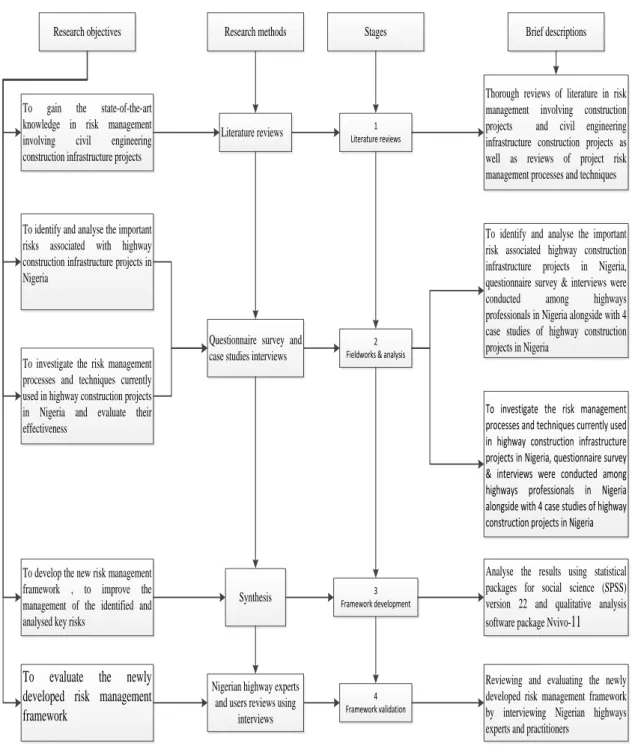
The specific research methods employed for the research in order to fulfil the stated objectives of the research are illustrated in Figure 1-1. The research methods must be
appropriate to fulfil the research objectives (Wing et al., 1998). Thus, the process
adopted consists of four distinct stages:
Stage 1 (literature review) satisfies the first research objective: A literature review refers to the process of finding and summarising the studies about a topic (Creswell, 2009). The literature sources for this study included, refereed academic journals, text books, conference papers, published PhD theses, government publications and other relevant documents, but with high priority given to refereed academic journals. This is because they are good representation of the extent of research achievements and they have been scrutinised by peer review (Sun and Meng, 2009). This review stage was used to establish the research gaps as well as the important risks associated with highway infrastructure construction projects and the project risk management processes and techniques.
Stage 2 (fieldwork and analysis) meets the second and the third research objectives: The findings of the first stage lead to the development of stage two, in which the important risks associated with highway infrastructure construction
7
projects in Nigeria are identified and analysed and the risk management processes and techniques currently used in highway construction projects in Nigeria investigated and evaluated. To achieve this concurrent mixed method approach was deemed as a useful approach.
Mixing quantitative and qualitative techniques enables the researcher to balance
the strengths and weaknesses of each approach and to substantiate the data
obtained by various methods in order to validate the results of the research (Bryman, 2004). Therefore, a questionnaire survey was administered to highway construction infrastructure project practitioners in Nigeria through an email web link (LimeSurvey) and manual distribution. This was followed by conducting semi-structured interviews with Nigerian highway practitioners involved in four cases of on-going highway construction projects in Central Nigeria, South-East Nigeria and South-West Nigeria.
Stage 3 (framework development) satisfies the fourth research objective: The findings from the literature reviews together with the questionnaire survey and case study findings in stage one and two led to the development of the newly highway project risk management framework in stage three.
Stage 4 (framework evaluation), satisfies the fifth research objective. To evaluate the new risk management procedure for highway projects in Nigeria, semi-structured interviews were conducted with 16 highways experts involved in four distinct on-going highway infrastructure construction projects in Nigeria. The evaluation feedback showed that the developed framework is user-friendly, cost effective and suitable for developing countries as it does not involve complicated processes.
8
Research objectives Research methods Stages Brief descriptions
To gain the state-of-the-art knowledge in risk management involving civil engineering construction infrastructure projects
To identify and analyse the important risks associated with highway construction infrastructure projects in Nigeria
To investigate the risk management processes and techniques currently used in highway construction projects in Nigeria and evaluate their effectiveness
To develop the new risk management framework , to improve the management of the identified and analysed key risks
To evaluate the newly developed risk management framework
Literature reviews
Thorough reviews of literature in risk management involving construction projects and civil engineering infrastructure construction projects as well as reviews of project risk management processes and techniques
Questionnaire survey and case studies interviews
To identify and analyse the important risk associated highway construction infrastructure projects in Nigeria, questionnaire survey & interviews were conducted among highways professionals in Nigeria alongside with 4 case studies of highway construction projects in Nigeria
To investigate the risk management processes and techniques currently used in highway construction infrastructure projects in Nigeria, questionnaire survey & interviews were conducted among highways professionals in Nigeria alongside with 4 case studies of highway construction projects in Nigeria
Synthesis
Analyse the results using statistical packages for social science (SPSS) version 22 and qualitative analysis software package Nvivo-11
Nigerian highway experts and users reviews using
interviews
Reviewing and evaluating the newly developed risk management framework by interviewing Nigerian highways experts and practitioners
1 Literature reviews
2 Fieldworks & analysis
3 Framework development
4 Framework validation
9
1.7
Structure of the thesis
The entire thesis is presented in ten chapters. This section presents a brief overview of each of the chapters.
Chapter 1 chapter has provided the background to the research, a statement of the problem, the research aim and objectives, an outline of the research objectives matched with the methods, and presented the structure of the research.
Chapter 2 presents a literature review of the concepts of project risk and project risk management, risk management and the project lifecycle, risk management of major infrastructure construction projects in various countries and highway infrastructure construction projects in developing countries, including Nigeria, to establish the state-of-the-art knowledge in risk management involving civil engineering infrastructure construction projects. It concludes with a chapter summary and identifies the literature gap that provides the foundation for the problem statement.
Chapter 3 presents a comprehensive review of risk management methodology, involving risk management process phases (risk management planning, identification, analysis, response and review and monitoring) and the tools and techniques relating to highway infrastructure construction projects. It reviews the findings regarding potential risks associated with highway infrastructure construction projects and proposes a classification for them that is the central theme of this research. It also provides a reflection of the preceding review followed by chapter summary and identification of the literature gap. Chapters two and three satisfy the first objective of the research and lay the foundation for the achievement of the remaining objectives.
Chapter 4 presents an overview of the concepts that guide researchers, highlighting their associated methods and data collection tools; their strengths and weaknesses. The general research strategies are discussed followed by the discussion of the research strategy adopted for this research and the rationale for doing so.
Chapter 5: Since the first part of data analysis is concerned with quantitative data analysis, this chapter presents the data analysis and the findings of the questionnaire survey. It presents the findings regarding the critical risk factors associated with highway infrastructure construction projects in Nigeria. It also
10
presents the risk management processes and techniques currently used to manage risks in the Nigerian highway construction projects, as well as examining their effectiveness. This chapter and chapter six satisfy the second and the third objectives of the research.
Chapter 6 is a continuation of Chapter 5. It presents the results of factor analysis of highway project risks in Nigeria.
Chapter 7 presents the second phase of the analysis, which is the data analysis of the case study interview findings from the four distinct on-going highway construction infrastructure projects in Nigeria. It also presents the findings regarding major risk factors affecting the performance of highway infrastructure construction projects in Nigeria and the risk management processes and techniques currently used in those projects to manage their risks, as well as their effectiveness, so as to validate the findings from the previous analysis. The chapter also presents the recommendations from the Nigerian highways practitioners on how to effectively manage the identified risks and concludes with summary of the research findings.
Chapter 8 presents the development of the risk management framework for highway infrastructure construction projects in Nigeria to satisfy the fourth research objective. It outlines the principle and the rationale for the development of the framework.
Chapter 9 presents the findings and discussion of the evaluation of the proposed highway project risk management framework by 16 Nigerian highway experts. It concludes with summary of the research findings.
Chapter 10 presents a summary of the entire research findings in pursuit of the research aim and measures them against the specific research objectives. Conclusions and recommendations for implementation are discussed, followed
11
Chapter 2: Risk Management Philosophy
2.1
Introduction
This chapter begins by examining the concepts of risk and risk management. Various definitions of risk, both generally and in the context of construction project management, are examined. It also reviews previous studies concerning risk management and the project lifecycle, risk management of major infrastructure projects in various countries and finally highway infrastructure projects in general and particularly in relation to developing countries. This chapter and chapter 3 form the literature review for this study.
2.2
LITERATURE REVIEW
Literature review refers to the process of finding and summarising the studies about a topic (Creswell, 2009). The literature is an academic term meaning all the published work on a topic. A review is a piece of writing where you present/ compare/evaluate and discuss one or more published works. The literature sources for this studies includes, refereed academic journals, text books, conference papers, published PhD thesis, government publications and other relevant documents but with high priority on refereed academic journals. This is because, according to Sun and Meng (2009), they are good representation of the extent of research achievements; and they have been scrutinised by peer review. The literature searching started with the identification of key words. There was no time restriction as for the date of the publications.
The important research papers are identified and grouped using the following methods:
Initially, the identified key words such as; ‘’risk’’, ‘’project risks and uncertainties’’, ‘’construction risk’’, ‘’project risk sources’’, ‘’infrastructure construction risk’’, ‘’infrastructure project risk‘’ highway project risk’’, ‘’project risk management’’, etc. were performed using several on-line databases including Science Direct, Emerald Fulltext, Taylor and Francis and Google Scholars in addition to the use of library resources.
The initial key word search yielded many leading journals which are relevant to risk management in highway infrastructure construction projects. These journals includes but not limited to: ‘’International Journal of project management’’, ‘’Journal of Operation and Management’’, ‘’Journal of Financial Management
12
of Property and Construction’’, ‘’Journal of Construction Engineering and Management’’, ‘’Journal of Construction Management and Economics’’, ‘’Engineering, Construction and Architectural Management’’ and Journal of Professional issues in Engineering Education. Each of the articles identified in the journal were carefully reviewed before the decision for its selection.
Reference lists of the paper identified in the above methods were also used to identify further relevant paper.
As a result of the above method, 156 articles have been found that had to be further reviewed for its inclusion in the current review. Literature mapping was used for the grouping of the most relevant articles. Further literature review is still on-going.
2.3
Project risks
A clear understanding of risk is important for effective project risk management. A number of definitions of risk are found in the literature. In the context of a project, risk can generally be defined as an uncertain event that affects project objectives either negatively or positively (PMI 2008; Caltrans, 2012). The APM (1997) defines risk ‘as an uncertain event or set of circumstances that, should it occur, will have an effect on achieving the project objectives’. Events are said to be certain if their possibility of occurrence is 100% and uncertain if their possibility of occurrence is less than 100%. Both of the above definitions share the same view of risk except that it is emphasised in the later definition that a set of circumstances could result in risk to the project outcomes. This is particularly true in highway construction projects where there could be several interdependent parties and events contributing to the project. The uncertainty could be related to the likelihood that a future event may or may not occur and also the unknown degree of its impact on project objectives, should it occur. Therefore, a project risk could be characterised by its possibility of occurrence and its corresponding uncertain consequence on project objectives (e.g., cost, time, quality, scope). The impact of a risk can be measured as the possibility of a specific undesirable occurrence and its undesirable consequences. Mathematically, can be expressed as RI = P x C; Where: RI = Risk Impact; P = Possibility of Occurrence & C = Corresponding Consequences. Risk can be viewed as a threat or opportunity that is likely to adversely or favourably affect the achievement of the project objectives (Hillson, 2002; ICE, 2005). Threat in this definition refers to a risk with negative effects while opportunity refers to a risk with positive effects. According to BS6079-1(2000) guide to project
13
management part 1, project risk is characterised as the likelihood of negative occurrences that could affect the project adversely making it more difficult or even impossible to achieve its objectives. Caltrans (2015) view risk as ‘the effect of uncertainty upon objectives’. A deviation from the expected, either positively or negatively, is an effect. There can be different categories of objectives which apply at various levels. From the researcher’s point of view, risk can be defined as the negative or positive result of uncertainty on the performance of project objectives (e.g., time, cost, quality, environmental sustainability). However, this research focusses on the negative part or threat of risk on the performance of highway construction projects in Nigeria.
2.3.1 Risk and uncertainty
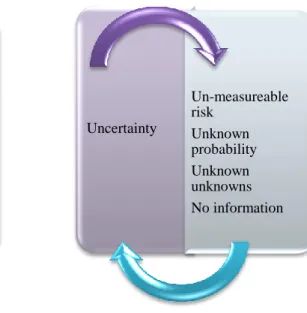
Literature reviews have shown that risk and uncertainty are frequently used together and sometimes considered to be interchangeable and synonymous (PMI. 2008; Jun et al., 2011; Caltrans, 2012). The concepts seem to be related and some publications tend not to distinguish between them. Considering the definitions of risk in the previous section, as defined by PM1 (2008) and Caltrans (2012), one could argue that risk and uncertainty can be used interchangeably and synonymously. Nevertheless, there is a clear distinction between them: although risk results from uncertainty, it can be argued that they are not synonymous (Lefley, 1997). Risk is measurable uncertainty while uncertainty is immeasurable risk (Olsson, 2008). This suggests that an uncertainty is to be considered as risk when measurable. Furthermore, risk involves a situation where the probability of the outcomes is known while uncertainty is a situation where the probability of the outcomes is not known (Olsson, 2008). Figure 2-1 further illustrates some of the differences between risk and uncertainty
2.3.2 Risk and issue
Risk and issues are two terms that have not been properly addressed. A project risk that has occurred can be seen as an issue. Just like risk and uncertainty, the two terms cannot be used interchangeably. The preceding sections made it clear that risk has probability associated with it but this is not so with issue. Think of issues as the problem at hand that the project team are facing that they need to do something about (Caltrans, 2012). Risk management can be considered as a proactive activity as opposed to issue management which can be considered as reactive
14
2.3.3 Sources of project risks
Project risks have their source from the uncertainty that is present to a different degree in all projects (PMI, 2008). Thus, risks are understood as one of the implications of uncertainty, in contrast to the traditional risk management approach which assumes risk is uncertainty. While project size can be one of the major causes of risk, other factors carrying risk along with them are complexity, speed of construction, location of the projects, technology being used and familiarity with the work (Dey and Ogunlana, 2004; Jun et al., 2011). Furthermore, risk in a project can be as a result of lack of team expertise and experience on a particular project, the possibility of occurrence of some set of circumstances and volatility of market conditions. The current development in the construction industry is toward increasing project size and complexity, both of which result in greater level of risk and uncertainty (Abdelgawad and Fayek, 2010). The science and engineering involved in many major projects become increasingly complex, resulting in higher risks. However, the need to identify project uncertainties, estimate their impact, analyse their interactions, and control them within a risk management structure has only been realized in recent years, mainly within the defence, construction and oil industries (Dey and Ogunlana, 2004). Compared to other businesses, the construction industry is exposed to more risks and uncertainties. The effect of this is poor project performance (e.g., cost and time overrun and poor quality work which further results in outright abandonment of projects, in some cases, for
Uncertainty Un-measureable risk Unknown probability Unknown unknowns No information Risk Measureable uncertainty Known probability Known unknown Partial information
15
example, the Skytrain Project in Thailand; the Very Fast Train (VFT) Project in Australia and the Akkyku Nuclear Power Plant in Turkey (Yeo and Tiong, 2000).
2.4
Project risk management
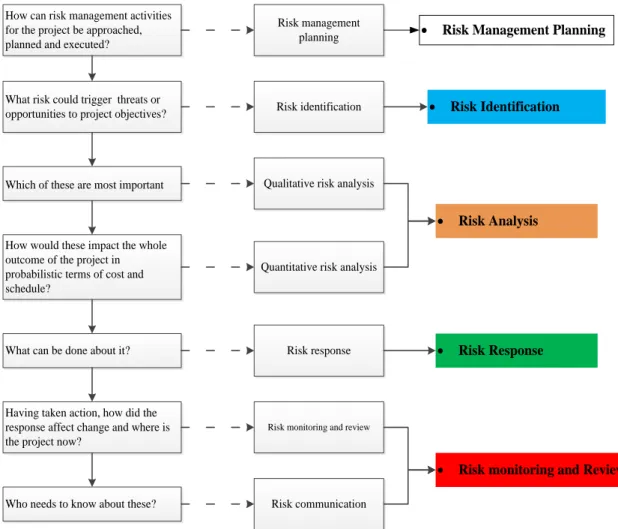
Risk management in the construction project management context is the extensive and well-organized way of planning, identifying, analysing, and reacting to risks that may positively or negatively affect project success. The purpose of risk management is to recognize uncertain situations that might jeopardize the success of construction projects and develop strategies to decrease the possibility of their occurrences. Alarcón et al. (2010) define risk management as the art and science of anticipating and planning for future uncertain events. Its objective according to my review is to understand and mitigate or control risks. Understanding the risk inherent in each of the phases of a construction project is important to improve project performance. Risk management is an integral part of project management (Olsson, 2008; Osipova and Eriksson, 2013). To support this view, it should be noted that the PMI (2004 & 2008) has included risk management as one of the nine Knowledge Areas in project management and described it as the process concerned with conducting risk management planning, identification, analysis, responses and monitoring and control on projects. The underlying concept of risk management is to manage risk effectively (Lyons and Skitmore, 2004). Risk management is most effective when first implemented at the early phase of the lifecycle of a project and then extended to the remaining phases of the project’s life cycle (Caltrans, 2007; Choudhry et al., 2014).
2.5
Risk management and the project lifecycle
The project life cycle includes all the phases of project delivery from initiation to the completion of a project to achieve its objectives. According to Grimaldi et al. (2012) it is a natural setting for determining specific risk management methodologies. Various terminologies for and explanations of what these phases (stages) consist of exist in the literature, as shown in the example in Table 2-1.
This research recognises four general kinds of phases that can be associated with the lifecycle of highway infrastructure construction projects, which are the feasibility, design, construction and operation phases. These falls into two main phases: the strategic (definition) and tactical (delivery) phases.
16
Table 2- 1: Examples of project management lifecycle definitions
Project lifecycle framework Representative literature Conceptualization, Planning, Execution &
Termination
(Lyons & Skitmore, 2004; PMI, 2008; Grimaldi et al., 2012)
Feasibility Design, Construction & Operation (Zou et al., 2007) Planning, Design, Construction Trial operation and
Operation & maintenance
(Qin & Jing, 2016)
Pre-planning (conceptual), Design/pre-construction,
Construction and Operation & maintenance
(Hastak &Baim, 2001)
Conception, feasibility, implementation, operation & termination
(BS6079-1, 2000)
The level of available information about the project and its environment (e.g. stakeholders, scope, time, and cost) varies through the successive phases of the projects. Consequently, as the amount of information increases, uncertainty will be reduced, and risk will also be reduced. Therefore, there are more risks at the commencement of a project, while they reduce as the project approaches its termination phase (Grimaldi et al., 2012). However, it has been argued that this will not always be the case in a complex project within a changing environment, where uncertainty will not necessarily diminish over time (Jafari, 2001). Grimaldi et al. (2012) suggest that the greatest
opportunity for risk reduction lies in the early project stages. Approaching risks issues
effectively and efficiently in the early phase is highly likely to provide high cost benefit; hence, it is recommended from inception, through successive project phases (Mills, 2001). Additionally, it has been recommended that the risk management processes should be directed toward monitoring the changes as well as the new risks emerging in the execution (Construction) phase and adopting the suitable strategies to mitigate them.
Numerous risks exist throughout the life cycle or phases of construction projects and they differ according to the project type, the contract involved and the procurement route. Beginning from feasibility phase through to the operational phase, risk involved in major infrastructure project can have direct effect on the project’s schedule, cost and overall performance, (Choudhry et al., 2014). Managing risks during the construction phase of a highway project could be as important, if not more important and complex,
17
than in the other phases. Risk management seem to have been given more prominence in the tactical phase of the construction project compared to the strategic phase. The reason for this is that in the strategic phase, project risk is not characterised by many noticeable risk events that could jeopardise project performance. Additionally, during the tactical phase e.g., the construction phase, the design is supposed to be fixed; thus, the project advancement is no longer tied to creating a deliverable timescale but on adhering to it; and financial risk is no longer an issue of pricing but focused on cost control (Zou et al., 2007). Certain risks could be transferred, retained or mitigated during the feasibility, design, tender or contract negotiation phases (Eskesen et al., 2004; Zou et al., 2007). During the construction phase, the likelihood of risk transfers is limited; hence, the contractors, clients and consultants are drawn to reduce the consequences of the occurrences of the risks (Eskesen et al., 2004). During each phase of the project life cycle, the cost of attending to the risk could increase either immediately or during the successive phases of the project (Hastak & Baim, 2001). Thus, adopting a phase by phase approach to project risk management is particularly important when projects are executed in phases, giving room for a formal review at the end of each of the phases.
2.6
Risk management of major infrastructure projects
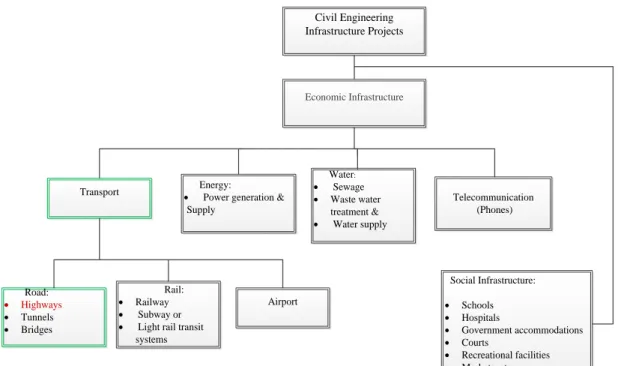
Ng and Loosemore (2007) identified two broad classifications of civil engineering infrastructure projects, which are economic infrastructure projects (e.g. bridges, drainage systems, sewage treatment plants, telecommunications networks & road, rail & air transport facilities) and social (e.g. education, health, tourism & education facilities) infrastructure projects (Figure 2-2). The emphasis of this research study is on highway infrastructure construction projects. All infrastructure projects are exposed to high levels of community involvement and accountability, as well as political pressure that could interfere with the effective funding, management and procurement of the projects (Ng and Loosemore, 2007). Such projects have long-term durations and naturally entail significant technical, legal, political and economic risks. Furthermore, they share some common risk management elements; these include: multi-layered relationships; cost, time and safety; procurement and contract; environmental and social concerns; construction innovation and economic return (Guo et al., 2014).
18
Civil Engineering Infrastructure Projects
Economic Infrastructure
Energy:
Power generation & Supply Water: Sewage Waste water treatment & Water supply Transport Telecommunication (Phones) Rail: Railway Subway or
Light rail transit systems Airport Road: Highways Tunnels Bridges Social Infrastructure: Schools Hospitals Government accommodations Courts Recreational facilities Markets, etc.
Figure 2- 2: Classification of Civil Engineering Infrastructure projects (Source: Ng and Loosemore, 2007).
Various risk factors are associated with large public infrastructure projects such as highway infrastructure construction projects, and the performance of such projects depends on the efficient and effective management of the critical risk factors. Compared to small and medium-sized construction projects, large infrastructure construction projects involve more intricate organizational structures to deal with a series of risk management elements. Achievement of time, cost and quality performance of large scale construction projects is always uncertain, due to their uniqueness (Dey, 2012).
Hence, comprehensive risk assessment is fundamental to understanding and improving the risks of major infrastructure projects (Wang et al., 2016). To efficiently and effectively manage these risks in major infrastructure projects, various approaches have been adopted in the literature, as summarised in Table 2-2. As can be seen in the table, there have been a considerable number of studies in various countries identifying the risks that affect the performance of large infrastructure projects. According to these studies, each country is exposed to different levels of risk, although they share some common similarities, as previously stated. It is also noted that most of the risks identified occurred during the construction phase of the infrastructure project. Across the different studies complex mathematical models and frameworks are proposed to
19
address the risks affecting the performance of major infrastructure projects in different countries. The application or practicability of such models or frameworks depends on the project risk management capabilities of an organisation. This again varies across different geographical locations. Risk management is recognised as an essential and integral part of project management in virtually all construction projects (Choudhry et al., 2014).
20
Table 2- 2: Risk management of major infrastructure projects in various countries
Infrastructure project type
Location Representative literature
Main findings
Cross-sea route China Wang et al. (2016). Developed a major infrastructure risk assessment framework (MIRAF) based