COPYRIGHT AND CITATION CONSIDERATIONS FOR THIS THESIS/ DISSERTATION
o Attribution — You must give appropriate credit, provide a link to the license, and indicate if changes were made. You may do so in any reasonable manner, but not in any way that suggests the licensor endorses you or your use.
o NonCommercial — You may not use the material for commercial purposes.
o ShareAlike — If you remix, transform, or build upon the material, you must distribute your contributions under the same license as the original.
How to cite this thesis
Surname, Initial(s). (2012). Title of the thesis or dissertation (Doctoral Thesis / Master’s Dissertation). Johannesburg: University of Johannesburg. Available from:
GRADE 9 MATHEMATICS LEARNERS’ STRATEGIES IN SOLVING NUMBER PATTERN PROBLEMS
by
APHANE KOKO PITHMAJOR
Dissertation
Submitted in fulfilment of requirements for the degree
MAGISTER EDUCATIONIS In MATHEMATICS EDUCATION in the FACULTY OF EDUCATION at the UNIVERSITY OF JOHANNESBURG SUPERVISOR: Dr E D Spangenberg MAY 2019
iii
DEDICATION
This research study is dedicated to my father, Joseph Shimane Aphane and my mother, Luccy Ramadimetsa Aphane, for bringing me up and providing me with an education; and for their support and encouragement, and also to my spouse, Thabo Serogole Mphahlele, and my son, Lethabo, for all their love, support and kindness. May the almighty God bless you all.
iv
ACKNOWLEDGEMENTS
I would firstly like to thank the almighty God for giving me strength, wisdom, courage and perseverance to complete my dissertation. My sincere gratitude and appreciation goes to the following people, who have helped and supported me through difficult times and, without who, I would not have been able to complete this dissertation:
My father Joseph Shimane Aphane and my mother Luccy Ramadimetsa Aphane for their support and motivation.
My spouse Thabo Serogole Mphahlele for your support, motivation encouragement and understanding during the most stressful and demanding period when this work was done.
My son Lethabo for your support and tolerance when I didn’t have free time and space for you.
My supervisor Dr E.D. Spangenberg for your time, effort and patience to read all my drafted work and provide a consistent feedback and also for your continued motivation, guidance and advice throughout my studies. Finally, for believing in me and providing me with hope to continue when I felt like I could not make it.
Dr Zwelithini Dhlamini for your professional guidance in helping with analysing the participants’ scripts.
Xenia Kyriacou for your time, effort and professional editing of my final document.
Kirchner van Deventer for your professional assistance in checking my reference list.
Thank you to the three principals who allowed me in their schools to conduct my research.
To all learners who participated in my research: Thank you for giving your valuable time to complete the activity and also to be interviewed. May the almighty God bless you all.
v
ABSTRACT
Problem solving provides an opportunity for learners to explore ideas and to extend their creativity, specifically if they are exposed to strategies that translate text into mathematical expressions. Number pattern problems allow learners to make predictions and justify their reasoning when solving problems. However, the solving of number pattern problems is often regarded as difficult for learners to do. Many learners use irrelevant strategies to solve number pattern problems and cannot easily identify number patterns embedded in problems. They also lack an understanding of the mathematical concepts of number patterns, which results in them not being able to solve algebraic problems or translate algebraic problems into mathematical equations. A reason for these difficulties could be that teachers often do not expose learners to various strategies for solving number pattern problems. Therefore, the purpose of this study is to investigate grade 9 mathematics learners’ strategies in solving number pattern problems. Knowledge about learners’ strategies will assist teachers in the teaching of problem solving and guide them to introduce various strategies, which can assist in the solving of number-related problems.
Mathematics is defined as a human activity that involves observing, representing and investigating patterns and qualitative relationships in physical and social phenomena and between mathematical objects themselves. The beliefs about the nature of mathematics provide a foundation for teacher's methods of teaching and how learners learn mathematics. It could also affect how mathematics concepts are explained, demonstrated and taught to learners. The in-depth investigation of patterns in mathematics could add more value to the ability to problem solve. Patterns are a way for learners to recognise order and organise their world and are important in all aspects of mathematics. The study was guided by the problem solving (PS) conceptual framework of Singer and Voica (2013), which highlights progression in problem solving according to four phases, namely decoding, representing, processing and implementing. This PS conceptual framework reflects learners’ levels of natural dispositions towards strategies for solving problems and offers insight into more the effective learning of mathematical problem solving.
vi
The study adopted an exploratory qualitative case study research strategy. Ninety grade 9 learners were purposively selected from three rural schools (30 participants from each school) to participate in the study. Qualitative data were collected through a written activity and semi-structured one-on-one interviews. Data analysis was done by means of content analysis following a deductive approach. The levels of engagement in the four phases of the PS conceptual framework of Singer and Voica (2013) were used to analyse and interpreted participants’ strategies.
The main finding revealed that learners utilise five main strategies in number pattern problems, namely (1) direct counting; (2) direct proportion; (3) recursive strategy; (4) mental image representation; and (5) mental model representation. Both direct counting and recursive strategies were evident during the decoding phase (DP). The strategy of mental image representation was evident during the representing phase (RP). The strategy of direct proportion, even inappropriately employed, was evident in both the processing phase (PP) and the implementing phase (IP). Mental modelling was evident in the (RP). The different strategies learners used to solve number pattern problems could sensitise teachers about other strategies to use when introducing number pattern problems to learners. This study also makes teachers aware of learners’ interpretations and implicit thinking processes about the strategies they use in solving number patterns during the different problem-solving process phases, which may eventually influence learners’ learning of mathematics.
vii
LIST OF FIGURES
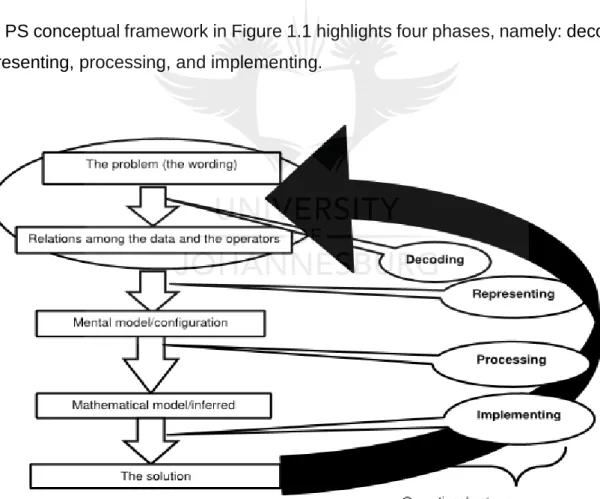
Figure 1.1: The phases of the PS conceptual framework of Singer and Voica (2013:13)
... 7
Figure 2.1: PS conceptual framework of Singer and Voica (2013:13) ... 37
Figure 3.1: A map of Limpopo Province showing the Capricorn district in the Lepelle Nkumpi Municipality ... 48
Figure 4.1: Participant A1’s response from school A coded as DP2 ... 88
Figure 4.2: Participant B2's response from school B coded as DP1 ... 89
Figure 4.3: Participant C6's response from school C coded as DP3 ... 91
Figure 4.4: Participants A4's response from school A coded as RP1 ... 93
Figure 4.5: Participant B2's response from school B coded as RP2 ... 94
Figure 4.6: Participant C5's response from school C coded as RP3 ... 95
Figure 4.7: Participant A1's response from school A coded as PP1 ... 97
Figure 4.8: Participant B9's response from school B coded as PP2 ... 98
Figure 4.9: Participant C5's response from school C coded as PP3 ... 99
Figure 4.10: Participant A7's response from school C coded as IP2 ... 101
Figure 4.11: Participant B8's response from school B coded as IP1 ... 102
viii
LIST OF TABLES
Table 3.1: Criteria used for selecting participants ... 51
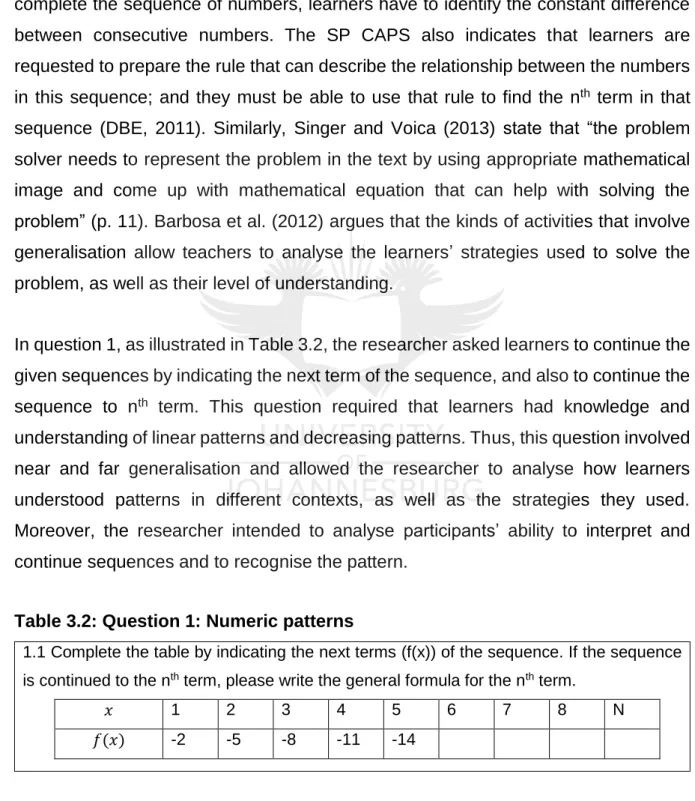
Table 3.2: Question 1: Numeric patterns ... 54
Table 3.3: Question 2: Geometric patterns ... 57
Table 3.4: Criteria for selecting participants for the interviews ... 63
Table 3.5: Management plan for the interviews ... 64
Table 4.1: Summary of the steps followed in the data analysis ... 72
Table 4.2: Summary of selected schools and demographic information of participants ... 74
Table 4.3: Key for analysing the decoding phase (DP) ... 75
Table 4.4: Key for analysing the representing phase (RP) ... 77
Table 4.5: Key for analysing the processing phase (PP) ... 79
Table 4.6: Key for analysing the implementing phase (IP) ... 82
Table 4.7: Number participants (per school) who responded according to the phases of the PS conceptual framework ... 86
Table 4.8: Number of participants’ interview responses showing the levels of engagement in the phases of the PS conceptual framework ... 107
Table 4.9: Levels of engagement in the four phases of the PS conceptual framework according to the responses in the written activity and interviews ... 116
Table 4.10: Findings related to the PS conceptual framework of the study in relation to the research questions ... 121
ix
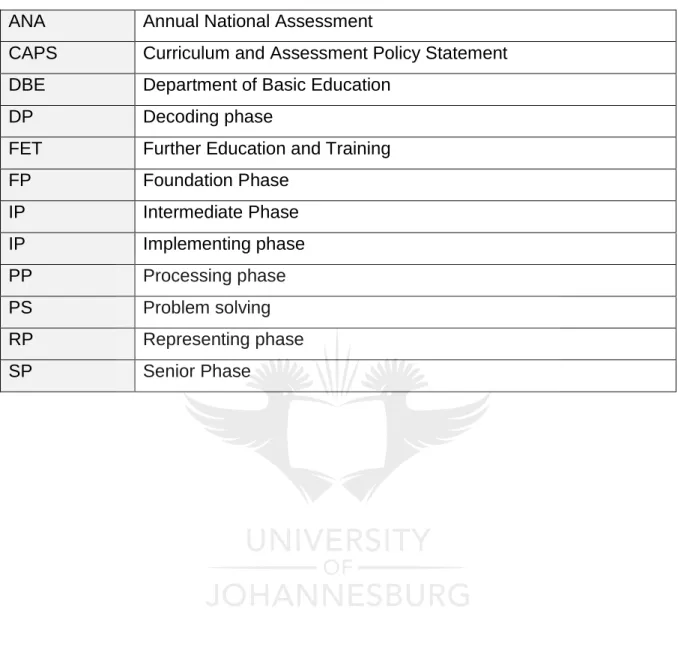
TABLE OF ACRONYMS
ANA Annual National AssessmentCAPS Curriculum and Assessment Policy Statement DBE Department of Basic Education
DP Decoding phase
FET Further Education and Training
FP Foundation Phase IP Intermediate Phase IP Implementing phase PP Processing phase PS Problem solving RP Representing phase SP Senior Phase
x
CONTENTS
DEDICATION iiiACKNOWLEDGEMENTS ... iv
ABSTRACT v LIST OF FIGURES... vii
LIST OF TABLES ... viii
TABLE OF ACRONYMS ... ix
CHAPTER 1: INTRODUCTION AND CONTEXTUALISATION ... 2
1.1 INTRODUCTION ... 2
1.2 BACKGROUND TO THE STUDY ... 3
1.3 MOTIVATION FOR THE STUDY ... 5
1.4 CONCEPTUAL FRAMEWORK ... 6
1.5 RESEARCH PROBLEM ... 9
1.6 MAIN RESEARCH QUESTION ... 11
1.6.1 Research sub-questions ... 11
1.6.2 The purpose and objectives of the study ... 12
1.7 CLARIFICATION OF CONCEPTS: WORKING DEFINITIONS ... 12
1.8 RESEARCH DESIGN AND METHODOLOGY ... 13
1.8.1 Research paradigm ... 13
1.8.2 The data collection methods and procedures ... 14
1.8.3 Population and sample ... 14
1.8.4 Data analysis procedures ... 14
1.9 TRUSTWORTHINESS ... 14
1.10 POSSIBLE CONTRIBUTION OF THE STUDY ... 15
1.11 STRUCTURE OF THE DISSERTATION ... 16
CHAPTER 2: LITERATURE OVERVIEW AND CONCEPTUAL FRAMEWORK .... 18
2.1 INTRODUCTION ... 18
2.2 THE NATURE OF MATHEMATICS ... 18
2.2.1 Defining mathematics ... 18
2.2.2 Beliefs about the nature of mathematics ... 19
xi
2.3.1 Defining pattern ... 22
2.3.2 Example of number pattern problems ... 22
2.3.3 Benefits of number pattern problems ... 23
2.4 PROBLEM SOLVING IN MATHEMATICS ... 24
2.4.1 Previous inquiries on problem solving in mathematics ... 24
2.4.2 Defining problem solving in mathematics... 25
2.4.3 Benefits and difficulties of problem solving for learners ... 26
2.5 LEARNERS’ EXPERIENCES OF PROBLEM SOLVING ... 27
2.6 STRATEGIES FOR PROBLEM SOLVING ... 30
2.7 PROCESSES FOR PROBLEM SOLVING IN MATHEMATICS ... 34
2.8 CONCEPTUAL FRAMEWORK OF THE STUDY ... 36
2.8.1 Phase 1: Decoding ... 37
2.8.2 Phase 2: Representing ... 38
2.8.3 Phase 3: Processing ... 39
2.8.4 Phase 4: Implementing ... 39
2.9 CHAPTER SUMMARY ... 40
CHAPTER 3: RESEARCH DESIGN AND METHODOLOGY ... 43
3.1 INTRODUCTION ... 43 3.2 RESEARCH DESIGN ... 43 3.2.1 Philosophic assumptions ... 44 3.2.1.1 Epistemological assumptions ... 44 3.2.1.2 Ontological assumptions... 45 3.2.1.3 Axiological assumptions ... 45 3.2.3 Research approach ... 46 3.2.4 Research strategy ... 46 3.3 RESEARCH METHODOLOGY ... 48 3.3.1 Research context ... 48 3.3.1.1 School A ... 49 3.3.1.2 School B ... 49
xii
3.3.1.3 School C ... 49
3.3.2 Population and sampling procedures ... 50
3.3.3 Instruments for data collection ... 52
3.3.4 Data collection process ... 61
3.3.5 Data analysis ... 64
3.4 QUALITY CRITERIA ... 66
3.4.1 Establishing trustworthiness ... 66
3.5 ETHICAL CONSIDERATIONS ... 68
3.6 CHAPTER SUMMARY ... 69
CHAPTER 4: DATA ANALYSES AND DISCUSSION OF FINDINGS ... 71
4.1 INTRODUCTION ... 71
4.2 PROFILE OF SCHOOLS AND DEMOGRAPHIC INFORMATION OF PARTICIPANTS ... 72
4.2.1 School A ... 72
4.2.2 School B ... 73
4.2.3 School C ... 73
4.3 ANALYSIS OF THE WRITTEN ACTIVITY ON NUMBER PATTERN PROBLEMS ... 74
4.3.1 Protocol for analysing the number pattern problems ... 74
4.3.2 Description of phases of the PS conceptual framework ... 74
4.3.3 Indicators for the decoding phase (DP) ... 75
4.3.4 Indicators for the representing phase (RP) ... 77
4.3.5 Indicators for the processing phase (PP) ... 79
4.3.6 Indicators for the implementing phase (IP) ... 81
4.3.7 Coding strategy ... 83
4.4 FINDINGS FROM THE ANALYSIS OF THE WRITTEN ACTIVITY ON NUMBER PATTERN PROBLEMS ACCORDING TO THE PHASES ... 85
4.4.1 Findings on the decoding phase (DP) and interpretation ... 88
xiii
4.4.3 Findings on the processing phase (PP) and interpretation ... 96
4.4.4 Findings on the implementing phase (IP) and interpretation ... 101
4.4.5 Overall findings from the written activity ... 104
4.5 ONE-ON-ONE SEMI-STRUCTURED INTERVIEWS ... 106
4.5.1 Findings on views of decoding and interpretation ... 107
4.5.2 Findings on views of representing and interpretation ... 110
4.5.3 Findings on views of processing and interpretation ... 111
4.5.4 Findings on views of implementing and interpretation ... 113
4.5.5 Summary of the overall findings from the semi-structured interviews ... 115
4.6 THE LEVELS OF ENGAGEMENT IN THE FOUR PHASES OF THE PS CONCEPTUAL FRAMEWORK IN STRATEGIES FROM THE ANALYSIS OF THE WRITTEN ACTIVITY AND THE INTERVIEWS ... 116
4.7 KEY FINDINGS PERTAINING TO THE RESEARCH QUESTIONS ... 120
4.8 CHAPTER SUMMARY ... 126
CHAPTER 5: CONCLUSIONS, RECOMMENDATIONS AND LIMITATIOnS ... 130
5.1 INTRODUCTION ... 130
5.2 OVERVIEW OF STUDY ... 130
5.3 SUMMARY OF FINDINGS ACCORDING TO THE RESEARCH OBJECTIVES 132 5.3.1 Research objective 1: Determine the strategies grade 9 mathematics learners engage in when solving number pattern problems ... 132
5.3.2 Research objective 2: Establish grade 9 mathematics learners’ views regarding the areas of difficulty (if any) they experience as they complete number pattern problems ... 133
5.3.3 Research objective 3: Ascertain the levels of engagement in the four phases of the PS conceptual framework in grade 9 mathematics learners’ strategies to a number pattern problem activity ... 134
5.4 SUMMARY OF OVERARCHING FINDINGS ... 134
5.5 IMPLICATIONS OF THE STUDY ... 135
5.6 LIMITATIONS OF THE STUDY ... 136
xiv 5.8 CONTRIBUTION OF STUDY ... 138 5.9 CONCLUSION ... 139 5.10 FINAL REFLECTION... 140 REFERENCES 141 APPENDICES 155 APPENDIX A: WRITTEN ACTIVITY ... 155
APPENDIX B: ONE-ON-ONE SEMI-STRUCTURED INTERVIEW ... 156
APPENDIX C: UNIVERSITY OF JOHANNESBURG ETHICAL CLEARANCE LETTER ... 158
APPENDIX D: LIMPOPO DEPARTMENT OF EDUCATION ... 159
APPENDIX E: LETTER TO THE PRINCIPALS ... 161
APPENDIX F: PERMISSION TO CONDUCT RESEARCH FROM SCHOOLS .. 163
APPENDIX G: LETTER TO THE PARENTS ... 166
APPENDIX H: LETTER TO LEARNERS ... 168
APPENDIX I: MARKING GUIDELINE ... 170
APPENDIX J: PROTOCOL TO REVIEW THE WRITTEN ACTIVITY ... 172
APPENDIX K: BIBLIOGRAPHIC CONTROL ... 174
APPENDIX L: LANGUAGE AND STYLE EDITING ... 175
APPENDIX M: ONE-ON-ONE SEMI-STRUCTURED INTERVIEW WITH PARTICIPANT A15 ... 176
APPENDIX N: ONE-ON-ONE SEMI-STRUCTURED INTERVIEW WITH PARTICIPANT B2 ... 178
APPENDIX O: ONE-ON-ONE SEMI-STRUCTURED INTERVIEW WITH PARTICIPANT C5 ... 180
APPENDIX P: WRITTEN ACTIVITY OF PARTICIPANT A4 ... 182
APPENDIX Q: WRITTEN ACTIVITY OF PARTICIPANT B2... 183
183 APPENDIX R: WRITTEN ACTIVITY OF PARTICIPANT C5 ... 184
2
CHAPTER 1: INTRODUCTION AND CONTEXTUALISATION
1.1 INTRODUCTIONIn South Africa, most learners across the primary grades have poor mathematics skills (Graven & Heyd-Metzuyanim, 2014), with the average performance steadily declining by approximately 10% each year (Department of Basic Education (DBE), 2014). The results of the Annual National Assessment (ANA) for mathematics in South Africa, is also of national concern because of the poor performance of grade 9 mathematics learners (Govender, 2013). The ANA tests are meant to serve as a diagnostic tool for identifying areas of strengths and weakness in teaching and learning, thus providing information for school-focused interventions. The tests also provide teachers with benchmark information and baseline data that can be used to improve “classroom assessment practices and inform the teaching and learning of literacy and numeracy” (DBE, 2012:4). Although the 2013 ANA national average increased slightly from 13% to 14% for grade 9 mathematics, the results are still poor. In addition, the overall performance in mathematics in the ANA of 2014 showed an increase in performance by a maximum of 8% for all grades, except for grade 9. Unfortunately, in 2015 the writing of the ANA was postponed (DBE, 2015).
The current forms of assessment available in grade 9 mathematics are tests and internal examinations, investigations, assignments and projects (DBE, 2013). Van Staden and Motsamai (2017) argue that South African learners continue to perform poorly in mathematics throughout all grades compared to their counterparts internationally, locally and regionally. The Head of the National Education Evaluation and Development Unit (NEEDU) Department of Basic Education, argues that poor learner performance is largely due to poor teacher subject knowledge, especially in mathematics, in most schools (Zingiswa, 2019).
Govender (2012) indicates that the DBE and other stakeholders have paid significant attention over the past years to the Further Education and Training (FET) phase (grades 10-12), especially grade 12, at the expense of the other phases. Govender (2012) argues that it is possible that this neglect has contributed to the poor state of mathematics teaching and learning in the lower grades. In particular, the majority of
3
grade 9 mathematics learners in South Africa face difficulties in solving number pattern problems. Maluleka (2013) notes that the greatest difficulty in working with mathematical problems is to translate real-life issues into mathematical problems. A person first need to have knowledge of the issue before trying to attempt it.
Mathematical problem solving is complicated because learners need to read and comprehend written content which is stated in numerical relations (Tolar, Fuchs, Cirino, Fuchs, Hamlett, & Fletcher, 2012). Phonapichat, Wongwanich, and Sujiva (2014) identify some key difficulties that learners experience in mathematical problem solving, namely: understanding keywords appearing in problems; interpreting keywords in mathematical sentences; figuring out what information to assume, and what information is necessary to solve the problem. Wang, Fuchs, and Fuchs (2016) notice that many learners approach mathematical problems without giving in-depth consideration about how unrelated details could derail them from associating a new problem with and existing known problem. According to Tambychik and Meerah (2010:150):
Learners’ difficulties in mathematics problem solving are due to incompetency in acquiring many mathematics skills and lacking in cognitive abilities of learning. This lacking, results in uncertainty, confusion and inaccuracy in the decision and connection making among information, and therefore leads to errors in mathematics problem solving.
1.2 BACKGROUND TO THE STUDY
Since the 1970’s much research has focused on problem solving. As explained by Allevato and Onuchic (2008:61):
Concomitantly, at the beginning of the 1970’s, systematic investigation of problem solving and its implications for curricula was initiated. Thus, the importance attributed to problem solving is relatively recent, and only in this decade did mathematics educators come to accept the idea that the development of problem-solving abilities deserved more attention. At the end of the 1970’s, problem solving emerged, gaining greater acceptance around the world.
4
In 1980 the National Council of Teachers of Mathematics (NCTM) published a document recommending problem solving to be the main focus of school mathematics (NCTM, 2010) (see section 2.5). Kilpatrick, Swafford, and Findell (2001:421) state that: Problem solving must be in the centre of the Mathematics Curriculum. Problem solving should be the site in which all of the strands of mathematics proficiency converge. It should provide opportunities for learners to weave together the strands of proficiency and for teachers to assess learners’ performance on all of the strands.
Lambdin (2009) expresses the belief that “the primary goals of mathematics learning are understanding and problem solving, and that these goals are inextricably related because learning mathematics with understanding is best supported by engaging in problem solving” (p. 6). Otten (2010) adds that problem solving develops creativity, flexibility and metacognitive skills that address professional and post-secondary demands. In other words, the study of problem solving in mathematics prepares learners for many aspects of their lives after school, for example, trades, professional careers and knowledgeable citizenship. In addition, Matlala (2015) states that the problem-solving approach in mathematics teaching may be a way to improve the quality of, and results in, school mathematics.
The importance of problem solving is also evident in the numerous studies on problem solving in mathematics that have been conducted in the South African context (Maluleka, 2013; Mochesela, 2007; Sepeng, 2010; Sepeng & Madzorera, 2014; Sepeng & Sigola, 2013; Sepeng & Webb, 2012). Maluleka (2013) discovered that grade 9 learners are trying to fix problems without comprehension; and that methods of interaction, reasoning and recording seem to be crucial to helping learners. Mochesela (2007:iii) found that “exposing learners to a variety of problem-solving strategies improves their problem solving performance and attitudes towards mathematics”. Therefore, creating an environment where learners attempt to find variety of strategies for solving number-related problems empowers them to explore alternatives and develops confidence in mathematics problem solving. Sepeng (2010) found that the discussion and argumentation techniques in mathematical problems have a positive effect on learners’ ability to consider reality during problem solving. Similarly, Sepeng and Webb (2012) found that debates in mathematics classrooms, as a learning approach, could enhance learners' efficiency in solving mathematical
5
problems, as well as their capacity to make sense of real-life problems. Sepeng and Madzorera (2014) have shown that learners are struggling to define algebraic terms that are used both in problem statements and in educational vocabulary. Sepeng and Sigola (2013) explored sources of mistakes made by grade 9 learners when they solve mathematical problems. They found that learners' mistakes in problem solving appear to be due to a lack of knowledge of mathematical vocabulary used in a problem declaration.
Despite all the above-mentioned research studies on problem solving in South Africa, grade 9 learners still struggle to solve number patterns-related problems.
1.3 MOTIVATION FOR THE STUDY
Mathematical problems allow learners to think creatively and develop new mathematical reasoning skills (Depaepe, De Corte, & Verschaffel, 2010). One benefit of problem solving is that it is a learner-centred approach in which learners investigate and explore mathematical ideas on their own (Depaepe et al., 2010). In addition, problem-solving motivates learners to perform academically as it enhances creativity and mental behaviour of learners to develop their knowledge (Căprioară, 2015). The Curriculum and Assessment Policy Statements (CAPS) document for Senior Phase (SP) Mathematics in South Africa also claims that mathematical problem solving “enables learners to understand the world (physical, social and economic) around them, and, most of all, encourages teachers to teach learners to think creatively” (DBE, 2011:8).
“Number pattern problems allow learners to make predictions and justify their reasoning when solving problems” (DBE, 2011:9). For example, in number pattern problems, learners are given a sequence of numbers and they have to identify a pattern or relationship between consecutive terms in order to extend the pattern. Examples of number patterns are: -2, -5, -8, -11… or 3, 7, 11, 15, 19… where the second term depends on what happens to the first term, and the third term depends on the second term. Number pattern activities can lead to the development of problem-solving capabilities by highlighting the evaluation of specific instances, systematically organising information, and inferring and generalising information (Barbosa, Vale, & Palhares, 2012). Number pattern problems have an important place in mathematics,
6
and pattern seeking is a valuable problem-solving strategy (Kurbal, 2015). According to Mahlobo and Ntombela (2014), problems involving number patterns provide “an opportunity to generalise and to give general algebraic descriptions of the relationship between terms and their position in a sequence” (p. 186).
The learning of patterns and sequences starts in the Foundation Phase (FP) where CAPS states that: “In the SP phase, learners work with both number patterns (e.g. skip counting) and geometric patterns (e.g. pictures)” (DBE, 2011:9). This topic continues through the Intermediate Phase (IP) and SP. Thus, in many nations, including South Africa, the use of symbols and variables to represent number patterns and generalisations is a significant element of the mathematics curriculum (Fray, Fish, & Taylor, 2015) (see section 2.3).
1.4 CONCEPTUAL FRAMEWORK
The problem-solving (PS) conceptual framework of Singer and Voica (2013) is adopted for this study and is briefly illustrated in Figure 1.1. This framework reflects the learners’ natural disposition towards strategies for solving problems, and offers “insight for more effective learning of mathematical problem solving and can be used in problem posing and problem analysis in order to devise questions more relevant for deep learning” (Singer & Voica, 2013:11). It is designed to help learners to read the problem with understanding by, firstly, identifying the key words that could help them solve the problem. The conceptual framework of Singer and Voica (2013) is particularly relevant to this study as it reflects the new, focused research publication devoted to mathematics problem solving. The framework describes the strategies that could help learners to make sense of the information on the given text, and ultimately to arrive at the correct solution. The framework describes phases to reach that could help learners to make sense of the information for effective problem solving (see section 2.8).
Singer and Voica (2013) as cited by Irvine (2017) point out that correlations exist between problem solving, problem posing, and creativity. Multiple descriptions of creativity include problem finding, problem solving, and problem posing, and problem posing is frequently used in assessing creativity. Salazar Solórzano (2014) indicate that the PS conceptual framework of Singer and Voica (2013), which involves four
7
operational categories, namely decoding, representing, processing and implementing, can be helpful when analysing the original problem, modifying it or posing a new problem. They further conclude that despite teachers being naturally predisposed to problem solving, they also need to be properly trained in this skill as part of their university studies in order to acquire an effective technique.
Munroe (2016) argues that Singer and Voica (2013)’ s PS conceptual framework consider problem solving as a generative activity from which information on the levels of mathematical thinking, skills, and areas of weakness of the learners could be drawn. This framework allows leaners to interact with multiple problems, methods, and solutions simultaneously and this increases the possibility of developing creativity in leaners (Munroe, 2016).
The PS conceptual framework in Figure 1.1 highlights four phases, namely: decoding, representing, processing, and implementing.
Figure 1.1: The phases of the PS conceptual framework of Singer and Voica (2013:13)
8 Phase 1: Decoding
According to Singer and Voica (2013), when a problem is given (the wording) the problem solver makes relations among the data and operators, which requires the solver to convert the text of the problem into understandable language. Lorenzo (2005) states that “breaking the problem into parts allows learners to focus on a few ideas at a time, when they have to work on a new unknown, which means that the likelihood of making mistakes would decrease” (p. 54) (See sub-section 2.8.1).
Phase 2: Representing
In this phase, the problem solver needs to represent the problem in the text by using appropriate mental representation (Singer & Voica, 2013). The representing process in mathematical problem solving permits learners to visually relate various types of information given in the problem statement to help them determine which mathematical expressions are useful in solving the problem (Jan & Rodrigues, 2012b) (see sub-section 2.8.2).
Phase 3: Processing
Singer and Voica (2013) state that in the processing phase (PP) the problem solver “uses the mental model suggested by the problem and personal mathematical competence to identify a mathematical model that can be associated with the problem” (p. 11). The learner creates a mental image to solve problems, which may produce mathematical models such as formulas or equations (see sub-section 2.8.3).
Phase 4: Implementing
During the implementing phase (IP), the problem solver implements what is already known about the problem in order to test a model or an equation. According to Singer and Voica (2013), this phase focusses on the “application of techniques that are specific to the found mathematical model and adaptable to the given particular situation, with the purpose to obtain final results for the problem” (p. 13) (see sub-section 2.8.4).
Singer and Voica (2013) argue that “when the process of solving is successful, from the text of the problem (the wording) to its solution, a solver need to work from the solution to the initial problem” (p. 13). Thus, a solver needs to interpret the solution in
9
relation to the given problem (the wording). The IP involves the understanding of the solution from the context within which the problem is given, meaning that the solver should be able to connect the formal solution of the problem with the initial data. The bold arrow in Figure 1.1 illustrates the closing of the solving cycle (Singer & Voica, 2013).
1.5 RESEARCH PROBLEM
According to Boonen, Van der Schoot, Van Wesel, De Vries and Jolles (2013), solving number pattern problems presents difficulties if learners cannot identify the relationship between the known and the unknown variable. This is particularly true when learners face challenges in understanding the problem-description text provided. Jupri and Drijvers (2016) confirm that the major difficulties encountered by learners when dealing with number pattern problems are “to understand the words, to formulate a mathematical model from the problem, to solve the problem expressed in the model, and to interpret the solution in terms of the original problem” (p. 2499).
Working with number patterns is particularly difficult for learners as the patterns are often embedded in problem solving. Problem solving becomes difficult for learners when the problem is presented linguistically, since they require learners to “read and interpret the problem, represent the semantic structure of the problem, and choose a solution strategy” (Schumacher & Fuchs, 2012:608). Learners cannot easily identify number patterns embedded in problems. Barbosa et al. (2012) state that students tend to use numeric rather than visual methods and experience several difficulties when solving pattern exploration issues, particularly when generalising remote values. Usually, learners experience difficulties in problem solving when trying to translate algebraic problems into mathematical equations (Ahmad, Tarmizi, & Nawawi, 2010).
The SP Mathematics CAPS document states that “problem solving and cognitive development should be central to all mathematics teaching. Learning procedures and proofs without a good understanding of why they are important will leave learners ill equipped to use their knowledge in later life” (DBE, 2011). However, the analysis of the 2014 ANA results reveals that the solving of problems is challenging for learners (DBE, 2014). Problem solving is a complex process in which learners need to be coached (Klingler, 2012) and by which an unfamiliar situation is resolved (Killen,
10
2007). Notwithstanding the emphasis on the importance of problem solving, many researchersrecommend further research in this regard (Boonen et al., 2013; Duru, Peker, Bozkurt, Akgün, & Bayrakdar, 2011; Jan & Rodrigues, 2012b; Mimbs, 2005; Peters, 2011; Sepeng & Sigola, 2013; Tambychik & Meerah, 2010).
Boonen et al. (2013) suggest that “follow-up studies should examine the effects of interventions in which elementary and secondary school learners are taught to systematically build visual-schematic (mental) representations during math problem solving” (p. 277). Duru et al. (2011) claim that teachers need to be informed about various strategies to solve problems in mathematics; and they need to understand learner difficulties in order to implement these various strategies. Jan and Rodrigues (2012a) suggest studies to determine which variables affect the capacity of students to understand mathematical problems in order to discover suitable teaching approaches to solve problems meaningfully.
Mimbs (2005) suggests that current and future teachers should be supported professionally with regard to strategies needed for problem solving. Peters (2011) recommends that future research “should be conducted in order to explore new or alternative strategies that can be added to the already known standard list of problem-solving strategies as suggested by Polya (1945)” (p. 93). In addition, Sepeng and Sigola (2013) recommend that strategies that can be used to solve problems should be made accessible to learners, especially “the use of models, images, tables, diagrams and other learning aids” (p. 332). According to Tambychik and Meerah (2010), further research based on learners’ ability to perform mathematical skills is necessary for a better understanding of problem solving. The identification of the mathematics skills needed for tackling problem-solving activities is essential for achieving better performance in these activities.
Barbosa et al. (2012) suggest that for learners to understand the meaning of numbers and variables, it is important that teachers provide tasks that encourage learners to use and understand the potential of visual strategies and to link numerical contexts with visual contexts. Number patterns problems can help learners to develop the ability to generalise, giving learners the opportunity to come up with a pattern rule or formula to find any term in a sequence. In addition, Sepeng and Sigola (2013) noticed that
11
many learners experience difficulties in reading and making sense of mathematical problems and it appears they are struggling to understand problem solving. Therefore, it is essential to assist learners in developing skills and strategies to effectively solve problems related to number patterns (Sepeng & Sigola, 2013). The problem of number patterns can lead to increased problem-solving abilities by highlighting the assessment of particular cases, systematically organising data, conjecturing and generalising information. Therefore, learners need to be exposed to strategies to solve number pattern problems in their classroom activities
Regardless of all the mentioned inquiries on problem solving, grade 9 learners in South Africa are still struggling to solve number patterns problems. As a mathematics teacher, I have observed that many grade 9 learners have difficulty in solving number pattern problems in mathematics. In particular, they cannot solve algebraic number pattern problems or translate algebraic number pattern problems into mathematical equations due to a lack of understanding of mathematical concepts. Many of them do not have sufficient knowledge or exposure to strategies for solving number pattern problems. Yet, problem solving provides an opportunity for learners to explore ideas and gives them the chance to extend their creativity.
1.6 MAIN RESEARCH QUESTION
In the light of the importance of number pattern problems in mathematics, as well as the complexity of the topic for many SP learners in South Africa, the following research question is interrogated in this study:
What strategies do grade 9 mathematics learners use in solving number pattern problems?
1.6.1 Research sub-questions
To address the main question, the following sub-questions were posed:
What are the strategies grade 9 mathematics learners engage in when solving number pattern problems?
What are the views of grade 9 mathematics learners regarding the areas of difficulty (if any) they experience as they complete number pattern problems?
12
What levels of engagement in the four phases of the PS conceptual framework are evident in grade 9 mathematics learners’ strategies to a number pattern problem activity?
1.6.2 The purpose and objectives of the study
The purpose of this study is to investigate grade 9 mathematics learners’ strategies in solving number pattern problems. Knowledge about learners’ strategies will assist teachers in the teaching of number pattern problems and guide them to employ various strategies, which can assist in the solving of number pattern problems.
The objectives of this study were to:
Determine the strategies grade 9 mathematics learners engage in when solving number pattern problems;
Establish grade 9 mathematics learners’ views regarding the areas of difficulty (if any) they experience as they complete number pattern problems; and Ascertain the levels of engagement in the four phases of the PS conceptual
framework in grade 9 mathematics learners’ strategies to a number pattern problems activity.
1.7 CLARIFICATION OF CONCEPTS: WORKING DEFINITIONS
The following section clarifies the concepts and definitions used in this study to ensure a clear understanding.
Mathematics:
“A diverse discipline that deals with data, measurements, and observations from science; with inference, deduction, and proof; and with mathematical models of natural phenomena, of human behaviour, and of social systems” (NRC, 1989).
Number patterns:
Number patterns are numbers, which cannot be transferred to “non-numeric patterns without loss of some crucial property of the pattern” (Liljedahl, 2004:4).
Problem solving:
A mathematical task that has the potential to provide intellectual challenges for enhancing learners’ mathematical understanding and development (NCTM, 2010).
13 Strategies in problem solving:
Groupings of mental or physical actions designed to solve a problem (Biddlecomb & Carr, 2011). “Giving problems to learners that would explore all aspects of principles and concepts depending on subject matter” (Killen, 2007:260).
Decoding:
The ability to interpret the given statement and to identify the key words in order to solve the problem (Clement, 2008).
Representing:
“Understanding the problem through a generated mental model” (Singer & Voica, 2013:11).
Processing:
Using problem-suggested mental settings and private mathematical expertise to define a mathematical model that can be connected with the problem (Singer & Voica, 2013).
Implementing:
Application of “techniques that are specific to the found mathematical model and adaptable to the given particular situation, with the purpose” of obtaining final results for the problem (Singer & Voica, 2013:11).
1.8 RESEARCH DESIGN AND METHODOLOGY
The following section describes the research design used in this study and how the data collection process was followed (see section 3.2).
1.8.1 Research paradigm
An interpretivist paradigm with an “epistemological position that prioritises people’s subjective interpretations and their own actions” (Matthews & Ross, 2010:28) was used. This paradigm provided an in-depth insight into the inquiry (see sub-section 3.2.1). A qualitative research approach in the form of an exploratory case study was used “to explore those situations in which the intervention being evaluated has no clear, single set of outcomes” (Yin, 2003:102) (see section 3.2).
The qualitative research approach focused on meaning and understanding and provided a rich description of the phenomenon under investigation (Merriam, 2009). Working with qualitative data in this study involved interpreting the words, stories,
14
accounts, and explanations of the participants about the strategies they use to solve problems on number patterns (see sub-section 3.2.2).
1.8.2 The data collection methods and procedures
In stage one, a written activity on number patterns prescribed by the SP mathematics CAPS, was used to collect qualitative data from learners (see section 3.3). In stage two, the researcher conducted one-on-one semi-structured interviews (after school hours) with selected participants to establish their views regarding the areas of difficulty they experience as they complete number pattern problems. Open-ended interviews were administered to probe for deeper understanding. Data collected from the interviews was transcribed (see section 3.3). Lastly, the researcher ascertained the levels of engagement in the four phases of the PS conceptual framework in the participants’ strategies derived from the analysis of the written activity and the interviews in order to determine the implications for solving number pattern problems (see section 3.3).
1.8.3 Population and sample
The population of the study was grade 9 mathematics learners in Quintile 1 schools in the Capricorn district of the Limpopo Province. The population comprised 90 learners from three rural schools (A, B and C). The researcher purposively selected 30 grade 9 mathematics learners from each of these three sampled schools; thus a total of 90 learners consisting of both males and females of ages ranging from 14–16 (see section 3.3).
1.8.4 Data analysis procedures
In stage one and two, inductive content analysis was used to analyse the written activity and interview transcripts. A constant comparative analysis method was used to ascertain the levels of engagement in the four phases of the PS conceptual framework in the participants’ strategies derived from the analysis of the written activity and the interviews (see section 3.3).
1.9 TRUSTWORTHINESS
According to Guion, Diehl, and McDonald (2002:1), “validity in qualitative research, refers to whether the findings of a study are true and certain”, thus trustworthiness.
15
Trustworthiness was ensured by using triangulation, which involved the analyses and comparison of results from multiple qualitative data collection instruments, namely documents and interviews. Trustworthiness was also established by considering credibility, transferability, dependability, and confirmability (Lincoln & Guba, 1985).
To ensure credibility, audio-taped interviews were transcribed and the inconsistent data was carefully checked and examined. Member checking was used by returning all the analysed interview transcripts to the participants to check whether or not they agreed with emerging findings (Birt, Scott, Cavers, Campbell, & Walter, 2016). However, it was difficult to validate the emerging findings, as participants could have reached a particular phase of the PS conceptual framework in their minds, but chose not to write down the solution they arrived at, for not trusting that the solution is accurate. Therefore, it was done just to check the accuracy of the transcriptions. To ensure transferability, a dense description of the methodology, a literature control, and verbatim quotes were provided. To ascertain dependability, the researcher continued interviewing participants until data-saturation was reached. Confirmability was established by external audits. Expert teachers/researchers were consulted to assist the researcher with advice regarding clarity of the interview questions, and the design of the activity sheet and assessment grid (see section 3.4).
1.10 POSSIBLE CONTRIBUTION OF THE STUDY
The study contributes to practice by providing information about learners’ strategies to solve problems, which could assist teachers in their future teaching of number patterns. Teachers could benefit from the interpretation of learners’ strategies pertaining to the implicit thinking processes of learners when they solve problems, which may influence their teaching of mathematics. Curriculum developers may benefit from an increased awareness of the difficulties learners experience with problem solving. Subject advisors could use learners’ strategies, in solving number pattern problems, in a meaningful and effective way to support teachers in their professional development of problem-solving proficiency. Policy developers were provided with guidelines on learners’ strategies to solve problems involving number patterns, which may influence policy. The importance of this study in terms of academic value is that it expands on the existing PS conceptual framework of Singer and Voica (2013), which may be used for further research pertaining to the
16
development and maintenance of effective strategies to solve problems involving number patterns.
1.11 STRUCTURE OF THE DISSERTATION The dissertation consists of five chapters:
Chapter 1 provides an introduction to the background and rationale of the study to orientate the reader. It briefly introduces the study’s research questions, purpose, objectives, and theoretical framework. The research paradigm, design, and methodology are also outlined. Important concepts are defined and possible contributions of the study are foregrounded.
Chapter 2 consists of an in-depth review of relevant literature, and explains the conceptual framework of the problem-solving process on which this study is based, namely: decoding, representing, processing, and implementing (Singer & Voica, 2013). The topics that are addressed in the literature review include: the nature of mathematics, problem solving in mathematics, problems in mathematics, number patterns, and strategies for problem solving.
Chapter 3 describes and justifies the research methodology and design used in this study. The data collection instruments, selection of the participants, data collection processes and data analysis procedures are discussed, including the validity and trustworthiness of the study.
Chapter 4 presents the results of the document analysis, and the analysis of the one-on-one semi-structured interviews; as well as the interpretation of the findings in light of the literature reviewed and the conceptual framework.
Chapter 5 summarises the study according to the research questions; makes recommendations for further research; discusses the implications of the research, and the limitations of the study. Lastly, this chapter concludes with a personal reflection on the study.
18
CHAPTER 2: LITERATURE OVERVIEW AND CONCEPTUAL
FRAMEWORK
2.1 INTRODUCTION
Chapter 2 provides an overview of literature pertaining to the nature of mathematics with reference to problem solving. Firstly, definitions of mathematics are provided followed by a discussion on beliefs about the nature of mathematics pertaining to teaching and learning practices. The nature of mathematics is viewed from the perspectives of mathematics as a discipline, knowledge of the teacher regarding mathematics, and how mathematics is learned and taught in a classroom (Siswono, Kohar, & Hartono, 2017). Then, problem solving focuses on problems in mathematics will be discussed. The discussion will be extended by focusing on learners’ experiences of problem solving and strategies to solve problems. The majority of grade 9 mathematics learners in South Africa face difficulties in solving problems. Problems belong to one of the difficult and complex topics in mathematics that learners encounter during their elementary level of mathematical development.
A discussion will follow focusing on number patterns and the design of a number pattern problem-solving activity. Working with number patterns in particular can be difficult for learners as it is often embedded in problems. Learners cannot easily identify number patterns embedded in problems. This chapter will conclude by describing the conceptual framework of Singer and Voica (2013) for problem solving in mathematics. This conceptual framework will highlight and elaborate on four phases, namely decoding, representing, processing and implementing.
2.2 THE NATURE OF MATHEMATICS 2.2.1 Defining mathematics
According to the DBE (2011), mathematics is a discipline consisting of many topics such as algebra, geometry, trigonometry, statistics and probability. In particular, mathematics “is a human activity that involves observing, representing and investigating patterns and qualitative relationships in physical and social phenomena and between mathematical objects themselves” (DBE, 2011:8).
19
Various scholars (Graven, 2015; Mwakapenda, 2008; Peters, 2011; Schoenfeld, 2013) have also attempted to define mathematics. Peters (2011) agrees that mathematics is an “ordered field of knowledge with many branches such as arithmetic, algebra, geometry, trigonometry, statistics and analysis that are related to and dependent on each other” (p. 7). Peters (2011) further claims that mathematics is a common language that uses closely defined terms and symbols that allow people to think about, record, and transmit their thoughts about the features and relationship of quantity. Schoenfeld (2013) states that in doing mathematics we investigate and discuss details and make conjectures. Through problem-solving techniques those conjectures can be proven and verified. In addition, Graven (2015) defines mathematics as a subject where learners must be able to build new knowledge from previously learnt knowledge as they progress towards more abstract levels, which implies having strategies of solve the problem, and the process of reasoning. In contrast, Mwakapenda (2008) defines mathematics as the ability to notice significant details of patterns with accurate logical thinking, which leads to theories of abstract relations.
From the given definitions, it can be concluded that mathematics is way of trying to understand, make sense of, or describe how one’s world works. Mathematics allows learners to have knowledge that they can use outside of school. The definition of mathematics as a human activity requires teachers to change their approach to mathematics teaching and learning – from traditional methods to allowing learners to think creatively, investigate and explore mathematical ideas on their own.
2.2.2 Beliefs about the nature of mathematics
Ernest (1991) argues that having a good understanding of the nature of mathematics, and its philosophical underpinnings, is important both for the teaching and learning of mathematics.
Teachers' views about the essence of mathematics should take into account the understanding of the content and the way of teaching and learning to enrich the learners’ enjoyment of it (Spangenberg & Myburgh, 2017). Similarly, Beswick (2012:145) suggested that:
20
There is a need to focus on the beliefs about the nature of mathematics that the teachers have constructed during their teaching experience as mathematics teachers in primary and secondary schools, as well as universities; and from years of involvement in the profession.
Many researchers (Ernest, 1991; Givvin, Stipek, Salmon, & MacGyvers, 2001; Lamichhane, 2017; Siswono et al., 2017; Űnlü & Aktaş, 2013) have investigated the beliefs that teachers hold about the nature of mathematics, and how these beliefs affect their practice. Ernest (1991) classified beliefs about the nature of mathematics into three main philosophical conceptions of mathematics, namely instrumentalist, Platonist and problem-solver. An instrumentalist view proposes that mathematics consists of certain operations, rules and skills. The role of a teacher is as an instructor, meaning that the teacher tells learners which rule and procedure to follow when solving a mathematical problem. The learner does not know if the answer is correct until the teacher tells them. The learner who is taught instrumentally can perform calculations and apply procedures, but will not necessarily understand the mathematics behind the rule or procedure (Skemp, 1976).
A Platonist view suggests that mathematics is a static, but unified body of certain rules (Ernest, 1991). Learning of mathematics is seen as a passive reception of knowledge, while a teacher is the possessor and explainer. In the problem-solver view, mathematics as a continually expanding field of human activity, creativity and discovery, in which patterns are generated and then distilled into knowledge (Ernest, 1991). A teacher facilitates while learners investigate and explore mathematical ideas on their own. The Platonist, instrumentalist and problem-solver views on mathematics teaching and learning can be summarised as follows (Beswick, 2012:30):
A Platonist believes mathematics teaching is content focused with an emphasis on understanding, while mathematics learning is an active construction of understanding. An instrumentalist views mathematics teaching as content focused with an emphasis on performance, while mathematics learning is about skill mastery, thus a passive reception of knowledge. While problem solving is a learner-centred approach in which learners investigate and explore mathematical ideas on their own.
21
Lamichhane’s (2017) research on the relationship between teachers’ beliefs about mathematics and their instructional practices showed that teachers with an absolutist belief tended to “blend with technical interest of curriculum development that adopts an instructional pedagogical approach and thus their classroom practices become more transmissions, autocratic and disempowering” (p. 19). The learner depends on the knowledge of the teacher. Learners might consider mathematics as a subject composed of meaningless symbols that have to be remembered and manipulated correctly to get the answer.
Siswono et al. (2017) investigated three Indonesian lower secondary mathematics teachers’ beliefs about the nature of mathematics, and how these beliefs related to their knowledge. The different philosophical views of teaching and learning mathematics were used, i.e., instrumentalist, Platonist and problem-solver. The study showed that “the instrumental teacher’s belief was consistent with his insufficient knowledge about problem solving, while both Platonist and problem-solving teachers’ beliefs were consistent with their sufficient knowledge of either content or pedagogical problem solving” (p. 6).
Űnlü and Aktaş (2013) investigated the beliefs of 104 pre-service elementary mathematics teachers about the nature of mathematics. They found that most pre-service teachers’ hold a problem-solver view; meaning that they did not believe that mathematical problems could only be solved in ways shown in the book, but that different strategies could be used. They thought that mathematics was concerned with intelligence, mental thinking and creativity.
In conclusion, beliefs about the nature of mathematics provide the foundation for a teacher’s method of teaching; and their views on how learners learn mathematics. Thus teachers’ beliefs about the nature of mathematics can affect how mathematics concepts are explained, demonstrated, and taught to learners. These different philosophies of mathematics provide an important lens for the study of learners’ errors and misconceptions in mathematics, and the relationship of these misconceptions to the different philosophies of mathematics learners might hold.
22
2.3 NUMBER PATTERNS IN PROBLEM SOLVING 2.3.1 Defining pattern
Peters (2011) defines mathematics as the science of finding patterns. Patterns are powerful tools in mathematics and can suggest several approaches, namely: knowledge of counting numbers, recognition of numbers, and relating numbers to the identification of pattern. Number-pattern tasks are problems that involve a number sequence. Recognising number patterns, as related to problem solving in this study, involves a process of looking out for numbers in a given sequence and forming a pattern, which allows the problem-solver to generalise a solution that can be applied in every given situation. The learning of patterns and sequences starts in the FP where CAPS states that: “In this phase, learners work with both number patterns (e.g. skip counting) and geometric patterns (e.g. pictures)” (DBE, 2011:9). The topic continues through to the IP and SP levels. “This understanding of patterns allows learners to make predictions and justify their reasoning when solving problems” (DBE, 2011:9). According to CAPS, number patterns in mathematics is about recognising, describing, and working with numerical and non-numerical patterns (DBE, 2011). In the mathematics curricula of many countries, including South Africa, the use of symbols and variables that represent patterns and generalisation are foregrounded (Fray et al., 2015). According to the NCTM (2000:91):
Patterns are a way for learners to recognise, order and to organise their world and are important in all aspects of mathematics. Learners recognise patterns in their environment and through experiences in school, and should become more skilled in noticing patterns in arrangements of objects, shapes, and numbers, and in using patterns to predict what comes next in an arrangement.
2.3.2 Example of number pattern problems
According to SP CAPS, there are two kinds of patterns in mathematics, namely, number patterns and geometric patterns (DBE, 2011). Ilany and Margolin (2010) classify number patterns according to two criteria: number patterns that deal with mathematical relationships between numbers or object sizes; and mathematical number patterns that deal with real-life situations. Szabo and Andrews (2017) emphasise that number pattern problems must unfold the mathematical competences necessary for solving the problem, rather than the recall of previously solved problems to derive the answer.
23
With number patterns, learners are given a sequence of numbers and they have to identify a pattern or relationship between consecutive terms in order to extend the pattern. Examples of number patterns are: -2, -5, -8, -11… or 3, 7, 11, 15, 19… where the second term depends on what happens to the first term, and the third term depends on the second term. Liljedahl (2004:4) argues that number patterns contain numbers, which cannot be transferred to
non-numeric patterns without loss of some crucial property of the pattern … For
example, the pattern 1, 2, 3, 4, 3, 2, 1 is transferable to a b c d c b a; and 1, 2, 1, 1, 2, 1, 1, 1, 2… can be transferred to a b a a b a a a b… without loss of the nature of the pattern. Thus, these two patterns cannot be defined as number patterns.
While geometric patterns are number patterns represented diagrammatically, the diagrammatic representation reveals the structure of the number patterns (DBE, 2011), e.g., flower patterns or matchstick patterns. Such patterns usually require some form of generalisation of patterns, usually in terms of algebraic symbols. Moreover, there are a variety of different number patterns in mathematics, including: “linear or arithmetic sequences and quadratic sequences” (DBE, 2011:22).
A number pattern or geometric pattern is linear sequence if each number is obtained by adding a constant increment to the previous number; while a quadratic sequence is a sequence of numbers in which the second difference between each consecutive term differs by the same amount, e.g., -3; 8; 23; 42; 65. To confirm that the sequence is quadratic, the second difference must be found. According to the CAPS, patterns in mathematics are about describing and working with numerical and non-numerical patterns (DBE, 2011). Patterns may be represented in concrete, visual words or symbolic forms using shapes, pictures and colours.
2.3.3 Benefits of number pattern problems
Number pattern activities enable learners to be creative and improve their algebraic thinking. This is achieved through open-ended questioning to develop a deep understanding of most topics in mathematics in order to prepare learners for further learning and to develop problem-solving skills. Number patterns can help learners to develop the ability to generalise, giving learners the opportunity to come up with a
24
pattern rule or formula to find any term in a sequence. According to Mahlobo and Ntombela (2014), solving number-pattern problems “is an opportunity to generalise and to give general algebraic descriptions of the relationship between terms and their position in a sequence” (p. 186). In addition, number pattern activities can lead to the development of problem solving skills by foregrounding the evaluation of specific instances, systematically organising data, and inferring and generalising information (Barbosa et al., 2012).
Barbosa et al. (2012) believe that the ways learners use strategies to solve problems on patterns may significantly contribute to teaching decisions that increase mathematical knowledge in learners and, more especially, in algebraic thinking. Barbosa et al. (2012) indicate that the in-depth investigation of pattern in mathematics can add more value to the ability to problem solving. “Number patterns, geometric and pictorial patterns is more beneficial in building a positive and meaningful image of mathematics and add more value to the development of several skills related to problem solving and algebraic thinking” (Barbosa et al., 2012:274).
2.4 PROBLEM SOLVING IN MATHEMATICS
2.4.1 Previous inquiries on problem solving in mathematics
Since the 1970’s much research has focused on problem solving. According to Allevato and Onuchic (2008:61-62):
At the beginning of the 1970’s, an investigation of problem solving and its implications for curricula was initiated. In 1976, at the 3rd International Congress on Mathematical Education, in Karlsruhe, Germany, problem solving was one of the themes addressed.
In 1980 the National Council of Teachers of Mathematics (NCTM) published a document recommending that problem solving be the main focus of school mathematics (NCTM, 2010) (see section 2.5). Kilpatrick et al. (2001:421) state that:
Problem solving must be in the centre of the Mathematics Curriculum. Problem solving should be the site in which all of the strands of mathematics proficiency converge. It should provide opportunities for learners to weave together the strands of proficiency and for teachers to assess learners’ performance on all of the strands.
25
Thinking processes and problem-solving teaching topics received increased attention from psychological researches in the 1980’s (Dwiyogo, 2016). In South Africa, CAPS states that “problem solving and cognitive development should be central to all mathematics teaching and learning. Learning procedures and proofs without a good understanding of why they are important leaves learners ill-equipped to use their knowledge in later life” (DBE, 2011:8). Moreover, problem solving is also part of every content area in the South African IP, SP and FET Mathematics curricula. Anderson (2009) recognises problem solving as skill that contributes to the processes that involve thinking and reasoning, interpretation of the give statement, analysing, predicting, evaluating and finding strategies to solve the problem.
2.4.2 Defining problem solving in mathematics
Problem solving is a process requiring learners to understand the situation, be able to identify key words to help to solve the problem, create strategies to solve the problem, and apply them to arrive at the solution. In other words, by studying problem solving in mathematics, learners become better prepared for many aspects of their lives after school, for example, trades, professional careers, and knowledgeable citizenship. In addition, Matlala (2015) states that a problem-solving approach to mathematics teaching may be a way to improve the quality and results of school mathematics. According to Lester and Kehle (2003), “problem solving involves coordinating previous experiences, knowledge, familiar representations and patterns of inference, and intuition in an effort to generate new representations and related patterns of inference that resolve some tension or ambiguity (i.e., lack of meaningful representations and supporting inferential moves) that prompted the original problem-solving activity” (p. 510).
Vula and Kurshumlia (2015) emphasise that problem solving should be part of mathematics teaching and learning since it affects the development and application of learners’ knowledge and abilities in mathematics. Problems in mathematics could involve real-life questions where information is provided to perform computations to solve them (Depaepe et al., 2010). Peters (2011) defines a problem in mathematics as a “verbal description of a problem situation wherein one or more questions are posed of which the answers can be obtained through the application of mathematical operations to information available in the text” (p. 7). According to Boonen and Jolles