Illinois State University
ISU ReD: Research and eData
Theses and Dissertations6-11-2018
Supporting Intermediate Teachers' Implementation
of the NGSS Through a Collaboration Based on
Mutuality
Elisha Nichole Swanson
Illinois State University, [email protected]
Follow this and additional works at:https://ir.library.illinoisstate.edu/etd Part of theScience and Mathematics Education Commons
This Thesis and Dissertation is brought to you for free and open access by ISU ReD: Research and eData. It has been accepted for inclusion in Theses and Dissertations by an authorized administrator of ISU ReD: Research and eData. For more information, please [email protected].
Recommended Citation
Swanson, Elisha Nichole, "Supporting Intermediate Teachers' Implementation of the NGSS Through a Collaboration Based on Mutuality" (2018).Theses and Dissertations. 944.
SUPPORTING INTERMEDIATE TEACHERS’ IMPLEMENTATION OF THE NGSS THROUGH A COLLABORATION BASED ON MUTUALITY
Elisha Nichole Swanson 190 Pages
The Next Generation Science Standards (NGSS) are based on a wealth of research on science education and student learning and written by a range of experts from relevant fields. This study is significant and timely, given the recent release of these standards which are designed to build a scientifically literate and productive society. The potential impact on K-12 students rests on the shoulders of educational professionals in the schools. The elementary level presents a unique set of challenges for quality science instruction, implicating a need for
classroom support to address limiting factors. The scope of the study is narrow; a case study approach focused this exploration on a single unit of study- the implementation of an NGSS-aligned unit of instruction at one intermediate school. The proposed research questions set the stage to explore how coaching as a delivery of on-going, embedded teacher support can facilitate the transfer of the NGSS from paper to practice; these questions also explored how reform-based initiatives in science can impact teacher perspectives and practices and student learning
outcomes. Findings suggest that coaching in science for intermediate teachers that is based on a collaborative partnership supports teachers’ shift toward reform-based science teaching which influenced student outcomes. Having a team of educational professionals join forces with a common goal effectively addressed limiting factors present in the research setting. While the coaching approach to professional development (PD) reflected most of the features indicative of
high-quality PD, within the school district of the research setting, this collaboration was an isolated case of PD in science. In order for changes in teacher practice and student learning to be sustainable and proliferate, support for practitioners must extend beyond one unit of instruction and two teachers.
SUPPORTING INTERMEDIATE TEACHERS’ IMPLEMENTATION OF THE NGSS THROUGH A COLLABORATION BASED ON MUTUALITY
ELISHA NICHOLE SWANSON
A Dissertation Submitted in Partial Fulfillment of the Requirements
for the Degree of DOCTOR OF EDUCATION School of Teaching and Learning ILLINOIS STATE UNIVERSITY
SUPPORTING INTERMEDIATE TEACHERS’ IMPLEMENTATION OF THE NGSS THROUGH A COLLABORATION BASED ON MUTUALITY
ELISHA NICHOLE SWANSON
COMMITTEE MEMBERS:
Anthony Lorsbach, Chair
ACKNOWLEDGMENTS
The journey to complete this doctoral degree was a long one, and this accomplishment would not have been possible without the support I received from my family and committee members along the way. My faith in God has also provided a source of strength and solace.
My parents always believed in me, pushed me to be my best, and loved me
unconditionally through my failures and successes in life. I truly do not know the meaning of sibling rivalry as my older brother and sister have expressed nothing but genuine pride and happiness for me at each milestone. My husband Eric supports my passion for learning and encouraged me to stay the course to obtain my undergraduate and graduate degrees. Ethan,
Elahson, Emilia, and Eli are the loves of my life and inspire me to set a good example each day. It may have taken eight years to complete this particular degree, but this pace meant I did not have to sacrifice precious time with my family. Thank you, Tony, for reminding me of this when I got discouraged at the duration of this academic marathon. Thank you also for always lending a listening ear and offering sound advice at my moments of concern, doubt, and naivety about the research process. To Allison, thank you for pushing me to be a better researcher and writer in the most collegiate and positive way. Willy, I have had the privilege of receiving guidance, mentorship, and an opening of doors from you since I set foot on the ISU campus fifteen years ago. I am honored to have the three of you on my dissertation committee and beyond grateful for the time, effort, and support you have bestowed upon me over the years.
Elizabeth and Ruth, I can never repay you for the opportunity you so graciously gave me to explore these research questions in your classrooms. I was in awe of your ability to care for and shape these young minds and enjoyed our partnership from beginning to end.
CONTENTS Page ACKNOWLEDGMENTS i CONTENTS ii TABLES vii FIGURES viii CHAPTER I: INTRODUCTION 1
Statement of the Problem 1
Purpose Statement and Research Questions 2
Significance of the Study 3
Science Education for an Informed Citizenry 4
Science Education for Equitable Learning Opportunities 4 Science Education: Success Depends Upon Support 5
CHAPTER II: REVIEW OF THE LITERATURE 7
The Next Generation Science Standards (NGSS): A Closer Look 7
Core Disciplinary Ideas, CDIs 7
Crosscutting Concepts, CCs 7
Science and Engineering Practices 8
The Nature of Science 9
An Emphasis on STEM and Literacy 9
Performance Expectations, PEs 10
Three-Dimensional Learning 11
All Standards, All Students 13
Implementing the NGSS- Theory to Practice 15
The BSCS 5E Instructional Model 17 Project-Based Science 17
Subject-Based Learning Versus Project-Based Learning 18
Implementing PBS 19
Challenges at the Elementary Level 21
Teacher Practices 23
The Classroom Climate 23
The Call for Professional Development 24
The Goals of Professional Development 27
Features of Effective Professional Development 29
Professional Development with Coaching for Elementary Level Science Teaching 31
Gap in the Literature 32
CHAPTER III: METHODOLOGY 34 Qualitative Methods 34
A Case Study Approach 35
Research Setting and Participants 37
Theoretical Frameworks 37
Features of High-Quality PD 38
A Coaching Model for NGSS Implementation 39
Changes in Teacher Perspectives and Practices 40
Exploring Student Outcomes 40
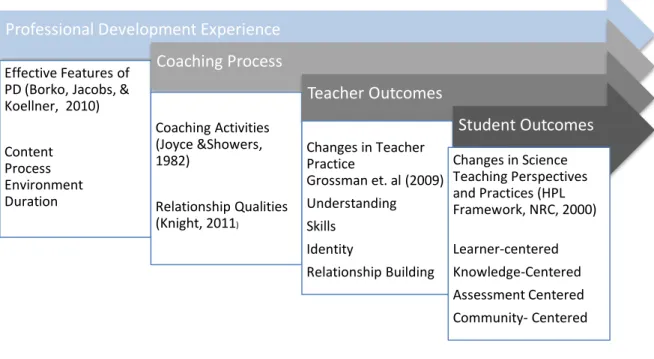
A Synthesis of Frameworks 42
Researcher and Participant Roles 42
Data Collection 44 Participant Journals 44 Semi-Structured Interviews 44 Unstructured Interviews 45 Observations 45 Documents 46 Data Analysis 46 Open Coding 47 Axial Coding 47 Constructing Categories 47 Addressing Validity 48 Researcher Bias 49 Reactivity 50 Reflexivity 50 Peer Review 51
Respondent Validation or Member Checking 51
Rich Data 52
Human Subjects Protocol 53
Organization of Findings 53
CHAPTER IV: THE INSTRUCTIONAL UNIT 55
The Topic- Nature of Science 55
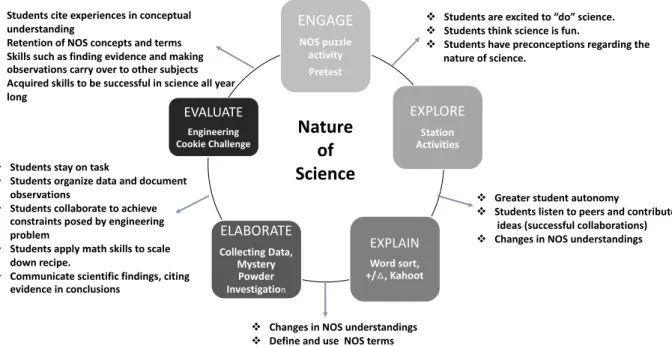
Instructional Activities 55 Engage 56 Explore 57 Explain 58 Elaborate 60 Evaluate 60
CHAPTER V: A COACHING MODEL FOR EFFECTIVE PD 64 Effective Features of Professional Development 64
Content is Situated in Practice 65
Content is Focused on Student Learning 67
The Process Includes a Modeling of Instructional Strategies 67
The Process Situates Teachers as Active Learners 69
PD Builds Learning Communities and Supports Collaboration 70
PD is Grounded in School Practice and Integrated with Applicable Reform Efforts 72
PD Activities are On-going and Sustainable 74
CHAPTER VI: THE COACHING PROCESS- EVOLUTIONARY CHANGES 83 Teacher Characteristics 83
The Teachers Were Comfortable with Collaboration 83
The Teachers Were Willing to Take Risks 84
The Teachers Care Deeply About Student Needs 87
The Teachers Were Eager to Identify Misconceptions and Develop PCK 87
The Teachers Were Willing to Learn Alongside Students 90
Teacher Needs 91
Time 91
Resources 93
Support 94
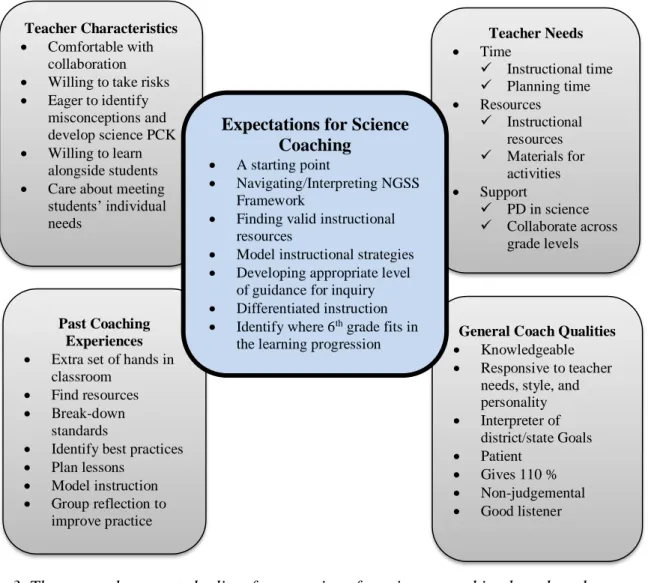
Teacher Expectations for Science Coaching 96
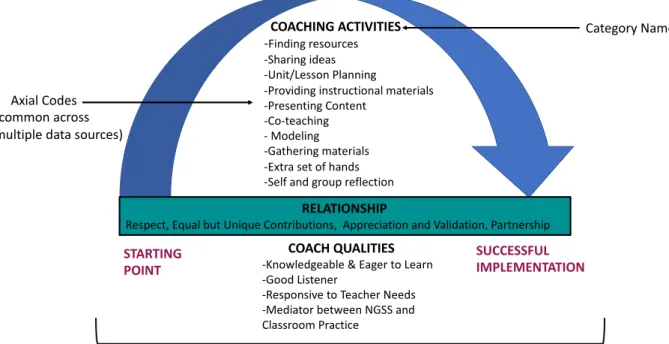
Coaching Activities as a Function of Time 99
In the Thick of It 100
The Homestretch 102
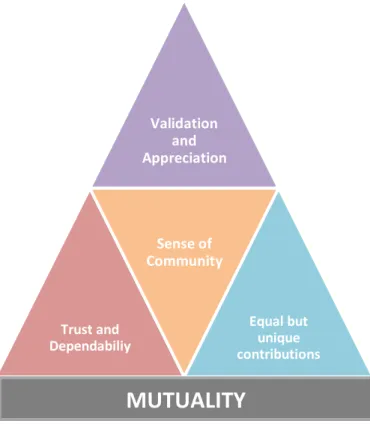
Coach-Teacher Relationship- The Foundation of Support 104
Trust and Dependability 104
Validation and Appreciation for Equal but Unique Contributions 107
Shared Sense of Community 108
CHAPTER VII: TEACHER PRACTICE- REVOLUTIONARY CHANGES 111
Changes in Practice 114
Teacher Understandings 114
Skills 116
Identity 120
Relationship Building 122
CHAPTER VIII: STUDENT OUTCOMES 124
Learner-Centered Outcomes 124
Sustaining Students' Excitement for Science 124 Sustaining Students' Curiosity of Natural Phenomena 126
Differentiating Instruction 127
Knowledge-Centered Outcomes 128
NOS Understandings 128
Use of Science and Engineering Practices 130
Integration of Skills 131
Assessment-Centered Outcomes 133
Formative Assessment for Student Growth 133 Summative Assessment to Inform Instruction 134
Community-Centered Outcomes 135
Collaboration 136
Recognizing the Relevance of Science and Engineering Outside of the Classroom 137
CHAPTER IX: CONCLUSIONS AND IMPLICATIONS 143
Coaching as High-Quality PD 143
The Coaching Process 146
Changes in Teacher Practice 147
Impacting Student Outcomes 149
Limitations of the Study 150
Recommendations for Further Research 151
REFERENCES 153
APPENDIX A: INTERVIEW PROTOCOLS 164
APPENDIX B: NATURE OF SCIENCE PRE-QUIZ 168
APPENDIX C: STATION ACTIVITY EXAMPLE 169
APPENDIX D: ELIZABETH'S ANCHOR CHART 171
APPENDIX E: EXPLAIN ACTIVITY 172 APPENDIX F: WORD SORT EXAMPLE 173
APPENDIX G: ELABORATE ACTIVITY 174 APPENDIX H: PROJECT-BASED SCIENCE ENGINEERING CHALLENGE 177
APPENDIX I: STUDENT SHARING OF DESIGN AND RESULTS 186 APPENDIX J: INSTITUTIONAL BOARD REVIEW (IRB) APPROVAL 190
TABLES
Table Page
1. An Alignment of Research Goals with Qualitative Procedures and Qualities 36 2. How People Learn (HPL) Framework-Perspectives of an Effective Learning 41
Environment
3. A Comparison of Data Sources for the “Coach-Teacher Relationship” Theme 54 4. Alignment of Unit Activities with the Five Phases of the 5E BSCS Instructional
Model 56
5. An Alignment of the NGSS NOS Understandings with the True/False Pre-Quiz Statements and the Six Explore Station Activities 59 6. An Alignment of the Engineering Project with Project-based Learning Features and
NGSS Engineering Principles 62
7. Alignment of Coaching Approach with Effective Features of PD 82 8. An Alignment Between the Instructional Activities and the NGSS Science and
Engineering Practices 117
9. Evaluation and Organization of Student Outcomes from the NGSS-Aligned Unit with
the HPL Framework. 139
10. Student Outcomes Commonly Reported Across Multiple Data Sources 140
FIGURES
Figure Page
1. Coaching as Professional Development for NGSS Implementation- Analysis Model 43 2. Data Analysis Example- Using Data to Describe the Coaching Process 48 3. Factors Influencing Expectations for Science Coaching 98 4. An Illustration of Coaching Activities and Participant Contributions over Time 105
5. Components of Mutuality 110
6. Progression of Student Knowledge and Skill over the 5E Phases of Instruction 142
CHAPTER I: INTRODUCTION
John Dewey compared a subject-based approach to teaching science with providing students with a map. Although a map is useful and can be used to navigate, receiving it as an end product is not a substitute for the experience and knowledge obtained by the creator in exploring the land first-hand. He wrote, “Let me use the analogy of the difference between an explorer blazing a trail in a new country and the finished map that is constructed after the country has been thoroughly explored. Well, we may first tell what the map is not. The map is not a substitute for personal experience” (as cited by Archambault, 1965, p. 350.) With a strong emphasis on science and engineering practices, core disciplinary ideas (CDIs), and crosscutting concepts (CCs), the Next Generation Science Standards (NGSS) privilege exploration,
integration, and application of content knowledge over a coverage of topics (NGSS Lead States, 2013). These dimensions are at the heart of the NGSS and work together to establish expectations for student performance. Applying the NGSS situates students as the trailblazers, with the teacher guiding and facilitating students’ journey like a compass along the way.
Statement of the Problem
A review of the literature on science teaching in elementary schools depicts a set of challenges specific to this learning environment (Appleton, 2007 & Roth, 2014). Elementary teachers cite a climate of standardized testing in language arts and mathematics, lack of teacher preparation in science and science methods courses, and lack of professional development opportunities in science as obstacles impacting both the quantity and quality of science learning activities they incorporate in their teaching. Yet the demands for teaching in a manner consistent with the NGSS require more instructional time, growth in teachers’ pedagogical content
practice. The NGSS call for major shifts in instruction and consequently a shift in the roles teachers and students assume in the classroom. Students will collaborate with each other and work with materials to construct knowledge, and teachers will create these engaging, interactive spaces. Passmore (2015) writes, “This is a time when teachers need to know they can stretch themselves to rise to new challenges. They need to be encouraged and supported in taking risks and trying new things with the knowledge that they won’t be judged on their first attempts but be given time and space to reflect and improve” (p. 27). The factors limiting the quantity and quality of science instruction at the elementary level are well documented in the literature (McMurrer, 2008). Elementary educators need to build partnerships with faculty who have the expertise and time to focus on developing curricula that adhere to the spirit and intent of the NGSS while also considering the limiting factors present in the learning context.
Purpose Statement and Research Questions
The goal of this study is to explore how coaching as a mechanism for professional development can support elementary educators’ implementation of an NGSS-aligned unit of instruction in the classroom. Coaching provides more teacher autonomy than the processes of evaluating, supervising, and mentoring (Barkley, 2010) and represents a “relationship between two equals committed to an idea of personal and professional improvement” (p. 6). This study is significant and timely, given the recent release of these standards which are designed to build a scientifically literate and productive society. The elementary level presents a unique set of challenges for quality science instruction, implicating a need for classroom support to address limiting factors. The scope of the study is narrow; a case study approach focuses this exploration on a single unit of study- the implementation of an NGSS-aligned unit of instruction at one intermediate school. The overarching research goal is not to generalize findings but to apply a
magnifying glass on the unit of study and provide rich, detailed descriptions that other
elementary educators may find relevant to their own practice. The proposed research questions set the stage to explore how coaching as a delivery of on-going, embedded teacher support can facilitate the transfer of the NGSS from paper to practice.
1. How can a coaching approach to teacher collaboration be used to offer high quality professional development for NGSS implementation at the elementary level? 2. Based on the characteristics and needs of the teacher-participants, how does the
coaching model develop throughout the implementation of the NGSS unit? 3. How can a coaching model as PD for NGSS implementation be used to catalyze
changes in elementary teachers’ science teaching practice?
4. How can coaching as a model for professional development for NGSS implementation impact student outcomes?
Significance of the Study
“Science—and therefore science education—is central to the lives of all Americans” (NGSS Lead States, 2013, para 3). Scientific advancements are at the backbone of society, providing humans with the innovations necessary to adapt and thrive across all terrains on earth. A walk through history shows a parallel between scientific progress and the advancement of society (Le Couteur & Burreson, 2004). For example, the scientific discipline is charged with addressing climate change, meeting an increasing demand for energy, protecting endangered species, informing technology development, and discovering treatments for diseases. Continuing on this trajectory, if the children of today are to thrive in the society of tomorrow, science
education must be a top priority in K-12 curricula. The NGSS were built from the Framework for K-12 Science Education: Practices, Crosscutting Concepts, and Core Ideas; this document was
rooted in research on how children develop and learn. They identify the scientific knowledge and skills practicing scientists, science educators, and science education faculty deem as critical for America’s children. (National Research Council, 2012). According to the NGSS writing team, the release of the NGSS is timely given the “reduction in the US economic competitive edge, lagging achievement of US students, essential preparation for careers and modern workforce, and the scientific and technological literacy for an educated society” (NGSS Lead States, 2013, para 1)
Science Education for an Informed Citizenry
The National Research Council has defined scientific literacy as “the knowledge and understanding of scientific concepts and processes required for personal decision making, participation in civic and cultural affairs, and economic productivity” (National Research Council, 1996, p. 2). To address these concerns and promote scientific literacy, classroom experiences must ignite a passion for learning science and maintain those interests by situating science learning in meaningful and relevant contexts. We are born into this world as curious and questioning beings. It is a travesty that through formal science education, children lose their propensity to ask and explore science-oriented questions (Kovalik & Olsen, 2010). The
literature speaks of the many obstacles facing elementary educators in teaching science, but the wonderment and curiosity of children is an encouraging factor to build upon in the elementary classroom.
Science Education for Equitable Learning Opportunities
The NGSS also have the potential to bring issues of equity to the forefront in reform efforts. The underrepresentation of women, minorities, and persons with disabilities is well-documented. For example, a survey conducted by the National Science Foundation (2013)
discloses the discrepancy between the percent of these populations in the total population and the percentage of these populations represented as groups of science and engineering undergraduate degrees earned and employed as scientists and engineers. According to Rodriguez and Berryman (2002) as cited in Appendix D of the NGSS:
Engineering has potential to be inclusive of students who have traditionally been marginalized in the science classroom and do not see science as being relevant to their lives or future. By solving problems through engineering in local contexts (e.g., gardening, improving air quality, cleaning water pollution in the community), students gain knowledge of science content, view science as relevant to their lives and future, and engage in science in socially relevant and transformative ways. (p. 4-5)
The elementary setting can be a place that breaks down the stereotype of who can be a scientist or engineer by providing opportunities for student-driven investigations and problem solving. Science Education: Success Depends Upon Support
Designing a cohesive curriculum that progresses in content and skill development, integrates science content with other academic subjects, and engages students in science and engineering practices through relevant and meaningful experiences is a tall order and a challenge that classroom teachers should not have to face alone. As Whitworth and Chiu (2015) conclude, “Providing teachers with individualized feedback, tailored to their needs and classrooms, can support teachers to make substantial changes to their existing practice” (p. 123). As the researcher considered the possibility of exploring a coaching model with elementary teachers, she approached this work with the understanding of how difficult change is and how frustrating it can be for practitioners to have an outsider evaluate and judge their teaching. Coaching offers support on a level playing field; it is based on reciprocal feedback that is specific to the needs of
a partnership. The shifts in instruction called for by the NGSS will be difficult and situate teachers outside of their comfort zone. However, there can be exhilaration and rejuvenation in new opportunities, and having someone to take that leap with makes the transition less daunting.
CHAPTER II: REVIEW OF THE LITERATURE
The Next Generation Science Standards (NGSS): A Closer Look
Practicing scientists, cognitive scientists, science education researchers, and science education standards and policy experts wrote the National Research Council’s Framework for K-12 Science Education based on the most current research on science and science learning. Achieve, Inc. used this framework as its foundation to construct the NGSS.
Core Disciplinary Ideas, CDIs
The work to identify the CDIs was based on the premise that depth of understanding is superior to a breadth of surface knowledge. Content presented in the NGSS framework is
reserved for key concepts that can be developed over time, have real-world applicability, and are significant across multiple disciplines (Bybee, 2013). The CDIs are grouped according to four domains: physical sciences, earth and spaces sciences, life sciences, and engineering, technology and application of science. For example, the CDIs articulated for the physical sciences include the following: Matter and its interactions, Forces and interactions, Energy, and Waves and their applications in technologies for information transfer.
Crosscutting Concepts, CCs
Crosscutting concepts are concepts that form a common thread among all fields of science, bridging the life, physical, earth, and space sciences. Duschl (2012) cites A Framework for K-12 Science Education in emphasizing the role these concepts play in students’
development of a “cumulative, coherent, and usable understanding of science and engineering” (p. 7). These concepts or themes span across scientific disciplines and represent science as a way of knowing. The CCs are reminiscent of the “unifying concepts” from the National Science Education Standards (NRC, 1996) and the “common themes” presented in Science for All
Americans (AAAS, 1989). In the NGSS framework, they are articulated specifically as (1) patterns; (2) cause and effect; (3) scale, proportion, and quantity; (4) systems and system models; (5) energy and matter; (6) structure and function; and (7) stability and change.
Science and Engineering Practices
According to the NSES, classroom inquiry “engages learners by asking scientifically oriented questions, prompts students to form explanations to scientific phenomena based on evidence, and develops students’ ability to evaluate, communicate, and support explanations” (NRC, 2000, p.25). Scientific inquiry has been a part of science education standards since the 1990s, and in the NGSS, it is included as a form of scientific practice. The NGSS describe the teaching and learning of science in terms of practices; these practices involve “doing something and learning something in such a way that the doing and learning cannot really be separated” (Michaels, Shouse, & Schweingruber, 2008, p. 34). It is the link between content and practice that leads to proficiencies in science, just as a knowledge of music and active practice allow a musician to be proficient at playing an instrument. (Duschl, Schweingruber, & Shouse,
2007). The NGSS focus on students’ engagement with the practices scientists and engineers use to describe the nature of scientific knowledge, conduct scientific inquiries, explain natural phenomena, engage in scientific discourse, and propose solutions to real-world problems. There are eight practices included in the standards: (1) asking questions and defining problems, (2) developing and using models, (3) planning and carrying out investigations, (4) analyzing and interpreting data, (5) using mathematics and computational thinking, (6) constructing
explanations and designing solutions, (7) engaging in argument from evidence, and (8) obtaining, evaluating, and communicating information.
The Nature of Science
In addition to engaging students in the practices of scientists to explore natural
phenomena, the NGSS also advocate for the explicit teaching of the nature of science (NOS). Through this teaching, students may gain an understanding of how the scientific discipline accumulates and articulates scientific knowledge over time. As referenced in Appendix H of the NGSS, the NRC (2012), states, “Epistemic knowledge is knowledge of the constructs and values that are intrinsic to science. Students need to understand what is meant by an observation, a hypothesis, an inference, a model, a theory, or a claim and be able to distinguish among them (p. 79). Accordingly, Appendix H of NGSS proposes the instruction of eight basic understandings about the nature of science: (1) scientific investigations use a variety of methods; (2) scientific knowledge is based on empirical evidence; (3) scientific knowledge is open to revision in light of new evidence; (4) scientific models, laws, mechanisms, and theories explain natural phenomena; (5) science is a way of knowing; (6) scientific knowledge assumes an order and consistency in natural systems; (7) science is a human endeavor; and (8) science addresses questions about the natural and material world.
An Emphasis on STEM and Literacy
During the period from 1990 through 2000, national education standards (Benchmarks for Science Literacy, National Science Education Standards, and Standards for Technology
Literacy) articulated standards for technology and engineering. In recent years STEM (Science Technology Engineering & Mathematics) education initiatives have emerged (Bybee, 2011). Scientists propose questions about natural phenomena and form explanations based on empirical evidence, and engineers address real-world problems, offering solutions based on scientific knowledge that meet certain criteria and constraints. Applied science can lead to the
development of technology, and technology can be used to advance scientific knowledge.
Mathematics can be used to describe relationships between variables, computational methods can be used to describe natural phenomena, and statistical techniques are central to characterizing trends and correlations in data sets. There is a significant overlap among these STEM
disciplines, and the science and engineering practices presented in the NGSS reflect the relationship between the STEM fields. Engaging in these practices also prompts students to develop literacy skills. Students expand their vocabulary and use of syntax specific to the scientific discipline. They construct evidence-based arguments and employ the discourse of science to communicate findings.
Performance Expectations, PEs
In addition to the three dimensions, the NGSS provide a list of Performance Expectations (PEs) for each core disciplinary idea. These PEs are “assessable statements of what students should know and be able to do” (Achieve, 2013, p. 1). The PEs incorporate all three dimensions within the framework, connect to the nature of science and other STEM disciplines, and are aligned with the Common Core State Standards in Mathematics and English Language Arts. The PEs, like the CDIs, grow in sophistication with increasing level of student thinking; PEs are articulated at early elementary, mid-elementary, middle, and high school levels. For example, consider the performance expectation articulated for grades 3-5: “develop a model to describe that matter is made of particles too small to be seen” (Achieve, 2013). This PE incorporates all three dimensions: (1) the science practice - developing and using models to explain phenomena, (2) the CDI- structure and properties of matter, and (3) the CC- scale, proportion, and quantity. The PEs also connect to the NOS understandings. For example, this PE could relate to the following NOS understanding: Scientific models, laws, mechanisms, and theories explain natural
phenomena. It is also linked to CDIs across grade levels and to specific Common Core standards articulated for literacy and quantitative reasoning skills.
The PEs describe expectations for student performance and can be used to guide educational professionals’ decisions regarding instruction and assessment. However, while the PEs indicate what students should achieve, it is up to the school administrators and practitioners to determine how students achieve the PEs. For example, students could investigate the
differences between deflated and inflated basketballs (including measuring and quantifying variables) and develop particle models to explain the observable properties of each. A similar activity could be conducted with different concentrations of sugar water. There is flexibility in how teachers orchestrate these exploratory opportunities for students, but without quality, exemplary instructional tasks to model, some teachers may feel unprepared and overwhelmed when creating or modifying lessons that adhere to the PEs set forth by the NGSS.
Three-Dimensional Learning
Familiarity with the three dimensions and the performance expectations outlined in the NGSS framework is a helpful starting point for practicing teachers. The NGSS also call for the dimensions to be integrated. Three-dimensional learning (NRC, 2014) posits that these
dimensions work together in science lessons to help students develop the knowledge and skills to meet the performance expectations. Teaching concepts through the use of practices gives
students a first-hand experience with the epistemological nature of scientific knowledge. In contrast, teaching students content and then using practices to verify the content situates the dimensions in isolation of one another. In her editorial piece for Science and Children, Mariel Milano (2013), also a member of the NGSS writing team, emphasized the integration of the standards' dimensions, "One of the instructional shifts in the NGSS is the use of all practices,
with all content, all year long. This represents a marked shift from the many curriculum tools that present the scientific method or scientific processes as a separate unit and leave their implied use up to chance throughout the year" (p. 15). These standards advocate for the teaching of science to be authentic to the discipline, to be meaningful to students’ lives, and to progress as students grow and develop throughout their K-12 education.
The NGSS consist of expectations for student performance that incorporate the core disciplinary ideas, crosscutting concepts, and practices; these performance expectations serve as standards for evaluating student learning and can guide practitioners’ decisions regarding instruction and assessment. What is both exciting and daunting about the NGSS is the freedom they bestow on teachers to design and implement curricula that adhere to the spirit and intent of the framework. The NGSS advocate for both teacher and student autonomy simultaneously, and with this freedom comes great responsibility. Joseph (2011) conceptualizes curriculum not as an object or explicitly prescribed plan but an opportunity for an in-depth examination and
transformation of goals for education from all aspects, including the well-being of all students, classroom practices that promote understanding, and the moral and democratic obligations for an equitable society. The NGSS reflect a “constructing understanding” (Windschitl, 2011)
orientation to curriculum which situates the learner in challenging tasks that require autonomous thinking, inquiry skills, metacognition, and collaboration. But to limit the impact of the NGSS to victories in cognition is a disservice to students, schools, and society as a whole. The NGSS also have the potential to advocate for equity in science education. This is an opportunity teachers must not overlook.
All Standards, All Students
The type of reform proposed by the NGSS is reminiscent of the Progressive movement in education dating 100 years ago. Joseph describes the goals of a progressive educational
philosophy as “to transmit culture and societal structure to promote social change; to give learner practical knowledge and problem-solving skills, to reform society” (p. 16). Throughout his life experiences and written work, John Dewey (1916) epitomized this movement. He believed that education should be informed by the study of students’ experiences, interests, and abilities, sustained by the active exploration into problems and contexts that are relevant to these
characteristics, and provided for the purpose of social progress and reform. Appendix D of the NGSS framework provides a rationale for the standards through the lens of a diversity and equity team and presents seven case studies describing experiences with teaching lessons within diverse classrooms that are aligned with the NGSS (NGSS Lead States, 2013). According to Stephen Pruitt, senior vice-president of Achieve. Inc., “Science can really be the great equalizer. But because science has the stigma for only being for a select group of students, we couldn’t afford to come out of the gate without having our diversity and equity work, and some resources for teachers as a companion to the new standards” (…as cited by Maxwell, 2013, p. 26). The seven case studies offer insights and specific strategies for NGSS implementation with economically disadvantaged students, students from minority racial and ethnic groups, students with
disabilities, students with limited English proficiency, female students, students in alternative education programs, and gifted students. Recommendations common across all of the case studies rely on the following strategies: (1) use cultural and linguistic resources as intellectual resources in the science classroom, (2) connect students’ background knowledge with science disciplinary knowledge, and (3) allocate resources to support science learning including
extensive professional development for teachers (Januszyk, Miller, & Lee, 2016; Lee, Miller, & Januszyk, 2014).
Students’ everyday experiences- the energy they consume, the materials they use, or the quality of air they breathe- can be used as contexts to study natural phenomena. Funds of knowledge (Moll, Amanti, Neff, & Gonzales, 1992) are the intellectual resources students acquire as a consequence of their lived experiences and interactions with cultural, linguistic, and social practices. It is not enough to approach NGSS implementation with a generic focus on the development of scientific knowledge and skills; in order for teachers to offer equitable science education to all students, they must value and allow students’ funds of knowledge to inform learning opportunities. They must shift from a deficit model to an affirming view of student ability. Valencia (2010) describes deficit thinking as an endogenous theory of school failure which places the blame on the individual, citing student deficits such as immoral behavior, inadequate linguistic and intellectual abilities, and lack of motivation as the driving force behind students’ lack of success in the classroom (p. 6-7). As a guide for preparing teacher candidates to be advocates of change for social justice, Villegas and Lucas (2002) present six characteristics that define a culturally responsive teacher. In addition to a constructivist approach to teaching, another strand emphasizes the importance of shifting from a deficit view to an affirming view of student ability. They describe an affirming attitude as, “acknowledging the existence and validity of a plurality of thinking, talking, behaving, and learning…all students, not just those from the dominant group, are capable learners who bring a wealth of knowledge and experiences to school.” (p. 23). The title of Appendix D of the NGSS must become a mantra as teachers reform practice to incorporate the NGSS- “All Standards, All Students.”
Implementing the NGSS- Theory to Practice
Although student-driven, first-hand investigations may be a novelty in many K-12 classrooms, their inception is rooted in cognitive and socio-cultural constructivist learning theories of the 20th century. A cognitive constructivist theory of learning, often associate with
the psychologist Jean Piaget, characterizes the process of “sense making” as constructing knowledge through the assimilation and accommodation of new information against the backdrop of existing conceptions or schemas from past experiences (Herron, 1996). A socio-cultural constructivist theory of knowledge describes sense making as a socially-mediated
process of cognition; learning is shaped through contexts of communication and interactions with others (Vygotsky, 1978). Vygotsky’s zone of proximal development refers to the gap between the understanding students can achieve as sole investigators in their learning environment versus the understanding that can develop through collaborating with a more experienced mentor or peer. A helpful synthesis of these two important views of learning is offered by Tobin and Tippins (1993) who explain that while knowledge is constructed and molded through personal experiences, both past and present, it is also influenced by the social and cultural aspects of the learning environment.
The tenets of these learning theories have significant implications for the teaching and learning of science. Children from a young age behave like scientists, asking questions about the world around them and formulating explanations based on their observations. As a result,
students enter the classroom with preconceptions of how the natural world works that are not consistent with the current theories accepted by the scientific community. Teachers must be purposeful in planning in order to reveal student preconceptions, demonstrate the short-comings of the preconceptions, and offer plausible and intelligible alternatives to students’ naïve beliefs;
in other words, there must be intrinsically motivating learning experiences to catalyze conceptual change (Bruning, Schraw, Norby, & Ronning, 2004, p. 340-346). Students must also be given the opportunity to grow in their understanding through peer collaboration.
During the 1960’s scientists and science educators begin to frame research on how students learn science from a teaching perspective. As an instructional approach to teaching science, the learning cycle mimics the process by which scientists explore natural phenomena, introduce ideas to explain phenomena, and apply scientific ideas to new contexts (Atkin & Karplus, 1962; Karplus, & Their, 1967). Used as an instructional model, teachers facilitate students’ transition between three phases of learning activities: (1) exploration, which provides students the opportunity to explore natural phenomena; (2) concept or term introduction, which uses instructional materials and classroom discussions to introduce relevant scientific vocabulary and explanations; and (3) concept application, which prompts students to apply newly discovered scientific ideas to a different context (Brown & Abell, 2007). After a meta-analysis conducted on several empirical studies exploring the effects of the learning cycle on student outcomes, Lawson, Abraham, and Renner (1989) concluded that this approach and sequence to teaching science encourages positive attitudes toward science and science learning, enhanced content achievement, and improved general thinking skills (p. 69).
While the NGSS can be used to guide instruction and assessment, they do not include a list of instructional tasks or evaluation tools to be used with the performance expectations. The implementation of these standards in the classroom presents significant challenges and requires resources in addition to the framework itself. High-quality curricular resources can be used by teachers as a model of what three-dimensional learning looks like in the classroom; however, currently, an NGSS aligned K-12 curriculum cannot be found. Instead, educators must search for
units of instruction that meet some of the standards or evaluate existing units for NGSS alignment (Penuel, Harris, & DeBarger, 2015).
The BSCE 5E Instructional Model
For teachers searching for guidance to support their implementation of the NGSS, the learning cycle can be a useful mechanism to initiate the appropriate changes in practice. When planning instructional units that adhere to the spirit of the NGSS, the Biological Sciences Curriculum Study (BSCE) 5E Instructional Model can be an invaluable tool. Built with teacher characteristics and needs in mind and inspired by the learning cycle approach, conceptual change models, and cooperative learning, this model can set the stage for student-led inquiries in the science classroom (Bybee, 2014). This model expands upon the learning cycle phases to include five phases-engage, explore, explain, elaborate, and evaluate. The explore, explain, and
elaborate phases align with the learning cycle sequence phases- exploration, concept
introduction, and concept application. The engage phase serves to spark student interest, expose preconceptions, and focus students’ attention on the content of the instructional unit. The evaluation phase provides students with formalized feedback on their performance and provides teachers with evidence of student learning. Teachers applying this sequence of five phases to lesson planning should keep three action goals in mind: (1) intrinsically motivating students to learn, (2) orchestrating a series of activities that reveal and confront students’ preconceptions and support the construction of new understandings and skills, and (3) encouraging students to mediate and solidify their ideas through peer collaboration and teacher feedback.
Project-Based Science
In addition to the BSCE framework, teachers can use a project-based science (PBS) approach to develop lesson activities that engage students in the NGSS science and engineering
practices within authentic contexts. According to Krajcik (2015), science education professor and CREATE for STEM coordinator at Michigan University, PBS is an instructional approach that aligns with the three-dimensional learning advocated by the NGSS. He states, “At the core of PBS is asking and investigating real world questions, a concept that dates back to Dewey, who promoted teaching about topics relevant to students’ lives” (p. 25). PBS encompasses driving questions, investigations, and collaboration; together these processes integrate science and engineering practices with learning concepts and communicating scientific knowledge. Not all science “projects” meet the criteria endorsed by the PBS approach. Projects that stimulate and model the real work of scientists and engineers incorporate eight features: (1) significant content (the CDIs presented in the NGSS), (2) inspire a need to know, (3) a question that gives the project a sense of challenge and purpose, (4) student voice and choice, (5) 21st century
competencies (critical thinking, collaborative skills, communication skills, creativity/innovation), (6) engagement in inquiry, (7) critique and revision (peer review, self-evaluation), and (8) a public audience (presentation of work to a community) (Larmer & Mergendollar, 2012).
Subject-Based Learning Versus Problem-Based Learning
In subject-based learning or SBL, the teacher informs students of what they need to know about a particular topic, the students learn the information, and then the teacher explains how this knowledge could be applied in a societal context. In problem-based learning or PBL, a problem is posed (by the teacher or by a student), and then the student must determine what information is needed to address the problem. In the quest for a solution, students must compile and evaluate resources, create and conduct investigations, collect and analyze data, and evaluate and
communicate the findings. These educational tasks, prompted by PBL, reflect the true nature of science and support scientific literacy. Ram (1999) describes the premise of PBL as follows,
“If we give students a challenging task that engages them, they will learn to solve problems and acquire the associated knowledge in order to solve the particular problem at hand” (p. 1122). Problem-based learning demands a higher level of inquiry than subject-based learning, making its use attractive to educators who wish to improve students’ science process skill sets as well as their content knowledge. When implementing problem-based learning, educators must consider the quality of the problem; the problem determines how valuable the learning experience can be. The problem should be complex, relevant to students’ lives, and reflect real-world issues that involve multiple perspectives (Chin & Chia, 2008). The goal of the PBL experience is not for students to find one right answer but to propose a solution and support its validity through research and investigation.
Implementing PBS
A project-based science approach incorporates PBL and aligns well with the NGSS; however, the leap from a SBL approach requires educators to step into a different role as a facilitator of student-led inquires. Despite the student learning outcomes possible with PBS, there are practical reasons for teachers’ use of a subject-based learning (SBL) approach. A subject-based approach to teaching science will expose students to content knowledge and the advancements made in science to date; however, it does not promote the development of the skills required to do science and to communicate within the scientific community. Ertmer and Simons (2006) identify teachers’ abilities to create a culture of collaboration and
interdependence, to adjust to changing roles, and to scaffold student learning as major challenges to successfully implementing problem-based learning in the classroom. Ertmer and Simons argue, “In order to increase the likelihood that PBL will be effectively integrated within K–12 contexts, a variety of resources are needed to support both teacher and student efforts. For
example, teachers will need guidance as they adopt new roles, facilitate student inquiry, provide constructive feedback, and apply new types of classroom management strategies” (p. 41).
Quality PBS units can be found in the literature and serve as a starting point for developing and evaluating science lessons for NGSS alignment. Rivet and Krajcik (2004)
describe a simple machines PBS unit asking 6th grade students, “How do machines help me build
things?” The project was developed by university professors from the University of Michigan in partnership with Detroit Public Schools and included twenty-four teachers and 2500 students spanning four years. Rivet and Krajcik studied the impact of the project on student learning outcomes over the course of the project and found gains in student achievement sustained when professional development for classroom teachers transitioned from university professors to teacher leaders in the schools. While the PBS unit effectively translated the reform science standards of the time to practice, the effort hinged on intensive professional development
opportunities that became sustainable through the training and availability of teacher leaders. In their review of STEM education initiatives since the 1990s, Zollman, Tahemezhadi, and Billman (2012) identify teacher quality as the greatest factor impacting students’ academic achievement. Successful STEM projects help practitioners improve their content pedagogical knowledge and increase their self-efficacy toward teaching science. Projects fitting this description share three characteristics: (1) a strong focus on teacher content and pedagogical knowledge, (2) relevancy to teacher’s classroom situation, and (3) intensive and sustained support (p. 106). In order for PBS activities to be more prevalent in K-12 environments, policy makers, administrators, teachers, and researchers must collaborate to break down the barriers preventing initiatives presented in the literature and articulated in the standards from impacting student learning in the classroom.
Challenges at the Elementary Level
Science is a discipline designed to empirically describe and explain natural phenomena, and it has flourished as a body of knowledge over the centuries because of humans’ natural curiosity of the world around them. Science teachers must not lose sight of this fundamental aspect of learning about the natural world and mechanism for advancing scientific knowledge. According to the NGSS, quality science instruction must begin with young children and progress over time to sustain students’ interest, excitement, and aptitude for building and applying
scientific knowledge. As Kovalik and Olsen (2010) describe in their book, Kid's Eye View of Science: A Conceptual, Integrated Approach to Teaching Science, K-6, children behave like scientists; their curiosity prompts them to question what they observe in the natural world, and they form inferences informed by their personal experiences and unique perspective. However, after formal science instruction begins, children lose their propensity to ask and explore science-oriented questions. A longitudinal study conducted by Aschbacher, Li and Roth (2010)
examined students’ interest and self-efficacy toward science and STEM careers throughout their secondary schooling. The participants reported an initial intrinsic interest in science by age eight, with that interest fading over time. The participants identified more out-of-school
experiences as motivators to pursue science versus in class experiences. Findings suggested that elementary education played a minimal role due to the lack of science instruction in elementary school. In a recent podcast, Michael Wysession (2015), member of the writing team for the NGSS, emphasized the need for financial resources to develop new curricula and provide professional development opportunities that build K-12 educators’ confidence to embrace the NGSS and support their integration of science and engineering practices in the classroom. He
proposes the NGSS framework be used to capitalize on children’s sense of wonder and build science understandings through student-centered experiences. He claims:
Once students see what science and engineering are really like, with the joys of discovery into how the universe operates, the camaraderie of teamwork, the sharing and debating of ideas, and the hands-on approach of designing and refining solutions to real problems with their own hands, there is a good chance they will stay more engaged and interested in science throughout their K-12 education and into adulthood.
Teacher Characteristics
Children at the elementary level may hold the innate curiosity and intrinsic motivation to engage in science learning, but unfortunately, their teachers face many challenges when
attempting to incorporate effective science instruction into the classroom. For example,
elementary educators identify time and resources, assessment ambiguity, limit of topics that can be covered, classroom disorder, and loss of teacher as authoritative knowledge provider and classroom manager as disadvantages of teaching inquiry-based science (Choi & Ramsey, 2010; Howes et al., 2008). In contrast with secondary educators, their teacher preparatory program did not allow for extensive coursework in all sciences, and as practitioners their time and effort must be split among multiple subjects. According to the 2012 National Survey of Science and
Mathematics (as cited by Banilower et al., 2013), fewer than half of elementary teachers have coursework in chemistry or physics and less than five percent of elementary science teachers have post-secondary coursework in engineering. A majority of elementary educators do not feel as prepared to teach science as they do mathematics and language arts, and they spend less than half the time per week on science instruction than these academic subjects as well.
Teacher Practices
Appleton’s (2007) review of research on science education at the elementary level reveals that due to a lack in background knowledge and low self-efficacy for teaching science,
elementary teachers tend to avoid reform-based teaching practices in science. Instead, teachers tend to minimize instructional time and emphasize only a select number of topics (which tend to favor the biological sciences over the physical sciences), stress right answers instead of
exploratory activities, rely heavily on expository teaching and textbooks, and avoid open-ended practical experience using equipment. Roth’s (2014) review reports similar findings and also points out that elementary educators struggle to adapt instruction to meet the needs of
underrepresented students in science. Any professional development model designed to assist elementary educators with NGSS implementation must consider this set of challenges unique to the elementary setting.
The Classroom Climate
In addition to these limiting factors, standardized testing influences science instruction at the elementary school. A heavy emphasis on student achievement in reading and mathematics often prompts teachers to enhance focus on those subjects at the expense of teaching science. Schools across the United States have reduced and in some cases eliminated science instruction in order to provide more time to teach reading and mathematics. This shift in instruction is a consequence of the No Child Left Behind (NCLB) Act which required states to administer two standardized assessment tests in reading and mathematics to be reported to determine a school’s Academic Yearly Progress or AYP (Griffith & Scharmann, 2008). The time and effort teachers spend on improving students’ reading and mathematics test scores can make time for science instruction difficult and professional development opportunities and resources for science scarce.
Many limiting factors work against children’s exposure to effective science instruction and their development of the skills required to “do” science. While embedding the NGSS into every day practice is no small task for educators, the integration of science and mathematics instruction with literacy skills is necessary for the successful implementation of the NGSS and well suited for a mathematics and language arts rich curriculum. The NGSS can actually pave the way for science instruction to be effectively integrated with mathematics and language arts.
Proponents of standardized testing argue for its use to quantify student performance and hold schools across the country accountable for providing quality, equitable education to their students. Opponents favor local control of education, and some advocate for the use of
performance-based assessments that measure student growth (Edwards, 2016). In a recent study exploring reform-based instruction, elementary educators reported that although a
student-centered, NGSS-inspired approach to exploring science improved student engagement and interest in science, its implementation was at odds with the standardized testing climate of the school (Nariman & Chrispeels, 2016). Standards-based reform, based on the NGSS performance expectations, also necessitates changes in how assessment tools are developed and used to measure students’ learning.
The Call for Professional Development
Over one hundred years ago, Maria Montessori spoke passionately about the squelching of the inquisitive spirit of children by the overly prescribed and sedentary nature of classroom curricula. She compared teachers working with students restricted to desks to a zoologist
studying butterflies pinned in place through a glass case. She believed in a student-driven, active learning approach to education as opposed to a “pouring” of content into children’s intelligence. She wrote, “It is not enough, then, to prepare in our Masters the scientific spirit. We must also
make school ready for their observation. The school must permit the free, natural manifestations of the child if the school scientific pedagogy is to be born. This is the essential reform” (p. 28 as cited in Flinders & Thorton, 2009). Her words resonate with the classroom inquiries inspired by the NGSS, but history reveals a pattern of student-centered reform efforts failing to cross the threshold of classroom doorways.
The national survey Looking into the Classroom: A Study of K-12 Mathematics and Science Education in the United States, supported by the National Science Foundation and conducted by Weiss et al. (2003), reported that out of the 186 science lessons observed in K-12 classrooms, 70% of the lesson content was influenced by state standards, yet only 5 % of the lessons’ instructional strategies were influenced by state standards. Interview analysis with teachers revealed that while the topics taught were dictated by state standards and district policies, the methods employed to teach those topics were selected by teachers, and teaching through inquiry was not a common practice. The 2000 National Survey of Science and
Mathematics Education (Hudson, McMahon, & Overstreet, 2002) conducted with 5,278 teachers reported that instructional practices consistent with inquiry-based teaching occurred less
frequently than traditional teaching methods (as cited in Wilson et al., 2010). The 2012 National Survey of Science and Mathematics (Baniflower et al., 2013) indicates a similar trend; activities associated with student inquiry such as citing evidence when making claims, representing and analyzing data, and engaging in project-based learning were incorporated regularly in only 16% or less of K-12 classrooms. How will the newest version of science standards, the Next
Generation Science Standards be different? Among the national studies mentioned, another common finding indicates that professional development and teacher collaboration were minor
factors in affecting teachers’ instructional decisions. Could these factors represent the missing link between reform on paper and reform in practice?
The work to complete the Next Generation Science Standards (NGSS) took two years and an all-star cast of writers including K-12 science teachers, science coordinators, science specialists, and school administrators; STEM initiative curriculum experts and directors;
university professors from science and science education departments; and practicing scientists, engineers, and cognitive psychologists (NGSS Lead States, 2013). Considering the time and range of professional power commissioned to draft these standards, the notion of resting the implementation of these standards solely on the shoulders of classroom teachers seems an absurdity. This writing process was a collaborative effort, and the work to bring them to fruition must be also. Moving forward, it is critical to look to the past; history reveals the story of science education standards that never permeated the classroom. For example, Wilson, Taylor, Kowalski, and Carlson (2010) through their exploration of the effectiveness of inquiry-based instruction on student learning concluded, “From Dewey to the present, inquiry has been an increasingly prominent theme in multiple science education reform movements worldwide. However, the transition from theory and advocacy to practice and policy has been
unsatisfactory” (p. 276). Even standards that are written by a team of respected science educators, scientists, and educational psychologists, supported by a wealth of educational research, and effectively articulated will remain a theoretical framework if changes in curriculum, instruction, and assessment at the classroom level do not follow.
How can educators nurture the inquisitive spirit of the child, sustain students’ interest in natural phenomena, and support their identity as scientific thinkers throughout K-12 education? Educators must situate science learning in meaningful contexts and build a classroom community
that supports student-led inquiries. In his book, Translating the NGSS to Classroom Instruction, Rodger Bybee (2013), NGSS writer and former director of the Biological Sciences Curriculum Study, advocates for students’ active learning of science content. He also argues that this approach would demand significant changes in curriculum, instruction, and assessment in the science classroom. Throughout the future, elementary educators with limited planning and instructional time, gaps in background knowledge in science content, and minimal experience with science and engineering practices will have to drastically change science instruction to align practice with the standards. This transition requires intense and sustained support, and this support must be provided in consideration of the constraints present in elementary schools. He writes:
From the late 1980s to the present, K-12 science teachers and the larger science education community have witnessed an era of standards-based reform. Basically, the idea is to develop clear, comprehensive, and challenging goals for student learning. Beyond learning goals, the implicit assumption is that standards would be used to make other components of the of education system more coherent. Curriculum, instruction,
assessments, and the professional development of teachers would be aligned. Common sense supports this view. But in education reform, common sense does not always carry the day. (p. 12)
The Goals of Professional Development
Teachers enter their professional environment with a set of preconceptions about teaching gathered through a lifetime of observations from the perspective of a pupil. Lortie (as cited in Darling-Hammond & Bransford, 2005, p. 369) described the acquiring of this knowledge base as the apprenticeship of ownership. While teachers’ experiences as students familiarize them with
the classroom setting and can provide inspiration for future work, some critical misconceptions can develop. For example, novice teachers, having not experienced the behind-the-scenes work of teachers, may hold an over-simplified view of teaching. Also, if their education primarily consisted of traditional, teacher-centered lessons, then they may also assume the role of an authoritative figure who “transfers” knowledge to students. Just as students’ conceptual change can be framed from the constructivist learning theory, so should the changes in attitudes, beliefs, and knowledge that affect teachers’ change in practice from traditional approaches to inquiry-based teaching. Darling-Hammond and McLaughlin (2011) eloquently summarize the dilemmas and demands associated with accomplishing reform-based work:
The success of this agenda ultimately turns on teachers’ success in accomplishing the serious and difficult tasks of learning the skills and perspectives assumed by new visions of practice and unlearning the practices and beliefs about students and instruction that have dominated their professional lives to date… Teachers learn by doing, reading, and reflecting (just like students do); by collaborating with other teachers; by looking closely at students and their work; and by sharing what they see. This kind of learning enables teachers to make the leap from theory to practice. (p. 81-83)
Research has shown that teacher quality (including factors such as years of experience and expertise in teaching area) has a significant impact on student achievement (Fuller, Carpenter, & Fuller as cited in Valencia, 2010, p. 117-119). In their review of Science, Technology, Engineering, and Mathematics (STEM) education initiatives, Zollman, Tahernezhadi, and Billman (2012), state, “The quality of the public school teacher has the greatest in-school impact on nurturing cognitive abilities, developing content knowledge, and increasing motivation of students” (p. 103). More specific and germane to this paper is the
strong correlation between teachers’ content knowledge and student achievement and the even stronger correlation between the number of content methods courses and student performance (Monk, 1994; Goldhaber & Brewer, 2000); Darling-Hammond and Bransford (2005) summarize these research findings and conclude, “All of these studies suggest that learning how to teach allows teachers to better use their knowledge of what to teach (p. 26). Shulman (1986) described this type of teacher knowledge as pedagogical content knowledge (PCK); PCK requires a
knowledge of how to best teach content including a sense of what makes the subject difficult to students, the preconceptions students bring to the classroom, and the strategies best suited to promote students’ conceptual understanding (p. 6-7). The How People Learn or HPL framework (National Research Council, 2000) paints a picture of an optimal learning environment that is created by teachers’ PCK and students’ learning needs. The four aspects of the environment- learner-centered, knowledge-centered, assessment-centered, and community-centered- comprise a space that is student-driven, collaborative, informative, authentic to the discipline, and relevant to society.
Features of Effective Professional Development
Effective PCK is not developed overnight, and the successful infiltration of the science education reform embedded in the NGSS hinges on the reform efforts in schools. Teachers must be provided with high quality curricular materials and assessments to model, professional
development sustained over time, and support from all educational professionals including peers, school and district leaders, administrators, and community partners (Penuel, Harris, & DeBarger, 2015). Professional development (PD) opportunities exist in a variety of shapes and sizes; teachers can have their pick from summer institutes, workshops, university courses, in-service days, conferences at the district, state, and national levels, mentoring, and coaching (Whitworth,
B. A. & Chiu, J. L, 2015). With all of these options it is important to study and identify the factors of PD that stimulate and sustain changes in teacher practice that lead to increased student achievement. From a comprehensive review and synthesis of research conducted on professional development programs in science for K-12 teachers, Luft and Hewson created a list of 4
elements present in effective PD models: (1) the PD offers context-specific and enduring support for teachers, (2), PD opportunities allow for collaboration among educational professionals, (3) the PD program is coherent and goal-oriented, and (4) PD goals are focused on developing pedagogical content knowledge. These findings confirm the recommendations offered by Darling-Hammond and McLaughlin (2011). Effective PD engages teachers in the tasks of teaching, assessing, observation and reflecting that reveals processes of learning and
development; is grounded in inquiry, reflection, and experimentation that is participant-driven; is collaborative and focused on developing communities of practice; is connected to teachers’ work with students; must be ongoing and supported through modeling, coaching, and cooperative problem solving; and is part of larger school changes that allow for changes in practice (such as changes in schedule, availability of resources, money for materials, community partnerships, etc.) (p. 82). Desimone (2009) offers a conceptual model for studying professional development opportunities. Her “path model” offers a lens to investigate how teacher knowledge, teacher practice, and student achievement are connected to one another and can be influenced by quality PD. In this model, high-quality PD is defined according to five core features that emerged from over a decade of research on PD experiences. Consensus across the literature reveals these features as (1) content focus, (2) active learning (3) coherence, (4) duration, and (5) collective participation.