ScholarWorks
Walden Dissertations and Doctoral Studies Walden Dissertations and Doctoral StudiesCollection
2016
The Relationship Between High School Culinary
Curriculum and Culinary Arts College Student
Achievement and Completion
Emily Knight Walden University
Follow this and additional works at:https://scholarworks.waldenu.edu/dissertations Part of theOther Education Commons
This Dissertation is brought to you for free and open access by the Walden Dissertations and Doctoral Studies Collection at ScholarWorks. It has been accepted for inclusion in Walden Dissertations and Doctoral Studies by an authorized administrator of ScholarWorks. For more information, please [email protected].
COLLEGE OF EDUCATION
This is to certify that the doctoral study by
Emily Knight
has been found to be complete and satisfactory in all respects, and that any and all revisions required by
the review committee have been made.
Review Committee
Dr. Carole Pearce, Committee Chairperson, Education Faculty Dr. Richard Braley, Committee Member, Education Faculty Dr. Michelle Brown, University Reviewer, Education Faculty
Chief Academic Officer Eric Riedel, Ph.D.
Walden University 2016
The Relationship Between High School Culinary Curriculum and Culinary Arts College Student Achievement and Completion
by
Emily Williams Knight
MS, Troy University, 1998 BS, Boston University, 1995
AS, Newbury College, 1993
Doctoral Study Submitted in Partial Fulfillment of the Requirements for the Degree of
Doctor of Education
Walden University April 2016
There is a lack of persistence and completion of students enrolled in a local college culinary arts program, a problem also evident in national data. Some students entering the college program have participated in a defined high school curriculum focused on
culinary arts, such as the National Restaurant Association Education Association’s ProStart curriculum. The purpose of this study was to determine if participation in the ProStart program was related to the mean grade point average (GPA) and time to
completion in the college culinary arts program. Dewey’s theory of experience provided the theoretical framework. Participants from 2 cohorts at the local college—students who participated in ProStart (n = 17) and those who did not (n = 122) were examined for GPA and number of months to program completion. A t test revealed the students who
participated in ProStart had higher average GPAs. There was no statistically significant difference in the time to completion between the 2 groups. The analysis must be viewed within the limitations of the available sample size of the ProStart group, and further study is recommended with larger group sizes. Based on the results of this study, a peer-to-peer mentoring program pairing ProStart with non ProStart students was developed and recommended to the research site. The implications for social change include providing research results to the local site and a recommendation for a mentoring program to improve the rate of completion in the culinary arts program.
The Relationship Between High School Culinary Curriculum and Culinary Arts College Student Achievement and Completion
by
Emily Williams Knight
MS, Troy University, 1998 BS, Boston University, 1995
AS, Newbury College, 1993
Doctoral Study Submitted in Partial Fulfillment of the Requirements for the Degree of
Doctor of Education
Walden University April 2016
This doctoral study is dedicated to my loving family, Alec, Elizabeth and Olivia. There were countless weekends when you allowed me to complete course assignments and to research my study topic. You never shared your disappointment or sadness that we weren’t doing things as a family; instead, you offered me unwavering support and
encouragement. I love the three of you so much and am fortunate to call you mine. I also dedicate this study to my mom and dad. With my dad serving in the United States Navy and completing several remote deployments, my mom was never able to complete her doctorate. She rose to being a community college president and my drive to complete this degree is as much for her, as it is for me. I am truly blessed to have such supportive parents. To my brother Chris, thank you for always being my champion and for being the best brother I could have asked for. Finally, I dedicate this to all the high school students who have the goal of entering the hospitality and restaurant industry. I was a high school student looking to build a career in the industry and wish I had access to the type of findings found in this study. It would have helped me to better understand how an investment in a high school program could benefit my future college academic achievement.
I would like to thank my Chair Dr. Carole Pearce and my methodologist, Dr. Richard Braley. They have provided me with tremendous support, guidance, and are two people I trust and respect. They say that your chair and committee are a critical
component of your ability to complete your doctorate. There is no doubt this is a team effort and I am blessed to have their support, guidance, and experience. Without them, I would never have achieved my dream of earning my doctorate in higher education.
i
List of Tables ...v
Section 1: The Problem ...1
Introduction ...1
Definition of the Local Problem ...2
Rationale ...5
Evidence of the Problem at the Local Level ... 5
Evidence of the Problem From the Professional Literature ... 7
Definitions...10
Significance...12
Research Questions ...13
Review of the Literature ...14
High School Career and Technical Education Curriculum... 15
The Growth of Culinary Programs ... 17
Theoretical Framework ... 18
High School Preparation Connected to Academic Achievement and College Completion ... 20
Summary of the Literature Review ... 24
Implications...24
Summary ...27
Section 2: The Methodology ...29
Introduction ...29
ii
Instrumentation and Materials ...33
Data Collection and Analysis...35
Data Analysis ... 36
Data Analysis Results ... 39
Assumptions, Limitations, Scope, and Delimitations ...43
Assumptions ... 43
Limitations ... 43
Scope of Study ... 44
Delimitations ... 44
Protection of Participants’ Rights ...44
Summary ...45
Section 3: The Project ...47
Introduction ...47
Description and Goals ...47
Rationale ...48
Review of the Literature ...49
Peer-to-Peer Mentoring ... 52
Benefits to the Mentee ... 54
Benefits to the Mentor ... 59
Literature Review Summary ... 60
Project Description...61
iii
Potential Barriers ... 64
Proposal for Implementation and Timetable... 65
Roles and Responsibilities of Student and Others ... 66
Project Evaluation ...66
Presentation of Recommended Peer Mentoring Program ...68
Implications Including Social Change ...68
Local Community ... 68
Far-Reaching ... 69
Conclusion ...70
Section 4: Reflections and Conclusions ...72
Introduction ...72
Project Strengths ...72
Recommendations for Remediation of Limitations ...73
Scholarship ...74
Project Development and Evaluation ...75
Leadership and Change ...76
Analysis of Self as Scholar ...77
Analysis of Self as Practitioner ...78
Analysis of Self as Project Developer ...78
The Project’s Potential Impact on Social Change...79
Implications, Applications, and Directions for Future Research ...80
iv
Appendix A: Executive Summary ...100 Appendix B: GPA Data Collection Chart ...114 Appendix C: Time to Completion Data Collection Chart ...118
v
Table 1. Statistical Analysis RQ1 ... 37
Table 2. Statistical Analysis RQ2 ... 38
Table 3. Independent Samples t Test ... 40
Table 4. Group Statistics of ProStart and Non ProStart Students (AGPA): RQ1 ... 41
Table 5. Independent Samples t Test (2) ... 42
Section 1: The Problem
Introduction
The field of culinary arts education began in Paris in the 1800s (Brennan, 2014). Ranhoffer, chef of one of the early and best known fine dining restaurants, called for the establishment of culinary training schools in the United States (Brennan, 2014). Until this time, many restaurant owners and chefs were importing talent from Europe. Importing culinary talent versus developing and nurturing local individuals became too costly and a new solution was needed.
The first cooking school in the United States was the Boston Cooking School located in Boston, MA (Butler, 2013). It was created to train women for jobs outside the home and demand quickly outweighed the number of people that could be trained in each kitchen. The school gained national prominence following an 1896 publication of The Boston Cooking-School Cook Book. The first edition was published by Farmer and remains in print today (Hegarty, 2014).
Following the success of the Boston Cooking School, the New Haven Culinary Institute was founded in 1946 (Culinary Institute of America [CIA], 2015). Roth, who was an attorney rather than chef, had a vision to create an education institution that would serve as a national center of excellence in culinary education. The early mission of The New Haven Culinary Institute was to provide training to returning World War II service members (CIA, 2015). The first class consisted of 50 people and was supported by three faculty members (CIA, 2015). The school was founded at the right time due to postwar prosperity and an increasing demand for entertainment and dining out. From 1946 to
1951, the school changed its name two more times, ending as the Culinary Institute of America.
The CIA expanded the Boston Cooking School teaching methodology. The CIA had a teaching philosophy which combined theory with hands on practical application and an industry based internship (CIA, 2015). They required each student to complete an 18-week long, paid internship (CIA, 2015). This required internship supports Dewey’s theory of experience-based education put to use in culinary arts education (Dewey, 1939).
Through the late 1950s to present day, culinary schools have grown in popularity and numbers. In 2013, 273 institutions offered 476 accredited postsecondary culinary programs (American Culinary Federation [ACF], 2013). In just 4 years, this is a 30% increase in the number of schools offering culinary arts programs and a 39% increase in number of program available (ACF, 2013). This is the number of program accredited by the ACF, and two prestigious programs are missing from this calculation, the CIA and Johnson and Whales University. Both schools decided to not participate in the ACF accreditation process. Even without this recognition, both these schools are consistently ranked in the top 10 culinary schools in the United States (Odesser-Torpey, 2014). For the purpose of this study, I used the ACF school count to determine the current market size of postsecondary culinary education. The ACF is the sole postsecondary culinary arts accreditor and their schools account for close to 90% of the market (ACF, 2013).
Definition of the Local Problem
The problem addressed in this study is the lack of academic achievement and completion of a culinary arts program at a small college in the Midwest by students who
either did or did not complete a vocational education program in culinary arts. There is a lack of persistence and completion of students enrolled into college culinary arts
programs across the United States (Hertzman & Maasb, 2012). This lack of success occurs nationally and also at a local college in the Midwest that offers an associates and bachelor’s degree in culinary arts. The lack of student completers, coupled with the cost of many of these programs (National Center for Education Statistics, 2013) has college leaders looking for strategies to improve persistence and completion rates (Marckle, 2015).
There is a heightened sense of urgency to improve completion rates due to continued criticism by key legislators regarding the cost and return on investment of college programs (Breed, McKinney, Mukherjee, Shefman, & Wade, 2015). The Bureau of Labor Statistics (2015) projected 5% growth in the culinary industry; industry leaders will need trained labor to meet this growing demand. Lack of completion, an
administration focused on persistence and academic success, and a local environment depending on trained culinary talent to serve the growing tourism industry are all key drivers that contribute to this local problem.
Prior to enrolling into an associate’s degree program in culinary arts, some students have completed high school career and technical education (CTE) programs. Entering students can come from two types of high school career and technical education programs - traditional programs that utilize varied curriculum and resources, or high school programs that utilize the National Restaurant Association Education Foundation (NRAEF) ProStart curriculum (National Restaurant Association, 2013). The NRAEF
ProStart Curriculum reaches more than 118,000 students in 1,700 high schools across 48 states, Guam, and several U.S. military bases (National Restaurant Association, 2013).
Once enrolled into a college culinary arts program, there is a lack of persistence and completion to graduation. This problem is mirrored in the public data that also indicated a national trend of low completion rates in college culinary arts programs (National Center for Education Statistics, 2013). Looking back at these students high school experience, their school districts can invest financial resources into various curriculums, some specific to culinary arts. A lack of evidence on a connection between students participating in a defined curriculum, like the NRAEF ProStart program and their future college success leaves high school administrators with lack of clarity around their return on their investment.
For the 2012-2013 academic year, the national discount rate, based on first-time, full-time students was 44.8%. This discount rate is an increase from the 2011-2012 academic year (Pullaro, 2013). If college administrators had evidence that students who participated in a high school ProStart program perform better academically, and have a greater chance to graduate, they will be able to better target scholarship and financial resources to the students with the greatest projected opportunity for success.
The purpose of this study was to determine whether there is a connection between high school students’ participation in ProStart curriculum and their academic
achievement and completion of a local college level culinary arts programs, as compared to students who did not participate in this high school curriculum. By determining a
connection or a lack there of, school administrators, students, and college leaders will have evidence to assist making key strategic decisions.
Rationale Evidence of the Problem at the Local Level
The local college’s retention rates mirror those of the national reported data, with only 41% of first time, full time students who began the culinary arts associates’ degree program in the fall 2011, completing the program within 3 years (IPEDS, 2014). Using the Department of Education metric (National Center for Education Statistics, 2013) for completion of first time, full time first year students, it means that 59% of students, who began did not finish the 2-year program within 3 years. The year-to-year retention rate for the culinary arts associate degree program, from 2012-2013 was 73% (Local College Annual Report, 2014). Those data mean 27% of students who started the program were no longer enrolled 1 year later.
There are a number of negative implications from college attrition, that is, when a student begins a program, but does not persist to completion. The college will experience a loss of tuition revenue; this financial loss could have a material impact on the financial sustainability of the institution (Fowles, 2013). A college budgets each year and plans for new as well as retuning students. When either of these targets are less than projections, many colleges do not have alternative strategies to recover the loss of revenue (Harding, 2014). This loss of expected revenue puts financial strain on the institution and may mean key initiatives or other areas of investment need to be postponed (Fowles, 2013).
Another negative impact of attrition on an institution of higher education is with the school’s accrediting agency and the state and federal legislative oversight that monitors such outcomes as completion (National Center for Education Statistics, 2013). Over the last 5 years, there has been growing oversight and focus by the federal
government, specifically by the Department of Education who has been working on new legislation related to graduation rates and the ability for students to find a job (Hentschke & Parry, 2014). If a college has lower graduation rates, specifically against national averages established by the department of education, it can have a negative impact on the brand and image of the institution by students and their families (Hentschke & Parry, 2014). This can again impact long term enrollment for the college. It can also mean negative ramifications from the Department of Education in the form of reduced access to federal funding and tighter reporting annual reporting requirements (Natow, 2015).
Along with the negative implications attrition has on an institution of higher education, it can also have a negative impact on perspective students and their families (Hentschke & Parry, 2014). As part of their evaluation process, many parents and perspective students look at the graduation rates of colleges (Steiner, Sundstrom, & Sammalisto, 2013). The current attrition results from this small college in the Midwest could deter students from selecting this particular culinary arts program. The role of reputation based on outcomes is expected to grow in importance in the years to come (Steiner et al., 2013).
The failure to complete a college program could have a long term financial impact on a student. For example, in 2013, the average worker, between the ages of 25-34 with a
high school credential, earned approximately $30,000. The average worker who held an associate’s degree, earned $37,500 (National Center for Education Statistics, 2014). The national unemployment rate in 2014 for workers with only a high school credential was 6%, while a worker with an associate’s degree was lower at 4.5% (Bureau of Labor Statistics, 2015). These data point to the increased likelihood of securing employment and the financial gain one makes by earning a college degree and also highlights the negative impact when they do not.
On the regional level, the mayor of a large city in the Midwest has publically stated that tourism and growth of the restaurant sector is a cornerstone of his economic agenda. The mayor has established a city goal for annual tourists of 55 million visitors a year (Anonymous, 2014). City economists estimated that if this goal is achieved by 2020, an additional 30,000 jobs will be created (Anonymous, 2014). There is current and growing demand for skilled culinary arts professionals. Prepared students who complete programs will be critical to achieving the mayor’s economic growth agenda.
Evidence of the Problem From the Professional Literature
Although there has been limited research on high school culinary arts programs and how they connect to future college success, there have been a number of studies on other high school career and technical education programs and college success. These studies vary in focus with many focusing on math and engineering disciplines and their potential connection to future college success. There are also several studies on college retention and persistence rates as college leaders and other key stakeholders look for ways to increase college completion.
Evaluating previous research on the topic of college readiness tied to formal high school academic programs, Chapa, Galvan-De Leon, Solis, and Mundy (2014) researched the effectiveness of a high school math and reading program on future academic success in college. This ex post facto study was focused on a high school in South Texas
examined the differences between the academic achievement in college math and reading courses between students who participated in the preparatory program and those that did not. The findings illustrated a strong improvement in the reading scores of those students who participated, but there was not a significant difference between the math scores of both groups (Chapa et al., 2014).
Bersudskaya and Chen (2011) analyzed trends of high school CTE participants. Bersudskaya and Chen focused specifically on students who participated in a high school program and then transitioned into college. Bersudskaya and Chen determined that of their sample population, 67% of high school students who took some culinary career and technical education courses in high school enrolled into a college program within two years of gradation. Bersudskaya and Chen showed that roughly 7% of students who took high school culinary courses transitioned to college. This is a higher percentage than most believe, as many career and technical education programs are designed to lead to direct employment (Schwartz, 2014).
Dupuis, Harwell, LeBeau, Medhanie, and Post (2014) investigated a possible connection between high school math curricula and college developmental courses. The results showed that the type of curriculum, number of years the student took math courses and their incoming standardized tests scores all contributed to their participation in
developmental college math courses. The specific role that curriculum, like the ProStart program, played was not determined. The findings did not show a strong connection between high school curriculum and the requirement to enroll into development math courses in college.
In order to increase completion rates in college culinary arts programs, students must first choose to pursue a college degree in this field of study. Jackson and Hasak (2012) researched high school career and technical education programs and proposed a new framework to increase participation in high school programs that help lead to future college success. Castellano, Sundell, Overman, Richardson, and Stone (2014) also studied the impact of high school vocation programs and determined that students who took additional vocational CTE programs in high school did not limit their opportunity to attend college.
Similar to Jackson and Hasak (2012), Stone and Lewis (2012) looked at historic pathways from high school to college, and offered an alternative to the 2 and 4-year degree that could include 15-18 months career and technical education training in fields such as culinary arts. This type of hands on and craft based learning has been determined to increase workforce readiness. Jonas, Gibson, and Yamaguci (2014) took it a step further and looked at the more than 400,000 Virginia high school students who participated in a CTE program in high school and determined that in order to increase future college success, CTE programs needed to contain a blend of academic foundation content with skills based and technical training.
There have also been studies on various high school curriculums and their
potential impact on students’ future success in college. Cole, High, and Weinland (2013) examined the retention of students in the College of Engineering, Architecture and Technology (CEAT) at Oklahoma State University (OSU) engineering program. Cole et al. determined that students completing a high school pre-engineering program of study, consisting of technical as well as some foundational academic courses might realize higher rates of persistence to a college engineering program. Those students who
participated in the high school pre-engineering program could have better persistence to graduation when enrolled into a college level engineering program. To determine these findings, Cole et al. compared the college enrollment trends of those that participated in the high school program with those that did not participate in the high school program. These findings align directly with this study in determining if there is a connection between prior preparation in a defined curriculum and future college success.
LeBeau et al. (2012) studied approximately 3,500 students from 229 high schools in the Midwest and determined that students who completed a rigorous math curriculum in high school did not persist in college at a higher rate than those students who did not complete a defined set of rigorous math courses in high school. This comparable study aligns with the proposed study by looking at specific and defined high school curriculum and if it leads to stronger persistence and academic success in college programs.
Definitions Career and Technical Education (CTE):
A term applied to schools, institutions, and educational programs that specialize in the skilled trades, applied sciences, modern technologies, and career
preparation. It was formerly (and is still commonly) called vocational education; however, the term has fallen out of favor with most educators. (Great Schools Partnership, 2014, p. 1)
Culinary Arts/Chef Training:
A program that prepares individuals to provide professional chef and related cooking services in restaurants and other commercial food establishments.
Includes instruction in recipe and menu planning, preparing and cooking of foods, supervising and training kitchen assistants, the management of food supplies and kitchen resources, aesthetics of food presentation, and familiarity or mastery of a wide variety of cuisines and culinary techniques. (National Center for Education Statistics, 2013, p. 1)
Dual Enrollment:
The term dual enrollment refers to students being enrolled simultaneously into two courses. Students can be enrolled in the same school or in two different institutions. Over the last decade, the term dual enrollment has often been used to reference students taking high school and college courses at the same time, and while they are still enrolled in high school. (Great Schools Partnership, 2012, p. 1)
National Restaurant Association Education Foundation (NRAEF): Founded in 1987, the NRAEF is the philanthropic foundation of the National Restaurant Association. The cornerstone product of the NRAEF is the ProStart curriculum that is used in high
schools across the United States, and in the territory of Guam and at Department of Defense schools in Europe and the Pacific (National Restaurant Education Foundation, 2014).
Vocational Education Training (VET): The 1990 Perkins Act defined vocational education as “organized educational programs offering a sequence of courses which are directly related to the preparation of individuals in paid or unpaid employment in current or emerging occupations requiring other than a baccalaureate or advanced degree” (National Center for Education Statistics, 2013, para 1).
Significance
Retention and persistence to completion of college students is a goal of students, parents, college faculty and staff, as well as legislators and policy leaders. There are a number of benefits to college completion including support of the labor pipeline for industry, long term earning power and job prospects for students, prestige and reputation of the college within the community, and overall student satisfaction with earning a college degree. This study provides insight into a possible connection between a defined high school curriculum and student academic achievement and completion of a two year college program. The information shared with the NRAEF leadership team, high school administrators focused on the discipline of culinary arts, and college leaders with programs in culinary arts will all benefit by the background information presented and the findings determined by this study.
This study may also contribute to positive social change by inspiring leaders within the NRAEF and 2-year culinary programs to work together on curriculum to
ensure students are better prepared for college programs. K12 administrators could use this information to support the investment in curriculum and teaching materials. If the results determined that students who participated in the program in high school
performed academically better and graduated at a higher percentage rate than their peers, who did not participate, K12 administrators would have better information and support to invest in this program, over adjacent disciplines.
The employment rate and potential earnings of a 2-year college graduate exceed those of a high school graduate (Board of Labor Statistics, 2014). Determining what helps a student perform academically better and persist to graduation is good for the student and for society.
Research Questions
RQ1: What is the difference in mean accumulated grade point averages between college-level culinary arts students who participated in ProStart curriculum in high school and college-level culinary arts students who did not participate in a ProStart curriculum in high school?
H01: There is no statistically significant difference in mean accumulated grade
point averages between college-level culinary arts students who participated in ProStart curriculum in high school and college-level culinary arts students who did not participate in a ProStart curriculum in high school.
Ha1: There is a statistically significant difference in mean accumulated grade
curriculum in high school and college-level culinary arts students who did not participate in a ProStart curriculum in high school.
RQ2: What is the difference in mean time to completion between college-level culinary arts students who participated in ProStart curriculum in high school and college-level culinary arts students who did not participate in a ProStart
curriculum in high school?
H02: There is no statistically significant difference in mean time to completion
between college-level culinary arts students who participated in ProStart curriculum in high school and college-level culinary arts students who did not participate in ProStart curriculum in high school.
Ha2: There is a statistically significant difference in mean time to completion
between college-level culinary arts students who participated in ProStart curriculum in high school and college-level culinary arts students who did not participate in ProStart curriculum in high school.
Review of the Literature
A review of the literature relative to high school career and technical education programs and their possible connection to future college success, as well as retention and persistence of students in 2-year college culinary arts programs, was completed. The following literature review outlines a sampling of the current research on select topics related to this specific study. The topic of high school curriculum and programs and their connection to future college persistence, experience learning theories, retention and persistence in college culinary programs, and retention in 2-year vocational college
programs were all researched. The literature review confirmed limited prior research on high school culinary arts programs and their possible link to academic success in college culinary arts programs.
The databases used for this literature review were, ERIC, ProQuest, Education Research Complete, Thoreau, Hospitality and Tourism Complete, National Center for Education Statistics, SAGE Primer, and Bureau of Labor Statistics. The Walden
University library was used extensively, as was a local library. The search terms used in varying combinations were vocational education, cooking school, career and technical education, college culinary arts, persistence from high school to college, culinary arts retention, learning styles, and culinary arts completion. Additionally, career and technical pathways to college, and college retention factors were explored.
A majority of the findings related to general retention and persistence in college. There were a few researchers who measured high school curriculum to future college persistence. There was a noticeable lack of specific evidence on retention within college culinary programs. These research results were expected as this area has been relatively unstudied and there was an expected gap in practice. The information is outlined in the following sections: High School Career and Technical Education Curriculum, Theoretical Framework, High School Preparation Connected to College Persistence and Completion, College Retention, and Summary.
High School Career and Technical Education Curriculum
A common theme across the available literature regarding high school career and technical education curriculum is that most curricula are designed to lead from classroom
to industry (Packard, Leach, Miki, Yedalis, & DiCocco, 2012). There are many
researchers who focused on the role of the teacher in student success within secondary CTE programs. There are very few studies about specific high school vocation
curriculum and that curriculum or program designed to prepare students for success in college culinary arts programs. Gustavo, Nakamoto, Oh, and Rueda, (2013) examined 267 11th and 12th grade students from California who were recent graduates of a career education program. The results showed that when adult role models were used in the classroom, alongside the curriculum, to encourage and support students, students were more interested in making education and career decisions. The influence of adult mentors increased the interest of these students to consider a specific career or to consider a pathway to postsecondary education.
Kim, Kim, DesJardins, and McCall (2015) examined a possible connection between students who took Algebra II in high school and their ability to attain a college degree. Applying an instrumental variable (IV) approach, and using longitudinal student record data from Florida, Kim et al. determined that students who successfully completed Algebra II in high school significantly increases the likelihood of college attendance, but not to completion. This finding is important because participation in a specific high school course was shown to impact college participation, but not completion.
Much of the research about secondary CTE education is focused on the teacher and their role in student success. Casale-Giannola (2012) conducted a qualitative study at two suburban high schools using three data sources: observation, consultation, and surveys. Sixty-seven classes were observed and Casale-Giannola determined that to
improve inclusion in CTE classrooms, teachers needed to increase active learning, provide more skill development in key areas, teachers themselves needed to improve their skills and strategies for dealing with students with disabilities, and should also invest in coteaching and more collaborative projects with other CTE teachers.
Fletcher, Djajalaksana, and Eison (2012) interviewed teachers and based on their findings recommended the most common methods of instruction to use in CTE
classrooms. Stephens (2011) linked the Carl D. Perkins Act of 2006, which requires professional development for CTE teachers, with the strategy of teacher internships as a method to improve teacher effectiveness. Stephens noted that advisory councils and cooperation education are two strategies to provide quality professional development to teachers.
The Growth of Culinary Programs
There are number of reasons for the recent growth of college culinary arts
programs. There has been a significant increase in the number of television networks and shows dedicated to cooking and baking. While newer television programming, like the Food Network (Tuschman, 2015), is driving strong viewership, it was in 1963 when Julia Child debuted her show, The French Chef (Brennan, 2014) that television viewers in the United States first saw how television brought awareness to cooking and to the
accessibility to culinary training (Woo, 2014).
Another reason for the growth of college culinary programs is the increase in available secondary programs. The National Center for Education Statistics (2013) projected that 1,466 US high schools offer some type of culinary class, with 1,354 of
these schools being regular public institutions and 112 being specialized culinary programs. With the number of high school culinary programs, there are more available students to matriculate to college culinary programs.
College culinary arts programs are offered in community colleges, private nonprofit and for-profit colleges. In 2011, 20,366 associate degrees were conferred (National Center for Education Statistics, 2013). This is up from 9,325 in 2012 (National Center for Education Statistics, 2013). Although the number of graduates has increased, so has the number of students enrolling into college culinary arts programs (National Center for Education Statistics, 2013).
Theoretical Framework
In this study, I used Dewey (1938) as the foundational theoretical framework. Dewey (1938) believed the best education experiences came from combining practical experience with academic rigor. Prior to the publication of one of his most famous works, Dewey wrote his pedagogic creed and stated that school must represent current life and be focused on living today and not organized for future living (Dewey, 1897).
Dewey was known for making schooling more engaging as he believed
curriculum should be a balance between demanding academics and real world application (Stipanovic, Lewis, & Stringfield, 2012). Dewey’s philosophy falls between traditional and progressive education with a focus that curriculum should be grounded within the theory of experience. Because of his steadfastness on this foundational aspect to his philosophy, in the early 1900s he began a movement that caused the creation of
experiential education programs which remain a foundation of many curricula today (Waks, 2013).
Dewey believed that students learned best in an environment that blended academics with hands on experience, and it was through the experience that students gained needed context and insight (Hohr, 2013). Several researchers have used Dewey’s theory to further explore achievement trends when students actively participate in the classroom. Using 20 fifth-grade classes, Pratton and Hale (1986) determined that when students actively participated in their learning, there was a significant and positive difference in performance. Freemana et al. (2013) completed a comprehensive study analyzing 225 previous studies on active learning and found that there was significant improvement in student academic performance when active learning was included in the delivery of course content. Active learning was in place in (n = 158 studies) and
traditional lecturing in (n = 67 studies). The results indicated that average student scores improved by about 6% in the active learning sections” (Freemana et al., 2013, p. 8410).
When evaluating Dewey’s experiential learning theory related specifically to culinary arts and hospitality, there has been demonstrated effectiveness of his theory (Bower, 2013; Hedeker, 2012; Thibodeaux, 2012) Hedeker laid out a model for creating a learner centered teaching kitchen. Hedeker connected Dewey’s theory of learning to applying the responsibility of learning on the student. Hedeker encouraged culinary instructors to provide their students with the tools to be successful and the freedom to own their learning. Hedeker believed that students should apply what they hear to real world application in the teaching kitchens.
The results from these studies reinforced Dewey’s theory of active learning and the impact that hands on learning has on student performance. The ProStart program and college culinary arts curriculum consists of traditional lecture materials that are blended with hands on experience delivered in a lab or kitchen environment. The ProStart high school curriculum was designed using Dewey’s theory of experience based education (W. Safstrom, personal communication, June 10, 2015). The goal of both programs is to incorporate hands on learning to support the lecture component and to provide real world learning of concepts presented in the traditional classroom environment. Dewey’s theory ties hand on learning to student success and therefore it is expected that the ProStart program will prepare students for academic achievement and completion.
High School Preparation Connected to Academic Achievement and College Completion
Recognizing the need to successfully transition secondary students to
postsecondary institutions, national leaders and policy makers developed new initiatives, such as career and tech prep academies, High Schools that Work and various defined secondary tech prep curriculums (Kim & Bragg, 2008). Many of these initiatives are attempts to infuse more rigorous academic and career and technical education into secondary programs to better prepare students for success in future college programs. Although there are limited studies on specific high school curriculums that lead to future college success, An (2013) researched the impact high school dual enrollment programs could have of college academic preparedness. With an analytical sample of more than 13,320 students, An determined that participation in dual enrollment increased first-year
GPA and decreased the need for remediation. That is an important finding as it shows that students who participate in specific programs, with added rigor, perform better in their first year of college.
Kim (2014) examined the relationship of high school dual credit and vocational programs to college readiness in three core disciplines; reading, writing, and math. The sample consisted of 612 high school graduates. These high school graduates went on to enroll into a community college, one in Florida and the other in Oregon. The findings indicated a significant difference between the academic success of the students in college who previously enrolled into dual credit and tech prep in high school and those that did not. These findings can help high school administrators encourage more students to participate in these defined high school curriculums.
Although retention of college students has been studied for more than 50 years, there is still no single solution that ensures all students who enroll in college persist to completion (Turner & Thompson 2014). There are researchers who focused on the reasons student attrite in 2-year college programs and also that offer strategies to support student persistence to completion. Turner and Thompson conducted a qualitative study to explore the perceptions of entering freshman, continuing sophomores, and students who dropped out during their first year. Turner and Thompson focused on the opinions and perceptions of these students and the data were organized into themes. Turner and Thompson concluded that there were four main drivers to retaining students in their first year; freshmen focused activities, developing effective study skills, instructor-student relationship, and academic advisements-support. These drivers of first year retention
were also confirmed by other researchers (DeBerard, Scott, Spielmans, & Julka, 2012; Kuh, Cruce, Shoup, & Kinzie, 2008).
Most colleges and universities are focused on completion. Community colleges that enroll half of all college students in the United States (Linderman & Kolenovic, 2013) have been working with organizations like the Lumina Foundation
(www.luminafoundation.org) to research the key drivers of student retention. The
Lumina Foundation is an independent organization with a focus on increasing the number of American’s earning a college degree, certificate, or credential (Lumina Foundation, 2015). America is 11th for postsecondary degree attainment globally (Lumina
Foundation, 2015); these educators, researchers, and policy makers are working together to suggest strategies for improvement.
Looking specifically at historically low completion rates in vocationally based programs, researchers from the City University of New York (CUNY) system used the common reasons for lack of completion, poor academic preparation, confusing degree plans, campus layouts, and demands of work and family, and created an accelerated degree program with the goal to improve completion by 50%. This program included intensive and accelerated development courses, cohort scheduling, mandatory student support services, winter and summer break course scheduling, and financial measures to assist with the cost of college. Within 3 years of the inception of this program, students were graduating at more than double the rate of similar CUNY students not enrolled into the accelerated program. The notion of creating a defined program for key disciplines and
supporting the lack of secondary preparation is one that could be leveraged at this college in the Midwest.
Considering the topic of student learning, Brown and Chesser (2013) composed a study of 390 students, “209 students were enrolled in online taped video classes and 184 were enrolled in traditional classes (p.106). All students received the same content, with the only difference being the 209 students received their culinary demonstration lecture via video while the other students received in a live setting via the instructor. The results showed that student performance did not differ between the two experiences (Brown & Chesser, 2013). However, the students were received the demonstration via video performed better in group assignments where they had to work together with their classmates to complete hands on projects.
Supporting defined pathways and cohort models as a strategy to improve two-year college retention, Bailey, Jaggars, and Jenkins (2015) agreed that the cafeteria model used today only distracts students and does not provide them with a clear pathway to degree completion. Bailey et al. focused on the cafeteria model of education delivery whereby students may select courses, often without oversight for academic advising. This self-selection can lead to an increased time to graduation. Bailey et al. proposed a guided model that allows students to gain key knowledge and skills across a defined number of courses. Through their research, Bailey et al. determined that the focus should be on programs, rather than courses. These programs should be designed to include the exact courses a student needs to complete, and to no longer allow the student to take endless
electives that may or may not lead to degree completion. This report has quickly gained national attention and support from many community college leaders.
Summary of the Literature Review
Legislators, government officials, college administrators, industry, parents, and students are all looking for strategies to improve college completion. There are only a few researchers who focused on a direct link between specific secondary CTE
preparation and future college completion. The current study is focused on how
secondary CTE curriculum prepares students to enter the workforce and there is a gap in research that links this preparation to college degree attainment. The outcome of this project is data that address the question of participation in a secondary ProStart program and a possible connection to college academic achievement and degree completion.
Implications
There are a number of possible implications based on the findings of this study. When completing the analysis of the first research question, analyzing the average grade point averages of the two cohorts for significant difference, the first outcome could be that there is a significant difference between the ProStart group AGPA mean score and the non ProStart group AGPA mean score. The possible implication for that result could be that the students entering the college program were better prepared by their high school participation in the ProStart curriculum. It could also mean that the students who participated in the ProStart program in high school had a stronger level of intent and commitment to their studies in culinary arts. A potential implication is that the students
having experienced culinary arts curriculum in high school gained needed knowledge that served as a foundation for further academic success in college.
A second possible outcome of this first research question is that there is no significant difference between the AGPA mean score of the ProStart group and the AGPA mean score of the non ProStart group. One possible implication for that is that the students participation in the high school ProStart curriculum did not provided additional benefit to their academic success in the college culinary arts program. A second
implication could be that exposure to culinary arts curriculum in high school does not predict future success in college, above that of those students who did not invest in the curriculum in their secondary experience.
For the second research question related to program completion, there are also two possible outcomes. The first is that a higher percentage of ProStart students
completed the 2-year college culinary program than the students who did not participate in the ProStart program. The implication for that could be that the students were more focused and committed to the discipline of culinary arts having already invested 2 years in the high school program. The second outcome of Research Question 2 is that there was not a significant difference in graduation percentages between those students who
participated in the ProStart program and those that did not. The implication for that is that the student’s participation in the high school ProStart program did not impact their
commitment to completing the college culinary arts program on time. It could also mean that there are other factors impacting students’ abilities to complete the program.
students did not complete through a qualitative study analyzing the thoughts, feelings, and insights of students who are currently enrolled in the program and who came from a ProStart or non ProStart high school experience.
Although these are important benefits to multiple stakeholders, one group that could benefit from the findings of this study is the high school teachers who use the ProStart curriculum in their classes. The small college in the Midwest where the research will be conducted could create and provide teacher professional development to the secondary teachers delivering the ProStart curriculum. That training could be developed by the college culinary faculty and could provide the secondary teachers with additional development in key areas of the college culinary arts curriculum. The secondary teachers could travel to this college in the summer, participate in hands on training with college faculty, and receive a certificate of completion.
Regardless if there is a significant difference between the two groups, there are also implications of this research on the National Restaurant Association Education Foundation (NRAEF). At conclusion of this study, the NRAEF could decide to invest resources in curriculum development to confirm alignment to industry and college
culinary arts programs. The NRAEF could interview former high school ProStart students who enrolled into college culinary arts programs and collect qualitative data regarding the student’s preparation and any potential gaps they experienced when enrolled into the college program. These findings could be used to refine the curriculum to better prepare students for what they need to be successful in college culinary arts programs.
Summary
Secondary schools continue to look for ways to increase the preparation of students for future college success, and yet there is a lack of evidence about specific curriculum assisting in this goal (Elder, Smith, & Stevens, 2014). Conversely, there is evidence that more than 25% of students who begin 2-year college culinary programs do not complete within 3 years (National Center for Education Statistics, 2013). A review of the literature suggested that more research is needed in the area of persistence and
academic success in a local college culinary arts programs. There is a gap in practice that connects high school career and technical preparation with future academic achievement and completion in college culinary arts programs.
Improving retention in college programs and increasing graduation rates is a priority for legislators, teachers, administrations, parents and students. Although there have been countless studies on what factors impact retention and attrition, there have been few studies on the impact of secondary curriculum and program participation on future college academic success and completion (An, 2013; Bailey, Jaggard & Jenkins, 2015; Casale-Giannola, 2012; DeBeard et al., 2012; Fletcher et al., 2012; Gustavo et al., 2012; Kim, 2014; Kim & Bragg, 2008; Kuh et al., 2008; Linderman & Kolenovic, 2013; Lumina Foundation, 2015; Packard et al., 2012; Stephens, 2011; Turner & Thompson, 2014). I looked at both academic achievement and persistence to graduation at a culinary arts program at a small college in the Midwest. Understanding if there is a significant difference between the two groups being measured will allow the college to focus resources and to implement strategies to support these learners.
Section 2 includes the rational for completing a quantitative study. It contains the research design and approach; the setting which is a small college in the Midwest, a listing of the instruments and materials used in the study, a description of the data collection and analysis process as well as the data analysis findings. Also included are assumptions, limitations, scope, and delimitations of this study. Finally, the steps taken to ensure the protection of the participants are reviewed.
Following Section 2, Section 3 contains an overview of the proposed project, a positon paper, and includes the rational, goals and objectives of creating and
implementing a peer-to-peer mentoring program. This section includes a detailed analysis of the framework and process needed for implementation along with recommended formative and summative assessment plan. The possible local and far reaching implications this program could have on social change are also covered. Finally, Section 4 provides an overview of the projects strengths and weaknesses, limitations, resources needed, as well as a reflection of my experience completing this doctoral study. These personal experiences include self-reflection on my role of researcher, practitioner, and scholar and the project’s potential impact on social change, implications,
Section 2: The Methodology
Introduction
The purpose of this study was to determine if there is a significant difference between the mean score of individual grade point averages and mean time to completion of college students who participated in the ProStart curriculum in high school, as
compared to college students who did not participate in ProStart curriculum in high school.
Research Design and Approach
To complete this study, a quantitative research design was used. The quantitative design was appropriate because a researcher begins with a theory, can compare groups or variables using statistical analysis, and then summarizes the findings into a presentation using numeric data (Creswell, 2012, p.13). I investigated whether or not the secondary ProStart curriculum could have affected postsecondary students’ academic performance and completion as assessed by their grade point average and their time to completion of the 2-year postsecondary culinary arts or baking and pastry programs. A quantitative design allowed me to compare two groups, to collect and analyze numeric data from the groups, and to answer the two specific research questions.
A statistical analysis was performed using two groups of students, (a) those who completed ProStart curriculum prior to entering college, and (b) those who did not complete ProStart prior to entering college. The analysis compared accumulated grade point averages and completion data to discover if there is a significant difference between the two groups of students.
Researchers who also compared two groups used a quantitative study design including Castellano, Sundell, Overman, Richardson, and Stone (2014); Cole, High, and Weinland (2013); and Jonas, Garland, and Yamaguchi (2014). Castellano et al. conducted a 4-year longitudinal field study of 6,638 high school students in three large school districts. They followed students from 9th grade to high school graduation and separated the students into two groups. One group contained students enrolled in programs of studies or career academies with focused curriculum on areas such as health sciences and culinary and hospitality, and the alternative group consisted of those students who
attended regular comprehensive high school curriculum. Castellano et al. found that in one district, the students who participated in the career focused curriculum and earned more CTE credits had a higher graduation rate. Student achievement varied by district; but, the results showed that the students who studied in defined career pathways earned higher GPAs.
Cole et al. (2013) measured the retention and degree completion of two groups of students enrolled in the CEAT at OSU. Cole et al. determined that students completing a high school pre-engineering program of study, consisting of consisting of technical as well as some foundational academic courses might realize higher rates of persistence to a college engineering program. Those students who participated in the high school pre-engineering program could have better persistence to graduation when enrolled into a college level engineering program. Cole et al. completed a quantitative study using statistical analysis to determine there was a significant difference in the retention of one group of students over the other.
Jonas et al. (2014) analyzed a sample of 77,006, 2008 high school graduates and 82,105, 2009 high school graduates and they compared the completers of CTE programs to those that did not participate in CTE programs in relation to future success in college. One key finding was that on average, the CTE high school completers were less likely to enroll into a 4-year college program, compared to the non CTE completers. The
researchers discovered that “only 66 percent of CTE completers enrolled in college within 1 year of high school graduation, compared to 73% of noncompleters of a high school CTE program” (Jones et al., 2014, p.13). Jones et al. showed a significant difference in enrollment into college and attainment of college credits between the two groups studied.
Also measuring the impact of specific teaching strategies or curriculum between two groups, Brown and Chesser (2013) analyzed two groups of students enrolled in a first year college culinary arts program. Each group was given the same instruction; however, one group received the demonstration via video while the other in a traditional live class demonstration. The results indicated that of the 390 students, split about evenly between the two courses, produced similar performance levels no matter the demonstration delivery method. Brown and Chesser concluded that the use on online instruction does not have a negative impact on student learning, nor does it enhance the student learning outcome over traditional education delivery.
When considering the research design, I also evaluated the characteristics of qualitative and mixed-methods approaches. I eliminated the qualitative design because it would focus on the experiences of the participants, rather than of the results of something
they did. Due to my position of authority at the research site, I was unable to conduct student interviews or to deploy a survey. Understanding the challenges and experiences as explained by new culinary arts students enrolled into the college culinary arts
programs would not allow me to determine if there was a significant difference in the GPAs and program completion between those student who participated in the high school ProStart program, and those that did not participate in the ProStart program. Therefore, a qualitative design was not appropriate to answer my research questions.
I considered leveraging a mixed-methods approach. Creswell (2012) noted that experienced researches should implement a mixed-methods design as it is often too complex for novice researchers. Considering this is my first comprehensive research study, I decided to focus on answering the research questions using a quantitative design rather than adding complexity I would be unprepared to handle.
Setting and Sample
The setting for this study was a small college in the Midwest. During the time of this study, the college reported 1,600 students in four programs with a focus on
hospitality management and culinary arts. The average enrollment for the School of Culinary Arts was 350 students (Anonymous, 2014). The sample was drawn from two entering cohorts of postsecondary, 2-year culinary arts and baking and pastry students. The first cohort was from October 2012 and the second, from January 2013. The two cohorts were added together to give a large enough sample size for analysis.
The sampling method used for this study was convenience sampling using data from 100% of the population who enrolled into one of the cohorts selected for analysis.
Convenience sampling is a technique where subjects are selected because of their accessibility to the researcher (Creswell, 2012). For this study, the students all attended the small college in the Midwest and enrolled into the 2-year college culinary arts or baking and pastry program. The total sample size for this study was 139 students, or 139 total student records. The office of institutional research identified those students who enrolled within the study parameter and identified 139 students, or qualifying study participants. The archived transcripts for those students were extracted from the student record software system and printed. Once copies of the available high school transcripts and all college transcripts were printed, the office of institutional research removed student identifying information.
Instrumentation and Materials
Archived data were used in this study. The high school and college transcripts for each student were collected. I requested the high school transcripts of each participant who enrolled during the measurement period and also the college transcripts from the research site. All data needed for this study were contained within these two documents for each participant. One additional piece of information required was the validation of the ProStart program the student may or may not have participated in. I could see the high school name and address on each participants high school transcript and cross referenced that to the participating list of schools published by the NRAEF. I could review the courses completed to determine if they participated in the high school culinary arts curriculum. The office list of participating ProStart schools was provided by the
Executive Director of the National Restaurant Association Education Foundation, Mr. Rob Gifford.
The college transcripts were deemed accurate and complete because they are reviewed and approved by the college registrar and these data are also used and submitted each year to the Department of Education and the state board of higher education. The college transcript includes courses attempted, completed, the dates of enrollment into each course, program completion date, and the cumulative grade point average achieved. The student’s high school transcript includes the high school name the student attended, dates of enrollment into each course, the courses attempted and completed, and the grade point average earned. By looking at the name of the high school and courses attempted, I could compare to the official list of participating ProStart schools to determine if the student participated in the ProStart program. Each student’s high school transcript was previously reviewed and approved by the Director of Admissions for admission to the college program, and is deemed accurate and complete.
Once I received the data, I first reviewed to ensure each of the student transcripts were enrolled into the 2-year culinary arts or baking and pastry program. Within the sample, there were 20 students who entered into the accelerated culinary arts program. This is a 1-year program for students who have already earned a college degree and are coming to gain just the cooking skills. These five students were included in RQ1 on GPA mean comparison, and removed in time to complete analysis of RQ2.
The analysis of participating ProStart student or nonparticipating ProStart students was then completed. The transcripts were assigned to one of the two groups, 1
for ProStart student and 2 for non ProStart student, and given a randomly assigned number. The student’s transcript was color coded as well to ensure the two groups were kept separate. Within each group, the entering cohort date was highlighted and the transcripts were again separated by entering in October 2012 or January 2013. Finally, the college GPA was reviewed and total written on the front of each transcript. The college transcript GPA was used, not including any transfer credit the student may have received from a previous institution.
Data Collection and Analysis
A written request was sent to the Director of Institutional Research requesting cooperation for this study. The Director of Institutional Research currently reports to the Registrar, who now reports to the Provost. Once agreed to by the Director of Institutional Research and Registrar, the letter of cooperation was sent by the Director of Finance and Operations, who at the time of the request, was the most senior member of the academic team. The letter of cooperation was received on July 1, 2015, and was submitted for approval with Walden University’s IRB application.
At the time of data collection, I served in a leadership capacity at this research site. To ensure no coercion took place, I followed the standard operating procedure of the Office of Institutional Research, which included submitting a formal request for
cooperation. The request was reviewed and approved by the Director of Institutional Research, irrespective of my leadership role.
Once permission was granted by Walden’s IRB (Approval Number 12-04-15-0406550), I continued to follow the outlined policy for data requests, and e-mailed the
Office of Institutional Research requesting the archival data needed for the study. Specifically, I contacted the Manager of Institutional Research who reports to the Director of Institutional Research. The data request was for the high school and college transcripts for those students who enrolled in the 2-year college culinary arts or baking and pastry program in October 2012 and January 2013. As per the policy of the Office of Institutional Research, I requested the data to be scrubbed by the Manager of Institution Research to de-identify student information.
The Office of Institutional Research provides all data requests in hard copy format. For this study, I met with the Director of Institutional on Thursday, December 17th, 2015 and she handed me the data in a closed file folder. I kept the file folder in my
possession as I flew back to my home and then locked it into a secure location in my home office. I used a password protected computer for data analysis which only I had access to this passcode.
Data Analysis
A t test analysis was used as the primary method of analysis in this study. The independent t test was appropriate because it is a test of mean value differences between sums of values from two groups (Creswell, 2012). By using a t test, I could determine if there was a significant difference in the academic achievement between the group of students who participated in the ProStart curriculum in high school and those who did not participate in the ProStart curriculum. I also used the t test to determine if there was a significant difference in mean time to completion between college-level culinary arts students who participated in ProStart curriculum in high school and college-level culinary
arts students who did not participate in ProStart curriculum in high school. An Analysis of Variance (ANOVA) was not needed because I was measuring the differences between two groups and not three.
RQ1. To complete the analysis of RQ 1, I entered the data and used the IBM software package, Statistical Package for the Social Sciences (SPSS). I used SPSS to perform the t test between AGPAs between the two groups. I entered the data indicating if the participant participated in or did not participate in the high school ProStart program and individual entered each GPA as found on the participants official transcript. Table 1 provides a representation of how data was organized to be analyzed.
Table 1
Statistical Analysis RQ1
Statistical Test Population Independent Variable
Dependent Variable
t test All students at research site who enrolled in culinary arts or baking and pastry program in October 2012 or January 2013 ProStart or Non ProStart Accumulated Grade Point Average (AGPA)
As indicated in Table 1, the independent variable was participation or nonparticipation in the high school ProStart program and the dependent variable was accumulated grade point average for courses taken at the research site. The population was all students who enrolled in the culinary arts or baking and pastry program in October 2012 or January 2013. The t test, tested the stated null hypothesis (Aslan, 2014; Prawitz & Cohart, 2014; Rojewski & Lee, 2012).
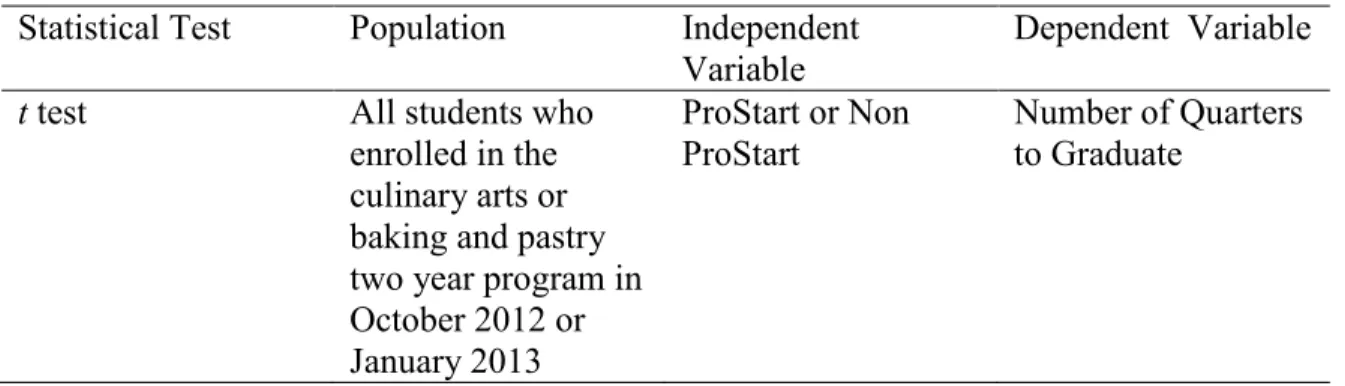
RQ2. To complete the analysis of RQ2, I also entered the data and used SPSS to analyze the data. I conducted a t test to test for a significant difference in mean time to completion between the two groups. I entered the data identifying if the participant participated in the ProStart high school program or did not participate, and I entered the number of months it took for them to complete the academic program.
Table 2 includes data related to RQ2, prior participation or nonparticipation in a secondary education ProStart program remained the independent variable and mean time to completion the dependent variable.
Table 2
Statistical Analysis RQ2
Statistical Test Population Independent Variable
Dependent Variable
t test All students who enrolled in the culinary arts or baking and pastry two year program in October 2012 or January 2013 ProStart or Non ProStart Number of Quarters to Graduate