Powering physics data transfers with FDT
This article has been downloaded from IOPscience. Please scroll down to see the full text article.
2011 J. Phys.: Conf. Ser. 331 052014
(http://iopscience.iop.org/1742-6596/331/5/052014)
Download details:
IP Address: 131.215.220.186
The article was downloaded on 30/03/2012 at 20:23
Please note that terms and conditions apply.
Powering physics data transfers with FDT
Zdenek Maxa1, Badar Ahmed2, Dorian Kcira1, Iosif Legrand1, Azher Mughal1
, Michael Thomas1
, Ramiro Voicu1 1
California Institute of Technology, Pasadena, California, USA
2
National University of Science and Technology, Pakistan
E-mail: [email protected]
Abstract. We present a data transfer system for the grid environment built on top of the
open source FDT tool (Fast Data Transfer) developed by Caltech in collaboration with the National University of Science and Technology (Pakistan). The enhancement layer above FDT consists of a client program - fdtcp (FDT copy) and a fdtd service (FDT daemon). This pair of components allows for GSI authenticated data transfers and offers to the user (or data movement production service) interface analogous to grid middle-ware data transfer services - SRM (i.e. srmcp) or GridFTP (i.e. globus-url-copy). fdtcp/fdtd enables third-party, batched file transfers. An important aspect is monitoring by means of the MonALISA active monitoring light-weight library ApMon, providing real-time monitoring and arrival time estimates as well as powerful troubleshooting mechanism.
The actual transfer is carried out by the FDT application, an efficient application capable of reading and writing at disk speed over wide area networks. FDT’s excellent performance was demonstrated e.g. during SuperComputing 2009 Bandwidth Challenge.
We also discuss the storage technology interface layer, specifically focusing on the open source Hadoop distributed file system (HDFS), presenting the recently developed FDT-HDFS sequential write adapter.
The integration with CMS PhEDEx is described as well. The PhEDEx project (Physics Experiment Data Export) is responsible for facilitating large-scale CMS data transfers across the grid.
Ongoing and future development involves interfacing with next generation network services developed by OGF NSI-WG, GLIF and DICE groups, allowing for network resource reservation and scheduling.
1. Introduction
The distributed computing model of the CMS [1] experiment relies heavily on effective utilisation of network links. The aim is to transfer data in as efficient and reliable fashion as possible. Such a need is similar to any experiment generating huge amounts of data that are necessary to distribute around the globe.
Although the main motivation for this presented study and project came primarily from CMS, the fdtcp grid transfer tool built on top of FDT can be used used in any experiment or collaboration requiring third-party, grid environment authenticated transfers.
1.1. Motivation
The transfer performance measurements discussed in the section 2 done over WAN links CERN - Caltech, USA and FDT’s excellent performance record on the SuperComputing conferences [3]
suggested that it’s worth to extend FDT capabilities into the grid environment. The experiments proved that the CMS data transfers, but also any data transfers-intensive experiment in general, would benefit from increased performance if FDT was used on the lowest lever of the transfer stack (e.g. as an alternative to GridFTP).
Another future aspect is the intention to employ dynamic network circuits provisioning (4.1).
1.2. FDT Characteristics
Fast Data Transfer (FDT) [2], also referred to asFDT Java, is an application capable of reading and writing at disk speed over wide area links. Written entirely in the Java language, it uses merely TCP sockets, Java NIO (New I/O) and direct memory buffers. It is based on the client-server model, is heavily multi-threaded and supports batched transfers1
.
Given the parallel nature of FDT, there is a major performance gain over WAN links (high RTT - Round Trip Time). Similarly to GridFTP, the FDT uses multiple TCP sessions. A novel concept is transferring files in a job in parallel (another level of parallelism above simultaneous TCP sessions), which provides a significant performance boost between distributed storages (e.g. Hadoop [9] or Lustre [10]).
It is distributed as an open-source project and has been developed by Caltech. The project is for example used by NOAA [11].
The FDT transfer can be very easily and seamlessly connected to the MonALISA monitoring framework that enables real time transfer monitoring - invaluable capability for network problems investigation.
Although FDT has a number of security features (source IP filtering, SSH, GSI2
-SSH, GSI-enabled server) it is not capable of managing third-party, grid-authenticated (GSI) transfers3
.
2. Transfer performance benchmarking
There has been a number of transfer performance measurements and comparisons conducted. The page [7] summarizes all initial experiments (with plain FDT before the enhancing fdtcp layer was developed) as well as analogous final comparisons between globus-url-copy (GridFTP),
srmcp(SRM) and fdtcp. This section discusses and interprets the final results4
.
Table 1. srmcp, globus-url-copy and fdtcp performance comparison (100x1GB transfer job) application parallel streams parallel files time [min] performance [MB/s]
globus-url-copy 35 1 (n/a) 74 23
srmcp 35 1 (n/a) 80-120 14-21
fdtcp 35 1 41 42
fdtcp 35 12 8-12 142-213
The benchmarking was carried out from the Caltech cluster at CERN to the Caltech campus cluster in California having distributed storages HDFS (Hadoop) [9] at both ends. The following list summarizes attributes of these tests:
1
A set of files in the transfer from A to B is processed by a single pair{client, server}as opposed to the grid
middle-ware GridFTP, which launches fresh instances of GridFTP{client, server}for each file in the batch.
2
Grid Security Infrastructure.
3
FDT features third-party transfers but only via SSH and such access is generally not given to users in the grid environment.
4
1 file in parallel means that parallel files files is not used or the feature is not available.
• memory to memory transfer between the clusters was 7.2Gbps (900MB/s) (link capacity), • a transfer job consists of 100 files of 1GB in size,
• measured values of time come from the GNU/Linux time utility, so all overhead of the
application, resp. protocol is taken into account (e.g. time spent in authentication, etc),
• unless specified, the SRM, resp. GridFTP tests were done using default values (e.g. buffer
sizes, etc).
srmcp doesn’t perform any data transfers physically itself, it calls GridFTP, resp. globus-url-copy to conduct the actual data movement. The comparison of results srmcp vs. globus-url-globus-url-copy then just shows the srmcp’s overhead on top of GridFTP. This is why only fdtcp vs globus-url-copy comparison is relevant5
. In order to interpret the superior fdtcp, resp. FDT performance over GridFTP, it’s necessary to realise following aspects:
• The feature of transferring files in parallel (fdtcp) specifies 12 parallel files. This value is
configurable in the fdtcp application and shall reflect the size of the storage cluster. If this was used in case of 1 storage node, it would lead to unnecessary transfer context switching and congestion, it is only useful in case of distributed storages,
• GridFTP doesn’t have the above feature. As the table 1 shows, this is where fdtcp
gains major boost over GridFTP. Taking into account the fact that an experiment’s, like CMS, huge amounts of data are always6
accommodated in a distributed storage7
, it is a major drawback that the only currently used transfer technology doesn’t provide such functionality, which lack of appears to be a chief contributor to the network links being utilized suboptimally,
• Another observed characteristic of GridFTP transfers was that for each file in the sequence
(batch) is launched a new pair of source-destination transfer applications - obvious overhead shutting and restarting the application. Also, the authentication is performed for each file in the batch. In the light of these facts, FDT can already be considered roughly twice as fast compared to GridFTP, even when parallel files are not enabled in FDT. This is only true with respect to the fileset features (100x1GB), as the following table 2 demonstrates8
.
Table 2. FDT, GridFTP transferring a single large file (1x100GB), no parallel files.
application parallel streams time [min] performance [MB/s]
globus-url-copy 35 29.5 57.9
FDT 35 28.9 59.1
The table 2 shows equal performance of FDT vs. GridFTP in case of 1x100GB transfer job, i.e. only one large file. Compared to the results in the table 1, this presents performance increase of 40% in case of FDT and 152% in case of GridFTP. The latter is significantly retarded by the circumstances discussed above in case of many files in the transfer job, e.g. 100x1GB. The
5
The FTS, another transfer service used e.g. by CMS PhEDEx system, delegates the transfer either to SRM (which cascades to GridFTP) or directly to GridFTP.
6
Not considering tape storage.
7
dCache, Hadoop, Lustre.
8
reached rate values in the table 2 are limited by the storage / filesystem performance regardless of the transfer protocol.
We conclude that, above reliable functionality, the optimal utilisation of the network links, which to a large degree translates into transfer protocol performance, is an important aspect. The argument that the traditional grid middle-ware service (GridFTP) can transfer files equally effectively when launched independently in parallel multiple instances is at least disputable: launching parallel transfer application instances in situations where performance of those applications shall be examined and questioned consumes unnecessary amounts of resources. Additional resources must be provided by additional physical nodes whose support and maintenance consumes extra both human and financial resources. In this context, we would like to quote [14]: ”More GridFTP9
increases the total throughput of the system10
and reduces individual server’s throughput.”. This is an important system administration observation suggesting investigations into optimal utilisation of resources.
3. Architecture & Implementation of fdtcp
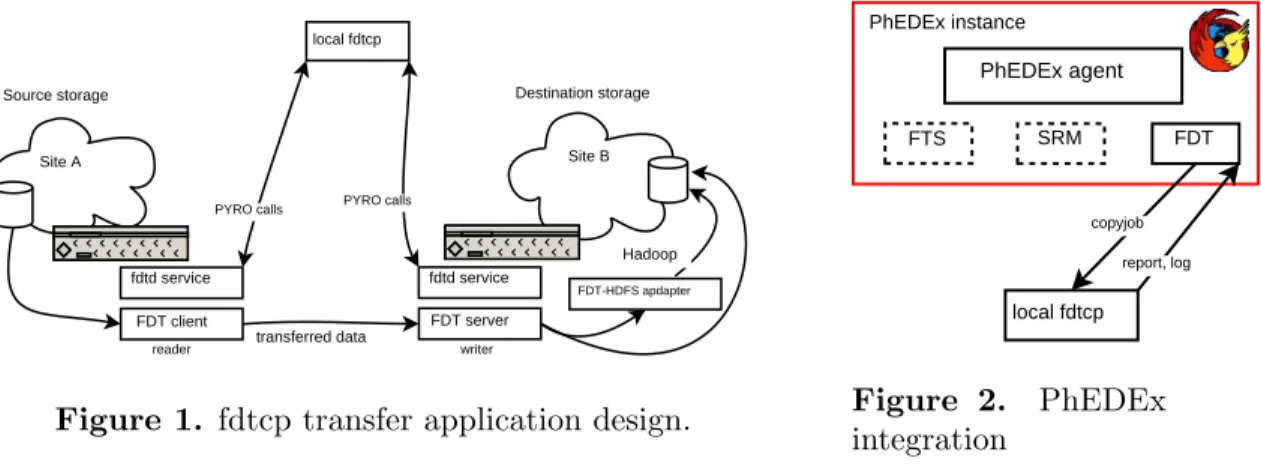
The scheme 1 displays the main blocks and the data, resp. control flow among them.
local fdtcp Site A Site B fdtd service fdtd service FDT-HDFS apdapter FDT client transferred data FDT server PYRO calls PYRO calls
reader writer
Source storage Destination storage
Hadoop
Figure 1. fdtcp transfer application design.
PhEDEx agent FTS SRM FDT PhEDEx instance local fdtcp copyjob report, log Figure 2. PhEDEx integration
• fdtcpis a Python client component that can be used analogously to srmcp11, it can be fed
the batch specification -copyjobfile and generates reportfile as required by PhEDEx,
• fdtd is a Python daemon, counterpart to fdtcp, utilizing PYRO [15] technology (RPC12),
runs at sites, fdtd performs following requests from fdtcp:
– grid authentication and mapping to local grid users against gridmap file
– launching FDT Java reader, resp. writer processes under local accounts
• FDT Java (represented by a single fdt.jar file) - Java processes started / stopped on
demand from fdtd, the writer (usually the destination party) will only respond to certain IP address (reader party), this service needs to run at sites supportingfdtprotocol (analogously to GridFTP),
• FDT-HDFS - Hadoop storage (HDFS) is capable of writing only sequential data (which
contradicts the parallel nature of FDT transfers). This adapter layer serializes arriving data into a form, which can be written into HDFS space in sequential fashion. This adapter
9
More GridFTP servers - reader, writer pairs.
10
Cluster of storage nodes.
11
The fdtcp/fdtd pair doesn’t provide any services beyond data movements, no remote files management like SRM does.
12
Remote Procedure Call.
component has also been developed within this project and it should be noted that for instance with Lustre store [10] it would not be necessary.
3.1. FDT-PhEDEx integration
This section enters the realm of CMS, which specifically means interfacing fdtcp and the PhEDEx system13
.
As shown in the 2 schema, the frontier is defined by FDT (FDT.pm) component within the PhEDEx instance. The download agent is a daemon, which periodically polls the central PhEDEx database for scheduled work on a given network link (e.g. Nebraska - Caltech). The FDT.pm module invokes fdtcp, feeding it with prepared copyjobfile (list of source, destination
pairs14
), receives back reportfile with transfer results. The currently supported transfer backends by PhEDEx are: SRM, FTS, FDT as shown in the picture 2.
In general it should be noted that FDT transfers by means of fdtcp can be used in situations where SRM, resp. srmcp is currently used (fdtcp and srmcp have analogous command line interface) and there is a need for better and optimal network utilisation. Up to the fdtcp level, the presented transfer technology is entirely independent on the CMS experiment systems.
3.2. Grid Authentication
The authentication mechanism currently used by fdtcp, fdtd when interacting with the host system is based on gridmapfile. This vehicle is used in both European as well as American grid environments, though in the latter is often complemented by a preferred GUMS system [16]. It is one of the future work items to implement GUMS support across fdtcp, fdtd.
3.3. FDT Transfer Monitoring
Figure 3. Hadoop
- Hadoop 100x1GB
files transfer CERN -Caltech T2 (California) reaching 107 MB/s via 1Gbps interface
FDT Java as well as fdtcp, fdtd and fdt-hdfs components are (very loosely) coupled with the MonALISA monitoring framework [12]. Each transfer executed by fdtcp is equipped with a unique transfer id, which can be used to track, trouble-shoot and monitor. Inspecting the progress of the transfer can currently be done via a web-executable MonALISA client application (groups FDT MON), however a web browser-accessible repository can easily be enabled.
The plot 3 shows almost saturated 1Gbps network interface. The long string on top of the picture is the transfer id. The peaks exceeding 1Gbps threshold are caused by buffering effect.
13
PhEDEx is the CMS production system responsible for data movements, utilises FTS (File Transfer Service) or SRM and by means of this project also FDT. Further information on the PhEDEx system can be found in the resources [6, 5].
14
4. Current Status and Future Work
The FDT transfers have been thoroughly tested in the grid environment. The installation of the component stack has been done on CMS T2 sites Caltech and Nebraska and PhEDEx instances at these sites were configured to utilise FDT for so called debug transfers (as opposed to production transfers). Once enough experience and confidence is gathered, the FDT protocol will be used for production transfers among selected sites. The page [4] lists details on progress of FDT-PhEDEx integration as well as instructions for PhEDEx administrators on how to evaluate this alternative transfer application.
However, the project is still under development. The main planned work items involve:
• Further ease of installation and configuration (largely automated from RPM packages), • Gather more experience / performance observation and eventually comparison of FTS vs
FDT transfers from within PhEDEx (PhEDEx transfer rate, plots) - performance study in the production CMS environment,
• Similarly to Hadoop-Hadoop performance tests, Lustre tests are planned,
• Evaluation of using GUMS for local grid user mapping (complement to the current gridmap
file) and usingglExec,
• Capability of utilisation of provisioned dynamic circuits (DYNES).
4.1. DYNES - Dynamic Network System
The DYNES [13] is a project funded by USA NSF and is aimed at creating a dynamic network ”cyber-instrument” spanning 40 US universities and 14 Internet2 connectors featuring scheduling, planning and provisioning dynamic network circuits for large transfers of scientific data.
The integration of FDT and dynamic network circuits capability was successfully demonstrated at GLIF 2009 meeting (Global Lambda Integrated Facility). This integration scenario happens on the FDT Java level and is therefore entirely transparent to PhEDEx as far as CMS is concerned.
Acknowledgments
This work was supported by the National Science Foundation within the DISUN grant, contract No. PHY-0533280, by the National Science Foundation within the Ultralight grant, contract No. PHY-0427110.
References
[1] CMS - Compact Muon Solenoid CERN experimenthttp://cms.cern.ch
[2] Fast Data Transfer (FDT)http://monalisa.cern.ch/FDT
[3] FDT SuperComputing 2009 conference bandwidth challengehttp://monalisa.cern.ch/FDT/sc09.html
[4] FDT and PhEDEx integration summaryhttps://twiki.cern.ch/twiki/bin/view/Main/PhEDExFDTIntegration
[5] CMS PhEDEx websitehttps://twiki.cern.ch/twiki/bin/view/CMS/PhEDEx
[6] Ricky Egeland, Tony Wildish, Simon Metson 2008 Data transfer infrastructure for CMS data taking XII
Advanced Computing and Analysis Techniques in Physics Research, November 3-7 2008 Erice, Italy
[7] Transfer performance benchmarking summaryhttps://twiki.cern.ch/twiki/bin/view/Main/TransferPerformance
[8] SRM - Storage Resource Managementhttps://sdm.lbl.gov/srm-wg
[9] HDFS - Apache Hadoop Distributed File Systemhttp://hadoop.apache.org/hdfs
[10] Lustre - Oracle Distributed File Systemhttp://wiki.lustre.org
[11] NOAA - National Oceanic and Atmospheric Administrationhttp://www.noaa.gov
[12] MonALISA - MONitoring Agents using a Large Integrated Services Architecturehttp://monalisa.cern.ch
[13] DYNES - Dynamic Network Systemhttp://www.internet2.edu/dynes
[14] Haifeng Pi 2010 High Throughput WAN Data Transfer with Hadoop-based Storage (PS23-4-071) CHEP
2010, October 18-22, 2010 Taipei, Taiwan
[15] PYRO - Python Remote Objectshttp://www.xs4all.nl/ irmen/pyro3
[16] GUMS Grid User Management Systemhttps://www.racf.bnl.gov/Facility/GUMS/1.3
![Table 1. srmcp, globus-url-copy and fdtcp performance comparison (100x1GB transfer job) application parallel streams parallel files time [min] performance [MB/s]](https://thumb-us.123doks.com/thumbv2/123dok_us/385886.2542771/3.893.135.767.807.925/performance-comparison-transfer-application-parallel-streams-parallel-performance.webp)