Identity-based Remote Data Integrity Checking with
Perfect Data Privacy Preserving for Cloud Storage
Yong Yu, Man Ho Au
∗, Giuseppe Ateniese, Xinyi Huang, Yuanshun Dai, Willy Susilo and Geyong Min
Abstract— Remote data integrity checking (RDIC) enables a data storage server, such as a cloud server, to prove to a verifier that it is actually storing a data owner’s data honestly. To date, a number of RDIC protocols have been proposed in the literature, but almost all the constructions suffer from the issue of a complex key management, that is, they rely on the expensive public key infrastructure (PKI), which might hinder the deployment of RDIC in practice. In this paper, we propose a new construction of identity-based (ID-based) RDIC protocol by making use of key-homomorphic cryptographic primitive to reduce the system complexity and the cost for establishing and managing the public key authentication framework in PKI based RDIC schemes. We formalize ID-based RDIC and its security model including security against a malicious cloud server and zero knowledge privacy against a third party verifier. We then provide a concrete construction of ID-based RDIC scheme which leaks no information of the stored files to the verifier during the RDIC process. The new construction is proven secure against the malicious server in the generic group model and achieves zero knowledge privacy against a verifier. Extensive security analysis and implementation results demonstrate that the proposed new protocol is provably secure and practical in the real-world applications.
Keywords: Cloud storage, data integrity, privacy preserving, identity-based cryptography.
I. INTRODUCTION
Cloud computing [1], which has received considerable at-tention from research communities in academia as well as industry, is a distributed computation model over a large pool of shared-virtualized computing resources, such as storage, processing power, applications and services. Cloud users are provisioned and de-provisioned recourses as they want in cloud computing environment. This kind of new computing represents a vision of providing computing services as public utilities like water and electricity. Cloud computing brings a number of advantages for cloud users. As examples, this include the following issues: (1) Users can avoid capital expenditure on hardware, software and services because they
∗Corresponding Author
Yong Yu, Yuanshun Dai and Geyong Min are with School of Computer Science and Engineering, University of Electronic Science and Technology of China, Chengdu, 611731, China. Email: [email protected]
Yong Yu and Xinyi Huang are with Fujian Provincial Key Laboratory of Network Security and Cryptology, Fujian Normal University, Fuzhou 350007, China.
Man Ho Au is with Department of Computing, The Hong Kong Polytechnic University, China.
Giuseppe Ateniese is with Department of Computer Science, Sapienza University of Roma, Italy
Willy Susilo is with the Center for Computer and Information Security Research, School of Computing and Information Technology, University of Wollongong, Wollongong, NSW 2522, Australia.
pay only for what they use; (2) Users can enjoy low man-agement overhead and immediate access to a wide range of applications; and (3) Users can access their data wherever they are, rather than having to stay close to their computers.
However, there is a vast variety of barriers before cloud computing can be widely deployed. A recent survey by Oracle referred the data source from international data corporation enterprise panel, showing that security represents 87% of users’ cloud fears1. One of the major security concerns of
cloud users is the integrity of their outsourced files since they no longer physically possess their data and thus lose the control over their data. Moreover, the cloud server is not fully trusted and it is not mandatory for the cloud server to report data loss incidents. Indeed, to ascertain cloud computing reliability, the cloud security alliance (CSA) published an analysis of cloud vulnerability incidents. The investigation [2] revealed that the incident of data Loss & Leakage accounted for 25% of all incidents, ranked second only to ”Insecure Interfaces & APIs”. Take Amazon’s cloud crash disaster as an example2. In 2011, Amazon’s huge EC2 cloud services crash permanently destroyed some data of cloud users. The data loss was apparently small relative to the total data stored, but anyone who runs a website can immediately understand how terrifying a prospect any data loss is. Sometimes it is insufficient to detect data corruption when accessing the data because it might be too late to recover the corrupted data. As a result, it is necessary for cloud users to frequently check if their outsourced data are stored properly.
The size of the cloud data is huge, downloading the entire file to check the integrity might be prohibitive in terms of bandwidth cost, and hence, very impractical. Moreover, tradi-tional cryptographic primitives for data integrity checking such as hash functions, authorisation code (MAC) cannot apply here directly due to being short of a copy of the original file in verification. In conclusion, remote data integrity checking for secure cloud storage is a highly desirable as well as a challenging research topic.
Blum proposed an auditing issue for the first time that en-ables data owners to verify the integrity of remote data without explicit knowledge of the entire data [3]. Recently, remote data integrity checking becomes more and more significant due to the development of distributed storage systems and online storage systems. Provable data possession (PDP) [4], [5] at untrusted stores, introduced by Ateniese et al., is a novel technique for “blockless validating” data integrity over remote
1IDC Enterprise Panel, 2010
servers. In PDP, the data owner generates some metadata for a file, and then sends his data file together with the metadata to a remote server and deletes the file from its local storage. To generate a proof that the server stores the original file correctly, the server computes a response to a challenge from the verifier. The verifier can verify if the file keeps unchanged via checking the correctness of the response. PDP is a practical approach to checking the integrity of cloud data since it adopts a spot-checking technique. Specifically, a file is divided into blocks and a verifier only challenges a small set of randomly chosen clocks for integrity checking. According to the example given by Ateniese et al. [4], for a file with 10,000 blocks, if the server has deleted 1% of the blocks, then a verifier can detect server’s misbehavior with probability greater than
99% by asking proof of possession for only 460 randomly selected blocks. Ateniese et al. proposed two concrete PDP constructions by making use of RSA-based homomorphic linear authenticators. Due to its necessity and practicability, remote data integrity checking has attracted extensive research interest [7]–[10], [12]–[15], [17]–[20], [24], [25] in recent years. Shacham and Waters [7] proposed the notion of compact proofs of retrievability by making use of publicly verifiable homomorphic authenticators from BLS signature [36]. This scheme also relies on homomorphic properties to aggregate a proof into a small authenticator value and as a result, the public retrievability can be achieved.
Ateniese et al. [21] considered dynamic PDP scheme for the first time based on hash functions and symmetric key encryptions, which means the data owner can dynamically update their file after they store their data on the cloud server. The dynamics operation involves data insertion, modification, deletion and appending. This scheme [21] is efficient but has only limited number of queries and block insertion cannot explicitly be supported. Erway et al. [23] extended the PDP model to dynamic PDP model by utilizing rank-based au-thenticated skip lists. Wang et al. [15] improved the previous PDP models by manipulating the Merkle Hash Tree (MHT) for block tag authentication. A recent work due to Liu et al. [24] showed that MHT itself is not enough to verify the block indices, which may lead to replace attack. They gave top-down levelled multi-replica MHT based data auditing scheme for dynamic big data storage on the cloud.
In data integrity checking with public verifiability, an ex-ternal auditor (or anyone) is able to verify the integrity of the cloud data. In this scenario, data privacy against the third party verifier is highly essential since the cloud users may store confidential or sensitive files say business contracts or medical records to the cloud. However, this issue has not been fully investigated. The “privacy” definition in the previous privacy-preserving public auditing scheme [13] requires that the verifier cannot recover the whole blocks from the responses generated by the cloud server. However, this definition is not strong enough, for example, it is vulnerable to dictio-nary attack. Wang et al. [25] proposed the notion of “zero-knowledge public auditing” to resist off-line guessing attack. However, a formal security model is not provided in this work. Yu et al. [26] recently enhanced the privacy of remote data integrity checking protocols for secure cloud storage, but their
model works only in public key infrastructure (PKI) based scenario instead of the identity-based framework. Encrypting the file before outsourcing can partially address the data privacy issue but leads to losing the flexibility of the protocols, since privacy preserving RDIC protocols can be used as a building block for other primitives. For example, Ateniese et al. [27] proposed a framework for building leakage-resilient identification protocols in the bounded retrieval model from publicly verifiable proofs of storage that are computationally zero-knowledge, but in the identification schemes, even the encrypted files must stay private.
Currently, a majority of the existing RDIC constructions rely on PKI where a digital certificate is used to guarantee the genuine of a user’s public key. These constructions incur complex key management procedures since certificate gen-eration, certificate storage, certificate update and certificate revocation are time-consuming and expensive. There is a variety of standards, say the Internet X.509 PKI certificate policy and certification practices framework (RFC 2527), that cover aspects of PKI. However, it lacks predominant governing body to enforce these standards. Despite a certificate authority (CA) is often regarded as trusted, drawbacks in the security procedures of various CAs have jeopardized trust in the entire PKI on which the Internet depends on. For instance, after discovering more than 500 fake certificates, web browser vendors were forced to blacklist all certificates issued by DigiNotar, a Dutch CA, in 2011. An alternative approach to using a certificate to authenticate public key is identity-based cryptography [28], in which the public key of a user is simply his identity, say, his name, email or IP address. A trusted key distribution center (KGC) generates a secret key for each user corresponding to his identity. When all users have their secret keys issued by the same KGC, individual public keys become obsolete, thus removing the need for explicit certification and all associated costs. These features make the identity-based paradigm particularly appealing for use in conjunction with organization-oriented PDP. For example, a university purchases the cloud storage service for the staff and students, who have a valid E-mail address issued by the IT department of the university. All the members of the university can have a secret key provided by the KGC, say the IT department. The members of the university can store their data together with the meta-data of the file to the cloud. To ensure the data are stored properly, an auditor, a staff of IT department can check the integrity for any member with his E-mail address only, which can relieve the complex key management caused by PKI. The first ID-based PDP was proposed in [29] which converted the ID-based aggregate signature due to Gentry [30] to an ID-based PDP protocol. Wang [31] proposed another identity-based provable data possession in multi-cloud storage. However, their security model called unforgeability for identity-based PDP is not strong enough for capturing the property of soundness in the sense that, the challenged data blocks are not allowed for TagGen queries in this model, which indicates that the adversary cannot access the tags of those blocks. This is clearly not consistent with the real cloud storage where the cloud server is, in fact, storing the tags of all data blocks. Moreover, the concrete identity-based PDP
protocol in [31] fails to achieve soundness, a basic security requirement of PDP schemes. The reason is that, the hashed value of each block is used for generating a tag of the block, as a consequence, a malicious cloud server can keep only the hash value of the blocks for generating a valid response to a challenge.
Our Contributions. The contributions of this paper are summarized as follows.
• In an ID-based signature scheme, anyone with access
to the signer’s identity can verify a signature of the signer. Similarly, in ID-based RDIC protocols, anyone knowing a cloud user’s identity, say a third party auditor (TPA), is able to check the data integrity on behalf of the cloud user. Thus, public verifiability is more desirable than private verification in ID-based RDIC, especially for the resource constrained cloud users. In this case, the property of zero-knowledge privacy is highly essential for data confidentiality in ID-based RDIC protocols. Our first contribution is to formalize the security model of zero-knowledge privacy against the TPA in ID-based RDIC protocols for the first time.
• We fill the gap that there is no a secure and novel ID-based RDIC scheme to date. Specifically, we propose a concrete ID-based RDIC protocol, which is a novel construction that is different from the previous ones, by making use of the idea of a new primitive called asymmetric group key agreement [32], [33]. To be more specific, our challenge-response protocol is a two party key agreement between the TPA and the cloud server, the challenged blocks must be used when generating a shared key by the cloud server, which a response to a challenge from the TPA.
• We provide detailed security proofs of the new protocol, including the soundness and zero-knowledge privacy of the stored data. Our security proofs are carried out in the generic group model [34]. This is the first correct security proof of ID-based RDIC protocol. Thus, the new security proof method itself may be of independent interest.
• We show the practicality of the proposal by developing
a prototype implementation of the protocol.
Organization: The rest of the paper are organized as follows. In Section II, we review some preliminaries used in ID-based RDIC construction. In Section III, we formalize the system model and security model of ID-based RDIC protocols. We describe our concrete construction of ID-based RDIC protocol in section IV. We formally prove the correctness, soundness and zero knowledge privacy of our ID-based RDIC protocol in section V. We report the performance and imple-mentation results in section VI. Section VII concludes our paper.
II. PRELIMINARIES
In this section, we review some preliminary knowledge used in this paper, including bilinear pairings and zero-knowledge proof.
A. Bilinear Pairing
A bilinear pairing [28] maps a pair of group elements to another group element. Specifically, letG1, G2 be two cyclic
groups of orderp.g1 andg2denote generators ofG1 andG2
respectively. A functione:G1×G1→G2 is called a bilinear
pairing if it has the following properties:
Bilinearity.For all u, v ∈G1 andx, y ∈Zp,e(ux, vy) =
e(u, v)xy holds.
Non-Degeneracy.e(g, g)6= 1G2 where1G2 is the identity
element ofG2.
Efficient Computation.e(u, v)can be computed efficiently (in polynomial time) for allu, v∈G1.
B. Equality of Discrete Logarithm
LetG be a finite cyclic group such that|G|=q for some primeq, andg1, g2be generators ofG. The following protocol
[37] enables a prover P to prove to a verifier V that two elementsY1, Y2 have equal discrete logarithm to base g1 and
g2 respectively.
Commitment.Prandomly choosesρ∈Zq, computesT1=
g1ρ, T2=g2ρ and sends T1, T2 toV.
Challenge. V randomly chooses a challenge c ∈ {0,1}λ
and sendsc back toP.
Response.Pcomputes z=ρ−cx (mod q)and returns z
toV.
Verify.Vaccepts the proof if and only ifT1=g1zY1c∧T2=
gz
2Y2c holds.
This protocol can be converted into a more efficient non-interactive version, which is denoted as P OK{(x) : Y1 =
gx
1 ∧Y2 =g2x}, by replacing the challenge with the hash of
the commitment, that is,c=H(T1||T2), whereH is a secure
hash function.
C. ID-based Signature
An identity-based signature (IDS) scheme [38], [39] consists of four polynomial-time, probabilistic algorithms described below.
Setup(k).This algorithm takes as input the security param-eter k and outputs the master secret key msk and the master public keympk.
Extract(msk, ID). This algorithm takes as input a user’s identityID, the master secret keymsk and generates a secret keyusk for the user.
Sign(ID, usk, m). This algorithm takes as input a user’s identity ID, a message m and the user’s secret key usk and generates a signatureσ of the messagem.
Verify(ID, m, σ, mpk). This algorithm takes as input a signatureσ, a messagem, an identityIDand the master public keympk, and outputs if the signature is valid or not.
III. SYSTEMMODEL ANDSECURITYMODEL
In this section, we describe the system model and security model of identity-based RDIC protocols.
A. ID-based RDIC System
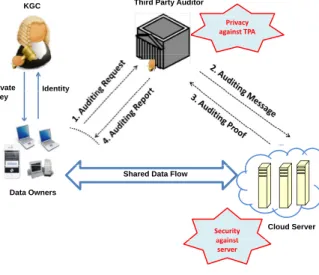
Usually, data owners themselves can check the integrity of their cloud data by running a two-party RDIC protocol. However, the auditing result from either the data owner or the cloud server might be regarded as biased in a two-party scenario. The RDIC protocols with public verifiability enable anyone to audit the integrity of the outsourced data. To make the description of the publicly verifiable RDIC protocols clearly, we assume there exits a third party auditor (TPA) who has expertise and capabilities to do the verification work. With this in mind, the ID-based RDIC architecture is illustrated in Fig 1. Four different entities namely the KGC, the cloud user, the cloud server and the TPA are involved in the system. The KGC generates secret keys for all the users according to their identities. The cloud user has large amount of files to be stored on cloud without keeping a local copy, and the cloud server has significant storage space and computation resources and provides data storage services for cloud users. TPA has expertise and capabilities that cloud users do not have and is trusted to check the integrity of the cloud data on behalf of the cloud user upon request. Each entity has their own obligations and benefits respectively. The cloud server could be self-interested, and for his own benefits, such as to maintain a good reputation, the cloud server might even decide to hide data corruption incidents to cloud users. However, we assume that the cloud server has no incentives to reveal the hosted data to TPA because of regulations and financial incentives. The TPA’s job is to perform the data integrity checking on behalf the cloud user, but the TPA is also curious in the sense that he is willing to learn some information of the users’ data during the data integrity checking procedure.
Third Party Auditor KGC Privacy against TPA Identity Private Identity Key
Shared Data Flow Data Owners Security against Cloud Server against server
Fig. 1. The system model of identity-based RDIC
B. System Components and its Security
Six algorithms namely Setup, Extract, TagGen, Chal-lenge, ProofGen and ProofCheck are involved in an identity-based RDIC system.
• Setup(1k)is a probabilistic algorithm run by the KGC. It takes a security parameterk as input and outputs the system parametersparamand the master secret keymsk.
• Extract(param, msk, ID) is a probabilistic algorithm
run by the KGC. It takes the system parametersparam, the master secret key msk and a user’s identity ID ∈ {0,1}∗ as input, outputs the secret keysk
ID that
corre-sponds to the identityID.
• TagGen(param, F, skID) is a probabilistic algorithm
run by the data owner with identity ID. It takes the system parameters param, the secret key of the user
skID and a file F ∈ {0,1}∗ to store as input, outputs
the tagsσ= (σ1,· · · , σn)of each file block mi, which
will be stored on the cloud together with the fileF.
• Challenge(param, F n, ID) is a randomized algorithm run by the TPA. It takes the system parametersparam, the data owner’s identityID, and a unique file nameF n
as input, outputs a challengechal for the file namedF n
on behalf of the userID.
• ProofGen(param, ID, chal, F, σ) is a probabilistic
al-gorithm run by the cloud server. It takes the system parametersparam, the challengechal, the data owner’s identity ID, the tag σ, the file F and its name F n as input, outputs a data possession proofP of the challenged blocks.
• ProofCheck(param, ID, chal, P, F n)is a deterministic algorithm run by the TPA. It takes the system parameters
param, the challengechal, the data owner’s identityID, the file name F nand an alleged data possession proof
P as input, outputs1or 0to indicate if the fileF keeps intact.
We consider three security properties namely completeness, security against a malicious server (soundness), and privacy against the TPA (perfect data privacy) in identity-based re-mote data integrity checking protocols. Following the security notions due to Shacham and Waters [7], an identity-based RDIC scheme is called secure against a server if there exists no polynomial-time algorithm that can cheat the TPA with non-negligible probability and there exists a polynomial-time extractor that can recover the file by running the challenges-response protocols multiple times. Completeness states that when interacting with a valid cloud server, the algorithm of ProofCheck will accept the proof. Soundness says that a cheating prover who can convince the TPA it is storing the data file is actually storing that file. We now formalize the security model of soundness for identity-based remote data integrity checking below, where an adversary who plays the role of the untrusted server and a challenger who represents a data owner are involved.
Security against the Server. This security game captures that an adversary cannot successfully generate a valid proof without possessing all the blocks of a userIDcorresponding to a given challenge, unless it guesses all the challenged blocks. The game consists of the following phases [35].
• Setup: The challenger runs theSetupalgorithm to obtain the system parametersparamand the master secret key
msk confidential.
• Queries: The adversary makes a number of queries to
the challenger, including extract queries and tag queries adaptively.
1) Extract Queries: The adversary can query the private key of any identity IDi. The challenger
computes the private keyskiby running theExtract
algorithm and forwards it to the adversary.
2) TagGen Queries: The adversary can request tags of any fileF under the identityIDi. The challenger
runs theExtractalgorithm to obtain the private key
ski, and runs theTagGenalgorithm to generate tags
of the fileF. Finally, the challenger returns the set of tags to the adversary.
• ProofGen: For a file F of which a TagGen query has been made, the adversary can undertake executions of the ProofGen algorithm by specifying an identity ID
of the data owner and the file name F n. The challenger plays the role of the TPA and the adversary Abehaves as the prover during the proof generation. Finally, the adversary can get the output of P from the challenger when a protocol execution completes.
• Output: Finally, the adversary chooses a file name F n†
and a user identity ID†. ID† must not have appeared in key extraction queries and there exists a TagGen
query with inputF† andID†. The adversary outputs the description of a proverP† which is-admissible defined below.
We say the cheating proverP† is-admissible if it
convinc-ingly answers an fraction of integrity challenges. That is,
Pr[(V(param, ID†, F n†) P†) = 1] ≥. The probability here is over the coins of the verifier and the prover. The adversary wins the game if it can successfully output a -admissible proverP†.
An ID-RDIC scheme is called-sound if there exists an ex-traction algorithmExtrsuch that, for every adversaryA, when-ever A, playing the soundness game, outputs an-admissible cheating prover P† on identityID† and file name F n†,Extr
recovers F† from P†, i.e.,Extr(param, ID†, F n†, P†) =F, except possibly with negligible probability.
Perfect data privacy against the TPA. By “perfect data privacy” we mean that TPA achieves no information of the outsourced data, that is, whatever TPA learns, the TPA could have learned by himself without any interaction with the cloud server. We make use of a simulator to formalize this model as follows.
Definition 1.An identity-based remote data integrity check-ing protocol achieves perfect data privacy if for every cheatcheck-ing verifierT P A∗, there exists a polynomial time non-interactive simulator S for T P A∗ such that for every valid public input
ID, chal, T ag and private inputF, the following two random variables are computationally indistinguishable:
1) viewT P A∗(ServerR,chal,F,ID,T ag,T P A∗), where R
de-notes the random coins the protocol uses. 2) S(chal, ID).
That is to say, the simulator S gets only the information of the public input and has no interactions with the server,
but still manages to output a response indistinguishable from whateverT P A∗ learns during the interaction.
IV. OURCONSTRUCTION
In this section, we provide a concrete construction of secure identity-based remote data integrity checking protocol supporting perfect data privacy protection. Our scheme works as follows. In the key extraction, we employ short signature algorithm due to Boneh et al. [36] to sign a user’s identity
ID∈ {0,1}∗ and obtain the user’s secret key. In TagGen, we
invent a new algorithm to generate tags of file blocks which can be aggregated into a single element when computing a response to a challenge. In the challenge phase, the TPA challenges the cloud by choosing some indexes of the blocks and random values. In the proof generation, the cloud server computes a response using the challenged blocks, obtains the corresponding plaintext and forwards it to the TPA. The details of the proposed protocol are as follows.
Setup.On input a security parametersp, the KGC chooses two cyclic multiplicative groupsG1 andG2 with prime order
q, where g is a generator of G1. There exists a bilinear map
e : G1 ×G1 → G2. The KGC picks a random α ∈ Zq∗
as the master secret key and sets Ppub = gα. Finally, the
KGC chooses three hash functions H1, H2 : {0,1}∗ →
G1 and H3 : G2 → {0,1}l. The system parameter is
(G1, G2, e, g, Ppub, H1, H2, H3, l).
Extract. On input the master secret key α and a user’s identityID ∈ {0,1}∗, this algorithm outputs the private key
of this user ass=H1(ID)α.
TagGen.Given a fileM namedfname, the data owner firstly divides it intonblocksm1,· · · , mn, wheremi∈Zq and then
picks a randomη∈Zq∗and computesr=gη. For each block
mi, the data owner computes
σi=smiH2(f name||i)η.
The tag for mi is σi. The data owner stores the file M
together with (r,{σi},IDS(r||f name)), to the cloud, where
IDS(r||f name)is an identity-based signature [38], [39] from the data owner on the value r||f name.
Challenge.To check the integrity ofM, the verifier picks a random c-element subsetIof the set[1, n]and for eachi∈I, chooses a random elementvi ∈Zq∗. Let Q be the set{(i, vi)}.
To generate a challenge, the verifier picks a random ρ∈Zq∗, computesZ =e(H1(ID), Ppub)and does the following.
1) Computec1=gρ, c2=Zρ.
2) Generate a proof that :
pf =P OK{(ρ) :c1=gρ ∧ c2=Zρ}.
The verifier sends the challengechal= (c1,c2,Q,pf)to the
server.
GenProof. Upon receiving chal = (c1, c2, Q, pf), the
server first computesZ =e(H1(ID), Ppub). Then, it verifies
the proof pf. If it is invalid, the auditing aborts. Otherwise, the server computesµ=P
i∈Ivimi,σ=Qi∈Iσ vi
i andm0=
H3(e(σ, c1)·c− µ
2 )and returns(m0,r,IDS(r||f name))as the
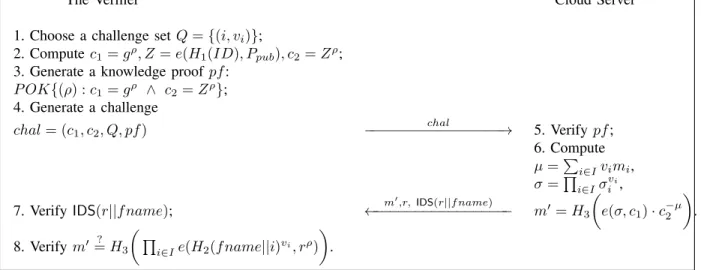
The Verifier Cloud Server 1. Choose a challenge set Q={(i, vi)};
2. Compute c1=gρ, Z=e(H1(ID), Ppub), c2=Zρ;
3. Generate a knowledge proof pf:
P OK{(ρ) :c1=gρ ∧ c2=Zρ}; 4. Generate a challenge chal= (c1, c2, Q, pf) chal −−−−−−−−−−−−−−−−−→ 5. Verifypf; 6. Compute µ=P i∈Ivimi, σ=Q i∈Iσ vi i ,
7. VerifyIDS(r||f name); m
0,r, IDS(r||f name) ←−−−−−−−−−−−−−−−−− m0=H3 e(σ, c1)·c−2µ . 8. Verifym0 =? H3 Q i∈Ie(H2(f name||i)vi, rρ) .
Fig. 2. Identity-based remote data integrity checking protocol
CheckProof.Upon receivingm0from the server, the verifier checks if IDS(r||f name) is a valid identity-based signature from the data owner on the message r||f name. If not, the proof is invalid. Otherwise, the verifier checks if
m0=H3 Y i∈I e(H2(f name||i)vi, rρ) .
If the equality holds, the verifier accepts the proof; Otherwise, the proof is invalid.
V. SECURITYANALYSIS OF THENEWPROTOCOL
In this section, we show that the proposed scheme achieves the properties of completeness, soundness and perfect data privacy preserving. Completeness guarantees the correctness of the protocol while soundness shows that the protocol is secure against an untrusted server. Perfect data privacy states that the protocol leaks no information of the stored files to the verifier.
A. Completeness
If both the data owner and the cloud server are honest, for each valid tagσiand a random challenge, the cloud server can
always pass the verification. The completeness of the protocol
can be elaborated as follows.
m0 = H3 e(σ, c1)·c− µ 2 = H3 e(σ, c1) e(H(ID), Ppub)ρ P i∈Imivi = H3 e(Q i∈Iσ vi i , c1) e(s, g)ρPi∈Imivi = H3 Q i∈Ie(σ vi i , c1) Q i∈Ie(s, c1)mivi = H3 Y i∈I e( σi smi, g ρvi) = H3 Y i∈I e(H2(f name||i)η, gρvi) = H3 Y i∈I e(H2(f name||i)vi, gρη) = H3 Y i∈I e(H2(f name||i)vi, rρ) . B. Soundness
In this part, we show that the probability of any generic
algorithm in breaking the soundness of our protocol is negligi-ble. Agenericalgorithm is an algorithm that does not exploit the algebraic structure of the underlying finite cyclic group. The generic group model is designed to capture the behavior of anygenericalgorithm. We briefly review the idea below.
Let p be a prime and ξi : Zp → {0,1}dlog2pe for i ∈
{1,2} be two independent random encoding functions. The generic group Gi is represented as Gi = {ξi(x)|x ∈ Zp}.
Since a generic algorithm does not exploit the structure of the group, we say that given an elementξi(x)∈Gi, nothing
about the element except equality can be inferred. Two oracles, Oi,i∈ {1,2} are used to simulate the group action: for any
ξi(b)returns an elementξi(a+b)(for multiplication) orξi(a−
b)(for division). Another oracle,OE, is used to represent the
pairing operation ofˆe:G1×G1→G2. Specifically, on input
ξ1(a)andξ1(b), oracleOE returns ξ2(a∗b).
Proof: After discussing the setting, we are going to show that our construction is secure against any genericalgorithm in the random oracle model. Let A be a generic adversary making q1, q2, q3 queries to the random oracles H1,H2, H3
respectively, we show how to construct a simulator S which simulates the view of A in the generic group model and extracts fromAthe set of messages.
• Settings. In the generic group model and the random oracle model, the public parameters can be represented as:
`, q,OE,O1,O2,H1,H2,H3, ξ1, ξα,
where the first three oracles represent the pairing oper-ation and group operoper-ations, and the next three oracles represent the hash operations, and ξ1, ξα are the
encod-ings of elementgandPpubrespectively. They are chosen
as random bit-strings by S. S associates the encoding
ξ1 to a constant polynomial 1 and ξα to a multivariate
polynomial α. Looking ahead, we shall see that at any stage, any group element will be associated with a mul-tivariate polynomial. Specifically, any element presented to A will be associated with a multivariate polynomial in variables (α,{Ii} qI i=1,{fi} n∗qf i=1 ,{ηi} qt i=1, ρ). We will
discuss the rule of polynomial associations shortly.
• Hash Queries. For any query to H1 with input IDk, S
returns a random bit-string ξIk and associates it to a
multivariate polynomial Ik. For any query to H2 with
inputf namej||i,S returns a random bit-stringξfj,i and
associates it to a multivariate polynomial fj,i. For any
query toH3,S returns a random bit-string (which is not
a group element).
• Group G1 operation (oracle O1). A presents to S two
elementsξF1,ξF2 and two integers,e1, e2.S looks up its
history to locate the polynomial associated to elements
ξF1 and ξF2 (assume they are F1 and F2 respectively).
If such elements do not exist, it means ξF1 or ξF2 is
not a valid group element and S rejects the operation. S computes e1F1+e2F2 and the resulting polynomial
is denoted as F3. S lookup its history to check if there
exists an elementξinG1which has been associated with
F3. If yes, it returnsξ. Otherwise,S picks a random
bit-string ξF3 and associates it to polynomial F3. It returns
ξF3 toA. Note that the element ξF3 represents the result
of group operation ξF1 to the power of e1 times ξF2 to
the power of e2.
• Group G2 operation (oracle O2). The handling is the
same as that ofO1 queries.
• Pairing operation (oracle OE). A presents to S two
elements ξF1, ξF2. S lookup its history to locate the
polynomial associated to elements ξF1 and ξF2 (assume
they areF1andF2respectively). If such elements do not
exist, it means ξF1 or ξF2 is not a valid group element
and S rejects the operation. S computes F1 ·F2 and
the resulting polynomial is denoted as F3. S looks up
its history to check if there exists an element ξ in G2
which has been associated withF3. If yes,S returns ξ.
Otherwise,Spicks a random bit-stringξF3and associates
it to polynomial F3. It returns ξF3 to A. Note that the
element ξF3 represent the result of the pairing operation
on elements ξF1 andξF3.
• Extraction Query.Apresents an identityID toS.S lo-cates anH1query with the same input. If not, it implicitly
makes an H1 query. It obtains the element representing
H(ID), say ξIk and its corresponding polynomial Ik.
If there exists an element in G1, say ξ, which has been
associated to the polynomialαIk,Sreturnsξ. Otherwise,
it picks a random bit-string ξαIk, associates it to the
polynomialαIk and returns it toA.
• TagGen Query. A presents an identity ID and a file
M = (m1, . . . , mn)toS with name f namej.S locates
an extract query withID. If not, it implicitly makes an extraction query with ID as input. Assume the element
H(ID)is associated with polynomialIk. It also obtains
the set of elements {H2(f namej||i)} (S makes those
H2 queries if they do not exist). Assume the element
H2(f namej||i) is associated with the polynomial fj,i
S picks a random bit-string ξηj and associates it with
the polynomial ηj. For i = 1 to n, S computes the
polynomialFj,i=αIkmi+fj,iηj. If an elementξj,ihas
been associated with polynomialFj,i,Sreturnsξj,ias the
tagσj,ifor blockmifor filef namej. Otherwise,Spicks
a random bit-stringξj,i, associates it withFj,i, and returns
ξj,ias the tag of the blockmi. The bit-stringξηj is also
given to A at this stage. Note that (ξηj, ξj,1, . . . , ξj,n)
represents (r, T) for file M with name f namej. An
identity-based signature IDS(r||f name) on r||f namej
is also given toA.
At some stage A decides to be challenged on a certain target identityID and a certain fileM = (m1, . . . , mn)with
name f name under the restriction that A has never made an extraction query on ID. We can safely assume A has made a hash query on ID. We assume the element H1(ID)
is associated with the polynomial I. S conducts a TagGen query withAusingIDandM as input. Assume the elements returned toAare(ξηj, ξj,1, . . . , ξj,n). In the following we will
drop the subscript j for clarity. Now, S plays the role of a challenger and A plays the role of the cloud server in the protocol.
• (Challenge). S picks a subset I ⊂ [1, n] and for each
i∈ I,Spicksvi.S further picks a random bit-stringξc1
and associates to it polynomial ρ. It also picks another random bit-stringξZ and associates to it the polynomial
αI. ξc1 andξZ represents the group G1 element c1 and
the group G2 element Z respectively. It also chooses a
random bit-stringξc2 and associates it to the polynomial
αIρ.ξc1,ξc2are given toA, along with a simulated proof
pf.
• (Polynomial Evaluation). Recall thatIis the polynomial associated with the elementH1(ID). Letηbe the
polyno-mial associated with the elementξη. Further, letfibe the
Thus, the tag for mi (the σi’s) will be associated with
polynomialsFi≡miαI+fiη. At this stage,Schooses at
random the values for all variables except the following:
α, I,{fi}i∈I, η, ρ.
In other words, all polynomials given toAare multivari-ate polynomials inc+ 4variables. The instantiation does not affect the view of the previous simulation as long as it does not create any “incorrect” relationship.
• (GenProof). Finally, A returns a value m0, along with a group element r and its identity-based signature
IDS(r||f name).
In the random oracle model, the only way for A to suc-cessfully return m0 =H3(Qi∈Ie(H2(f name||i)vi, rρ))is to
make a query to H3 with an element ξ in group G2. Due
to the unforgeability of the identity-based signature, we can safely assume r (represented by the element ξη used in the
verification is the one given to Aduring the TagGen query. For A to win with non-negligible probability, ξ must be associated with a polynomial F such that
F ≡X
i∈I
vifiρη.
It remains to show that in order to produce an element ξ
whose associated polynomial satisfies the above equivalence relationship, A has to make a set of group operation queries which allows S to extract the set of constants{mi}.
Further-more, these set of queries are madeafterthe challenge phase. Firstly, note that for each query, A obtains at most a new group element and thus the total number of elements obtained by Ais finite. Before the challenge phase,Ahas no element whose polynomial is associated with the variableρnorIαρ.
Before the challenge phase, each element in group G1 is
associated with a polynomial of the following form:
A0+A1α+A2η+A3I+ X i∈I A4,ifi+ X i∈I A5,i(miIα+fiη)
whereA’s are coefficients known toA. Likewise, each group element in group G2 is associated with a polynomial of the
following form:
k X
j=1
cjFj∗Fj0
where Fj and Fj0 are polynomials associated with elements
in group G1 and cj being a constant. It is easy to see that
polynomials obtained by A before the challenge will not satisfy the required relationship as the variable ρis missing.
After the challenge phase, A has access to two additional elements whose polynomials are ρ in group G1 and Iαρ in
group G2 respectively. From this, all group G2 elements
ob-tained byAare associated with a polynomial of the following
form: A0+A1ρ+A2α+A3η+A4I+ X i∈I A5,ifi+ X i∈I
A6,i(miIα+fiη) +A7Iαρ+
B1ρ2+B2ρα+B3ρη+B4ρI+ X i∈I B5,ifiρ+ X i∈I
B6,i(miIαρ+fiηρ) +B7Iαρ2+
C1α2+C2αη+C3αI+ X i∈I C4,ifiα+ X i∈I
C5,i(miIα2+fiηα) +C6Iα2ρ+
D1η2+D2Iη+ X i∈I D3,ifiη+ X i∈I D4,i(miIαη+fiη2)+ D5Iαρη+ E1I2+ X i∈I E2,ifiI+ X i∈I E3,i(miI2α+fiIη) +E4I2αρ+ X i∈I X j∈I F1,i,jfifj+ X i∈I X j∈I F2,i,j(miIαfj+fifjη)+ X i∈I F3,iIαρfi+ X i∈I X j∈I
G1,i,j(m1Iα+fiη)(mjIα+fjη)+ X
i∈I
G2,i(miI2α2ρ+fiηIαρ)+
H1I2α2ρ2
where all coefficients are known to A and S. Equating the coefficients withF, all coefficients are0exceptB6,iandA7.
Specifically, B6,i=vi for alli∈ I andA7=Pi∈Imivi.
In other words, S can extract from Athe terms A7 which
is P
i∈Imivi. With |I| interactions, S can compute all the
values ofmifromA. Furthermore, observe that the operations
that leads to this coefficient A7 has to be issued after the
challenge since they are related to the polynomial Iαρ. This completes the proof.
C. Perfect Data Privacy Preserving
To prove that the scheme preserve data privacy, we show how to construct a simulator S, having blackbox-access to verifier V, can simulate the remote data integrity checking protocol without the knowledge of the data file blocks {mi}
nor their corresponding{σi}3.
We assume IDS(r||f name), r, f name is given to S. In other words, our protocol does not preserve the privacy of the file name nor the parameterr. Sincer=e(g, g)η, whereηis a
random value chosen by the data owner, it is reasonable to say
r does not contain the information of the file blocks. Below we show howS answers the challenge given by a verifier V. Upon receiving the challengechal from V,S parses chal
as (c1, c2, Q, pf). Next, S extracts from V the valueρ. Due
3Since{σ
to the soundness of pf, S obtains ρ such that c1 = gρ
and c2 = e(H1(ID), Ppub)ρ. S parses Q as {(i, vi)} and
computes m0=H3(Qi∈Ie(H2(f name||i)vi), rρ).S outputs
(m0, r, IDS(r||f anme))as the response to this challenge. For each challenge (c1, c2, Q, pf), there is a unique value
m0 that is valid. Thus, the above simulation is perfect. VI. PERFORMANCE ANDIMPLEMENTATION
In this section, we first numerically analyze the cost of the new protocol, and then report its experimental results.
A. Numerical Analysis
We provide a numerical analysis of costs regarding compu-tation, communication and storage of the proposed protocol in this part.
Computation cost. We present the computation cost from the viewpoint of the KGC, the data owner, the cloud server and the verifier (TPA). For simplicity, we denote byEG1, EG2the
exponentiations inG1 and G2,MG1, MG2 the multiplication
in G1 and G2, P the pairing computation and H the
map-to-point hash function respectively. We ignore the ordinary hash functions in numerical analysis since the cost of these functions is negligible compared with other operations.
The primary computation of the KGC is generating system parameters and private key for each user. Thus, the main computational cost of KGC is 2EG1+ 1H. The dominated
computation of data owner is generating tags for file blocks as σi = smiH2(f name||i)η, which is the most expensive
operation in the protocol but fortunately it can be done offline. For a file with n blocks, the cost of the data owner is
(2n+ 1)EG1+nH. The main cost of the verifier is generating
a challenge and checking the validity of a proof. The verifier needs to perform1pairing operation, and6exponentiations in
G1 to generate a challenge when using the proof of equality
of discrete logarithm given in [37]. When checking a proof, the cost of the verifier is(c+ 1)EG1+cP+cH+ (c−1)EG2.
The main computation cost of generating a proof by the cloud server is calculating the aggregation of σi, that is σ= Q
i∈Iσ vi
i , and the total cost is2P+(2c−1)MG1+EG2+MG2.
Communication cost. In the challenge phase, the verifier sends (c1, c2, Q, pf) to the server, where Q = {(i, vi)}
denotes the challenge set. In practice, we can employ a pseudo-random functionθand a pseudo-random permutationψas the public parameters. The verifier only needs to include a key
k1 of θ and a key k2 of ψ in the challenge, instead of the
challenge set Q, which can reduce the communication cost significantly. In this case, the communication cost is of binary length log2c1+log2c2+log2k1+log2k2+log2pf. In the
response phase, the server returns (m0, r, IDS(rk f name))
as the response to the verifier. An identity-based signature usually contains two points (320 bits) of elliptic curves, thus the communication cost of the response is of binary length
l+log2r+ 320.
Storage cost.Regarding the storage cost of the cloud server, the data owner and the verifier, since identity-based data auditing schemes are publicly verifiable, both the data and the tags are stored on the cloud server. An identity-based digital
signature algorithm is used to protect the commitmentrfrom being tampered by external and internal adversaries. In this case, what stored on the cloud are as follows.
Data Tags rkIDS(r,fname)
The data owner needs to store nothing in the context of public verifiability. With the knowledge of the identity information of the data owner, a verifier is able to check the integrity of the data on behalf the data owner. Thus, what the verifier needs to store is the challenge set Q and the value ρ randomly selected by himself. The storage cost of a verifier can be reduced to log2k1 + log2k2 + log2q
bits. The storage cost of the block tags is upper bounded by dlog2(M)/log2qe160 bits when employing proper elliptic
curves [28]. The cloud server hosts the data, the tags, r and its signature. As a consequence, the storage cost of the cloud server is upper bounded bylog2M+dlog2(M)/log2qe160 +
log2r+len(IDS(rkf name)).
B. Implementation Results
The implementation was conducted with pbc-0.5.13 [40] with pbc wrapper-0.8.0 [41] on Intel i7-4700MQ CPU @ 2.40GHz. The memory is always sufficient since the scheme only requires a polynomial space. In our implementation, we made use of parameter a.param, one of the standard parameter settings of pbc library. Parametera.paramprovides a symmetric pairing with the fastest speed among all default parameters. The implementation time overheads of the proto-col are displayed in the following two parts.
In the first part, we setup a file of a constant size of 1
MB, and observe the impact of the number of challenged blocks in terms of the time cost. In our setting, the size of a data block is bounded by the group order p, i.e.,160 bits. Hence, we have 50,000 blocks in total. This implies that the timing results for Setup, Extract and TagGen steps are constant for this part. See Table I for more details. We can see that both the Setup algorithm and the Extract algorithm are extremely fast. The Setup algorithm picks some random values and compute a modular exponentiation in G1, which
costs4.8ms, and the Extract algorithm needs to perform one modular exponentiation in G1 for generating the private key
of a cloud user, which cost 0.1ms. The TagGen algorithm is expensive and we show that the TagGen timing result consists of two phases, an off-line phase, where the data owner can pre-processH2(f nameki)η without knowing the actual data; and
an on-line phase, where the data owner needs to computesmi
for each data block. (Note that since all those exponentiations are carried out with a same base, we can use a lookup table to accelerate those single-base multiple-exponent operations.) The time cost of off-line computation of generating tags for
1 MB file is 241.9 seconds while the on-online time cost is
20.3 seconds. This is an acceptable result compared with the previous preprocessing result in [5].
We then increase the number of challenged blocks from
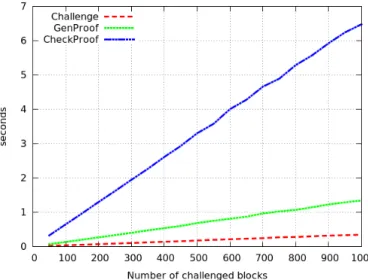
50 to1000 with an increment of 50 for each test to see the time cost of Challenge, GenProof and CheckProof steps. As one shall see from Figure 3, the timing cost of those three
Setup Extract TagGen: off-line TagGen: on-line Challenge GenProof CheckProof 4.8 ms 0.1 ms 241.9 second 20.3 second 351 ns per challenge 1.3 ms per challenge 6.6 ms per challenge
TABLE I
SUMMERISE OF THE TIME COST FOR A1MBFILE
Fig. 3. Increasing number of challenges for fixed size of file
parts increases with the increase of the number of challenges. This is consistent with the empirical analysis because when the number of challenged block rises, more random values {i, vi}need to be selected in the challenge algorithm, and the
cloud server has an increasing computations of σvi
i while the
TPA has more exponentiations, multiplication operations and pairing computations in Q
i∈I
e(H2(f name||i)vi, rρ). But it is
fair to say that the proposed identity-based RDIC protocol is efficient for both the cloud server and the verifier. For example, let us investigate a point on the curve. Ateniese et al. [4] demonstrated that, if the cloud server has polluted 1%of the blocks, then the verifier can challenge 460blocks in order to achieve the probability of server misbehavior detection of at least 99%. We can see that it costs the verifier only about3.0
seconds to verify a response and the server 0.7 seconds to generate a response when challenging460 blocks.
In the second part, we test the most expensive algorithm TagGen of the protocol by increasing the file size from 200
KB to 2 MB, that is, from10,000 blocks to100,000 blocks accordingly, and record the time for TagGen. As expected, both on-line and off-line time to generate tags for a given file increases almost linearly with the increase of the file size. Figure 4 gives more details. The implementation shows that generating tags is more expensive than other parts but fortunately, computing tags for a file is a one time task, as compared to challenging the outsourced data, which will be done repeatedly. Since the cloud users can do the off-line work completely parallelizable in advance, we pay only attention to the on-line cost. We can see that the efficiency of TagGen of our protocol is comparable to that of the existing well-known schemes, say [5]. To generate tags for a 2 MB file, it costs
Fig. 4. Tag generation time for increased size of files
almost 42 seconds. As such, one shall be able to anticipate the time cost of generating tags for any size of files.
VII. CONCLUSION
In this paper, we investigated a new primitive called identity-based remote data integrity checking for secure cloud storage. We formalized the security model of two important properties of this primitive, namely, soundness and perfect data privacy. We provided a new construction of of this primitive and showed that it achieves soundness and perfect data privacy. Both the numerical analysis and the implementation demon-strated that the proposed protocol is efficient and practical. ACKNOWLEDGEMENTS. This work is supported by the National Natural Science Foundation of China (61501333,61300213,61272436,61472083), Fok Ying Tung Education Foundation (141065), Program for New Century Excellent Talents in Fujian University (JA14067).
REFERENCES
[1] P. Mell, T. Grance, Draft NIST working definition of cloud computing, Reference on June. 3rd, 2009. http://csrc.nist.gov/groups/SNC/cloud-computing/index.html.
[2] Cloud Security Alliance. Top threats to cloud computing. http://www.cloudsecurityalliance.org, 2010.
[3] M. Blum, W. Evans, P.Gemmell, S. Kannan, M. Naor, Checking the correctness of memories. Proc. of the 32nd Anual Symposium on Foundations fo Vomputers, SFCS 1991, pp. 90–99, 1991.
[4] G. Ateniese, R. C. Burns, R. Curtmola, J. Herring, L. Kissner, Z. N. J. Peterson, D. X. Song, Provable data possession at untrusted stores. ACM Conference on Computer and Communications Security, 598-609, 2007.
[5] G. Ateniese, R. C. Burns, R. Curtmola, J. Herring, O. Khan, L. Kissner, Z. N. J. Peterson, and D. Song, Remote data checking using provable data possession.ACM Trans. Inf. Syst. Secur., 14, 1–34, 2011.
[6] A.Juels, and B. S. K. Jr. Pors, proofs of retrievability for large files.Proc. of CCS 2007, 584-597, 2007.
[7] H. Shacham, and B. Waters, Compact proofs of retrievability.Proc. of Cryptology-ASIACRYPT 2008, LNCS 5350, pp. 90-107, 2008. [8] G. Ateniese, S. Kamara, J. Katz, Proofs of storage from homomorphic
identification protocols. Proc. of ASIACRYPT 2009, 319-333, 2009. [9] A. F. Barsoum, M. A. Hasan, Provable multicopy dynamic data
posses-sion in cloud computing systems, IEEE Trans. on Information Forensics and Security, 10(3): 485–497, 2015.
[10] J. Yu, K. Ren, C. Wang, V. Varadharajan, Enabling cloud storage auditing with key-exposure resistance,IEEE Trans. on Information Forensics and Security, 10(6): 1167–1179, 2015.
[11] J. Liu, K. Huang, H. Rong, H. M. Wang, Privacy-preserving public auditing for regenerating-code-based cloud storage, IEEE Trans. on Information Forensics and Security, 10(7): 1513–1528, 2015. [12] Q. Wang, C. Wang, J. Li, K. Ren, and W. Lou, Enabling public
verifiability and data dynamics for storage security in cloud computing.
Proc. of ESORICS2009, LNCS 5789, 355–370, 2009.
[13] C. Wang, Q. Wang, K. Ren, and W. Lou, Privacy-preserving public auditing for data storage security in cloud computing.Proc of IEEE INFOCOM 2010, 525–533, 2010.
[14] C. Wang, K. Ren, W. Lou, and J. Li, Toward publicly auditable secure cloud data storage services.IEEE Network, 24, 19-24, 2010.
[15] Q. Wang, C. Wang, K. Ren, W. Lou, and J. Li, Enabling public audibility and data dynamics for storage security in cloud computing.IEEE Trans. Parallel Distrib. Syst., 22, 847-859, 2011.
[16] C. Wang, S. S.Chow, Q. Wang, K. Ren, and W. Lou, Privacy-preserving public auditing for secure cloud storage.IEEE Trans. on Computers, 62, 362-375, 2013.
[17] K. Yang, and X. Jia. An efficient and secure dynamic auditing protocol for data storage in cloud computing. IEEE Trans. on Parallel and Distributed Systems, 24(9): 1717-1726, 2013.
[18] Y. Zhu, G. J. Ahn, H. Hu, S. S. Yau, H. G. An, C. J. Hu, Dynamic audit services for outsourced storages in Clouds.IEEE Trans. Services Computing, 6(2): 227-238, 2013.
[19] Y. Zhu, H. Hu, G. J. Ahn, S. S. Yau, Efficient audit service outsourcing for data integrity in clouds.Journal of Systems and Software, 85(5): 1083-1095, 2012.
[20] H. Wang, Y. Zhang, On the knowledge soundness of a cooperative provable data possession scheme in multicloud storage,IEEE Trans. on Parallel and Distributed System, 25(1): 264–267, 2014.
[21] G. Ateniese, R. D. Pietro, L. V. Mancini, G. Tsudik, Scalable and efficient provable data possession, Proc. of SecureComm 2008, Article No. 9 ,doi:10.1145/1460877.1460889.
[22] C. Wang, Q. Wang, K. Ren, W. Lou. Ensuring data storage secruty in cloud computing, Proc. of IWQoS 2009, 1-9, 2009.
[23] C. Erway, A. Kupcu, C. Papamanthou, R. Tamassia, Dynamic provable data possession, Proc. of CCS 2009, 213-222, 2009.
[24] C. Liu, R. Ranjan, C. Yang, X. Zhang, L. Wang, J. Chen, MuR-DPA: Top-down levelled multi-replica merkle hash tree based secure public auditing for dynamic big data storage on cloud. IEEE Trans. on Computers, 64(9): 2609–2622, 2015.
[25] C. Wang, S. S. Chow, Q. Wang, K. Ren, and W. Lou, Privacy-preserving public auditing for secure cloud storage,IEEE Trans. on Computers, 62, 362–375, 2013.
[26] Y. Yu, M H Au, Y. Mu, S. Tang, J. Ren, W. Susilo, and L. Dong, Enhanced privacy of a remote data integrity checking protocol for secure cloud storage,International Journal of Information Security, 14(4): 307– 318, 2015.
[27] G. Ateniese, A. Faonio, S. Kamara, Leakage-resilient identification schemes from zero-knowledge proofs of storage. IMA Int. Conf. 2015, 311-328, 2015.
[28] D. Boneh, M. Franklin, Identity-based encryption from the weil pairing, Proc. of CRYPTO 2001, LNCS 2139, 213–229, 2001.
[29] J. N. Zhao, C. X. Xu, F. G. Li, and W. Z. Zhang, Identity-Based Public Verification with Privacy-Preserving for Data Storage Security in Cloud Computing,IEICE Transactions, 96-A(12), 2709-2716, 2013. [30] G. Gentry, Z. Ramzan, Identity-Based aggregate signature, Proc. of
Public Key Cryptography 2006, LNCS 3958, 257-271, 2006. [31] H. Wang, Identity-based distributed provable data possession in
mul-ticloud storage, IEEE Trans. on Service Computing, 8(2), 328–340, 2015.
[32] Q. Wu, Y. Mu, W. Susilo, B. Qin, J. Domingo-Ferrer, Asymmetric group key agreement. Proc. of Eurocrypt 2009, LNCS 5479, 153–170, 2009. [33] L. Zhang, Q. Wu, J. Domingo-Ferrer, B. Qin, Z. Dong,
Round-efficient and sender-unrestricted dynamic group key agreement protocol
for secure group communications. IEEE Transactions on Information Forensics and Security, 10(11): 2352–2364, 2015.
[34] V. Shoup, Lower bounds for discrete logarithms and related problems, Proc. of Eurocrypt 1997, 256–266, 1997.
[35] Y. Yu, Y. Zhang, Y. Mu, W. Susilo, Provably Secure Identity based Provable Data Possession. Proc. of ProvSec 2015, LNCS 9451, 1–16, 2015.
[36] D. Boneh, B.Lynn, and H. Shacham, Short signatures from the weil pairing.Journal of Cryptology, 17, 297–319, 2004.
[37] D. Chaum, T. P. Pedersen, Wallet databases with observers. Proc. of Crypto 1992, 89–105, 1993.
[38] J. C. Cha, and J. H. Cheon, An identity-based signature from gap Diffie-Hellman groups, in:Processing of PKC 3003, LNCS 2567, 2003, pp. 18-30.
[39] F. Hess, Efficient identity based signature schemes based on pairings, in:Processing of SAC 2002, LNCS 2595, 2003, pp. 310-324. [40] B. Lynn, The Pairing-Based Cryptography Library (0.5.13). online:
http://crypto.stanford.edu/pbc/.
[41] A. Kate, The Pairing-Based Cryptography (PBC) Library - C++ Wrapper Classes (0.8.0). online:http://crysp.uwaterloo.ca/ software/PBCWrapper/.