Fake perfect in X-marked conditionals
* Katrin SchulzILLC, University of Amsterdam
Abstract The topic of this paper is a problem concerning the interpretation of tense in conditionals: Fake Tense. Fake tense refers to the observation that in English subjunctive conditionals the simple past, and sometimes also the past perfect, appear not to be interpreted as semantic past tense or past perfect. We will focus in particular on the function of the perfect in conditionals with fake past perfect. Two different lines of approach to fake tense can be distinguished in the literature: past-as-modal approaches (PaM) claim that the past tense markers receive in these contexts a modal interpretation; past-as-past approaches (PaP) propose that the past still receives a temporal interpretation, though it contributes in an unexpected way to the meaning of the sentence. We will first spell out a PaM approach based on an idea inSchulz 2014and then argue that this approach is not convincing. This will be partly done based on two empirical studies concerning the form of generic counterfactuals/counterpossibles. We will then propose a PaP approach to the perfect in conditionals with fake past perfect. This approach will build on an interventionist account of counterfactuals using causal structural models (Pearl 2000,2013).
Keywords:conditionals, tense, fake tense, presuppositions
1 Introduction
The topic of the paper is the linguistic puzzle known asFake Tense.1 This notion refers to the observation that in certain English conditionals the simple past, and also the past perfect appear not to be interpreted as semantic past tense or past perfect. The goal of the paper is to add to a better understanding of why the tense marked occur in this context and what their function is.
This places the current project in the more general enterprise of understanding the semantic anatomy of conditional sentences. Within the field of semantics this is a topic that has gained more and more attention during the last 20 years. Recent publications includeKaufmann 2005andGronn & von Stechow 2010on the seman-tics of English indicative conditionals, andIatridou 2000;Ippolito 2003,2006,2013;
* I want to thank Alexandre Cremer and Arnold Kochari for help with the empirical research, Dean McHugh and Jonathan Pesetsky for checking the questionnaire and the audience at the workshop "Conditionals at the crossroads of semantics and pragmatics" for useful feedback.
Arregui 2007,2009;Stechow & Gronn 2008on the semantics of English subjunctive conditionals. In line with these publications the present manuscript hopes to add to our understanding of the interaction of the semantics of conditionals with other operators occurring in conditional sentences. Here we are particularly interested in the interaction with tense.
A bit of terminology. Before we can start with a detailed discussion of the phe-nomenon of fake tense, we first need to introduce some terminology on conditional sentences. We distinguish for English three conditional constructions. Ippolito
(2013) uses the terms indicative conditionals, simple past subjunctive conditional and past perfect subjunctive conditionals. We will follow Sabine Iatridou and Kai von Fintel and replace the term subjunctive conditional byX-marked conditionalsto avoid confusion with the subjunctive mood. Thus, we will use the notionssimple past X-marked conditional(SPC for short) andpast perfect X-marked conditional (PPC). An SPC contains in the consequent as modal would,could,might,ought or should. The finite verb in the antecedent is in the simple past (1b) orwere is used (1c). A PPC contains additionally in the antecedent and the consequent perfect markings (1d-1e). Anindicative conditionalis a conditional sentence that does not contain as finite verbform in the consequentwould,could,might,oughtorshould (1a).
(1) a. If Peter left in time, he will be in Frankfurt this evening. b. If Peter left in time, he would be in Frankfurt this evening.
c. If Peter were to leave in time, he would be in Frankfurt this evening. d. If Peter had left in time, he would have been in Frankfurt this evening. e. If you had been in Paris next week, we could have met.
Fake Tense. Now, think about the temporal location of the eventualities described in the antecedent.2 In the indicative conditional (1a) the finite verb in the antecedent is marked for the simple past. The tense morphology is interpreted as temporal anteriority: the eventuality described in the antecedent is localised in the past with respect to the utterance time. Compare this to the second sentence (1b).3 This SPC
2 The same point can be made with the consequent as well, though in this case, because of the involved modal, the effect is less transparent.
3 Another way to express this conditional in English is as given in (i). (i) If Peter were to leave in time, he would be in Frankfurt this evening.
In some American dialects of English this form is preferred to (1b). Speakers of British English generally prefer (1b) to (i). However, the point relevant for the present discussion can be made as
has exactly the same antecedent as the indicative conditional (1a). But in this case the antecedent cannot be interpreted as referring to the past. Instead, Peter’s leaving has to be understood as taking place in the future (relative to the speech time). It looks like the past morphology in (1b) does not contribute to the meaning of the sentence; at least not in the expected way. It seems to be fake. In the PPC (1e) there appear to be even two layers of fake morphology. The antecedent is marked with the past perfect. According to standard accounts of the semantics of the English tenses this means that the described eventuality is located in the past of some contextually given past time. But again, the antecedent talks about the future. So, both layers of past morphology, the simple past and the perfect appear to be fake. In (1d), on the other hand, the perfect still seems to have a temporal function: the eventualities described in antecedent and consequent are localised in the past.
This phenomenon is called inIatridou 2000fake tenseorfake past. As we see, it is a problem of X-marked conditionals. But this surprising behaviour of tense morphology is not restricted to conditionals sentences. It occurs, for example, in counter-to-fact wishes, complement clauses of a comparison starting with ‘like’ or ‘as if’, the scope of verbs like ‘suppose’, ‘assume’, and other constructions. Furthermore, there is a large number of different languages that all display fake tense in certain contexts (seeJames 1982for more details). However, while there is a lot of cross-linguistic variation concerning the contexts in which fake tense occurs, in all of these languages it is used in the conditional constructions they can use to express counterfactuals (seeIppolito 2013: 23 for more references). So, this context seems to be at the heart of the phenomenon. Therefore, it is no surprising that the vast majority of the literature focusses on explaining fake tense in conditionals.
The literature. In general, two strategies of how to approach the problem can be distinguished:Past-as-pastapproaches (PaP) andPast-as-modalityapproaches (PaM). The central claim of PaP approaches is that even though it looks like the past tense is not interpreted temporally in X-marked conditionals, it still is. It just contributes its meaning in an unexpected way. Approaches that fall in this group are
Tedeschi 1981;Ippolito 2013,2006;Arregui 2007,2009, but you find related ideas also in the philosophical literature (cf. Edgington 2004). The central idea behind PaP approaches is that in order to evaluate X-marked conditionals, one has to go back in time to some point when it was still open whether the antecedent would become true or not. At this past time it is then evaluated whether in case the antecedent turned out to be true, the consequent would be true as well. The Past tense expresses the
well for (i). Also in this case the antecedent carries past tense markings on the finite verb ("were") that appear to be not interpreted. We discuss here the forms without "were", because in them the problem of fake tense is more transparently visible.
involved backshift in time.
Though PaP approaches strongly dominate in the formal semantics literature on fake tense, overall the majority of the approaches are of the PaM variety (see
Palmer 1986;Fleischmann 1989;Dahl 1997;Iatridou 2000;Schulz 2014and many more). The claims made by proposals in this group diverge largely, however they all share the idea that the simple past is interpreted in (1b)in situ, applying to the eventuality described in the antecedent and the consequent. But instead of localising this eventuality in time, the past tense receives a mood or modality meaning, often paraphrased as distance from reality. The general problem of approaches along this line is that the proposals made stay on a very general, intuitive level and are not worked out in full detail. In consequence, they are hard to test and difficult to criticise. Proposals like Iatridou 2000 and Schulz 2014 try to overcome this limitation of PaM approaches.
This paper. In this paper we will focus on fake perfect in PPCs like (1e). That means we will focus on PPCs talking about the present or future, because in this case we know that also the perfect in antecedent and consequent is fake. Fake perfect has received much less attention in the literature than fake (simple) past, especially in the PaM camp. We will start in Section2with a discussion of what is known about the meaning and use of PPCs. The hope is that this will help us to understand the function of the fake tense morphology occurring in these conditionals. We will then introduce in Section3a PaM explanation for this second layer of past morphology that is based on an idea sketched inSchulz 2014. In Section4we will present two empirical studies that place some doubt on this proposal. After that we will sketch a PaP to fake perfect in Section5and argue, in Section6, that it deals better with the observations. Section7concludes the paper.
2 Observations on the use of SPCs and PPCs
As stated above, the goal of this paper is to explain fake perfect in PPCs talking about the present or future. These perfect markings are the only visible difference between PPCs and SPCs. This suggests that in order to uncover the function of the perfect morphology here, we should have a look at the differences in meaning or distribution between both types of conditionals. The most thorough discussion of such differences can be found inIppolito 2013. For X-marked conditionals talking about future eventualitiesIppolito(2013) makes the following two observations.
i. The SPC form, but not the PPC form can be used to talk about future eventualities that are still possible at the utterance time. Conditionals about
future eventualities for which it is already clear that they will not occur are expressed using PPCs.
ii. The counterfactuality of PPCs talking about the present or the future (in contrast to PPCs talking about the past) cannot be cancelled.
Ippolito argues for the second observation using variations of the Arsenic example of
Anderson 1951(Ippolito 2006,2013). The first observation is supported by examples like (2) and (3) below. Suppose the game the conditionals in (2) and (3) talk about was scheduled for yesterday, but ended up being cancelled last minute because of bad weather. In this case (2) can be used, but (3) is infelicitous. However, if the game already took place yesterday, then (2) is no longer felicitous and (3) has to be used (Ippolito 2006,2013).
(2) If they played the last game tomorrow, Charlie’s team would win.
(3) If they had played the last game tomorrow, Charlies’s team would have won. We shouldn’t read observation (i) as implying that SPCs and PPCs differ in that SPCs can never be counterfactual. Counterfactuals in the SPC-form do exist (4-5). (4) John is dancing a waltz with Mary right now. If he were dancing this waltz
with Sue instead, Mary would be jealous. (Ippolito 2013, example 42) (5) If kangaroos had no tails, they would topple over. (Lewis 1973)
But SPCs cannot be used unrestrictively for counterfactual conditionals. For one thing they cannot be used to talk about eventualities localised in the past relative to the utterance time, whether they are counterfactual or not.4 Additional, Ippolito formulates the restriction (iii).
iii. "... whether they have static or eventive antecedents, [SPCs, our terminology] can in principle be counterfactual, but if the particular eventuality in the antecedent has already happened in the past or if any presupposition in the antecedent is inconsistent with the actual history at the utterance time, then a SPC is infelicitous." (Ippolito 2013: 55). In these cases a PPC is required. Thus, there are 2 additional contexts in which a PPC and not a SPC has to be used: (a) the eventuality considered in the antecedent took already place in the past (2-3), and (b) a presupposition of the antecedent is inconsistent with the facts at the utterance time. In her analysis Ippolito argues that the first restriction is a particular instantiation of the second. She adopts to this purpose Musan’s notion of a
possibility presupposition. According to this idea each eventuality a sentences talks about carries the presupposition that it is possible (in the utterance world), where possibility is defined time-dependent: "... for any eventualityv, letvbe possible at timet andwjust in casevhas not already ’culminated’ or, more generally, ’ended’ at any timet0<t inw." (Ippolito 2013: 75). This idea of possibility presuppositions allows Ippolito to analyse observation (a) as a special case of (b).
To sum up, we saw in this section that in X-marked conditionals about the present or the future both, fake simple past and fake past perfect can occur. But there are some differences in the the distribution of both forms, summarised in the observations (i)-(iii). However, notice that the distribution of SPCs and PPCs is not completely complementary. Counterfactuals about the present (4) and generic counterfactuals/counterpossibles (5) allow for both forms. Whatever function we ascribe to the extra layer of perfect morphology in PPCs has to account for these observations.
3 From temporal distance to modal distance
3.1 The proposal ofSchulz(2014)
An interesting idea for the contribution of the perfect in PPCs is sketched inSchulz 2014. This paper focusses on accounting for the first layer of past tense morphology in X-marked conditionals. It builds on the highly influential PaM approach of
Iatridou(2000). Iatridou argues that the semantic function expressed by the past tense morphology is a very general schema of exclusion: the topic x excludes the x of the deictic center. When thisexclusion featureranges over times, it results in a past tense interpretation.5 But the exclusion feature can also be applied to the modal domain. In this case it expresses that the topic world excludes what for all we know is the world of the speaker. More precisely, the topic world cannot be among the worlds that are consistent with what the speaker knows. It follows that the topic world needs to differ form the actual world. This is, according toIatridou(2000), the contribution of fake past in SPCs. The past tense expresses that the conditional
5 It has been argued that thereby Iatridou has difficulties to explain why past tenses cannot express reference to the future. Iatridou doesn’t consider this to be a serious problem, because the future has a special status anyway.
talks about a hypothetical situation that excludes the actual world.6,7
Schulz(2014) provides a compositional account of fake past in the framework of Generative Semantics. The provided explanation of fake past is very similar to that inIatridou 2000. There are only two serious differences. Firstly, Schulz’ proposal doesn’t assume an underspecified meaning for the past tense morphol-ogy, but proposed that the morphological markings of past tense can check for two different, but strongly related semantic operators. This choice isn’t conceptually motivated, but seems to be due to the rigorous formal and compositional treatment that Schulz attempts. The formal framework Schulz works in doesn’t easily adapt to underspecification. Both operators in Schulz 2014express basically the same semantic function: x<x∗, wherexis the variable the operator binds andx∗is the relevant deictic centre. Again, if this schema is interpreted on the temporal domain and the involved order is interpretation naturally as temporal precedence, you get a semantic past tense. In the modal case it is less obvious what the corresponding order is. Schulz proposes to base the modal order a simple epistemic sphere model. The central sphere is the set of worlds that the speaker expects the actual world to be among. Then we have the sphere of worlds that the speaker considers possible but doesn’t expect to be the actual world. And finally the set of world the speaker considers not possible candidates for the actual world. In its modal interpretation the simple past then localises the relevant antecedent worlds the conditional quantifies over outside the epistemic deictic centre, i.e. the conditional is talking about unex-pected worlds. The order in the schema that underlies the temporal and the modal interpretation of the simple past is the second substantial difference betweenIatridou 2000andSchulz 2014.
In involving an order, Schulz’ semantics comes closer to the standard semantics for the simple past and doesn’t inherit Iatridou’s problem to explain why her exclu-sion feature doesn’t allow the topic time to lie in the future of the temporal deictic center.8 Another advantage ofSchulz 2014is that it allows for a natural extension to PPCs; one that directly parallels the standard compositional analysis given for the past perfect (see, for instance,Kamp & Reyle 1993). This extension is sketched
6 The underlying idea ofIatridou(2000) strongly reminds ofKarttunen & Peters(1979)’s proposal according to which, while an indicative conditional requires the antecedent proposition to be com-patible with the context set, a subjunctive conditional requires its negation to be comcom-patible with the context set. In consequence, if we assume a standard approach to negation, the antecedent of a subjunctive conditional cannot be entailed by the context set.
7 While Iatridou acknowledges the problem of PPCs and the two layers of fake morphology occurring in them (see footnote 26 inIatridou 2000), her approach only discussed SPCs.
8 The explanation given inIatridou 2000for this observation (Iatridou 2000: 246) is not completely satisfying. Even if English and other languages only distinguish two tenses: present and past, and the future is a modal construction, it is unclear how this could prevent the past tense, as described in her proposal, to take a topic time in the future of the utterance time.
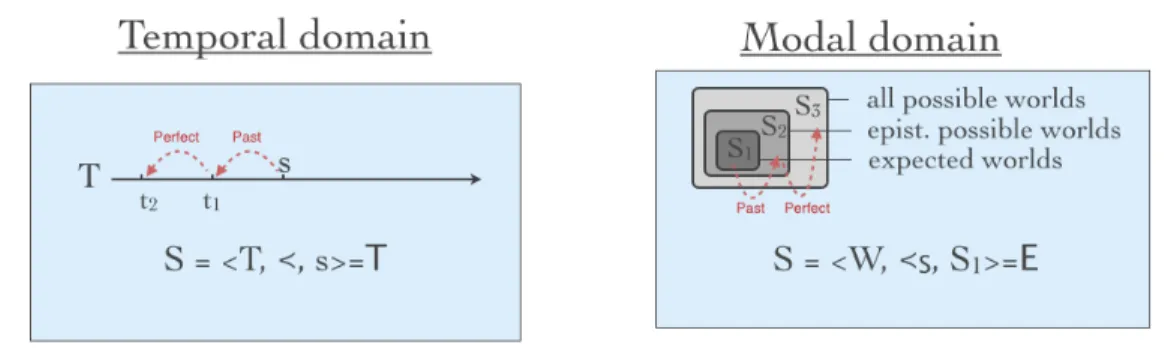
Figure 1: Double past shift on the temporal and the modal domain.
in Section 5 ofSchulz 2014. The standard approach to the past perfect analyses this tense as expressing a double past-shift: localising an eventuality in the past of a (contextually given) past time. In the framework ofSchulz(2014) the proposed epistemic order allows for a double backshift on the modal domain. Remember that this order distinguishes 3 spheres: the set of worlds the speaker expects the actual world to be among, the set of worlds the speaker considers possible, but doesn’t expect and the set of worlds the speaker considers impossible. Applying a double backshift using this order results in worlds in the third sphere, worlds that are according to the speaker impossible (see Figure1). Hence, PPCs about the present or the future are predicted to convey counterfactuality by their semantics.
This is a very natural extension of the PaM proposal for fake simple past to fake past perfect.9 Just like the simple past, the perfect in PPCs is only interpreted on a different domain. The function expressed by the tenses doesn’t change. This proposal would also allow for a reading of PPCs where the simple past is interpreted on the modal domain, but the perfect is still interpreted temporally. In this case the conditional needs to talk about past eventualities. This suggests a different classification of X-marked conditionals. One should distinguish single X-marked conditional, i.e. conditionals with one level of tense morphology (the simple past) interpreted modally, and double X-marked conditionals, i.e. conditionals with two levels of tense morphology interpreted modally. The first type would express unexpectedness of the described antecedent event. The second type would express that the antecedent is counterfactual.
9 If one would spell this out in the general compositional framework proposed inSchulz 2014, it would come down to the introduction of a third conditional operator that selects for the modal interpretation of the past perfect. Again, this looks like a consequent of the general semantic framework that the paper works with and that doesn’t allow for expressions with an underspecified type. But the compositionally of the past perfect in its modal interpretation, which is one of the strong features of the proposal, would be lost to a great extend.
3.2 Applying the proposal to the observations
Let us turn to the observations made about PPCs and SPC that we discussed in the last section. Can this proposal account for them? Observation (i) on page550
seems to be covered. SPCs don’t need to be counterfactual and can talk about future possibilities that are still open, as long as they are unexpected by the speaker. PPCs where both layers of past morphology are interpreted modally are counterfactual by semantics. They can only talk about future events that are already excluded at the utterance time. The proposal doesn’t seem to cover why PPCs need to be used in this case and SPCs are excluded. The semantics for SPCs allows them to be counterfactual. Thus, why not use them when talking counterfactually about the future? We could apply to the principle maximise presuppositionto account for this. In the approach of Schulz PPCs and SPCs only differ with respect to their presupposition. PPCs have stronger presuppositions than SPCs. According to this principle a speaker should use the presuppositionally stronger claim in case he/she thinks that the presuppositions are supported by the context. Hence, the use of PPCs when talking about eventualities in the future that no longer can become true.
The proposal can also account for observation (ii) on page 550. Given the sketched proposal for double X-marked conditionals, these conditionals are pre-dicted to be counterfactual by their semantics. This inference is not defeasible. The approach also predicts correctly that PPCs about the past are not necessarily coun-terfactual. The perfect in these conditionals might still be interpreted temporally. In this case the conditional is a single X-marked conditional and only presupposes that the eventuality described in the antecedent is unexpected from the viewpoint of the speaker. Finally, the approach also allows for SPCs to be counterfactual. The eventualities considered in the conditional don’t have to be impossible, but they can.
This leaves us with observation (iii) on page551. This observation is not covered: the theory says nothing about the presuppositions the subordinate sentences of the conditional might give rise to. We could say that this observation is just not in the scope of the theory developed here. But this is not completely satisfying. We proposed here a theory that is supposed to account for the meaning of the perfect in PPCs, and, thereby, for the differences in meaning between SPCs and PPCs. Hence, accounting for observation (iii) should be in the scope of any such theory. It is unclear how this theory could be extended in a way that allows for the observed differences between SPCs and PPCs. We will come back to this later.
There is another question that this proposal gives raise to: why should be want to use SPCs to express counterfactuals? Above, we invoked the principle Maximise Presupposition to explain why when talking about the future there is a clear division of labour: SPCs are used to talk about open possibilities, PPCs to talk about counterfactual scenarios. But shouldn’t this division of labour extend to other
contexts where both forms are in principle acceptable? Wouldn’t you expect that also when talking counterfactually about the present or in case of counterpossibles a PPC should be clearly preferred over a SPC? That should mean that examples like (4) and (5) should be rare exceptions. Or, using the other side of the principle Maximise Presupposition, if a speaker uses the weaker SPC-form, it should allow the hearer to infer that (according to the speaker) the conditional is not counter-to-fact. In the next section we will discuss two empirical studies that test these predictions.
4 The use of SPCs and PPCs in counterfactual conditionals
The empirical question the two studies in this section set out to answer is which form of X-marked conditionals speakers use to express counterfactual reasoning. For counterfactuals about past eventualities, the answer seems to be quite clear: PPCs. Also for the future it is clear that the PPC form is used to express counterfactuality. But what about the other cases: what about counterfactual reasoning about the present? And what about generic counterfactuals? The first study will address this question by analysing a specific corpus with a high number of counterfactual conditionals. The second study is based on an online questionnaire.
4.1 Study 1
The idea behind the first study was to analyse the distribution of SPCs and PPCs in natural occurring counterfactual discourse. For this we would need a corpus with a high frequency of counterfactuals. More specifically, we want to have a high number of counterfactuals in situations where in principle both, the SPC-form and the PPC-SPC-form could be used. The corpus that was used for this study consists of philosophical papers on the subject of counterpossibles. Counterpossible conditionals are conditionals with an antecedent that, according to the speaker, cannot possibly be true (6-9).
(6) If Hobbes had (secretly) squared the circle, sick children in the mountains of South America at the time would have cared.
(7) If Plato had been identical with Socrates, Plato would have been snub-nosed. (8) If 6 were prime, 35 would be composite.
(9) If Fermat’s Last Theorem were false, 2+2 would be 5.
The literature on counterpossibles is so far free of any considerations concerning the actual form of the sentences that are used to express them. Therefore, we will cautiously assume that the corpus is not polluted by a theoretical bias of the
authors. The corpus consists of 9 articles, all published in the last 20 years.10 The counterfactual conditionals occurring in the paper were harvested manually. All examples were annotated according to the following criteria.11
• Is the counterfactual considered by the author(s) to be a counterpossible12 (yes/no/unclear)?
• Is it a SPC, a PPC, an indicative conditional or a mixed case?13
• Does the antecedent refer to the past, the present the future or is it a generic statement?
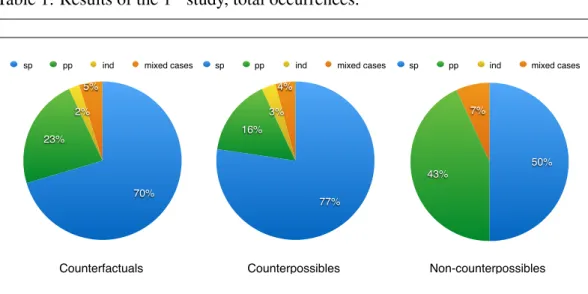
Table1displays the results of this study. Figure2gives a first graphical overview over the distribution of the different conditional forms used to express counterfactual reasoning in the corpus. The term "Counterfactuals" refers to all examples in the corpus. "Counterpossibles" are those conditionals in the corpus that the speaker considered counterpossible, "Non-counterpossibles" are all other counterfactuals. Each circle-diagram in Figure2corresponds to one row in Table1.
For those counterfactuals that refer to the past the PPC form and the SPC form do not truly compete. SPCs are in general not used to talk about the past.14 These examples are therefore not relevant for the study. Table2and Figure3display the results for those conditionals in the corpus that did not refer to the past. As the data show, restricted to counterfactuals not talking about the past the SPC form strongly dominates the picture. Only 3% of the non-past counterfactuals in the corpus where formulated using the past perfect in antecedent and consequent.
4.2 Study 2
In the corpus study reported on in Section4.1nearly all the non-past counterfactuals were expressed using an SPC. But as a corpus study it mainly gives insights in how counterfactuals are used. It might be the case that English speakers prefer to produce counterfactuals as SPCs, even though both, SPCs and PPCs are considered
10 A 10th paper had to be excluded during the analysis, because both of the authors were not native speakers of English. It turned out that their use of PPCs and SPCs significantly differed from that of papers were at least one native speaker was involved.
11 The corpus will be made available on the website of the author.
12 The notion of a counterpossible depends on your position regarding certain philosophical, in particular metaphysical questions. We selected those conditionals as counterpossible that the author(s) either explicitly call(s) a counterpossible or that are counterpossible according to the philosophical position defended in the paper.
13 In mixed cases different forms are used in antecedent and consequent.
total sp pp ind mix counterfactuals 230 162 52 5 11 percentages 70% 23% 2% 5 % counterpossibles 172 133 27 5 7 percentages 77 % 16 % 3 % 4 % non-counterpossibles 58 29 25 0 4 percentages 50 % 43 % 0 % 7 %
Table 1: Results of the 1st study, total occurrences.
5%
2%
23%
70% sp pp ind mixed cases
4%
3% 16%
77% sp pp ind mixed cases
7%
43%
50% sp pp ind mixed cases
3%
3%
2%
92%
sp pp ind mixed cases 3%
3% 3%
90%
sp pp ind mixed cases
Counterfactuals Counterpossibles Non-counterpossibles
Counterfactuals Counterpossibles Figure 2: Results of the 1st study, total occurrences.
equally acceptable in these contexts. They might prefer producing SPCs simply for the reason that their form is less complex. In the second study we therefore focus on acceptability judgements. Because the majority of the examples in the corpus study were generic or counterpossible counterfactuals, this was also the subgroup of counterfactuals studied in this experiment.
For this study we used an online questionnaire, designed with Qualtrics. Partici-pants where asked to judge the naturalness of the SPC form compared to the PPC form. The questionnaire consisted of 8 target sentences plus 24 fillers, distracting the participants from the conditional form and the generic content of the target sen-tences. There were 8 generic statements that were not conditionals, 8 conditionals that were not generic statements and 8 sentences that were neither of both. For a complete list of the examples see the homepage of the author. The goal was to test the acceptability of both SPCs and PPCs in this context and whether there is a preference for one of the forms. Because acceptability is a difficult concept to
total sp pp ind mix counterfactuals 175 161 4 5 5
percentages 92% 2% 3% 3 %
counterpossibles 147 133 5 5 4
percentages 90 % 3 % 3 % 3%
Table 2: Results of the 1st study, the diagram focuses on those counterfactuals that do not talk about the past.
5%
2%
23%
70% sp pp ind mixed cases
4%
3% 16%
77% sp pp ind mixed cases
7%
43%
50% sp pp ind mixed cases
3%
3%
2%
92%
sp pp ind mixed cases 3%
3% 3%
90%
sp pp ind mixed cases
Counterfactuals Counterpossibles Non-counterpossibles
Counterfactuals Counterpossibles
Figure 3: Results of the 1st study, zooming in on counterfactuals that do not talk about the past.
judge for unschooled speakers, the questionnaire asked participants how natural the examples sound. Always, both, the SPC and the PPC were given. The participants could choose between the following answers: SPC is the more natural form, PPC is the more natural form, both forms are equally natural (both), none of the two forms sounds natural for the given example (none). An example of the screen a participant would see for one of the target sentences is given in Figure4. The order of the examples was randomised, as was the order of the SPC and the PPC form in the answers between which the participants could choose.
The questionnaire was distributed using prolific.ac. It was filled in by 52 partici-pants, who spend on average 7 minutes on it and received 1 pound as payment. The participants were all native speakers. The results of the study are given in Figure5.15 Even though the difference is less clearcut than in the previous study, also this
Figure 4: Example from the online questionnaire.
SP-C PP-C both none percentages 66 % 9 % 19 % 7 %
Table 3: Results of the 2nd study.
time there is a strong preference of SPCs over PPCs. Only a very small group of participants prefer PPCs over SPCs. But there is a substantial group (19%) that considers both forms equally natural.
4.3 Discussion
Looking at the data of the corpus study, it seems that PPCs are hardly ever used to express counterfactual conditionals, except to express past reference. But we have to be careful with this result. First of all, one should not forget that only a very limited number of speakers produced the corpus that was analysed here. In future work a larger corpus should be used to confirm the results. Additionally, the corpus concerns a very specific discourse. That might have affected the data. Finally, it is unclear how much the speakers did reflect on the linguistic form of the counterfactuals they used. Even though linguistic form hardly plays any role in the debate on counterpossibles, the authors might be aware of the linguistic literature on conditionals and that might affect their judgements. However, all of these concerns don’t play a role in the second study and still the SPC form came out as the dominant form for generic and counterpossible counterfactuals.
0 10 20 30 40 SP PP both none
Figure 5: Results of the 2nd study.
significant difference between the studies in how strongly the SPC form dominated the PPCs form. While in the corpus study 92% of the occurrences where SPCs, only in 66% of the questions in the online questionnaire the participants selected SPC as the preferred form of the target sentence. In 19% of the cases participants judged both, SPC and PPC as equally acceptable. This difference between the studies hints at a difference between grammaticality and production. A possible explanation is that the higher complexity of the PPCs form compared with the SPC form leads to more use, even though both forms are equally acceptable in the relevant contexts. This is supported by the substantial percentage of cases in which both forms are judged as equally natural. It might even be that some participant judge the SPC form more natural because it is the less complex and therefore more often used form. Overall, we can conclude that there is a clear preference to use the SPC form when it comes to expressing generic and counterpossible counterfactuals. The form appears also to be more acceptable for expressing generic or counterpossible counterfactuals.
This result is problematic for the proposal developed in Section 3. In order to account for one of the central observations in Section 2 (observation (i)) we involved the principleMaximise Presuppositions. However, based on this principle we expected a division of labour: the PPC is used for counterfactual conditionals, the SPC for those where the antecedent is still possible. This is clearly not what we observe here. One way to defend this proposal is by claiming that the principle Maximise Presuppositionscannot be applied in the present case. The reason is the different complexity of the expressions we compare here (SPC and PPX). How-ever, if we make this move, we lose the proposed explanation of observation (i). Additionally, we would still have to tell a story that explains the observations made here in terms of the proposal. One could propose that the observed difference in distribution is entirely due to the difference in complexity between both forms. The SPC form is preferred because it is the simpler form. But why should the additional
meaning conveyed by the PPC form be worth nothing? Because in case of generic or counterpossible conditionals the counterfactuality already follows from the meaning of the sentence? But there are many other cases in with a language does choose to mark something even though it is already conveyed by the sentence (agreement markings are an example). Furthermore, in certain contexts a PPC is preferred over a SPC (see observation (iii)). Why is it in this case worth the extra effort to mark counterfactuality?
We conclude that while conceptually the proposal made in Section 3is very elegant and convincing, it does have difficulties accounting for observation (i) made in Section2. The solution involving the principleMaximize Presuppositionthat we proposed in Section3cannot explain the experimental results presented here. In Section3we already noticed that the approach cannot account for observation (iii) either. In view of these facts we should look for an alternative explanation of fake perfect in PPCs.
5 The proposal
In this section we will introduce an explanation of fake perfect that hopefully can overcome the problems of the approach discussed above. We will start looking for this explanation by having another look at the other central observation that this proposal cannot account for: observation (iii). This was the observation that if the particular eventuality in the antecedent has already happened in the past or if any presupposition in the antecedent is inconsistent with the actual history at the utterance time, then a SPC is infelicitous. Why should an SPC have a problem with such situations? We could say: because SPCs cannot change the past!
Such an explanation of fake perfect would clearly fall into the other camp of approaches towards fake tense discussed in the introduction: PaP approaches. The PaP literature also focus nearly exclusively on accounting for fake simple past in SPCs. According to this line of approach, the role of the simple past in SPCs is to take us back to a past time at which it was still open whether the antecedent would become true. We then select at this past time those possible "futures" that make the antecedent true and check whether they make the consequent true as well. While this seems to make sense for counterfactual SPCs, it is much less convincing for SPCs that are not counterfactual (which means, given observation (i), all SPCs about the future). Even stronger: SPCs talking about the future don’t seem to include counterfactual scenarios. Thus, a PaP approach to fake simple past in future SPCs appears to make wrong predictions.
Here we want to consider the possibility of a PaP approach to the perfect in PPCs. Thus, we propose that the perfect (and not the simple past) shifts the evaluation time of the conditional to the past. Consequently, we would predict that in SPCs
no past-shift of the evaluation time of the conditional occurs. At first glance, this proposal seems to run into trouble with counterfactual SPCs. If the evaluation time isn’t shifted back in this case, how can we access any possibilities that make the counterfactual antecedent true? This problem will be solved uding a different domain of quantification for conditionals. The possibilities among we will look for those that make the antecedent true are not the set of metaphysical alternatives at a certain point in time (cf. Condoravdi 2002), but the possibilities we get by intervening at a certain point in time. That means we adopt an interventionist approach to the meaning of X-marked conditionals (Pearl 2000,2013;Schulz 2011;Ciardelli, Zhang & Chapollion 2016). According to this line of approach we construct the hypothetical scenarios that counterfactual conditionals talk about by intervention in the actual world. This intervention forces the truth of the antecedent by plain stipulation, without concerns for the (causal) history of the antecedent.16 Then, we check whether this intervention makes the consequent true. The interventionist approach can be applied to counterfactuals as well as non-counterfactual conditionals.
The central innovation of the theory proposed here is that it combines a stan-dard Kratzerian semantics for conditionals with an interventionist approach to the domain of quantification. This new framework allows us to proposed the following explanation of fake perfect in X-marked conditionals: the function of the perfect is to shift the time of intervention to the past. In SPCs the intervention that makes the antecedent true is localised at the present or in the future. But with the additional past markings of the fake perfect in a PPC, the intervention is localised in the past. As we will see in Section6, this can account for all the central observations made in Section2.
5.1 The basic ingredients of the proposal in a nutshell
In the following we will give a rough outline of the approach to fake perfect that we want to defend here. Spelling out the details is left for another occasion. However, we hope that we still convey enough of the general idea to illustrate the attractiveness of the approach.
The basic interpretation rule for conditionals. The approach can be spelled out using a restrictor approach to the meaning of conditional sentences (Kratzer 1979,1991). According to this approach conditionals are modal constructions. The antecedent of the conditional functions as restrictor of the modal, the consequent as its nucleus. The modal takes two additional arguments: a modal baseMand an
16 InLewis 1979this is described as a small miracle. This interventionist approach cannot directly account for disjunction in the antecedent, but there are ways to work around this, see, for instance,
order≤. The meaning of the conditional with antecedentAand consequentCcan then be described as given in (10), whereMin≤(w0,A)denotes the set of worlds in
Mthat make the antecedent true and are ≤-minimal in this respect. The proposal basically claims that a conditional is true in case all antecedent worlds in M that are minimal with respect to the order make the consequent true as well.
(10) M,w0|=M,O(A,C) iffdef ∀w∈MinM,≤(w0,A):M,w|=C
Ontology. In order to account for the observations at stake in this paper, we need to take time into account. Therefore, the basic objects conditionals quantify over are not worlds, but indexes: pairshw,tiwith as first element an event structurewand as second element a timet that marks the temporal centre of the index. We can assume that events and times are ontological primitives or we work with a construction of time out of events. Which option one chooses doesn’t affect the proposal made here.
For the definition of the order the semantics of conditionals rely on, we need to enrich our model with a representation of the causal laws. For this we adopt the structural equations approach discussed inPearl 2000. The formal details are not relevant to our purposes here. It suffices to assume that we have some representation of the causal dependencies that allows us to check whether a set of events agrees or disagrees with the given causal laws. Based on this representation the events of an event structure are ordered according to direct causal dependency: e1≤e2ife1is one of the causes ofe2.
Modal Base. The modal base is given by all indexes, whose event structures obey the logical, metaphysical and conceptual laws. A bachelor is an unmarried man. Pigs don’t have wings. Any state has a beginning and an end. Things have to exists to participate in any kind of relation with other objects; a person has to be alive to undertake any kind of action. That kind of laws. To be able to deal with generic counterpossible counterfactuals, as least the metaphysical and logical laws will eventually need to be defeasible as well. But for the moment, we focus on accounting for X-marked conditionals that concern events localised in time.
Order. We need to define an order that compares indexes with respect to their similarity to the actual index: the actual event structure together with the time of utterance. The interventionist approach to counterfactuals as defined inPearl 2000,
2013 is not a similarity approach to the meaning of counterfactual conditionals, but arrives at the relevant antecedent worlds by construction: the operation of intervention is applied to the actual world and transforms it into the relevant worlds
that makes the antecedent true. However, inMarti & Pinosio 2014it has been shown that for recursive structural models this construction process can be translated into a similarity order over worlds. This order can take over the role of the ordering source in the standard Kratzerian approach. But we will need to modify it a bit. First of all, we are working here with event structures. But given that the event structures are ordered by causal dependence, we can use this order structure to extend the definitions given inMarti & Pinosio 2014to the present context.
However, there is also a more substantial change that is necessary. In the original interventionist approach the intervention always targets the eventuality that is described in the antecedent. This is the eventuality that you force to be true. PPCs can be taken to show that this is too strikt. Sometimes it is not possible to make the antecedent true just by stipulating the described eventuality, for instance, in case the preconditions of that eventuality are not set properly. In this case the intervention should take place earlier and put these preconditions in place. We want to model intervention here using the order that goes into the semantics of the conditional. That means, the order should say that an event structure is the more similar to the actual event structure, the more of its history is exactly identical to the actual event structure. That will have the effect that the intervention, i.e. the first divergence from the actual course of events, will take place at the latest possible moment.
The semantics of the perfect. The function of the perfect is to signal that a past intervention was necessary to make the antecedent true. Thus, perfect is also in its fake use interpreted as a past shifter. However, it doesn’t apply to the eventualities described in the antecedent and the consequent of the conditional, but to the modal claim the conditional makes. There is no underspecification or ambiguity in the meaning of the perfect that accounts for its fake use in X-marked conditionals, as proposed in PaM approaches to the fake past. It just contributes its meaning in a different way to the general conditional construction. There are a number of option for how this could be approached from a compositional perspective, but this will not be discussed in this paper.
6 Predictions
In this section we will discuss in how far the new proposal can account for the observations made in Section 2. Let us start with an observation that does not directly concern the distribution of PPCs, but rather SPCs. We observed that these conditionals can be counterfactual. One might think that because the new approach does not access alternative worlds in the past of the utterance time, it cannot handle counterfactual SPCs. But that is not true. The approach allows for interventions at the utterance time. As long as the conditional doesn’t need a past intervention
to make the antecedent true, an SPC can be used to talk counterfactually about the present.
Lets turn to the observations concerning the distribution of SPCs and PPCs that we discussed in Section2.
Observation (i):The SPC form, but not the PPC form can be used to talk about future eventualities that are still possible at the utterance time. Conditionals about future eventualities for which it is already clear that they will not occur are expressed using PPCs.
In case the antecedent is still possible at the utterance time, the event structures selected as most similar agree with the actual course of events up to the point where they make the antecedent true (by intervention). The antecedent refers to the future, hence, no past intervention is needed and the SPC form has to be used. If the antecedent is no longer possible at the utterance time, but the antecedent still talks about the future, this must be because something has happened (in the past) that excludes this future possibility. For instance the event took already place, or something happened that violates the necessary preconditions of the relevant eventuality. A direct intervention in the antecedent is not possible, because it would violate model constraints imposed on the modal base. A past intervention is needed and, hence, the PPC form has to be used.
Observation (ii): The counterfactuality of PPCs talking about the present or the future (in contrast to PPCs talking about the past) cannot be cancelled.
If a PPC is used, we can infer that a past intervention was necessary to make the antecedent true. Hence, even though the antecedent talks about future, at the utterance time the antecedent is no longer possible. It follows that the antecedent is counterfactual. This can be derived directly from the proposed semantics for fake perfect in X-marked conditionals. It is not a pragmatic inference or conventional implicature. Cancellation is not possible.
Observation (iii): "... whether they have static or eventive an-tecedents, [SPCs, our terminology] can in principle be counterfac-tual, but if the particular eventuality in the antecedent has already happened in the past or if any presupposition in the antecedent is inconsistent with the actual history at the utterance time, then a SPC is infelicitous." (Ippolito 2013: 55). In these cases a PPC is required.
According to the approach defended here, the cases described in this observation in which an SPC cannot be used to express a counterfactual about the present or the future coincide with those situations in which a past intervention is needed to avoid a violation of a conceptual or metaphysical law. If, for instance, the event did already happen in the past, making the antecedent true again by intervention is not possible, because it would violate the metaphysical law that any event can only take place once. It is also not possible to stipulate an event by intervention whose preconditions are not met (as in the discussed case of presupposition failure). The constraints on the modal base will prevent us from allowing such interventions. in all these cases a past intervention is needed to make the antecedent true. Therefore, only the PPC form is acceptable and a formulation of the conditional as SPC is not possible. This accounts for observation (iii).
Thus, we see that the new proposal accounts for all the observations concerning the distribution of SPCs and PPCs that were discussed in Section2. But that doesn’t mean that it solves all our problems. The proposal in its present form cannot deal with generic or counterpossible counterfactuals. In order to do so, one would need to extend the interventionist approach to conceptual interventions. This is left for future work.
However, let us speculate for a moment whether such an approach could account for the distribution of SPCs and PPCs that we observed in Section4. If we focus only on the results of the first empirical study discussed in Section4, we would have to explain why PPCs cannot be used for generic or counterpossible counterfactuals. This seems to be possible. The perfect in PPCs is used to localise the intervention that makes the antecedent true in time. But generic or counterpossible counterfactuals don’t reason about concrete events in time. Therefore, the use of the perfect doesn’t make sense for these counterfactuals.
The results of the second experiment discussed in Section 4 were less clear cut. There is a substantial group of people that consider the use of PPCs for these counterfactuals equally acceptable as that SPCs. Why should that be possible given the approach defended here? We could propose that for this group the perfect in generic and counterpossible counterfactuals just runs empty; it doesn’t contribute anything. Hence, both forms, SPC and PPC, are equally acceptable. In future work it has to be investigated how plausible such an explanation is.
7 Conclusion
Goal of this paper was to explain fake perfect in PPCs talking about the present or the future. We started with developing a PaM approach extending the proposals ofIatridou 2000;Schulz 2014for fake simple past. Subsequently, we tested this approach, first on observations in the literature on the use of PPCs and then in two
empirical studies. We concluded that while very attractive from a conceptual point of view, the approach is not descriptively adequate. We then sketched an alternative PaP approach and argued that this approach covers the data on the distribution of SPCs and PPCs much better. In future work this alternative proposal needs to be spelled out in detail, together with an account of the compositional derivation of the proposed semantics of PPCs.
The proposal made in this paper only concerns the contribution of the perfect in PPCs. As said above, we defended here a PaP approach with respect to fake perfect. But we didn’t take any particular stance towards the contribution of the simple past in X-marked conditionals. We did argue that a standard PaP approach to fake simple past is problematic. Such an approach can also not be combined with the PaP approach to fake perfect made here.17 Maybe there is a different way to spell out a PaP approach to fake simple past, but it is hard to see how such an approach could work together with the proposal for fake perfect made here.
We could, however, combine the proposal sketched here with a PaM approach to the simple past. The fact that the PaM proposal developed in Section3doesn’t seem to work for the perfect doesn’t mean that going with a PaM approach is not an option for the simple past.18 If we combine the present proposal, for instance, withSchulz 2014for the simple past, this gives rise to a view where both past tenses involved in PPCs express a back-shift with respect to the indexes (world-time pairs) a conditional talks about, but along different dimensions. The simple past applies to the world component of an index and claims that this world is removed from the epistemic deictic centre. The perfect applies to the time component of an index and conveys that this time lies in the past of the utterance time.
However, the PaM approach defended in Iatridou 2000and Schulz 2014 has been criticised recently (seeMacKay2015). The approach will have to change in order to adapt to this criticism. This change might affect the general picture sketched here. But how exactly this will work out and how it will affect the approach to fake perfect sketched in this manuscript will have to be addressed in future work.
References
Anderson, Allan R. 1951. A note on subjunctive and counterfactual conditionals. Analysis11. 35–38.
Arregui, Anna C. 2007. When aspect matters: The case of would- conditionals. Natural Language Semantics15(3). 221–264.
17 The simple past can not longer express a pst shift of the modal base, as proposed inIppolito 2013, because this function has been taken over by the perfect.
18 In fact, we didn’t exclude PaM for fake perfect in general, either. Just the particular approach that we tried here didn’t work.
Arregui, Anna C. 2009. On similarity in counterfactuals. Linguistics and Philosophy 32. 245–278.
Ciardelli, Ivano, Linmin Zhang & Lucas Chapollion. 2016. Two switches in the theory of counterfactuals. A study of truth conditionality and minimal change. draft.
Condoravdi, Cleo. 2002. Temporal interpretation of modals. Modals for the present and for the past. In D. Beaver et al. (eds.),The construction of meaning, 59–87. CLSI Publications.
Dahl, Oystein. 1997. The relation between past time reference and counterfactuality: A new look. In Angeliki Athanasiadou & Ren Dirven (eds.),On conditionals again, 97–112. Amsterdam/Philadelphia: John Benjamins.
Edgington, Dorothy. 2004. Counterfactual and the benefit of hindsight. In Phil Dowe & Paul Noordhof (eds.), Cause and chance: Causation in an indeterministic world, Routledge.
Fleischmann, Suzanne. 1989. Temporal distance: A basic linguistic metaphor. Studies in Language13. 1–50.
Gronn, Atle & Arnim von Stechow. 2010. Complement tense in contrast: The SOT parameter in Russian and English. Oslo Studies in Language2(1). 109–153. Iatridou, Sabine. 2000. The grammatical ingredients of counterfactuality. Linguistic
Inquiry31(2). 231–270.
Ippolito, Michaela. 2003. Presuppositions and implicatures in counterfactuals. Natural Language Semantics11. 145–186.
Ippolito, Michaela. 2006. Semantic composition and presupposition projection in subjunctive conditionals. Linguistics and Philosophy29(6). 631–672.
Ippolito, Michaela. 2013. Subjunctive conditionals: A linguistic analysis. Cam-bridge, Massachussetts: MIT Press.
James, Deborah. 1982. Past tense and the hypothetical: A cross-linguistic study. Studies in Language6. 375–403.
Kamp, Hans & Uwe Reyle. 1993. From discourse to logic. Dordrecht: Kluwer. Karttunen, Lauri & Stanley. Peters. 1979. Conventional implicature. In Choon-Kyu
Oh & David A. Dinneen (eds.),Syntax and Semantics 11, Presupposition, 1–56. New York: Academic Press.
Kaufmann, Stefan. 2005. Conditional truth and future reference. Journal of Seman-tics22(3). 231–280.
Kratzer, Angelika. 1979. Conditional necessity and possibility. In Rainer Bäuerle, Urs Egli & Arnim von Stechow (eds.),Semantics from different points of view, 387–394. Berlin/Heidelberg/New York: Springer.
Kratzer, Angelika. 1991. Conditionals. In Arnim von Stechow & Dieter Wunderlich (eds.),Semantics: An international handbook of contemporary research, 651– 656. Berlin/New York: De Gruyter.
Lewis, David. 1973. Counterfactuals. Oxford: Blackwell.
Lewis, David. 1979. Counterfactual dependence and time’s arrow. NOÛS 13. 455–476.
MacKay, John. 2015. Actuality and fake tense in conditionals. Semantics & Pragmatics8. 1–12.
Marti, Johannes. & Riccardo Pinosio. 2014. Similarity orders from causal equations. InProc. JELIA, 500–513.
Palmer, Frank R. 1986. Mood and modality. Cambridge: Cambridge University Press.
Pearl, Judea. 2000. Causality. Models, reasoning, and inference. Cambridge: Cam-bridge University Press.
Pearl, Judea. 2013. Structural counterfactuals: A brief introduction. Cognitive Science37. 977–85.
Schulz, Katrin. 2011. If you wiggle A, then B will change. Synthese 179(2). 239–251.
Schulz, Katrin. 2014. Fake tense in conditional sentences. A modal approach. Natural Language Semantics22(2). 117–144.
Schulz, Katrin. 2017. Past-as-Modal 2.0. ms.
Stechow, Arnim von & Atle Gronn. 2008. Tense and presuppositions in counterfac-tuals. Handout of a talk given at NYU.
Tedeschi, Philip. 1981. Some evidence for a branching-futures semantic model. In Philip Tedeschi & Annie Zaenen (eds.),Syntax and Semantics: Tense and Aspect14, New York: Academic Press.
K. Schulz
Institute for Logic, Language and Computation (ILLC) University of Amsterdam
Science Park 107 1098XG Amsterdam