© Journal of University of Babylon for Pure and Applied Sciences (JUBPAS) by University of Babylon is licensed under a Creative Commons Attribution 4. 0 International License, 2019.
196
A New Colour-Texture Feature Extraction
Method for Image Retrieval System Using Gray
Level Co-occurrence Matrix
Fatin Mahdi
Department of Computer Systems Technology,
of Administration Rusafa, Middle Technical University, Baghdad, Iraq [email protected]
Abdulkareem Ibadi
Al-Esraa University College, Baghdad, Iraq,
Abstract
Proposed a new colour-texture feature extraction method is presented for Content Based Image Retrieval (CBIR) system using Gray Level Co-occurrence Matrix (GLCM). In this method, Colour-GLCM (C-Colour-GLCM) is extracted from each colour channel, and then computes the average of each column of GLCM matrix for each channel. In this case, we will get a feature vector include colour and texture features at the same time to achieve the objectives of any CBIR system which are; decrease the Feature Vector (FV) dimensions which consequently reduces retrieval time, and also increase the retrieval accuracy. To perform the evaluation of the proposed CBIR system, 4000 test images have been used as query images including 500 original images were selected randomly from image database of Iraqi National Museum of Modern Art, then applying seven image transformations on each original image resulting 3500 transformations image sued as query image. The proposed C-GLCM algorithm has led to improve and increase the retrieval accuracy (93.63%) comparing with GLCM that extraction from whole gray image (87.88%) and comparing with statistical properties that extraction from GLCM feature (80%).
Keywords: Content Image Retrieval System; Pre-Processing; Feature Extraction; Colour and texture features; GLCM; Colour-GLCM
1. Introduction
Recently, the advancement in multimedia acquisition devices such as scanner and digital cameras sensor, has led to exponential increase of images collection, audio, and video in various and numerous real application areas such as medical imaging, criminal investigation, trademark registration, museum and art galleries, etc. Searching among these images to find the desired image has become costly problem. The problem with existing and widely adapted method for text-based image retrieval are done manually and proved to be difficult, time consuming and insufficient. Therefore efficiently and effectively automatically retrieve the desired images from large and varied image databases is now a necessity. This system is commonly known as Content-Based Image Retrieval (CBIR) system, which is defined as any system
ARTICLE INFO
Submission date: 7 / 8 / 2019
Acceptance date: 26/ 8 / 2019
197
that helps to organize, retrieve, archive, and brows the image by its visual content [1], [2]. Image Retrieval System (IRS) is an active research in computer vision and database management since more than 25 years, causing in important request for design an efficient system for multimedia information retrieval [1]. Retrieval of images is the active and effective research subject in information retrieval [3].
DataBase Images (DBIs) are indexed by their own visual low-level features (colour, texture, and shape) and retrieve images based on visual similarity in appearance to the
Query Image (QI) [4]. Three important characteristics that must be available in CBIR
system to be an optimal system; low computational complexity, low retrieval time, and high retrieval accuracy [5]. The key in accomplishing an effective IRS using
CBIR approach is to select the most proper low-level features that represent the image as unique much as possible using one of feature selection method to increase the efficiency of IRS [6]. The features selections have to be sufficient and discriminative in describing the content present in the image. Texture analysis takes a significant and valuable area of the research in machine vision and in image processing. Most of the natural surfaces show texture, the efficient system must be capable of dealing with the texture world around it. Texture like colour feature, it is one of the most important and a robust feature for image retrieval and image recognition systems; it refers to visual patterns that have properties of homogeneity that do not result from the presence of only a single colour or intensity. Texture is defined as a structure of surfaces formed by repeating a particular element or several elements in different relative spatial positions. Generally, the repetition involves local variations of scale, orientation, or other geometric and optical features of the elements, it contains important information about the structural arrangement of surfaces and their relationship to the surrounding environment, such as; clouds, leaves, fabric, tree bark, fabrics, water, etc. Typically, texture features methods calculate the degree of uniformity, roughness, contrast, frequency, coarseness, directionality, density, regularity, linearity, and phase [7], [8].
2. Literature Review
Since the early 1990s, CBIR has become an active field for researchers, many algorithms and literature addressing this approach. Instead of being manually annotated by text-based keywords, images in CBIR were indexed by their own visual content. [9], [10], [11] conducted an excellent survey in the field of CBIR which emphasized on two fundamental bases; visual feature extraction method and retrieval system design. Recently, many methods are developed for extraction of such features; [12] they proposed an effective Genetic Algorithm (GA). They computed the mean and standard deviation from colour feature; also they extracted GLCM as texture features and computed some statistical features from GLCM like entropy. The proposed method gives a good retrieval results as the users’ expectation. [13] They have extracted global (from whole image) and local (from sub-image) colour histogram as a colour feature using HSV colour space. While for texture feature, they have extracted Discrete Wavelet Transform (DWT). Then, for matching process, they used different similarity metrics such as Euclidean, Canberra and City-block distances for comparison purpose between the retrieval results obtained by each one. Lastly, they have compared between all the results obtained by using different Feature
198
3. Typical CBIR System
The principle of the typical CBIR system is depending on automatically extracted visual information (colour, shape, and texture) from each image in the
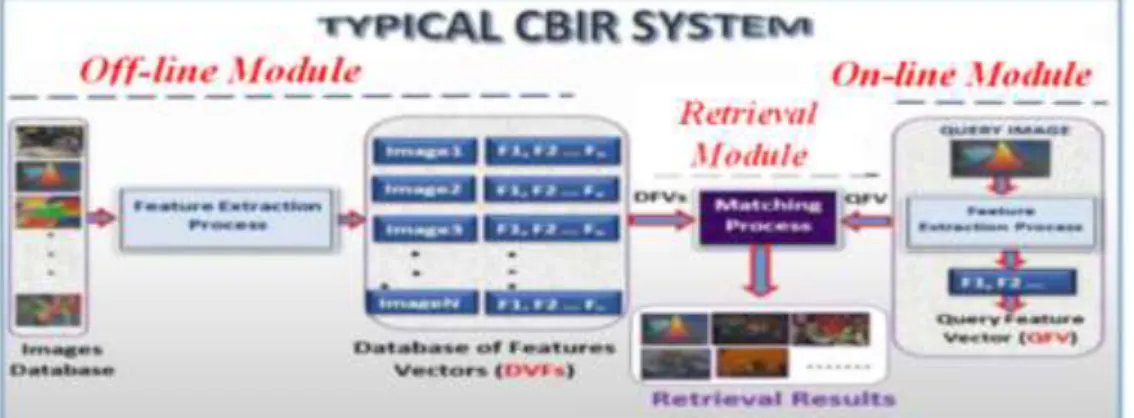
DBIs, then stores these values in new database called features database [14]. These feature data are of very small size comparing with the raw data of an image. Thus the features database contains an abstraction of pixel values from each image in the DBIs. The typical CBIR is consisting of three modules as shown in figure (1).
3.1 Off-Line Module
The first and main component of any CBIR system is the off-line modules which include; DBIs collection, The process of extract the feature descriptors that represent the FV of each image in the database then saved these feature vectors (FVs) in the database to represent the DFVs.
3.2 On-Line Module
On-line module is the process that is done between the CBIR system and the system’s user by provides the system with QI, then the system will be extracted the
FV of QI automatically to form the Query Feature Vector (QFV).
3.3 Retrieval Module
The last module of any CBIR system is the retrieval module. In this module;
DFVs are loaded, then computing the similarity distance between them with QFV
using one of the similarity metrics in order to retrieve and display the most similar image to the QI that has zero value or lowest distance value. [2], [10], [15].
199
4. Proposed CBIR System
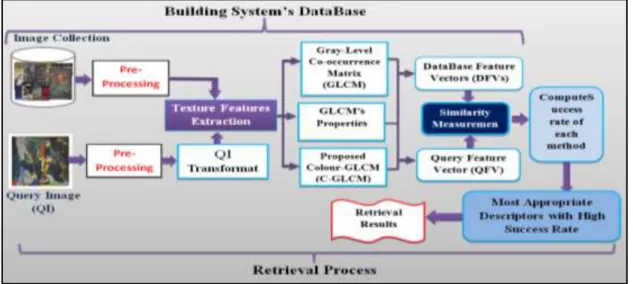
Figure (2) shows the main components of the proposed CBIR system that will be discussed in details next sections. These components include build the system’s database and image retrieval process.
4.1 Building System’s Database
The building system’s database is divided into three functions; image collection stage, pre-processing stage, and FE stage. Each function is complementary to the other stage and should be done sequentially step by step as shown in figure (2).
4.1.1 Image Collection Stage
The first stage of the proposed CBIR system is to create the DBIs. Figure (3) displays some images samples of Iraqi National Museum of Modern Art (INMMA) used in proposed CBIR system.
Fig 3: Samples of images database
200
4.1.2 The Pre-Processing Stage
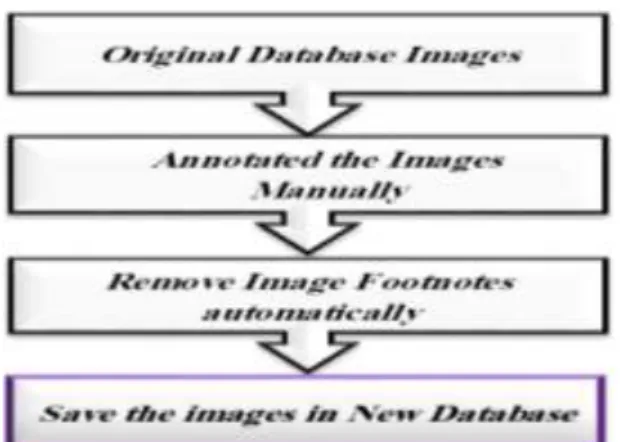
The second stage of the proposed CBIR system is the pre-processing function which is necessary for most of IR system because most of digital images have been obtained using a digital camera and may be irregular in the shape. Figure (4) shows the diagram of pre-processing function of DBIs.
This stage contain two processes for preparing the images before analyzing them including; firstly, annotated all the images by assigning the suitable image file name manually and secondly, remove the image footnotes automatically to enhance the images using the following algorithm:
Algorithm 1: Remove Image Footnotes (RIF)
Input: INIDB {Image Database}
Output: OUTIDB {The Target Image without footnotes}
Step1: Load INIDB (Img).
Step2: Get an Image from INIDBs
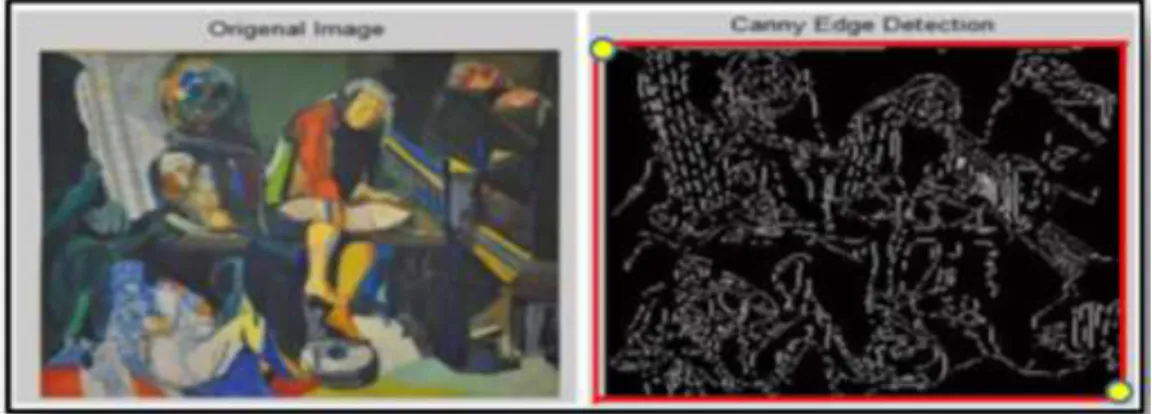
Step3: Determine the edge contours of the image (image footnotes) by applying
Canny Edge Detection (CED), see the reference [16] for more details about
CED method.
Step4: Fixed the first corner point (first pixel) until the last corner point (last pixel) on
the image frame, which represent the first and last pixels of the original image after remove the image footnotes (Two small yellow circles) as shown in figure (5b).
Step5: Resave original image (after remove the image footnotes) in the new database.
Step6: Repeat the steps from (1-5) on all images in INIDBs.
201
Figure (6a) shows some examples of original database images while figure (6b) shows these images after pre-processing process.
4.1.3 Feature Extraction Stage
In order to search images based on their contents (features), a CBIR system must obtain these content from image collection and QI, this process is known as
Feature Extraction (FE) process. FE process is the important and major step in any methodology of CBIR system where the image data are represented in meaningful and reasonable manner and converted to significant numeric [17]. The main key to perform an effective image retrieval system is to select the proper features that represent the image as strong as possible [2], [18]. In this paper, texture feature is extracted as a global feature.
Texture feature plays a main role in some real applications like image and
video retrieval, analysis of medical image, and remote sensing because it provides a good information about the selected image region or the spatial arrangement of intensities in an image [19], [20]. There are various texture features extraction approaches were proposed and developed to improve the performance efficiently of
CBIR system that used texture as image feature. Generally, texture analysis methods can be classified into statistical and frequency (filtering) methods [21], [22], [23]. The statistical method treats the textures feature as the statistical event or as numeric quantities that represent the statistical properties of the intensities and pixel’s position. This approach is less intuitive, easier and efficient to compute, and it is commonly
-a- -b-
Fig. 6: a: Before Pre-processing process; b: After Pre-processing process -a-
Fig. 5: a: Original image b: Edge map by canny edge detection
202
used for segmentation, classification, and image retrieval. Gray Level Co-occurrence
Matrix (GLCM) [24], run-length matrix [25], local binary pattern that describe textures according to the relationships between the colours components of neighbouring pixels, [26] are examples among the statistical approach. Frequency approach is represents textures in the frequency domain and represents a texture as a set of primitive texels in repeated or regular pattern in an image, Gabor filter [27], discrete cosine transform [28], wavelet transform, etc. are examples of frequency approach [29].
4.1.3.1 Gray Level Co-occurrence Matrix Feature
Gray Level Co-occurrence Matrix (GLCM) feature was introduced by [7]. It is the method of calculating the frequency of pixel pairs having the same gray-level in the image and it has proved to be a common method of texture feature extraction from an image. GLCM is called a second-order statistic because it collects the information of the pixel pairs instead of single pixel, it is based on studies of pixel intensity’s distribution statistically and it expresses the probabilities P(i, j | d, θ) of which two pixels having relative polar coordinates (d, θ) appear with intensities (i, j) [30]. Also, it can be defined as the sum of times number that the pixel with intensity gray-level value (i) occurred in the specified relationship to a pixel with value j in the input image. Thus, the following parameters should be specified before computing GLCM
feature [31], [32], [33].
1. The spatial relationship (angle θ) is defined as the pixel of interest (reference) pixel, and the neighbour pixel is limited to (0o, 45o, 90o, and 135o).
2. The displacement vector d = (dx, dy) between the interest pixel and its neighbour pixel over the image, d is an integer number and could take a value of (1,2,3,…n). 3. The number of gray levels (G), a typical value of G is 4, 8, 16 or 32. The GLCM’s
size is determined by the number of (G) [34].
The output is 2D (square) dependence GLCM matrix. To get a probability matrix, GLCM is normalizing by the sum of the entries. We can get multiple numbers
of GLCM matrices depending on the different values of (θ and d) that used to extract
it.
4.1.3.2 GLCM properties
Due to the nature of values of GLCMs which are sparse and large, Haralick [7] has described fourteen various statistics which are computed from GLCM with the purpose of describing the image to get efficient descriptors as texture features vector. In this paper, the following GLCM properties are used in the proposed CBIR system as texture feature:
1. Contrast
Returns a measure of the intensity contrast between a pixel and its neighbour over the whole image:
203
2. Correlation
Returns a measure of how correlated a pixel is to its neighbour over the whole image:
3. Energy
Returns the sum of squared elements in the GLCM:
4. Homogeneity
Returns a value that measures the closeness of the distribution of elements in the
GLCM to the GLCM diagonal:
Where,
Pi,j = Represent the elements of the normalized symmetrical GLCM μ = Represent the GLCM mean (being an estimate of the intensity of all
pixels in the relationships that contributed to the GLCM)
σ = Represent the variance of the intensities of all reference pixels in the relationships that contributed to the GLCM.
3.1.3.3 Improved the Retrieval Accuracy of GLCM Algorithm
To improve the feature extracted using GLCM, in this paper, proposed C
olour-GLCM (C-GLCM) feature is presented to achieve the objectives of proposed CBIR,
which include reducing the dimensions of FV which consequently reduces retrieval time and increase the retrieval accuracy. The following steps represent the proposed
C-GLCM algorithm:
Algorithm 2: C-GLCM feature extraction method
Input: DBIs {Load DataBase Images} Img: {Original Image}
Output: C-GLCM {Colour-GLCM descriptor}
Step 1: Read Img.
Step 2: Apply image resize process.
Step 3: Separate the three image colour channels into red, green, and blue channel.
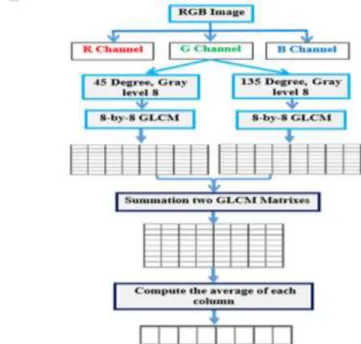
Step 4: Compute GLCM feature with 45 and 135 degree direction and (8*8) GLCM
levels for each channel.
Step 5: Compute the average of each column of GLCM matrix for each channel that
204
AvergRGLCM = mean (RGLCM 45 + RGLCM 135), AvergGGLCM = mean (GGLCM 45 + GGLCM 135), AvergBGLCM = mean (BGLCM 45 + BGLCM 135) Therefore, the length of each average is equal to only (8) dimensions.
Step6: Concatenate the results obtained from step 5 using the following equation:
C-GLCM = [AvergRGLCM AvergGGLCM AvergBGLCM]
In this case, the length of FV of C-GLCM will be 24 dimensions instead of 64
dimension of GLCM. Figure (8) shows the flowchart of proposed C-GLCM feature extraction method:
Thus
4.2 Retrieval Process
In this stage, pre-processing is applied on QI as done on DBIs, and then the same features that extracted from DBIs are extracted from QI to obtain QFV. One problem may face any DBIs that are used in image retrieval system which is each image has been obtained using a digital camera may have different resolution. To overcome this problem, the following seven transformations are applied on the original images, and then used them for test purpose to check whether any changing to QI, the system can retrieve the similar images to the QI despite the differences in the image resolution.
FV of C-GLCM = = 24 Dim
205
1. Image Rotation
Rotating, turning, or reversing image allows to correctly displaying an image that may have been taken with a camera at an angle or scanned in a scanner at a different angle. Three image rotations 90, 180, and 270 degree will be done on each original image. Figure (8) shows an example of original image with three rotations.
2. Image Noise
Noise is the undesirable effects produced in the image due to the errors in the process of image acquisition which is affected in the pixel values; so it does not reflect the true density of the real scene. The noise quantity is determined by the number of pixels that is corrupted in the image as a result of noise. In this paper, Salt and pepper noise is applied on all original images; it is one of noise’s type among many types of noise. This type of noise contains random pixels and being set to (On pixels) which mean bright pixels on the dark region, and (Off pixels) which mean dark pixels on the bright region. Figure (9) shows an example of one image after adding salt and pepper noise.
3. Image Pyramid
The third transformation is transform each original image to image pyramid by computes a Gaussian pyramid expansion for one stage multi-resolution pyramid of the image (I) using equation (5) and the size of image output is equal to:
(2*M-1)-by-(2*N-1)……….(5) Where,
M and N represent the size of rows and columns the image.
Fig. 8: Original image with three rotations
206
4. Image Cropping
The process of removing the image footnotes is called image cropping and it is performed in order to improve the image framing. It is limited since it can only remove pixels from the image periphery. Figure (10) shows an example of an original image with cropping it.
5. Image Scaling
Image scaling is the process of resizing a digital image. It means reduces or increase the physical size of the entire image by changing the number of image's pixels.
Retrieval Algorithm
The performance of proposed CBIR system includes the following stages: Stage 1: Load one image randomly as QI.
Stage 2: Apply pre-processing function. Stage 3: Apply FE process to get QFV. Stage 4: Load DFVs.
Stage 5: Compute the similarities between QFV and DFVs using the common metric that is used in image retrieval system is Euclidean Distance by examining the root of the squared difference between QI and DBIs, where the value of distance shows the degree of the similarity between QI and DBIs.
Stage 6: Sort the distance values in ascending order and store them with associated image file in a new database.
Stage 7: Retrieve and display the images which have zero or smallest distance value where represent the most similar image. In some details, if the distance value is equal to zero, i.e. the same image of QI, if it is smallest value, this means that the image is most similar to QI; else, it is not similar image to
QI.
207
4. Experiments and Results
In this section, describes the experiments and results obtained by the proposed CBIR system is presented. The system recorded promising results in retrieving relevant images from the large museum images database that is used to test the performance of proposed CBIR system. Many comparisons to check the accuracy of texture feature using GLCM methods used in this paper are discussed and experimented. This database is provided by (INMMA), 4000 original images belong to many Iraqi artists have been used as QI including 500 original museum images which were selected randomly among all the museum images, then applying seven image transformations that mentioned in section 4.2 on each original image resulting
3500 transformations images. Texture image feature was used as based to retrieve the similarity images. The subsequent experiment is a comprehensive comparison of different FE techniques. Visual comparison of the improvement achieved by proposed CBIR will be given at the end of this experiment. All experiments were conducted using Matlab 7.10 (2010a) as the software tool and an Intel (R) Core™ 2 Duo, processor with a 2.20 GHz CPU and 8 GB RAM as the testing platform.
To select the suitable GLCM texture feature, in this paper, firstly, the GLCM feature was applied using the method which mentioned in section (4.1.3.1). We focused on how the spatial relationship (direction) parameter is affected on the retrieval results, while other parameters keep it constant. Thus, several experiments were conducted using four different directions (0°, 45°, 90°, and 135°) to create multiple GLCMs for a single input image by scanning the intensity of each pixel and its neighbour, defined by displacement d=1. We can also combine any two or more directions to form an average of GLCM matrixes. As a result, the system produces high accuracy with the best angle selection experimentally (45º together with 135º) and G = 8 to compute the
GLCM feature. A new matrix is formed by sum the elements of matrices which
represent the GLCM feature vector with 64-dimention (8-by-8). Secondly, statistics metrics that are very useful texture features can be computed from GLCM with the purpose of describing the image to get efficient descriptors as texture features vector and to decrease the dimension of GLCM vector including homogenous, contract, correlation, and energy properties using the equations (1-4), then two experiments are done to get the FV of GLCM are done to retrieve the similarity images; the first
experiment is by concatenating these four features to form the FV with 4- dimension,
the second experiment is by computing the average for these four features. Last
experiment is done using the proposed C-GLCM.
5. Performance Evaluation
The evaluation is carried out based on computing the retrieval accuracy for each method of GLCM descriptor for each retrieval type. To evaluate GLCM descriptors for each type of query image, a new evaluation method called the average of success retrieval rate is proposed to compute the accuracy of retrieval performance of each feature’s descriptor by computing the percentage of successful retrieval. The retrieval results by GLCM descriptor was considered successful by the user if the original museum image was in the first rank of the returned set. The overall comparison
208
results that obtained using all GLCM methods including the proposed C-GLCM
method are summarized in Table (1).
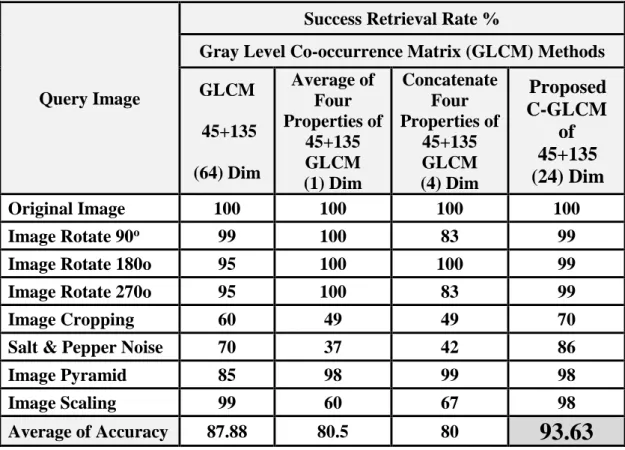
Table 1: Success retrieval rate of GLCM descriptor methods
Success Retrieval Rate %
Query Image
Gray Level Co-occurrence Matrix (GLCM) Methods Proposed C-GLCM of 45+135 (24) Dim Concatenate Four Properties of 45+135 GLCM (4) Dim Average of Four Properties of 45+135 GLCM (1) Dim GLCM 45+135 (64) Dim 100 100 100 100 Original Image 99 83 100 99 Image Rotate 90o 99 100 100 95
Image Rotate 180o
99 83
100 95
Image Rotate 270o
70 49 49 60 Image Cropping 86 42 37 70
Salt & Pepper Noise
98 99 98 85 Image Pyramid 98 67 60 99 Image Scaling
93.63
80 80.5 87.88 Average of AccuracyThe results show that the proposed C-GLCM improved the retrieval results with average of success retrieval rate from (80% to 93.63%) which represent the most a proper texture feature descriptor.
6. Conclusion and Feature Work
6.1 Conclusions
In this paper, we have proposed a new Museum Image Archiving and Retrieval (MIAR) system for INMMA. This section introduces the major outlines that are concluded from this study as presented in the following points:
1. The experimental results reported promising high retrieval accuracies by using the proposed C-GLCM feature. Algorithm development of GLCM texture feature by extraction from each colour channel lead to improve and increase the retrieval accuracy (93.63%) compared with GLCM that extraction from whole gray image (87.88%) and compared with statistical properties that extraction from GLCM
(80%). These results come with users’ expectation
2. The proposed C-GLCM method produced feature vector contains texture and colour features at the same time with low dimensional.
209
3. The design of the proposed system is very flexible, allowing the system user to expand the images database because the system is extensible as there is no limitation in adding new museum images at any time.
6.2. Future Works
Although the system performs well, at the current stage, there is much room for enhancement to expand the proposed system to a wide range of retrieval applications. Some possible future works are discussed below:
1. Finding other feature descriptors and feature fusion methods to fuse these descriptors appropriately in order to increase the image retrieval accuracy.
2. Finding automatically a method to annotate the museum images associated with
MIAR system. This process will lead to retrieve the similarity museum images based on textual information in addition to image content.
Conflict of Interests.
There are non-conflicts of interest
References
[1] CH. Kavitha, B. Prabhakara Rao, A. Govardhan, (2011). An Efficient Content Based Image Retrieval Using Colour and Texture of Image Sub-Blocks. International Journal of Engineering Science and Technology (IJEST), Vol. 3, No. 2, pp. 1060-1068.
[2] Abdulkareem O.I., Fatin Abbas Mahdi, (2015). New Feature Fusion Technique Based Museum Image Retrieval System. Aust. J. Basic & Appl. Sci., 9(1): 106-11.
[3] Jun Zhang, Lei Ye, (2010). Properties of series feature aggregation schemes. World Review of Science, Technology and Su st. Development, Vol. 7.
[4] ChandrakantS. Parkhi, Anshu Gupta, (2014). A comparative implementation of content based image retrieval techniques in wavelet and cosine domains. IOSR Journal of Electronics and Communication Engineering (IOSR-JECE), Vol. 9, Issue 2, PP. 25-30, www.iosrjournals.org.
[5] S. Mangijao Singh, K. Hemachandran, (2012). Content-Based Image Retrieval using Colour Moment and Gabor Texture Feature. IJCSI International Journal of Computer Science Issues, Vol. 9, Issue 5, No 1, www.IJCSI.org.
[6] Fatin Abbas. Mahdi, Abdulkareem Ibadi (2014). MIRS: Museum Image Retrieval System using Most Appropriate Low-Level Feature Descriptors. IJCSI International Journal of Computer Science Issues, Vol. 11, Issue 5, No 2.
[7] Haralick R., K. Shanmugam, Dinstein I. (1973). Texture Features for Image Classification. IEEE Transactions on Systems, Man and Cybernetics, SMC-3(6), pp. 610-621.
[8] Smita S Patil1, A. A. Junnarkar, D. V. Gore. (2014). Study of Texture Representation Techniques. International Journal of Emerging Trends & Technology in Computer Science (IJETTCS),Vol(3), Issue 3.
[9] Deepak S. Shete, M.S. Chavan, (2012). Content Based Image Retrieval Review. International Journal of Emerging Technology and Advanced Engineering, (IJETAE), Vol. 2, Issue 9.
210
[10] B. Suganya, J.Kavitha, D. Saravanan, (2013). Image Retrieval Techniques: A Survey. International Journal of Futuristic Science Engineering and Technology Vol. 1 Issue 4.
[11] Yogita Mistry, D. T. Ingole. (2013). Survey on Content Based Image Retrieval systems. International Journal of Innovative Research in Computer and Communication Engineering, Vol. 1, Issue 8.
[12] Chih-Chin Lai, Member, Ying-Chuan Chen, (2011). A User-Oriented Image retrieval System Based on Interactive Genetic Algorithm. IEEE transactions on instrumentation and measurement, Vol. 60, no. 10.
[13] Meenakshi Madugunki, D. S. Bormane ,SonaliBhadoria, C. G. Dethe, (2011). Comparison of Different CBIR Techniques. Electronics Computer Technology 1(ICECT), 3rd International Conference on, vol.4, no., pp.372-375, 8-10.
[14] Shristi Jain, Dr. Asmita A. Moghe2, 2017. A Review of Different Content Based Image Retrieval Techniques, (IJCSIT) International Journal of Computer Science and Information Technologies, Vol. 8 (1), 100-104.
[15] Hamid A. Jalab, Nor Aniza Abdullah, (2013). Content-Based Image Retrieval Based on Electromagnetism-Like Mechanism. Hindawi Publishing Corporation Mathematical Problems in Engineering.
[16] J. F. Canny, (1986). “A Computational Approach to Edge Detection”, IEEE Transactions on Pattern Analysis and Machine Intelligence, vol.8, No.6, pp.679-698.
[17] Athanasios Tsitsoulis, (2013). A first stage comparative survey on human activity recognition methodologies. International Journal on Artificial Intelligence Tools Vol. 22, No. 6.
[18] Savvas A. Chatzichristofis, Yiannis S. Boutalis, (2011). Compact Composite Descriptors for Content Based Image Retrieval: Basics, Concepts, Tools. Book,VDM Verlag Dr. Muller GmbH & Co. KG.
[19] Jian Yang, Jingfeng Guo, (2011). Image Texture Feature Extraction Method Based on Regional Average Binary Gray Level Difference Co-occurrence Matrix. Virtual Reality and Visualization (ICVRV), 2011 International Conference on, pp. 239 – 242.
[20] D. Abraham Chandy, J. Stanly Johnson, S. Easter Selvan (2013). Texture feature extraction using gray level statistical matrix for content-based mammogram retrieval. Multimed Tools Appl DOI, Springer Science & Business Media New York.
[21] Castelli, V., Bergman L.D. (2002). Image databases: Search and Retrieval of Digital Imagery. book, John Wiley & Sons, Inc.
[22] Neetesh G., R. K. Singh, P.K. Dey, (2011). A New Approach for CBIR Feedback based Image. International Journal of Computer Applications, Volume 14– No.4, January, pp. 0975 – 888.
[23] Swati V. Sakhare, Vrushali G. Nasre, (2012). An Efficient Approach for Content Based Image Retrieval (Colour & Texture) by Wavelet & Gabor. National Conference on Innovative Paradigms in Engineering & Technology (NCIPET) Proceedings published by International Journal of Computer Applications (IJCA). [24] Zhang, J., Li, G., He, S. (2008). Texture-based image retrieval by edge detection matching GLCM, The 10th IEEE International Conference on High Performance Computing and Communications.
[25] Zheng, C., Sun, D.W., Zheng, L. (2007). A new region-primitive method for classification of colour meat image texture based on size, orientation, and contrast. Meat science, 76(4), pp. 620-627.
211
[26] Er. KirtiSachdeva, O.P.Vinocha, (2014). A Comparative Study of Factors Affecting Performance of Local Binary Pattern (LBP) Variant along with Distance Metrics for Face Recognition. International Journal of Scientific & Engineering Research, Vol. 5, Issue 1.
[27] Mäenpää, T., Pietikäinen, M. (2004). Classification with color and texture: jointly or separately. Pattern Recognition, 37(8), 1629-1640.
[27] Alice Porebski, Nicolas Vandenbroucke, Ludovic Macaire. (2008). Haralick feature extraction from LBP images for color, IEEE, Image Processing Theory, Tools & Applications.
[28] Jae Young Choi ; Yong Man Ro ; Konstantinos N. Plataniotis (2012). Color Local Texture Features for Color Face Recognition, IEEE Transactions on Image Processing ( Volume: 21 , Issue: 3.
[29] Porebski, A., Vandenbroucke, N., Macaire, L. (2008). Haralick feature extraction from LBP images for color texture classification. Paper presented at the Image Processing Theory, Tools and Applications, IPTA.
[30] Samar M. Alqhtani, SuhuaiLuo, Brian Regan, (2015). Fusing text and image for event detection in twitter. The International Journal of Multimedia & Its Applications (IJMA) Vol.7, No.1.
[31] P. Mohanaiah, P. Sathyanarayana, L. GuruKumar, (2013). Image Texture Feature Extraction Using GLCM Approach. International Journal of Scientific and Research Publications, Volume 3, Issue 5.
[32] Thakare, Vishal S., Nitin N. Patil, (2014). Classification of Texture Using Gray Level Co-occurrence Matrix and Self-Organizing Map. Electronic Systems, Signal Processing and Computing Technologies (ICESC), International Conference on. IEEE.
[33] Christoph Georg Eichkitz, Marcellus GregorSchreilechner, Paul de Groot, Johannes Amtmann, (2015). Mapping directional variations in seismic character using gray-level co-occurrence matrix-based attributes. Interpretation, Vol. 3, No. 1; p. T13–T23, 9 FIGS.
[34] P.G.Reddy, (2010). Extraction of Image Features for an Effective CBIR System. In IEEE Conference Publications – Recent Advances in Space Technology Services and Climate Change (RSTSCC), pp. 138-142.