ON THE ACCURACY AND PROPERTIES OF RECENT ACROECONOIC FORECASTS
Victor Zarnowitz*
University
of Chicagoand
National Bureau of Econoiic Research
Working Paper No. 229
NAIIONAL BUREAU OF ECONOMIC RESEARCH, INC.
261 Madison Avenue New York, N.Y. 10016
Revised February 1978
Preliminary; Not for Quotation
NBER working papers are distributed informally and in limited number for comments only. They should not be quoted without written permission.
This report has not undergone the review accorded official NBER publications; in particular, it has not yet been submitted
for approval by the Board of Directors.
NOTE:
This
is an abbreviated version of a report on work in progress supported by grants from the National Science Foundation and the Earhart Foundation to the NationalBureau of Economic flesearch.
*1 am grateful to Dennis Bushe, Thomas TZutzen, and oert Osterlund for assistance with research and preparation of
ON THE ACCURACY AND PROPERTIES OF
RECENT MACROECONOMIC FO!ECASTS
Abstract
The aim of this study is to contribute to the measurement and analysis
of errors in economists' predictions of changes in aggregate income, output,
and. the prIce level. n11
sample
studies of forecasts can be instructive,
it their limitations must be recognized. Compilation of consistent forecast
records extending over longer periods of tine is necessary to establish a
reasonably reliable base for assessments of forecasting behavior and. perfor—
mance. Thus the historical record of post—World War II forecasts assembled
in the 1960's by the NB is here extended and updated.
The end—of—year predictions of annual percentage changes in GNP earn
good marks for overall accuracy when judged according to realistic rather
than ideal standards. Moreover, they are found to have improved significantly
in the period since the early l96O s compared with the previous years after
World War II.
The corresponding predictions for GNP in constant dollars (real
growth) and the GNP implicit price index (inflation) are considerably poorer.
The former suffer fran large turning point errors, the latter from large
underestimation errors. Indeed, forecasts of inflation are not much better
than projections of the most recently observed inflation rates, and they lag
behind the actual rates much like such projections. But the errors in
forecasts of real growth are negatively correlated with the errors in forecasts
Forecasts
for the year as a whole canbe
satisfactory when basedon
a
good record for the first two
quarters;they tend.
to be more accurate than forecastswith longer spans. An exaiination of the recent multiperiod
pre-dictions fr veU—kiown econometric models and. business outlook
surveys shov
that
the errors for real growth and inflation cumulated rapid.ly beyond. the
spans.of 2 to 1 cpiarters. Previous studies have shon the cumulation to be
as
a
rule less than proportional to the increase in the span, but in the
period of recession and recovery 1973—75 the build—up of
errors was much greater.Again the nominal GNP forecasts benefitted from offsetting errors
as the rise in
prices was heavily underestimated andthe downturn in real
activity was missed. Forecasters were generally unprepared for the concurrence
of accelerating inflation and slowing, then declining output rates: they
optimistically
(and. probably also from a lingering faith in a simple Phillips trade-off) kept anticipating less inflation andmore
growth.At
the present time, the predictive value of detailed multiperiod
forecasts reaching out further than a few quarters ahead must be rather
heavily discounted. No doubt, in periods less turbulent than the recent
past the longer forecasts can be considerably more accurate, but thiz fair—
weather
argument is not very persuasive or helpful.
Victor Zarnowitz
Graduate School of !3usiness
University of Chicago
Chicago, Illinois 60637
312/753—3615
Victor Zarnowitz
I.
On Some Uses andlimitations
of Forecast DataHow
and how well economists forecast, and how much their predictions
•
help or hurt public and. private decision mdcing, are matters that
oughtto
receive much attention of the profession. This is so ot only because of
their direct
interest to the authors, users, and critics of the forecasts,but
also because
oftheir intrinsic
but less evident academic interest. hatis
the practical applicability of economic analysis in this critical area?
l4hat
is the qualityof
foresight and counsel that canbe expected of
respon-sible economists?
These arebroad
questions whichare not
easy to answer,but they
are basic
and.surely deserve
to be tackled. Thisrequires
that wesystematically confront forecasts as indications of
how economists
cx ante thoughtevents
are likelyto
un.foldwith
cx post knowledge of what actuallydid.
happen and how.
The aims, from tieleast
to t.emost
ambitious, are(1)
to
measure forecast errors, (2) to explain them, and (3)
to
learn how to
reduce them in the future.
Success
in forecasting may be occasional and. fortuitous or
intuitive,but
progress in. forecasting, to the extent it is possible, can only come from
advances of science, not art or chance. It presupposes
thatsu.fficiently
important and persistent
regularities in economic processes andrelationships
ed.st
and
be properly identified and. used. Learning processes areinvolved,
which
can be
time-consumingarid, discontinuous,
reflecting in. partthe shifts
and
discontinuities inthe econrmc change itself,
inpart the inadequacies
of
measurement
andanalysis.
Data
on economic forecasts generally cover short tine periods. Iørlg
tine series on
consistentpredictions simply do not exist. Few if
anythat
matter (source,target,
timing,assumptions,
data, models,and
methods used),so that it
is often d.ifficult to determine what constitutes a suitable"sample"
of forecasts of a given type. Moreover, few forecasters leave their
models and. techniq.ues unchanged for long as they seek inprovements and try to
adapt to new developments in the economy. Hence, a particular forecaster's
past record is often a hi.ly uncertain basis for inferences how he will
perform in the future.
Even
more hazardous, if not irresponsible, are attempts to grade
fore-casters on the evidence of how well they predicted change in. a particular
short period, say, a year or a few years. C].early, on any individual occasion
sce forecasters will, be ahead of others by sheer chance or for some
idio-syncratic reasons. Strong evidence of significant and stable differences over
time would be required to rank the forecasting individuals, groups, or models
with a modicum of confidence, and, such evidence is essentially lacking
(Zarnowitz, 1967, 1971; Christ; McNees, 1975).
The proliferation in recent years of mu.ltiperiod. quarterly
macro-forecastz offers no substitute for long historical series. These are rich
data
containing much interesting material that certainly deserves to be
care-fully recorded and analyzed. However, such forecasts, and. so their errors,
tend. to be internally correlated in at least two ways: (a) serially, Within
each
sequence made from a given base period. and (b) across the successive
sequences, which overlap and thus refer partially to the sane target period.
Each multiperiod forecast is a joint product of the common infornation,
technique, and juderit used, and each depends on previo..s forecasts of which
it is to some extent a revision. Thus, errors in the data, models, procedures,
and jtidents, autocorrelated disturbances, and certain types of distributed
multi-period
forecasts. Theresulting
complex correlation structures resistestima-tion,
given the small samples of comparable predictions from any giverx source.
Consequently, measures of average accuracy, bias, etc., calcui.ated
from such
samples are difficult to interpret from the viewpoint of
statistical inference
(Spivey and. Wrobleski).
Two conclusions are surely
valid.. First,small-sample studies cf
fore-casts are still needed and can be instructive, but their llmi tations must be
recognized. Second, it is necessary to compile and. examine forecast records
extending as far back in time as possible, so as to gain information, take a
lcnger view of forecasting behavior and. performance, and place the short
records of recent predictions in a proper perspective. Historical data on•
post-World. War II forecasts assembled in the 1960's by the National Bureau.
of Economic Research provide a good base here, which I was able to partially
extend and update. Some pre1cm1nary results for annual forecasts of three
variables
arereported below.
II.
The Record of Annual GNP Forecasts Since 1914.7In the
early post-World
WarII
period, most forecasts were made near the end of thecalendar
yearfor
the next yearand
most referred to GNPin
currentdollars. The evidence
we have on such forecasts goes back to 1914.7but is quite fragmentary for the late 1914O's and early 1950's.
The period of transition from the
wareconomy witnessed the largest
errors on record in the
GNPforecasts.
Even after the 1914.5-14.6 predictionswere
shown to have greatly underestimated the then prev±ling levels ci' economic
activity (Klein, 1914.6), expectations of a business slump stubbornly persisted.
One =a].l, reputable group of private forecasters came up with an
averageprediction for 1914.7 of a 6
percent
decline in G?, whereas the actual change
fractional
decline but GNP
instead
advanced again at much the same surprisingly
high rate. The failure of forecasts during these years was widespread, with
but a few partial except±ons; the develonents of the time could not be
predicted well, with estimates based on data and relationships for the 1930's
and false analogies with the early post-World War I period. When a recession
finally cane late in 191.8, it proved shorter than many had. expected. A
"consensus forecast" by znre than 30 respondents polled in December l9!.8
anticipated well the decline of nearly 2% in TP during 1919, but a year
1tter the sane group was wide off the mark in predicting a d.rop of
3.5%while
GP actually staged a strong cneback in 1950 with a rise exceeding 10%.
•
The evidence for the period 1953-76 is stimr'ized in Table 1 in terms
.of compar1sou. between the predicted and the actual annual percentage changes.
It is generally instructive to analyze forecast errors in terms of levels,
absolute changes, and percentage changes but, if a choice must be made for
succinctness,
thereare several good reasons for using percentage changes
'where
technicallyappropriate,
particularlyfor
variables with strong trends. (1). What Is predicted in the firstplace
is changefrom
thelast
known orestimated level, and
percent
changes often varyless
with the levelsand are
more
stable
and comparable over time thand.oflar changes.
(2) The percent changeforecasts
areapt
to be less affected bydata revisions. (3) some
important measures of
predictive performance, such as rre1ations withactual
values, are much more meaningful for change forecasts than for level
forecasts.
(14.) It is the rates of growthin economic aggregates (income,
output,
prices) that are of maininterest
to analysts and policy. makers.The
forecasts are made late in the yeart -
1
or,
in a few cases,very early in the target year t;
typically,
the forecasters know the officialTABLE 1 J)*4A3Y NEASUBE8 OF ERROR FOB. MUIJAL PREDICTIONS OF PERCE1ITAON OLANCIB IN WIP 1953-76 Line period and No. of Years Chvered Livingston Survey,
)ean
ForecastC(1)
Selected
private
Precasts,
)4eanb(2)
N.Y. Yore- ASA/NBER Econoniccasters
Survey, Report Michigan %*arton Club, )lean Medianof
tha
Model!de1
Forecast0Forecaat'
piesident (3) e) (5) (6) (7)Extrapolations
—- ActualInst
Average changeb Changet (8) (9)Prelts- inaryi
(10) Eeviaedk(U)
Mean Absolute percentage Change, Predicted and Actual 1 1953-76(2k) 5.7 6.o . 6.6 6.9 2 1956-63 (8) k.3 k.7 k.o 5.0 5.3 3 1963-76(1k) 7.1.7.2
7.6
7.2
7.67.9
8.1 8.6 8.3 8.2 8.k 8.2 ii 1969-76 (8) 8.1 8.08.8
Mean Absolute Ezzor,in
PercentagePetuts
5 1953-76(2k)i.6
1.2 3.1 2.3 0.5 6 1956-63 (8) 1.7 1.k 1.7 3.k 1.9 0.5 7 1963-76(1k) 1.1 0.9 0.9 1.3 0.8 2.3 1.8 0.3 8 1969-76 (8) 1.0 o.6i.
0.8 1.0 0.9 2.62.0
0.3 9 1953-76(2k) -1.0 -0.7 Mean Error,in
percentage lints -0.3-0.1
-0.5 10 1956-63 (6) .O.1& -0.1-0.8
0.2 -o.k -0.3U
1963-76(1k) -0.8 -o.6 -0.2 -0.5 -0.3 -0.3-o.6
-0.3 12 1969-76 (8) -0.3 -O.k-0.3
0.2 -0.1 -0.2 -0.3 -0.5 -o.k Squaredcorrelation
(r2) Between Predicted andActual
Change 13 1953-76(2k) .739 .792 012 .05k 1k 1956-63 (8) .63k .L97 .563 .1551 .038 .752 .603 .689 .oo6 .079 15 1963-76(1k) .717 .791 i6 1969-76 (8) .780 .875 .768 .83k .7k6 .669 .002 .000Notes
toTable 1
aBased on
surveysconducted by
JosephA. Livingston, syndicated columnist, now
with the iiladelphia Inquirer3 and published in the Piilad.elphia Bulletin and.
American
Banker. Of the semiannual surveys, only the end-of-year ones are
used here; they typically cover answers to
a questionnairemailed in November
and, appear in
a"Business Outlook" column
latein December. The participantz
in these
surveys,listed at the end of the Bulletin columns, varied in number
between 1J and.
62.bAverage c end-of-year annual GNP forecasts
the following sources: (1)
Fortune magazine ("Business Roundup"); (2) Harris Trust and Savings Bank;
(3) IBM Economic Research Department; (11.)
National
Securities and. Research
Corporation;
(5)NICB (now Conference Board) Economic Forum; (6) Robert W.
Paterson,
University of Missouri; (7) Prudential Insurance Company of America;
(8) UCLk Business Forecasting Project. The earliest of these predictions
were made in October, the latest in January. st but not all of the
fore-casts in each of these eight sets are available in published form; those for
the period ending in 1969 were analyzed in IBER studies of economic
fore-casting (Zarziowitz, 1967, 1972, 19711').
the semiannual forecasts of
thisgroup, onliy the end-of-year ones are
included.The group mean forecasts used here
cover individual predictionsvarying in number
between31 and. 39. These data, too, were analyzed in I1B
studies (see ref. in
noteb), but no forecasts were collected for the period
after
1963.The predictions for
1956-58were made
inOctober, those for
1959-63 in December.
Cisource: Qp.arterly releases by the American Statistical Association and. the
National Bureau of Economic Research, published in the ASA AniStat
News and.the BER co1orations in Economic Research. Median forecasts
fromthe
November surveys only' are used.. The membership in. these surveys varied.
between 11.5
and
814..See Zarnowitz, 1969, and V.
andJ.
Su,1975.
eRorecasts by the Council of
EconomicAdvisers (CEA) as stated in. the Economic
Report (usually as the midpoint in a relatively narrow range). As a rule,
the Economic Reort appears in January. For some earlier studies of these
forecasts, see Moore, 1969 and 1977; Za.rnowitz, 1972; FeUer, 1976; MeNees,
1977.
published ex ante forecasts from, the
Research Seminarin i.antitative
Economics
(RsQ) ofthe University of Michigan. Based on
several workingmodels (see Suits, 1962;
Eyrnaris and Shapiro, 1970 and 19711.). The forecasts
arethose
released in connection withthe University
of Michigan an.nu.al"Conference
on the Economic Outlook,"
occurring usually in November(in
19711.
and
1975,December).
Wharton Economic Newsletter, Econometric Forecasting Unit, Wharton
School
of Finance & Commerce, University of Pennsylvania. Forecasts basedon a
series of
versionsof Wharton
models. See Evans and Klein,1968;
Evans, Klein, and Saito, 1972; McCarthy, 1972; Duggal, Klein, and McCarthy,
19711. The
forecasts here covered aredated in November or (as in 1971 and
1973-75) in December.
Notes to Table 1 (contd..)
hAsses that next year's percentage change will be the same as that of the
previous year. The actu.al changes used are those based on the prellmtnary
estimates explained
in note jbelow.
tAssumes that next year's
percentagechange will be the sane as the average
percentage change in the four previous years. On the actual changes used.,
seenotej.
ABased on the first official estimates following the year for which
thefore-cast was made.
kBased
oncurrent data taken from U.S.
Department ofCommerce, Bureau of
Economic Analysis, gandbook of Cyclical Indicators, A Supplement to the
Business Conditions Digest, May 1977.
year
t —
1.
Theactual changes used. to compute the errors are based on the
first official estimates for the year t published. early in. the following
(t +
1)
year. These are provisional values which are themselves partly
near-term predictions, and subsequent revisions indicate that the errors in the
early data are by no means negligible (cols. 10-11). on. the average, without
regard to sign, these revisions are about one-third the size of the forecast
errors (lines 5-8).
Theerrors are computed by subtracting the actual from
the predicted (or estimated.) changes, and. they are predominantly negative,
which shows that both forecasts and the provisional figures strongly tend to
und.erstate
the changes in C.TP (lines 9-12). By farmost
of these underestimated. changesare increases
(for a reviewof similar findings of
earlier studies,see
Zarnowitz, 1972).
Table 1 discloses a substantial correspondence between the forcasts
and. the realizations. The predicted changes approd.niate the actual ones well
in each period covered, the averages of the former being generally less than
one percentage point smaller than the averages of the latter (lines 1_li.).
Wflere the mean actual changes increased (is from 5% p.a. in 1956-63 to
8%
pa. in 1963-76), so did the mean predicted changes; moreover, the
discrepan-cies between the two diminished in the latter years. The forecasts are in
all cases
considerably more accurate thanthe naive model which assumes that
next year' s
percentage
change will be the sameas that of the previous year
and more accurate than the--somewhat less naive--tread extrapolation model
which projects the average percentage change of the four previous years.
Collectively,
the mean absolute error of forecasts is less than halfthat
of thefirst naive model' (lines 5-8, col.
8),arid
the ratio of the two declines
from 0.11.7 in 1956-63 to 0.11.3 in 1963-76 and 0.311. in 1969-76. The
correspondingratios
for comparisons of the forecasts with the four-year moving average
(:trefldu) extrapolations (col. 9) are O.8!i., 0.56, ar.d
o.1.
The average error measures are imDortant but they fall far short of
telling the whole story. Measures of correlation (which unfortunately are
often omitted from forecast evaluations) are needed to show how well the
predicted changes have tracked the actual changes over tii. The r
coeffi-cients for the forecasts covered in Table 1 are
allpositive and
significant;the r2 statistics generally exceed 0.5
and,for the more recent periods,
average 0.7 or higher (lines 13—16, cola. 1—7). In contrast, the corresponding
coefficients for the extrapolations (cols. 8 arid. 9) are zero or near—zero
(where larger, r is negative).
Because sufficiently long and consistent annual
time-seriesdata for IP are
not
available, no attempt was made 'ere to test the forecasts against
hier
startsds
provided bymore effective extrapolation
methodssuch
asthe
auto-regressive integrated moving
average(ARmA) models. However, recent
com-parisons of quarterly
forecastswith such models
showthe forecasts to be on
the
averagemore accurate (Hirsch, Grimm, and Narasixnham; rist; Spivey
and.
Wrobleski), and I would expect this to be a
true for the annual
fore-casts and particularly with respect to the correlations with
the actual values.
ie evidence supports the
conclusionthat the end-of-year forecasts of
current-doUar
GNP next year hada reasonably satisfactory record of accuracy
since
1953. Indeed, in comparisons with earlier forecasts (Sapir; Okun;Zarriowitz, 1967),
that
record improved considerably in the 1960's and. even inthe 1970's, a turbulent period presumed to have been particularly difficult to forecast.
It must be noted that our collection is
certainly rio
randomsample,
includingas it
does the official Administration forecasts and. several of themost
reputable and
influential sets of private predictions by business and. academic economists (seenotes to
Table 1). It is also truethat
our dataand. measures have some shortcomings that must not be overlooked. In particular. the
estimates of the cu.crerit position (ECP) thich the forecaster actually used
as the starting point or base are not always reported. In some cases,
there-fore, the base values had. to be imputed., which was doneusing data as of the
(precise
or approximated) date of the fortcast plus such information as was available on how the forecaster derived his ECP's on other occasions. Theimputations, even if carefully made, undoubtedly contain some errors. However,
these
errors are
definitelynot such as to invalidate
the broad conclusions 1of this paper.
More detailed inferences concerning te relative accuracy of the different
forecast sets covered. cannot be drawn from these results. One reason is that the forecasts differ appreciably with regard to their precise dates, and. it is knownfrom
previous research that the earlier predictions have a significant advantageover the later ones
(Zarnowitz, 1967; McNees, 1975). itis relevant,
however,
to make the general observation that the average error and correlationmeasures do not
show large, consistent differences among the
forecast sets being compared.This is in
agreementwith earlier findings
whichtogether
strongly suggest that the
search for a consistently superior forecaster is about as promising as the search for the philosophers? stone(Zarnowitz, 1971;
McNees,
A few further observations seem warranted. Although the forecasters included differ in many respects, even a detailed inspection reveals few
sharp contrasts
between their predictions for the same years. Of course,
1Other
possible errors, also not critical, might arise fromthe fact that
some
of our forecasts, lacking directly reported annual predictions, are averagesof
forecasts for shorter periods within the coming year. This could causesome deviations from the span or target period intended by
thefore-casters (Carison, 1977).
competent
forecasters use common data and. techniques, regularly interact,
and are often similarly influenced by recent events and. current attitudes and
ways of thinking. The genuine cx
ante
forecasts here considered are all to a
large extent 'judginental." Large doses of judnerit enter, mostly helpfully,
the forecasts derived with the aid. of econometric models (see, e.g., Haitovsky,
Treyz, and.
Su). This could weU. tend. to reduce thedispersion among the
corresponding prediction of this type; there is indeed some evidence that
errors of ex ante forecasts with econometric models vary less than errors
of cxpost forecasts made without
judental a&jtistments (irist). At the
same
time,many so-called Judgmental forecasters use partly some more or less
explicit econometric equations or models, "outside" or "own" (Zarnowitz, 1971;
V. and J.
Su).While publishd forecasts by ranking practitioners
areoften
developed
with particular skill or care, group average forecasts benefit over
• time greatly from cancellations of individual errors of opposite sign
(Zarnowitz, 1967 and. 1972). At any given time, the deviations between
corres-•ponding forecasts from different sources are likely
to bereduced by the
working of these balancing factors. Thus, it is not surprising that forecasts
for the same variable and. target period tend to be similar. Indeed, the
cor-relations between pairs
of theforecast sets included in Table 1, computed
*
for
the four periods distinguished therein, are significantly higher than the
correlations between predictions and. realizations recorded on lines 13-16.
The r2 coefficieats for eight pairs of the predicted percentage change series
'all exceed o.8, and. some are considerably higher.
Of the 110 observations comprised in our seven
forecast set3, about 61i.percent
areunderestimates
and 311.percent
areoverestimates.
By farmost
ofthe latter refer to years marked by economic recessions (19511., 1960, 1970,
year-to-year declines in the period covered in Table 1: in 195!., which the
forecasts
overstated, and in 1958,which the forecasts missed (accounting for
the only
turning-pointerrors
in this sample). Thus underestimation wasii
mited
to the increases in GNP; moreover, it was most pronounced when the increases were part±cularly
1are as
in 1953,1955-56,
1965-66,1968-69,
and
1973.These results suggest tim presence of "systematic" errors, but not in the sense
of a bias that could have been readily escaped or corrected
in advance. It seems difficult to discount them as
merely anothermanifesta-tion
of the faniliar tendency of forecasts to underestimate the observed
changes (which, for
series withrandom elements, is a property of even unbiased
arid, efficient forecasts; Mincer and. Zarnowitz, 1969;
Hatanaka,1975).
2hatis
underestimated. here is the average annual rate
of growthin
a series which,as
properly recognized by the forecasters, is trend-dominated
and. seldomdeclines from year to year.
This
outcomecan
be
traced to the forecasters'
tardy recognition
of high-growthphases
("booms") and, increasingly, ofinfla-tion speedups,
but it was also mitigated by their even tardier recognition of business recessions and slowdowns, Such movements arerecurrent
and notpurely
random; they
have important,detectable
regularities as shown by historicalstudies of business cycles; but they are also nonperiodic and.
indeed
vary a great deal over time, so their predictability remainsvery
limited. In any event, simple
"learning from past errors" would not have beenof
much use here as
the errors of these forecasts generally have zero or verylow
autocorrelations.
III. Annual Forecasts of
Real GNP and the PriceLevel
It
is difficult to obtain and verify consistent forecasts of Piriconstant dollars and the
implicit price deflator (IPD) that would cover more1960's made systematic efforts to decompose their predictions of current-dollar GNP into quantity arid,
price
elements. Of the forecasters withecono-metric
models,
whopaid. mQre
attention to real GNP,only
two(Michigan and.
hartoa)
havelonger
records.2
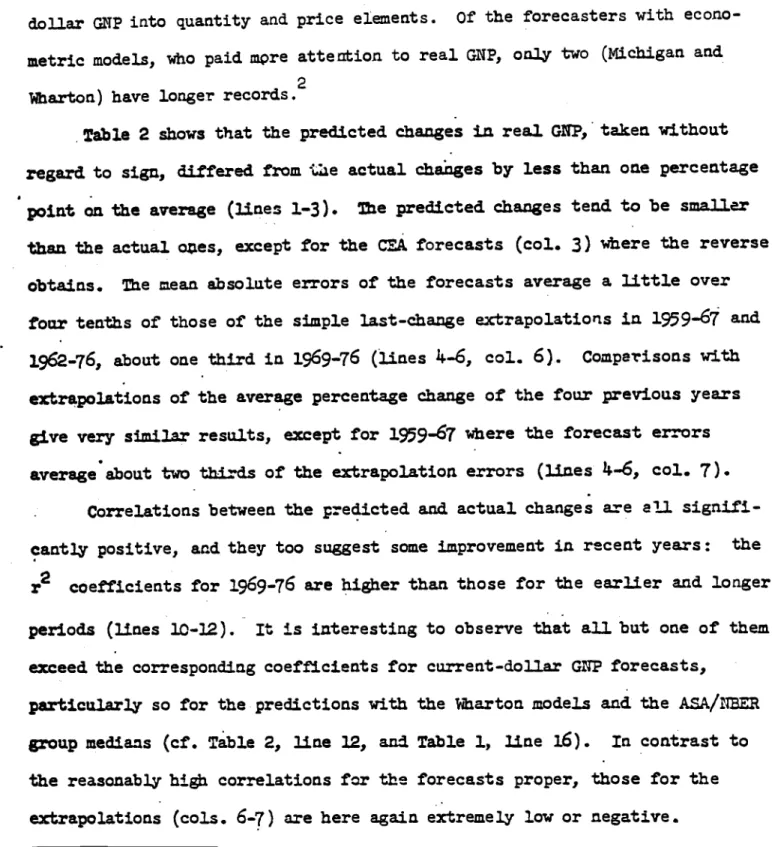
Table 2 shows that the predicted changes in real GITP, taken without
regard to sign, differed from the actual changes by less than one percentage
point on theaverage (lines 1-3). The predicted changes tend. to be smller
than
the actual
ones,except for the CEA forecasts (col. 3) where the reverse
obtains. The mean absolute errors of the forecasts average a little over
tour tenths of those of the simple last-change extrapolatiorts in 1959-67 and
1962-76, about one third. in 1969-76 (lines i+-6, col.
6).Comparisons with
extrapolationsof the average percentage change
of
the four
previous yearsgive
very similar
results,except for 1959-67 where the forecast errors
average about two thirds of the extrapolation errors (lines I_6,
ccl. 7).
Correlations between the predicted and actual changes are
eU
signifi-cant].y positive, and they too suggest some
improvement in recent years: ther2
coefficients
for1969-76 are higher than
those for theearlier
andlonger
periods (lines 10-12). It is interesting to observe that all but one ofthem
exceed the
corresponding
coefficients for current-dollal GNPforecasts,
particularly
so
for the predictions with the arton models and theASA/1BER
group
medians
(ci. Table 2, line12,
and. Table 1, line16).
Incontrast
to the reasonably highcorrelations
for theforecasts
proper, those for the extrapolations (cola. 6-7)are here
again extremely low or negative.2Some
of
the econometric forecasts were released. at more than one datenear the end.
of
the year, and. in more than.one
version depetid.ing onthe
data used or policy assumptions made. In all but a few doubtful instances wheresomewhat arbitrary decisions had to be made, the forecasts chosen are those preferred. by the forecaster or, lacking stated preferences, those which embodied assumptions most common to the forecasts made at the time.
TABIZ 2
J)*ART MEASURES OF ERROR OR AXft1UAL PREDICTIONS
07PERCENTAGE (LANGES fl REAL GNP, 1959-76
lAce .
.
O• 0 55•3 Cove Selected Private Forecasts, Mean& (1.)ASAJNBER Ecoctcrsic
trapolations
ActualSurvey, Reoort
Michigan arten
Median of the Mode Model List Average
Prelim-Forecast ?resideatb
ange
ange
inoy Revised(2) (3) (Ii) (5) (6) (7) (6) (9)
1• 1959-67 (9)
.
'.1.
Mean Abaolate Percentage aage, Predicted and Actual
3.7 S
3(,0)C
2 1962-76(15) Lu 3.8
Li.
Lo
3 1969-76 (8) 3.3
Lo
3.5 3.2 3.6 3.3.
-MeanAbsolute ror, in Percentage Peints
1959-67 (9) 1.3 1.0 2.7 1.7 5 1962-76(15) 1.1
1.
2.8 2.6 6 1969.-76 (8) 1.0 1.2 1.6 0.9 3.7 3.6 0.3 •7
8 1959-67 (9) 1962-76(13) -0.9Mean s•or, in Percentage Points
-0.5 -o.6 -1.1. -0.2 o.6 0.2 -0.3 0.1 -0.1. 9 1969-76 (8) • 0.7 0.8 0.8 0.5 -0.15 0.7 0.06 10 11. 12 1959-67 (9) 1962-76(15) 1969-76 (8)
.5
Squared Correlatioa (re) Between Predicted.531 306dand Actualange
.775 .617 .012
.936 .857 .709 .9k]. .001. •320d
Thr sources and explanations of the data used in columns 2-9, see footnotes it through k, respectively, in Table 1. CAverage of end-of-year annual forecasts of real. GD? inferred from the forecasts of current-dollar GD?, the
consumer price index (CPI) and the wholesale price Index (WPi) from the following sources: (1) harrIs Trust and Savings Back; (2) 1atioaal Securities and Research Corporation; (3) :1C3 (Conference Beard) Eonoeic Torum; (Ii) Robert W. Paterson, University of Missouri; (5) UClA Business Forecasting Project. Trese forecasts were obtained by dividing the forecasts of GD?, as reported in current dollars, by the composite price level
fore-casts, the latter are weighted su.-os of the reoorted forecasts of C?I and U?!, the weiitz being .67 and .353,
respectively (the first of these proportions represents the average ratio c'f sonsunption expenditures to GD? in
the period _L93-9). For further detail and analysis or the individual forecasts in this set, see Zarnowitz,
1968. See
also Table 1, f'n.b. —
-forecasts for 1962, 1963, 1965, end 1968 must be inferred from statements iAthe Report; they are con-firmed by the Council as approximately' correct, though ot in all caoes orecisely correct Moore, 1977). The other forecasts are all, based on figures given in the Reoort and so fully verified.
figure in psrentheaes is based on prelimina.ry CLIP figures deflated by weIghted averages of the corresoond-Lug data for CPI and UP! (with weights as given in fn. a above). This series of "actual" values is comparable to the forecasts used in column 1 onLy.
These
surnarymeasures, then, present te annual forecasts of
real GNP
in a generally favorable light. However, the accuracy of these forecasts
varied greatly in
differentyears, which at times impaired seriously their
usefulness, and this does not show up
inthe snmmry. As suggested by the
averages with regard to sign (lines 7-9), the usual tendency
of forecasts to
underestimate changes prevailed in
thefirst half of the period 1959-76 but
cot in the second. half. Actually, the errors varied considerably in. each
sub-period, primarily reflecting cyclical change and. in
particularthe disturbing
effects of missed downturns. Real. GNP turned down in
l951.,1958, 1970, and.
19Th1.,
but of the 10 predictions for these years which are available eight
specified continued rises and only two succeeded in signaling declines.
Main, and not surprisingly, nearly all of
thesignificantly large
over-etimatioa errors refer to the years during which national output grew at
relatively low or decreasing rates, and, most of the larger u.nderestiination
errors refer to the years of high real growth rates.
It is of considerable interest to note that the tn'ning-point errors
are much larger than other errors (on the average about 2 1/2-3 times larger,
for all forecasts in this collection). Thus, even though relatively few,
these directional errors had, a strong adverse impact on the overall accuracy
of
thereal GNP forecasts, as indicated by the following tabulation.
Mean
Pbso1utePercert of Total
Number
Error, %Points
Absolute ErrorUnderestimation errors 33
1.12
Overestimation errors
21
0.92 214.11.little
because they are few arid. far between (cf. Samuelsori). Bat the argument
goes further to say that such few large errors are the necessary (and small)
price to pay for the avoidance of many large errors "between turning points"
by means of optimal estimation procedures such as least squares. However, it
is not clear that these procedures imply more than that the variance of
thepred.icted.
changes must be less than that of the actual changes (and
progres-sively declining as the forecast span is lengthened.). The inevitability
(indeed;
even the existence) of a trade-off between errors at major turning points and other errors has never been demonstrated, and it would seern a e.u.nsel of despair for the forecasters to accept it. Prediction-of cyclical turns in suchseries
as real GIP, though certainly difficult, is oatnieces-•
sarily impossIble,
particularly on an annual basis (note the good record. in forecasting troughs). In sum, there are indeed. strong reasons for makers arid.users
of economic forecasts to give a great deal of attention toturning-point errors.
Actually, most of them realize this, as shown by the widespread practice of analyzing such errors (Hicinan, ed., 1972; studies in I.E.R.,19714._75). However,
there is certainly much
need for improvement here, and room for some new initiatives (e.g., on. how to use current signals from leading indicators, see Vaccara and. Zarnowitz).The worst single year for the predictions covered. in Table 2 was 19714.,
on
the e'e of which forecasters across the field missed the onset of a serious recession. This, plus the smaller turnin;-Doint errors for 1970, arethe
main reasons for the rise in the average errors of these forecasts in1969-76
compared
with the earlier years. But the rise in. the absolute errors was notlarge, and there was no decline in accuracy as measured by the criteria of cumparisoris with extrapolations and correlations of predicted with actual changes
(Table 2, cols. 3 and ii.).
Limited evidence
from one longer series ofsuggests that real P
predicted
similar average errors in
the two 8-year periods 1953-60 and. 1969-76, with much smaller errors in the
relatively quiet
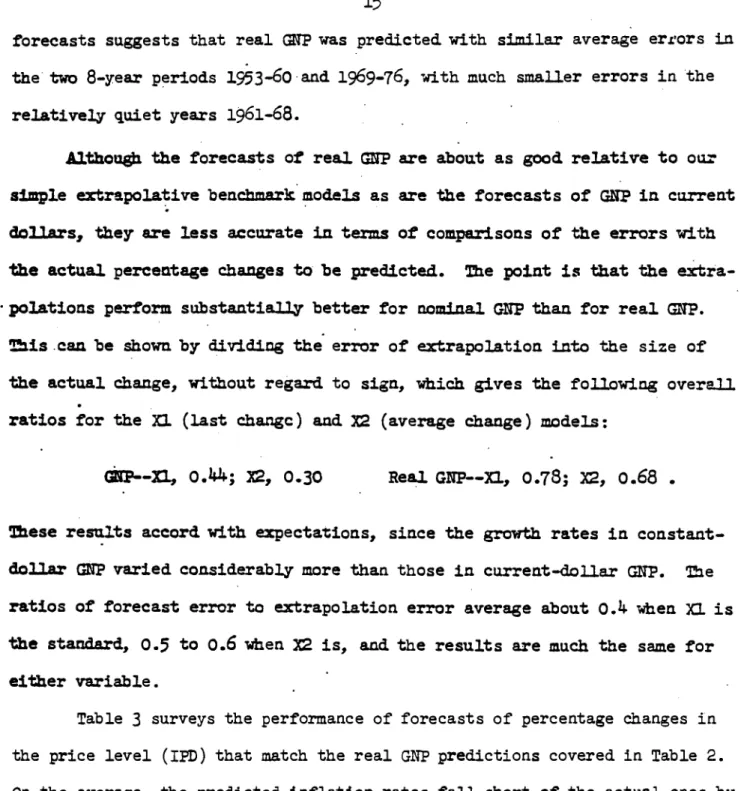
years 1961-68.Although the
forecastsof real
(NP are about asgood. relative to our
simple
extrapolative
bew4imk
models as are
the forecastsof GNP in current
dollers,
theyare less accurate in terms
of
comparisons of the
errorswith
theactual percentage changes to be predicted.
The pointis that the
extra-• polations perform substantially better for
noniaal GNP than for real GNP.
This can be shown
by
dividing the error
of
extrapolation
into thesize of
the
actualchange, without regard
tosign, which
gives the following overallratios for the
Xl (last changc) and. (average change) models:•
(P-—U, o.14; X2, 0.30
Real GNP-—Xl, 0.78; X2, o.68
These
results accord with
expectations, since the growth rates in constant—dollar G1'P varied
considerably more
thanthose in
current-dollar GNP.The
ratios of forecast error to extrapolation error
averageabout 0.l. when Xl is
the
standard, 0.5to o.6
hea C2 is,
and. the results are
much thesane
for eithervariable.
Table 3 surveys the performance of forecasts of percentage changes in
the price level (I) that match the real G predictions covered in Table 2. On
the average, the
predicted inflation rates fall short of the actual ones byfractions of one percentage point (flues 1-3). The 1959-67 forecast sets are less
accurate than
simple last-change extrapolations (line Li.), and the other sets outperform the naive models by relatively small margins, much less than those observed for the series. The naive models work comparatively well here, with errors averaging about 3/10 of the actual changes in IPD.PCV.CE AGES UI E IRICE L.EVFI, 1959-76 . Line Period
,,
Noor Tears Covered Selectet Private ThreCasts, Meana (1)A$A/L Zcnonic
trapolations Actu.ai.survey, Roort Michigan ata.r-tna
Median
o the
Model Model Last AverageForecast Presidetb
iange
aoge J
(2) . (6) (7)
Prelin-iaz
Revised(8) Mean Absolute Percentage ange, Predicted end Actual
1. .195947 (9) 1.5 1.9
l.9(1.le)° 2.0
2 1962-76(15) . 3.7 3.8 3 1969-76 (8) 5.3 5.0 5.3 ..2
5.9 6.2Mean Absolute ror, in Percentage Points
1959-67 (9) 0.6 0.7 0.3 0.7
5 1962-76(15) 1.0 1.0 1.3
1.
0.i
6 1969-76 (8) 1.3
1.
1)1. 2.0 2.1.0.
Mean ror, in Percentage Points
7 195947 (9) 0.2
0
-0.1. 0.0i -0.38 1962-76(15) 0.5 -o.5 -0.2 -1.0
9 1969-76 (8) -0.9 -0.6 -0.9
.0.6
-0.2 -1.2.0.
10 1959-67 (9) .389
Sqnared correi.atioa (r2) Between predicted and Actual acge
1]. 1962-76(15) •
.768 .682 .536 .508
12 1969-76 (8) .526 .581 .5ie
.6o
.166.059
LTE: Forsources and explanations of thedata usedin colunns 2-9, see footnotes d t.roug k, respective1', in Table 1.
'Average of end-of-year annual forecasts of the conposite price level (a weighted su of forecasts of CPI and WPI).Se. Table 2, tfl. a, onthe weights used and sources. bse. Table 2, rn. b.
figure in parentheses is based on weighted averages of data for CPI and UPI. This
series of actuals for the
cposite price level, is conparable to the forecasts used in coluna 1. onl,y (ct. Table 2, fo.
c).
change (cols. 6-7), which is the reverse of the situation for GNP in both
current and. constant dollars. The forecasts underestimated strongly (much
more than the last-change extrapolations) the average inflation since 1961
(lines 7-9). The predicted and. actual percentage changes in the price level
are all positively correlated, but the correlations for 1969-76 are generally
lower than their counterparts for (TP and, still more so, for real GNP (lines
10-12).
Forecasts of inflation often have much in common with projections
of thelast observed rate of inflation. To illustrate, correlations between the
errors of these forecasts and the errors of the correspond.ing extrapolations
produce the following
r2
coefficients:Michigan, 1959-76: 0.51; CEA,
1962-76: 0.78; ASA/NBER, 1969-76: 0.95; Wharton, 1969-76: 0.80. For growth
rates in real G1'TP, the correlations between forecast errors arid, extrapolation
errors are also
positive butthroughout lower, in most cases much lower.
These
results are not surpristng and they
have a positive aspect inasmuch asforecasts shou.ld be closer to extrapolations of a given
type in
those cases where such extrapolations aremore
effective (for an elaboration, see Mincerand. Zarrio'witz). However, our
comparisons
areconstrained
to naivemodels
which presumably do not represent
high standardsfor
economic forecasting. In particular, price-level forecasts that arehighly correlated
withlast-change
extrapolations
must share the property'of
the latter to laga
yearbehind the actual
rates of inflation. Indeed, the correlations between thepredicted
changes andthe
previous year' actual changes areall
positiveand. high: the r2 coefftcients for the four
sets
of IPDforecasts
listedearlier in this paragraph
are 0.76,
0.87,0.81,
and 0.72, respectively.The annual percentage changes in real GNP
are inversely
related to thosetwo
variables do not show a strong
or stable association. Therelationships
between the predicted changes generally parallel the actual ones. This is
illustrated
by the r2 coefficients tabulated below (for symbols, see Table 1i).
1962-76
1969-76
Actual
Michigan CEA Actual MichiganCEA
RCP-IPD
.567(-) .328(-) .528(-J.61i6(_)
.l72(-)
.65l(-)RCNP-CNP
.297
.210 .222 .614J .1.61i.91
I-GNP
.020
.217
.o68
.o85(-)
.oo
.o22(-)
The
errors of the forecasts are similarly interrelated. Table Ii.
demon-trates a
pervasive pattern ofnegative correlation between errors in
fore-casting
real growth andinflation
(col. 1).The tendency
for these errors tobe
offsetting, which benefits the forecasts of P in current dollars, is
most strongly in evidence for the more recent years. When forecasters
over-estimated real
growth,-or missed a downturn and projected continued growth
instead, they typically also underestimated inflation, as in 1969-71 and
l973—7.. Underprediction of real growth occurred in 1972 and 1975-76 in
combination with overp,rediction of' inflation.
These observations, which have some precedents (Zarnowitz, 1969; Moore,
1969,
1977), areconsistent with a view of the world in which
nominal GN'Pchanges are predicted directly and relatively well, but their division
intoreal and. price changes continues to pose great
problems. Many forecasters mayagree
with that view in general terms, and. some subscribe tà models consistent
with it (a specific excznple might be the St. Iuis model in which the dollar
change in total GNP expenditure is determined mainly by
thedollar change in
a measure of money stock). However, most macroeconometric models, including
the two sets covered here, have separate aggregate real demand, output, and
TABLE .
CORRELATIONS BETWE ERRORS OF FORECASTS OF PERCENTAGE CHANGES
I NONA.L ONP, REAL GNP, AID lID, 1962-76
Squared. Correlation (r )
Between Forecast Errors
for
for
for
Line
Source of i1orecast
RP and. IPD RGNP and. ? lID .nd. (P
(1)
(2)
(3)
1962-76 (15 years)
1
Economic Report (CEA)
.297(-)
.359
2
Michigan model
•191.()
.129
.006
1969-76 (8 years)
3
Economic Report (cEA)
.677(-)
•o1i
.259
Michigan model
.68i.(-)
.209
.O]Ji
5
hartoa
model
.311.O(.)
.036
.li.66
6
ASA/NBERsurvey, median
.52.(-)
.013
.351
NOTE: The smbo1s RONP, lID, and (TP denote real GNP, the ip1icit price
deflator, and. nomina.]. GNP, respectively. The correlations (r) are
positive, except there the sign (-) following the
r2 coeffiient
indicates that r is negative.
better in current than in constant dollars. In fact, so'e studies of the
recent
performance of quarterlymodels
arriveat the cpposite conclusion,
namely that
the results for real G are better than those for nominal GNPbecause
of
deficient priceforecasts
(iggal, .ein, and
McCarthy; Eckatein,
Green, and. Sinai). The available evidence seans too lirnited and. too mixed.
to permit any conclusive generalizations on. this point. But it is interesting
to observe that the importance o± output errors vs. price errors ay vary
with changes in the relative roles of
realvs. nominal factors and disturbances:
in
the1970's the errors of the GNP forecasts were for the
most partbetter
correlated. with the IPD
errors
than with theRGNP errors, whereas in the 1960t
the contrary situation obtained (Table II.,
cols.
2-3).
IV. Quarterly Multiperiod Forecasts, 1970-75: An Overall Appraisal
Here we have space only for a
summary of
some earlyresults
from a study in progress. The forecasts and actual data areused in
the same form as before, but they now refer to overlapping sequences of quarters, ot simply to a series of successive years. Our materials cover 22 quarters from 1970:3 through1975 :, a period for
which
forecasts from several new sources are available. Firstestimates for the
precedingyear, taken
from thedata prior to the 1976
benchmarkrevision of the national income accounts, serve as
comparablereali-zations. The full version of the study will include also comparisons with the
revised
data in an integrated treatment of forecast errors and measurementerrors. Adjustments of the
forecasts for base revisions, used in
some fore-cast evaluations, are regarded as questionable and. are avoided.The mean absolute errors of GNP
forecasts
are close to one percentage point (like the annual forecasts, see Table 1) for two quarters ahead, and abouthalf
ofthat or less for one quarter ahead. Over longer spans, the MAE
rise more or less steadily by
incrementsvarying
from0.3 to 0.5 of one
per-centage point for each additional quarter; they approach
and exceed 2 percen-tage points for l1.-quarter and 5-quarter spans, and 3 percenpercen-tage points for 7-quarter and. 8-quarter spans, respectively (Table 5,lines
1-3). Consistent with earlier findings and interpretations for various types of multiperiodforecasts (see, e.g., Zarnowitz, 1967, pp. 60-72), the MAE increase less than in proportion to the extension of the span. The errors in forecasts of
percentage
changes expressed on a per-unit-of-time basis (roughly, errors
divided
by the length of the effective span) neither rise nor decline syste-matically as the forecast reaches further into the future. The same applies to the errors of the implicit predictions of changes during the successiveTABLE 5
StTh'fl1ARY ASUPES OF ERROR FOR QUARTERLY MtJI2IPERIOD
PRICTIONS OF PERCEITAGE CEANGE m
P,
1970-75
ne
Forecast
Seta
Span o± Forecast in Quartersb
One Two
Three
Four
Five
Six
Seven
(1)
(2)
(3)
(ii.)
(5)(6)
(7)
Eit
(8)
Mean Absolute Error, in Percentage ints ()C
1 2 3 Chase DRI GE .14.2
1.03
1.32
i.68
2,22
2.73
3.19
.53
1.014. 1.11.3 1.911. 2.11.3 2.69 2.95 .11.2 .95 1.311. 1.71 2.19 2.59 2.88 3.11.92.80
3.25Mean Error, in Percentage ints Ii. 5
6
Chase DRI .01 .014. .02 .08 -.111. -.66 -1.11.8-.01
.11 .05 .11 .01 -.1i.2 -1.12 -.JA -.15 -.30 -.15 -.15 -•144. -.95 -2.311. -1.69 -1.68Squared Correlation (r )
BetweenPredicted and. Actual
Change
7
8
9
Chase DRI GE .752 .11.51 .107 .058 .127.l31.
.179
.632
.11.69.069
.000*
.008
.102 .211.9 .753.577
.2811. .159 .132 .180 .227.293
.6oo
.225
Theil's Inequality
Coefficient(U)e
10 II
12
Chase DRI GE .211.1 .287 .291 .268 .236 .218 .198 .2811. .292 .299 .295.272
.218 .182 .215 .260 .260 .211.3 .233 .204 .181 .189 .ili.8 .172aChase. Chase Econometric Associates, Inc.; DRI:
Data Resources, Inc.; GE:MAPCAST
group
at the General Electric Company. The forecast data arethose ased
and
described inS.
K. McNees, 1975, 1976.Chase
and DRI are"early-quarter
forecasters,"
while GEis
a "late-quarter forecaster" (for the release dates, see McNees, i976,p. 11.1).
bNer
offorecasts covered (a) for spans 1 to 7, respectively:
22, 21, 20, 19, 18, 17, and16
(for each of the sets). For span 8,the
number is 15 (Chase), 111.(DRI), and 12 (GE).
CDefining the predicted change and
the
actual change (for the given set,variable,
1
period., and span) as and. At,
respectively, MAE =
Ee ,
where
et =
- At.
d.
single quarters covered; it is the cumulation of these intraforecast (umarginalfl)
change errors that technically accounts for the tendency of errors in the total predicted changes to grow with the span.3
Vhere
both forecasts and realizations refer to increases (as
they domost of the
time by far
inthe case of ip), rrors of positive sign denote
overestimation
of actual change. The mean errors in Table 5, lines 14._6,are
predominantly
small and. positive, except for the longer spans where some of
them are
largeand. negative. As will be shown below,
these averages conceal large errors of opposite sign in the forecasts for some
of the different economic phases of the period 1970-75.
2
The
r coefficients for the correlations between the predicted and.actual changes In P exceed o.6 or 0.7 for one quarter ahead (like the annual
forecasts)
and. exceed. Q•1.
or 0.5 for two quarters ahead. Theyare
much smaller forthe
longerspans, mostly in the 0.1-0.25 range,
ina few cases near
zero(lines 7-9).
Theil?
s inequality coefficients generally fall between 0.2 and
0.3(lines 10—12). This indicates
that these forecasts are all much betterthan
a naive model extrapolating the last recorded percentage change
(for
which
U =1).
That model, it should be noted, is but a minimal standard
for
economic forecasts. Interestingly, theU coefficients do not increase
with the forecast span;
infact, they decline slitly below .2 for the
longestspans.
The
nexttwo
tableshave the sane format as Table 5,
whichfacilitates
presentation
and comparisons of these measu.res. Real GNP forecasts have MAE (in percentage points) rising from o.-o.6 for one quarter aheadto
-6
for
3Note that fewer observations are available for the longer spans (Table 5,
b). This reduces the comparability of the measures reported for the
differ-ent spans, but does noteliminate it.
6
SUMMARY ASUPES OF ERROR FOR QUARTERI?L MTJLTIPERIOD PREDICTIONS
OF PERCE1TAGE CHANGE m REAL GNP, 1970-75
.
Line
Forecast
Seta
Span of Forecast in Qjlartersb
One
TwoThree
Four
Five
Six
Seven
Eight
(1)
(2)
(3)
(ii.)
(5)
(6) (7) (8)Mean Absolute Error, in Percentage ixits ()C
1
Chase
.51
1.11
1.81
2.11.63.29
11..19 )4..955.31
2
DRI.61
1.37
2.08
2.75
3.52
4.15
4..78
3 GE
.50
1.20
1.75
2.15
2.80
3.80
14..765.15
Mean Error, in Percentage PDints ()d
14.
Chase
.17
.51
.92
1.11.61.98
2.38
2.63
2.82
5 DRI
.26
.77
1.201.82
2.59
3.16
3.66
14..726 GE
.00
.22
.36
.9
1.532.09
2.11.6Squared Correlation (r2) Between Predicted and Actual
2.58
Change
7
Chase
.839 .81'7 .727.703
.733
.710 .6o14..596
8 DRI .793 .711.5 .598 .814. .785 .827 .711.1.638
9 GE .808 .711.1.677
.607
.772
.7614..661
.662
eTheil's
Inequality Coefficient (13)
10
Chase
.11.33.502
.607
.673
.711.74l
.758
.711.1II
DRI •5O1.622
.721
.769
.781 .7711..771i
.836
12
GE .11.27 .1198 .511.8.606
.627
.676
.71ji
.6911eight
quarters ahead, that is, somewhat more than in proportion to the measuredspan
(Table 6,lines
1-3). The errors for the twoshortest
spans arenot
muchlarger than those for GP in current dollars, but the errors for the longest
spansare 50
to
100 percent larger. The u.nusually rapid build-up of the MAE
can be traced in large part to turning point errors. In quarterly multiperiod.
forecasting, turning points are more frequent and more difficult to predict
than
inannual forecasting, but the errors associated with them matter much
more yet: here, missing a turn often means that a whole chain of predictions
for the
subsequent observations is badly off.The mean
errors of these forecasts are
allpositive, which is largely
due to the effects of missing or underestimating the declines in real GNP
during
the recession (Table 6,
lines
1i.6).
Thealso cumulate continuously
and. rapidly
here, quite nriltke those for thenominal GNP
forecasts. On the other hand, the r2coefficients
arerather surprisingly high in Table
6,lines
7-9, much above the corresponding figures for (2Pin
Table 5,particularly
for spans of 3-8
quarters.
Relative to the size ofthe
actual changes, however,the real (P
errors
aremuch
largerthan
the current—dollar GNP errors:the inequality coefficients rise from •14—.5
to
.7—.8(Table
6,lines
10-12).
The
MAE of
forecasts of inflation in terms of the Pimplicit price
deflator
are like those of the (p forecasts for the shortest spans--O.5 or less one quarter ahead, approximately 1percentage
point twoquarters
ahead--but
they cumulate rapidly, especially for the longest spans (Table 7, lines
1-3). The figures for the eight-quarter-ahead predictions are
heremore than
12 times as large as those for the one-quarter-ahead predictions. This
exceptionally
strong build-up of errors reflects a progression of under-estimates of the inflation rates, rising more than inproportion
tothe
spanTABLE 7
SIThARY ASURES OF ERROR FOR QUARTERLY MtJLTIPERIOD PREDICTIONS
OF PERCENTAGE CEANGE fl E PRICE LEVEL, 1970-75
ne
Forecast
Seta
Span of Forecast, in Quartersb
One
Two ThreeFour
Five
Six
Seven
(1)
(2)
(3)
(14.) (5) (6)(7)
Eight
(8)
Mean Absolute Error, in Perceiltage Points (MA.E)C
1
2
3 Chase .39 1.02 1.61;. 2.29 2.98 3.87 4.88 DRI .514. 1.11 1.69 2.37 3.05 4.01;. 5.17 GE .39.90
1.11.9 1.96 2.37 3.06 4.o8 5.69 6.78 4.79Mean Error, in Percentage Points ()d
1;.
5
6
Chase DRI GE -.15 -.11.9 -.96 -1.50 -2.33 -3.31 -.27 -.70 -1.22 -1.85 -2.82 -3.88-5.12
-.12 -.36 -.70 -1.20 -1.85 -2.78 -3.76-.48
-6.78 -4.57 Squared Correlation (r2) Between Predictedand. Actual
change7
89
Chase DRI GE .6oo .11.40 .3911. .287 .211.6 .233 .320 .14.78 .426 .412 .346.4oi
.398 .384 .657 .633 .5o8 .11.40 .11.38 .457 .524 .381 .371 .676Theil's Inequality Coefficient (U)e 10 11 12 Chase DRI GE .311 .358 .377 .410 .438 .462 .480 .375
.38
.397 .422 .444 .475.508
.284
.286.326
..3514..369
.395.4i6
.496 .540 .410The
r2coefficients for the IPD inflation forecasts are
generallyhigher than those
for the forecastsof percentage change in
nominal GITP(except
for a few short predictions) but throughout lowerthan the
correspond-ing statistics
for the real growth forecasts. They range from .23 to .66and
tend to decrease as the spans lengthen (Table 7,lines
7-9).The
U
coeffi-cients (lines 10—12) are close to .2 for the shorter spans and close to .5for
the longest; they are thus higher than their counterparts for the current—dollar GNP forecasts but lower than those for the real GNP forecasts.The quantity
and price ingredients of the TP
forecasts show a pattern of offsetting errors in thequarterly
aswell
as annual data. The irtean errors of real growth predictions are aLl, positive, those of inflation predictionsall negative, and. these statistics, matched by source and span, have similar absolute values for most of the shorter forecasts As a result, the ?€ of the current-doll:ar tP forecasts for spans 1_li. are as a rule positive but very
small
for chase and DRI, negative but small
for GE. The negative of the inflationforecasts outweigh
the positive of the real growth forecasts in spans5-8, so that the
of the percentage change
forecastsfor P
arepre-dnmiriantly
negative and substantial (of. lines k-6in
Tables ,6, and
7).The
surveyed accuracy measures
do not show anyof the forecasters to be
consistently superior to the others. They do
favorGE over Chase and.
DRI inmost instances, but by modest margins
and in a way thatcan be explained
by an advantage in timing:the
GE forecastsare issued late in
each quarter, the others early.The
results reported in this study should and will be carefully conipared with those of other evaluations of the same forecasts, but the task is still to be completed.The
errormeasures used here differ in
several respects from those used by others,and additional
computations are required to allow for these differences.V. Quarterly Multiperiod Forecasts: An Analysis by Su.bperiods
The period l97O:3-l975:4, although short, was unusually
varied
and.marked by major disturbances arid drastic changes in the economy's course. It is
useful to divide it into the following parts, as suggested by the contemporary
business-cycle and inflationary developments.
I. 1970:3-1973:1. End
ofthe
mild.1970
recessionfollowed by an
expansion that accelerated in 1972, with relatively
stable inflation.
II.
1973:l_1973:!.. Slower real growth and a sharp inflation speedu.p(materials
shortages, run-ups in commodity prices, oil embargo).III. 1973:1._1975:1. Recession, severe in its last two quarters, accoin-panied first by
a further
riseand then by a
dxwri-turn in the rate of inflation.
IV. 19'7:1_197:11. Sharp
upturn aridthe initial recovery phase, with
a further decline in inflation.
One question is whether forecasts that originated in these four
sub-periods show significantly different characteristics and performance. The
other is whether forecasts for these subperiods (i.e., those that aimed at
the
corresponding groups oftarget quarters) are
sodifferentiated. It turns
out
that the answers to both questions are definitely yes.To illustrate the first point, the expansion phase I produced forecasts that underestimated growth in dollar GNP mainly because they underestimated inflation. The percentage changes in real GNP were partly underpredicted, partly (in some longer forecasts) overpredicted, but whether negative or positive the of these forecasts were small. In general, the record of the
forecasts
that were madeduring the
periodI was good in tezs of both the ME
and
the MAE figures, even for the long spans. In contrast, the slowdown phaseII produced real growth
predictions with very large positive ME and inflationforecasts with
very large negativeME (widerestimation errors).
These errors balanced each other so that
theME for the nominal
GMP predictionswere
moderate (and mostly
negative,except for the
longest forecasts).The
recession phase I gave rise to even larger positive mean errors in the real growth
forecasts as the declines were repeatedly missed anii,
when finally recognized,underestimated. These errors were larger absolutely than
thenegative
errors on
the price side, which reflected a continuing underestimationof
inflation, so that the predictions of' the growth rates
in nominal GNPhad
consistentlypositive ME in
the subperiodIII.
The above sIimrny is based on charts (not reproduced here) which show
the average errors (MAE and
ME) byspan
andby subperiod. in which the
fore-casts originated.
These charts look very similar for such different models
as Chase and DRI: they show in each case the same strild.ng differences
between the forecasts made in
subperiods I,II, and III. The suggested
infer-ence is that concurrent predictions from different sources and models have common patterns such that their errors depend strongly and similarly on the characteristics of the time of their origin.
In a second exercise, the forecasts were assigned to the four stibperiods according to their target quarters,
not their base
quarters, as illustratedIn
Charts 1-3. Here the samples are
partitioned differently, hence the resulting patternsdiverge from
those obtained on thefirst plan, but the
LI. .
No averages for phase IV are used on this basis, since they contain too few observations in the truncated. sample.
conclusion
is analogous: the type and size of forecast errors depend criti-cally on the economic properties of the target periods vis--visthose
of the periods of origin. Forecasters perform best when the twoperiods
are alike,belonging to the same already recognized phase, e.g., a continuing expansion as in 1971-72
(most of
subperiod. I). They perform worst when the target falls into a new phase, particularly when the latter departs sharply from the currently established pattern (forecasts made in. subperiods II and. III, and those for subperiods III and. IV provide many examples, particularly in the long-span categories). Such period characteristics are much more important determinants of forecast errors than are any differences among the forecasters.Chart 1 shows that both Chase and DRI persistently underestimated the
percentage changes in GI'TP for su.bperiods I and., much more strongly, II. Both
forecasters overestimated the changes in their short forecasts for subperiod III and. underestimated them in their long forecasts for the same phase.
Over-est.mates prevailed. in all forecasts for the last phase covered., IV, and. here
the average errors behave in an unusual fashion, first increasing and then decreasing with the lengthening span.. This is due to offsets between. the real growth forecasts with positive ME and the inflation. forecasts with negative ME (see Charts 2 and 3).
Chart 2, which covers the real growth forecasts, shows u.nderestimates
dominating the errors for I and. II, much larger MAE aud. positive lylE for III
and. IV. The huge average errors for the two latter phases derive mainly
from the forecasters' failure to predict the declines in real GNPI5 The long-span errors for the 1975 recovery (IV) are strikingly large here.
5The change errors,
-At
(see Table 5for
the symbols), are positivewhere P >
0 and.
At < 0, and. also where< 0 and At < 0 but
At. These cases dominate in Chart 2 the results for both the recession phase III and. the recovery phase IV. Although real GNP reached a trough in 1975:1 and increased thereafter, the actual changes over longer spans ending in 1975 are negative; that is, real GNP was lower during period IV than in.r4 0
.Ia
4:
0
OP4r4
vw) .zo.z.za iw 11 H C., a) a Ca S.' 4.' a -4 a 4, 04:
'
S.' .43 -4HI
4.' • 0 (Y(.r(\ç\I
liii CL a (j) 4, . M 0Lr4 ..' r4r4H1 o-
1-4 -4HHC jTrr i.=
C-H;ttt
:':
rr
1rp.
/
.1.r
4 -IIT'
:
-1E'
1
1
•1 — •- -. -1.-I. 4-4•
u; '(ni) .zo.z.z iN ,--;i•
--
-H- ---+---,-
.,S
.-14I .4. — — —'— '±... •c-=•:l:
'.3
I..:
I
_____I
i-i——r-r ________ _________-
Ii\
cy (\O r C4T
4h\I
cI 0 — S.— ..+, -* Qi 0 0 iCaC424 a) •C.) C) C).
Cd Cd a0
E r1000 C44C4..4 00 a H a)a) hullIl
3II
---im :C.Ij1ktj%J. QUARTERLY MULTIPERIOD FORECASTS OF PERCENTAGE CHANGES
IN
REAL GNP, AVERAGE ERRORS BY SUBPERIOD AND SPAN, TWO MODELS,1970-75
11n9lffftrIifftrI
nn
5-I 5-I N H 0 1-IT
Legend:
See
chart