International Journal of Innovation and Business Strategy (IJIBS)/ Vol. 7, No. 1, January 2017, 10-17
Conceptual Framework on Usage of Islamic Banking
amongst Banking Customers in Libya
Walid Ali Albashir1*, Yuserrie Zainuddin2, and Shrikant Panigrahi3
1,2,3
Faculty of Industrial Management, Universiti Malaysia Pahang, Kuantan, Malaysia *[email protected]
Abstract: The main purpose of this paper is to increase customer perception for Islamic banking products and its awareness in Libya. There has been an urgent requirement of Islamic banking in the Libyan banking system due to economic turbulence and being unable to maintain national finances. Libyan banks have already implemented Islamic banking system as an alternative to the conventional system, however, the adoption of Islamic products is not widely accepted by customers. Based on literature done regarding adoption studies, this paper suggests and justifies the applicability of Ajzen’s Theory of Planned Behaviour in Islamic banking adoption. From literature review and conceptual framework, lack of attitude and behaviour of customers on Islamic banking product acceptance is a great challenge for Libyan Islamic banks. Therefore, there is a need for marketing efforts by banks to increase awareness, perception, and intention of Libyan banking customers in relation to Islamic banking.
Keywords: Islamic banking, theory of planned behaviour, behavioural intention, Libya
Paper type: Conceptual paper
1. Introduction
The main purpose of this paper is to raise customer awareness and perception towards usage and increase success of Islamic banking products. The economy in Libya is highly dependent on the oil and gas industry. Nevertheless, due to economic and government struggles post-Gadhafi transition, the country’s banking sources and financial institutions are unable to maintain national finances. This makes an urgent requirement of Islamic banking that is considered as the conduct of banking procedures in coherence with Islamic teaching. The reality of Islamic banking emergence as an alternative to conventional banking and its contribution in propelling the development of global economy has been proven in the international financial outlook (Tahir et al., 2006). Over the recent decades, Islamic banking industry has emerged as one of the fastest growing industries and has spread to all corners of the globe, receiving wide acceptance from Muslims and non-Muslims (Molyneux and Iqbal, 2004).
International Journal of Innovation and Business Strategy (IJIBS)/ Vol. 7, No. 1, January 2017, 10-17
In an interview with Reuters while attending the opening of the Arab Economic forum in 2013, Libyan governor Saddek Omar Elkaber mentioned that the growth of Islamic banking has not been encouraging and have been dominated by Libya’s undeveloped financial sector (Laessing, 2013). Similarly, the then Economy Minister Mustafa Abu Fanas stated that the role of Islamic law in economy has been studied by experts to see how and when to transform to build up a strong economy.
Customers in any financial institution play a pivotal role in determining its success. Customers require personalized services and full knowledge to ensure that their wealth is invested in a safe manner. Thus, it becomes vital for all financial institutions to have adequate knowledge of consumer perceptions regarding products and services to effectively achieve market growth. Most research on understanding consumers’ perceptions of Islamic banks investigate bank selection criteria of consumers. Nonetheless, there is hardly any study that explores barriers, which prevent or discourage consumers from choosing Islamic banks. This study hence attempts to achieve a better understanding of consumer perceptions by studying the barriers to help Islamic banks utilize potential opportunities through innovative strategies.
2. Banking System in Libya
There are about 10 major banks in Libya: Central Bank of Libya, Agricultural Bank, National Commercial Bank, Commerce and Development Bank, Arab Foreign Bank, Savings and Real Estate Investment Bank, Sahara Bank, al-Jamahiriya Bank, Umma Bank, and Wahda Bank.
Under former dictator Muammar Gaddafi, overthrown in 2011, the growth of Islamic banking was not encouraged and the entire financial system was kept undeveloped, as four state-controlled institutions dominated the industry. In an interview conducted by Stanley Carvalho and Regan Doherty, Almaguri mentioned that:
"There is good demand for Islamic banking and we want a balance between conventional and Islamic banking". Currently, the 16 banks operating in Libya, including seven foreign banks, offer mainly conventional banking services with some providing interest-free Islamic banking through sharia-compliant windows.
In addition to that, banks’ post-conflict engagement is initially expected to accompany only Libya’s short-term economic recovery efforts; the transition programme will lay the foundation for longer-term goals. This includes creating a more vibrant and competitive economy with a level playing field for the private sector to create sustainable jobs and wealth.
3. Literature Review
This paper employs Roger’s Diffusion Theory and Ajzen’s Theory of Planned Behaviour (TPB) to investigate the level of Islamic banking usage amongst customers in Libya. Study on Islamic banking adoption will shed some light on the intention of Libyan banking customers. This research is unique because there is a lack of studies focusing on adoption of Islamic banking in Libya. Libyan banks have already implemented the Islamic banking system as an alternative to the conventional system, however, adoption of Islamic products is not widely accepted by customers. This may be due to lack of information availability, lack of perception on quality of Islamic products, and low innovation of Islamic banking compared to convention banking system. Furthermore, it is very crucial for customers to patronize the Islamic banking system (Wajdi Dusuki and Irwani Abdullah, 2007).
Islamic banking does not accommodate interest, which conferred risk on one side at the detriment of the other. Trading is permitted but interest is banned and as such, there is risk sharing in trade and investment. For a client to claim benefit in the form of return as propagated by the Islamic principle, he should equally assume some risk (Kamarulzaman and Madun, 2013). Perceived risk therefore plays an important role in
International Journal of Innovation and Business Strategy (IJIBS)/ Vol. 7, No. 1, January 2017, 10-17
trade and investment decision of Islamic banking consumers. Previous studies in different contexts reveal the effect of perceived risk on consumer decision (Gerrard and Barton Cunningham, 2003).
Unlike in conventional banking where depositors assume less risk due to prior knowledge of the return, Islamic banking depositors face a relatively high risk as the amount to be earned is not known; rather it depends on the outcome of the business. Thambiah et al. (2011) noted that the basic nature of Islamic banking products and services makes it riskier to the eyes of potential adopters as the effect of using it tends to be invisible to clients in the short-range. Meanwhile, customers of Islamic banks face high risk due to uncertainty arising from the business, which is inversely proportionate to the rate of adoption (Rogers, 2003). Nevertheless, they also have a better chance of gaining a higher return compared to a conventional bank customer who receives a fixed return no matter what the business or investment achievement was. In addition, Perry and Rehman (2011) noted that in a conventional system, the capital of the financial institution is at risk before that of the depositors. However, in Islamic financial institutions, the reverse seems to be the case. Usage of Islamic banking will be evaluated based on proposed behavioural framework comprising of perceived risk, perceived behavioural control, subjective norms, behavioural beliefs, customer attitude, customer involvement, and behavioural intention on Islamic banking usage.
A. Perceived behavioural control
Perceived behavioural control (PBC) is defined as “an individual’s perception of how easy or difficult it would be carry out a behaviour. PBC denotes a subjective degree of control over the performance of a behaviour for the given outcome”. In the literature of social psychology, PBC has been a debated topic on nature and role of PBC by clarifying the role of TPB and describing its underlying dimensions. Ajzen (1991) proposes TPB with the same TRA tools but with PBC as an additional instrument that captures volitional factors for predicting human behaviour (Conner and Armitage, 1998).
Meanwhile, Amin et al. (2011) use knowledge as a moderator of the relationship between attitudes, subjective norms, and PBC on intention to buy. This means customers’ intention to use Islamic Banking was more of a motivation to comply with expectations of others than evaluation of outcome from engaging in the use of the facility. Furthermore, Alam et al. (2012) studied Musharakah-mutanaqisah financing and the influence of religiosity on intention to adopt the new facility using TPB. Attitude, PBC, and religiosity proved significant in the study, while subjective norm was found to be insignificant. Thus, it is expected that:
H1: Perceived behavioural control (PBC) will have a positive influence on Islamic banking usage among Libyan banking customers.
B. Subjective norms
Subjective norms (SN) is the second main determinant of TPB that is assumed to be part of the belief that specific individuals approve or disapprove performing a behaviour (Ajzen, 2005). Individuals who believe that they are motivated to comply with others to perform their behaviour are actually surrounded by social pressure and individuals who are motivated to comply and disapprove by avoiding to perform the behaviour will have a subjective norm. Hence, it can be said that subjective norms are expressed symbolically that is the combination of normative beliefs and motivation. The attitude towards the behaviour is determined by the sum of accessible behavioural beliefs, which refers to the subjective probability that the behaviour will achieve expected outcomes positively or negatively. Subjective norm is determined by the sum of normative beliefs, which reflects the perceived behavioural expectation or opinions of important referents individuals or groups. Therefore, it is hypothesized that:
International Journal of Innovation and Business Strategy (IJIBS)/ Vol. 7, No. 1, January 2017, 10-17
H2: Subjective norms will have a positive influence on Islamic banking usage among Libyan banking customers.
C. Behavioural beliefs
To understand the reason for Islamic banking adoption, it is crucial to understand individual’s behavioural attitude that influences their purchase intention (George, 2004). Behavioural attitude is defined as an individual’s attitude towards an object need not be related to any single behaviour performed with respect to the object (Cushman and McPhee, 2013). An individual’s attitude towards an object influences the overall pattern of response to the object. Some studies have focused on customer’s attitude towards ICT adoption. Jun and Jaafar (2011) found that online security, privacy protection, and after sale service are believed to be complicated for online purchase and could directly influence customer’s attitude. Furthermore, Thaw et al. (2012) investigated on consumer’s perspective towards Islamic banking adoption and concluded that secured online transaction, privacy of personal data, and trustworthiness of Islamic banking are crucial elements that affect an individual’s attitude. In addition, Kirkpatrick (2005) expressed religion as a psychological connection and dominant emotional relationship to things. Religion is a cause, principle, or a system of beliefs, practices held to with ardour and faith. Islamic bank has the spirit and philosophy of Islam, regarding interest-free transactions and risk sharing. Therefore, it is hypothesized that:
H3: Behavioural beliefs will have a positive influence on Islamic banking usage among Libyan banking customers.
D. Perceived risks
Perceived risk is defined as uncertainty that a consumer perceives while purchasing any product. Islamic banking does not accommodate interest, which confers risk on one side at the detriment of the other. Trading is permitted but interest is banned and as such, there should be risk sharing in trade and investment. For a client to claim benefit in the form of return as propagated by the Islamic principle, he should equally assume some risk (Kamarulzaman and Madun, 2013). Perceived risk therefore plays an important role in trade and investment decision of Islamic banking consumers. Researches in different contexts reveal the effect of perceived risk on consumer decision (Gerrard and Barton Cunningham, 2003; Zhao et al., 2010).
H4: Perceived risks will have a positive influence on Islamic banking usage among Libyan banking customers.
E. Customer involvement as mediator
Involvement has the potential of being an important mediator of consumer behaviour (Mitchell, 1979). Furthermore, the mediating effect of customer involvement between the antecedents of TPB and behavioural intention for using Islamic banking is studied. Recently there have many corporate and academic interests to investigate the issue of customer involvement (Alajoutsijärvi et al. 2012; Cheung and To, 2011; Feng et al., 2010). A significant proportion of technological innovations in advanced countries is actually developed by description of customer involvement in innovations (Franke and Von Hippel, 2003). The mechanisms of maintaining customer involvement functions and further fostering of innovation performance in academies are still less developed. Therefore, some researches have been devoted to focus customers’ perspectives and their impacts on performance (Martinez and Martinez, 2010). Nonetheless, research focusing on customer involvement antecedents in the innovation process has received little attention (Lager, 2010). This paper examines the importance of customer involvement in the Libyan banking system for using Islamic banking. Thus, it is hypothesized that:
International Journal of Innovation and Business Strategy (IJIBS)/ Vol. 7, No. 1, January 2017, 10-17
H5: Customer involvement will have a mediating effect between antecedents of TPB and Islamic banking usage among Libyan banking customers.
F. Behavioural intention
Islamic banking is growing at an average rate of 15% a year, which makes it the fastest-growing sector in the financial markets of the contemporary world (Chong and Liu, 2009). According to banking statistics, the growth rate of Islamic banking has outpaced traditional banking during the past decade (Ghannadian and Goswami, 2004). Islamic banks have grown around the world and are generally the product of private initiatives.
This study is concerned on explaining customers’ intention to use Islamic banking products. Nevertheless, in this area and concept of behavioural intention, prior studies have deliberately focused in developed countries (Chibelushi and Costello, 2009; Dwivedi et al., 2009; Karakaya and Shea, 2008; Mohamad and Ismail, 2009). In developing countries, researchers (Duncombe, 2011; Olatokun and Kebonye, 2010; Sin Tan et al., 2009; Sutanonpaiboon and Pearson, 2006) have concluded that the chapter on adoption is old whereas others have urged for new dimensions of understanding Islamic banking adoption and usage issues by customers. Islamic banking accepts deposit and mobilizes financial resources through a Shariah compatible mode (Rehman et al., 2012), which is considered as compatible with Islamic values. Individuals tend to align themselves with ideas that are in accords with their interests, needs, and existing attitudes (Rogers, 2003). This study argues for a behavioural dimension that situates adoption of Islamic banking by customers through Shariah perspectives.
4. Research Model
TPB is a well-established theory that was first proposed by Ajzen (1991) from the background of social psychology. In psychology, Theory of Planned Behaviour is a theory about the link between beliefs and behaviour (Ajzen, 1991). According to TPB, there are three main constructs that identify an intention to use a technology. These are attitude, subjective norm, and perceived behavioural control. In addition, Claudia (2012) found that beliefs tend to play a significant role in the context of online buying, having both direct and moderating effects. Results of the structural equation modelling in Claudia’s (2012) study indicated a direct effect of normative beliefs on the intention to buy online.
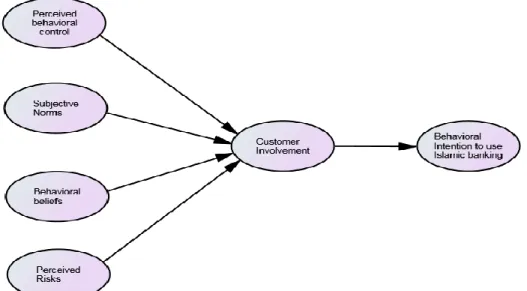
The relationship between variables of the study is shown in the research model, where perceived risk, perceived behavioural control, subjective norms, and behavioural belief are directly related to behavioural intention to use Islamic banking and are indirectly related to customer attitude and involvement. As shown in Figure 1, the theory suggests that intention is the main predictor for actual usage of Islamic banking by Libyan customers.
International Journal of Innovation and Business Strategy (IJIBS)/ Vol. 7, No. 1, January 2017, 10-17
Figure 1. Research model
If the consumer behavioural intention is negative, then the output will be lack of trust in Islamic banking, where consumers reject to buy and stop purchasing through Islamic banking. On the other hand, if consumer perception is positive, then the buying intention will be positive also, and subsequently output will be increased in usage of Islamic banking in which consumers have accepted to buy and proceed in payment process and check-out. Thus, based on such direct or indirect relationship, it is hypothesized that consumers will find Islamic banking usage reliable and behavioural that would increase their behavioural intention. Such perceived risk, perceived behavioural control, subjective norms, and behavioural beliefs can be overcome through the TPB model that identifies the attitude and behaviour of consumers for acceptance.
5. Conclusions
Based on the literature that has been done regarding adoption studies, this paper suggests and justifies the applicability of Ajzen’s Theory of Planned Behaviour in Islamic banking adoption. In fact, based on evaluation of fitness of perceived attributes of innovation aspects with extensive literature review in banking affairs as well as Islamic banking context, this current research tries to provide details on the topic of Islamic banking usage and adoption in the context of Libya. Islamic banks are supposed to offer a range of Islamic financial products and services, to create a strong customer base. It is obvious from the findings that the awareness level of people regarding products and services is low, as well as no significant relationship with adoption to IB is found. Confirmed by previous researches whereby people have awareness on financial teachings of Islam but there is a lack of knowledge about IB products (Khattak and Rehman, 2010; Adnan et al., 2011; Rammal and Zurbruegg, 2006). Hence, it is obvious that lack of attitude and behaviour of customers on Islamic banking product acceptance is a great challenge for Libyan Islamic banks. There is a need for marketing efforts by banks to increase awareness, perception, and intention of Libyan banking customers in relation to Islamic banking.
International Journal of Innovation and Business Strategy (IJIBS)/ Vol. 7, No. 1, January 2017, 10-17
References
Ajzen, I. (1991), "The theory of planned behavior", Organizational Behavior and Human Decision Processes, Vol. 50 No. 2, pp. 179-211.
Ajzen, I. (2005), Attitudes, personality and behaviour: McGraw-Hill International.
Alajoutsijärvi, K., Mainela, T., Salminen, R. and Ulkuniemi, P. (2012), "Perceived customer involvement and organizational design in project business, Scandinavian Journal of Management, Vol. 28 No. 1, pp. 77-89.
Amin, H., Rahim Abdul Rahman, A., Laison Sondoh Jr, S. and Magdalene Chooi Hwa, A. (2011), "Determinants of customers' intention to use Islamic personal financing: The case of Malaysian Islamic banks", Journal of Islamic Accounting and Business Research, Vol. 2 No. 1, pp. 22-42.
Cheung, M. F. and To, W. (2011), "Customer involvement and perceptions: The moderating role of customer co-production", Journal of Retailing and Consumer Services, Vol. 18 No. 4, pp. 271-277. Chibelushi, C. and Costello, P. (2009), "Challenges facing W. Midlands ICT-oriented SMEs", Journal of
Small Business and Enterprise Development, Vol. 16 No. 2, pp. 210-239.
Chong, B. S. and Liu, M.-H. (2009), "Islamic banking: interest-free or interest-based?", Pacific-Basin Finance Journal, Vol. 17 No. 1, pp. 125-144.
Claudia, I. (2012), "Modeling the impact of normative beliefs in the context of online buying: Direct and moderating effects", Romanian Economic Journal, Vol. 15 No. 44, pp. 243-262.
Conner, M. and Armitage, C. J. (1998), "Extending the theory of planned behavior: A review and avenues for further research", Journal of applied social psychology, Vol. 28 No. 15, pp. 1429-1464.
Cushman, D.P. and McPhee, R.D. (2013). Message—Attitude—Behavior Relationship: Theory, Methodology, and Application: Elsevier.
Duncombe, R. (2011), "Researching impact of mobile phones for development: concepts, methods and lessons for practice" Information Technology for Development, Vol. 17 No. 4, pp. 268-288.
Dwivedi, Y.K., Papazafeiropoulo, A. and Scupola, A. (2009), "SMEs'e-commerce adoption: perspectives from Denmark and Australia", Journal of Enterprise Information Management, Vol. 22 No. 1/2, pp. 152-166.
Feng, T., Sun, L. and Zhang, Y. (2010), "The effects of customer and supplier involvement on competitive advantage: An empirical study in China", Industrial Marketing Management, Vol. 39 No 8, pp. 1384-1394.
Franke, N. and Von Hippel, E. (2003), "Satisfying heterogeneous user needs via innovation toolkits: the case of Apache security software", Research policy, Vol. 32 No. 7, pp. 1199-1215.
George, J.F. (2004), "The theory of planned behavior and Internet purchasing", Internet Research, Vol. 14 No. 3, pp. 198-212.
Gerrard, P. and Barton Cunningham, J. (2003), "The diffusion of internet banking among Singapore consumers", International Journal of Bank Marketing, Vol. 21 No. 1, pp. 16-28.
Ghannadian, F.F. and Goswami, G. (2004), "Developing economy banking: the case of Islamic banks",
International Journal of Social Economics, Vol. 31 No. 8, pp. 740-752.
Jun, G. and Jaafar, N.I. (2011), "A study on consumers’ attitude towards online shopping in China",
International Journal of Business and Social Science, Vol. 2 No. 22, pp. 122-132.
Kamarulzaman, Y. and Madun, A. (2013), "Marketing Islamic banking products: Malaysian perspective",
International Journal of Innovation and Business Strategy (IJIBS)/ Vol. 7, No. 1, January 2017, 10-17
Karakaya, F. and Shea, T. (2008), "Underlying motivations for establishing e-commerce business and their relationship to e-commerce success" Journal of Internet Commerce, Vol. 7 No. 2, pp. 153-179.
Kirkpatrick, L. A. (2005), Attachment, evolution, and the psychology of religion: Guilford Press.
Laessing, U. (2013), Libya says aims to run economy, banking system on Islamic lines. In G. Jones (Ed.),
Reuters. Tripoli.
Martinez, J. A. and Martinez, L. (2010), "Some insights on conceptualizing and measuring service quality",
Journal of Retailing and Consumer Services, Vol. 17 No. 1, pp. 29-42.
Mitchell, A. A. (1979), "Involvement: a potentially important mediator of consumer behavior", NA-Advances in Consumer Research, Vol. 6, eds. William L. Wilkie, Ann Abor, MI : Association for Consumer Research, pp.191-196.
Mohamad, R., and Ismail, N.A. (2009), "Electronic commerce adoption in SME: The trend of prior studies", Journal of Internet Banking and Commerce, Vol. 14 No. 2.
Molyneux, P. and Iqbal, M. (2004), Banking and financial Systems in The Arab World: Springer.
Olatokun, W. and Kebonye, M. (2010), "E-commerce technology adoption by SMEs in Botswana",
International Journal of Emerging Technologies and Society, Vol.8 No. 1, pp. 42.
Perry, F.V., and Rehman, S.S. (2011), "Globalization of Islamic finance: Myth or reality?", International Journal of Humanities and Social Science, Vol. 1 No. 19, pp. 107-119.
Rehman, S., Khan, S., Pervaiz, A. and Perry, E. (2012), "Recurrence of inguinal herniae following removal of infected prosthetic meshes: a review of the literature", Hernia, Vol. 16 No. 2, pp. 123-126.
Sin Tan, K., Choy Chong, S., Lin, B. and Cyril Eze, U. (2009), "Internet-based ICT adoption: evidence from Malaysian SMEs", Industrial Management and Data Systems, Vol. 109 No. 2, pp. 224-244. Sutanonpaiboon, J. and Pearson, A. M. (2006), "E-commerce adoption: perceptions of managers/owners of
small-and medium-sized enterprises (SMEs) in Thailand", Journal of Internet Commerce, Vol. 5 No. 3, pp. 53-82.
Tahir, I. M., Bakar, N., Ismail, M. and Wan, W. (2006), "Customer expectations and perceptions of service quality in islamic banking: Evidence from Malaysia", Journal of Islamic Economics, Banking and Finance, Vol. 2 No. 1, pp. 70-82.
Thambiah, S., Eze, U.C., Santhapparaj, A.J., and Arumugam, K. (2011), "Customers' perception on Islamic retail banking: A comparative analysis between the urban and rural regions of Malaysia", International Journal of Business and Management, Vol. 6 No. 1, pp. 187.
Thaw, Y.Y., Dominic, P.D.D. and Mahmood, A.K. (2012), "A structural equation modelling approach for Malaysian consumers’ perspectives on e-commerce B2C transactions", International Journal of Business Information Systems, Vol. 10 No. 2, pp. 178-196.
Wajdi Dusuki, A. and Irwani Abdullah, N. (2007), "Why do Malaysian customers patronise Islamic banks?" International Journal of Bank Marketing, Vol. 25 No. 3, pp. 142-160.
Zhao, X., Lynch, J. G. and Chen, Q. (2010), "Reconsidering Baron and Kenny: Myths and truths about mediation analysis, "Journal of Consumer Research, Vol. 37 No. 2, pp. 197-206.