Personal Fall Detection Device
ECE4007, Senior Design Project
Section L03, Team Personal Fall Detection
Project Advisor, Koblasz and James
Jonathan Annua
Mason Edwards
Matthew Jue
Terry Sharp
Josh Whittle
Submitted
September 16, 2009
Table of Contents
Executive Summary ... iii
1 Introduction ... 1
1.1 Objective ... 1
1.2 Motivation ... 1
1.3 Background ... 2
2 Project Description And Details ... 2
3 Technical Specifications ... 3
3.1 Transmitter Package ... 3
3.2 Receiver Package ... 3
4 Design Approach And Details ... 4
4.1 Design Approach ... 4
4.2 Codes and Standards ... 6
4.3 Constraints, Alternatives and Tradeoffs ... 7
5 Schedule, Tasks, Milestones ... 7
6 Project Demonstration... 8
7 Marketing And Cost Analysis ... 9
7.1 Marketing Analysis ... 9
7.2 Cost Analysis ... 11
8 Summary ... 12
References ... 13
EXECUTIVE SUMMARY
The Personal Fall Detection Device (PFDD) is a system of interconnecting devices that automatically detects if the user has fallen; if so, the PFDD uses a telephone landline to contact emergency services. The PFDD is an automated device intended to help the elderly living at home, since they are sometimes unable to call for the necessary help due to their physical or mental condition. The PFDD uses a transmitter and receiver, in conjunction with a tilt switch and pressure switch, to activate an automatic emergency dialer which contacts emergency personnel when the user falls. The transmitter package will consist of a tilt switch, wireless doorbell transmitter, and control circuit. The receiver package will be a Heath/Zenith doorbell receiver that comes with the transmitter, the pressure switch and the emergency contact dialer. The receiver package will be able to receive signals from up to 75ft away. The PFDD will be priced less than $150 with no monthly fee, which is less than or comparable in price to current fall detection products. The small size and noninvasive nature of the PFDD will allow the user to comfortably wear it around the house. The user will also not have to worry about contacting emergency services if a fall occurs
ITRODUCTIO
Elderly people living at home oftentimes need help during the night if they accidently fall and injure themselves. Their physical condition may not always let them reach a telephone, and their mental condition may not allow them to recognize that they are injured and need help. The Personal Fall Detection Device (PFDD) is a system of interconnecting devices that detects if the user has fallen out of bed. If a fall occurs it then uses a telephone landline to contact emergency services. While hospitals and nursing homes can certainly make use of the PFDD, it is
specifically designed for personal use.
1.1Objective
The PFDD consists of five parts designed to detect if an elderly person living at home has fallen. It is comprised of a network of devices connected by wireless transmitters and receivers. A tilt switch attached to the user’s leg or worn around the neck determines if the user is lying horizontal, while a pressure switch mounted under the user’s bed determines whether they are horizontal in bed or on the floor. If the user is out of bed and horizontal, a circuit, that interprets both signals, will send an alert to an automatic telephone dialer, which can then call the
appropriate emergency number.
1.2Motivation
The most popular devices aimed to help senior citizens living at home currently require the user to press a button to gain help [1]. However, some users may forget to press the button due to a mental condition, or may be too injured from falling to be able to respond. The PFDD is an automated device intended to help the user in case he or she is unable to call for the necessary
help. With an approximate cost of $150, the PFDD is comparable in price to emergency alert buttons currently on the market.
1.3Background
A similar system, called “Automatic Fall Detection and Activity Monitoring for Elderly,” is currently being developed by the company Fatronik [2]. The user will wear a watch or belt that contains an accelerometer and a vital signs monitor to detect if a fall has occurred. A GPS system based on where the user lives is also use in order determine the location of the elderly person. The two key features of their design are that their device is small enough to be worn on the wrist and that it contacts a 24/7 communication call center. Since the system is still being created, there is no final price yet. However, an initial purchasing fee and additional monthly fee for customer support is predicted by Fatronik. The Personal Fall Detection Device is more automated than Fatronik’s device, since it will automatically call emergency services instead of having a person at a call center constantly monitoring the user. Further, the PFDD will cost under $150 with no monthly fee, which will cost much less in the long run than Fatronik’s monitoring device.
2 PROJECT DESCRIPTIO AD DETAILS
The project engineers will use a wireless doorbell transmitter and receiver, in conjunction with a tilt switch and a pressure switch, to use an automatic emergency dialer to contact emergency personnel when a fall occurs. The PFDD will have the following attributes: • Small enough to fit around the neck
• Light enough to be worn around the neck • Have a battery life of at least one week
• Have a transmitter range large enough to cover an average size house • Cost less than $150
• Is easy to install for an elderly or handicapped person
These attributes will satisfy the needs of an elderly person that is susceptible to accidental falls.
3 TECHICAL SPECIFICATIOS 3.1Transmitter Package
The Transmitter Package will consist of a tilt switch, wireless doorbell transmitter, and control circuit. The doorbell transmitter is a Heath/Zenith doorbell transmitter that comes prebuilt, is battery powered, and sends off a signal at the frequency that is built into it. The transmitter requires a 12-Volt DC battery. This battery should be able to last at least a week. The tilt switch must activate at an angle of 90°. The total specifications for the Transmitter Package can be seen in Table 1.
Table 1. Transmitter Package Specifications
Battery life 168 hours minimum
Weight limit 3lbs
Operational angle Between 80° and 100°
3.2Receiver Package
The Receiver Package will be the Heath/Zenith doorbell receiver that comes with the transmitter. It is set up to receive the frequency that the transmitter sends. It will receive signals from up to 75ft away. The PIC, used as an AND gate requires a 5V DC power source which will come from the doorbell receiver’s power source. The pressure switch that indicates whether the person is in the bed will consist
of a 40lb compression spring from Lee
and sends a signal to the PIC indicating if it is on or off. The switch will supply as the logic chip. The Emergency dialer will
premade and is powered through the phone wire. The total specifications for the Receiver Package can be seen below in Table 2.
Table Power source
Operational distance Bed pressure
4 DESIG APPROACH AD DETAILS 4.1Design Approach
The pressure switch is a normally open push button that is placed between the bed frame and the mattress. As the user lies in bed the push button is pressed down and is in its active state. Since the normal state for the pressure
pressure switch signal is considered to be an active bed is the first operational state as seen
Figure 1. State Machine Implementation of Fall Detection Monitor
Lee Spring Company and a pressure switch that completes the circuit indicating if it is on or off. The switch will operate on the same 5V
The Emergency dialer will be an AT&T four button dialer. The dialer comes premade and is powered through the phone wire. The total specifications for the Receiver Package can
Table 2. Receiver Package Specifications
120V AC, 5V DC, Phone line 75ft
>40lb
DESIG APPROACH AD DETAILS
is a normally open push button that is placed between the bed frame lies in bed the push button is pressed down and is in its active the normal state for the pressure switch is low, when the user is on the bed, the
signal is considered to be an active high signal. Detecting if the user is on the bed is the first operational state as seen in Figure 1.
State Machine Implementation of Fall Detection Monitor
and a pressure switch that completes the circuit operate on the same 5V power be an AT&T four button dialer. The dialer comes premade and is powered through the phone wire. The total specifications for the Receiver Package can
is a normally open push button that is placed between the bed frame lies in bed the push button is pressed down and is in its active
en the user is on the bed, the signal. Detecting if the user is on the
The Transmitter Package is composed of a tilt switch and the transmitter of a wireless doorbell. The tilt switch is a single pole,
vertically the switch is open and when oriented within 10° off horizontal, the switch is The tilt switch detects the user’s orientation and
in the horizontal state. The doorbell transmitter has a normally open push button that when pressed sends the signal to the wireless doorbell receiver. The tilt switch will be placed in parallel with this push button. The result is the Transmitter
switch is in its open state and prevents the current from feeding the transmitter. When oriented horizontally, the tilt switch is now in its closed state and current is allowed to feed the device and transmit to the wireless receiver. The user can wear the Transmitter
neck as a pendant or strapped to their ankle.
The Emergency Automatic Dialer is the device that when connected to a phone jack 45), a user can simply call emergency personnel
push buttons. A relay that accepts a TTL signal
button and will be used to trigger the Emergency Automatic Dialer as seen in
Figure 2.
is composed of a tilt switch and the transmitter of a wireless doorbell. The tilt switch is a single pole, single throw (SPST) switch that when oriented
and when oriented within 10° off horizontal, the switch is The tilt switch detects the user’s orientation and operates the wireless doorbell transmitter
bell transmitter has a normally open push button that when pressed sends the signal to the wireless doorbell receiver. The tilt switch will be placed in
The result is the Transmitter Package that when vertical, the tilt switch is in its open state and prevents the current from feeding the transmitter. When oriented horizontally, the tilt switch is now in its closed state and current is allowed to feed the device
eceiver. The user can wear the Transmitter Package neck as a pendant or strapped to their ankle.
The Emergency Automatic Dialer is the device that when connected to a phone jack 45), a user can simply call emergency personnel by pressing one of the four
pre-that accepts a TTL signal from the receiver circuit will replace button and will be used to trigger the Emergency Automatic Dialer as seen in Figure
. Components of Fall Detection Monitor
is composed of a tilt switch and the transmitter of a wireless (SPST) switch that when oriented and when oriented within 10° off horizontal, the switch is closed.
transmitter when bell transmitter has a normally open push button that when pressed sends the signal to the wireless doorbell receiver. The tilt switch will be placed in
that when vertical, the tilt switch is in its open state and prevents the current from feeding the transmitter. When oriented horizontally, the tilt switch is now in its closed state and current is allowed to feed the device
Package around the
The Emergency Automatic Dialer is the device that when connected to a phone jack (RS-programmed will replace one push
The PIC is an 8-pin DIP controller that has two inputs and one output. The PIC will be programmed to accept TTL input signals from the pressure switch and the wireless doorbell receiver. A LM7805 5V voltage regulator will be integrated into the wireless doorbell receiver’s power supply in order to provide the power rails for the PIC, pressure switch, and doorbell receiver output. The Product of Sums will be the following by letting ܲݎ݁ݏݏܵݓ݅ݐܿℎ be the
signal from the pressure switch of the bed, ݈ܶ݅ݐܵݓ݅ݐܿℎ be the signal coming from the wireless
receiver indicating horizontal orientation of the user, and AutoDTMFDialer be the output signal that triggers the automated touch tone dialer.
ܲݎ݁ݏݏܵݓ݅ݐܿℎ ⋅ ݈ܶ݅ݐܵݓ݅ݐܿℎ = ܣݑݐܦܶܯܨܦ݈݅ܽ݁ݎ
4.2Codes and Standards
The Emergency Automatic Dialer uses an RJ-45 phone jack to call the emergency personnel [3]. The Emergency Automatic Dialer uses Dual Tone Multi-Frequency(DTMF) to call a
number across an analog telephone line. The frequencies used in DTMF are outlined in the International Telecommunication Union [4] standards. The Emergency Automatic Dialer also adheres to the ADA’s specifications of modifying existing equipment or devices to better suit an individual with a disability without lowering the quality and production standard to make the accommodation [5].
The Wireless Transmitter complies with Part 15 of the FCC Rules and RSS-210 of Industry of Canada [6]. The Wireless Transmitter may not cause harmful inference and must accept interference that might cause undesired operation. The power supply adheres to the United States’s and Canada’s national standards and has a nominal voltage of 120V at 60 Hz [7].
4.3Constraints, Alternatives and Tradeoffs
The pressure switch is mounted between the bed frame and the mattress and is operated by a spring that must compress at a weight greater than 40lbs. Compression springs lose their
elasticity if compressed for an extended period of time, so using a commercial sensor mat might have longer more reliable life cycle for this application.
5 SCHEDULE, TASKS, MILESTOES
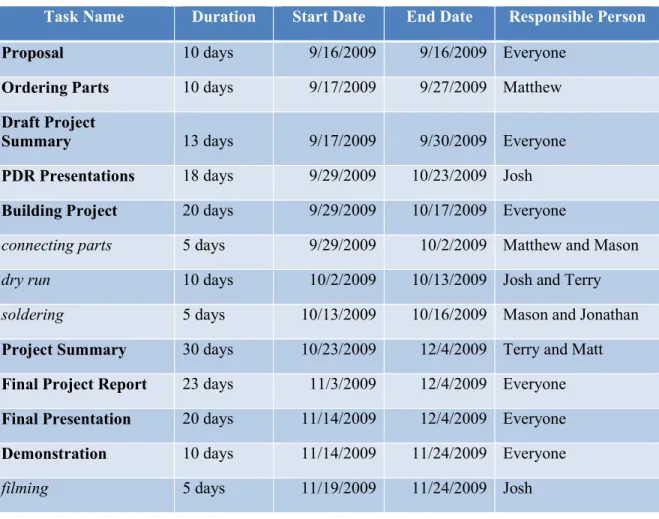
The PFDD will be designed, implemented, and demonstrated in the next three months. Table 3 shows the major tasks in bold and the milestones in italics.
Table 3. Schedule, Tasks, Milestones
Task ame Duration Start Date End Date Responsible Person
Proposal 10 days 9/16/2009 9/16/2009 Everyone
Ordering Parts 10 days 9/17/2009 9/27/2009 Matthew
Draft Project
Summary 13 days 9/17/2009 9/30/2009 Everyone
PDR Presentations 18 days 9/29/2009 10/23/2009 Josh Building Project 20 days 9/29/2009 10/17/2009 Everyone
connecting parts 5 days 9/29/2009 10/2/2009 Matthew and Mason
dry run 10 days 10/2/2009 10/13/2009 Josh and Terry
soldering 5 days 10/13/2009 10/16/2009 Mason and Jonathan
Project Summary 30 days 10/23/2009 12/4/2009 Terry and Matt Final Project Report 23 days 11/3/2009 12/4/2009 Everyone Final Presentation 20 days 11/14/2009 12/4/2009 Everyone Demonstration 10 days 11/14/2009 11/24/2009 Everyone
After completing the proposal, the PFDD parts will be ordered. After the parts arrive the design will be built and implemented. The table in Appendix A contains the Gantt chart for the schedule.
6 PROJECT DEMOSTRATIO
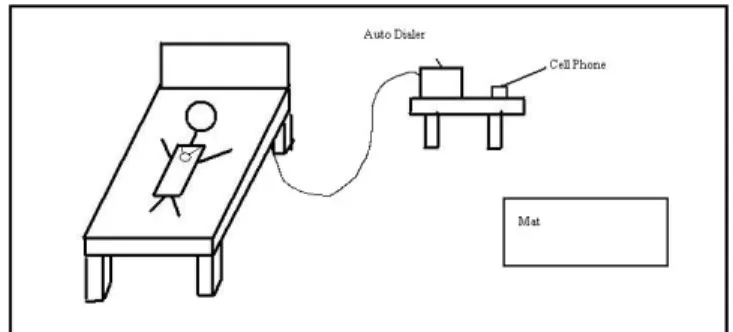
The final project will be demonstrated in the form of a video clip. The video recording that will demonstrate the final result of the project will take place in a dorm room at The Georgia Institute of Technology. In order to test the personal fall detector, the bed in the room will be equipped with the pressure switch, and a student will lie on the bed while wearing the
transmitter package. The auto dialer that connects to the receiver package will be on the top of a table near the bed. A mat will be prepared so the student can fall on it. Figure 3 shows how the room will be setup.
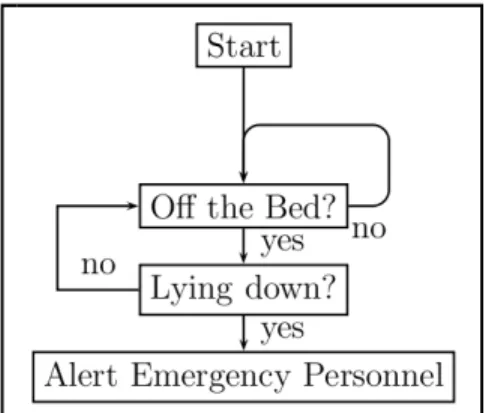
There will be two trials as shown in Figure 4. In the first trial, the student will get of the bed, and then he will walk around for a minute and lay on the bed again. The alarm should not go off in first trial, and the auto dialer will not make any call. In the second trial, the student will get off the bed, and he will then fall on the mat. The auto dialer will receive the signal and call the number of one of the student’s cell phone. Once the call connects, the cell phone will ring.
Figure 4. Trials Flow Chart
7 MARKETIG AD COST AALYSIS 7.1Marketing Analysis
VRI, iLife Fall Detection Sensor, Brickhouse Alert Home System, Life Alert, and many other companies offer emergency alert systems. The majority of these companies sell the alert system with activation of monthly monitoring services. The PFDD would allow the end user to customize the call out number to call a family member, caretaker, neighbor, or other emergency contact rather than requiring them to sign up for monthly monitoring services. The unit could also be marketed to home monitoring agencies that do not manufacture their own hardware.
The largest advantage the PFDD will have over its competitors will be cost. VRI’s medical alert system is $175 with purchase of their silver monthly monitoring service [8]. Brickhouse Alert requires a $200 deposit on the hardware with purchase of a monthly monitoring service [9]. The PFDD will be less than $150 and will not require a monthly subscription to a
The various home alert systems use several different techniques to determine emergency situations. Some incorporate only a panic button which limits its effectiveness to only those that are physically and mentally capable to activate the button in the event of an emergency. The sensors that other devices use may be prone to false alarms when put into a position or through a motion that resembles its programmed definition of a fall, such as lying down. The PFDD makes use of a tilt switch to keep the product as cheap and reliable as possible. However, a tilt switch can be prone to false alarms when the user chooses to lay down in bed which is why the PFDD is unique from other level detection based alert systems in that it monitors bed pressure to determine if the signal was a fall or simply climbing into bed. Pressure switches could be incorporated into other furniture such as couches or chairs, so that the user can comfortably recline wherever the pressure switch has been installed in their house.
The main marketing technique needed for the PFDD will be a salesman that will contact and demonstrate the product to doctors, caretakers, monitoring services, and retailers. Since this product will not require a monthly subscription to operate it will be necessary for it to be available in retail stores. The elderly or less internet savvy consumers will require a call center staffed with product knowledgeable employees to better access the market of those wishing to buy the product for themselves. The PFDD will require a website that provides all the
information a consumer is seeking in order to achieve a strong internet presence in the home alert market. The internet is important for attracting the consumers who are younger and are buying this product for an elderly loved one. In order to generate website traffic it will be necessary to use an advertising agency to run print, TV, and online advertisements.
7.2 Cost Analysis
The PFDD will cost less than $150 mainly due to hardware, manufacturing, and marketing costs. Engineering costs are one time and will be distributed across the thousands of units produced.
The engineering cost will be approximately $8000 based on $40/hr for the estimated 200 hours of design work. Assuming a minimum of 5,000 units are sold each year for five years then only $0.32/unit will be charged for the engineering costs.
Hardware costs are based on prices and estimates retrieved from the internet. The level switch is $4.69 for 500 from Mouser [10]. The wireless doorbell is $13 from Home Depot so buying in bulk from Heath Zenith should be lower than the retail price [11]. The auto-dialer is $16.50 with shipping from ebay.com [12]. The pressure switch is $0.64 for 500 from Digi-Key [13]. The spring for the pressure switch is $1.39 for 500 from Lee Spring [14]. Circuit boards will cost $3.05 for 500 from Digi-Key [13]. The hardware costs should total to about $50/unit.
Manufacturing costs, specifically labor, will be substantial per unit as it would take about 0.2 hr/unit at $10/hr to produce each unit, which comes out to about $2/unit. Tooling for the process would be limited primarily to screwdrivers and soldering equipment and would be distributed across the number of units produced. The manufacturing location’s monthly rent, the shipping costs, and the plant management would be expensive until mass production is achieved.
Marketing costs would be substantial early on to develop the name brand and product recognition. Contracting out advertising and website design would be best to avoid hiring
employees. Maintaining a call center and internet sales could be done internally or could be contracted out as well. The sales team will need to market to doctors, caretakers, and retailers which will require using display models or giving free trial systems to preferred agents.
8 Summary
The project group is currently in the process of researching and ordering the parts that are required to build the PFDD. The project group is also deciding which of the members are going to be in charge of building the PFDD and which members are going to test the PFDD. The group is also deciding who will be in charge of keeping up with all of the documentation for the PFDD
References
[1] Bonazle Inc, "Bonazle Find everything but ordinary," June 2007. [Online]. Available:
http://www.bonanzle.com/booths/medical_alerts/items/EMERGENCY_PHONE_LIFE_ALERT _SENIOR_PENDANT_BIG_BUTTONS__.
[2] G. Perolle, "Automatic Fall Detection and Activity Monitoring for Elderly," April 2006. [Online]. Available:
http://www.medetel.lu/download/2006/parallel_sessions/presentation/0407/Perolle.pdf. [3] V. Kajioka, "Cat.5 Patch Cord," February 2001. [Online]. Available:
http://lilinote.k12.hi.us/STATE/T4/t4hand00-01.nsf/8525608c005e322585255d7c00545af7/f57e0074e1dedb1a0a2569e70034dadd?OpenDocu ment.
[4] ITU, "International Telecommunications Union," July 2009. [Online]. Available: http://www.itu.int/ITU-T/.
[5] The U.S. Equal Employment Opportunity Commission, "Americans with Disabilities," June 1999. [Online]. Available: http://www.eeoc.gov/types/ada.html.
[6] HeathCo LLC, "Wireless Plug-in Chime," September 2007. [Online]. Available: http://heath-zenith.hcents.com/data/manuals/595-5684-08.pdf.
[7] Powerstream Technology, "PowerStream," September 2009. [Online]. Available: http://www.powerstream.com/cv.htm.
[8] Inc VRI, "VRI be well Live Safe," September 2009. [Online]. Available: http://www.monitoringcare.com/purchase/index.asp.
[9] Brick House Alert, "24/7 Medical Alert Monitoring For Seniors | Fall Detection Medical Alarm," September 2009. [Online]. Available: http://www.brickhousealert.com/personal-emergency-medical-alarm.html.
[10] Mouser Electronics, "Mouser Electronics a tti company," September 2009. [Online]. Available:
http://mouser.com/ProductDetail/NKK-Switch/DSA01/?qs=sGAEpiMZZMvMXbh32ZmHAENhpH4LAI3h. [11] Homer TLC, "Home Depot," September 2009. [Online]. Available:
http://www.homedepot.com/h_d1/N-5yc1vZ1xr5/R-100626844/h_d2/ProductDisplay?langId=-1&storeId=10051&catalogId=10053.
[12] I. Huntin, "Ebay - AT&T 4 Number EMERGENCY Automatic DIALER ~NIB~ Elderly," September 2009. [Online]. Available:
http://cgi.ebay.com/AT%26T-4-Number-EMERGENCY-Automatic-DIALER-~NIB~-Elderly_W0QQitemZ330218878523QQcmdZViewItem. [13] Digi-Key Corporation, "Digi-Key," September 2009. [Online]. Available:
http://search.digikey.com/scripts/DkSearch/dksus.dll?Detail&name=518PB-ND. [14] Lee Spring Company, "Lee Spring," September 2009. [Online]. Available:
http://www.leespring.com/product_spec.asp?partnum=LW175250375S&springType=C&subTyp e=.