DOT/FAA/AR-06/2
Office of Aviation Research and Development
Washington, DC 20591
Flight-Critical Data Integrity
Assurance for Ground-Based
COTS Components
March 2006 Final Report
This document is available to the U.S. public through the National Technical Information Service (NTIS), Springfield, Virginia 22161.
U.S. Department of Transportation Federal Aviation Administration
NOTICE
This document is disseminated under the sponsorship of the U.S. Department of Transportation in the interest of information exchange. The United States Government assumes no liability for the contents or use thereof. The United States Government does not endorse products or manufacturers. Trade or manufacturer's names appear herein solely because they are considered essential to the objective of this report. This document does not constitute FAA certification policy. Consult your local FAA aircraft certification office as to its use.
This report is available at the Federal Aviation Administration William J. Hughes Technical Center's Full-Text Technical Reports page: actlibrary.tc.faa.gov in Adobe Acrobat portable document format (PDF).
Technical Report Documentation Page
1. Report No.
DOT/FAA/AR 06/2
2. Government Accession No. 3. Recipient's Catalog No.
5. Report Date
March 2006 4. Title and Subtitle
FLIGHT-CRITICAL DATA INTEGRITY ASSURANCE FOR GROUND-BASED
COTS COMPONENTS 6. Performing Organization Code
7. Author(s)
Yann Hang Lee1 and Jim Krodel2
8. Performing Organization Report No.
10. Work Unit No. (TRAIS) 9. Performing Organization Name and Address
1
Arizona State University Office of Research and Sponsored Projects Box 873503 Tempe, AZ 85287
2
United Technologies Pratt & Whitney Aircraft 400 Main Street
East Hartford, CT 06108
11. Contract or Grant No.
13. Type of Report and Period Covered 12. Sponsoring Agency Name and Address
U.S. Department of Transportation Federal Aviation Administration
Office of Aviation Research and Development Washington, DC 20591
14. Sponsoring Agency Code
AIR-120 15. Supplementary Notes
The Federal Aviation Administration Airport and Aircraft Safety R&D Division Technical Monitor was Charles Kilgore. 16. Abstract
Ground processing systems are likely to use commercial-off-the-shelf (COTS) software and hardware for maintaining flight critical data. Hence, the COTS ground processing systems must be trustworthy and secure in order to maintain the integrity of the data. This requires various approaches, including information protection, data integrity and access security.
This report describes the results of our studies on the existing guidance governing the use of COTS components for safety-critical applications of ground-based systems, and the objectives of current guidance from the point of view of applicability and shortcomings. The use of hazard analysis and vulnerability analysis as a means for developing an effective risk mitigation strategy is provided and the relevance of the Rotorcraft Advisory Circular to a COTS components scenario is summarized. In order to address security and vulnerability concerns, several technologies such as encryption/decryption, authentication, access control, intrusion detection, etc., particularly in relation to application within a health and usage monitoring system (HUMS) context, are discussed. The report also includes two case studies involving COTS products to determine if they can be qualified by following existing software guidance, such as DO-178B and DO-278.
17. Key Words
COTS, Ground-based, HUMS, Security, Safety, Access, Process, Software
18. Distribution Statement
This document is available to the public through the National Technical Information Service (NTIS) Springfield, Virginia 22161.
ACKNOWLEDGEMENTS
The authors wish to express their appreciation for the assistance of the Federal Aviation Administration who provided valuable comments and suggestions. The authors would also like to acknowledge their deep appreciation for the support of William Weiss of United Technologies Research Center who provided significant contributions to this research.
TABLE OF CONTENTS
Page
EXECUTIVE SUMMARY xi
1. INTRODUCTION 1
2. OVERVIEW 4
3. DESCRIPTION OF THE SYSTEM UNDER STUDY 6
4. OVERVIEW OF AVAILABLE GUIDANCE RELATING TO COTS AND
GROUND-BASED SYSTEMS 9
4.1 Coverage of COTS in DO-278 9
4.2 The FAA Ground-Based, COTS-Related Process 10
4.3 Airborne Software Assurance Levels 12
4.4 Nonairborne Software Assurance Levels 13
4.5 Considerations of the HUMS ACs 14
4.5.1 Background of HUMS 14
4.5.2 The HUMS Advisory Circulars 15
4.5.3 Commercial Off-The-Shelf Approaches in the HUMS ACs 16
5. CURRENT AND EMERGING INDUSTRY APPROACHES TO SECURITY
AND SAFETY 20
5.1 Security Approaches 21
5.1.1 Cryptography 21
5.1.2 Cryptography in the HUMS Context 24
5.1.3 Access Security 25
5.1.4 Access Control in the HUMS Context (An Example) 28
5.1.5 Intrusion Detection 30
5.1.6 Intrusion Detection Within a HUMS Context 33
5.1.7 Information and Data Protection 34
5.1.8 Data Integrity Assurance in HUMS Context 36
5.2 Safety Approaches and Risk Mitigation 37
5.2.1 Hazard Analysis of the HUMS 37
5.2.2 Vulnerability Analysis of the HUMS 42
5.3 Considerations for Integrated Safety and Security Approaches 44
6.1 Case Study of COTS Having Differing HUMS Part Actions
(Case Study 1) 46
6.2 Case Study of a Widely Used COTS DBMS Within a HUMS Context
(Case Study 2) 50
6.3 The COTS Installation Software 56
7. SUMMARY AND RECOMMENDATIONS 56
7.1 Summary 56 7.2 Results 57 7.3 Recommendations 57 8. REFERENCES 58 9. GLOSSARY 61 APPENDICES
A—A Proof-of-Concept Demonstration Architecture B—System Security Evaluation Criteria
LIST OF FIGURES
Figure Page
1 Top-Level Architecture of HUMS 7
2 Proposed Common Risk Index 11
3 Enhanced Common Risk Index 14
4 Symmetric Key Cryptosystem 21
5 Message Authentication Code 22
6 Public Key Cryptosystem 23
7 Secure ACARS 24
8 Secure Network Architecture 29
9 Model of an Auditing System 36
10 Hazard Analysis Mode 37
11 Vulnerability Analysis Model 42
12 Risk Management Strategy 45
LIST OF TABLES
Table Page
1 Likelihood Definitions 11
2 Severity Definitions 12
3 Sample Hazard Analysis for a HUMS 38
4 Sample Vulnerability Analysis for a HUMS 43
5 Analysis of DO-278, AL4, for Two COTS Components 47
LIST OF ACRONYMS
AC Advisory Circular
ACARS Aircraft Communication Addressing and Reporting System ACL Access control list
AIS Automated Information System
CAST Certification Authorities Software Team
CC Common criteria
CFR Code of Federal Regulations
CNS/ATM Communication, Navigation, Surveillance/Air Traffic Management CORBA Common Object Request Broker Architecture
COTS Commercial off-the-shelf CRC Cyclic redundancy check
DBMS Database management system DoS Denial of service
EAL Evaluation assurance level FAA Federal Aviation Administration FHA Functional hazard assessment GUI Graphical user interface
HF High frequency
HUMS AC Health and Usage Monitoring System Advisory Circular HUMS Health and usage monitoring system
ICA Instructions for Continued Airworthiness ICBM Inter Continental Ballistic Missile
IDS Intrusion Detection System
IT Information technology
IVM Independent verification means MAC Message Authentication Code MD5 Message Digest version 5 MDC Modification Detection Code
N/A Not applicable
NAS National Airspace System
OS Operating system
PC Personal computer
POC Proof-of-concept
PP Protection profile
SHA Secure hash algorithm
ST Security target
TOE Target of evaluation
VB Visual Basic®
EXECUTIVE SUMMARY
Ground-based processing systems for aviation applications may process and store flight-critical data. Hence, they must be trustworthy so that the integrity of the data can be assured. To be trustworthy, a safety-critical, ground-based avionics system should provide not only security, but also a number of other system properties, such as reliability, safety, and quality of service. The increasing reliance on data networks and commercial off-the-shelf (COTS) components has continued to expand the focus of safety and security from individual subsystems to the connections between them.
Issues in making a COTS component-based, ground-based processing system for aircraft maintenance trustworthy and secure have been investigated. Three guidance documents constitute the basis of the investigation: (1) RTCA DO-178B, Software Considerations in Airborne Systems and Equipment Certification, which provides guidance for airborne systems; (2) DO-278, Guidelines For Communication, Navigation, Surveillance, and Air Traffic Management (CNS/ATM) Systems Software Integrity Assurance, which gives guidance for ground-based systems; and (3) the Health and Usage Monitoring Systems (HUMS) Advisory Circulars (AC) (AC 27-1B Change 1 and AC 29-2C Change 1), which provides guidance to achieve airworthiness approval for rotorcraft HUMS installation, credit validation, and continued airworthiness.
This report includes the investigation results on a variety of issues that arise from the use of COTS components in safety-critical systems and the approaches needed to ensure the integrity of the data. With a focus on HUMS, the report first gives a big picture view at the use of COTS in ground systems, the advantages and challenges posed by the use of COTS components. The issues in applying the current available guidance relating to COTS and ground-based systems are also discussed. This discussion includes the guidelines available in DO-278 pertaining to planning, acquiring, verifying, and managing the use of COTS software.
Research was conducted into possible safety hazards and security threats leading to a loss of data integrity by using vulnerabilities and safety hazard analysis techniques. The first step was to identify the threats and hazardous events in the system. Following this identification, the possible security and safety impacts and the criticality to the system operation were determined. In addition, possible remedial techniques were devised to address the hazards and threats. A risk mitigation strategy was adopted for each hazard and vulnerability corresponding to its risk level. This strategy may, in turn, affect some of the original requirement definitions at the design phase, resulting in a more robust design.
A significant amount of research effort was devoted to the evaluation of the applicable DO-178B and DO-278 objectives to the COTS components of HUMS. A preferred method of determining the applicability of the DO-178B and DO-278 objectives would be to perform a detailed analysis of each system component for all the objectives of the applicable guidance document and provide a rationale of compliance. A sample of the research investigation into this technique is presented in the report, specific for the HUMS system under study. It provides insight into possible ways in which such components may be analyzed, even if it is not always possible to
meet the required objectives due to the nature of COTS components. Of key importance in this technique is the component’s assigned assurance level from the system safety assessment.
To evaluate the feasibility of risk mitigation techniques to address various hazards and vulnerabilities in the HUMS system, a scaled down demonstration prototype of a HUMS system was developed. In this prototype, risk management mechanisms are implemented in a scaled-down, proof-of-concept version to determine the feasibility of such mechanisms. The application of lessons learned from the case study and demonstration prototype were considered for the HUMS case, however, they may be applied to other ground-based systems (such as communication, navigation, surveillance, and air traffic management systems).
As a part of this investigative report, a study on the use of COTS in a different domain area for the purpose of safety and security was performed. Towards this end, a case study was performed on COTS component use in the development of a nuclear certifiable tester for the Minuteman III Inter Continental Ballistic Missile. The study found that, similar to COTS components in HUMS, the primary advantage gained in adopting a COTS approach is the reduction in design cycle time and costs. In addition, there is an absolute necessity for a planning, requirement, design approval, and certification process to incorporate COTS components in safety-critical applications.
1. INTRODUCTION.
The primary purpose of this research is to investigate the challenges involved in making the commercial off-the-shelf (COTS), ground-based processing system for aircraft maintenance trustworthy and secure. With the advent of powerful information management and communication tools, flight data and maintenance records can be easily collected, analyzed, and disseminated for use by ground-based systems with COTS components. This presents an opportunity for cost optimization and an increase in efficiency.
For instance, in the helicopter domain, a health and usage monitoring system (HUMS) may provide several benefits including improved aircraft safety, increased availability and reliability, rapid determination of aircraft status, reduced overhaul and repair costs, and reduced scheduled component removal. Many helicopter parts are dynamically loaded and are subject to develop fatigue cracks. If a flight-critical part fails, it could cause a catastrophic accident. As a result, many of these parts are life-limited and are assigned a safe-life limit in flight hours based on cumulative fatigue damage under variable amplitude loading. For example, according to Miner’s theory of linear damage rule, the total fatigue is the sum of the cumulative damage proportions at different stress levels. To calculate the safe-life limit, the aircraft’s usage or flight maneuvers (flight regimes), the frequency of those maneuvers, or the percent usage of that regime in a particular time frame is determined. This information is combined with material strength characteristics and part test results, and then used to establish an acceptable calculated retirement time for these parts. This calculated retirement time is conservative. The parts are typically removed from service once the predefined retirement time is reached. However, structural usage monitoring approaches dynamically adjust service life for individual components based on measured actual usage spectrums while the helicopter is being flown. This results in cost optimization and efficient use.
COTS components are used in many applications in ground-based aviation systems. For these systems, the hardware is likely to be a set of personal computers (PC). The operational software is also COTS, such as Microsoft® Windows®. The flight data may be saved in COTS storage devices. Also, it is very likely that the equipment is connected to the Internet or wireless networks, and installed in a nonsecure environment, and may involve human intervention in the decision-making process. A different approach to system design, certification, or a mitigating action may be required to make the system fail-safe.
As previously stated, the primary purpose of this research is to investigate the challenges involved in making ground-processing aircraft maintenance systems composed of COTS components trustworthy and secure. The investigation primarily focuses on three areas:
• Information and data protection. Data can be corrupted at any point during its lifetime. Corruption can occur during computation, transmission, and storage. This area deals with the protection and verification of information. Traditional techniques to handle these problems are investigated and new techniques or combinations of existing approaches are suggested.
• Access security. Flight data is very vulnerable to malicious attacks as it can be intercepted during data transfers and tampered with. In order to prevent this, various forms of access security such as authentication, digital signature, and public key infrastructure are investigated. The challenges involved in setting up such an infrastructure, as well as the issues related to accountability of flight data accessed are investigated.
• Process and objectives for data integrity in ground-based COTS systems. Data integrity must be maintained. To ensure this, processes followed by the ground-based COTS systems are analyzed to identify possible fault conditions and their potential impact on safety requirements. Fault mitigation techniques are proposed to ensure that all objectives for maintaining data integrity in ground-based COTS systems are satisfied. This report closely considers the existing guidance: (1) RTCA DO-178B, Software Considerations in Airborne Systems and Equipment Certification, which addresses the software components in airborne systems; (2) DO-278, Guidelines For Communication, Navigation, Surveillance, and Air Traffic Management (CNS/ATM) Systems Software Integrity Assurance, for the assurance of flight-related software contained in nonairborne CNS/ATM systems; and (3) the HUMS Advisory Circulars (AC) 27-1B Change 1 and AC 29-2C Change 1) for airworthiness approval for rotorcraft HUMS installation, credit validation, and continued airworthiness. The applicability of this guidance material to COTS components and any remedial techniques that help meet the objectives outlined in the guidance were investigated.
To investigate the above stated areas of focus, the following steps were taken:
• Studied current and emerging industry approaches and guidelines for ground-based data protection schemes with a focus on HUMS and condition-based maintenance systems. • Studied the application of security and authentication approaches in other industries and
identified their limitations and strengths.
• Evaluated the objectives of DO-278 to the COTS components in HUMS application and the approaches listed in the Rotorcraft HUMS Advisory Circular for certifying HUMS ground-based systems that contain COTS components.
• Developed a functional hazard and vulnerability analysis as a means for developing an effective risk mitigation strategy.
• Performed two case studies involving COTS products to determine if they can be qualified by following the existing software aspects of certification guidance such as DO-178B and DO-278. Case study 1 investigated both Microsoft Windows and Microsoft® Access® as COTS components. Case study 2 considered a customer-designed HUMS system, which used a COTS database management system (DBMS).
• Conducted a representative demonstration project to evaluate the flexibility of the proposed protection process and objectives in ensuring proper handling of flight-critical information.
The report is structured as follows:
• Section 2 defines the term COTS and describes the motivation to use COTS components in building ground-based, safety-critical systems. A detailed discussion on the advantages (such as faster and cheaper development cycles) and challenges (such as ensuring safety and security) when using COTS components in safety-critical systems is provided.
• Section 3 provides an introduction to the HUMS, which is chosen as a representative ground-based system for the study. A functional description and a top-level architecture of a HUMS system are provided. The safety and security concerns of a HUMS system are highlighted.
• Section 4 provides a description of the current available guidance relevant to use of COTS components in safety-critical systems. DO-278, DO-178B, and the HUMS Advisory Circular (HUMS AC) are evaluated to provide an introduction to the existing approaches of integrating COTS components in safety-critical systems. This section also discusses the guidelines pertaining to planning, acquiring, verifying, and managing the use of COTS software available in the DO-278, DO-178B, and the HUMS ACs. Alternate approaches for acceptance of COTS software in safety-critical systems are also discussed.
• Section 5 presents the current and emerging industry approaches regarding safety and security. An introduction to cryptography, access security, intrusion detection, and information and data protection technologies is presented. The use of these technologies is also discussed in context of a HUMS. Toward this end, vulnerabilities to which airborne data is prone and the ways by which it can be protected are highlighted. The notions of safety and risk mitigation strategies are introduced. This section also presents a hazard and vulnerability analysis of HUMS and its various subsystems, such as ACARS, HUMS database, COTS software, HUMS gateway, and HUMS internal network. Appropriate safety and risk mitigation approaches are presented. The section concludes with a discussion on integration of safety and security approaches for HUMS. • Section 6 uses the HUMS as a representative ground-based system to see how the
COTS-specific objectives of DO-278 help in the planning, acquisition, verification, and configuration management process. A preferred method of determining the applicability of the DO-278 objectives would be to perform a detailed analysis of each system component for all the objectives of this guidance document and provide a rationale of compliance. To illustrate this technique, two case studies involving use of COTS software in a sample HUMS system are presented. Case study 1 investigated both Microsoft Windows and Microsoft Access as COTS components. Case study 2 considered a customer-designed HUMS system, which used a COTS DBMS. Both case
studies determine the applicability of the DO-278 objectives to the COTS component by performing a detailed analysis of that component for all the objectives of DO-278. • Section 7 provides a conclusion and identifies promising areas of further research.
• Sections 8 and 9 document the references and the glossary of terms used in this document, respectively.
• Appendix A describes the outline of the demonstration project implemented as a proof-of-concept.
• Appendix B describes the current standard used in evaluating the security of a system (i.e., the common criteria).
• Appendix C presents a case study (within a different domain) in which COTS components are used to meet safety and security requirements.
2. OVERVIEW.
DO-178B [1] provides guidance for software used in airborne systems, while DO-278 [2] provides guidance for flight-related software used in ground-based systems. This report focuses on ground-based COTS systems and, as such, uses DO-278 for software assurance guidance. This report also considers ways and means of effectively using ground-based data and considers the HUMS advisory material (AC-27-1B Change 1 and AC-29-2C Change 1).
Since this report revolves around the use of COTS components, a definition of the term COTS is imperative. As defined in DO-278, COTS software is a term used to encompass a wide range of software that includes [2]:
• Purchased software,
• Nondevelopmental items, and
• Software previously developed without consideration of DO-278 (or DO-178B). The typical characteristics of COTS software are [2]:
• May or may not be approved through other approval processes
• Partial or no data may be available as evidence of compliance with objectives of the DO-278 (or DO-178B)
The term off-the-shelf in COTS means that it was not developed by the user but was already existing. Rather than write volumes of new code, COTS software components are used as building blocks to be fit together to satisfy the requirements of new systems. A COTS-based
system is one that uses one or more COTS components. COTS-based systems have been cited to have multiple advantages including [3]:
• Development cycle time is reduced. The complex, sophisticated software systems typical today would not be practical to build if every function had to be written from scratch for each new system.
• Total development cost, which includes both development and maintenance cost, is reduced.
• The component is often already in extensive use with a large community of satisfied users.
Consequently, software developers build many parts of new systems by adding functionality provided by COTS software components. However, many challenges need to be addressed when using COTS in safety-critical systems including [3]:
• It is often difficult to know what someone else did to ensure that their software component is reliable and will execute as expected when integrated into a new and complete system.
• The user has limited or no access to source code or other software life cycle data. • The user usually has no control over the requirements and updates of the COTS. • There is a learning curve associated with the use of COTS.
• COTS component developer may not have given any attention to safety-critical aspects. A paper developed by the international Certification Authorities Software Team (CAST) also documents several concerns when using a COTS operating system (OS) in safety-related systems, when the COTS OS does not have supporting DO-178B software life cycle data. These concerns include (not an exhaustive list, since each project will have its own specific issues) [4]: • Integrity of COTS OS design and implementation is unknown to the user or integrator. • Unknown functionality and side effects in the COTS OS may exist.
• The COTS OS can negatively affect the operation of other software applications that are executing using the functions of the OS and COTS resource management hardware and software.
• Mitigation approaches to address the COTS OS’s potential effects are sometimes themselves implemented in the COTS OS’s environment.
• It may not be technically feasible to establish completion criteria for identifying and addressing all the failure condition classifications of functions that could be affected by the COTS OS.
• Verification of correctness and completeness of functionality and mitigation schemes external to the COTS OS is difficult.
• Errors may exist in the COTS OS that are unknown to the applicant or developer. • Patches to the COTS OS could have effects on the safe implementation.
• The configuration control, problem report resolution, and continued operational safety of any application containing COTS software requires special attention.
• It is difficult to satisfy the objectives of DO-178B/ED-12B (or other certification authority approved guidance) for all software in the airborne application when COTS software is used.
• COTS products might be susceptible to viruses.
• The support provided by COTS software suppliers may not be compatible with the long-life needs of safety-critical systems (e.g., aircraft).
As can be seen from the above discussion, the same characteristics that make COTS an attractive alternative to in-house development may cause serious safety and security concerns. Nevertheless, the potential gains of using COTS should not be ignored. By following guidelines governing the use of COTS, systems can be built that have a high degree of reliability.
3. DESCRIPTION OF THE SYSTEM UNDER STUDY.
For the purpose of this report, a generic HUMS has been selected as a representative ground-based system. A HUMS attempts to predict appropriate times to change parts ground-based on actual use of the parts, as opposed to the more traditional technique of changing parts after a specific number of operating hours. A HUMS can be defined in several ways. One way is based on what it does as identified by the following characteristics [5]:
• Health. A measure of the overall flightworthiness of the aircraft. Health is assessed by examining instantaneous indicators of the well-being of vital components on the aircraft, as well as by trend analysis of these indicators.
• Usage. A measure of how the life of components is being expended on the life-limited parts of the aircraft. Usage determines the time to overhaul the major components.
• Monitoring. A means by which information can be gathered on the vital systems of the aircraft.
The HUMS AC definition of HUMS separates the health and monitoring systems as follows [6 and 7]:
• Health Monitoring System. Equipment, techniques, and/or procedures by which selected incipient failure or degradation can be determined.
• Usage Monitoring System. Equipment, techniques, and/or procedures by which selected aspects of service history can be determined.
Although the general role of HUMS is widely accepted, little consensus exists on what exactly constitutes a HUMS. References 6 and 7 require that a HUMS consist of a variety of sensors and data acquisition systems onboard the rotorcraft or on a ground station (or a combination of both). Other texts only require the HUMS to contain the ground-based processing system. References 5 and 7 provide detailed descriptions of the HUMS concept and specific implementations of the concept. Because of this lack of consensus, this report’s view of a HUMS needs to be stated. For the purpose of this report, a HUMS is a system which includes the following:
• Avionics equipment and data.
• Associated ground equipment and data.
A typical high-level architecture diagram of a HUMS is shown in figure 1.
FIGURE 1. TOP-LEVEL ARCHITECTURE OF HUMS [8]
The HUMS can be thought of as three distinct parts, as depicted in figure 1. The aircraft contains a large number of onboard sensors that feed data to the onboard processor(s). The processor(s) then transmit this data through a channel, such as the Aircraft Communication Addressing and Reporting System (ACARS) to the ground stations. The ACARS channel may also have some data storage with the actual data transfer to ground stations occurring offline at a later stage. The ground stations receive data and store it for subsequent inspection and use.
Ground Station(s) Onboard Processor(s) Data Storage/ ACARS Ground Processor(s) Database(s) On - Aircraft Data Link On - Ground Data Link
To ensure that data integrity is maintained, one must investigate the safety and security issues in the HUMS. Figure 1 shows that data can be compromised at two points, during transmission through the ACARS and during storage in the databases on the ground. Discussions about these two areas of vulnerability follow.
The ACARS is the data link used by most commercial aircrafts today for two-way communication between the aircraft and ground control. It transmits data in text format over available radio frequency channels. Anyone can intercept these transmissions and gain information such as aircraft type, condition, position, projected track, cargo content, and operational details [9] from the transmission. There are three primary concerns with using such an unsecured network [10]:
• Privacy concerns. Anyone within range and having a very high frequency (VHF) or a high-frequency (HF) device can intercept ACARS signals. This raises an issue of privacy of the health and usage signals transmitted from the aircraft to the ground stations.
• Authenticity. Assurance cannot be obtained that the transmission is coming from the aircraft/authorized ground station. That is, the origin of the message cannot be guaranteed.
• Data Integrity. The integrity of the data during transmission cannot be guaranteed. However, other nonsecurity related concerns exist as well:
• Saturation of radio frequencies. Since only a limited bandwidth is available with an ever-increasing number of flights, the number of new frequencies that can be allocated is very limited.
• Decrease in quality of data transmission. Because of the exponential increase in flight demands, the available bandwidth is continually shrinking, resulting in poor quality of data transmissions to and from ground control staff.
The ground-based processing systems are points where the data is vulnerable as well. The primary concerns and some techniques for consideration for data integrity during storage are: • Access security. Only authorized personnel should be able to access the HUMS data.
Sophisticated schemes (such as firewalls and encryption) need to be considered.
• Authentication and access control. Simple identification/password mechanisms do not provide the level of security desired. Modern techniques such as digital signatures should be adopted. Also, different users should be assigned different privilege levels to prevent malicious/involuntary corruption of data by authorized users.
• Intrusion detection. Intrusion detection techniques should be adopted to detect patterns of intrusive behavior (such as denial-of-service (DoS) attacks) and take the necessary corrective action.
• Information verification and accountability. Before the data can be used, it should be ensured that data has not been modified maliciously or due to other considerations such as noise bursts, power surges, and so on. Techniques such as checksum calculation, cyclic redundancy check and message authentication codes should be investigated. The use of audit trails should also be considered as a vehicle to maintain accountability. An audit trail is a series of records of events that take place in a system. The events may be related to the OS, application programs, or users of the system. An independent examination of these records can ensure compliance with established controls, policy, and operational procedures [11]. Audit trails thus enable a user to verify the activity of an information system and can help trace violations of security policies back to individuals.
4. OVERVIEW OF AVAILABLE GUIDANCE RELATING TO COTS AND
GROUND-BASED SYSTEMS.
4.1 COVERAGE OF COTS IN DO-278.
The Federal Aviation Administration (FAA) provides guidance to developers of airborne software systems so that those systems meet the regulations and are safe and execute as expected when integrated into a new and complete system. The implementation phase of airborne software development is typically manifested by tight control of the entire development effort. Most aspects of the development of a software system (design, configuration control, quality assurance, life cycle management, etc.) are under the control of the developer. Therefore, the developer of a new airborne system, and the FAA, can have confidence that if the guidelines are followed during the development of the new system, then it will perform its intended functionality with a level of assurance that complies with airworthiness requirements. The software assurance guidelines are published as RTCA DO-178B.
In 2002, RTCA Inc. published guidelines for developers of based systems. The ground-based systems are often CNS/ATM systems and typically include COTS software components. These guidelines are published as DO-278, Guidelines for Communication, Navigation, Surveillance, and Air Traffic Management (CNS/ATM) Systems Software Integrity Assurance [1]. DO-278 is based on DO-178B, and for software that is being written line by line, the guidance is very similar to DO-178B. DO-278 also addresses the incorporation of COTS software components, and Section 4 of DO-278 is devoted mainly to software development with COTS software components.
Section 4 of DO-278 specifically addresses the use of COTS software and addresses four processes (planning, acquisition, verification, and configuration management) that must be considered when COTS software is used. The extensive discussion of COTS software is new to DO-278 and was not included in DO-178B. Section 3 of DO-278 contains ten tables of objectives derived from ten tables of objectives in DO-178B. Some of the objectives in these ten
tables are COTS-related. The COTS-specific objectives in Section 4 of DO-278 are an addition to, rather than a replacement of, the objectives in section 3.
This project analyzes all of the DO-278 COTS-related objectives from the perspective of a representative COTS software component in a representative ground-based system (see section 6 of this report).
4.2 THE FAA GROUND-BASED, COTS-RELATED PROCESS.
Many analyses are needed for an effective assessment of a ground-based system. Some of these include Operational Safety Assessment, Comparative Safety Assessment, Preliminary Hazard Analysis, Subsystem Hazard Analysis, System Hazard Analysis, Operating and Support Hazard Analysis, Test Safety Analysis, System Safety Program Plan, and a safety assessment. Some of these analyses and documents are used to accommodate FAA Order 8040.4, which states that the FAA should use a formal, disciplined, and documented decision-making process to address safety risks in relation to high consequence decisions impacting the complete product life cycle. The products resulting from this order are System Safety Handbook [12] and System Safety Management Program [13]. Precise definition of the assessment process of a ground-based system at this time is difficult because some of the acquisition process and guidelines are still undergoing change at this time with the National Airspace System (NAS) Modernization Program being the driving force.
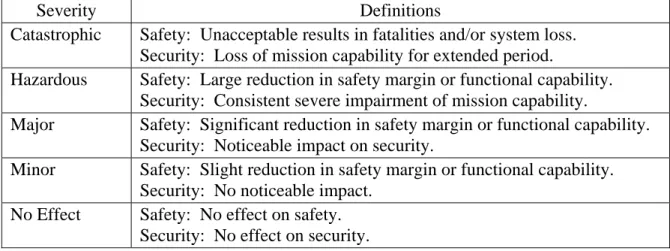
The FAA System Safety Handbook for ground-based systems defines system safety as “aiming to optimize safety by the identification of safety-related risks, eliminating or controlling them by design and/or procedures, based on acceptable system safety precedence” [12]. System safety is risk management. At one end of the spectrum, it is not acceptable to have air transport systems that would generally be considered dangerous (catastrophic failures occurring at frequent intervals). At the other end of the spectrum, it is not practical or cost-effective to build systems that are 100% reliable (no failures at all, not even very minor failures at very infrequent intervals). Therefore, practicality and cost effectiveness lie in the middle of the spectrum, balancing the likelihood that a failure will occur, with the consequences if that failure actually does occur. Consequently, in reference 14, Stroup, et al. have proposed a Common Risk Index, which is a matrix that can be used to determine a qualitative measurement (high, medium, or low) of potential system risk by combining the severity of consequences with the likelihood of occurrence. For example, a hazard whose likelihood is classified as extremely remote, and severity as catastrophic is classified as having a high risk. The matrix can then be mapped onto the assurance levels specified in DO-278, thereby helping developers in defining an effective risk mitigation strategy. Section 5.3 of this report will describe how the likelihood and severity information obtained from the mapping between this matrix and assurance levels of DO-278 software can be used in the generation of a risk mitigation strategy. The matrix in figure 2 illustrates the proposed Common Risk Index. The definitions of likelihood and severity terms are given in tables 1 and 2.
No effect Minor Major Hazardous Catastrophic Extremely Improbable Extremely Remote Remote Probable Minor Major Hazardous Catastrophic Extremely Improbable Extremely Remote Remote Probable Likelihood Severity High risk Medium risk Low risk High risk Medium risk Low risk
FIGURE 2. PROPOSED COMMON RISK INDEX [13] TABLE 1. LIKELIHOOD DEFINITIONS [13]
Likelihood Definitions Probable Qualitative: Anticipated to occur one or more times during the
entire system/operational life of an item.
Quantitative: Probability of occurrence per operational hour is equal to or greater than 1 x 10⁻⁵
Remote Qualitative: Unlikely to occur to each item during its total life. May occur several times in the life of an entire system or fleet. Quantitative: Probability of occurrence per operational hour is less than 1 x 10⁻⁵, but greater than 1 x 10⁻⁷
Extremely remote Qualitative: Not anticipated to occur to each item during its total life. May occur a few times in the life of an entire system or fleet. Quantitative: Probability of occurrence per operational hour is less than 1 x 10⁻⁷ but greater than 1 x 10⁻⁹
Extremely improbable Qualitative: So unlikely that it is not anticipated to occur during the entire operational life of an entire system or fleet.
Quantitative: Probability of occurrence per operational hour is less than 1 x 10⁻⁹
TABLE 2. SEVERITY DEFINITIONS
Severity Definitions Catastrophic Safety: Unacceptable results in fatalities and/or system loss.
Security: Loss of mission capability for extended period.
Hazardous Safety: Large reduction in safety margin or functional capability. Security: Consistent severe impairment of mission capability.
Major Safety: Significant reduction in safety margin or functional capability. Security: Noticeable impact on security.
Minor Safety: Slight reduction in safety margin or functional capability. Security: No noticeable impact.
No Effect Safety: No effect on safety. Security: No effect on security.
Section 5.3 investigates how the above matrix can be used in developing an effective risk mitigation strategy.
4.3 AIRBORNE SOFTWARE ASSURANCE LEVELS.
All airborne software could potentially have an impact on safety. Hence, it is subject to certification requirements as documented in Title 14 Code of Federal Regulations (CFR) [15]. DO-178B defines a set of objectives to establish assurance that airborne software has the integrity needed for use in safety-related applications [2]. DO-178B is implemented by AC 20-115B. AC 20-115B considers DO-178B to be a means, but not the only means, to secure FAA approval of digital computer software. The guidance of DO-178B is provided in the form of objectives for life cycle processes (this is defined according to software levels A through E), activities to be performed to achieve these objectives, and evidence indicating that these objectives have been met [16]. DO-178B acts as a guideline for determining that an acceptable level of confidence is present in the software aspects of airborne systems (in accordance with FAA airworthiness requirements). The primary part of the DO-178B definition of the different software level is as follows [1]:
• Level A. Software that could cause or contribute to the failure of the system resulting in a catastrophic failure condition.
• Level B. Software that could cause or contribute to the system resulting in a hazardous or severe failure condition.
• Level C. Software that could cause or contribute to the system resulting in a major failure condition.
• Level D. Software that could cause or contribute to the system resulting in a minor failure condition.
• Level E. Software that could cause or contribute to the system resulting in no effect on the system.
4.4 NONAIRBORNE SOFTWARE ASSURANCE LEVELS.
The levels in DO-278 are based on and relevant to DO-178B. In DO-278, these levels are called assurance levels and, when applied to a non-airborne-based system, are represented by the following [2]:
• Assurance Level 1 (AL1). Software that could cause or contribute to the failure of the ground-based system resulting in a catastrophic failure condition. Equivalent to DO-178B Level A (as mentioned in section 4.3 of this report).
• Assurance Level 2 (AL2). Software that could cause or contribute to the failure of the ground-based system resulting in a hazardous or severe failure condition. Equivalent to DO-178B Level B (as mentioned in section 4.3 of this report).
• Assurance Level 3 (AL3). Software that could cause or contribute to the failure of the ground-based system resulting in a major failure condition. Equivalent to DO-178B Level C (as mentioned in section 4.3 of this report).
• Assurance Level 4 (AL4). This level accounts for certain CNS/ATM (ground-based) systems where AL3 is too stringent and AL5 is too lenient. There is no DO-178B equivalent for this assurance level.
• Assurance Level 5 (AL5). Software that could cause or contribute to the failure of the ground-based system resulting in a minor failure condition. Equivalent to DO-178B Level D (as mentioned in section 4.3 of this report).
• Assurance Level 6 (AL6). Software that could cause or contribute to the failure of the ground-based system resulting in no effect on the system. Equivalent to DO-178B Level E (as mentioned in section 4.3 of this report).
The DO-278 assurance levels are correlated to risk, as illustrated by an enhanced Common Risk Index in figure 3.
The assigned assurance levels will depend on the function to be performed by the software and the impact of that function’s failure. The specific process applied to the software will vary, depending on whether it is a COTS component or not.
AL 1 AL 2 AL 5 AL 6 AL 3 AL 4 High Risk Low Risk Medium Risk AL 2 AL 3 AL 6 AL 5 AL 4 AL 3 AL 4 AL 6 AL 5 AL 4 AL 4 AL 5 AL 6 AL 6 AL 5 AL 1 AL 2 AL 6 AL 3 Catastrophic Hazardous No Safety Effect Minor Major Probable Remote Extremely Remote Extremely Improbable Likelihood Severit y AL 5
FIGURE 3. ENHANCED COMMON RISK INDEX [17]
4.5 CONSIDERATIONS OF THE HUMS ACs.
This section will review the current guidance listed in the Rotorcraft HUMS ACs’ guidance material found in AC-27-1B Change 1 and AC-29-2C Change 1 for certifying HUMS ground-based systems that contain COTS components. The specific guidance of concern is found in Chapter 3 and Miscellaneous Guidance Section 15 (MG 15) of the HUMS ACs. This section will also consider other potential guidance such as DO-178B and DO-278B.
4.5.1 Background of HUMS.
Health and usage monitoring has become a focal point in the helicopter domain. Anticipated benefits include improved aircraft safety, increased availability and reliability, rapid determination of aircraft status, reduced overhaul and repair costs, and reduced scheduled component removal [18]. Many helicopter parts are dynamically loaded and are subject to develop fatigue cracks. As a result, many of these parts are life-limited and are assigned a safe-life limit in flight hours based on Miner’s theory of linear damage rule. The process is to determine the aircraft’s usage or flight maneuvers (flight regimes), the frequency of those maneuvers, or the percent usage of that regime in a particular time frame. This information is combined with material strength characteristics and part-testing results. These loads are then used to establish an acceptable calculated retirement time for these parts [19]. The development
of a HUMS is rather unique in that the application software, perhaps level A, that is developed under DO-178B could be integrated with COTS software that may require a level D (or even higher) software assurance level, depending on the functional hazard assessment (FHA).
Recent efforts have explored substituting the assumed worst-case usage with the actual measured usage to calculate retirement times. This would permit safe part-life to be extended if the actual measured usage is less than then assumed usage. It would also permit early removal of parts to maintain safety margins if the actual usage was more severe than assumed. In reference 19, a design assessment is carried out for an application taking such an approach. The application under study in reference 19 was a Helicopter Structural Usage Monitor. The usage monitoring effort acquires helicopter sensor data, which is used to determine the aircraft’s flight regime. The regimes are calculated in real time once per second and stored in a data file that is used on landing to calculate a damage fraction for the part. This data is packed and sealed with a cyclic redundancy check (CRC) algorithm. The damage data is then moved to a ground-based computer [19].
A business case point of view in the HUMS domain is presented in reference 8, but it is cited that in June 1999, at the time the business case was developed, the HUMS ACs (AC 27-1B Change 1 and AC 29-2C Change 1) were in draft form, with the intent to provide specific guidance for FAA approval of functions implemented on a PC-based ground station. Because of the guidance being in draft form, several HUMS applications chose not to include COTS software as part of their HUMS solution. As a result, there is little current data as to the effectiveness of the AC guidance related to COTS. However, since the official release of the HUMS ACs guidance material, to date, no HUMS applications for rotorcraft have been approved for maintenance credits. That is, the HUMS applications that were approved by the FAA for rotorcraft to date, do not replace the existing maintenance program requirements. These HUMS applications have been approved on a no maintenance credit basis. This means that maintenance actions are not predicated on the data collected and processed by the approved HUMS applications.
4.5.2 The HUMS Advisory Circulars.
Advisory circular material AC 27-1B and AC 29-1C for airworthiness approval of HUMS was developed by the Rotorcraft Health and Usage Monitoring System Advisory Guidance, which consists of the FAA, the Joint Aviation Authorities (JAA), the Aerospace Industries Association of America Inc. (AIA), and the Association Europeene des Constructeurs de Material Aerospatial [6 and 7].
The advisory circulars provide guidance to achieve airworthiness approval for three basic aspects to HUMS certification:
• Rotorcraft HUMS installation • Credit validation
Certification of HUMS must address all three aspects. These aspects are not independent of each other and have varying degrees of interaction among themselves. Installation includes all the equipment needed for the end-to-end application that is associated with acquiring, storing, processing, and displaying the HUMS application data, including airborne and ground-based equipment. Credit validation includes evidence of effectiveness for the developed algorithms, acceptance limits, trend-setting data, tests, etc., and for the demonstration methods employed. ICA includes the methods used to ensure continued airworthiness of those parts that could change with time or use.
4.5.3 Commercial Off-The-Shelf Approaches in the HUMS ACs.
AC 27-1B Change 1 and AC 29-2C Change 2 (referred to as HUMS ACs for the remainder of this report) have very specific terms when discussing the various approaches to using COTS in a HUMS. The HUMS ACs explain the following terms:
• COTS. This term defines equipment, hardware, and software that is not qualified to aircraft standards.
• Mitigating Action. It is an autonomous and continuing compensating factor that may modify the level of qualification associated with certification of a HUMS application. Mitigating actions are often performed as part of continued airworthiness considerations and are also an integral part of the certification.
• Independent Verification Means. An independent process to verify the correct functionality of a HUMS application on a ground station that uses COTS. The intent of independent verification is to gain some degree of confidence in the COTS operation reliability. Note: This process may be discontinued when sufficient confidence in the application has been achieved.
The COTS definition in the HUMS ACs is very different than traditional COTS definitions. The HUMS ACs state that COTS can be any software or hardware that has not been developed to DO-178B (or DO-254) standards. This definition means that for the FAA to approve a HUMS, the COTS software and hardware must both be developed and qualified to acceptable aircraft standards. However, the group that developed the HUMS ACs recognized that many existing ground stations used COTS components, like PCs and commercial operating systems, to process maintenance data collected through traditional means (i.e., manual recording of component life usage by humans). Hence, the developers of the HUMS ACs wanted to continue to allow this use of COTS components, but there needed to be some acceptable criteria that these COTS components needed to be evaluated against. The HUMS ACs do not relieve the HUMS application software from having to comply with DO-178B, even if this software resides in ground-based COTS station. An example of the HUMS application software is the software that is developed to recognize the various flight regimes and processes raw data to determine the extent of wear and tear on a specific aircraft part. This HUMS application software may reside in the ground-based COTS station.
DO-178B defines COTS in a different way. The DO-178B glossary defines COTS software as “Commercially available applications sold by vendors through public catalog listings” [1]. This definition states nothing about the pedigree of the COTS product relative to DO-178B. In fact, if one were to have a commercially available product that has been developed to the guidance of DO-178B, then it would be COTS under DO-178B, but not under the HUMS ACs. Correspondingly, if one were to have an in-house developed software module not developed to DO-178B, then the HUMS ACs state it is COTS, but under DO-178B it would not be COTS because it was not commercially available.
In the HUMS ACs, a mitigating action is very different from independent verification means (IVM), and they should not be confused. Mitigating action can be viewed as a compensation factor applied to the HUMS, which can result in an allowance in the reduction of the required level of qualification for the HUMS hardware and software. The compensating factor applied as a mitigating action is permanent. The IVM addresses the need to independently verify the results of COTS software or hardware components that have not been developed to DO-178B (or DO-254 for complex electronic hardware). The intent of the IVM process is to gain some degree of confidence in the operational reliability of the ground-based COTS station. This process may be discontinued when sufficient confidence in the application has been achieved.
4.5.3.1 The HUMS ACs Intent and Other Considerations.
Like airborne systems, the HUMS system must determine its end-to-end criticality by performing a FHA, including the ground components. From a hardware point of view, ground components can include not only a PC desktop, laptop, and server, but also subassembly components such as modems, Ethernet cards, or memory transfer media (such as memory sticks). On the software side, not only does the system under review need to consider the computing engine software (such as databases or spreadsheet software), but also the enabling software (such as communications driver software and the OS). Any potential effect on the data must be considered in the FHA. The HUMS ACs’ intent is to have the FHA identify all system components, including COTS components, and determine the component’s criticality level to find its corresponding software level. Any COTS component performing such actions (i.e., that determines component life time) must come under the guidance of DO-178B or an acceptable alternative.
Compliance to the determined FHA criticality level can be accomplished by qualification plus appropriate mitigating action. The final level of equipment qualification may not only be the result of technical consideration, but also of other mitigating actions, which can result in a reduction of qualification levels for equipment.
4.5.3.1.1 The HUMS ACs and Service History.
The HUMS ACs further state that for COTS components, the IVM must be accompanied with satisfactory service history. Recent service history findings have shown, however, that for higher criticality systems, service history may simply not be an appropriate or practical choice. Care must be taken when using service history since it is usually part of a system. Any use of service history for a COTS component is typically an extrapolation of the system’s performance.
Software Conference that when trying to apply an effective service history argument to a component of a system, problematic data collection practices, problematic interpretations, and associated assumptions are moving targets. Such problems provide a challenge to effectively quantifying and justifying the data used to support the service history case.
Given Ferrell’s [20] findings with regards to the difficulty of establishing a sound service history base, at least for the higher criticality systems, the HUMS AC statement of “satisfactory service history” would be very difficult to argue for.
Take, for example, the use of Miner’s Cumulative Damage theory. Historically, the approach has been validated via service history. With the HUMS proposition of recalculating Miner’s laws using data from actual usage, an effective database of service history is lacking for validation of any new directed action with regards to the part’s continued performance ability. 4.5.3.1.2 The Required Guidance Objectives for Air- and Ground-Based Software.
The service history discussion above is one of several related to the state of accepting COTS components. The more important issue or question to debate is, given that DO-178B was developed for airborne systems, What are the safety attributes of COTS components that are now ground-based?
DO-178B requires structural coverage to identify any code not exercised through tests (so that any potential unintended functionality can be identified and addressed). DO-248B, section 4.2, provides a glimpse of the source of this requirement back to 14 CFR. 14 CFR 25.1309, Subpart F – Equipment, states that the equipment, systems, and installations “must be designed to ensure that they perform their intended function under any foreseeable operating conditions.” It has been observed that the requirement for structural coverage on ground-based systems may financially preclude the use of COTS. Yet these COTS components may provide many benefits. Perhaps a reassessment of the structural coverage requirements for ground-based systems should be considered.
In June 2002, the CAST completed a position on an Automatic Code Generation (ACG) Tools [21]. The CAST paper recognizes that halts during execution, overflows, variations in time response, hardware and software incompatibilities, hardware failures, unbounded recursive algorithms, bad stack usage, resource contention, task conflicts, bad interaction with other systems, etc., are examples of issues that may jeopardize flight safety if they appear in aviation software. However, these types of errors may not have any influence on the flight safety if they occurred within a non-airborne-automated, code-generation tool.
The CAST paper continues to modify the basis of compliance for such a tool by considering two entities of many ACGs:
• Entity 1. The library of elementary symbols (e.g., code primitives or basic functions) that contain basic symbols that contain the source code associated with implementing the function of each elementary symbol.
• Entity 2. The architect (e.g., tool logic and program constructor) that reads the software specification and selects the association to the elementary symbol and may insert the corresponding source code for each selected symbol.
In the CAST paper, each entity has different applications of DO-178B-related guidance. A similar approach could be taken for software components in a HUMS. Similarly, two entities should be considered for HUMS ground-based COTS components: (1) COTS components not directly related to the manifestation of vehicle part action (discussed in the following section) and (2) COTS components directly related to such action (discussed in following section). For example, a COTS Visual Basic (VB) program written in an Excel spreadsheet that implements vehicle part action algorithms should have a different scope of verification than a COTS OS. 4.5.3.1.3 Commercial Off-The-Shelf Not Related to Vehicle Part Action.
Many COTS software components exist that do not have part-life, decision-making authority. Examples are OSs and communication software. Certainly, this class of COTS software is simply enabling software that permits the HUMS data to be operated on by other software. Section 6 provides a brief look at the objectives of DO-178B to determine which are pertinent. 4.5.3.1.4 Commercial Off-The-Shelf Directly Related to Vehicle Part Action.
A focus for ground-based COTS components in a HUMS is correctness and accuracy for the predicted vehicle part action. Compiler libraries, database software, and other computationally intensive COTS software must have many more applicable DO-178B objectives than not-directly-related COTS components. Arguably, one could state that all objectives must be applied according to a criticality level as determined by the FHA. But, as noted with the publication of DO-278, not all ground-based systems align well with the objectives for assurance levels. Hence, a new assurance level was created (AL4).
In fact, in many areas of ground-based software operations, the accountability of these objectives possibly should be on a case-by-case basis. A preferred method of determining the applicability of the DO-178B or DO-278 objectives may be to perform a detailed analysis of each system component for all the objectives of these guidance documents and provide a rationale for why or why not an objective needs to be met. A deeper research investigation into this technique is performed later in this document on two components of the demonstration portion of this study (see section 6).
4.5.3.1.5 Independent Verification Means.
Multiple-version redundancy has been offered in the HUMS ACs as a means for independent verification of ground-based COTS hardware and software equipment. The use of multiple versions for fault tolerance has been discussed in the past. Leveson [22] states that multiple-version redundancy has been shown to have no statistical basis and cites six separate sources supporting this claim. The issue of independence and redundancy of software needs more investigation.
4.5.3.2 Alternate Approaches for Acceptance of COTS Software.
Certainly, the guidance in DO-178B is a recognized means of compliance. DO-278, discussed elsewhere in this document, provides additional guidance recommendations with respect to COTS software. DO-278 also has specific guidance on COTS that goes beyond the scope of DO-178B.
DO-248B attempts to clarify portions of DO-178B including several discussions on COTS acceptability, but provides no new or additional guidance material beyond DO-178B. DO-178B is highly process-based, yet a trend appears to be leaning toward more product-based analysis. When one considers permitting modular certification or approval of components as Rushby suggests in reference 23, alternate approval methods will be needed. A variety of approaches can aid in the determination of the acceptability of a COTS component. An area of future study for this research would be to assess alternate means, as listed below for each objective, and determine the viability of making such an analysis process part of the suggested guidance of DO-178B or DO-278.
• Wrappers
• Calculation Reasonable Checks • Data Input Reasonable Checks • Full Up Part-life Models • Partitioning
• Isolation
• Product Service Experience • Prior Assurance • Process Recognition • Reverse Engineering • Restriction of Functionality • Audits • Inspections • Formal Methods
• Fault Detection and Accommodation • Monitoring—Performance, Safety, Activity • Fail-safe Architectures
• Adaptive Part Model Predictions—recent confidence index
5. CURRENT AND EMERGING INDUSTRY APPROACHES TO SECURITY AND
SAFETY.
This section considers some of the current security and safety trends for COTS software and their relationship to HUMS.
5.1 SECURITY APPROACHES.
System security is closely related to system safety; both deal with threats or risks to the system and both involve protection against losses, although the types of losses involved may be different. Faults inherent to the system can be removed over a period of time in system testing, but system security is a factor that needs to be considered even when the system is in a functional stage, as negligence in security may compromise system safety.
Security focuses on malicious actions of outside or inside attackers. System security is different from safety in that it protects the system from the deliberate attacks of malicious attackers, while system safety deals with protecting the system in case of faults or failures that are unintentional (i.e., not deliberate). The primary emphasis in security has been on preventing unauthorized access to classified information. However, it also includes unauthorized disclosure, modification, and withholding of data.
The following sections introduce various security mechanisms (i.e., cryptography, access security, intrusion detection, information and data protection) and consider their potential use in the HUMS context.
5.1.1 Cryptography.
Cryptography is the art of creating and using cryptosystems. A cryptosystem or cipher system is a method of disguising messages so that only certain people (the intended recipients of the message) can see through the disguise. The original message that is disguised is called plaintext. The disguised message is called ciphertext. Encryption refers to the method used to convert plaintext into ciphertext. Decryption refers to any procedure to convert ciphertext into plaintext. A cryptosystem is usually a whole collection of algorithms. Cryptosystems come in two different versions: secret key cryptosystems and public key cryptosystems. This section describes the basics of cryptography and the applications of cryptography that are relevant to the HUMS.
5.1.1.1 Secret Key Cryptography.
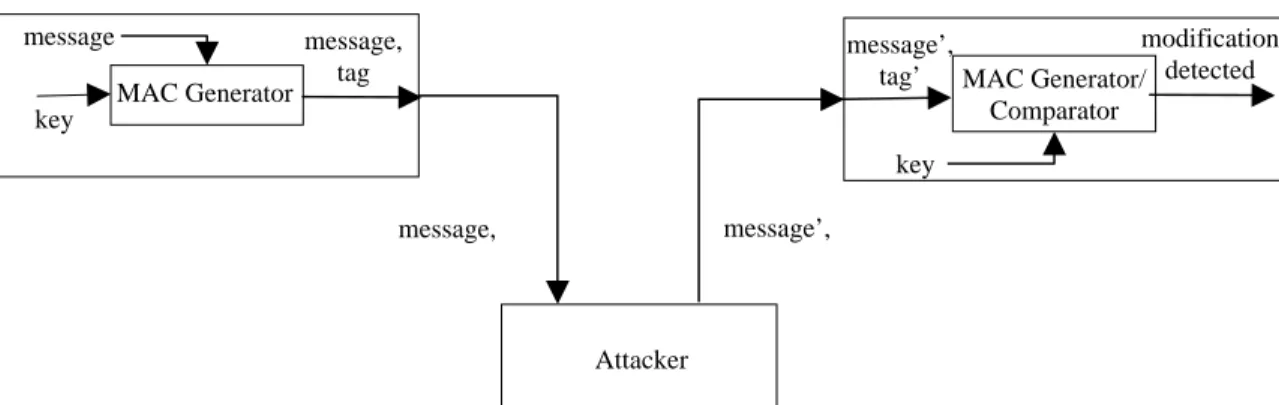
Secret key cryptography is sometimes referred to as symmetric cryptography [24]. In this traditional form of cryptography, the same key is used for encryption and decryption, as shown in figure 4. Message Authentication Codes (MAC) use secret keys to provide authentication.
Encryption Decryption
Key
Plaintext Ciphertext Original
Secret key cryptography has certain advantages over public key cryptography, its higher speed being one. However, secret key cryptography requires that the sender and receiver of a message agree on a secret key, and this is often a difficult task due to eavesdropping.
The most common techniques in secret key cryptography are block ciphers, stream ciphers, and MACs. Each is discussed below.
5.1.1.1.1 Block Ciphers.
A block cipher is a type of secret key encryption algorithm that converts a block of unencrypted data of fixed length into a block of encrypted data of the same length. A secret key is used for this transformation. Decryption is performed using the same secret key. The fixed length of unencrypted data (plaintext) and encrypted data (ciphertext) is termed the block size.
5.1.1.1.2 Stream Ciphers.
A stream cipher is a type of secret key encryption algorithm. As opposed to block ciphers that operate on blocks of plaintext, stream ciphers transform smaller units of unencrypted data (generally bits into the ciphertext).
A stream cipher generates a key stream (i.e., a sequence of bits used as a key). Encryption generally involves combing the key stream and the plaintext, which is quite commonly a bitwise XOR operation.
5.1.1.1.3 Message Authentication Code.
A MAC involves the use of an authentication tag generated by applying a secret key and an authentication scheme to a plaintext message. Unlike digital signatures, MACs cannot be verified by receivers that do not possess the secret key used to create the MAC. As shown in figure 5, a sender uses G (key, message) to generate a tag. This tag is appended to the message and is transmitted. If an attacker succeeds in intercepting the message, he or she modifies the message and tag. The modified message and tag then reach the receiver, who uses G (message′, key) to determine whether or not the contents have been modified.
MAC Generator key message, tag message Sender Attacker message, Receive MAC Generator/ Comparator message’, tag’ modification detected message’, key
5.1.1.2 Public Key Cryptosystems.
In secret key cryptography, the sender and receiver of a message use the same secret key; the sender uses the secret key to encrypt the message, and the receiver uses the same secret key to decrypt the message.
A key exchange scheme is required for the sender and receiver to agree on the same key. If an eavesdropper is able to intercept the key during exchange, all transmissions encrypted using this key will be prone to passive attacks on the confidentiality of the data.
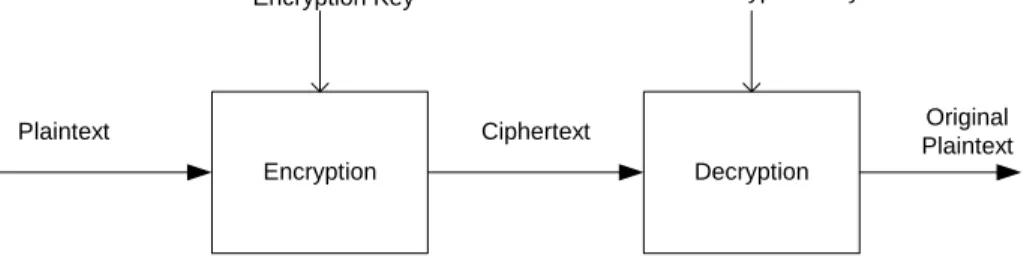
To deal with key management issues, Whitfield Diffie and Martin Hellman introduced the concept of public key cryptography in 1976. Public key cryptosystems have two primary uses, encryption and digital signatures. The system involves the private key and the public key. Private keys are kept secret while public keys may be disclosed to anyone. Public key cryptography can be used not only for privacy (encryption), but also for authentication (digital signatures) and other various techniques. Figure 6 shows a public key cryptosystem that uses different keys for encryption and decryption.
Encryption Decryption
Encryption Key Decryption Key
Plaintext Ciphertext Original
Plaintext
FIGURE 6. PUBLIC KEY CRYPTOSYSTEM
Public and private keys are linked mathematically. Since the public key is not kept secret, an attacker may try to derive the secret private key using the public key. However, in public key cryptosystems, the task of deriving the private key from the public key is made difficult. For instance, some public key cryptosystems like RSA (Rivest, Shamir, Adelman) are designed such that deriving the private key from the public key requires the attacker to factor a large number. This derivation is computationally infeasible. Encryption and digital signatures are further discussed below.
5.1.1.2.1 Encryption.
Assume A and B to be two entities that wish to communicate. Suppose A wishes to send a message. A looks up B’s public key, encrypts the plaintext with B’s public key, and sends the ciphertext to B. Confidentiality is achieved, as only B, who has the private key, can decrypt the message.
![FIGURE 1. TOP-LEVEL ARCHITECTURE OF HUMS [8]](https://thumb-us.123doks.com/thumbv2/123dok_us/978585.2628411/18.918.146.768.593.866/figure-level-architecture-hums.webp)
![FIGURE 2. PROPOSED COMMON RISK INDEX [13]](https://thumb-us.123doks.com/thumbv2/123dok_us/978585.2628411/22.918.219.625.111.452/figure-proposed-common-risk-index.webp)
![FIGURE 3. ENHANCED COMMON RISK INDEX [17]](https://thumb-us.123doks.com/thumbv2/123dok_us/978585.2628411/25.918.182.735.131.680/figure-enhanced-common-risk-index.webp)
![FIGURE 8. SECURE NETWORK ARCHITECTURE [25]](https://thumb-us.123doks.com/thumbv2/123dok_us/978585.2628411/40.918.127.785.118.622/figure-secure-network-architecture.webp)