Ontologies of Software Artifacts and Activities: Resource Annotation and
Application to Learning Technologies
Miguel–Angel Sicilia
1, Juan-Jos´e Cuadrado
1and Daniel Rodr´ıguez
2 1University of Alcal´a, Madrid (Spain)
{
msicilia,jjcg
}
@uah.es
2University of Reading, UK
[email protected]
Abstract
The emerging consensus on the boundaries and main el-ements of the Software Engineering (SE) discipline repre-sents an opportunity for the engineering of shared concep-tualizations that may serve both to design automated tools and tasks that help in diverse phases and aspects of the soft-ware process, and also to annotate learning–oriented re-sources. Formal ontologies provide an appropriate logics– based framework for such conceptual models. This paper describes the main ontological commitments that underlie theOnto-SWEBOKproject, focusing on how SE artifacts and activities can be represented. The paper also discusses how semantic annotations can be provided for learning re-sources oriented to the initial and continuing education on the discipline, which enables the reuse of such resources in diverse learning designs.
1. Introduction
The 2004 Guide to the Software Engineering Body of Knowledge(SWEBOK1) is a significant milestone in
reach-ing a broad agreement on the content of the Software En-gineering discipline. The SWEBOK is aimed at develop-ing a consensus in what constitutes “validated”, rational and scientific Software Engineering (SE) knowledge. As such, it represents a concrete, shared view of the discipline that rests on a collection of interrelated concepts. How-ever, the current form of the SWEBOK uses natural lan-guage text and technical narrative to describe the main el-ements and boundaries of the discipline. While this is ap-propriate for human communication, a formalized version of the text is required for the development of diverse tools that use computational semantics [15] to manage, search and trace diverse kind of SE resources or representations.
1http://www.swebok.org
Formal ontologies are engineered artifacts aimed at repre-senting a shared, consensual conceptualization of a given domain [9]. Description logics [2] and extensions are the underlying representation framework for ontologies as they are used in the so–called Semantic Web applications [3]. In consequence, the engineering of a formal ontology repre-senting the SWEBOK would enable knowledge reuse and a standardized model for the cataloguing of SE artifacts. In addition, the process of ontology engineering could be used as a tool for revision of the SWEBOK, considering that on-tological analysis methods [19, 4] are aimed at clarifying the conceptual structures and properties of a given domain. Previous work have addressed some aspects of engineer-ing formal representations of SE elements. Falbo et al [7] reports on the use of shared conceptualizations for inte-grated tool development, and Althoff et al [1] describe an architecture oriented to reuse of experience in SE that uses ontologies as the underlying formalism. Deridder et al have used ontologies for the specific purpose of linking artifacts at several phases of the development process [5]. Nonethe-less, the knowledge representation underlying these systems are conceptual models aimed at enabling concrete function-ality, and not oriented to describing the main ontological commitments [19] of the discipline. The SWEBOK project opens new possibilities to ontology engineering in the field of SE, since it represents a shared consensus on the con-tents of the discipline and provide pointers to relevant lit-erature on each of its concepts, which are two important elements in ontology engineering [9, 17]. Existing research has provided insight in ontological representation problems on some of the areas of the SWEBOK [20] and on the tech-niques used for ontological representation [12]. Neverthe-less, work is still needed in the analysis of the main ontolog-ical commitments of SE as a discipline, and the representa-tion of both its “upper” concepts and the resources that refer to them.
annotate software entities and associatedresources is de-scribed. Here the term “entity” is used to refer to existing elements (be them physical or temporal), and “resource” is used to refer to information bearing things that can be re-lated to concept describing SE entities. The concrete ap-proach described is based on a layered ontological structure that facilitates meta–description (even with languages that lack such logical facility), and it is flexible enough to ac-commodate a diversity of applications that deal with entities or resources. The use of annotations connected to the on-tology of SWEBOK as a means to devise reusable learning materials is provided as an example of the latter.
The rest of this paper is structured as follows. Section 2 provides the core ontological elements of the ontology of SWEBOK developed as part of theOnto-SWEBOKproject. Then, Section 3 describes how actual entities and any kind of discourse about them can be represented. Then, Section 4 sketches the main elements of the integration of the ontol-ogy described with existing learning technolontol-ogy standards. Finally, conclusions and future research directions are pro-vided in Section 5.
2. Ontological representations of SWEBOK
Activities and Artifacts
Engineering sciences are mainly concerned withdesign, e.g. as described by Mitcham “designing is a special kind of activity that so far has found almost no place in what is known as the “philosophy of action”, that is, the reflective analysis of the distinctive characteristics of human behav-ior” [13]. In consequence, it deals with purposeful activ-ities that use and createartifacts. Then, the core classes subsuming the rest of the more concrete concepts and rela-tionships in the ontology of SE should somewhat deal with artifactscreated byagentsas a result of codifiedactivities guided byrules. All these elements can be found in current large commonsense knowledge bases asOpenCyc(the open source version ofCyc[11]). The following list provides the mapping of these elements (OpenCyc terms are prefixed by “oc”)
• Developers in a generic sense, including “intelli-gent” systems that aid in the process can be con-sidered as instances of oc IntelligentAgent, “agents capable of knowing and acting, and of em-ploying their knowledge in their actions. An in-telligent agentoc knowsAbout certain things, and itsoc beliefs(and possiblyoc goals) concern-ing those thconcern-ings may influence its actions. [...] an intelligent agent might be a single individual or might consist of a group of individual agents (see
oc MultiIndividualAgent).”
• Activities inOpenCyccan be regarded asoc Action
“The collection ofoc Eventsthat are carried out by some ”doer” (seeoc doneBy). Instances of Action include any event in which one or more actors effect some change in the (tangible or intangible) state of the world, typically by an expenditure of effort or energy.” Anoc Eventis in turn “a dynamic situation in which the state of the world changes; each instance is some-thing one would say ‘happens’.” Moreover, engineer-ing activities are in factoc PurposefulActions, “Each instance of PurposefulAction is an action con-sciously, volitionally, and purposefully done by at least one actor”. In addition, the notions ofdesignand de-signingactions inOpenCycextend these definitions to activities oriented to produceoc Specifications
which are a prominent category of artifacts in the do-main of SE.
• An oc Artifacts is “an at least partially tan-gible thing which was intentionally created by an
oc Agent (or a group of Agents working together) to serve some purpose or perform some function.”
• Rules in a general sense include in the SE do-main prescribed sequences of actions, desired char-acteristics of artifacts and general organizational con-straints. These rules are of diverse nature, and in OpenCyc they would be regarded as instances of
oc SupposedToBeMicrotheory, which group together assertions that describe how things are “sup-posed to be” according to some source.
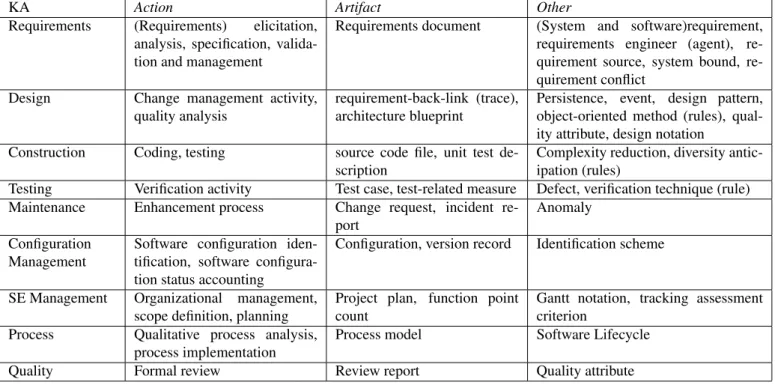
The use of the just described conceptual framework to the descriptions of each SWEBOK Knowledge Area (KA) in the first chapter of the book resulted in the tentative iden-tification of elements as those provided in Table 2. The method for elicitation was simply that of contrasting lit-eral definitions in the SWEBOK Guide to the categories described above.
The examination of the “Requirements” KA is illustra-tive of some of the main ontological commitments of the activity–artifact framework:
i A clear distinction should be drawn betweenArtifacts and “real world” entities. From a pragmatic ontolog-ical perspective, “real things” are not necessarily tan-gible, in the sense that they are not made of matter, and they are not definitely created by any kind of SE IntelligentAgent. A relevant example is a user need. Nonetheless, in many cases we are only concerned with the representations, since they are the only infor-mation we have about the “real” entities, e.g. the sys-tem boundis not a physical frontier but the delimitation of the system as represented in stakeholder’s desires.
KA Action Artifact Other Requirements (Requirements) elicitation,
analysis, specification, valida-tion and management
Requirements document (System and software)requirement, requirements engineer (agent), quirement source, system bound, re-quirement conflict
Design Change management activity, quality analysis
requirement-back-link (trace), architecture blueprint
Persistence, event, design pattern, object-oriented method (rules), qual-ity attribute, design notation
Construction Coding, testing source code file, unit test de-scription
Complexity reduction, diversity antic-ipation (rules)
Testing Verification activity Test case, test-related measure Defect, verification technique (rule) Maintenance Enhancement process Change request, incident
re-port
Anomaly Configuration
Management
Software configuration iden-tification, software configura-tion status accounting
Configuration, version record Identification scheme
SE Management Organizational management, scope definition, planning
Project plan, function point count
Gantt notation, tracking assessment criterion
Process Qualitative process analysis, process implementation
Process model Software Lifecycle
Quality Formal review Review report Quality attribute
Table 1. Main actions and artifacts (produced by SE actions) in the KA
ii Parts of artifacts are information bearing things (oc IBT) that are representations of other elements. For example, a use case diagram is an artifact that in-cludes representations of requirements and their intrin-sic relationships.
iii Actual actions should be differentiated from meth-ods or other prescriptions of sequences of actions. Methods in OpenCyc can be represented through
oc methodForAction predicates connecting an action with an action sequence that describes an appro-priate method for carrying out the action. This way, re-quirement elicitation techniques can be separated from the the actual events that conform the process followed in a specific project.
iv Rules should be separated in microtheories that are only constrained to be internally consistent. Each microtheory may represent a different position on methodological issues, e.g. “extreme” versus “tradi-tional” development, reflecting the changing nature of many SE approaches.
Commitment [i] above is useful for the encoding or rules implicit in statements like “examining the require-ments document to ensure that it defines the right system (i.e. the system that the user expects)”. This is a clear case in which the distinction becomes important from a method-ological perspective. In addition, artifacts are rigid entities
with a clear mereology of parts, according to OntoClean definitions [19], while real world entities are not necessar-ily characterized that way.
The action-event dichotomy described above is sufficient for the representation of temporal events that represent a change in the engineering context. However, other The IEEE Std 610.12 - 1990 document definesprocessas “a se-quence of steps performed for a given purpose”,procedure as “a course of action to be taken to perform a given task”, a techniqueas “technical and managerialproceduresthat aid in the evaluation and improvement of the software devel-opment process”, and method standard as “a standard that describes the characteristics of the orderlyprocessor
pro-cedureused in the engineering of a product or performing
a service”. These definitions have a degree of ambiguity, so that the genericmethod term will be used to subsume the other three concepts.
3. Annotating Software Engineering Artifacts
and Activity Descriptions
The Artifact and Action terms are the subsumers of SE results and activities respec-tively. EngineeredArtifacts are by necessity
producedBy someEngineeringAction. This is a form of traceability by which the objectives of activities become explicit.
1, with upper concepts representing those that can be found in knowledge bases likeOpenCyc.
Three parts of the ontology should be clearly differen-tiated. The description part groups the T-box and A-box (in terms of description logics [2]) that characterize arti-facts and activities as created and enacted by actual SE practice. These could be used for process representation as in [7], and constitute by themselves a form of ontology of actual software configuration items, and a comprehen-sive record of activities that could be used for tracking in project management. On the contrary, theprescriptivepart deals with a different aspect of reality, which comprises the approaches orrulesto concrete practical activities that are “commonly accepted” as considered in the SWEBOK. Even though a degree of consensus exists for them, nothing pre-vents the possibility of conflict and inconsistency. For ex-ample, two process models may differ in the importance they give to some artifacts or activities (“extreme” and agile approaches as compared with classical ones are a relevant example). In addition, several competing techniques may exist for some actions from which there is not a strong ev-idence about which one is the “right” one. TheCyc [11] concept of “microtheory” allows the grouping of different methodological or pragmatical standpoints, providing the flexibility required for an evolving discipline as SE. In this context, methods in a general sense are the rules that tell something about how to carry out sequences ofActions.
An additional aspect of the SWEBOK as a knowledge base is the representation ofresources. Here the term re-source is assimilated to that of IBTs that provide infor-mation about the rest of the elements of the ontology (i.e. they are essentiallydependenton them [19]). Two classes of resources are distinguished. The literature on SE is the compendium of IBTs that describe elements of the dis-cipline, and as such, links from ontology terms and in-stances are provided through a reification technique as that described in [17]. Resources in general are any IBT or
ConceptualWorkthat predicates on elements of the SE ontology. Both parts enable the straightforward building of concept browsers that use ontology–based seeking tech-niques [8] to locate resources or to go from resources to concepts or instances. This cross-linking provides the in-frastructure for technique of analysis as the one described by Wille et al. [20].
The concept of “annotation” in ontology–based repre-sentations does not require a fixed data schema prescribing some “fields” that should be filled for item depending on its type. On the contrary, any axiom or property inside the on-tology can be considered a predication that describes some-thing useful from a broad view of semantics [15]. In con-sequence, the ontological descriptions of all the elements described can be considered as annotations in themselves. For example, the representation of a requirements
docu-ment as an instance of the corresponding class would have as annotations all other predicates inside the ontology that refer to it. If only a part of them would be desired to be used, a simple mechanism providing “super–slots” could be applied, i.e. high-level predicates or relations that sub-sume the ones that are considered. For example, a prop-erty trace-relationcould be used as a subsumer of the variety of relations that may be interpreted as carriers of information about traceability asderivedFrombetween artifacts orscheduledInbetween activities (e.g. activi-ties that are scheduled as the result of a meeting discussion).
4. Integrating Standardized Learning
Tech-nologies with the Ontology of SWEBOK
Current approaches to Web–based learning are based on the concept oflearning object, for which several definitions have been proposed. Reusability is considered to be an es-sential characteristic of the concept of learning object as the central notion for modern digital learning content design. For example, Polsani [14] includes reuse in his definition of learning object as “an independent and self-standing unit of learning content that is predisposed to reuse in multiple instructional contexts”, and Wiley [21] also mentions the term in his learning object definition “any digital resource that can be reused to support learning”. Existing work has dealt with the integration of that concept inOpenCyc[18]. Learning objects by definition are described by metadata records. IEEE LOM [10] is a relevant standard that deter-mines a collection of metadata fields for learning objects.
Given the above ontological structure,
LearningObject is a defined concept that repre-sents anti–rigid entities subsumed by IBT that become learning resources by virtue of the declaration of their possible educational usages. It is of special relevance to consider that every digital Artifact represented is by itself a learning resource, at least as an exemplar of an element of the discipline. The annotations provided in the sense described in the previous section could be used to decide on their use in learning activities. But this view is loose with respect to automated reuse, since the annotations aredescriptiverather thannormativein the sense described by S´anchez-Alonso and Sicilia [16]. This calls for an additional layer in the ontology that explicitly targets learning objectives. The following provides an illustration on such additional representation based targeting examples relevant to the IEEE/ACM Computing Curricula 2001 (CC2001).
“Software requirements and specifications” is a core topic in CC2001, and the the differentiation between func-tional and non-funcfunc-tional requirements is one of the skills to be acquired. A learning object covering such element could provide some brief description of the topic (thus
Figure 1. Overall structure of the ontology
being self-standing and of lower granularity as recom-mended in [14]) and then provide an adaptive part which takes from an ontological A-box (which we assume to have the representation of several software projects) an instance of Functional-Requirement and another of NonFunctional-Requirement from the same
Project. The approval status of the requirements in the project would act as a filter for selecting only “cor-rect” requisites. In addition to this, the non-functional requirement could be restricted to be connected to some
QualityAttribute instance (e.g. efficiency or
usability) to highlight such relation, while a trace to derived artifacts could be showed for the functional one (reaching the final source code if available). Note that this kind of designs for learningreuseactual SE results.
Following the example, the learning object thus designed would provide the following normative usage conditions ex-pressed in terms of acontract[16]:
• The learner should know some basic material, e.g. the lrn.knows(con-req-def) precondition is required, stating that the concept of software requisite should be previously mastered by the learner.
• The postcondition should state the (expected) in-crease in understanding of what functional and non-functional means for requisites. This correspond with the intention of the(9.1.) Purposemetadata element in the IEEE LOM standard [10].
In addition, the kind of resource (LOM 5.2. element) should be set to “illustration” as a specific kind of resource
that exemplifies through project data. These and other meta-data elements enable the dynamic selection of learning ob-jects for concrete situations, including informal training. For example, the above learning object could be selected au-tomatically by a CASE tool as a help item in a requirement tool, or it may be selected as part of a degree on Computer Science covering the contents of the CC2001.
Since normative definitions as the above do not preclude the same object to be described for a different usage (in the sense of Downes’ resource profiles [6]), the labor of learn-ing design in this context would benefit of an unprecedented level of reuse, including referencing to available and rele-vant actual professional practice results.
5. Conclusions and Future Research Directions
A core set of concepts borrowed fromOpenCychas been used to delineate the main ontological commitments of an approach to the ontology of SE as a disciplined artifact– creating discipline. The descriptive versus prescriptive as-pects have been differentiated, and the dichotomy between representations in artifacts as documents and the actual “re-ality” has been described as a way to state rules of a general kind. This basic structure may be extended or modified in further work, but in any case it serves as a foundation for research on the topic.
Such kinds of discipline–oriented ontologies provide a clear value in their applicability to facilitate education and training, since they can be used as tools for metadata an-notation. This paper has discussed this with reference to describinglearning objects.
Ongoing work in theOnto-SWEBOKproject should ad-dress many ontological definitions that are not currently ex-plicit in the Guide to the SWEBOK. The use of existing large conceptualizations and common ontological analysis techniques will be used to eventually come up with a ontol-ogy of SE based on notions of engineering as technolontol-ogy– creating endeavors.
References
[1] Althoff, K.-D., Birk, A., Hartkopf, S., M¨uller, W., Nick, M., Surmann, D. and Tautz, C. (2000). Sys-tematic Population, Utilization, and Maintenance of a Repository for Comprehensive Reuse. In G. Ruhe and F. Bomarius (eds.),Learning Software Organizations -Methodology and Applications, Springer Verlag, Lec-ture Notes in Computer Science, LNCS 1756, 25-50 [2] Baader, F., Calvanese, D., McGuinness, D., Nardi,
D., Patel-Schneider, P. (eds.). (2003).The Description Logic Handbook. Theory, Implementation and Appli-cations, Cambridge.
[3] Berners-Lee, T., Hendler, J., Lassila, O. (2001). The Semantic Web.Scientific American, 284(5), 34-43. [4] Brachman, R. (1983). What IS-A Is and Isn’t: An
Analysis of Taxonomic Links in Semantic Networks. IEEE Computer16(10), 30-36.
[5] Deridder, D., Wouters, B., Lybaert, W. (2000). The Use of an Ontology to Support a Coupling between Software Models and Implementation. InProceedings of the International Workshop on Model Engineering, 14th European Conference on Object-Oriented Pro-gramming (ECOOP).
[6] Downes, S. (2004). Resource Profiles.Journal of In-teractive Media in Education, 2004 (5).
[7] Falbo, R.A., Natali, A. C. C., Mian, P. G., Bertollo, G., Ruy, F. B. (2003). ODE: Ontology-based software Development Environment. InProceedings of the “IX Congreso Argentino de Ciencias de la Computaci´on”, 1124-1135.
[8] Garcia, E. and Sicilia, M.A. (2003). User Interface Tactics in Ontology-Based Information Seeking . Psy-chnology e-journal1(3), 243-256.
[9] Gruber T. (1995). Towards principles for the design of ontologies used for knowledge sharing.International Journal of Human-Computer Studies, 43(5/6), 907-928.
[10] IEEE LTSC (Learning Technology Standards Com-mittee). (2002). Learning Object Metadata (LOM). IEEE 1484.12.1-2002.
[11] Lenat, D.B. (1995). Cyc: A Large-Scale Investment in Knowledge Infrastructure”.Communications of the ACM38(11) 33–38.
[12] Mendes, O., Abran, A. (2004). Software Engineer-ing Ontology: A Development Methodology.Metrics News, 9, 68-76.
[13] Mitcham, C. (1994). Thinking through Technol-ogy: The Path between Engineering and Philosophy. Chicago: University of Chicago Press, xi, 397. [14] Polsani, P. R. (2003). Use and Abuse of Reusable
Learning Objects. Journal of Digital information, 3(4).
[15] Seth, A. et al.(2005). Semantics for the Semantic Web: The Implicit, the Formal and the Powerful.Intl. Jour-nal on Semantic Web and Information Systems1(1), 1-18.
[16] S´anchez-Alonso, S. and Sicilia, M. A. (2005). Norma-tive Specifications of Learning Objects and Learning Processes: Towards Higher Levels of Automation in Standardized e-Learning.International Journal of In-structional Technology and Distance Learning, 2(3), 3-12.
[17] Sicilia, M.A., Garcia, E., Aedo, I. and Diaz, P. (2003). A literature-based approach to annotation and brows-ing of Web resources.Information Research8(2). [18] Sicilia, M.A., Garc´ıa, E., S´anchez, S. and Rodr´ıguez,
E. (2004) Describing learning object types in ontolog-ical structures: towards specialized pedagogontolog-ical selec-tion. InProceedings of ED-MEDIA 2004 - World con-ference on educational multimedia, hypermedia and telecommunications, 2093-2097.
[19] Welty, C. and Guarino, N. (2001) Supporting onto-logical analysis of taxonomic relationships.Data and Knowledge Engineering39(1), 51-74.
[20] Wille, C., Abran, A., Desharnais, J.M., Dumke, R.R. (2003). The quality concepts and subconcepts in SWEBOK: An ontology challenge , in Proceedings of the 2003 International Workshop on Software Mea-surement (IWSM), 113–130.
[21] Wiley, D. A. (2001).The Instructional Use of Learn-ing Objects.Association for Educational Communica-tions and Technology, Bloomington.