Decision Makers’ Guide to
Municipal Solid Waste
Incineration
The World Bank Washington, D.C.
© 1999 The International Bank for Reconstruction and Development / THE WORLD BANK
1818 H Street, N.W.
Washington, D.C. 20433, U.S.A. All rights reserved
Manufactured in the United States of America First printing August 1999
This report has been prepared by the staff of the World Bank. The judgments expressed do not necessari-ly reflect the views of the Board of Executive Directors or of the governments they represent.
The material in this publication is copyrighted. The World Bank encourages dissemination of its work and will normally grant permission promptly.
Permission to photocopy items for internal or personal use, for the internal or personal use of specific clients, or for educational classroom use, is granted by the World Bank, provided that the appropriate fee is paid directly to the Copyright Clearance Center, Inc., 222 Rosewood Drive, Danvers, MA 01923, U.S.A., tele-phone 978-750-8400, fax 978-750-4470. Please contact the Copyright Clearance Center before photocopying items.
For permission to reprint individual articles or chapters, please fax your request with complete informa-tion to the Republicainforma-tion Department, Copyright Clearance Center, fax 978-750-4470.
All other queries on rights and licenses should be addressed to the World Bank at the address above or faxed to 202-522-2422.
Cover photo by ?
Library of Congress Cataloging-in-Publication Data PLEASE PROVIDE
iii
Foreword v
Solid Waste Incineration 1
Institutional Framework 2
Waste as Fuel 5
Economics and Finance 7
Project Cycle 10
Incineration Technology 11
v
Foreword
The Decision Makers’ Guide to Incineration of Municipal
Solid Waste is a tool for preliminary assessment of the
feasibility of introducing large-scale incineration plants into the waste management systems of major cities in developing countries.
The Decision Makers’ Guide targets waste manage-ment authorities, as well as institutions involved in financing public utility projects. This guide identifies the most important factors in assessing short- and long-term viability of municipal solid waste incineration.
Fulfillment of the key criteria of the Guide (manda-tory, strongly advisable, or preferable) does not neces-sarily mean that a project is feasible. Compliance with the key criteria simply allows the project proposer to proceed with a proper feasibility study with limited risks of a negative outcome.
Noncompliance with one or more of the mandato-ry key criteria, however, indicates a significant risk that
the project is not institutionally, economically, techni-cally, or environmentally feasible. Therefore, either the project should be redesigned, or the unfulfilled criteria should be studied in depth to clarify their influence on the project viability.
The supporting Technical Guidance Report provides the foundation for a much more detailed evaluation of all the aspects of a proposed project. The Report is spe-cific and requires some prior technical knowledge (although not necessarily about waste incineration). It is thus intended mainly for the organizations support-ing the decision-makers.
The Guide was prepared by Mr. J. Haukohl, Mr. T. Rand, and Mr. U. Marxen of RAMBØLL, and it was managed by Mr. J. Fritz of the World Bank. It was reviewed by Dr. C. Bartone of the World Bank and by Mr. L.M. Johannessen, long-term consultant to the Bank.
Legend
MSW: Municipal solid waste (domestic and similar)
ISW: Industrial solid waste
Mass burning: Incineration of MSW as received
Incineration plant: Treatment facility for solid waste with energy recovery and emission control Key criteria identifying the factors influencing the decision-making process are listed in order of priority, using the following grading system:
✓ ✓ ✓ Mandatory key criteria ✓ ✓ Strongly advisable key criteria ✓ Preferable key criteria
If a mandatory key criterion cannot be expected to be fulfilled, further planning of a solid waste incineration plant should be stopped.
Solid Waste Incineration
Municipal solid waste (MSW) incineration plants tend to be among the most expensive solid waste manage-ment options, and they require highly skilled person-nel and careful maintenance. For these reasons, incin-eration tends to be a good choice only when other, simpler, and less expensive choices are not available.
Because MSW plants are capital-intensive and require high maintenance costs and comparatively higher technically trained operators, they are common-ly adopted by developed countries. However, high cap-ital and maintenance costs may make MSW incinera-tion beyond the reach of many of the lesser developing countries. The Decision Makers’ Guide aims to reduce such mistakes by clarifying some of the basic require-ments for a successful incineration plant project. Incineration Advantages
Incineration is an efficient way to reduce the waste vol-ume and demand for landfill space. Incineration plants can be located close to the center of gravity of waste gen-eration, thus reducing the cost of waste transportation. Using the ash from MSW incinerators for environmen-tally appropriate construction not only provides a low cost aggregate but further reduces the need for landfill capacity. In particular, incineration of waste containing heavy metals and so on should be avoided to maintain a suitable slag quality. (However, ordinary household waste does contain small amounts of heavy metals which do not readily leach under field conditions and which routinely pass USEPA TCLP tests.) The slag qual-ity should be verified before it is used. Energy can be recovered for heat or power consumption.
All waste disposal alternatives eventually decompose organic materials into simpler carbon molecules such
as CO2(carbon dioxide) and CH4(methane). The bal-ance between these two gases and time frame for the reactions varies by alternative. Incineration provides the best way to eliminate methane gas emissions from waste management processes. Furthermore, energy from waste projects provides a substitute for fossil fuel combustion. These are two ways incineration helps reduce greenhouse gas emissions.
One of the most attractive features of the incinera-tion process is that it can be used to reduce the origi-nal volume of combustibles by 80 to 95 percent. Air pollution control remains a major problem in the implementation of incineration of solid waste dispos-al. In the United States, the cost of best available tech-nology for the incineration facility may be as high as 35 percent of the project cost. The cost of control equipment will, however, depend upon the air pollu-tion regulapollu-tions existing in a given lesser developing country.
Waste incineration may be advantageous when a landfill cannot be sited because of a lack of suitable sites or long haulage distances, which result in high costs. Incineration Disadvantages
An incineration plant involves heavy investments and high operating costs and requires both local and for-eign currency throughout its operation. The resulting increase in waste treatment costs will motivate the waste generators to seek alternatives. Furthermore, waste incineration is only applicable if certain require-ments are met. The composition of waste in develop-ing countries is often questionable in terms of its suit-ability for autocombustion. The complexity of an incineration plant requires skilled staff. Plus, the residues from the flue gas cleaning can contaminate the environment if not handled appropriately, and must be 1
Decision Makers’ Guide to
disposed of in controlled and well-operated landfills to prevent ground and surface water pollution.
Applicability of Incineration
MSW incineration projects are immediately applicable only if the following overall criteria are fulfilled. • A mature and well-functioning waste management
system has been in place for a number of years. • Solid waste is disposed of at controlled and
well-operated landfills.
• The supply of combustible waste will be stable and amount to at least 50,000 metric tons/year.
• The lower calorific value must on average be at least 7 MJ/kg, and must never fall below 6 MJ/kg in any season.
• The community is willing to absorb the increased treatment cost through management charges, tip-ping fees, and tax-based subsidies.
• Skilled staff can be recruited and maintained. • The planning environment of the community is
sta-ble enough to allow a planning horizon of 15 years or more.
Institutional Framework
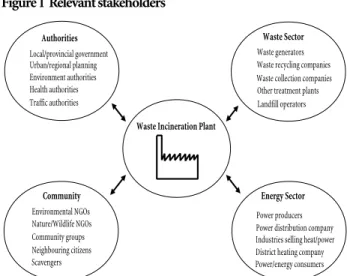
The success or failure of an incineration scheme depends on the attitude of the multiple stakeholders and on the legislative and institutional framework cur-rently in place.
Stakeholders in an MSW incineration plant project often have conflicting interests. The project therefore can become an environmental and economic issue with many groups.
The stakeholders’ reaction to the project may differ depending on the institutional setting of the plant. The incineration plant can be located in the waste sector (preferable) or the energy sector, or it can be a fully pri-vatized independent entity. In any case, the incinera-tion plant must be an integral part of the waste man-agement system.
Depending on the organizational affiliation of the plant, there is a need for strong irrevocable agreements regulating the supply of waste, the sale of energy, and the price setting.
A high degree of interaction, either through owner-ship or long-term agreements, between the different parts of the waste management system and the waste incineration plant is important to avoid environmen-tal, institutional, or financial imbalances in the overall solid waste management system.
The Waste Sector
A well-developed and controlled waste management system is considered a prerequisite to an MSW incin-eration plant. Generators consider waste to be a nui-sance and want to dispose of it at the lowest possible cost. However, many people who work formally or informally with waste collection, transportation, recy-cling, and disposal seek to maximize their profit or make a living.
Existing regulations and enforcement must there-fore be highly efficient to ensure that all waste which cannot be recycled is disposed of at controlled and well-operated landfills. This goes for both municipal solid waste, often taken care of by a public waste man-agement system, and industrial solid waste (ISW), gen-erally handled by independent waste companies.
Overall control of the waste flow—including ISW, if part of the design volume—is important to ensure reli-able supply of suitreli-able waste to the waste incineration plant.
Mature solid waste management systems are highly integrated and operated efficiently under public finan-cial and budgetary control. They include organizations
2 Municipal Solid Waste Incineration
Energy Sector Power producers Power distribution company Industries selling heat/power District heating company Power/energy consumers Community Environmental NGOs Nature/Wildlife NGOs Community groups Neighbouring citizens Scavengers
Waste Incineration Plant
Waste Sector Waste generators Waste recycling companies Waste collection companies Other treatment plants Landfill operators Authorities Local/provincial government Urban/regional planning Environment authorities Health authorities Traffic authorities
involved in the collection, transportation, and dispos-al of waste in environmentdispos-ally controlled landfills. Costs for some systems are fully paid by the generators (although some are tax-supported or subsidized). Introducing new facilities into such a system calls for optimizing and controlling the waste flow and fee structure to maintain a balance between the different disposal options. In order of complexity, energy can be recovered as hot water, low grade steam, super heated steam for electricity generation, or a combination of the steam options.
Public awareness campaigns emphasizing waste min-imization, recycling, and proper waste management are also part of a mature waste management system. The Energy Sector
Incineration of MSW is significantly more expensive than controlled landfilling. For a plant to be economi-cally feasible, costs must be minimized through sale of energy recovered.
The primary concern is the end use of the energy produced: district heating, steam, electricity, or any combination. Therefore, the characteristics of the
ener-gy sector play an important role when considering an MSW incineration plant.
Sale of energy in the form of hot water for district heating purposes—or in particular cases, low pressure steam to large-scale industrial consumers nearby, pro-vided that sufficient contracts and guarantees can be arranged—minimizes plant construction costs and recovers a high percentage of energy. Sale of combined power and heat or steam results in a degree of energy recovery that is no higher, but the cost and the com-plexity of the plant are increased.
The energy sector is often heavily regulated. Concession to produce and sell electricity is generally granted to a limited number of public and private operators. An incineration plant established by anoth-er authority or a private organization may thanoth-erefore encounter difficulties before gaining the necessary approvals and agreements. Early co-operation with the end user organizations is therefore useful.
It is most feasible when the energy can be sold to one consumer for its own use or resale. The consumer may be a utility company with an existing distribution net-work, for example.
Energy prices are often subject to taxation or are partly subsidized. Pricing may therefore be a political issue requiring a government decision. Also, in most developed countries, energy prices are controlled by fiscal measures to favor energy production based on biomass fuels.
Political and socio-economic considerations play an important role when fixing the price of waste-generated energy. A high price resulting in a reduction of the waste tipping fee favors the waste sector, and low energy prices favor the energy consumers.
Community Aspects
The community and NGOs where a new MSW inciner-ation plant is to be established are often concerned about environmental impacts. These concerns may arise from a lack of knowledge, general resistance towards changes, or fear of the unknown, such as higher waste manage-ment charges, loss of subsistence, or fear of pollution.
Public awareness campaigns initiated in the early planning stages can alleviate this concern. Furthermore, a detailed discussion about the environ-mental protection measures included in the project—
Decision Makers’ Guide 3
Optimum
scenario Acceptablescenario Improvementrequired
No Yes No Yes Yes No Yes Is the waste collection system well-organized with clear division of responsibilities and control of all waste types?
Investigate the feasibility of the waste as fuel
Is waste disposed of in environmentally controlled landfills? No Yes No Yes No Yes No Yes No Con-trol of all types of waste Is waste disposal
fully controlled? wasteAll MSWonly
All waste MSW only Upgrade collection system before introducing incineration Upgrade disposal system before introducing incineration Revise waste charge system before incineration Implement controlled landfills before incineration Do the waste generators pay for the full cost of waste collection and disposal?
MSW
& ISW House-holds Only municipal
solid waste
not only with the environmental authorities, but also with the organized NGOs—is necessary.
In the design phase, the environmental authorities are to establish standards for the plant emissions and handling of the residues. In the operational phase, the same authorities will need to control and enforce those standards.
The public concern may lessen if the environmental authorities and those in charge of the MSW incinera-tion plant are truly independent of one another. Plant Ownership and Operation
The number of stakeholders around an MSW inciner-ation plant will result in diverging and conflicting interests. Depending on who owns the incineration plant, institutional borderline problems may arise regarding delivery of a sufficient quantity and quality of waste, the pattern and price of sale of energy or both. Problems must be solved at an early stage through detailed long-term agreements. Key agreements are those related to waste supply and energy sale.
Municipally operated incineration plants have many benefits. The municipality can control the collection and transport of waste to the facility (although this is not always the case). The public has some confidence
that the municipality will ensure the environmental performance of the facility. In many cases the public energy distribution organization finds it easier to nego-tiate with another public body, which minimizes the potential for problems.
There must be a mechanism to ensure the long-term viability of the incineration facility. The risks involved in financing such operations relate to controlling costs and revenues. Waste tipping fees and energy sales pro-vide revenues. Contracts that guarantee waste volumes and price over the life of the project are important, and must address the potential for short falls in waste receipts. Energy generation potential relates to both the quantity and quality of the waste received. The deteri-oration in waste quality can lead to decreased energy production—in which case, energy sales revenues will also decrease. The facility must have guarantees that allow operations to be sustained. The community where the facility is established will thus have to accept the economic risk.
Operation and maintenance of the plant requires skilled managers, operators, and maintenance staff, so staff recruiting and developing are important. The skills required are similar to those of the energy sector. The owner may choose to subcontract all or part of the operation and maintenance of the facility to private companies with long-standing practical experience.
Worldwide, there are few experienced manufactur-ers and buildmanufactur-ers of MSW incineration plants. Hence, foreign currency will be needed not only for the initial investment but also for certain spare parts. The plant must therefore be organized with unhindered access to procurement of spares and services paid for in both local and foreign currency.
Key Criteria for Institutional Framework
✓ ✓ ✓ A solid waste management system, com-prising a controlled and well-operated landfill, has been functioning well for a number of years.
✓ ✓ ✓ Solid waste collection and transportation (MSW and ISW) are managed by a limited number of well-regulated/controlled organ-ization(s).
4 Municipal Solid Waste Incineration
Select hot water or LP steam boiler for cost efficiency. Select steam boiler, turbine with outlets for steam
and hot water circuit. Select a steam boiler with turbine and cooling circuit. Is only sale of electric
power possible? May the energy be sold as a combination of electricity and heat or steam?
Is the MSW incineration plant located where all energy recovered can be sold for district heating or steam for industrial purposes?
Re-assess the economic feasibility of the project.
Yes No Yes No Yes No Energy recovered cannot be brought to good use!!
✓ ✓ ✓ There are signed and approved letters of intent or agreements for waste supply and energy sale.
✓ ✓ ✓ Consumers and public authorities are able and willing to pay for the increased cost of waste incineration.
✓ ✓ ✓ Authorities are responsible for controlling, monitoring, and enforcing operations. ✓ ✓ ✓ A public guarantee is available for
repay-ment of capital costs and operation costs ✓ ✓ The authorities responsible for control,
monitoring, and enforcement are indepen-dent of the ownership and operation of the plant.
✓ ✓ Skilled staff for plant operation are available to the plant owner at affordable salaries. Otherwise, there must be long-term reliable operation and service contracts.
✓ The waste management authority owns the incineration plant.
Waste as Fuel
A most crucial factor in the feasibility of an MSW incineration plant is the nature of the waste and its calorific value. If the mandatory criteria for waste
com-bustibility are not fulfilled, the project should be ter-minated.
As a result of the socio-economic situation in many low to middle income countries or areas, only limited amounts of useful resources are wasted. Organized and informal recycling activities in the waste handling sys-tem tend to reduce the amount of paper, cardboard, and certain types of plastic in the waste. Additionally, the waste may have high ash and moisture content.
Municipal solid waste in such areas therefore often ends up with a low calorific value and its ability to burn without auxiliary fuel is questionable either year-round or in certain seasons. In areas with heavy pre-cipitation, closed containers for collection and trans-portation should be used to avoid a significant increase of the water content of the waste.
Industrial, commercial, and institutional wastes (except from market waste) tend to have a significant-ly higher calorific value than domestic waste. Mixing different types of wastes may therefore make incinera-tion possible. However, the collecincinera-tion system must be managed well to maintain segregated collection under these circumstances.
Waste generation depends highly on socio-econom-ic conditions and the degree of urbanization and industrialization. In general, waste generation and composition data cannot be projected from one place to another. Introduction of advanced waste treatment facilities must therefore always be based on a compre-hensive local waste survey.
Introduction of advanced waste treatment like MSW incineration will have a significant impact on existing informal recycling activities. For example,
Decision Makers’ Guide 5
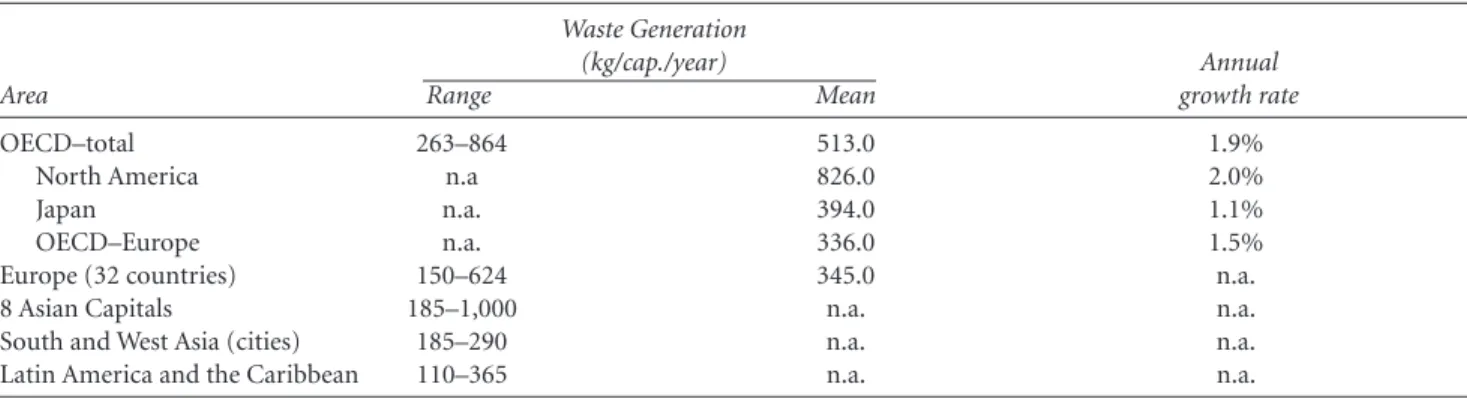
Table 1:Waste generation
Waste Generation
(kg/cap./year) Annual Area Range Mean growth rate
OECD–total 263–864 513.0 1.9%
North America n.a 826.0 2.0%
Japan n.a. 394.0 1.1%
OECD–Europe n.a. 336.0 1.5%
Europe (32 countries) 150–624 345.0 n.a.
8 Asian Capitals 185–1,000 n.a. n.a.
South and West Asia (cities) 185–290 n.a. n.a.
Latin America and the Caribbean 110–365 n.a. n.a.
n.a. = Not applicable.
scavengers may lose their source of income. Even if these people are compensated for their loss of income, some of them will shift to the early stages of the han-dling system. This may alter the composition and com-bustibility of waste arriving at an incineration plant. Scavenging and other recycling activities must there-fore be carefully managed.
The waste survey must account for the existing waste composition and calorific value and for expected changes during the adopted planning period. Annual variations must be carefully surveyed and assessed, for example, by conducting a year-long sampling program to establish waste constituents, trends, and seasonal vari-ation, as well as variation between collection areas. The average annual lower calorific value must be at least 7 MJ/kg, and must never fall below 6 MJ/kg in any season. Key Criteria for Waste as Fuel
✓ ✓ ✓ The average annual lower calorific value must be at least 7 MJ/kg, and must never fall below 6 MJ/kg in any season.
✓ ✓ Forecasts of waste generation and composi-tion are established on the basis of waste surveys in the catchment area of the planned incineration plant. This task must be carried out by an experienced (and inde-pendent) institution.
✓ ✓ Assumptions regarding the delivery of com-bustible industrial and commercial waste to an incineration plant should be founded on an assessment of positive and negative incentives for the various stakeholders to dispose of their waste at the incineration facility.
6 Municipal Solid Waste Incineration
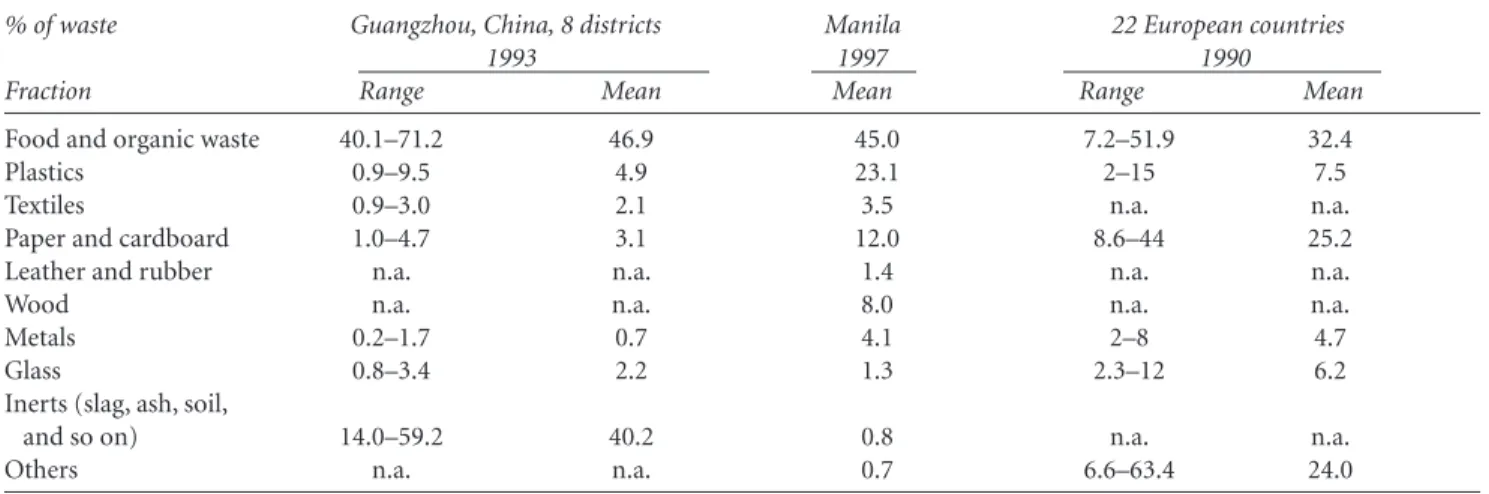
Table 2: Waste components
% of waste Guangzhou, China, 8 districts Manila 22 European countries
1993 1997 1990
Fraction Range Mean Mean Range Mean
Food and organic waste 40.1–71.2 46.9 45.0 7.2–51.9 32.4
Plastics 0.9–9.5 4.9 23.1 2–15 7.5
Textiles 0.9–3.0 2.1 3.5 n.a. n.a.
Paper and cardboard 1.0–4.7 3.1 12.0 8.6–44 25.2
Leather and rubber n.a. n.a. 1.4 n.a. n.a.
Wood n.a. n.a. 8.0 n.a. n.a.
Metals 0.2–1.7 0.7 4.1 2–8 4.7
Glass 0.8–3.4 2.2 1.3 2.3–12 6.2
Inerts (slag, ash, soil,
and so on) 14.0–59.2 40.2 0.8 n.a. n.a.
Others n.a. n.a. 0.7 6.6–63.4 24.0
n.a. = Not applicable.
Source: cf. Technical Guidance Report
No Yes No Yes No Yes No Yes
Has a survey been conducted to establish the amount of MSW generated in the area?
Do records document the annual variation in waste volume and composition?
Is the lower calorific value of the waste
documented to be at least 6 MJ/kg throughout all seasons? (Average annual LCV>7 MJ/kg) Has the effect of scavenging and recycling on the waste volume and composition been investigated? Conduct a waste monitoring program Conduct a waste monitoring program The waste is not suited for incineration
Evaluate the consequences of introducing incineration
The waste is likely feasible for mass
burning
✓ ✓ The annual amount of waste for incinera-tion should not be less than 50,000 tons, and the weekly variations in the waste supply to the waste incineration plant should not exceed 20 percent.
A preliminary feasibility assessment of using a par-ticular waste as fuel can be made on the basis of the content of ash, combustible matter (ignition loss of dry sample), and moisture.
The maximum amount of energy recoverable through MSW incineration depends primarily on the lower calorific value of the waste, but also on the sys-tem applied for energy recovery. It is most efficient when both electricity and steam/heat are produced, and the yield is lowest when only electricity is generat-ed and the surplus heat is coolgenerat-ed away.
Energy prices vary greatly from place to place, even within the same country. Electricity is a high-value energy form, so a low energy yield is, to some extent, compensated for through price differences.
Economics and Finance
MSW incineration is an advanced waste treatment technology which is costly to implement, operate, and maintain. A significant amount of foreign currency must be available for the initial procurement of equip-ment and spares, and for replenishing stocks of spares and for expatriate expert plant overhauls later.
Normally, MSW incineration furnaces are designed with a capacity limit of about 20 to 30 metric tons/h. The recommendation is 10 to 20 metric tons/h. It is rec-ommended to divide the total plant capacity into two or more identical incineration lines, thus improving the plant’s flexibility and availability—for example, when one line is closed for maintenance.
The investments in an MSW plant depend to a great extent on the required form of energy output. The least expensive plants are those equipped with hot water boilers only. Production of steam and elec-tricity makes the investments in mechanical plant and civil works much higher (about 40 percent). The
Decision Makers’ Guide 7
Table 3: Fuel characteristics of MSW
Guangzhou, China Manila, 8 districts, 1993 5 districts, 1994 Philippines, 1997 Parameter Units Range Mean Mean Mean
Combustible % 14.6–25.5 22.3 31.4 37.6
Ash % 13.8–43.1 28.8 22.0 15.6
Moisture % 39.2–63.5 48.9 46.6 46.7
Lower calorific value kJ/kg 2,555–3,662 3,359 5,750 6,800
6 7 0.00 0.50 1.00 1.50 2.00 2.50 3.00 8 9 10 11
Figure 5 Energy Recovery
MWh/metric ton
Lower Calorific Value (MJ/kg)
CHP Power only Heat only
0.0 10.0 20.0 30.0 40.0 50.0 60.0 6 7 8 9 10 11
Figure 6 Value of Energy Sale (Based on an electricity price of $35/MWh and a heat price of $15/MWh)
US$/ton
Lower Calorific Value (MJ/kg)
operating costs are also higher for electricity produc-ing facilities.
Figures 7 and 8 indicate estimated investments and net operating costs as of mid 1998 as a function of the annual amount of waste processed at power generating plants. It is, furthermore, assumed that the plants are equipped to meet medium level emission standards (see next section). Compliance with basic emission control allows only a 10 percent investment reduction. The assumed operating time is 7,500 hours annually. The curves are valid only for plants designed for waste with a lower calorific value of less than 9.0 MJ/kg. Furthermore, the electricity sale price is assumed to be $35/MWh.
The figures indicate a significant scale of economy with respect to investment as well as net treatment costs.
The net treatment costs of an MSW incineration plant are rather sensitive to fluctuations in the quanti-ty and qualiquanti-ty of waste treated. The net costs
sensitivi-ty graph indicates the resulting change in treatment costs if the waste has a reduced calorific value or if the supply of waste falls short of the design load.
8 Municipal Solid Waste Incineration
0
0 500 1,000 1,500 2,000 2,500
100 200 300 400 500 600 700 800
Figure 7 Estimated Cost of Incineration Plants
0 50 100 150 200 250 300 350 0 30 1,000 US$/metric ton/day million US$
Plant Capacity (metric tons/day)
Civil Machinery
Total Investment/capacity
Investment Costs
Plant Capacity (1,000 metric tons of waste/year)
60 90 120 150 180 210 0.0 10.0 20.0 30.0 40.0 50.0 60.0 0 100 200 300 400 500 600 700 800
1,000 metric tons of waste a Year
million US$/year 0 10 20 30 40 50 60 70 80 0 500 1,000 1,500 2,000 2,500 Metric tons/day US$/metric ton Total costs Net costs Income Net cost/metric ton
Figure 8 Estimated Net Treatment Costs
9 MJ/kg
6 MJ/kg (min. calorific value)
11 MJ/kg Design load Min. capacity Max. capacity A B 25.0 180,000 200,000 220,000 240,000 260,000 280,000 300,000 320,000 340,000 35.0 45.0 55.0 65.0 75.0 85.0
Waste Supply (metric tons/year)
Net Treatment Cost (US$/metric ton)
Figure 9 Sensitivity of Incineration Costs
No Yes No Yes No Yes No Yes Is a public guarantee for
payment of capital and operating costs obtainable?
Is foreign currency committed/available for capital and operating costs?
Are the regulations for enforcing payment of waste charges and energy in place? Obtain commitment or cancel project Cancel project The economic viability is in jeopardy The project is economically viable Evaluate the consequences of introducing incineration Are the serviced
communities able and willing to pay the incineration costs? No Yes Perform sensitivity analysis Has an economic
sensitivity analysis been conducted and worst case assessed?
Waste with a lower calorific value of 6 MJ/kg only has a net treatment cost of 30 percent above that of waste with a lower calorific value of 9 MJ/kg. If the plant processes only two-thirds of the design load because of a shortage of waste or extended periods of maintenance, the treatment cost increases significantly.
Any forecast of the net costs of MSW incineration should be conservative and accompanied by a sensitiv-ity/risk analysis. The economic risk, even for fully pri-vatized plants, will end up with the society serviced by the plant.
The net cost of MSW incineration is significantly higher than for landfills established according to strict environmental standards. Therefore, the question which must always be asked about any incineration project is—why not landfill? Only in situations where landfill is not viable (for example, if there is no land, as is the case in Singapore, or if there is no political will to site a landfill) will WTE be a good choice.
From a strict financial point of view, it may be diffi-cult to justify the increased costs of waste disposal. A full cost benefit analysis is therefore required to assess whether the locally obtainable benefits justify the costs. Recovering the costs of an MSW incineration plant in low to medium income countries is difficult. Depending on the family size, each household may eas-ily generate from 1 to 2 metric tons of waste for incin-eration annually. The net tipping fee at the incinincin-eration plant will therefore amount to at least US$ 50 to 100 per year per household. Hence, in some regions, the waste service charge could be comparable to other pub-lic supply charges such as power and heating. It is important to assess the ability and willingness of the population to pay such a treatment charge in addition to the cost of collection and transportation.
The cost of incineration may be recovered through a combination of a tipping fee usually paid by trade and industry and a general waste management charge usu-ally paid by households and such. The general charge may be collected directly as a waste management charge, or together with other public service bills (such as electricity or water), or property taxes, and so on. The charges may, however, become so great that the normal market mechanisms or waste disposal system are dis-torted. The plant may therefore need to be subsidized via the budget of the city. Otherwise, it might take strict
enforcement to ensure that waste is taken to the incin-eration plant rather than disposed of indiscriminately.
It is important to design an affordable and publicly acceptable fee policy, which ensures sufficient income for operating, managing, and developing the plant, as well as a suitable waste flow matching the treatment capacity of the plant. Various fee policies are possible with adequate support from a combination of fiscal and legal measures. Establishing regional or intermu-nicipal waste management co-operations may provide economies of scale that should be compared against the increased costs of transport.
Key Criteria for Incineration Economy
✓ ✓ ✓ There must be a stable planning environ-ment with predictable prices of consum-ables, spare parts, disposal of residues, and sale of energy. Furthermore, the capital costs (large share of foreign currency) must be predictable.
✓ ✓ ✓ The financing of the net treatment cost must ensure a waste flow as intended in the overall waste management system. Consequently, the tipping fee at the waste incineration plant must be lower or at least correspond to the tipping fee at the landfill site. Willingness and ability to pay must be thoroughly addressed.
✓ ✓ ✓ Foreign currency must be available to pur-chase critical spare parts.
✓ ✓ When surplus energy is to be used for dis-trict heating, the incineration plant must be located near an existing grid to avoid costly new transmission systems.
✓ To be economically feasible, the individual incineration units should have capacities of at least 240 t/d (10 t/h), and there should be at least two separate units.
✓ If a regular market for sale of hot water (district heating or similar) or low
sure steam is present, the plant should be based on sale of heat only. This is prefer-able both in terms of technical complexi-ty and economic feasibilicomplexi-ty. A certain extent of cooling to the environment dur-ing the warm season may be preferable to costlier solutions.
Project Cycle
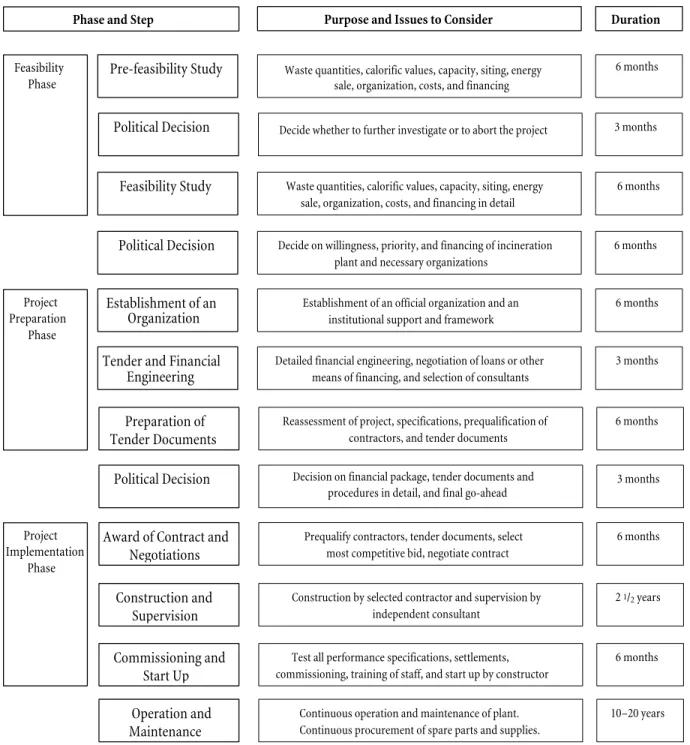
The project implementation cycle of MSW incinera-tion plants involves three main phases: feasibility assessment, project preparation, and project imple-mentation. At the end of each phase, the project should be reevaluated for feasibility.
10 Municipal Solid Waste Incineration
Phase and Step
Pre-feasibility Study
Feasibility Study
Political Decision
Establishment of an Organization Tender and Financial
Engineering Preparation of Tender Documents
Political Decision
Award of Contract and Negotiations Construction and Supervision Commissioning and Start Up Operation and Maintenance
Purpose and Issues to Consider
Waste quantities, calorific values, capacity, siting, energy sale, organization, costs, and financing
Waste quantities, calorific values, capacity, siting, energy sale, organization, costs, and financing in detail
Decide on willingness, priority, and financing of incineration plant and necessary organizations
Establishment of an official organization and an institutional support and framework
Detailed financial engineering, negotiation of loans or other means of financing, and selection of consultants
Reassessment of project, specifications, prequalification of contractors, and tender documents Decision on financial package, tender documents and
procedures in detail, and final go-ahead
Prequalify contractors, tender documents, select most competitive bid, negotiate contract
Construction by selected contractor and supervision by independent consultant
Test all performance specifications, settlements, commissioning, training of staff, and start up by constructor
Continuous operation and maintenance of plant. Continuous procurement of spare parts and supplies.
Duration 6 months 6 months 6 months 6 months 3 months 6 months 3 months 6 months 2 1/2 years 6 months 10–20 years Political Decision Decide whether to further investigate or to abort the project 3 months
Feasibility Phase Project Preparation Phase Project Implementation Phase
It is important to involve the public throughout the project cycle—through awareness campaigns in the mass media and public hearings on major deci-sions with a direct community impact. Public par-ticipation beyond what is recommended for urban planning and environmental impact assessment may be useful in dissolving public resistance to the project.
Feasibility Assessment
The feasibility of MSW incineration projects in devel-oping countries is highly questionable. Therefore, the feasibility assessment should be conducted in two stages: preliminary and comprehensive. The prelimi-nary assessment can be based on existing informa-tion, including properly adapted relevant data from literature. The comprehensive assessment will involve comprehensive collection of local data on waste gen-eration and composition, a detailed study of plant finance and a full environmental impact assessment, for example. Early on, the performance criteria should be established for the plant’s air pollution con-trol system.
Project Preparation
An appropriate project organization must be estab-lished early in the project preparation phase. In addi-tion, the institutional framework of the facility must be clarified early on.
The project organization will develop appropriate agreements regarding project financing, waste supply, energy sale, and disposal of residues, as well as perform the necessary environmental impact assessments.
The project organization will, furthermore, develop project tender documents and negotiate contracts with successful tenderers.
Since the project organization’s tasks cover a wide range of expertise, independent experts with suitable experience in the implementation of waste incinera-tion projects must be hired.
Key Criteria for the Project Cycle
✓ ✓ ✓ A skilled independent consultant with experience from similar projects should be employed at an early stage.
✓ ✓ ✓ To avoid conflicts, the public should be involved and informed during all phases but especially in the planning phase (feasibility assessment and project preparation phase). Project Implementation
The role of the project organization during implemen-tation will depend greatly on the final institutional affiliation of the MSW incineration plant. For a fully privatized facility, the project organization must mon-itor project progress and control the contractor’s ful-fillment of all obligations.
For a publicly owned and operated plant, the project organization will have to not only monitor and control the progress of the actual plant implementation but also establish the plant management organization. Staff has to be recruited and trained well ahead of commis-sioning the facility. Start-up assistance, including train-ing of staff and understandtrain-ing of the operation manu-al, is often included in the supplier’s contract.
Incineration Technology
There are many options for MSW incineration plant technology. The range of equipment varies from exper-imental to well-proven, though only the well-proven are recommended. Development problems with new technology are complicated and costly to solve, as developing countries lack the internal technical exper-tise to overcome them. Such problems could cause the entire project to fail.
Based on the intended application, incineration plant equipment may be grouped in four main cate-gories:
• Pretreatment • Combustion system • Energy recovery • Flue gas cleaning
The flow diagrams on the last three pages of this
Guide provide a simplified view of how various types
of equipment may be combined. The diagram on ener-gy recovery shows that enerener-gy end use is decisive even for the choice of boiler type. The Air Pollution Control
diagrams indicate the options for meeting various air pollution standards.
Pretreatment
Mass burning of “as received” and heterogeneous waste requires little or no pretreatment such as size reduc-tion, shredding, or fine sorting. Mass burning systems are typically based on a movable grate.
Mass burning incineration with a movable grate incinerator is a widely used and thoroughly tested tech-nology for waste incineration. It meets the demands for technical performance and is capable of accommodat-ing large variations in waste composition and calorific value. Another, but less widely applied, mass burning alternative is the rotary kiln.
Some technologies pretreat the waste stream to remove non-carbonaceous materials, such as metal and glass—for example, for production of “refuse derived fuel.” These technologies offer some benefits in terms of reduced furnace size and improved energy efficiency. However, the front end processing that shreds and mixes the wastes is demanding and expen-sive. Therefore, the incineration technologies for burn-ing pretreated and homogenized waste are of limited use—and historically, such technologies have typically failed.
Theoretically, a fluidized bed may be applied for combustion of pretreated and homogenized municipal solid waste. The fluidized bed technology has a num-ber of appealing characteristics in relation to combus-tion technique. The advantages are, however, not thor-oughly proven on municipal solid waste, and the fluidized bed is therefore not recommended. The flu-idized bed may be good for special types of industrial waste, and for this purpose it is widely applied—for instance, in Japan.
Combustion System
When implementing a new municipal solid waste incineration plant, the technology must be based on feasible and well-proven technology. At present, only the mass burning principle with a movable grate fulfills this criterion. Furthermore, suppliers with numerous reference plants that have been successful for a number of years, preferably in low and middle income coun-tries, should be chosen.
The design of the combustion system must hinder the formation of pollutants, especially NOxand organ-ic compounds such as dioxins, as much as possible. Energy Recovery
A main benefit of solid waste incineration is the possi-bility of reusing the waste as fuel for energy production. The flue gases carrying the energy released in a waste incineration furnace have to be cooled in a boiler before the air pollution control system. The boiler is also a necessary technical installation for energy recov-ery. The feasible type of boiler, however, depends on how the energy will be used: as hot water for district heating, process steam for various types of industries, or electricity.
The choice between the various end use possibilities depends on the local energy market conditions, including: • Existing infrastructure for energy distribution—for
example, the availability of a power grid and district heating network
• Annual energy consumption pattern (the energy output from MSW incineration plants is relatively constant)
• Prices of the various types of energy and possible agreements with the consumer(s).
The overall thermal efficiency of an MSW incinera-tion plant equipped for energy recovery depends on the end-use of the energy recovered. Production of elec-tricity has a low thermal efficiency but high-price ener-gy, whereas hot water for district heating is considered cheap energy with a high overall thermal efficiency and low cost and technical installation complexity.
The obtainable energy recovery efficiencies appear on the flow diagram at the back of the Guide.
Flue Gas Cleaning
Incinerating municipal solid waste generates large vol-umes of flue gases. The flue gases carry residues from incomplete combustion and a wide range of pollutants. The pollutants and their concentration depend on the composition of the waste incinerated and the combus-tion condicombus-tions. Ash, heavy metals, and a variety of organic and inorganic compounds can be found in varying quantities.
The pollutants are present in the form of particles (dust) and gases such as HCl, HF, and SO2. Some harm-ful compounds such as mercury, dioxins, and NOxcan only be fully removed by applying advanced chemical treatment technologies that increase the overall invest-ment considerably.
The selection of the flue gas cleaning system depends primarily on the actual emission standards, if any, and the desired emission level. In this context the different APC systems can be grouped as basic, medi-um, or advanced emission control.
Basic emission control, in which only the particulate matter is reduced, is simple to operate and maintain and the investment cost is relatively low. At the same time, a significant part of the most harmful substances are also retained because dust particles (fly ash) and pollutants absorbed on the surface of the particles can be removed by equipment such as electrostatic precip-itators. Basic emission control is a minimum require-ment.
By applying relatively simple dry or semidry scrub-bers, medium level emissions can be controlled.
The state-of-the-art flue gas cleaning systems (advanced emission control) applied in, for instance, Europe and the United States, are very complex and the benefits in terms of reduced emissions should always be compared to other emission sources.
Removal of dioxins and furans has received much public attention in Europe and North America, which has increased installation investments and treatment costs.
Incineration Residues
The main residue from MSW incineration is slag. The amount generated depends on the ash content of the waste. In the combustion process, the volume of waste from high income cities will by experience be reduced by approximately 90 percent and the weight by 70 to 75 percent. For low income areas the amount of ash in the waste can be high—for example, in areas using coal, wood, or similar for heating.
In addition to the slag, the plant generates residues from more or less advanced dry, semidry, or wet flue gas cleaning processes. The amount and its environ-mental characteristics will depend on the technology applied.
The slag from a well-operated waste incinerator will be well burnt out, with only a minor content of organ-ic material. Besides, the heavy metals in the slag, whorgan-ich are normally leachable, will to some extent become vit-rified and thus insoluble. Much of the slag may
there-Decision Makers’ Guide 13
Table 4: Emission control levels
Saving/cost Emission compared to plant control Parameters designed for medium level controlled control level
Basic Particles only—for example, –10% of total
< 30 mg/Nm3. investment
Medium Standard for particle emission. Additional standards for HCl, HF, SO2, and the heavy metals of As, Cd, Cr, Cu, Pb, Mn, Hg, and Ni.
Advanced State-of-the-art emission +15% of total control. Stricter standards for investment the medium level parameters
and supplementary control of NOx, the metals Sb, Co, Tl, and V as well as dioxins.
Table 5: MSW incineration flue gases
Emission standard (mg/Nm3, dry, 11% O 2)
Parameter Raw flue gas Basic Medium Advanced
Particles 2,000 30 30 10
HCl 600 n.a. 50 10
HF 5 n.a. 2 1
SO2 250 n.a. 300 50
NOx(as NO2) 350a n.a. n.a. 200
Hg 0.3 n.a. n.a. 0.05 Hg + Cd 1.8 n.a. 0.2 n.a. Cd + Tl 1.6 n.a. n.a. 0.05 Ni + As 1.3 n.a. 1 n.a. Pb + Cr + Cu + Mn 50 n.a. 5 n.a. Sb + As + Pb + Cr + Co + Cu + Mn + Ni + V 60 n.a. n.a. 0.5
Dioxinsb 3 n.a. n.a. 0.1
n.a. = Not applicable in the particular standard. a. Without any primary measures.
b.Polychlorinated para-dibenzoe dioxins and furans, ng/Nm3
fore be used as road construction material or some-thing similar after sorting.
The other residues must, however, be disposed of. Therefore, a well-designed and well-operated landfill, preferably located in abandoned mine shafts or other places where leaching with rainwater can be prevented must be available.
Proper disposal of fly ash and other flue gas clean-ing residues is the subject for another study. However, in general, it should be treated as hazardous waste and disposed of according to leachate properties.
The fine particle size of the residues calls for special precautions during handling at the plant and the landfill. Key Criteria for Incineration Technology
✓ ✓ ✓ The technology should be based on the mass burning principle with a movable grate. Furthermore, the supplier must have numerous reference plants in successful operation for a number of years.
✓ ✓ ✓ The furnace must be designed for stable and continuous operation and complete burn-out of the waste and flue gases (CO<50 mg/Nm3, TOC<10 mg/Nm3).
✓ ✓ ✓ The flue gases from the furnace must be cooled to 200°C or lower before flue gas treatment.
✓ ✓ ✓ The flue gas cleaning equipment must be at least a two-field ESP (basic emission con-trol, dust<30 mg/Nm3).
✓ ✓ ✓ A controlled landfill must be available for residue disposal. Full leachate control must be exercised at the landfill.
✓ ✓ The annual amount of waste for incinera-tion should not be less than 50,000 metric tons and the weekly variations in the waste supply to the waste incineration plant should not exceed 20 percent.
✓ ✓ Municipal solid waste incineration plants should be in land-use zones dedicated to medium or heavy industry.
✓ ✓ The stack should be twice the height of the tallest building within 1.0 km, or at least 70 meters high.
✓ See Technical Guidance Report.
14 Municipal Solid Waste Incineration
Table 6: Salts in leachate from MSW incineration residues
Concentration Fly ash and dry + Wet product + level Slag semidry product fly ash
Very Higha Cl Cl, Ca, Na, K, Pb Cl, Na, K
Highb SO
4, Na, K, Ca Zn, SO4 SO4, Ca
Mediumc Cu, Mo, Pb Cu, Cd, Cr, Mo Mo
Lowd Mn, Zn, As, Cd, As As, Cr, Zn
Ni, Se
Very Lowe Cr, Hg, Sn Hg Pb, Cd, Cu, Hg
Max. leaching of ions from incinerator residues, indicative a. Initial concentration > 10 g/L
b. 0.1–10 g/L c. 1–100 mg/L d. 0.01–1 mg/L e. < 0.01 mg/L