Procurement optimisation based on balanced
scorecard.
Implementation guidelines for pharmaceutical industry
Master Thesis
International Business Economics
Egle Juzokait÷ Lina Trainavičiūt÷
International Business Economics M.Sc. in International Business
Name of the Master Thesis:
Procurement optimisation based on balanced scorecard. Implementation guidelines for pharmaceutical industry.
Submission date: 31st of August, 2009
Supervisor: John Kuada
Pages: 143
Authors: Egl÷ Juzokait÷ Lina Trainavičiūt÷
Abstract
This Master thesis aims at directing European pharmaceutical manufacturing companies towards gaining financial benefits through optimisation of production material procurement performance. This is done by employing the principles of balanced scorecard method and building a framework for procurement function performance measurement, where the most important success factors, objectives and measures are indicated and grouped according to five different perspectives tied among themselves with synergetic relations. Hypotheses are formulated according to the characteristics and trends of pharmaceutical industry. While using the hypotheses we want to investigate which objectives and success factors are the most crucial for procurement success. We test the hypotheses empirically with a pilot survey and come to the conclusions that the most important factor that should be optimised is material quality, while this is the most probable to achieve if a supplier has implemented quality management system. Additionally, supplier relationship management is crucial determinant of production material procurement, thus it is another aspect that should receive largest attention in procurement performance optimisation. The most significant tool for supplier relationship management is long-term relationship.
Table of Contents
Table of Contents _________________________________________________________ 2 1. Introduction _________________________________________________________ 4 2. Problem Formulation _________________________________________________ 7 3. Methodology ________________________________________________________ 13 3.1. Paradigmatic Approach _______________________________________________ 14 3.1.1. Ontology ________________________________________________________________ 14 3.1.2. Epistemology __________________________________________________________ 15 3.1.3. Paradigmatic Position ____________________________________________________ 16 3.2. Methodological Approach _____________________________________________ 17 3.3. Research Methods and Techniques ______________________________________ 20 3.4. Evaluation of the Research ____________________________________________ 23 3.4.1. Reliability _____________________________________________________________ 24 3.4.2. Replication ____________________________________________________________ 24 3.4.3. Validity _________________________________________________________________ 24 3.4.4. Relevance _____________________________________________________________ 254. Theoretical Framework _______________________________________________ 27
4.1. Procurement Concept and Role in Supply Chain Management _______________ 27 4.2. Business Performance Measurement ____________________________________ 34 4.2.1. Tools and Techniques for Performance Measurement _____________________________ 34 4.2.2. Balanced Scorecard ________________________________________________________ 36 4.2.2.1. Financial Perspective _____________________________________________________ 37 4.2.2.2. Customer Perspective _____________________________________________________ 38 4.2.2.3. Internal Business Processes Perspective ______________________________________ 39 4.2.2.4. Learning and Growth Perspective ___________________________________________ 40 4.2.3. The Process of Setting KPIs _________________________________________________ 40 4.3. Implementation Directions for Procurement Performance Measurement ______ 43 4.3.1. Barriers in Procurement BSC Implementation ___________________________________ 43 4.3.2. Corporate Strategy and Procurement Performance Measurement _____________________ 45 4.3.3. Effectiveness and Efficiency Dimensions in Procurement ________________________ 48 4.3.4. Procurement Performance Measurement Dependency on Purchased Materials ________ 50 4.3.5. Adjustment of Balanced Scorecard for Procurement _______________________________ 51 4.4. Procurement Optimisation Techniques __________________________________ 56 4.4.1. Financial Measures ________________________________________________________ 56 4.4.2. Procurement Contracting Strategies ___________________________________________ 59 4.4.2.1. Impact on Cash Flow __________________________________________________ 60 4.4.2.2. Tendering Process ____________________________________________________ 60 4.4.3. Supplier Relationship Management Strategies ___________________________________ 60 4.4.3.1. General Approach to SRM ______________________________________________ 61 4.4.3.2. Supplier Segmentation Strategies _________________________________________ 63 4.4.3.3. Choice of the Right Supplier ____________________________________________ 66 4.4.3.4. Understanding Pricing _________________________________________________ 67
4.4.3.5. Quality Control ______________________________________________________ 68 4.5. Creation of Procurement Measurement Model ____________________________ 72 4.5.1. Overview of Success Factors, Objectives and KPIs of Procurement Performance ________ 73 4.5.2. Moderating Variables ______________________________________________________ 77 4.5.3. Procurement Measurement Model _____________________________________________ 79
5. Procurement Measurement Model in Pharmaceutical Industry _______________ 83
5.1. Characteristics of Procurement in Pharmaceutical Industry _________________ 83 5.2. Procurement Model Application in Pharmaceutical Industry – Hypotheses’
Building ___________________________________________________________________ 87 5.2.1. Main Procurement Success Factor in Pharmaceutical Industry _______________________ 90 5.2.2. Procurement Optimisation Tools and Methodologies in Pharmaceutical Industry ________ 93
6. Empirical Analysis ___________________________________________________ 96
6.1. Population and Sample ________________________________________________ 96 6.2. Testing Hypotheses ___________________________________________________ 96 6.3. Data Reliability ______________________________________________________ 98 6.4. Testing the Hypotheses _______________________________________________ 101 6.4.1. Testing Hypothesis 1 ______________________________________________________ 101 6.4.2. Testing Hypothesis 2 ______________________________________________________ 103 6.4.3. Testing Hypothesis 3 ______________________________________________________ 107 6.4.4. Testing Hypothesis 4 ______________________________________________________ 110
7. Findings __________________________________________________________ 113
7.1. What Should be Optimised? __________________________________________ 113 7.2. What Indicates Optimisation in Supplier’s Performance? __________________ 114 7.3. How Should Supplier’s Performance be Optimised? ______________________ 115 7.4. Recommendations for Supplier Relationship Management _________________ 116
8. Conclusions and Recommendations ____________________________________ 119 9. Reflections and Further Research _____________________________________ 124 References ____________________________________________________________ 127 Appendix 1 - The Overview of KPIs ________________________________________ 134 Appendix 2 - The Questionnaire ___________________________________________ 138
1.
Introduction
Currently evolving tendency, noticed in various companies is the development of the approach towards purchasing function from a purely operational function to a strategic item of the company, significantly contributing to the overall success of a company. In addition, a value of strategic procurement has been recognised by academics. (e.g. Cox, 1996, Anderson, 1998, Chen et.al., 2004, Kerkhoff , 2005, Dimitri et al. 2006 ). Their interest in various aspects of procurement is increasing and new innovative solutions are searched in order to create more competitive advantages through procurement function. The benefits that can be gained from strategic procurement are significant – from improved financial situation of the company to contribution to R&D and manufacturing processes optimisation (Kerkhoff, 2005).
Although performance optimisation of procurement has been broadly discussed (e.g., Dyer et al. 1998, , Vonderembse, 1999, Boer, 2001, Farmer and Van Weele, 1995, Van Weele 2002, Kerkhoff, 2005, Van Weele, 2005, Dimitri et al. 2006, Berger, 2006, Baily, 2008, Buchanan, 2008 and many others), a field of performance measurement in procurement, which is surely not less important as the actual optimisation, has been discussed in the academic world only briefly. It must be noted that performance measurement is essential, as it provides guidance for optimisation strategy development and builds a foundation for benchmarking opportunities as well. Thus, this Master thesis attempts to address the gap of theoretical discussion of purchasing in performance measurement context.
Balanced scorecard (BSC) is a framework for implementation of performance measurement system, which has significant advantages over other performance measurement frameworks due to its broad applicability and flexibility (Dixon 1990, Kaplan and Norton, 1992, Maskel, 1992, Kaplan and Norton 1996, Beathem et. al. 2004). Thus, we believe that BSC should be a suitable framework for analysis of purchasing performance. Some issues were noticed when companies have attempted to apply BSC for performance measurement in their procurement departments. One of the main issues, brought up by Wagner & Kaufmann (2004) was that companies were facing difficulties in understanding the procurement system as well as drivers of procurement performance.
Therefore, this issue is analysed in our Master thesis in order to provide guidelines for extended understanding of procurement system and facilitated procurement optimisation. Moreover, our methodological systems approach guides us in all aspects of the research and as well significantly contributes to definition of the main research questions, as we are researching various aspects of procurement system and relations between them.
Consequently, throughout our master thesis, we are trying to answer these questions: • Which factors can be named as procurement success factors, objectives and what
are relevant performance measures? What are the variables, moderating them? What are relationships existing in the procurement system?
• How can the most important areas of procurement be optimized? What optimisation tools and methodologies and targets should be used?
• Are the provided theoretical assumptions valid in practical business, particularly in pharmaceutical industry? What are the most important procurement success factors and procurement performance measures and optimisation tools in regard to production material procurement performance optimisation in pharmaceutical manufacturing companies?
The research is guided by the questions, mentioned above. Firstly, we review relevant theoretical background in the fields of procurement and performance measurement. Due to the complexity of procurement as a system we believe that a theoretical framework in necessary in order to facilitate the understanding. We chose balanced scorecard as it both creates a required research framework, however also enables us to contribute to purchasing performance measurement field. Also, we discuss the relationship between different perspectives of procurement performance as well as importance of these perspectives. Then, we conclude the theoretical part of the master thesis by presentation of the procurement measurement model, which summarizes the theoretical discussion and is based on the antecedent-consequence logic. The model consists of several aspects – procurement success factors, procurement strategic objectives and relevant key performance indicators, as well as relationships between them. Moreover, the model includes moderating variables, which, we assume (justification in section 5.2. Moderating variables), affect the nature of the relationships between the different aspects of the model.
After presenting the theoretical model, we are aiming at investigating the application of the model for practical purposes. As one of the most important moderating procurement measurement model variables is identified to be an industry and we chose this moderating variable as a limitation for our empirical research. Purchasing in pharmaceutical industry can be defined as highly complex process, thus the application of the model for pharmaceutical industry can be predicted to be challenging. Moreover, the pharmaceutical manufacturers are facing constantly increasing competitive challenges, as well as market and legislative pressures, thus procurement optimisation can be highly beneficial in this industry in order to gain significant competitive advantages. Therefore, the procurement measurement model is tested among European pharmaceutical manufacturing companies. Additionally, procurement of only one group of materials is being tested, i.e. raw material and production goods. We believe that the procurement of this group of materials can make significant influence on overall performance of pharmaceutical manufacturing company.
Particularly, we are aiming at testing our hypotheses about supplier perspective as the main procurement performance driver, thus we investigate its most important success factor, its indicator and tools for optimizing procurement in pharmaceutical industry. We use quantitative research method for the empirical analysis, particularly a questionnaire, distributed among pharmaceutical manufacturers in Europe. The target of the questionnaire is creating a pilot survey, identifying suitable guidelines for further research. Afterwards, we are analyzing the gathered data by using several statistical tests in order to ensure the validity of our findings. Further we discuss and interpret our findings in both theoretical and practical context, and create guiding principles for procurement optimisation in pharmaceutical industry. Moreover, we provide guidelines for further research due to the pilot survey target, chosen for the empirical research.
2.
Problem Formulation
Companies are starting to understand the importance of procurement as a strategic function of the organization – this tendency can be seen both in the business world and the increasing amount of academic articles, investigating the procurement field. As the competition is increasing, different ways of creating competitive advantages are being researched, evaluated and implemented. In the case of supply chain and particularly procurement, the benefits of optimisation are mostly clear - Kerkhoff (2005) notices that the financial situation of the company can be improved through the procurement function by locating and exploiting the potential for increased profit and reduced procurement expenditures. Moreover, the way managers design the procurement has a major effect on company’s performance in both short and long run (Dimitri et al., 2006). However, although procurement is gaining more and more important role, some significant issues still remain unsolved.
Whilst emphasis has been on the need to improve quality, shorten delivery times and foster innovation in controlling purchases and making a contribution to corporate performance, the importance of cost and price cannot be neglected.
(Farmer & Van Weele, 1995) Although the issue of finding the balance between quality and costs in procurement was discussed already in the 90s (Farmer & Van Weele, 1995), the search for optimised solutions is still continuing, despite significant progress and substantial achievements in this field.
Performance optimisation
Given the fact that the strategic importance of procurement has been emphasized and proven, initiatives for optimisation of procurement are undoubtedly relevant. The broad range of academic literature on different topics of improvements in procurement are available, including optimised supplier relationship management (Dyer et al., 1998, Kotabe et al., 2003), lean procurement (Wincel, 2003) and Total Quality Management (TQM) (Matthews, 2006, Chang, 2009) in procurement activities. Moreover, the benefits of
evaluating and benchmarking performance in the procurement field have also been significantly recognized as a tool for guiding procurement optimisation (Lau et al, 2006). The primary step for procurement optimisation is collecting specific business data, which summarizes the performance of different aspects of procurement. When the performance data is collected and evaluated, performance gaps, performance shortfalls, even performance advantages can be identified (Neely, 1999). This data is as well used for benchmarking purposes. Thus procurement performance measurement can be considered as the foundation for successful optimisation practices, as, if successfully implemented, the performance measurement system guides the direction of optimisation, based on the past results.
Historically, the performance measurement systems were based on the management accounting systems, which were primarily based on the financial performance results of the company. (Otley, 1999) They were based on the approach, developed by Anthony (1965), when management control, strategic planning and operational control were targeted to be distinguished. However, Anthony (1965) neglected operational control and strategic planning as too complex questions and focused mainly on management control. However, the importance of more sophisticated approaches, taking into consideration the other dimensions, was clear. The balanced scorecard (BSC) framework, introduced by Kaplan & Norton (1992), was an attempt to integrate all dimensions, having high importance for the management of performance. Due to this and other significant advantages, extensively described in the following chapters, balanced scorecard is one of the best available approaches providing the overview of the strategy of a company or a business unit. Thus, we are expecting the balanced scorecard to be a relevant framework for researching strategic procurement and its performance drivers as well as foundation for providing procurement optimisation guidelines. However, at the same time we are going to investigate in our thesis, if the BSC presents the full overview of the procurement strategy
of the company, and if there are any important factors, having significant strategic importance for procurement, which are not presented in the performance measurement system.
The choice of the relevant foundation for research is surely important, as it provides and structures the information, which should attract attention of the managers in order to make
relevant decisions. However, the implementation phase of the balanced scorecard is important as well, because not only the information is crucial; the way in which managers interpret and use the provided information is also making a significant influence on the research (Otley, 1999).
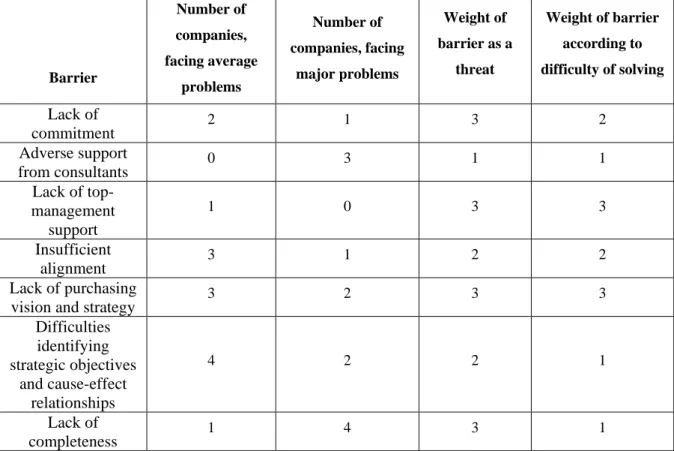
Wagner & Kaufmann (2004) investigated the barriers for successful implementation of balanced scorecard. The results of the research proved that the most crucial barriers in terms of level of threat and difficulty are:
• lack of purchasing vision and strategy,
• difficulties identifying strategic objectives and cause-effect relationships between the performance results and their drivers, 1
• lack of completeness.
The barriers, named above, clearly identify that the issues, arising during the implementation of the balanced scorecard, are related not to the concept of balanced scorecard itself; they are rather associated with the lack of broad understanding of the strategy of a procurement department and the understanding of the way that the performance should be optimised (Wagner & Kaufmann, 2004).
The findings of Wagner & Kaufmann (2004) identify that despite broad procurement research, academic and managerial literature and guidelines, the companies are still facing difficulties in implementing performance measurement systems due to the lack of understanding the procurement system, its external stakeholders and influential factors inside and outside the company, what are the primary drivers of procurement performance, what influences and modifies the performance. In this case, even the most advanced performance measurement system will not generate required results. Surely, it can still provide the diagnostic measurements, however they will be neither proactive, nor highly applicable.
Thus, it can be concluded that even if performance measurement is highly beneficial tool, which can drive significant procurement contributions to corporate performance, the lack of knowledge about the procurement function as a system and the relationships between
1
The drivers of performance are naturally embedded in the strategic objectives, if the objectives are set properly
various factors in this system is preventing successful implementation of the performance measurement systems, in this case - the implementation of the balanced scorecard.
The lack of understanding about procurement as a system is one of the main issues, preventing successful procurement performance measurement as well as all benefits originating from it.
If returning back to the most generic problem in procurement – finding the balance between the cost and the quality, this conceptual issue has high importance in the case of identification of procurement performance drivers, setting objectives and interpreting the results. It can be expected that due to this conceptual issue of finding the balance between cost and quality, the complexity of performance measurement increases, as the threat of sub-optimisation is very high. Thus, it is even more important to understand the procurement as a system.
Building upon the previously listed issues, emphasizing the problem of deep understanding of procurement as a system, the following questions arises, creating a foundation for the research of the Master thesis.
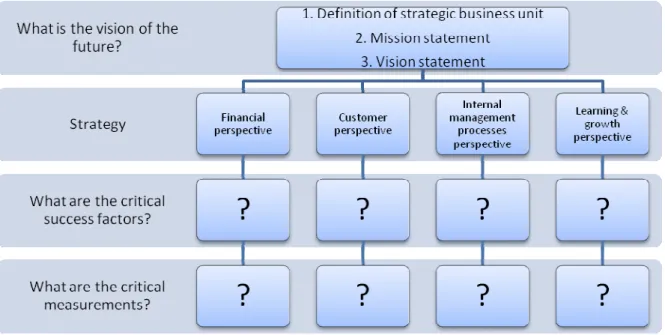
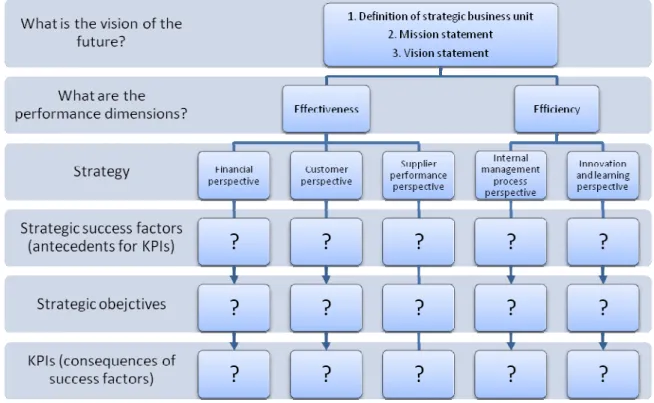
Firstly, the identification of the procurement system, its parts, relationships between them and their functioning principles are necessary for creating a procurement performance measurement system. As the performance measurement tool, in particular balanced scorecard, is considered to be the summarizing tool for procurement system, we see the strategic success factors as antecedents for procurement optimisation objectives and consequently for Key Performance Indicators (KPIs). Thus, the research logic for procurement system is based on antecedent-consequence relation. Based on this consideration, in order to represent the procurement system, the antecedents of procurement performance and procurement KPIs must be identified. Moreover, the relationship between them must be assigned in order to contribute to understanding of procurement as a system. Finally, the procurement system is surely a very complex system, having many internal and external stakeholders and other influential factors, which can be considered to be moderating the relationships in the procurement system – they must be surely identified too. Thus, the questions arise:
What are the relevant procurement success factors, their objectives and performance measures? What are the relationships between them and what are the variables, moderating them?
Surely, the complexity of the procurement system can become overwhelming, if the research is performed in a detailed level. However, if considering the purpose of the research to be facilitated achievement of success in procurement performance measurement, certain limitations must be drawn. As mentioned before, one of the main problems is the lack of understanding the procurement as a system. However, when applying the performance measurement system, the most emphasis is set on understanding the performance drivers in the procurement system. Thus, after presenting the procurement system, the most important performance drivers in the system must be identified, in order to ensure applicability for performance measurement. These performance drivers will surely be represented through finding the key procurement success factors and resulting KPIs. Thus, we search for an answer for the question:
What is the most important procurement performance driver?
However, defining the procurement system and emphasizing the most important areas might be not enough for creating an overall understanding of the procurement system, when the performance measurement target is not only diagnostics, but as well guiding optimisation. Thus, the guidance of how to achieve notable improvements in the procurement areas is necessary. The most important procurement optimisation areas are easily identified through evaluation of importance of the procurement performance drivers, perspectives, success factors an objectives. This process of identification of optimisation areas was described before. Thus, the following question must be answered:
How can be the most important areas of procurement optimized? What optimisation tools and methodologies and targets should be used?
Moreover, the research is aiming not only at building the theoretical overview and assumptions. The empirical research is needed in order to provide the relevant accuracy of the research and to ensure that the information, assumptions and guidelines are up-to-date. Thus the empirical testing, involving experienced procurement professionals is necessary. Also, one of the moderators of the relationships in the procurement system is assumed to
be the industry-related factor, as the approach of the stakeholders, as well as other influential factors, can differ much depending on the industry. Thus, the empirical analysis is targeting to answer the question:
Are the provided theoretical assumptions valid in practical business, particularly in pharmaceutical industry? What are the most important procurement success factors and procurement performance measures and optimisation tools in regard to production material procurement performance optimisation in pharmaceutical manufacturing companies?
Following the questions that were provided above, the main goals of our Master thesis are: • To build a model, explaining the antecedents, consequences and moderating
variables of procurement performance measurement and to define the main procurement performance driver
• To test the model in European pharmaceutical industry in regard to the main procurement performance driver
• To apply the results of empirical analysis for suggestions of building optimised procurement setup and strategy as well as performance measurement.
3.
Methodology
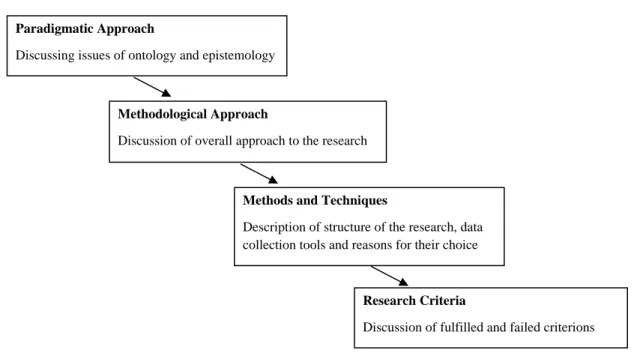
We are developing our methodological chapter according to below illustrated structure.
Figure 1. Structure and Levels of Discussion in a Methodology Chapter. Source: own creation.
Our ontological viewpoints, according to Abnor and Bjerke (1997), should illustrate our understanding of the “realities” and how we deal with them in our research, as well as how they influence our research design. Epistemological considerations explain how the researcher believes knowledge must be created in relation to two dominant paradigms – subjectivism and objectivism, which perspectives about knowledge creation are better reflecting researcher’s view (Kuada, 2008). Another section of the chapter reflects
methodological approach, which presents the systematic approach to our research. Lastly,
the chapter of methods and techniques should describe tools used in the research which help solving the problem.
Paradigmatic Approach
Discussing issues of ontology and epistemology
Methodological Approach
Discussion of overall approach to the research
Methods and Techniques
Description of structure of the research, data collection tools and reasons for their choice
Research Criteria
3.1.
Paradigmatic Approach
3.1.1. Ontology
In this section we will explain ontological issues of our study, i.e. the way that we, as researchers, understand “realities” and how we face them in your research.
Objectivism and constructionism are the two positions in ontology, first of which states that
reality of organisations is independent of “social actors” (Bryman and Bell, 2003, p.20), whereas second one asserts that organisations can be influenced by “social actors”.
Organisations and their procurement departments are the targets of our quantitative investigation. We are interested in exploring the relations between organisations and their departments, but not the relation between organisation and people. However, people in organisations are still important for the research, as they contribute to gaining the knowledge. As we explain later about methodological approach, we are considering people in the companies as individuals, whose knowledge is formed by the systems, which we are interesting in. Therefore, they are able to provide objective information instead of their own subjective understanding. Thus, we can state that our research viewpoint towards the reality is objective.
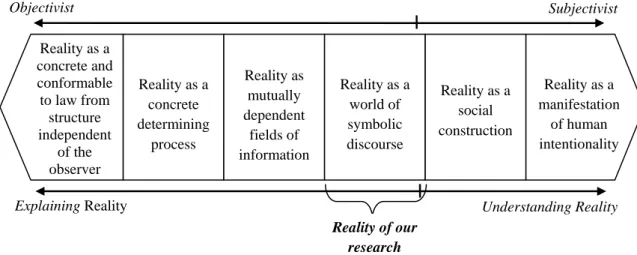
More exact research approach to reality can be explained using Abnor’s and Bjerke’s (1994) categorisation. They differentiate six approaches towards the reality, one of which, i.e. reality as a world of symbolic discourse, reflects ours, as researchers’, view towards the reality (see Fig…). In the latter case, the patterns of the relations appearing due to human actions and interactions are the object of investigation. In our research, one of the most important tasks is to find the factors/systems outside and inside the company, which are interacting with the procurement system and to explain the pattern of the most significant relations, which would help to optimise the procurement. Additionally, we aim at explaining the pattern of interfaces between the systems of procurement and other functions of a company (production, R&D, finance), i.e. what is the level of importance of each of these relations and how these interactions can create positive synergies for the company.
Figure 2. Ontological position of our research. Adapted from Abnor and Bjerke (1994).
3.1.2. Epistemology
Epistemological issue, or the view towards social world and natural sciences, has two opposite positions: positivism and interpretivism (Bryman and Bell, 2003). While positivism stands for the application of the methods of natural sciences for the social realism research, interpretivism keeps strict boundary between social reality – “people and their institutions” (Bryman and Bell, 2003, p.15), and natural sciences. Similarly, Maylor and Blackmon (2005, p. 140) suggest a distinction between two research approaches: scientific approach and ethnographic approach. Generally, the logic of the scientific approach is based on the measurement in order to achieve understanding. The tools, used in the scientific approach are surveys, experiments and databases, which are based on mainly numbers and create a particular measure as a result of the research. On the contrary, the ethnographic approach uses the observations and interviews as the most common tools, words are emphasized and their meaning is provided as a result. Moreover, the scientific approach tries to answer the questions “what?” and “how much?”, whereas the ethnographic approach looks for answers to “why?” and “how?”.
We guide our research with positivistic/scientific attitude. One of the leading aims in our thesis is to understand the most important factors, determining the success of procurement. We consider organisations as “concrete entities” (Pugh, 1983, p.45), where operations can be transferred into data, which we are able to collect and create measures for procurement optimisation. Thus, our investigation is based on the collected data, which is produced by
Understanding Reality Explaining Reality Subjectivist Objectivist Reality as a concrete determining process Reality as mutually dependent fields of information Reality as a world of symbolic discourse Reality as a social construction Reality as a manifestation of human intentionality Reality as a concrete and conformable to law from structure independent of the observer Reality of our research
evaluating processes in companies. Theory will allows us to develop hypotheses which will be tested afterwards and findings will be made, which will be drawn into theory as new knowledge.
Additionally, we are implying a combination of deductive and inductive principles (see Figure 5) in our study, which means that we are developing our research through scientific statements and differentiate the roles of theory and research.
3.1.3. Paradigmatic Position
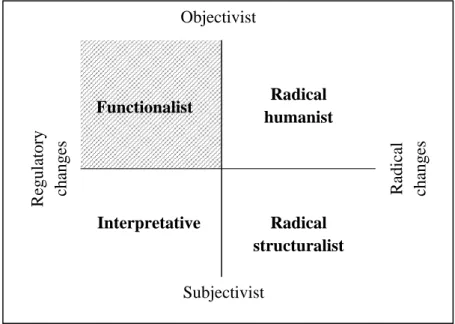
The understanding of ontological and epistemological positions of the researcher allow identifying paradigmatic position of the research. According to Burrell and Morgan (1979), they reflect the assumptions that researchers make about the nature of organisations and the way they collected the knowledge about them. According to Burrell and Morgan (1979), research on organisations can take one of four paradigmatic positions: functionalist, interpretative, radical humanist and radical structuralist. According to our position between the extremes of objectivism and subjectivism, as well as functional position of the research (regulatory or radical), our study reflects functionalist position (see Figure 3).
Figure 3. Paradigmatic position of our Master thesis. Adapted from Burrell and Morgan (1979). Objectivist Subjectivist R eg u la to ry ch an g es R ad ic al ch an g es Functionalist Interpretative Radical structuralist Radical humanist
With the explanation of mentioned assumptions, we want to tell, that we are analysing organisations as systems which also involve people, and our role is to be independent on organisation value observers. Thus, objectivist approach is characterising our research. Additionally, as we have mentioned in epistemological considerations, our research is directed towards understanding purposes rather than explaining and suggesting radical changes in procurement area, therefore we will suggest regulatory changes in companies’ procurement function.
3.2.
Methodological Approach
After discussion of paradigmatic position of our research, we will explain chosen methodological approach of our study. Abnor and Bjerke (1994) suggest three possible approaches: analytical, systems and actors approaches. Whereas analytical investigation is related to finding only cause-effect relationships of single elements, we are interested in different kinds of relations: cause-effect relations and producer-product relations, which could explain how “purposeful forces” are influencing our system, in order to find a way which would guide the strategic procurement development. Additionally, synergy effect, enabled by relations between systems or elements, is very important in our work and reflects systems approach, whereas synergies are irrelevant in analytical approach.
Moreover, the relations analysed using actors approach are dependent on the people inside of organisation, thus they are dialectic and not objective. We are aiming at investigating companies as objective realities and creating a framework suitable for all companies in chosen industry, and not at finding implications for specific company, thus we have rejected actors approach.
While systems approach can be used for explaining (explanatics) or understanding (hermeneutics) purposes, we are approaching the knowledge as explanaticists. With the help of the survey, we are getting the knowledge of individuals from the systems of Procurement departments (explained below). The knowledge which they are providing, is related to the behaviour in and strategies of Procurement function, thus, we consider that their answers to questionnaire are conditioned by present strategies and behaviour of the procurement in companies where individuals are working and not by their subjective
understanding, which would already mean that we are approaching the system as hermeneuticists.
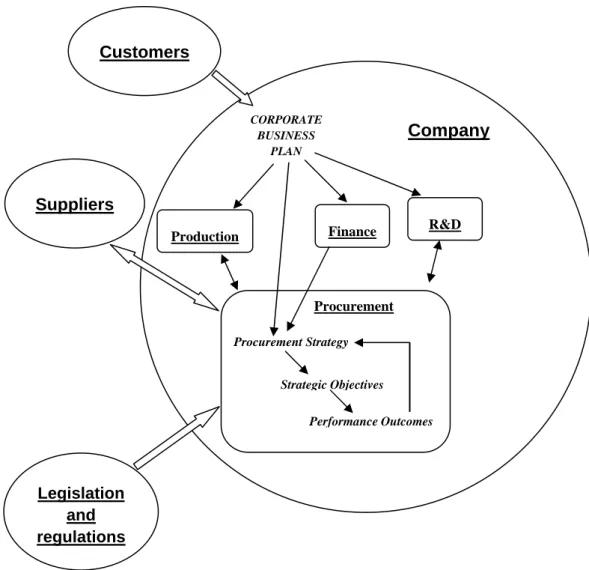
The model of the system, which is showing relations, relevant to our research, is shown in the Figure 4 and explained below. It reflects the system of raw material procurement and it can be used not only in pharmaceutical, but also in other manufacturing companies.
Figure 4. Raw material procurement system, its supersystem and forces, influencing the system. Source: own creation.
The main system in our research is Procurement department (called just “Procurement” in the figure). The important factors and processes, influencing one another, also all performance of procurement department/function are illustrated inside the system of Procurement department. There are two types of purposeful forces affecting the Procurement: these ones caused by members of supersystem and the ones that are caused
Procurement Strategy StrategicObjectives PerformanceOutcomes Company CORPORATE BUSINESS PLAN Procurement R&D Production Finance Suppliers Customers Legislation and regulations
by external systems. The supersystem, Company, contains not only the system of Procurement department, but also other systems (other departments). These systems, which have direct influence on Procurement, are also illustrated inside of the Company. The systems of R&D, Finance and Production act as purposeful forces on the system of Procurement. Additionally, Procurement department may influence R&D and Finance systems as well.
Procurement system contains important processes which are shaping one another in a way that is illustrated in the Figure 4 (procurement strategy is shaping strategic objectives, these are affecting the performance outcomes, which are reshaping procurement strategy). Furthermore, our analysed Procurement department is related to several external systems: Customers, Suppliers and Legislation and regulations. Procurement is indirectly related to Customers – procurement department purchases raw material for the production of the goods which are suggested to the customer, thus the quality and price of the goods depends a lot on the raw material provided by procurement department. On the other hand, Customers are also influencing procurement indirectly. Company is shaping its corporate strategy regarding customers’ demand and their evaluation of the products that they buy from the company. Consequently, the strategy of the procurement is formed according to the corporate strategy.
Suppliers and Procurement have two-way relation. The relation is appearing due to communication and negotiations among these systems. The main target of negotiations is usually price and quality of the product. Additionally, when strategic supplier relationship management is applied, the communication is developing in order to create closer relation between supplier and procurer and to develop products. The relation and communication between the two systems is widely analysed in our work in theoretical part (Sections 4.4.2. and 4.4.3)
Legislation and regulations also have an effect on Procurement system as they are limiting actions and strategy of procurement. An example of such limitation in pharmaceutical manufacturing industry may be related to the material quality requirements.
3.3.
Research Methods and Techniques
After formulating the problem, we decided to use quantitative research method. Our choice was influenced by time and financial resources, additionally, by the scope of the research problem. Interviews could be a suitable mean in order to get comprehensive knowledge from procurement departments, however, time and financial resources would be a barrier for this choice, taking into consideration the fact that we are analysing pharmaceutical industry exceeding the scale of Denmark. Self-completion questionnaire sent out in electronic way could thus provide us with a possibility to collect data from bigger number of companies and to get representative results for raw material purchasers in European pharmaceutical manufacturing companies. Moreover, as discussed before, there is a lack of academic literature related to purchasing performance measurement. A desirable tool, commonly used before administering a self-completion questionnaire in such cases is pilot study. The pilot study is applied in quantitative analysis for testing if research instrument as a whole functions well. (Bryman and Bell, 2003, p. 170). Also, our research has limited time resources. Thus due to knowledge and time limitations we are aiming to make a pilot survey in the empirical analysis, in order to create guidelines for further research and practical procurement optimisation.
Moreover, there are two theories, helping to integrate theory and research and design relationship between them. These are inductive and deductive theories, which were already mentioned in section about epistemological considerations. When an investigation is approached from the deductive view, it is based on existing theories and applies the knowledge from theories for making recommendations for practical case (Bryman and Bell, 2003, p.10). Inductive theory tells that the researcher is developing new theories based on observations and findings (ibid., p.12).
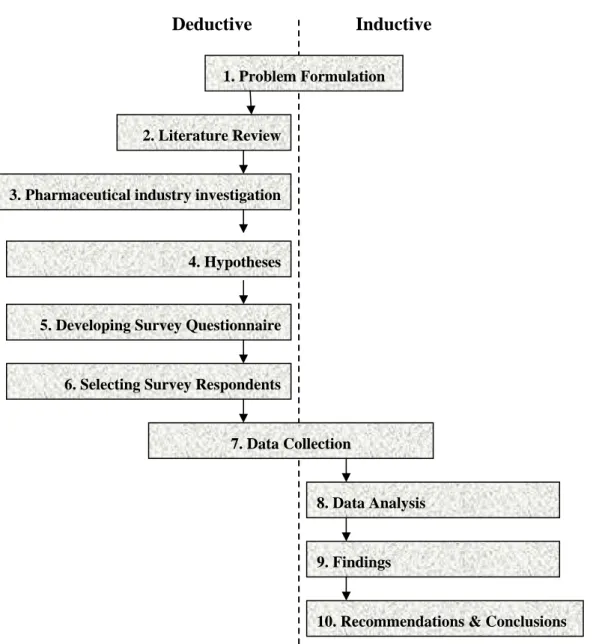
We have chosen quantitative research method, thus, deductive research type is more suitable. We develop our study in clear steps, starting with theoretical background and at the end involving inductive approach. The research design, reflecting mentioned approaches, is illustrated in Figure 5.
Figure 5. The combination of deductive and inductive approaches in our research. Source: own creation.
We have found the lack of scientific knowledge in the field of performance measurement of procurement. Thus, we have first analysed the existing literature which was relevant for our research topic and which helped us to construct a framework for procurement performance measurement. Additionally, it was important to define features and trends of pharmaceutical industry, which are related to raw material procurement. The latter and theoretical chapters allowed us to make assumptions about which forces are the most important in raw material purchasing performance and what variables are determining these forces. Consequently, we were able to formulate the hypotheses.
Deductive Inductive
1. Problem Formulation
2. Literature Review
3. Pharmaceutical industry investigation
4. Hypotheses
5. Developing Survey Questionnaire
6. Selecting Survey Respondents
7. Data Collection
8. Data Analysis
9. Findings
As the fifth step, we have developed a self-completion questionnaire (Annex 2) for our quantitative research in order to confirm or deny the hypotheses. In the presentation (Annex .. ) of our questionnaire, we have underlined the responsibilities of the person, who should answer the questionnaire, in order to avoid the possibility that not competent employee would become our respondent. Moreover, such details were mentioned, as the type of the company which we were interested in, the purpose of our research, anonymity, an approximate time that would be taken to fill in the questionnaire, and appreciation for filling in the questionnaire. Additionally, the possibility to order the electronic copy of finalised Master thesis in exchange was suggested to the respondents.
The questionnaire first included general questions (size measures of the company, location of procurement head office and job title of a respondent) in order to be sure that the company and person are suitable for our sample. The questionnaire consisted predominantly of closed questions, which makes it easier for respondents to answer them (Bryman and Bell, 2003, p.158), thus respondents have to spend less time on each question and the possibility to receive fully filled questionnaire increases. Additionally, the open space was left after some of the questions in order to give possibility for the respondents to note any other important measures which we have missed while identifying most important measures.
After the questionnaire design, the next steps are to select respondents and collect the data. Our target respondents were employees, who are working in pharmaceutical manufacturing company and who are involved in any level of raw material procurement management for pharmaceuticals’ production. We did not have any source of the contacts of suitable people, thus we have used several methods for creating the sample of the survey.
1) Firstly we have sent the inquiries to a large number of European procurement associations and pharmaceutical associations in different countries. Unfortunately, only several responses came and with negative answers.
2) Afterwards, we have sent e-mails to a number of companies (to their general e-mails for inquires) which fit into our research limitations, asking to provide the emails of one employee from each company who would have described responsibilities. In such way we received four contact emails of potential respondents and several negative responses.
3) We have collected a list of companies, including the ones which did not respond to the e-mails sent earlier. The companies, which are originating from the countries with highest pharmaceutical industry development level in Europe2, were primarily chosen (e.g. France, Germany, Switzerland, etc.), thus, assuming that their procurement is strategically well-developed and their contribution to the survey could give good outcomes for our research. Next, we have tried calling to the companies and establishing initial contacts. However, this method requires a lot of time due to a necessity to make at least several calls to one company in order to find the directions to the right employee. Additionally, many receptionists in companies were not willing to redirect the call to the suitable person due to the company’s policy.
4) Lastly, due to time limitation we were not able to make more calls, thus, we have sent out emails with the link to the questionnaire to a number of companies (using e-mail addresses for general inquiries), that were not contacted before, and asked them to forward the link to the required person in their company, however this method almost did not give results.
After executing the survey, we have analysed collected data using SPSS program. We have used several techniques of quantitative data analysis: Scheffe test and calculation of Euclidean distance – to confirm or deny the hypotheses, ANOVA – to test the relationships between variables, histograms – for visualising the results.
In step 9 we are interpreting the results of analysed data and considering if our hypotheses are supported. Finally, according to the findings of the study, we discuss the implications of our findings for the theoretical background, which we used for building our research.
3.4.
Evaluation of the Research
Four criterions are described in this chapter and their appliance in our thesis is discussed. The criterions are necessary in order to evaluate the quality of chosen design of the research for our thesis. Bryman and Bell (2003) stress the criterions of reliability, replication and validity. Further analysis is based on their explanation. Additionally, the fourth criterion, relevance, is analysed according to Hammersley (1992).
2
3.4.1. Reliability
Reliability concept is related to a repeatability of results of the research (Brymann and Bell, 2003). Authors explain that the repeatability is achievable when consistent measures are used in the research.
Firstly, stability in measures over time is an important characteristic in quantitative research. It could be evaluated if after administering the measures to a sample of respondents one time, it would be repeated second time with the same sample. However, we do not have a possibility to evaluate this criterion, thus, we cannot claim that our measures are stable over time.
Internal reliability tells if a multiple-item measure is coherent, i.e. if indicators are
related to each other.
3.4.2. Replication
We have described different processes and elements of our research in detail. Thus we can assume that we have fulfilled the replication criterion. The application of this criterion makes the research building process available for others and thus helps to reach more convincing results. Additionally, replication is also very closely related to reliability. If the description of sequence and context of the research is very detailed, it is more reliable. If it is lacking of details, some uncertainties may appear for readers and a level of reliability is low.
3.4.3. Validity
Brymann and Bell (2003) tells that it is important to consider two main types of validity in a research:
External validity helps to create a representative sample. Our research contains a pilot survey with the small sample, therefore we are not applying this criterion tour research. Ecological validity aims at stating if the findings of the research are applicable to
everyday life and natural social settings. Our study may not fully meet this criterion because our research tool is a questionnaire. Thus, we cannot be guaranteed that the
answers of respondents really reflected their and their department’s behaviour in every day work. Additionally, Cicourel (1982, in Brymann and Bell, 2003) is raising a question of whether respondents have necessary knowledge for answering the questions. Regarding this aspect, we are sure that our respondents had this knowledge due to their job function and clear instructions given in the covering text about a person we needed in the company.
Even though our research does not fully meet ecological validity due to used instrument for the research, we believe that this was the best way to do investigation in order to fulfil the aims (refer to the chapter) of the Master thesis considering time limitation and available resources.
Whereas Bryman and Bell (2003) emphasise above named criteria for research design evaluation, Hammersley (1992) is also suggesting taking into consideration relevance criterion. Thus, we are discussing in the following section.
3.4.4. Relevance
Criterion of relevance is concerning the importance of the topic in certain field or contribution to the existing literature in related field. This Master thesis can be named as fulfilling relevance criterion due to following main objectives: 1) building a framework which can be used as a basis for procurement optimisation strategies and which is supplementing previous literature on procurement management and optimisation, and 2) reaching the findings that will be new and valuable for business in pharmaceutical manufacturing industry.
To be more specific, it was discussed in Chapter… Problem Formulation that there were many researches done on procurement optimisation before, however they were oriented only towards financial results and financial past performance, without analysing operational details and management. In our Thesis we are using Balance scorecard framework as a basis for considering all perspectives affecting the procurement performance and identifying a number of factors (in different perspectives) which should be analysed while creating the procurement performance optimisation strategy. This is
going to be an input of our research into the existing literature on procurement performance management.
Additionally, according to the built framework on antecedents and consequences of procurement performance, we are going to use it in pharmaceutical manufacturing industry in order to lead companies to the procurement performance optimisation strategy.
4.
Theoretical Framework
4.1.
Procurement Concept and Role in Supply Chain Management
We are starting building theoretical framework by introducing the perception of supply chain and analysing different suggestions of what is the role of procurement in a company and how procurement should be approached. Accordingly, we formulate a definition of procurement which would guide further process of our Master thesis.
Concept of supply chain
Supply chain management (SCM) – extremely popular research topic today. Mentzer et al. (2001) suggests several phenomenons as the reasons for that. First, the supply chain management came together with the start of global sourcing. Due to the increasing global sourcing among the companies, they were forced to look for more efficient and coordinated flow of materials into and out of the company, which can be achieved by closer relationships with suppliers. Second, companies started competing more on the basis of time and quality, together the requirements of customers have increased. Both of mentioned factors - global orientation and increased performance-based competition - caused increased environmental uncertainty and the need of closer coordination with suppliers and distributors.
Regardless of the popularity of the supply chain management concept, still a lot of uncertainties appear regarding its meaning. Lambert et al. (1998) presents a supply chain as a network of members and the links between members of the supply chain. Additionally, the third element - business processes – create a value for the customers and they have to be integrated and managed across the supply chain by the management components.
Figure 6. Supply Chain Management: Integrating and Managing Business Processes Across the Supply Chain. Source: Lambert et al., 1998.
The figure demonstrates the supply chain network, where the functions of a company are illustrated (e.g. logistics, marketing and sales), aligning in the supply chain together the suppliers and the end users. The information flow, product flow and key supply chain business processes are stretching through all the supply chain from the original supplier to the end user, while creating the integrated processes in the supply chain. Moreover, business processes in integrated supply chain become supply chain business processes extending across intra- and inter- company boundaries. (Lambert et al., 1998)
Mentzer et al. (2001) defines a supply chain as a set of three or more entities (organizations or individuals) directly involved in the upstream and downstream flows of products, services, finances, and/or information from a source to a customer. Mentzer et al. (2001) identifies three degrees of supply chain complexity: a “direct supply chain,” an “extended supply chain,” and an “ultimate supply chain.”
A direct supply chain includes three elements: a company, a supplier, and a customer involved in the upstream and/or downstream flows of products, services, finances, and/or information (Mentzer et al., 2001).
Figure 7. Direct supply chain. Source: Mentzer et al., 2001.
An extended supply chain includes several additional links: suppliers of the immediate supplier and customers of the immediate customer. All links are involved in the upstream and/or downstream flows of products, services, finances, and/or information (Mentzer et al., 2001).
Figure 8. Extended supply chain. Source: Mentzer et al., 2001.
An ultimate supply chain consists of all the organizations involved in all the upstream and downstream flows of products, services, finances, and information from the ultimate supplier to the ultimate customer (Mentzer et al., 2001). The third figure briefly demonstrates the complexity that ultimate supply chains can reach. The example of the additional elements (comparing with the extended supply chain) that can exist in such supply chain is third party financial supplier, which may be providing financing, assuming some of the risk, and offering financial advice. Moreover, a third party logistics (3PL) provider can be providing transportation services between several companies, whereas a market research firm can be supporting a company with the information about the ultimate customer.
Figure 9. Ultimate supply chain. Source: Mentzer et al., 2001.
While approaching the topic of our thesis, procurement is identified as one of key business processes in the supply chain together with customer relationship management, customer service management, demand management, order fulfilment, manufacturing flow management and product development and commercialisation (Lambert et al., 1998). That
means that it is one of the components which make a significant importance for company’s performance. However, procurement is sometimes still seen as simple purchase or acquisition of the physical resources that company needs and no strategic importance is given for such purchasing. Further literature review identifies the researches of the scholars made on the questions addressing the necessity of strategic management of the procurement and its significant in business performance. Different authors in some cases mean the same by using terms “strategic procurement” or “strategic purchasing”. Moreover, sometimes only the term “procurement” is used while having “strategic purchasing” in mind. We are using “strategic procurement” concept in the thesis, however when different authors are cited, other terms than this may be used.
Strategic procurement
The ideas about the necessity for the firms to give more attention for the purchasing function and the whole procurement department were already demonstrated at the beginning of the 1990s. Pearson and Gritzmacher (1990) proposed that purchasing function has to be oriented to strategic roles. Besides, procurement and supplier management needs to interact with other departments via the purchasing function in order to improve the monitoring environment of the supply market Pearson and Mendez (1994) suggested that procurement and supplier management must have the ability to execute the following activities: quality requirement assessment, training, supplier selection, total cost analysis, evaluation standards, strategic alliances and collaboration. Cox (1996) raised a problem of conceptualization and theory building within the developing discipline of purchasing and supply chain management. One of the questions addressed in his article was about the concept of strategic procurement management and the way that it differs from the traditional conception of purchasing and supply management. He stressed that there must be an attempt to provide a theoretical clarification of the optimal role for procurement within business management. Only in this way it is possible to develop operationally practical concepts, tools and techniques and to assess under which circumstances and conditions they are 'fit for purpose' (Cox, 1996), where the main ‘purpose’ of every company is a profit.
Cox (1996) investigated the way to approach the effective business strategy through the strategic procurement management. The first and the vital point on which the author is basing procurement management model is proactive approach and in no case it can be
reactive. If company is basing its business management on such approach, then company’s boundaries need to change constantly in response to customer’s preferences and the strategic procurement management must always focus on the ultimate role of the company. Furthermore, Cox (1996) notifies that it is crucial to understand what adds value for the business and what profit margins are. That can be reached by proactive behaviour of decision-maker and constant seek of how the costs and value are created in their supply and value chains, also in relation to the competitors. Only in that case strategic procurement management approach can be implemented because the very first task of this approach is to undertake value chain positioning. Value chain positioning concept means “the process by which the key decision-makers within a firm consciously undertake market positioning through an analysis of the totality of supply and value relationships within their markets” (Cox, 1996, p. 69). While the company is heading to achieving sustainable profitable advantage through the strategic procurement management, a number of external contractual relationships have to be considered. The decision of which ones of them ‘fit for purpose’ can not be made only in relation to upstream external supply management. The decisions of procurement managers have to be made on the basis of the corporate strategic goals of the company in terms of its market and value positioning objectives.
In relation to the positioning of the procurement activities in company’s value chain, in 1985 Porter has composed a value chain differentiating primary and supporting activities (van Weele, 2005). Primary activities are related to physical transformation and handling of the product that company is producing and distributing to its customers, whereas procurement is one of the supporting activities, which are enabling and supporting the primary activities. Procurement here relates to the activities of purchasing, some of which may be purchasing raw materials, manufacturing equipment, or buildings. These purchasing actions can be related to all primary activities and go along with supporting activities, such as technology development, HR management and firm infrastructure, therefore Porter has distinct procurement as supporting activity for creating value in a company (van Weele, 2005).
Furthermore, Chen et al. (2004) distinguish slightly different approach to the success of the business through the strategic procurement. They state that strategic procurement is a vital link in a working supply chain and that strategic purchasing can give a competitive advantage to a firm by enabling the firm to: 1) foster close working relationship with
limited number of suppliers, 2) promote open communication among supply chain partners and 3) develop long-term strategic relationship orientation to achieve mutual gains.
Researchers feature procurement with two major goals (Lambert and Cooper, 2000; Skjott-Larsen et al., 2003; Christopher and Gattorna, 2005; Wisner, 2003; Piramuth, 2005): to ensure an uninterrupted flow of raw materials at the lowest total cost, and to improve the quality of the final product and to react rapidly to market changes.
Scholars agree that strategic procurement management is crucial for better financial performance of a company (e.g. Kerkhoff, 2005, Dimitri et al., 2006). Kerkhoff (2005) notices that of the financial situation of the company through the procurement function can be improved by locating and exploiting the potential for increased profit and reduced procurement expenditures. Moreover, the way managers design the procurement has a major effect on company’s performance in both short and long run (Dimitri et al., 2006). Procurement is influencing short-term performance because it is immediately determining the cost and quality of inputs in the supply chains; whereas procurement has a great significance for a long-term performance by determining suppliers’ and more generally firms’ incentives to invest in R&D and to innovate in general (Dimitri et al., 2006).
Additionally to the improvement of financial measures, the shift from simple purchasing to strategic procurement (in different literature it may be named as strategic purchasing) would raise the role of procurement department to the higher position, equalling its importance to the research and development, production or marketing and sales, which would provide purchasers with a chance to contribute their know-how to the strategic corporate decisions (Kerkhoff, 2005).
Kerkhoff (2005) suggests several phases of the provision of strategic procurement. First, an analytical background for accounting from existing data and information has to be created. That means that an effort should be put in mechanical and very detailed work. Second, creative work is required in order to develop an efficient profit-oriented procurement strategy, which has to be consistently implemented.
According to the reviewed literature and different suggestions for strategic procurement management, we have defined strategic procurement as:
A business function which is responsible for management of firm resources on the basis of corporate goals, while proactively seeking for long-term external relationship and integration along with internal functions of the company.
Despite the increasing evolution of procurement towards a strategic function of a company, which creates constantly increasing complexness of this function, the main objectives of the procurement department can be identified simply as (Pooler & Pooler, 1997):
• To ensure economic supply by the procurement of goods, supplies, and services to keep the company in operation
• To contribute to profits by efficiently controlling the flow of money passing through the operation
4.2.
Business Performance Measurement
In sub-chapter 4.1. we have introduced the concepts of procurement and supply chain. Now we are going to approach business performance measurement topic.
We have already mentioned in problem formulation chapter, that procurement measurement is recognised as a tool for procurement optimisation guidelines. Therefore, performance measurement takes very important role in building our procurement optimisation framework. In this chapter we are first introducing companies’ performance measurement topic in general and explain why we are choosing the balanced scorecard model as a basis for further development of our thesis.
Subsequently we describe the balanced scorecard method more detailed and describe different business perspectives included in balanced scorecard model. Additionally, we present the concept of Key Performance Indexes, which are the part of BSC model, and which are used to measure different areas in business performance.
4.2.1. Tools and Techniques for Performance Measurement
Bull (2007) identified three dimensions, upon which the performance could be measured: efficiency, effectiveness and efficacy. The choice of the relevant measurement dimensions is dependent on the strategy chosen:
• The efficiency dimension is related to the resource-based view of a firm, when the emphasis is noted on how efficiently the resources of a company are used.
• The effectiveness dimension is based on the market-led strategy, when meeting customer demands and creating added-value is essential
• The efficacy dimension, founded on success-led strategy, when the measures are targeted at evaluating, how well a company is able to achieve its vision and purpose.
Bull (2007) claims that the third dimension – efficacy is rarely used, as the most common dimensions of performance measurement are efficiency and effectiveness. According to
the definition it can be understood that efficacy dimension is covering both efficiency and effectiveness dimensions and it is a very broad dimension. However, we are willing to perform a more detailed analysis of the performance measurement dimensions. Thus, we believe that as efficacy dimension is reflected by effectiveness and efficiency dimensions, it is reasonable to concentrate of only effectiveness and efficiency in our research. Consequently, efficacy will not be further investigated in our research. The chosen two