Agronomy Research 12(2), 681–686, 2014
Some practical applications of e-learning in OHS and
ergonomics in higher education
V. Siirak*, P. Tint and A. Traumann
Department of Work Environment and Safety, Tallinn University of Technology, Ehitajate tee 5, EE19086 Tallinn, Estonia; *Correspondence: [email protected] Abstract. The computer based e-learning in Moodle environment and other computer applications in the teaching of occupational health and safety (OHS) are investigated. The social constructivist learning theory is effective method for teaching and learning of OHS and ergonomics issues in the university education. The computer programme for determination of the safety level at enterprise is presented. The simple computer applications are very suitable educational tools for e-learning of OHS and ergonomics. They could be also used by the employers of small and medium-sized enterprises. The scope of practical applications of e-learning in OHS and ergonomics in higher education is analysed on the basis of the scientific literature and analysing the methods used in the EU.
Key words: e-learning, occupational health and safety, ergonomics. INTRODUCTION
We are living in time of global changes. New competence requirements in information and knowledge management mean new challenges for national educational systems and also for higher education.
Tallinn University of Technology’s (TUT) Strategy for Provision of Education has been prepared for the period of 2012–2015, keeping in mind long-term perspectives until the year 2020.
The Vision 2015 contains: TUT is an internationally recognized university which provides competitive education on all levels of higher education. TUT strives for high-quality education based on contemporary study methods and forms, stimulates creative thinking, is student-oriented and flexible. The graduation rates have gone up, including also the proportion of full-time students and students who graduate within nominal study duration. TUT is a recognized provider and developer of lifelong learning options ensuring substantive as well as formal diversity and quality of education. The university systematically introduces the possibilities of science and innovation, popularizes technological knowledge, and motivates constantly and systematically gifted young people to study in TUT.
The Vision 2020 contains: TUT is one of the leading universities of technology in the Baltic Sea region and an active partner in cooperation networks of universities, clusters and state institutions. Provision of education in the international research university combines provision of education, research and innovation. Research and
development of young lecturers and research fellows as well as specialists who value innovation and are necessary for the society.
The study materials of all compulsory subjects shall be available for the students via a single e-learning environment or the study information system. Study courses and materials in an e-learning environment should be in conformity with the quality standards developed by the e-Learning Development Centre.
The university shall ensure the sufficient material base in order to carry out the study process effectively. The infrastructure supporting studies, also on a regional basis (a sufficient number of auditoriums in conformity with current requirements, a single e-learning environment etc.) and a support structure (educational technology and multimedia centre with up-to-date technical equipment and specialists) for lecturers upon preparation the study materials have been developed.
TUT has developed the user-friendliness and functionality of the study information system and the cohesion of the study information system and the e-learning environment. There is an in-service training information system which is a part of a single study information system. The development of the study information system takes place systematically and strategically. All information systems support different study options and forms thereby enabling joint development of the provision of education (Tallinn University of Technology, 2012).
According to the strategy of e-learning in Tallinn University of Technology, approved at 2006, for year 2013, 95% of courses have to be provided by support of e-learning environment. Since 2003 – more than 550 courses by support of e-e-learning environment (BlackBoard or Moodle) have been created.
PBL (problem based learning) is an educational format that uses real-life problems as a starting point for acquiring knowledge and requires students` active involvement in this process. It is a method that encourages independent learning and gives students practice in tackling complex or new situations and discovering their gaps in knowledge with respect to understanding a problem in its relevant context. Deeper understanding of the material rather than a superficial coverage is encouraged by PBL. PBL encourages students to become more involved in, and responsible for their own learning. Each problem or case should encourage the student to develop an understanding for the interrelation of real life problems, as is the case with most problems in ergonomics and safety in enterprises.
Macroergonomics includes OHS, ergonomics at workplace, psychology and physiology; major accident risk etc. The discipline is particularly spread in the US (Glendon et al., 2000; Hendrik et al., 2005).
THE AIM OF THE PAPER
The blended learning with the web-support of the Moodle e-learning environment and web-based practical applications, based on social constructivist learning theory and problem-based learning (PBL) have been investigated. It is an effective tool for teaching and learning the Occupational Health and Safety (OHS) and Ergonomics in higher education.
OHS AND ERGONOMICS EDUCATION IN TALLINN UNIVERSITY OF TECHNOLOGY
Since 2006, in the Department of Work Environment and Safety, the courses in Work Environment & Ergonomics and Risk & Safety Sciences are supported by the Moodle e-learning environment. These disciplines are obligatory to all faculties. Courses have been provided according to the principles of social constructivist learning theory. The main attention is paid to the problem based learning (PBL). Courses have been provided as a blended learning in combination of face-to-face learning and computer-based-learning by support of the Moodle e-learning environment (Siirak, 2000, 2011, 2012; Tint & Siirak, 2000).
There are two main basic courses in the field of OHS and ergonomics for the students in Tallinn University of Technology: 1) ‘Risk and safety science’ for technical specialities (mechanical, civil engineering, chemical and electrical engineering) and 2) ‘Work environment and ergonomics’ for the economic and infotechnology specialities (Tint et al., 2012; Kalkis et al., 2013; Koppel et al., 2013).
Case studies for solving the OHS and ergonomic problems and prevent accidents in enterprises are included to the learning process. A study-tool for practicing the determination of safety level at the enterprise (safety audit) by the students of info-communication technology (ICT) as a course assignment for examination was created.
STUDY-TOOL FOR PRACTICING THE DETERMINATION OF SAFETY LEVEL AT THE ENTERPRISE (SAFETY AUDIT)
Safety audits are a vital way of verifying that a company’s safety management is working properly. Several methods have been developed for supporting safety auditing: questionnaires, interviews, observations and document reviews. Safety management system in six Estonian enterprises were assessed using Diekemper & Spartz (1970) (D&S) method, which was modified by Kuusisto considering the demands of the OH&S standard OHSAS 18001:2007 (Diekemper, 1970; Kuusisto, 2000). The investigated enterprises were selected from the manufacturing industries. These enterprises’ assessments are given as the examples for students.
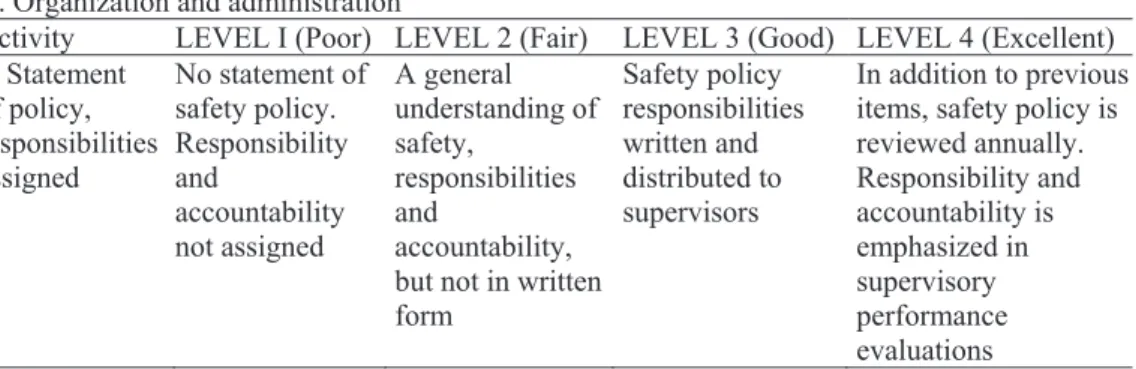
Table 1A. Modified Diekemper & Spartz method for assessment of safety system. Determination of activities’ safety levels (area A)
A. Organization and administration
Activity LEVEL I (Poor) LEVEL 2 (Fair) LEVEL 3 (Good) LEVEL 4 (Excellent) 1. Statement of policy, responsibilities assigned No statement of safety policy. Responsibility and accountability not assigned A general understanding of safety, responsibilities and accountability, but not in written form Safety policy responsibilities written and distributed to supervisors In addition to previous items, safety policy is reviewed annually. Responsibility and accountability is emphasized in supervisory performance evaluations
The assessment in this method is carried out on four level systems: level 1(poor); level 2 (fair); level 3 (good); level 4 (excellent) (example Table 1A).
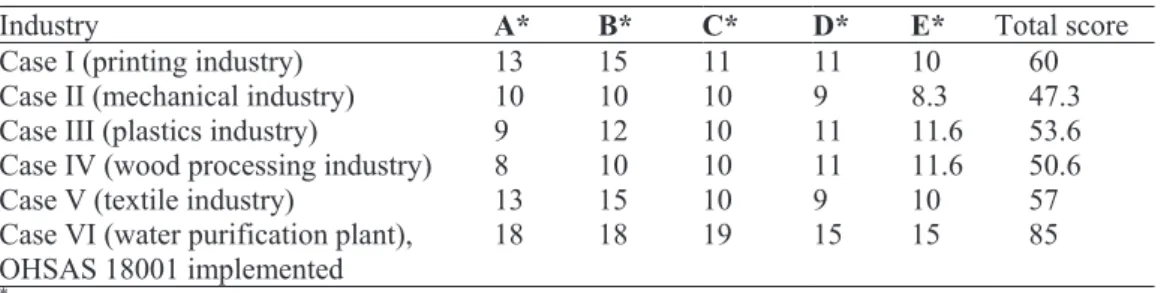
Table 1B. Results of auditing of safety system in Estonian enterprises (Järvis & Tint, 2008)
Industry A* B* C* D* E* Total score
Case I (printing industry) 13 15 11 11 10 60 Case II (mechanical industry) 10 10 10 9 8.3 47.3 Case III (plastics industry) 9 12 10 11 11.6 53.6 Case IV (wood processing industry) 8 10 10 11 11.6 50.6 Case V (textile industry) 13 15 10 9 10 57 Case VI (water purification plant),
OHSAS 18001 implemented
18 18 19 15 15 85
*
Maximum score in each area (A, B, C, D, E) is 20. Maximum total score is 100
The modified D&S method addresses 30 activities. These are categorized into the following activity areas:
A* – organization and administration (statement of policy, responsibilities assigned; direct management involvement; safety instructions to hazardous tasks; workplace design; health care);
B* – industrial hazard control (housekeeping-storage of materials; machine guarding; maintenance of equipment, guards, hand tools; material handling- manual and automated; and personal protective equipment);
C* – fire control and industrial hygiene (chemical hazard control references; storage of flammable and explosive materials; ventilation- fumes, smoke and dust control; skin contamination control; fire control measures);
D* – supervisory participation, motivation and training, line supervisor safety training; training of new employees; job hazard analysis; training for specialized operations (fork trucks, grinding, punch presses, solvent handling, etc.); worker/manager safety contact and communication);
E* – accident investigation, statistics and reporting procedures, accident investigation by line personnel; accident cause analysis and statistics; near-accident investigation).
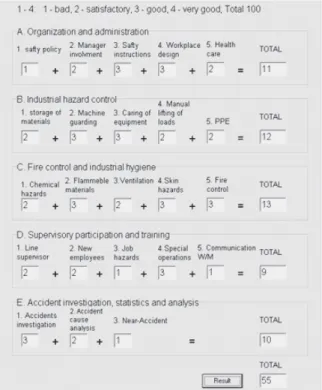
The results of the implementation of the D&S method for external safety audit are given in Table 1B and a computerized method for determination of safety level is presented in Fig. 1.
Explanation: The safety activities are divided into 5 groups: (characterized earlier). In these five groups in every group there are 3–5 activities (seen in Fig. 1), for example it begins with organization and administration and safety policy has got a
mark ‘1’ at the enterprise. The total mark for safety policies in the example enterprise is 55 (Fig. 1). In Table 1B we can see the real numbers of some enterprise, for example printing industry 60 points (Järvis & Tint, 2008).
Figure 1. Use of a computerized method in the determination of safety activities at enterprises. RESULTS AND DISCUSSION
Structural changes in industry and economics have taken place in the 21st century and the globalized world needs responsible qualified engineers and scientists. It also provides new challenges before the OHS and ergonomics in higher education, the new possibilities, dimensions and solutions are opening to OHS specialists. One of the new possibilities and solutions in education of engineers is the problem-based learning (PBL) by blended learning with the support of the Moodle e-learning environment.
The study-tool for practicing the determination of safety level at the enterprise (safety audit) in combination with blended learning by computer based support in the Moodle e- learning environment is very effective learning tool in higher education for solving the problems of OHS and ergonomics at the enterprise. The development of other learning tools is in progress.
CONCLUSIONS
Moodle e-learning environment is a very effective learning tool supporting blended learning encouraging students motivation for learning activities and interests to the course for solving the OHS and ergonomic problems in enterprises.
New learning and teaching solutions will open before the high-school teachers in the future development of the Moodle e-learning environment according to the rapid
The advantage of blended learning is the face-to-face contact between the students and teachers personally and it is enriching the learning process. According to our experiences, the activities in the Moodle e-learning environment (assignments, learning forums etc.) and practical applications of e-learning encourage the students interest for working in the classroom face to face with the teacher in a new level.
ACKNOWLEDGEMENTS. We would like to express the gratitude to the European Commission and Estonian National ICT program for Higher Education for supporting the creation of the course of working environment and ergonomics in Moodle e-learning environment, autumn 2006 (EITSA 2 ESF project REDEL).
REFERENCES
Diekemper, R.F. & Spartz, D.A. 1970. A quantitative and qualitative measurement of industrial safety activities. ASSE Journal, Dec, 12–19.
Glendon, A.I. & Stanton, N.A. 2000. Perspectives of safety culture. Safety Science 34, 193–214. Hendrik, H.W. & Kleiner, B. 2005. Macroergonomics: Theory, Methods, and Applications.
CRC Press, 432 pp.
Järvis, M. & Tint, P. 2008. Innovations at workplace: an evidence based model for safety management. Business. Theory and Practice 10(2), 150–158.
Kalkis, H., Roja, Z., Kalkis, V. & Rezepina, I. 2013. Ergonomics approach in enterpreneurship.
Agronomy Research, 11(2), 413–420.
Koppel, T., Tasa, T. & Tint, P. 2013. Electromagnetic fields in contemporary office workplaces. Agronomy Research 11(2), 421–434.
Kuusisto, A. 2000. Safety management systems. Audit tools and reliability of auditing.
Publications 428, Espoo, Finland: VVT (Technical Research Centre of Finland).
OHSAS 18001:2007. Occupational health and safety management systems. Requirements. UK: British Standard Institution.
Siirak, V. 2012. Moodle E-learning Environment as an Effective Tool in University Education.
Journal of Information Technology and Application in Education (JITAE) 1(2), 94–96. Siirak, V. 2011. Experience of E-Learning in Ergonomics and OHS Education in University. In
XIX World Congress of Safety and Health at Work: Building a Global Culture of Prevention for a Healthy and Safe Future. International Labour Office, p. 309.
Siirak, V. 2010. Some experiences of e-learning in the Moodle e-learning environment. In Haftor,D. & Mirijamdotter, A. (eds): Information and Communication Technologies, Society and Human Beings: Theory and Framework (IGI Publishing). Hershey, Pennsylvania, USA, pp. 291–296.
Siirak, V. 2000. Experience with problem-based learning in ergonomics and safety education in Estonia. In: de Waard, D., Weikert, C., Hoonhout, J. Ramaekers, J. (eds), Human-System Interaction: Education, Resarch and Application in the 21st Century. Maastricht: Shaker Publishing, pp. 99–106.
Tallinn University of Technology’s Strategy for Provision of Education. Approved by decision no. 62 of 17.04.2012 of the Council of TUT.
Tint, P., Traumann, A., Pille, V., Tuulik-Leisi, V.-R. & Tuulik, V. 2012. Computer users' health risks caused by the influence of inadequate indoor climate and monotonous work.
Agronomy Research 10(S1), 261–276.
Tint, P. & Siirak, V. 2000. Computer-based learning in occupational safety and health and health problems with computer use. In: de Waard, D., Weikert, C., Hoonhout, J., Ramaekers, J.(eds). Human-System Interaction: Education, Research and Application in the 21st Century.Maastricht: Shaker Publishing. pp. 107–109.