Computing Multi-Dimensional Trust by mining E-Commerce
Feedback Comments
A thesis submitted in fulfilment of the requirements for the degree of Master of Engineering
Lishan Cui M.Eng.
School of Computer Science and Information Technology RMIT University
Declaration
I certify that except where due acknowledgement has been made, the work is that of the author alone; the work has not been submitted previously, in whole or in part, to qualify for any other academic award; the content of the thesis is the result of work which has been carried out since the official commencement date of the approved research program; and, any editorial work, paid or unpaid, carried out by a third party is acknowledged.
Lishan Cui
School of Computer Science and Information Technology RMIT University
ii
Acknowledgments
I would like to express my gratitude to all those who gave me the possibility to complete this research thesis. I would like to thank my supervisors, Dr.Xiuzhen Zhang and Professor Yan Wang, for their support, not only with my research and thesis, but also in other events in my life. They have been great supervisors in motivating me on doing high quality research and keeping me on track on progress.
I would like to thank several of my fellow research students, especially Sabrina, Husna and Shafiza. It was of great help to have such kind friends to support me and to socialise with throughout my research study.
The RMIT Research Writing group was also beneficial in my research, allowing me to engage in frequent discussions of my work, which helped to improve the ideas and presentation found in this thesis.
Last but not least, I would like to thank my family and friends for their love, motivation and guidance throughout my entire academic career.
iii
Credits
Portions of the material in this thesis have previously appeared in the following publications:
• X. Zhang, L. Cui, and Y. Wang. Computing Multi-Dimensional Trust by Mining E-Commerce Feedback Comments. IEEE Transactions on Knowledge and Data Engi-neering, Accepted on 5 Nov. 2013. To appear.
• L. Cui, X. Zhang, and Y. Wang. Mining E-Commerce Feedback Comments for Dimen-sion Rating Profiles. InProc. The 9th International Conf. on Advanced Data Mining and Applications, ADMA, 2013.
The thesis was written in the TeXstudio editor on Windows 7, and typeset using the LATEX 2ε document preparation system. Experimental work was performed using Sun Java.
Results were analysed using RStudio, and graphs generated using Microsoft Visio and gg-plot2 Lib.
All trademarks are the property of their respective owners.
Note
Unless otherwise stated, all fractional results have been rounded to the displayed number of decimal figures.
Contents
Abstract 1
1 Introduction 2
1.1 Background . . . 2
1.2 Research problems . . . 4
1.3 Thesis objectives and scope . . . 5
2 Literature Review 7 2.1 Computational trust evaluation . . . 7
2.2 Feedback comment analysis . . . 9
2.3 Aspect opinion extraction and summarisation . . . 11
2.4 Matrix factorisation . . . 14
3 CommTrust: Comment-based Multi-dimensional Trust Evaluation 15 3.1 The CommTrust model . . . 15
3.2 A user study . . . 20
3.3 Summary . . . 24
4 Lexical-LDA: Mining Feedback Comments for Dimension Rating Profile by Lexical Topic Modelling 25 4.1 Extracting aspect expressions and ratings by typed dependency analysis . . . 25
4.2 Grouping dimension expressions into dimensions . . . 28
4.3 Rating evaluation . . . 31
4.4 Experiments . . . 32
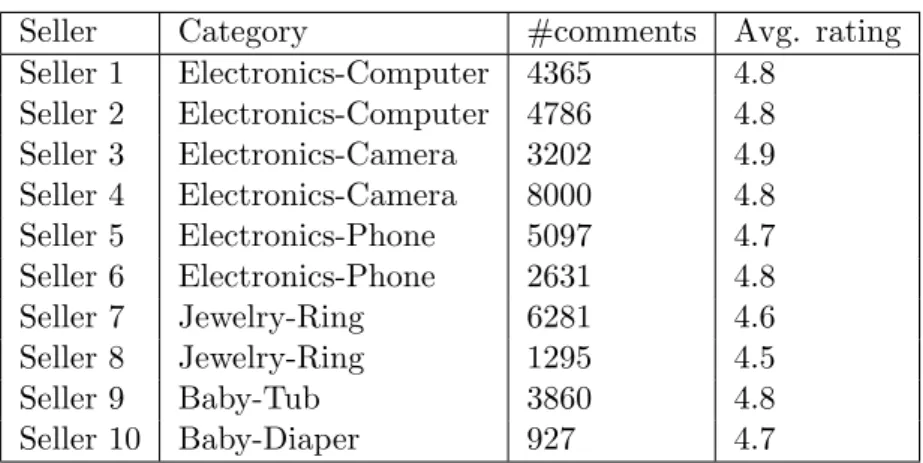
4.4.1 Datasets . . . 32
CONTENTS v
4.4.3 Evaluation of Lexical-LDA . . . 36
4.4.4 Evaluation of the trust model . . . 41
4.5 Summary . . . 44
5 DR-mining: Lexical Knowledge-based Dimension Rating Profile Analysis 46 5.1 Knowledge based dimension opinion exraction . . . 46
5.2 Computing dimension weights by matrix factorisation . . . 50
5.2.1 Singular value decomposition . . . 51
5.2.2 Computing dimension weights in the latent component space . . . 52
5.3 Experiments . . . 54
5.3.1 Accuracy of the CommTrust DR-mining algorithm . . . 54
5.3.2 Evaluation of the trust model . . . 58
5.3.3 Trust profiles for sellers . . . 60
5.4 Summary . . . 61
6 Conclusions and Future work 63
A An SVD Example 67
List of Figures
3.1 The CommTrust framework . . . 17
3.2 The dimension trust score model . . . 18
3.3 A sample of pairwise preference in user study . . . 21
4.1 Typed dependency relation analysis example . . . 26
4.2 The Lexical-LDA framework . . . 28
4.3 The RI of Lexical-LDA dimension grouping . . . 36
4.4 The accuracy of Lexical-LDA dimension grouping . . . 37
4.5 The dimension trust profiles by CommTrust Lexical-LDA for sellers . . . 44
5.1 The CommTrust DR-mining algorithm . . . 49
5.2 Latent component representations under SVD for the rating matrix . . . 51
5.3 Dimension accuracy of the CommTrust DR-mining algorithm . . . 54
5.4 Dimension rating accuracy of the CommTrust DR-mining algorithm . . . 55
5.5 The comprehensive trust profiles by CommTrust for eBay sellers . . . 58
5.6 The comprehensive trust profiles by CommTrust for Amazon sellers . . . 59
5.7 Dimension trust weight with respect to number of comments on eBay . . . . 60
List of Tables
3.1 Sample comments on eBay . . . 16
3.2 An example of dimension ratings for a seller on eBay . . . 19
3.3 Meanings of the Kappa statistics . . . 22
3.4 Seller rankings by reading comments in user studies . . . 23
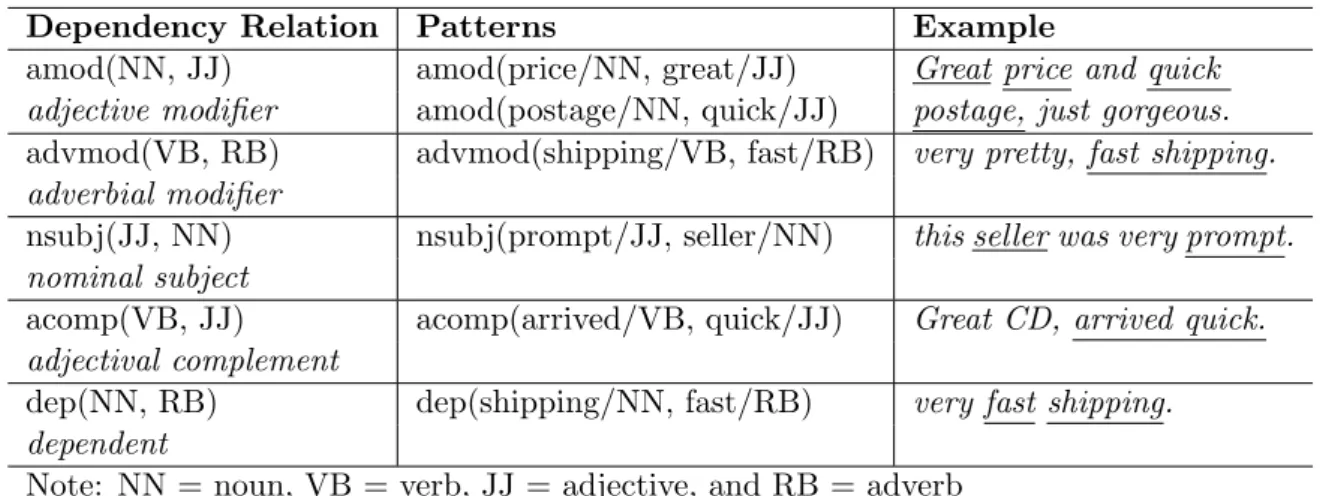
4.1 Dimension rating patterns . . . 27
4.2 The eBay dataset . . . 33
4.3 The eBay dataset of Detailed Seller Ratings . . . 33
4.4 The Amazon dataset . . . 34
4.5 The head term clusters for dimensions . . . 38
4.6 The precision of identifying different ratings . . . 40
4.7 Overall trust scores by CommTrust Lexical-LDA for ten eBay sellers . . . 40
4.8 Overall trust scores by CommTrust Lexical-LDA for ten Amazon sellers . . . 41
4.9 Unweighted overall trust scores for ten eBay sellers . . . 42
4.10 Unweighted overall trust scores for ten Amazon sellers . . . 42
4.11 The dimensional trust profiles for ten eBay sellers . . . 43
4.12 The dimensional trust profiles for ten Amazon sellers . . . 43
5.1 Dimension words . . . 47
5.2 Dimension-associated opinion expressions . . . 48
5.3 Overall trust scores and ranks for ten eBay sellers and ten Amazon sellers . . 56
5.4 Dimension trust scores for ten eBay sellers . . . 57
Abstract
Reputation-based trust models are widely used in e-commerce applications, and feedback ratings are aggregated to compute sellers’ reputation trust scores. The “all good reputation” problem however is prevalent in current reputation systems – reputation scores are universally high for sellers and it is difficult for potential buyers to select trustworthy sellers.
In this thesis, based on the observation that buyers often express opinions openly in free text feedback comments, we have proposed CommTrust, a multi-dimensional trust evaluation model, for computing comprehensive trust profiles for sellers in e-commerce applications. Dif-ferent from existing multi-dimensional trust models, we compute dimension trust scores and dimension weights automatically via extracting dimension ratings from feedback comments. Based on the dependency relation parsing technique, we have proposed Lexical-LDA (Lexical Topic Modelling based approach) and DR-mining (Lexical Knowledge based app-roach) approaches to mine feedback comments for dimension rating profiles. Both approaches achieve significantly higher accuracy for extracting dimension ratings from feedback com-ments than a commonly used opinion mining approach. Extensive expericom-ments on eBay and Amazon data demonstrate that CommTrust can effectively address the “all good reputation” issue and rank sellers effectively. To the best of our knowledge, our research demonstrates the novel application of combining natural language processing with opinion mining and summarisation techniques in trust evaluation for e-commerce applications.
Chapter 1
Introduction
1.1 Background
There has been a tremendous growth in e-commerce applications, where buyers and sellers conduct transactions on the web. Users are attracted to online-shopping not only due to the convenience in accessing the information of items on-sold, but also because of the availability of other buyers feedback on their purchasing experience, item-related and/or seller-related. All major online-shopping websites encourage buyers to provide feedback, often in the form of ratings along with some textual comments, to facilitate potential transactions.
Reputation reporting systems [Resnick et al., 2000; Xiong and Liu, 2004; Zacharia and Maes, 2000] have been implemented in e-commerce systems such as eBay and Amazon (for third-party sellers), where overall reputation trust scores for sellers are computed by aggre-gating feedback ratings. In e-commerce environments, reputation mechanisms are related to the ratings that a seller received from buyers. The ratings indicate the ability of the seller to provide satisfactory transactions in the future, which is beneficial to new buyers. For ex-ample on eBay, the reputation score for a seller is computed by aggregating buyer feedback ratings in the past 12 months, such as either the total number of positive ratings minus the total number of negative ratings or the percentage of positive ratings out of the total number of positive ratings and negative ratings.1
A well-reported issue with the eBay reputation management system is the “all good sellers” problem [Resnick et al., 2000; Resnick and Zeckhauser, 2002] where feedback ratings are over 99% positive on average [Resnick et al., 2000]. Such strong positive bias can hardly guide buyers to select sellers to transact with them. At eBay detailed seller ratings for
1
CHAPTER 1. INTRODUCTION
sellers (DSRs) on four aspects of transactions, namely item as described, communication, postage time, and postage and handling charges are also reported. DSRs are aggregated rating scores on a 1- to 5-star scale. Still the strong positive bias is present – our analysis on sample eBay data shows that on average over 60% of aspect ratings are 4.9 stars. One possible reason for the lack of negative ratings at e-commerce web sites is that users who leave negative feedback ratings can attract retaliatory negative ratings and thus damage their own reputation [Resnick et al., 2000]. Note also that DSRs are not used to compute the overall trust scores for sellers.
The textual comments can provide detailed information that is not available in ratings. Even though buyers leave positive feedback ratings, they still express some disappointment and negativeness in free text feedback comments, often towards specific aspects, or dimen-sions of transactions. For example, a comment like “The products were as I expected.” expresses positive opinion towards the Product dimension, whereas the comment “Delivery was a little slow but otherwise, great service. Recommend highly.” expresses negative opinion towards the Delivery dimension but a positive rating to the transaction in general.
There are several reasons why comments provide more reliable information. First, ordinal ratings are interpreted differently by different users. Some users tend to rate higher while others tend to rate lower. Secondly, most online shopping websites also allow sellers to rate the buyers to counter-balance the impact of malicious buyers. Since the average rating could affect the sales greatly, sellers may use this mechanism as a weapon to defend their business, rating down buyers who provide low ratings on their purchase. As such, the mechanism effectively leads to pseudo high ratings than what comments are reflecting.
From the buyer’s perspective, while the average rating may not be a fully reliable measure, it is the only easily accessible measure. Browsing through tens of pages of comments can be time consuming, and to digest the information is a daunting task, as well. This calls for a better measure to represent the reputation of seller accurately. Such reputation is sometimes referred to as trust, which is defined by Wang and Lim [2008] as “the extent to which one party measures the other party’s willingness and ability to act in the measuring party’s interest”.
By analysing the wealth of information in feedback comments we can uncover buyers’ embedded opinions towards different aspects of transactions, and compute comprehensive reputation profiles for sellers. Specifically using the positive and negative subjectivity of opinions towards aspects of transactions as dimension ratings, we propose Comment-based Multi-dimensional trust (CommTrust), a fine-grained multi-dimension trust evaluation model
CHAPTER 1. INTRODUCTION
for e-commerce applications.
1.2 Research problems
Different from existing work of computing trust from user ratings, we propose a dimensional trust model based on feedback comments. The trust is decomposed into multi-ple aspects to represent different dimensions of a transaction, including such as the quality of products or the delivery status of orders. We derive trust dimensions from textual feed-back comments and combine customer preferences on each dimension to highlight customer concerns. There are four main research questions:
1. How can multi-dimensional trust from extracted dimensions and the associated opinion polarity be computed?
In e-commerce environments different transactions may have different contexts. The trustworthiness of a seller should be related to forthcoming transactions. How to ef-ficiently compute the trust level for a seller from the sentiment expressed in buyer feedback comments and represent it effectively is our first task.
2. How can dimensions from online feedback comments that customers have expressed their opinions on be more accurately identified?
In e-commerce, sellers provide products and services, and buyers pay for them. During the process of finishing these transactions, the quality of products, communication of sellers (whether the seller has friendly communication with buyers), delivery time (whether the seller delivers items on time) and shipping charges (whether the charges are reasonable) might be some of the dimensions which buyers are interested in. In online feedback comments, different customers describe different aspects of dimensions. How to accurately identify these dimensions expressed in natural language textual comments is our second task.
3. How can weights for each dimension that extracted from feedback comments be evalu-ated?
In e-commerce, the feedback comments and ratings leaved by buyers are highly noisy. There are many comments are writen from the same buyer and therefore are highly correlated. Some buyers are lenient or harsh raters and therefore their ratings should
CHAPTER 1. INTRODUCTION
be taken with a grain of salt. How to efficiently evaluate the weights of each dimension is our third task.
4. How can sentiment from textual feedback for each dimension be more accurately classi-fied?
Sentiment classification aims to identify view-point from information expressed in text. Whether a piece of text is expressing positive or negative attitude towards associated dimensions of comments need to be identified. How to accurately classify sentiment is our fourth task.
1.3 Thesis objectives and scope
Our work aims to provide a comprehesive trust profiles for sellers that allows buyers to conduct their online shopping based on past experience. Our focus is on extracting dimension ratings from feedback comments and further aggregating these dimension ratings to compute dimension trust scores. The motivation of our research is that online feedback comments contain disdinct informatnion for users to rank sellers, therefore content of comments can be used to reliably evaluate the trustworthiness of sellers.
The contribution of this thesis are:
• We propose to use Comment-based Multi-dimensional trust (CommTrust), a fine-grained multi-dimension evaluation model, to calculate the trust for e-commerce appli-cations. While the model is potentially extensible to target item-specific trust, in this study we focus on computing comprehensive trust profile for sellers.
• We propose an algorithm to identify dimension rating expresses from feedback com-ments by applying lexicon-based opinion mining techniques [Pang and Lee, 2008] in combination with dependency relation analysis, a tool recently developed in natural language processing (NLP) [De Marneffe et al., 2006; De Marneffe and Manning, 2008].
• We tackle the four research questions by two approaches:
1. The topic modelling approach is applied to develop the Lexical-LDA algorithm for grouping dimension rating extraction and trust computation. Lexical LDA makes use of two types of lexical knowledge based on dependency relations for clustering dimension expressions into dimensions so as to produce meaningful cluster. The
CHAPTER 1. INTRODUCTION
first lexical knowledge is that the co-occurrence of dimension expressions with respect to a same modifier across comments can provide more meaningful contexts for dimension expressions, compare to add on counts of dimension expressions by comments. The second knowledge is that the dimension expressions extracted from the same comment are very unlikely about the same topic. Based on these two types of lexical knowledge, we revised Latent Dirichlet Allocation (LDA) [Blei et al., 2003] to develop the Lexical-LDA algorithm.
2. With the seed dimension words we propose Dimension Rating mining (DR-mining), a knowledge-based approach that incorporates domain knowledge, meta-data, and general grammatical patterns to accurately identifying dimension rating expres-sions from feedback comments. The matrix factorisation technique applied to automatically compute trust weights.
To the best of our knowledge, CommTrust is the first piece of work that computes fine-grained multidimensional trust profiles automatically by mining feedback comments. The rest of this thesis is organized as follows.
In Chapter 2, the necessary background knowledge of the trust evaluation, sementic analysis, and text comments mining related works is introduced.
In Chapter 3, we propose the comment-based multi-dimensional trust (CommTrust) model to identify trustworthy and reliable sellers..
In Chapter 4, we present topic modelling approach to mining feedback comments for dimension rating profiles. We propose the Lexical-LDA algorithm to conduct dimension rating extraction and trust computation.
In Chapter 5, we propose a knowledge-based approach that incorporates domain knowl-edge, meta-data, and general grammatical patterns to mining feedback comments for dimen-sion rating profiles. We formulate the problem of computing dimendimen-sion weights from ratings as a factor analytic problem and propose a matrix factorisation technique to automatically compute weights for dimensions from the sparse and noisy dimension rating matrix.
We conclude out study in Chapter 6, where the work of the thesis is summarised, par-ticularly in relation to the research questions. Furth more the future research problems are discussed.
Chapter 2
Literature Review
Related work for our research falls into four main areas: 1) computational approaches to trust, especially reputation-based trust evaluation and recent developments in fine-grained trust evaluation; 2) e-commerce feedback comments analysis and more generally mining opinions on movie reviews, product reviews and other forms of free text documents; 3) aspect opinion extraction and summarisation on movie reviews, product reviews and other forms of free text; and 4) applications of the matrix factorisation technique for recommender systems and other data mining tasks.
2.1 Computational trust evaluation
The strong positive rating bias in the eBay reputation system has been well documented in literature [Resnick et al., 2000; Resnick and Zeckhauser, 2002; ODonovan et al., 2007], although no effective solutions have been reported. Notably in [ODonovan et al., 2007] it is proposed to examine feedback comments to bring seller reputation scores down to a rea-sonable scale, where comments that do not demonstrate explicit positive ratings are deemed negative ratings on transactions. Ratings on transactions are further aggregated as the overall trust scores for sellers. In this study on the other hand, our focus is on extracting dimension ratings from feedback comments and further aggregating these dimension ratings to compute dimension trust scores.
The notion of computational trust is essential to ensure the operation of open systems. Similar to that buyers and sellers are referred to as individuals in e-commerce applications, terms like peers and agents are often used to refer to individuals in open systems in various applications in the trust evaluation literature. Trust is the subjective probability with which
CHAPTER 2. LITERATURE REVIEW
an individual assesses that another individual performs a given action [Jøsang et al., 2007]. In [Ramchurn et al., 2004] a comprehensive overview of trust models is provided. Individual level trust models are aimed to compute the reliability of peers and assist buyers in their decision making [Yu and Singh, 2002; Schillo, 2000; Sabater and Sierra, 2001] whereas system level models are aimed to regulate the behaviour of peers, prevent fraudsters and ensure system security [Ramchurn et al., 2004]. Reputation is a collective measure of trustworthiness computed from referrals or ratings from members in a community [Jøsang et al., 2007]. Reputation-based trust models are a class of trust models that aim to use public reputation profiles of peers to promote good behaviours and ensure security and reliability of open systems [Resnick et al., 2000; Ramchurn et al., 2004; Yu and Singh, 2002; Schillo, 2000; Jøsang et al., 2007; Kamvar et al., 2003; Rettinger et al., 2011; Wang et al., 2012; Xiong and Liu, 2003; 2004], and have been widely used in e-commerce systems [Resnick et al., 2006], peer-to-peer networks [Xiong and Liu, 2004], and multi-agent systems [Ramchurn et al., 2004; Wang and Singh, 2006].
Accurately computing individual reputation requires effective approaches to gathering and aggregating ratings for individuals. Rating aggregation algorithms include simple pos-itive feedback percentage or average of star ratings as in the eBay and Amazon reputation systems [Resnick et al., 2006], the Beta reputation based on statistical distribution assump-tion for ratings [Jøsang and Ismail, 2002], as well as more advanced models like Kalman inference [Wang et al., 2012], which also computes trust score variance and confidence level. More sophisticated reputation models consider factors like time, where recent feedback rat-ings carry more weights [Sabater and Sierra, 2001; Wang and Singh, 2006]. PeerTrust [Xiong and Liu, 2003; 2004] is a framework for peer-to-peer systems where contextual factors are considered for computing trust scores and weights for peers. The trust score for a peer is computed by combining a weighted average satisfaction amount that the peer receives from transactions and a weighted trust measure by community-based characteristics. Contex-tual factors considered for computing trust scores and weights include the total number of transactions a peer has completed and the credibility of feedback sources. The EigenTrust algorithm [Kamvar et al., 2003] uses a rating matrix representation for local trust scores and computes the global ratings for peers based on finding the principal eigenvector of the rating matrix. All existing models previously discussed assume that feedback ratings are readily available and focus on aggregation algorithms [Sabater and Sierra, 2001; Wang et al., 2012; Xiong and Liu, 2003; 2004; Wang and Singh, 2006]. A couple of studies focus on gathering ratings through social networks [Yu and Singh, 2002; Schillo, 2000]. Nevertherless ratings
CHAPTER 2. LITERATURE REVIEW
are assumed available rather than obtained via data mining.
The multi-dimensional approach to fine-grained trust computation has been studied in the area of agent technologies [Sabater and Sierra, 2001; Griffiths, 2005; Reece et al., 2007], where the overall reputation score for an agent is computed by aggregating dimension reputations. In [Sabater and Sierra, 2001], individual, social and ontological reputations are computed from factors such as delivery date and quality, and their ratings are then combined to form an overall score. In [Griffiths, 2005] the dimension scores are computed from direct experience of individual agents, and then aggregated by weighted summation. Reece et al. [Reece et al., 2007] presented a probabilistic approach considering the correlation among dimension during aggregation. In all these multi-dimensional trust models however, weightings for dimension trust are either not considered or assumed given.
Other approaches to fine-grained trust computation have also been proposed in liter-ature [Rettinger et al., 2011; Wang and Lim, 2008; Zhang and Fang, 2007; Zhang et al., 2012a;b], where specific factors for individual and transaction contexts are considered. How-ever, many factors considered in these models such as attributes associated with products and attributes regarding the interactions between sellers and products, are not readily available in e-commerce applications.
In CommTrust we focus on mining dimension ratings from free text comments, and furthermore our trust evaluation model computes fine-grained dimension trust scores and dimension weights, both from the dimension rating matrix obtained by mining feedback comments.
2.2 Feedback comment analysis
The success of e-commerce applications, such as eBay and Amazon, depends highly on the availability of user interaction. Usually, reputable sellers attract a large user population to transact with them and leave comments afterwards. Intuitively, one can use a reputation score to quantify how good a seller is at providing good services. However, the strong positive rating bias in reputation system has been noted in literature [Resnick et al., 2000; Resnick and Zeckhauser, 2002; ODonovan et al., 2007]. There have been studies on analysing feedback comments in e-commerce applications to capture negativity information to provide reasonable reputation range score for sellers [ODonovan et al., 2007; Gamon, 2004; Hijikata et al., 2007; Lu et al., 2009].
CHAPTER 2. LITERATURE REVIEW
ODonovan et al. [2007] and Gamon [2004] focus on sentiment classification of feedback comments. It is demonstrated that feedback comments are noisy and therefore analysing them is a challenging problem. ODonovan et al. [2007] tackled the problem of excessive positive bias of feedback ratings in eBay by extracting more negative feedback from free text comments. Comments do not demonstrate explicit positive ratings or missing aspect comments are deemed negative ratings on transactions. Ratings on transactions are further aggregated as the overall trust scores for sellers. Gamon [2004] formulated sentiment classi-fication of customer feedback comments as a special case of text categorisation. As a result, more feedback ratings are classified to be negative and the feedback ratings on eBay are brought to a more reasonable scale.
In [Hijikata et al., 2007], a technique for summarising feedback comments is presented, aiming to filter out courteous comments that do not provide real feedback. They noticed, feedback comments include not only comments presenting real opinions but also many stereo-typed sentences, clauses or phrases such as expressions for thanks or expressions of courtesy, hereinafter all of which are referred as “descriptions of courtesy”. They propose a social summarization method (SS method) for summarizing feedback comments. This method uses social relationships in an online auction for summarizing one sellers feedback comments. This method does not focus on the seller but focuses on a buyer who bought an item from the seller. This method compares the feedback comment on the target seller written by a cer-tain buyer to the feedback comments on the sellers other than the target seller written by the buyer. Then it produces a summary by extracting two types of descriptions. One is a description that appears only in the feedback comment on the target seller and the other is a description that appears in the feedback comments on the sellers other than the target seller but does not appear in the feedback comment on the target seller. By this method, the descriptions of courtesy can be eliminated without deleting descriptions which are seemed that the buyers wrote from their real feelings.
Lu et al. [2009] focuses on generating “rated aspect summary” from eBay feedback com-ments, aiming to discover different perspectives towards their aggregated ratings. This kind of decomposition is quite useful because different users may have quite different needs and the overall ratings are generally not informative enough. A statistical technique named struc-tured Probabilistic Latent Semantic Analysis (PLSA) was proposed to discover aspects and their ratings from user comments. However their statistical generative model is based regres-sion on the overall transaction ratings and the resultant aspect ratings are likely biased due to the positive bias in transaction ratings.
CHAPTER 2. LITERATURE REVIEW
With CommTrust rather than simply classifying comments into positive or negative as in [ODonovan et al., 2007], we mine the text comments to extract dimensions and their associated feedback orientations hidden in the free text, which is free from the positive bias in the overall transaction ratings. Different from [Lu et al., 2009], which adopted a statistical generative learning model, CommTrust adopts a more knowledge-based approach making use of the deeper lexical knowledge of dependency relation from the Stanford natural language parser [De Marneffe et al., 2006; Kubler et al., 2009] between candidate dimensional words and opinion words. More importantly our work aims at inferring both the dimension ratings and dimension weights rather than generating an aggregated summary inferred from overall ratings. Our approach is complementary to the statistical approach and potentially can greatly improve the computation efficiency and effectiveness of statistical models.
2.3 Aspect opinion extraction and summarisation
More generally our work is related to opinion mining and sentiment analysis on free text documents, especially opinion mining in product reviews and movie reviews. In these studies, product or movie features and the opinions towards them are extracted. Summaries are produced by selecting and re-organising sentences according to the extracted features.
Review mining and summarization is the task of producing a sentiment summary, which consists of sentences from reviews that capture the authors opinion. Review summarization is interested in features or aspects on which customers have opinions. It also determines whether the opinions are positive or negative. This makes it differ from traditional text summarization. A comprehensive overview of the field is presented in [Pang and Lee, 2008; Liu, 2012]. Most existing works on review mining and summarization mainly focus on product reviews. For example, [Hu and Liu, 2004b; Popescu and Etzioni, 2005; Shi and Chang, 2006] concentrated on mining and summarizing reviews by extracting opinion sentences regarding product aspects.
Hu and Liu [2004a;b] aim to summarize all the customer reviews of a product to help a potential customer make a decision on whether to buy the product. They proposed to extract nouns and noun phrases as candidate aspects and then apply association rule mining techniques to compute the aspects and their associated opinions. The NLProcessor linguistic parser (NLProcessor 2000) is applied to parse each sentence and identify simple nouns/noun phrases as product aspects by yielding the part-of-speech tag [Manning and Sch¨utze, 1999] of each word. Association rule mining [Agrawal and Srikant, 1994] is used to find all frequent
CHAPTER 2. LITERATURE REVIEW
itemsets (a set of words or a phrase that occurs together). They extract opinion words as nearby adjective, which adjacent adjective that modifies the noun/noun phrases that is a frequent feature. WordNet [Stark and Riesenfeld, 1998; Miller et al., 1990] is used to identify opinion orientation for all the adjectives in the opinion word list. For those adjectives that WordNet cannot recognize, they are discarded as they may not be valid words. For the case that the synonyms or antonyms of an adjective have different known semantic orientations, use the first found orientation as the orientation for the given adjective. They also checked negation words, which appearing close around the opinion word, to opposite the opinion orientation of the sentence. The close means that the word distance between a negation word and the opinion word should not exceed a threshold(they set it to 5).
Carenini et al. [2005] proposed feature extraction for capturing knowledge from product reviews. Their method is based on the results of Hu and Liu [2004b], then mapped to the user-defined taxonomy features hierarchy thereby eliminating redundancy and providing conceptual organization.
Popescu and Etzioni [2005] developed an unsupervised information extraction system called OPINE, which extracted product aspects and opinions from reviews. Similar to pre-vious works, OPINE extracts noun phrases from reviews and retains those with frequency greater than an experimentally set threshold, and then OPINEs feature assessor assesses those noun phrases for extracting explicit aspects. The assessor evaluates a noun phrase by computing a Point-wise Mutual Information score between the phrase and meronymy discriminators associated with the product class.
Somprasertsri and Lalitrojwong [2010] proposed an approach to extract product aspects and to identify the opinions associated with these aspects from reviews through syntactic information based on dependency analysis. Similar to Hu and Liu [2004a;b], they extract noun or noun phrase as a potential product aspect, adjective as a potential opinion word. The aspect-opinion pair candidates are identify by dependency path, not using the distance between adjective and noun/noun phrase.
In another domain, Zhuang et al. [2006] proposed a multi-knowledge based approach, which integrates WordNet, statistical analysis and movie knowledge, for movie review mining and summarization. They used WordNet, movie casts and labeled training data to generate a keyword list for finding aspects and opinions. The grammatical rules between aspect words and opinion words were applied to identify the valid aspect-opinion pairs.
To identify the expressions of opinions associated with aspects, some researchers consid-ered that a product aspect and its opinion words usually co-occur within a certain distance
CHAPTER 2. LITERATURE REVIEW
in the sentence. Hu and Liu [2004b] focused on adjacent adjectives that modify aspect nouns or noun phrases. They use adjacent adjectives as opinion words that associated with as-pects. Kim and Hovy [2004] explored the following four sizes of regions which may contain both of product aspects and their opinions. The four regions are: (1) full sentences; (2) words between the opinion holder and the topic; (3) region 2 +/- two words; and (4) from the first word behind the holder to the end of sentences. In other research, Popescu and Etzioni [2005] apply manual extraction rules in order to find the opinion words. This idea is similar to that of [Hu and Liu, 2004b] and [Kim and Hovy, 2004], but instead of using a window of size or adjacent adjectives they define extraction rules to find the expressions of opinions. More recently, Zhuang et al. [2006], Qiu et al. [2009], Qiu et al. [2011] and Somprasertsri and Lalitrojwong [2010] apply dependency relation analysis to extract aspect opinions. However these work do not group aspect opinion expressions into clusters.
Some work groups aspects into clusters, assuming aspect opinion expressions are given [Zhai et al., 2011]. Recently a semi-supervised algorithm [Mukherjee and Liu, 2012] was proposed to extract aspects and group them into meaningful clusters as supervised by user input seed words. Unsupervised topic modelling-based techniques have been developed to jointly model opinions and aspects (or topics), based on either the probabilistic Latent Semantic Analysis (pLSA) [Hofmann, 1999] or Latent Dirichlet Allocation (LDA) [Blei et al., 2003]. The models differ in granularities [Mei et al., 2007; Titov and McDonald, 2008b; Lin and He, 2009; Titov and McDonald, 2008a; Brody and Elhadad, 2010] and how aspects and opinions interact [Lin and He, 2009; Brody and Elhadad, 2010; Mei et al., 2007; Zhao et al., 2010]. All these exist-ing work however are based on the unigram representation of documents and none of them make use of any lexical knowledge.
There has been some recent work on computing aspect ratings from overall ratings in e-commerce feedback comments or reviews [Lu et al., 2009; Wang et al., 2010; 2011]. Their aspect ratings and weights are computed based on regression from overall ratings and the positive bias in overall ratings is not the focus.
For word sentiment classification, the basic approach is to assemble a small amount of seed words by hand, sorted by polarity into two lists - positive and negative - and then to grow this by adding words obtained from WordNet [Miller et al., 1990]. This approach assumes, synonyms of positive words are mostly positive and antonyms mostly negative. Antonyms of negative words are added to the positive list, and synonyms to the negative one. Opinion lexicons like SentiWordNet have been developed in linguistic studies, and have been widely used for various sentiment analysis tasks. SentiWordNet [Esuli and Sebastiani, 2006] is
CHAPTER 2. LITERATURE REVIEW
an opinion lexicon derived from the WordNet database where each term is associated with numerical scores indicating positive and negative sentiment information. Ohana and Tierney [2009] states the SentiWordNet lexical resource could be used as an important resource for the problem of automatic sentiment classification tasks.
In CommTrust we develop Lexical-LDA and DR-mining approaches make use of the lexical knowledge of dependency relation analysis to identify dimension ratings in feedback comments. SentiWordNet is applied to determine sentiment orientation.
2.4 Matrix factorisation
Matrix factorisation is a general factor analytic technique, and has been widely applied in various areas, especially in information retrieval [Deerwester et al., 1990] and recommender systems [Hofmann, 2004; Koren et al., 2009; Koren, 2010]. In information retrieval, latent Semantic Indexing (LSI)[Deerwester et al., 1990] is a method for automatic indexing and retrieval, where singular value decomposition (SVD) is applied to decompose a term by document matrix into a set of orthogonal factors from which the original matrix can be approximated by linear combination. Similarity between documents, queries, and terms can be easily represented as matrix algebra and used for information retrieval.
Collaborative filtering (CF) is a popular approach for recommender systems, and matrix factorization is a well-recognized approach to CF [Koren et al., 2009; Koren, 2010; Paterek, 2007; Tak`acs et al., 2007]. Given the ratings to items by users, latent factor models express both items and users on factors inferred from the patterns of ratings. User-item interactions are then represented as inner products of vectors in the new factor space. High corre-spondence between item and user factors leads to recommendation of an item to a user. Koren [Koren, 2010; 2008] proposes augmentation to standard SVD for effective prediction of ratings in CF.
In CommTrust, our application of SVD is fundamentally different from existing applica-tions. While existing applications of SVD use matrices in the reduced feature space after decomposition to compute similarity among original data objects, CommTrust computes the relative weights of original data objects in the reduced feature space. Noises are removed and correlation of data objects is considered in SVD transformation, and as a result weights computed in the new reduced feature space are more accurate description of weightings of original data objects.
Chapter 3
CommTrust: Comment-based
Multi-dimensional Trust Evaluation
We view feedback comments as a source where buyers express their opinions more honestly and openly. Our analysis of feedback comments on eBay and Amazon reveals that even if a buyer gives a positive rating for a transaction, s/he still leaves comments of mixed opinions regarding different aspects of transactions in feedback comments. Table 3.1 lists some sample comments, together with their rating from eBay. For example for comment c2, a buyer gave
a positive feedback rating for a transaction, but left the following comment: “bad communi-cation, will not buy from again. super slow ship(ping). item as described.”. Obviously the buyer has negative opinion towards the communication and delivery aspects of the trans-action, despite an overall positive feedback rating towards the transaction. We call these salient aspects dimensions of e-commerce transactions. Comment-based trust evaluation is therefore multi-dimensional. Hereafter we will use the terms opinion and rating interchange-ably to express the positive, negative and neutral polarities toward entities that expressed in natural language text.
3.1 The CommTrust model
Figure 3.1 depicts the CommTrust framework. Unlike existing trust models (including the one used on eBay) where explicit transaction feedback ratings (positive or negative) are used to compute overall trust scores for sellers. Aspect opinion expressions, and their associated ratings (positive or negative) are first extracted from feedback comments. Dimension trust scores together with their weights are further computed by aggregating dimension ratings.
CHAPTER 3. COMMTRUST: COMMENT-BASED MULTI-DIMENSIONAL TRUST EVALUATION
Table 3.1: Sample comments on eBay
No Comment eBay rating
c1 beautiful item! highly recommend using this seller! 1
c2 bad communication, will not buy from again. super slow
ship(ping). item as described.
1
c3 quick response 1
c4 looks good, nice product, slow delivery though. 1
c5 top seller. many thanks. A+ 1
c6 great price and awesome service! thank you! 1
c7 product arrived swiftly! great seller. 1
c8 great item. best seller of ebay 1
c9 slow postage, didn’t have the product asked for, but seller was
friendly.
1
c10 wrong color was sent, item was damaged, did not even fit phone. 1
Note: 1 = Positive, 0 = Neutral, -1 = Negative
The algorithm for mining feedback comments for dimension ratings and the technique for computing dimension weights will be described in Chapter 4 and Chapter 5.
Definition 3.1.1. The overall trust score T for a seller is the weighted aggregation of di-mension trust scores for the seller,
T =
m
X
d=1
td∗wd, (3.1)
wheretdandwdrepresent respectively the trust score and weight for dimensiond(d= 1..m).
The trust score for a dimension is the degree or probability that buyers express positive opinion towards the dimension, and roughly is positively correlated with the proportion of positive ratings towards the dimension. However, buyers only express limited positive or negative opinions towards some dimensions in feedback comments. Computing the trust score from a limited number of samples has a high chance of over estimate. For example, out of 1,956 feedback comments for ten eBay sellers of the transactions from 31 January to 18 March 2012, only 73 comments contain ratings towards thecommunicationdimension, where 72 are positive. The percentage of positive ratings is thus 98.6% (72 out of 73). However, this estimation is made from a limited sample of only 73 ratings. We propose to apply Bayesian adjustment to compute the trust scores for dimensions from a limited number of ratings.
Following the definition of trust by Jøsang et al. [2007], the trust score on a dimension for a seller is the probability that buyers expect the seller to carry out transactions on this
CHAPTER 3. COMMTRUST: COMMENT-BASED MULTI-DIMENSIONAL TRUST EVALUATION
Feedback comments Mining for dimension ratings Computing dimension weights Dimension trust evaluation Weighted overall
trust evaluation Seller trust profile
Figure 3.1: The CommTrust framework
dimension satisfactorily. The trust score for a dimension can be estimated from the number of observed positive and negative ratings towards the dimension. LetS={X1, ..., Xn} ben
observations of binary positive and negative ratings, whereyobservations are positive ratings.
S follows binomial distribution B(n, p). Following the Bayes rule, p can be estimated from observations and some prior probability assumption. Assuming the Beta distribution for the prior,
Beta(p|α, β) == Γ(α+β) Γ(α)Γ(β)p
α−1(1−p)β−1
where α and β are hyper-parameters expressing prior beliefs, the Bayes estimate of p is formed by linearly combining the meanα/(α+β) from prior distribution and the meany/n, as below [Casella and Berger, 1990; Heinrich, 2005]
ˆ
p= y+α
n+α+β. (3.2)
Note that the Beta distribution is a special case of the Dirichlet distribution for two dimen-sions [Heinrich, 2005].
It has been shown in the Beta reputation system [Jøsang and Ismail, 2002] that the assumption of Beta distribution for the prior belief leads to reasonable trust evaluation. The Beta reputation system adopts constant settings of α=β = 1 for Equation 3.2. We develop the approach further by introducing hyper-parameter settings forαandβto suit for a varying number of observed positive and negative ratings. It is preferable to have only one parameter for trust evaluation [Jøsang and Ismail, 2002]. With the prior belief of neutral tendency for trust, it can be assumed thatα=β. Letα+β=m, thenα=β = 1/2∗m. The trust score for a dimension is thus defined as follows:
CHAPTER 3. COMMTRUST: COMMENT-BASED MULTI-DIMENSIONAL TRUST EVALUATION 0.5 0.6 0.7 0.8 0.9 1.0 10 50 100 200 300 n value tr ust score
m= 0
m= 2
m= 6
m=10
m=20
Figure 3.2: The dimension trust score model
n=|{vd|vd= +1∨vd=−1}|, the trust score fordis:
td=
|{vd|vd= +1}|+ 1/2∗m
n+m . (3.3)
Equation 3.3 is also called m-estimate [Karplus, 1995]. According to Definition 3.1.2, td
is in the range of [0..1], and 0.5 represents the neutral tendency for trust. In Equation 3.3,m
is a hyper-parameter and can be seen as pseudo counts – 1/2∗mcounts for the positive and negative classes respectively. The higher value ofm, the more actual observations are needed to revise the natural neutral trust score of 0.5. More importantly by introducing the prior distribution using the super-parameter m, the adjustment can reduce the positive bias in ratings, especially when there are a limited number of positive and negative ratings [Resnick et al., 2000; Resnick and Zeckhauser, 2002].
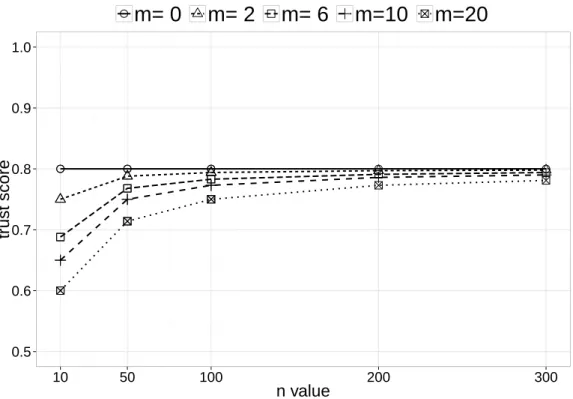
Based on our experiment datasets (1,956 feedback comments for ten eBay sellers of the transactions from 31 January to 18 March 2012) refer to Section 5.3, Figure 3.2 plots trust score td by Equation 3.3 in relation to different settings of total number of ratings n and
CHAPTER 3. COMMTRUST: COMMENT-BASED MULTI-DIMENSIONAL TRUST EVALUATION
Table 3.2: An example of dimension ratings for a seller on eBay
No Product Delivery Comm. Cost Tran. eBay Comment
c1 1 0 0 0 1 1 beautiful item! highly
recom-mend using this seller!
c2 0 0 0 0 1 1 great service
c3 0 0 1 0 0 1 quick response
c4 1 -1 0 0 0 1 looks good, nice product, slow
delivery though.
c5 0 0 0 0 1 1 top seller. many thanks. A+
c6 0 0 0 1 1 1 great price and awesome
ser-vice! thank you!
c7 0 1 0 0 1 1 product arrived swiftly! great
seller.
c8 1 0 0 0 1 1 great item. best seller of ebay
c9 -1 -1 0 0 1 0 slow postage, didn’t have the
product asked for, but seller was friendly.
c10 -1 0 0 0 0 -1 wrong color was sent, item
was damaged, did not even fit phone.
Comm.: Communication, Tran.: Transaction
other values of y/n. It shows that when the total number of observed ratings n is large (n≥300),tdis not very sensitive to the settings ofmand converges to the observed positive rating frequency of 0.8. When there is a limited number of observed ratings, that isn <300, an observed high positive rating frequency y/n is very likely an overestimation, and so m
is set to regulate the estimated value for td. With m = 2, when n ≥ 50 td ≈ 0.8. On the
other hand, with m = 20, only when n ≈ 300td ≈ 0.8. From our experiments, settings of m= 6..20 typically give stable results. By default, we set m= 6.
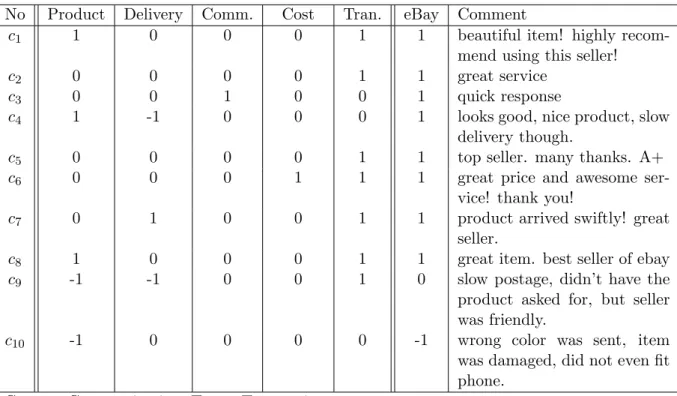
Example 3.1.1. Table 3.2 shows dimension ratings from ten feedback comments for a seller randomly selected from eBay. We annotated the commens as five dimensions correspond to the aspects of Item as described, Shipping time, Communication and Postage and handling charges of the Detailed Seller Ratings on eBay.1 In addition, users often express opinions directly towards the overall experience with transactions in comments. For example, a com-ment like “Great eBayer. A+++++” has not commented specific aspects of a transaction but rather describes an overall experience towards the Transaction. The feedback ratings
1
CHAPTER 3. COMMTRUST: COMMENT-BASED MULTI-DIMENSIONAL TRUST EVALUATION
from eBay are listed in the colomn of “eBay”.
Note that out of ten comments, only comment c3 contains opinion for Communication
and onlyc6 contains opinion for Cost. This lack of ratings for the Communication and Cost
dimensions is indeed widespread on eBay and Amazon.
Following Equation 3.3, setting m = 6 for such a small sample, the results of dimension trust scores for the dimensions Product, Delivery, Communication and Cost are 54.55%, 44.44%, 57.14% and 57.14% respectively. It is obvious that there is high variance in the dimension trust scores for this seller, from 44.44% for Delivery to 57.14% for Communication and Cost. The dimension trust scores give a comprehensive trust profile for the seller.
Assuming an equal weight of 0.25 for all dimensions in Equation 3.1, the average of dimension trust scores is 53.3%. Given that the trust score for the Delivery dimension is as low as only 44.44%, the overall trust score of 53.3% is reasonable estimate for the overall trust level for this seller. In contrast, according to the feedback ratings on eBay, the positive feedback percentage is 88.89% (eight positive ratings out of a total of nine non-zero ratings). Obviously the eBay positive feedback percentage score is inflated due to the strong positive bias in limited number of nonzero ratings. On the other hand, the overall trust score from transaction ratings by Equation 3.3 is 76.92% (seven positive ratings out of a total of seven non-zero ratings), which still can not bring down the overall trust score to a reasonable level. CommTrust can significantly reduce the strong positive bias in eBay reputation systems, and solve the “all good sellers” problem. With CommTrust, seller ratings are regulated to a more reasonable level and truly reputable sellers are effectively differentiated from irreputable sellers.
3.2 A user study
A user study was conducted to elicit users ranking of sellers from reading feedback comments, which was also used as the ground truth for evaluating the CommTrust multi-dimensional trust evaluation model. Inspired by evaluation techniques from the Information Retrieval community [Thomas and Hawking, 2006], experiment participants are asked to judge differ-ences rather than make absolute ratings. For ten sellers, each seller is paired with every other seller and form 45 pairs. The orders for pairs and for sellers within pairs were randomised to avoid any presentational bias. Each pair was judged by five users and a seller preferred by at least three users was seen as a vote for the seller. The total number of preference votes from 45 pairs for each seller were used as the preference score to rank sellers.
CHAPTER 3. COMMTRUST: COMMENT-BASED MULTI-DIMENSIONAL TRUST EVALUATION
Select the more trustworthy seller
Seller A
Negative poor item 12 wrong size 10 slow shipping 1 …. Positive great item 762 great seller 1309 fast postage 1155 … +ve percengage delivery 7325 99.88% item 3123 96.18% seller 11450 99.36% transction 1568 99.94%
Seller B
Negative inaccurate description 3 wrong phone 17 slow shipping 12 … Positive great product 787 described item 720 great phone 684 … +ve percengage shipping 8845 99.63% item 4051 93.88% seller 14683 99.46% condition 731 97.86%Figure 3.3: A sample of pairwise preference in user study
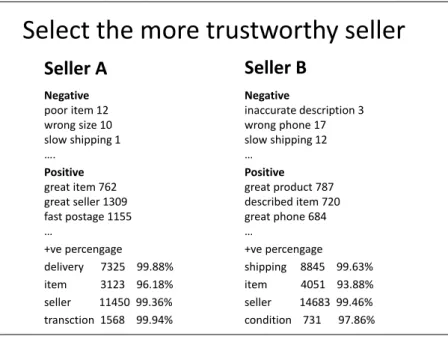
It is infeasible to ask participants to read all comments for two sellers and choose a preferred seller. We therefore generated summaries of comments for sellers. The comment summaries for each pair of users were presented side by side to elicit users preference judge-ments. For a seller, we generated opinionated phrases for four dimensions, where positive and negative phrases for each dimension are ordered by decreasing frequency. The three most frequent positive and negative phrases for each dimension formed the summary for a seller. An example page for the survey is shown in Figure 3.3.
In this user study, the degree of agreement among five users annotation is evaluated by the Kappa statistics [Fleiss, 1971]. The following equation shows how the overall value of kappa is calculated:
k= Po−Pe 1−Pe
wherePodenotes the observed agreement, andPedenotes the expected agreement. The kappa values range from -1 to +1. Landis and Koch [1977] interpreted kappa statistics as shown in Table 3.3. On the eBay data dataset, k= 0.58, and on the Amazon dataset, k= 0.63. The user annotation in our experiments falls in moderate to substantial agreement.
The ultimate goal of trust evaluation for e-commerce applications is to rank sellers and help users select trustworthy sellers to transact with. In this respect, in addition to absolute trust scores, relative rankings are more important for evaluating the performance of different
CHAPTER 3. COMMTRUST: COMMENT-BASED MULTI-DIMENSIONAL TRUST EVALUATION
Table 3.3: Meanings of the Kappa statistics
Kappa value Agreement level
<0 poor agreement [0,0.2) slight agreement [0.2,0.4) fair agreement [0.4,0.6) moderate agreement [0.0,0.8) substantial agreement [0.8,1) almost perfect agreement
trust models. To this end, we employ Kendall’sτ [Sheskin, 2004] to measure the correlation between two rankings based on the number of pairwise swaps that is needed to transform one ranking into another. Kendall’sτ measures the degree of two sets of ranks with respect to the relative ordering of all possible pairs. In other words it is the difference between the probability that the observed data are in the same order versus the probability that the ovserved data are not in the same order. The following equation shows how Kendall’s τ is the probability of the difference of the concordant pairs and the discordant pairs.
τ = nC−nD
n(n−1)/2 where:
nC is the number of concordant pairs of ranks
nD is the number of discordant pairs of rands
[n(n−1)]/2 is the total number of possible pairs of ranks
A concordant pair is when the rank of the second variable is greater than the rank of the former variable. A discordant pair is when the rank is equal to or less than the rank of the first variable.
The value ofτfalls in [−1,1], a positive value indicates positive correlation, zero represents independence and a negative value indicates negative correlation. Whenτ = 1, indicates the complete agreement among the rankings (i.e., all of the pairs of ranks are concordant), and when τ =−1, indicates the complete disagreement among the rankings (i.e., all of the pairs of ranks are discordant).
τ is the standard metric for comparing information retrieval systems, and it is generally considered thatτ ≥0.9 for a correlation test suggests two system rankings are equivalent. A large value for|τ|withp≤0.05 suggests that two rankings are correlated, and a small value for|τ|withp >0.05 suggests that two rankings are generally independent.
CHAPTER 3. COMMTRUST: COMMENT-BASED MULTI-DIMENSIONAL TRUST EVALUATION
Table 3.4: Seller rankings by reading comments in user studies
eBay seller eBay rank Comment rank
Amazon seller Amazon rank Comment rank Seller 1 6 6 Seller 1 5 5 Seller 2 8 5 Seller 2 4 6 Seller 3 10 10 Seller 3 7 2 Seller 4 4 2 Seller 4 1 1 Seller 5 7 3 Seller 5 3 8 Seller 6 5 1 Seller 6 8 7 Seller 7 9 7 Seller 7 2 4 Seller 8 1 9 Seller 8 9 9 Seller 9 2 4 Seller 9 6 3 Seller 10 3 8 Seller 10 10 10
Kendall’s τ=0.1111,p-value=0.7275 Kendall’sτ=0.4222,p-value= 0.1083
rank-diff=3 rank-diff=1.8
Results from the experiment for eBay and Amazon sellers are summarised in Table 3.4. Under the column heading of Comment rank is the ranking of sellers by user preferences after participants read the comment summaries for sellers. The eBay rank and the Amazon rank are based on our experiment data, refer to Section 4.4.1. The eBay rank is calculated based on the total number of positive and negative feedback ratings for transactions in the last 12 months, that is the percentage of positive ratings out of the total number of positive ratings and negative ratings. Note that this score is very close to that computed by Equation 3.3, especially when the sample size is large. The Amazon rank is the ranking of sellers by the average rating in the past 12 months. The correlation between rankings are measured by Kendall’s τ. The rank difference between two ranking vectors is defined as:
rank-diff = P
irank(i)−rank0(i) N
where rank(i) and rank’(i) are respectively the rank for seller i by two ranking methods, and N=10. The low Kendall’s τ value (0.1111 and 0.4222) and high p-value (0.7275 and 0.1083) suggest that on eBay and Amazon, user preference rankings after reading comment summaries are not strongly correlated with the rankings by the respective eBay and Amazon reputation systems. This suggests that the comments contain distinct information for users to rank sellers. The ranking difference of 3 for ten eBay users between rankings by reading comments and by eBay reputation system suggests that on average there is a difference of 3 ranks for sellers by the two approaches. Similarly for Amazon sellers there is difference of
CHAPTER 3. COMMTRUST: COMMENT-BASED MULTI-DIMENSIONAL TRUST EVALUATION
1.8 ranks on average. Our user study demonstrates that it can be speculated that content of comments can be used to reliably evaluate the trustworthiness of sellers, which is the objective of CommTrust.
3.3 Summary
In this chapter we have proposed comment-based multi-dimensional trust model, computing overall and dimensional turst scores from feedback comments. Based on an example of dimension ratings for an eBay seller, the CommTrust can significantly reduce the strong positive bias in eBay reputation systems and solve the “all good sellers” problem.
We have performed a user study. In this user study, the users are given the summary of comments from 45 pairs of ten different sellers, and they had to choose which seller is more trustworthy. The findings showed that the ranking from the user study is different from the ranking from eBay and Amazon for the same seller.
Given that the user comments are very rich and diverse, we have proposed CommTrust to identify trustworthy and reliable sellers. In the next chapter, more detailed discussion will be presented on how to mine the comments to extract the dimension and dimension ratings from the comments, and the finds of CommTrust Lexical-LDA.
Chapter 4
Lexical-LDA: Mining Feedback
Comments for Dimension Rating
Profile by Lexical Topic Modelling
Our research questions are focused on how to extract dimension ratings from feedback com-ments and further aggregating these dimension ratings to compute dimension trust scores. Therefore we proposed CommTrust Lexical-LDA to solve our research questions.
We will first describe our approach based on the typed dependency analysis to extracting dimension expressions and identifying their associated ratings. Topic modelling is a principled approach to group terms of the same topic into one group [Zhai et al., 2011]. We then propose an algorithm based on popular topic modelling method that Latent Dirichlet Allocation (LDA) [Blei et al., 2003] for grouping dimension expressions into dimensions and computing dimension weights. This approach can achieve stable performance across domains, and the features used are more transparent to a human user.
4.1 Extracting aspect expressions and ratings by typed dependency analysis On e-commerce sites like eBay and Amazon, user feedback comments are generally short, and very often are phrases or short sentences. Our analysis reveal that these short sentences and phrases can be accurately described usingdependency relations [De Marneffe and Manning, 2008] in natural language parsing. Based on the parsing results of dependency relations, we can identify dimension-rating patterns that describe dimensions and associated ratings.
CHAPTER 4. LEXICAL-LDA: MINING FEEDBACK COMMENTS FOR DIMENSION RATING PROFILE BY LEXICAL TOPIC MODELLING
Dependency Relations amod(NN, JJ) nsubj(JJ, NN) amod(NN, JJ) root(ROOT-0, shipping-3) amod(shipping-3, super-1) amod(shipping-3, quick-2) root(ROOT-0, excellent-3) nsubj(excellent-3, product-1) cop(excellent-3, was-2) root(ROOT-0, deal-3) det(deal-3, a-1) amod(deal-3, great-2) root(ROOT-0, all-1) num(star-3, 5-2) dep(all-1, star-3) 1. super/JJ 2. quick/JJ 3. shipping/NN 1. product/NN 2. was/VBD 3. excellent/JJ 1. a/DT 2. great/JJ 3. deal/NN 1. all/DT 2. 5/CD 3. star/NN
NN: noun; JJ: adjective; VBD: verb past; DT: determiner; CD: cardinal number.
Comment: “Super quick shipping. Product was excellent. A great deal. ALL 5 STAR.”
Figure 4.1: Typed dependency relation analysis example
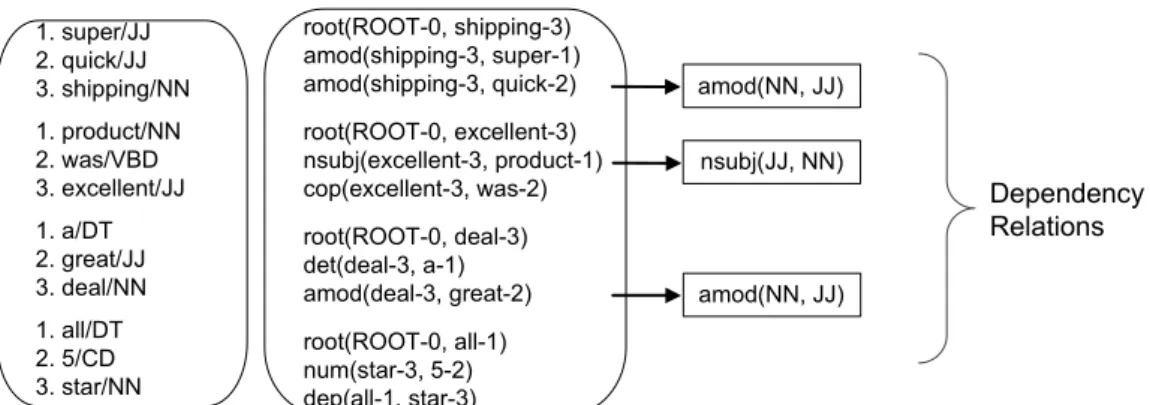
The typed dependency relation representation [De Marneffe and Manning, 2008] is a recent Natural Language Processing ( NLP ) tool to help understand the grammatical re-lationships in sentences. All information in a sentence is represented as binary relations between pairs of words while ignoring linguistic details that are not relevant to users. With typed dependency relation parsing, a sentence is represented as a set of dependency relations between pairs of words in the form of (head, dependent), where content words are chosen as heads, and other related words depend on the heads. Figure 4.1 shows an example of analysing the comment “Super quick shipping. Product was excellent. A great deal. ALL 5 STAR.” using the Stanford typed dependency relation parser. The comment comprises four sentences, and the sentence “Super quick shipping.” is represented as three dependency relations. shippingdoes not depend on any other words and is at the root level. The adjective modifier relations amod (shipping-3, super-1) and amod (shipping-3, quick-2) indicate that
super modifiesshipping and quick modifiesshipping. The number following each word (e.g., shipping-3) indicates the position of this word in a sentence. Words are also annotated with their Part of Speech (POS) tags such as noun(NN), verb (VB), adjective (JJ) and adverb (RB).
If a comment expresses opinion towards dimensions then the dimension words and the opinion words should form some grammatical dependency relations expressing the modifying relationship. It has been reported that phrases formed by adjectives and nouns, and verbs and adverbs express subjectivity [Turney, 2002]. Among the dependency relations expressing grammatical relationships, we select the relations that express the modifying relation between adjectives and nouns, and adverbs and verbs, as determined by the dependency relation
CHAPTER 4. LEXICAL-LDA: MINING FEEDBACK COMMENTS FOR DIMENSION RATING PROFILE BY LEXICAL TOPIC MODELLING
Table 4.1: Dimension rating patterns
Dependency Relation Patterns Example
amod(NN, JJ) amod(price/NN, great/JJ) Great price and quick adjective modifier amod(postage/NN, quick/JJ) postage, just gorgeous.
advmod(VB, RB) advmod(shipping/VB, fast/RB) very pretty, fast shipping. adverbial modifier
nsubj(JJ, NN) nsubj(prompt/JJ, seller/NN) this seller was very prompt. nominal subject
acomp(VB, JJ) acomp(arrived/VB, quick/JJ) Great CD, arrived quick. adjectival complement
dep(NN, RB) dep(shipping/NN, fast/RB) very fast shipping. dependent
Note: NN = noun, VB = verb, JJ = adjective, and RB = adverb
parser. Based on our analysis of a sample dataset of 1956 eBay feedback comments for 10 eBay sellers, five types of dependency relations are found to frequently express dimension rating patterns (DR-patterns), as listed in Table 4.1. It can be seen that with the modifying relations generally the noun or verb expresses the target concept under consideration whereas the adjective or adverb expresses opinion towards the target concept. With the example comment in Figure 4.1, the dependency relations adjective modifier amod (NN, JJ) and normal subject nsubj (JJ, NN) suggest DR-patterns (shipping, super), (shipping, quick),
(excellent, product)and(deal, great). DR-patterns comprise a dimension word and an opinion word. We also call dimension word ashead term, opinion word asmodifier term, and the pair of (head term, modifier term) as dimension expression or aspect expression. For example, with the DR-pattern amod (price/NN, great/JJ), “price” is the head dimension word while “great” is the dependent opinion word.
Ratings from DR-patterns towards the head terms are identified by identifying the prior polarity of the modifier terms by SentiWordNet [Baccianella et al., 2010], a public opinion lexicon. The prior polarities of terms in SentiWordNet include positive, negative or neutral, which corresponds to the ratings of +1, -1 and 0. More detailed information will be descussed in Section 4.3.
The negation relation (neg()) from the Stanford parser is used to detect any negation of ratings in DR-patterns. We go through the dependency relations for DR-patterns for the negation modifierneg()of the head or dependent. If either the head or dependent word of a DR-pattern involves theneg()relation, the relevant rating is inverted. For example, a buyer of eBay wrote the comment “after five days waiting, the item is not available.”. Applying the
CHAPTER 4. LEXICAL-LDA: MINING FEEDBACK COMMENTS FOR DIMENSION RATING PROFILE BY LEXICAL TOPIC MODELLING
(fast, shipping) (not-good, seller) (great, price) (poor, item)
Dimension expressions:
LDA Clusters for dimensions
Weight factor
Figure 4.2: The Lexical-LDA framework
typed dependency relation parser, we can get “num(days-3, five-2),prep after(available-10, days-3),partmod(days-3, waiting-4),det(item-7, the-6),nsubj(available-10, item-7), cop(available-10, is-8), neg(available-10, not-9), root(ROOT-0, available-10) ”. The POS tags of this comment are “ after/IN, five/CD, days/NNS, waiting/VBG, the/DT, item/NN, is/VBZ, not/RB, available/JJ”. The suggested pair from DR-patterns isnsubj(available, item). The negation relation neg(available, not) modifies the word available from suggented pair. The extracted expression is (item, available, neg).
Ratings from dimension expressions towards the head terms are identified by identifying the prior polarity of the modifier terms by SentiWordNet, a public opinion lexicon. The prior polarities of terms in SentiWordNet include positive, negative or neutral, which corresponds to the ratings of +1, -1 and 0. Negations of dimension expressions are identified by theNeg()
relation of the dependency relation parser. When a negation relation is detected the prior polarity of the modifier term is inverted.
4.2 Grouping dimension expressions into dimensions
For obvious topic modelling is a model for automatic discovering granularity “topics”. We propose the Lexical-LDA algorithm to group aspect expressions into semantically coherent categories, which we call dimensions. Different from the conventional topic modelling app-roach, which takes the document by term matrix as input, Lexical-LDA makes use of shallow lexical knowledge of dependency relations for topic modelling to achieve more effective clus-tering. Figure. 4.2 depicts the Lexical-LDA framework.
We make use of two types of lexical knowledge to “supervise” grouping dimension ex-pressions into dimensions so as to produce meaningful clusters.
CHAPTER 4. LEXICAL-LDA: MINING FEEDBACK COMMENTS FOR DIMENSION RATING PROFILE BY LEXICAL TOPIC MODELLING
informative. We instead use the co-occurrence of dimension expressions with respect to a same modifier across comments, which potentially can provide more meaningful contexts for dimension expressions.
• We observe that it is very rare that the same aspect of e-commerce transactions is commented more than once in the same feedback comment. In other words, it is very unlikely that the dimensions expressions extracted from the same comment are about the same topic.
With the shallow lexical knowledge of dependency relation representation for dimension expressions, the clustering problem is formulated under topic modelling as follows: the di-mension expressions for a same modifier term or negation of a modifier term are generated by a distribution of topics, and each topic is generated in turn by a distribution of head terms. This formulation allows us to make use of the structured dependency relation rep-resentations from the dependency relation parser for grouping. Input to Lexical-LDA are dependency relations for dimension expressions in the form of(modifier, head)pairs or their negations, like(fast, shipping) or(not-good, seller).
Gibbs sampling has been proposed as approximate inference for LDA [Griffiths and Steyvers, 2004]. A detailed description of the derivation process for a Gibbs sampler for LDA is given in [Heinrich, 2005], while we only present the results below. Let M,K and V
denote respectively the number of documents, the number of topics and the number of word tokens in the vocabulary. Let also that~αandβ~ respectively be the hyper-parameters on the mixing proportions for topics and on the mixture components of topics. Equation 4.1 below is the update equation for computing the full conditional distribution of a word token wi for
a topic k, where i = (m, n) denote the nth word in the mth document, w~ = {w
i = t, ~w¬i}, ~
z={zi =k, ~z¬i} and n(.,.¬)i denote counts, token iis excluded from the corresponding
docu-ment or topic, and the hyper-parameters are omitted.
p(zi =k|~z¬i, ~w)∝ n(k,t)¬i+βt PV t=1(n (t) k,¬i+βt) . n (k) m,¬i+αk PK k=1(n (k) m,¬i+αk) (4.1)
The second type of lexical knowledge that generally two head terms from the same com-ment are for different dimensions is applied in LDA as a weight factor for adjusting the conditional probability for assigning head terms for a modifier term to dimensions. Specifi-cally, for a head term wi with indexi= (m, n), in computing the conditional probability for assigningwi to topick, we consider the evidence as presented by the head terms appearing