Association for Information Systems
AIS Electronic Library (AISeL)
MCIS 2017 Proceedings
Mediterranean Conference on Information Systems
(MCIS)
9-2017
Mobile Marketing Tools And The Consumer
Decision-Making Process
Athanasios Patsiotis
Deree, ACG, [email protected]
Marwan Atik
Free Studio, L.L.C., [email protected]
Follow this and additional works at:
http://aisel.aisnet.org/mcis2017
This material is brought to you by the Mediterranean Conference on Information Systems (MCIS) at AIS Electronic Library (AISeL). It has been accepted for inclusion in MCIS 2017 Proceedings by an authorized administrator of AIS Electronic Library (AISeL). For more information, please [email protected].
Recommended Citation
Patsiotis, Athanasios and Atik, Marwan, "Mobile Marketing Tools And The Consumer Decision-Making Process" (2017).MCIS 2017 Proceedings. 29.
1
MOBILE MARKETING TOOLS AND THE CONSUMER
DECISION-MAKING PROCESS
Research full-length paper
Track N°09
Patsiotis, Athanasios, Deree, ACG, Athens, Greece, [email protected]
Atik, Marwan, Free Studio, L.L.C., Lebanon, [email protected]
Abstract
This paper explores the influence of mobile marketing tools in the consumer decision-making process. The aim is to provide a better understanding of consumer mobile shopping behaviour. There is limited research on this topic, which mainly explains the use of qualitative method in this study. The dining industry in Lebanon provides the respective service and geographic research contexts for this exploratory study. In-depth interviews conducted with a purposive sample of service providers and consumer opinion leaders. Their views were contrasted. The results show that there is limited use of the traditional mobile marketing tools and a shift from traditional mobile tools to modern or more trendy ones was noticed (e.g., Push Notifications instead of SMS). Moreover, it is found that mobile tools influence consumer shopping differently and their effect varies given the customer type. The decision-making process of loyal customers and influencers is more affected by mobile marketing tools than the regular or ordinary customers. In addition, in some cases mobile marketing may speed up the shopping process and may encourage impulse purchases. Marketers should be aware of the different mobile tools and know how and when to use them to develop effective targeting campaigns.
Keywords: mobile marketing, mobile tools, consumer behaviour, customer loyalty
1 Introduction
Mobile marketing is an important tool for marketers, whether they are seeking one-to-one or mass communication (Watson, McCarthy and Rowley, 2013). It can be utilized for several purposes, primarily to increase consumers' brand engagement through SMS. This topic was the focus of numerous studies that started exploring consumers' mobile device adoption, since it has a direct impact on mobile marketing use. As the mobile gained popularity marketers begun to apply mobile features in their marketing campaigns. Undoubtedly, mobile use has increased dramatically during the recent years. One of the reasons is that telecom operators, keep on adding new services and features to encourage further the mobile adoption (Bauer et al., 2005), similarly, phones manufacturers. According to the International Telecommunications Union, currently, mobile broadband networks cover eighty-four percent of the world's population (ITU, 2016). Nevertheless, only forty-seven percent use the Internet (ITU, 2016). Concerning developing countries, twenty percent of the residents are not using mobile phones (ITU, 2016). This highlights the complexity of mobile marketing as it shows that the factors that influence its effectiveness are multidimensional. From one side, it depends on the adoption rate of the mobile as a device, the internet service, the marketing services, and the mobile marketing tools. From the other side, it is affected by consumers' attitude towards those services and tools. Not to mention internal attributes related to the product, service, customers' satisfaction, etc. Nowadays, the smartphone has replaced the traditional mobile device as a sequential and more advanced technological interface. Persaud and Azhar (2012) argue that the increase in smartphones capacity and adoption rate creates endless possibilities for marketers (Persaud and Azhar, 2012). Compared to other new media, smartphones have perhaps the ultimate marketing potential, however, according to Friedrich
2
et al. (2009) this channel is growing so fast that even the best marketers are not able to fully understand it and benefit from it (Friedrich et al., 2009). Nielsen (2014) reveals that in the USA, and the UK consumers' use of smartphones' web browsers has exceeded their usage of computer-based browsers (Nielsen, 2014). This shift of online marketing from desktop and laptops computers to mobile devices, and the drastic increase in mobile usage among consumers would set new rules for marketers. Consequently, new marketing methods and strategies shall be adopted. Despite this foreseen advantage, there is limited research about mobile marketing in general and particularly smartphone marketing (Shankar and Balasubramanian, 2009; Watson et al., 2013). In the meantime, most studies related to this field are based on standard mobile phone, while today most people own a smartphone. Kim and Law (2015) argue that there is also a lack of studies that explore mobile marketing from marketers' viewpoint (Kim and Law, 2015). Additionally, the fact that mobile technology is evolving fast is probably rendering a large number of previous studies obsolete. Thus, it is crucial to explore this topic further, especially that many firms doubt the effectiveness of mobile marketing (Bart, Stephen and Sarvary, 2014). Surprisingly, Shankar and Balasubramanian (2009) paper reveals that most consumers showed little receptiveness towards mobile marketing. Therefore, and based on this insight, the current paper has focused on the minority of the population which is supposed to be interested in and receptive to mobile marketing. It also attempted to investigate a literature gap identified by Shankar and Balasubramanian (2009), which refers to the effect of mobile marketing on the different stages of the purchase decision-making process.
The purpose of this study is to provide a better understanding of consumer mobile shopping behaviour. In that respect, it examined the impact of mobile applications in the consumer decision-making process. This was addressed by two research questions:
RQ1. Which are the mobile tools that consumers use for shopping?
RQ2. What is the influence of those tools in the consumers’ decision-making process? Most, previous studies related to Mobile Marketing are based on western markets that are usually more advanced in term of technology such as Internet infrastructure/speed, and where the society has a different influence over consumers. The dining industry in Lebanon (upscale casual diners, casual diners and the fast food restaurants) provided the context for this investigation, considering the Lebanese as a collectivist society (Hofstede, Hofstede and Minkov, 2010), where people regularly eat out in groups of family or friends. Thus, dining was explored as a social event. It is also assumed that mobile marketing may suit some industries more than others (Bart et al., 2014), and the dining industry could provide a useful context. In the following sections, first a literature review presents relevant existing research, second there is an explanation of the method employed, next there is a discussion of findings, and finally conclusions are drawn and implications for further research and for practice are noted.
2 Literature review
2.1 Mobile marketing
SMS is perhaps the first mobile-specific feature used in marketing. According to Okazaki (2005), SMS is the most popular among mobile marketing tools (Okazaki, 2005). One of the earliest studies on SMS marketing effectiveness revealed that companies used SMS mainly to build a brand, communicate an offer, or vote in a contest (Barwise and Strong, 2002). In addition, there are concerns that SMS is limited in terms of multimedia (Shankar, and Balasubramanian, 2009). In contrast, today many mobile applications such as Whatsapp are providing advanced messaging platforms, which may have reduced the popularity of the SMS. With the introduction of smartphones, the mobile-specific functions and services have
3
augmented considerably, and today mobile applications became countless. Interestingly, most of those tools can be used in marketing. Nevertheless, each of them may have different applications. This fact gave marketers the opportunity to apply and combine their methods. Therefore, it can be argued that smartphones have paved the way for mobile marketing. The literature examined extensively the factors that influence mobile marketing acceptance (e.g., Faheem and Yasir, 2010; Hanley, Becker and Martinsen, 2006). However, mobile marketing can be divided into two categories, the 'push' and the 'pull' advertising. Push mobile advertising is the act of sending consumers unsolicited advertisements directly to their phones. In contrast, pull marketing generates demand; it encourages people to request or seek the service on their own (Dickinger et al., 2004). Therefore, some mobile tools are employed for push (e.g. SMS and MDAs), and some others are utilized to facilitate access to marketing information related to a brand (e.g. Mobile apps and QR code). This implies that consumers would have different attitudes and opinions about each tool. Consequently, they may prefer to adopt a set of tools over another. Obviously, push marketing is likely to invade consumer’s privacy; this has led researchers to consider the permission-based mobile marketing. Meaning that consumer would have the possibility to opt-in or out of receiving the service. Or else, control the content, the message timing (Stewart and Pavlou, 2002; Watson et al., 2002) or the frequency (Blomqvist, Hurmelinna and Seppanen, 2005).
Studies also underlined some negative aspects of mobile marketing. For instance, negative perceptions associated with intrusion (Monk et al., 2004) and annoyance (Muk, 2007). From a supplier perspective, numerous companies doubt the effectiveness of mobile advertising. For instance, Ma, Suntornpithug and Karaatli (2009) concur that not all mobile marketing campaigns proved to be favorable. Moreover, according to Bart et al. (2014), many organizations believe that mobile marketing is not effective for their product. Watson et al. (2013) confirm the negative attitude of consumers towards mobile marketing communication. They suggest that mobile users prefer to have control over the interaction with the firms, thus, marketers need to emphasize permission marketing and to build trust. According to them, pull marketing may help to resolve this problem. In this regard, the present paper does not focus on the segment that has a negative attitude towards Mobile Marketing. Instead, the attention is centered towards the audience that has a positive attitude.
Research on consumer acceptance of mobile marketing has mainly focused on the influencing factors. The majority of those studies are based on frameworks that derive from the Theory of Reasoned Action (TRA) (Ajzen and Fishbein, 1980), the Theory of Planned Behaviour (TPB) (Ajzen, 1991), the Technology Acceptance Model (TAM) (Davis, 1989; Davis, Bagozzi, and Warshaw, 1992) and several TAM extensions (e.g., Venkatesh, 2003), and the innovation characteristics (Rogers, 2003) (e.g., Mallat, 2007; Pagani, 2004; Shankar and Balasubramanian, 2009; Sultan, Rohm, and Gao, 2009; Zhang and Mao, 2008). A recent study on consumer m-shopping behaviour provides an extensive literature review of extant relevant research (Marriott, Williams and Dwivedi, 2017). The above studies either examined consumer attitudes towards mobile marketing in general regardless of the forms of communication or tools, or examined some of the most popular methods used in mobile marketing, such as text messaging, integrated content, games, geotargeting, and telemarketing (e.g., Shankar and Balasubramanian, 2009). Additionally, they have stressed the importance of social networking and location-based services and called marketers to identify opportunities in those fields (Shankar and Balasubramanian, 2009). There is also a limited number of studies on mobile marketing in the Hospitality industry (Kwon et al., 2013). Several of the above studies also proposed further research inquiry on the different mobile marketing tools. However, according to the best of our knowledge, there is no research evidence on the effect of mobile marketing on the different stages of the purchase decision-making process. The consumer buying behavior model of Engel, Blackwell and Kollat (1968) is the most commonly used model to evaluate consumers’ purchase decision-making process (e.g., Mothersbaugh and Hawkins, 2016). The model breaks decision-making down into five discrete but interlinked stages, namely, problem/need recognition, information search,
4
evaluation of alternatives, purchase decision, and post-purchase behavior. It should be noted that consumers do not necessary go through all stages or follow the same sequence (Kotler et al., 2009). Moreover, research has examined the dining decision-making in a family context (Chen et al., 2016). The role of the mother in the 'information search' stage, the influence of children, as well as the role played by the father in the final decision were emphasized (Chen et al., 2016). Consequently, the family decision can be viewed as a group decision-making. Group decision making is perhaps more adequate in the dining decision-making as it's rare for someone to dine out alone, thus dining out is considered as a social event (Longart, 2015). Hence, it's interesting to know the role of the group leader, the influencers and the rest of the group members.
2.2 Mobile marketing tools and services
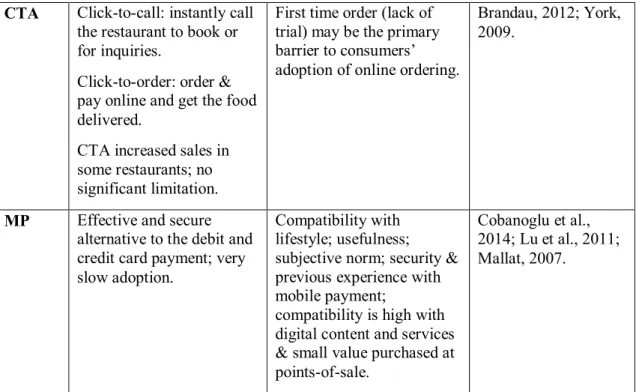
Several tools and applications are now provided to consumers by the smartphone. Mobile marketing became popular since its basic form, the SMS, was introduced in 2000 (McCorkle et al., 2013). While SMS is now one of the mobile marketing tools that are considered successful, it seems that it has reached the majority of adoption. Our review of the relevant literature reveals that excluding SMS, only a small number of studies have explored specific mobile features (e.g. QR code, mobile loyalty apps, and mobile payment). Consequently, the influence of mobile marketing on the decision-making process was overlooked (Shankar and Balasubramanian, 2009). Table 1 below presents key findings of the literature related to the different mobile tools examined across different contexts. The benefits and limitations, as well as the factors influencing acceptance are summarized for the following tools: SMS, Mobile Display Advertising (MDA), Mobile apps (M-apps), Camera & QR Code, Mobile Loyalty Programs (MLP), Location-based Services (LBS), Call-to-Action tools (CTA), and mobile payment (MP). M-apps, QR Code, LBS, CTA, and MP are considered as pull marketing technologies, which are not intrusive and users have control over them. The rest of the mobile tools are push marketing technologies that face a continuous consumer resistance.
2.3 Restaurant typology
Muller and Woods (1994) are among the first to classify restaurants. However, due to the constant evolution of the industry, this classification was replaced or amended. Walker (2014) suggests three categories: (1) fine dining, (2) casual dining, and (3) quick service/fast-food restaurants. Mehta and Maniam (2002) define fine dining as the most formal dining experience where service, elegance, and location are important (Mehta and Maniam, 2002). However, this type will be out of the scope of this study. In casual diners, the atmosphere is more relaxed, and they normally cater to mid-scale consumers; however, some of those restaurants target upscale customers. Therefore, in this paper, casual diners were divided into two categories, (1) casual, and (2) upscale casual. Fast-food restaurants are chains specialized in meals prepared to be consumed on or off site, their preparation time is minimal, and are affordable (Mehta and Maniam, 2002). On a separate note, it's worth mentioning that some studies consider a more detailed classification (e.g. Lundberg, 1994).
3 Research method
3.1 Data collection & sampling
The literature review revealed that the adoption of mobile tools, in general, is slow and limited. Consequently, a small part of the population is using/accepting mobile marketing. Hence, it's better to identify those individuals and gain from them in-depth information. In addition, there is absence of empirical evidence of the effect of mobile marketing on the different stages of the purchase decision-making process. These factors suggest the use of qualitative methods of data collection (Creswell, 1994; Hair et al., 2012; Patton, 2002). Data was collected from qualitative interviews that focused on mobile marketing tools. Primary data was gathered from two different sources: (1) marketing managers and (2) various types
5
M-Tools
Benefits & limitations Acceptance factors Empirical evidence SMS A direct MKT tool;
reaches consumers on-the-go; does not require Internet; limited in terms of multimedia.
Ease of use; message informativeness; credibility and relevance; content irritation; attitudes towards M-MKT; permission-based ads; incentives. Chowdhury et al., 2006; Hanley et al., 2006; Khan, 2008; McCorkle et al., 2013; Nielsen Mobile (2008); Shankar and Balasubramanian, 2009.
MDA An alternative to web display advertising; reaches consumers on-the-go; consumers may not pay attention to ads, small screen.
High involvement or utilitarian products;
message relevance; types of MDA may have a different effect on attitudes; type of device has influence.
Bart et al., 2014; Carroll et al., 2007; Elkin, 2011; Grobart, 2012; Nasco and Bruner, 2008; Rosenkrans and Myers, 2012; Tri and Bao-Tran, 2014.
M-apps Relevant info on-the-go; irritation doesn’t influence adoption; games app may facilitate online sale; photo & video (e.g., Instagram); lack of awareness.
Usefulness; ease of use; compatibility are crucial antecedents of usage intention.
Alana, 2012; Audi et al., 2016; Blank, 2013; Lu et al., 2015; Luhur and Widjaja, 2014; Verma, Stock and McCarthy, 2012.
Camera
QR code
Shooting & live streaming/ publishing photos & videos and sharing them instantly; Camera assists in scanning QR codes; QR bridge the gap between the digital & physical; consumers use QR primarily to access info & offer; low adoption.
Photo/ video popularity may encourage sharing; consumer awareness & familiarity; location & type of information;
convenience; ease of use; more information; mobile discounts and peer recommendations.
Chang, Yu and Lu, 2015; Okazaki, Hirose and Li, 2011;
Okazaki, Navarro and Lopez-Nicholas, 2013; Schmidmayr, Ebner and Kappe, 2008; Watson et al., 2013.
MLP Apps allow to add loyalty points & redeem; mobile comment & suggestion can replace the paper comment cards & mystery shoppers; several restaurants use such apps; low adoption.
Lack of awareness; lack of space on consumers’ phone.
Brandau, 2012; Demonlin and Zidda (2009); Jargon (2013); Ruggless, 2014.
LBS Search for a nearby diner & get the direction to it; reach consumers at time of purchase and send them relevant ads; share location while in a diner; no
significant limitation.
Need of info on-the-move; LBS in a consumer’s social environment and the level of past experience with mobile apps; customization; permission & intrusiveness (ads); hedonic value and satisfaction.
Gazley, Hunt and McLaren, 2015; Gerpott and Berg, 2011; Yu et al., 2013.
6
CTA Click-to-call: instantly call the restaurant to book or for inquiries.
Click-to-order: order & pay online and get the food delivered.
CTA increased sales in some restaurants; no significant limitation.
First time order (lack of trial) may be the primary barrier to consumers’ adoption of online ordering.
Brandau, 2012; York, 2009.
MP Effective and secure alternative to the debit and credit card payment; very slow adoption.
Compatibility with lifestyle; usefulness; subjective norm; security & previous experience with mobile payment;
compatibility is high with digital content and services & small value purchased at points-of-sale.
Cobanoglu et al., 2014; Lu et al., 2011; Mallat, 2007.
Table 1.Literature summary related to the different mobile tools.
of consumers assumed to be opinion leaders. To obtain in-depth knowledge that leads to the research objectives restaurant marketers were interviewed from one side, and diners from the other side. Marketers from seven Lebanese restaurants were interviewed, and their views contrasted with six food fanatics (consumers) views. Then findings were compared with the literature.
To select the marketers, an online search was conducted using the renowned Zomato website (an online Lebanese restaurant guide) to identify the restaurants that are rated the highest by consumers. Consequently, a group of around fourteen restaurants having a score that exceed 3.4 over five were chosen and contacted via their official Facebook page. This method was followed to make sure those restaurants have an online presence and are high standard. Subsequently, their marketing department is supposed to be competent. Some of the restaurants answered the message, however, not all were cooperative. For instance, one restaurant marketing manager answered some of the questions in writing via e-mail; which was expected. Therefore, the researcher relied on personal connections to reach the projected number of Marketing Managers that is seven. The interviewer made sure to consult a minimum of two restaurant's Head of marketing from each category to create somewhat a balanced sample. Table 2 presents the criteria of restaurant choice.
The technique used was a face-to-face semi-structured interview that was conducted in the marketers' office. Interviews were recorded on the researcher's smartphone and were transcribed later on for the analysis. Questions were prepared in a way that helps the researcher understand (1) what mobile tools, restaurant marketers are adopting, (2) why they are utilizing them, and (3) their role in the dining decision-making. The Critical Incident Technique was used during interviews. The latter assisted in getting in-depth knowledge of managers’ experiences (Gubrium and Holstein, 2002), as it consists of asking the participant to recall a particular incident (in this context it is a mobile marketing campaign) that s/he remembers from his/her experience. For instance, they were asked to recall a successful and unsuccessful mobile campaign and then to identify the reasons. This method helped the marketer and the researcher to base their argument on facts. This process has strengthened the validity of the answers. The questions in the discussion guide were related to the dining decision-making for each of the mobile marketing tools presented in Table 1.
7
Type Cuisine Marketing position Branches Years in
business
Up-scale casual dinner
American, Italian, Asian
Marketing & Communication manager
4 2
Up-scale casual dinner
Lebanese Marketing manager 6 10
Casual dinner American/ French Head of Communication 15 > 20 Casual dinner American Senior marketing specialist 17 > 20 Casual dinner French, Italian,
American
Marketing manager 4 3
Fast food American Marketing manager 18 > 20
Fast food Lebanese Director of Sales & Marketing 37 > 20
Table 2. Criteria of restaurant choice and the interview participants.
During interviews, and after each marketer has given his view, the researcher summarized the responses of previously interviewed marketers and asked the opinion of the new participants about it. Additionally, at times they were confronted with opposite views from the literature to see their interpretation. This method has revealed interesting information and has assisted in the interpretation of the results. However, when asked to identify a campaign that was not successful, marketers were reluctant to answer. The researcher noticed that the reason might be the fact that they don't want to reveal a weakness.
The selection of consumer participants was based on the following criteria: (1) they were smartphone users, and (2) they had an influential role in the restaurant decision-making process. In that respect, they were considered as opinion leaders within their respective groups (e.g., Mothersbaugh and Hawkins, 2016). Forsyth (2006) argues that group leader has a pivotal role; however, there are also other essential roles such as task, relationship, and individual roles (Forsyth, 2006). In a restaurant decision-making context, one of the tasks could be the search of information. In other words, one of the group members' role may be the pursuit of information about restaurants. Therefore, in the present research, participants were asked to identify their role in the group they belong to. Consequently, following this method (Mothersbaugh and Hawkins, 2016), the following opinion leaders were identified: three group leaders, two influencers, and one foodie/ influencer. The answers have highlighted the key roles in the group dining decision-making. Moreover, gender was considered as Josiam, Kalldin and Duncan (2014) state that women are often the buyers for the family, they make over eighty percent of the daily purchase decision-making, and they are frequently more informed than men. Additionally, Verma et al. (2012) study revealed that women are considerably more likely to read a review on Trip Advisor compared to men. In fact, the research revealed that this might be true in Lebanon as well, since two male consumers and one marketer confirm the fact that females/wives undertake the research for potential eateries, and present the alternatives. Additionally, it was noticed that the role of the males might be to verify or double check the options offered by females. Interviewees were recruited primarily based on the recommendation of friends. They are aged between twenty-four and forty-six and have a university degree. Additionally, among participants there was one newly married couple and one member of a family that has young children; since according to Chen et al. (2016), each member of the family may have a particular role in the restaurant decision-making process (Chen et al., 2016).
8
Moreover, the married couple was asked to describe how they use to make the dining decision when they were single or when they want to go out with friends without their partner. Participants who showed that they don't accept marketing, in general, their answers were dismissed from the analysis. From another angle, marketers were asked to identify bloggers or influencers in the food industry. Consequently, one of the marketers has provided the contact number of one influencer who was interviewed, as he is supposed to be highly involved in dining. Married couples were selected from the researcher's close friends. According to Adler and Adler (1998), qualitative researchers may not know in advance the number of interviewees as this depends on the data needed. Hence, they suggest collecting data until they reach empirical saturation (Adler and Adler, 1998). Indeed, for diners’ interviews, saturation occurred from the fourth meeting, since participants' answers started to look similar. In the meantime, their replies have provided the insights needed to reach the main research objectives. Nevertheless, six consumers were interviewed in total to ensure the accuracy of the results, which is supposed to increase the reliability of the study. Marketers’ questionnaire was amended to fit diners’ interviews. New questions were added based on marketers’ insights and the characteristic of the participants (e.g., family member, gender, influencer, etc.) noted.The focus was primary to investigate how and when mobile tools are utilized. Accordingly, another sequence of semi-structured interviews was undertaken in coffee shops and at homes. Similarly, the Critical Incident technique was adopted, which led respondents to recall recent experiences with mobile marketing. As with the marketers’ interviews, once respondents have given their opinion on a particular subject, the researcher has provided an opposite argument from the literature to see the reaction and interpretation of interviewees (Miles and Huberman, 1984). This technique obliged them to explain further their standpoint.
3.2 Data analysis
For data analysis, The General Analytical Procedure was implemented (Miles and Huberman, 1984; Miles, Huberman and Saldana, 2014). This method consists of four steps: (1) reducing the data, (2) displaying it in appropriate tables, (3) drawing conclusions, and (4) validating findings. To assess the rigor of a qualitative research, Lincoln and Guba (1985) argue that transferability, credibility, dependability and confirmability are more suitable to consider than the terms validity and reliability (Lincoln and Guba, 1985). To improve transferability, restaurants were divided into three categories and in each category, the eateries had more or less the same characteristic/standard. The researcher provided a thick description of the restaurants to reflect authenticity. Regarding the dependability issue, it was addressed by explaining in details the processes applied throughout the study. To increase confirmability every step of the research was justified and alternative explanations of the observations were provided. Data reduction was achieved by simplifying and abstracting the data generated from the transcribed interviews (Miles and Huberman, 1984). This was done in two stages. In the first phase, irrelevant data was dismissed, and those who revealed interesting facts were broadly summarized and coded. This was done to keep a record of the participants' views and interpretation. Since in an interpretive methodology it's not easy to make sense of the participants' behaviour from the beginning (Collis and Hussey, 2013), this needs a significant amount of time. In the second step, the same data was reduced further and coded in a way that reflects whether interviewees are adopting a particular mobile marketing tool or not. In other words, the data from the first stage were utilized to interpret the results of the second stage. The consumer decision-making process and TAM used as the main theoretical frameworks for the analysis. In addition, the different mobile tools helped in fitting the generated data into categories. Consequently, it was possible to display it into appropriate matrixes. Tables include columns, rows, headings, and researcher's thoughts in some of them (Collis and Hussey, 2013). This process facilitated the identification of the consistencies among the data and conclusions were drawn. Lastly, the multiple sources of data facilitated triangulation as the different results were contrasted, which has verified and validated the findings (Bogdan and Biklen, 2006).
9
4 Discussion of findings
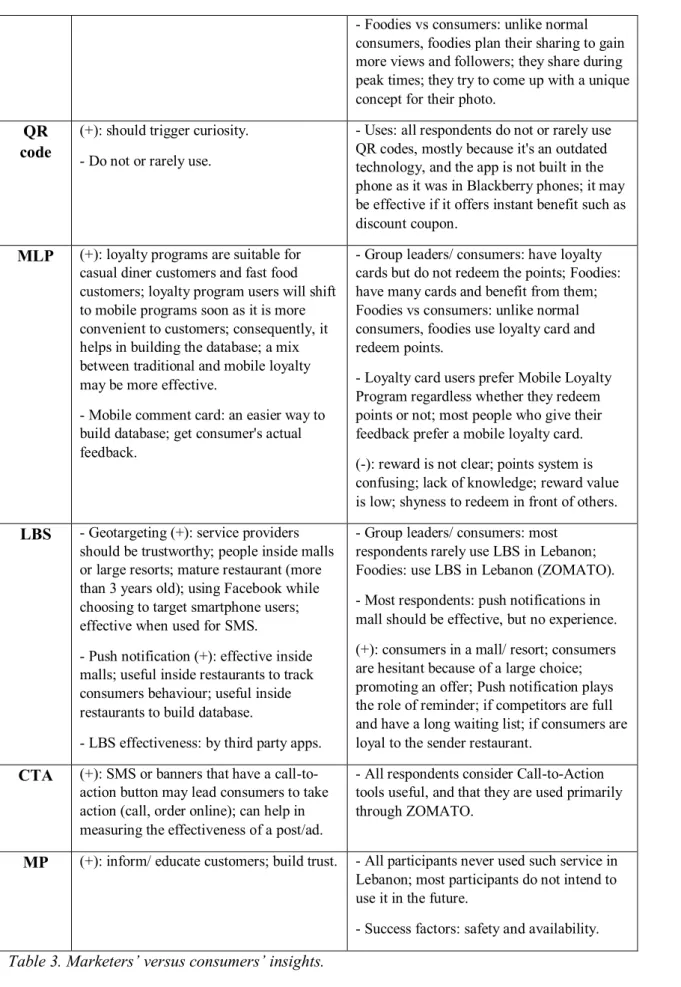
Concerning the mobile tools that consumers use for shopping, results reveal that the adoption/acceptance of mobile tools by marketers and by consumers is relatively low. Two managers posit that the usefulness and effectiveness of the mobile tools depend on the way they are utilized and the purpose they are used for. The comparison of marketers’ and consumers’ views concerning effectiveness revealed to complement each other. It's crucial to underline that all respondents confirm undertaking all searches related to food and dining through smartphones while currently most online marketing tools are adapted to mobile. Consequently, in the middle of this vast arena, the role of traditional mobile marketing tools (SMS/MDA) and their impact on the dining decision-making process appeared less prominent. Even marketers are rarely or have stopped using them. Apparently, there is a shift to mobile social media. Table 3 presents a summary of marketers’ and consumers’ insights.
The influence of mobile marketing tools in the consumer decision-making process appeared to be variable. According to one consumer, Word-Of-Mouth (WOM) is the primary factor that influences his decision whether it comes from friends or his wife. Thus, she was asked to identify the source of WOM. Interestingly, she replied that today there is a new trend which is the so-called foodies. According to her, those are food enthusiastic that have blogs or social media channels where they post their opinion, reviews and photos related to restaurants. Consequently, they are the primary initiators of WOM. If that is true, then it can be argued that social media has encouraged such people. As mobile social media, which allow consumers to share photos instantly, Livestream videos may have propagated this trend further and faster. In other words, it has empowered foodies, and increased their popularity and influence. Hence, restaurants should consider foodies while planning their marketing strategy. Once they become loyal they are likely to play the role of brand ambassadors. Somehow, another foody acknowledged doing that as new restaurants usually invite him, and after tasting, he decides whether to organize an outing with a large group of friends to try the restaurant officially or not. Thus, it can be argued that the combination of social media platforms with the mobile camera and the convenience offered by smartphones, contributed in developing this trend. This process has probably empowered ordinary consumers as well. Consequently, this may have amplified WOM effect which would undoubtedly impact the 'information search' and evidently the 'evaluation of alternative' stages of a niche audience decision-making, since it reduces the set of alternatives that a diner may have. Longart (2015) found that positive WOM is crucial for including a new restaurant in the 'evoked set’, which is the reduced size of alternatives. The views of the latter foody suggest that ordinary consumers prefer to get a summary instead of reading everything related to restaurants. Nonetheless, despite its considerable influence, WOM is not the only factor, since personal beliefs have an impact, as highlighted in the TRA model.
Undoubtedly, the traditional mobile tools may still influence consumer's decision process. For instance, and as defined by group leaders, SMS plays the role of reminder, and if the offer is attractive, it stays in mind during the planning stage of an outing. Therefore, the offering would be included in the 'evoked set of alternatives.' This is supported by Shankar and Balasubramanian (2009), who argue, based on the Elaboration Likelihood Model (ELM) that mobile marketing is good for highlighting existing need by tapping into consumers' peripheral route of persuasion. Which unlike the central route do not need extensive information processing (Mothersbaugh and Hawkins, 2016). Consequently, a mobile message that takes into account all factors that increase effectiveness discussed in this paper would affect the process. As it will reduce the time between the 'need recognition' and the 'purchase' stages or perhaps eliminate the 'search' and 'evaluation of alternatives' stages. Push notification is location-based, and offers the ability to send instant messages to customers that are in a proximity of a restaurant, at a particular time. It requires immediate action. For instance, it can be a welcome message, according to one marketer. Therefore, this type of notifications may create impulsive buying as it can either remind the customer of a restaurant, or highlight a need that he wasn't aware of; then he can quickly fulfill it, since he is close to
10
M-tools Marketers’ insights Consumers’ insights
SMS (+): targeting - loyal customers, clients’ database, those accepted to receive, employees, non-loyal/ mass when to offer something new; good timing; type of content (promoting event, new menu, new branch); should include call-to-action. (-): why SMS is not used - no significant database & loyal customers; not effective with high social class audience; instant but short effect; Lebanese are not impulsive buyers; social media is taking the lead.
- Uses: read rarely or occasionally food SMS and search for more information; it is used as a reminder; it helps in the planning stage; it places a restaurant/ offer in the evoked set of alternatives; sent from known place with a good experience (regular customers); when it reminds about a place; special offer/package; new offer (especially old restaurants); SMS is effective regardless whether it's from a known/ unknown source; loyalty encourages foodies to share SMS with friends/ followers. - Fast food SMS are avoided; healthy/ diet. MDA (+): targeting – young generation; should
be personalized and offer exactly what the smartphone surfer is seeking; type of content (announce a big event, high involvement products may be more suitable, informative, promote an offer, teaser); should include call-to-action; type of apps (related to food and dining, third party apps, avoid political apps). - Rarely used; compared to MDAs sponsored ads are used more often.
- Uses: MDAs may be read if placed on food related apps; high involvement products may be more suitable for MDAs.
- All respondents do not check MDAs related to restaurants (mainly no influence).
- Sponsored ads are more accepted by consumers; sponsored ads influence foodies a lot, as well as some consumers.
- Effective sponsor ads factors: offer what the consumer is seeking exactly.
M-app (+): services (should have delivery and online ordering on its brand app, should offer something not available on third party app); type of restaurant (the higher the standard the lower is the brand app importance; for large database of loyal customers, brand app is important in controlling and directing customers; for international fast food chains a brand app that can be used all over the world). - Third party app/ Zomato: everything related to dining including call-to-action. - Social media apps: Instagram – sharing food photos, using hashtag, younger shift to Instagram, working well in Lebanon; Facebook – sharing food photos, tracking sponsored ads and posts performance.
- Brand app download: most respondents do not download brand apps.
- Downloading factors: brand app should include interesting services that can't be found on third party apps - online ordering and delivery, online booking, loyalty program (consumer loyalty may positively influence downloading).
- Third party apps: all respondents use third party apps (primarily ZOMATO app - reason: review accuracy; Foursquare - reason: location based service; Fork). - Social Media apps: for new restaurants ZOMATO is the primary influencer; or known restaurants social media have more influence (primarily Instagram).
Photo & Video sharing
(+): interaction with consumers; give customers a reason to show off (nice food presentation, shocking platter size); video should be short, as the internet in Lebanon is slow; images shared by the brand should be simple; props/ unique decoration.
- Group leaders/ consumers: rarely share food photos; most share food photo privately on Whatsapp/ Instagram; influenced by food presentation, renowned restaurant/ show off); Foodies: share food photos and/or their lifestyle photos; share publicly (Instagram).
11
- Foodies vs consumers: unlike normal consumers, foodies plan their sharing to gain more views and followers; they share during peak times; they try to come up with a unique concept for their photo.
QR code
(+): should trigger curiosity. - Do not or rarely use.
- Uses: all respondents do not or rarely use QR codes, mostly because it's an outdated technology, and the app is not built in the phone as it was in Blackberry phones; it may be effective if it offers instant benefit such as discount coupon.
MLP (+): loyalty programs are suitable for casual diner customers and fast food customers; loyalty program users will shift to mobile programs soon as it is more convenient to customers; consequently, it helps in building the database; a mix between traditional and mobile loyalty may be more effective.
- Mobile comment card: an easier way to build database; get consumer's actual feedback.
- Group leaders/ consumers: have loyalty cards but do not redeem the points; Foodies: have many cards and benefit from them; Foodies vs consumers: unlike normal consumers, foodies use loyalty card and redeem points.
- Loyalty card users prefer Mobile Loyalty Program regardless whether they redeem points or not; most people who give their feedback prefer a mobile loyalty card. (-): reward is not clear; points system is confusing; lack of knowledge; reward value is low; shyness to redeem in front of others. LBS - Geotargeting (+): service providers
should be trustworthy; people inside malls or large resorts; mature restaurant (more than 3 years old); using Facebook while choosing to target smartphone users; effective when used for SMS.
- Push notification (+): effective inside malls; useful inside restaurants to track consumers behaviour; useful inside restaurants to build database.
- LBS effectiveness: by third party apps.
- Group leaders/ consumers: most respondents rarely use LBS in Lebanon; Foodies: use LBS in Lebanon (ZOMATO). - Most respondents: push notifications in mall should be effective, but no experience. (+): consumers in a mall/ resort; consumers are hesitant because of a large choice; promoting an offer; Push notification plays the role of reminder; if competitors are full and have a long waiting list; if consumers are loyal to the sender restaurant.
CTA (+): SMS or banners that have a call-to-action button may lead consumers to take action (call, order online); can help in measuring the effectiveness of a post/ad.
- All respondents consider Call-to-Action tools useful, and that they are used primarily through ZOMATO.
MP (+): inform/ educate customers; build trust. - All participants never used such service in Lebanon; most participants do not intend to use it in the future.
- Success factors: safety and availability. Table 3. Marketers’ versus consumers’ insights.
12
the place. Hence, this tool would influence the 'need recognition' stage, and will drive consumers to skip the search and evaluation stages. Or at least, reduce remarkably the 'evoked set' which will lead directly to purchase.
ZOMATO is used extensively by most consumers during their search for alternatives and evaluation. This finding is supported by Longart (2015) study as it revealed that consumers during their information search consider food guides (Longart, 2015). ZOMATO is available in both web and app versions, what mobility have probably added is convenience. Since consumers do not have to start a computer to search for a restaurant number. They can open the app find a restaurant, contact it instantly, and on the go. Such tools are facilitating the comparison of alternatives. Therefore, it only assists in searching for info related to the brand. Now, if it includes online ordering, and loyalty program services available exclusively on it, it might have an influence on the 'Post-purchase' stage, for this type of apps would give the Marketers the opportunity to control and build their database of regulars (Demoulin and Zidda, 2009). Subsequently, this encourages them to repeat purchase using the loyalty program; noting that brand apps that include online ordering and payment may impact the 'Transaction' stage. Moreover, mobile Call-to-Action tools would also speed up and encourage purchase. Lastly, once all consumers adopt mobile payment, this would facilitate the in-store transaction. Figure 1 below represents the influence of foodies WOM and mobile tools on the decision-making.
Figure 1
.
The influence of foodies WOM and the mobile tools on consumer decision-making.5 Conclusion and implications
From a theoretical perspective, the first contribution is the fact that loyalty is the primary factor that positively affects smartphone tools adoption/acceptance. In this regard, the majority of the literature articles explore the elements that increase or influence customer loyalty (e.g., Ma, QU and Eliwa, 2014). This leads eventually to the repetitive purchase, and consequently increases sales. In contrast, this paper highlights the characteristic and behavior of loyal customers and their influence on mobile marketing effectiveness. The decision-making process of loyal customers is more affected by mobile marketing tools than the regular or ordinary customers. Moreover, the findings underline the role of foodies, who were
13
recognized as the ultimate loyal customers, since they read, analyze and share publically the info related to restaurants. Additionally, they are the word-of-mouth initiators. On the other hand, the study shows how consumers’ types influence mobile tools effectiveness. This study also confirms that there is a difference between regular (repeat) customers and loyal customers. For instance, all participants appeared to be regular customers at some restaurants but not loyal to them. The participant who was identified as a foodie is the only one who exhibits loyalty behaviors. However, two of the remaining members state that they are loyal to a particular 'special offer'. Regular customers repeat purchase for different reasons (e.g., cheaper place than similar ones, or convenient location). In contrast, loyal customers don't look for alternatives, as they believe that the product is superior to competitors' products (e.g., Mothersbaugh and Hawkins, 2016). From another angle, the influence of most smartphone marketing tools on the Lebanese diner's decision-making process was stressed. It came out that in some contexts, smartphones can speed up or shorten the process. To the researcher knowledge, this topic was not addressed in the smartphone era. The conceptual framework in Figure 1 could be further examined and confirmed or revised with subsequent empirical evidence.
The limitations of this study are mainly based on the qualitative method used and are relevant to the research context. The findings may not apply to lower standard restaurants. Nevertheless, some components can still be applied for industries that have the same characteristics. Also, it would be helpful to examine the behavior of other foodies. However, since the number of powerful foodies in Lebanon may not exceed ten; one participant may be acceptable. Moreover, the mobile loyalty program, the push notification and the mobile payment are not implemented in Lebanon so far. Therefore, future studies are encouraged to reevaluate the relevant findings. Finally, mobile social media appears to be taking over a significant part of the Smartphone marketing. Thus, it's noteworthy to explore whether other industries are experiencing the same, since this research posits that social media may be more suitable for product related to social events and lifestyle. Lastly, since Lebanon is a collectivist country, loyalty dominates other societal rules (Hofstede et al., 2010). Hence, loyalty effects on smartphone could be explored in individualistic nations.
To benefit from smartphone marketing marketers should focus on building their database of loyal customers, especially if the eatery is newly opened. Perhaps, this can be done through direct marketing, CRM, or by collaborating with foodies who can be identified on social media networks. This study has stressed many alternatives to increase customer loyalty, such as the mobile loyalty programs, and the mobile comment cards. For market leaders, a brand app that includes online ordering may also help in building the database, and may turn regular customers into loyal customers. Additionally, the restaurants should emphasize special occasions in their advertisements and messages (e.g., holidays), as the level of involvement in dining varies according to the occasion. Consequently, special events may increase posts efficiency. On the other hand, they should consider launching yearly package deals, and set menus that offer excellent value for money. Since such deals can lead some consumers to become loyal to the offer. When loyalty, occasions, and package deals are addressed adequately, smartphone marketing is likely to be more efficient. To grab the attention of the general audience, mobile marketing message should promote something new with a call-to-action link. Findings may be applied in other industries that have more or less the same characteristics. For instance, in the fashion industry, there are the so-called fashionista, who are probably playing the role of foodies when it comes to fashion brands.
14
References
Adler, P.A. and P. Adler (1998). Peer Power: Preadolescent Culture and Identity. New Brunswick, NJ: Rutgers University Press.
Ajzen, I. (1991). “The Theory of Planned Behavior.” Organizational Behavior and Human Decision Processes 50, 179-211.
Ajzen, I., and M. Fishbein (1980). Understanding attitudes and predicting social behavior. Englewood Cliffs, NJ: Prentice-Hall Press.
Alana, K. (2012). “Instagram & Co.: the mobile era of food photography” [Online]. Available from: https://www.finedininglovers.com/stories/food-photography-tips- mobile/ (Accessed: 18 August 2016).
Audi, M., Wahbi, M., Abdallah, S., Kassem, L., Jaber, N. and R. Makkawi (2016). “Adoption of Mobile Banking Applications in Lebanon.” Journal of Internet Banking & Commerce
21(1), 1-15.
Bart, Y., Stephen, A. and M. Sarvary (2014). “Which products are best suited to mobile advertising? A field study of mobile display advertising effects on consumer attitudes and intentions.” Journal of Marketing Research 51 (3), 270-285.
Barwise, P. and C. Strong (2002). “Permission-based mobile advertising.” Journal of Interactive Marketing 16 (1), 14-24.
Bauer, H., Reichardt, T., Barnes, S. and M. Neumann (2005). “Driving consumer acceptance of mobile marketing: a theoretical framework and empirical study.” Journal of Electronic Commerce Research 6 (3), 181-192.
Blank, C. (2013). “Game Time. Brands’ mobile games build customer sales, loyalty” [Online]. Available from: https://www.qsrmagazine.com/exclusives/game-time (Accessed: 18 August 2016).
Blomqvist, K., Hurmelinna, P. and R. Seppanen (2005). “Playing the collaboration game right: balancing trust and contracting.” Technovation 25 (5), 497–504.
Brandau, M. (2012). “3Smartphones.” Nation's Restaurant News [Online] 46 (2), p. 4. Carroll, A., Barnes, S.J., Scornavacca, E. and K. Fletcher (2007). “Consumer perceptions and
attitudes toward SMS advertising: recent evidence from New Zealand.” International Journal of Advertising 26 (1), 79–98.
Chang, Y.T., Yu, H. and H.P. Lu (2015). “Persuasive messages, popularity cohesion, and message diffusion in social media marketing.” Journal of Business Research 68 (4), 777-782.
Chen, Y., Lehto, X., Behnke, C. and C. Tang (2016). “Investigating children’s role in family dining-out choices: evidence from a casual dining restaurant.” Journal of Hospitality Marketing & Management 25 (6), 706-725.
Chowdhury, H., Parvin, N., Weitenberner, C. and M. Becker (2006). “Consumer attitude toward mobile advertising in an emerging market: an empirical study.” International Journal of Mobile Marketing 1 (2), 33-42.
Cobanoglu, C., Wan, Y., Shatskikh, A. and A. Agarwal (2014). “Are consumers ready for mobile payment? An examination of consumer acceptance of mobile payment technology in restaurant industry.” FIU Hospitality Review 31 (4), p. 1.
Collis, J. and R. Hussey (2013). Business Research: A Practical Guide for Undergraduate and Postgraduate Students. 4th edition. London: Palgrave-MacMillan.
Creswell, J. W. (1994). Research Design: Qualitative and Quantitative Approaches. Thousand Oaks, CA: Sage.
Davis, F.D. (1989). Perceived usefulness, perceived ease of use, and user acceptance of information technology. MIS Quarterly, 13 (3), 319-340.
Davis, F.D., Bagozzi, R.P. and P.R. Warshaw (1992). “Extrinsic and intrinsic motivation to use computers in the workplace.” Journal of Applied Social Psychology 22 (14), 1109-1130.
Demoulin, N. and P. Zidda (2009). “Drivers of customers' adoption and adoption timing of a new loyalty card in the grocery retail market.” Journal of Retailing 85 (3), 391-405.
15
Dickinger, A. Haghirian, P. Murphy, J. and A. Scharl (2004). “An investigation and conceptual model of SMS marketing.” In: Proceedings of the 37th Annual Hawaii International Conference on System Sciences. Hawaii,pp. 471-480.
Elkin, N. (2011). “Mobile advertising and marketing: moving to the mainstream. Available from: http://www.emarketer.com (Accessed: (Accessed: 6 April 2016).
Engel, F. Kollat, T. and D. Blackwell (1968). Consumer Behavior. 1st edition. New York: Holt, Rinehart and Winston.
Faheem, A. M. and K. Yasir (2010). “Acceptance of mobile marketing among university students.” Mustang Journal of Business & Ethics 1, 9-29.
Forsyth, D.R. (2006). Group Dynamics. Belmont, CA : Thomson/Wadsworth. Friedrich, R., Gröne, F., Hölbling, K. and M. Peterson (2009). “The march of mobile
marketing: new chances for consumer companies, new opportunities for mobile operators.” Journal of Advertising Research 49 (1), 54-61.
Gazley, A. Hunt, A. and L. McLaren (2015). “The effects of location-based-services on consumer purchase intention at point of purchase.” European Journal of Marketing 49 (9/10), 1686-1708.
Gerpott, T. and S. Berg (2011). “Determinants of the willingness to use mobile location-based services: an empirical analysis of residential mobile phone customers.” Business & Information Systems Engineering 3 (5), 279-287.
Grobart, S. (2012). “Mobile ads are the future. They’re also lousy.” BusinessWeek (November 1).
Gubrium, J. and J. Holstein (2002). Handbook Of Interview Research. Thousand Oaks, CA: SAGE.
Hair, J., Wolfinbarger, M., Bush, R. and Ortinau, D. (2012). Essentials of Marketing Research. 3rd edition. New York: McGraw-Hill.
Hanley, M., Becker, M. and J. Martinsen (2006). “Factors influencing mobile
advertising acceptance: will incentives motivate college students to accept mobile advertisements?” International Journal of Mobile Marketing 1 (1), 50-58.
Hofstede, G., Hofstede, G. and M. Minkov (2010). Cultures and organizations: software of the mind: intercultural cooperation and its importance for survival. New York: McGraw-Hill.
International Telecommunications Union (2016). “ITU releases annual global ICT data and ICT Development Index country rankings, Korea tops global ICT Development Index (IDI) for second straight year.” Available from:
http://www.itu.int/en/mediacentre/Pages/2016-PR53.aspx (Accessed: 18 December 2016).
Jargon, J. (2013). “Restaurants turn to mobile loyalty rewards apps to lure customers.” The Wall Street Journal. Available from:
http://www.wsj.com/articles/SB10001424127887323689204578569382612115700 (Accessed: 4 August 2016).
Josiam, B., Kalldin, A. and J. Duncan (2014). “Using the involvement construct to understand the motivations of customers of casual dining restaurants in the USA.” FIU Hospitality Review 31 (4), 155.
Khan, M. (2008). Consumers prefer mobile advertising with incentives [Online]. Available from: http://www.mobilemarketer.com/cms/news/research/1066.html (Accessed: 22 August 2016).
Kim, H. and R. Law (2015). “Smartphones in tourism and hospitality marketing: a literature review.” Journal of Travel & Tourism Marketing 32 (6), 692-711.
Kotler, P. Keller, L. Koshy, A. and M. Jha (2009). Marketing Management – A South Asian Perspective, but China and Japan also contribute. 13th edition. India: Prentice Hall. Kwon, J. Bae, J. and S. Blum (2013). “Mobile applications in the hospitality industry.”
Journal of Hospitality And Tourism Technology 4 (1), 81-92.
Ladki, S. (2006). “Dining behavior exhibited by Lebanese consumers during the month of Ramadan.” Journal of Food Service Business Research 7 (4), 111-125.
16
Lincoln, Y.S. and E.G. Guba (1985). Naturalistic Inquiry. Newbury Park (CA): Sage. Luhur, H. and N. Widjaja (2014). “Location-based social networking media for restaurant
promotion and food review using mobile application.” EPJ Web of Conferences 68, 1-10. Longart, P. (2015). “Consumer decision making in restaurant selection.” British Library
Ethos [Online]. Available from:
http://ethos.bl.uk/OrderDetails.do?uin=uk.bl.ethos.665837? (Accessed: 25 August 2016). Lu, J., Wang, M., Mao, Z. and L. Hu (2015). “Goodbye maps, hello apps? Exploring the
influential determinants of travel app adoption.” Current Issues in Tourism 18 (11), 1059-1079.
Lu, Y. Yang, S. Chau, P.Y. and Y. Cao (2011). “Dynamics between the trust
transfer process and intention to use mobile payment services: a cross-environment perspective.” Information and Management 48 (8), 393-403.
Lundberg, D. E. (1994). The hotel and restaurant business. 6th edition. New York: Van Nostrand Reinhold.
Ma, E., QU, H. and R.A. Eliwa (2014). Customer loyalty with fine dining: the moderating role of gender. Journal of Hospitality Marketing & Management 23 (5), 513-535.
Ma, J. Suntornpithug, N. and G. Karaatli (2009). “Mobile advertising: does it work for everyone?” International Journal of Mobile Marketing 4 (2), 28-35.
Mallat, N. (2007). “Exploring consumer adoption of mobile payments – a qualitative study.”
Journal of Strategic Information Systems 16, 413-432.
Marriott, H.R., Williams, M.D. and Y.K. Dwivedi (2017). “What do we know about consumer m-shopping behavior?” International Journal of Retail and Distribution Management 45 (6), 568-586.
McCorkle, D. Jurkus, V. Auruskeviciene, V. and J. Reardon (2013). “The antecedent effects of SMS marketing on consumer intentions.” International Journal of Business,
Marketing, & Decision Science 6 (1), 88-105.
Mehta, S.S. and B. Maniam (2002). “Marketing determinants of customers' attitudes towards selecting a restaurant.” Academy of Marketing Studies Journal 6 (1), 27-44.
Miles, M. and A. Huberman (1984). Qualitative Data Analysis: A Sourcebook of New Methods. Beverly Hills: Sage.
Miles, M.B., Huberman, A.M., J. Saldana (2014). Qualitative Data Analysis: A methods Sourcebook. 3rd edition. London: Sage.
Monk, A., Carroll, J., Parker, S. and M. Blythe (2004). “Why are mobile phones annoying?”
Behaviour and Information Technology 23 (1), 33–41.
Mothersbaugh, D.L. and D.I. Hawkins (2016). Consumer Behavior: Building Marketing Strategy. 13th edition. New York: McGraw-Hill.
Muk, A. (2007). “Consumers’ intentions to opt in to SMS advertising.” International Journal of Advertising 26 (2), 177–198.
Muller, C.C. and R.H. Woods (1994). “An expected restaurant typology.” Cornell Hotel and Restaurant Administration Quarterly 35 (3), 27-37.
Nasco, S. and G. Bruner (2008). “Comparing consumer responses to advertising and non-advertising mobile communications.” Psychology & Marketing 25 (8), 821-837. Nielsen Mobile (2008). “Critical mass: the worldwide state of the mobile web.” [Online].
Available from: http://www.nielsen.com/us/en/insights/reports/2008/critical-mass-worldwide-state-of-the-mobile-web.html (Accessed: 19 March 2016).
Nielsen (2014). “How smartphones are changing consumers’ daily routines around the globe.” [Online]. Available from:
http://www.nielsen.com/us/en/insights/news/2014/how-smartphones-are-changing-consumers-daily-routines-around-the-globe.html (Accessed: 19 March 2016).
Okazaki, S. (2005). “New perspectives on m-commerce research.” Journal of Electronic Commerce Research 6 (3), 160-164.
Okazaki, S., Hirose, M. and H. Li (2011). QR code mobile promotion: an initial inquiry, Breaking new ground in theory and practice [Electronic Book], 407- 422.
17
Okazaki, S., Navarro, A. and C. López-Nicolas (2013). “Assessing gender differences in ‘quick response’ code loyalty promotion acceptance.” Service Industries Journal 33 (12), 1165-1177.
Pagani, M. (2004). “Determination of adoption of third generation mobile multimedia services.” Journal of Interactive Marketing 18 (3), 46–59.
Persaud, A. and I. Azhar (2012). “Innovative mobile marketing via smartphones: are consumers ready?” Marketing Intelligence and Planning 30 (4.), 418–443.
Patton, M.Q. (2002). Qualitative Research and Evaluation Methods. 3rd edition. Thousand Oaks (CA): Sage.
Rogers, E.M. (2003). Diffusion of Innovations. 5th edition. New York: Free Press.
Rosenkrans, G. and K. Myers (2012). “Mobile advertising effectiveness.” International Journal of Mobile Marketing 7 (3), 5-24.
Ruggless, R. (2014). “Loyalty goes mobile.” Nation's Restaurant News 48 (20), 10. Schmidmayr, P., Ebner, M. and F. Kappe (2008). “What’s the power behind 2D barcodes?
Are they the foundation of the revival of print media?” In: Proceedings of I-KNOW ‘08 and I-MEDIA ‘08 Austria, September 3–5 [Online], pp. 232–242.
Shankar, V. and S. Balasubramanian (2009). “Mobile marketing: a synthesis and prognosis.”
Journal of Interactive Marketing 23 (Anniversary Issue), 118-129.
Stewart, D.W. and P.A. Pavlou (2002). “From consumer response to active consumer: measuring the effectiveness of interactive media.” Journal of the Academy of Marketing Science 30 (4), 376–396.
Sultan, F. Rohm, A. and T. Gao (2009). “Factors influencing consumer acceptance of mobile marketing: a two-country study of youth markets.” Journal of Interactive Marketing 23, 308-320.
Tri Dinh, L. and N. Bao-Tran Ho (2014). “Attitudes toward mobile advertising: study of web display and mobile app display advertising.” Asian Academy of Management Journal 19 (2), 87-103.
Venkatesh, V., Morris, M.G., Davis, G.B. and F.D. Davis (2003). “User acceptance of information technology: toward a unified view.” MIS Quarterly 27 (3), 425-478.
Verma, R. Stock, D. and L. McCarthy (2012). “Customer preferences for online, social media, and mobile innovations in the hospitality industry.” Cornell Hospitality Quarterly 53 (3), 183-186.
Walker, J.R. (2014). Exploring the Hospitality Industry. 2nd edition.Harlow: Pearson. Watson, C. McCarthy, J., and J. Rowley (2013). “Consumer attitudes towards mobile
marketing in the smart phone era.” International Journal of Information Management 33, 840-849.
Watson, R. T., Pitt, L. F., Berthon, P. and M. Zinkhan (2002). “U-Commerce: expanding the universe of marketing.” Journal of the Academy of Marketing Science 30 (4), 333–347. York, E.B. (2009). “Why pizza giants want customers to click, not call, for delivery.”
Advertising Age 80 (14), 3-23.
Yu, J., Zo, H., Choi, M. and A. Ciganek (2013). “User acceptance of location-based social networking services: an extended perspective of perceived value.” Online Information Review 37 (5), 711-730.
Zhang, J. and E. Mao (2008). “Understanding the acceptance of mobile SMS advertising among young Chinese consumers.” 25 (8), 787-805.