Important Computer Competencies for the
Nursing Profession
Wey-Wen Jiang·Wei Chen·Yu-Chih Chen*
ABSTRACT: Nursing requires computer competencies. This study aimed at identifying those competencies required for the nursing profession in Taiwan. The Delphi technique was deployed in this study. In the Delphi questionnaires, computer competencies were sorted into seven domains: concepts of hardware, software, and networks; principles of computer applications; skills of computer usage; program design; limitations of the computer; personal and social issues; attitudes toward the computer. In three Delphi questionnaires, nursing informatics experts gave us their opinions on the importance of each computer competency for the nursing profession. The experts also designated when the competency should be cultivated. This study provides a comprehensive list for nursing professionals to check on their computer competence. The results of this study should also serve as good references for teachers and schools in designing related curriculums.
Key Words: nursing informatics, computer competence, Delphi technique.
Introduction
Nowadays, more and more computers are being used in health care systems to store, organize, and transmit informa-tion. Although nurses do not need a high degree of computer expertise, their performance will be much more efficient if they have good computer skills. In other words, nurses who operate computers proficiently can quickly access health care-related information using computers. And they may be able to provide more appropriate and efficient care to their patients.
Wilkinson (1996) predicted that, in the near future, those who could not use computers would be as disadvantaged as those who could not read and write. The study by Ngin, Simms, and Erbin-Roesemann (1993) suggested that the introduction of computers could not only improve unit morale but could also stimulate the learning of new skills related to effective and quality care delivery. An examination of the roles of nurses revealed that nurses are high level information processors in all areas of nursing practice (Hovenga, 1998). Some hospitals even use computers to provide Intranet-delivered training for nurses (Wolford & Hughes, 2001).
With the increasing versatility and power of personal computers, the use of information technology has a central role in all areas of health care delivery. However, many staff dislike using computers and often it is left to one or two peo-ple to use the machine (Hellan, McGuire, & Cooper, 1998). Therefore, every nurse needs appropriate knowledge and skills about computers. Since new entrants to nursing diploma programs often have varying degrees of compe-tence and experience with information technology (Sinclair & Gardner, 1999), some effort has to be made to raise their information technology competence to an adequate level.
This paper describes a research project that was con-cerned with identifying important computer competencies for nurses. The data were collected using the Delphi tech-nique, which has not been previously used in nursing infor-matics studies in Taiwan. Nursing schools can educate their students toward the identified competencies. Student nurses with the competencies will adapt themselves quickly to their computer environment at work once they graduate. We hope the competencies will help nursing professionals to work efficiently and serve as the basis of life-long learning, enabling them to maintain up-to-date computer knowledge PhD, Associate Professor, Department of Information Management, National Taipei College of Nursing; *RN, PhD, Deputy Director of Nursing, Taipei Veterans General Hospital, & Adjunct Assistant Professor, Graduate Institute of Health Allied Education, National Taipei College of Nursing.
Received:February12, 2004 Revised: June 25, 2004 Accepted: August 4, 2004
Address correspondence to: Wey-Wen Jiang, No. 365, Ming-Te Rd., Peitou, Taipei 112, Taiwan, ROC. Tel: 886(2) 2822-7101 ext. 3916; Fax: 886(2) 2871-9068; Email: [email protected]
and skills. Nursing professionals may also use the research results to check on their computer competence and try to make up any shortcomings.
Literature Review
Nurses need appropriate knowledge and skills to use computers. Many previous papers have addressed the required computer competencies for nurses. Since compe-tencies are often cultivated through nursing informatics cur-riculums, the content of those curriculums provide strong evidence of the important competencies. There are many papers which describe the design of those curriculums. Early works
An early book by Ronald and Skiba (1987) provided guidelines for basic computer education in nursing. In 1990, Romano and Heller described a prototype educa-tional program to prepare nurses for the role of information systems specialist. Bryson (1991) developed a list of com-petencies from nursing educators’ perceptions about the computer training needed in nursing degree programs. Bryson concluded that nursing educators desired nursing graduates to understand how a computer works and to develop skills in using application programs. Carter and Axford (1993) identified computer learning needs of prac-ticing nurses at the bedside. These works are the founda-tions of much later research.
Computer uses
McDaniel, Matlin, Elmer, Paul, and Monastiere (1998) reported a national survey done in the United States. Cur-rent and anticipated computer uses by staff nurses and by staff development professionals were provided. McNeil et al. (2003) did a survey to establish the perceived current and future uses of information technology tools by practic-ing nurses.
Computer competencies
Sinclair and Gardner (1999) identified core compe-tencies in information technology (IT) to educate nursing students with a consistent level of IT literacy. Staggers, Gassert, and Curran (2002) produced a research-based master list of informatics competencies for nurses of four levels: beginning nurses, experienced nurses, informatics specialists, and informatics innovators. Curran (2003) fur-ther defined and validated the competencies for advanced practice nurses. Yee (2002) addressed minimum
informa-tion technology competencies needed in Singapore nursing education. The needs assessment was conducted with a panel representing nursing education, nursing manage-ment, and nursing practice. Two main categories of infor-mation technology (IT) were identified: basic IT skills and work-related IT skills.
Curriculums
In the paper by Reinhard and Moulton (1995), a nurs-ing informatics curriculum for graduate students was de-scribed. It consisted of a pre-course workshop and four-course sequence. Topics in the pre-four-course workshop in-cluded computer hardware and software; fundamentals of microcomputers; computer applications in practice, educa-tion, administraeduca-tion, and research; nursing informatics; information systems; and expert systems. Vanderbeek and Beery (1998) provided a detailed description of an under-graduate healthcare informatics course. An article by Travis and Bernnan (1998) discussed the design, imple-mentation, and evaluation of an innovative nursing infor-matics curriculum incorporated into a baccalaureate nurs-ing program. Inman, Johansen, Powlas, Timm, and Turner (2000) did a survey to determine learning needs of nurses and developed a curriculum with three classes: computer concepts for nursing, computer basics for nursing, and computer applications for nursing. In the work of Ro-senfeld, Salazar-Riera, and Vieira (2002), a pilot informa-tion literacy program was offered. However, the unit-based instruction in that program presented significant obstacles for effective learning of new technological skills for staff nurses.
European projects
There was a European Union funded project called NIGHTINGALE, which focused on the nursing profes-sion’s needs related to the telecommunication and infor-matics area (Mantas, 1998). The project tried to provide consensus curriculum development in nursing informa-tics. Kokol, Zazula, Brumec, and Kolenc (1999) reported another European project called NICE. It was about developing a new nursing informatics curriculum for the 21stcentury. In Finland, Saranto, and Leino-Kilpi (1997) developed the information technology syllabus for nurs-ing education usnurs-ing the Delphi technique. In their study, nurses’ qualifications in nursing informatics and recom-mendations for teaching information technology were provided.
Courses in Taiwan
Our Ministry of Education has also stipulated content standards of computer courses for students in vocational schools, including nursing schools. Currently, many nurs-ing schools in Taiwan provide computer courses to educate students in competence areas such as processing of text, data, graph, image, video, and sound files. There are also courses on network usage and digital data storage and anal-ysis.
The Study
Changes in computer technology are occurring at a rapid pace: new technology comes along every day. And nursing professionals in different countries may need to have different computer competencies. The purpose of this study was to address the following questions.
1. What are the computer competencies required for the nursing profession in Taiwan?
2. When is the proper time to cultivate those competen-cies?
Method
Participants
The Delphi technique is often used for gathering opin-ions and achieving a consensus (Cohen, Manion, & Morri-son, 2000; Thomas & NelMorri-son, 2001). Because there are not many experts who are conversant with both computers and nursing in Taiwan, investigation on a large scale is not fea-sible. Not many experts are required when using the Delphi technique, and experts may answer questionnaires at their convenience without joining a meeting. The authors there-fore, adopted the Delphi technique to conduct the investi-gation.
A total of 29 experts were recruited to the panel. The panelists consisted of 11 males and 18 females. They all worked at nursing-related institutions, including clinical practice, community, computer companies, or schools. They had an average age of 40 and average working experi-ence of 14 years. More than three-quarters of the experts had a master’s degree or higher. They had been using com-puters for 14 years on average. The profile of the experts is shown in Table 1.
Procedure
Sometimes, it is difficult to answer an open-ended questionnaire, and experts need a lot of time to think. This
could result in a low return rate. A constructed question-naire was therefore, developed for the first run. The authors adopted domains and skills/objectives defined in Bryson (1991). Modification of domain titles and competences was done by the authors after reviewing the articles men-tioned in the literature review section. It was also done based on the authors’ own teaching and working experi-ence. The content standard of our country was taken into account as well.
The first questionnaire contained 74 competency items in 7 domains: concepts of hardware, software, and net-work; principles of computer applications; skills in com-puter usage; program design; limitations of the comcom-puter; personal and social issues; attitudes toward the computer.
In the first questionnaire, computer competencies were sorted into seven domains, and each domain was listed with several competency items. Experts were asked to rank the importance of each competency item using a Likert-type scale with choices ranging from 1 to 5 (1 = not at all important; 2 = not important; 3 = neither important nor unimportant; 4 = important; 5 = very important). Experts could propose competencies which they were felt important but which were not listed in the questionnaire.
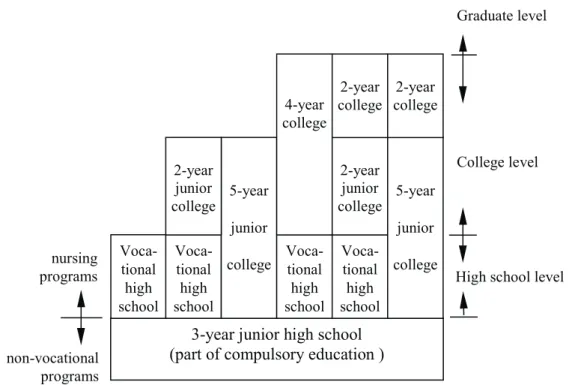
In the questionnaires, experts were also asked to ch-eck when each competency item should be cultivated. Should a competence be cultivated at student’s high school level or college level? Or should it be cultivated by self-learning or through on-the-job training? In Taiwan, voca-tional nursing schools include vocavoca-tional high schools of nursing (three-year program after junior high school), junior college of nursing (five-year program after junior high school or two-year program after vocational high school), colleges of nursing (four-year program after voca-tional high school or two-year program after junior col-lege), and graduate school of nursing. Figure 1 depicts the nursing programs in Taiwan. Since not many students attend graduate programs of nursing in Taiwan, we did not consider competencies to be cultivated in graduate pro-grams.
The three-run Delphi postal survey was carried out between May and September 2002. All 29 experts partici-pated in the three runs. In other words, the response rate was 100% for all runs. When responses of a run were col-lected, the mean of importance of each competency item was listed in the questionnaires for the next run. Compe-tency items proposed by experts in that run were also listed in the questionnaire for the next run.
In the first run, the questionnaires with 74 competency items in seven domains were sent to 29 experts. Every competency item obtained a mean of importance larger than 3.0 in that run. Therefore, all those items were listed on the questionnaire for the second run to get more consen-taneous opinions. No item was withdrawn. Some experts proposed new competency items in the first run. Those items were included in the second run questionnaire to obtain all panelists’ opinions.
In the second run, questionnaires listed with 87 compe-tency items were sent out. Again, every compecompe-tency item in the second run obtained a mean of importance larger than 3.0 and some new competency items were proposed. Based on the response of the second run, the questionnaire for the
third run, with 94 competence items, was generated. In the third (final) run, no new competence was proposed.
Because standard deviation (SD) is associated with the distribution of scores around the mean,SDcan be used as a measure of consensus. Saranto and Leino-Kilpi (1997) defined consensus using the value ofSD. In their study,SD < 0.75 indicated strong consensus. In our third run, theSD of importance of each competency item is about the same as it was in the second run. This implied that theSDwould not converge to a smaller value. Therefore, no further run was conducted. Through 3 runs of Delphi questionnaires, experts reached quite consentaneous (smallSD) opinions. And there were 94 competency items in seven domains in the final run.
Table 1.
Profile of the Experts(N = 29)
Variable n %
Number of experts with nursing background 18 62.1
Number of experts with management background 10 34.5
Number of experts with information technology background 9 31.0
Number of experts with master’s degree or higher 23 79.3
Number of experts who work in clinical institutions 15 51.7
Number of experts who work in academic institutions 10 34.5
Number of experts who work as heads in their organizations 18 62.1
3-year junior high school
(part of compulsory education )
Voca-tional high school Voca-tional high school 5-year juniorcollege Voca-tional high school 2-year junior college 4-year college Voca-tional high school 2-year junior college 5-year junior college 2-year college 2-year college
High school level College level non-vocational programs nursing programs Graduate level
Results
Average Importance of Competencies in
Seven Domains
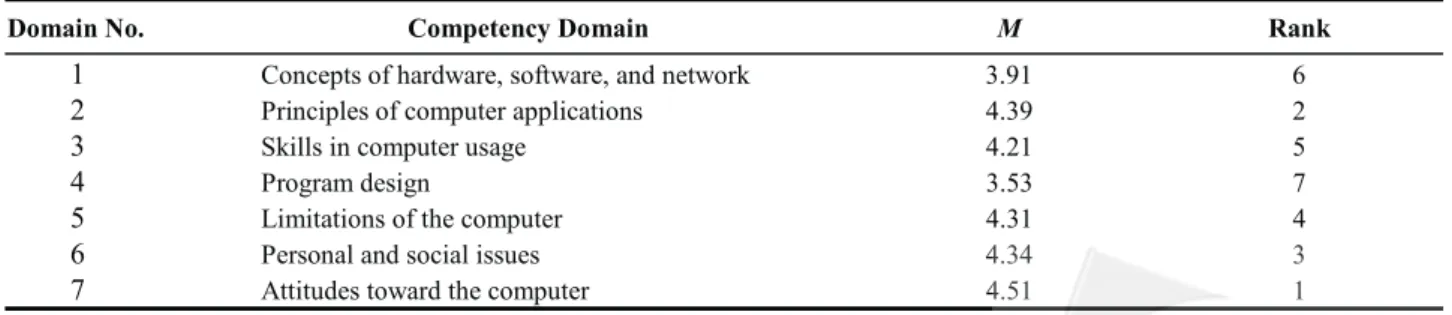
Average importance of competency items in each domain was calculated. The average importance obtained from the final (third) run is shown in Table 2. They were 3.91, 4.39, 4.21, 3.53, 4.31, 4.34, and 4.51, respectively. It shows that “concepts of hardware, software, and network” and “program design” were less important. “Attitudes toward the computer” were the most important (had the highest mean) among the competency domains in the ques-tionnaire.
Cutoff Values for Mean and
SD
Since a rating of four or five indicated that the expert thought the competency item was important or very impor-tant, and a rating of three indicated that the expert was neu-tral, a mean rating of 3.5 indicated that experts were not neutral or negative toward the competence, but rather they were at least somewhat positive toward it. In the present study, the authors adopted the consensus definition used by Saranto and Leino-Kilpi (1997). There was a strong con-sensus whenSD£0.75. Competency items with means sig-nificantly larger than 3.5 andSD£0.75 were regarded as important competencies.
Table 3 shows competence items listed in the final run of the research. Mean andSDof importance of each com-petence item were calculated. In Table 3, every compe-tence item has mean of importance no less than 3.5, except three items (No. 10, 17, and 18) in domain one and six items (No. 60 through 65) in domain four. In order to know which competence items have mean of importance signifi-cantly larger than 3.5, a single sample t-test was done using statistical software SPSS. Results showed there were 75 items whose importance was significantly larger than 3.5
(2-tailed,p< .05). Those items are marked with a symbol ‡ in Table 3. They all hadSD£0.75. Competence items 19, 37, 58, 71, 81, 94, and 101 were open questions of the seven domains, and the experts did not propose any new competence in those questions in the final run. Those items are therefore, not shown in Table 3.
Very Important Competencies
A rating of 4 indicated that the expert regarded the competency item as an important item. A rating of 5 indi-cated that it was considered to be very important. There-fore, a mean larger than 4.5 indicated that more than 50 per-cent of the experts regarded the competency item as a very important item. Let us have a closer look at items with Mean > 4.5.
From Table 3 we know: competency items No.s 6, 7, and 8 in domain one were very important, especially item No. 8. Those three items were all basic competencies for operating computers. In domain two, most experts agreed that competency items No.s 20, 21, and 22 were very important, especially item No. 21 (be able to use the World Wide Web to search for information). All experts gave highest importance to item No. 21. Searching information from the World Wide Web is a key competency for the nursing profession.
In domain three, competency items No.s 38, 39, 40, 42, 44, 45, 52 and 54 received very high importance, among which item No. 38 (be able to use word process-ing software) was considered the most important. Indeed, it is a very basic skill for today’s nurses. No com-petency item in domain four had an importance mean greater than 4.0, which shows most experts did not think “program design” was very important for the nursing profession. Nevertheless, “be able to communicate with software developers” (item No. 66) had the highest mean (3.9).
Table 2.
The Mean of Importance of Each Competency Domain
Domain No. Competency Domain M Rank
1 Concepts of hardware, software, and network 3.91 6
2 Principles of computer applications 4.39 2
3 Skills in computer usage 4.21 5
4 Program design 3.53 7
5 Limitations of the computer 4.31 4
6 Personal and social issues 4.34 3
Table 3.
The Competence Data Obtained From the Final Run(N = 29)
Domain Competency Item M SD
CS* % H-sch† n Colg†† n Self††† n
1 1. Know today’s popular types of computer systems such as Apple Macintosh and IBM-compatible.
3.86‡ 0.69 76 22 1 10
1 2. Know the common computer terminology, e.g. bit, byte, RAM, ROM, HD.
4.07‡ 0.65 83 27 1 5
1 3. Know the basic components of a computer’s hardware system and their function.
3.86‡ 0.64 72 27 1 4
1 4. Know input and output devices of computers. 3.97‡ 0.50 86 26 1 4
1 5. Know the basic components of a computer’s soft-ware system and their function.
4.03‡ 0.42 93 26 2 3
1 6. Know the basic usage of a computer, e.g. login/ logout a computer, use a mouse.
4.55‡ 0.57 97 22 3 9
1 7. Know the usage of file management functions in computer operating systems.
4.62‡ 0.49 100 26 3 3
1 8. Know how to operate computer systems (e.g., Windows).
4.72‡ 0.45 100 29 2 3
1 9. Know how to install software drivers for peri-pherals.
4.07‡ 0.59 86 25 3 7
1 10. Be able to assemble basic components of com-puter hardware.
3.31 0.60 38 5 4 25
1 11. Be able to resolve common error situations. 4.07‡ 0.59 86 23 7 10
1 12. Know basic principles of computer networks. 3.79‡ 0.62 76 20 10 5
1 13. Know basic structures of computer networks. 3.72 0.65 69 15 10 11
1 14. Know today’s major network types. 3.69 0.60 69 13 13 8
1 15. Know common network hardware devices, e.g. network adapters, hub, modem.
3.66 0.55 62 23 7 9
1 16. Know how to setup communication software in computers.
4.17‡ 0.60 90 24 7 6
1 17. Know the difference between analog and digital signals.
3.10 0.49 17 20 6 5
1 18. Know important milestones in the evolution of computer technology.
3.14 0.64 21 20 4 8
2 20. Be able to use a library information retrieval system to search for references, e.g. Medline.
4.93‡ 0.26 100 10 23 5
2 21. Be able to use the world wide web (WWW) to
search for information.
5.00‡ 0.00 100 27 5 6
2 22. Be able to send/receive mails and transfer files through networks.
4.90‡ 0.31 100 26 7 4
2 23. Know there are video discs for nurses’
con-tinuing education, patients' health education, etc.
4.45‡ 0.63 93 6 27 2
2 24. Know there is simulation software for continuing education and training.
4.28‡ 0.59 93 4 27 2
2 25. Be able to use computerized self-learning equip-ment.
4.38‡ 0.68 90 16 16 2
2 26. Know what a nursing information system is. 4.48‡ 0.51 100 2 28 3
2 27. Know what today’s major nursing information
systems are.
4.48‡ 0.57 97 2 29 3
2 28. Know what a hospital information system (HIS) is. 4.45‡ 0.57 97 1 29 3
2 29. Know that HIS are useful tools in promoting hospital running efficiency.
4.41‡ 0.57 97 2 28 4
2 30. Know the significant highlights in the evolution of computer applications in nursing.
3.97‡ 0.42 90 3 26 2
2 31. Know about applications of computer networks
and telecommunications in nursing.
4.31‡ 0.60 93 2 27 1
2 32. Know about applications of robotics and expert systems in nursing.
3.90‡ 0.62 76 1 28 1
2 33. Know about computer applications in medical
decision analysis.
4.21‡ 0.63 86 1 28 1
2 34. Know there are package software and software
tools which can be used in nursing.
4.36‡ 0.56 93 4 26 2
2 35. Know about common computerized equipment
in medicine and health care, such as CAT scan and MRI.
3.97‡ 0.57 83 1 27 3
2 36. Know how to apply computers for personal use. 4.17‡ 0.54 93 21 7 9
3 38. Be able to use word processing software to
generate nursing documents, e.g. reports, patient care plan, etc.
4.86‡ 0.35 100 26 5 2
3 39. Be able to use a spreadsheet program (e.g. MS
Excel) as a management tool in nursing.
4.66‡ 0.48 100 12 20 2
3 40. Be able to use presentation editing software (e.g. MS PowerPoint) for preparing lectures or patient education.
4.59‡ 0.57 97 23 9 2
3 41. Be able to use database software to construct
nursing databases.
4.07‡ 0.75 76 1 28 2
3 42. Be able to use nursing information systems. 4.59‡ 0.57 97 1 28 3
3 43. Be able to maintain nursing information systems. 3.86‡ 0.69 69 1 26 3
3 44. Be able to use HIS to do nursing work, e.g.
nursing records.
4.62‡ 0.56 97 2 28 1
3 45. Be able to use HIS to store/retrieve and transfer data such as patient information or drug information.
4.72‡ 0.45 100 3 27 4
3 46. Be able to use common computerized equipment
for patient monitoring and care.
4.45‡ 0.57 97 1 28 4
3 47. Understand the output data from computerized
equipment for patient monitoring and care.
4.34‡ 0.55 97 1 28 2
3 48. Be able to use packaged software (e.g., Front-Page) to create web pages.
3.59 0.57 55 3 27 3
3 49. Be able to create multimedia files for web pages. 3.55 0.51 55 2 26 3
3 50. Know how to use statistical software (e.g. SPSS, SAS, etc.)
3.90‡ 0.56 79 0 28 2
3 51. Be able to use statistical software for nursing research.
3.90‡ 0.67 79 0 28 3
3 52. Know how to manage and store files. 4.59‡ 0.68 97 23 8 4
3 53. Be able to convert files for different application software.
4.14‡ 0.52 93 4 25 3
3 54. Know how to use common peripherals such as
printers and scanners.
4.52‡ 0.51 100 26 5 5
3 55. Know how to create multimedia files. 3.55 0.57 52 5 21 4
3 56. Know how to edit multimedia files. 3.52 0.51 45 3 21 3
3 57. Be able to use computers as self-learning tools. 4.21‡ 0.62 90 26 6 5
4 59. Know what a computer program is. 3.55 0.57 59 22 9 1
Domain Competency Item M SD CS* % H-sch† n Colg†† n Self††† n
4 60. Be able to identify today's common programming languages.
3.34 0.55 38 20 7 3
4 61. Be able to read a short computer program. 3.41 0.63 41 2 24 4
4 62. Be able to make changes to a short computer
program.
3.17 0.54 17 0 25 4
4 63. Be able to design a short computer program. 3.24 0.58 24 0 25 4
4 64. Know what an algorithm is. 3.21 0.62 31 1 26 4
4 65. Know the characteristics of good computer pro-grams.
3.45 0.63 52 1 26 4
4 66. Be able to communicate with software developers. 3.90‡ 0.67 79 1 27 4
4 67. Know procedures for developing nursing application programs.
3.76‡ 0.64 72 0 26 4
4 68. Be able to design a flowchart for a nursing infor-mation system.
3.76 0.69 69 0 27 3
4 69. Be able to understand flowcharts of HIS. 3.79‡ 0.68 72 0 28 2
4 70. Know the importance of procedure integration
before program design.
3.79 0.90 62 0 24 3
5 72. Know that a computer program has limitations
in its design and capability.
4.10‡ 0.56 90 28 4 2
5 73. Know that computers are not intelligent in them-selves and must be programmed based on our needs.
4.21‡ 0.49 97 27 3 1
5 74. Know that the computer is only a tool to provide better nursing care. It cannot replace the role of nurses.
4.41‡ 0.50 100 28 4 1
5 75. Know limitations and reliability of computerized patient monitoring systems.
4.41‡ 0.50 100 6 25 1
5 76. Know the reasons for slow response time such
as heavy demands on computer systems.
4.10‡ 0.56 90 26 4 2
5 77. Know that computer files need to be backed up. 4.76‡ 0.44 100 27 5 4
5 78. Know about problems of data integrity. 4.55‡ 0.51 100 28 5 2
5 79. Know that computer users are usually the ones
who make mistakes.
4.45‡ 0.57 97 28 4 2
5 80. Know that computers in use today do not have
good enough ability to interpret natural language.
3.83‡ 0.66 69 27 3 2
6 82. Know the importance of computer technology to
us and our society.
4.21‡ 0.42 97 26 4 3
6 83. Know that the use of computers may result in
manpower shifts within the hospital organization.
4.14‡ 0.36 97 25 4 3
6 84. Know that the computer can be used as a tool for staffing, scheduling, quality control, etc.
4.21‡ 0.42 97 9 22 1
6 85. Know that the use of the computer might result in dehumanization of patient care.
3.93‡ 0.60 76 6 23 1
6 86. Be concerned about how data is collected and used. 4.11‡ 0.58 83 6 22 0
6 87. Know the importance of confidentiality when
processing computerized data and medical records.
4.75‡ 0.44 97 28 10 3
6 88. Know about the laws regarding protecting personal information in computers.
4.43‡ 0.69 86 28 5 2
6 89. Know about the copyrights regarding computer
programs and electronic files.
4.50‡ 0.58 93 28 4 2
In domain five, most experts thought competency items No. 77 and 78 were very important, especially item No. 77 (know that computer files need to be backed up). Today, computer systems are often attacked by computer viruses. With files backed up, users will avoid losing pre-cious data. As for domain six, most experts agreed that com-petency items No. 87 and 92 were very important. However, competencies listed in domain six are often neglected by nursing educators in Taiwan. Competency items No. 95 and 99 in domain seven had means of importance larger than 4.5. Attitude toward the computer and attitude toward life-long learning were regarded as very important.
Consensus
Traditionally, items considered very important or important are counted to find a consensus. Consensus is defined either as unanimity (100%) or as a majority view (> 67%). In this study, consensus was calculated using this traditional measure. With 29 panelists, at least 67%, or 19 panelists, had to rate an item as 4 or 5, for that item to be considered as within the consensus.
In Table 3, Delphi consensus was recorded in 78 com-petency items. Among those items, 16 scored a 100 percent consensus. There were 16 items with a consensus value less than 67% (non-consensus). By observing the data listed in Table 3, we can see the following fact. If items did not reach consensus, their means of importance were not significantly larger than 3.5. Items with large mean impor-tance and items that reached consensus are important com-petencies required for the nursing profession.
Competencies for Nurses at Different Levels
The 29 experts all participated in three runs. The high school (fifth) column of Table 3 shows how many experts thought the competency should be cultivated at students’ high school level. The college (sixth) column of Table 3 shows how many experts thought the competency should be cultivated at students’ college level. Numbers in the far right-hand column denote how many experts thought the competence should be cultivated through self-learning or on-the-job training. Experts could mark in multiple col-umns for each competency item.6 90. Know the basic technique of encryption and access control.
4.39‡ 0.50 97 23 13 3
6 91. Know what computer viruses are. 4.46‡ 0.58 93 27 4 5
6 92. Know how to prevent and handle attacks by viruses.
4.57‡ 0.57 93 28 4 3
6 93. Know about ergonomics as related to the design of the computer screen, location of computer devices to minimize harm from computers.
4.43‡ 0.57 93 27 4 1
7 95. Develop positive attitude toward computers. Not be afraid of using computers.
4.62‡ 0.56 97 28 4 3
7 96. Know that females can be computer literate, just likes males are.
4.48‡ 0.63 93 28 4 3
7 97. Develop a positive attitude toward the computer as a good nursing tool.
4.45‡ 0.50 100 28 3 2
7 98. Know that the computer will not be a powerful nursing tool until users put efforts into learning how to use it.
4.48‡ 0.50 100 26 6 3
7 99. Develop positive attitude toward life-long learning. Be happy to take on-the-job training.
4.52‡ 0.57 97 28 6 5
7 100. Know where to find resources to resolve computer problems.
4.48‡ 0.57 97 27 6 3
Note.Competency items which had more experts marked in the college column than in the high school column are shaded with gray background. * Denotes consensus;†Denotes how many experts thought the competence should be cultivated during students’ high school time;††Denotes how many experts thought the competence should be cultivated during students’ college time;†††Denotes how many experts thought the competence should be cultivated through self-learning or on-the-job training;‡Denotes mean of the competence was significantly larger than 3.5 (2-tailed,p< .05).
When to Cultivate Competencies
Competency items which had more experts marked in the college column than in the high school column are shaded in Table 3. There are 42 competency items in the shaded cells. We can see that nursing profession-related competency items tended to have more experts marked in the college column. On the other hand, competency items that are useful to everyday life had more experts marked in the high school column than in the college column. It shows that most experts thought those basic competency items should be cultivated at high school level. Only advanced competencies should be cultivated at college level.
Very few experts thought nursing professionals should obtain the listed competencies through self-learning or on-the-job training. However, 25 of the experts thought nurses should learn how to assemble the basic components of computer hardware through self-learning or on-the-job training. This shows that most experts believe that com-puter competencies should be cultivated in nursing degree programs.
Competencies such as “be able to use nursing infor-mation systems,” “know that computer files need to be backed up,” and “know the importance of confidentiality when processing computerized data and medical records” are not commonly taught in Taiwan. However, they re-ceived great attention from the experts. This implies that we should reconsider the contents of computer courses for nursing students.
Discussion
Compared with Previous Works
In our research, the seven computer literacy domains used by Bryson’s study (1991) were adopted and modified. The competency items were sorted into those seven domains. Many of the items came from Bryson’s work and other previously mentioned articles. Some of them were from panelists’ suggestions and the authors’ teaching and working experience. After three runs of Delphi question-naires, experts reached broadly concurrent opinions. There were 94 competency items in the final run. Table 4 shows the domains in this research and Bryson’s work. Numbers of competency items in each domain are also compared in Table 4. In our study, domain one and domain three had a lot more items than the corresponding domains in Bryson’s work.
Since Bryson’s work was done 15 years ago, out-of-date items in his list were withdrawn and new compe-tency items were added. For example, “know about disk operating systems (DOS) for the microcomputer” was in Bryson’s list, but not in our list. While “know basic princi-ples of computer networks” was listed on our question-naires, it was not on Bryson’s.
In Saranto and Leino-Kilpi’s study (1997), nurses’ competences in nursing informatics were put in seven con-tent areas: Basic components of the computer system; ski-lls in computer use; ability to resolve error situations; abil-ity to use hospital information systems; skills in computer-ized patient monitoring; systems security; obstacles and prerequisites of automated data processing. A total of 33 competency items (94 items in our study) were listed in their final run. While items 20 and 21 in our study had great importance (M> 4.9), they were not shown in Saranto’s list of competencies. Our study provided a comprehensive list for today’s nursing profession.
In Taiwan, many nursing schools focus on teaching students the skills for using Microsoft Office, searching for information from the World Wide Web, and editing Web pages. The contents identified in our study had a much wider scope. The identified important items should be cov-ered in nursing education.
Table 4.
Comparison of Domains in This Research and Bryson’s Study
Domains CP*
This Research
1. Concepts of hardware, software, and network 18 2. Principles of computer applications 17
3. Skills in computer usage 20
4. Program design 12
5. Limitations of the computer 9 6. Personal and social Issues 12 7. Attitudes toward the computer 6 Bryson’s Study
3. Skills in hardware and software principles 11 4. Uses and application principles 13
2. Skills in computer usage 10
1. Programming and algorithm skills 10 5. Limitations of the computer 10 6. Personal and social aspects 10 7. Relevant values and attitudes 4
Note.*
: Number of competence items in the domain with mean of importance no less than 3.0.
Opinions of Participants from Different
Backgrounds
Although the Delphi technique was used to obtain a consensus about the research topic, we wanted to know if experts from different backgrounds tended to have differ-ent opinions on some competency items. An independnt-samples t-test was conducted using SPSS. Experts with a certain background were put into one group, experts with-out that background into the other group. For grouping variables with more than two values, the cut-off point was chosen based on balancing the numbers of experts in the two groups. Means of importance of the two groups were compared by 2-tailed t-test.
Competency items having significant mean differ-ence (p < .05) are shown in Table 5. For example, experts younger than 40 gave higher importance to item No.s 23, 24, and 87; but they gave lower importance to item No.s 48, 49, 53, 61, and 68. Experts with nursing major tended to give higher importance to competency item No.s 5, 13, 14, 17, 33, 50, 51, 54, 57, 72, 74, 83, 84,
91, 92, and 96. They did not give lower importance to any other items.
In Table 5, competency item No.s 13, 50 and 83 show up the most (four times each). Let us take competency item No. 50 (know how to use statistical software) as an example. Experts from different backgrounds had quite different opin-ions about that competency item. Female experts gave higher importance to that item than male experts did. Also, experts with nursing major and experts who worked as heads tended to give higher importance to that competency item than their counterparts did. By contrast, experts with information sci-ence majors gave lower importance to the item than experts with out the majors did. These findings somewhat reflected the needs of the experts’ working environments.
Conclusions
The authors used the Delphi technique to conduct the study and identify the important competencies for the nurs-ing profession. The proper time to cultivate each compe-tence was investigated. Results showed importance of the
Table 5.
Competency Items Having Significant Mean Difference Between Different Background Expert Groups
Background expert groups Competency item number Means
Nursing major/Not nursing major 5, 13, 14, 17, 33, 50, 51, 54, 57, 72, 74, 83,
84, 91, 92, 96 higher/lower
Management major /Not management major 27, 43 higher/lower
Information science major/ Not information science major
13, 14, 31, 50, 51, 53, 54, 74, 75, 80, 83, 84,
86, 91, 92 lower/higher
With master or higher degree/
Without master or higher degree 13, 77 lower/higher
With master or higher degree/
Without master or higher degree 55, 56, 59, 61, 63, 64, 65, 69 higher/lower
Work at clinical institution/
Work at non-clinical institution 26, 33, 41, 80, 83, 88 higher/lower
Work at an academic institution/
Work at a Non-academic institution 26, 80, 83, 88, 99 lower/higher
Work as a head/Non-head 50, 55, 56, 63 higher/lower
Work as a head/Non-head 13, 82, 84, 95, 96, 97, 98, 99, 100 lower/higher
male/female 5, 50, 51, 72 lower/higher
age < 40 years/age³40 years 23, 24, 87 higher/lower
age < 40 years/age³40 years 48, 49, 53, 61, 68 lower/higher
Working experience < 12 years/
Working experience³12 years 53, 61, 63 lower/higher
Using computer experience < 14 years/
Using computer experience³14 years 55, 56 lower/higher
Using computer experience < 14 years/
competency items in seven domains. The domain of “atti-tude toward the computer” was viewed as the most impor-tant. These research results can serve as a comprehensive list for nursing professionals to check on their computer competence and try to make up any shortcomings. They are also good references for teachers and schools in designing computer curricula. Because of limited class hours, teach-ing students toward all the competency items may be impossible. If that is the case, teachers may choose more important items among the listed competencies. For exam-ple, competency items with importance significantly larger than 3.5 are good candidates for teaching content.
Limitations
The authors used the Delphi technique to conduct the study and identify the important competencies. Due to the shortage of companies working in the area of nursing infor-matics in Taiwan, we only recruited 2 experts from compa-nies which design hospital information systems.
Acknowledgments
This study was supported by a research grant from the National Science Council, Taiwan. The authors wish to express their great appreciation to the 29 experts for spending much time responding to the questionnaires. Consultation from Dr. M.-Y. Hsu was also highly appreci-ated.
References
Bryson, D. M. (1991). The computer-literate nurse. Com-puters in Nursing, 9(3), 100-107.
Carter, B. E., & Axford, R. L. (1993). Assessment of computer learning needs and priorities of registered nurses practic-ing in hospitals.Computers in Nursing, 11(3), 122-126. Cohen, L., Manion, L., & Morrison, K. (2000). Research
methods in education(5th ed., pp. 238-239). New York: Routledge Falmer.
Curran, C. R. (2003). Informatics competencies for nurse practitioners.AACN Clinical Issues: Advanced Practice in Acute & Critical Care, 14(3), 320-330.
Hellan, E. M., McGuire, M. M., & Cooper, M. (1998). Com-puters in midwifery practice: A view from the labour ward. Journal of Advanced Nursing, 27(1), 24-29. Hovenga, E. J. S. (1998). Health and medical informatics
education for nurses and health service managers.
In-ternational Journal of Medical Informatics, 50(1-3), 21-29.
Inman, D., Johansen, M., Powlas, K., Timm, J., & Turner, D. (2000). Microcomputer education for nursing: An ap-proach to microcomputer education in a large tertiary care center. Journal for Nurses in Staff Development, 16(2), 73-79.
Kokol, P., Zazula, D., Brumec, V., & Kolenc, L. (1999). Nursing informatics education for the next millenium. Future Generation Computer Systems, 15(2), 211-216.
Mantas, J. (1998). Developing curriculum in nursing infor-matics in Europe.International Journal of Medical In-formatics, 50(1-3), 123-132.
McDaniel, A. M., Matlin, C., Elmer, P. R., Paul, K., & Monastiere, G. (1998). Computer use in staff develop-ment: A national survey. Journal for Nurses in Staff Development, 14(3), 117-126.
McNeil, B. J., Elfrink, V. L., Bickford, C. J., Pierce, S. T., Beyea, S. C., Averill, C., et al. (2003). Nursing infor-mation technology knowledge, skills, and preparation of student nurses, nursing faculty, and clinicians: A U. S. survey. Journal of Nursing Education, 42(8), 341-349.
Ngin, P., Simms, L. M., & Erbin-Roesemann, M. (1993). Work excitement among computer users in nursing. Computers in Nursing, 11(3), 127-133.
Reinhard, S. C., & Moulton, P. J. (1995). Integrating infor-matics into the graduate community health nursing cur-riculum.Public Health Nursing, 12(3), 151-158. Romano, C. A., & Heller, B. R. (1990). Nursing informatics:
A model curriculum for an emerging role.Nurse Educa-tor, 15(2), 16-19.
Ronald, J. S., & Skiba, D. J. (1987). Guidelines for basic computer education in nursing. New York: National League for Nursing.
Rosenfeld, P., Salazar-Riera, N., & Vieira, D. (2002). Pi-loting an information literacy program for staff nurses: Lessons learned.CIN: Computers, Informatics, Nursing, 20(6), 236-241.
Saranto, K., & Leino-Kilpi, H. (1997). Computer literacy in nursing: Developing the information technology sylla-bus in nursing education.Journal of Advanced Nursing, 25(2), 377-385.
Sinclair, M., & Gardner, J. (1999). Planning for information technology key skills in nurse education.Journal of Ad-vanced Nursing, 30(6), 1441-1450.
Staggers, N., Gassert, C. A., & Curran, C. (2002). A Delphi study to determine informatics competencies for Nurses at four levels of practice.Nursing Research, 51(6), 383-390.
Thomas, J. R., & Nelson, J. K. (2001).Research methods in physical activity(4th ed., pp. 272-273). Champaign, IL: Human Kinetics.
Travis, L., & Bernnan, P. F. (1998). Information science for the future? An innovative nursing informatics curriculum. Journal of Nursing Education, 37(4), 162-168.
Vanderbeek, J., & Beery, T. A. (1998). A blueprint for an un-dergraduate healthcare informatics course.Nurse Edu-cator, 23(1), 15-19.
Wilkinson, J. M. (1996). The C word: A curriculum for the fu-ture.N & HC Perspectives on Community, 17(2), 72-77. Wolford, R. A., & Hughes, L. K. (2001). Using the hospital
intranet to meet competency standards for nurses. Jour-nal for Nurses in Staff Development, 17(4), 182-187. Yee, C. C. (2002). Identifying information technology
com-petencies needed in Singapore nursing education.CIN: Computers, Informatics, Nursing, 20(5), 209-214.