Florida International University
FIU Digital Commons
FIU Electronic Theses and Dissertations University Graduate School
6-29-2018
A Simplified Secure Programming Platform for
Internet of Things Devices
Halim Burak Yesilyurt
Florida International University, [email protected]
DOI:10.25148/etd.FIDC006845
Follow this and additional works at:https://digitalcommons.fiu.edu/etd
Part of theInformation Security Commons,OS and Networks Commons,Other Computer Engineering Commons, and theSoftware Engineering Commons
This work is brought to you for free and open access by the University Graduate School at FIU Digital Commons. It has been accepted for inclusion in
Recommended Citation
Yesilyurt, Halim Burak, "A Simplified Secure Programming Platform for Internet of Things Devices" (2018).FIU Electronic Theses and
Dissertations. 3788.
FLORIDA INTERNATIONAL UNIVERSITY Miami, Florida
A SIMPLIFIED SECURE PROGRAMMING PLATFORM FOR INTERNET OF THINGS DEVICES
A thesis submitted in partial fulfillment of the requirements for the degree of
MASTER OF SCIENCE in
COMPUTER ENGINEERING by
Halim Burak Yesilyurt
To: John L. Volakis
College of Engineering and Computing
This thesis, written by Halim Burak Yesilyurt, and entitled A Simplified Secure Programming Platform for Internet of Things Devices, having been approved in respect to style and intellectual content, is referred to you for judgment.
We have read this thesis and recommend that it be approved.
Kemal Akkaya
Alexander Pons
A. Selcuk Uluagac, Major Professor
Date of Defense: June 29, 2018
The thesis of Halim Burak Yesilyurt is approved.
John L. Volakis College of Engineering and Computing
Andres G. Gil Vice President for Research and Economic Development and Dean of the University Graduate School
c
Copyright 2018 by Halim Burak Yesilyurt
ACKNOWLEDGMENTS
I would like to thank the Cyber-Physical Systems Security (CSL) group and their members, my academic advisor, my committee members, my family, and friends
for being supportive and helpful during my studies and to the Department of Electrical and Computer Engineering, FIU for providing me with this opportunity.
I would also like to acknowledge the support of my thesis by US National Science Foundation under the grant number NSF-CAREER-CNS-1453647,
NSF-ACI-1339781, and Florida Center for Cybersecurity’s Capacity Building Program.
ABSTRACT OF THE THESIS
A SIMPLIFIED SECURE PROGRAMMING PLATFORM FOR INTERNET OF THINGS DEVICES
by
Halim Burak Yesilyurt
Florida International University, 2018 Miami, Florida
Professor A. Selcuk Uluagac, Major Professor
The emerging Internet of Things (IoT) revolution has introduced many useful appli-cations that are utilized in our daily lives. Users can program these devices in order to develop their own IoT applications; however, the platforms and languages that are used during development are abounding, complicated, and time-consuming. The software solution provided in this thesis, PROVIZ+, is a secure application devel-opment software suite that helps users create sophisticated and secure IoT applica-tions with little software and hardware experience. Moreover, a simple and efficient domain-specific programming language, namely Panther language, was designed for IoT application development to unify existing programming languages. In addition to these contributions, PROVIZ+ supports a novel secure over-the-air programming framework, namely SOTA, using Bluetooth and WiFi as well as serial programming. In this thesis, we explain the features of PROVIZ+’s components, how these tools can help develop IoT applications, and SOTA. We also present the performance evaluations of PROVIZ+ and SOTA.
TABLE OF CONTENTS
CHAPTER PAGE
1. INTRODUCTION . . . 1
2. BACKGROUND INFORMATION . . . 3
2.1 Internet of Things (IoT) . . . 3
2.2 Over-the-air Programming . . . 6
2.3 Automatic Code Generation Tools . . . 6
2.4 Parser Generators . . . 7
3. RELATED WORK . . . 8
3.0.1 Visual IoT Sensor Application Development Tools . . . 9
3.0.2 Secure Over-the-Air Programming Frameworks . . . 10
3.0.3 IoT Platforms . . . 11
4. PROVIZ+: A SIMPLIFIED SECURE PROGRAMMING PLATFORM FOR INTERNET OF THINGS DEVICES . . . 13
4.1 Introduction . . . 13
4.2 Design and Implementation . . . 15
4.2.1 Main Application . . . 16
4.2.2 Proviz Client Applications . . . 26
4.2.3 PROVIZ+ Android Tablet Application . . . 29
5. SOTA: SECURE OVER-THE-AIR PROGRAMMING FRAMEWORK . . 32
5.1 Introduction . . . 32
5.2 Threat Model and Assumptions . . . 35
5.3 SOTA Architecture . . . 36
5.3.1 Remote Programmer . . . 36
5.3.2 IoT Device Communication Module . . . 40
5.3.3 IoT Device . . . 41
5.3.4 Provision of Security . . . 42
6. PERFORMANCE EVALUATION . . . 46
6.1 Testbed and Methodology . . . 46
6.2 Results . . . 48
6.2.1 Time Analysis . . . 48
6.2.2 CPU, Memory, and Storage Analysis . . . 51
6.2.3 Security Analysis . . . 53
7. CONCLUSION . . . 55
7.1 Benefits of the PROVIZ+ Software Suite . . . 55
LIST OF TABLES
TABLE PAGE
2.1 Specifications of Raspberry Pi models . . . 4
2.2 Arduino IoT device specifications . . . 5
6.1 Specification of devices that were used in the experiments. . . 46
6.2 The PROVIZ+ main application task completion time statistics. . . 49
6.3 The SOTA Framework experiment results. . . 50
6.4 The PROVIZ+ Software Suite resource usage statistics. . . 51
LIST OF FIGURES
FIGURE PAGE
2.1 Raspberry Pi IoT device [RASa]. . . 4
2.2 Arduino IoT device [ARD]. . . 5
4.1 PROVIZ+ main components. . . 16
4.2 Visual-based programming tool. . . 17
4.3 Code-based programming tool. . . 17
4.4 Explanation of the PROVIZ+ main application. . . 18
4.5 Steps of IoT device configuration task. . . 19
4.6 Steps of adding a sensor to IoT device in the visual-based programming tool. . . 19
4.7 PROVIZ+ code generation process diagram. . . 21
4.8 Sample distance measurement sensor application in the Panther language. 25 4.9 Components of the PROVIZ+ Raspberry Pi client application. . . 29
4.10 Notification of the PROVIZ+ Android tablet application to the existing IoT devices around. . . 30
4.11 PROVIZ+ topology importer to tablet application tool. . . 31
4.12 Screenshots of the PROVIZ+ Android tablet application. . . 31
5.1 The SOTA system structure . . . 35
5.2 Major components of the SOTA Framework. . . 37
5.3 STK500 communication protocol parser. . . 38
5.4 SOTA packet structure built upon the STK500 Protocol. . . 39
5.5 Watchdog supported micro-controller reset function. . . 42
5.6 Steps of the authentication process. . . 44
6.1 The SOTA Framework performance analysis testbed. . . 47
CHAPTER 1
INTRODUCTION
The Internet of Things (IoT) devices have become very popular in various crit-ical and non-critcrit-ical usage fields. Many people have started to use IoT devices realizing their benefits in their lives and scientific research [MSPC12, CGOF13]. Because of the popularity of IoT devices, developers gravitate toward the develop-ment of IoT applications. These applications utilize IoT devices that contain various peripherals (e.g, sensors, cables, communication shields) and controller units (e.g, micro-controllers, micro-processors, security modules); they read data from sensors and then process it in the controller unit. A wide variety of sensors can be used within the IoT context with purposes such as measuring the temperature of a room, detecting movement in a vehicle, and establishing the identity of a user.
The continuous increase of attention to IoT applications has yielded a new
ecosys-tem of platforms and languages [DEDP15, CBS+18]. This ecosystem caused a need
for a framework that facilitates secure IoT application development, which unifies a broad range of IoT development environments and languages. Those interested in developing applications for various IoT devices have to learn programming lan-guages and how to operate several development environments. For example, con-sider someone who wants to develop a temperature measurement system using an Arduino-based IoT device. To do so, the person needs to know how to program applications written in the C language as well as be acquainted with hardware-related concepts regarding the measurement of sensors and the Arduino IoT device. Moreover, if the person wants to transfer their application to run on another IoT device such as a Raspberry Pi, this person will need to port the code into this new devices programming platform by rewriting the application in another
program-programming languages and platforms for different IoT devices, over-the-air pro-gramming Bluetooth and WiFi data transmission protocols require great attention and an in-depth knowledge of IoT devices. To address these issues, this thesis aims to design a software suite that facilitates the need to learn so many technologies: it helps to reduce the barrier of entry for secure IoT application development. The software suite solution, PROVIZ+, which is introduced in Chapter 4, is a secure IoT application development software suit that helps users to develop IoT applica-tions without asking for any software or hardware experience. PROVIZ+ supports various IoT development boards including major brands such as Raspberry Pi and Arduino. Moreover, the software suite includes a domain-specific programming lan-guage, namely Panther lanlan-guage, which is introduced in Chapter 4, to unify the existing programming languages to simplify the development of IoT applications. In addition to the Panther language, PROVIZ+ has visual programming and script-based programming tools which enable users to program IoT devices either by drag-ging and dropping using the visual programming tool or writing code in the Panther language using the code-based programming tool. PROVIZ+ also supports auto-mated Bluetooth, WiFi, and wired data transmission for Arduino and Raspberry Pi IoT devices. Besides, it provides an easy IoT application and firmware transfer mechanism to supported IoT devices. This firmware upload process can be achieved either over-the-air or through physical communication over the serial data cables. Since the firmware transfer is a crucial task for different IoT applications, we de-signed and implemented a novel over-the-air programming feature for PROVIZ+. Also, as existing over-the-air programming protocols for low-powered IoT devices do not include adequate security mechanisms to defend against different malicious at-tacks, we designed and implemented a secure over-the-air programming framework, named SOTA, which is introduced in Chapter 5.
CHAPTER 2
BACKGROUND INFORMATION
This chapter provides background information about Internet of Things and corresponding or related technologies that are used in the development of PROVIZ+ and the SOTA framework.
2.1
Internet of Things (IoT)
The Internet of Things (IoT) is the network of physical devices that have actuators, sensors, and computation and communication units in order to exchange data with each other over a communication protocol. IoT applications can be created using several types of customized hardware, single board computers, and micro-controllers [PRO, CUB13]. Since Raspberry Pi and Arduino are selected as natively supported IoT devices in PROVIZ+, they are introduced in the following sub-sections.
Raspberry Pi
The Raspberry Pi is a single board computer (SBC) that has a system on chip (SOC) as the central processing unit with an integrated ARM central processing unit (CPU) and a graphics processing unit (GPU). Since it has a GPU and it can run a desktop environment smoothly, it can be used as a personal computer. In addition to being powerful, Raspberry Pi devices are credit card-sized computers, which means that they are portable and can easily be moved to another location. Pis have multiple purpose I/O pins which enable developers to create IoT sensor applications. Moreover, they support WiFi and Bluetooth connection protocols to support data transmission over wireless networks. Because Raspberry Pis have a powerful microprocessor, developers use them for IoT applications that require high
Table 2.1: Specifications of Raspberry Pi models
Device Name CPU Memory Ethernet Wireless Bluetooth OS Raspberry Pi Zero 1GHz 512 MB DDR2 None None None Linux Raspberry Pi 2 Model B 0.9 GHz 1 GB DDR2 Yes None None Linux Raspberry Pi 3 Model B 1.2 GHz 1 GB DDR2 Yes 802.11n Bluetooth 4.1 Linux Raspberry Pi 3 B+ 1.4 GHz 1 GB DDR2 Yes 802.11 b/g/n/ac Bluetooth 4.2 Linux Raspberry Pi A+ 700 MHz 256 MB DDR2 Yes Yes Bluetooth 4.1 Linux Raspberry Pi Zero WH 1 GHz 512 MB DDR2 Yes 802.11n Bluetooth 4.1 Linux
computation power. In the scope of this thesis, we use Raspberry Pi 3 Model B shown in Figure 2.1 in performance evaluations of the PROVIZ+ software suite. The specifications of the different Raspberry Pi models can be seen in Table 2.1.
Figure 2.1: Raspberry Pi IoT device [RASa].
Arduino
Arduino is an hardware and software development company that builds single-board computers and micro-controller kits. These kits are distributed as an open-source hardware with large open-source community support.
Because they do not have SOC, they mostly do not support embedded com-munication protocols unlike Raspberry Pis. Despite having limited capabilities, Arduino devices can perform sophisticated tasks by utilizing sensor and communi-cation shields, which can be added to the board. These shields can be WiFi, Zigbee, or Bluetooth communication shields to support data transmission, and also they can
Table 2.2: Arduino IoT device specifications
Device Name CPU Memory Ethernet Wireless Bluetooth OS
Arduino YN 400 MHz & 16 MHz 64 MB DDR2 Yes Yes None Linux
Arduino Uno 16 Mhz 8-Bit 2 Kb None None None Bare Machine
Arduino Mega 2560 16 MHz 8 KB None None None Bare Machine
Arduino Due 84 MHz 96 KB None None None Bare Machine
Arduino LilyPad USB 8 MHz 2.5 KB None None None Bare Machine
Arduino Zero 48 MHz 32 KB None None None Bare Machine
be sensor shields to increase the capabilities of Arduinos such as measuring temper-ature, pressure, or humidity. Arduino IoT devices have a low-level I/O operation support; they support Inter-Integrated Circuit (I2C) and Serial Peripheral Interface Bus (SPI) communication ports. Interestingly, a large majority of Arduino IoT de-vice models have the same brand of micro-controller, Atmel [ATW]. Having the same micro-controller makes it possible to develop common solutions for many IoT products without needing to differentiate by the type of Arduino IoT devices. In addition to wide communication port support, they are also energy-efficient as they employ low power ATMEL micro-controllers. Table 2.2 shows the specifications of the popular Arduino IoT devices. In the scope of this thesis, we use the Arduino Mega 2560 IoT device that is shown in Figure 2.2.
2.2
Over-the-air Programming
Over-the-air programming is a method of programming electronic devices remotely without any physical contact. It can be achieved using Bluetooth or WiFi communi-cation protocols. These protocols carry firmware pieces for target micro-controllers or microprocessors for purposes of updating the firmware due to security concerns or to add new features to it. The majority of Arduino-based IoT devices contain At-mel micro-controllers which utilize the STK500 Bootloader [ATM] to communicate with the remote programmer during the firmware transfer. In the SOTA framework, the STK500 Bootloader was modified to make a secure over-the-air programming framework.
2.3
Automatic Code Generation Tools
Automatic code generation tools produce the source code of an application for var-ious devices from templates. These templates carry necessary information that are taken from users to be utilized in the code generation of the target application. In the scope of this thesis, an automatic code generation tool was used to generate the source code for the IoT devices used in this project by only using a code generation template. As such, users only require filling a code generation template so as to generate the source code for Arduino and Raspberry Pi IoT devices. Specifically, the Apache Freemarker [APA] library was selected to implement the automatic code generation tool for the PROVIZ+ software suite.
2.4
Parser Generators
Parser generators produce the source code of a parser that are for reading, under-standing, and executing binary files or text. Generated parsers are generally used in parsing structured text operations. In the scope of this thesis, a parser generator library is added to the PROVIZ+ software suite in order to parse the Panther lan-guage. In PROVIZ+, the generated parser first utilizes the script that is written in the Panther language, then fills the code template to produce the source code for a target device. For this, the ANTLR library [ANT] was selected as a parser generator tool to generate the parser of the Panther language in the PROVIZ+ software suite.
CHAPTER 3
RELATED WORK
In this chapter, the related work in visual IoT sensor application development tools are given and compared with PROVIZ+. We also provide the related work for the SOTA framework in the next section. Finally, we discuss other IoT programming platforms.
The PROVIZ+ software suite presented in this work is inspired by the previ-ous software project also titled PROVIZ [RCUB16]. That project was intended to provide a framework to visualize and program wireless sensor networks (WSNs). It allowed the user to develop wireless sensor applications using a scripting language that could be easily written and reused by any developer [RCUB16]. Although built on the same concept, the new PROVIZ, PROVIZ+, has some crucial differences. These include:
• PROVIZ+ is built for IoT devices. The first generation of the PROVIZ project
was created for WSNs and their sensor nodes such as the MICAz [CRO]. However, PROVIZ supports obsolete sensor devices, which are stale and dep-recated. PROVIZ+ works smoothly with a broad range of popular IoT devices. It creates sensor applications by programming IoT boards such as the Arduino and Raspberry Pi devices.
• PROVIZ+ supports over-the-air programming, unlike PROVIZ.
• The PROVIZ+ software suite includes an Android App that enables users to
monitor flexibly their IoT devices’ sensor data.
• As opposed to PROVIZ, the graphical user interface of PROVIZ+ was
needed in a sequential manner. In this way, the user can understand what occurs on the back end as they program the device.
3.0.1
Visual IoT Sensor Application Development Tools
PROVIZ+ is the first software of its kind to have committed itself to ease and simplicity across platforms for IoT devices. Some visual development tools for wire-less sensor networks exist, including Viptos [CLZ06], SensorSim [PSS00], and WIS-DOM [VIE05]. Viptos is a graphical development tool that programs WSNs in TinyOS [TIN] using diagrams of TinyOS components. This framework integrates the development of WSN applications with hardware visualization to ease the user development process. WISDOM is a modular application development tool. Like PROVIZ+, it has the capacity to program many different sensor platforms within the same network. It uses a modular system to send different programs to different sensors in the network to build the most versatile network. Both these platforms achieve similar goals to PROVIZ+ in terms of heterogeneous networks, network deployment, and visual development tools. However, they are confined to the tra-ditional WSN realm. PROVIZ+ is the only software to have also achieved the goal of secure programming capabilities of heterogeneous IoT networks. Furthermore, SensorSim aims to develop a simulation environment for sensor networks. The au-thors of it designed a micro sensor node model that covers radio, power, and battery features of the simulated sensor nodes. Also, SensorSim includes a scripting lan-guage that can simply develop virtual sensor nodes in a simulation environment. PROVIZ+ is different from SensorSim because it has the capability of developing physical IoT applications instead of having a simulation environment, and secure over-the-air programming.
3.0.2
Secure Over-the-Air Programming Frameworks
Secure and wireless code-dissemination has been the focus of several useful studies in the literature [KW05, DHM05, RSUB12]. Especially, given the resource-limited nature of IoT devices, energy-efficient code dissemination is vital. Since most of the sensor applications based on embedded systems are limited regarding energy source, computation power, and usable memory size, energy efficient code dissemination is one of the vital aims of PROVIZ+, and it is also a concern for these related studies,
[KW05], [DHM05], [RSUB12]. In [ABB+12], the authors propose a new framework
called SenSeOp for a selective and secure over-the-air programming protocol for WSNs. In their study, they used asymmetric encryption with Elliptic Curve Cryp-tography to protect the firmware against cybersecurity attacks. In addition to the asymmetric cryptography used in this work, [LK] uses hash functions instead of public key cryptography to provide a secure sensor network programming method. According to authors, the signature-based public key infrastructure (PKI) might produce an overhead for embedded devices and wireless sensor nodes. In this study, SHA or MD5 supported hash chains are used to provide security. Also, in [HST08], the work aims to offer over-the-air programming techniques using rateless codes. In [RL03], the authors aim to distribute the firmware wirelessly to wireless sensors by only sending the changed part of the firmware (i.e., delta) to sensor nodes. Another useful study [LGN06] classifies and compares network reprogramming protocols in terms of security, survivability, and performance metrics. Most of the attacks men-tioned in this work [LGN06] are directly related to the packet routing-related attacks and the solution provided in the work also utilizes a symmetric key cryptography as in SOTA. In a different study [KW03], the authors present attacks on secure rout-ing and its countermeasures in order to mitigate possible damage. Besides these
work introduces the PatRICIA [NSV+13] framework as a high level, end-to-end,
cloud-based IoT programming framework. It has a data persistence layer as well as a cloud run-time layer. Since data persistence requires extensive memory and high input-output traffic, this approach is more suitable for advanced IoT devices that have more memory and computational power than low-cost Arduino-based IoT boards.
Furthermore, the topic of secure over-the-air programming has become popular in the vehicular networks domain. In the [NL08] study, the authors used symmetric encryption to offer secure firmware updates over the air. Their solution aims to pro-vide data integrity, authentication, confidentiality, and freshness. Also in this study [NSN08], the same authors proposed a solution for self-verification of downloaded firmware to detect any modification of firmware during the flashing and downloading
phases. Finally, another study [ISR+11] proposes a secure firmware update protocol
that can be used with not only hard-wired, but also over-the-air data transmission. Our proposed solution in this thesis, the SOTA framework, is different from the aforementioned studies as firstly, it focuses on providing an over-the-air pro-gramming solution to IoT devices; secondly, it proposes an open-source configurable implementation of over-the-air programming framework to IoT devices that have low-power, tiny micro-controllers such as the Atmel chipsets; and thirdly, it pro-vides a comprehensive security services, including confidentiality, authentication, and integrity.
3.0.3
IoT Platforms
The development of IoT platforms has been popular among technology companies. And, today there are many commercial IoT platforms in the market [THI, AMA,
GOO, APP, IBM]. These commercial IoT platforms focus on the cloud-based sensor data analytics rather than programming IoT devices. They mostly receive sensor data from IoT devices and then process them to visualize on a screen. In addition to this, these platforms can only work with specific IoT devices and are closed-source. They do not provide a flexible platform for extensions by the developers nor users. PROVIZ+ is different from the aforementioned platforms because of the follow-ing reasons. Firstly, PROVIZ+ primarily focuses on IoT device programmfollow-ing, and can program different IoT devices. Secondly, PROVIZ+ proposes a non-commercial open source and extendable software suite. Thirdly, PROVIZ+ has a secure over-the-air programming capability to program IoT devices remotely. Finally, PROVIZ+ contains a domain-specific programming language to easily program the IoT devices and applications, unifying the existing IoT programming languages for a more user-friendly development process.
CHAPTER 4
PROVIZ+: A SIMPLIFIED SECURE PROGRAMMING PLATFORM FOR INTERNET OF THINGS DEVICES
The PROVIZ+ software suite is an application development environment for IoT devices. PROVIZ+ is explained in detail in this chapter. The organization of this chapter is as follows: In section 4.1, we present introductory information about the PROVIZ+ software suite; then, we give details about our design and implementation of PROVIZ+.
4.1
Introduction
The use of IoT devices such as Arduinos and Raspberry Pis has increased in recent years [RW12, RASb]. These powerful single-board computers allow users to learn about the power of micro-computing while enabling them to digitally solve real-world problems [SPBS13].
The continuous increase in IoT devices has created a new ecosystem of novel
platforms and languages [DEDP15, CBS+18]. This ecosystem creates a need for a
framework that can facilitate the secure development of IoT applications and can unify a broad range of IoT application development environments and languages. Otherwise, those interested in developing applications for various IoT devices have to learn programming languages and how to setup several development environments. To help the aforementioned circumstances, the PROVIZ+ software suite is in-troduced in this chapter. PROVIZ+ is a cross-platform, user-friendly secure sensor application development software suite. It allows for programming a variety of IoT single-board computers using novel visual-based or code-based programming tools.
The programming of IoT boards has traditionally required an extensive back-ground on hardware and software components of the target device. This has resulted in a steep learning curve for the developers in this environment. For example, con-sider someone who wants to develop a temperature measurement system using an Arduino-based IoT device. To do so, the person needs to know how to program in the C language as well as be acquainted with hardware-related concepts regard-ing measurement sensors and the Arduino-based IoT device. Moreover, if the same person wants to transfer the application to run on another IoT device such as a Raspberry Pi, this person will need to port the code into this new devices pro-gramming platform by re-writing the application in another propro-gramming language (e.g., Python). In addition to the cost of learning a broad range of programming languages and platforms for different IoT devices, vital IoT device functions and operations such as over-the-air and serial programming, Bluetooth and WiFi data transmission protocols, and IoT device management require great attention and an in-depth knowledge of IoT devices. PROVIZ+ is designed with an easy all-in-one programming feature to mend this dissonance. This feature allows users to program any of these boards using only the Panther language.
The PROVIZ+ software suite’s main contributions are listed as follows:
• PROVIZ+ offers support to different IoT devices platforms including Arduinos
and Raspberry Pis. This extends to the broad range of sensors that these boards support (e.g., Adafruit BME280 12C [Sys]).
• PROVIZ+ provides an automatic firmware upload mechanism for a generated
firmware to transfer to a target IoT device. It supports WiFi, Bluetooth, and universal serial bus communications.
• PROVIZ+ presents an easy-to-use graphical user interface that enables users of all knowledge and backgrounds to readily create a range of sensor applications from simple IoT applications to complex research experiments.
• PROVIZ+ protects the firmware during the over-the-air programming for IoT
devices with a novel over-the-air programming framework, called SOTA that is introduced in Chapter 5.
• PROVIZ+ has an Android tablet application for location independent tracking
of sensor data.
• PROVIZ+ includes a simple, comprehensive language that consolidates the
sensor application development of all IoT boards to a single language.
• PROVIZ+ offers a built-in visual representation of the devices and sensors in
network that can be easily exported as a JSON file to be shared with others.
4.2
Design and Implementation
PROVIZ+ is a secure application development platform for IoT devices, and it con-sists of four components: a main application, a Raspberry Pi client application, an Arduino client application, and a tablet application. All components, the relations between them, and which operating system they support can be seen in Figure 4.1. The source code of the PROVIZ+ software suite was written in the JAVA and C programming languages, and the graphical user interface (GUI) was designed by utilizing JAVA FX library. For the PROVIZ+ Android tablet application, JAVA Android Development Kit was used to develop an Android tablet device compatible application. Moreover, PROVIZ+ has a native SOTA over-the-air programming framework support to make secure firmware transfer for tiny IoT devices and this
The Proviz+ software suite
Linux Pipe Manager WiFi Connection Module
Bluetooth Connection Module
SSH Module Proviz Client Application
Web server Proviz Tablet Android Application
Web client Proviz Arduino Client Application Code Generator
WiFi Connection Module Bluetooth Connection Module
Serial Connection Module Panther Language Compiler
Proviz Main Application
Figure 4.1: PROVIZ+ main components.
framework was implemented using the C language as well as the native Atmel micro-controller development library.
Since the PROVIZ+ project is mostly written in the JAVA programming lan-guage and runs on Java Virtual Machine (JVM), it supports three operating sys-tems: Linux, Windows, and OS X. To create flexibility between components in the PROVIZ+ software suite, we designed it as a modular project. Future developers can quickly add new components to extend the capability of PROVIZ+.
Instead of developing PROVIZ+ as a command line software, we designed and implemented a GUI to provide a robust and user-friendly experience for all users, regardless of their technical background.
4.2.1
Main Application
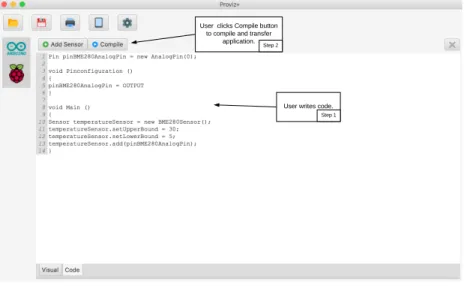
The PROVIZ+ main application is a comprehensive software that supports two ways of programming sensor applications for IoT devices: a visual programming and a code-based programming tool. A user can program IoT devices using either
the visual programming tool, which can be seen in Figure 4.2 or the code-based programming tool that can be seen in Figure 4.3.
User clicks the "Compile" button to compile and transfer the
application.
Step 5
User selects an IoT device to program.
Step 1
User clicks a sensor of selected IoT device.
Step 2
User clicks a variable of the selected sensor.
Step 3
User sets upper and lower bound of the selected variable. Step 4
Figure 4.2: Visual-based programming tool.
User writes code. User clicks Compile button
to compile and transfer application.
Step 2
Step 1
Figure 4.3: Code-based programming tool.
An example usage scenario for programming can be specified in Figure 4.4: The user drags and drops the IoT device logo from the board selection toolbar and then
makes a right click to get more options. These options are Program, Configure, and Details. Board Selection Toolbar Main Toolbar View Switcher
Figure 4.4: Explanation of the PROVIZ+ main application.
The user clicks Configure to configure the board then the IoT device properties
window, seen in Figure 4.5a, is shown to the user for getting input about the selected
IoT board. The user fills the required input fields, then clicks Next to navigate to
the connection type selection screen, seen in Figure 4.5b. After selecting one of the options on the connection type selection screen, PROVIZ+ handles creating a connection between the IoT device and the main application. When the activation of the connection between the user’s computer and the IoT device is done, PROVIZ+ shows the confirmation message screen to let user know about the result of the configuration process. This confirmation message screen can be seen in Figure 4.5c. A configuration of the IoT device involves selecting a connection type, board name, and board type.
After the configuration process, the user will able to add sensors on to the IoT
development board by clicking on the Program option in the device programming
(a) Step 1: IoT device properties Window. (b) Step 2: communication selection window (c) Step 3: confirmation window
Figure 4.5: Steps of IoT device configuration task.
the configuration first. The visual programming tool will welcome the user as the default tool; however, the user can change to the code based programming tool by selecting the option from the view switcher in both programming windows. The user can add new sensors using the sensor add wizard to the selected IoT device. The method for adding a sensor to the IoT device can be followed in Figure 4.6.
(a) Step 1: sensor selection window
(b) Step 2: sensor pin assignment window
(c) Step 3: confirmation of sensor pin assignment Figure 4.6: Steps of adding a sensor to IoT device in the visual-based programming tool.
Then, the user can change the upper bound and lower bound values related to the sensor or board properties in the visual programming tool, which can be seen in Figure 4.2. In addition to the visual programming tool, the user can create their own IoT applications using the code-based programming tool as seen in Figure 4.3. When the user clicks the compile button in the device programming window, PROVIZ+ creates the required source code of the IoT application. This code com-piles to prepare the transfer over the firmware distribution. When the firmware distribution is over, it starts to accept a connection request from the programmed
IoT board to visualize the gathered data on the topology view or the data table view in Figure 4.4. In addition to the aforementioned usage scenario, the user can save the existing topology to continue later, transfer the topology to the PROVIZ+ Android application, or customize the user interface components to increase the us-ability of PROVIZ+.
As noted earlier, all graphical components were designed and implemented using the JAVA FX library. Actually, we first designed and implemented the user in-terfaces of PROVIZ+ using the JAVA Swing library; however, we realized that it had a compatibility issue with high-resolution computer screens. It was showing a GUI smaller than their actual size due to the high-resolution screen bug in the Java Swing library [JAV]. After that, we decided to replace it with JAVA FX.
As can be seen in Figure 4.1, the PROVIZ+ main application includes five main components: a code generator, a WiFi connection module, a Bluetooth connection module, a serial connection module, and lastly the Panther programming language compiler. In the following sub-sections, the main components will be explained in further detail.
Code Generator
The main purpose of PROVIZ+ is programming IoT development boards with a broad range of various purpose sensors. To be able to develop secure IoT sensor applications, the source code of the application needs to be created by PROVIZ+. This generated source code varies depending on the device. To illustrate this, if the user chooses a Raspberry Pi as a target device, the source code can be written in Python or Java. On the other hand, if the user selects Arduino for the IoT application, the source code of the Arduino project should be written in the C language.
While we were designing the PROVIZ+ software architecture, we specified that instead of generating the user’s sensor application source code from scratch, produc-ing it from a general template would be more efficient and easier to manage. When the user selects an icon for the IoT device from the board selection toolbar at the main PROVIZ+ screen, shown in Figure 4.4, it automatically creates a template class for it. That template class contains information about the selected board such as the board type, connection type, and how many sensors it will have. When a user adds new sensors to the board, the new sensors are attached to a sensor array that is in the board’s template class. This template class is used to generate the source of the sensor application, and this can be seen in code generation steps in Figure 4.7. The code generator accepts the board template to get the detailed information
Arduino Code Generation Template Raspberry Pi Code Generation Template Code Generator Board Template a b Project Source Code For Arduino Project Source Code
For Raspberry Pi a 1 b 3 2
Figure 4.7: PROVIZ+ code generation process diagram.
about the target board. Afterwards, it gets the code generation template to fill the necessary blanks in source code templates to create an actively working source code. Currently, PROVIZ+ supports two IoT development boards: Arduino and Raspberry Pi; however, these supported IoT development boards can be extended
by adding new templates due to the modular structure of PROVIZ+. Note that the Apache Freemarker framework [APA] was used to develop code generator.
WiFi Connection Module
PROVIZ+ supports WiFi data communication to transmit sensor data, and securely program the IoT devices over-the-air. The sensor data transmission is established using the TCP protocol stack for Arduino and Raspberry Pi devices. Even though the TCP connection is slower than UDP, TCP is selected as PROVIZ+’s native transmission protocol. The reason behind this is that any non-transmitted sensor data can cause catastrophic consequences and the TCP protocol assures that each communication packet arrives seamlessly to the destination unlike the UDP proto-col. When a user finishes designing an IoT application and wants to transfer it to the target IoT board, the user transmits the firmware physically only once. This physical firmware transmission copies firmware using a USB device for Raspberry Pis and serial data transmission for Arduino devices. After that, the user will be able to update the device’s firmware over-the-air instead of programming physically using the SOTA framework for Arduino devices and Secure File Transfer Protocol (SFTP) for Raspberry Pi devices. SFTP is used for the firmware distribution to Raspberry Pi devices to provide confidentiality of firmware. When the user starts over-the-air programming for Raspberry Pis, PROVIZ+ initiates SFTP connection to target Raspberry Pi development boards. This SFTP connection works as a passwordless File Transfer Protocol (FTP) by utilizing the public key cryptogra-phy authentication. A public key of the target device is transferred to the main PROVIZ+ application during the initial firmware transfer.
Arduino is a single board controller, and it uses mostly Atmel micro-controllers. Normally, Atmel micro-controllers use STK500 Communication
Proto-col [ATM] to perform firmware update; however, STK500 Communication ProtoProto-col does not have enough security mechanism to protect the firmware during over-the-air programming. In the scope of this thesis, we also developed a novel secure over-the-air programming framework (SOTA) that is introduced in Chapter 5 for Atmel-based IoT devices. Since Arduino boards mostly use Atmel micro-controllers, we integrated the SOTA framework into the PROVIZ+ software suite in order to
provide secure over-the-air capabilities for the Arduino devices. Specifically the
Ar-duinoFirmwareUpload JAVA class was implemented in order to program Arduino
devices remotely using the SOTA secure over-the-air programming framework. Over-the-air programming and data aggregation occur over the same TCP con-nection to minimize interactions between the PROVIZ+ main application and Ar-duino. As, Arduino boards do not have WiFi connection capabilities, in this thesis, the ESP8266 WiFi module [ESP] was used to bring WiFi connection capabilities to Arduino. This WiFi module supports transparent data transmission over Universal Asynchronous Receiver Transmitter (UART), which is a vital feature for over-the-air programming. When the main application wants to update the firmware, it sends a reboot command to Arduino, then Arduino resets itself using the watchdog
timer-based reset method. When Arduino resets itself, it runs the SOTA bootloader
instead of the actual sensor application, and it receives the SOTA and STK500 Communication Protocol commands to replace the current firmware. In the trans-parent data communication protocol, ESP8266 works as a communication bridge, but ESP8266 does not change the context of a packet that is coming from a sender and it directly transmits to a recipient.
Bluetooth Connection Module
PROVIZ+ uses the Bluetooth Classic connection during the firmware distribution and sensor data transmission to the PROVIZ+ main application. Raspberry Pi has a built-in Bluetooth adapter; however, Arduino does not have any Bluetooth module. Before sending firmware to Arduino or getting sensor data from the Arduino board, the selected board needs to be configured. This configuration includes the Bluetooth pairing process between the Bluetooth module and the user’s computer. After the completion of the pairing operation, the user may send firmware updates to a device. The major difference between Bluetooth support and WiFi support is that Bluetooh does not need to physically program devices using serial data transmission first. For this, we use Bluefruit EZ-Link Bluetooth Shield [BLU] to provide the aforementioned Bluetooth benefits to the user because it supports over-the-air programming for
Arduino devices. We developed the BluetoothManager JAVA class to handle all the
necessary Bluetooth data transmission operations.
Serial Connection Module
Serial Connection Module is the third option for programming IoT devices, which requires physical contact. When a user connects IoT boards with the USB cable to
a computer, it creates device object in the /dev folder for UNIX-based operating
systems or the COM port object for Windows. This device or port objects can read
incoming messages from the target IoT device and send new firmware to the target IoT device.
Panther Programming Language Compiler
The Panther programming language is a domain-specific programming language that was designed for the PROVIZ+ software suite. Before the Panther programming
language, whenever a user wanted to program their IoT development board, they needed to learn a broad range of programming languages. For example, if the user wants to program the Arduino board for an IoT project, the user needs to learn the C programming language. For Raspberry Pi, the user needs to know various pro-gramming languages to implement IoT applications. This situation may be feasible for an expert developer; however, any person who does not have any programming experience has to spend a lot of time to learn all the necessary programming lan-guages. With Panther language, learning only one programming language will be enough to design and implement complex IoT applications. We analyzed different programming languages to design an efficient and straightforward domain-specific programming language. The programming languages that are used to program IoT devices are multi-purpose programming languages, and they have unnecessary oper-ations, functions, and libraries. We removed these unnecessary operators, functions, and libraries for the IoT application development to provide a simple IoT program-ming language. As you can see in Listing 4.8, if the user wants to program an IoT development board to implement a distance measurement application, all the user needs to write is 10 lines of code.
Pin d i s t a n c e S e n s o r P i n = new AnalogPin ( 3 ) ; v o i d P i n c o n f i g u r a t i o n ( ) { d i s t a n c e S e n s o r P i n = OUTPUT; } v o i d Main ( ) { S e n s o r d i s t a n c e S e n s o r = new E z s o n a r S e n s o r ( ) ; d i s t a n c e S e n s o r . setUpperBound = 1 2 0 ; d i s t a n c e S e n s o r . setLowerBound = 2 0 ; d i s t a n c e S e n s o r . add ( d i s t a n c e S e n s o r P i n ) ; }
Figure 4.8: Sample distance measurement sensor application in the Panther lan-guage.
We can explain the structure of the Panther language by showing the sample distance measurement code in Listing 4.8. In the sample code, there are three major areas: a pin initialization, a pin data direction specification, and a main function area in order to make the code more manageable by the user. The pin initialization area is for declaring and defining pins of selected sensors. The user might give a variable name to the pins of the target sensor, then specify a type for
the corresponding pins and their orders. Let us assume that we have a MB1000
LV-MAXSONAR-EZ0 distance measurement sensor, and this sensor has a 5V power
input, ground, TX, RX, analog, and pulse-width pins. The user wants to use this sensor in the IoT application and also connect that sensor through an analog port. In the first line, the user declares the third pin of a sensor for transmitting the analog signal to the target device. In lines between 2-4, the user specifies pin’s data transmission method. After this specification, the next area is the main logic area. In this, the user claims which sensor will be used in the IoT application and sets upper and lower bounds of it, then the user binds the declared pins to the sensors. We implemented the Panther language using the ANTLR parser generator [ANT], and it automatically generates the necessary compiler files for the Panther language. Then, we imported it to the PROVIZ+ main application to be used in the code-based programming tool of PROVIZ+.
4.2.2
Proviz Client Applications
In addition to the main application, the client applications were developed in order to bring PROVIZ+’s features to IoT devices. Each platform has unique characteristics. So, developing platform specific client applications is required for the supported devices. In the scope of PROVIZ+, we developed Arduino and Raspberry Pi client
applications using the C and JAVA languages, respectively. These applications are responsible for responding to over-the-air programming, sensor data aggregation,
and communication with the other devices. The following subsections give the
detailed information about the aforementioned client applications.
Proviz Arduino Client Application
In order to provide the secure over-the-air feature, we developed the ProvizWiFi
library for Arduino IoT devices. The ESP8266 WiFi shield requires commands to configure itself, connects to wireless networks, and so on. The user may prepare required communication commands without getting any help to initiate secure over-the-air programming or can use our proposed library to automatically create the required communication commands. In addition to this manual usage opportunity, our code generation module uses the library during the secure over-the-air program-ming for the Arduino IoT devices. We combined the ESP8266 communication and PROVIZ+ secure over-the-air commands to unify the required two libraries into a single library. Each Arduino sketch source code file contains two main functions: setup and loop. In the setup function, the serial communication between Arduino and ESP8266 are prepared; then, PROVIZ+’s identification data from the Arduino IoT board’s EEPROM storage are loaded. A string that contains unique identifi-cation and the boolean data that indicate if the board is already programmed are stored in the EEPROM. After loading the data from EEPROM, the WiFi module is checked to know if it is reachable; then, it starts to connect to the access point and the SOTA Remote Programmer that is in the PROVIZ+ main application. When the user clicks on the firmware send button in the main application, the main ap-plication sends a reboot command to the target Arduino device to let Arduino load
its bootloader address space to run the SOTA bootloader. In the reset cycle, the watchdog timer of the micro-controller is used.
After putting the micro-controller into the SOTA bootloader mode, it sends commands from the SOTA Communication Protocol to distribute the new firmware to the target devices. In summary, our contributions include the development of a skeleton application that can remotely program the micro-controller of Arduino-based IoT devices. Since the secure over-the-air feature requires the WiFi data
communication, we designed and implemented the ProvizWiFi library that makes
the code generator module’s task easy for developing the Arduino IoT applications with the secure over-the-air programming capability.
Proviz Raspberry Pi Client Application
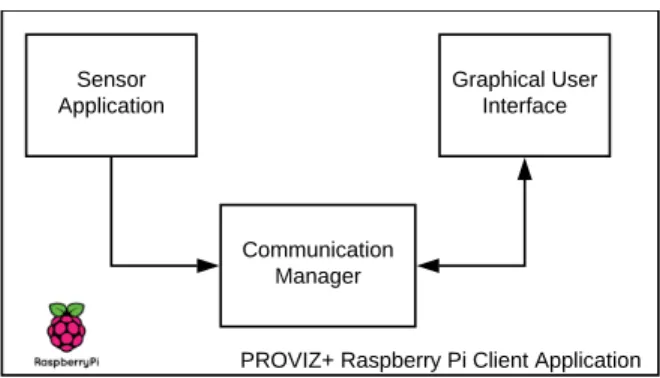
Raspberry Pi 3 Model B has WiFi and Bluetooth communication capabilities with-out requiring any external hardware. We aimed to implement the communication manager between the Raspberry Pi devices and the main application. With this in mind, the PROVIZ+ Raspberry Pi Client Application was developed. It has four main functionalities: managing an IoT application’s life-cycle, forwarding the sensor values in JSON format to the main application, handling the WiFi and Bluetooth communication stacks, and receiving a new IoT application code from the main PROVIZ+ application. Specifically, the PROVIZ+ Raspberry Pi Client works with the Linux operating system seamlessly and it consists of the sensor application, the communication manager that handles communication and management tasks between software components, and a graphical user interface application.
The relation between the components of the client can be seen in Figure 4.9. The communication manager receives the aggregated sensor data from the sensor application; then, it forwards the data to the main PROVIZ+ application. The
Sensor Application Communication Manager Graphical User Interface
PROVIZ+ Raspberry Pi Client Application
Figure 4.9: Components of the PROVIZ+ Raspberry Pi client application.
communication between the sensor application and the communication manager is
done by utilizing pipes in Linux. Moreover, it has a GUI that has the start/stop
button for the communication manager, and a debug panel to show the aggregated sensor value to the user. The main application sends a new firmware request to the communication manager for the over-the-air firmware update. The communication manager receives a new sensor application and resets the application life-cycle.
4.2.3
PROVIZ+ Android Tablet Application
In this thesis, we also developed the PROVIZ+ Android tablet application to extend the user experience in our ecosystem. Leaving only the PROVIZ+ main application as a data viewer is not applicable and practical because a user may have to be mo-bile. In order to provide another flexible platform, we chose the Android operating system and designed an Android tablet application. When a user designs the IoT application topology on the PROVIZ+ main application, the user can transfer that to the PROVIZ+ Android application. After that, the main application notifies existing IoT devices in the topology about the new data viewer application. Then, IoT devices in the topology start to send the aggregated sensor data to the Android
tablet application. The notification process of IoT devices in the topology can be followed in Figure 4.10.
Proviz Main GUI App
Proviz Android Tablet App Web Service Android GUI Web Service Client
Device Programmer
SoC IoT Boards SoC IoT Boards
1 Topology
Send
Other Proviz Components
2 Informing devices about webservice
SoC IoT Boards
3 IoT boards starts to send sensor value
Figure 4.10: Notification of the PROVIZ+ Android tablet application to the existing IoT devices around.
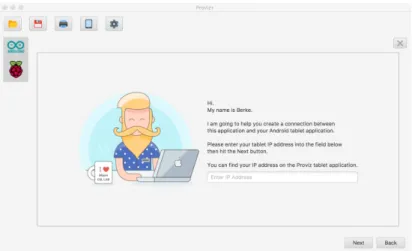
The task of importing the topology and the usage of the tablet application occur as follows: First of all, the user clicks the tablet icon in the main toolbar in Figure 4.4, then this opens the topology importer wizard screen, and the user provides the IP address of the tablet. The topology importer wizard screen can be seen in Figure 4.11. After that, the system automatically enables the tablet application and it shows the topology on the tablet screen. The user might not know how to access the IP address of their tablet; hence, instead of leaving this task to the user, the PROVIZ+ Android application shows the IP address of their tablet on the screen, which is shown in Figure 4.12a. Then, the user enters the IP address into the IP address field of the topology importer screen of the main application. As soon as the connection is established with the PROVIZ+ main application, the PROVIZ+ Android application opens the topology view by loading the existing topology. The sample loaded topology on the tablet application screen is shown in Figure 4.12b. Whenever the user clicks on the board icon, a pop-up message window appears with
Figure 4.11: PROVIZ+ topology importer to tablet application tool.
the board information and the sensor values, which is shown seen in Figure 4.12c. In addition to the topology view, the user may monitor the IoT devices by checking them on the data table view in the PROVIZ+ Android tablet application. Here, IoT devices directly send their aggregated data to the tablet application as well as the main application. In doing so, even if the user closes the main application, the user can continue to use the tablet application. Since the entire system depends on the IP address, the user can configure a static IP address for the tablet application.
(a) Step 1: IP address view
(b) Step 2: topology view
(c) Step 3: sensor data view
CHAPTER 5
SOTA: SECURE OVER-THE-AIR PROGRAMMING FRAMEWORK
This chapter introduces a novel secure over-the-air programming framework, namely SOTA. SOTA is a part of the PROVIZ+ Software Suite to secure over-the-air pro-gramming of low-powered IoT devices by providing full data confidentiality, inte-gration, and authentication. The rest of chapter is organized as follows: In section 5.1, we present introductory information about SOTA. Then, we propose our threat model and assumptions in the following section. The overall system design and implementation is given in section 5.3.
5.1
Introduction
A myriad of smart and interconnected IoT devices have become an integral part of our lives, scientific experiments, and military operations. The utilization of IoT devices can range from implementing a simple LED blink application to crucial applications such as monitoring military personnel’s heart rate activity. These ap-plications require data transmission as well as remote programming capabilities to update vulnerable firmware with the latest secure firmware efficiently. This can be mostly done using a data transmission cable or over-the-air depending on usage and available resources. Since IoT devices usually have one or more low-power micro-controllers with limited computational capability, using efficient security systems to protect the IoT device’s firmware is vital while remotely programming these devices. One of the main usages of the over-the-air programming is firmware upgrade to ex-tend the device’s capability or fixing a security vulnerability and privacy leakage. One recent incident in military is the leakage of sensitive location information of fitness tracker’s data [Ros]. In 2013, the US military gave wearable fitness trackers
to their personnel to track their activity in the scope of fighting with obesity. These wearable fitness trackers automatically share users’ running routes when they are connected with a social network. This shared running routes creates heat maps that show military running routes, and it causes serious privacy concerns. To remedy this problem, an updated firmware for the wireless fitness tracker can be applied. Since a large amount of fitness trackers were distributed to military personnel, over-the-air firmware update is more feasible and efficient than physical firmware update. However, over-the-air firmware updates should be conducted with proper security precautions so as not to cause any other security concerns and should consider the resource-limited nature of the IoT devices. Indeed, secure over-the-air programming is crucial for any type of IoT application because without security, IoT devices can be reprogrammed by hackers and even firmware can be stolen by eavesdropping a live firmware distribution process. There are many further real examples of these incidents. One recent incident is the case of the Broadcom WiFi chip, which can be hijacked without any user interaction via its over-the-air programming capabil-ity [Kha]. Another example is the over-the-air update feature for modern vehicles. Many modern vehicle manufacturers have started to add over-the-air capabilities to keep their vehicles up to date without requiring any physical interaction to their vehicles. The vehicle manufacturers have implemented these features to eliminate the need for physical interaction with the vehicle. This feature can bring ease and convenience to the car owners; however, it opens the doors for potential vulnera-bilities to hackers and malware. Hackers can exploit these vulneravulnera-bilities to upload ransomware. They can steal the vehicle firmware by eavesdropping during a vehicle firmware update and alter it. These types of attacks have already been seen in the real world. In 2015, the first major recall of vehicles happened due to cybersecu-rity concerns. Cybersecucybersecu-rity researchers discovered how to enter vehicle’s system
by hacking Harman’s U-connect equipment on 2014 Jeep vehicles [Mea]. As these examples highlight, secure over the air programming is a vital topic. Especially, if the target environment is IoT, having limited memory, stack size, and computation power exacerbate the issues.
To address these concerns and provide a more efficient and robust solution for aformentioned problems in this thesis, a secure over-the-air programming framework called SOTA is proposed for Arduino-based IoT devices. Specifically, a symmetric encryption mechanism with AES 128 bit CBC is used to satisfy the firmware security requirements as well as providing authentication and data integrity services. The entire SOTA framework can be seen in Figure 5.1. SOTA is designed and imple-mented as a platform-independent, open-source, and efficient remote programmer which can simultaneously program multiple IoT devices. We also made SOTA avail-able for the scientific community [REM] [CLI] [BOO].
Contributions: The main contributions are as follows:
• We designed a secure over the air programming communication protocol that
supports confidentiality, integrity, and authentication for ATMEL 8 Bit mi-crocontroller based IoT devices.
• We added a new authentication module to the original STK 500
Communica-tion Protocol.
• We implemented over-the-air programming framework called SOTA, the
boot-loader software, the over-the-air client software for ATMEL microcontrollers and the remote programmer software to program IoT devices remotely.
• We optimized existing symmetric encryption implementation with AES 128
Remote Programmer
IoT Device IoT Device
RX/TX
RX/TX
ESP8266
ESP8266
Figure 5.1: The SOTA system structure
5.2
Threat Model and Assumptions
In SOTA, our threat model is based on confidentially, integrity, and authentication (CIA triad). Our solution creates end-to-end secure communication channels to transmit the firmware or any code updates to the IoT device using a symmetric encryption mechanism with AES-128 CBC algorithm. This model comes with a few assumptions. First, the private keys and initialization vectors are preloaded to the IoT devices in a secure fashion. Next, the attackers can try to eavesdrop ongoing communications between the IoT device and a benign user. Lastly, the denial-of-service attacks are outside of the scope of this work.
The following summarizes the security goals of the SOTA framework:
• Making data transmission secure and confidential: Some applications may
require high level confidentiality when over-the-air-firmware updates occur. These firmware updates may contain crucial information which if compromised could pose a large threat.
• Adding authentication mechanism to eliminate any unauthorized
modifica-tions to the IoT device communicamodifica-tions and providing data integrity to ensure that the data is not corrupted.
• Plain and tiny solution: Since many IoT devices have limited computational
program memory and 8 KB SRAM. If SRAM is not used efficiently and prop-erly, possible memory leak error is inevitable. Hence, the SOTA framework should be designed with this constraint in mind. Another reason for creating plain and tiny solution is to consume less power. Applying cryptographic op-erations to IoT devices consume much power than regular opop-erations, but the SOTA framework aims to mend this problem.
5.3
SOTA Architecture
In this section, we present the details of the architecture of the SOTA framework.
As seen in Figure 5.2, SOTA consists of three major components: IoT Device, IoT
Device Communication Module, andRemote Programmer. All of these components
were designed with modularity and configurability in mind to provide the most flexible remote programming capability to the IoT devices. Also, as seen in the figure, similar components were designed for both the IoT Device and the Remote Programmer to keep the operations smooth. Finally, security (confidentiality, au-thentication, and integrity) was built in all of the operations. Note that the SOTA framework is designed with modular and configurable way so that any other devices or communication mechanisms can be easily integrated into the framework. In the following sub-sections, the components and important operations are articulated.
5.3.1
Remote Programmer
The Remote Programmer is responsible to get the firmware from the user and send it to the IoT Device in a secure way over the air. It also supports a multi-device programming capability in a secure way by utilizing JAVA Thread library and the
Programmer Bootloader
Security Module
Packet Operations Module
Authentication Module
Security Module
Packet Operations Module
Authentication Module TCP Server
ESP 8266 WiFi Module TCP Client ATMEL ATmega2560 IoT Device Computer Program Remote Programmer IoT Device Communication
Module
Figure 5.2: Major components of the SOTA Framework.
AES 128 bit CBC symmetric encryption algorithm [Bar16]. It is written in JAVA language to support different platforms (e.g., Linux, Mac OS, and Windows).
The Remote Programmer includes a TCP Server and the Programmer module
to deliver the firmware to the target IoT Device reliably. In SOTA, the target IoT device is Arduino device with ATmega2560 micro-controller given their popular-ity. The TCP Server is an embedded TCP server to manage the data communica-tion between the Remote Programmer and the IoT Device Communicacommunica-tion Module. When the server gets new packets from the Communication Module, it directly
passes them to the Programmer module without any modification on the packet.
Also, whenever the server gets a packet from the Programmer, it directly transmits packets to the Communication Module. In SOTA, the Programmer includes the
Security Module and the SOTA Communication Protocol, which is responsible for
assembling the packet in theSOTA Packet Operations Modulebased on the STK500
Communication Protocol available for ATmega2560 micro-controllers. However, the default vendor-built STK500 Communication Protocol does not support any secu-rity. Hence, in SOTA’s framework, confidentiality, integrity, and authentication ser-vices were also implemented to improve the security of the operations. Specifically, SOTA Packet Operations Module encapsulates STK500 Communication Protocol
packets encrypted in the Security Module with a packet starting point indicator byte (0x58) and two bytes that represent the size of the encrypted packet. For receiving commands from the IoT device, it parses the received SOTA Communi-cation Protocol packet to extract IoT device’s encrypted STK500 communiCommuni-cation protocol response packet. After finishing extraction of STK500 communication pro-tocol response packet, it decrypts the received encrypted STK500 communication protocol response packet; then, it parses decrypted STK500 communication proto-col response packet to extract commands of the STK500 communication protoproto-col. The parsing operation is shown in Figure 5.3.
START GET_CHECK PROCESS GET_SEQ_NUM MSG_SIZE_1 MSG_SIZE_2 GET_TOKEN GET_DATA Token is received Token is not received Start End Checksum is correct Sequence number is incorrect
Sequence Number is correct Message_Start Byte received
Checksum is incorrect
Figure 5.3: STK500 communication protocol parser.
The packet structure built upon the STK500 Communication Protocol packets is shown in Figure 5.4. As noted earlier, this new packet structure provides data integrity, confidentiality, and authentication.
The packet structure starts with 0x1B hexadecimal value to indicate the location of the starting point of the packet. Then, it continues with the sequence number field to prevent any replay attack. When the value of the sequence number field reaches the maximum value (0xFF), it zeros itself. The next two bytes represent the size of the communication commands in MSB byte order. After the size fields, 0x0E
0x58 MSB LSB AES Encrypted STK500 V2 Packet
0x1b 0x00 MSB LSB 0x0e Communication Commands 0x32
SOTA STK500 Size of Following Encrypted Part in Hexadecimal Format Sequence Number in hexadecimal
Size of Following Part in Hexadecimal Format
Checksum of Packet
Figure 5.4: SOTA packet structure built upon the STK500 Protocol.
Algorithm 1: The Remote Programmer and IoT Device programming flow.
1 Accept request
2 Send reboot command to micro-controller
3 whilereboot acknowledgment is not receiveddo
4 Send reboot command to micro-controller
5 Send authentication packet
6 whileauthentication acknowledgment is not receiveddo
7 Send authentication packet
8 Send synchronization packet to micro-controller
9 whilesynchronization acknowledgment is not received
do
10 Send synchronization packet to micro-controller
11 Send enabling program mode packet to micro-controller
12 whileenabling program mode acknowledgment is not received do
13 Send enabling program mode packet to micro-controller
14 Send load address packet to micro-controller 15 whileload address acknowledgment is not
receiveddo
16 Send load address packet to micro-controller
17 whilefirmware transfer is not finisheddo
18 Send 256 KB firmware part to micro-controller 19 whilefirmware sending acknowledgmentdo
20 Send 256 KB firmware part to
micro-controller
21 Send closing programming mode packet to micro-controller
22 whileclosing programming acknowledgement is not receiveddo
23 end closing programming mode packet to micro-controller
hexadecimal value comes into the next field as a fixed value and it is named as to-ken. Token indicates following bytes are micro-controller operation commands such as enabling program mode or closing firmware update mode. After the token, com-munication commands are shown in the next fields until one byte-sized check-sum field. These communication bytes can be anything from the STK 500 Communica-tion Protocol [ATM]. The final field is the checksum fields to provide data integrity between packet fields in each communication packet. The interaction between the Remote Programmer and the IoT Device flows are shown in Algorithm 1.
5.3.2
IoT Device Communication Module
In SOTA, the IoT Device Communication Module supports the WiFi connection; however, it can be easily extended by adding new connection methods. Specifically, in SOTA ESP 8266 [SHI] Wi-Fi shield is used to connect the IoT device (i.e., AT-mega2560) with the Remote Programmer. ESP 8266 is a Wi-Fi module that can be connected with not only Arduino devices, but also other IoT devices. It has 1 MB of flash memory and integrated TCP/IP protocol stack as well as IEEE 802.11 b/g/n support. ESP 8266 Wi-Fi module has the ESP 8266 Wi-Fi chip [SHI] as well as 1 MB flash memory as a communication buffer. It supports two modes of com-munications: transparent and normal. In the transparent mode, the Wi-Fi module gets data from a sender and then transmits to the receiver without modifying com-munication packets; however, in the normal mode, the Wi-Fi module puts packet header that gives information about the sender and communication type. Since this packet header is not useful and inefficient during the firmware distribution, we configured the ESP 8266 Wi-Fi module to use it in the transparent mode. This makes it possible to establish transparent UART communication between the IoT Device ATmega2560 and the ESP 8266 Wi-Fi module. This communication module directly communicates between the IoT Device and the Remote Programmer and it acts as a communication bridge. It has its own TCP stack and it can serve as a TCP client so the IoT Device and the bootloader inside the device does not have to deal with the TCP protocol and this situation makes IoT device perform its tasks without sacrificing any system resources for the Wi-Fi access support.